Article

Gender and Sex Differences in Adolescents’ Interpersonal Emotion Regulation: A Multi-Method Study


by
Gloria Mittmann
1,*,
Beate Schrank
1,2,
Verena Steiner-Hofbauer
1,
Susanne Siegmann
1 and
Sonja Zehetmayer
3
1
Research Centre Transitional Psychiatry, University Hospital Tulln–NOE LGA, Faculty of Medicine, Karl Landsteiner University, 3430 Tulln, Austria
2
Department of Psychiatry and Psychotherapy, University Hospital Tulln, Karl Landsteiner University of Health Sciences, 3430 Tulln, Austria
3
Center for Medical Data Science, Medical University of Vienna, 1090 Vienna, Austria
*
Author to whom correspondence should be addressed.
Adolescents 2026, 6(2), 28; https://doi.org/10.3390/adolescents6020028
Submission received: 6 November 2025 / Revised: 11 February 2026 / Accepted: 15 March 2026 / Published: 18 March 2026

Abstract

Background: Interpersonal emotion regulation (iER) is the process of managing others’ emotions and is critical during early adolescence, when social awareness and peer dependence increase. Little is known about how sex and gender role orientation shape adolescents’ iER. This study examined whether early adolescents differ in their use of person-focused (acceptance) versus problem-focused (positive engagement) strategies and whether these differences depend on context and measurement method. Methods: Data were collected from 322 adolescents (141 girls, 181 boys; aged 10–14 years, M = 12.47, SD = 1.55). The cross-sectional online study used a multi-method design comprising open-ended visual vignettes, a standardised questionnaire, and a serious game task. Participants also completed a validated gender-role self-concept measure assessing femininity and masculinity. Analyses were conducted using Poisson and logistic regressions with sex, femininity, and masculinity as predictors. Results: Across tasks, adolescents preferred problem-focused over person-focused strategies. Girls and those higher in femininity reported or generated more acceptance-based strategies, whereas boys and those higher in masculinity favoured positive engagement. These effects were evident in reflective measures (vignettes and questionnaire) but not in the interactive game, where sex and gender differences were absent. Conclusions: Findings suggest that gendered socialisation processes shape how adolescents regulate others’ emotions, particularly when behaviour is consciously reported. However, in ecologically valid contexts, these differences diminish, indicating shared capacities for adaptive interpersonal regulation across genders.

1. Introduction

1.1. Interpersonal Emotion Regulation in Early Adolescence

Emotion regulation (ER) refers to the processes through which individuals influence which emotions they experience, when they experience them, and how these emotions are expressed [1]. While a substantial body of research has explored how people regulate their own emotions (intrapersonal ER), less is known about how they help to regulate the emotions of others, a process known as interpersonal emotion regulation (iER). iER plays a critical role in social functioning, facilitating empathy, prosociality, and the maintenance of supportive relationships [2,3]. These competencies become particularly important during early adolescence, a developmental phase characterised by heightened social awareness, emotional sensitivity, and reliance on peers for emotional support [4]. Understanding iER during this formative period is therefore central to explaining how young people navigate increasingly complex social worlds.
Recent work highlights that emotion regulation abilities undergo rapid change in early adolescence and that both parental and peer contexts shape their development [5]. Difficulties in emotion regulation are linked to poorer social adjustment, greater distress, and daily life impairments in adolescence [6]. In real-time studies, adolescents’ iER with parents and peers predicts subsequent emotional wellbeing [7], underscoring that iER is not only a theoretical construct but also a key developmental mechanism with long-term implications. However, much of the existing evidence relies on single-method or self-report approaches, limiting insight into how adolescents regulate others’ emotions across different contexts and levels of reflection. To address this gap, the present study adopts a multi-method design combining open-ended vignettes, self-report measures, and an interactive serious-game task to capture complementary facets of adolescents’ interpersonal emotion regulation.

1.2. Conceptualising Interpersonal Emotion Regulation

Niven et al. [8] proposed the Interpersonal Affect Regulation Classification (IARC) as a comprehensive taxonomy of strategies people use to influence others’ emotional states. Within the IARC, affect-improving strategies can be grouped into two higher-order clusters: problem-focused (positive engagement) strategies such as giving advice, reframing the situation, or offering instrumental help, and person-focused (acceptance) strategies such as validating, comforting, or showing attention. Both clusters are regarded as adaptive and prosocial. Although the IARC was originally developed and validated with adults, it provides a useful lens for understanding adolescents’ developing social–emotional competencies, particularly as they begin to apply emotion regulation strategies in peer contexts [9]. Table 1 presents the adaptive iER strategies of the IARC that form the conceptual basis of this study.

1.3. Sex, Gender, and the Socialisation of Emotion

The distinction between biological sex and gender is central to understanding emotion regulation. Sex refers to biological characteristics, whereas gender encompasses the socially constructed roles, norms, and identities associated with femininity and masculinity [10,11]. Socialisation processes communicate distinct emotional expectations: girls are typically encouraged to be emotionally expressive, caring, and relational, while boys are socialised to appear agentic, independent, and emotionally restrained [12,13]. These gendered expectations shape both emotional expression and support-giving behaviour. Accordingly, girls may tend to use person-focused strategies that emphasise empathy and validation, whereas boys may favour problem-focused approaches involving action and solution-seeking.
Although sex and gender differences in intrapersonal ER and related constructs (such as coping and empathy) are well documented [14,15], research directly examining iER in young people remains scarce. Studies in adults indicate that women use more interpersonal and emotion-focused strategies [16], yet findings for adolescents are inconsistent. Early adolescence may mark a pivotal period when gendered patterns of emotional behaviour intensify—a process described by the Gender Intensification Hypothesis [13]. As adolescents internalise cultural expectations of femininity and masculinity, these norms may influence how they perceive and respond to others’ emotions [17]. Recent evidence supports this view, showing that supportive parental responses predict stronger ER abilities in girls, while peer interactions play an increasing role across adolescence [5].

1.4. A Developmental and Contextual Perspective

Methodological context may shape observed sex and gender differences. Self-reports often reflect conscious adherence to gender norms, whereas behaviour in interactive or naturalistic contexts may reveal subtler or attenuated differences [18]. Indeed, the effectiveness and expression of interpersonal strategies vary across social partners and contexts: interactions with parents versus peers activate different regulatory goals and social expectations [9,19]. A multi-method approach combining open-ended, self-report, and ecologically valid tasks can therefore disentangle socially desirable responses from genuine behaviour and provide a fuller understanding of adolescents’ iER. To capture adolescents’ iER across different levels of reflection and ecological validity, we employed a multi-method approach combining open-ended vignettes, self-report, and a serious game. Vignettes are well-established tools for eliciting social judgements in controlled yet realistic scenarios [20] and have been successfully adapted into visual formats to enhance engagement and cross-cultural comparability in young samples [21]. However, self-reports may be influenced by social desirability and gendered self-perceptions [22], while game-based paradigms can provide a more immersive and naturalistic assessment of social behaviour [23]. Integrating these methods therefore allows for the examination of iER both as an explicit social–cognitive skill and as an enacted social behaviour.

1.5. The Present Study

The present study examined sex and gender role orientation differences in the use of iER strategies among early adolescents aged 10–14 years. Using the IARC framework, we differentiated between person-focused (acceptance) and problem-focused (positive engagement) strategies. Employing three complementary methods (open-ended visual vignettes, a standardised questionnaire, and a serious game), we aimed to determine whether and how self-identified sex and self-perceived gender role orientation (femininity and masculinity) predicted adolescents’ iER strategy use.
We hypothesised that:
  • Girls and adolescents identifying more strongly with feminine traits would use more person-focused (acceptance) strategies, whereas boys and those scoring higher in masculinity would use more problem-focused (positive engagement) strategies.
  • These differences would be most pronounced in reflective contexts (vignettes and self-reports) and less evident in interactive gameplay, where spontaneous reactions may be less influenced by gendered expectations.
By integrating sex and psychosocial dimensions of gender within a multi-method framework, this study aims to advance understanding of how developing adolescents learn to regulate others’ emotions in socially and developmentally meaningful ways. Specifically, the present study employs open-ended vignettes, self-report measures, and a serious-game task, providing a novel, multi-method approach to examining interpersonal emotion regulation in early adolescence and allowing for the comparison of reflective and more ecologically grounded assessments.

2. Materials and Methods

2.1. Participants

Participants were 322 early adolescents (181 boys, 141 girls) aged 10 to 14 years (M = 12.47, SD = 1.55). They were recruited through social media and the research group’s school network in Austria and Germany. All participants provided informed consent prior to participation. Ethical approval was granted by the local ethics committee (EK 1075/2020). Participants were included if they were aged 10–14 years and completed the relevant study tasks. Participants who selected non-binary or prefer-not-to-say options for sex were excluded from analyses due to insufficient subgroup size for meaningful statistical comparison, and cases with missing task data were excluded from task-specific analyses. Thirty-one participants were excluded because they selected the response options “neither” or “I prefer not to say” for the variable sex. Participation took place entirely online. No monetary compensation was offered; however, participants could enter a raffle for small prizes (e.g., vouchers).

2.2. Procedure

The aim of the study was to investigate sex and gender differences in adolescents’ use of iER strategies. Participation took approximately 25–30 min and followed the sequence below:
  • Demographic and consent questions
  • Open-ended visual vignette task
  • iER questionnaire
  • Serious game task
  • Gender role orientation questionnaire
This order was chosen to avoid priming or learning effects between measures, allowing the open-ended task to capture spontaneous responses before exposure to predefined strategy options. The questionnaire measures used in this study are standardised instruments with established reliability and validity. The vignette and game tasks were grounded in the Interpersonal Affective Regulation Classification (IARC) framework and were designed to capture theoretically meaningful dimensions of interpersonal emotion regulation across different contexts. All tasks were completed using the secure online platform SoSci Survey accessible from home computers or tablets. Valid data were available for 303 participants in the vignette and questionnaire tasks and for 125 participants in the game task. Missing data resulted primarily from technical interruptions or incomplete sessions.

2.3. Measures

2.3.1. Interpersonal Emotion Regulation

Visual Vignettes
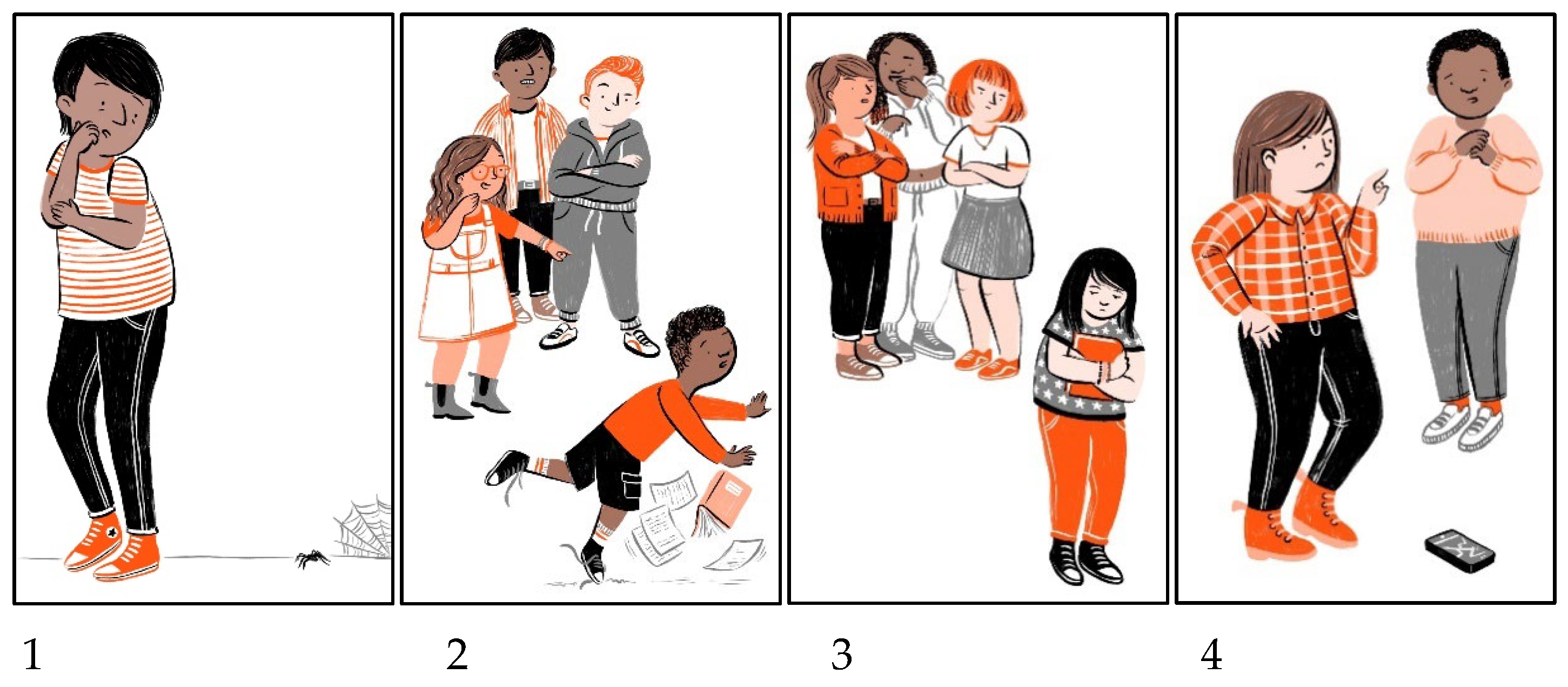
To assess spontaneous iER strategies, participants responded to four illustrated vignettes showing common social situations in which a peer experiences a negative emotion (e.g., fear, embarrassment, sadness, anger; Figure 1). For each vignette, they were asked:
“If you were in that room, what could you do to help this person?”
Responses were open-ended and unconstrained in length. Two trained coders independently classified each response into one of the two affect-improving clusters of the Interpersonal Affect Regulation Classification (IARC; [8]): positive engagement or acceptance. Irrelevant or maladaptive responses (e.g., “ignore them”, “make fun of them”) were excluded from analysis, in line with the study’s focus on adaptive interpersonal emotion regulation strategies. Coding agreement between raters was high (Cohen’s κ = 0.84), and discrepancies were resolved through discussion.
Questionnaire: Emotion Regulation of Others and Self (EROS)
The Emotion Regulation of Others and Self Scale (EROS; [24]) was used to measure self-reported use of iER strategies. Only the six extrinsic affect-improving items were included, which measure positive engagement and acceptance. Participants rated how often they had used each strategy to change another person’s feelings during the previous four weeks on a 5-point Likert scale (1 = not at all, 5 = a great deal). For the present analyses, cluster scores were computed by averaging the items corresponding to each strategy category. The scale demonstrates construct validity, and prior research has reported good internal consistency for the extrinsic affect-improving subscale (α = 0.82). The questionnaire was translated into German using a forward–backward translation procedure by bilingual psychologists. Minor linguistic adjustments were made to ensure comprehension for adolescents aged 10–14.
Serious Game Task
To capture iER behaviour in an ecologically valid context, participants played an adventure-style serious game created using RPG Maker MV [25,26]. The game follows a main character (a student of similar age to the participants) through a storyline involving peers in emotionally charged situations. Across ten social encounters, the player selects one of four response options: two maladaptive (e.g., ignoring, teasing) and two adaptive strategies. Among the adaptive options, one reflects positive engagement and the other acceptance. To maintain ethical appropriateness and task progression, players who choose a maladaptive option are prompted to try again until an adaptive strategy is selected. The task therefore measured choice preference between adaptive strategies rather than success rate.

2.3.2. Gender Role Orientation and Sex

Gender role orientation was measured using the Inventory for Measuring Gender Role Self-Concept in Adolescence (GRI-JUG; [27]). The instrument comprises four 5-item subscales: positive feminine (Fem+), negative feminine (Fem−), positive masculine (Mas+), and negative masculine (Mas−) attributes. Items were rated on a 5-point scale (1 = does not apply at all, 5 = applies nearly always).
Sex was measured with a single self-identification question offering the options “girl”, “boy”, “neither”, and “I prefer not to say”. Although this item refers to sex, it reflects self-identified rather than biological sex characteristics, consistent with ethical guidelines for research with minors.

2.4. Data Analysis

Analyses were conducted using R (version 4.3). Descriptive statistics were calculated for all study variables. Mean and standard deviation were reported for age, whereas medians and interquartile ranges (IQR) were reported for non-normally distributed continuous variables.
For all analyses, self-identified sex was coded as a binary variable (0 = boy, 1 = girl). Femininity (Fem; sum of Fem+ and Fem− subscales of the GRI-JUG) and masculinity (Mas; sum of Mas+ and Mas− subscales of the GRI-JUG) scores were computed as mean scale scores, with higher values indicating stronger endorsement of the respective traits. For the vignette and game tasks, dependent variables reflected the total number of acceptance and positive-engagement strategies selected.
Analyses were conducted separately for each data source (vignette task, questionnaire, and serious-game task) using available-case data. Missing data were handled by listwise deletion within each analysis and primarily resulted from technical interruptions or partial task completion; no imputation procedures were applied.
To account for potential clustering of participants within schools, mixed-effects regression models including a random intercept for school were initially fitted for all outcomes. For the binary questionnaire outcomes, logistic mixed-effects regression models were estimated. As the variance component of the random effect was estimated as zero across these models, final logistic regression analyses were conducted without the random effect and results from the corresponding standard logistic regression models are reported. Multivariable models were examined for multicollinearity.
For count outcomes (number of acceptance or positive-engagement strategies in the vignette and game tasks), Poisson mixed-effects regression models including a random intercept for school were estimated. Residual diagnostics for dispersion and zero inflation were assessed using the DHARMa R package version 0.4.7 [28]. No substantial violations of model assumptions were detected.
Separate regression models were estimated for acceptance and positive-engagement strategies, with sex, femininity, and masculinity entered as predictors. Where multiple predictors were significant (p < 0.05), combined models were estimated. The significance level was set at α = 0.05. Given the limited prior research on interpersonal emotion regulation in early adolescence and the exploratory character of this multi-method design, hypotheses were considered preliminary and p-values are interpreted descriptively.

3. Results

3.1. Descriptive Statistics

Table 2 presents descriptive statistics for all main study variables by sex. Girls and boys did not differ significantly in age, but as expected, they differed in gender role orientation scores: girls reported higher femininity and boys higher masculinity. Most participants endorsed traits of both genders to varying degrees, although boys tended to report higher masculinity and lower femininity overall.

3.2. Frequency of Strategy Use

Across the sample, early adolescents used problem-focused (positive engagement) strategies more frequently than person-focused (acceptance) strategies. This tendency was evident in both the open-ended vignette responses and the serious game data, suggesting that even at this early stage of adolescence, young people often focus on addressing problems directly rather than offering purely emotional support. In the vignette task, the median number of positive-engagement strategies was 3, compared with 1 for acceptance. In the game task, the median was 6 for positive engagement and 3 for acceptance, mirroring the same directional pattern.

3.3. Sex and Gender Differences in iER Strategies

3.3.1. Open-Ended Vignette Task

Results of the Poisson regression models are shown in Table 3. A significant effect of sex emerged for the acceptance cluster, with girls generating more acceptance-related strategies than boys. No significant differences were found for the positive-engagement cluster. Femininity and masculinity scores did not significantly predict the number of strategies produced, although femininity showed a non-significant positive trend. These findings partially support Hypothesis 1, indicating that girls, consistent with socialisation emphasising empathy and relational focus, spontaneously produced more person-centred strategies.

3.3.2. Questionnaire (EROS)

Table 4 displays the logistic regression results for the EROS self-report data. Sex predicted both clusters: girls were more likely than boys to endorse high use of acceptance and positive-engagement strategies. When femininity and masculinity were added, femininity predicted greater use of acceptance strategies, whereas masculinity predicted greater use of positive engagement. In the combined models, both sex and gender remained significant predictors for their respective clusters (apart from masculinity for the acceptance cluster). These results support Hypothesis 1, suggesting that biological and psychosocial aspects of gender jointly shape how adolescents regulate others’ emotions in reflective contexts.

3.3.3. Serious Game Task

Analyses of the serious-game data yielded no statistically significant effects of sex, femininity, or masculinity on the frequency of adaptive strategy choices (Table 5). Only a non-significant trend was observed for femininity predicting higher selection of positive-engagement strategies. These null findings suggest that in interactive, ecologically valid contexts, sex and gender differences in iER strategy use become less pronounced. This partially supports Hypothesis 2, which predicted smaller differences in spontaneous behavioural contexts relative to reflective tasks.

4. Discussion

This study examined sex and gender role orientation differences in adolescents’ iER using a multi-method design. Across measures, girls and adolescents scoring higher in femininity tended to use more person-focused (acceptance) strategies, while boys and those higher in masculinity favoured problem-focused (positive engagement) strategies. These effects appeared in reflective contexts (vignettes and questionnaires) but were not evident in the interactive game task. This pattern suggests that gendered tendencies in iER are more pronounced when behaviour is consciously reported than when enacted spontaneously in social interaction.

4.1. Sex and Gender Role Orientation in Interpersonal Emotion Regulation

The findings extend prior research showing that women and girls tend to employ more interpersonal and emotion-focused strategies than men [29]. The present results indicate that these patterns emerge already in early adolescence, a developmental period when social expectations surrounding gender and emotion intensify [13]. Although all adolescents in our sample more frequently used problem-focused than person-focused strategies overall, girls’ greater use of person-centred strategies may reflect early internalisation of gender norms emphasising empathy, nurturance, and interpersonal sensitivity [12,17]. By contrast, boys’ tendency towards problem-focused responses may align with masculine norms that value agency and solution-oriented action [30]. The fact that both self-identified sex and self-reported gender traits predicted iER strategy use underscores that gendered socialisation processes rather than biological differences alone shape adolescents’ approaches to others’ emotions. These findings support conceptual models that distinguish between sex and gender as interacting yet separable influences on social–emotional behaviour [10].

4.2. Contextual and Methodological Effects

A notable finding was that sex and gender differences were strongest in the self-report and vignette tasks but disappeared in the interactive game. This pattern likely reflects the influence of context and measurement modality on gendered responding. In reflective tasks, participants may rely on internalised stereotypes about “how boys or girls should behave” [18,22], whereas interactive tasks evoke more immediate, situationally driven behaviour less constrained by self-presentation concerns. Similar context-dependent differences have been reported in recent real-time investigations of adolescents’ iER with parents and peers [7] and in studies demonstrating the facilitating role of peer interaction in emotion regulation [9]. These findings also illustrate the value of multi-method designs in developmental psychology. By combining open-ended, self-report, and behavioural measures, we could identify convergence and divergence between adolescents’ perceived and enacted regulation tendencies. Such approaches are essential for capturing social–emotional processes that are both conscious and automatic in nature.

4.3. Developmental Implications

Early adolescence appears to be a formative stage for the consolidation of gendered emotion regulation patterns. Consistent with the Gender Intensification Hypothesis, this period involves heightened awareness of peer norms and social comparison [13]. Parental and peer emotion socialisation jointly contribute to these trajectories [5], and girls may receive more encouragement to engage emotionally with others, whereas boys may be steered towards action and independence. From a developmental perspective, the attenuation of sex/gender differences in interactive contexts might indicate that, despite socialised expectations, adolescents share similar capacities for prosocial emotion regulation when situational demands override self-concept. This finding resonates with recent evidence that effective iER predicts social competence and wellbeing irrespective of sex [6].
From an applied perspective, these findings may inform educational and counselling contexts by highlighting the value of supporting adolescents in developing flexible interpersonal emotion regulation strategies that go beyond gender-stereotyped expectations.

4.4. Strengths and Limitations

This study’s strengths include its large sample, inclusion of both biological and psychosocial gender indicators, and the use of multiple complementary methodologies. These design features respond directly to recent calls for clearer conceptualisation and more ecologically valid research on iER [3,7].
However, several limitations should be noted. The cross-sectional design precludes conclusions about developmental change. Furthermore, our sample consisted primarily of Austrian and German adolescents, limiting cultural generalisability. Participants who selected non-binary options were too few to analyse separately, highlighting the need for more inclusive samples in future research. Although sex was measured via self-identification as girl or boy, and treated analytically as a categorical variable, sex categories themselves are shaped by social and cultural interpretations [31]. As such, findings should be understood as reflecting socially embedded sex distinctions rather than strictly biological differences. A further limitation concerns the restriction of responses in the game and vignette task to adaptive interpersonal emotion regulation strategies. The game task, while ecologically valuable, forced participants to select adaptive responses, which may have constrained behavioural variability. While this design choice was motivated by the study’s focus on adaptive regulation, it limits the extent to which the tasks capture adolescents’ unrestricted spontaneous reactions. In cases where participants initially provided a maladaptive response, these responses were excluded from analysis, meaning that recorded data reflect the use of adaptive strategies rather than the full range of possible reactions. However, explicitly maladaptive responses in the vignette task were rare in the present sample (nine responses directed towards the target), indicating that this restriction affected only a small subset of cases. Nevertheless, findings from the vignette task should be interpreted as reflecting adaptive strategy use rather than unrestricted first-response behaviour.

4.5. Future Directions and Practical Implications

Future studies could examine how iER develops. Differentiating between emotional contexts (e.g., sadness versus anger) or relational targets (parents, peers) may reveal finer-grained mechanisms. Extending this work to more diverse gender identities and cultural backgrounds would further enhance inclusivity and external validity. Practically, understanding gendered patterns of iER can inform school-based programmes that promote empathy, cooperation, and emotional competence among adolescents. Emphasising that both person-focused and problem-focused strategies are valuable may help counteract restrictive gender norms and foster more flexible social–emotional repertoires.

5. Conclusions

In summary, this study provides novel evidence that both self-identified sex and gender role orientation shape early adolescents’ iER, yet these effects depend on the social and methodological context in which behaviour is observed. By integrating multiple methods and separating sex from gender, the study advances understanding of how young people learn to manage others’ emotions at a pivotal stage of social development.

Author Contributions

G.M.: conceptualisation, investigation, data curation, writing—original draft, writing—review and editing; B.S.: conceptualisation, funding acquisition, supervision, writing—review and editing; V.S.-H.: writing—review and editing; S.S.: formal analysis; S.Z.: formal analysis; writing—review and editing. All authors have read and agreed to the published version of the manuscript.

Funding

This research was supported by Ludwig Boltzmann Gesellschaft and Karl Landsteiner University of Health Sciences.

Institutional Review Board Statement

The study was conducted in accordance with the Declaration of Helsinki and approved by the Ethics Committee of Karl Landsteiner University (EK 1075/2020) on 28 October 2020.

Informed Consent Statement

All participants provided informed consent prior to participation.

Data Availability Statement

The datasets generated and/or analysed during the current study are available from the corresponding author on reasonable request.

Conflicts of Interest

The authors declare no conflicts of interest.

Abbreviations

The following abbreviations are used in this manuscript:
EREmotion Regulation
EROSEmotion Regulation of Others and Self Scale
GRI-JUGGender Role Self-Concept in Adolescence
IARCInterpersonal Affect Regulation Classification
iERInterpersonal Emotion Regulation

References

  1. Gross, J.J. The Emerging Field of Emotion Regulation: An Integrative Review. Rev. Gen. Psychol. 1998, 2, 271–299. [Google Scholar] [CrossRef]
  2. Zaki, J.; Williams, W.C. Interpersonal emotion regulation. Emotion 2013, 13, 803–810. [Google Scholar] [CrossRef] [Scilit] [PubMed]
  3. Niven, K. The four key characteristics of interpersonal emotion regulation. Curr. Opin. Psychol. 2017, 17, 89–93. [Google Scholar] [CrossRef] [Scilit] [PubMed]
  4. Steinberg, L.; Morris, A.S. Adolescent Development. Annu. Rev. Psychol. 2001, 52, 83–110. [Google Scholar] [CrossRef] [Scilit]
  5. Wang, J.; Wang, M.; Du, X.; Viana, K.M.P.; Hou, K.; Zou, H. Parent and Friend Emotion Socialization in Early Adolescence: Their Unique and Interactive Contributions to Emotion Regulation Ability. J. Youth Adolesc. 2024, 53, 53–66. [Google Scholar] [CrossRef] [Scilit]
  6. Poznyak, E.; Debbané, M. Emotion regulation beyond executive and attention difficulties: Impact on daily life impairments in community adolescents. Child Adolesc. Psychiatry Ment. Health 2025, 19, 47. [Google Scholar] [CrossRef] [Scilit]
  7. Do, Q.B.; McKone, K.M.P.; Hamilton, J.L.; Stone, L.B.; Ladouceur, C.D.; Silk, J.S. The link between adolescent girls’ interpersonal emotion regulation with parents and peers and depressive symptoms: A real-time investigation. Dev. Psychopathol. 2025, 37, 1–15. [Google Scholar] [CrossRef] [Scilit]
  8. Niven, K.; Totterdell, P.; Holman, D. A classification of controlled interpersonal affect regulation strategies. Emotion 2009, 9, 498–509. [Google Scholar] [CrossRef] [Scilit]
  9. Sahi, R.S.; Eisenberger, N.I.; Silvers, J.A. Peer facilitation of emotion regulation in adolescence. Dev. Cogn. Neurosci. 2023, 62, 101262. [Google Scholar] [CrossRef] [Scilit]
  10. Lips, H.M. Sex and Gender: An Introduction; Waveland Press: Long Grove, IL, USA, 2017. [Google Scholar]
  11. West, C.; Zimmerman, D.H. Doing Gender. Gend. Soc. 1987, 1, 125–151. [Google Scholar] [CrossRef] [Scilit]
  12. Chaplin, T.M. Gender and Emotion Expression: A Developmental Contextual Perspective. Emot. Rev. 2015, 7, 14–21. [Google Scholar] [CrossRef] [Scilit] [PubMed]
  13. Hill, J.P.; Lynch, M.E. The intensification of gender-related role expectations during early adolescence. In Girls at Puberty; Springer: Berlin/Heidelberg, Germany, 1983; pp. 201–228. [Google Scholar]
  14. Tamres, L.K.; Janicki, D.; Helgeson, V.S. Sex Differences in Coping Behavior: A Meta-Analytic Review and an Examination of Relative Coping. Personal. Soc. Psychol. Rev. 2002, 6, 2–30. [Google Scholar] [CrossRef] [Scilit]
  15. Nolen-Hoeksema, S.; Aldao, A. Gender and age differences in emotion regulation strategies and their relationship to depressive symptoms. Personal. Individ. Differ. 2011, 51, 704–708. [Google Scholar] [CrossRef] [Scilit]
  16. López-Pérez, B.; Morillo, D.; Wilson, E. Development and Validation of the Interpersonal Affect Improvement Strategies Questionnaire. Eur. J. Psychol. Assess. 2019, 35, 280–294. [Google Scholar] [CrossRef] [Scilit]
  17. Kågesten, A.; Gibbs, S.; Blum, R.W.; Moreau, C.; Chandra-Mouli, V.; Herbert, A.; Amin, A. Understanding Factors that Shape Gender Attitudes in Early Adolescence Globally: A Mixed-Methods Systematic Review. PLoS ONE 2016, 11, e0157805. [Google Scholar] [CrossRef] [Scilit]
  18. Goldenberg, I.; Matheson, K.; Mantler, J. The Assessment of Emotional Intelligence: A Comparison of Performance-Based and Self-Report Methodologies. J. Personal. Assess. 2006, 86, 33–45. [Google Scholar] [CrossRef] [Scilit]
  19. Naor-Ziv, R.; Shamay-Tsoory, S.; Levy-Gigi, E. The Effectiveness of Interpersonal Emotion Regulation and the Role of Anxiety in Parent-adolescent Relationships. Cogn. Ther. Res. 2023, 47, 648–654. [Google Scholar] [CrossRef] [Scilit]
  20. Rossi, P.H. Vignette analysis: Uncovering the normative structure of complex judgments. In Qualitative and Quantitative Social Research: Papers in Honor of Paul F. Lazarsfeld; Merton, R.K., Coleman, J.S., Rossi, P.H., Eds.; Free Press: New York, NY, USA, 1979; pp. 176–186. [Google Scholar]
  21. Facciani, M.; Brashears, M.E.; Zhong, J. Visual vignettes for cross-national research. Int. J. Soc. Res. Methodol. 2020, 25, 29–43. [Google Scholar] [CrossRef] [Scilit]
  22. van de Mortel, T.F. Faking It: Social Desirability Response Bias in Self-Report Research. Aust. J. Adv. Nurs. 2008, 25, 40–48. [Google Scholar]
  23. Hamari, J.; Koivisto, J.; Sarsa, H. Does Gamification Work?—A Literature Review of Empirical Studies on Gamification. In Proceedings of the 47th Hawaii International Conference on System Sciences, Waikoloa, HI, USA, 6–9 January 2014. [Google Scholar] [CrossRef] [Scilit]
  24. Niven, K.; Totterdell, P.; Stride, C.B.; Holman, D. Emotion Regulation of Others and Self (EROS): The Development and Validation of a New Individual Difference Measure. Curr. Psychol. 2011, 30, 53–73. [Google Scholar] [CrossRef] [Scilit]
  25. Mittmann, G.; Barnard, A.; Zehetmayer, S.; Wimmer, S.; Zehetner, V.; Doerfler, S.; Woodcock, K.; Schrank, B. A Serious Game for Emotion Regulation in Adolescents: Player Experience and Pilot Feasibility Study. Int. J. Game-Based Learn. 2024, 14, 1–17. [Google Scholar] [CrossRef] [Scilit]
  26. Mittmann, G.; Zehetmayer, S.; Schrank, B. Study protocol for a randomised controlled trial to evaluate the effectiveness of a serious game targeting interpersonal emotion regulation in early adolescents. Trials 2021, 22, 741. [Google Scholar] [CrossRef] [Scilit]
  27. Krahe, B.; Berger, A.; Möller, I. GRI-JUG. Instrumentarium zur Erfassung des Geschlechtsrollen-Selbstkonzepts im Jugendalter [Verfahrensdokumentation aus PSYNDEX Tests-Nr. 9005895 und Fragebogen mit Auswertungsanleitung]. In Elektronisches Testarchiv; Leibniz-Zentrum für Psychologische Information und Dokumentation (ZPID): Trier, Germany, 2011; pp. 195–208. [Google Scholar] [CrossRef]
  28. Hartig, F. DHARMa: Residual Diagnostics for Hierarchical (Multi-Level/Mixed) Regression Models, R Package Version 0.4.7. 2025. Available online: https://cran.r-project.org/web/packages/DHARMa/vignettes/DHARMa.html (accessed on 6 November 2025).
  29. López-Pérez, B.; Pacella, D. Interpersonal emotion regulation in children: Age, gender, and cross-cultural differences using a serious game. Emotion 2019, 21, 17–27. [Google Scholar] [CrossRef] [Scilit]
  30. Barbee, A.P.; Cunningham, M.R.; Winstead, B.A.; Derlega, V.J.; Gulley, M.R.; Yankeelov, P.A.; Druen, P.B. Effects of Gender Role Expectations on the Social Support Process. J. Soc. Issues 1993, 49, 175–190. [Google Scholar] [CrossRef] [Scilit]
  31. Gough, J. Interrogating the distinction between sex and gender. Australas. Philos. Rev. 2023, 7, 272–278. [Google Scholar] [CrossRef] [Scilit]
Figure 1. Vignettes used to depict situations that require the use of iER strategies. From left: 1. Fear—An early adolescent is scared of a spider. 2. Embarrassment—An early adolescent trips over in front of their peers. 3. Sadness—An early adolescent is being excluded by their peers. 4. An early adolescent is angry because someone broke their phone.
Adolescents 06 00028 g001
Table 1. Classification of adaptive iER by Niven et al. [8].
ClusterDefinitionExample Strategies
Positive engagementStrategies aimed at improving how the target feels about a situation by changing the situation or perspective.Giving advice, helping solve a problem, reframing the event.
AcceptanceStrategies aimed at validating or supporting the person without directly addressing the problem.Listening, showing empathy, comforting, offering attention.
Table 2. Descriptive statistics for females and males.
fmp 1
n141181
Age (mean (SD))12.01 (1.39)12.85 (1.64)
Fem (median [IQR])6.00 [5.00, 6.00]5.00 [5.00, 6.00]0.001
Mas (median [IQR])6.00 [6.00, 7.00]6.00 [6.00, 7.00]0.026
Fem+ (median [IQR])3.00 [3.00, 4.00]3.00 [3.00, 4.00]0.001
Fem− (median [IQR])2.00 [2.00, 3.00]2.00 [2.00, 2.00]0.241
Mas+ (median [IQR])4.00 [3.00, 4.00]4.00 [4.00, 4.00]0.042
Mas− (median [IQR])2.00 [2.00, 3.00]2.00 [2.00, 3.00]0.178
1 The p-value gives the results of the Wilcoxon test, which is a rank sum test comparing ranks of the observations.
Table 3. Poisson regressions for vignette task predicting iER strategy frequency by sex and gender role orientation.
Estimatez Valuep-Value
Positive engagement: sex−0.036−0.530.594
Positive engagement: Mas0.0421.410.160
Positive engagement: Fem0.0421.410.160
Acceptance: sex−0.422−4.260.000
Acceptance: Mas0.0491.110.269
Acceptance: Fem0.0571.230.217
Table 4. Logistic regressions for EROS questionnaire by sex and gender role orientation.
Univariate Logistic Regression for EROSOR (95% CI)p-Value
Positive engagement: sex0.39 (0.21–0.69)0.002
Positive engagement: Mas1.37 (1.05–1.80)0.020
Positive engagement: Fem1.50 (1.14–2.00)0.005
Acceptance: sex0.30 (0.18–0.50)0.000
Acceptance: Mas1.09 (1.14–2.00)0.469
Acceptance: Fem1.41 (1.11–1.82)0.006
Multiple Model for the Positive Engagement Cluster and the Acceptance Cluster in the EROSOR (95% CI)p-Value
Positive engagement: sex0.38 (0.20–0.70)0.002
Positive engagement: Fem1.25 (0.93–1.70)0.147
Positive engagement: Mas1.38 (1.03–1.86)0.032
Acceptance: sex0.32 (0.19–0.54)0.000
Acceptance: Fem1.29 (1.01–1.67)0.044
Table 5. Poisson regressions for serious game task predicting iER strategy choice by sex and gender role orientation.
Estimatez Valuep-Value
Positive engagement: sex−0.067−0.840.402
Positive engagement: Mas0.0110.300.761
Positive engagement: Fem0.0801.910.056
Acceptance: sex−0.050−0.450.652
Acceptance: Mas−0.049−1.000.316
Acceptance: Fem−0.058−1.030.301
Disclaimer/Publisher’s Note: The statements, opinions and data contained in all publications are solely those of the individual author(s) and contributor(s) and not of MDPI and/or the editor(s). MDPI and/or the editor(s) disclaim responsibility for any injury to people or property resulting from any ideas, methods, instructions or products referred to in the content.