
Article

Synthesis of an O,N,O-C Multidentate Ligand Bearing an N-Heterocyclic Carbene Towards Heterobimetallic Complexes


Department of Materials and Life Sciences, Faculty of Science and Technology, Sophia University, 7-1 Kioi-cho, Chiyoda-ku, Tokyo 102-8554, Japan
*
Author to whom correspondence should be addressed.
Compounds 2026, 6(1), 24; https://doi.org/10.3390/compounds6010024
Submission received: 1 February 2026 / Revised: 6 March 2026 / Accepted: 13 March 2026 / Published: 20 March 2026

Abstract

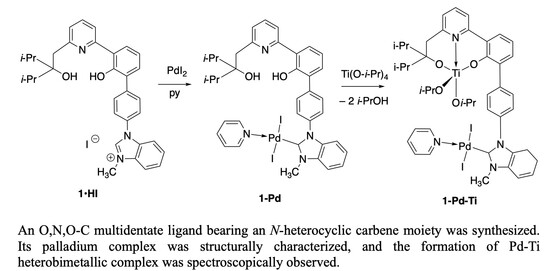
A novel multidentate ligand with an O,N,O-tridentate ligand moiety and an N-heterocyclic carbene (NHC) was synthesized. Its palladium complex, in which the NHC part coordinates to the palladium atom, was synthesized and structurally characterized. The O,N,O-part coordinated to an early transition metal such as titanium. The Ti-Pd heterobimetallic complex was observed in solution.

Graphical Abstract

1. Introduction

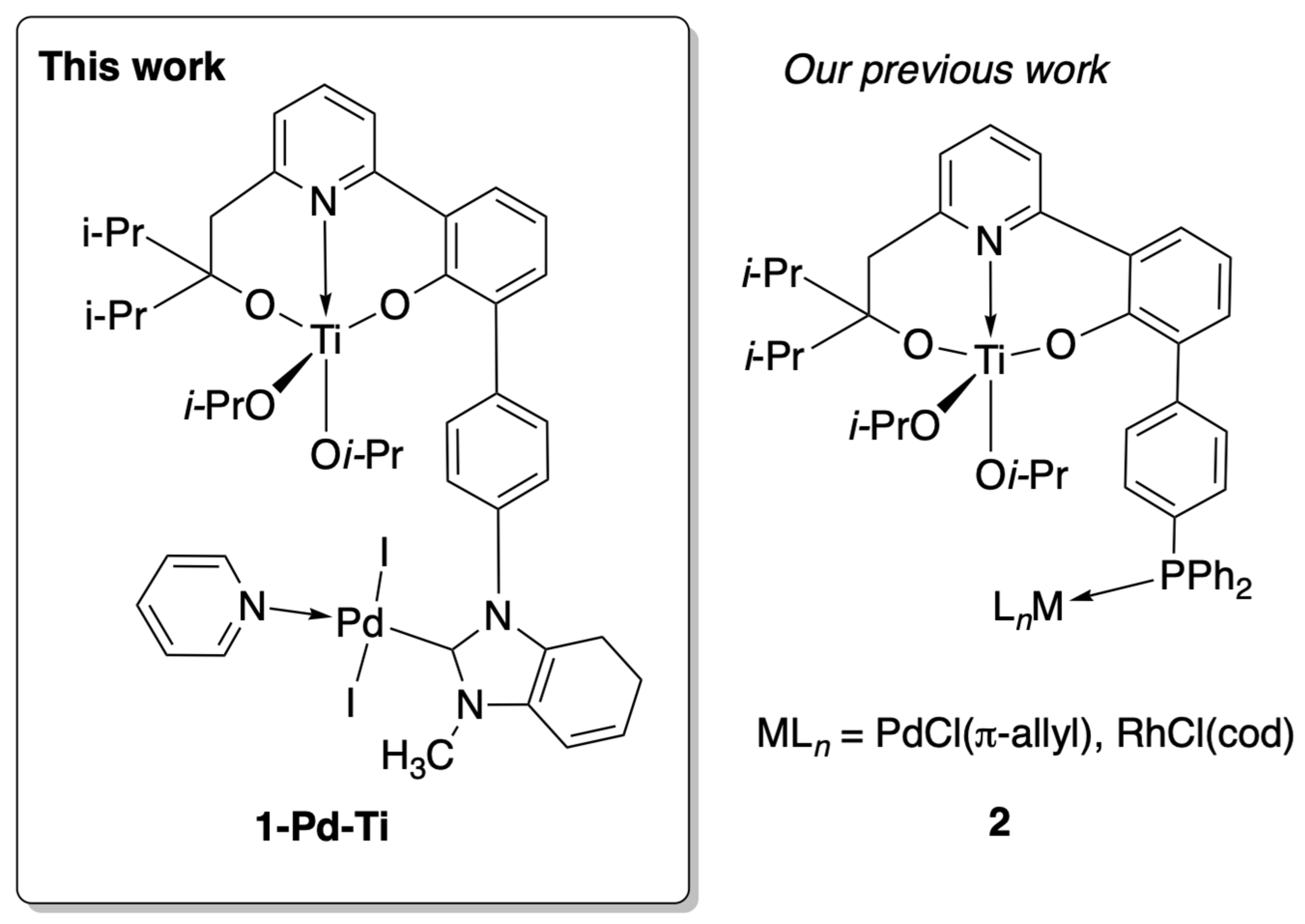
Heterobimetallic complexes have attracted much attention from material and synthetic chemists because these are promising candidates for the development of novel materials such as MOFs (metal–organic frameworks) and functional molecules [1,2,3,4,5,6]. Catalytic reactions using heterobimetallic systems have also been reported [7,8,9,10,11,12,13,14,15,16,17,18,19,20,21,22,23,24,25,26]. We reported the O,N,O-multidentate ligand and its titanium complex and their catalytic ability in olefin polymerization [27]. Thereafter, we synthesized O,N,O-N,N and O,N,O-P multidentate ligands and their heterobimetallic complexes [28,29]. Recently, we designed the O,N,O-P multidentate ligands 2 that have a rigid structure, and their heterobimetallic complexes (Figure 1) [30]. The O,N,O-moiety effectively captured a −Ti(O-i-Pr)2 segment and the phosphine ligand coordinated late-transition metals such as palladium and rhodium.
The advantage of these complexes is that they allow for the facile construction of a 1:1 heterobimetallic system. Because of the different properties of the two ligand moieties, each selectively captures metals. This allowed the formation of heterobimetallic compounds by simply adding two metals one by one.
N-Heterocyclic carbene (NHC) ligands have received much attention from inorganic and organic chemists because these ligands often enhance catalytic activity [31,32]. There have been reports on multidentate ligands containing NHC moieties [33,34,35,36,37,38], and there are many examples of heterobimetallic complexes based on multidentate NHC ligands [39,40,41,42]. In this work, we designed the multidentate ligand 1 on the basis of an O,N,O-structure that has an NHC ligand moiety. Herein, we wish to report on the synthesis and structure of the novel O,N,O-C multidentate ligand and its transition metal complexes. This provides a simple protocol for an equimolar heterobimetallic system containing an NHC ligand.

2. Materials and Methods

2.1. General

When organometallic compounds were involved, all manipulations were conducted under argon using the standard Schlenk technique or under nitrogen in a glove box. Dehydrated tetrahydrofuran (THF) was purchased from Kanto Chemical Co., Inc. Tokyo, Japan and further dried and deoxygenated by using a Glass Contour Solvent System™ (NIKKO HANSEN & Co., Ltd., Osaka, Japan) before use. Lithium diisopropylamide (n-hexane/tetrahydrofuran) and titanium(IV) isopropoxide were purchased from Kanto Chemical Co., Inc. and used as received. Benzimidazole, 2-isopropoxy-4,4,5,5-tetramethyl-1,3,2-dioxaborane and 4-fluorobromobenzene were purchased from Tokyo Chemical Industry Co., Ltd. Tokyo, Japan. Iodomethane and dichloro[1,1′-bis(diphenylphosphino)ferrocene]palladium(II) dichloromethane adduct were purchased from FUJIFILM Wako Pure Chemical Corporation, Osaka, Japan. Palladium(II) iodide was purchased from Merck KGaA, Darmstadt, Germany and used as received. The O,N,O-moiety 3 was prepared as previously reported [30]. The intermediate 1-(4-(4,4,5,5-tetramethyl-1,3,2-dioxaborolan-2-yl)phenyl)-1H-benzo[d]imidazole (4) was prepared according to the literature [43]. NMR spectra were recorded on JNM-ECA 500 (JEOL Ltd. Tokyo, Japan) and AVANCE III HD 400X (Bruker, Billerica, MA, USA) spectrometers. Microwave heating was conducted with Monowave 300 (Anton Paar, Graz, Austria).

2.2. Preparation of 5

The O,N,O-intermediate 3 (205 mg, 0.543 mmol), 4 [44] (175 mg, 0.543 mmol), Na2CO3 (345 mg, 3.3 mmol) and PdCl2(dppf)•CH2Cl2 (44 mg, 0.054 mmol) were dissolved in THF/H2O (1/1, 2.0 mL). The mixture was stirred at 75 °C overnight, and cooled to rt. After extracting with CH2Cl2 (50 mL × 3), the organic layer was washed with H2O and brine. The volatiles were removed in vacuo and the residue was purified with column chromatography on silica gel (EtOAc/CHCl3 = 1/1) to create the product as a yellow solid (170 mg, 64%). 1H NMR (CDCl3, Me4Si, 500 MHz): δ 0.94 (d, J = 7 Hz, 6H, CH3), 0.96 (d, J = 7 Hz, 6H, CH3), 1.98 (sep, J = 7 Hz, 2H, CH), 3.07 (s, 2H, CH2), 7.04 (t, J = 7.7 Hz, 1H, Ar), 7.3–7.37 (m, 3H, Ar), 7.43 (dd, J = 7.4, 1.7 Hz, 1H, Ar), 7.59 (d, J = 8.5 Hz, 2H, Ar), 7.64–7.68 (m, 1H, Ar), 7.79 (t, J = 7.7 Hz, 1H, Ar), 7.85 (tb, J = 8.0, 1.6 Hz, 2H, Ar), 7.89 (m, 3H, Ar), 8.19 (br, 1H, N=CH). 13C NMR (CDCl3, Me4Si, 125.8 MHz): δ 16.78 (CH3), 16.89 (CH3), 33.79 (CH), 40.32 (CH2), 77.17(-q, COH), 109.67 (CH), 116.16 (CH), 117.67 (CH), 118.49 (q), 119.45 (CH), 121.67 (CH), 122.50 (2C, CH), 122.59 (CH), 122.61 (CH), 125.32 (CH), 128.39 (q), 130.09 (2C, CH), 131.19 (CH), 132.67 (q), 133.78 (q), 136.75 (CH), 137.55 (q), 141.35 (CH), 142.92 (q), 155.81 (q), 155.91 (q), 156.06 (q).

2.3. Preparation of HI Imidazolium Salt 1•HI

Compound 5 (162 mg, 0.33mmol) and iodomethane (94 mg, 0.66 mmol) were dissolved in DMF (3 mL) in a 30 mL vial equipped for Monowave 300 (Anton-Paar). The mixture was heated with Monowave 300 at 80 °C for 2 h. The volatiles were removed under vacuum and the residual solid was purified with column chromatography on silica gel (CHCl3/MeOH = 7/1) to give 1•HI as a pale yellow solid (122 mg, 58%). 1H NMR (CDCl3, Me4Si, 500 MHz): δ 0.96 (d, J = 6.8 Hz, 6H, CH3), 0.97 (d, J = 6.8 Hz, 6H, CH3), 1.99 (sep, J = 6.8 Hz, 2H, CH), 3.08 (s, 2H, CH2), 4.51 (s, 3H, NCH3), 7.05 (t, J = 7.7 Hz, 1H, Ar), 7.36 (dd, J = 7.5, 1.0 Hz, 1H, Ar), 7.43 (dd, J = 7.5, 1.5 Hz, 1H, R), 7.72–7.89 (m, 8H, Ar), 7.91 (d, J = 8.6 Hz, 2H, Ar), 7.91 (d, J = 8.6 Hz, 1H, Ar), 11.08 (s, 1H, N=CH). 1H NMR (DMSO-d6, Me4Si, 500 MHz): δ 0.85 (d, J = 6.8 Hz, 12H, CH3), 1.89 (sep, J = 6.8 Hz, 2H, CH), 2.97 (s, 2H, CH2), 4.19 (s, 3H, NCH3), 7.06 (t, J = 7.4 Hz, 1H, Ar), 7.48 (dd, J = 7.5, 10 Hz, 1H, Ar), 7.75 (t, J = 8 Hz, 1H), 7.81 (t, J = 8 Hz, 1H), 7.88 (d, J = 8 Hz, 2H), 7.93–7.98 (m, 4H), 8.12 (t, J = 8 Hz, 2H), 8.17 (d, J = 8 Hz, 1H), 10.17 (s, 1H, N=CH). 13C NMR is unavailable because of extremely low solubility.

2.4. Preparation of the Pd Complex 1-Pd

In a Schlenk tube (20 mL), ligand 1•HI (51 mg, 0.08 mmol) was dissolved in pyridine (3 mL), and PdI2 (29 mg, 0.08 mmol) and K2CO3 (55 mg, 0.4 mmol) were added. The mixture was stirred at 80 °C for 15 h. The orange solution was cooled and the solvent was removed under vacuum. The residue was extracted with dichloromethane three times, and the organic layer was washed with water and brine. The solution was dried over magnesium sulfate and the solvent was removed in vacuo. The residue was purified by column chromatography (hexane/ethyl acetate = 9/1 to 1/9) to create a crude product of brown oil. The oil was dissolved in chloroform and the solution was exposed to hexane vapor to produce orange crystals (55 mg, 72%). 1H NMR (CDCl3, Me4Si, 500 MHz): δ 0.96 (d, J = 7.3 Hz, 6H, CH3), 0.98 (t, J = 7.3 Hz, 6H, CH3), 2.00 (sep, J = 7.3 Hz, 2H, CH), 3.09 (s, 2H, CH2), 4.31 (s, 3H, -CH3), 7.04 (t, J = 7.6 Hz, 1H), 7.26 (m, 1H), 7.33 (td, J = 7.9, 1.2 Hz, 1H), 7.35 (d, J = 7.9 Hz, 1H), 7.45 (d, J = 7.8 Hz, 1H), 7.54 (dd, J = 7.6, 1.5 Hz, 1H), 7.67 (tt, J = 7.7, 1.6 Hz, 1H), 7.79 (t, J = 7.6 Hz, 1H), 7.84 (d, J = 7.6 Hz, 1H), 7.86 (dd, J = 7.9, 1.7 Hz, 1H), 7.99 (d, J = 8.5 Hz, 2H), 8.05 (d, J = 8.5 Hz, 2H), 8.86–8.87 (m, 2H, Py). 13C NMR (CDCl3, Me4Si, 125.8 MHz): δ 17.86 (2C, CH3), 17.96 (2C, CH3), 34.90 (2C, CH), 36.30 (CH3), 41.47 (CH2), 78.29(q, COH), 109.87, 111.33, 117.34, 118.74, 119.66 (q), 123.27, 123.32, 123.62, 124.47 (2C), 126.43, 128.00 (2C), 129.65 (q), 130.41 (2C), 132.70, 135.15 (q), 135.76 (q), 136.16 (q), 137.52, 137.82, 139.62 (q), 153.71 (2C), 156.96 (q), 157.26 (q), 157.26 (q), 157.30(q) 162.63 (q, Pd-C).

2.5. Preparation of Heterobimetallic Complex 1-Ti-Pd

Complex 1-Pd (41.6 mg, 0.044 mmol) was dissolved in CDCl3 (0.6 mL) in a Schlenk tube and titanium tetraisopropoxide (12.5 mg, 0.44 mmol) was added. The solution was kept at rt for 12 h, and the solution was observed by 1H NMR spectroscopy. Formation of 1-Pd-Ti at a ca. 84% yield was suggested judging from the NMR spectrum. 1H NMR (CDCl3, Me4Si, 500 MHz): δ 1.21 (d, J = 6 Hz, 12H, CH3), 1.8 (br, 2H, CH), 3.5 (br, 2H, CH2), 4.31 (s, 3H, -CH3), 6.85 (t, J = 7.6 Hz, 1H), 7.0–7.8 (m, 16H), 8.71 (m, 2H, Py).

2.6. Attempting a Catalytic Cross-Coupling Reaction Using 1-Pd

The Pd complex 1-Pd (9.5 mg, 0.01 mmol) was dissolved in THF (1 mL), and hydrazine monohydrate (79%, 0.02 mmol) was added. After stirring for 5 min, 2-bromophenol (86 mg, 0.5 mmol) and 3-bromo phenols (86 mg, 0.5 mmol) were dissolved in this solution. The solution was cooled to −78 °C and phenylmagnesium bromide (1 M in THF, 2.5 equiv) was added. The mixture was allowed to warm up to rt and stirred at rt for 48 h. Aliquot was quenched with dil. HCl and analyzed by gas chromatography. A trace amount of the coupling product was observed by gas chromatography.

2.7. X-Ray Diffraction Analysis of the Ligand 1•HI

Crystals suitable for X-ray analysis were obtained from a methanol solution by slow evaporation of the solvent. A colorless needle crystal (0.40 × 0.015 × 0.01 mm) was mounted on MicroMountsTM (MiTegen, Ithaca, NY, USA), a polyimide film, and coated with methanol. All measurements were carried out on a XtaLAB Synergy-S diffractometer (Rigaku Holdings Corporation, Tokyo, Japan) equipped with a multi-layer mirror monochromated Cu-Kα radiation source at 153 K. The data were obtained and processed using CrysAlisPro (Rigaku Holdings Corporation, Tokyo, Japan) [45]. The structure was determined by direct methods [46] and further refined through Fourier techniques. The unit cell contained one water molecule and two crystallographically independent molecules of 1•HI. Non-hydrogen atoms were refined with anisotropic displacement parameters, while hydrogen atoms were treated using the riding model. The final cycle of full-matrix least-squares refinement on F2 utilized 11,171 observed reflections and involved 732 variable parameters with the SHELXT (http://shelx.uni-goettingen.de/) [47] implementation in Olex2 1.5 (Figure S1) [48]. Crystallographic data are summarized in Table S1. CIF data were deposited in Cambridge Structural Database (CCDC-2287460).

2.8. X-Ray Diffraction Analysis of the Pd Complex 1-Pd

Crystals were obtained from a chloroform solution by exposing to hexane vapor. An orange needle crystal (0.20 × 0.03 × 0.01 mm) was mounted on MicroMounts™ (MiTegen), a polyimide film, and coated with paraffin. Measurements were performed in the same manner as for 1•HI. The structure was determined by direct methods [46] and further developed through Fourier techniques. Non-hydrogen atoms were subjected to anisotropic refinement, whereas hydrogen atoms were treated using the riding model. The final cycle of full-matrix least-squares refinement on F2 utilized 7266 observed reflections and included 464 variable parameters. All calculations were carried out with the CrystalStructure 4.2.5 [49] crystallographic software package, except for the refinement step, which was performed using SHELXL97 (http://shelx.uni-goettingen.de/ (accessed on 5 March 2026)) (Figure S2) [50]. Crystallographic data are summarized in Table S1. CIF data were deposited in Cambridge Structural Database (CCDC-2287461).

3. Results and Discussion

3.1. Synthesis of Ligand 1

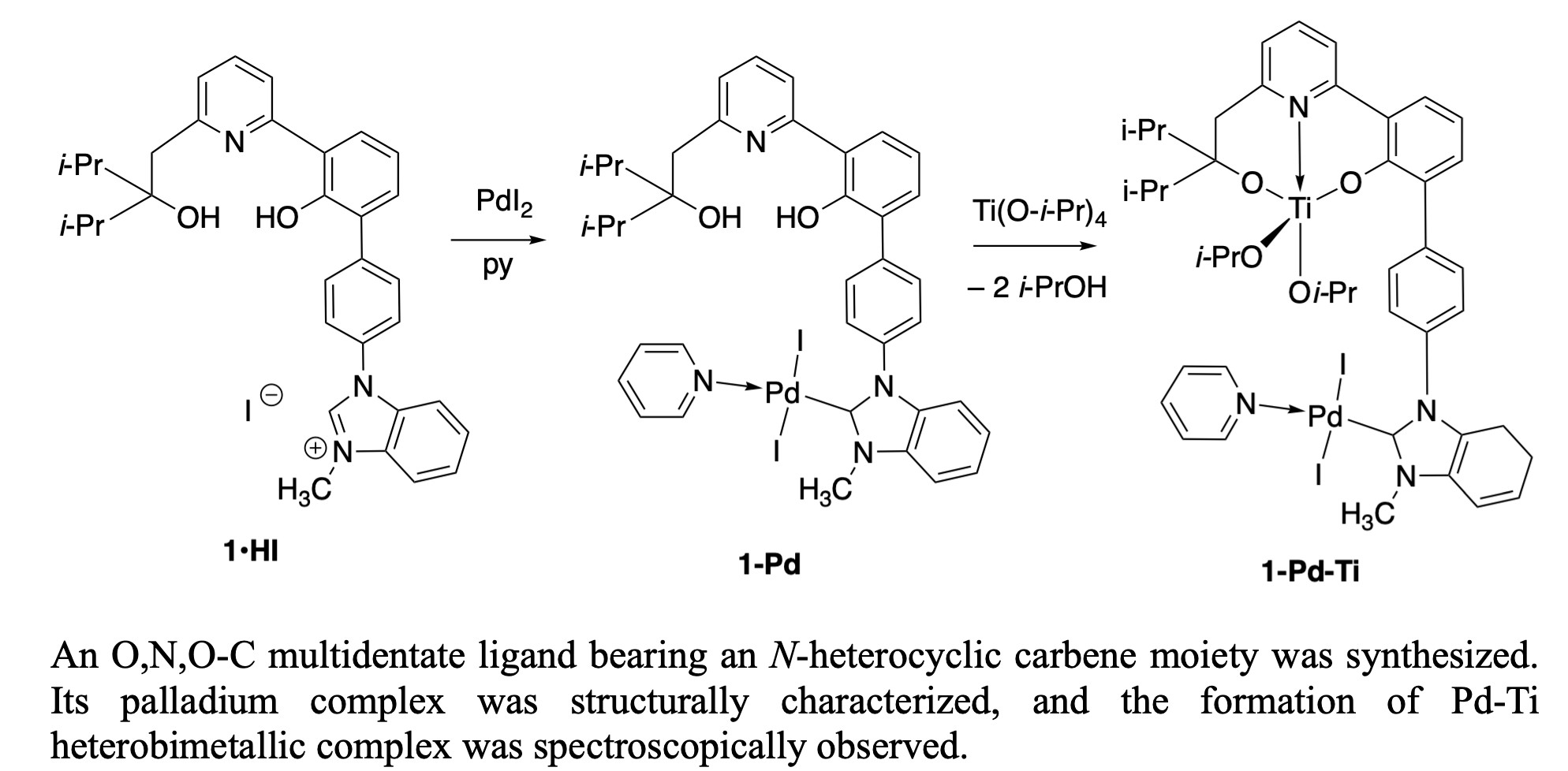
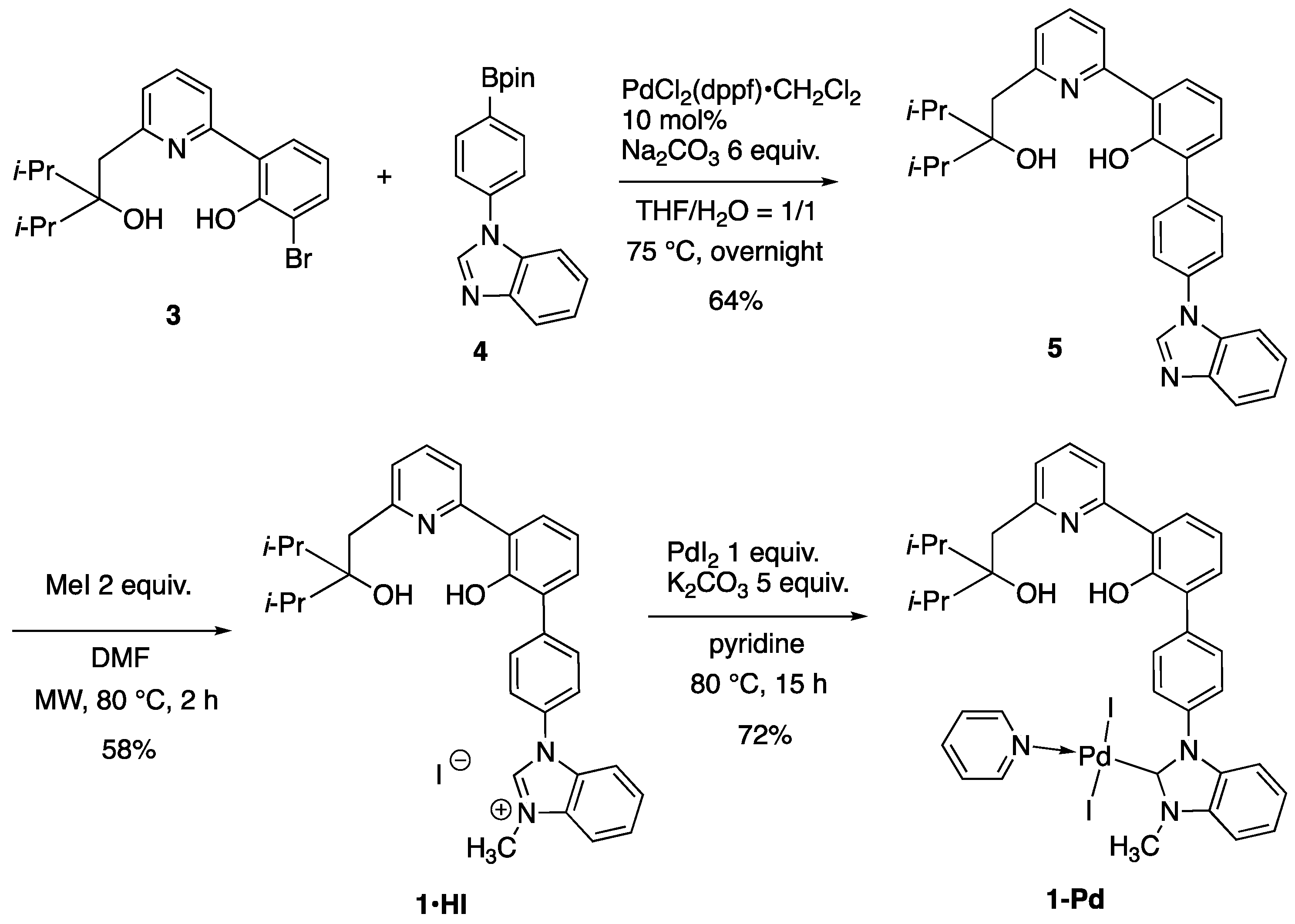
To install an N-heterocyclic carbene group in the multidentate ligands, we employed the O,N,O-moiety 3, which we previously used for the O,N,O-P ligands 2. The benzimidazole moiety was installed by Suzuki–Miyaura cross-coupling. The coupling partner 4 was prepared by nucleophilic substitution on 1-bromo-4-fluorobenzen by benzimidazole followed by palladium-catalyzed borylation. 1H NMR spectroscopy of 5 showed a broad singlet at 8.2 ppm that was assignable to a CH=N proton in the benzimidazole group. The corresponding methine carbon appeared in the 13C NMR spectrum at 109.7 ppm. These chemical shifts were in the same range as those of N-phenylbenzimidazole [51]. The coupling product 5 was treated with iodomethane under microwave heating to afford the HI salt of the ligand 1 (Scheme 1).
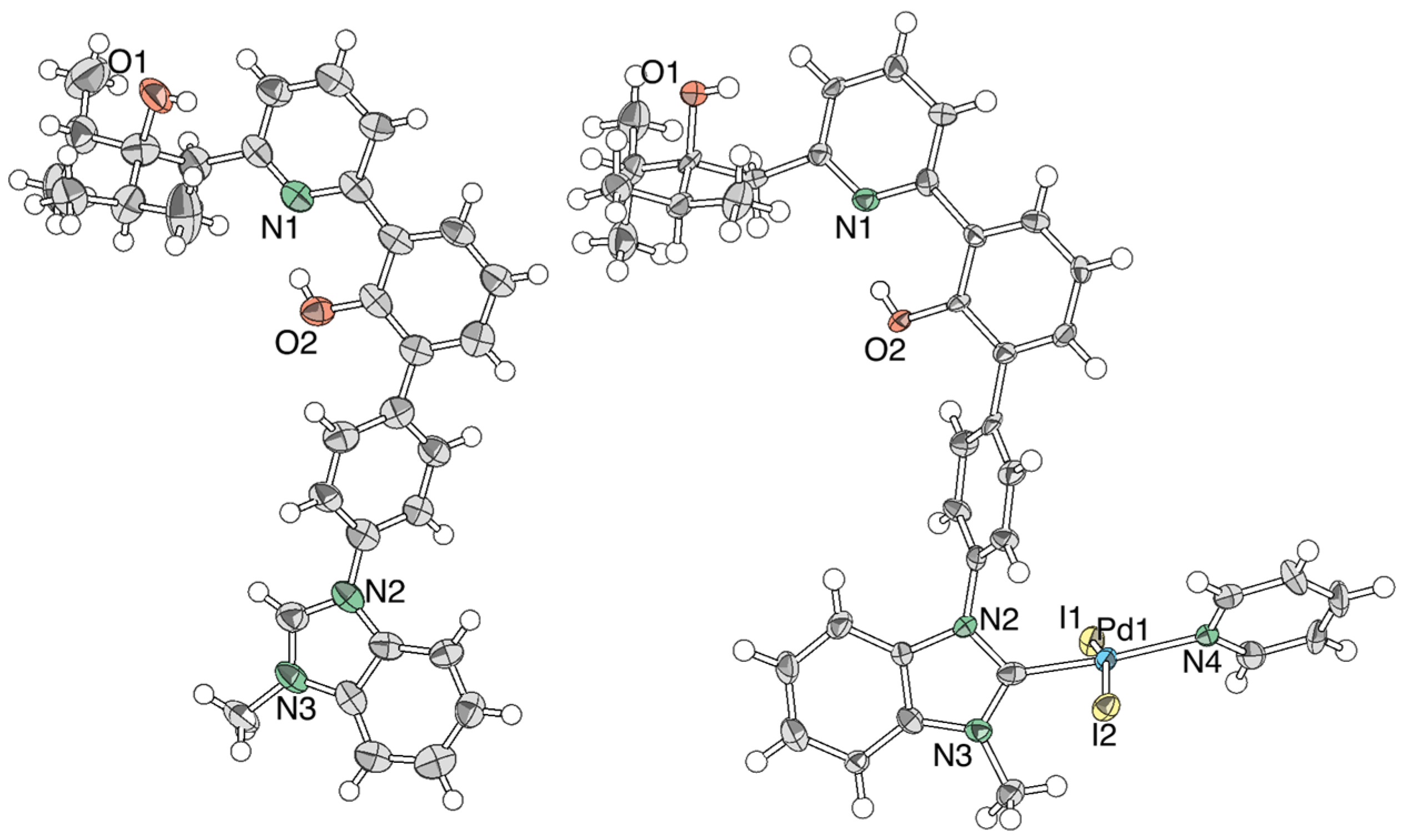
The ligand precursor 1•HI was identified by 1H NMR spectroscopy, and the molecular structure was unambiguously characterized by X-ray diffraction analysis (Figure 2). Because of the extremely low solubility, satisfactory 13C NMR spectra could not be obtained. Despite the unsatisfactory accuracy of the analyzed results, the molecular structure was confirmed. The benzimidazolium group was attached on the O,N,O-ligand via a benzene ring. The methine proton of the imidazolium group appeared at 11.1 ppm in CDCl3 and at 10.2 ppm in DMSO-d6. The N-methyl group was observed at 4.51 and 4.16 ppm in CDCl3 and DMSO-d6, respectively. These NMR data were similar to those of 3-methyl-1-phenylbenzimidazolium iodide [52].

3.2. Synthesis of Metal Complexes of 1

The ligand imidazolium salt 1•HI reacted with PdI2 and K2CO3 in pyridine to obtain the Pd complex 1-Pd at a 72% yield. In the 1H NMR spectra, the methine proton of imidazolium at 11 ppm disappeared, and protons of the palladium-coordinated pyridine were found at 8.86 ppm as a multiplet. 13C NMR spectroscopy showed the Pd-coordinated NHC quaternary carbon at 162 ppm. This supported the formation of 1-Pd. Recrystallization from chloroform/hexane gave orange needle crystals, and the molecular structure of 1-Pd was determined by X-day diffraction analysis (Figure 2). One pyridine molecule coordinated to the metal, with two iodine atoms in trans to palladium. Selected bond lengths and angles are shown in Table 1. The Pd–C distance was 1.936(12) Å, as typically observed in Pd–NHC complexes; however, it was slightly shorter than that in a similar Pd–benzimidazole complex reported by Lee et al. (1.964(3) Å) [53]. The angles around the Pd atom were nearly perpendicular and the sum of the angles around the metal was 360.9°, showing the square-planar structure of the palladium complex.
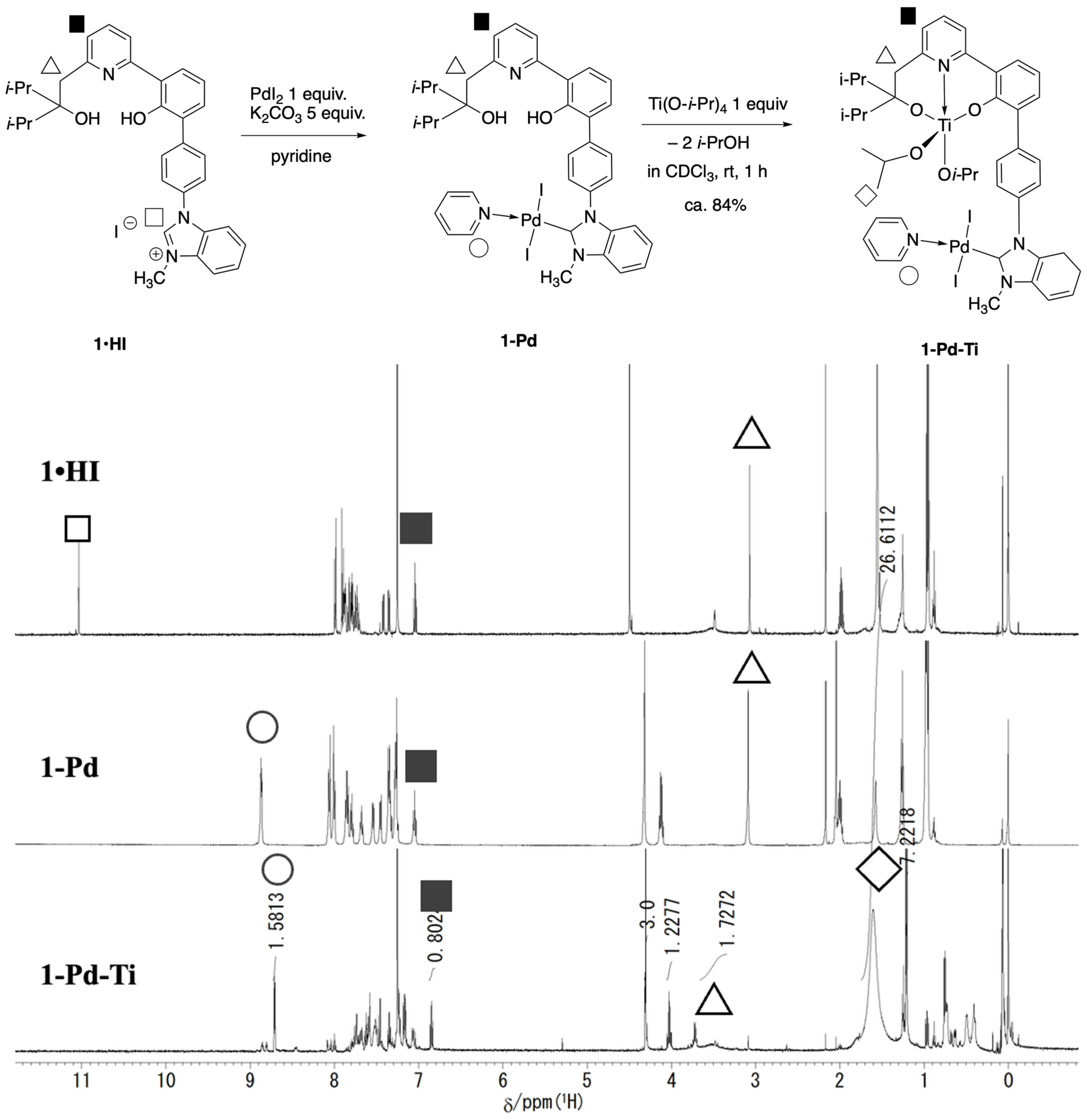
In our previous study on the O,N,O-P ligand 2, we confirmed that the O,N,O-moiety reacted with Ti(O-i-Pr)4 to form the corresponding titanium complex with the tridentate ligand. The structure of the Ti complex was characterized by NMR spectroscopy and X-ray crystallographic analysis [30]. Thus, in the present study, we attempted to prepare a heterobimetallic complex using 1. To a solution of 1-Pd in chloroform-d, an equimolar amount of Ti(O-i-Pr)4 was added and the solution was observed by NMR (Figure 3).
As for the O,N,O-moiety of 1, the pyridine proton at the 3-position to the nitrogen atom (■) shifted upfield to 6.8 ppm, and protons of the methylene arm of O,N,O (△) broadened because of the coordination of the O,N,O-moiety to titanium. The broadened methylene signal indicated exchange of isopropoxy groups, probably due to the presence of free isopopanol. A broad signal at 1.7 ppm (◇) is assignable to the methyl protons of isopropoxy/isopropanol. These changes were observed in our previously reported O,N,O-multidentate ligands as well [28,29,30]. These proposed the coordination of 1 to the titanium atom with the O,N,O-group. Protons assignable to pyridine that coordinates to Pd (○) appeared at 8.7 ppm. These suggested the formation of the heterobimetallic Ti-Pd complex 1-Ti-Pd. However, the formation of diastereomers, probably because of conformational change, was observed, and this made further identification difficult. Our attempt to obtain good crystals suitable for X-ray diffraction analysis has been unsuccessful so far, likely due to the formation of diastereomers. We conducted preliminary studies on the catalytic ability of 1-Pd for a Kumada–Tamao cross-coupling reaction, aiming at the formation of a complex of 1-Pd and magnesium. Unfortunately, however, the cross-coupling products were obtained in low yields.

4. Conclusions

A multidentate ligand bearing an O,N,O-tridentate moiety and an N-heterocyclic carbene group was synthesized. Its palladium complex was prepared and structurally characterized, and the formation of its Ti-Pd heterobimetallic complex in solution was suggested. Further investigation of the property and reactivity of the complexes is in progress in our laboratory.

Supplementary Materials

The following supporting information can be downloaded at https://www.mdpi.com/article/10.3390/compounds6010024/s1: Figure S1. Molecular structure of 1•HI. One of the two independent 1•HI molecules is shown with 50% probability. Iodide ions and a water molecule are omitted for clarity; Figure S2. Molecular structure of 1-Pd; Table S1. Crystal data and structure refinement for 1•HI and 1-Pd.

Author Contributions

Conceptualization, N.S.; methodology, N.S. and Y.S.; validation, Y.G.; formal analysis, M.H. and Y.G.; investigation, M.H. and Y.G.; writing—original draft preparation, N.S.; writing—review and editing, Y.S.; supervision, N.S.; funding acquisition, N.S. All authors have read and agreed to the published version of the manuscript.

Funding

This research was funded by a Sophia university Special Grant for Academic Research.

Data Availability Statement

The original contributions presented in this study are included in the article. Further inquiries can be directed to the corresponding author.

Acknowledgments

The authors thank Yoko Yanagida and Emiko Okano (Sophia Univ.) for their assistance in the spectroscopic measurements.

Conflicts of Interest

The authors declare no conflicts of interest.

References

  1. Li, M.; Yang, W.; Wu, S.; Su, Z.; Pan, Q. Fluorescence of europium from absence to emergence in cadmium-induced heterobimetallic organic frameworks for ratiometric sensing. Inorg. Chem. Front. 2025, 12, 3845–3852. [Google Scholar] [CrossRef]
  2. Peng, A.; Li, G.; Wang, C.; Huang, Z. A heterobimetallic MOF as a stable heterogeneous catalyst with high activity for ethylene oligomerization. Chem. Commun. 2025, 61, 969–972. [Google Scholar] [CrossRef]
  3. Kim, S.; Kim, T.; Ju, K.; Bae, J.H.; Park, I.H. SCSC Transformation of Heterobimetallic 2D MOF to Homometallic 2D MOF via Solvent-Assisted Removal of Second Metal Component: An Add-and-Remove Strategy. Inorg. Chem. 2025, 64, 6544–6551. [Google Scholar] [CrossRef]
  4. Xu, J.; Li, Z.; Wang, R.; Zhang, X.; Zhang, X.; Wei, Y.; Hou, X.; Liu, Y. Metalloporphyrin-Sensitized Ti Metal–Organic Framework Nanostructures for Visible-Light-Driven Hydrogen Evolution. ACS Appl. Nano Mater. 2025, 8, 2179–2187. [Google Scholar] [CrossRef]
  5. Navarro-Alapont, J.; Armentano, D.; Pardo, E.; Ferrando-Soria, J. Exploring a metalloligand for construction of an oxamato-based metal-organic framework. J. Coord. Chem. 2022, 75, 2413–2423. [Google Scholar] [CrossRef]
  6. Imberti, C.; Lok, J.; Coverdale, J.P.C.; Carter, O.W.L.; Fry, M.E.; Postings, M.L.; Kim, J.; Firth, G.; Blower, P.J.; Sadler, P.J. Radiometal-Labeled Photoactivatable Pt(IV) Anticancer Complex for Theranostic Phototherapy. Inorg. Chem. 2023, 62, 20745–20753. [Google Scholar] [CrossRef] [PubMed]
  7. Ritleng, V.; Chetcuti, M.J. Hydrocarbyl ligand transformations on heterobimetallic complexes. Chem. Rev. 2007, 107, 797–858. [Google Scholar] [CrossRef] [PubMed]
  8. Ikariya, T.; Shibasaki, M. (Eds.) Bifunctional Molecular Catalysis; Springer: Berlin/Heidelberg, Germany, 2011; Volume 37. [Google Scholar]
  9. Inagaki, A.; Akita, M. Visible-light promoted bimetallic catalysis. Coord. Chem. Rev. 2010, 254, 1220–1239. [Google Scholar] [CrossRef]
  10. Shibasaki, M.; Kanai, M.; Matsunaga, S.; Kumagai, N. Recent progress in asymmetric bifunctional catalysis using multimetallic systems. Acc. Chem. Res. 2009, 42, 1117–1127. [Google Scholar] [CrossRef]
  11. Osakada, K.; Tanabe, M. Platinum and Palladium Complexes with Metal–Silicon Bonds. New Bonding, Structures, and Chemical Properties. Bull. Chem. Soc. Jpn. 2005, 78, 1887–1898. [Google Scholar] [CrossRef]
  12. Wichmann, O.; Sillanpää, R.; Lehtonen, A. Structural properties and applications of multidentate [O,N,O,X′] aminobisphenolate metal complexes. Coord. Chem. Rev. 2012, 256, 371–392. [Google Scholar] [CrossRef]
  13. Igashira-Kamiyama, A.; Konno, T. Rational creation of chiral multinuclear and metallosupramolecular compounds from thiol-containing amino acids. Dalton Trans. 2011, 40, 7249–7263. [Google Scholar] [CrossRef]
  14. Leon, N.J.; Yu, H.-C.; Mazzacano, T.J.; Mankad, N.P. Pursuit of C–H Borylation Reactions with Non-Precious Heterobimetallic Catalysts: Hypothesis-Driven Variations on a Design Theme. Synlett 2019, 31, 125–132. [Google Scholar] [CrossRef]
  15. Tsurugi, H.; Laskar, P.; Yamamoto, K.; Mashima, K. Bonding and structural features of metal-metal bonded homo- and hetero-dinuclear complexes supported by unsaturated hydrocarbon ligands. J. Organomet. Chem. 2018, 869, 251–263. [Google Scholar] [CrossRef]
  16. Chipman, J.A.; Berry, J.F. Paramagnetic Metal-Metal Bonded Heterometallic Complexes. Chem. Rev. 2020, 120, 2409–2447. [Google Scholar] [CrossRef]
  17. Gupta, G.R.; Shah, J.; Vadagaonkar, K.S.; Lavekar, A.G.; Kapdi, A.R. Hetero-bimetallic cooperative catalysis for the synthesis of heteroarenes. Org. Biomol. Chem. 2019, 17, 7596–7631. [Google Scholar] [CrossRef] [PubMed]
  18. Lam, N.Y.S.; Wu, K.; Yu, J.Q. Advancing the Logic of Chemical Synthesis: C-H Activation as Strategic and Tactical Disconnections for C-C Bond Construction. Angew. Chem. Int. Ed. 2021, 60, 15767–15790. [Google Scholar] [CrossRef]
  19. Hara, N.; Saito, T.; Semba, K.; Kuriakose, N.; Zheng, H.; Sakaki, S.; Nakao, Y. Rhodium Complexes Bearing PAlP Pincer Ligands. J. Am. Chem. Soc. 2018, 140, 7070–7073. [Google Scholar] [CrossRef] [PubMed]
  20. Yang, L.; Uemura, N.; Nakao, Y. meta-Selective C-H Borylation of Benzamides and Pyridines by an Iridium-Lewis Acid Bifunctional Catalyst. J. Am. Chem. Soc. 2019, 141, 7972–7979. [Google Scholar] [CrossRef]
  21. Mizuta, T.; Miyaji, C.; Katayama, T.; Ushio, J.-I.; Kubo, K.; Miyoshi, K. Bi- and Trinuclear Complexes of Group 4 Metal and Palladium Bridged by OPPh2 Groups: Synthesis and High Catalytic Activities in Double Hydrophosphinylation of 1-Octyne. Organometallics 2009, 28, 539–546. [Google Scholar] [CrossRef]
  22. Ishikawa, S.; Manabe, K. DHTP ligands for the highly ortho-selective, palladium-catalyzed cross-coupling of dihaloarenes with grignard reagents: A conformational approach for catalyst improvement. Angew. Chem. Intl. Ed. 2010, 49, 772–775. [Google Scholar] [CrossRef]
  23. Liu, S.; Motta, A.; Mouat, A.R.; Delferro, M.; Marks, T.J. Very large cooperative effects in heterobimetallic titanium-chromium catalysts for ethylene polymerization/copolymerization. J. Am. Chem. Soc. 2014, 136, 10460–10469. [Google Scholar] [CrossRef]
  24. Ishino, H.; Takemoto, S.; Hirata, K.; Kanaizuka, Y.; Hidai, M.; Nabika, M.; Seki, Y.; Miyatake, T.; Suzuki, N. Olefin Polymerization Catalyzed by Titanium−Tungsten Heterobimetallic Dinitrogen Complexes. Organometallics 2004, 23, 4544–4546. [Google Scholar] [CrossRef]
  25. Yamaguchi, Y.; Suzuki, N.; Mise, T.; Wakatsuki, Y. Synthesis of ansa-Zirconocene/Rhodium Heterobimetallic Complexes: Enhanced Catalytic Activity in Stereospecific Polymerization of α-Olefins. Organometallics 1999, 18, 996–1001. [Google Scholar] [CrossRef]
  26. Gao, J.; Zhu, D.; Zhang, W.; Solan, G.A.; Ma, Y.; Sun, W.-H. Recent progress in the application of group 1, 2 & 13 metal complexes as catalysts for the ring opening polymerization of cyclic esters. Inorg. Chem. Front. 2019, 6, 2619–2652. [Google Scholar] [CrossRef]
  27. Suzuki, N.; Kobayashi, G.; Hasegawa, T.; Masuyama, Y. Syntheses and Structures of Titanium Complexes Having O,N,O-Tridentate Ligands And Their Catalytic Ability for Ethylene Polymerization. J. Organomet. Chem. 2012, 717, 23–28. [Google Scholar] [CrossRef]
  28. Suzuki, N.; Haraga, K.; Shimamura, T.; Masuyama, Y. Synthesis and Structures of Ti-Pd Hetero bimetallic Complexes. Eur. J. Inorg. Chem. 2015, 2015, 5480–5487. [Google Scholar] [CrossRef]
  29. Suzuki, N.; Yoneyama, S.; Shiba, K.; Hasegawa, T.; Masuyama, Y. Synthesis of O,N,O-P multidentate ligands and the formation of early-late heterobimetallic complexes. Inorg. Chim. Acta 2018, 471, 355–363. [Google Scholar] [CrossRef]
  30. Suzuki, N.; Yoneyama, S.; Sato, K.; Shiba, K.; Nakayama, T.; Uematsu, Y.; Sakurai, K. Synthesis of O,N,O-P-multidentate ligands and their heterobimetallic complexes. J. Organomet. Chem. 2022, 982, 122531. [Google Scholar] [CrossRef]
  31. Hahn, F.E.; Jahnke, M.C. Heterocyclic carbenes: Synthesis and coordination chemistry. Angew. Chem. Int. Ed. 2008, 47, 3122–3172. [Google Scholar] [CrossRef]
  32. Jayaraj, A.; Raveedran, A.V.; Latha, A.T.; Priyadarshini, D.; Swamy, P.C.A. Coordination Versatility of NHC-metal Topologies in Asymmetric Catalysis: Synthetic Insights and Recent Trends. Coord. Chem. Rev. 2023, 478, 214922. [Google Scholar] [CrossRef]
  33. Rajmane, A.; Jadhav, S.; Kumbhar, A. N, O-polydentate ligands for palladium-catalyzed cross-coupling reactions (Part III). J. Organomet. Chem. 2022, 957, 122147. [Google Scholar] [CrossRef]
  34. Hoshimoto, Y.; Ogoshi, S. Development of Metal Complexes Equipped with Structurally Flexible Carbenes. Bull. Chem. Soc. Jpn. 2021, 94, 327–338. [Google Scholar] [CrossRef]
  35. Ibáñez, S.; Poyatos, M.; Peris, E. N-Heterocyclic Carbenes: A Door Open to Supramolecular Organometallic Chemistry. Acc. Chem. Res. 2020, 53, 1401–1413. [Google Scholar] [CrossRef]
  36. Ye, C.X.; Meggers, E. Chiral-at-Ruthenium Catalysts for Nitrene-Mediated Asymmetric C-H Functionalizations. Acc. Chem. Res. 2023, 56, 1128–1141. [Google Scholar] [CrossRef]
  37. van Vuuren, E.; Malan, F.P.; Landman, M. Multidentate NHC complexes of group IX metals featuring carbon-based tethers: Synthesis and applications. Coord. Chem. Rev. 2021, 430, 213731. [Google Scholar] [CrossRef]
  38. Hazra, S.; Hoshimoto, Y.; Ogoshi, S. N-Phosphine Oxide-Substituted Imidazolylidenes (PoxIms): Multifunctional Multipurpose Carbenes. Chem. Eur. J. 2017, 23, 15238–15243. [Google Scholar] [CrossRef]
  39. Boselli, L.; Carraz, M.; Mazères, S.; Paloque, L.; González, G.; Benoit-Vical, F.; Valentin, A.; Hemmert, C.; Gornitzka, H. Synthesis, Structures, and Biological Studies of Heterobimetallic Au(I)–Ru(II) Complexes Involving N-Heterocyclic Carbene-Based Multidentate Ligands. Organometallics 2015, 34, 1046–1055. [Google Scholar] [CrossRef]
  40. Gu, S.; Xu, D.; Chen, W. Heterobimetallic complexes containing an N-heterocyclic carbene based multidentate ligand and catalyzed tandem click/Sonogashira reactions. Dalton Trans. 2011, 40, 1576–1583. [Google Scholar] [CrossRef] [PubMed]
  41. Kitabayashi, A.; Ono, Y.; Taketsugu, T.; Sawamura, M.; Higashida, K. Dimetal-Binding Scaffold 2-(Pyridin-2-yl)imidazo [1,5-b]pyridazine-7-ylidene: Synthesis of Trinuclear Heterobimetallic Complexes Involving Gold-Metal Interactions. Chem. Eur. J. 2023, 29, e202301673. [Google Scholar] [CrossRef] [PubMed]
  42. Yamauchi, Y.; Mondori, Y.; Uetake, Y.; Takeichi, Y.; Kawakita, T.; Sakurai, H.; Ogoshi, S.; Hoshimoto, Y. Reversible Modulation of the Electronic and Spatial Environment around Ni(0) Centers Bearing Multifunctional Carbene Ligands with Triarylaluminum. J. Am. Chem. Soc. 2023, 145, 16938–16947. [Google Scholar] [CrossRef]
  43. Gross, J.L.; Robichaud, A.J.; Mazzacani, A.; Williams, M.J. Aminoalkylazole Derivatives as Histamine-3 Antagonists. Patent WO 2009/012252 A1, 15 July 2008. [Google Scholar]
  44. Diness, F.; Fairlie, D.P. Catalyst-free N-arylation using unactivated fluorobenzenes. Angew. Chem. Int. Ed. 2012, 51, 8012–8016. [Google Scholar] [CrossRef]
  45. CrysAlisPro, Data Collection and Processing Software; Rigaku Corporation: Tokyo, Japan, 2015. Available online: https://rigaku.com/products/crystallography/x-ray-diffraction/crysalispro?setLang=english (accessed on 5 March 2026).
  46. Burla, M.C.; Caliandro, R.; Camalli, M.; Carrozzini, B.; Cascarano, G.L.; Caro, L.D.; Giacovazzo, C.; Polidori, G.; Siliqi, D.; Spagna, R. IL MILIONE: A suite of computer programs for crystal structure solution of proteins. J. Appl. Crystallogr. 2007, 40, 609–613. [Google Scholar] [CrossRef]
  47. Sheldrick, G.M. SHELXT-integrated space-group and crystal-structure determination. Acta Crystallogr. A Found. Adv. 2015, 71, 3–8. [Google Scholar] [CrossRef]
  48. Sheldrick, G.M. Crystal structure refinement with SHELXL. Acta Crystallogr. C Struct. Chem. 2015, 71, 3–8. [Google Scholar] [CrossRef] [PubMed]
  49. CrystalStructure, version 4.2.5. Crystal Structure Analysis Package. Rigaku Corporation: Tokyo, Japan, 2017.
  50. Sheldrick, G.M. A short history of SHELX. Acta Crystallogr. A 2008, 64, 112–122. [Google Scholar] [CrossRef] [PubMed]
  51. Plater, M.J.; Barnes, P.; McDonald, L.K.; Wallace, S.; Archer, N.; Gelbrich, T.; Horton, P.N.; Hursthouse, M.B. Hidden signatures: New reagents for developing latent fingerprints. Org. Biomol. Chem. 2009, 7, 1633–1641. [Google Scholar] [CrossRef]
  52. Osiak, J.G.; Setzer, T.; Jones, P.G.; Lennartz, C.; Dreuw, A.; Kowalsky, W.; Johannes, H.H. Twist it! The acid-dependent isomerization of homoleptic carbenic iridium(iii) complexes. Chem. Commun. 2017, 53, 3295–3298. [Google Scholar] [CrossRef]
  53. Lee, Y.-Y.; Zseng, H.-W.; Tsai, Z.-H.; Su, Y.-S.; Hu, C.-H.; Lee, H.M. Isomeric Palladium Complexes Bearing Imidazopyridine-Based Abnormal Carbene Ligands: Synthesis, Characterization, and Catalytic Activity in Direct C–H Arylation Reaction. Organometallics 2019, 38, 805–815. [Google Scholar] [CrossRef]
Figure 1. O,N,O-multidentate ligand and its heterobimetallic complexes.
Compounds 06 00024 g001
Scheme 1. Preparation of ligand 1 and its Pd complex.
Compounds 06 00024 sch001
Figure 2. Molecular structure of 1•HI (left) and 1-Pd (right). Drawn with 50% probability. The iodide ion in 1•HI is omitted.
Compounds 06 00024 g002
Figure 3. 1H NMR spectra of ligand 1-Pd and 1-Ti-Pd.
Compounds 06 00024 g003
Table 1. Selected bond lengths (Å) and angles (°) of 1-Pd.
Pd–I12.6091(10)
Pd–I22.6130(10)
Pd–N42.111(9)
Pd–C321.936(12)
I1–Pd–I2165.00(4)
I1–Pd–N495.9(2)
I1–Pd–C3283.7(3)
I2–Pd–N493.4(2)
I2–Pd–C3287.9(3)
N4–Pd–C32175.2(3)
Disclaimer/Publisher’s Note: The statements, opinions and data contained in all publications are solely those of the individual author(s) and contributor(s) and not of MDPI and/or the editor(s). MDPI and/or the editor(s) disclaim responsibility for any injury to people or property resulting from any ideas, methods, instructions or products referred to in the content.