Article

Tuning of Thermally Activated Delayed Fluorescence Properties in the N,N-Diphenylaminophenyl–Phenylene–Quinoxaline D–π–A System


Department of Applied Chemistry, Graduate School of Engineering, Osaka Metropolitan University, 1-1 Gakuen-cho, Naka-ku, Sakai 599-8531, Osaka, Japan
*
Author to whom correspondence should be addressed.
Compounds 2025, 5(4), 59; https://doi.org/10.3390/compounds5040059
Submission received: 12 November 2025 / Revised: 6 December 2025 / Accepted: 10 December 2025 / Published: 16 December 2025
(This article belongs to the Special Issue Feature Papers in Compounds (2025))

Abstract

Thermally activated delayed fluorescence (TADF) often achieves high device efficiencies in organic light-emitting diodes. Here we develop TADF dyes, 1-H and 1-Me, based on an N,N-diphenylaminophenyl–phenylene–quinoxaline donor–π–acceptor system, which contains an unsubstituted 1,4-phenylene and a 2,5-dimethyl-1,4-phenylene π-spacer, respectively. In UV–vis absorption spectra in toluene at room temperature, 1-H showed a relatively intense shoulder band at 400 nm, whereas 1-Me had a weak, blue-shifted shoulder at 386 nm, indicating 1-Me adopts a more twisted π-conjugation system. On the other hand, the photoluminescence (PL) wavelength of 1-MePL; 558 nm) under the same conditions was slightly red-shifted in comparison with that of 1-HPL; 552 nm), due to larger structural relaxation of 1-Me. From PL lifetime measurements, both the dyes showed TADF in 10 wt%-doped poly(methyl methacrylate) film, and their PL quantum yields were moderate (ΦPL; ca. 0.5 at 300 K). As for the photokinetics, 1-Me exhibited larger rate constants for intersystem crossing and reverse intersystem crossing than 1-H due to the small excited-state singlet–triplet energy gap (ΔEST) of 1-Me. Furthermore, theoretical calculations indicated the triplet state of 1-Me is destabilized by localization of the spin density, resulting in the reduced ΔEST to facilitate TADF.

1. Introduction

Organic light-emitting diodes (OLEDs) [1,2] have been applied to color elements in flat panel displays of television sets and smartphones due to their technical advantages such as flexibility, thinness, light weight, high device efficiency, surface emission, and self-emission [3,4,5,6,7,8,9,10]. One of the important constituents determining the characteristics of OLEDs is the emitter used in the emission layer. In the case of OLEDs, holes and electrons are injected from the anode and the cathode, respectively, into the emission layer and recombine to generate singlet and triplet excitons of the emitting material in a ratio of 1:3 according to the spin statistics theorem [11]. The devices with conventional fluorescent emitters do not utilize the triplet excitons, and hence the internal quantum efficiency (IQE) is limited to a theoretical maximum of 25%. To overcome the limitation for fluorescent emitters, the utilization of thermally activated delayed fluorescence (TADF) has been suggested since 2012 by Adachi and coworkers as a promising photophysical process to harvest the triplet excitons, achieving high IQEs up to 100% [12,13,14,15,16,17,18,19,20,21,22,23]. In the case of TADF emitters, the upconversion of the triplet exciton to the singlet excited state via the reverse intersystem crossing (RISC) is a crucial process. It is well known that an extremely small excited-state singlet–triplet energy gap (ΔEST) leads to efficient RISC as expressed in Equation (1) [24]:
k R I S C ξ S T 2 e x p Δ E S T k B T
where kRISC, ξST, kB, and T denote the RISC rate constant, the spin–orbit coupling constant, the Boltzmann constant, and absolute temperature, respectively.
To design fluorescent emitters with small ΔEST, twisted donor (D)–acceptor (A) dyes have been developed because the spatial separation between the highest occupied molecular orbital (HOMO) and the lowest unoccupied molecular orbital (LUMO) effectively reduces ΔEST as expressed in Equation (2) [25,26,27]:
Δ E S T = E S E T = 2 J = 2 φ H O M O 1 φ L U M O 2 e 2 r 12 φ H O M O 2 φ L U M O 1
where ES and ET are the energy levels of the lowest excited singlet (S1) and triplet (T1) states, respectively, J is the singlet–triplet electron exchange energy, φHOMOφLUMO denotes the HOMO–LUMO overlap, e is the elementary charge, and r12 is the distance between the positive and negative charge centers. In general, it is empirically known that efficient TADF requires a ΔEST of less than 0.2 eV [28,29].
We recently reported that an intramolecular charge transfer (ICT) dye (2, Figure 1), consisting of an N,N-diphenylaminophenyl–6,7-difluoro-3-(trifluoromethyl)quinoxaline donor–acceptor system, showed TADF behavior in poly(methyl methacrylate) (PMMA) film under nitrogen atmosphere (photoluminescence (PL) wavelength λPL; 539 nm, PL quantum yield ΦPL; 0.77) [30]. However, the contribution of TADF to the overall emission was limited to ca. 10% due to a relatively large ΔEST of 0.20 eV. To achieve more efficient TADF, further reduction in the ΔEST is required. In this work, we designed and synthesized a new D–π–A ICT dye 1-H, in which a 1,4-phenylene spacer was inserted between the N,N-diphenylaminophenyl donor unit and the quinoxaline acceptor unit of 2 (Figure 1). In addition, 1-Me, incorporating a 2,5-dimethyl-1,4-phenylene spacer in place of the 1,4-phenylene spacer in 1-H, was synthesized to adopt a more twisted conformation due to enhanced steric hindrance between the trifluoromethyl and methyl substituents. Here we report the synthesis and PL properties of 1-H and 1-Me, with a particular focus on the influence of the π–spacer on the TADF behavior.

2. Materials and Methods

2.1. General Information

For the synthesis of 1-H and 1-Me, the starting materials, catalysts, and solvents were purchased from Wako Pure Chemical Industries Ltd. (Osaka, Japan), Tokyo Chemical Industry Co., Ltd. (Tokyo, Japan), Kanto Chemical Co. (Tokyo, Japan), Inc., Sigma-Aldrich Co. (St. Louis, MO, USA), or BLD Pharmatech Ltd (Shanghai, China). and used without further purification. Precursor 5-H was prepared according to the reported method [31]. Precursor 7 was also prepared according to the literature [30]. 1H NMR (400 MHz), 13C NMR (101 MHz), and 19F NMR (376 MHz) spectra were obtained on a JEOL (Akishima, Japan) ECX-400 spectrometer, using tetramethylsilane (0.00 ppm for 1H NMR), residual CHCl3 (77.16 ppm for 13C NMR), and hexafluorobenzene (−162.9 ppm for 19F NMR) as internal standards. Electrospray ionization time-of-flight mass spectra (ESI-TOF MS) were measured on a JEOL (Akishima, Japan) JMS-T100LP mass spectrometer using dichloromethane/methanol (1:1, v/v) as solvent. Elemental analyses were carried out on a J-Science Lab (Kyoto, Japan) MICRO CORDER JM10 analyzer.

2.2. Photophysical Measurements

UV–vis absorption spectra were recorded on a Shimadzu (Kyoto, Japan) UV-3600 spectrophotometer. PL spectra were recorded on a Horiba Jobin Yvon (Longjumeau, France) SPEX Fluorolog-3 spectrofluorometer. The PL quantum yields (ΦPLs) were measured on a Hamamatsu Photonics (Hamamatsu, Japan) C13534-01 absolute PL quantum yield measurement system. PL lifetimes (τs) were obtained on a Horiba Jobin Yvon (Longjumeau, France) FluoroCube spectroanalyzer using a 390 nm nanosecond-order LED light source. The sample solutions for spectral data acquisition were prepared using spectroscopic-grade solvents. PMMA films doped with 1-H and 1-Me were prepared by spin-coating from chloroform solutions onto a quartz plate and dried at 60 °C for 15 min. PL spectra and PL lifetimes at various temperatures were obtained by using a Unisoku (Hirakata, Japan) CoolSpek cryostat.

2.3. Synthesis

  • 4’-Bromo-2′,5′-dimethyl-N,N-diphenyl-[1,1′-biphenyl]-4-amine (5-Me)
A mixture of 3 (1.6 g, 6.1 mmol), 4 (1.0 g, 3.5 mmol), 1,4-dioxane (56 mL), potassium carbonate (2.4 g, 17 mmol), and water (14 mL) was saturated with nitrogen through the gas bubbling. Then, under nitrogen atmosphere, Pd(PPh3)4 (0.40 g, 3.5 mmol) was added, and the mixture was stirred at 110 °C for 40 h. After cooling to room temperature, the solvent was removed, and water (60 mL) was added to the residue, and extracted with chloroform (60 mL × 3). The combined organic layer was washed with brine and dried over anhydrous magnesium sulfate. After the solvent was removed, the crude product was purified by silica gel column chromatography (chloroform/hexane = 1:7, v/v) to give the titled compound as a colorless powder (1.1 g, 77%); 1H NMR (400 MHz, CDCl3) δ 7.43 (s, 1H), 7.27 (t, 3J = 7.3 Hz, 4H), 7.07–7.16 (m, 9H), 7.03 (t, 3J = 7.3 Hz, 2H), 2.38 (s, 3H), 2.26 (s, 3H); 13C NMR (101 MHz, CDCl3) δ 147.66, 146.73, 140.65, 134.91, 134.74, 134.67, 133.71, 132.02, 129.77, 129.26, 124.43, 123.15, 123.08, 122.91, 22.26, 19.85; ESI-TOF MS (m/z) calcd for C26H22BrN+ ([M]+): 427.0936; Found: 427.0921. Anal. Calcd for C26H22BrN: C, 72.90; H, 5.18; N, 3.27. Found: C, 72.95; H, 5.33; N, 3.34.
  • N,N-Diphenyl-4′-(4,4,5,5-tetramethyl-1,3,2-dioxaborolan-2-yl)-[1,1′-biphenyl]-4-amine (6-H)
A mixture of 5-H (0.33 g, 0.81 mmol), bis(pinacolato)diboron ((Bpin)2, 0.21 g, 0.82 mmol), potassium acetate (0.24 g, 2.5 mmol), and dry 1,4-dioxane (15 mL) was saturated with nitrogen through the gas bubbling. Then, under nitrogen atmosphere, Pd(dppf)Cl2∙CH2Cl2 (0.034 g, 0.042 mmol) was added, and the mixture was stirred at 100 °C for 6 h. After cooling to room temperature, the mixture was poured into water (50 mL) and extracted with ethyl acetate (50 mL × 3). The combined organic layer was washed with brine and dried over anhydrous magnesium sulfate. After the solvent was removed, the crude product was purified by silica gel column chromatography (chloroform/hexane = 1:1, v/v) to give the titled compound as a colorless powder (0.16 g, 45%); 1H NMR (400 MHz, CDCl3) δ 7.87 (d, 3J = 8.2 Hz, 2H), 7.59 (d, 3J = 8.2 Hz, 2H), 7.51 (d, 3J = 8.7 Hz, 2H), 7.27 (t, 3J = 7.3 Hz, 4H), 7.14 (m, 6H), 7.04 (t, 3J = 7.3 Hz, 2H), 1.37 (s, 12H); 13C NMR (101 MHz, CDCl3) δ 147.58, 147.44, 143.27, 135.23, 134.71, 129.26, 127.83, 125.87, 124.45, 123.72, 122.97, 83.75, 24.87; ESI-TOF MS (m/z) calcd for C30H31BNO2+ ([M+H]+): 448.2453; Found: 448.2409. Anal. Calcd for C30H30BNO2: C, 80.54; H, 6.76; N, 3.13. Found: C, 80.63; H, 7.04; N, 3.17.
  • 2′,5′-Dimethyl-N,N-diphenyl-4′-(4,4,5,5-tetramethyl-1,3,2-dioxaborolan-2-yl)-[1,1′-biphenyl]-4-amine (6-Me)
Precursor 6-Me was prepared as a colorless powder (0.25 g, 57%) according to a similar method for the preparation of 6-H, where 5-Me (0.40 g, 0.93 mmol) was used as a starting material in place of 5-H; 1H NMR (400 MHz, CDCl3) δ 7.67 (s, 1H), 7.27 (t, 3J = 7.3 Hz, 4H), 7.19 (d, 3J = 8.2 Hz, 2H), 7.14 (d, 3J = 7.3 Hz, 4H), 7.09 (d, 3J = 8.2 Hz, 2H), 7.08 (s, 1H), 7.02 (t, 3J = 7.3 Hz, 2H), 2.53 (s, 3H), 2.29 (s, 3H), 1.35 (s, 12H); 13C NMR (101 MHz, CDCl3) δ 147.73, 146.53, 143.84, 142.23, 138.01, 135.90, 131.45, 131.35, 129.82, 129.22, 126.76, 124.34, 123.14, 122.79, 83.33, 24.87, 21.66, 19.84; ESI-TOF MS (m/z) calcd for C32H35BNO2+ ([M+H]+): 476.2766; Found: 476.2729. Anal. Calcd for C32H34BNO2: C, 80.84; H, 7.21; N, 2.95. Found: C, 80.85; H, 7.19; N, 3.12.
  • 4′-(6,7-Difluoro-3-(trifluoromethyl)quinoxalin-2-yl)-N,N-diphenyl-[1,1′-biphenyl]-4-amine (1-H)
A mixture of 6-H (0.12 g, 0.26 mmol), 7 (0.065 g, 0.24 mmol), 1,2-dimethoxyethane (4.8 mL), tripotassium phosphate (0.13 g, 0.60 mmol), and water (2.4 mL) was saturated with nitrogen through the gas bubbling. Then, under nitrogen atmosphere, Pd(PPh3)4 (0.014 g, 0.012 mmol) was added, and the mixture was stirred at 100 °C for 2 h. After cooling to room temperature, the mixture was poured into water (10 mL) and extracted with dichloromethane (20 mL × 3). The combined organic layer was washed with brine and dried over anhydrous sodium sulfate. After the solvent was removed, the crude product was purified by silica gel column chromatography (chloroform/hexane = 1:1, v/v) to give the titled compound as a yellow powder (0.13 g, 99%); 1H NMR (400 MHz, CDCl3) δ 8.02 (dd, 3JH–F = 9.9 Hz, 4JH–F = 8.0 Hz, 1H), 7.97 (dd, 3JH–F = 10.3 Hz, 4JH–F = 8.0 Hz, 1H), 7.74 (d, 3JH–H = 8.2 Hz, 2H), 7.69 (d, 3JH–H = 8.2 Hz, 2H), 7.55 (d, 3JH–H = 8.7 Hz, 2H), 7.29 (t, 3JH–H = 7.3 Hz, 4H), 7.13–7.19 (m, 6H), 7.06 (t, 3JH–H = 7.3 Hz, 2H); 13C NMR (101 MHz, CDCl3) δ 154.26 (dd, 1JC–F = 261.18 Hz, 2JC–F = 16.29 Hz), 153.16 (dd, 1JC–F = 259.74 Hz, 2JC–F = 16.29 Hz), 152.63 (d, 3JC–F = 2.88 Hz), 147.74, 147.46, 142.05, 141.34 (q, 2JC–F = 34.98 Hz), 140.33 (d, 3JC–F = 11.50 Hz), 136.63 (d, 3JC–F = 11.50 Hz), 134.90, 133.56, 129.29, 128.35, 127.80, 126.48, 124.58, 123.52, 123.12, 121.19 (q, 1JC–F = 276.04 Hz), 115.25 (d, 2JC–F = 17.25 Hz), 114.88 (d, 2JC–F = 17.25 Hz); 19F NMR (376 MHz, CDCl3) δ −62.87, −125.56, −127.84; ESI-TOF MS (m/z) calcd for C33H20F5N3+ ([M]+): 553.1577; Found: 553.1609. Anal. Calcd for C33H20F5N3: C, 71.61; H, 3.64; N, 7.59. Found: C, 71.27; H, 3.76; N, 7.59.
  • 4′-(6,7-Difluoro-3-(trifluoromethyl)quinoxalin-2-yl)-2′,5′-Dimethyl-N,N-diphenyl-[1,1′-biphenyl]-4-amine (1-Me)
Dye 1-Me was prepared as a yellow powder (0.051 g, 47%) according to a similar method to the preparation of 1-H, where 6-Me (0.089g, 0.19 mmol) was used as a starting material in place of 5. After silica gel column chromatography, 1-Me was further purified by removing residual 6-Me under vacuum; 1H NMR (400 MHz, CDCl3) 8.04 (dd, 3JH–F = 9.9 Hz, 4JH–F = 8.2 Hz, 1H), 7.95 (dd, 3JH–F = 10.1 Hz, 4JH–F = 8.2 Hz, 1H), 7.28 (t, 3JH–H = 7.3 Hz, 4H), 7.22–7.26 (m, 3H), 7.11–7.17 (m, 7H), 7.04 (t, 3JH–H = 7.3 Hz, 2H), 2.32 (s, 3H), 2.07 (s, 3H); 13C NMR (101 MHz, CDCl3) δ 154.29 (dd, 1JC–F = 261.18 Hz, 2JC–F = 16.29 Hz), 153.45 (d, 3JC–F = 2.88 Hz), 153.37 (dd, 1JC–H = 259.74 Hz, 2JC–H = 16.29 Hz), 147.72, 146.78, 142.73, 142.10 (q, 2JC–H = 37.38 Hz), 140.37 (d, 3JC–F = 11.50 Hz), 136.93 (d, 3JC–F = 10.54 Hz), 135.21, 134.29, 133.32, 132.57, 131.81, 130.47, 129.94, 129.27, 124.44, 123.11, 122.91, 121.03 (q, 1JC–F = 276.04 Hz), 115.43 (d, 2JC–F = 17.25 Hz), 114.98 (d, 2JC–F = 17.25 Hz), 20.13, 19.14; 19F NMR (376 MHz, CDCl3) δ −64.90, −125.50, −127.75; ESI-TOF MS (m/z) calcd for C35H24F5N3+ ([M]+): 581.1890; Found: 581.1896. Anal. Calcd for C35H24F5N3: C, 72.28; H, 4.16; N, 7.23. Found: C, 72.53; H, 4.39; N, 7.32.

3. Results and Discussion

3.1. Synthesis of 1-H and 1-Me

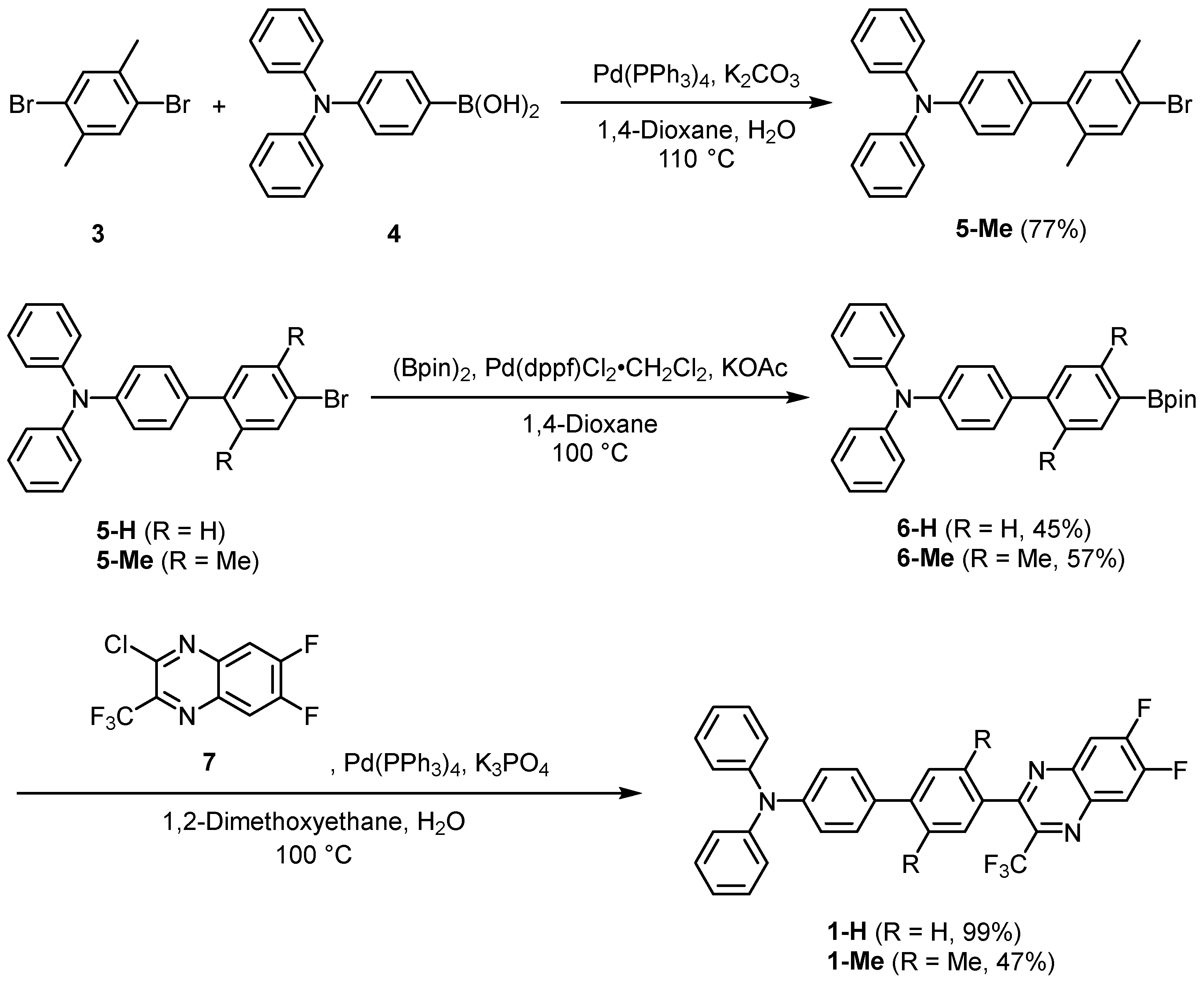
The synthesis of 1-H and 1-Me is shown in Scheme 1. Precursors 5-H [31] and 7 [30] were prepared according to the reported methods. Precursor 5-Me was obtained by the Suzuki–Miyaura cross-coupling reaction of 3 and 4. Precursors 5-H and 5-Me were then borylated by the Miyaura–Ishiyama borylation using (Bpin)2 to obtain 6-H and 6-Me, respectively. Then, 1-H and 1-Me were obtained by the Suzuki–Miyaura cross-coupling reaction of 7 with 6-H and 6-Me, respectively. The characterization of 1-H and 1-Me was carried out by 1H, 13C, and 19F NMR spectroscopy, ESI-TOF MS spectrometry, and elemental analysis. The 1H, 13C, and 19F NMR spectra of 5-Me, 6-H, 6-Me, 1-H, and 1-Me are shown in Figures S1–S5.

3.2. Photophysical Properties in Toluene

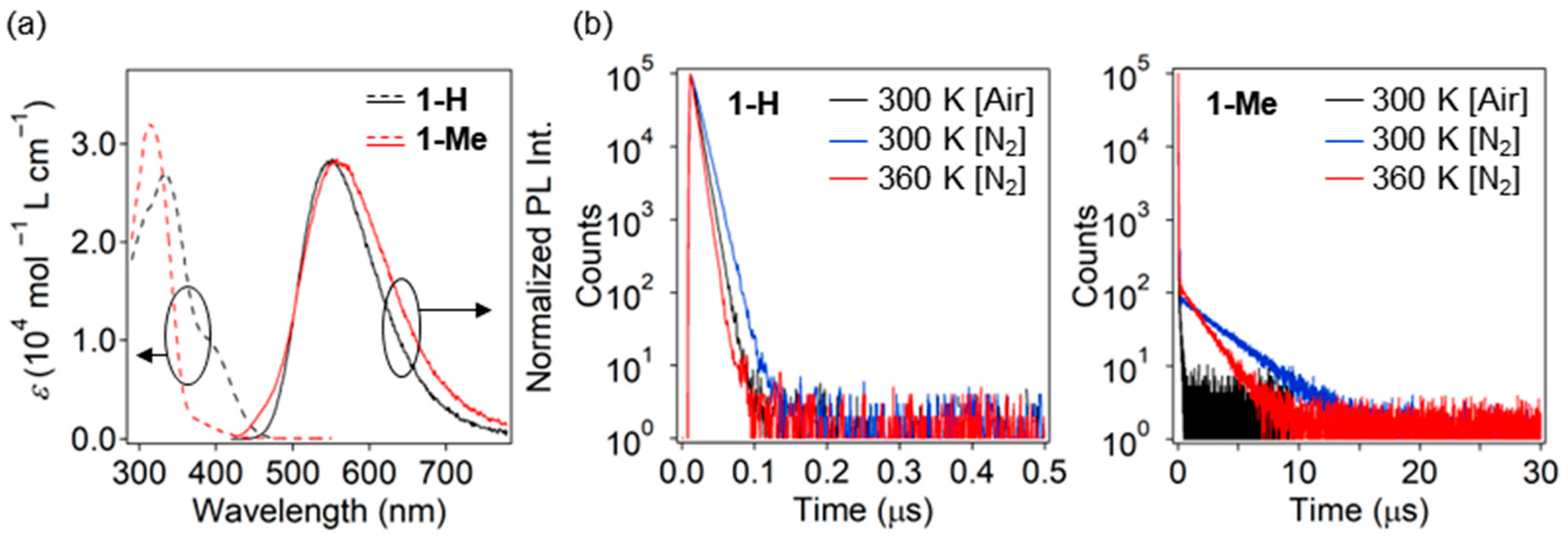
We firstly evaluated UV–vis absorption properties of 1-H and 1-Me in toluene at room temperature. The spectra are shown in Figure 2a, and the spectral data such as absorption peaks (λabs) and molar absorption coefficients (εabs) are summarized in Table 1. Dyes 1-H and 1-Me had strong absorption bands at 334 and 313 nm with εabss of 26,900 and 32,000 mol−1 L cm−1, respectively, which were assigned to moderate ICT transitions from the donor unit to the π-spacer and acceptor units as shown in Figure S6. In addition, both the dyes showed relatively weak shoulder absorption bands at 400 and 386 nm with εabss of 9000 and 1500 mol−1 L cm−1, respectively, attributed to a long-range ICT transition from the donor unit to the acceptor unit. The poor and slightly blue-shifted ICT absorption of 1-Me in comparison with the corresponding ICT absorption of 1-H implied the HOMO–LUMO separation by the largely twisted D–π–A structure of 1-Me as discussed in the section of theoretical calculations.
Contrary to the results for the UV–vis absorption properties, the λPL of 1-MePL; 558 nm) was red-shifted in comparison with that of 1-HPL; 552 nm), corresponding to CIE chromaticity coordinates of (0.41, 0.54) for 1-H and (0.42, 0.50) for 1-Me. From the theoretical calculations (vide infra), this result was attributed to the enhancement of ICT by the electron-donating methyl groups on the π-spacer as well as the larger structural relaxation of 1-Me than that of 1-H. The ΦPL of 1-H was 0.24 in toluene at room temperature under air, while that of 1-Me (ΦPL; 0.06) was quite low. Under nitrogen atmosphere, the ΦPLs increased to 0.55 and 0.21 for 1-H and 1-Me, respectively, indicating that the PL decay involves intersystem crossing to and from the triplet states, thus showing characteristics of typical TADF behavior [32,33].
To investigate the TADF properties of 1-H and 1-Me, we conducted PL lifetime measurements in toluene, as shown in Figure 2b, and the data are summarized in Table 1. Dye 1-H showed only a single component PL lifetime in the nanosecond order (τ1; 7.5 ns) at 300 K under air, assignable to prompt fluorescence. A similar result was obtained under nitrogen atmosphere, although the lifetime was a little bit elongated (τ1; 10 ns). On the other hand, 1-Me exhibited biexponential PL decay profiles at 300 K under air, consisting of a nanosecond-order lifetime component (τ1; 8.0 ns) and a sub-microsecond-order one (τ2; 150 ns), with contributions of A1 = 96.7% and A2 = 3.3%, respectively. In contrast, at 300 K under nitrogen atmosphere, τ2 increased to 3.7 μs, with the enlarged contribution of A2 = 11.3%. Furthermore, upon raising the temperature from 300 to 360 K, the contribution of τ2 further increased to A2 = 12.5%, indicating that 1-Me showed TADF characteristics.

3.3. Photophysical Properties in PMMA Film

We also evaluated the PL properties of 1-H and 1-Me in PMMA film. In 1 wt%-doped PMMA film, 1-H and 1-Me exhibited blue-shifted emission at 527 and 539 nm, respectively. Under air, their ΦPLs (0.41 and 0.19, respectively) were higher than those in toluene, owing to reduced structural relaxation in the rigid polymer matrix (Figure S7 and Table S1). Furthermore, the ΦPLs increased under nitrogen, particularly for 1-Me, indicating the involvement of TADF in the observed emission. We attempted to measure the PL lifetime. However, due to the weak emission intensity, reliable measurements could not be conducted. Therefore, the doping concentration was increased to 10 wt%.
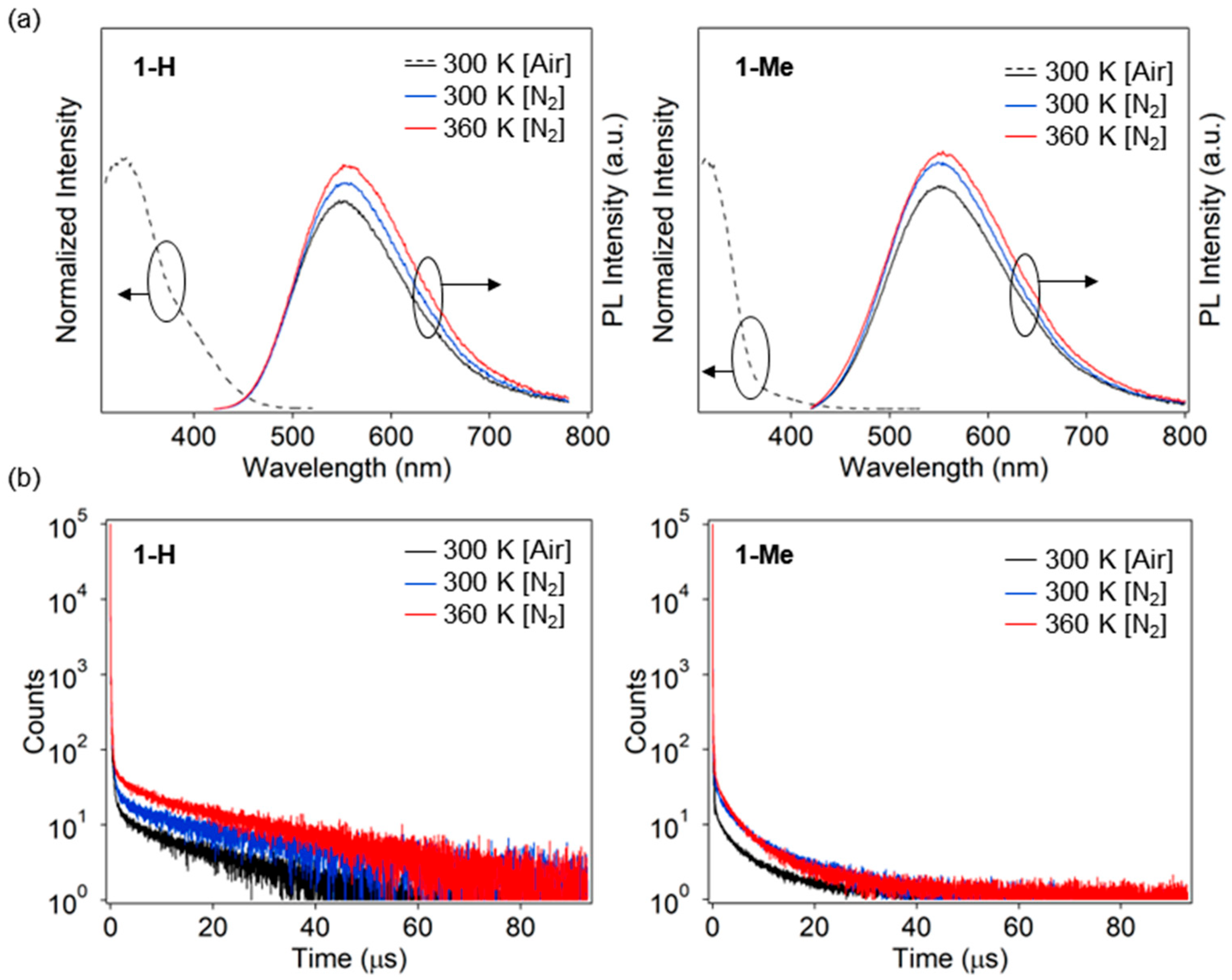
In Figure 3a is shown the excitation and PL spectra, and in Figure 3b is shown the PL decay profiles. The PL data including the PL lifetime data are also summarized in Table 2. As shown in Figure 3a, the excitation and PL spectra in 10 wt%-doped PMMA film at 300 K under air were slightly red-shifted for both the dyes, suggesting contributions from aggregate formation. In the case of 1-Me, the red shift of λPL by 11 nm was smaller than that of 1-H (20 nm), which can be attributed to steric hindrance from the methyl substituents on the π-spacer, preventing close molecular packing. In 10 wt%-doped PMMA film at 300 K under air, 1-H and 1-Me showed ΦPLs of 0.38 and 0.23, respectively. As observed in toluene and 1 wt%-doped PMMA film, the ΦPLs significantly increased to 0.55 and 0.46, respectively, under nitrogen atmosphere. PL lifetimes were successfully obtained in 10 wt%-doped PMMA film, providing further insight into the TADF properties. Interestingly, 1-H had delayed fluorescence components (τ3; 2.0 μs and τ4; 21 μs) as well as prompt fluorescent components (τ1; 16 ns and τ2; 180 ns) at 300 K under air, although it exhibited only prompt fluorescence in toluene. The delayed fluorescence components of 1-H in 10 wt%-doped PMMA film increased in the contribution from A3 = 1.0% and A4 = 11.5% under air to A3 = 2.2% and A4 = 21.9% under nitrogen atmosphere. The contribution of the delayed fluorescence components further increased to A3 = 3.1% for τ3 and A4 = 34.9% for τ4 at 360 K under nitrogen atmosphere. Thus, it was demonstrated that 1-H shows TADF in 10 wt%-doped PMMA film, albeit involving aggregate-based emission to some extent. Dye 1-Me also showed two prompt fluorescent components in the nanosecond order and two microsecond-order delayed fluorescence components under air. The delayed fluorescence components were enlarged under a nitrogen atmosphere and at higher temperatures, indicating that TADF is involved in its PL. To simplify the discussion, PL lifetimes were averaged using weights based on their relative contributions, and the averaged prompt and delayed fluorescence lifetimes were represented as τp and τd, respectively (Table 2) [34]. As a result, the contribution of the delayed fluorescence component (Ad) increased from 24.0 to 38.1% for 1-H and from 30.0 to 38.9% for 1-Me, when the temperature was elevated to 360 K under nitrogen atmosphere.

3.4. Estimation of ΔEST

For further discussion about the TADF properties of 1-H and 1-Me, ΔESTs were estimated from the fluorescence and phosphorescence spectra in glassy 2-methyltetrahydrofuran at 77 K under nitrogen atmosphere. The obtained spectra are shown in Figure 4, and the ES, ET, and ΔEST are listed in Table 3. The fluorescence spectra were recorded immediately after flash excitation without any delay, whereas the phosphorescence spectra were measured with delays of 0.10 ms for 1-H and 0.20 ms for 1-Me to eliminate fluorescence. The values of ES and ET were determined from the onsets of fluorescence and phosphorescence spectra, respectively. The onset wavelengths were obtained from the x-intercept of the best-fit line to the rising edge of each spectrum. The ES of 1-H (ES; 2.79 eV) was higher than that of 1-Me (ES; 2.68 eV), while the ET of 1-H (ET; 2.55 eV) was more stabilized than that of 1-Me (ET; 2.61 eV). As a result, it was found that 1-Me possesses a sufficiently small ΔEST of 0.07 eV to allow an efficient RISC process. In contrast, 1-H exhibited a moderately large ΔEST of 0.24 eV, which is somewhat high for efficient TADF.

3.5. Photophysical Parameters

Based on the ΦPLs and PL lifetimes of 1-H and 1-Me in 10 wt%-doped PMMA film at 300 K under nitrogen atmosphere, we estimated the photophysical parameters according to Equations (3)–(9) [35,36]:
k p = Φ p / τ p
Φ P L , N 2 = k p / k p + k I C
Φ p = k p / k p + k I C + k I S C
Φ I C = k I C / k p + k I C + k I S C
Φ I S C = 1 Φ p Φ I C
k d = Φ d / Φ I S C τ d
k R I S C = k p k d Φ d / k I S C Φ p
where the parameters Φ, τ, and k represent the quantum yield, the PL lifetime, and the rate constant, respectively. The subscripts p, d, IC, ISC, and RISC denote prompt fluorescence, delayed fluorescence, internal conversion from S1 to the ground state (S0), intersystem crossing from S1 to T1, and reverse intersystem crossing from T1 to S1, respectively.
The photophysical parameters are summarized in Table 4. Although no significant difference was found for the λPL among 2PL; 539 nm [30]), 1-H, and 1-Me, the ΦIC increased in the order of 2 (ΦIC; 0.21 [30]) < 1-H < 1-Me, implying that the introduction of the π-spacer enhanced molecular flexibility. Thus, 1-Me showed the smaller Φp than 1-H due to its larger ΦIC. In contrast, the Φd of 1-Me was the same as that of 1-H. Since the kps of both the dyes were comparable (kp; 1.2–1.5 × 10⁷ s−1), the higher kd of 1-Me (kd; 4.2 × 10⁴ s−1) relative to that of 1-H (kd; 1.9 × 10⁴ s−1) indicated more efficient TADF for 1-Me. The values of kISC and kRISC were 6.9 × 10⁶ and 1.0 × 10⁴ s−1 for 1-H, and 1.4 × 10⁷ and 1.9 × 10⁴ s−1 for 1-Me. Compared to 1-H, the larger kISC and kRISC of 1-Me indicated that the ISC and RISC processes of 1-Me are promoted due to the small ΔEST.

3.6. Theoretical Calculations

To discuss the influence of introduction of the π-spacer on the TADF properties, density functional theory (DFT) and time-dependent DFT (TD-DFT) calculations were conducted on the Gaussian 09 program package [37]. Optimized geometries at the S0, S1, and T1 states and the spin density at the T1 state were obtained at PBE0/6-31G(d,p) level. The natural transition orbital (NTO) analysis was conducted on the Multiwfn program [38,39]. Cartesian coordinates of 1-H and 1-Me at S0, S1, and T1 geometries are shown in Tables S2–S7.
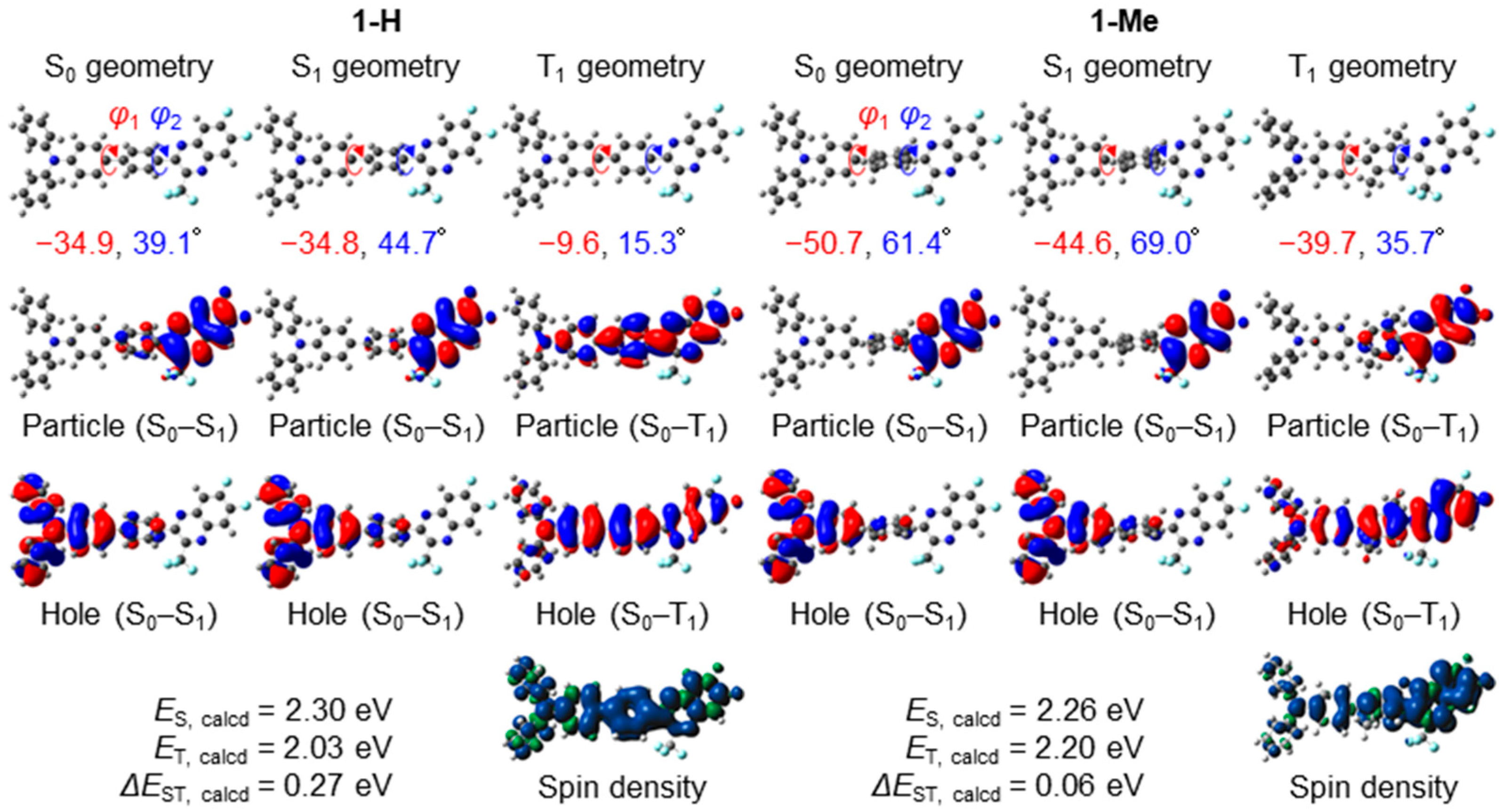
To support the TADF behavior of 1-H and 1-Me, energy levels of the S1 and T1 states were estimated. The calculated energy level of the S1 state (ES, calcd) of 1-Me (ES, calcd; 2.26 eV) was slightly lower than that of 1-H (ES, calcd; 2.30 eV). In contrast, the calculated energy level of the T1 state (ET, calcd) of 1-Me (ET, calcd; 2.20 eV) was significantly higher than that of 1-H (ET, calcd; 2.03 eV). As a result, the calculated ΔESTEST, calcd) of 1-MeEST, calcd; 0.06 eV) was smaller than that of 1-HEST, calcd; 0.27 eV). The ΔEST, calcds were consistent with the experimental values and suggested that the narrow ΔEST, calcd of 1-Me facilitates efficient RISC. The difference in the energy level was considered in terms of the molecular geometry. As shown in Supplementary Materials (Figure S8), the dihedral angle between the phenylene spacer and the N,N-diphenylaminophenyl donor unit is defined as φ1 (°), and that between the phenylene spacer and the quinoxaline unit is defined as φ2 (°). As shown in Figure 5, 1-H at the S0 geometry showed a φ1 of −34.9° and a φ2 of 39.1°, indicating that the D–π–A system at the S0 state is largely distorted on the donor and acceptor sides of the π-spacer. Compared to 1-H, 1-Me showed larger distortion angles at the 2,5-dimethyl-1,4-phenylene spacer; φ1 and φ2 of −50.7 and 61.4°, respectively, consistent with its blue-shifted ICT absorption with the lower εabs. As shown in Figure S8, the energetic barriers around φ1 and φ2 in 1-H are relatively low (less than 0.14 eV), whereas those in 1-Me are obviously high when the D–π–A conjugation system is less distorted. Thus, the large steric hindrance imposed by the methyl groups on the N,N-diphenylaminophenyl donor, the trifluoromethyl group, and the quinoxaline unit contributed to the large dihedral angles of 1-Me. Upon transition from the S0 to the S1 state, 1-H and 1-Me showed further twisted geometries with φ2 of 44.7 and 69.0°, respectively, although both the dyes adopted slightly planar geometries between the donor and the π-spacer; φ1 of −34.8 and −44.6°, respectively. Especially, 1-Me exhibited greater increases in the dihedral angles, φ1 and φ2 at the S1 state, than 1-H. To quantify the geometric change between the S0 and S1 states, the molecular root mean square deviation (RMSD) was calculated for 1-H and 1-Me (Figure S9), according to Equation (10) [40]:
R M S D = 1 n i n a t o m x i x i 2 + y i y i 2 + z i z i 2
where xi, yi, zi and x′i, y′i, z′i refer to the x-, y-, z-coordinates of the i-th atom of the S1 and S0 geometries, respectively. From the result of the RMSD calculations, 1-Me had larger RMSD (0.1962 Å) than 1-H (0.1139 Å), indicating that 1-Me undergoes larger substantial structural relaxation than 1-H. From the result of the NTO analysis for the S0–S1 transition of 1-H and 1-Me, the hole and particle at the S1 geometry were mainly distributed over the donor and acceptor units, respectively, with a slight contribution of the π-spacer on the hole. The slight stabilization of ES, calcd for 1-Me in comparison with ES, calcd for 1-H should be attributed to the enhanced ICT character due to the electron-donating methyl groups on the π-spacer. On the other hand, the NTOs at the T1 optimized geometry on the S0–T1 transition were quite different between 1-H and 1-Me. Dye 1-H exhibited a π–π* character in the S0–T1 transition, whereas 1-Me showed an ICT transition from the donor and the π-spacer to the acceptor unit. To explain the difference in the ET,scalcd between 1-H and 1-Me, spin density distribution at the T1 state was calculated, as it is known that localization of the spin density tends to destabilize the triplet state [41]. Compared to the delocalized spin density of 1-H, the spin density of 1-Me was found to be localized on the quinoxaline unit. Thus, the T1 energy level of 1-Me was relatively destabilized, thereby resulting in the small ΔEST.

4. Conclusions

We developed new ICT-type TADF dyes 1-H and 1-Me, consisting of an N,N-diphenylaminophenyl–phenylene–quinoxaline D–π–A system. Introduction of the π-spacer led to a blue shift in the λabs accompanied by a decrease in εabs, in comparison with the D–A dye 2. This indicated spatial separation of the frontier orbitals was enhanced in the present D–π–A system due to the highly twisted molecular geometry. On the other hand, both the dyes exhibited the PL with the λPL at ca. 550 nm in toluene, and the π-spacer hardly affected the λPL. In toluene, 1-Me showed TADF behavior due to the narrow ΔEST of 0.07 eV, while 1-H with a relatively large ΔEST of 0.24 eV did not show any TADF characteristics. In contrast, in 10 wt%-doped PMMA film, TADF behavior was observed for both the dyes. Notably, 1-Me showed a greater contribution of TADF to the overall PL than 1-H, indicating that the TADF process was more effectively promoted in 1-Me. The relatively large kISC and kRISC of 1-Me in comparison with 1-H upon the transition between the S1 and T1 states should be attributed to the small ΔEST of 1-Me. Theoretical calculations revealed that, at the S1 state, the donor–π-spacer and π-spacer–acceptor dihedral angles of 1-Me are larger than those of 1-H, indicating that 1-Me shows larger structural relaxation than 1-H. Based on the NTO analyses, the S1 energy level of 1-Me is slightly stabilized in comparison with that of 1-H by the enhanced ICT through electron donation from the methyl groups on the π-spacer as well as the larger structural relaxation upon the S0–S1 transition. Contrary to the S1 energy level, the T1 state of 1-Me is destabilized in comparison with 1-H. This is because, in the T1 state, the planar structure of 1-H facilitates delocalization of spin density, whereas the twisted geometry of 1-Me results in spin density localization on the acceptor unit. As a result, the stabilized S1 and destabilized T1 states of 1-Me lead to a smaller ΔEST than that of 1-H. Therefore, we conclude that we have succeeded in managing the ΔEST in the present D–π–A system by introducing the π-spacer that induces the molecular distortion of the D–π–A structure. We believe that the present study should provide valuable insight into the development of ICT-type TADF emitters with narrow ΔESTs.

Supplementary Materials

The following supporting information can be downloaded at: https://www.mdpi.com/article/10.3390/compounds5040059/s1, Figure S1: 1H and 13C NMR spectra of 5-Me; Figure S2: 1H and 13C NMR spectra of 6-H; Figure S3: 1H and 13C NMR spectra of 6-Me; Figure S4: 1H, 13C and 19F NMR spectra of 1-H; Figure S5: 1H, 13C and 19F NMR spectra of 1-Me; Figure S6: Simulated UV–vis absorption spectra at PBE0/6-31G(d,p) level and assignments of the electronic transitions for 1-H and 1-Me; Figure S7: Excitation and PL spectra of 1-H and 1-Me in 1 wt%-doped PMMA film at 300 K under air; Figure S8: The energy of the S0 states calculated as a function of the dihedral angles for 1-H and 1-Me; Figure S9: Optimized molecular geometries of 1-H and 1-Me with the root mean square deviation (RMSD) values; Table S1: PL properties of 1-H and 1-Me in 1 wt%-doped PMMA film under various conditions; Table S2: Cartesian coordinates of 1-H at S0 optimized geometry; Table S3: Cartesian coordinates of 1-H at S1 optimized geometry; Table S4: Cartesian coordinates of 1-H at T1 optimized geometry; Table S5: Cartesian coordinates of 1-Me at S0 optimized geometry; Table S6: Cartesian coordinates of 1-Me at S1 optimized geometry; Table S7: Cartesian coordinates of 1-Me at T1 optimized geometry.

Author Contributions

Conceptualization, M.N. and S.Y.; investigation, M.N. and H.C.; data curation, M.N. and H.C.; writing—original draft preparation, M.N. and S.Y.; writing—review and editing, S.K., T.M. and S.-i.K.; supervision, S.Y.; project administration, S.Y.; funding acquisition, M.N. and S.Y. All authors have read and agreed to the published version of the manuscript.

Funding

This research was funded by Japan Science and Technology Agency (JST) Support for Pioneering Research Initiated by the Next Generation, Japan (JST SPRING, Grant Number JPMJSP2139) and JST Core Research for Evolutional Science and Technology, Japan (JST CREST, Grant Number JPMJCR2001).

Data Availability Statement

The original contributions presented in this study are included in the article/Supplementary Material. Further inquiries can be directed to the corresponding author.

Conflicts of Interest

The authors declare no conflicts of interest.

References

  1. Tang, C.W.; VanSlyke, S.A. Organic electroluminescent diodes. Appl. Phys. Lett. 1987, 51, 913–915. [Google Scholar] [CrossRef]
  2. Tang, C.W.; VanSlyke, S.A.; Chen, C.H. Electroluminescence of doped organic thin films. J. Appl. Phys. 1989, 65, 3610–3616. [Google Scholar] [CrossRef]
  3. Swanson, S.A.; Wallraff, G.M.; Chen, J.P.; Zhang, W.; Bozano, L.D.; Carter, K.R.; Salem, J.R.; Villa, R.; Scott, J.C. Stable and Efficient Fluorescent Red and Green Dyes for External and Internal Conversion of Blue OLED Emission. Chem. Mater. 2003, 15, 2305–2312. [Google Scholar] [CrossRef]
  4. Sheats, J.R.; Antoniadis, H.; Hueschen, M.; Leonard, W.; Miller, J.; Moon, R.; Roitman, D.; Stocking, A. Organic Electroluminescent Devices. Science 1996, 273, 884–888. [Google Scholar] [CrossRef]
  5. Farinola, G.M.; Ragni, R. Electroluminescent materials for white organic light emitting diodes. Chem. Soc. Rev. 2011, 40, 3467–3482. [Google Scholar] [CrossRef] [PubMed]
  6. Hung, L.S.; Chen, C.H. Recent progress of molecular organic electroluminescent materials and devices. Mater. Sci. Eng. R Rep. 2002, 39, 143–222. [Google Scholar] [CrossRef]
  7. Mitschke, U.; Bäuerle, P. The electroluminescence of organic materials. J. Mater. Chem. 2000, 10, 1471–1507. [Google Scholar] [CrossRef]
  8. Chen, Z.; Ho, C.-L.; Wang, L.; Wong, W.-Y. Single-Molecular White-Light Emitters and Their Potential WOLED Applications. Adv. Mater. 2020, 32, 1903269. [Google Scholar] [CrossRef]
  9. Lee, M.-T.; Yen, C.-K.; Yang, W.-P.; Chen, H.-H.; Liao, C.-H.; Tsai, C.-H.; Chen, C.H. Efficient Green Coumarin Dopants for Organic Light-Emitting Devices. Org. Lett. 2004, 6, 1241–1244. [Google Scholar] [CrossRef]
  10. Thomas, K.R.J.; Lin, J.T.; Velusamy, M.; Tao, Y.-T.; Chuen, C.-H. Color Tuning in Benzo[1,2,5]thiadiazole-Based Small Molecules by Amino Conjugation/Deconjugation: Bright Red-Light-Emitting Diodes. Adv. Funct. Mater. 2004, 14, 83–90. [Google Scholar] [CrossRef]
  11. Wang, J.; Chepelianskii, A.; Gao, F.; Greenham, N.C. Control of exciton spin statistics through spin polarization in organic optoelectronic devices. Nat. Commun. 2012, 3, 1191. [Google Scholar] [CrossRef]
  12. Uoyama, H.; Goushi, K.; Shizu, K.; Nomura, H.; Adachi, C. Highly efficient organic light-emitting diodes from delayed fluorescence. Nature 2012, 492, 234–238. [Google Scholar] [CrossRef]
  13. Kaji, H.; Suzuki, H.; Fukushima, T.; Shizu, K.; Suzuki, K.; Kubo, S.; Komino, T.; Oiwa, H.; Suzuki, F.; Wakamiya, A.; et al. Purely organic electroluminescent material realizing 100% conversion from electricity to light. Nat. Commun. 2015, 6, 8476. [Google Scholar] [CrossRef] [PubMed]
  14. Hatakeyama, T.; Shiren, K.; Nakajima, K.; Nomura, S.; Nakatsuka, S.; Kinoshita, K.; Ni, J.; Ono, Y.; Ikuta, T. Ultrapure Blue Thermally Activated Delayed Fluorescence Molecules: Efficient HOMO–LUMO Separation by the Multiple Resonance Effect. Adv. Mater. 2016, 28, 2777–2781. [Google Scholar] [CrossRef] [PubMed]
  15. Sarma, M.; Wong, K.-T. Exciplex: An Intermolecular Charge-Transfer Approach for TADF. ACS Appl. Mater. Interfaces 2018, 10, 19279–19304. [Google Scholar] [CrossRef]
  16. Xiao, Y.; Wang, H.; Xie, Z.; Shen, M.; Huang, R.; Miao, Y.; Liu, G.; Yu, T.; Huang, W. NIR TADF emitters and OLEDs: Challenges, progress, and perspectives. Chem. Sci. 2022, 13, 8906–8923. [Google Scholar] [CrossRef] [PubMed]
  17. Huang, T.; Jiang, W.; Duan, L. Recent progress in solution processable TADF materials for organic light-emitting diodes. J. Mater. Chem. C 2018, 6, 5577–5596. [Google Scholar] [CrossRef]
  18. Tanaka, H.; Shizu, K.; Miyazaki, H.; Adachi, C. Efficient green thermally activated delayed fluorescence (TADF) from a phenoxazine-triphenyltriazine (PXZ-TRZ) derivative. Chem. Commun. 2012, 48, 11392–11394. [Google Scholar] [CrossRef]
  19. Stachelek, P.; Ward, J.S.; dos Santos, P.L.; Danos, A.; Colella, M.; Haase, N.; Raynes, S.J.; Batsanov, A.S.; Bryce, M.R.; Monkman, A.P. Molecular Design Strategies for Color Tuning of Blue TADF Emitters. ACS Appl. Mater. Interfaces 2019, 11, 27125–27133. [Google Scholar] [CrossRef]
  20. Zassowski, P.; Ledwon, P.; Kurowska, A.; Herman, A.P.; Lapkowski, M.; Cherpak, V.; Hotra, Z.; Turyk, P.; Ivaniuk, K.; Stakhira, P.; et al. 1,3,5-Triazine and carbazole derivatives for OLED applications. Dyes Pigm. 2018, 149, 804–811. [Google Scholar] [CrossRef]
  21. Adachi, C. Third-generation organic electroluminescence materials. Jpn. J. Appl. Phys. 2014, 53, 060101. [Google Scholar] [CrossRef]
  22. Nakanotani, H.; Tsuchiya, Y.; Adachi, C. Thermally-activated Delayed Fluorescence for Light-emitting Devices. Chem. Lett. 2021, 50, 938–948. [Google Scholar] [CrossRef]
  23. Zhu, L.; Zhang, Z.; Liy, Y.; Deng, Z.; Luo, Y.; Liu, Y.; Zhao, Z.; Tang, B.Z. Delayed Fluorescence Materials: Mechanism, Design, and Bioapplication. J. Phys. Chem. C 2024, 128, 15763–15777. [Google Scholar] [CrossRef]
  24. Chen, T.; Zheng, L.; Yuan, J.; An, Z.; Chen, R.; Tao, Y.; Li, H.; Xie, X.; Huang, W. Understanding the Control of Singlet-Triplet Splitting for Organic Exciton Manipulating: A Combined Theoretical and Experimental Approach. Sci. Rep. 2015, 5, 10923. [Google Scholar] [CrossRef]
  25. Tanaka, H.; Shizu, K.; Nakanotani, H.; Adachi, C. Dual Intramolecular Charge-Transfer Fluorescence Derived from a Phenothiazine-Triphenyltriazine Derivative. J. Phys. Chem. C 2014, 118, 15985–15994. [Google Scholar] [CrossRef]
  26. Chen, C.; Huang, R.; Batsanov, A.S.; Pander, P.; Hsu, Y.-T.; Chi, Z.; Dias, F.B.; Bryce, M.R. Intramolecular Charge Transfer Controls Switching Between Room Temperature Phosphorescence and Thermally Activated Delayed Fluorescence. Angew. Chem. Int. Ed. 2018, 57, 16407–16411. [Google Scholar] [CrossRef] [PubMed]
  27. Issac, J.; Ravi, S.; Karthikeyan, S.; Periyasami, G.; Moon, D.; Anthony, S.P.; Madhu, V. Substituent Controlled Tunable Fluorescence from Green to Red and pH Stimuli-Induced Reversible Fluorescence Switching in Triphenylamine–Quinoxaline Derivatives. Asian J. Org. Chem. 2024, 13, e202400282. [Google Scholar] [CrossRef]
  28. Hosokai, T.; Matsuzaki, H.; Nakanotani, H.; Tokumaru, K.; Tsutsui, T.; Furube, A.; Nasu, K.; Nomura, H.; Yahiro, M.; Adachi, C. Evidence and mechanism of efficient thermally activated delayed fluorescence promoted by delocalized excited states. Sci. Adv. 2017, 3, e1603282. [Google Scholar] [CrossRef] [PubMed]
  29. Pershin, A.; Hall, D.; Lemaur, V.; Sancho-Garcia, J.-C.; Muccioli, L.; Zysman-Colman, E.; Beljonne, D.; Olivier, Y. Highly emissive excitons with reduced exchange energy in thermally activated delayed fluorescent molecules. Nat. Commun. 2019, 10, 597. [Google Scholar] [CrossRef]
  30. Nagaoka, M.; Ueda, K.; Chihara, H.; Suzuki, N.; Kodama, S.; Maeda, T.; Yagi, S. Photo- and Electroluminescence of N,N-Diphenylaminophenyl–Quinoxaline Donor–Acceptor-Type Dyes: Electronic Impacts of Electron-Withdrawing Ability of the Acceptor Unit. Asian J. Org. Chem. 2025, 14, e00364. [Google Scholar] [CrossRef]
  31. Kim, M.-J.; Ahn, M.; Shim, J.H.; Wee, K.-R. Terphenyl backbone-based donor–π–acceptor dyads: Geometric isomer effects on intramolecular charge transfer. Phys. Chem. Chem. Phys. 2020, 22, 3370–3378. [Google Scholar] [CrossRef]
  32. Keruckiene, R.; Vaitusionak, A.A.; Hulnik, M.I.; Berezianko, I.A.; Gudeika, D.; Macionis, S.; Mahmoudi, M.; Volyniuk, D.; Valverde, D.; Olivier, Y.; et al. Is a small singlet–triplet energy gap a guarantee of TADF performance in MR-TADF compounds? Impact of the triplet manifold energy splitting. J. Mater. Chem. C 2024, 12, 3450–3464. [Google Scholar] [CrossRef]
  33. Méhes, G.; Nomura, H.; Zhang, Q.; Nakagawa, T.; Adachi, C. Enhanced Electroluminescence Efficiency in a Spiro-Acridine Derivative through Thermally Activated Delayed Fluorescence. Angew. Chem. Int. Ed. 2012, 51, 11311–11315. [Google Scholar] [CrossRef]
  34. Zhang, Q.; Kuwabara, H.; Potscavage, W.J., Jr.; Huang, S.; Hatae, Y.; Shibata, T.; Adachi, C. Anthraquinone-Based Intramolecular Charge-Transfer Compounds: Computational Molecular Design, Thermally Activated Delayed Fluorescence, and Highly Efficient Red Electroluminescence. J. Am. Chem. Soc. 2014, 136, 18070–18081. [Google Scholar] [CrossRef]
  35. Wu, T.-L.; Huang, M.-J.; Lin, C.-C.; Huang, P.-Y.; Chou, T.-Y.; Chen-Cheng, R.-W.; Lin, H.-W.; Liu, R.-S.; Cheng, C.-H. Diboron compound-based organic light-emitting diodes with high efficiency and reduced efficiency roll-off. Nat. Photonics 2018, 12, 235–240. [Google Scholar] [CrossRef]
  36. Goushi, K.; Yoshida, K.; Sato, K.; Adachi, C. Organic light-emitting diodes employing efficient reverse intersystem crossing for triplet-to-singlet state conversion. Nat. Photonics 2012, 6, 253–258. [Google Scholar] [CrossRef]
  37. Frisch, M.J.; Trucks, G.W.; Schlegel, H.B.; Scuseria, G.E.; Robb, M.A.; Cheeseman, J.R.; Scalmani, G.; Barone, V.; Petersson, G.A.; Nakatsuji, H.; et al. Gaussian 09, Revision A.01; Gaussian, Inc.: Wallingford, CT, USA, 2009. [Google Scholar]
  38. Lu, T.; Chen, F. Multiwfn: A Multifunctional Wavefunction Analyzer. J. Comput. Chem. 2012, 33, 580–592. [Google Scholar] [CrossRef]
  39. Lu, T. A comprehensive electron wavefunction analysis toolbox for chemists, Multiwfn. J. Chem. Phys. 2024, 161, 082503. [Google Scholar] [CrossRef] [PubMed]
  40. Hou, B.; Liu, M.; Li, Y.; Pan, Y.; Yang, B. Effect of cyano substitution in TADF molecules on luminescence properties: A theoretical study. Chem. Phys. 2023, 575, 112080. [Google Scholar] [CrossRef]
  41. Shao, S.; Wang, S.; Xu, X.; Yang, Y.; Lv, J.; Ding, J.; Wang, L.; Jing, X.; Wang, F. Bipolar Poly(arylene phosphine oxide) Hosts with Widely Tunable Triplet Energy Levels for High-Efficiency Blue, Green, and Red Thermally Activated Delayed Fluorescence Polymer Light-Emitting Diodes. Macromolecules 2019, 52, 3394–3403. [Google Scholar] [CrossRef]
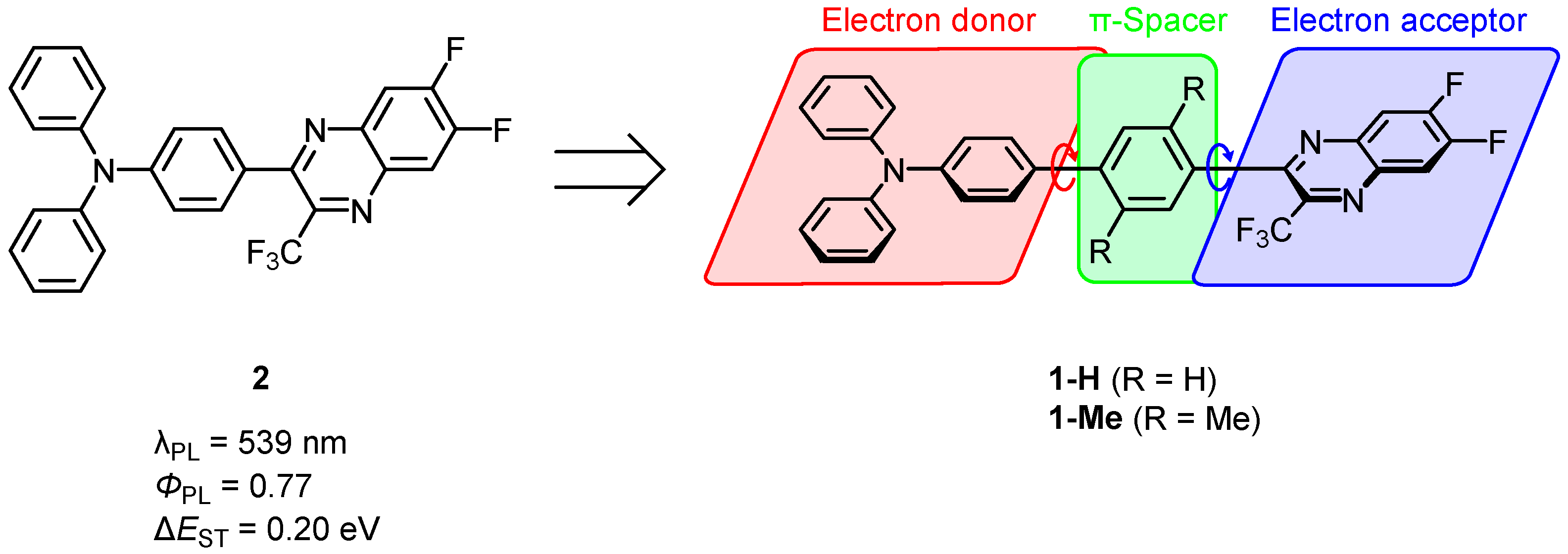
Figure 1. Chemical structures of 1-H, 1-Me, and 2.
Compounds 05 00059 g001
Scheme 1. Synthesis of 1-H and 1-Me.
Compounds 05 00059 sch001
Figure 2. (a) UV–vis absorption (dotted lines) and PL spectra (solid lines) of 1-H and 1-Me in toluene at room temperature under air. (b) PL decay profiles of 1-H and 1-Me in toluene.
Compounds 05 00059 g002
Figure 3. (a) Excitation (dotted lines) and PL spectra (solid lines) of 1-H and 1-Me in 10 wt%-doped PMMA film. (b) PL decay profiles of 1-H and 1-Me in 10 wt%-doped PMMA film.
Compounds 05 00059 g003
Figure 4. Fluorescence (Flu.) and phosphorescence (Phos.) spectra of 1-H and 1-Me in glassy 2-methyltetrahydrofuran at 77 K under nitrogen atmosphere. The phosphorescence spectra were recorded at 0.10 (1-H) or 0.20 ms delay (1-Me). Dotted lines are best-fit lines for onset determination.
Compounds 05 00059 g004
Figure 5. Dihedral angles and NTO analyses for 1-H and 1-Me at the S0, S1, and T1 geometry, and spin density maps of these dyes at the T1 state. The calculations were performed at PBE0/6-31G(d,p) level.
Compounds 05 00059 g005
Table 1. UV–vis absorption and PL properties of 1-H and 1-Me in toluene under various conditions.
Compd.λabs (nm)
abs (mol−1 L cm−1)]
λPL
(nm)
ΦPL
[Air/N2]
CIE 2
(x, y)
τ1 (ns) [A1 (%)]/τ2 (μs) [A2 (%)]
300 K, Air300 K, N2360 K, N2
1-H334 [26,900], 400 [9000] 15520.24/0.55(0.41, 0.54)7.5 [100]/-10 [100]/-6.1 [100]/-
1-Me313 [32,0], 386 [1500] 15580.06/0.21(0.42, 0.50)8.0 [96.7]/0.15 [3.3]24 [88.7]/3.7 [11.3]17 [87.5]/1.9 [12.5]
1 Obtained by peak deconvolution using Gaussian functions. 2 Commission internationale de l’éclairage (CIE) chromaticity coordinate.
Table 2. Excitation and PL properties of 1-H and 1-Me in 10 wt%-doped PMMA film under various conditions.
Compd.ConditionλEX (nm)λPL (nm)ΦPLCIE 3
(x, y)
τ1 (ns)
[A1 (%)]
τ2 (ns)
[A2 (%)]
τ3 (μs)
[A3 (%)]
τ4 (μs)
[A4 (%)]
τp (ns) 4
[Ap%] 5
τd (μs) 6
[Ad%] 7
1-H300 K, Air326, 403 15470.38(0.39, 0.50)16 [79.5]180 [8.0]2.0 [1.0]21 [11.5]--
300 K, N2-5550.55-16 [68.3]200 [7.7]2.3 [2.2]32 [21.9]35 [76.0]29 [24.0]
360 K, N2-5510.61 2-13 [53.9]150 [8.0]2.2 [3.1]29 [34.9]26 [61.9]27 [38.1]
1-Me300 K, Air313, 394 15500.23(0.38, 0.49)3.0 [69.7]60 [13.9]1.8 [5.0]10 [11.4]--
300 K, N2-5540.46-3.0 [51.0]70 [19.0]3.4 [12.7]17 [17.3]21 [70.0]11 [30.0]
360 K, N2-5540.49 2-2.0 [41.3]60 [19.8]3.1 [21.7]16 [17.2]21 [61.1]8.8 [38.9]
1 Obtained by peak deconvolution using Gaussian functions. 2 Estimated from the integrated PL intensity relative to that at 300 K. 3 Commission internationale de l’éclairage (CIE) chromaticity coordinate. 4 τp = (A1τ1 + A2τ2)/(A1 + A2). 5 Ap = A1 + A2. 6 τd = (A3τ3 + A4τ4)/(A3 + A4). 7 Ad = A3 + A4.
Table 3. Onset wavelengths of fluorescence and phosphorescence spectra (λflu, onset and λphos, onset, respectively), energy levels of the lowest excited singlet and triplet states (ES and ET, respectively) of 1-H and 1-Me, and the energy gap between the excited singlet and triplet states (ΔEST).
Compd.λflu, onset (nm)λphos, onset (nm)ES (eV) 1ET (eV) 2ΔEST (eV) 3
1-H4444862.792.550.24
1-Me4634752.682.610.07
1 ES (eV) = 1240/λflu, onset. 2 ET (eV) = 1240/λphos, onset. 3 ΔEST (eV) = ES (eV) − ET (eV).
Table 4. Photophysical parameters of 1-H and 1-Me in 10 wt%-doped PMMA film at 300 K under nitrogen atmosphere.
Compd.ΦpΦdkp (107 s−1)kd (104 s−1)ΦICΦISCkIC (106 s−1)kISC (106 s−1)kRISC (104 s−1)
1-H0.420.131.21.90.340.249.86.91.0
1-Me0.320.141.54.20.380.3018141.9
Disclaimer/Publisher’s Note: The statements, opinions and data contained in all publications are solely those of the individual author(s) and contributor(s) and not of MDPI and/or the editor(s). MDPI and/or the editor(s) disclaim responsibility for any injury to people or property resulting from any ideas, methods, instructions or products referred to in the content.