Article

Improvement of Structural, Elastic, and Magnetic Properties of Vanadium-Doped Lithium Ferrite

1
Department of Physics, Faculty of Science, Ain Shams University, Abbassia, Cairo 11566, Egypt
2
Department of Chemical Sciences, University of Padova, Via Marzolo 1, 35131 Padova, Italy
*
Author to whom correspondence should be addressed.
Compounds 2025, 5(4), 54; https://doi.org/10.3390/compounds5040054
Submission received: 27 October 2025 / Revised: 16 November 2025 / Accepted: 25 November 2025 / Published: 1 December 2025

Abstract

The influence of vanadium substitution on the structure, elastic, mechanical, and magnetic behavior of lithium ferrite (Li0.5+xVxFe2.5−2xO4; x = 0.00–0.2) was systematically studied. X-ray diffraction (XRD) was used to investigate the crystal structure, and infrared spectroscopy (IR) was used to determine the cation distribution between the two ferrite sublattices, in addition to the elastic and mechanical behavior of Li0.5+xVxFe2.5−2xO4 ferrites. X-ray analysis revealed a monotonic decrease in lattice parameter from 8.344 Å to 8.320 Å with increasing V5+ content, confirming lattice contraction and stronger metal–oxygen bonding. Despite a moderate increase in porosity (from 6.9% to 8.9%), the elastic constants C11 and C12 increased, indicating improved stiffness and reduced compressibility. The derived Young’s, bulk, and rigidity moduli rose with the doping of V5+. Correspondingly, the longitudinal, shear, and mean velocities (Vl, Vs, and Vm) increased. The Debye temperature also showed a linear rise from 705 K to 723 K with V5+ doping, directly reflecting enhanced lattice stiffness and phonon frequency. Furthermore, both the saturation magnetization (MS) and the initial permeability (μi) increased up to V5+ concentration x = 0.1 and then decreased. Curie temperature (TC) decreased with increasing V5+ concentration, while both the saturation magnetization (MS) and the initial permeability (μi) increased up to V5+ concentration x = 0.1 and then decreased, while the coercivity (HC) showed the reverse trend. These results confirm that V5+ incorporation significantly enhances the Li ferrite, improving its elastic strength, lattice energy, thermal stability, and magnetically controlling properties and making them suitable for a variety of daily uses such as magneto-elastic sensors, high-frequency devices, and applications requiring mechanically robust ferrite materials.

1. Introduction

Ferrites have recently gained significant attention due to their versatile applications in modern technologies such as lithium-ion batteries, communication systems, information storage, microwave devices, biosensors, magnetic fluids, hyperthermia treatment, water purification, and renewable energy systems [1,2,3,4].
Spinel ferrites, with the general formula AB2O4, exhibit three structural types: normal, inverse, and mixed spinel ferrite. In normal spinel, divalent cations occupy the tetrahedral (A) sites while Fe3+ ions occupy the octahedral [B] sites. In inverse spinel, Fe3+ ions occupy the (A) sites, and both Fe3+ and divalent cations share the [B] sites. Mixed spinel ferrite exhibits a random distribution of cations over both sublattices. The magnetic and electrical properties of ferrites—saturation magnetization, permeability, Curie temperature, and coercivity—are strongly linked to cation distribution, particle size, crystal structure, and synthesis conditions [5,6,7]. Applications in materials science, telecommunication, biomedicine, and data storage all depend on an understanding of these phenomena. Magnetic characteristics may be optimized for applications by adjusting particle size and morphology. The inverse spinel crystal structure of lithium ferrite, which possesses soft ferromagnetic characteristics, has the A-site for Fe3+ ions and the B-site for Li+ and the remaining Fe3+ ions [8]. Lithium ferrite has many features that make it eligible for participating vigorously in the electronic and technological industries, such as microwave devices and rechargeable Li-ion batteries, as well as circulators, filters, adjustable electronic modulators, and memory cores [9]. Additionally, there is a great focus on doped Li-ferrites for their possible applications in Li batteries as cathode materials [10]. The high values of magnetization, permeability, and Curie temperature are some of the Li-ferrite advantages. Many authors have studied the structural and magnetic properties of Li-ferrite [1,2,4,11]. Furthermore, the modulations of Li-ferrite magnetic properties via doping with different ions (substitution and addition) were studied. For example, Li-Cd ferrite [12], Li-Ni ferrite [13], Li-Co ferrite [13], Li-Ge ferrite [14], and Li-Zn-Ti ferrite [13] were all investigated. On the other hand, pentavalent vanadium was shown to have an interesting effect on the different properties of ferrites. Both magnetic and crystallographic properties of vanadium-substituted Li-Co-Ti ferrite were investigated [15]. Increasing the vanadium content led to an increase in the saturation magnetization and then to some decrease, whereas the coercivity decreased. The effect of V5+ substitution on the dielectric and magnetic properties of Li-Zn-Ti ferrite showed that the density, the magnetization, and the Curie temperature all decreased with increasing vanadium content. The dielectric behavior increased with the increase in temperature while showing dispersion with the frequency [16,17]. Magnetic and electric studies of only one sample of very small content (only 0.02) of vanadium ions substituted Li-ferrite showed that the lattice parameter, Curie temperature, and the dc electrical resistivity decrease while the initial permeability and the magnetization increase [18]. Moreover, the effect of V2O5 additions on the ordering of Li-Zn ferrite was investigated by T. Iimura [19], where the superlattice disappeared by increasing (V5+) content. Incorporating V2O5 was observed to alter the distribution of cations within the spinel structure. V5+ ions likely integrate into the lattice, impacting the arrangement of Li, Zn, and Fe ions, which in turn modified magnetic properties, like saturation magnetization and Curie temperature. The research showed that minor quantities of V2O5 might boost elastic and magnetic performance by refining the cation distribution [19].
From the previous literature survey, it is observed that the previous studies seem insufficient to understand the detailed role of the vanadium ion in changing the elastic magnetic properties of ferrites, especially lithium ferrite. In addition, the linking of these changes with the effect of the vanadium ion on the crystal structure is not clearly discussed in these studies. For these reasons, this work deals, for the first time, with the effect of V5+ ion as a substitution on the structure, physical, elastic, and magnetic properties of Li-ferrite, aiming to improve its mechanical and magnetic properties. Elastic parameters such as the elastic constants (C11 and C12), bulk modulus (B), Young’s modulus (Y), rigidity modulus (R), and Debye temperature are critical for understanding lattice dynamics, interatomic bonding, and mechanical stability. Since these parameters are directly linked to interatomic force constants and sound velocities, their variation with V5+ content provides deeper insight into how substitution influences lattice stiffness and energy. Moreover, relatively high concentrations of vanadium were incorporated into the ferrite lattice to arrive at a complete discussion and understanding of its role in the changes of these properties. Lastly, the magneto-mechanical characteristics of Li0.5+xVxFe2.5−2xO4 ferrite open the door for several applications, such as magneto-elastic sensors and high-frequency devices, which make several everyday uses possible.

2. Materials and Methods

2.1. Preparation of Samples

Samples of the chemical formula Li0.5+xVxFe2.5−2xO4 (x = 0.0 to 0.2, step 0.05) were synthesized using the usual solid-state synthesis. Oxides (purity = 99.99%, Sigma Aldrich, Carlsbad, CA, USA) of Fe2O3 and V2O5, together with Li2CO3, were mixed according to their molecular masses. Each sample’s mixture was ground for 24 h to a fine powder using a machine type (Retsch RM100, Düsseldorf, Germany), presintered at 800 °C for 6 h in air, ground again, and pressed under 700 MPa at room temperature into toroidal forms. At last, all samples were sintered at 1050 °C for 3 h in air and then slowly cooled to room temperature. Figure 1 illustrates a schematic diagram for solid-state synthesis for Li0.5+xVxFe2.5−2xO4 synthesis. The reaction is as follows:
0.25 + 0.5 x L i 2 C O 3 + 0.5 x V 2 O 5 + 1.25 x F e 2 O 3 L i 0.5 + x V x F e 2.5 2 x O 4 + ( 0.25 + 0.5 x ) C O 2

2.2. Measurements and Calculations

An X’Pert Graphics diffractometer (PANalytical, Almelo, The Netherlands) was used to obtain X-ray diffractograms (CuKα, 40 kV, 30 mA, and λ = 1.54056 Å). Step-scan mode was used to measure diffraction intensities in the angular range of 20–80° (step size 2θ = 0.02°; counting time 2 s). Theoretical X-ray density ( ρ x ) of the samples was calculated according to the formula ρ x = 8 m N A a 3 , where m is the molecular mass, N A is Avogadro’s number, and a is the lattice parameter [20]. Archimedes’ principle was used to measure the density of samples ( ρ ). The porosity percentage P% was calculated according to the relation P = 100 [ 1 ( ρ ρ x ) ] [21]. In the wavenumber range of 400–4000 cm−1, Fourier transform infrared spectroscopy (FTIR) was carried out at room temperature in transmission mode using a Spectrometer JASCO, 6300, Hachioji, Japan. Magnetization (M) was measured using a room temperature vibrating sample magnetometer (VSM) (model Lake Shore no. 7410, Westerville, OH, USA). A toroid of each sample was used as a transformer core for measuring the initial permeability µi as a function of temperature at a constant frequency f = 10 kHz. The value of µi was calculated using Poltinnikov’s formula [22], V s = μ o n p n s I p A ω L μ i , where Vs is the induced voltage in the secondary coil, np and ns are the number of turns of the primary and secondary coils, respectively, Ip is the current in the primary coil, A is the cross-sectional area of the sample, ω is the angular frequency, and L is the average path of the magnetic flux. To ensure reproducibility, all samples were synthesized under identical conditions using the same batch of precursors, and each characterization (XRD, FTIR, and VSM) was repeated at least three times, yielding deviations within ±3%. These controls support the reliability of the reported data and trends.

3. Results

3.1. Structure and Physical Properties

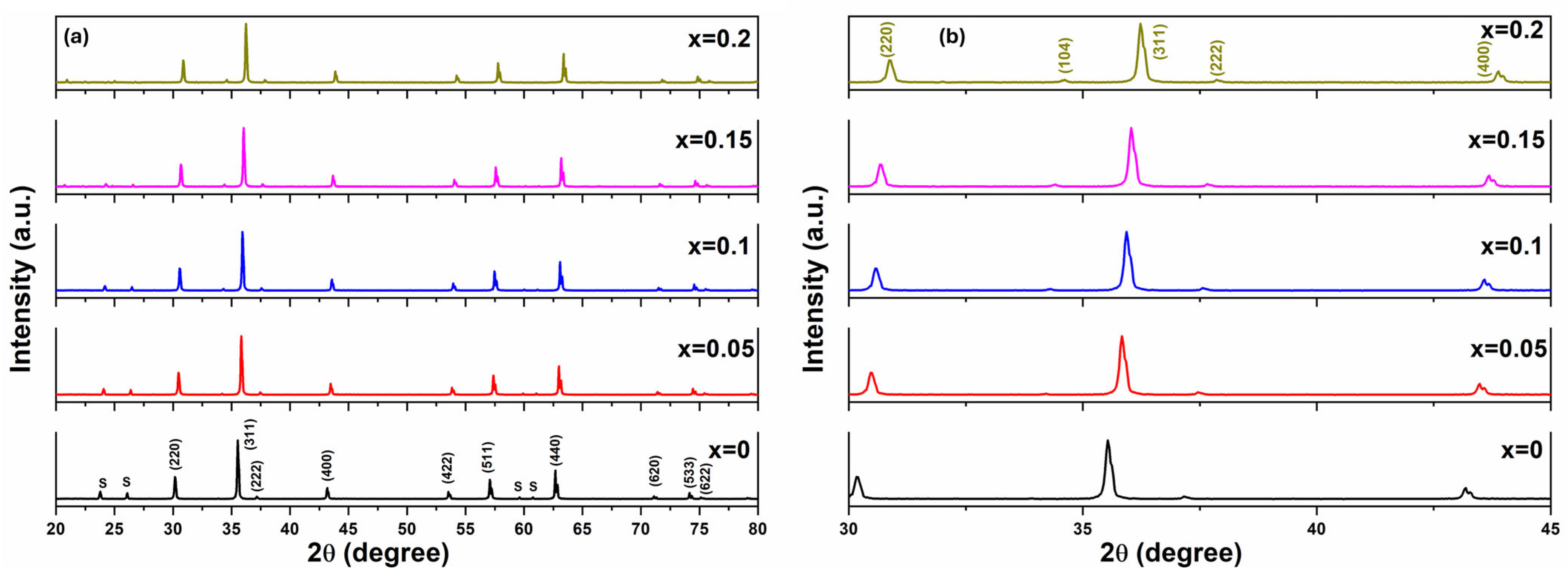
X-ray diffraction patterns for all samples are illustrated in Figure 2a. It is noted that they all have the cubic spinel structure, and the Miller indices of all diffraction peaks are indexed using the ordered Li0.5Fe2.5O4 JCPDS card number 75-0407. Moreover, the 1:3 octahedral ordering (superstructure planes) or (long-range order) reflections for the cubic primitive Li-ferrite also appear, and they are observed to vanish gradually on increasing V5+ ion concentration. A similar effect of the addition of V2O5 to Li-Zn [19] and Mn-Zn [23] ferrite was previously reported.
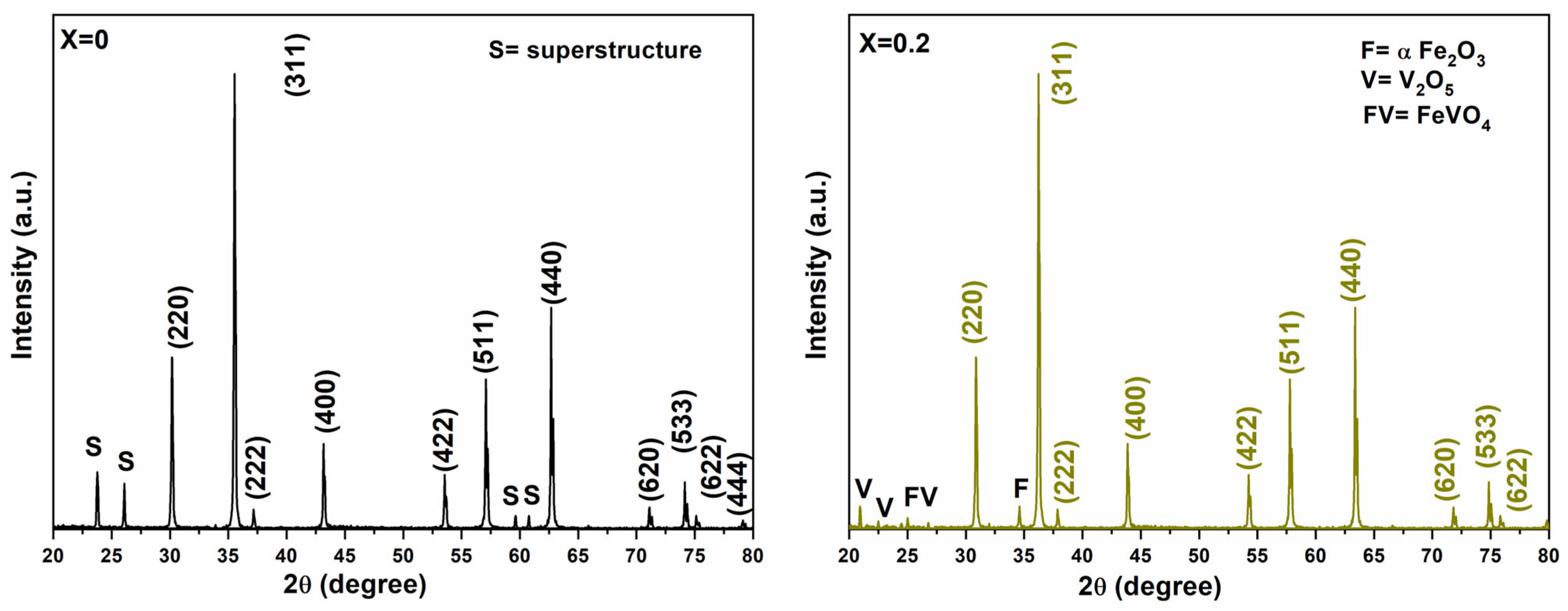
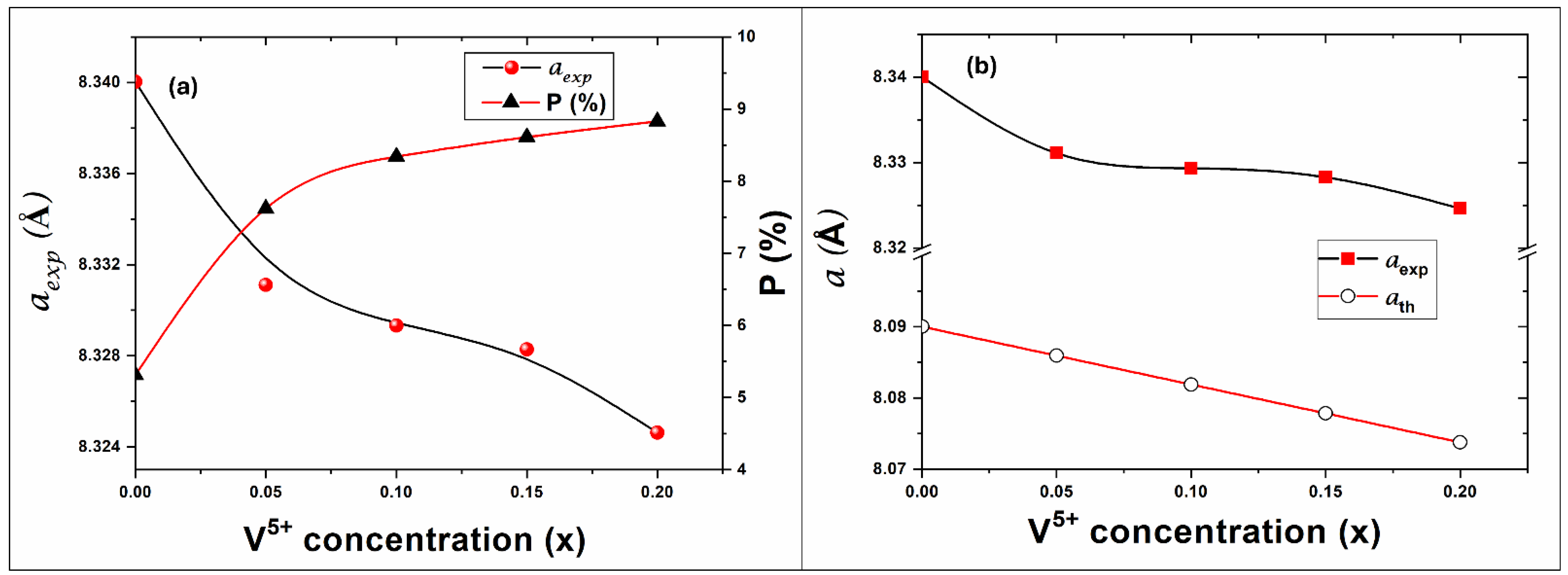
However, Figure 3 shows that minority extra phases of very small relative intensities (<5% maximum) of α-Fe2O3, V2O5 [24], and FeVO4 for two samples (x = 0 and 0.2) were detected with increasing V5+ ion concentration. Moreover, Figure 2b illustrates the shift of the positions of the crystallographic planes for all Li0.5+xVxFe2.5−2xO4 samples. One can observe that all reflections are shifted to higher 2θ values, which implies an increase in the inter-planar spacing according to Bragg’s law. This must lead the lattice parameter to decrease due to V5+ substitution. To make sure of that, the relation a e x p =   d h k l h 2 + k 2 + l 2 was used to calculate the experimental lattice parameter ( a e x p ) of the Li0.5+xVxFe2.5−2xO4 phase, where d h k l is the inter-planer spacing and h, k, and l are the Miller indices of each plane. These values of ( a e x p ) were plotted versus the Nelson–Riley function F ( θ ) , where F θ = 1 2 c o s 2 θ s i n θ + c o s 2 θ θ . Straight lines were obtained, and the extrapolation of them to F ( θ ) = 0 gives the accurate values of ( a e x p ) [25]. Further, both lattice parameters and densities for all investigated samples are listed in Table 1. Figure 4a shows the lattice parameter ( a e x p ) variation with V5+ concentration (x). The value of the lattice parameter for the unsubstituted sample Li0.5Fe2.5O4 (8.340 Å) compares well with that recorded before (8.332 Å [18]). It is clear from Figure 4a that the lattice parameter decreases with increasing V5+ content. Such a decrease could be understood, noting that the average value of V5+ and Li1+ ions radii is less than the radius of the replaced Fe3+ ion. Furthermore, the X-ray detected oxide phases (α-Fe2O3, V2O5, and FeVO4) reside at the grain boundaries and may cause a pressure on the unit cell and in turn share in the decrease in the lattice parameter. For more confirmation, the theoretical values of the lattice parameter ( a t h ) were calculated using the following cation distribution between the two sublattices (A, tetrahedral, and B, octahedral) of the spinel structure [18].
V x 5 + F e 1 x 3 + A L i 0.5 + x 1 + F e 1.5 x 3 + B O 4 2
The Li1+ ion has a strong preference to occupy the B-site [2] and the previously reported preference of V5+ ion to occupy the A-site [18]. This distribution itself will soon be assured by an analysis of the IR spectra of our samples. According to this cation distribution, the theoretical values of the lattice parameter ( a t h ) were calculated by Equation (1) as follows:
a t h = 8 3 3 [ r A + r O + 3 r B + r O ]
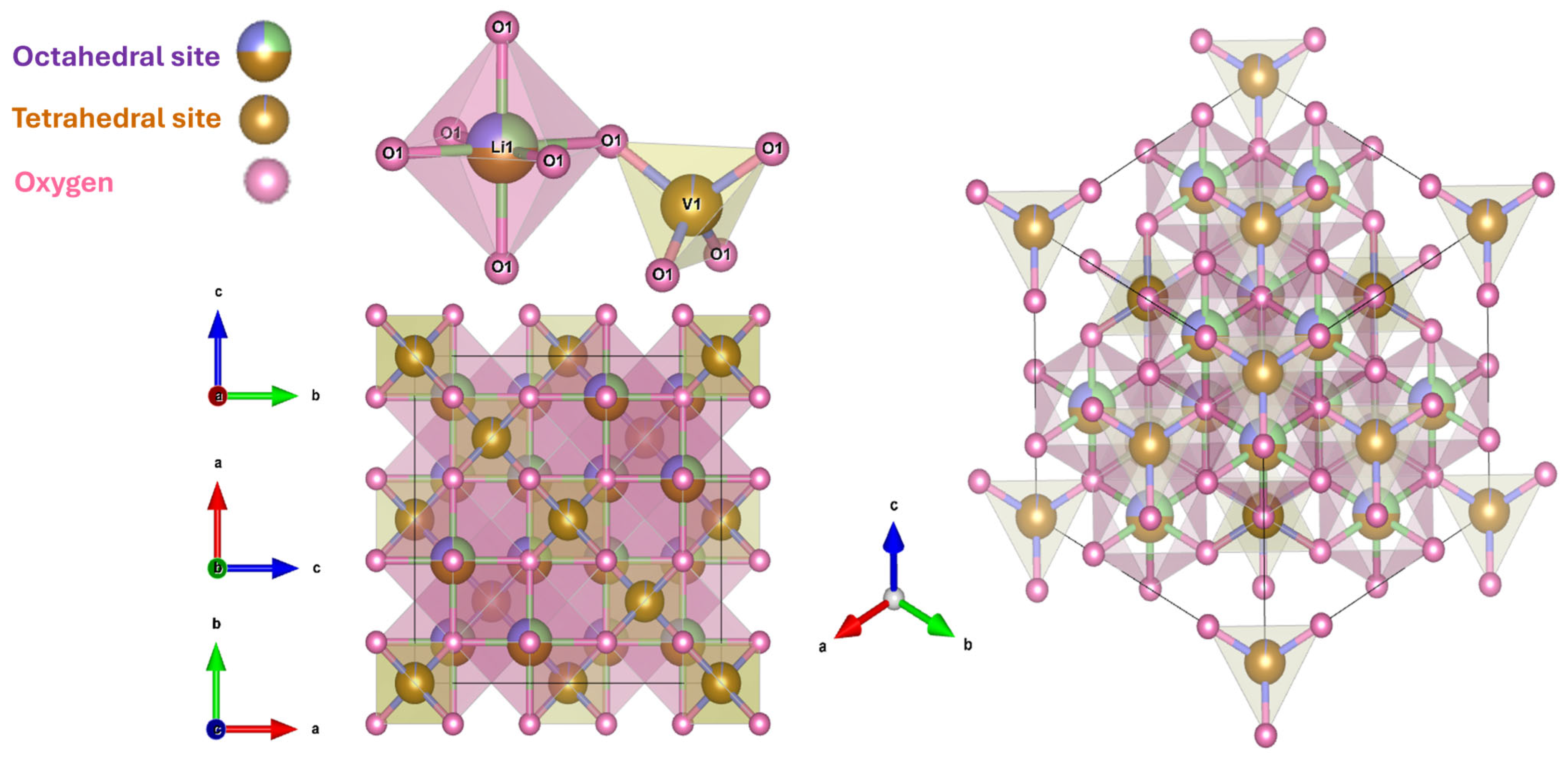
where rA, rB, and rO are the radii of the A-site, B-site, and oxygen ion, respectively [8]. The fact that the values of all ionic radii depend on the coordination number was considered in the substitution in Equation (1). A schematic for the cubic and polyhedron structures of Li0.5+xVxFe2.5−2xO4 ferrite is shown in Figure 5 [25]. Both values (theoretical and experimental) are plotted in Figure 4b, and it is clear that they have a decreasing behavior. Moreover, it can be noticed that a e x p > a t h for all V5+ concentrations. This could be attributed to the formation of Fe2+ ions (of larger radius) according to the oxidation process and the metal–metal charge transfer transition. On the other hand, Figure 4a illustrates that the porosity P% increases with increasing V5+ concentration. Similar results were previously reported for vanadium-substituted Li-ferrite [18]. Such an increase in porosity is expected because the density decreases for Li0.5+xVxFe2.5−2xO4 as heavier Fe3+ ions (molecular mass = 55.847 g/mole) are replaced by lighter Li1+ and V5+ ions (average molecular mass = 28.941 g/mole). This result may also be explained by noting the competition between the two types of porosities, Pintra (intragranular) and Pinter (intergranular) [25]. Pintra is related to the ionic radii in the lattice, while Pinter is directly proportional to the grain size. For Li0.5+xVxFe2.5−2xO4, the replacement of Fe3+ ions by Li1+ and V5+ ions of a smaller average radius causes a decrease in Pintra values. Moreover, an increase in V5+ content in ferrites leads the grain size to increase [15] and hence increases Pinter. This, in turn, supports that the increase in the intergranular porosity is the dominant factor in increasing the total porosity P%.

3.2. Infrared Spectroscopic Analysis

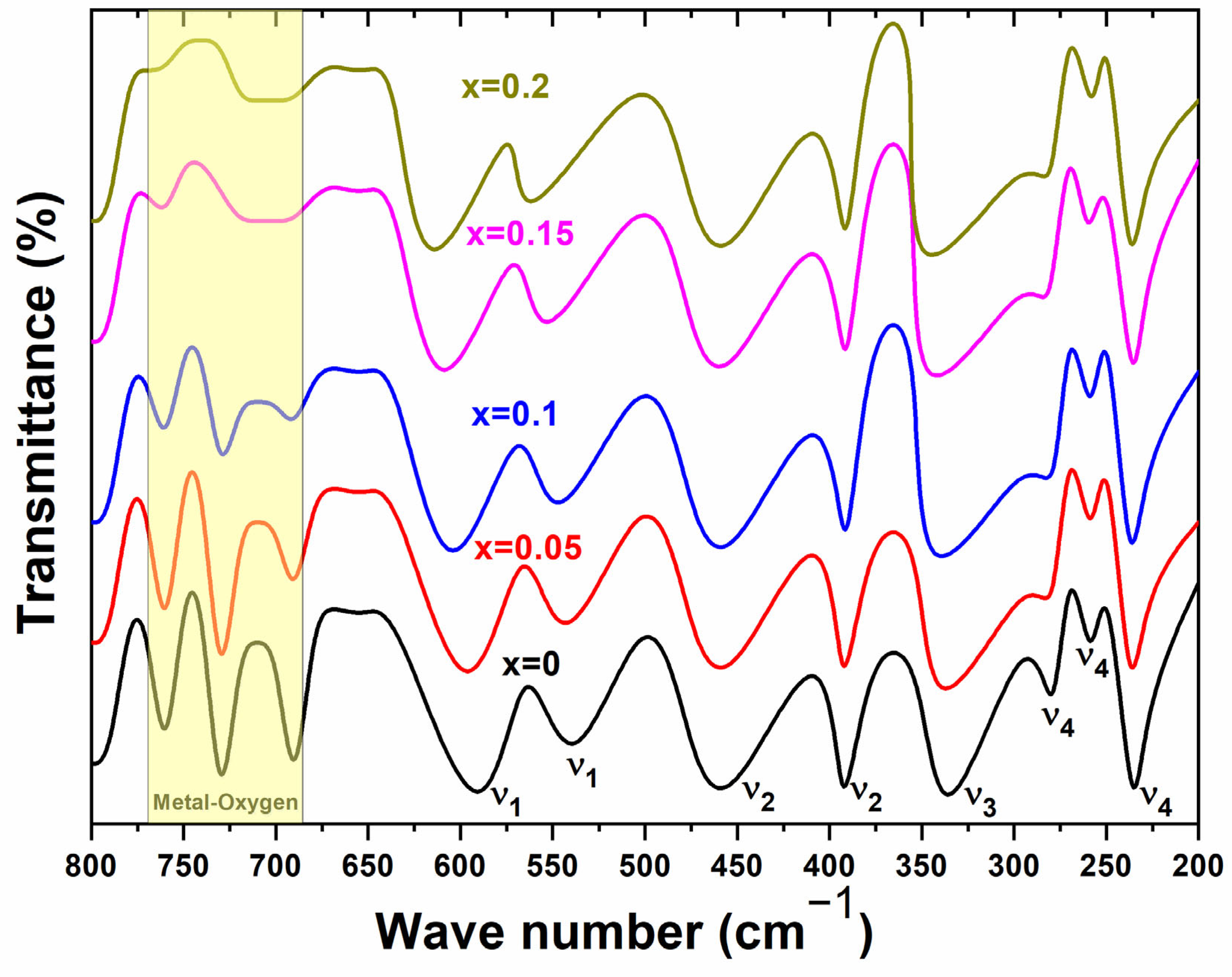
In fact, one of the most important sources for collecting information on positions of different ions in the crystal unit cell is what is provided by infrared (IR) spectra [26]. In view of this, the IR transmission spectra of all studied ferrite samples were obtained to help in the determination of the cation distribution of Li0.5+xVxFe2.5−2xO4 ferrite. Figure 6 illustrates the IR spectra of all Li0.5+xVxFe2.5−2xO4 samples, and Table 2 has the wavenumber positions of their bands. Each IR spectrum is found to have mainly four bands. These bands demonstrate the four fundamental vibrations for spinel ferrites (namely, ν1, ν2, ν3, and ν4) [27]. ν1 refers to tetrahedral complexes, ν2 and ν3 refer to octahedral complexes, and ν4 refers to the lattice vibrations [13]. It is valuable to note here that ν3 is usually assigned to Fe2+- O complexes, which indicates that Fe2+ ions exist in all our ferrite samples, as concluded in the previous discussion of the lattice parameter behavior. Moreover, the band positions of the Li0.5Fe2.5O4 sample agree well with those reported earlier [28]. On the other hand, it is clear that other bands appear within the wavenumber range of 690–760 cm−1. These bands are mainly associated with the stretching vibrations of metal–oxygen (Fe3+–O2−) bonds within the octahedral positions of the spinel lattice and tend to disappear by increasing the concentration of V5+ ions (i.e., their intensity decreases). Such bands are due to the long-range order (superstructure), and they ensure the role of V5+ ion substitution in the transformation from ordered to disordered Li-ferrite [13]. Moreover, the presence of Fe2+ ions in Li0.5+xVxFe2.5−2xO4 ferrites has been demonstrated to result in either this band splitting or the formation of shoulders on the absorption bands. This phenomenon is attributed to the Jahn–Teller distortion induced by Fe2+, which creates local distortions in the crystal field potential, consequently leading to splitting the band to 690 cm−1 and 760 cm−1 [29]. This enforces our previous interpretation of these superstructure planes in X-ray diffractograms.
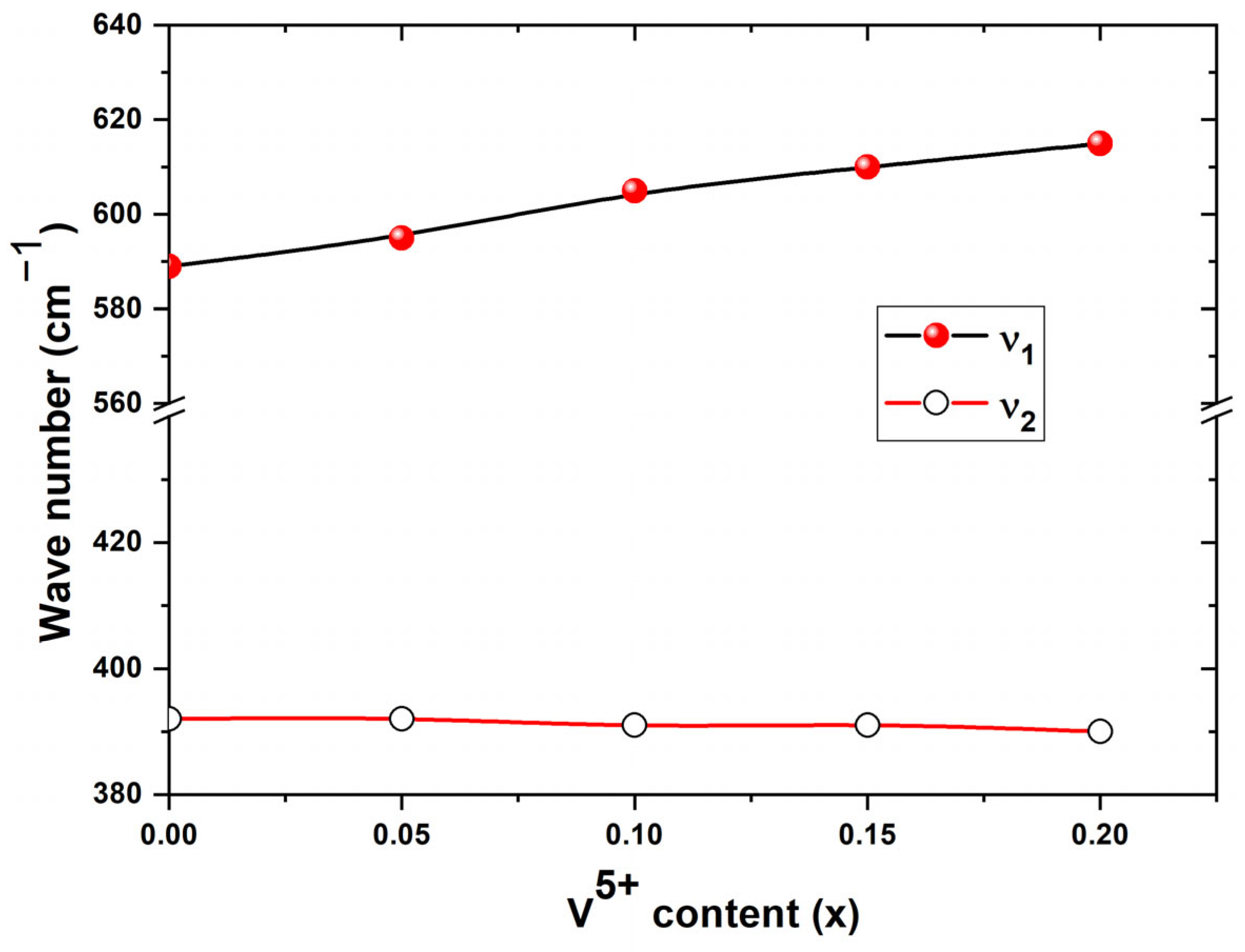
Furthermore, Figure 7 shows the variations of ν1 and ν2 for all Li0.5+xVxFe2.5−2xO4 ferrite samples. It is obvious that ν1 increases with increasing V5+ concentration while ν2 is nearly constant. Such an observation implies that V5+ ions occupy the tetrahedral sites only. The behavior of ν is generally governed by the force constant (F) and the mass of the ion (m) forming the bond through the relation ν   α F m [30]. Increasing V5+ concentration, the force constant (F) increases as it is inversely proportional to the lattice parameter (which was found to decrease with increasing x. Conversely, the mass (m) decreases because the mass of V5+ (50.942 g/mole) is lighter than that of Fe3+ (55.847 g/mole). It can be concluded that both the increase in (F) and the decrease in (m) lead to an increase in ν1, which is found experimentally. Thus, the increase in ν1 supports that V5+ ions replace Fe3+ ions in the A-site. The preference of V5+ ions to enter the A-site matches well with previous studies [31]. From the above discussion, and according to the fact that Li1+ ions have a strong preference to occupy the B-site [12], one can propose the cation distribution to be as follows:
V x 5 + F e 1 x 3 + A L i 0.5 + x 1 + F e 1.5 x 3 + B O 4 2
For tetrahedral and octahedral sites, respectively, the force constants (Ft) and (Fo) could be computed using the following relation [32]:
F t = 7.62 × M 1 × υ t × 10 7
F o = 5.31 × M 2 × υ o × 10 7
where M1 and M2 are the molecular weight of both tetra- and octahedral sites, respectively, and υ t and υ o are the corresponding centre frequencies of both sites. Table 2 provides a summary of the force values. While Fo decreases, the force constant Ft increases as V5+ content increases. This variance can be explained by the difference in ionic radii between Fe3+ and V5+ions, as well as their occupancy at the A- and B-sites. Like most thermal quantities, the Debye temperature (θIR) connects the elastic characteristics to thermodynamic ones. So, it is one of the most crucial characteristics. As the molecular structure of ferrites may be inferred from the IR spectra, (θIR) could be determined using the following relation, which is where the greatest lattice vibrations occur [32]:
θ I R = h c υ a v 2 π k B
where h, c, kB, and υ a v are Planck’s constant, the velocity of light, Boltzmann’s constant, and the average value of the wavenumbers.
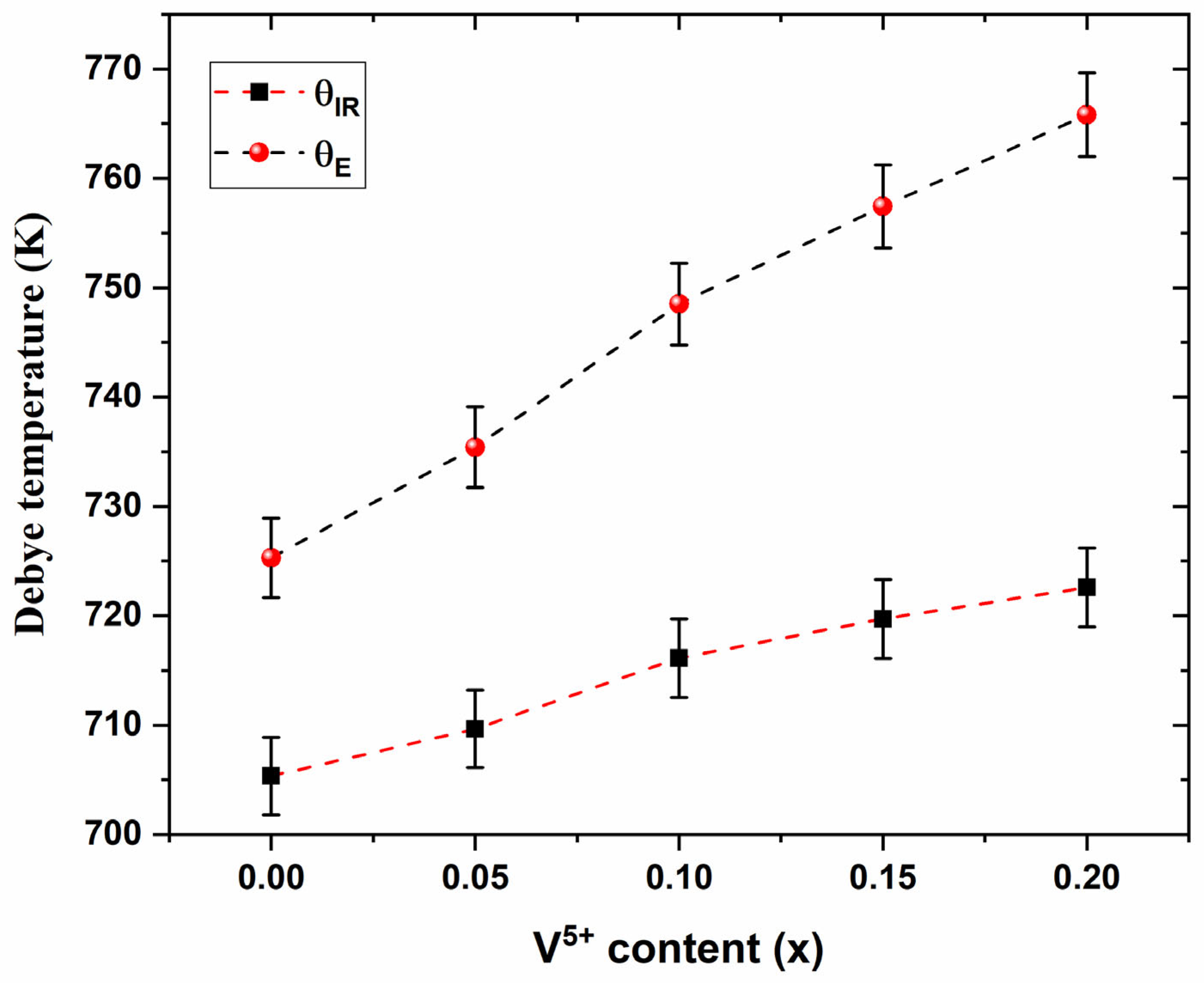
Figure 8 illustrates the variation of Debye temperature with V5+ content. One can see that, with an increase in V5+ concentration, the Debye temperature became higher. The rise in the wavenumber of IR bands may be the cause of this change. According to the specific heat theory, the rising trend of the Debye temperature may be explained by the fact that electrons absorb some of the heat, which causes the value of θIR to rise. It is important to note that higher V5+ content results in a higher rate, demonstrating once more the strong correlation between V5+ doping and the change in (θIR). Additionally, these variations in the Debye temperature imply that electrons in n-type semiconductors, rather than other processes, are responsible for the conduction in these samples [29].

3.3. Elastic Properties

Elastic parameters (as constants and moduli) that characterize a solid’s capacity to stretch or compress in various directions can be categorized into two terms: elastic constant and/or elastic moduli. Although there are generally thirty-six elastic moduli, only three moduli are present in spinel ferrites [32]. Elastic moduli and Debye temperature (θE) were determined using the IR and structural data details of the investigated ferrite as lattice parameters, X-ray density, porosity, and average force constant values. The following formula was used to calculate the average force constant (Fave.):
F a v e . = F t + F o 2
The stiffness constants (C11) and (C12) were calculated using the following relations [32,33]:
C 11 = F a v e . a
C 12 = C 11 × σ ( 1 σ )
where ( a ) and (σ) are the lattice parameter and Poisson’s ratio, respectively, which depend on the porosity according to the following relation [33]:
σ = 0.324   ( 1 1.0143   P )
It was found that Poisson’s ratio values, which are shown in Table 2, fall between 0.3006 and 0.2941, and this indicates that the samples are elastically stable and the bonds are still partly ionic (Fe–O, Li–O) but have some covalent contribution in line with the isotropic elasticity hypothesis [32,34]. The slight decrease from 0.3006 to 0.2941 as V5+ content increases means that the material becomes slightly more rigid and less compressible, and the lattice becomes slightly stiffer and less ductile.
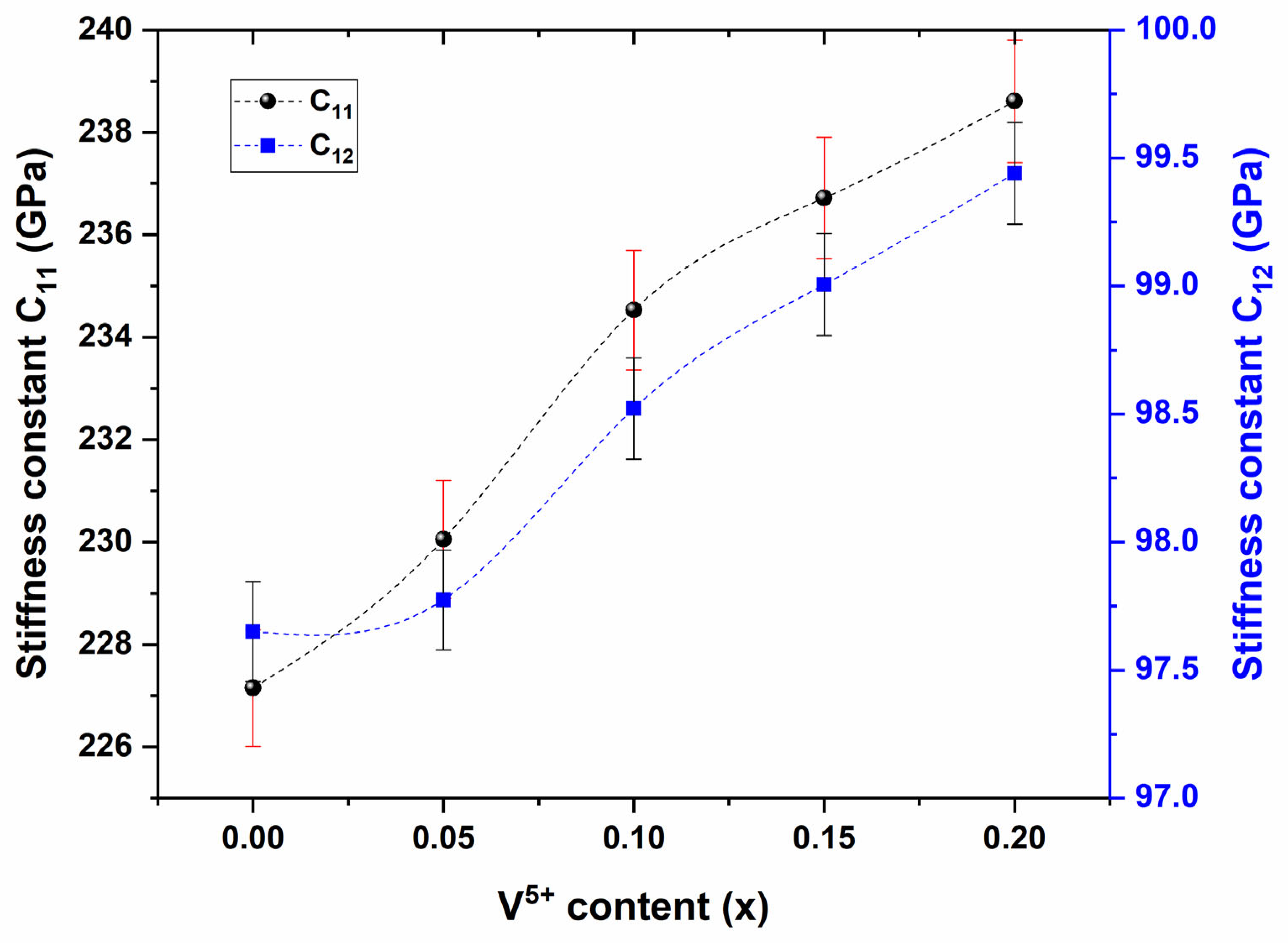
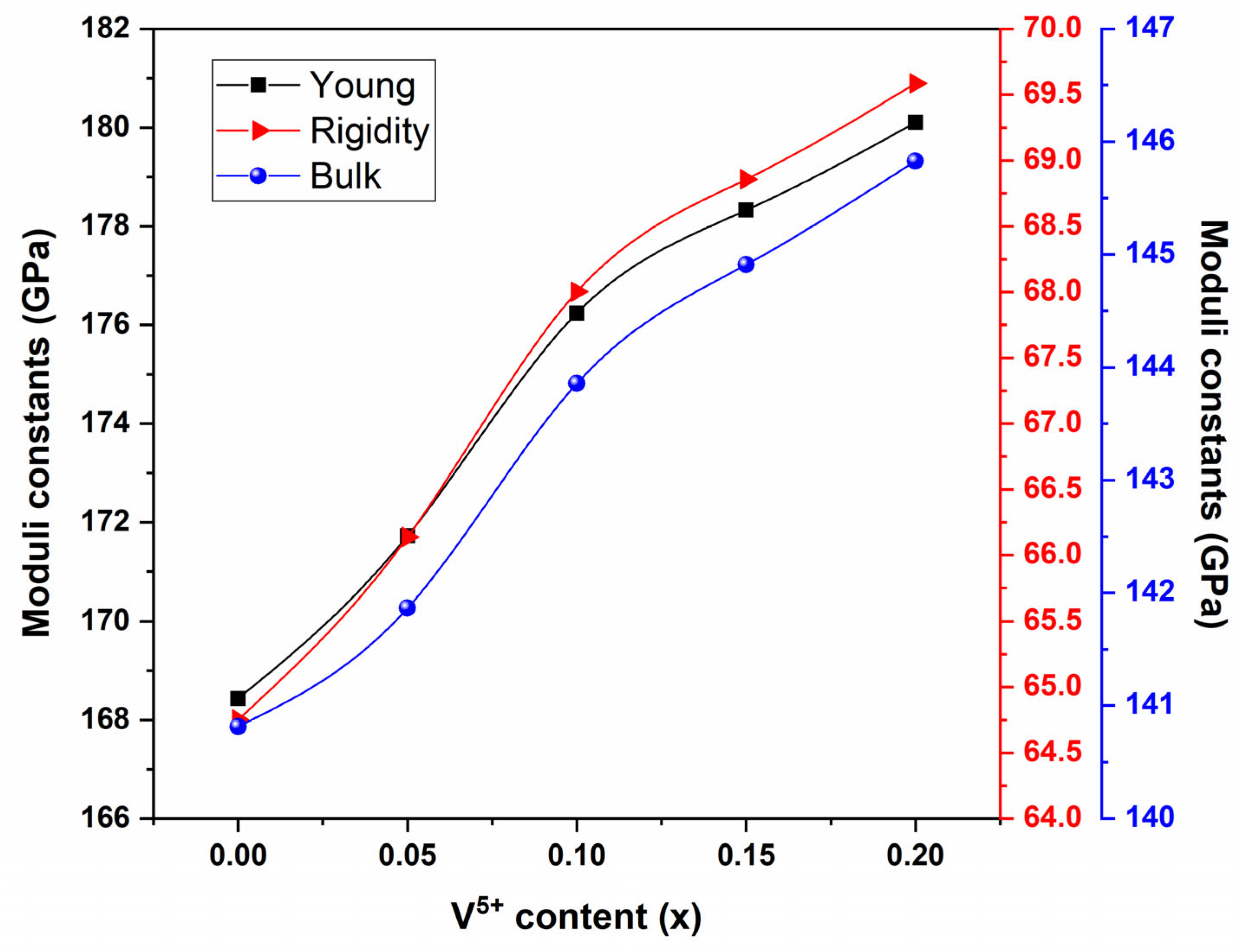
Moreover, Figure 9 shows that the stiffness constants (C11 and C12) increased as the concentration of V5+ increased. The force constant and the tightness of the atom bonding really affect the stiffness constant values. Accordingly, it can be proposed that the emerging bond between V5+ and Fe3+ bonds in the current spinel system (K increases a decreases) is the reason why the stiffness constants rose with the V5+ concentration. Additionally, using these two stiffness constants, the elastic moduli, such as Young’s modulus (E), rigidity modulus (R), and bulk modulus (B), were calculated using the following relations [33].
Young’s modulus
E = ( C 11 C 12 ) ( C 11 + 2 C 12 ) ( C 11 + C 12 )
Rigidity modulus
R = E 2 ( σ + 1 )
Bulk modulus
B = 1 3 ( C 11 + 2 C 12 )
Figure 10 illustrates how the elastic moduli increase as the concentration of V5+ ions increases because the interatomic linkages between the various atoms eventually gain their effectiveness. Based on Wooster’s model [33,35], the behaviour of elastic moduli is associated with the weakening of interatomic bonding between various atoms in the current spinel system. Moreover, the increase in elastic moduli with V5+ doping in Li ferrite arises from lattice contraction and enhanced metal–oxygen bond strength due to the smaller, higher-valence, and more covalently bonded V5+ ions. Furthermore, as V5+ concentration rises, the repulsion between electrons may increase because V5+ ions replace Fe3+ ions in the outermost orbital configuration in the Li0.5+xVxFe2.5−2xO4 ferrite system. This, in turn, causes the elastic moduli to further go up.
Moreover, using the following formulas proposed by Waldron [33], the longitudinal and shear elastic wave velocities ( V l ) and ( V s ), respectively, were calculated as follows:
V l =   ( C 11 ρ x ) 1 2
V s   = ( R ρ x ) 1 2
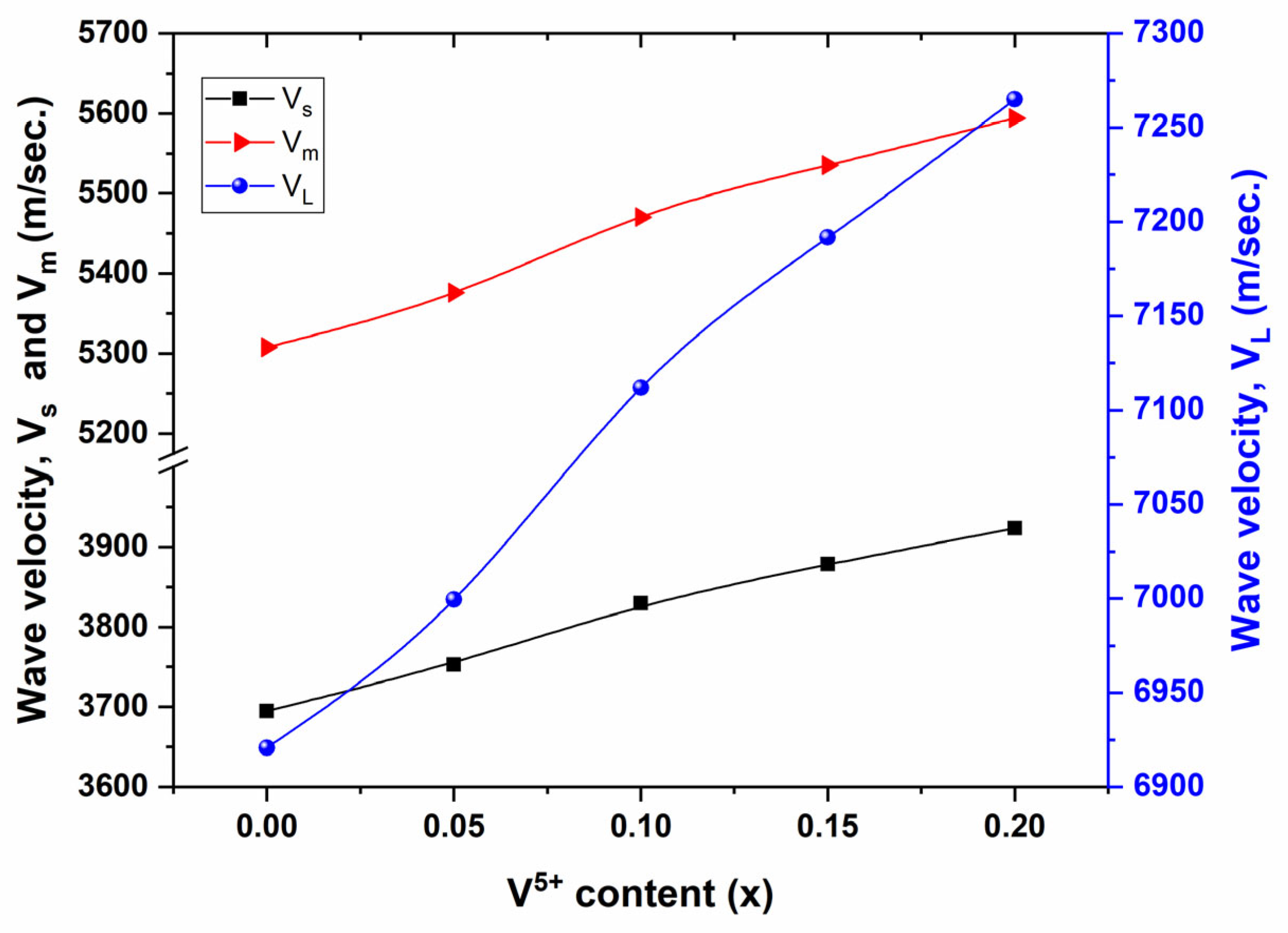
Then, ( V l ) and ( V s ) were then used to compute the mean wave velocity ( V m ). Figure 11 depicts the variation of V l , V s , and V m against V5+ content. The decreasing trend, as shown in Figure 11, of V l , V s , and V m increased with V5+ substitution in Li0.5+xVxFe2.5−2xO4. This could be due to (i) the lattice contraction, in which the substitution of a smaller radius of V5+ decreases the lattice constant, and the shorter cation–oxygen distances mean stiffer bonds with higher force constants, leading to large elastic moduli and, consequently, high sound velocities. (ii) V5+ has a higher positive charge and stronger electrostatic attraction to O2−. So, both effects increase bond strength and interatomic force constants, which directly raise elastic wave velocities. Further, the partial replacement of Fe3+ with V5+ enhances the cation–oxygen–cation bridge stiffness (B–O–B), which reduces internal lattice vibrations and increases the resistance to deformation.
Additionally, using Anderson’s formula [32,36], the Debye temperature from elastic parameters ( θ E ) was determined using the mean wave velocity ( V m )
θ E = h k B   3 Q N A ρ x 4 π m 1 / 3 V m
where Q and m are the number of atoms in the unit formula and molecular weight, respectively.
The Debye temperature ( θ I R ) values derived from IR data are clearly comparable to those derived from elastic constant data ( θ E ), as shown in Figure 8. However, ( θ I R ) is smaller than ( θ E ), and the existence of low-frequency vibrational bands in the infrared spectrum is the primary cause of this discrepancy [37]. The increased rigidity of our studied Li0.5+xVxFe2.5−2xO4 ferrite may be the cause of the rise in Debye temperature with increasing V5+ concentration (Figure 8). Both the fluctuation of the lattice constant, which is primarily influenced by the concentration of V5+, and the variation of elastic constants and Debye temperature often have an inverse connection. Once more, this demonstrates the close relationship between the elastic characteristics of the Li0.5+xVxFe2.5−2xO4 ferrite system and its V5+ concentration.
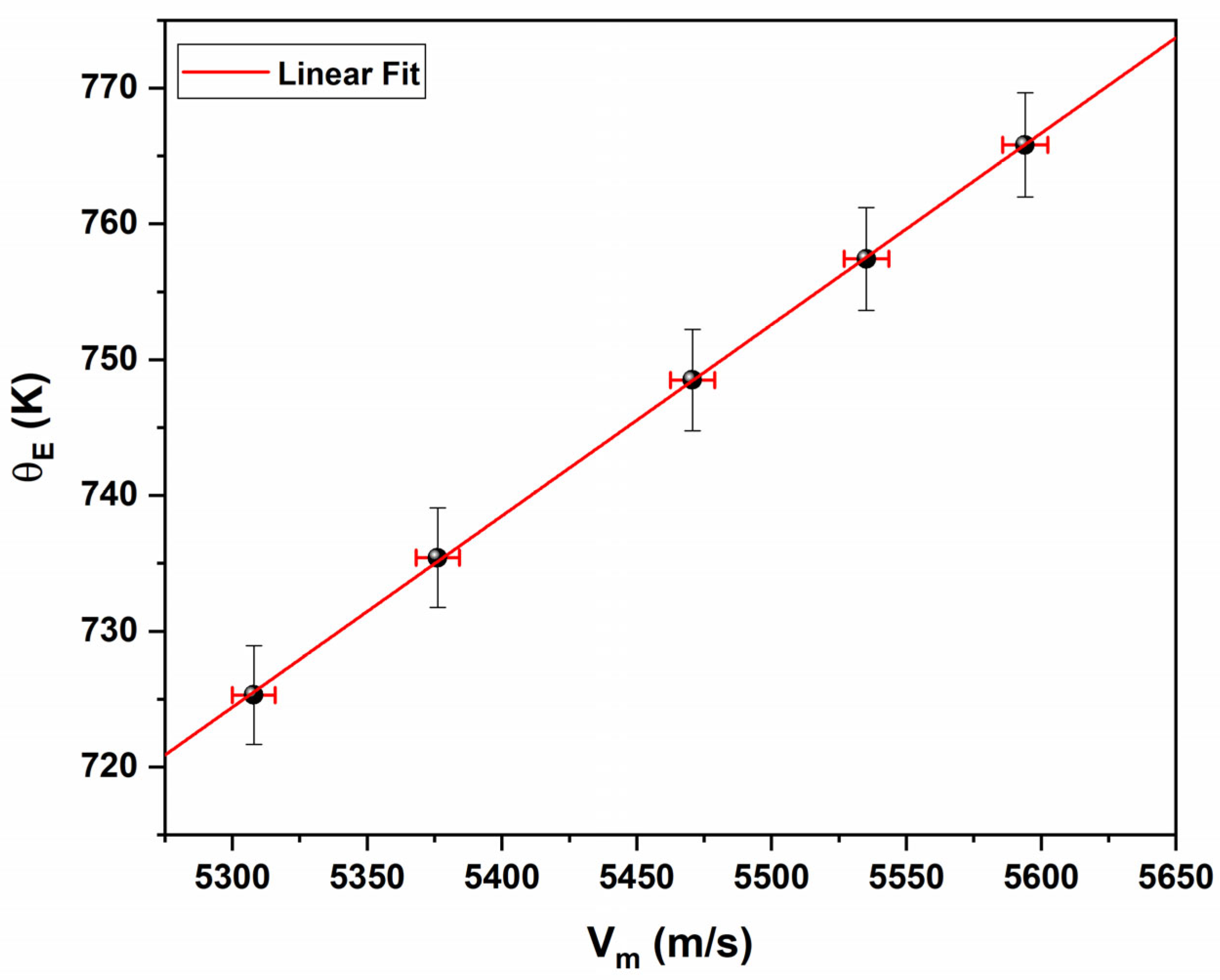
However, it is interesting to note that, as Figure 12 illustrates, the average sound velocity ( V m ) rises linearly with an increase in ( θ E ). This behaviour suggests a clear relationship between an acoustic parameter ( V m ) and a thermodynamic one ( θ E ), and this rise reflects enhanced interatomic force constants, stronger V–O and Fe–O bonds, and reduced lattice compressibility. The lattice becomes more rigid, phonons propagate faster, and the material exhibits greater elastic stability and higher lattice energy, confirming that vanadium doping effectively stiffens the crystal network at the atomic level. Other reports have noted the same difference for other mixed ferrites [20,29,32,35,38].

3.4. Magnetization

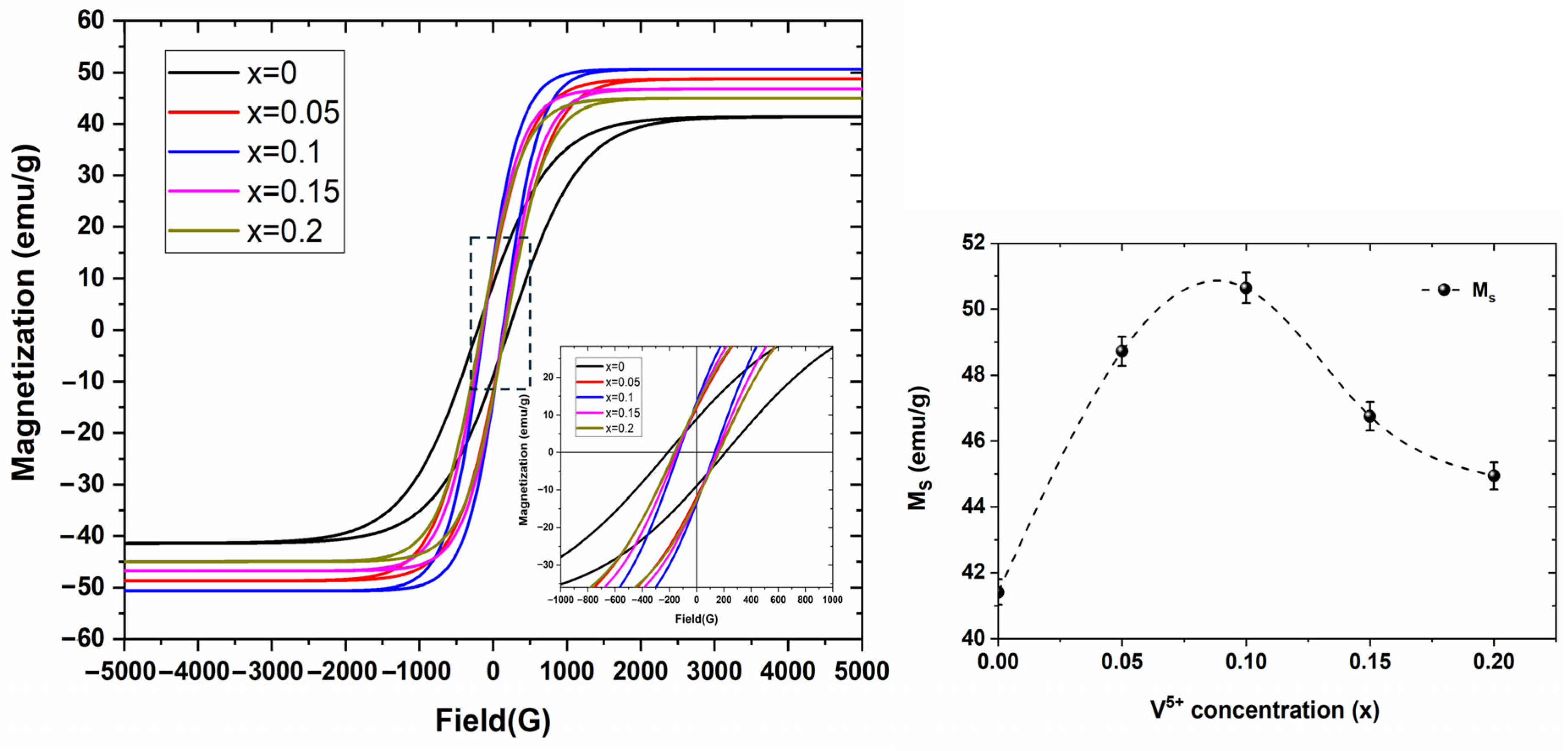
Figure 13 illustrates the hysteresis curves of Li0.5+xVxFe2.5−2xO4 ferrite samples as a function of the applied magnetic field (H). It can be seen that by increasing the magnetic field, the magnetization of all samples increases and tends to saturation at high field values. Moreover, Figure 13 shows the variation of the saturation magnetization (MS) with V5+ concentration (x). Moreover, Table 3 observed that MS increases with V5+ concentration to reach its maximum value at x = 0.1 and then decreases for higher V5+ concentrations. Considering the proposed cation distribution, which was concluded from the IR spectra, the value of the magnetic moment per formula unit, which represents the total magnetization, is given by the following:
M S c a l c u l a t e d = M B M A = 2.5 μ B
where MA, MB, and μB are the magnetic moments of ions in the A- and B-sites and the Bohr magneton, respectively. As is known, according to Neel theory, A-B interaction is the most important factor that affects magnetization. In fact, other factors combine to create this interaction. This means that MS must have the same value for all samples, which was not found experimentally, as is clear in Table 3. But, according to the non-collinear model, the experimental magnetic moment per formula unit is given by the following equation [30]:
M S e x p e r i m e n t a l = M B cos θ Y K M A
where θYK is the Yafet–Kittel canting angle between the moments in the B-sites. It is noted that increasing V5+ concentration leads the concentration of Fe3+ in the B-site to decrease. Thus, the B-B interaction begins to decrease, and in turn, θYK decreases, as shown in Table 3. According to the last Equation (16), such a decrease in θYK leads to an increase in MS, which explains its behavior for 0 ≤ x ≤ 0.1. On the other hand, the decrease in MS for V5+ concentration x > 0.1 may be due to the continuous decrease in Fe3+ ions with a higher magnetic moment (5 μB) in the B-site and the formation of Fe2+ ions with a lower magnetic moment (4 μB), which reduces the magnetization of these sites more than expected. The large decrease in the long-range ordering may also contribute to decreasing MS in this range of V5+ concentration [39]. Furthermore, the initial increase in Ms with low V5+ substitution in Li ferrite (0 ≤ x ≤ 0.1) can be attributed to cation redistribution between the A- and B-sites, where limited V5+ incorporation drives Fe3+ migration from the A- to B-sites, strengthening the net B-sublattice magnetization. Such an oxygen vacancy-induced reduction in magnetization has been similarly reported for doped Li-ferrites and other spinel systems [11,40], where oxygen deficiency leads to a partial disruption of magnetic ordering. However, further V5+ addition introduces a large number of nonmagnetic ions and oxygen vacancies for charge compensation, which disrupts Fe–O–Fe superexchange pathways and induces Fe3+ → Fe2+ conversion. These effects generate lattice strain, spin canting, and magnetic dilution, collectively leading to the subsequent decline in Ms at higher doping levels. Meanwhile, the decrease in Ms at higher V5+ content could be due to the formation of nonmagnetic secondary phases (α-Fe2O3, FeVO4), which dilute the ferrimagnetic spinel network and disrupt Fe–O–Fe superexchange interactions. These structural inhomogeneities induce spin canting and magnetic dilution, reducing the overall magnetization.

3.4.1. Initial Permeability

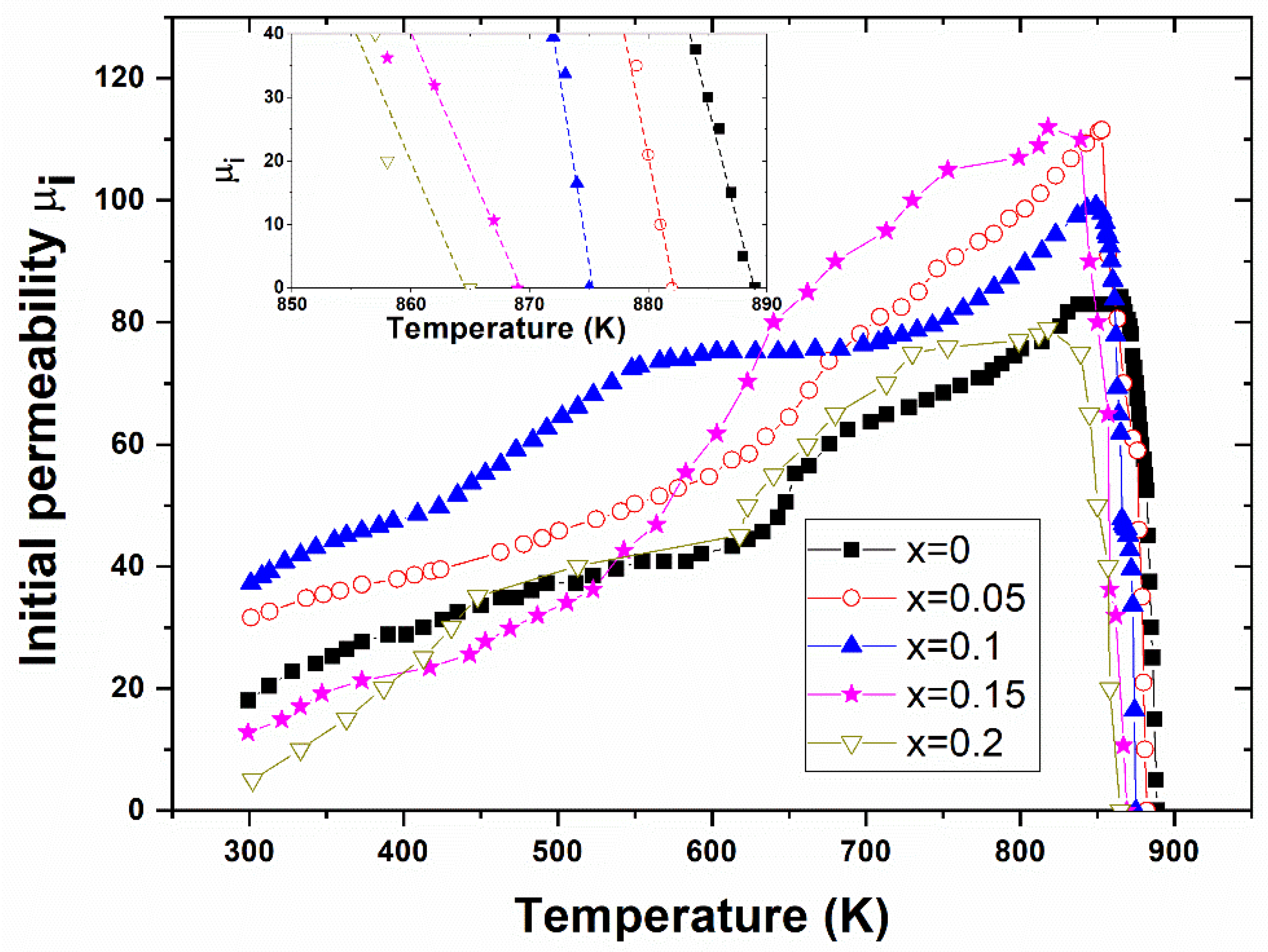
Figure 14 shows the change in the initial permeability (µi) as a function of temperature for Li0.5+xVxFe2.5−2xO4 ferrite samples, and the values are recorded in Table 3. It can be seen that µi increases with increasing temperature, and it begins to decrease faster near the Curie temperature TC. The Globus relation (Equation (17)) [41] is usually used to explain such a behavior as follows:
μ i α M S 2 D k 1 0.5
where (D) is the average grain size and (k1) is the anisotropy constant. According to this relation, the behavior of µi is controlled by the competition of both MS and k1. As the decrease in k1 with temperature is much faster than MS, µi tends to increase with increasing temperature. For temperatures higher than TC, the random orientations of the magnetic moments in the paramagnetic state are established, and the magnetization vanishes, which leads μi to decrease with an increase in temperature.
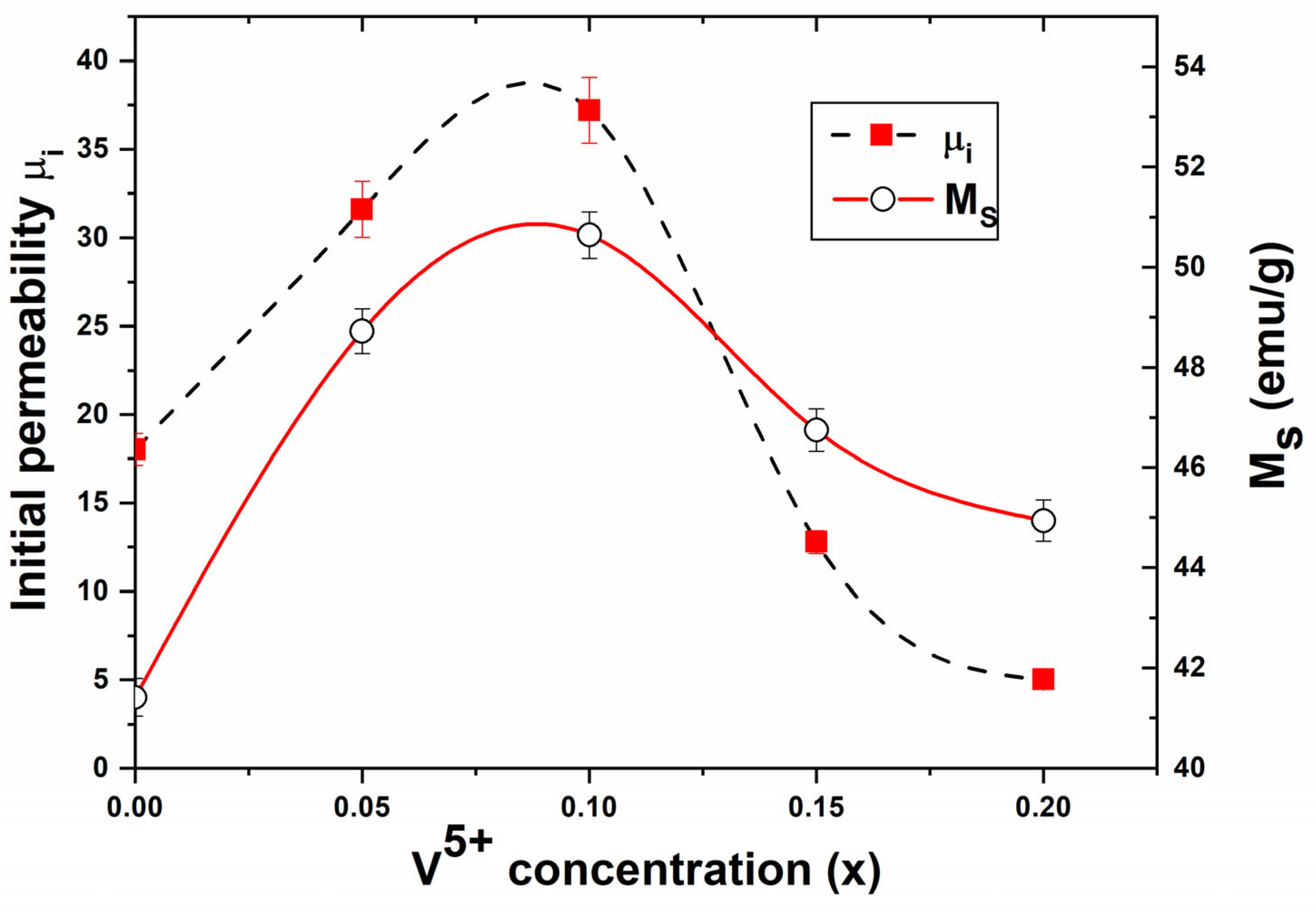
Furthermore, the behavior of µi, at room temperature, with V5+ concentration (x) is shown in Figure 15. The composition dependence of initial permeability of ferrites could be explained by taking the Globus relation (Equation (17)) into consideration and the fact that the porosity has an inverse relation with μi, as it hinders the domain wall motion [25]. It is clear that µi has a similar behavior to (x) as that of MS (plotted in the same Figure 15). This observation indicates that MS is the dominant factor in the behavior of μi in the whole range of V5+ concentration for Li0.5+xVxFe2.5−2xO4 ferrite. Moreover, for x ≤ 0.1, the increase in µi is supported by the decrease in k1 (due to the decrease in the iron concentration) and the probable increase in the grain size (due to the increase in V5+ concentration [15,42]). On the other hand, for x > 0.1, the decrease in µi is supported by the increase in porosity and the formation of extra phases (detected by X-ray).

3.4.2. Curie Temperature (TC)

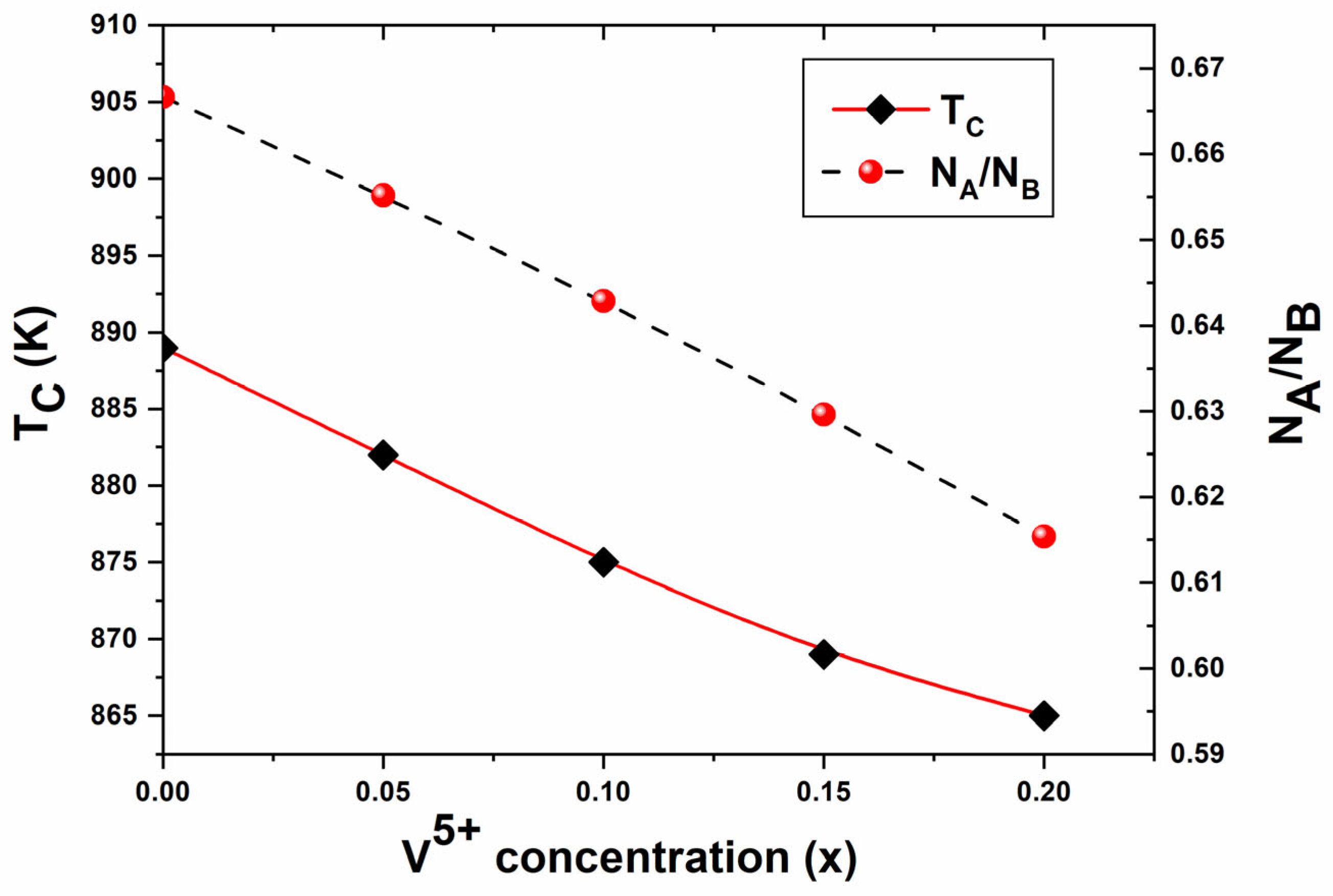
The thermal stability of the magnetic ordering in ferrites is measured by the Curie temperature (TC). Figure 16 and Table 3 show the values of the temperature at which the initial permeability tends to zero for all our ferrite samples. These values were taken as Curie temperatures (TC) and plotted as a function of V5+ concentration in Figure 16. A close result was reported for the TC of lithium ferrite (TC  889 K) [43]. It can be noticed that TC decreases continuously with increasing V5+ concentration. As is known, TC depends mainly on the A-B interaction that is affected by the following factors: first, the magnitude of the magnetic moments in A- and B-sites (in Li0.5+xVxFe2.5−2xO4, the only moments are those of Fe3+ ions); second, the relative concentration of the moments on both sites (NA/NB); and third, the distance between the A- and B-sites, which is proportional to the variation of the lattice parameter. According to these factors, one can discuss the decrease in TC for Li0.5+xVxFe2.5−2xO4 ferrite as follows. According to the previous cation distribution, (NA/NB) is found to decrease extremely with increasing (x) (as shown in Figure 16), which clearly explains the decrease in TC in the whole range of V5+ concentration. Moreover, the formation of Fe2+ ions (of smaller magnetic moment 4 μB) and the detected minority extra phases of α-Fe2O3, V2O5, and FeVO4 in the whole range of V5+ concentration give further contribution in decreasing TC. Furthermore, the decrease in MS for x > 0.1 leads the A-B interaction to decrease and enhances the decrease in TC. It is to be noted here that the decrease in the lattice parameter (Figure 5) has the effect of increasing TC. So, it could be deduced that the previous factors are dominant against the effect of the decrease in the lattice parameter in the behavior of TC. Furthermore, high Curie temperatures of lithium ferrites are suitable for high-temperature applications where thermal stability is essential, such as inductors, transformers, and microwave devices [1,2]. Introducing vanadium ions allows the tuning of Tc of lithium ferrite, promoting the creation of ferrites with unique magnetic characteristics adapted to different operating conditions.

4. Conclusions

Replacing vanadium in lithium ferrite Li0.5+xVxFe2.5−2xO4 leads to a marked improvement in its thermodynamic, elastic, and magnetic properties. The reduced lattice parameter, resulting from the smaller radius of the V5+ ion, promotes V–O and Fe–O bonding while simultaneously increasing porosity. Cation distribution obtained from IR analysis shows the preference of V5+ ions to occupy the tetrahedral sites. Furthermore, both the X-ray and the IR spectra confirmed the existence of the long-range order (superstructure) and ensured the role of V5+ ion substitution in the transformation from ordered to disordered Li-ferrite. The corresponding increase in C11 and C12 and the elastic moduli indicate improved lattice rigidity and mechanical resilience. The increased mean sound velocity and Debye temperature with doping confirm that the intermolecular force constants and lattice vibration energy are significantly increased, despite the slight rise in porosity. Moreover, doping lithium ferrite with vanadium leads to enhancing the saturation magnetization, Curie temperature, and the permeability. The Curie temperature decreased with increasing V5+ concentration, allowing for tuning of the TC of Li0.5+xVxFe2.5−2xO4 ferrites. On the other hand, saturation magnetization and initial permeability were enhanced up to a V5+ concentration of x = 0.1. These results demonstrate that V5+ substitution effectively enhances the mechanical and magnetic properties of Li0.5+xVxFe2.5−2xO4 ferrite, making it a promising candidate for magneto-elastic sensors, high-frequency devices, and applications requiring mechanically robust ferrite materials.

Author Contributions

Conceptualization, W.R.A.; methodology, W.R.A. and A.M.F.; software, W.R.A. and A.M.F.; validation, W.R.A., H.M.E., and A.M.F.; formal analysis, W.R.A. and A.M.F.; investigation, W.R.A. and A.M.F.; resources, W.R.A. and A.M.F. data curation, W.R.A., H.M.E., and A.M.F.; writing—original draft preparation, W.R.A. and A.M.F.; writing—review and editing, W.R.A., H.M.E., and A.M.F.; visualization, W.R.A. and A.M.F.; supervision, W.R.A. and A.M.F. All authors have read and agreed to the published version of the manuscript.

Funding

This research received no external funding.

Data Availability Statement

The original contributions presented in this study are included in the article. Further inquiries can be directed to the corresponding author.

Conflicts of Interest

The authors declare no conflicts of interest.

References

  1. Sahu, M.K.; Mallick, P.; Satpathy, S.K.; Behera, B. Structural, Dielectric, and Electrical Study of Bismuth Ferrite-Lithium Vanadate. Eur. Phys. J. Appl. Phys. 2022, 97, 72. [Google Scholar] [CrossRef]
  2. El-naggar, A.M.; Mohamed, M.B.; Aldhafiri, A.M.; Heiba, Z.K. Effect of Vacancies and Vanadium Doping on the Structural and Magnetic Properties of Nano LiFe2.5O4. J. Mater. Res. Technol. 2020, 9, 16435–16444. [Google Scholar] [CrossRef]
  3. Zonkol, M.G.; Faramawy, A.M.; Allam, N.K.; El-Sayed, H.M. Improvement of the Magnetization and Heating Ability of CoFe2O4 /NiFe2O4 Core/Shell Nanostructures. Phys. Scr. 2024, 99, 125970. [Google Scholar] [CrossRef]
  4. Malathi, S.; Sridhar, B.; Wayessa, S.G. A Study of Lithium Ferrite and Vanadium-Doped Lithium Ferrite Nanoparticles Based on the Structural, Optical, and Magnetic Properties. J. Nanomater. 2023, 2023, 6752950. [Google Scholar] [CrossRef]
  5. Nikmanesh, H.; Eshraghi, M.; Karimi, S. Cation Distribution, Magnetic and Structural Properties of CoCrxFe2−XO4: Effect of Calcination Temperature and Chromium Substitution. J. Magn. Magn. Mater. 2019, 471, 294–303. [Google Scholar] [CrossRef]
  6. Li, M.; Tian, Z.; Yu, X.; Yu, D.; Ren, L.; Fu, Y. Influence of Thermal Annealing on the Morphology and Magnetic Domain Structure of Co Thin Films. Mater. Res. Express 2021, 8, 056103. [Google Scholar] [CrossRef]
  7. Pianciola, B.N.; Lima, E.; Troiani, H.E.; Nagamine, L.C.C.M.; Cohen, R.; Zysler, R.D. Size and Surface Effects in the Magnetic Order of CoFe2O4 Nanoparticles. J. Magn. Magn. Mater. 2015, 377, 44–51. [Google Scholar] [CrossRef]
  8. Mazen, S.A.; Abu-Elsaad, N.I.; Nawara, A.S. Studies on Micro-Structure and Dc Conductivity of Polycrystalline Li0.5+0.5xSixFe2.5−1.5xO4 Spinel Ferrites. Powder Technol. 2017, 317, 339–347. [Google Scholar] [CrossRef]
  9. Hernández-Gómez, P.; Muñoz, J.M.; Valente, M.A.; Graça, M.P.F. Broadband Ferromagnetic Resonance in Mn-Doped Li Ferrite Nanoparticles. Mater. Res. Bull. 2019, 112, 432–437. [Google Scholar] [CrossRef]
  10. Pham, T.N.; Huy, T.Q.; Le, A.T. Spinel Ferrite (AFe2O4)-Based Heterostructured Designs for Lithium-Ion Battery, Environmental Monitoring, and Biomedical Applications. RSC Adv. 2020, 10, 31622–31661. [Google Scholar] [CrossRef] [PubMed]
  11. Aepurwar, D.N.; Shirsath, S.E.; Mujasam, K.; Hadi, M.; Devmunde, B.H. Effect of Li1+ Ion on the Physico-Chemical Properties Cation Distribution of Sol-Gel Synthesized Ni-Zn Spinel Ferrite Nanoparticles. Ceram. Int. 2024, 50, 55658–55668. [Google Scholar] [CrossRef]
  12. Aepurwar, D.N.; Prasad, V.J.S.N.; Devmunde, B.H. Effect of Cd2+ Substitution on the Structural, Magnetic, and Dielectric Properties of Li-Ni Spinel Ferrite Nanoparticles Synthesized via Sol-Gel Method. Phys. Open 2025, 23, 100273. [Google Scholar] [CrossRef]
  13. Nagarale, J.R.; Pedanekar, R.S.; Patil, A.R.; Ganbavle, V.V.; Parale, V.G.; Rajpure, K.Y.; Kulkarni, S.N. Enhancing Dye Degradation with Li–Ni Ferrite: A Sol-Gel Auto-Combustion Synthesis Strategy with Temperature Tunable Properties. Mater. Chem. Phys. 2025, 338, 130628. [Google Scholar] [CrossRef]
  14. Mazen, S.A.; Abdallah, M.H.; Nakhla, R.I.; Zaki, H.M.; Metawe, F. X-Ray Analysis and IR Absorption Spectra of Li-Ge Ferrite. Mater. Chem. Phys. 1993, 34, 35–40. [Google Scholar] [CrossRef]
  15. Chae, K.P.; Kwon, W.H.; Lee, J.-G.; Lee, S.W. Crystallographic and Magnetic Properties of Vanadium-Substituted Li-Co-Ti Ferrite. J. Korean Phys. Soc. 2010, 56, 1838–1842. [Google Scholar] [CrossRef]
  16. Maisnam, M.; Phanjoubam, S.; Sarma, H.N.K.; Thakur, O.P.; Devi, L.R.; Prakash, C. Dielectric Properties of Vanadium Substituted Lithium Zinc Titanium Ferrites. Int. J. Mod. Phys. B 2003, 17, 3881–3887. [Google Scholar] [CrossRef]
  17. Maisnam, M.; Phanjoubam, S.; Sarma, H.N.K.; Prakash, C.; Devi, L.R.; Thakur, O.P. Magnetic Properties of Vanadium-Substituted Lithium Zinc Titanium Ferrite. Mater. Lett. 2004, 58, 2412–2414. [Google Scholar] [CrossRef]
  18. Samy, A.M. Magnetic and Electrical Studies of V, Cd and Gd Ions Substituted Li-Ferrite. J. Mater. Sci. Eng. Adv. Technol. 2011, 4, 133–147. [Google Scholar]
  19. IIMURA, T. Effect of V2O5 Additions on the Ordering of Li-Zn Ferrite. J. Am. Ceram. Soc. 1976, 59, 539–540. [Google Scholar] [CrossRef]
  20. Faramawy, A.M.; Elsayed, H.; Agami, W.R. Correlation between Structure, Cation Distribution, Elastic, and Magnetic Properties for Bi3+ Substituted Mn-Zn Ferrite Nanoparticles. Mater. Chem. Phys. 2024, 314, 128939. [Google Scholar] [CrossRef]
  21. Raju, M.K.; Raju, M.R.; Babu, K.R. Structural Observations, Density and Porosity Studies of Cu Substituted Ni-Zn Ferrite through Standard Ceramic Technique. Chem. Sci. Trans. 2015, 4, 325–330. [Google Scholar] [CrossRef][Green Version]
  22. El-Sayed, H.M.; Agami, W.R. Improvement of the Magnetic Properties of Li–Zn Ferrite by Bi3+ Substitution. J. Mater. Sci. Mater. Electron. 2016, 27, 4866–4870. [Google Scholar] [CrossRef]
  23. Yang, Y.C.; Zhong, X.C.; Long, K.W.; Liu, Z.W.; Ramanujan, R.V. Effective Reduction of Sintering Temperature for High-Performance Mn-Zn Ferrites via Synergistic Doping of V2O5 and Al2O3 Sintering Aids. Ceram. Int. 2025, 51, 41430–41444. [Google Scholar] [CrossRef]
  24. Ranu, R.; Kadam, S.L.; Gade, V.K.; Desarada, S.V.; Yewale, M.A. Comparative Microstructural Analysis of V2 O5 Nanoparticles via X-Ray Diffraction (XRD) Technique. Nanotechnology 2024, 35, 435701. [Google Scholar] [CrossRef] [PubMed]
  25. Faramawy, A.M.; Mattei, G.; Scian, C.; Elsayed, H.; Ismail, M.I.M. Cr3+ Substituted Aluminum Cobalt Ferrite Nanoparticles: Influence of Cation Distribution on Structural and Magnetic Properties. Phys. Scr. 2021, 96, 125849. [Google Scholar] [CrossRef]
  26. Faramawy, A.M.; Elsayed, H.; Sabry, M.; El-Sayed, H.M. The Effect of Opto-Electronic Transition Type on the Electric Resistivity of Cr-Doped Co3O4 Thin Films. Coatings 2023, 13, 328. [Google Scholar] [CrossRef]
  27. Ravinder, D. Far-Infrared Spectral Studies of Mixed Lithium-Zinc Ferrites. Mater. Lett. 1999, 40, 205–208. [Google Scholar] [CrossRef]
  28. El-Sayed, H.M.; Samy, A.M.; Sattar, A.A. Infra-Red and Magnetic Studies of Nb-Doped Li-Ferrites. Phys. Status Solidi 2004, 201, 2105–2111. [Google Scholar] [CrossRef]
  29. Mazen, S.A.; Abu-Elsaad, N.I. IR Spectra, Elastic and Dielectric Properties of Li–Mn Ferrite. ISRN Condens. Matter Phys. 2012, 2012, 907257. [Google Scholar] [CrossRef]
  30. Agami, W.R.; Ashmawy, M.A. Structural, Physical, and Magnetic Properties of Nanocrystalline Manganese-Substituted Lithium Ferrite Synthesized by Sol–Gel Autocombustion Technique. Appl. Phys. A 2020, 126, 563. [Google Scholar] [CrossRef]
  31. Hu, D.; Zhao, F.; Miao, L.; Zhang, Z.; Wang, Y.; Cheng, H.; Han, Y.; Tian, M.; Gu, H.; Ma, R. Magnetic Properties and Microstructures of a Ni-Zn Ferrite Ceramics Co-Doped with V2O5 and MnCO3. Ceram. Int. 2019, 45, 10028–10034. [Google Scholar] [CrossRef]
  32. Patange, S.M.; Shirsath, S.E.; Jadhav, S.P.; Hogade, V.S.; Kamble, S.R.; Jadhav, K.M. Elastic Properties of Nanocrystalline Aluminum Substituted Nickel Ferrites Prepared by Co-Precipitation Method. J. Mol. Struct. 2013, 1038, 40–44. [Google Scholar] [CrossRef]
  33. Faramawy, A.M. Role of Rare Earth Doping on Structural, Elastic, Optical, and Magnetic Properties of Co-Cu Spinel Ferrite Nanoparticles Prepared by Sol Gel Auto-Combustion (SGAC) Route. Phys. B Condens. Matter 2025, 712, 417331. [Google Scholar] [CrossRef]
  34. Pawar, R.A.; Patange, S.M.; Tamboli, Q.Y.; Ramanathan, V.; Shirsath, S.E. Spectroscopic, Elastic and Dielectric Properties of Ho3+ Substituted Co-Zn Ferrites Synthesized by Sol-Gel Method. Ceram. Int. 2016, 42, 16096–16102. [Google Scholar] [CrossRef]
  35. Nessem, R.G.; Sattar, A.A.; EL-Sayed, H.M.; Faramawy, A.M. Controlling Elastic, Magnetic and Optical Properties of Mn0.7Zn0.3Fe2O4/CdxZn1−XFe2O4; x = (0–0.5) Core/Shell Nanostructures via Lattice Matching. Mater. Chem. Phys. 2025, 346, 131323. [Google Scholar] [CrossRef]
  36. Modi, K.B.; Chhantbar, M.C.; Joshi, H.H. Study of Elastic Behaviour of Magnesium Ferri Aluminates. Ceram. Int. 2006, 32, 111–114. [Google Scholar] [CrossRef]
  37. Modi, K.B. Elastic Moduli Determination through IR Spectroscopy for Zinc Substituted Copper Ferri Chromates. J. Mater. Sci. 2004, 39, 2887–2890. [Google Scholar] [CrossRef]
  38. Ravinder, D.; Balachander, L.; Venudhar, Y.C. Elastic Behaviour of Manganese Substituted Lithium Ferrites. Mater. Lett. 2001, 49, 205–208. [Google Scholar] [CrossRef]
  39. Agami, W.R.; Ashmawy, M.A.; Sattar, A.A. Structural, IR, and Magnetic Studies of Annealed Li-Ferrite Nanoparticles. J. Mater. Eng. Perform. 2014, 23, 604–610. [Google Scholar] [CrossRef]
  40. Askarzadeh, N.; Shokrollahi, H. Results in Chemistry A Review on Synthesis, Characterization and Properties of Lithium Ferrites. Results Chem. 2024, 10, 101679. [Google Scholar] [CrossRef]
  41. Shanks, K.; Senthilarasu, S.; Mallick, T.K. Optics for concentrating photovoltaics: Trends, limits and opportunities for materials and design. Renew. Sustain. Energy Rev. 2016, 60, 394–407. [Google Scholar] [CrossRef]
  42. Rao, B.P.; Caltun, O.; Dumitru, I.; Spinu, L. Complex Permeability Spectra of Ni–Zn Ferrites Doped with V2O5/Nb2O5. J. Magn. Magn. Mater. 2006, 304, e749–e751. [Google Scholar] [CrossRef]
  43. Verma, S.; Joy, P.A. Magnetic Properties of Superparamagnetic Lithium Ferrite Nanoparticles. J. Appl. Phys. 2005, 98, 124312. [Google Scholar] [CrossRef]
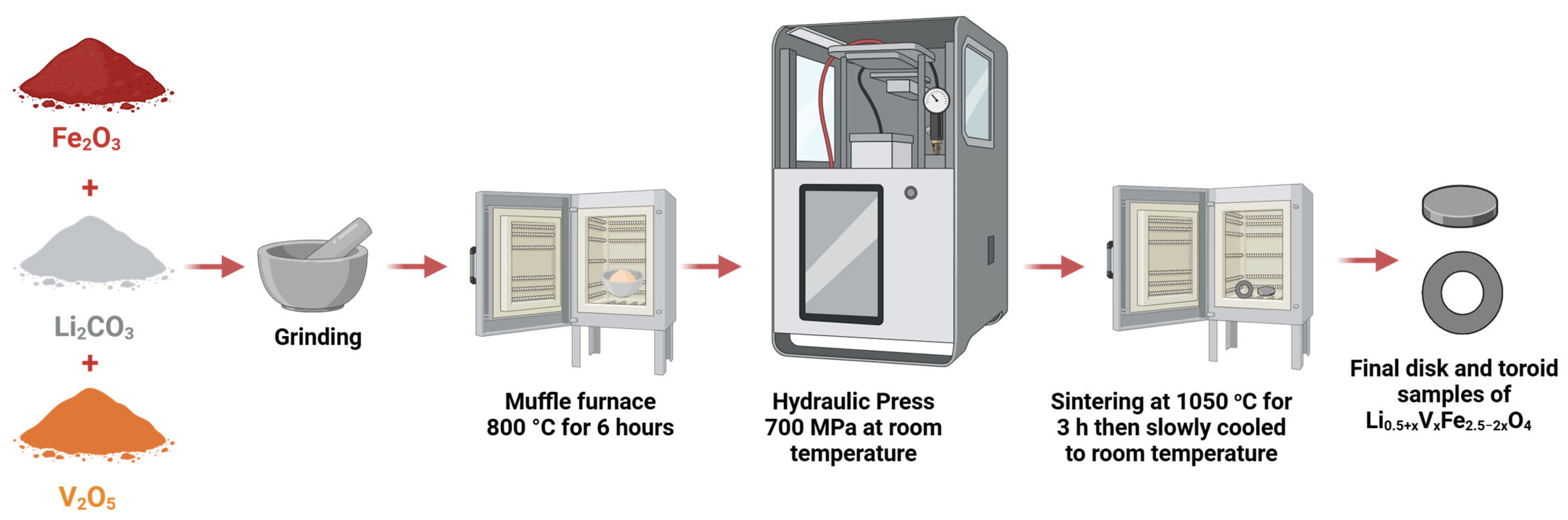
Figure 1. Solid-state synthesis process for Li0.5+xVxFe2.5−2xO4 ferrite samples.
Compounds 05 00054 g001
Figure 2. (a) X-ray diffraction patterns and (b) the shift of the positions of some crystallographic planes for all Li0.5+xVxFe2.5−2xO4 ferrite samples.
Compounds 05 00054 g002
Figure 3. X-ray diffraction patterns for two samples (x = 0 and 0.2) showing the planes of Li0.5+xVxFe2.5−2xO4 ferrite and minority phases.
Compounds 05 00054 g003
Figure 4. Variation of (a) the lattice parameter a e x p (Å) and porosity P(%), (b) experimental a e x p and theoretical a t h values of the lattice parameter with V5+ concentration (x).
Compounds 05 00054 g004
Figure 5. Schematic representation of spinel cubic crystal structure, tetrahedral (A-site), and octahedral (B-site) of Li0.5+xVxFe2.5−2xO4 ferrite.
Compounds 05 00054 g005
Figure 6. Infrared transmission spectra for all Li0.5+xVxFe2.5−2xO4 ferrite samples.
Compounds 05 00054 g006
Figure 7. Variation of wave numbers (ν1 and ν2) with V5+ concentration (x).
Compounds 05 00054 g007
Figure 8. Variation of the Debye temperature (θIR) and (θE) with V5+ content.
Compounds 05 00054 g008
Figure 9. Variation of stiffness constants (C11 and C12) with V5+ content.
Compounds 05 00054 g009
Figure 10. Variation of elastic moduli with V5+ content.
Compounds 05 00054 g010
Figure 11. Variation of wave velocities ( V l ), ( V s ), and ( V m ) with V5+ content.
Compounds 05 00054 g011
Figure 12. A plot of Debye temperature ( θ E ) vs. average sound velocity (Vm) in Li0.5+xVxFe2.5−2xO4.
Compounds 05 00054 g012
Figure 13. Variation of magnetization M with the magnetic field for all Li0.5+xVxFe2.5−2xO4 ferrite samples (left) and the concentration dependence of MS (right).
Compounds 05 00054 g013
Figure 14. Temperature dependence of the initial permeability for all samples (the inset shows the values near TC).
Compounds 05 00054 g014
Figure 15. The variation of the initial permeability μi, at room temperature, and MS with V5+ concentration (x).
Compounds 05 00054 g015
Figure 16. The variation of the Curie temperature (TC) and NA/NB with V5+ concentration (x).
Compounds 05 00054 g016
Table 1. Structural parameters obtained from X-ray diffraction of Li0.5+xVxFe2.5−2xO4 ferrites.
Lattice Parameters (Å) [±0.002]Porosity
[±0.01]
X-Ray Density (g cm−3)
[±0.001]
x a e x p a t h P(%) ρ x
08.3408.0905.314.742
0.058.3318.0867.624.695
0.18.3298.0828.344.637
0.158.3288.0788.614.577
0.28.3258.0748.834.521
Table 2. Variation of wave number (cm−1) of the IR observed bands, force constants (N/m), and Poisson’s ratio with V5+ concentration for all investigated ferrite samples.
Tetrahedral BandsOctahedral BandsLattice VibrationF × 105σ
xν1ν2ν3ν4FtFo
0589–540460–392335235–259–2812.561.230.3006
0.05595–543460–392340236–259–2812.611.220.2982
0.1605–548460–391346236–259–2802.691.220.2955
0.15610–554460–391349235–260–2822.731.200.2949
0.2615–562460–390352236–259–2792.781.190.2941
Table 3. Magnetic parameters of Li0.5+xVxFe2.5−2xO4 ferrites.
xMs (emu/g)
[±0.1]
Hc (G)
[±0.05]
Br (emu/g)
[±0.1]
M (g)
[±0.1]
Ms (μB) [exp.]Mag. Mom. (μB) [calc.]ΘYK (°)Initial Permeability ( μ i )Tc (K)
[±2]
041.42211.368.9207.081.542.529.3118.02889
0.0548.72156.5412204.391.782.525.7531.61882
0.150.64132.6813201.701.832.525.2737.21875
0.1546.75145.6913199.011.672.528.7112.79869
0.244.94163.5113196.321.582.530.865.01865
Disclaimer/Publisher’s Note: The statements, opinions and data contained in all publications are solely those of the individual author(s) and contributor(s) and not of MDPI and/or the editor(s). MDPI and/or the editor(s) disclaim responsibility for any injury to people or property resulting from any ideas, methods, instructions or products referred to in the content.