Article

DO11.10 CD4 T Cell Cross-Reacts with Trypanosoma cruzi Antigens

1
Gonçalo Moniz Institute, Oswaldo Cruz Foundation (IGM-Fiocruz), Salvador 40296-710, BA, Brazil
2
Center of Health Sciences, Federal University of Recôncavo da Bahia (UFRP), Santo Antonio de Jesus 44570-000, BA, Brazil
3
Laboratory of Clinical Immunology, Oswaldo Cruz Institute, Oswaldo Cruz Foundation (IOC-FIOCRUZ), Rio de Janeiro 21040-360, RJ, Brazil
*
Author to whom correspondence should be addressed.
Parasitologia 2026, 6(2), 12; https://doi.org/10.3390/parasitologia6020012
Submission received: 17 August 2025 / Revised: 4 February 2026 / Accepted: 12 February 2026 / Published: 24 February 2026

Abstract

Acute Trypanosoma cruzi infection induces an exuberant immune response; however, the host is unable to clear the parasite, and the infection progresses to a chronic phase. T and B cells play a crucial role in controlling infections. Although the parasite constitutes a myriad of antigenic determinants capable of activating many T and B cell clones, some antigens trigger a large proportion of CD8 T cells, implying TCR cross-reactivity targeting these determinants. Polyclonal activation may result in an inefficient immune response against the parasite, diverting it to less critical antigenic determinants, allowing infection persistence, and increasing the risk of autoimmunity. Cross-reactivity has been demonstrated in CD8 T cells but not in CD4 T cells. Herein, we demonstrate, by cytometry, that CD4+ T cells, carrying the DO11.10 transgenic TCR, which are responsive to OVA, are activated during the T. cruzi acute infection, becoming effector memory T cells that produce cytokines such as IFN-γ, TNF-α, IL-4, and IL-10. In addition, prior oral exposure to OVA altered cytokine production by these transgenic T cells upon infection. We also demonstrate that T. cruzi induces Foxp3 expression in a sizable pool of transgenic T cells.

1. Introduction

Trypanosoma cruzi is the etiological agent of Chagas disease, a neglected condition [1]. The acute infection is followed by a potent immune response that controls the parasite’s growth [2]. However, the host cannot clear the parasite, and a chronic infection is established [2]. A wide range of immune responses can be detected during the acute phase of the disease, helping to keep parasite growth in check [2]. Yet most of the lymphocyte response is polyclonal and may occur through bystander activation [3]. However, it has been proposed that T cell receptors largely are cross-reactive [4]. Several molecular mechanisms have been proposed to explain TCR cross-reactivity in various models [5]. In addition, peripheral T cells might express two distinct TCRs in mice and humans, denoted as double TCR-expressors [6]. Therefore, it is reasonable to argue that T cell cross-reactivity may be one of the reasons to justify the polyclonal T cell activation during T. cruzi infection. Cross-reactivity may have important immunological implications. For instance, T cells are positively selected in the thymus by self-peptides and MHC. They may yet interact with and produce immune responses to non-self-peptides in the peripheral lymphoid organs [5,7]. Importantly, infections can trigger and expand clones that cross-react with self-antigens, thereby causing autoimmune diseases [8,9].
On the other hand, cross-reactivity may help to develop vaccines to prevent or ameliorate autoimmune diseases. For instance, it has been reported that non-self-heat shock protein-derived peptides may activate cross-reactive regulatory T cells, thereby preventing autoimmune diseases [10,11,12]. Moreover, prior contact with pathogens or non-pathogenic microflora can modify the immune response to an unrelated microorganism, as previously documented [9,13]. For example, we have previously described how aged or thymectomized mice are completely resistant to infection with T. cruzi, whereas young mice are susceptible [14,15]. Resistance, in that case, correlated with the increase in naturally occurring memory T cells in these animals at the moment of infection, suggesting that environmental antigen-reactive T cells may help control the parasite load by responding to T. cruzi antigens through cross-reactivity [2]. Interestingly, a high degree of cross-reactivity between different CD8 T cell clones and T. cruzi antigen-derived peptides has recently been demonstrated [16]. Together, these findings might help explain important aspects of Chagas disease pathogenicity. Yet there is no clear information on the cross-reactivity of CD4+ T cells with class II MHC during T. cruzi infection, in part due to the lack of reagents such as stable MHC class II-peptide tetramers.
In this study, we have described the phenotypes and functional changes in the DO11.10 transgenic CD4+ T cell, which bears the TCR recognized by the clonotypic monoclonal antibody KJ1-26, during acute T. cruzi infection. Originally, the DO11.10 transgenic TCR was specific for an Ovalbumin-derived peptide (323–339) in the context of IAd class II MHC [17]. Therefore, the activation of DO11.10 transgenic CD4+ T cells to a multitude of unrelated antigens, such as T. cruzi, is somewhat surprising. We demonstrate that DO11.10 transgenic CD4 T cells are largely activated to an effector memory phenotype during the acute T. cruzi infection in BALB/c mice. The percentage of transgenic T cells expressing IFN-γ, TNF-α, IL-4, and IL-10 also increases in the acute phase. Previous oral immunization with OVA altered the cytokine profile of DO11.10 CD4 T cells, increasing the percentage of IL-10-expressing cells. Additionally, some DO11.10 CD4 T cells begin to express Foxp3. These results suggest that cross-reactivity between CD4 T cells and class II MHC peptides may be similar to the CD8 T cell compartment and peptides related to class I MHC. These findings might have profound implications for the quality of the immune response during the infection.

2. Materials and Methods

2.1. Animals

Female DO11.10 BALB/c mice (4–6 weeks old) were obtained from the Centro de Pesquisas Gonçalo Moniz animal house. Mice were previously checked for the expression of the KJ1-26 clonotype before breeding or experiments. Only mice expressing high frequencies of KJ1-26 were used. The animals were housed in microisolators under conventional conditions and handled in accordance with institutional ethical guidelines. All mouse procedures were carried out in accordance with the Ethics Committee of the Oswaldo Cruz Foundation, under protocols CPqGM 015/09 and CPqGM 038/09.

2.2. Ovalbumin Immunization

To investigate whether prior immunization with the transgenic cognate antigen would modify the immune response to T. cruzi antigens, Ovalbumin (Sigma-Aldrich, A5253, Saint Louis, MO, USA) was dissolved in drinking water at 5 mg/mL, filtered, and administered ad libitum for 5 days. A fresh solution was prepared daily. Mice were rested for 7 days and then immunized intravenously via the retroorbital sinus using 300 μg/0.1 mL of OVA (Sigma-Aldrich, A5503, Saint Louis, MO, USA) diluted in PBS. This protocol contained slight modifications to a previously published study [18].

2.3. Infection

Groups of 5 mice each were infected intraperitoneally with 103 blood-form trypomastigotes of the Tulahuen strain of T. cruzi in 0.2 mL of 0.15 M phosphate-buffered saline (PBS). Infected blood was obtained from BALB/c mice at the peak of parasitemia. Control mice received the same volume of PBS. Mice were sacrificed between days 22 and 25 after infection, depending on the experiment. No significant differences were observed during this brief period.

2.4. In Vitro Cell Culture

Splenocytes were cultured in triplicate at a density of 107 cells/well in 24-well plates (Nunc) in RPMI 1640 (Gibco, Grand Island, NY, USA) supplemented with 10% fetal bovine serum (Hyclone, Logan, UT, USA), 50 μM 2-ME, and one mM HEPES (complete medium). Cells were cultured at 37 °C and 5% CO2 for 24 h in complete medium alone, as previously described [19]. Cell viability was always assessed by PI staining and consistently remained above 93% before in vitro cultures. Brefeldin A was added 6 h before cell harvest to facilitate intracellular cytokine detection for flow cytometric analysis.

2.5. Flow Cytometric Analysis

Spleen cells were isolated as described [20] and placed in ice-cold PBS supplemented with 5% FBS and 0.01% sodium azide. Staining was performed as previously described [20]. In some experiments, CD4 T cells were magnetically sorted using surface staining with APC anti-CD4 (Clone RM4-4), followed by anti-APC microbeads (Miltenyi Biotec, Bergisch Gladbac, Germany) according to the manufacturer’s instructions. Purity was consistently above 95%, as confirmed by cross-checking with a PE-CY5.5 anti-CD4 antibody (Clone GK1.5, a non-epitope-overlapping antibody). The fluorochrome-conjugated monoclonal antibodies used were: anti-CD4 (Clones GK1.5 and RM4-4), anti-DO11.10 clonotype (Clone KJ1-26), anti-CD44 (Clone IM7), anti-CD62L (Clone MEL-14), anti-Foxp3 (Clone 150D), anti-IL-4 (Clone 11B11), anti-IL-10 (Clone JES5-16E3), anti-IFN-γ (Clone XMG1.2), and anti-TNF-α (Clone MP6-XT22). These were purchased from eBioscience, BioLegend, or Caltag. Streptavidin-PE-Cy5.5 from Caltag was used to reveal biotin-conjugated antibodies. Intracellular stainings for IL-4, IL-10, IFN-γ, and TNF-α were performed as described [20]. Buffer kits for intracellular and intranuclear staining were from eBioscience and used according to the manufacturer’s instructions. Isotype controls (clones RTK2071 and RTK4530) were included to establish background levels for cytokine intracellular assays. After surface staining, the cells were fixed with 1% paraformaldehyde in PBS and analyzed using a three-color FACScan (Becton & Dickinson, San Jose, CA, USA). Results were analyzed using FlowJo, software (version 6.4.7). CD4 T cells were electronically gated within the lymphocyte population, as defined by FSC x SSC parameters. T cells expressing the KJ1-26 clonotype were further gated inside the CD4+ T cells (Figure 1A).

2.6. Statistical Analysis

The significance of differences between experimental and control groups was determined as described in each figure of legend. Two-tailed p values below 0.05 were considered statistically significant. Results were analyzed using the InStat 2 software for Macintosh.

3. Results

3.1. Frequencies of Transgenic DO11.10 CD4 T Cells During Acute T. cruzi Infection

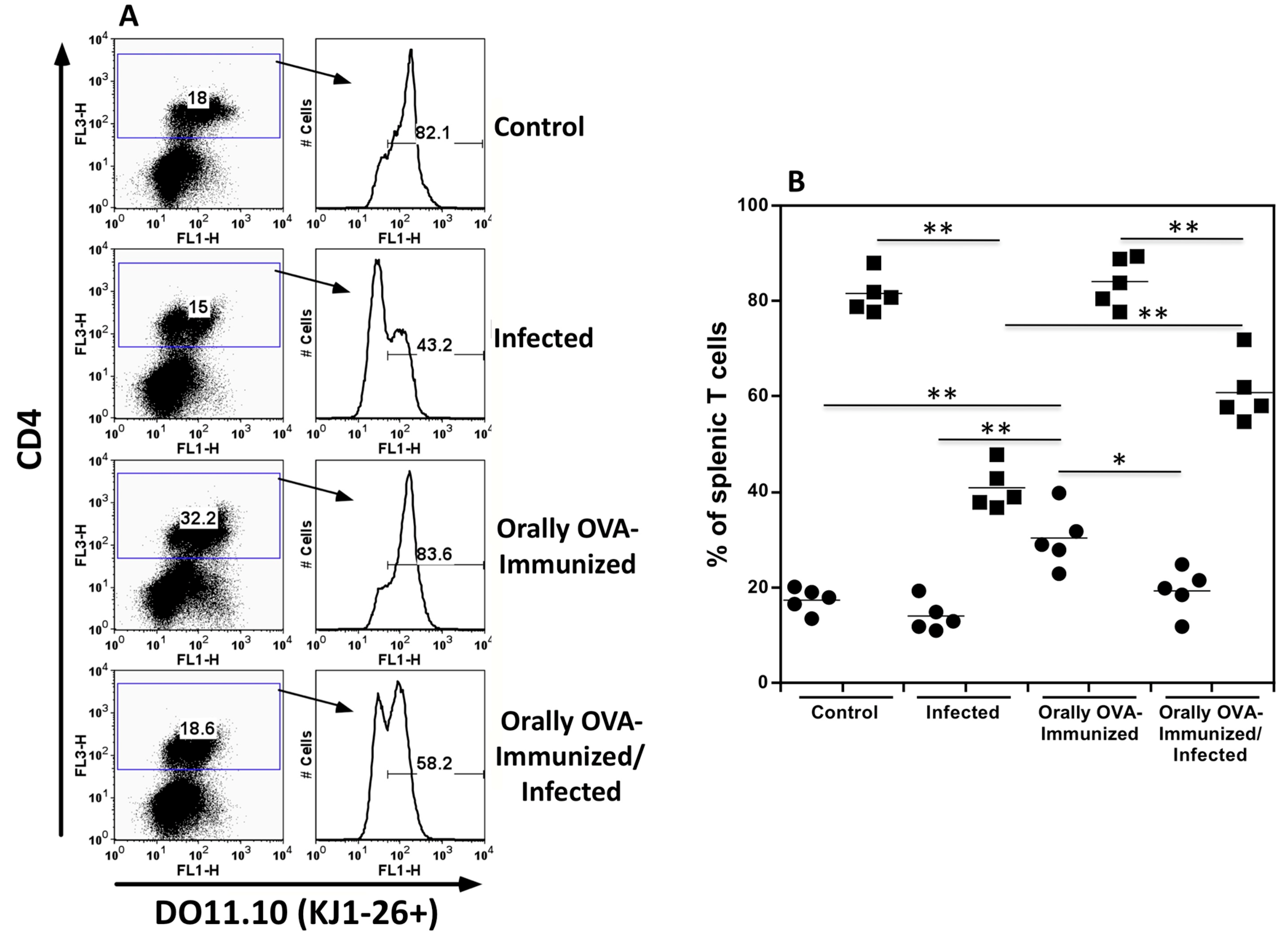
To test whether signs of cross-reactivity could also be observed in CD4 T cells, we infected DO11.10 transgenic mice with T. cruzi. Figure 1A shows representative dot plots of splenic CD4+KJ1-26+ T cells from different experimental groups. Figure 1B shows the frequencies of total splenic CD4+ T cells (closed circles) and CD4+KJ1-26+ transgenic T cells (closed squares) from individual mice in various experimental groups. Transgenic DO11.10 CD4+ T cells comprise the majority of splenic CD4 T cells in control mice. The same situation was observed for mice previously immunized with OVA. However, T. cruzi-infected mice showed smaller frequencies of transgenic T cells in the CD4+ T cell population within 25 days after infection. OVA immunization significantly prevents the diminution of DO11.10 transgenic T cells in the overall CD4+ T cell population, indicating that antigen-experienced transgenic T cells may be better preserved during acute infection. Please note that the fluorescence intensity of KJ1-26 staining was slightly lower in infected mice, indicating some degree of activation. Low expression of the transgenic DO11.10 TCR has been reported following antigen-specific activation [21,22]. Therefore, these results suggest that DO11.10 transgenic CD4+ T cells may interact with T. cruzi antigens and become activated during acute infection. It is also interesting that a large proportion of transgenic T cells become negative for the KJ1-26 clonotype, indicating that an endogenous alpha chain has been rearranged and that a second TCR is expressed on these cells. This situation has been described before for DO11.10 transgenic mice [22,23]. In fact, a large proportion of CD4+ KJ1-26 T cells lack the expression of the CD62L molecule, indicating they are effector memory T cells (Supplementary Figure S1).

3.2. DO11.10 Transgenic CD4+ T Cells Are Activated to Effector Memory Lymphocytes During the Acute T. cruzi Infection

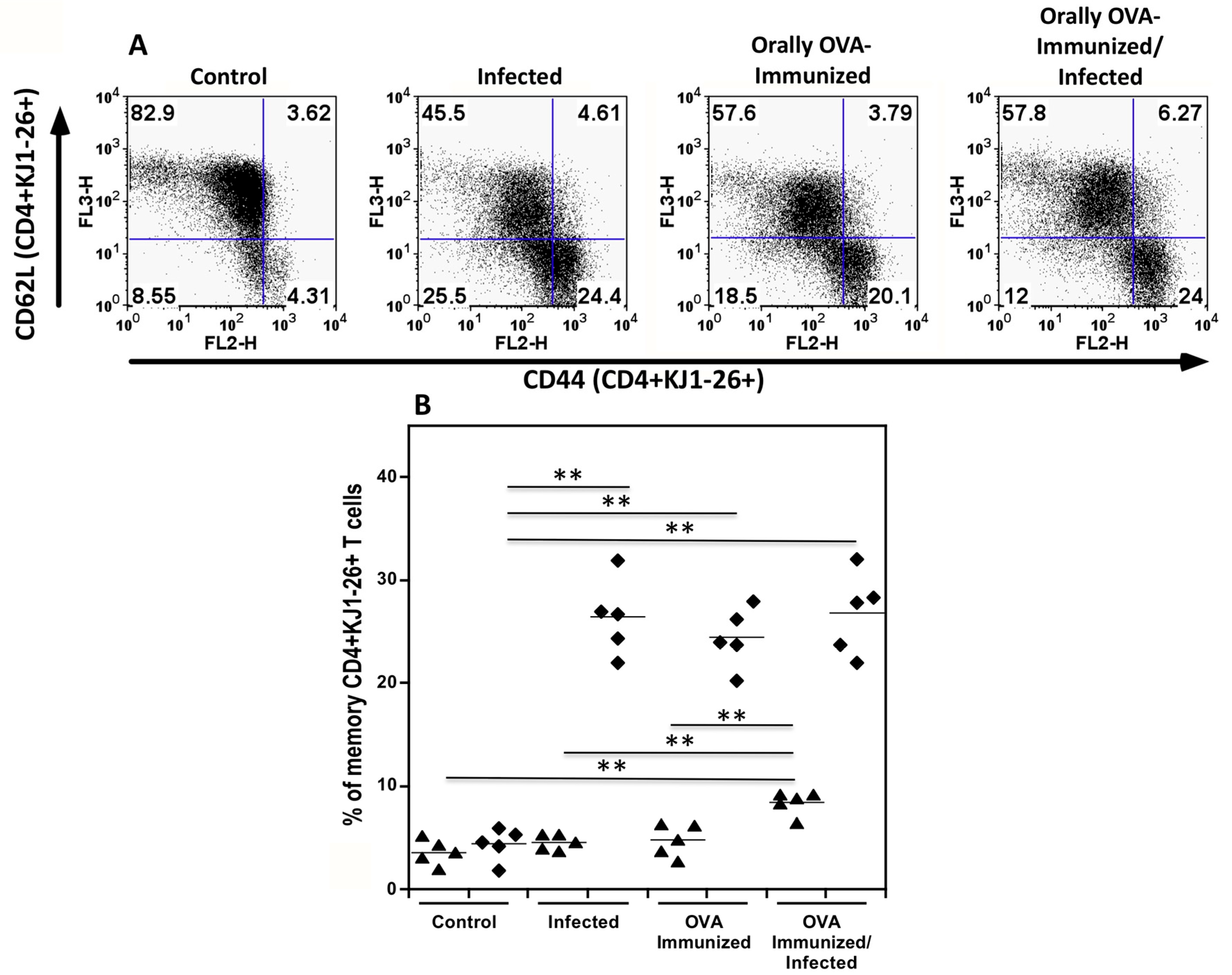
To better explore the hypotheses above, flow cytometric analysis of sorted splenic KJ1-26+CD4+ T cells from infected DO11.10 mice revealed a significant increase in the percentage of memory T cells when compared with control mice. Figure 2A, B shows that DO11.10+CD4+ T cells from normal mice are predominantly in the resting stage, exhibiting low percentages of markers associated with memory T cells. On the other hand, OVA immunization or infection of DO11.10 transgenic mice increased the rate of effector memory transgenic T cells, expressing high levels of CD44 and low levels of CD62L (closed diamonds). Previous immunization with OVA also increases the percentage of central memory transgenic CD4+ T cells (closed triangles) after infection, compared to the other groups.

3.3. T. cruzi Infection Increases the Frequencies of Splenic TNF-α+ and IFN-γ+ DO11.10 Transgenic T Cells

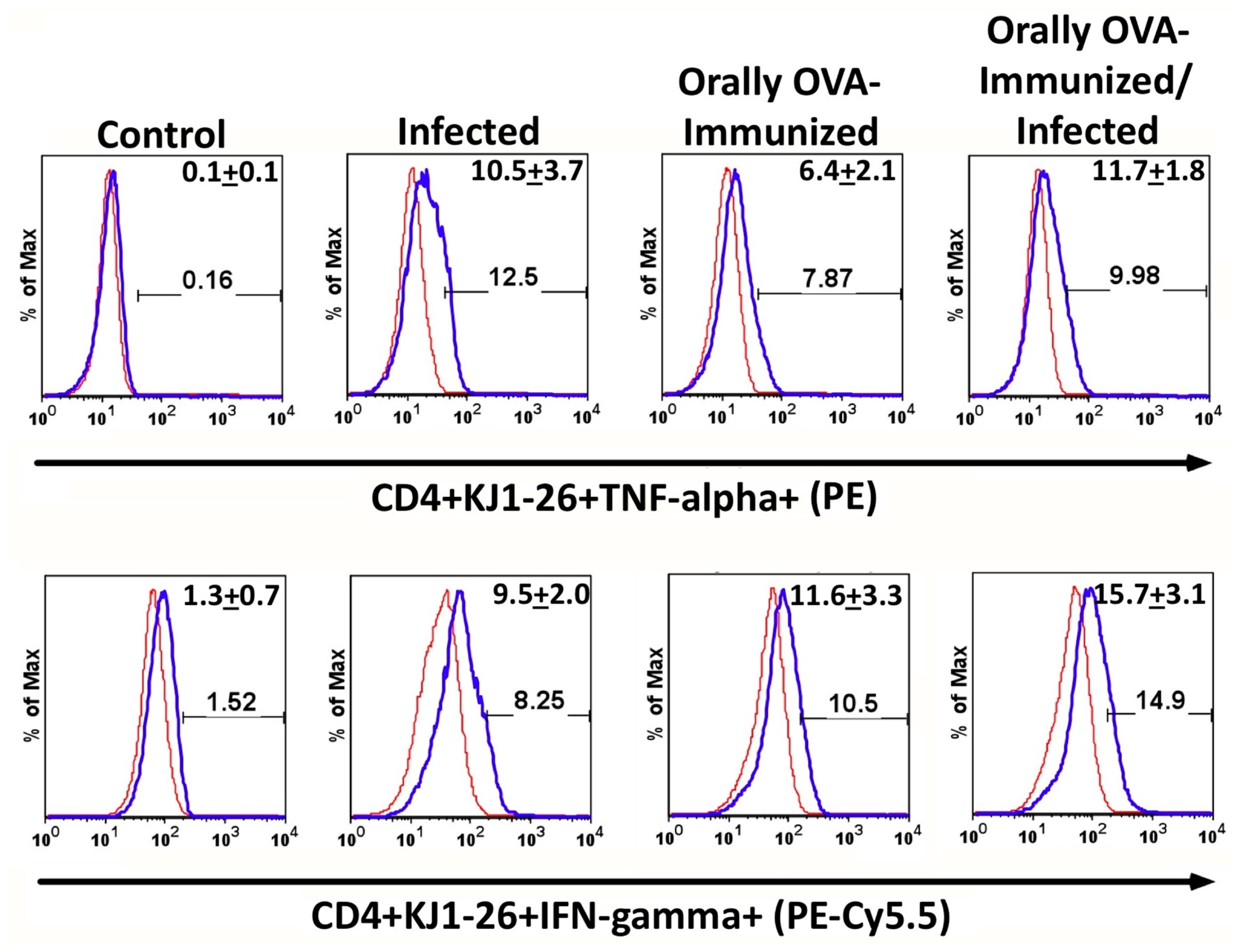
To further characterize these activated cells, intracellular cytokine staining was performed. Infection with T. cruzi increased the frequencies of CD4+KJ1-26+ cells that spontaneously expressed TNF-α after 24 h of culture in complete medium, as shown in Figure 3 (upper histogram set). Previous OVA immunization also augments spontaneous TNF-α production compared with non-immunized controls. However, the infection did not increase the frequency of transgenic splenic T cells expressing TNF-α in OVA-immunized animals compared with the OVA-immunized group.
The frequencies of transgenic splenic T cells, which spontaneously produce IFN-γ, increase upon infection compared to uninfected mice and are like those of mice previously immunized with OVA. In addition, infection in OVA-immunized mice does not further augment the percentages of transgenic T cells that produce IFN-γ. These results suggest that prior OVA immunization has set a limit on the production of TNF-α and IFN-γ induced by T. cruzi infection.

3.4. DO11.10 Transgenic CD4+ T Cells Spontaneously Produce IL-4 and IL-10 upon T. cruzi Infection

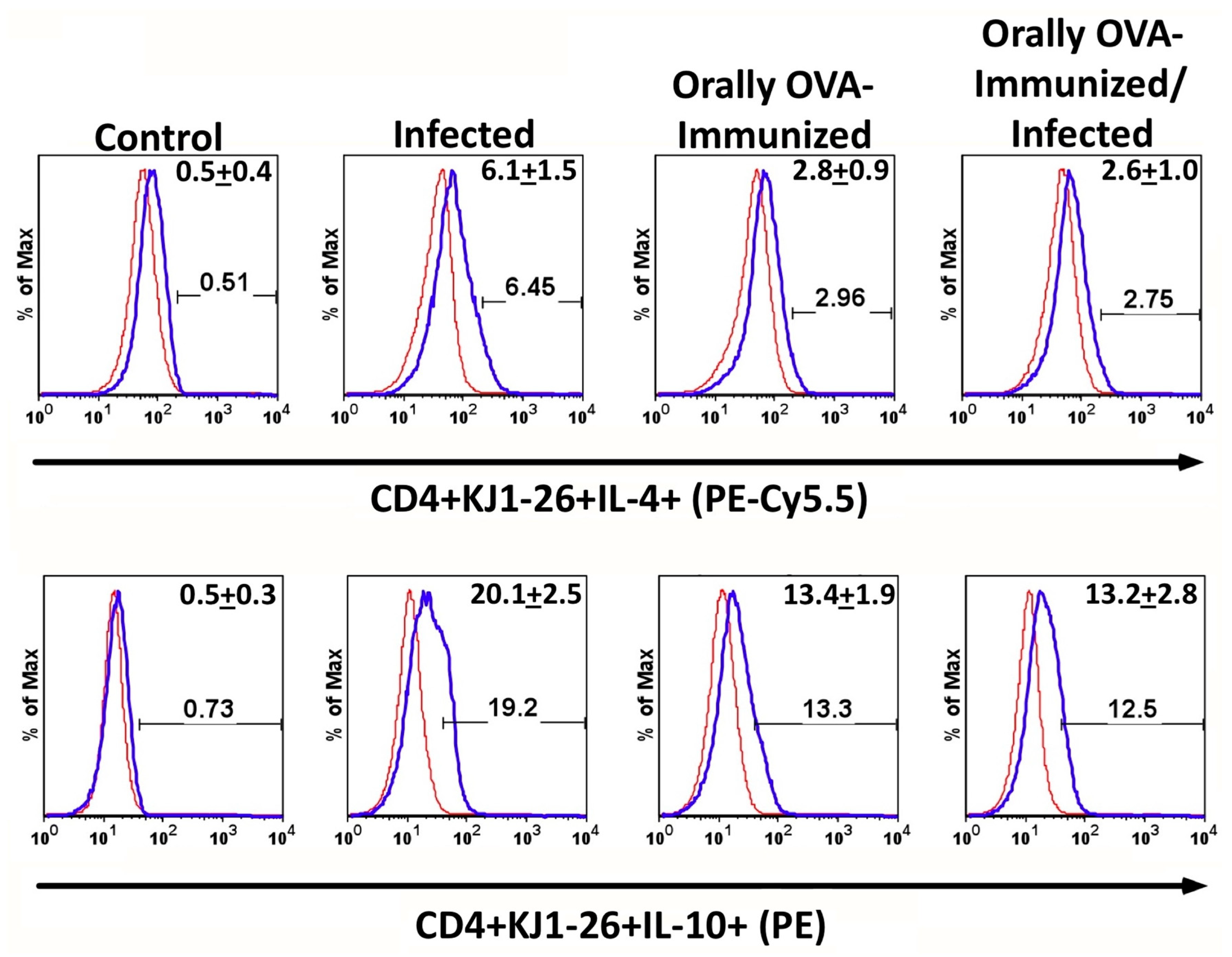
To assess whether T. cruzi infection could induce the production of regulatory cytokines, we evaluated IL-4 and IL-10 in naïve mice and in mice orally exposed to OVA before infection. Figure 4 shows that transgenic CD4+ T splenocytes from infected mice displayed higher frequencies of IL-4- and IL-10-expressing cells than unstimulated controls. Additionally, previous OVA immunization significantly increased the frequency of IL-4+ cells compared to non-immunized animals. However, the infection did not augment the relative number of IL-4+ cells in OVA-immunized mice. We have also studied the frequencies of IL-10 expression on transgenic CD4+ T lymphocytes. The lower histograms in Figure 4 show that infection increased the frequency of splenic IL-10 transgenic producers compared with control, OVA-immunized, or OVA-immunized-infected DO11.10 mice. Interestingly, pre-immunization with OVA significantly increased the frequencies of IL-10-producing transgenic T cells compared to non-immunized mice. However, these frequencies were still lower than those infected non-immunized mice. These results suggest that prior oral exposure to OVA modulates the immune response of DO11.10 T cells, shifting them toward a more regulatory phenotype.

3.5. Induction of Foxp3 Expression in DO11.10 CD4 T Cells During Infection

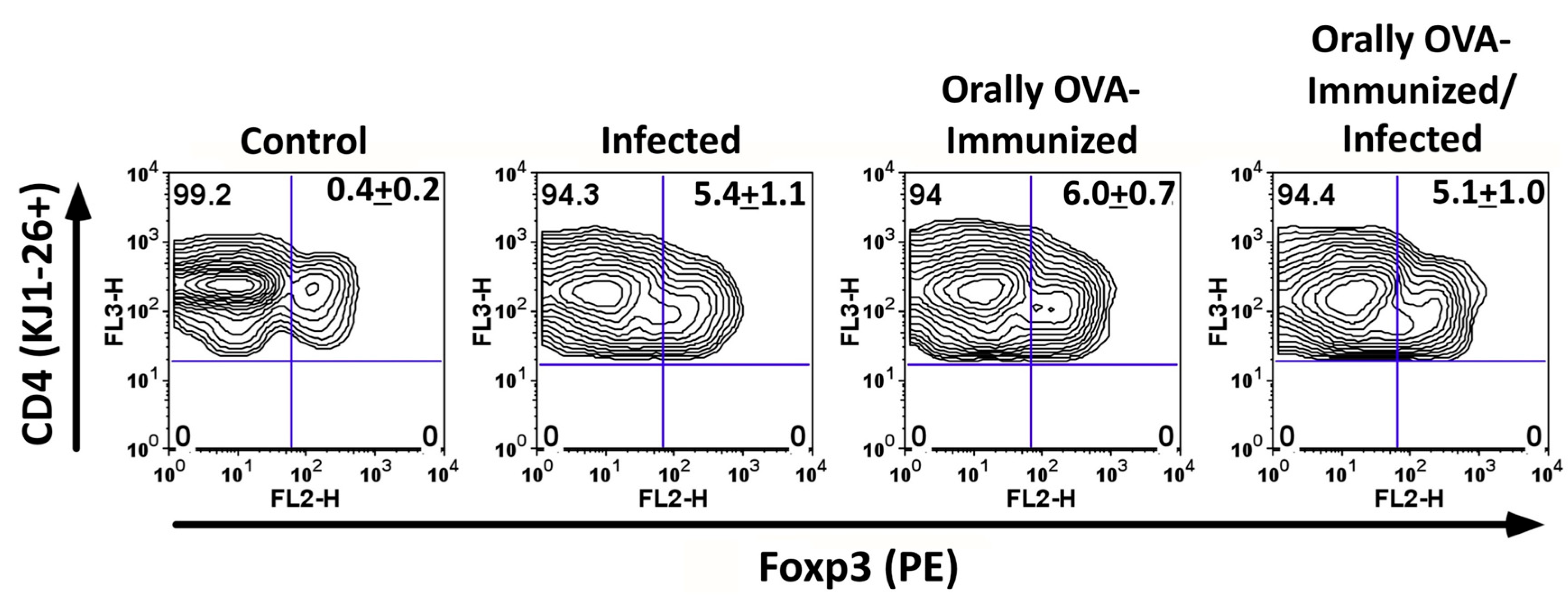
We also examined Foxp3 expression in DO11.10 CD4 T cells during acute T. cruzi infection. A considerable proportion of KJ1-26+ CD4 T cells upregulated Foxp3 in infected mice (Figure 5). Previous exposure to OVA also induced equivalent frequencies of transgenic T cells expressing Foxp-3, even in the presence of the infection. These results indicate that T. cruzi infection can cause the differentiation of a subset of DO11.10 CD4 T cells into regulatory T cells, potentially contributing to immune regulation during infection.

4. Discussion

Cross-reactivity is a well-known characteristic of CD8 T cells during T. cruzi infection [16]. However, whether CD4 T cells also exhibit cross-reactivity in this context remains unclear. In this study, we demonstrate that DO11.10 CD4 T cells specific for OVA 323–339 in the context of I-Ad can be activated during acute T. cruzi infection. These cells not only acquired an effector memory phenotype but also produced pro-inflammatory cytokines, including IFN-γ and TNF-α. Moreover, a subset of these cells expressed IL-10 and Foxp3, suggesting the induction of a regulatory component.
The finding that DO11.10 CD4 T cells were activated in the absence of OVA strongly supports the hypothesis that cross-reactivity extends to CD4 T cells. These results are consistent with previous work demonstrating extensive TCR cross-reactivity in CD8 T cells [4,16]. Cross-reactivity may provide the immune system with flexibility to respond to a broad range of antigens; however, it can also lead to potentially harmful outcomes, such as autoimmune reactions or diversion of the immune response toward less relevant antigens [5,7,8].
Interestingly, following T. cruzi infection, CD4+DO11.10+ transgenic T cells were reduced among total CD4+ T lymphocytes. Although this result may appear paradoxical, it suggests that transgenic T cells are losing the TCR clonotype recognized by the KJ1-26 mAb. In this case, the observation would be indicative of transgenic T cell activation, as T cells may internalize their TCR upon cognate interaction, as noted in the Results section. Indeed, a large number of CD4+KJ1-26 T cells were activated and displayed an effector memory phenotype, suggesting they are progeny of clonotype-positive T cells (SF 1). Alternatively, one may hypothesize that mature transgenic T cells re-express RAG and undergo rearrangement of the endogenous α-chain, becoming double TCR expressors. Although TCR revision has been described in some peripheral T cell populations in mice [24,25,26], it has not been demonstrated during T. cruzi infection. Interestingly, approximately one-third of peripheral T cells in humans are double TCR expressors [27], and studies in mice report similar findings [6]. Despite this, very little information is available on the role or significance of double TCR expressors in infections or autoimmune diseases. Regardless of the precise mechanism underlying the downmodulation of the transgenic TCR, a substantial proportion of CD4 T cells expressing the KJ1-26 clonotype acquire an effector memory phenotype during acute infection. This observation indicates that T. cruzi antigens activate transgenic CD4 T cells, leading to spontaneous cytokine production, including IFN-γ, TNF-α, IL-4, and IL-10.
Moreover, prior oral exposure to OVA altered the cytokine profile of DO11.10 CD4 T cells during infection, increasing the proportion of IL-10–producing cells. Oral antigen administration is known to promote regulatory T cell responses, and our findings suggest that prior antigen exposure can shape the outcome of cross-reactive immune responses during infection [10,11,12]. This observation underscores the importance of environmental antigens in shaping immune responses to pathogens.
The induction of Foxp3 expression in DO11.10 CD4 T cells during infection further supports the notion that T. cruzi can promote regulatory T cell differentiation. Regulatory T cells have been implicated in modulating the balance between protective immunity and immune-mediated pathology in Chagas disease [2]. Thus, functional cross-reactivity in CD4 T cells may not only contribute to parasite persistence by diverting immune responses away from critical epitopes but may also help control immunopathology by promoting the emergence of Treg cells. However, the data presented here concerning the regulatory potential of IL-10– and Foxp3-expressing DO11.10 T cells are largely descriptive and lack direct in vivo functional evidence.
In conclusion, this study provides strong evidence of CD4+ T cell activation during T. cruzi infection, consistent with cross-reactivity, mirroring observations previously reported for CD8+ T cells. Yet it does not definitively establish the underlying molecular mechanism. Further studies aimed at directly demonstrating DO11.10 TCR cross-reactivity using a panel of defined T. cruzi antigens in functional assays, or at directly identifying double TCR expressors, will be essential to clarify this issue. These data may also expand our understanding of T cell responses in Chagas disease, suggesting that both effector and regulatory outcomes of cross-reactivity may influence the course of infection, depending on previous environmental antigen exposures.

Supplementary Materials

The following supporting information can be downloaded at: https://www.mdpi.com/article/10.3390/parasitologia6020012/s1, Supplementary Figure S1. CD4+KJ1-26 splenic T cells from DO11.10 transgenic mice show effector memory phenotype. In the upper panel, dot plots show gated CD4+KJ1-26 T cells from infected and orally OVA-immunized infected animals. The graph below shows the percentages of effector memory T cells in individual animals from each group. There was no statistical difference between the groups. Animals were sacrificed 23 days after infection. The Mann–Whitney test was used for comparisons (p < 0.05 was considered significant).

Author Contributions

Conceptualization: F.C. and J.M. Methodology: F.C., J.N. and J.M. Formal analysis: F.C., J.N. and J.M. Writing: J.M. Supervision: F.C. and J.M. Funding acquisition: F.C. and J.M. All authors have read and agreed to the published version of the manuscript.

Funding

This research received no external funding.

Institutional Review Board Statement

The animal study protocol was approved by the Ethics Committee of FIOCRUZ-BA (CPqGM 015/09 and CPqGM 038/09, 23 January 2009).

Informed Consent Statement

Not applicable.

Data Availability Statement

All data are presented in the study. Crude data may be obtained from the corresponding author upon request.

Conflicts of Interest

The authors declare no conflicts of interest.

References

  1. Andrade, D.V.; Gollob, K.J.; Dutra, W.O. Acute chagas disease: New global challenges for an old, neglected disease. PLoS Neglected Trop. Dis. 2014, 8, e3010. [Google Scholar] [CrossRef]
  2. Cardillo, F.; de Pinho, R.T.; Antas, P.R.; Mengel, J. Immunity and immune modulation in Trypanosoma cruzi infection. Pathog. Dis. 2015, 73, ftv082. [Google Scholar] [CrossRef][Green Version]
  3. Minoprio, P.M.; Coutinho, A.; Joskowicz, M.; Lima, M.R.D.; Eisen, H. Polyclonal lymphocyte responses to murine Trypanosoma cruzi infection: II. Cytotoxic T lymphocytes. Scand. J. Immunol. 1986, 24, 669–679. [Google Scholar] [CrossRef]
  4. Mason, D. A very high level of crossreactivity is an essential feature of the T-cell receptor. Immunol. Today 1998, 19, 395–404. [Google Scholar] [CrossRef]
  5. Petrova, G.; Ferrante, A.; Gorski, J. Cross-reactivity of T cells and its role in the immune system. Crit. Rev. Immunol. 2012, 32, 349–372. [Google Scholar] [CrossRef]
  6. Schuldt, N.J.; Binstadt, B.A. Dual TCR T Cells: Identity Crisis or Multitaskers? J. Immunol. 2019, 202, 637–644. [Google Scholar] [CrossRef]
  7. Lang, H.L.; Jacobsen, H.; Ikemizu, S.; Andersson, C.; Harlos, K.; Madsen, L.; Hjorth, P.; Sondergaard, L.; Svejgaard, A.; Wucherpfennig, K.; et al. A functional and structural basis for TCR cross-reactivity in multiple sclerosis. Nat. Immunol. 2002, 3, 940–943. [Google Scholar] [CrossRef]
  8. Christen, U.; Edelmann, K.H.; McGavern, D.B.; Wolfe, T.; Coon, B.; Teague, M.K.; Miller, S.D.; Oldstone, M.B.; von Herrath, M.G. A viral epitope that mimics a self-antigen can accelerate but not initiate autoimmune diabetes. J. Clin. Investig. 2004, 114, 1290–1298. [Google Scholar] [CrossRef]
  9. Sharma, S.; Thomas, P.G. The two faces of heterologous immunity: Protection or immunopathology. J. Leukoc. Biol. 2014, 95, 405–416. [Google Scholar] [CrossRef]
  10. Moudgil, K.D.; Thompson, S.J.; Geraci, F.; De Paepe, B.; Shoenfeld, Y. Heat-shock proteins in autoimmunity. Autoimmune Dis. 2013, 2013, 621417. [Google Scholar] [CrossRef]
  11. van der Zee, R.; Anderton, S.M.; Prakken, A.B.; Paul, A.G.L.; van Eden, W. T cell responses to conserved bacterial heat-shock-protein epitopes induce resistance in experimental autoimmunity. Semin. Immunol. 1998, 10, 35–41. [Google Scholar] [CrossRef]
  12. Zheng, G.; Oo, T.T.; Janjam, S.S.S.; Ellis, C.; Chakravarthy, S.P.; Palani, S.; Anthon, W.; Tsaras, G.; Williams, A.; Feng, A.; et al. An antigen-less pro-vaccine for treating autoimmunity. J. Immunol. 2025, 214, 1477–1482. [Google Scholar] [CrossRef]
  13. Belkaid, Y.; Hand, T.W. Role of the microbiota in immunity and inflammation. Cell 2014, 157, 121–141. [Google Scholar] [CrossRef]
  14. Cardillo, F.; Falcao, R.P.; Rossi, M.A.; Mengel, J. An age-related gamma delta T cell suppressor activity correlates with the outcome of autoimmunity in experimental Trypanosoma cruzi infection. Eur. J. Immunol. 1993, 23, 2597–2605. [Google Scholar] [CrossRef]
  15. Cardillo, F.; Nomizo, A.; Mengel, J. The role of the thymus in modulating gammadelta T cell suppressor activity during experimental Trypanosoma cruzi infection. Int. Immunol. 1998, 10, 107–116. [Google Scholar] [CrossRef][Green Version]
  16. Bunkofske, M.E.; Dash, P.; Awad, W.; Thomas, P.G.; Tarleton, R.L. Highly cross-reactive and competent effectors dominate the CD8+ T cell response in Trypanosoma cruzi infection. J. Immunol. 2025, 214, 2000–2014. [Google Scholar] [CrossRef]
  17. Murphy, K.M.; Heimberger, A.B.; Loh, D.Y. Induction by antigen of intrathymic apoptosis of CD4+CD8+TCRlo thymocytes in vivo. Science 1990, 250, 1720–1723. [Google Scholar] [CrossRef]
  18. Zhou, P.; Borojevic, R.; Streutker, C.; Snider, D.; Liang, H.; Croitoru, K. Expression of dual TCR on DO11.10 T cells allows for ovalbumin-induced oral tolerance to prevent T cell-mediated colitis directed against unrelated enteric bacterial antigens. J. Immunol. 2004, 172, 1515–1523. [Google Scholar] [CrossRef]
  19. Nihei, J.; Cardillo, F.; Mengel, J. The Blockade of Interleukin-2 During the Acute Phase of Trypanosoma cruzi Infection Reveals Its Dominant Regulatory Role. Front. Cell. Infect. Microbiol. 2021, 11, 758273. [Google Scholar] [CrossRef]
  20. Cardillo, F.; Cunha, F.Q.; Tamashiro, W.M.; Russo, M.; Garcia, S.B.; Mengel, J. NK1.1+ cells and T-cell activation in euthymic and thymectomized C57Bl/6 mice during acute Trypanosoma cruzi infection. Scand. J. Immunol. 2002, 55, 96–104. [Google Scholar] [CrossRef]
  21. Lai, W.; Yu, M.; Huang, M.N.; Okoye, F.; Keegan, A.D.; Farber, D.L. Transcriptional control of rapid recall by memory CD4 T cells. J. Immunol. 2011, 187, 133–140. [Google Scholar] [CrossRef]
  22. Saparov, A.; Kraus, L.A.; Cong, Y.; Marwill, J.; Xu, X.Y.; Elson, C.O.; Weaver, C.T. Memory/effector T cells in TCR transgenic mice develop via recognition of enteric antigens by a second, endogenous TCR. Int. Immunol. 1999, 11, 1253–1264. [Google Scholar] [CrossRef]
  23. Lemaire, M.M.; Dumoutier, L.; Warnier, G.; Uyttenhove, C.; Van Snick, J.; de Heusch, M.; Stevens, M.; Renauld, J.C. Dual TCR expression biases lung inflammation in DO11.10 transgenic mice and promotes neutrophilia via microbiota-induced Th17 differentiation. J. Immunol. 2011, 187, 3530–3537. [Google Scholar] [CrossRef]
  24. Kondo, E.; Wakao, H.; Koseki, H.; Takemori, T.; Kojo, S.; Harada, M.; Takahashi, M.; Sakata, S.; Shimizu, C.; Ito, T.; et al. Expression of recombination-activating genes in mature peripheral T cells in Peyer’s patch. Int. Immunol. 2003, 15, 393–402. [Google Scholar] [CrossRef][Green Version]
  25. McMahan, C.J.; Fink, P.J. RAG reexpression and DNA recombination at T cell receptor loci in peripheral CD4+ T cells. Immunity 1998, 9, 637–647. [Google Scholar] [CrossRef]
  26. Serra, P.; Amrani, A.; Han, B.; Yamanouchi, J.; Thiessen, S.J.; Santamaria, P. RAG-dependent peripheral T cell receptor diversification in CD8+ T lymphocytes. Proc. Natl. Acad. Sci. USA 2002, 99, 15566–15571. [Google Scholar] [CrossRef]
  27. Padovan, E.; Casorati, G.; Dellabona, P.; Meyer, S.; Brockhaus, M.; Lanzavecchia, A. Expression of two T cell receptor alpha chains: Dual receptor T cells. Science 1993, 262, 422–424. [Google Scholar] [CrossRef]
Figure 1. Quantitation of splenic DO11.10 transgenic CD4+ T cells bearing the TCR clonotype, identified by the KJ1-26 mAb. (A) shows dot plots and histograms from spleen cells from uninfected control, infected, OVA-immunized, and OVA-immunized/infected transgenic mice obtained on day 25th of infection. Representative dot plots and histograms from one animal per group are depicted. (B) shows the frequencies of splenic CD4+ (closed circles) and CD4+KJ1-26+ T cells (closed squares) from individual animals in different groups. Experiments were repeated three times, on other occasions, with similar results. The Mann-Whitney test was used to compare two distinct groups of mice (* p < 0.05, ** p < 0.01).
Parasitologia 06 00012 g001
Figure 2. Quantitation of central and effector memory DO11.10 transgenic CD4+ T cells in the acute infection. Spleen cells from uninfected control, infected, OVA-immunized, and OVA-immunized/infected transgenic mice obtained on day 22nd of infection were studied. In (A), each dot plot represents one mouse from the same experiment. Central memory transgenic KJ1-26+ T cells were defined by the expression of high levels of CD44 and CD62L, whereas effector memory T cells were characterized by high CD44 expression and were negative for CD62L. In (B), the percentages of central (closed triangles) and effector (closed diamonds) memory KJ1-26+CD4+ T cells are shown among groups. In these experiments, CD4 spleen cells from individual mice were magnetically sorted after staining with an APC-labeled CD4 monoclonal antibody (mAb) and anti-APC microbeads. The groups were five mice each. The Mann–Whitney test was used to compare two different groups of mice. (** p < 0.01).
Parasitologia 06 00012 g002
Figure 3. The frequencies of DO11.10 transgenic T cells expressing TNF-α and IFN-γ increased during acute T. cruzi infection. The upper set of histograms shows the percentage of splenic TNF-α-producer CD4+ KJ1-26+ T cells from different experimental groups (blue line histograms). The lower set of histograms represents the percentage of DO11.0 transgenic T cells producing IFN-γ (blue line histograms). To establish the lower limits for TNF or IFN-γ-expression, a negative control was established using isotype mAb controls (red line histograms). Numbers in the right upper corner of each histogram represent the mean of the percentage of TNF-α- or IFN-γ-producer cells ± SD. Illustrative histograms from one animal for each experimental group are shown. Spleen cells from control (C), infected (I), OVA-immunized (O-I), and OVA-immunized/infected (O-I/I) transgenic mice were cultured in complete medium for 24 h. Brefeldin A was added for the last 6 h before cell harvesting. Experiments were conducted 23 days after initial infection. Mice were analyzed individually (n = 5 per group). A total of three independent experiments were performed with similar results. Two groups were compared, using the Mann–Whitney test (p < 0.05 was considered statistically significant). Comparison among different groups for TNF-α data (C Vs. I, p < 0.01; C Vs. O-I, p < 0.01; C Vs. O-I/I, p < 0.01). Comparison among different groups for IFN-γ data (C Vs. I, p < 0.01; C Vs. O-I, p < 0.01; C Vs. O-I/I, p < 0.01; I Vs. O-I/I, p < 0.05).
Parasitologia 06 00012 g003
Figure 4. Production of IL-4 and IL-10 by DO11.10 transgenic T cells upon T. cruzi infection. The upper and lower sets of histograms show the percentage of splenic IL-4 or IL-10-producing CD4+ KJ1-26+ T cells from different experimental groups, respectively (blue line histograms). To set the lower limits for IL-4 and IL-10 expression, a negative control was established using isotype-matched mAbs (red line histograms). Numbers in the right upper corner of each histogram represent the mean of the percentage of IL-4 or IL-10 producer cells ± SD. Illustrative histograms from one animal for each experimental group are shown. Spleen cells from control (C), infected (I), OVA-immunized (O-I), and OVA-immunized/infected (O-I/I) transgenic mice were cultured in complete medium for 24 h. Brefeldin A was added for the last 6 h before cell harvesting. Experiments were conducted 23 days after initial infection. Mice were analyzed individually (n = 5 per group). A total of three independent experiments were performed with similar results. Two groups were compared, using the Mann–Whitney test (p < 0.05 was considered statistically significant). Comparison among different groups for IL-4 data (C Vs. I, p < 0.01; C Vs. O-I, p < 0.01; C Vs. O-I/I, p < 0.01; I Vs. O-I, p < 0.01; I Vs. O-I/I, p < 0.01). Comparison among different groups for IL-10 data (C Vs. I, p < 0.0001; C Vs. O-I, p < 0.0001; C Vs. O-I/I, p < 0.0001; I Vs. O-I, p < 0.01; I Vs. O-I/I, p < 0.01).
Parasitologia 06 00012 g004
Figure 5. The number of splenic CD4+KJ1-26+Foxp3+ T cells increased after T. cruzi infection. In Figure 5, representative plots depicting the percentages of splenic CD4+KJ1-26+Foxp3+ T cells are shown. Mice were used on day 25 after T. cruzi inoculation. Numbers in the upper right quadrant represent mean ± SD of the percentage of Foxp3+ T cells in the CD4+KJ1-26+ splenic T cells in each experimental group. No significant differences were found among the experimental groups. However, infected, OVA-immunized, and OVA-immunized/infected transgenic mice showed higher percentages of Foxp3+ transgenic T cells compared to uninfected, unimmunized controls. Animals were analyzed individually (n = 5 per group). Experiments were repeated on three occasions (days 22 and 25, after infection) with similar results (p < 0.01, Mann–Whitney test).
Parasitologia 06 00012 g005
Disclaimer/Publisher’s Note: The statements, opinions and data contained in all publications are solely those of the individual author(s) and contributor(s) and not of MDPI and/or the editor(s). MDPI and/or the editor(s) disclaim responsibility for any injury to people or property resulting from any ideas, methods, instructions or products referred to in the content.