1. Introduction
Sex estimation is a foundational aspect of building a biological profile, serving as a critical first step in narrowing the pool of potential identities and facilitating positive identification. In practice, the pelvis and skull are regarded as the most reliable skeletal elements for this purpose due to their pronounced sexual dimorphism. However, in many forensic and medico-legal scenarios, these bones are often absent, fragmented, or incomplete, particularly in cases involving decomposition, trauma, or mass disasters. Such limitations underscore the need to identify alternative skeletal elements that can provide dependable indicators of sex, especially those that are more likely to be preserved [
1].
The first cervical vertebra (atlas, C1) presents a potentially valuable yet underexplored structure for sex estimation. Its distinctive ring-shaped anatomy, consisting of two lateral masses connected by anterior and posterior arches, distinguishes it from other cervical vertebrae [
2]. Its resilience and distinct anatomical features suggest that it may exhibit subtle but consistent sex-related differences arising from variations in biomechanics and overall skeletal robusticity [
3]. Despite these factors, the atlas has not been as extensively studied as other skeletal regions, and its utility in sex estimation remains insufficiently established, particularly within specific populations. For comparison, studies on the second cervical vertebra (C2) have reported sex estimation accuracies ranging from approximately 68% to over 91% across populations such as Australia and India [
2,
4,
5], highlighting the potential value of further investigation into C1.
Population specificity is a well-recognized factor influencing the accuracy of forensic anthropological methods [
6]. Skeletal morphology is shaped by genetic, environmental, and lifestyle factors [
7] leading to measurable differences across populations [
8]. Consequently, methods developed in one population may not be directly applicable to another without validation. Within the Middle Eastern region, and specifically among the Omani population, there is a notable lack of research addressing sexual dimorphism of the cervical vertebrae. Challenges remain due to interpopulation differences and the potential for misclassification, emphasizing the importance of developing population-specific standards and continuous methodological refinement [
9]. This gap limits the availability of appropriate reference standards for both forensic and clinical applications in the region.
Methodologically, most previous investigations into vertebral dimorphism have relied on conventional linear measurements [
4,
10]. While such approaches are straightforward and reproducible, they reduce complex anatomical structures into simplified dimensions, potentially overlooking subtle variations in shape. Geometric morphometric techniques offer an alternative by enabling the analysis of shape as a whole, preserving the spatial relationships among anatomical landmarks [
11]. The use of two-dimensional geometric morphometrics (2D-GM) in the present study was primarily motivated by its practical applicability, accessibility, and compatibility with routinely acquired radiographic images in both forensic and clinical environments. Two-dimensional geometric morphometrics, in particular, provides high reliability, a comprehensive assessment of bone morphology, and consistency through the use of homologous landmarks across specimens, facilitating precise and reproducible analyses [
12]. When applied to two-dimensional radiographic images, these methods provide a practical and non-invasive means of capturing morphological variation, making them particularly suitable for retrospective analyses of existing clinical data and potential use for forensic radiology. 2D-GM remains widely utilised in forensic anthropology due to its lower cost, reduced technical requirements, ease of standardisation, and applicability to retrospective radiographic datasets where advanced 3D imaging is unavailable [
13,
14,
15]. Furthermore, when radiographic acquisition is standardised and anatomical landmarks are carefully selected, 2D approaches are capable of capturing biologically meaningful shape variation and have demonstrated utility in sex estimation studies involving cranial and postcranial structures.
Given these considerations, a clear gap exists in the current literature. There is a need for population-specific studies that explore the potential of the atlas as a sex estimation tool using methods capable of capturing its complex morphology. The absence of such data is particularly evident for the Omani population, where no established models currently exist for sex estimation based on C1. This study aims to assess the utility of 2D geometric morphometric analysis of the C1 vertebra as a sex estimation tool in an Omani population. The results will contribute to developing region-specific forensic standards and enhance the application of forensic anthropology in Oman, offering a valuable tool for identification efforts when primary identifiers are unavailable.
2. Materials and Methods
2.1. Data Collection
This retrospective, cross-sectional study of lateral skull radiographs acquired from the Radiology and Molecular Imaging Department at Sultan Qaboos University Hospital (SQUH) between 2015 and 2021. Radiographic images were saved in Joint Photographic Experts Group (JPEG) and Digital Imaging and Communications in Medicine (DICOM) file formats to facilitate a comprehensive examination of the C1morphology. Ethical clearance for the study was provided by the SQUH Medical Research Ethics Committee (MREC) (MECID no: 2022119-10937).
X-rays came from regular patient visits, with head placement following clinic rules meant to match how people naturally hold their head. Still, because the study looked back at old records, it was not possible to confirm exact head angles every time, which counts as a weakness. To help balance differences in posture, readings used clear points on skull images taken from the side, even if tiny shifts might remain.
2.2. Study Population
In total, 320 Omani adults (160 males and 160 females), aged 18 to 65 years, who had cervical spine imaging at Sultan Qaboos University Hospital (SQUH) between 2015 and 2021 formed the study sample. All subjects were skeletally mature by age (≥18 years). Only Omani nationals with clear documentation of their sex and good quality lateral radiographs showing adequate visualisation of the first cervical vertebra (C1) were included.
All radiographs in this study were acquired under standardized imaging conditions and protocol. The head was positioned in Natural Head Position (NHP), defined as the subject standing or seated upright with the visual axis aligned to a horizontal plane at eye level, allowing the craniovertebral junction to assume its physiological resting alignment. This approach was adopted because variation in head flexion, extension, or axial rotation can introduce projectional distortion of the atlas morphology, particularly affecting the apparent shape and spatial relationships of the lateral masses and anterior–posterior arches in two-dimensional radiographs.
The exclusion criteria were: (1) cervical spine trauma; (2) congenital abnormalities of the atlas; and (3) degenerative or pathological changes that can affect morphology of C1. Radiographs were retrieved retrospectively from the database of Radiology and Molecular Imaging Department, SQUH.
A biostatistician helped to estimate the sample size using a two-sample mean comparison with a 5% margin of error and 95% confidence interval, which resulted in a required sample size of 404 participants. However, due to data availability and strict inclusion criteria, a total of 320 eligible cases were included with equal proportion of males and females to minimise classification bias.
The sample was sex-balanced but derived from one tertiary care center and may not represent the demographic and regional diversity of the general Omani population. This potential limitation has been taken into account in the interpretation of the findings.
2.3. Materials
Landmark digitization was conducted using TpsDig2 software (Version 2.31; F.J. Rohlf, Stony Brook University, USA, 2015), and subsequent shape analyses were carried out via MorphoJ (Version 1.07a; C.P. Klingenberg, University of Manchester, UK, 2011) [
16] and GraphPad Prism (Version 9; GraphPad Software, San Diego, CA, USA, 2021). Additional software applications, such as Inkscape, Microsoft Excel, and Notepad++, supported data organization and figure preparation.
2.4. Landmarking Application
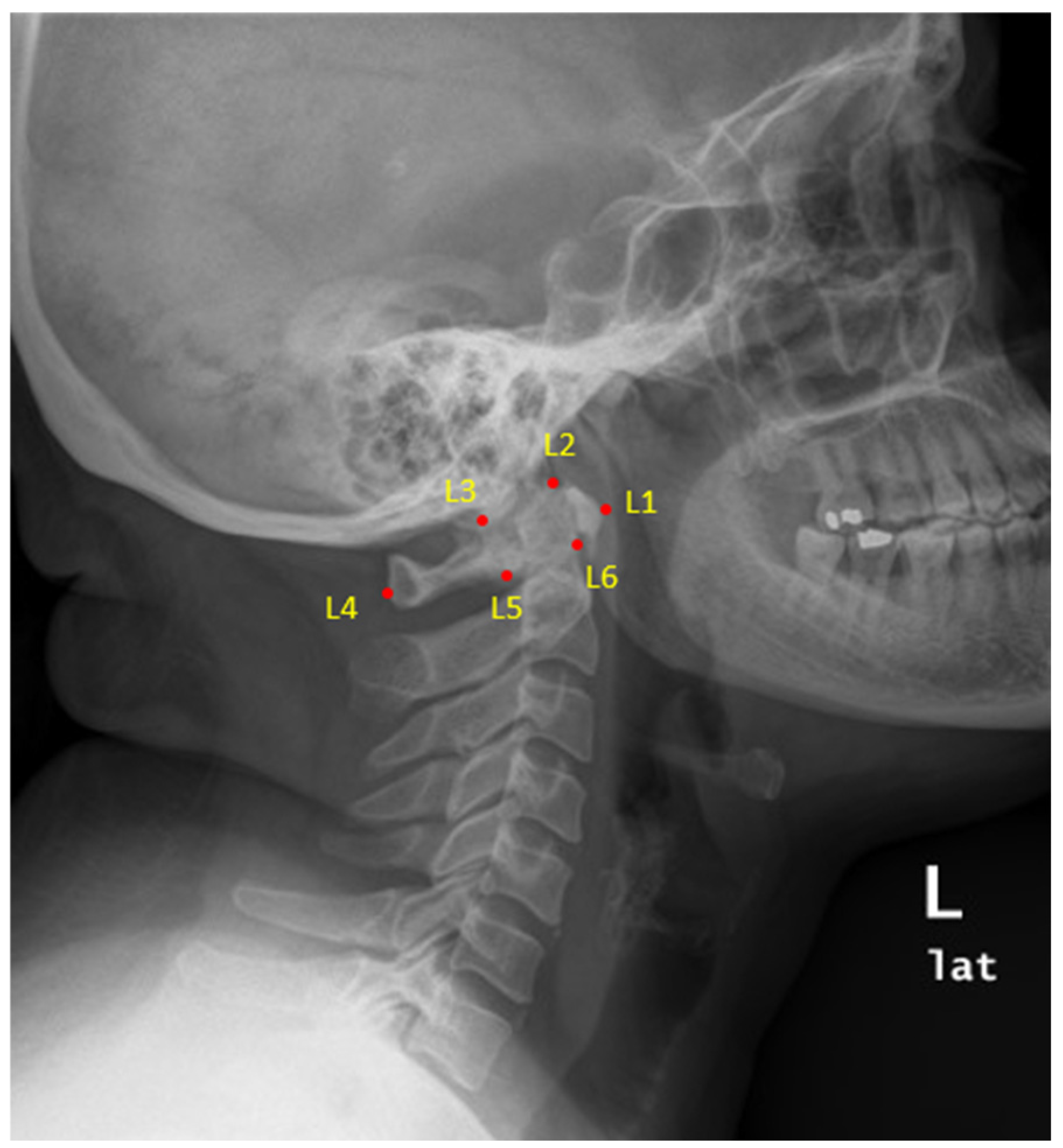
A geometric morphometric approach using two-dimensional coordinates derived from anatomical landmarks on the atlas (C1) was conducted. Six two-dimensional anatomical landmarks were manually placed on lateral skull radiographs utilizing TPS Dig2 (Version 2.31). Landmark selection was adapted from established morphometric protocols successfully applied in both traditional and geometric contexts [
13,
14,
17].
Table 1 provides comprehensive landmark definitions, while
Figure 1 visually illustrates their anatomical locations.
2.5. Intra- and Inter-Observer Analysis
To enhance measurement precision, all landmark placements were reviewed in collaboration with a radiologist [
18]. Intra-observer repeatability was assessed using a pilot analysis, wherein the primary examiner performed landmark digitization on 40 radiographs on two separate occasions (2 weeks interval). Then, paired
t-tests were employed to detect significant differences between repeated measures [
18]. This washout period is consistent with best practices in morphometric research, ensuring that repeated measurements are independent and not influenced by recall of prior landmark placement. For inter-observer reliability, two independent assessors digitized landmarks on 40 radiographs, and outcomes were evaluated through independent samples
t-tests.
2.6. Statistical Analysis
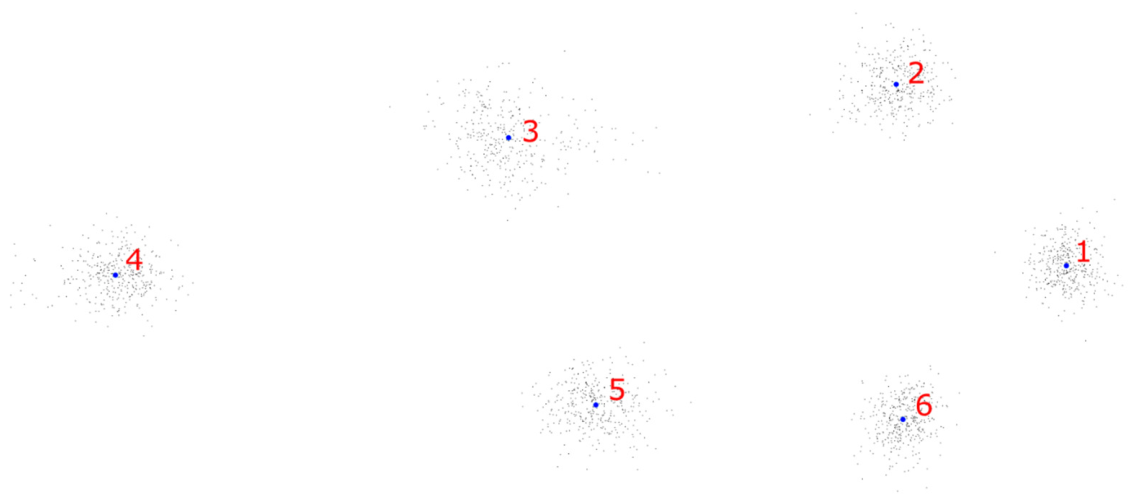
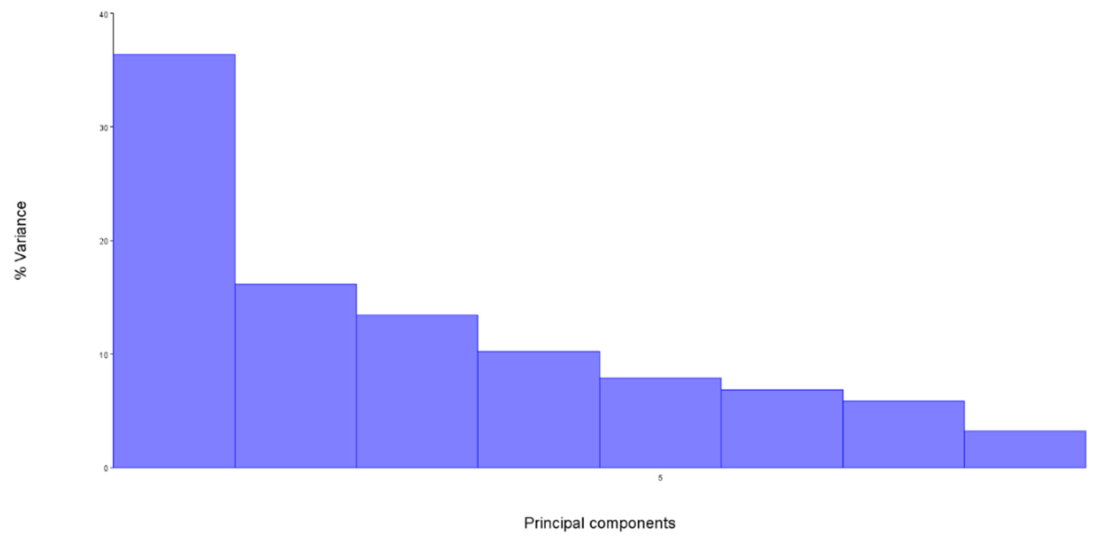
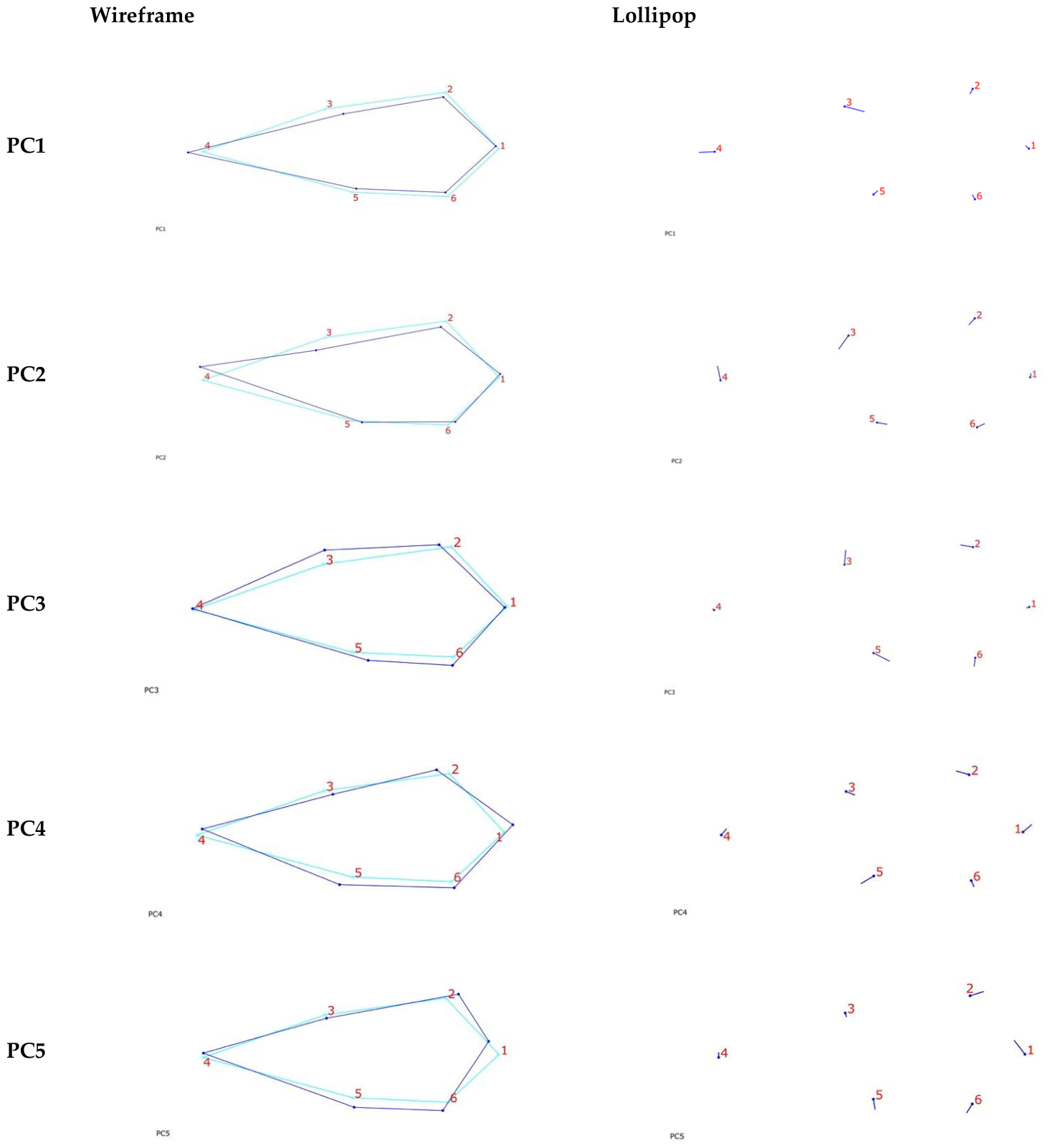
Geometric morphometric analyses were conducted using landmark coordinate data obtained from the two-dimensional radiographic images of the first cervical vertebra (C1). Two-dimensional geometric morphometric techniques were executed in MorphoJ (version 1.07a), including Generalized Procrustes Analysis (GPA), Principal Component Analysis (PCA), Procrustes ANOVA, Canonical Variate Analysis (CVA), and Discriminant Function Analysis (DFA). Prior to statistical analysis, landmark configurations were subjected to Generalized Procrustes Analysis (GPA) to remove non-shape variation associated with translation, rotation, and scale, thereby standardising all specimens into a common coordinate system. PCA was utilized to condense the dataset’s landmark variables into principal components, elucidating primary sources of morphological variability [
19]. Procrustes ANOVA assessed size and shape disparities among different age groups [
16], while CVA examined the differentiation of shape characteristics within the sample population. To evaluate sexual dimorphism and classification performance, discriminant function analysis (DFA) was performed using the Procrustes shape coordinates as predictor variables. The classification procedure was designed to assess the ability of C1 morphology to correctly assign individuals to their respective sex categories based on geometric shape differences. To minimize overestimation of classification performance and improve generalizability of the model, cross-validation was applied using a leave-one-out cross-validation (LOOCV) approach, whereby each specimen was iteratively classified using a model generated from all remaining specimens excluding the test individual. Classification accuracy was therefore calculated based on cross-validated predictions rather than training data alone [
15].
4. Discussion
The present study evaluated sexual dimorphism of the first cervical vertebra (C1) in an Omani population using a two-dimensional geometric morphometric approach applied to lateral cervical radiographs. The findings demonstrate that the atlas exhibits measurable shape differences between males and females, supporting its potential utility as an alternative skeletal element for sex estimation when more commonly used structures are unavailable.
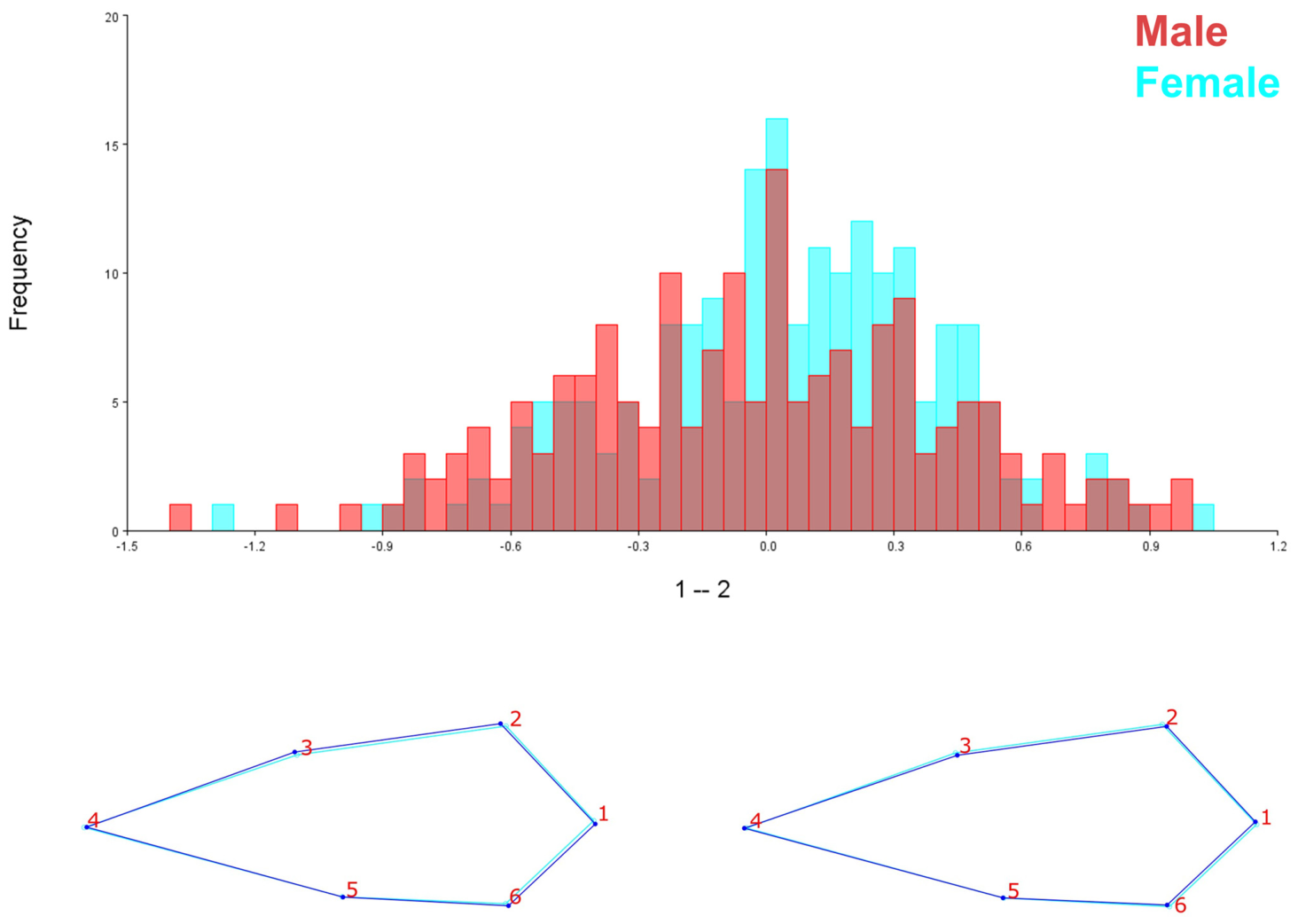
Procrustes ANOVA showed that there was a statistically significant difference in the C1 vertebra’s shape between the sexes (
p = 0.0457). This suggests that, after removing the effects of scale, orientation, and position, the configuration of anatomical landmarks on C1 retains sex-specific patterns. However, male and female centroid sizes did not differ significantly (
p = 0.2432). The Procrustes ANOVA results indicate that sexual dimorphism in the atlas is expressed primarily through shape rather than centroid size. This is similar to what is published from the Greek population which shows a significant sex-based variation in the C1 vertebra [
13]. However, size is shown to be a differentiating factor in the Malaysian and Brazilian populations [
20,
21]. This is an important observation, as it indicates that sexual dimorphism in C1 is not driven by general skeletal robusticity alone, but rather by more subtle morphological variations in form. Shape-based analyses, which capture the relative positioning and geometry of anatomical features, appear to be more sensitive in detecting sex differences in C1 of this population. This finding reinforces the value of geometric morphometric approaches, as such differences would likely remain undetected or underestimated using conventional linear measurements that emphasize absolute dimensions.
Sex was correctly classified in 73.44%. of cases using discriminant functional analysis (DFA) after cross-validation. From a forensic standpoint, an accuracy in the range of approximately 70–77% is considered acceptable for supplementary indicators. However, it is important to interpret these results within the appropriate forensic anthropological context, where skeletal analysis is inherently probabilistic rather than absolute. In forensic practice, particularly in disaster victim identification (DVI) and forensic casework involving commingled or fragmentary remains, the most sexually diagnostic skeletal elements such as the pelvis are frequently absent or severely compromised. Under such conditions, alternative anatomical structures, including the C1, become essential sources of biological information. Previous forensic anthropological studies have similarly demonstrated moderate classification accuracies for cervical vertebra-based sex estimation, reinforcing that such skeletal regions should be considered as complementary rather than primary indicators of sex. Similar to the Omani study, Marino’s research indicated that the centroid size alone may not be a valid metric to estimate sex, attaining an accuracy of 77–85% with shape metrics of the first cervical vertebrae [
22]. The considerable shape variability noted within the Omani study supports the findings of Sertel Meyvaci and colleagues who indicated an accuracy estimate of 78.8% with anatomical measurements of the first cervical vertebrae in the Turkish population [
23]. Fauad and colleagues studied the Malaysian population with C1 classification accuracy of 80%, which is similar to a study on the Brazilian population with an accuracy of 81.2% [
20,
21]. Furthermore, DFA from European populations revealed a classification accuracy of 74% in males and 79.5% in females [
17]. The observed variation in gender classification accuracy of cervical vertebrae could be a result of inter-population variation.
The findings of the present study are compared to both traditional morphometric approaches and three-dimensional geometric morphometric methodologies used in forensic sex estimation from C1 vertebrae. Conventional metric analyses of the atlas vertebra have primarily focused on linear dimensions, including transverse diameter, sagittal diameter, vertebral canal dimensions, and measurements of the lateral masses, with reported classification accuracies generally ranging between approximately 70% and 90%, depending on the studied population, sample size, and statistical approach employed [
24,
25]. The classification accuracy observed in the present study (73–77%) is therefore comparable to several previously published cervical vertebra studies and falls within the expected range for morphometric analyses of non-pelvic skeletal elements. While traditional linear metric methods provide relatively simple and reproducible measurements, they may inadequately capture the complex spatial relationships and integrated shape characteristics of the craniovertebral region. In contrast, geometric morphometric approaches analyze the overall landmark configuration and preserve shape geometry, allowing a more comprehensive assessment of morphological variation beyond isolated dimensions [
26]. Recent three-dimensional geometric morphometric (3D-GM) studies using computed tomography and surface scanning technologies have reported slightly higher classification accuracies, frequently exceeding 80% [
27], likely due to their ability to capture complete spatial anatomy and depth-related morphological variation that may be lost in two-dimensional projections.
Sexually dimorphic shape differences in the first cervical vertebra (C1) may represent ecological adaptations related to function and cranio-cervical relationships. One of the major functions of cervical vertebrae is to support the skull and allow for the head to move. Shape differences may thus reflect adaptations to different loads and movement patterns between the sexes. The morphology of the cervical spine is closely associated with cranial features, and therefore a source of dimorphism in males and females may arise due to evolutionary selective forces on head size and shape [
28]. The degree of sexual dimorphism will likely vary among human populations as well, thus highlighting the importance of gaining population reference data when examining anatomical structures in a forensic scenario [
1]. Additionally, population-specific morphology may further modulate these differences, as the Omani population may exhibit distinct C1 characteristics arising from genetic background, dietary patterns, and environmental influences. Age-related changes, including degenerative remodeling of articular surfaces, osteophytic development, and alterations in cortical thickness, may introduce additional non-sexual variability that can obscure dimorphic patterns, particularly in adult and older individuals. It should be noted, however, that the relative contributions of sexual dimorphism, population-specific morphology, and biomechanical loading to the observed shape variation cannot be definitively disentangled within the retrospective, cross-sectional design of the present study.
A key strength of this study lies in the application of geometric morphometrics to radiographic data as a means of improving sex estimation accuracy beyond what conventional linear measurements can achieve. By preserving the spatial relationships among anatomical landmarks, this method captures subtle, integrated shape differences that are often overlooked when relying solely on linear or angular measurements [
29]. This is particularly important for anatomically complex structures such as the atlas, where variation is not confined to single dimensions but distributed across the entire configuration [
28]. Furthermore, the use of lateral cervical radiographs enhances the practical and translational value of the study. Radiography is routinely performed in clinical practice, and in forensic contexts, it forms a core component of post-mortem examinations and Disaster Victim Identification (DVI) protocols, where imaging of skeletal structures is often captured before or during autopsy [
30]. This allows forensic anthropologists to analyze skeletal morphology non-invasively. By integrating geometric morphometrics with forensic imaging, this approach offers a reliable, non-destructive, and widely applicable tool that bridges clinical practice and forensic identification, enhancing the potential for accurate sex estimation in both living and deceased individuals. In addition, in clinical and radiological contexts, morphometric assessment of the upper cervical spine may contribute to the understanding of normal anatomical variation to assist in preoperative planning.
5. Limitations
Despite the strengths of this study, several limitations should be acknowledged. First, the use of two-dimensional lateral cervical radiographs inherently restricts the analysis to a single plane, which may not fully capture the three-dimensional complexity of the atlas. Subtle shape variations along other planes could therefore be missed, and future studies employing CT-based three-dimensional geometric morphometrics would provide a more comprehensive characterization of atlas morphology. Furthermore, the retrospective, cross-sectional radiographic design of this study does not allow us to disentangle the relative contributions of sexual dimorphism, population-specific morphology, and biomechanical loading to the observed shape variation. Future longitudinal or population-comparative studies are needed to address this. The sample size, while sufficient for exploratory analysis, may not fully represent the variability within the Omani population, limiting generalizability. The moderate classification accuracy achieved in this study (73–77%) indicates that 2D geometric morphometric analysis of C1 should not be used as a standalone forensic sex estimation tool. Rather, it should be applied as a supplementary indicator within a multi-element identification framework, particularly in cases where primary skeletal indicators such as the pelvis and skull are unavailable. Furthermore, the absence of external validation on an independent sample means that the reported accuracy estimates may not generalize beyond the present dataset. Future research should focus on increasing sample sizes and incorporating three-dimensional imaging modalities, such as CT scans, and validating the method on independent population samples to confirm its forensic applicability.




 ,
,