Brief Report

Sexual Dimorphism in Skeletal Remains with Variable Degrees of Preservation—A Preliminary Study

by
Maria José Amorim
1,2,
Inês Morais Caldas
1,2,3,
Daniel Pérez-Mongiovi
1,2 and
Alexandra Teixeira
1,2,*
1
Associate Laboratory i4HB-Institute for Health and Bioeconomy, University Institute of Health Sciences-CESPU, 4585-116 Gandra, Portugal
2
Forensic Science Research Laboratory, UCIBIO-Research Unit on Applied Molecular Biosciences, University Institute of Health Sciences (1H-TOXRUN, IUCS-CESPU), 4585-116 Gandra, Portugal
3
Faculty of Dental Medicine, University of Porto, 4200-393 Porto, Portugal
*
Author to whom correspondence should be addressed.
Forensic Sci. 2026, 6(1), 25; https://doi.org/10.3390/forensicsci6010025
Submission received: 10 February 2026 / Revised: 26 February 2026 / Accepted: 28 February 2026 / Published: 4 March 2026
(This article belongs to the Special Issue Feature Papers in Forensic Sciences)

Abstract

Background/Objectives: When analyzing human skeletal remains for human identification, the assessment of sexual dimorphism is fundamental because it underlies sex estimation, a key parameter of the biological profile, which reduces the number of candidates to approximately one half. Ideally, the most dimorphic bones (the pelvis and long bones) are used, but this analysis may be compromised when the skeletal remains are badly preserved, which is often the case in older skeletons. It is, therefore, necessary to investigate sexual dimorphism in alternative skeletal elements as the quantity and quality of bone structures present in ancient skeletons represent crucial aspects when assessing biological differences between the sexes. The present study aims to evaluate the degree of sexual dimorphism in selected skeletal elements as a preliminary step toward identifying sexually dimorphic parameters with potential applicability in future research on poorly preserved skeletons. Methods: A metric assessment of sexual dimorphism was performed on the clavicle, sternum, and seventh cervical vertebra from a 20th Century collection of identified skeletons from the Portuguese population from CESPU (CEIC), showing a variable degree of bone preservation. Results: Our preliminary data suggest that although all bones analyzed may have exhibited some degree of sexual dimorphism, five parameters—sternal body length, manubrium width, first stern-vertebrae width, clavicle maximum length, and cervical vertebral body height—showed the most promising results. Nevertheless, further studies are needed to validate these observations, using a bigger sample of badly preserved bones. Conclusions: These results represent a preliminary assessment of sexually dimorphic parameters, which may be of interest in circumstances where skeletal elements are poorly preserved.

1. Introduction

The human skeleton is a key resource for human identification, and this analysis can be particularly valuable in mass graves where skeletons may be highly fragmented and badly preserved [1], as well as mass disasters in circumstances where human remains are difficult to identify because of fragmentation, burning, decomposition, or commingling [2,3]. In these circumstances, human remains must be sorted and correctly linked to victims before eventual DNA tests can be performed, as exemplified by the victim identification protocol used at the World Trade Center following the September 11 terrorist attack in 2001 [2]. The assessment of sexual dimorphism is fundamental in this process as it underlies sex estimation, thereby facilitating the assessment of other biological profile parameters, as there are differences in ageing, bone size, and ancestry traits between males and females [4,5].
After careful analysis of the skeletal remains, the biological profile is estimated and other elements that help in the identification process are collected. This reduces the number of candidates and enables the application of primary methods to establish a positive identification [6].
The pelvis is considered the bone with the greatest degree of sexual dimorphism, followed by the long bones, in particular, the humerus and femur, and then the skull [4,5,6,7,8]. As such, these are the preferential bones used for the assessment of sexual dimorphism in adults as they contain several morphologic characteristics that clearly vary between males and females [7,8,9,10,11,12,13]. When these preferred bones are absent or badly preserved, it is necessary to resort to bones with less sexual dimorphism, such as the mandible, ribs, or sternum, among others [14,15,16,17]. Consequently, a range of metric and non-metric approaches has been developed to document sexual dimorphism across a skeleton [11]. Postmortem differences in bone structures are influenced by various factors, namely, taphonomy, which studies the phenomena that influence biological remains from the period of death and after the death of an individual [4,18]. Several aspects affect skeletal remains, such as abiotic extrinsic factors (namely, water, temperature, soil pH, and oxygen), which, in turn, influence the biotic extrinsic factors (colonizing bacteria, arthropods, and mammalian and avian scavengers), impacting the preservation of bone over time [19,20]. Individual factors (specifically, the body weight and age of an individual), as well as cultural factors, also play roles in the decomposition process and bone preservation [18,20].
One of the main challenges concerning the assessment of sexual dimorphism in older skeletal remains is the poor degree of preservation often observed in individuals deceased at an advanced age, which results in lower quantity and quality of bone structures in chronologically older skeletons compared to more recent ones [11,19]. Therefore, the study of alternative skeletal elements and parameters expressing sexual dimorphism in badly preserved skeletons that might be used in circumstances where more dimorphic bones are absent can significantly contribute to human identification in adverse circumstances. The main objectives of this study are to evaluate sexual dimorphism using metric parameters from less frequently used skeletal elements, such as the seventh cervical vertebra, clavicle, and sternum, in a Portuguese population and to perform a preliminary screening of the sexually dimorphic parameters that may support future research in poorly preserved skeletons from this population. These bones were chosen taking into consideration their sexual dimorphism potential, bone structure, and the possibility of measuring several independent metric parameters in each bone. The clavicle has been reported in different studies to exhibit sexually dimorphic parameters including the maximum length, superior-inferior diameter, and anterior-posterior diameter, and it is also relatively well-preserved and recovered in forensic settings [9,16,21]. Concerning the seventh cervical vertebra, several parameters have also been described as sexually dimorphic, including vertebral body height, as well as cervical anterior-posterior diameter and the transverse diameter. This vertebra is also reasonably well represented in forensic contexts and due to its distinctive long prominent spinous process, and it is easier to identify than other vertebrae, which is an advantage when analyzing poorly preserved bones [6,21,22]. Finally, the sternum has been widely studied and shown to have sexually dimorphic parameters, including sternal body length and manubrium width [9,15,17]. Even though it may present a variable degree of preservation and recovery, depending on the forensic context [21], it remains useful for sexual dimorphism studies.

2. Materials and Methods

2.1. Study Sample

The study sample consisted of 43 skeletons (24 males and 19 females) from a 20th Century Portuguese population, with variable degrees of preservation, belonging to the identified human osteological collection from CESPU (CEIC). Sex estimation was carried out using anthropological methods and confirmed by cemetery records [23].
The inclusion criteria included the presence of at least one of the bones to be evaluated (clavicle, sternum, or 7th cervical vertebra).
The state of preservation of the skeletal remains was evaluated according to two criteria, adapted from a previously published protocol [24], as follows:
the quantity and integrity of the bones.
The preserved skeletons had 50–100% of the bones present that were not fragmented, and the cortical surface was highly preserved.
The badly preserved skeletons had 25–49% of the bones present that were not fragmented or partially fragmented, showing some degree of cortical surface preservation.
The very badly preserved skeletons had 1–24% of the bones present that were not fragmented or partially fragmented, with poor cortical surface preservation.
Following their assessment, three different parameters from three different bones were selected to investigate sexual dimorphism.
The bones and parameters analyzed included:
-
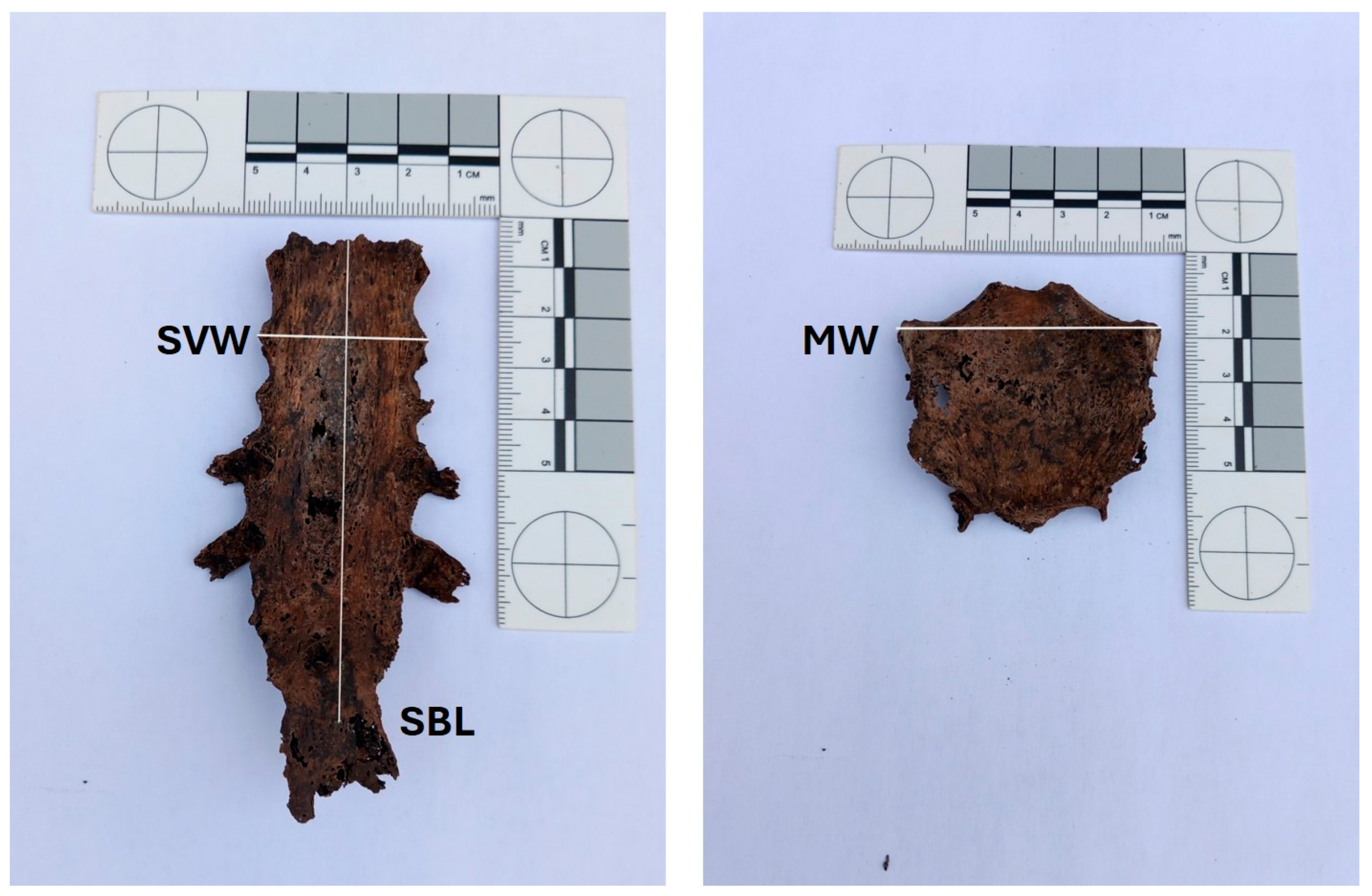
The sternum: sternal body length (SBL), manubrium width (MW), and first Ssern-vertebrae width (SVW) (Figure 1).
-
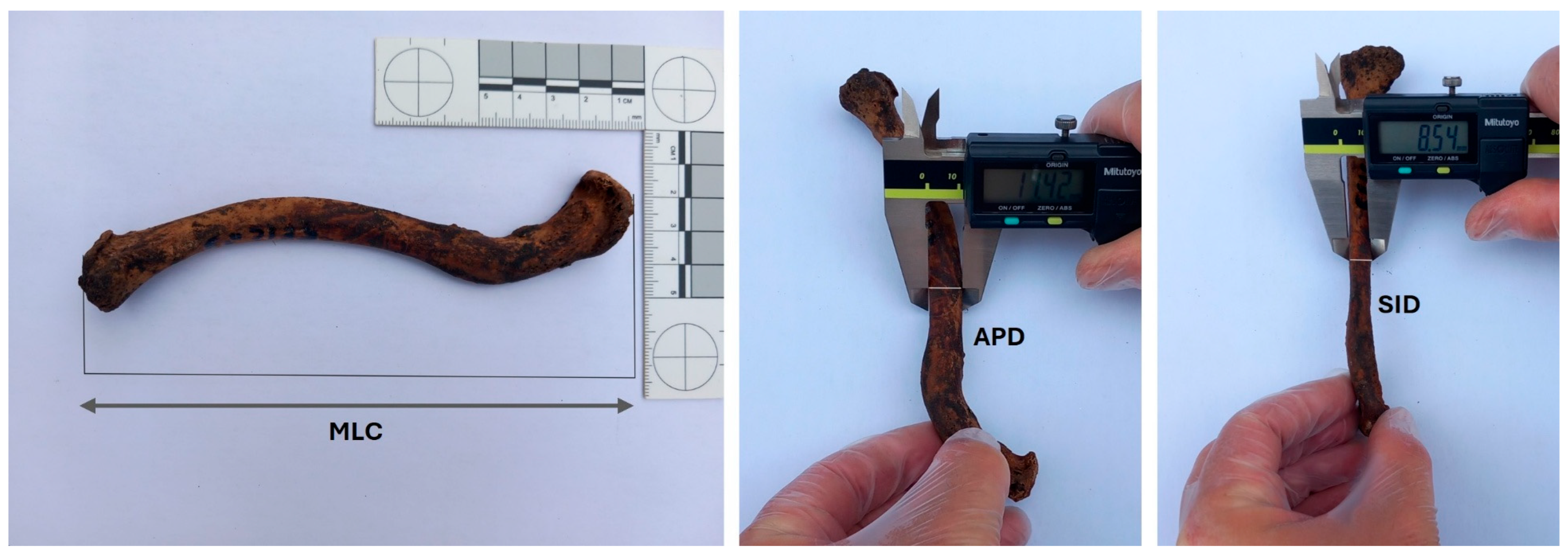
The clavicle: maximum length of clavicle (MLC), superior-inferior diameter (SID), and anterior-posterior diameter (APD) (Figure 2).
-
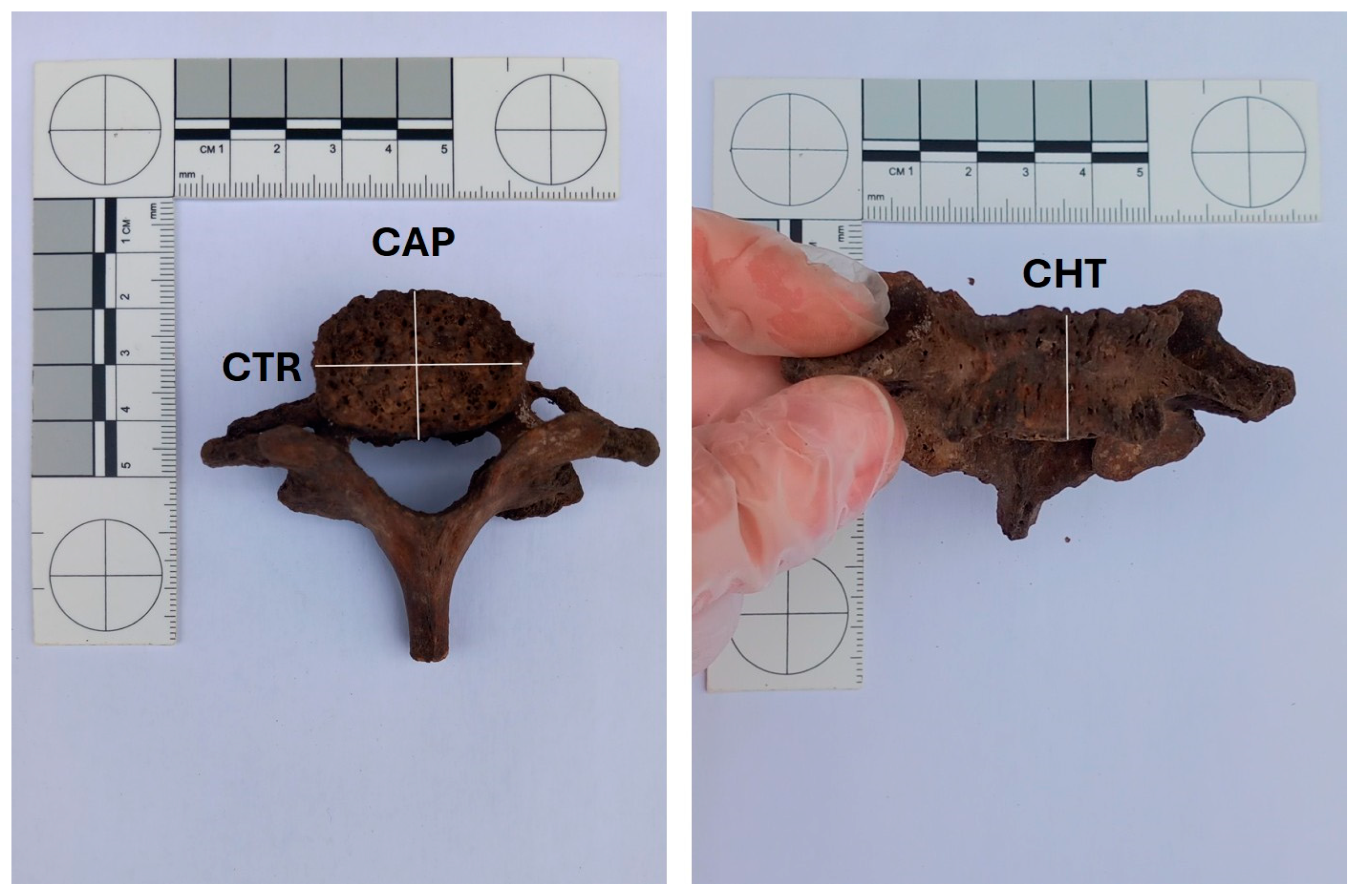
The seventh cervical vertebrae: cervical vertebral body height (CHT), cervical anterior-posterior diameter (CAP), and cervical transverse diameter (CTR) (Figure 3).

2.2. Statistical Analysis

A calibration test was performed by two independent researchers (MJA and AT).
The intra-observer variability of all measurements was addressed by having three independent measurements, performed by the principal researcher (MJA) under the same conditions, for each parameter tested. After the rejection of the 1st measurement, the difference between the 2nd and 3rd measurements was calculated.
A descriptive statistical analysis was performed, and Welch’s t-test and Cohen’s d were applied to evaluate the differences in the measured parameters between the males and females. These analyses were preceded by verification of the normality assumptions using the Shapiro–Wilk test. For one parameter that deviated from normality, a Mann–Whitney U test was performed as a sensitivity check. A significance level of 5% was adopted for all hypothesis tests. Microsoft® Excel® for Microsoft 365 MSO (v.2305) was used for data handling, and the statistical analyses were performed using the XLSTAT statistical and data analysis solution [25] and Jamovi (version 2.6.44).

3. Results

3.1. Sample Characterization

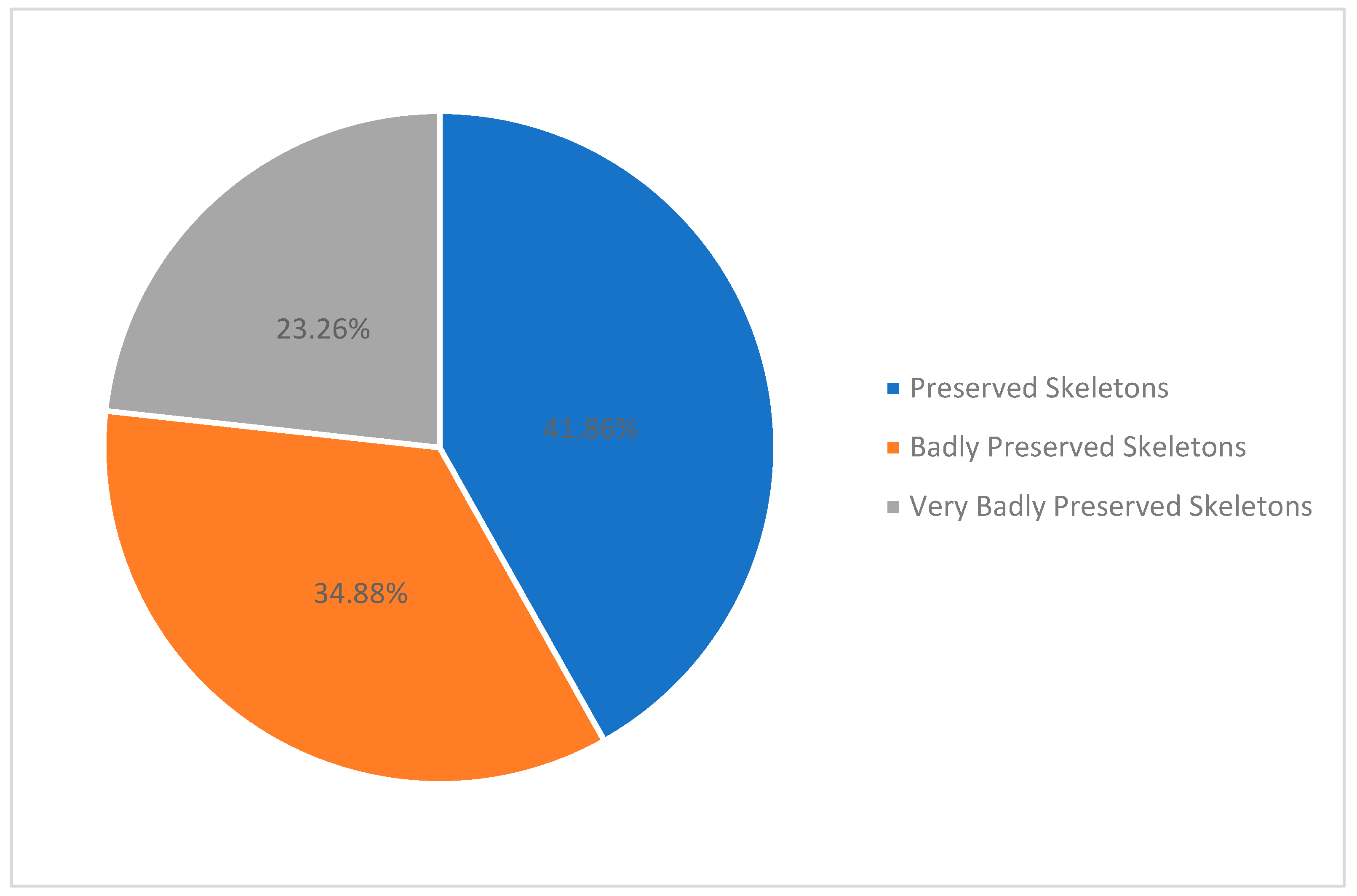
In a collection of skeletons identified from the Portuguese population from the twentieth Century (CEIC), forty-three skeletons were studied and initially divided into three categories: preserved, badly preserved, and very badly preserved skeletons. Of the forty-three skeletons analyzed, the majority were badly preserved or very badly preserved (fifteen and ten skeletons, respectively), whereas eighteen skeletons were considered preserved (Figure 4).
In the preserved sample, the Sternum and vertebra were present in all skeletons and the clavicle in 17 out of the 18 skeletons. Measurements were carried out with different levels of effectiveness, depending on the bones: at least 1 parameter was measured in all sternal bones, 17 clavicles, and 10 vertebrae (Table 1). In the badly preserved sample (including both the badly preserved and very badly preserved bones), out of the 25 skeletons analyzed, the sternum was present in only 8 skeletons, the clavicle in 23, and the vertebrae in all skeletons (with varying degrees of fragmentation). Measurements were carried out on 5 sternal bones, 14 clavicles, and 10 7th cervical vertebrae (Table 1). When comparing the contribution of each sample to the results, approximately 77% of the sternum measurements were performed on preserved samples and 23% on badly preserved ones, while for the clavicle and 7th cervical vertebra, the contribution was very similar (55% preserved/45% badly preserved for the clavicle and 50% each for the 7th vertebra) (Table 1).

3.2. Statistical Analysis of the Parameters Analyzed for the Clavicle, 7th Cervical Vertebra, and Sternum

All the parameters analyzed in the clavicle showed higher values in the males than in the females (Table 2). However, only the mean value of the maximum length of clavicle (MLC) presented a substantial difference between the sexes (149.26 ± 7.43 mm in males vs. 138.57 ± 12.54 mm in females) (Table 2), and Welch’s t-test indicated a significant difference (p = 0.038), with a large effect size (Cohen’s d = 1.04) (Table 3).
The analysis of the seventh cervical vertebra showed no differences between the sexes for the mean value for the transversal diameter (25.33 ± 2.66 mm in males vs. 25.68 ± 1.49 mm in females) (Table 4). Concerning the cervical anterior-posterior diameter, the mean value was only slightly superior in the males, while the cervical vertebral body height was superior in the males (14.52 ± 1.90 mm in males vs. 12.41 ± 1.51 mm in females) (Table 4). The Welch’s t-test indicated a significant difference (p = 0.015; Cohen’s d = 1.23) (Table 5).
Concerning the sternum, the mean value of the sternal body length (SBL) was superior in the males (94.17± 9.22 mm) compared to the females (84.04 ± 5.35 mm) (Table 6). The mean value of manubrium width (MW) and first stern-vertebrae width (SVW) was also superior in the males when compared to the females (55.99 ± 5.99 mm and 46.16 ± 4.11 mm for MW, and 28.30 ± 4.15 mm and 23.42 ± 2.66 mm for SVW) (Table 6). In all cases, the differences between the male and female measurements were significant, with a large effect size (p = 0.010; Cohen’s d = 1.34 for SBL) (p < 0.001; Cohen’s d = 1.91 for MW) (p = 0.006; Cohen’s d = 1.40 for SVW) (Table 7).

4. Discussion

Sex estimation is a fundamental step in human identification, and although genetics provide clear and reliable results, obtaining DNA profiles from human remains can be challenging since DNA may be degraded due to taphonomic factors such as temperature, humidity, soil pH, or microbial activity [26,27]. DNA preservation is also affected by bone type and density, implying that the quality of the DNA obtained depends in part on the skeletal elements available for analysis [26]. In mass disasters and mass graves, present in armed conflict areas or in archaeological settings, due to commingled samples, highly fragmented remains, and lack of reference samples, an anthropological study of the skeletal remains is necessary to identify human bones, determine the minimal number of individuals, assess trauma, analyze perimortem/postmortem damage, and produce a biological profile, therefore helping in the identification process as well as in determining the cause, manner, and circumstances of death [2,5]. Hence, the evaluation of sexual dimorphism through anthropologic methods can be useful in these circumstances as it provides information that supports sex estimation, which, in turn, facilitates the determination of other biological profile parameters. The estimation of the biological profile decreases the number of potential candidates, ultimately allowing the use of primary methods to establish a positive identification [6,7,8,9,10,11,12,13,14,15,16,17,18]. Although the pelvis and long bones are the most sexually dimorphic bones [4,8], skeletons are not always preserved as they may be burned, damaged, or incomplete and, consequently, it is essential to investigate the expression of sexual dimorphism in alternative skeletal elements in these adverse contexts [28]. The usefulness of sexually dimorphic parameters depends on the specific population under study, on the degree of preservation and damage to the skeleton, and on the extent of sexual dimorphism inherent to the skeletal elements studied [7,8,9,10,11,12,13,14,15,16,17,18].
Therefore, it is important to assess sexual dimorphism in skeletal elements that are less commonly studied, such as the clavicle, sternum, and seventh cervical vertebra. Although other skeletal elements could be studied, such as the scapula and the bones of the hand and foot, we believe their analysis would be more challenging as the distal part of the scapula body is fragile, while the bones from the hand and foot are less dimorphic and tend to have a lower recovery rate than the bones analyzed in this study [6,21,22].
In this work, 58.14% of the skeletons belonging to the identified human osteological collection from CESPU (CEIC) showed degradation (with 23.26% of them being badly preserved) (Figure 4). Using this sample, three metric parameters previously reported in different populations were evaluated for each bone to perform an initial screening of the metric traits expressing sexual dimorphism that might be used in badly preserved skeletons of the Portuguese population [6,16,17,29].
The percentages of badly preserved and preserved clavicles analyzed were similar (55% and 45%, respectively) (Table 1), and the maximum length was the sole parameter that showed a clear difference between the males and females, being statistically significant (p = 0.038) with a Cohen’s d of 1.04, indicating a large effect size (Table 3). These data suggest that this parameter may retain sexual dimorphism even in poorly preserved bones and, if confirmed, could be considered for inclusion in future sex estimation research. Our results are in accordance with studies on a Portuguese population reporting the maximum length as a dimorphic parameter [16]. Concerning the seventh cervical vertebra, the relative contributions of preserved and badly preserved bones were also similar (50%) (Table 1), and only the vertebral body length showed significant differences between the females and males (p = 0.015; Cohen’s d = 1.23) (Table 5). These observations partially agree with the results of a study by Rozendaal et al., 2020 [6], who found that the vertebral body maximum length exhibited the greatest sexual dimorphism, and it was the most consistent measurement among the seventh cervical vertebra parameters, with transversal diameter ranked as the second most dimorphic parameter. In our study, we did not observe differences in the transverse diameter data between the males and females (Table 4); however, this observation should be further validated using a larger sample size.
Regarding the sternum, the sample was small and there was a greater level of degradation, affecting the possibility of analysis and, consequently, the measurements were performed mainly on the preserved bones (77% were preserved and 23% were badly preserved). Nevertheless, this bone revealed strong sexual dimorphism across all evaluated parameters, and sternal body length, manubrium width, and first stern-vertebrae width were superior in the males when compared to the females as follows: 94.04 ± 9.22 mm and 84.04 ± 5.35 mm for SBL, 55.99 ± 5.99 mm and 46.16 ± 4.11 mm for MW, and 28.30 ± 4.15 mm and 23.42 ± 2.66 mm for SVW (Table 6). These results are compatible with previously published data regarding sternum dimorphism and its reported relevance for sex estimation in a contemporary Spanish population, where the sternal body length was the most dimorphic single parameter analyzed [17]. Our data are also in partial agreement with a study by Kalbouneh et al., 2021 [30], which showed that the sternal body length was the best parameter for estimating sex, with an accuracy of 81.6%, managing to differentiate between the various age groups, and the researchers concluded that there is a greater dimorphism among middle-aged adults and the elderly. Regarding the manubrium width, sexual dimorphism was also observed but only in the skeletons of elderly individuals; however, for the first stern-vertebrae width, they reported no significant differences found between the females and males, which differs from our preliminary results [30]. Overall, the sternum appears to be the most sexually dimorphic bone in our study. However, its practical assessment in badly preserved bones is constrained as they only represent 23% of the sample. Therefore, when considering poorly preserved skeletons, the clavicle seems the more promising bone analyzed, with the maximum length parameter showing sexual dimorphism.
This preliminary study has, however, several important limitations. A significant sampling of the bones present in the skeletons of the Portuguese population is essential to evaluate the parameters analyzed regarding sexual dimorphism and to validate our observations. It is necessary to note that the collection of skeletons did not contain the same number of male and female skeletons. Furthermore, some bones were absent or impossible to study, which resulted in small, unbalanced samples. Another factor to consider is that with a larger sample, it would be possible to perform a statistical test (ROC) to evaluate whether these parameters might be useful for future sex estimation studies. Importantly, the sample selection was limited to individuals in which the skeletal elements of interest were present and at least partially preserved. Although this may introduce bias, it allowed us to evaluate the practical utility of these bones in circumstances where pelvic or long bones cannot be used. In this regard, the sternum appears highly dimorphic, with all three evaluated parameters showing differences between males and females, even though these elements are frequently less well-preserved [21]. Because very few poorly preserved sternal bones were available and our study focused on measurable elements, interpretation for badly preserved contexts is limited. While we used Welch’s t-tests and reported effect sizes to account for unequal variances, our results should be interpreted with caution.
Despite the limitations and preliminary nature of this study, the results suggest that the five parameters (sternal body length, manubrium width, first stern-vertebrae width, clavicle maximum length, and cervical vertebral body height) show sexual dimorphism and should be further studied using larger and more balanced samples. Additionally, evaluation of the survivability and recovery rates of skeletal elements should also be addressed. Future studies on sexual dimorphism in poorly preserved human skeletal remains should focus on the development of metric reference databases that include fragmented and poorly preserved elements, namely, from the Portuguese identified collections. Such databases would be useful to forensic anthropology specialists and researchers, enabling the development and refinement of metric analyses and standards, which would be applicable in challenging forensic circumstances. The increasing development of three-dimensional (3D) methods applied to skeletal remains might provide significant advantages for anthropological studies, including sexual dimorphism parameters, in conditions of poor preservation by enabling the collection of metric data from fragmented bones to reconstruct missing bony features and fragmented skeletal remains [31]. Moreover, the databases would also be useful to further analytic studies, including geometric morphometric analyses and machine-learning based classifications, which have shown significant potential for improving sex estimation with high accuracy [32,33] but where the analysis of fragmented bones is still challenging [32,34]. Integrating new metric parameters for poorly preserved bones, such as the ones analyzed in this study, into specific metric databases with 3D digital technologies represents a key future direction for advancing research on the sexual dimorphism of poorly degraded skeletal elements.

Author Contributions

Conceptualization, M.J.A., I.M.C., D.P.-M. and A.T.; methodology, M.J.A. and A.T.; validation, M.J.A., I.M.C., D.P.-M. and A.T.; formal analysis, M.J.A. and A.T.; investigation, M.J.A. and A.T.; data curation, M.J.A. and A.T.; writing—original draft preparation, M.J.A. and A.T.; writing—review and editing, I.M.C., D.P.-M. and A.T.; visualization, D.P.-M. and A.T.; supervision, A.T.; project administration, M.J.A. and A.T.;. All authors have read and agreed to the published version of the manuscript.

Funding

This research received no external funding.

Institutional Review Board Statement

The study was conducted in accordance with the Declaration of Helsinki and approved by the Ethics Committee of the University Institute of Health Sciences—CESPU (ethical approval no. 23/CE-IUCS/2023, date of approval-11 January 2024).

Informed Consent Statement

This study utilized skeletal remains from the XXI Century CEIC Collection of our university. This collection has been assembled from cemeteries in Porto, Portugal, in strict compliance with all applicable ethical and legal standards. Specifically, the remains were processed according to Portuguese Decree-Law no. 411/98, which stipulates that after the legal burial period, unclaimed remains may be donated for scientific purposes provided no objection is registered by the deceased in the national registry (RENNDA). All individuals included in this collection fulfilled these legal criteria, and a mandatory consultation of the RENNDA confirmed no prior refusal. Therefore, under this established legal framework, informed consent was considered to be implicit (tacit consent), and a classical informed consent procedure was not applicable to this study.

Data Availability Statement

The extracted feature datasets and derived analytical results are available from the corresponding author upon reasonable request.

Conflicts of Interest

The authors declare no conflicts of interest.

References

  1. Gojanović, D.M.; Sutlović, D. Skeletal remains from World War II mass grave: From discovery to identification. Croat. Med. J. 2007, 48, 520–527. [Google Scholar]
  2. de Boer, H.H.; Roberts, J.; Delabarde, T.; Mundorff, A.Z.; Blau, S. Disaster victim identification operations with fragmented, burnt, or commingled remains: Experience-based recommendations. Forensic Sci. Res. 2020, 5, 191–201. [Google Scholar] [CrossRef]
  3. Jayakrishnan, J.; Reddy, J.; Kumar, R.B.V. Role of forensic odontology and anthropology in the identification of human remains. J. Oral Maxillofac. Pathol. 2021, 25, 543–547. [Google Scholar] [CrossRef]
  4. Christensen, A.M.; Passalacqua, N.V.; Bartelink, E.G. Forensic Anthropology: Current Methods and Practice; Elsevier: San Diego, CA, USA, 2014. [Google Scholar]
  5. Márquez-Grant, N.; Roberts, J. Redefining forensic anthropology in the 21st century and its role in mass fatality investigations. Eur. J. Anat. 2021, 25, 19–34. [Google Scholar]
  6. Rozendaal, A.S.; Scott, S.; Peckmann, T.R.; Meek, S. Estimating sex from the seven cervical vertebrae: An analysis of two European skeletal populations. Forensic Sci. Int. 2020, 306, 110072. [Google Scholar] [CrossRef]
  7. Blau, S.; Graham, J.; Smythe, L.; Rowbotham, S. Human identification: A review of methods employed within an Australian coronial death investigation system. Int. J. Leg. Med. 2020, 134, 375–385. [Google Scholar] [CrossRef] [PubMed]
  8. Spradley, M.K.; Jantz, R.L. Sex estimation in forensic anthropology: Skull versus postcranial elements. J. Forensic Sci. 2011, 56, 289–296. [Google Scholar] [CrossRef] [PubMed]
  9. Spradley, M.L. Metric methods for the biological profile in forensic anthropology: Sex, ancestry, and stature. Acad. Forensic Pathol. 2016, 6, 391–399. [Google Scholar] [CrossRef]
  10. Cappella, A.; Gibelli, D.; Vitale, A.; Zago, M.; Dolci, C.; Sforza, C.; Cattaneo, C. Preliminary study on sexual dimorphism of metric traits of cranium and mandible in a modern Italian skeletal population and review of population literature. J. Leg. Med. 2020, 44, 101695. [Google Scholar] [CrossRef]
  11. Kiskira, C.; Eliopoulos, C.; Vanna, V.; Manolis, S.K. Biometric sex assessment from the femur and tibia in a modern Greek population. Leg. Med. 2022, 59, 102126. [Google Scholar] [CrossRef]
  12. Khan, M.A.; Gul, H.; Mansor Nizami, S. Determination of gender from various measurements of the humerus. Cureus 2020, 12, e6598. [Google Scholar] [CrossRef] [PubMed]
  13. Moosa, S.S.; Shaikh, M.H.R.; Khwaja, M.; Shaikh, S.A.H.; Siddiqui, F.B.; Daimi, S.R.H.; Hiware, S.D.; Ismail, E.E.; Begum, Y. Sexual dimorphic parameters of femur: A clinical guide in orthopedics and forensic studies. J. Med. Life 2021, 14, 762–768. [Google Scholar] [CrossRef] [PubMed]
  14. Sairam, V.; Geethamalika, M.V.; Kumar, P.B.; Naresh, G.; Raju, G.P. Determination of sexual dimorphism in humans by measurements of mandible on digital panoramic radiograph. Contemp. Clin. Dent. 2016, 7, 434–439. [Google Scholar] [CrossRef] [PubMed]
  15. Peleg, S.; Kallevag, R.P.; Dar, G.; Steinberg, N.; Masharawi, Y.; May, H. New methods for sex estimation using sternum and rib morphology. Int. J. Leg. Med. 2020, 134, 1519–1530. [Google Scholar] [CrossRef]
  16. Curate, F.; Alves, I.; Rodrigues, T.; Garcia, S.J. Assigned sex estimation with the clavicle and scapula: A study in a Portuguese reference sample. Med. Sci. Law 2024, 64, 15–22. [Google Scholar] [CrossRef]
  17. García-Parra, P.; Pérez Fernández, Á.; Djorojevic, M.; Botella, M.; Alemán, I. Sexual dimorphism of the human sternum in a contemporary Spanish population. Forensic Sci. Int. 2014, 244, 313.e1–313.e9. [Google Scholar] [CrossRef]
  18. Işcan, M.Y.; Steyn, M. The Human Skeleton in Forensic Medicine, 3rd ed.; Charles C Thomas Pub Ltd.: Springfield, IL, USA, 2014. [Google Scholar]
  19. Wescott, D.J. Recent advances in forensic anthropology: Decomposition research. Forensic Sci. Res. 2018, 3, 278–293. [Google Scholar] [CrossRef]
  20. Emmons, A.L.; Mundorff, A.Z.; Hoeland, K.M.; Davoren, J.; Keenan, S.W.; Carter, D.O.; Campagna, S.R.; DeBruyn, J.M. Postmortem skeletal microbial community composition and function in buried human remains. mSystems 2022, 7, e0004122. [Google Scholar] [CrossRef]
  21. Scott, S.; Jantz, R.L. Survivability versus rate of recovery for skeletal elements in forensic anthropology. J. Forensic Sci. 2022, 67, 1758–1765. [Google Scholar] [CrossRef]
  22. Amores, A.; Botella, M.C.; Alemán, I. Sexual dimorphism in the 7th cervical and 12th thoracic vertebrae from a Mediterranean population. J. Forensic Sci. 2014, 59, 301–305. [Google Scholar] [CrossRef]
  23. Caldas, I.M.; Dinis-Oliveira, R.J.; Azevedo, R.M.S.; Madureira-Carvalho, Á. The assembly of a new human osteological collection: The XXI CEIC as a forensic pedagogical tool. Forensic Sci. 2023, 3, 521–532. [Google Scholar] [CrossRef]
  24. Biehler-Gomez, L.; Mattia, M.; Mondellini, M.; Cattaneo, C. Differential skeletal preservation between sexes: A diachronic study in Milan over 2000 years. Archaeol. Anthropol. Sci. 2022, 14, 147. [Google Scholar] [CrossRef]
  25. Lumivero. XLSTAT Statistical and Data Analysis Solution. 2023. Available online: https://www.xlstat.com (accessed on 15 July 2024).
  26. Latham, K.E.; Miller, J.J. DNA recovery and analysis from skeletal material in modern forensic contexts. Forensic Sci. Res. 2018, 4, 51–59. [Google Scholar] [CrossRef]
  27. Kravanja, P.; Golob, A.; Concato, M.; Leskovar, T.; Zupanič Pajnič, I. Effects of different environmental factors on preservation of DNA in petrous bones: A comparative study of two Slovenian archaeological sites. Forensic Sci. Int. 2025, 371, 112495. [Google Scholar] [CrossRef]
  28. Krishan, K.; Chatterjee, P.M.; Kanchan, T.; Kaur, S.; Baryah, N.; Singh, R.K. A review of sex estimation techniques during examination of skeletal remains in forensic anthropology casework. Forensic Sci. Int. 2016, 261, 165.e1–165.e1658. [Google Scholar] [CrossRef]
  29. Demir, U.; Etli, Y.; Hekimoglu, Y.; Kartal, E. Sex estimation from the clavicle using 3D reconstruction, discriminant analyses, and neural networks in an Eastern Turkish population. Leg. Med. 2022, 56, 102043. [Google Scholar] [CrossRef]
  30. Kalbouneh, H.; Mubarak, N.; Daradkeh, S.; Ashour, O.; Alkhatib, A.M.; Suboh, L.; Nofal, A.; Mahafzah, W.; Alsalem, M. Estimation of sex based on metrics of the sternum in a contemporary Jordanian population: A computed tomographic study. Medicine 2021, 100, e28169. [Google Scholar] [CrossRef]
  31. Jani, G.; Johnson, A.; Parekh, U.; Thompson, T.; Pandey, A. Effective approaches to three-dimensional digital reconstruction of fragmented human skeletal remains using laser surface scanning. Forensic Sci. Int. Synergy 2020, 2, 215–223. [Google Scholar] [CrossRef]
  32. Baca, K.; Bridge, B.; Snow, M. Three-dimensional geometric morphometric sex determination of the whole and modeled fragmentary human pubic bone. PLoS ONE 2022, 17, e0265754. [Google Scholar] [CrossRef]
  33. Toneva, D.; Nikolova, S.; Agre, G.; Zlatareva, D.; Hadjidekov, V.; Lazarov, N. Machine learning approaches for sex estimation using cranial measurements. Int. J. Leg. Med. 2021, 135, 951–966. [Google Scholar] [CrossRef] [PubMed]
  34. Garcovich, D.; Albert Gasco, L.; Alvarado Lorenzo, A.; Aiuto, R.; Adobes Martin, M. Sex estimation through geometric morphometric analysis of the frontal bone: An assessment in pre-pubertal and post-pubertal modern Spanish population. Int. J. Leg. Med. 2022, 136, 319–328. [Google Scholar] [CrossRef] [PubMed]
Figure 1. Sternum measurements: sternal body length (SBL), first stern-vertebrae width (SVW), and manubrium width (MW).
Forensicsci 06 00025 g001
Figure 2. Clavicle measurements: maximum length of clavicle (MLC), anterior-posterior diameter (APD), and superior-inferior diameter (SID).
Forensicsci 06 00025 g002
Figure 3. Seventh cervical vertebra measurements: cervical anterior-posterior diameter (CAP), cervical transverse diameter (CTR), and cervical vertebral body height (CHT).
Forensicsci 06 00025 g003
Figure 4. Schematic representation of the level of skeletal preservation of the sample analyzed in this study.
Forensicsci 06 00025 g004
Table 1. Relative Contribution of the Preserved and Badly Preserved Skeletons to the Present Data.
SampleNumbernº of Bones Presentnº MeasuredData Contribution
Preserved Clavicle        181755%
Skeletons187th cerv. Vertebra    181050%
Sternum         171777%
Badly Preserved Clavicle        231445%
Skeletons 257th cerv. Vertebra    251050%
Sternum         8523%
TOTAL43
Table 2. Comparison of the Clavicle Measurements for the Males and Females.
ClavicleSexNMean (mm)SD (mm)Minimum (mm)Maximum (mm)
MLCMale17149.267.43129.94161.09
Female9138.5712.54121.23165.32
SIDMale1811.591.349.5915.09
Female1310.731.558.3112.98
APDMale1811.022.057.7414.98
Female1310.372.007.6013.37
Legend: MLC (maximum length of clavicle), SID (superior-inferior diameter), APD (anterior-posterior diameter), and SD (standard deviation).
Table 3. Independent sample Welch’s t-tests for clavicle parameters.
Claviclet (Welch)dfpMean
Difference
SE Difference95% Confidence IntervalEffect Size (Cohen’s d)
LowerUpper
MLC2.3511.10.03810.694.550.6820.701.04
SID1.6223.60.1190.860.53−0.241.960.60
APD0.88826.40.3820.660.74−0.862.170.32
Legend: MLC (maximum length of the clavicle), SID (superior-inferior diameter), APD (anterior-posterior diameter).
Table 4. Comparison of the Seventh Vertebra Measurements for the Males and Females.
7th Cervical VertebraSexNMean (mm)SD (mm)Minimum (mm)Maximum (mm)
CHTMale1114.511.9011.4117.90
Female812.411.5110.6615.42
CAPMale1118.592.1615.4822.64
Female817.481.6115.8420.85
CTRMale1225.332.6618.6028.25
Female825.681.4923.8228.37
Legend: CHT (cervical vertebral body height), CAP (cervical anterior-posterior diameter), CTR (cervical transverse diameter), and SD (standard deviation).
Table 5. Independent sample Welch’s t-tests for the Seventh Cervical Vertebra parameters.
7th Cervical Vertebraet (Welch)dfpMean
Difference
SE Difference95% Confidence IntervalEffect Size (Cohen’s d)
LowerUpper
CHT2.7016.80.0152.110.780.463.771.23
CAP1.2817.00.2161.110.87−0.722.940.58
CTR *−0.3817.60.709−0.350.93−2.311.60−0.16
* CTR did not follow normality (Shapiro–Wilk p = 0.03); a Mann–Whitney U test was performed as a sensitivity check (p = 0.671). Cohen’s d represents the effect size for the parametric comparisons. Legend: CHT (cervical vertebral body height), CAP (cervical anterior-posterior diameter), CTR (cervical transverse diameter).
Table 6. Comparison of the Sternal Measurements in the Males and Females.
SternumSexNMean (mm)SD (mm)Minimum (mm)Maximum (mm)
SBLMale1094.179.2281.30105.80
Female984.045.3578.5095.20
MWMale1255.995.9948.7466.25
Female746.164.1138.8951.35
SVWMale1128.304.1523.3535.23
Female823.422.6619.7827.02
Legend: SBL (sternal body length), MW (manubrium width), SVW (first stern-vertebrae width), and SD (standard deviation).
Table 7. Independent Sample Welch’s t-tests for the sternum parameters.
Sternumt (Welch)dfpMean
Difference
SE Difference95% Confidence IntervalEffect Size (Cohen’s d)
LowerUpper
SBL2.9714.70.01010.103.422.8417.401.34
MW4.2316.4<0.0019.822.324.9114.701.91
SVW3.1116.80.0064.871.571.578.181.40
Legend: SBL (sternal body length), MW (manubrium width), SVW (firsts stern-vertebrae width).
Disclaimer/Publisher’s Note: The statements, opinions and data contained in all publications are solely those of the individual author(s) and contributor(s) and not of MDPI and/or the editor(s). MDPI and/or the editor(s) disclaim responsibility for any injury to people or property resulting from any ideas, methods, instructions or products referred to in the content.