Article

Comparative Elemental Signatures of Full Metal Jacket (FMJ) and Lead Round Nose (LRN) Projectiles on Complex Biological Targets Using Micro-XRF and Portable XRF


by
Suthisa Leasen
1,*,
Panida Lorwongtragool
1,
Sittichoke Chaiwan
2 and
Montri Donphoongpri
3
1
Materials Science and Innovation Research Unit, Faculty of Science and Technology, Rajamangala University of Technology Suvarnabhumi, Nonthaburi 11000, Thailand
2
Department of Ceramic Art and Design, Faculty of Decorative Arts, Silpakorn University, Nakhon Pathom 73000, Thailand
3
Forensic Scientist (Fireman and Toolmark Examiner) Ballistic and Physical Division, Central Institute of Forensic Science, Ministry of Justice, Bangkok 10210, Thailand
*
Author to whom correspondence should be addressed.
Forensic Sci. 2026, 6(1), 11; https://doi.org/10.3390/forensicsci6010011
Submission received: 25 December 2025 / Revised: 22 January 2026 / Accepted: 27 January 2026 / Published: 2 February 2026
(This article belongs to the Special Issue Feature Papers in Forensic Sciences)

Abstract

Background: In forensic ballistics, identifying ammunition types on physical evidence is critical, particularly when metallic residues are minimal. This study comparatively analyzes the elemental signatures deposited by two common projectiles—Full Metal Jacket (FMJ) (Cu/Zn jacket) and Lead Round Nose (LRN) (exposed Pb core)—on complex targets, including pig bone/tissue and mango wood. Methods: Using a semi-automatic handgun at an intermediate range of 5.0 m, residues were examined through high-resolution benchtop Micro-XRF (M4 Tornado) for micro-spatial analysis and Portable XRF (Elio) for rapid field characterization. Additionally, fresh pork leg samples were subjected to a 3-month environmental degradation period to assess trace persistence. Results: Observations indicated that LRN projectiles exhibit markedly elevated Lead (Pb) concentrations along the wound track in bone, hence confirming Pb as a reliable indicator for unjacketed ammunition; specifically, the median Pb concentrations at bullet wiping were 10.39 wt% for M4 and 7.34 wt% for Elio. Conversely, FMJ traces remain strictly confined to the surface bullet wipe area, with median concentrations of Pb, Cu, and Zn being 2.21 wt%, 0.24 wt%, and 0.59 wt% via M4, respectively. Statistical analysis showed a strong correlation for high-concentration elements on tissue, but significantly greater variance on wooden surfaces where FMJ traces exhibited a very weak negative correlation (r = −0.2774) due to minimal and irregular metal transfer. Taphonomic evaluation revealed that the Pb signature from LRN is exceptionally stable (r ≈ 0.9999) even after decomposition, while FMJ signatures are highly sensitive to environmental exposure. Conclusions: This research underscores the necessity of high-sensitivity Micro-XRF (M4) for definitive ammunition verification, providing a refined analytical framework for shooting incident reconstruction even involving degraded remains or complex environmental scenes.

1. Introduction

Investigations involving firearms typically rely on examining unique markings left on projectiles and cartridge casings by the barrel. However, in many cases, recovered projectiles may be severely damaged, fragmented into tiny pieces, or so distorted that matching the striations to a suspected firearm is incomplete or impossible [1,2]. In these scenarios, analytical chemical methods become critically important for providing forensic evidence to identify bullet traces and trajectories at the crime scene, and potentially linking them to the type of ammunition used [3,4,5,6]. The analysis of elemental signatures from ballistic residues has been a long-standing practice in forensic science to identify the presence of metallic traces such as Lead (Pb), Antimony (Sb), Copper (Cu), and Zinc (Zn) on target surfaces [7].This research extends this concept by studying the transfer of these elements onto complex physical target surfaces (e.g., bone-containing tissue and wood), thereby simulating real-world crime scene conditions [3,5,8,9].
The definitive identification of projectile types and the reconstruction of shooting incidents are fundamental pillars of forensic ballistics. While traditional examinations rely on matching unique striations left by the firearm’s barrel on projectiles and cartridge casings, this method is frequently hindered in real-world scenarios. Projectiles recovered from crime scenes are often severely distorted, fragmented, or mangled upon impact with high-density targets, such as bone or structural wood, rendering physical comparison incomplete or impossible. In such instances, analytical chemical methods, particularly the analysis of metallic elemental signatures, become crucial for providing circumstantial evidence to characterize the general category of ammunition (e.g., jacketed versus unjacketed projectiles) based on their distinct elemental transfer patterns.

1.1. Elemental Transfer Mechanisms: FMJ vs. LRN

Projectiles possess distinct heavy metal compositions that serve as chemical markers [8]. Full Metal Jacket (FMJ) projectiles feature a lead core encased in a brass jacket, typically composed of Copper (Cu) and Zinc (Zn). This jacket maintains the bullet’s structural integrity during penetration [10], primarily transferring jacket material as a “bullet wipe” around the entrance wound. Conversely, Lead Round Nose (LRN) projectiles consist of an unjacketed lead alloy, often containing Antimony (Sb) or Tin (Sn). Upon impacting dense biological or organic matrices, LRN bullets undergo severe deformation and fragmentation, resulting in extensive volumetric deposition of Lead (Pb) throughout the wound track [2].

1.2. Rationalizing Micro-XRF and Portable XRF Methodologies

Advanced spectroscopic techniques offer non-destructive alternatives to traditional chemographic tests [10,11]. The benchtop Micro-X-ray Fluorescence (Micro-XRF) spectrometer, such as the M4 Tornado, provides micrometer-scale spatial resolution (spot size < 20 µm) and elemental mapping capabilities [12,13,14,15]. These features are indispensable for characterizing traces on irregular, rough, or heterogeneous surfaces like bone and wood [12,16]. Complementing laboratory analysis, Portable XRF (Elio) has emerged as a viable tool for rapid, on-site field screening [5], allowing investigators to identify heavy metal traces directly at the crime scene without sample preparation [17]. Validating the correlation between these two instruments is critical for integrating field-based screenings into formal forensic protocols [13,18].

1.3. Research Gaps: Range and Taphonomic Persistence

Despite advancements, significant challenges remain in detecting residues at intermediate firing ranges and on degraded evidence. Current literature provides limited data on trace deposition at distances of 5.0 m, where conventional residues become highly dispersed. Furthermore, the effects of environmental exposure and tissue degradation (forensic taphonomy) on the persistence of these metallic signatures are not fully elucidated. Skeletal remains and structural wood may act as long-term reservoirs for ballistic evidence, but their reliability after prolonged exposure remains a critical question for investigations involving decomposed remains.
This study aims to bridge these gaps by comparatively analyzing the elemental signatures of FMJ and LRN projectiles on complex simulated targets (fresh pork leg and mango wood) fired from an intermediate distance of 5.0 m. A key focus is placed on assessing the persistence of these traces after a 3 months environmental degradation period.

2. Materials and Methods

2.1. Firearms and Ammunition

A 9 mm LUGER semi-automatic handgun (Glock 17, manufactured by GLOCK Ges.m.b.H., Deutsch-Wagram, Austria) was used for all test firings. The elemental compositions of the FMJ and LRN projectiles were characterized using the XRF M4 to identify diagnostic marker elements (e.g., Cu and Zn for the FMJ, and Pb and Sb for the LRN core) prior to evaluating the residues on the targets.

2.2. Experimental Setup and Firing Protocol

Fresh pork legs were used, with the internal position of the bone confirmed to ensure the bullet’s impact point was appropriately set to simulate a shot through the bone. These specimens were purchased from a local commercial market and were originally produced for human consumption. Consequently, as the materials were sourced as food industry by-products, formal animal ethics committee approval was not required. Target positions were then established, and a qualified firearms specialist was utilized, capable of maintaining a firing distance tolerance of less than 2 cm from the designated target. The area surrounding the impact point was marked to serve as a standardized sampling region.
Mango branches with a diameter of 3–4 inches were cut, and their moisture content was recorded. A Control Area was marked on the mango branches to determine the baseline value of naturally occurring elements in the wood before XRF analysis.
As illustrated in Figure 1, all test firings were performed at a constant distance of 5.0 ± 0.5 m within an outdoor range. This setup was designed to simulate real-world conditions, such as forensic investigations and hunting environments. The experiments took place between April and July, characterized by a tropical climate with ambient temperatures ranging from 32 °C to 38 °C. Despite the presence of variable environmental factors, such as undetermined wind direction, the inorganic elemental residues (Pb, Cu, Sb, and Zn) exhibit high stability. This ensures that the detected elemental signatures remain representative of the projectile–target interaction, unaffected by the extreme tropical heat during the study period.

2.3. Non-Destructive Analysis and Taphonomy Simulation

As the experiment was conducted at a 5 m firing distance, where bullets were expected to penetrate the targets (fresh pork leg and mango branch), a Bullet Recovery System was set up as a dampening material behind the targets to collect fully penetrated bullets or fractured fragments. After each shot, the targets were photographed to document morphological changes, including the size and characteristics of the bullet’s entrance and exit wounds, which served as a reference for subsequent inspection using the XRF M4 and Elio.
The XRF M4 and Elio instruments allow for Non-Destructive Analysis [9]. Therefore, the entire target samples (mango branch, approximately 1 foot long, and the fresh pork leg’s shank section) were used for direct analysis of the traces generated by the bullets. No sections of tissue or bone were cut from the bullet impact point for separate analysis; instead, Elemental Mapping and spot analysis were performed directly on the surface of the samples using the XRF M4.
To evaluate inter-instrument consistency, statistical correlations—including Pearson’s correlation coefficient (r) and the coefficient of determination (R2)—were calculated based on the comparative analysis of elemental intensities (measured as counts per second, cps). These values were derived from corresponding mapping points (pixels) for primary marker elements (Pb, Cu, and Zn) across both the Micro-XRF (M4 Tornado) and Portable XRF (Elio).
The Portable XRF (Elio) was initially employed for non-destructive bulk analysis and rapid field screening on the large surfaces of the pork leg and mango wood samples. To simulate the discovery of forensic evidence under environmental degradation, the fired pork leg samples were subjected to a three-month outdoor air-drying period. Following this, samples were re-examined by both instruments to assess the persistence rate of bullet traces on degraded bone and tissue.
For data characterization, descriptive statistics were used to summarize the elemental concentrations for LRN and FMJ samples. However, due to the non-normal distribution of the data—confirmed by the presence of numerous outliers in the box-and-whisker plots (see Supplementary Figures S1 and S2)—the results exhibited a significant right-skewed pattern. Consequently, the median and range (Min–Max) were employed as the primary measures for statistical reporting, as they provide a more robust and accurate representation of the heterogeneous ballistic residues than the mean and standard deviation. Finally, correlation analysis was applied to evaluate the agreement between the semi-quantitative results obtained from both XRF systems.

3. Results

3.1. Basic Composition of Ammunition and Control Analysis

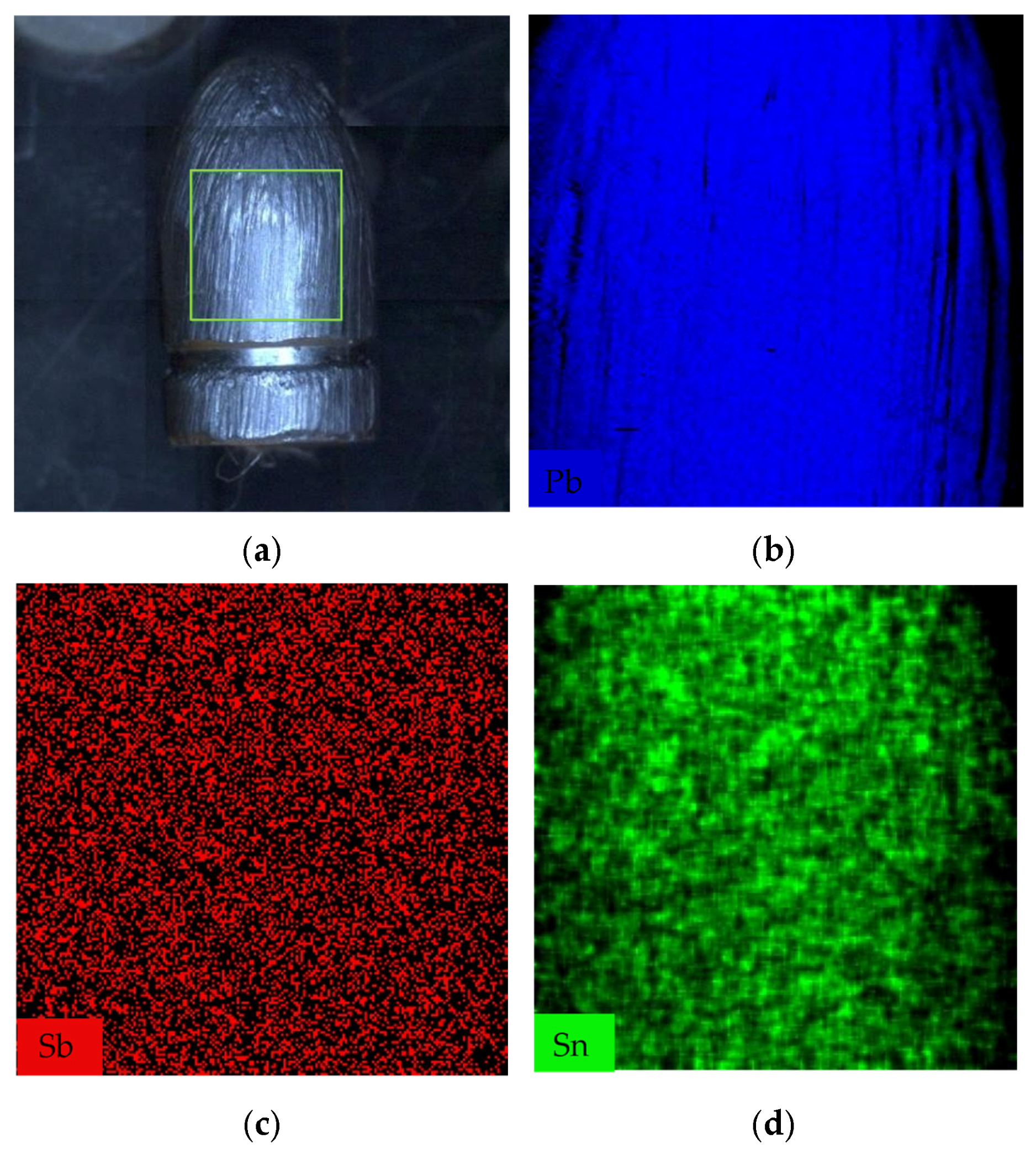
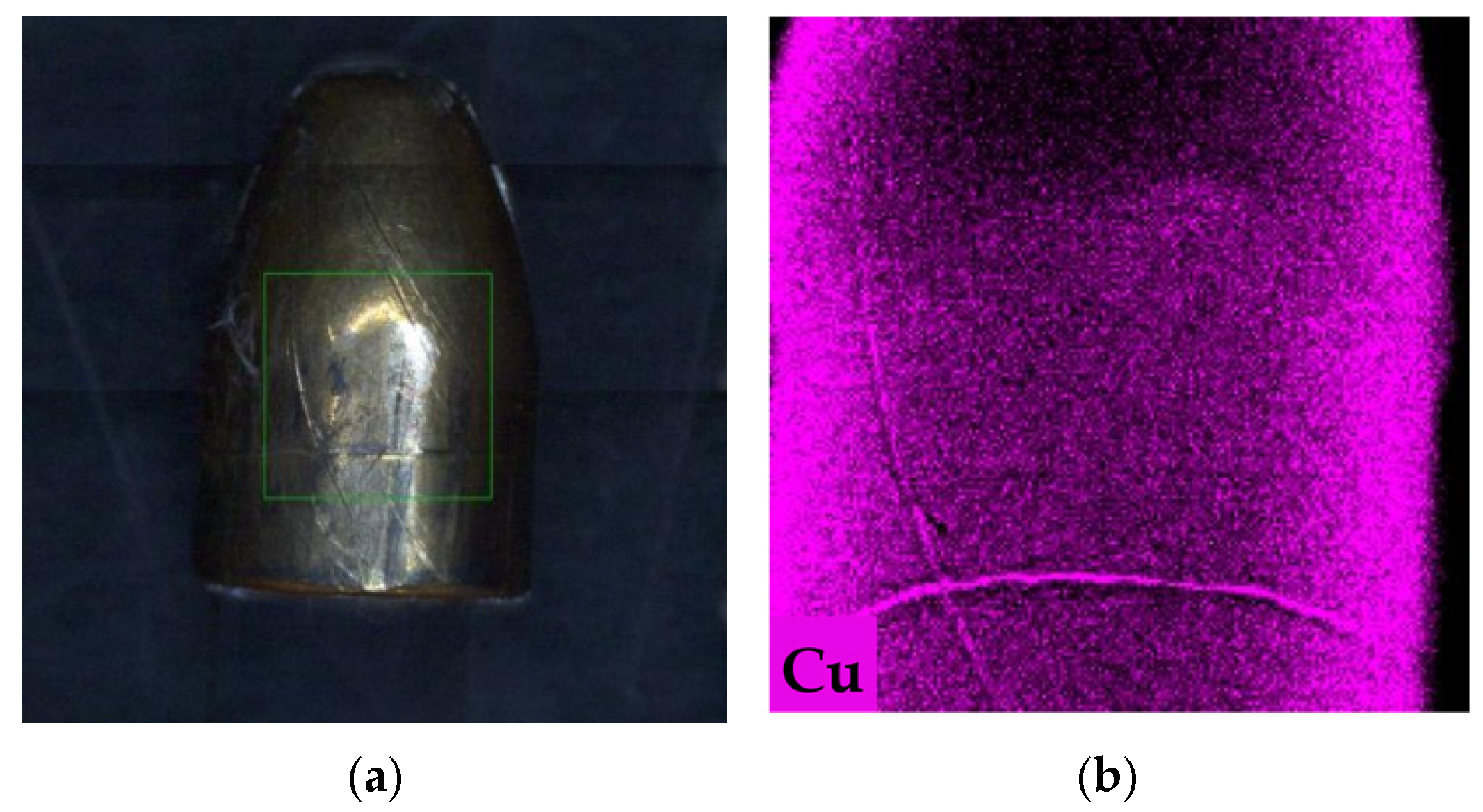
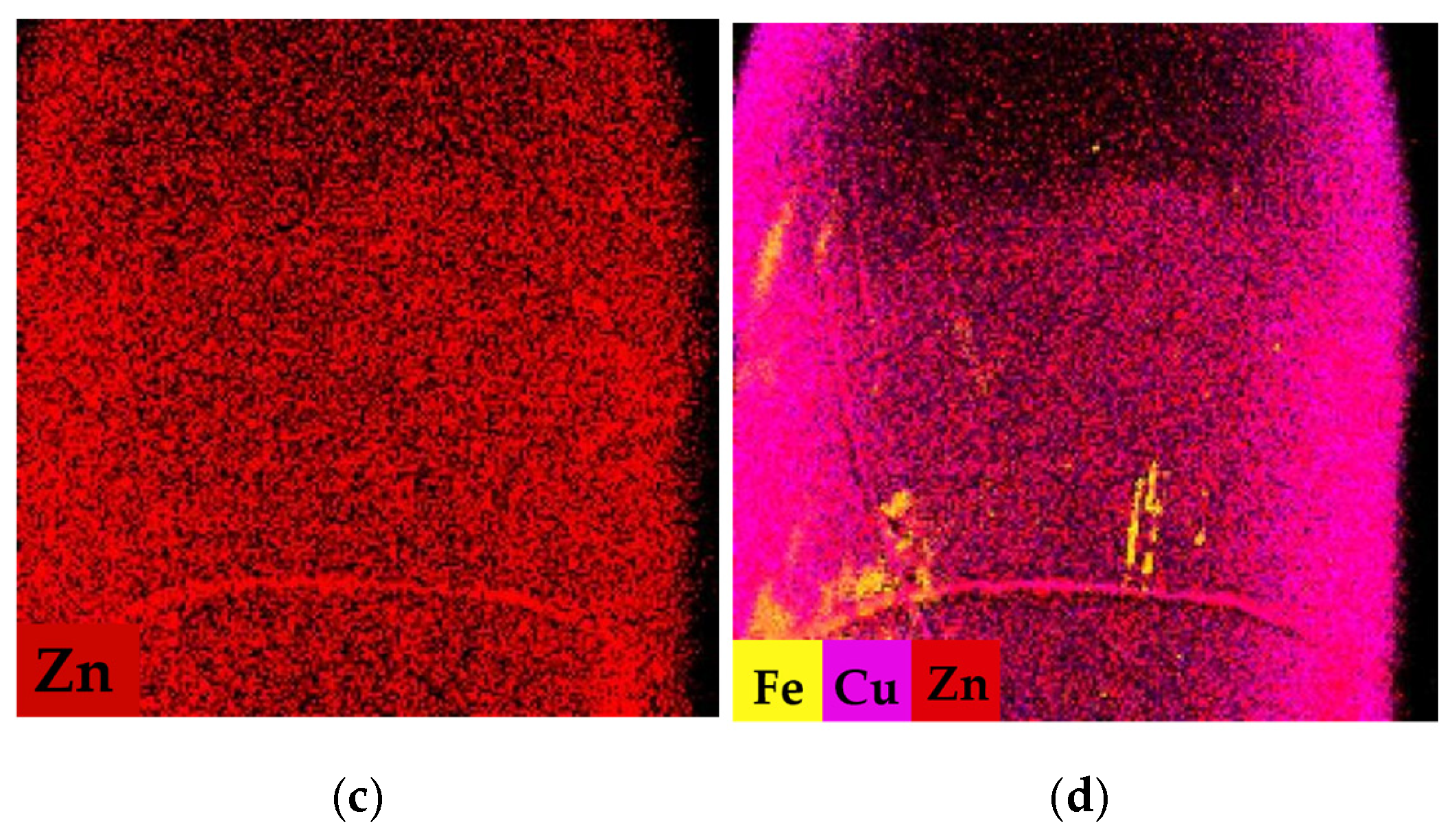
The characterization of the projectiles used in this study confirmed that the LRN bullet primarily consists of Lead (Pb) with Antimony (Sb) as a significant trace element at the percentage level (XSb > 1.0%), as shown in the elemental maps in Figure 2. Conversely, the FMJ bullet displayed a composition of Copper (Cu) and Zinc (Zn) at a ratio consistent with standard brass jacketing, as illustrated in the elemental maps in Figure 3. This baseline data is essential for identifying the specific marker ratios required to distinguish ammunition-derived metallic traces from naturally occurring elements or environmental contaminants in the targets.

3.2. Transfer of Bullet Traces onto Target Surfaces

3.2.1. Results of Elemental Mapping Using XRF M4

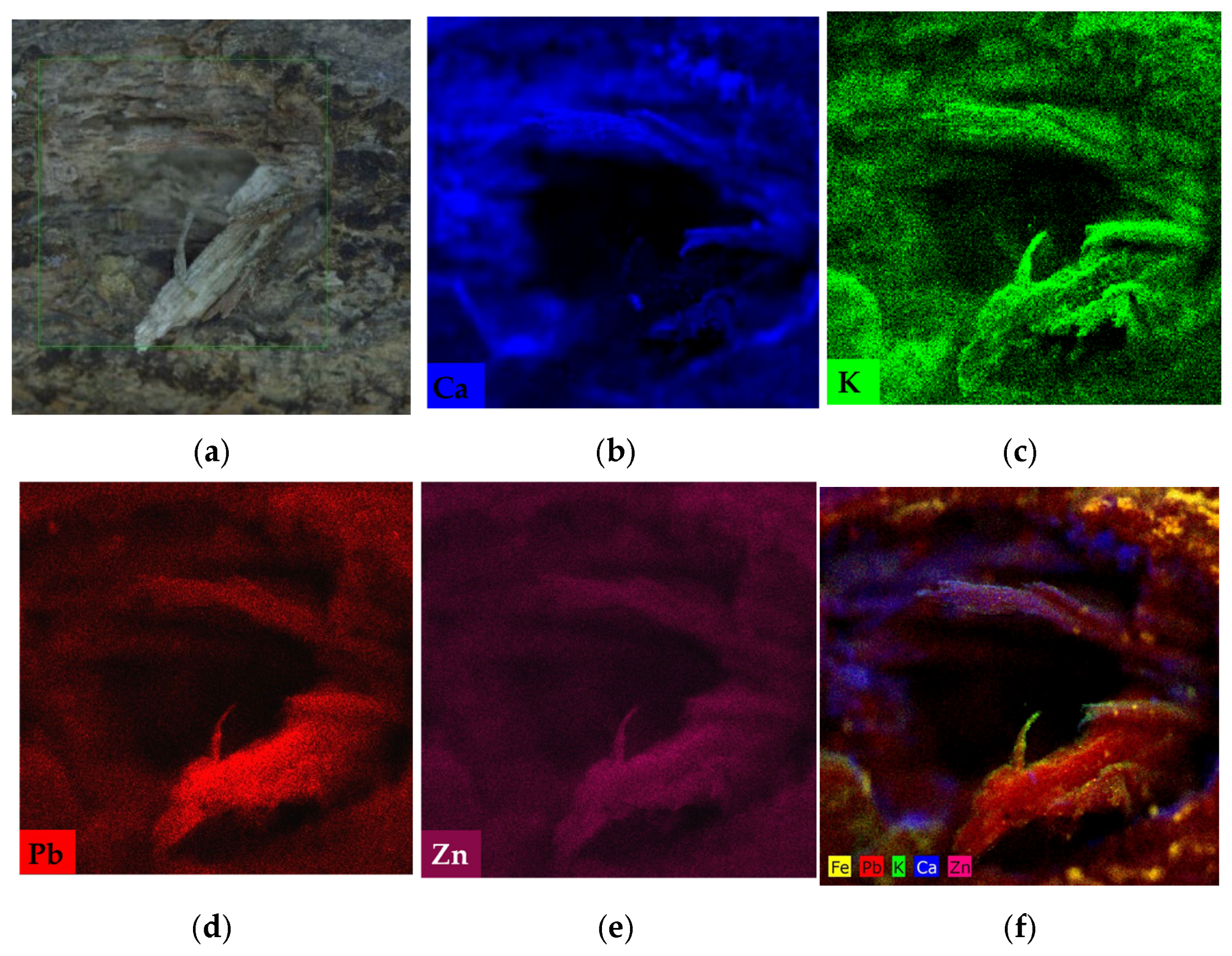
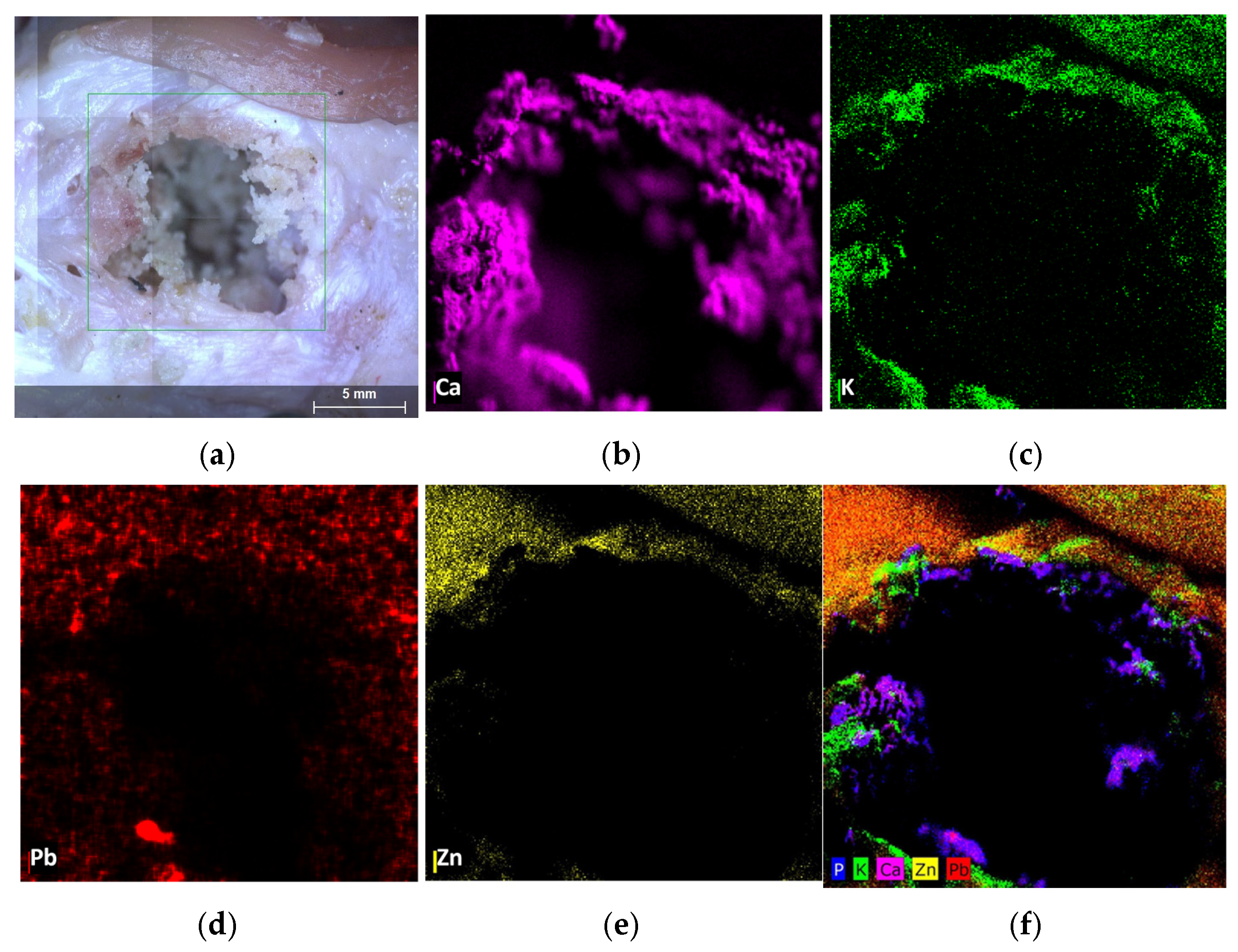
The high-resolution elemental mapping performed with the XRF M4 provided a clear visualization of the distinct transfer mechanisms between the two ammunition types. Mapping of the mango branch targets (Figure 4) and fresh pork leg (Figure 5) revealed a widespread primary dispersion of Lead (Pb) around the entry point and throughout the wound track. This pattern is indicative of the severe fragmentation and deformation that unjacketed lead projectiles undergo upon impacting high-density biological or organic matrices.
In contrast, the elemental maps for FMJ projectiles showed that Copper (Cu) and Zinc (Zn) were strictly localized at the entrance surface, forming a well-defined “bullet wipe” ring. Zinc (Zn) exhibited an overlapping spatial pattern with Lead (Pb) originating from barrel contamination, which clearly delineated the bullet wipe location on both the fresh pork leg and mango wood surfaces. Detectable quantities of Lead (Pb) from the FMJ core were found at levels approximately twice as low as Zinc (Zn), confirming that the brass jacket remained largely intact during penetration.

3.2.2. Semi-Quantitative Comparison and Instrument Performance

Normalized mass fractions data (Table 1) confirmed higher detectability for LRN signatures compared to FMJ.
Statistical analysis revealed a strong correlation between the XRF M4 and Elio for high-concentration elements on tissue. However, for FMJ on wooden surfaces, the correlation was significantly weaker (r = −0.2774, R2 = 0.077), underscoring the challenges of identifying minimal, irregularly dispersed residues on porous plant matrices.

3.2.3. Forensic Taphonomy: Trace Persistence on Air-Dried Tissue

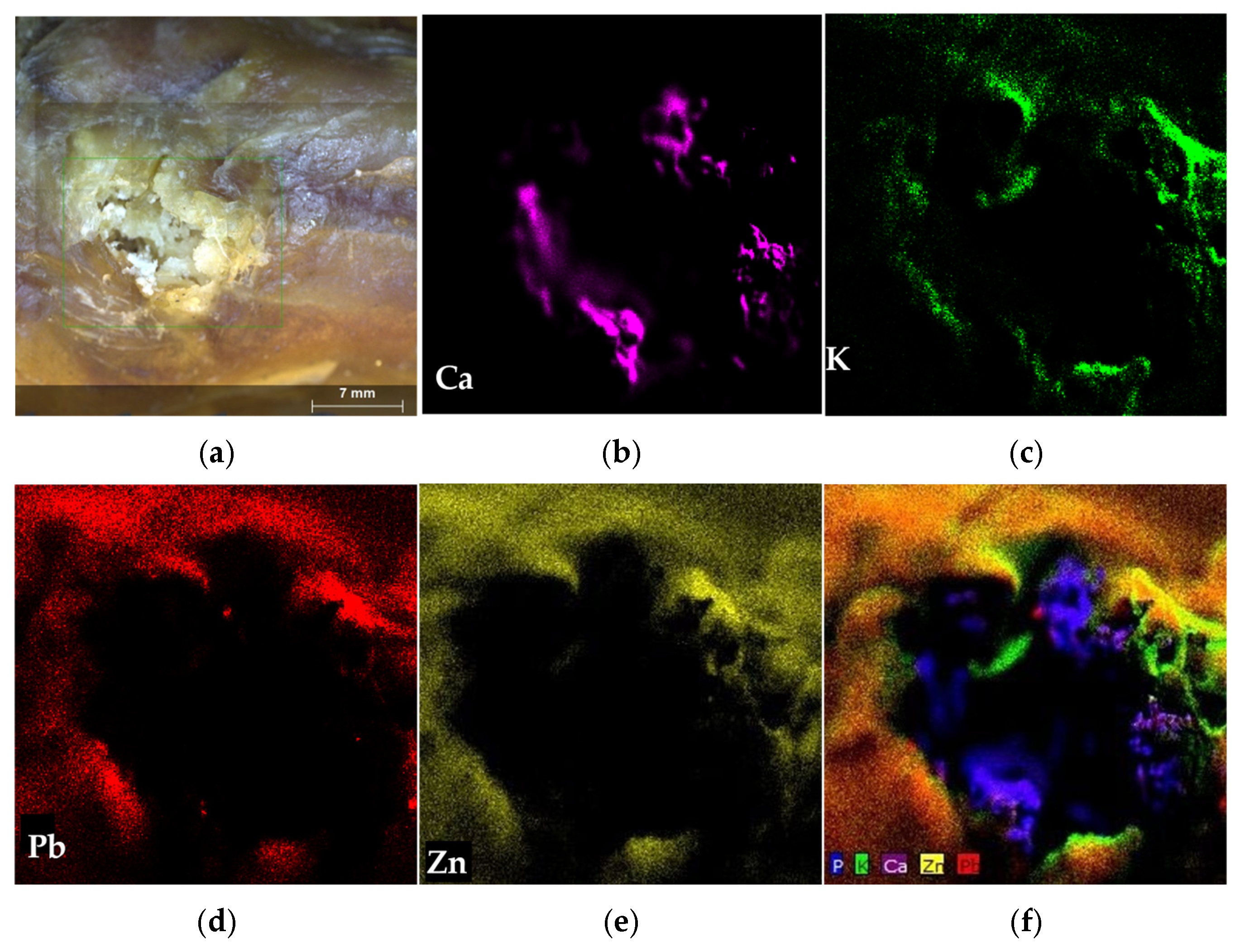
The persistence of bullet traces was evaluated by comparing fresh pork leg samples with those dried outdoors for 3 months. The results, as summarized in Table 2 and illustrated in the elemental maps of the air-dried samples in Figure 6, show a stark difference in stability based on ammunition type.
For LRN ammunition, the Lead (Pb) signature remained exceptionally stable with a correlation coefficient (r) of 0.9999 between fresh and air-dried states, confirming its reliability as a marker even after tissue decomposition. Conversely, FMJ traces were highly sensitive to taphonomic processes [15], with Pb levels dropping significantly (from 2.14 to 0.25 wt%) and Cu levels falling below detection limits, resulting in a very low correlation (r ≈ 0.1362). These statistical findings highlight the superior forensic persistence of volumetric lead traces from unjacketed bullets compared to superficial bullet wipes [1,7].

4. Discussion

4.1. Different Trace Transfer Mechanisms and Taphonomic Persistence

The clear difference in trace transfer mechanisms between the volumetric deposition of lead from LRN and the superficial Cu/Zn deposition from FMJ was confirmed, strongly supporting the study’s primary hypothesis [1]. The unjacketed LRN projectile undergoes severe deformation and fragmentation upon impact with hard wood or bone, resulting in the deep embedment and dispersal of lead (Pb) and antimony (Sb) fragments surrounding the projectile’s trajectory [2,8,10,19]. This mechanism ensures that a high bulk quantity of heavy elements is transferred into the biological or structural target.
In contrast, the FMJ metal jacket acts as an effective shield, restricting the transfer of the primary elemental signature to the copper/zinc alloy. These elements are typically deposited as a “bullet wipe” restricted to the surface entry point. The findings clearly demonstrated that the Micro-XRF M4 detected all three primary metallic elements—Pb, Cu, and Zn—within the bullet wipe area, emphasizing that even with minimal projectile deformation, FMJ ammunition provides significant markers to identify the firearm (via barrel contamination) and the specific ammunition type [7,9,17,19].
The evaluation of taphonomic effects revealed that the elemental signature of LRN ammunition, particularly Lead (Pb), is exceptionally stable (r = 0.9999, R2 = 0.9999) despite a 3 months outdoor exposure period. This demonstrates that Lead remains a highly effective indicator for unjacketed ammunition even in desiccated or decomposed remains. The detection of Tin (Sn) in association with Lead (Pb) in the LRN residues is consistent with its common industrial use as a hardening agent in lead alloys to improve the structural integrity of unjacketed projectiles during flight and impact. Conversely, FMJ signatures are highly sensitive to forensic taphonomy, showing a very low correlation (r ≈ 0.1362) between fresh and air-dried states. This vulnerability arises because superficial bullet wipes dissipate much faster under environmental exposure compared to LRN traces deeply embedded within the bone or wood matrix. Furthermore, the persistent presence of Iron (Fe) traces observed along the Lead Elemental Area (LEA) suggests a ‘barrel-to-bullet’ transfer mechanism. These traces likely originate from the transfer of the firearm’s internal steel components or residues within the barrel during discharge, which are subsequently deposited onto the projectile and transferred to the target upon impact.
Regarding the statistical distribution, the observed high variance—where the standard deviation exceeds the mean (e.g., Pb concentrations of 13.83 ± 14.25 wt%)—requires careful interpretation. In forensic ballistics, such ‘heavily scattered’ data are not indicative of measurement error but rather reflect the physical heterogeneity of projectile residues. These residues comprise a combination of fine vaporized lead and larger metallic ‘hotspots’ or fragments. While the mean is significantly influenced by these extreme outliers, the median provides a more robust measure of central tendency for such right-skewed data. Furthermore, the high SD itself serves as a diagnostic indicator of LRN projectiles, which tend to shed more physical material upon impact compared to the more contained residues of FMJ rounds. From a forensic reconstruction perspective, this high variance is informative; these ‘hotspots’ mark specific points of material transfer that are critical for trace evidence localization. Therefore, we suggest a dual interpretation strategy: using the median for reliable inter-group comparisons while treating extreme outliers as qualitative evidence of projectile fragmentation.

4.2. Comparative Performance of XRF Techniques in Forensic Trace Analysis

The strong statistical correlation coefficient (R2 > 0.95 for high-concentration LRN traces) between the Elio and the XRF M4 confirms the role of the Portable XRF as a rapid, non-destructive, and effective primary screening tool [13,14,18]. This capability is critical for field operations involving the quick assessment of large evidence items or targets in remote locations where transporting evidence to a laboratory may compromise its integrity. The Elio’s ability to identify differential elemental concentrations without requiring complex sample preparation allows for immediate decision-making at the crime scene. It is important to note that the observed semi-quantitative discrepancies between the benchtop M4 Tornado and the portable Elio stem from fundamental differences in excitation geometry, detector efficiency, and analytical spot size (micro-spatial versus bulk analysis). Consequently, these instruments are not expected to yield identical numerical values. However, the forensic significance lies in the consistency of the elemental signatures—specifically the relative presence and spatial distribution of Pb, Cu, and Zn—which remain diagnostic for ammunition class identification across both platforms. In forensic practice, the portable XRF serves as a high-speed tool for field triage and lead-time investigative intelligence, whereas the high-resolution Micro-XRF provides the definitive, high-precision mapping required for formal evidentiary verification in criminal proceedings.
Furthermore, the detailed analysis of elemental ratios provides deeper insight into the composition of the detected residues. The observed excess of Zinc (Zn) relative to Copper (Cu) in the FMJ signatures can be attributed to the contribution of primer-derived gunshot residues (pGSR). As reviewed by Romolo and Margot [20], Zinc compounds, such as zinc peroxide, are frequently utilized as oxidizing agents in modern primer formulations. Upon discharge, these primer components are vaporized and subsequently deposited onto the target surface alongside metallic fragments from the bullet jacket. This additional influx of Zinc from the primer explains why the Zn-to-Cu ratio measured via XRF exceeds the expected stoichiometric ratio of the brass jacket alone.
However, the significant variance and weak negative correlation observed for FMJ traces on wooden surfaces (r = −0.2774, R2 = 0.0770) underscore the inherent limitations of portable bulk analysis when dealing with porous and irregularly shaped plant matrices [11]. This disparity in correlation coefficients across different substrates reflects the sensitivity of XRF technology to target matrix effects, where the low agreement on wood targets specifically demonstrates the challenges of trace analysis on non-uniform surfaces. Conversely, the near-perfect correlation (R2 > 0.99) observed for Lead in LRN samples highlights the stability of this marker, suggesting that portable systems can achieve benchtop-level reliability when measuring high-concentration residues.
Furthermore, it is noteworthy that within these FMJ traces, Zinc (Zn) concentrations were systematically higher than Copper (Cu), despite the typical composition of brass jackets. This elevation is likely attributed to the contribution of primer-derived residues (e.g., zinc peroxide), which are vaporized and deposited alongside projectile fragments. As XRF is a surface-sensitive technique, the resulting signal represents a combined signature of both the jacket material and the superimposed gunshot residues (GSR).
This underscores the necessity of a tiered analytical approach: while Portable XRF serves as a valuable tool for field triage and preliminary identification, it must be followed by laboratory-based Micro-XRF analysis for definitive ammunition verification, especially for trace-level residues [6]. The high spatial resolution of the XRF M4 (spot size < 20 µm) remains indispensable for clearly distinguishing between superficial contamination and deeply embedded metallic fragments, ensuring a higher level of confidence in forensic reconstructions [5,7,15,16].
To compensate for the limited sample size, the experimental variables were strictly controlled to minimize external variance; for instance, the involvement of professional ballistic experts ensured impact precision within ±2.0 cm, and a constant firing distance of 5.0 ± 0.5 m was maintained. Furthermore, forensic ballistic experimentation on biological targets is inherently constrained by the destructive nature of projectile impact and ethical considerations regarding animal remains management. Within this framework, the sample size employed in this study is deemed adequate and aligns with forensic research standards that prioritize non-destructive analysis. While the number of replicates may appear limited, the Micro-XRF mapping approach provides an extensive ‘within-sample’ dataset. Each elemental map comprises thousands of individual pixels, each acting as a discrete data point that confirms spatial distribution and elemental correlation with higher precision than traditional bulk analysis. This high-density spatial data significantly enhances internal statistical confidence, ensuring that the identified trace patterns are fundamentally representative of the ballistic transfer mechanism rather than stochastic noise. Future studies with larger datasets could further refine the semi-quantitative variance across different environmental conditions.

5. Conclusions

This study established that Micro-XRF and Portable XRF spectrometry are effective, non-destructive tools for identifying ammunition-derived elemental signatures on complex biological and organic targets. The primary distinction between the two projectile types was the transfer mechanism: Lead Round Nose (LRN) bullets underwent severe fragmentation, providing widespread volumetric dispersion of Lead (Pb) and Antimony (Sb) through the wound track, while Full Metal Jacket (FMJ) bullets left localized surface traces of Copper (Cu) and Zinc (Zn) as well-defined bullet wipes.
Statistical analysis, transitioning to non-parametric measures to account for the physical heterogeneity of residues, validated Lead (Pb) as an exceptionally stable and robust marker for unjacketed LRN ammunition. It maintained a near-perfect correlation (r ≈ 0.9999) between fresh and air-dried tissue states, despite the logistical constraints of a limited sample size. In contrast, FMJ traces were significantly more vulnerable to environmental exposure, especially on porous wooden matrices where the data exhibited high variance—characterized by a low median but distinct metallic hotspots.
While Portable XRF (Elio) is suitable for rapid field screening of high-concentration residues, the benchtop Micro-XRF (M4) is indispensable for analyzing sparse traces and identifying distinctive signatures through high-density ‘within-sample’ mapping. The presence of high statistical variance in certain samples, rather than being an error, serves as a diagnostic indicator of projectile fragmentation and material shedding. These findings provide a refined analytical framework for ammunition verification in forensic investigations involving degraded remains or complex environmental scenes.

Supplementary Materials

The following supporting information can be downloaded at: https://www.mdpi.com/article/10.3390/forensicsci6010011/s1, Figure S1: Box-and-whisker plots of (a,b) Pb, (c,d) Cu, and (e,f) Zn concentrations (wt%) deposited on Pork leg, categorized by projectile type: Full Metal Jacket (FMJ) and Lead Round Nose (LRN)., Figure S2: Box-and-whisker plots of elemental concentrations (wt%) of (a,b) Pb, (c,d) Cu, and (e,f) Zn on fresh versus air-dried pork leg samples., Figure S3: Box-and-whisker plots of elemental concentrations (wt%) of (a) Pb, (b) Cu, and (c) Zn on fresh versus air-dried pork leg samples.

Author Contributions

Conceptualization, S.L. and M.D.; methodology, M.D.; validation, P.L. and M.D.; formal analysis, S.L. and P.L.; investigation, S.L., S.C. and M.D.; data curation, S.L. and M.D.; writing—original draft preparation, S.L. and P.L.; writing—review and editing, S.L.; visualization, S.L.; supervision, P.L. and M.D.; project administration, S.L.; funding acquisition, S.C. and M.D. All authors have read and agreed to the published version of the manuscript.

Funding

This research received no specific grant from any funding agency in the public, commercial, or not-for-profit sectors.

Institutional Review Board Statement

Not applicable.

Informed Consent Statement

Not applicable. The individual appearing in the figures is a professional expert providing a demonstration and was not a participant from whom research data were collected. Informed consent for publication was obtained from the individual appearing in Figure 1 to publish this paper.

Data Availability Statement

The Micro XRF analysis data and Elemental mapping run by M4 Tornado Micro XRF; brand Bruker was presented in this study were provided by Absotec Co., Ltd. These data are available upon request from the corresponding author for academic research purposes. However, the use of these data for any commercial purposes is strictly prohibited.

Acknowledgments

The authors would like to acknowledge Bruker Corporation and Absotec Co., Ltd. (Thailand) for providing access to the Bruker M4 Tornado Micro-XRF instrument and the necessary equipment/facilities used in this study. The analyses performed with this advanced micro-X-ray fluorescence system were crucial in obtaining high-quality elemental mapping and compositional data for this research. Additionally, we wish to thank the firearms expert for his contribution to the shooting demonstrations and for providing the necessary firearms and equipment for our data collection. The authors would like to thank the Forensic Science Specialists Association (FoSSA Thailand) for their invaluable guidance on the experimental design and for suggesting the research topic.

Conflicts of Interest

The authors declare no conflicts of interest. The funders/equipment providers had no role in the design of the study; in the collection, analyses, or interpretation of data; in the writing of the manuscript; or in the decision to publish the results.

Abbreviations

The following abbreviations are used in this manuscript:
LRNLead Round Nose
FMJFull Metal Jacketed
XRFX-ray Fluorescence
ElioEnergy Dispersive Micro-X-ray Fluorescence Spectrometer (Commercial model by Bruker)
PbLead
SbAntimony
CuCopper
ZnZinc
SnTin
FeIron

References

  1. Abd Malik, S.A.; Nordin, F.A.D.; Ali, S.F.M.; Abdullah, A.F.L.; Chang, K.H. Distinctive bullet impact holes by 9-mm caliber projectile on sheet metal surfaces. J. Forensic Sci. Med. 2022, 8, 97–103. [Google Scholar] [CrossRef]
  2. Vermeij, E.; Rijnders, M.; Pieper, P.; Hermsen, R. Interaction of bullets with intermediate targets: Material transfer and damage. Forensic Sci. Int. 2012, 223, 125–135. [Google Scholar] [CrossRef] [PubMed]
  3. Ansari, N.; Parmar, H. Exploring the capabilities of Micro-XRF to study the dispersion of GSR in firearms cases. Forensic Sci. Med. Pathol. 2025, 21, 1230–1239. [Google Scholar] [CrossRef] [PubMed]
  4. Black, O.; Smith, S.C.; Roper, C. Advances and limitations in the determination and assessment of gunshot residue in the environment. Ecotoxicol. Environ. Saf. 2021, 208, 111689. [Google Scholar] [CrossRef] [PubMed]
  5. Bonizzoni, L.; Mazzarelli, D.; Franceschetti, L.; Vitali, C.; Amadasi, A.; Cattaneo, C. Investigating gunshot wounds in charred bone with XRF spectroscopy: A technical note. Int. J. Legal Med. 2024, 138, 2587–2593. [Google Scholar] [CrossRef] [PubMed]
  6. Shrivastava, P.; Jain, V.K.; Nagpal, S. Gunshot residue detection technologies—A review. Egypt. J. Forensic Sci. 2021, 11, 11. [Google Scholar] [CrossRef]
  7. Serol, M.; Ahmad, S.M.; Quintas, A.; Família, C. Chemical analysis of gunpowder and gunshot residues. Molecules 2023, 28, 5550. [Google Scholar] [CrossRef] [PubMed]
  8. Meng, H.H.; Chen, Y.L. Energy dispersive X-ray analysis of bullets commonly encountered in Taiwan. Forensic Sci. J. 2006, 5, 21–34. [Google Scholar]
  9. Ovide, O.; Corzo, R.; Trejos, T. The analysis of glass from portable electronic devices and glass accessories using µ-XRF for forensic investigations. Forensic Sci. Int. 2023, 343, 111550. [Google Scholar] [CrossRef] [PubMed]
  10. Melo, L.G.; Martiny, A.; Pinto, A.L. Nano characterization of gunshot residues from Brazilian ammunition. Forensic Sci. Int. 2014, 240, 69–79. [Google Scholar] [CrossRef]
  11. Merli, D.; Di Trocchio, C.; Capucciati, A.; Fabbris, S.; Profumo, A.; Cucca, L.; Donghi, M. Bullet contribution to inorganic residue on targets. Talanta Open 2021, 4, 100067. [Google Scholar] [CrossRef]
  12. Becker, P.; Neff, C.; Hess, S.; Weis, P.; Günther, D. Forensic float glass fragment analysis using single-pulse laser ablation inductively coupled plasma time of flight mass spectrometry. J. Anal. At. Spectrom. 2020, 35, 2248–2254. [Google Scholar] [CrossRef]
  13. Kobylarz, D.; Michalska, A.; Jurowski, K. Field portable X-ray fluorescence (FP-XRF) as powerful, rapid, non-destructive and ‘white analytical tool’ for forensic sciences-State of the art. Trends Anal. Chem. 2023, 169, 117355. [Google Scholar] [CrossRef]
  14. Leatherland, L.; Andrews, Z.; Neumann, C.; Chester, J.; de Bruin-Hoegee, M.; Ernst, T.; Trejos, T. Assessing the expanded capacity of modern μ-XRF SDD systems for forensic analysis through an interlaboratory study: Part I—Electrical tapes. Forensic Chem. 2025, 47, 100719. [Google Scholar] [CrossRef]
  15. Pringle, J.K.; Jeffery, A.J.; Ruffell, A.; Stimpson, I.G.; Pirrie, D.; Bergslien, E.; Partridge, J. The use of portable XRF as a forensic geoscience non-destructive trace evidence tool for environmental and criminal investigations. Forensic Sci. Int. 2022, 332, 111175. [Google Scholar] [CrossRef] [PubMed]
  16. Sýkora, J.; Komendová, R. Field determination of trace concentrations of hazardous metals in waters by portable EDXRF. Environ. Monit. Assess. 2024, 196, 1226. [Google Scholar] [CrossRef] [PubMed]
  17. Łach, B.; Fiutowski, T.; del Hoyo-Meléndez, J.M.; Koperny, S.; Krupska-Wolas, P.; Mindur, B.; Dąbrowski, W. Application of a Full-Field macro-XRF imaging spectrometer to non-invasive investigation of elemental composition in three-dimensional artworks. npj Herit. Sci. 2025, 13, 58. [Google Scholar] [CrossRef]
  18. Ricca, M.; Alberghina, M.F.; Randazzo, L.; Schiavone, S.; Donato, A.; Albanese, M.P.; La Russa, M.F. A combined non-destructive and micro-destructive approach to solving the forensic problems in the field of cultural heritage: Two case studies. Appl. Sci. 2021, 11, 6951. [Google Scholar] [CrossRef]
  19. Bominathan, U.R.; Abd Malik, S.A.; Abdullah, A.F.L.; Chang, K.H. Determination of elemental ratios correlating to the projectiles of conventional and non-toxic ammunitions. Malays. J. Anal. Sci. 2025, 29, 1361. [Google Scholar]
  20. Romolo, F.S.; Margot, P. Identification of gunshot residue: A critical review. Forensic Sci. Int. 2001, 119, 195–211. [Google Scholar] [CrossRef] [PubMed]
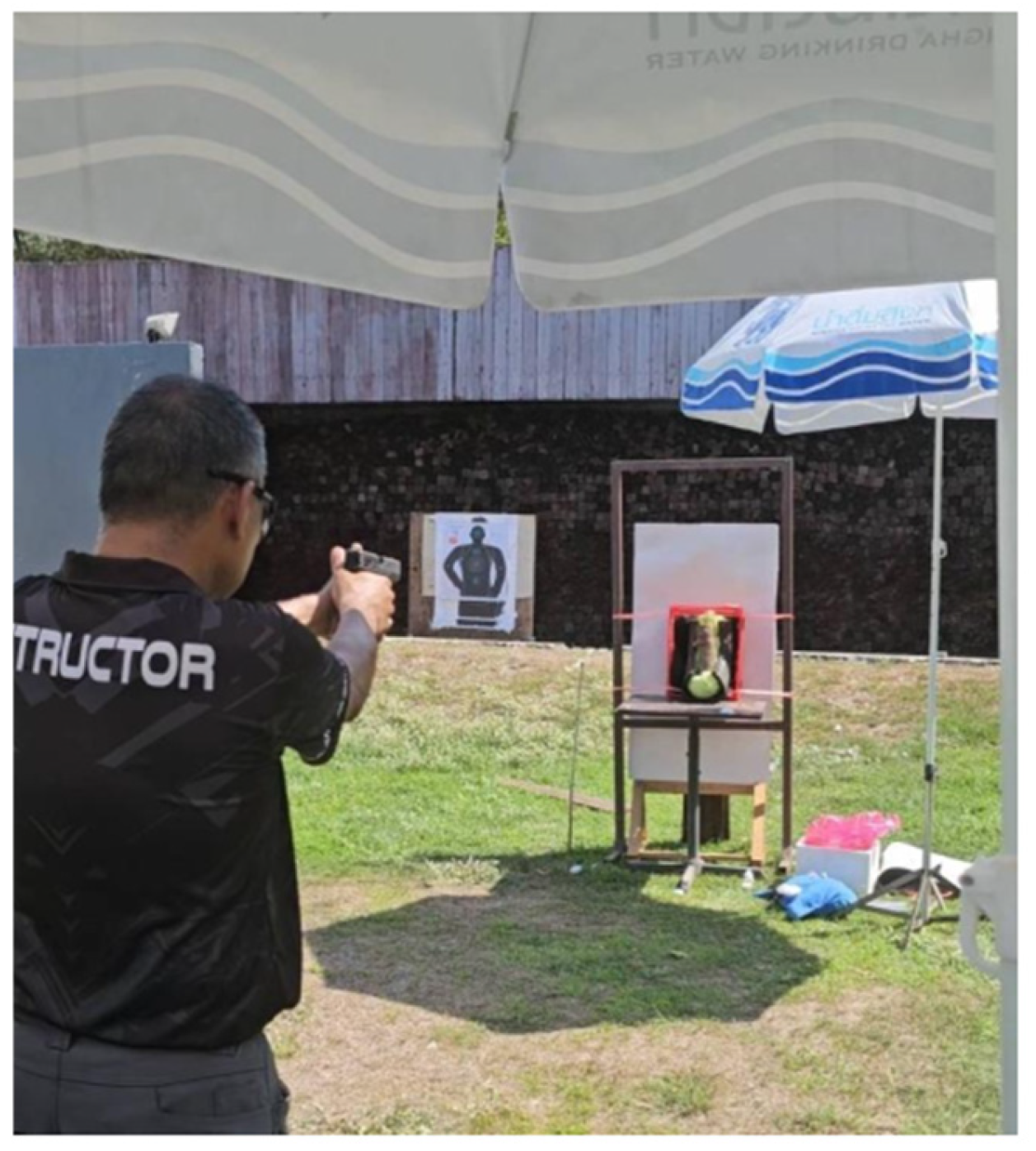
Figure 1. Experimental setup for the firing protocol (5.0 m distance).
Forensicsci 06 00011 g001
Figure 2. Elemental mapping analysis performed via M4 Micro-XRF: (a) photograph of a fired LRN bullet; (b) Pb elemental map, (c) Sb elemental map, and (d) Sn elemental map. The green box in (a) indicates the area selected for mapping.
Forensicsci 06 00011 g002
Figure 3. Elemental mapping analysis performed via M4 Micro-XRF: (a) photograph of a fired FMJ bullet; (b) Cu elemental map; (c) Zn elemental map; and (d) composite elemental map displaying Fe, Cu, and Zn. The green box in (a) indicates the area selected for mapping.
Forensicsci 06 00011 g003aForensicsci 06 00011 g003b
Figure 4. Elemental maps detected via M4 Micro-XRF highlighting primary elements at the bullet penetration site: (a) photograph of the rear side of the mango branch at the bullet penetration site, (b) Ca elemental map, (c) K elemental map, (d) Pb elemental map, (e) Zn elemental map, and (f) composite elemental map of Ca, K, Pb, Zn, and Fe. The green box in (a) indicates the specific region of interest (ROI) where elemental mapping was conducted using the M4 Tornado.
Forensicsci 06 00011 g004
Figure 5. Elemental maps detected by M4 Micro-XRF featuring primary elements on fresh pork leg (tissue/bone): (a) photograph of the front side of the fresh pork leg at the bullet penetration site, (b) Ca elemental map, (c) K elemental map, (d) Pb elemental map, (e) Zn elemental map, and (f) composite elemental map of Ca, K, Pb, Zn, and Fe. The green box in (a) indicates the specific region of interest (ROI) analyzed using the M4 Tornado.
Forensicsci 06 00011 g005
Figure 6. Elemental maps detected by M4 Micro-XRF featuring primary elements on air-dried pork leg tissue: (a) photograph of the front side of the pork leg at the bullet penetration site, (b) Ca elemental map, (c) K elemental map, (d) Pb elemental map, (e) Zn elemental map, and (f) composite elemental map of Ca, K, Pb, Zn, and Fe.
Forensicsci 06 00011 g006
Table 1. Summary of elemental concentrations (wt%) of Pb, Cu, and Zn reported as Median (Min–Max) on pork leg and mango wood substrates.
Target SurfaceElemental SignatureXRF M4 Median (Min-Max)
(wt%)
Elio Median (Min-Max)
(wt%)
LRNFMJLRNFMJ
Fresh pork leg (bone/tissue)Pb10.39 (1.57–40.58)2.21 (1.16–2.86)7.34 (3.99–16.11)0.27 (0.00–1.01)
Cu0.06 (0.00–0.21)0.24 (0.13–0.53)n.d.0.24 (0.10–1.09)
Zn0.64 (0.14–0.96)0.59 (0.00–0.89)n.d.n.d.
Mango branch (Entrance surface)Pb3.00 (0.46–3.77)0.53 (0.46–0.79)1.40 (0.27–1.71)0.06 (0.00–0.14)
Cu0.13 (0.11–0.13)0.15 (0.12–0.24)0.03 (0.00–0.08)0.07 (0.03–0.19)
Zn0.31 (0.20–0.50)0.24 (0.12–0.50)n.d.n.d.
n.d. = not detected.
Table 2. Relative elemental concentrations (wt%) expressed as Median (Min–Max) on fresh versus air-dried pork leg (bone/tissue).
Elemental SignatureFresh Pork Leg (Bone/Tissue)
(wt%)
Air-Dried Pork Leg (Bone/Tissue)
(wt%)
LRNFMJLRNFMJ
Pb10.39 (1.57–40.58)2.21 (1.16–2.86)6.74 (1.20–59.48)0.31 (0.10–0.33)
Cu0.06 (0.00–0.21)0.24 (0.13–0.53)n.d.n.d.
Zn0.64 (0.14–0.96)0.59 (0.00–0.89)0.41 (0.09–0.62)0.48 (0.34–0.71)
n.d. = not detected.
Disclaimer/Publisher’s Note: The statements, opinions and data contained in all publications are solely those of the individual author(s) and contributor(s) and not of MDPI and/or the editor(s). MDPI and/or the editor(s) disclaim responsibility for any injury to people or property resulting from any ideas, methods, instructions or products referred to in the content.