Article

New Perspectives in Auricularia Bull. (Auriculariales, Basidiomycota) in Colombia, with the Description of a New Species †

by
Laura Ximena Castillo-Balaguera
1,
María Paula Herrera-Sánchez
1,2,
Lina Rocío Dávila-Giraldo
1,3,
Walter Murillo-Arango
1,
Iang Rondón-Barragán
2 and
Cristian Zambrano-Forero
1,*
1
Grupo de Investigación en Productos Naturales (GIPRONUT), Facultad de Ciencias, Universidad del Tolima, Calle 42 #1B-1 Barrio Santa Helena, Ibagué 730001, TOL, Colombia
2
Grupo de Investigación en Inmunobiología y Patogénesis (GIP), Facultad de Medicina Veterinaria y Zootecnia, Universidad del Tolima, Calle 42 #1B-1 Barrio Santa Helena, Ibagué 730001, TOL, Colombia
3
Laboratorio de Taxonomía y Ecología de Hongos—TEHO, Instituto de Biología, Facultad de Ciencias Exactas y Naturales, Universidad de Antioquia, Calle 70 #52-21, Medellín 050010, ANT, Colombia
*
Author to whom correspondence should be addressed.
Taxonomy 2026, 6(1), 19; https://doi.org/10.3390/taxonomy6010019
Submission received: 18 June 2025 / Revised: 15 January 2026 / Accepted: 28 January 2026 / Published: 2 March 2026

Abstract

The genus Auricularia holds significant ecological importance due to its role in wood decaying and notable economic value as both an edible and medicinal resource. This study investigates the diversity of Auricularia species in Colombian Andes using an integrative approach. Species identification was based on macromorphological and micromorphological characteristics, alongside molecular analyses employing ITS and LSU markers. A total of 184 sequences of 81 specimens and 30 species were used to construct a phylogenetic tree including RPB2 marker sequences taken from GenBank. The results revealed six Auricularia species in the Colombian Andes: A. subglabra, A. cornea, A. fuscosuccinea, A. nigricans, A. brasiliana, and the newly described A. ibaguensis. This study provides morphological descriptions, distribution records, and interspecific distinctions, aligning these taxa with four out of the five recognized Auricularia species complexes. Novel sequences deposited in GenBank enhance taxonomic resolution, particularly within the A. cornea complex. These findings contribute new insights into the taxonomy of Auricularia in the Colombian Andes and emphasize the need for further research on Neotropical species, which may show significant differences from taxa in other biogeographic regions.

1. Introduction

Wild edible fungi (WEF) comprise naturally occurring fungal species that contribute essential nutrients to human diets. The collection and consumption of WEF have had a long history in human societies, with archeological evidence indicating their use for at least 12,000 years [1,2,3,4] and written records documenting their continued utilization across different cultures over millennia [2]. These fungi hold considerable cultural and economic importance, particularly for rural communities in Mesoamerica, including Mexico, Guatemala, Honduras, and Nicaragua, where they are traditionally harvested and sold in local markets as accessible and nutritious food resources [4,5].
Most species within the genus Auricularia Bull. are highly valued for their combined nutritional and medicinal properties. In addition to their importance as edible fungi, species of Auricularia play a key ecological role in forest ecosystems as efficient decomposers of woody substrates, particularly in tropical regions. They predominantly colonize angiosperms growing on dead trees, fallen trunks, and branches, although occasional records from gymnosperms have also been reported [1].
Within this broader historical context of wild fungal consumption, species of Auricularia represent a well-documented example of both traditional use and subsequent domestication. In recent years, interest in WEF has increased, driven in part by growing demand for nutraceutical and functional foods rich in bioactive compounds [6]. Several Auricularia species are widely consumed throughout Asia for their nutritional and medicinal value, especially in China and other East Asian countries [7]. Extensive and systematic studies on the global diversity of Auricularia have been carried out, and 39 species have been recorded in the genus [1,8,9]. Among these, A. heimuer is particularly notable, as it has been cultivated for more than 1400 years, representing one of the earliest documented cases of fungal domestication and sustained cultivation [10,11].
In Colombia, ethnomycological studies highlight the cultural relevance of Auricularia among peasant communities, particularly in the department of Boyacá, where these fungi are traditionally collected and prepared in various dishes, including stews and foods accompanied by milk, eggs, or bread [12]. According to the ColFungi database, seven species of Auricularia have been reported in the country: A. fuscosuccinea, A. auricula-judae, A. cornea, A. delicata, A. mesenterica, A. nigricans, and A. tenuis. However, the taxonomic validity of several of these records remains uncertain, as many species were originally described from European materials, and their reported occurrence in tropical ecosystems has not always been supported by molecular evidence. Given that tropical forests may harbor distinct and previously unrecognized evolutionary lineages, integrative phylogenetic and morphological analyses are essential to clarify species boundaries and confirm species identities.
Understanding fungal diversity and its potential applications is fundamental for informed conservation strategies, sustainable management, and accurate assessment of ecological and socio-economic value. In this study, we investigate Auricularia specimens collected from the Colombian Andes using an integrative approach combining morphological examination and molecular phylogenetic analyses. Our aim is to provide a clearer assessment of the species diversity and distribution of Auricularia in the studied departments.

2. Materials and Methods

2.1. Sample Collection

Specimens of Auricularia were collected from the Colombian Andes between March and October 2023 from the municipalities of Ibagué, Espinal, Nilo, and Pradera, located within the departments of Tolima, Cundinamarca, and Valle del Cauca, respectively (Figure 1). Species of the genus Auricularia grow solitarily or in groups on dead wood; therefore, sampling was focused on this type of substrate. The selected collection sites were privately owned lands used for ecotourism, characterized by tropical dry forests (TDF) or premontane moist forests (PMF).
Macroscopic fungi were photographed in situ, with immature sporocarps documented and mature specimens collected using a knife and stored in wax bags to preserve their structures. The samples were transported to the GIPRONUT (Research Group on Natural Products) microbiology laboratory for isolation and further analysis. This study was conducted under a collection permit granted for access to biological resources for non-commercial purposes (Permiso Marco de Recolección, Resolución 2191 de 2018, Universidad del Tolima). All specimens collected were preserved and deposited in the Fungarium of the Universidad del Tolima (FUT).

2.2. Isolation and Purification

The isolation process employed four modified methods adapted from Ramadhani et al. [13], including context, substrate, and spore isolation. All samples were handled under sterile conditions. The recovered mycelium was transferred onto malt extract agar (Oxoid, Basingstoke, United Kingdom) and incubated at 28 °C to promote growth. The isolation of Auricularia specimens was confirmed based on morphological characteristics of the mycelium, using diagnostic keys for species of Auricularia, including A. auricula-judae, following outlined guidelines under code 2.3c.15.32.36.40.47.(53).54.55 [14].

2.3. Morphological Studies

The collected specimens were first analyzed in their fresh state for macromorphological description and subsequently dried at 50 °C. Cross-sections of the dried basidiomata were prepared and stained with 5% Congo red and lactophenol blue to evaluate the presence or absence of a medulla and crystals, as well as to measure abhymenial hairs, hyphae, basidia, and basidiospores. Microscopic examinations were conducted using a Zeiss Primo Star (Oberkochen, Germany) microscope equipped with an Axiocam ERc 5s for both imaging and measurement. A minimum of twenty spores per sample were measured to calculate Q-values using Piximetre software version 6.1 and spore shapes were classified according to the corresponding value ranges [15]. Species identification was carried out using the taxonomic keys [1].

2.4. DNA Extraction and Purification

A total of 50 mg of isolated mycelium or basidiome was used for genomic DNA (gDNA) extraction using the CTAB method, with a pretreatment using 0.5 M NaOH [16]. For each sample, 1000 µL of CTAB preheated to 65 °C and 200 µL of polyvinylpyrrolidone were added, and the mixture was homogenized using a vortex. The tubes were incubated at 65 °C for 1 h. Following incubation, samples were centrifuged at 14,000× g for 5 min, and 600 µL of the upper phase was transferred to a new 1.5 mL tube. Chloroform/isoamyl alcohol (24:1) was then added, and the mixture was vortexed and centrifuged at 4000× g for 20 min. Subsequently, 300 µL of the upper phase was transferred to a new 1.5 mL tube, and an equal volume of cold isopropanol (1:1) was added. Samples were incubated overnight at −20 °C to precipitate DNA.
The precipitated DNA was centrifuged at 14,000× g for 10 min, and the resulting pellet was washed with 70% ethanol and sodium acetate (3 M). After an additional incubation at −20 °C for 45 min, samples were centrifuged again at 14,000× g for 10 min. The pellet was washed twice with 1000 µL of 70% ethanol, followed by a final centrifugation at 13,500× g for 10 min at 4 °C. Finally, the ethanol was carefully decanted without disturbing the precipitate, and the pellet was resuspended in 100 µL of TE buffer.

2.5. PCR and Sequencing

All samples were evaluated by the amplification of the ITS region (~690 bp) and LSU (~1500 bp) using the following primers: ITS forward (5′-CTTGGTCATTTAGAGGAAGTAA-3′) and reverse (5′-TCCTCCGCTTATTGATATGC-3′); LSU forward (5′-GCATATCAATAAGCGGAGG-3′); and reverse (5′-TACTACCACCAAGATCT-3′), respectively. Polymerase chain reaction (PCR) was carried out in a ProFlex™ 3 × 32-Well PCR System (ThermoFisher Scientific, Waltham, MA, USA) using OneTaq® 2X Master Mix (New England Biolabs, Ipswich, MA, USA). Reactions were performed in a total volume of 50 μL consisting of 19 μL distilled deionized water, 25 μL of OneTaq® 2X Master Mix (New England Biolabs, USA), 2 μL of each primer (forward and reverse) at a concentration of 10 pmol/μL, and 2 μL gDNA as the template.
The thermal cycling profile was adjusted according to the manufacturer’s instructions, and the annealing temperature was set according to the primer melting temperature (55 °C). PCR products were confirmed by agarose gel electrophoresis, stained with HydraGreen (ACTGene, Piscataway, NJ, USA), and visualized under UV light using the ENDUROTM gel documentation system (Labnet International Inc., Edison, NJ, United States). PCR products were sequenced using the Sanger method (Macrogen Inc., Seoul, Korea), and the sequences obtained were subsequently analyzed using BLASTn (https://blast.ncbi.nlm.nih.gov, accessed on 1 December 2024).

2.6. Phylogenetic Analysis

Sequences were assembled, visualized, and edited using Geneious® 9.1.8. ITS, LSU, RPB2 sequences of Auricularia species were retrieved from Wu et al. [1] and from additional BLAST searches in the NCBI database (National Biotechnology Information Centre). A database was constructed using the sequences available for analysis (Table 1). Sequence alignments were performed using MAFFT v.7 [17] (http://mafft.cbrc.jp/alignment/server/, accessed on 1 December 2024), applying the L-INS-i algorithm for ITS, G-INS-i for LSU, and E-INS-I for the coding regions.
Phylogenetic trees were constructed using Bayesian inference (BI), implemented in MrBayes v3.2.7 [18], and maximum likelihood (ML) analysis, implemented in RAxML-HPC v8 [19]. Nucleotide substitution models for each genomic region and gene fragment were selected based on the corrected Akaike Information Criterion (AICc) using jModelTest 2.1.4 [20]. Bayesian analyses were run for 10 million generations, sampling every 1000 generations. Posterior probability values above 0.9 were considered strongly supported. For maximum likelihood analyses, the GTR-GAMMA evolutionary model was applied with 1000 bootstrap replicates. Bootstrap values above 70% were considered strongly supported.

2.7. Secondary Research

A comprehensive literature search was conducted to compile information on the genus Auricularia, with particular emphasis on original species descriptions. Multiple platforms were consulted, including Google Scholar, ResearchGate, SciELO, and Scopus, along with specialized mycological databases such as MycoBank (https://www.mycobank.org/) and Index Fungorum (https://www.indexfungorum.org/, accessed 15 November 2024).
Species distribution was evaluated using data from ColFungi (https://colfungi.org). The “Checklist of Fungi of Colombia” from the Catalogue of Fungi of Colombia [21] was reviewed to obtain detailed records at both departmental and municipal levels. The compiled distribution data were subsequently cross-referenced with species descriptions and distribution notes reported by Wu et al. [1].

3. Results and Discussion

Fifteen specimens of Auricularia were collected across the sampled localities. Ten specimens were collected from elevations between 1000 and 1600 m in premontane moist forests (PMF), while the remaining five were collected between 300 and 1000 m in tropical dry forest (TDF). All specimens were found growing on dead angiosperm wood, with no apparent host specificity, which is consistent with previous reports for the genus [22].
Three specimens (vouchers: Castillo Balaguera 30, Castillo Balaguera 40, and ZF 64) were successfully isolated in culture, and their identities were morphologically confirmed using Nobles key. All collected and isolated cultures were preserved and deposited in the Fungarium of the Universidad del Tolima (FUT).
According to Wu et al. [1], Auricularia species are grouped into five recognized species complexes: A. auricula-judae, A. cornea, A. delicata, A. fuscosuccinea, and A. mesenterica. The specimens analyzed in this study were assigned to four of these complexes (A. fuscosuccinea, A. cornea, A. delicata, and A. mesenterica), based on a combination of morphological and molecular phylogenetic analyses.

3.1. Phylogenetic Analysis

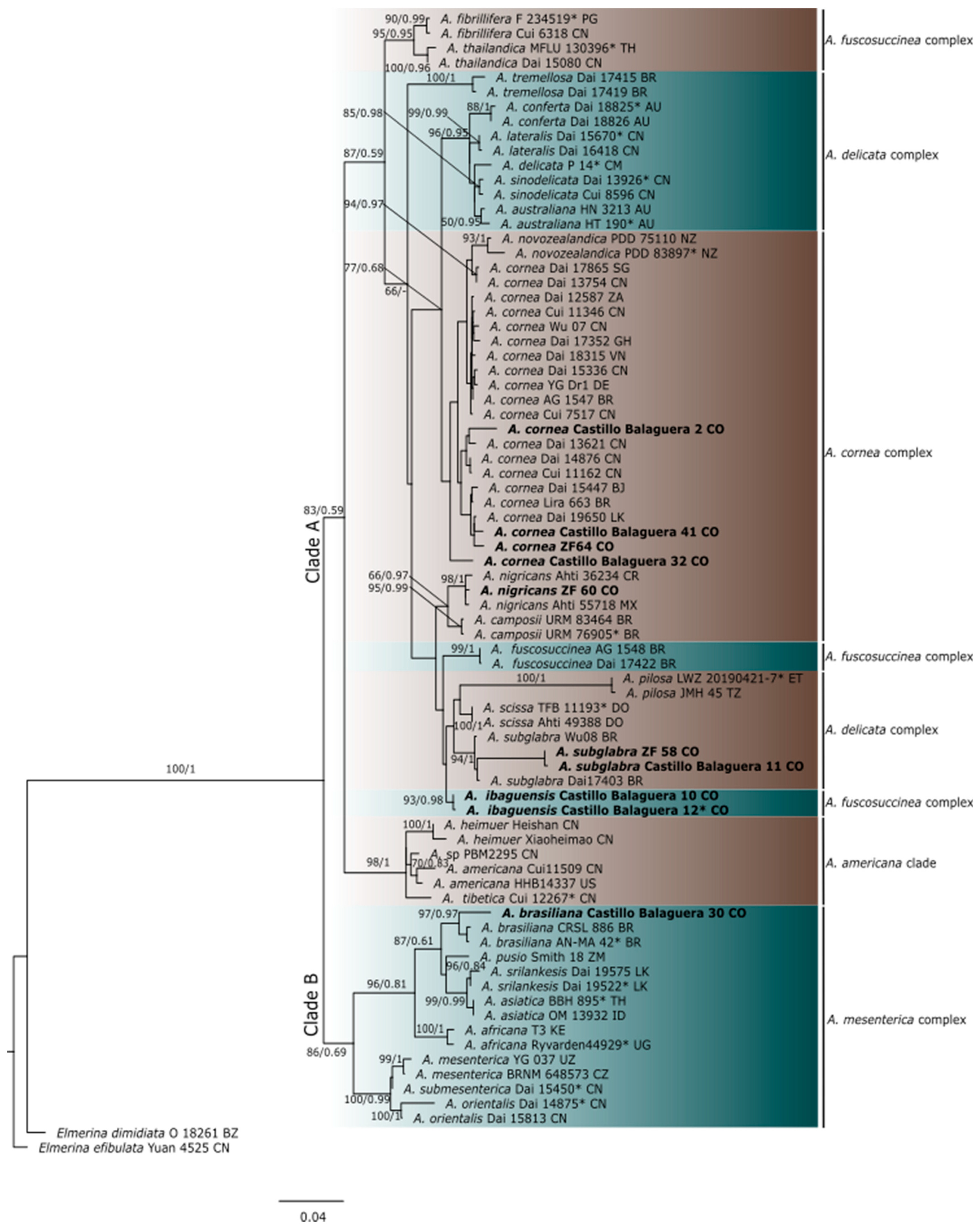
To determine phylogenetic relationships, a dataset comprising concatenated ITS, LSU, and RPB2 sequences was analyzed. Elmerina efibulata and E. dimidiata were designated as outgroup taxa. The final alignment included 81 specimens and comprised a total 2729 aligned positions. Both maximum likelihood (ML) and Bayesian inference analyses yielded similar topologies; however, only the ML tree is presented here, with support values from both methods.
The results confirm that Auricularia constitutes a monophyletic group. The phylogenetic analysis recovered two well-supported clades, designated Clade A and Clade B (Figure 2). Clade A includes 22 species corresponding to the A. fuscosuccinea, A. delicata, A. cornea, and A. americana species complexes, whereas Clade B comprises eight species belonging to the A. mesenterica complex.
This topology is consistent with previous phylogenetic studies of the genus [23,24]. Additionally, Wu et al. [1] noted that the A. cornea complex remains unresolved, citing insufficient support for its internal clades. This lack of resolution also extends to the morphological level, as the same authors reported significant morphological variation in A. cornea without a discernible biogeographic pattern. Our findings corroborate these observations, revealing low phylogenetic support (Figure 2) and at least two distinct morphotypes. Matheny et al. [25] reported that Auricularia possesses multiple copies of EF1-α, making it a valuable molecular marker. Their study suggested that EF1-α could help resolve phylogenetic relationships within clades that are difficult to analyze using traditional DNA markers, thus EF1-α sequences a promising approach to clarify the A. cornea complex.

3.2. Taxonomy

  • Auricularia brasiliana Y.C. Dai & F. Wu.
MycoBank: 811443
Specimens examined: Colombia, Cundinamarca Department, municipality of Nilo, Piscilago Conservation area, 4°12′52.3″ N 74°40′50.9″ W, 308 m asl, 13 April 2023, leg. Castillo-Balaguera 30 (FUT); GenBank access codes: PV133394 (ITS), PV133408 (LSU).
Description: Basidiomata gelatinous, auriculate, sessile, laterally attached, and dimidiate as in polypores. Auriculate margins of 1.91 to 9.02 cm in diameter and 0.09 to 1.06 cm thick. Pileus with white concentric zones, when fresh, pale yellow, becoming yellowish-brown with thin concentric bands when dry. Surface tomentose, with ledge-shaped and lobed margins. Hymenophore Auriculate, with lobed margins, grayish orange and greyish brown when fresh. Internal features: Medulla absent. Crystals not seen. Long and thin abhymenial hairs 487.8–609.3 µm; basidia clavated with thin-walled 42.9–52.4 × 3.1–4.5 µm; Pilose Zone (PZ) 104.31 μm, compact zone (CZ) to 25.3 μm. Superior subcompact zone (SSZ) 40.92 μm. Intermedia Laxa Zone (INZ) 765.03 μm. Inferior Laxa Zone (ILZ) 169.99 μm and Hymenium 152.48 μm. Cystidioles absent. Basidiospores cylindric, 10.2–12.2 × 4.1–4.8 µm Qm = 2.4.
Notes: Auricularia brasiliana belongs to the A. mesenterica complex, which includes A. asiatica, A. Africana, A, pusio, A. srilankensis, A. submesenterica, and A. orientalis. A. mesenterica grows on unidentified angiosperm woods, typically from summer to autumn and for many years was considered a cosmopolitan species [24,26]. Phylogenetic analysis showed that specimen clusters within Clade B of the phylogenetic tree, forming a well-supported group with high statistical confidence (Figure 2). The specimen sequenced for this study is recovered as sister to A. pusio, A. srilankensis, and A. asiatica, showing phylogenetic relationships consistent with those reported by Wu et al.
Wu et al. [7] described A. brasiliana, distinguishing it from A. mesenterica s.s. by its shorter basidia and distinctly inflated hyphae in KOH. The species also differs from A. pusio, A. srilankensis, and A. asiatica by having much longer hairs, smaller basidiospores, and noticeably smaller basidia. Regarding the characteristics of the specimen collected and identified as A. brasiliana in this study, differences were observed in the length of the abhymenial hairs, which are much shorter than those reported by Wu (1000–1500 × 2–3.5 μm), as well as in basidial size, which was larger than previously reported (30–47 × 3–5 μm in Wu’s A. brasiliana).
No differences were observed in basidiospore morphology. Although Wu described the basidiospores as allantoid with Q = 2.62, the spore quotient (Q) value obtained in this study (2.0–3.0) fell within a similar range and supported their classification as cylindrical. Additionally, the phylogenetic analysis showed that the specimen clusters within Clade B of the phylogenetic tree, forming a well-supported clade with high statistical confidence (Figure 2).
According to the ColFungi portal, A. mesenterica has been reported in Europe, Tropical Asia, Africa, the South-Central Pacific, South America, North America, Australia, and Temperate Asia. However, Wu et al. [1] identified distinct distribution patterns within the A. mesenterica complex: A. pusio is distributed in Australia and Zambia; A. srilankensis is exclusively reported from Sri Lanka in South Asia; and A. brasiliana was first recorded in Brazil and is primarily found in tropical regions. In Colombia, A. mesenterica has been documented in seven departments—Amazonas, Caldas, Caquetá, Cesar, Chocó, Meta, and Valle del Cauca [21]. Notably, there are no confirmed records of A. brasiliana from Colombia. Considering the findings of Wu et al., which indicate distributional specificity within the A. mesenterica complex, it is essential to re-evaluate records of A. mesenterica in South America and to include a larger number of sequences from Colombian specimens. This approach allows a more accurate assessment of the differences between A. brasiliana and the specimens of the mesenterica complex collected in the country. Nevertheless, based on the morphological and molecular evidence obtained, this study provides the first confirmed record of A. brasiliana in Colombia.
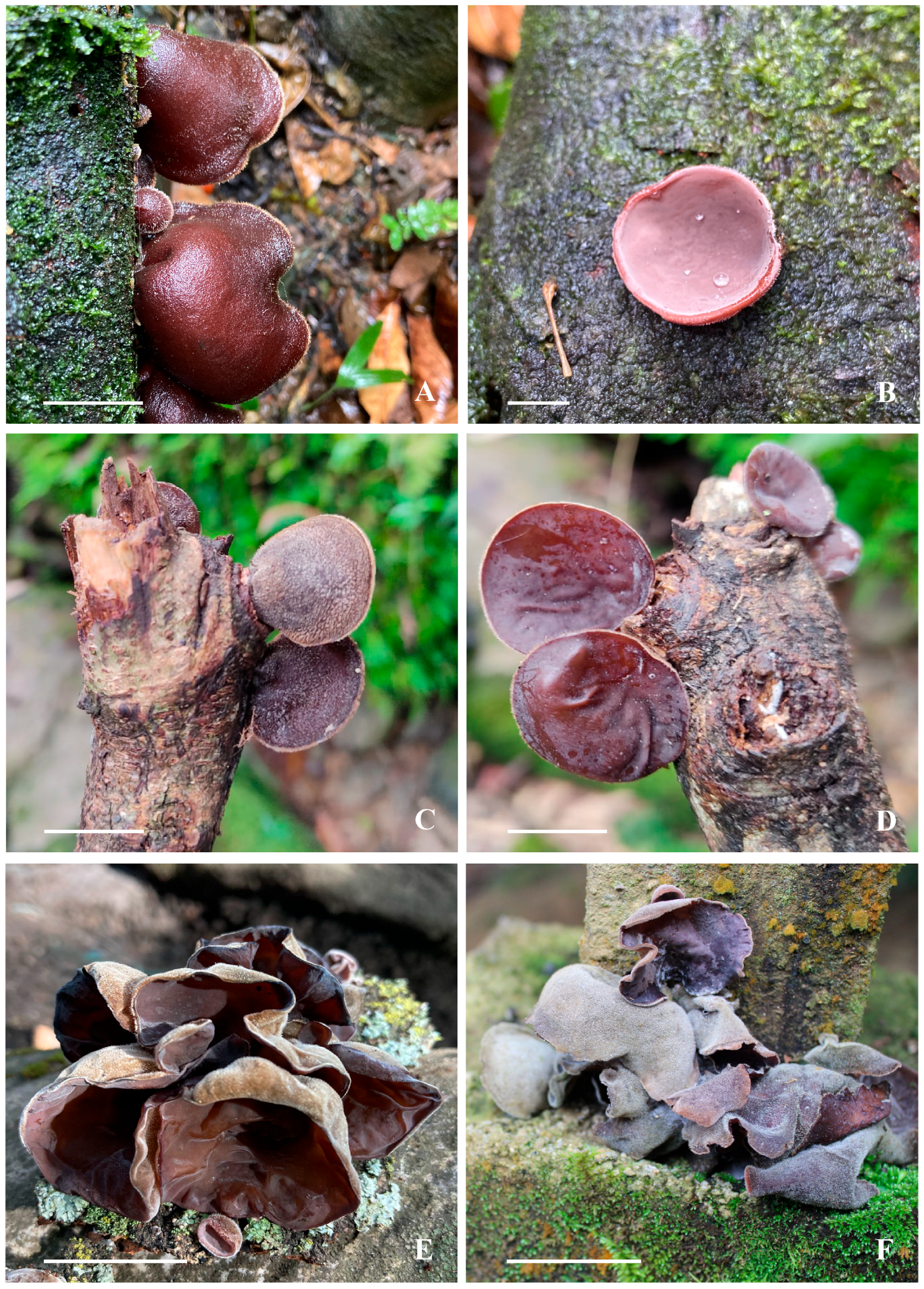
Figure 3. Fresh basidiomata of Auricularia species collected in the Colombian Andes. (A,B). A. nigricans; (C,D). A.subglabra; (E,F). A. brasiliana. Scale bar. (A) = 3.5 cm; (B) = 1.7 cm; (C) = 1.5 cm. (D) = 1.3 cm; (E) = 2.5 cm; (F) = 1.8 cm. Photos: Cristian J. Zambrano Forero (AD); Laura C. Balaguera (E,F).
Taxonomy 06 00019 g003
  • Auricularia cornea Ehrenb.
MycoBank: 167247
Specimens examined: Colombia, Tolima Department, municipality of Ibagué, Granja de Anita Calambeo, 4°27′34″ N, 75°13′11.28″ W, 1320 masl, 26 March 2023, leg. Castillo-Balaguera 2 (FUT), GenBank access code: PV133403 (LSU); idem., Barrio Cañaveral, 4°27′9.2″ N 75°11′11.3″ W, 1080 masl, 13 April 2023, leg. Castillo-Balaguera 9 (FUT); idem., Municipality of Espinal, Chicoral, 4°12′27.9″ N 74°57′42.7″ W, 382 masl, leg. Castillo-Balaguera 40 (FUT); idem., Castillo-Balaguera 41, GenBank access codes: PV133392 (ITS), PV133401 (LSU); idem., Cundinamarca Department, municipality of Nilo, Piscilago conservation área, 4°12′52.4″ N 74°41′01.3″ W, 305 masl, 10 July 2023, leg. Castillo-Balaguera 32 (FUT), GenBank access codes: PV133393 (ITS), PV133402 (LSU); idem., Valle del Cauca Department, municipality of Pradera, La Buitrera, 3°28′28″ N 76°11′28″ W, 1526 masl, 10 october 2023, leg. ZF 64 (FUT), GenBank access code: PV133400 (LSU).
Description: Basidiomata gelatinous when fresh, greyish red to olive yellow, becoming grayish yellow when dry, gregarious; auriculate, sessile, attached to the wood by a single point at the base. Pileus 2.2–7.0 cm in diameter; with an entire margin, sometimes with a white line; surface more or less hirsute, brown to violet. Hymenophore smooth to slightly cross-linked, grayish red to dark brown. Internal features: Medulla present in the middle of the cross-section; Crystals not observed. Abhymenial hairs long and thin, 30.78–421.5 × 3.71–9.4 µm; basidia and basidioles are too condensed; Pilose Zone (PZ): 101.94–281.45 μm, Compact Zone (CZ): 10.97–45.52 μm, Superior subcompact zone (SSZ): 39.14–77.71 μm, Superior laxa zone (SLZ): 210.16–335.78 μm, a Medullary layer (MED): 76.15–190.43 μm, inferior laxa zone (ILZ): 101.58–201.63 μm, Inferior Subcompact zone (ISZ): 67.37–125.95 μm and hymenium (H): 105.82–242.29 μm. Cystidioles absent. Basidiospores cylindric, hyaline, thin-walled, 11.2–13.1 × 4.3–5 µm. Qm = 2.6, with oil guttules.
Notes: Auricularia cornea was first described by Ehrenberg in 1820, who noted its auriculiform shape, subgelatinous texture, and the presence of guttules in the spores. He also reported a distinct semi-thick line, a characteristic that was also observed in the cross-sections of the specimens analyzed in this study.
Wu et al. [1] identified A. cornea as a species complex comprising six closely related taxa: A. camposii, A. cornea, A. eburnea, A. eminii, A. nigricans, and A. novozelandica. They highlighted its macroscopic variability, particularly in the coloration of fresh basidiomata, as well as the presence of dense hairs on the upper surface. Microscopically, A. cornea is distinguished by the presence of a well-defined medulla and crystalline structures, both of which were observed in all specimens identified as A. cornea in this study.
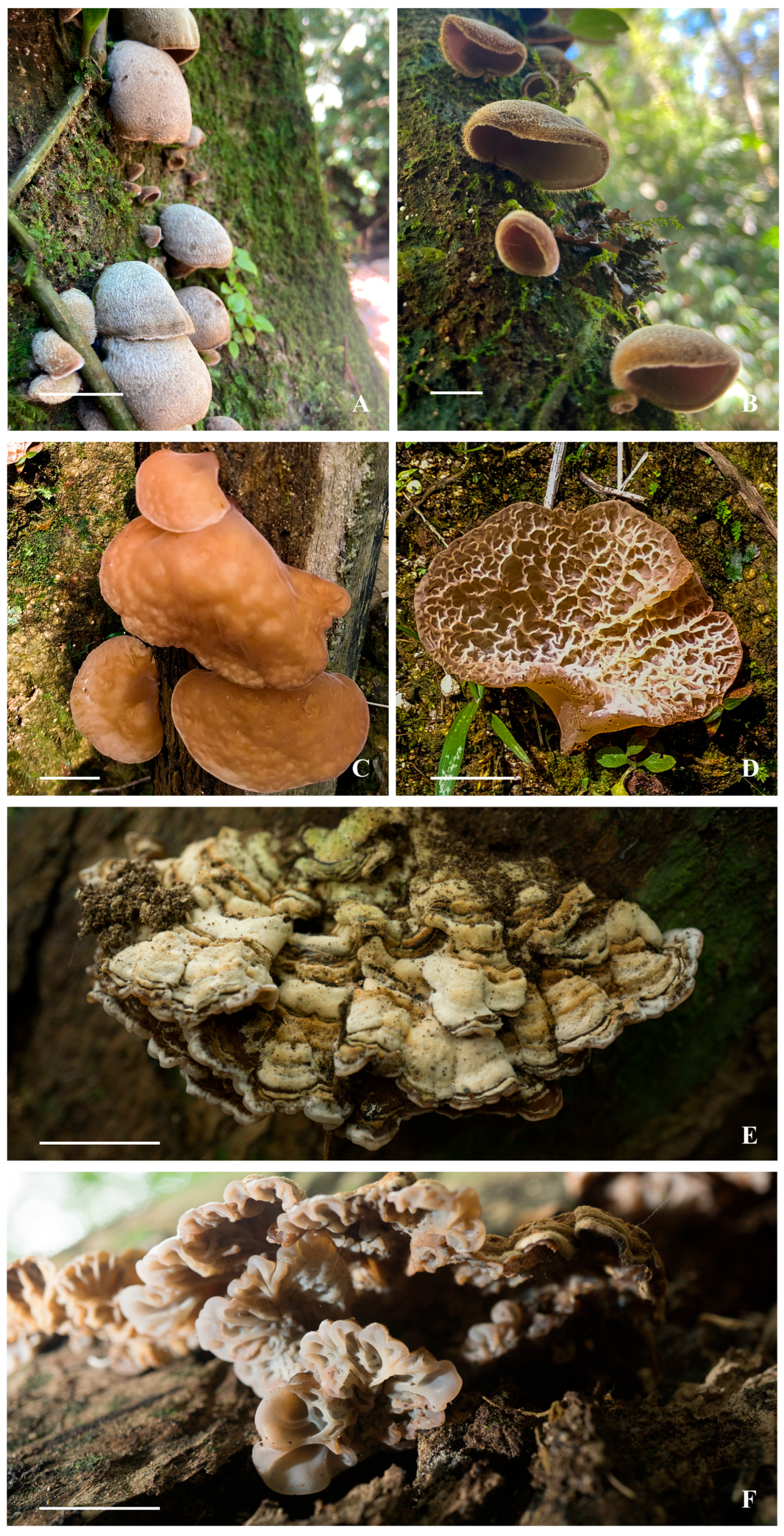
The same authors report that A. cornea remains an unresolved species complex due to the lack of well-supported and clearly defined clades in phylogenetic analyses, as well as its considerable morphological variability. The findings of this study align with these observations, as we identified at least two distinct morphotypes (Figure 4). The first morphotype exhibits a densely hirsute surface, ranging from white to yellow, with a dark margin and a brown hymenophore that darkens significantly upon drying (Vouchers: Castillo-Balaguera 2, 32, 40, and 41). The second morphotype features a slightly hirsute brown surface, a light-colored margin, and a hymenophore that varies from grayish red to violet (Vouchers: Castillo-Balaguera 9 and ZF 64).
According to ColFungi (2024), A. cornea has a global distribution. However, there are no previous records of this species in the Tolima department, where only A. auricula-judae, A. delicata, and A. fuscosuccinea have been documented [27,28]. This study represents the first confirmed record of A. cornea in the region.
Figure 4. Fresh basidiomata of Auricularia cornea specimens collected in the Colombian Andes. (A,B). Voucher ZF64; (C,D). Voucher Castillo-Balaguera 9; (E). Voucher Castillo-Balaguera 40; (F). Voucher Castillo-Balaguera 2. Scale bar. (A) = 2 cm; (B) = 1.5 cm, (C) = 2.5, (D) = 1.7 cm, (E) = 2.5 cm, (F) = 5.8 cm. Photos: Cristian J. Zambrano Forero (A,B); Laura C. Balaguera (CF).
Taxonomy 06 00019 g004
  • Auricularia ibaguensis Castillo-Balaguera, Zambrano-Forero & Dávila-Giraldo, sp. nov.
MycoBank: 857728
Etymology: ibaguensis—refers to type locality, the municipality of Ibagué.
Holotype: Colombia, Tolima department, municipality of Ibagué, Barrio Cañaveral, 4°27′9.2″ N 75°11′11.3″ W, 1080 masl, 13 April 2023, leg. Castillo-Balaguera 12 (FUT), GenBank access codes: PV133396 (ITS), PV133409 (LSU).
Other specimens examined: Colombia, Tolima Department, Municipality of Ibagué, Barrio Cañaveral; 4°27′9.2″ N 75°11′11.3″ W, 1080 masl, 13 April 2023, leg. Castillo-Balaguera 10, GenBank access codes: PV133395 (ITS), PV133410 (LSU); idem. Granja Anita Calambeo, 4°27′34.6″ N 75°13′11.28″ W, 1320 masl, 26 March 2023, leg. Castillo-Balaguera 4; idem. El Totumo, 4°24′19.6″ N 75°12′03.7″ W, 1080 masl, 12 June 2023, leg. ZF 61.
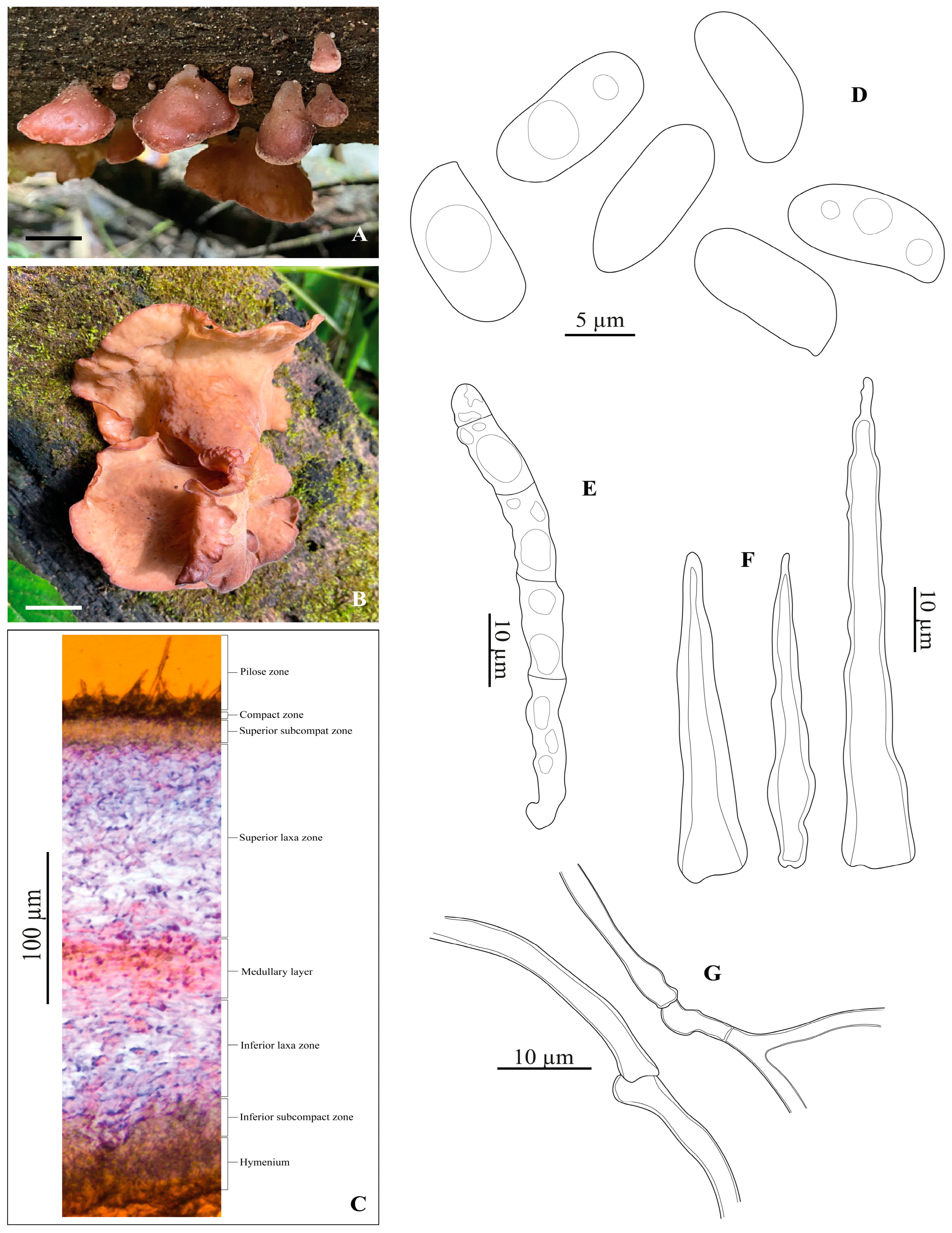
Description: Gelatinous basidiome that grows solitary or gregarious, sessile to substipitate, whole margin, presence of a white stipe (<1 mm) in the outside edge of the basidiomas, attached to the wood at a single point, auriculate basidiomata 2.5–5 × 1.6–4.5 cm. Pileus brownish orange color to pale red when a fresh, reddish-brown color to light brown when dry, sparsely hairy surface, reticulate-porous hymenophore that is most remarkable when dry. Internal features: Medulla present near the abhymenium or central. Crystal not seen. Short abhymenial hairs 12.3–52.4 × 2.6–7.3 µm some with ornamentations; hyphae with clamp connections and simple septa; clavate basidia, transversely septate, with oil guttules, 45–66.8 × 3.9–5.8 µm, sterigmata not observed. Cystidioles absent. Pilose Zone (PZ): 9.17–36.35 µm, Compact Zone (CZ): 4.35–11.69 µm, Superior subcompact zone (SSZ): 9.67–29.89 µm; Superior laxa zone (SLZ): 80.13–200.43 µm; M (medulla): 23.62–93.3 µm; inferior laxa zone (ILZ): 52.11–193.95 µm, Inferior Subcompact zone (ISZ): 19.74–55.8 µm, and hymenium (H): 20.3–55 µm. Cystidioles absent. Basidiospores cylindric, hyaline, smooth, thin-walled, usually with one to three oil guttules. IKI–, CB–, 10.4–12.7 × 5.0–6.2 µm, Lm × Wm = 11.8 × 5.4 µm, Q = (1.8) 2.1–2.3 (2.6), Qm = 2.2 (n = 84/4).
Ecology and distribution: Growing on dead logs of unidentified angiosperms. Known only from the transition zone between tropical dry forest and premontane forest, as well as urban areas in Ibagué, Colombia.
Notes: We describe a new Auricularia species discovered in Ibagué, a municipality within the Magdalena Valley. Comparative analysis with A. fuscosuccinea, its closest relative, revealed notable morphological distinctions. A. ibaguensis exhibits a more reticulated hymenophore and significantly smaller abhymenial hairs (12.3–52.4 µm in A. ibaguensis vs. 75–165 µm in A. fuscosuccinea). Additionally, its basidiospores are shorter and broader, with a cylindrical shape (Figure 5), whereas those of A. fuscosuccinea are longer, thinner, and range from cylindric to allantoid (12–14 × 4.3–5.2). Differences in hyphal trama were also observed, with A. ibaguensis exhibiting smaller structural measurements compared to A. fuscosuccinea [1,24], particularly in the medulla, inferior laxa zone, and hymenium. Phylogenetic analysis (Figure 2) confirmed the distinctiveness of A. ibaguensis, placing it in a well-supported independent clade.
In Colombia, A. auricula-judae, a morphologically similar species, has been widely reported. However, molecular studies [1] suggest that A. auricula-judae s.s. is restricted to Europe. This species differs from A. ibaguensis by its smooth hymenophore, significantly longer abhymenial hairs (100–150 (−250) µm), and larger, distinctly allantoid basidiospores.
Figure 5. Fresh basidiomata and microscopic structures of Auricularia ibaguensis. (A). Basidiomata voucher Castillo-Balaguera 10; (B). Basidiomata voucher Castillo-Balaguera 12; (C). Trama; (D). Basidiospores; (E). Basidia; (F). Abhymenial hairs; (G). Hyphae. Scale bar. (A) = 2 cm; (B) = 1 cm. Photos: Laura C. Balaguera (A,B). Illustration: Lina R. Dávila Giraldo.
Taxonomy 06 00019 g005
  • Auricularia nigricans (Sw.) Birkebak, Looney & Sánchez-García.
MycoBank: 803171
Specimens examined: Colombia, Tolima Department, municipality of Ibagué, El Totumo. 4°27′34.668″ N, 75°13′11.28″ W, 1080 masl, 12 June 2023, leg. ZF 60 (FUT), GenBank access codes: PV133391 (ITS), PV133407 (LSU).
Description: Basidiomata gelatinous, gregarious, sessile; attached broadly to the wood. Pileus Auriculate 1.1 to 3.5 cm, with an entire margin; surface tomentose, whole margin. Pileus Tomentose Golden grey when fresh (Figure 3), when dry, powdery appearance, purplish brown smooth hymenophore. Internal features: Dense medulla present in the middle of the cross-section. Crystal not seen. Long and thin abhymenial hairs 182.9–421.5 × 6.71–9.4 µm. Basidioles are too condensed. Pilose Zone (PZ) to 91.29–262.53 μm. Compact zone (CZ) 22.14–25.6 μm. Superior subcompact zone (SSZ) to 93.15–109.49 μm, a superior laxa (SL) 407.51–435.15, Medulla (M) 125.21–145.01 μm, zona laxa inferioris (IL) 182.58–281.51 μm, the subcompact inferiors (ISC) 162.27–166.15 μm, and hymenium (H): 199.02–280.27 μm. Cystidioles absent. basidiospores not seen.
Notes: Auricularia nigricans belongs to the A. cornea complex, which includes five other species: A. camposii, A. cornea, A. eburnea, A. eminii, and A. novozelandrica. It was reclassified in 2013 by Brian P. Looney, Joshua M. Birkebak, and P. Brandon Matheny. According to the original publication, its nomenclatural history is complex. The species was first described by Olof Swartz (1788) as Peziza nigrescens Sw. Later, Swartz (1806) cited and expanded upon his original description but referred to the species as Peziza nigricans Sw., inadvertently creating a superfluous name based on the same type specimen. Subsequently, Donk recognized the necessity of transferring Peziza nigricans to Auricularia, the appropriate contemporary genus. Finally, Looney et al. [23] examined the type material type and confirmed that this taxon corresponds to A. nigricans.
Wu et al. [1] described A. nigricans as having a densely hirsute upper surface and a well-defined medulla near the abhymenium. These characteristics closely resemble those of A. cornea; however, A. nigricans can be distinguished by its more pronounced hirsute upper surface.
Regarding its distribution, Nadir et al. [29] reported that A. nigricans occurs in tropical regions of the Americas, Asia, and other parts of the world. However, Wu et al. [1] identified discrepancies, noting that the species has been reported in North America as a synonym of A. polytricha. In Colombia, Gómez-Montoya et al. [28] documented A. nigricans in the departments of Amazonas, Antioquia, Cesar, Chocó, Caldas, Meta, Quindío, and Valle del Cauca. This study provides the first confirmed record of A. nigricans in the department of Tolima.
  • Auricularia subglabra Looney, Birkebak, & Matheny.
MycoBank: 801341
Specimens examined: Colombia, Tolima department, municipality of Ibagué, Vereda Chembe, 4°28′57.3″ N 75°09′59.7″ W, 1532 masl, 23 March 2023, leg. ZF 58 (FUT), GenBank access codes: PV133397 (ITS), PV133411 (LSU); idem. Barrio Cañaveral, 4°27′09.2″ N 75°11′11.7″ W, 1082 masl, 13 April 2023, leg. Castillo-Balaguera 11 (FUT), GenBank access codes: PV133398 (ITS), PV133412 (LSU).
Description: Basidiomata gelatinous, gregarious, sessile to substipitate. Attached to the wood by a single point. Pileus Auriculate pileus, with entire or lobed margins, 1.98–4.6 × 1.19–6.3 cm. bronze to dull yellow when fresh, becoming brown when dry; Surface velutinose only visible under the microscope, appearing glabrous to the eye; Hymenophore reticulate to porous. Internal features: Schizomedulla present. Crystal not seen. Abhymenial hairs with a slightly swollen base 13.5–63.1 × 3.5–6 µm. Basidioles clavate, with oil guttules, 26–71.8 × 5.6–8.55 µm. Pilose zone (P): 17.46–22.26 µm; compact zone (C): 6.21–7.48 µm; Superior subcompact zone (SSC): 24.65–34.11 µm; Superior laxa zone (SLZ): 110.34–140.26 µm; Medulla (M): 443.53–465.33 µm; inferior laxa zone (ILZ): 145.7–165.85 µm, Inferior Subcompact zone (ISZ): 79.77–84.33 µm; hymenium (H): 40.28–46.68 µm. Cystidioles absent. Basidiospores cilindric, hyaline, thin-walled, 8.2–11.0 × 4.2–5.9 µm. Qm = 2.0, with oil guttules.
Notes: Auricularia subglabra was described by Looney, Birkebak, and Matheny in 2013 from specimens collected in Costa Rica. According to these authors, this species belongs to the A. delicata complex, which comprises nine species: A. australiana, A. conferta, A. delicata, A. lateralis, A. pilosa, A. tremellosa, A. sinodelicata, A. scissa, and A. subglabra. It is distinguished by “the general absence of abhymenial hairs (though solitary hairs are sometimes present) and the presence of a schizomedulla that can occasionally separate completely in KOH solution” [23].
This species is often confused with A. scissa, as both exhibit a conspicuously porose-reticulate hymenophore and a schizomedulla. However, they differ in the length and frequency of abhymenial hairs. A. subglabra typically has very short hairs, not exceeding 50 μm, whereas the specimens collected in this study exhibited hairs up to 63 μm in length.
Previous research indicates that A. subglabra has been primarily reported in the montane cloud forests of Costa Rica [23]. In Colombia, there are no confirmed records of this species. However, Gómez-Montoya et al. [28] report A. delicata from Colombia, including the department of Tolima. Given that molecular data suggest A. delicata s.s. is restricted to Africa [1], it is essential to reassess Colombian specimens assigned to A. delicata through molecular and taxonomic analyses to determine whether they belong to A. subglabra or another species within the A. delicata complex.

3.3. Identification Key for Auricularia in Colombian Andes

1Basidiomes without concentric zones, medulla present2
1′Basidiomes with concentric zones, tomentose surface, reticulate hymenophore, medulla absentA. brasiliana
2Densely hairy surface, medulla present near the abhymenium3
2′Sparsely hairy surface, distinct medulla 4
3Basidiomes rough, with an erect and rigid texture of dark color, abhymenial hairs of irregular size 30.78–421.5 × 3.71–9.4 µmA. cornea
3′Basidiomes soft (woolly), light in color, abhymenial hairs of 182.9–421.5 × 6.71–9.4 µmA. nigricans
4Reticulated hymenophore when fresh, apparently smooth surface, with small abhymenial hairs of 13.5–63.1 × 3.5–6 µm, with the presence of a schizomedullaA. subglabra
4′Hymenophore more or less reticulate when dry, velutinous surface, without schizomedulla5
5Hymenophore slightly reticulate when dry, surface with abhymenial hairs 75–165 µm long and 3.1–6.58 µm wide, presence of medulla measuring 32–361 µm, lower lax zone 26–506 µm, hymenium measuring 41–86 µm, basidiospores cylindrical to allantoicA. fuscosuccinea
5′Hymenophore very reticulate when dry, surface with abhymenial hairs with length from 12.3 to 52.4 µm and width of 2.6–7.3 µm, presence of medulla of 23.62–93.3 µm, lower lax zone 52.11–193.95 µm, hymenium of 20.3–55 µm, basidiospores shorter and wider, clearly cylindrical.A. ibaguensis

Author Contributions

Conceptualization, C.Z.-F., L.R.D.-G., and W.M.-A.; methodology, C.Z.-F., M.P.H.-S., and I.R.-B.; formal analysis, L.X.C.-B., M.P.H.-S., and C.Z.-F.; investigation, L.X.C.-B., M.P.H.-S., and C.Z.-F.; writing—original draft preparation, L.X.C.-B.; writing—review and editing, C.Z.-F., and M.P.H.-S.; visualization, L.R.D.-G.; funding acquisition, L.R.D.-G., and W.M.-A. All authors have read and agreed to the published version of the manuscript.

Funding

This research was funded by Sistema General de Regalías de Colombia, project “Fortalecimiento de Vocaciones Científicas en Jóvenes Mediante Becas-Pasantías en la Región Centro Sur. Caquetá, Amazonas, Putumayo, Huila y Tolima”, code BPIN- 2022000100076.

Data Availability Statement

The data presented in this study are openly available in GenBank. [https://www.ncbi.nlm.nih.gov/genbank/, accessed on 27 January 2026].

Acknowledgments

We are grateful to the University of Amazonia and the Laboratory of Natural Products GIPRONUT at the University of Tolima for their support of this research project.

Conflicts of Interest

The authors declare no conflicts of interest. All co-authors have seen and agree with the contents of the manuscript.

References

  1. Wu, F.; Tohtirjap, A.; Fan, L.F.; Zhou, L.W.; Alvarenga, R.L.M.; Gibertoni, T.B.; Dai, Y.C. Global Diversity and Updated Phylogeny of Auricularia (Auriculariales, Basidiomycota). J. Fungi 2021, 7, 933. [Google Scholar] [CrossRef] [PubMed]
  2. Boa, E. Los Hongos Silvestres Comestibles: Perspectiva Global de Su USO e Importancia Para La Población (Productos Forestales No Madereros); Food & Agriculture Organization: Rome, Italy, 2005; ISBN 9253051574. [Google Scholar]
  3. Borhegyi, C.; Borhegyi-Forrest, S.; Wexler, P. Mushroom Intoxication in Meso-America; Academic Press: Cambridge, MA, USA, 2015. [Google Scholar]
  4. Guzmán, G. Las Relaciones de Los Hongos Sagrados Con El Hombre a Través Del Tiempo. An. Antropol. 2016, 50, 134–147. [Google Scholar] [CrossRef]
  5. Franco Molano, A.E.; Palacios, V.; Marcela, A.; Quintero, L.; Alberto, C. Macrohongos de la Región del Medio Caquetá-Colombia Guía de Campo; Multimpresos: Medellin, Colombia, 2005. [Google Scholar]
  6. Cano-Estrada, A.; Romero-Bautista, L. Valor Económico, Nutricional y Medicinal de Hongos Comestibles Silvestres. Rev. Chil. Nutr. 2016, 43, 75–80. [Google Scholar] [CrossRef]
  7. Wu, F.; Yuan, Y.; Rivoire, B.; Dai, Y.C. Phylogeny and Diversity of the Auricularia mesenterica (Auriculariales, Basidiomycota) Complex. Mycol. Prog. 2015, 14, 42. [Google Scholar] [CrossRef]
  8. Kout, J.; Wu, F. Revealing the cryptic diversity of wood-inhabiting Auricularia (Auriculariales, Basidiomycota) in Europe. Forests 2022, 13, 532. [Google Scholar] [CrossRef]
  9. Jahedi, A.; Safaie, N.; Goltapeh, E.M.; Ahmadifar, S. Auricularia (wood ear mushroom) genus: A contribution to classification and new species records for Iran and world. Plant Fungal Syst. 2024, 69, 205–217. [Google Scholar] [CrossRef]
  10. Zhang, J.X.; Cheng, Q.; Huang, C.Y.; Gao, W.; Qu, J.B. History, Current Situation, and Trend of Edible Mushroom Industry Development. Mycosystema 2015, 34, 524–540. [Google Scholar]
  11. Wu, F.; Yuan, Y.; Malysheva, V.F.; Du, P.; Dai, Y.C. Species clarification of the most important and cultivated Auricularia mushroom “Heimuer”: Evidence from morphological and molecular data. Phytotaxa 2014, 186, 241–253. [Google Scholar] [CrossRef]
  12. Peña Cañón, E.R.; Niño Fernandez, Y.M.; Mejía, L.E. Importancia Cultural de Hongos Silvestres Comestibles En Cuatro Municipios de Boyacá (Colombia).: Uso de Hongos Comestibles En Boyacá. Cienc. Desarro. 2023, 14, 31–46. [Google Scholar]
  13. Ramadhani, I.; Idris, I.; Masrukhin, M.; Setiawan, R.; Nurcahyanto, D.; Ikhwani, A.; Elfirta, R. Isolation and Identification of Macrofungi from Gunung Halimun Salak National Park. J. Mikol. Indones. 2019, 3, 104–117. [Google Scholar] [CrossRef]
  14. Nakasone, K.K. Diversity of Lignicolous Basidiomycetes in Coarse Woody Debris. In Biodiversity and Coarse Windy Debris in Southern Forests, Proceedings of the Workshop on Coarse Woody Debris in Southern Forests: Effects on Biodiversity, Athens, GA, USA, 18–20 October 1993; Department of Agriculture, Forest Service, Southern Research Station: Asheville, NC, USA, 1996; pp. 35–42. [Google Scholar]
  15. Largent, D. How to Identify Mushrooms to Genus III: Microscopic Features; Mad River Press Inc.: Eureka, CA, USA, 1977. [Google Scholar]
  16. Onyango, B. Molecular Characterization of Wood Ear Mushrooms [Auricularia sp.] from Kakamega Forest in Western Kenya. Curr. Res. Environ. Appl. Mycol. 2016, 6, 51–60. [Google Scholar] [CrossRef]
  17. Katoh, K.; Standley, D.M. MAFFT Multiple Sequence Alignment Software Version 7: Improvements in Performance and Usability. Mol. Biol. Evol. 2013, 30, 772–780. [Google Scholar] [CrossRef] [PubMed]
  18. Ronquist, F.; Teslenko, M.; van der Mark, P.; Ayres, D.L.; Darling, A.; Höhna, S.; Larget, B.; Liu, L.; Suchard, M.A.; Huelsenbeck, J.P. MrBayes 3.2: Efficient Bayesian Phylogenetic Inference and Model Choice Across a Large Model Space. Syst. Biol. 2012, 61, 539–542. [Google Scholar] [CrossRef]
  19. Stamatakis, A. RAxML Version 8: A Tool for Phylogenetic Analysis and Post-Analysis of Large Phylogenies. Bioinformatics 2014, 30, 1312–1313. [Google Scholar] [CrossRef] [PubMed]
  20. Darriba, D.; Taboada, G.L.; Doallo, R.; Posada, D. JModelTest 2: More Models, New Heuristics and Parallel Computing. Nat. Methods 2012, 9, 772. [Google Scholar] [CrossRef]
  21. Cossu, T.; Lücking, R.; Vargas-Estupiñán, N.; Carretero, J.; Vasco, A.; Moncada, B.; Kirk, P.M.; De Almeida, R.; Gaya, E.; Coca, L.F. Annotated Checklist of Fungi of Colombia. In Catalogue of Fungi of Colombia; Kew: Surrey, UK, 2022. [Google Scholar]
  22. Alvarenga, R.L.M.; Naves, L.R.R.; Xavier-Santos, S. The Genus Auricularia Bull. Ex Juss. (Basidiomycota) in Cerrado (Brazilian Savanna) Areas of Goiás State and the Federal District, Brazil. Mycosphere 2015, 6, 532–541. [Google Scholar] [CrossRef]
  23. Looney, B.P.; Birkebak, J.M.; Brandon Matheny, P. Systematics of the Genus Auricularia with an Emphasis on Species from the Southeastern United States. N. Am. Fungi 2013, 8, 1–25. [Google Scholar] [CrossRef]
  24. Montoya-Alvarez, A.; Hayakama, H.; Minamya, Y.; Fukuda, T.; López-Quintero, C.; Franco-Molano, A. Phylogenetic Relationships and Review of the Species of Auricularia (Fungi: Basidiomycetes) in Colombia. Caldasia 2011, 33, 55–66. [Google Scholar]
  25. Matheny, P.B.; Wang, Z.; Binder, M.; Curtis, J.M.; Lim, Y.W.; Henrik Nilsson, R.; Hughes, K.W.; Hofstetter, V.; Ammirati, J.F.; Schoch, C.L.; et al. Contributions of Rpb2 and Tef1 to the Phylogeny of Mushrooms and Allies (Basidiomycota, Fungi). Mol. Phylogenetics Evol. 2007, 43, 430–451. [Google Scholar] [CrossRef]
  26. Lowy, B. A Morphological Basis for Classifying the Species of Auricularia. Mycologia 1951, 43, 351–358. [Google Scholar] [CrossRef]
  27. Zambrano-Forero, C.J.; Dávila-Giraldo, L.R.; Motato-Vásquez, V.; Villanueva, P.X.; Rondón-Barragán, I.S.; Murillo-Arango, W. Diversity and Distribution of Macrofungi (Ascomycota and Basidiomycota) in Tolima, a Department of the Colombian Andes: An Annotated Checklist. Biodivers. Data J. 2023, 11, e104307. [Google Scholar] [CrossRef]
  28. Gómez-Montoya, N.; Ríos-Sarmiento, C.; Zora-Vergara, B.; Benjumea-Aristizabal, C.; Santa-Santa, D.J.; Zuluaga-Moreno, M.; Franco-Molano, A.E. Diversidad de Macrohongos (Basidiomycota) de Colombia: Listado de Especies. Actual. Biol. 2022, 44, 1–94. [Google Scholar] [CrossRef]
  29. Nadir, H.A.; Alı, A.J.; Salıh, S.A. Auricularia nigricans (Auriculariaceae, Basidiomycota) Is First Introduced from Halabja Province, Iraq. Mantar Derg. 2020, 11, 68–74. [Google Scholar]
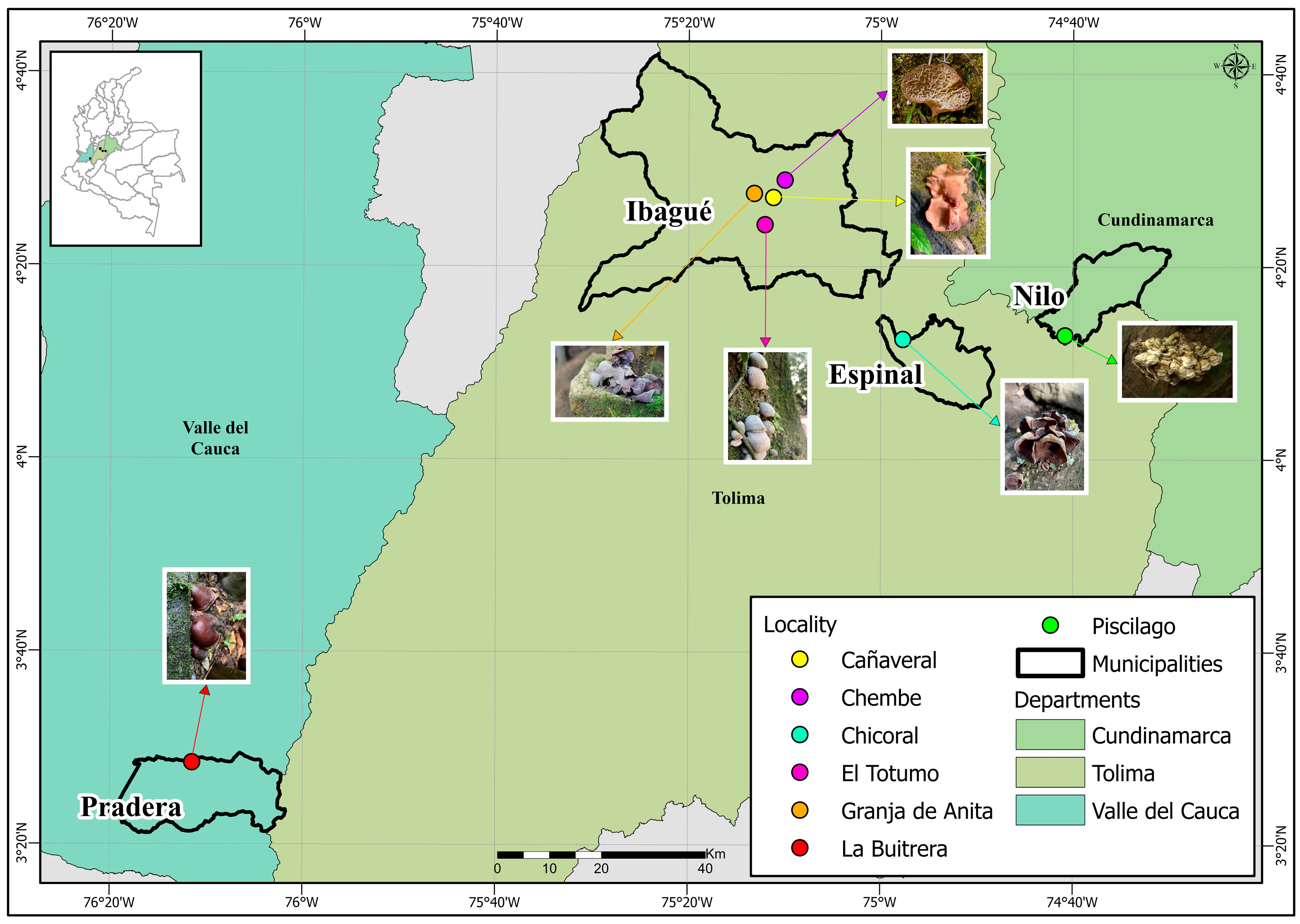
Figure 1. Sample collection sites located in the Colombian Andes. The map was generated using ArcGIS version 10.8 (ESRI, Redlands, CA, USA). Reproduced with permission of the author. Alvaro Alexander Dávila-Giraldo.
Taxonomy 06 00019 g001
Figure 2. Phylogenetic position of the Colombian Auricularia collection based on combined ITS, LSU and RPB2 datasets, inferred using maximum likelihood (ML) and Bayesian analyses. Bootstrap values lower than 65% and posterior probability values lower than 0.95 are not shown. * = type specimens. Materials sequenced in this work are shown in bold.
Taxonomy 06 00019 g002
Table 1. Taxa sampled in this study and used in phylogenetic analyses of Auricularia species. For each collection, the species name, voucher, and GenBank accession number are provided. Missing information is indicated with a hyphen (-). Asterisks (*) indicate type specimens. Materials sequenced in this work are shown in bold.
SpeciesVoucherOrigin ITS LSURPB2
Auricularia africanaT3KEMH213349MZ669918-
Auricularia africanaRyvarden 44929 *UGMH213350MZ669897MZ740061
Auricularia americanaCui 11509CNKT152094KT152110-
Auricularia americanaHHB 14337USKM396768--
Auricularia asiaticaBBH 895 *THKX621160--
Auricularia asiaticaOM 13932IDMZ618931MZ669899MZ740046
Auricularia australianaHT 190 *AUMZ647503MZ669920-
Auricularia. australianaHN 3213AUMZ647504MZ669921-
Auricularia brasilianaAN-MA 42 *BRKP729275KP729293-
Auricularia brasilianaCRSL 886BRKP729274KP729292-
Auricularia brasilianaCastillo_Balaguera 30COPV133394PV133408-
Auricularia camposiiURM 76905 *BRMH213351MH213395MH213427
Auricularia camposiiURM 83464BRMH213352MH213396MH213428
AuriculariaconfertaDai 18825 *AUMZ647500MZ669901MZ740048
Auricularia confertaDai 18826AUMZ647505--
Auricularia corneaYG-Dr1DEMH213353 MH213397MH213429
Auricularia corneaDai 12587ZAKX022012 KX022043-
Auricularia corneaDai 15336CNKX022014 KX022045KX022074
Auricularia corneaWu 07CNMH213354MH213398MH213430
Auricularia corneaDai 17352GHMH213355MH213399MH213431
Auricularia corneaCui 7517CNMH213356 MH213400-
Auricularia corneaDai 14876CNMH213357 MH213401-
Auricularia corneaLira 663BRMH213359MH213403MH213433
Auricularia corneaDai 15447BJMH213360--
Auricularia corneaDai 13754CNMH213361MH213404MH213434
Auricularia corneaDai 17865SGMH213362 MH213405-
Auricularia corneaDai 18315VNMH213363 MH213406-
Auricularia corneaCui 11346CNMZ618933MZ669902MZ740049
Auricularia corneaCui 11162CNMZ618934MZ669903MZ740050
Auricularia corneaAG 1547BRKX022016KX022047KX022076
Auricularia corneaDai 13621CNMZ618936MZ669905MZ740052
Auricularia corneaDai 19650LKMZ618937MZ669906MZ740053
Auricularia corneaCastillo-Balaguera 2CO-PV133403-
Auricularia corneaCastillo_Balaguera 32COPV133393PV133402-
Auricularia corneaCastillo_Balaguera 41COPV133392PV133401-
Auricularia corneaZF64CO-PV133400-
Auricularia delicataP 14 *CMMH213364 MZ669933-
Auricularia fibrilliferaF 234519 *PGKP765610KP765624MH213449
Auricularia fibrilliferaCui 6318CNKP765611KP765625KP729310
Auricularia fuscosuccineaDai 17422BRMH213367MH213408MH213437
Auricularia fuscosuccineaAG 1548BRKX022028KX022059KX022089
Auricularia heimuerXiaoheimaoCN-KY418890-
Auricularia heimuerHeishanCN-KY418889-
Auricularia ibaguensisCastillo_Balaguera 10COPV133395PV133410-
Auricularia ibaguensisCastillo_Balaguera 12COPV133396PV133409-
Auricularia lateralisDai 15670 *CNKX022022KX022053-
Auricularia lateralisDai 16418CNMH213370MH213411MH213441
Auricularia mesentericaBRNM 648573CZKP729279KP729297
Auricularia mesentericaYG 037UZMZ618939MZ669908
Auricularia nigricansAhti 55718MXMH213372 MH213413-
Auricularia nigricansAhti 36234CRKM396802KM396850-
Auricularia nigricansZF60COPV133391PV133407-
Auricularia novozealandicaPDD 83897 *NZKX022034 KX022065-
Auricularia novozealandicaPDD 75110NZKX022032KX022063-
Auricularia orientalisDai 14875 *CNKP729270KP729288
Auricularia orientalisDai 15813CNKX022036KX022067
Auricularia pilosaLWZ 20190421-7 *ETMZ647506--
Auricularia pilosaJMH 45TZKM267731--
Auricularia pusioSmith 18ZMMH213375MZ669926-
Auricularia scissaTFB 11193 *DOJX065160--
Auricularia scissaAhti 49388DOKM396805KM396853KP729324
Auricularia sinodelicataDai 13926 *CNMH213379MZ669909-
Auricularia sinodelicataCui 8596CNMH213376MH213415MH213444
Auricularia sp.PBM2295 Clone1CNDQ200918AY634277-
Auricularia srilankensisDai 19522 *LKMZ647501MZ669912-
Auricularia srilankensisDai 19575LKMZ647502 MZ669913MZ740058
Auricularia subglabraDai 17403BRMH213382MH213419MH213448
Auricularia subglabraWu 08BRMH213384MZ669928-
Auricularia subglabraZF58COPV133397PV133411-
Auricularia subglabraCastillo_Balaguera 11COPV133398PV133412-
Auricularia submesentericaDai 15450 *CNMH213386MH213420
Auricularia thailandicaMFLU 130396 *THKR336690-KX022093
Auricularia thailandicaDai 15080CNKP765622KP765636
Auricularia tibeticaCui12267 *CNKT152106KT152122-
Auricularia tremellosaDai 17415BRMH213390-KP729320
Auricularia tremellosaDai 17419BRMH213391-MZ753969
Elmerina dimidiataO 18261BZJQ764664 JQ764641-
Elmerida efibulataYuan 4525CNMZ618945MZ669917MZ740063
Disclaimer/Publisher’s Note: The statements, opinions and data contained in all publications are solely those of the individual author(s) and contributor(s) and not of MDPI and/or the editor(s). MDPI and/or the editor(s) disclaim responsibility for any injury to people or property resulting from any ideas, methods, instructions or products referred to in the content.