


Abstract
Metal-chalcogenide compounds with perovskite-type compositions have drawn increasing attention for their optical properties for solar energy conversion. Herein, a new α-type polymorph of the ternary sulfide SrHfS3 is described, crystallizing in the NH4CdCl3 structure type. The yellow-colored plate-shaped crystals were synthesized at 1173 K using an elemental tin flux in an evacuated sealed tube. Its crystal structure was characterized at room temperature using single crystal X-ray diffraction to form in the orthorhombic Pnma space group, with the refined cell parameters of a = 8.5041(4) Å, b = 3.8004(2) Å, c = 13.8935(6) Å, and V = 449.02(4) Å3. The structure comprises five independent crystallographic sites, having one Sr, one Hf, and three S sites. The structure can be described as containing one-dimensional chains of distorted HfS6 octahedra extending down the b-axis to form HfS3]2− strips of edge-sharing octahedra. The Sr atoms act as charge-balancing space fillers in the structure. High-purity bulk samples of α-SrHfS3 could be prepared for measurement of its bandgap by optical diffuse-reflectance spectroscopy, showing a direct bandgap of 2.1(1) eV. Results of electronic structure calculations are consistent with this bandgap and type. The conduction and valence band edges stem from the respective empty Hf d-orbitals and the filled S p-orbital states. In summary, crystal growth of the α-type polymorph of SrHfS3 has been demonstrated using a Sn flux approach, which can facilitate future broader synthetic explorations at lower temperatures.
1. Introduction
Metal chalcogenides (MCs) have been the focus of extensive research over the past few decades due to their diverse crystal structures and unique physical properties [1,2,3,4]. These compounds, composed of metals and chalcogen elements such as sulfur, selenium, or tellurium, exhibit tunable optical and electronic characteristics, making them suitable for broad range of applications, such as photovoltaics [5,6], photoluminescence [7,8], photocatalysis [9,10], second-order nonlinear optics [3,11], solar cells [12,13], and other optoelectronic applications [14,15]. The chemistry of MCs is often complex due to multidimensional bonding, which leads to the formation of structures with tunable dimensionalities of their underlying structure connectivity [1,16]. The MC compounds are primarily bonded covalently with a variety of potential structures, mostly adopting trigonal or octahedral coordination geometries, depending on the transition-metal cations and the choice of synthetic method. Evidently, a broad range of MCs has been developed, which can be categorized into binary, ternary, and quaternary systems. The structural diversity and potential properties of MCs continue to inspire the exploration of novel compounds and innovative synthetic strategies aimed at developing enhanced or entirely new properties through controlled crystal growth and compositional tuning [17].
A prominent class of MCs crystallizes in the AMX3 structure, where A and M metal cations together have a total valence of 6. The A site is usually occupied by Group–IIA elements such as Ba, Ca, or Sr, while the M-sites typically include group-IVB elements like Hf, Zr, or Ti. The X-site is generally a chalcogen, such as S, Se, or Te. A few examples of the chalcogenide complexes belonging to the AMX3 family are CaZrS3, SrZrS3, BaZrS3, BaUS3, CaHfS3, BaHfS3, EuZrS3, EuHfS3, EuHfSe3, etc., [18,19,20]. The AMX3 type complexes are known to crystallize in the GdFeO3, with a three-dimensional distorted perovskite structure, or the NH4CdCl3, having one-dimensional chains, structure types [21,22]. In AMX3 compositions, the corner and edge-sharing nature of octahedra leads to more delocalized bands and functional carrier mobilities. MCs with the AMX3 formula show interesting optical properties, similar to metal halide perovskites (e.g., CsPbBr3) [23,24]. Additionally, these MCs exhibit exceptionally high absorption coefficients, further underscoring their potential in solar energy conversion applications.
In our recent efforts to synthesize new Sr-based complexes and understand the underlying structural chemistry of these chalcogenides, a new polymorph, α-SrHfS3, has been discovered, belonging to the AMX3 family with the NH4CdCl3 structure type. The β-SrHfS3 phase has been reported earlier [20], and is known to crystallize in the GdFeO3 structure type. The single crystal synthesis of the title compound using an elemental Sn flux facilitated its subsequent structural characterization by single crystal X-ray diffraction. A high-purity, polycrystalline product was obtained for measurements of its optical bandgap by UV-Vis diffuse reflectance spectroscopy. Additionally, electronic structure calculations have been carried out to probe the structural and compositional origins of its band gap and optical absorption.
2. Materials and Methods
2.1. Chemicals Used
Single crystals and polycrystalline phases of a new ternary sulfide, α-SrHfS3 were synthesized using seal tube solid state synthesis method using elemental starting materials of Sr ingot (Alfa Aesar, Haverhill, MA, USA, 99.99% purity), Hf powder (Alfa Aesar, Haverhill, MA, USA, 99.6% purity), S powder (Sigma Aldrich, Milwaukee, WI, USA, 99.999% purity), and Sn powder (Sigma Aldrich, Milwaukee, WI, USA, 99.999% purity). As Sr and Hf are air sensitive, all the starting materials were handled in an Argon-filled dry glovebox.
2.2. Synthesis of α-SrHfS3 Single Crystals
Efforts to synthesize the Sr-based analog of our previously reported compound [25] resulted instead in the initial discovery of yellow, plate-shaped crystals of α-SrHfS3. This reaction utilized a mixture of elemental precursors: Sr (72.6 mg, 0.839 mmol), Hf (49.3 mg, 0.276 mmol), Sn (21.9 mg,0.184 mmol), and S (56.1 mg, 1.751 mmol). These reagents were massed and loaded into a 6 mm outer diameter (OD) fused-silica tube inside an Ar-filled glove box, targeting the nominal stoichiometry of Sr9Hf3Sn2S19. The reaction mixture was sealed after evacuation under a vacuum of approximately 10−4 torr for ten minutes. The sealed reaction vessel was then placed inside a programmable muffle furnace (Nabertherm, Lilienthal, Germany) and gradually heated to 773 K in 10 h, where it was annealed for 12 h. The temperature was subsequently raised to 1173 K in 10 h, followed by annealing step at this temperature for 72 h. It was then cooled to 573 K using a cooling rate of 20 K h−1, after which the furnace was powered off to allow the system to return to room temperature. Optical microscopy (Olympus, Center Valley, PA, USA) of the resulting product was analyzed in an ambient atmosphere revealing the presence of yellow, plate-shaped crystals along with powdered product. Energy dispersive X-ray spectroscopy (EDS) on selected yellow, plate-shaped crystals using a Versa 3D focused ion beam scanning electron microscope (Thermo Fisher Scientific, Hillsboro, OR, USA) shows the presence of Sr, Hf, and S in the ~1:1:3 molar ratio (Figure S2). Given the product distribution, it was hypothesized that the elemental Sn acted as a flux to crystallize the α-SrHfS3 single crystals. A stoichiometric reaction of elemental starting materials with 200 mg Sn as a flux and the same heating profile was found to reproduce the synthesis of the α-SrHfS3 single crystals, hence confirming this assumption.
2.3. Synthesis of Bulk, Polycrystalline α-SrHfS3
A high-purity polycrystalline α-SrHfS3 sample was synthesized using a two-step solid-state reaction carried out at elevated temperatures. First, the elemental starting materials consisting of Sr (120.9 mg, 1.38 mmol), Hf (246.3 mg, 1.38 mmol), and S (132.8 mg, 4.14 mmol) were loaded into a 10 mm OD fused silica tube inside an Ar-filled glove box. The tube was then evacuated to 10−4 torr and sealed using a gas torch. In the first step, the reaction was heated at 1173 K in 10 h, followed by radiative cooling to room temperature. The tube was opened, and the product was crushed into fine powder inside an Ar-filled glove box, followed by compression into an 8 mm cylindrical pellet. The pellet was then resealed under vacuum in a fused-silica tube. In the second step, the reaction was heated in a muffle furnace to 873 K over a period of 6 h, maintained at that temperature for 48 h, and then cooled radiatively to room temperature. The resulting product was opened inside a glovebox and finely ground using a mortar and pestle. The high-purity formation of polycrystalline α-SrHfS3 was confirmed through powder X-ray diffraction (XRD) characterization using a D6 phaser instrument (Bruker, Karlsruhe, Germany).
2.4. Characterization by X-Ray Diffraction Techniques
Single crystal X-ray diffraction for the α-SrHfS3 crystals was carried out using the Bruker D8 venture diffractometer operating with a monochromatized Mo Kα (λ = 0.71073 Å) radiation source. For data collection, a yellow plate-shaped crystal was selected and mounted on a transparent loop that was then fixed to the goniometer head. After confirming the quality of the crystals using an initial fast scan data collection, a full dataset for the crystal was collected and integrated using the APEX4 software [26]. The absorption correction was applied to the final dataset using the multi-scan method of the SADABS software, version 2008/1 [27]. During the data collection, an operating voltage of 50 kV and a current of 1.4 mA were supplied. The exposure time, detector-to-crystal distance, and frame width were also fixed to 3 s per frame, 50 mm, and 0.5°, respectively.
For the structure solution of α-SrHfS3, the SHELXTL suite of programs [28] was utilized, where the XPREP program [29] suggested the orthorhombic crystal system with a primitive (P) cell. Based on the symmetry and observed extinction conditions, the program suggested two space groups: non-centrosymmetric Pna21 and centrosymmetric Pnma. Based on the statistics of the intensity of reflection value (|E2 − 1| = 0.895), the centrosymmetric space group Pnma was chosen. Finally, the structure was solved using the XS program (direct methods) of the SHELXTL suite of programs, followed by the structure refinements [28,30]. A total of five crystallographically independent sites were identified by the program based on their coordination environment and interatomic distances, which were assigned later as one Sr, one Hf, and three S sites in the structure solution. The site occupancy factor for each atomic site was also refined, which confirmed that all the sites were completely occupied and without disorder. This led to a final refined formula of SrHfS3 for the structure. This structure has been denoted as α-SrHfS3 throughout the manuscript. Refinement of atomic positions, scale factors, and atomic displacement parameters was performed using the SHELXL program [30]. Finally, the structure was finalized by verifying the symmetry using the ADDSYM program [31] and standardizing the atomic position using the STRUCTURE TIDY program of PLATON [32]. Additional crystallographic details for the α-SrHfS3 structure are provided in Table 1, Table 2 and Table 3, and in the Supporting Information.
Table 1.
Crystallographic refinement details for the single crystals of α-SrHfS3 a.
Table 2.
Fractional atomic coordinates, site symmetries, Wyckoff positions, and equivalent isotropic displacement parameters (Å2) α-SrHfS3 crystal structure.
Table 3.
Selected interatomic distances in the α-SrHfS3 structure.
The bulk polycrystalline powder of α-SrHfS3 was characterized by powder X-ray diffraction (XRD) collected at room temperature using a PANalytical Empyrean diffractometer with Cu Kα radiation (λ = 1.54 Å). The data were recorded over a 2θ range of 5° to 75°, with a step size of 0.013°.
2.5. Characterization by UV-Vis Diffuse Reflectance Spectroscopy
Room temperature solid-state diffuse reflectance spectra for a polycrystalline sample of α-SrHfS3 were obtained using a Shimadzu UV3600 spectrophotometer (Kyoto, Japan). Barium sulfate (BaSO4), previously dried, served as the reference standard for the reflectance measurements across the wavelength range of 2400 nm (0.5 eV) to 350 nm (3.5 eV). The Kubelka–Munk equation (α/S = (1 − R2)/2R) was employed to convert the reflectance data into corresponding absorption values. Here R, S, and α are reflectance, scattering coefficients, and absorption coefficients, respectively [33]. The optical bandgap of the polycrystalline α-SrHfS3 sample was subsequently determined through analysis using a Tauc plot:
(αhν)n = A(hν − Eg)
Here, Eg, h, A, and ν correspond to the bandgap, Planck’s constant, proportionality constant, and the frequency of incident light, respectively. The exponent n indicates the type of electronic transition, with n = 2 representing a direct band gap and n = ½ corresponding to an indirect band gap [34].
2.6. Electronic Structure Calculations
Density functional theory (DFT) calculations of the electronic structures of both the α and β polymorphs of SrHfS3 were performed using the Projector Augmented Wave (PAW) method of the Vienna Ab initio simulation package (VASP) [35,36]. The exchange-correlation functionals were treated using the generalized gradient approximation method [37]. The energy cut-off threshold of 300 eV was used in consistent with the respective PAW pseudopotentials for Sr_sv, Hf_pv, and S. The energy convergence criteria for the geometry relaxation calculations were set to 10−8 eV for reaching self-consistency. The geometry relaxed structures for both the α and β polymorphs of SrHfS3 were achieved using a Γ-centered k-point mesh of 3 × 6 × 2 and 4 × 3 × 4, respectively. The individual atomic contributions were projected out, and the total density of states (DOS) were calculated. For both the crystal structures, the k-point path of Γ-X-S-Y-Γ-Z-U-R-T-Z|X-U|Y-T|S-R was followed within the Brillouin zone, including eight intersections along each high symmetry direction for a total of 96 k points [38].
3. Results and Discussion
3.1. Synthesis and Structural Description
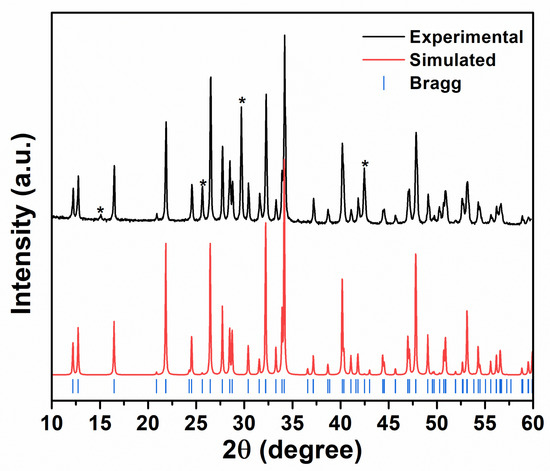
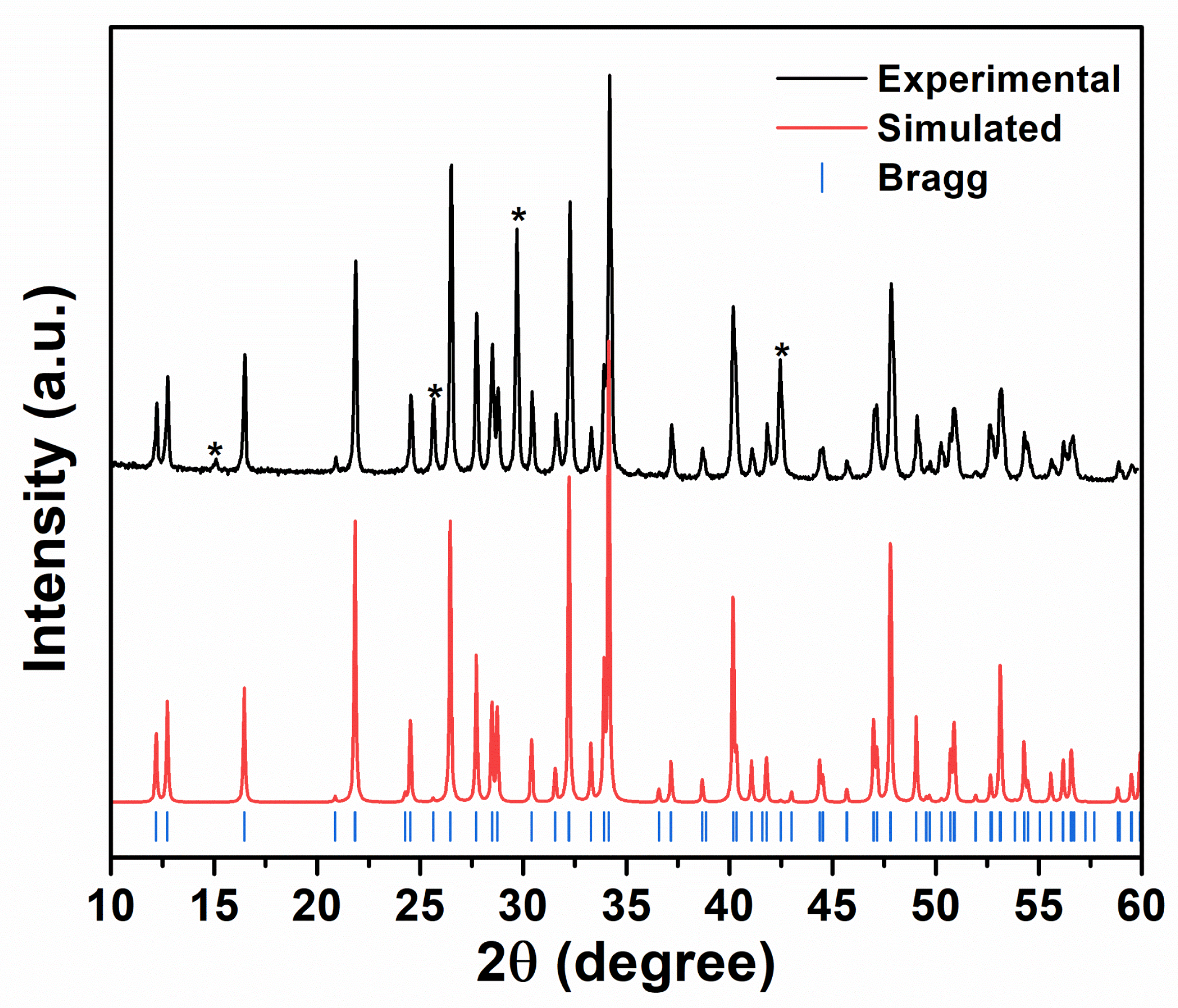
Initial attempts to synthesize the sulfur and strontium-containing analog of Ba9Hf3Sn2Se19 resulted in the successful synthesis of the new ternary phase α-SrHfS3. However, its synthesis could subsequently be attained in high purity from a stoichiometric reaction at high reaction temperatures, as shown in Figure 1 by comparison of the simulated versus experimental powder XRD plots. The synthesis of the polycrystalline α-SrHfS3 phase was always accompanied by a SrS impurity. A reaction temperature of 1173 K was found to yield the highest product purity after synthetic attempts over a range of reaction temperatures. By comparison, an alternate β-SrHfS3 polymorph is synthesized at a higher reaction temperature of 1373 K [20], possessing a structure type that is an orthorhombic distortion of the perovskite-type structure. Thus, the addition of an elemental Sn flux was necessary to grow single crystals of the α-SrHfS3 polymorph at the lower reaction temperature and to characterize its structure by single crystal XRD.
Figure 1.
Comparison of the experimental powder XRD of polycrystalline α-SrHfS3 versus the simulated pattern obtained from the single crystal refinement results. The blue line and the (*) symbol represent the Bragg positions and a SrS impurity phase [39].
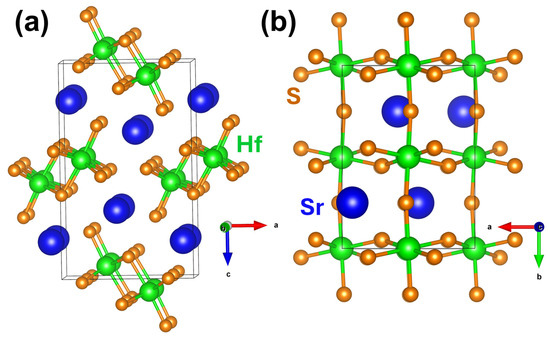
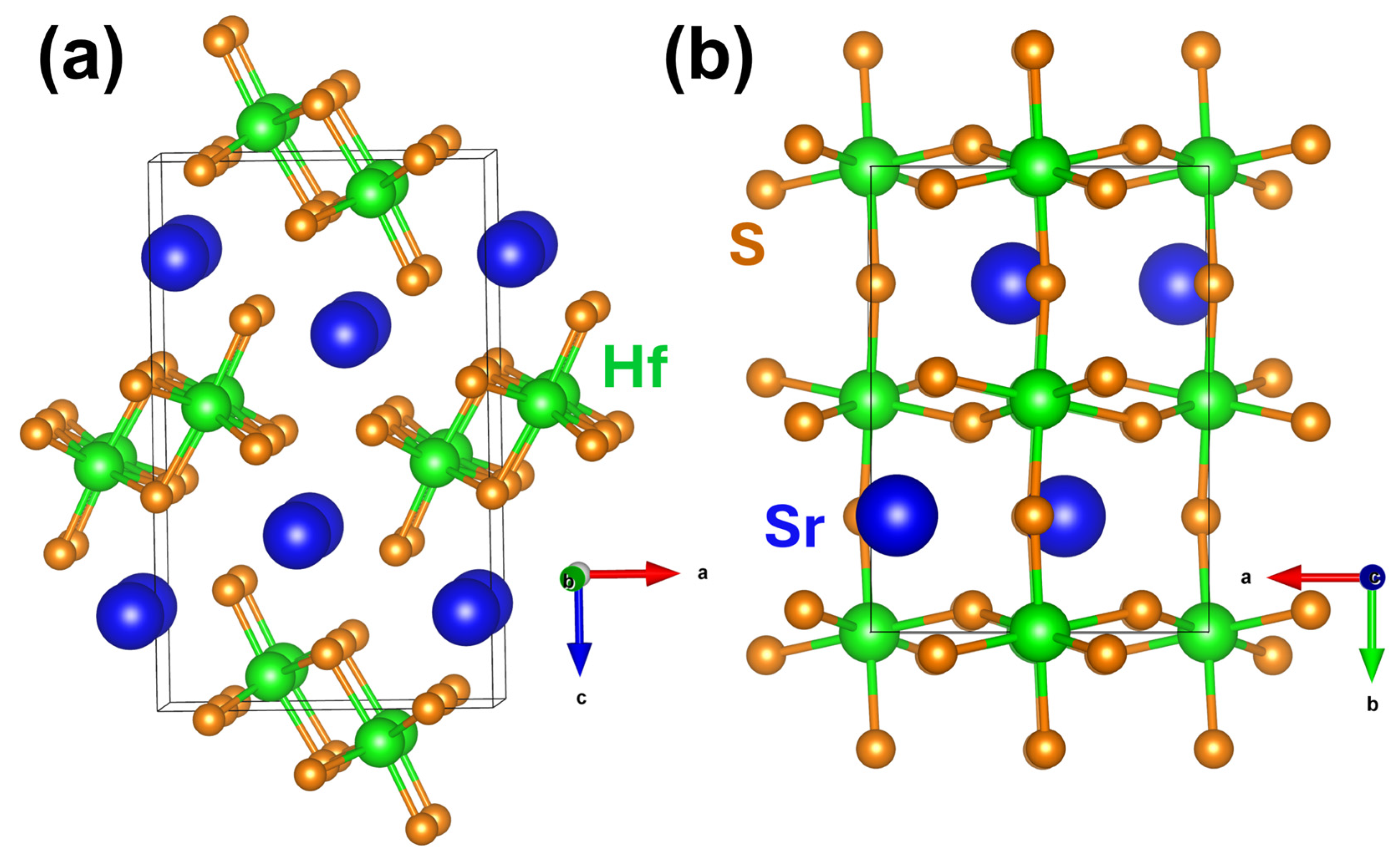
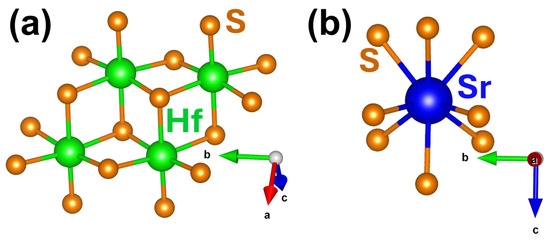
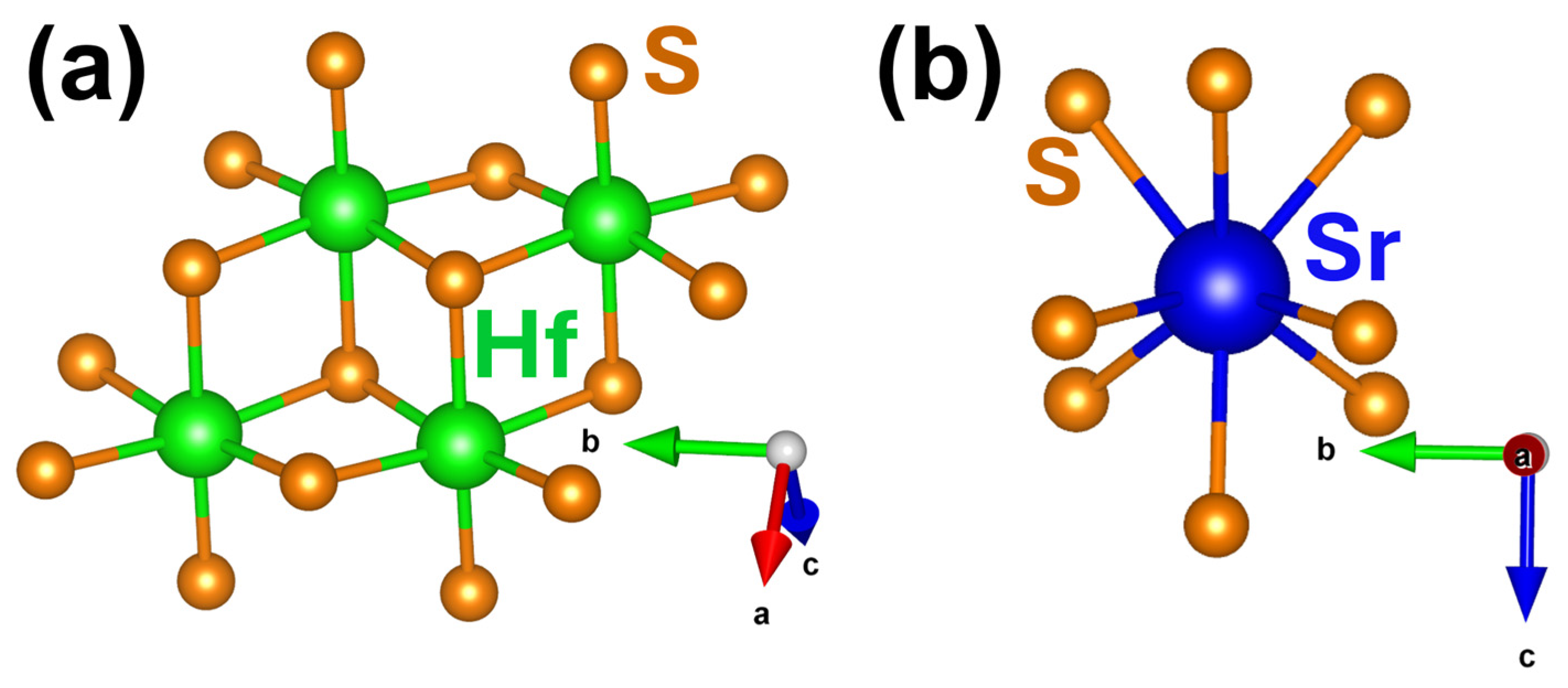
The yellow-colored crystals of α-SrHfS3 were characterized at room temperature by single crystal XRD to crystallize in the orthorhombic crystal system and space group Pnma (a = 8.5041(4) Å, b = 3.8004(2) Å, c = 13.8935(6) Å and V = 449.02(4) Å3). The structure consists of five independent crystallographic sites (one Sr, one Hf, and three S sites) with four formula units per unit cell (Z = 4). All atomic sites were refined as fully occupied, with the atomic coordinates, site symmetries, and Wyckoff position listed in Table 2. The crystal structure of the α-SrHfS3 compound is represented in Figure 2a. The structure extends along the b-axis, where the Hf atoms are connected to each other via edge sharing. Each Hf atom is connected to six S atoms and forms a distorted octahedra geometry in the crystal. These octahedra share two of the S atoms with each other along the a-axis, which further extends infinitely along the b-axis, forming HfS3]2− strips having two edge-sharing chains of octahedra, as shown in Figure 2a and Figure 3a. The extended view of the Sr coordination in the crystal structure is condensed into a three-dimensional net of SrS3]4−. Each Sr cation is connected to eight S anions, forming a distorted bicapped trigonal prismatic type geometry shown in Figure 3b. The Sr polyhedra extend along the a-axis via face sharing with the other Sr polyhedra. These polyhedra also extend along the c-axis via edge sharing, given in Figure S1 in the Supporting Information.
Figure 2.
Unit cell views of the α-SrHfS3 structure (a), and the previously reported β-SrHfS3 structure (b) [20].
Figure 3.
The coordination environment for (a) Hf atoms and (b) Sr atoms in the α-SrHfS3 structure.
The Hf-S distances in the α-SrHfS3 structure occur in the range of 2.426(1) Å to 2.607(1) Å. These distances are consistent with those in related metal chalcogenide compounds, such as Rb4Hf3S14 (2.426(2) Å to 2.683(2) Å) [40], Ba6Hf5S16 (2.470(2) Å to 2.530(2) Å) [41] and Rb2HfS4 (2.472(1) Å to 2.576(1) Å) [42]. The Sr-S interatomic distances fall in the range of 3.050(1) Å to 3.287(1) Å. These bond distances can be compared with previously reported compounds such as Sr2GeS4 (2.934(4) Å to 3.354(5) Å) [20], SrSc2S4 (2.980(7) Å to 3.154(9) Å) [43], and SrU2S5 (2.965(1) Å to 3.589(1) Å) [44]. Additionally, calculated bond valence sums, Table S3 in the Supporting Information, are consistent with a charge-balanced formula which can be written as (Sr+2) (Hf+4) (S−2)3.
The crystal structure of the α-SrHfS3 polymorph is markedly different than the previously reported β-SrHfS3 structure, illustrated in Figure 2b [20]. The earlier reported compound, β-SrHfS3, adopts the GdFeO3 structure type. This structure type is an orthorhombic distortion of the ideal cubic perovskite type, consisting of a 3D network of vertex-sharing HfS6 octahedra. By comparison, the α-SrHfS3 structure adopts the NH4CdCl3 structure type, consisting of chains of edge-shared HfS6 octahedra. Previous reviews covering a wider range of metal–chalcogenide semiconductors, specifically possessing perovskite-type compositions, have highlighted the structural factors that determine which of these two main structure types form in different chemical systems [45]. For example, the analogous Ba-containing BaHfS3 and BaZrS3 can be synthesized in only the GdFeO3 structure type. However, the Zr-version of the title compound, SrZrS3, can similarly be prepared in both the GdFeO3 and the NH4CdCl3 structure types [18,46]. The latter represents the higher temperature structure above 1253 K, similar to the temperature dependence of SrHfS3. It has been recently postulated that EuHfS3 and SrHfS3 could potentially form in the NH4CdCl3 structure type at lower reaction temperatures [45]. Thus, the present study is the first experimental validation of its formation at a reaction temperature of 1173 K.
3.2. Optical Properties
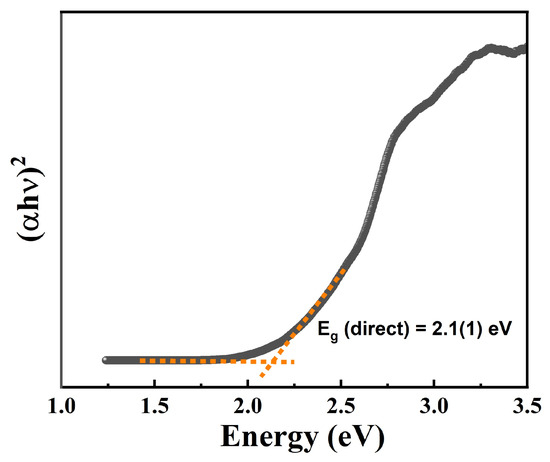
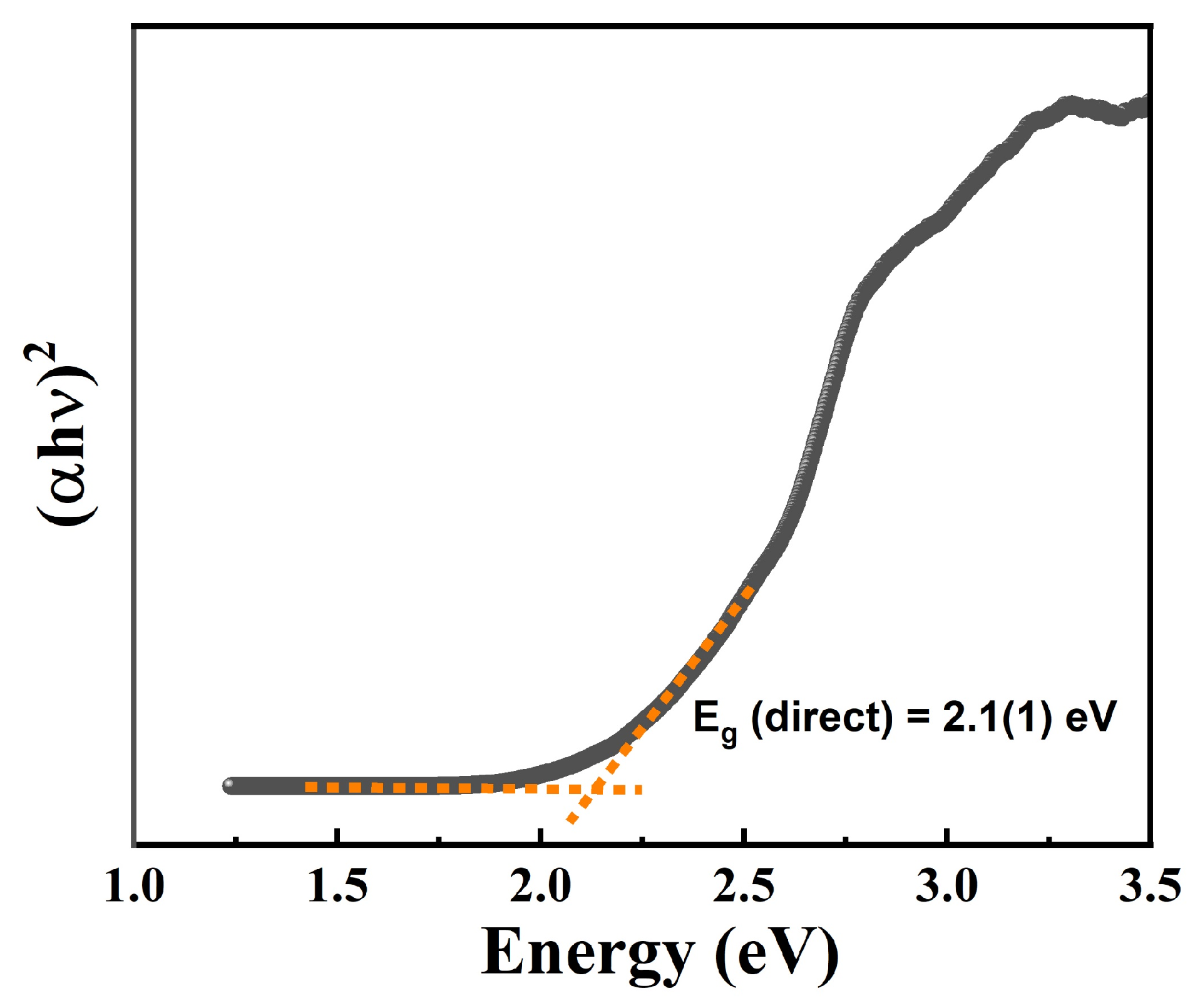
The metal chalcogenide perovskites have been the subject of intense recent research efforts because of their promising optoelectronic properties for applications involving solar energy conversion [45]. Their optical band gaps typically occur deep within the visible-light energies, with optical absorption coefficients rising to greater than 105 cm−1. UV-Vis diffuse reflectance spectroscopy measurements were collected on the yellow-colored crystals of the α-SrHfS3 polymorph within the wavelength range of 350 nm to 2400 nm. The optical bandgap was analyzed from a Tauc plot of the direct band transition, as depicted in Figure 4. The band transition was estimated from the onset of absorption, occurring at about 2.1(1) eV in the Tauc plot. This value is consistent with its semiconducting properties and yellow-colored crystals. By comparison, the previously reported band gaps (direct) for the related α-SrZrS3 and β-SrZrS3 polymorphs occur at about 1.5 and 2.1 eV, respectively [46]. Hence, the relatively smaller direct bandgap for the α-SrHfS3 polymorph is consistent with these results.
Figure 4.
Tauc plot of α-SrHfS3 polycrystalline sample. The black line represents the direct bandgap plot.
3.3. Electronic Structure Calculations
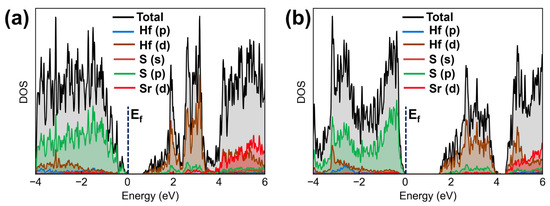
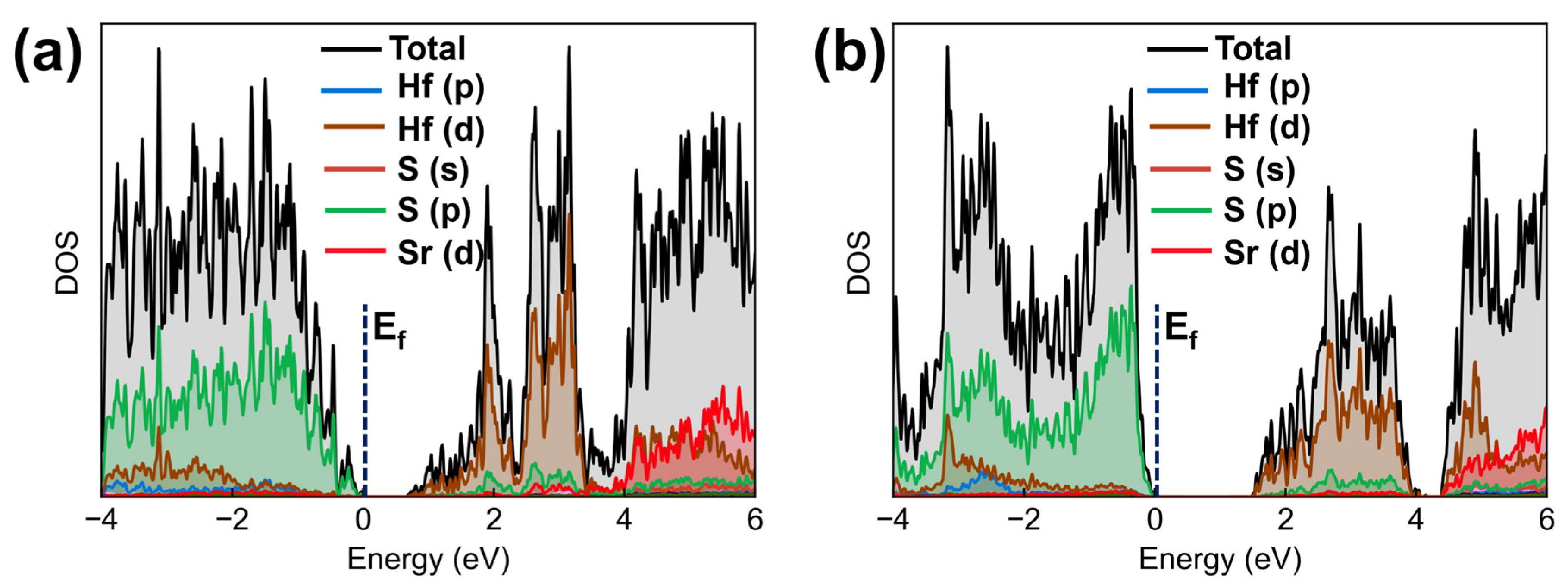
The electronic structures of both α-SrHfS3 and β-SrHfS3 were calculated using density functional theory methods to probe the structural origins and trends in their band gaps. After a full geometry relaxation, the total energy was calculated to be −33.0261 eV per formula for α-SrHfS3 and a relatively higher −33.0199 eV per formula for β-SrHfS3. The difference in total energies of about 6.2 meV per formula is negligible and consistent with the capability to synthesize either polymorph as a sensitive function of the reaction conditions, such as by varying temperature or using a Sn-flux reagent. Next, the density-of-states (DOS) and band structures were calculated and plotted, as shown in Figure 5. The partial DOS showing each of the atomic orbital contributions has been projected for Sr, Hf, and S, with the total DOS shown as the black line and the Fermi level (Ef), the vertical dashed line. Both DOS plots show a valence band (VB) and conduction band (CB) predominantly comprising S p-orbital (green line) and Hf d-orbital (brown line) states, respectively. On comparing their band gaps in Figure 5a,b, the band gap for the β-SrHfS3 polymorph is larger by about 0.8 eV. The band structures of α- and β-SrHfS3 are given in Figure S3 and Figure S4, respectively, in the Supporting Information. Band structure calculations demonstrate that both polymorphs have the closest energy separation of their VB and CB edges located at the Γ k-points, with direct band gaps of 0.70 eV for α-SrHfS3 and 1.50 eV for β-SrHfS3. Compared to the experimental value of 2.1(1) eV for α-SrHfS3, this underestimation of its bandgap by about 1.4 eV is the result of well-documented issues accompanying density functional theory calculations on solids. This trend in their band gaps is also consistent with other chalcogenide semiconductors, which exhibit both the α and β polymorphs. For example, the related SrZrS3 exhibits both polymorphs, with optical measurements finding that the β-SrZrS3 shows a larger bandgap by about 0.6 eV.
Figure 5.
Calculated electronic density-of-state plots for (a) α-SrHfS3 and (b) β-SrHfS3 crystal structures. The Fermi energy levels are located at 0 eV, which is shown by blue dashed line.
4. Conclusions
The α-type polymorph of the ternary sulfide SrHfS3 has been synthesized as a polycrystalline product from solid-state reactions at 1173 K, as well as in the form of yellow single crystals using an excess of elemental Sn as a flux. The compound is found to crystallize in the NH4CdCl3 structure type in the orthorhombic Pnma space group, consisting of doubled edge-shared chains of distorted octahedra. It is synthesizable at a relatively lower reaction temperature as compared to the previously reported β-SrHfS3 polymorph with the GdFeO3 distorted perovskite structure type. Optical diffuse-reflectance spectroscopy yielded a direct bandgap of 2.1(1) eV. Results of electronic structure calculations are consistent with a direct bandgap occurring at the Γ k-point. The conduction and valence band edges are found to comprise the empty Hf-based d-orbitals and the filled S-based p-orbital states predominantly, respectively. In summary, crystal growth of the α-type polymorph of SrHfS3 is demonstrated using a Sn flux, providing a synthetic pathway to perovskite-type compositions that receive increasing attention for their applications in solar energy conversion.
Supplementary Materials
The following supporting information can be downloaded at: https://www.mdpi.com/article/10.3390/solids7020020/s1, Figure S1: Unit cell view of α-SrHfS3 crystal structure, having only Sr polyhedra represented approximately along the b-axis; Figure S2 shows the EDS data of α-SrHfS3 crystals; Figure S3. Electronic band structure for α-SrHfS3; Figure S4. Electronic band structure for β-SrHfS3; Table S1. Atomic displacement parameters (Å2) for α-SrHfS3; Table S2. Geometric parameters (Å, º) for α-SrHfS3; Table S3. Calculated bond valence sums for the ions in α-SrHfS3.
Author Contributions
Formal analysis, investigation, visualization, and writing—all authors: K.A.J.R., S.J., S.Y. and P.A.M.; project administration and supervision—P.A.M. All authors have read and agreed to the published version of the manuscript.
Funding
The authors acknowledge primary support of this work from the National Science Foundation (DMR-2317605). This work used the High-Performance Research Computing FASTER cluster at Texas A&M University through allocation CHE240107 from the Advanced Cyberinfrastructure Coordination Ecosystem: Services & Support (ACCESS) program, which is supported by U.S. National Science Foundation grants #2138259, #2138286, #2138307, #2137603, and #2138296.
Data Availability Statement
The crystallographic information file (cif) of the α-SrHfS3 crystal structure is deposited to Cambridge Crystallographic Data Centre (CCDC) with the CCDC number of 2533120, and it can be accessed from https://www.ccdc.cam.ac.uk/ (accessed on 30 March 2026). Further details of crystal structure, geometric parameters, and electronic structure calculations are provided in the Supporting Information.
Acknowledgments
The authors acknowledge primary support of this work from the Department of Chemistry and Biochemistry at Baylor University.
Conflicts of Interest
The authors declare no conflicts of interest.
References
- Kanatzidis, M.G. Discovery-Synthesis, Design, and Prediction of Chalcogenide Phases. Inorg. Chem. 2017, 56, 3158–3173. [Google Scholar] [CrossRef] [Scilit]
- Pell, M.A.; Ibers, J.A. Layered Ternary and Quaternary Metal Chalcogenides. Chem. Ber. 1997, 130, 1–8. [Google Scholar] [CrossRef] [Scilit]
- Chung, I.; Kanatzidis, M.G. Metal Chalcogenides: A Rich Source of Nonlinear Optical Materials. Chem. Mater. 2014, 26, 849–869. [Google Scholar]
- Xiao, Y.; Xiong, C.; Chen, M.-M.; Wang, S.; Fu, L.; Zhang, X. Structure Modulation of Two-Dimensional Transition Metal Chalcogenides: Recent Advances in Methodology, Mechanism and Applications. Chem. Soc. Rev. 2023, 52, 1215–1272. [Google Scholar] [CrossRef] [Scilit]
- Matthews, P.D.; McNaughter, P.D.; Lewis, D.J.; O’Brien, P. Shining a Light on Transition Metal Chalcogenides for Sustainable Photovoltaics. Chem. Sci. 2017, 8, 4177–4187. [Google Scholar] [CrossRef] [Scilit]
- Wei, X.; Hui, H.; Perera, S.; Sheng, A.; Watson, D.F.; Sun, Y.-Y.; Jia, Q.; Zhang, S.; Zeng, H. Ti-Alloying of BaZrS3 Chalcogenide Perovskite for Photovoltaics. ACS Omega 2020, 5, 18579–18583. [Google Scholar] [CrossRef] [Scilit]
- Dabbousi, B.O.; Rodriguez-Viejo, J.; Mikulec, F.V.; Heine, J.R.; Mattoussi, H.; Ober, R.; Jensen, K.F.; Bawendi, M.G. (CdSe)ZnS Core−Shell Quantum Dots: Synthesis and Characterization of a Size Series of Highly Luminescent Nanocrystallites. J. Phys. Chem. B 1997, 101, 9463–9475. [Google Scholar]
- Zhang, Y.; Hong, G.; Zhang, Y.; Chen, G.; Li, F.; Dai, H.; Wang, Q. Ag2S Quantum Dot: A Bright and Biocompatible Fluorescent Nanoprobe in the Second Near-Infrared Window. ACS Nano 2012, 6, 3695–3702. [Google Scholar] [CrossRef] [Scilit] [PubMed]
- Ran, M.-Y.; Zhou, S.-H.; Wei, W.; Song, B.-J.; Shi, Y.-F.; Wu, X.-T.; Lin, H.; Zhu, Q.-L. Quaternary Chalcohalides CdSnSX2 (X = Cl or Br) with Neutral Layers: Syntheses, Structures, and Photocatalytic Properties. Inorg. Chem. 2021, 60, 3431–3438. [Google Scholar] [PubMed]
- Nie, L.; Zhang, Q. Recent Progress in Crystalline Metal Chalcogenides as Efficient Photocatalysts for Organic Pollutant Degradation. Inorg. Chem. Front. 2017, 4, 1953–1962. [Google Scholar] [CrossRef] [Scilit]
- Li, Y.-Y.; Wang, W.-J.; Wang, H.; Lin, H.; Wu, L.-M. Mixed-Anion Inorganic Compounds: A Favorable Candidate for Infrared Nonlinear Optical Materials. Cryst. Growth Des. 2019, 19, 4172–4192. [Google Scholar] [CrossRef] [Scilit]
- Steinmann, V.; Brandt, R.E.; Buonassisi, T. Non-Cubic Solar Cell Materials. Nat. Photon. 2015, 9, 355–357. [Google Scholar] [CrossRef] [Scilit]
- Kageshima, Y.; Kumagai, H.; Minegishi, T.; Kubota, J.; Domen, K. A Photoelectrochemical Solar Cell Consisting of a Cadmium Sulfide Photoanode and a Ruthenium–2,2′-Bipyridine Redox Shuttle in a Non-Aqueous Electrolyte. Angew. Chem. 2015, 127, 7988–7992. [Google Scholar] [CrossRef] [Scilit]
- Yu, Z.; Hui, H.; West, D.; Zhang, H.; Sun, Y.; Kong, S.; Zhang, Y.; Deng, C.; Yang, S.; Zhang, S.; et al. Chalcogenide Perovskite Thin Films with Controlled Phases for Optoelectronics. Adv. Funct. Mater. 2024, 34, 2309514. [Google Scholar] [CrossRef] [Scilit]
- Sahoo, D.; Naik, R. A Review on the Linear/Nonlinear Optical Properties of Se Doped Chalcogenide Thin Films as Potential Optoelectronic Applications. J. Non-Cryst. Solids 2022, 597, 121934. [Google Scholar] [CrossRef] [Scilit]
- Kanatzidis, M.G.; Huang, S.-P. Coordination Chemistry of Heavy Polychalcogenide Ligands. Coord. Chem. Rev. 1994, 130, 509–621. [Google Scholar] [CrossRef] [Scilit]
- Kageyama, H.; Hayashi, K.; Maeda, K.; Attfield, J.P.; Hiroi, Z.; Rondinelli, J.M.; Poeppelmeier, K.R. Expanding Frontiers in Materials Chemistry and Physics with Multiple Anions. Nat. Commun. 2018, 9, 772. [Google Scholar] [CrossRef] [Scilit]
- Lee, C.-S.; Kleinke, K.M.; Kleinke, H. Synthesis, Structure, and Electronic and Physical Properties of the Two SrZrS3 Modifications. Sol. State Sci. 2005, 7, 1049–1054. [Google Scholar] [CrossRef] [Scilit]
- Song, X.; Shai, X.; Deng, S.; Wang, J.; Li, J.; Ma, X.; Li, X.; Wei, T.; Ren, W.; Gao, L.; et al. Anisotropic Chalcogenide Perovskite CaZrS3: A Promising Thermoelectric Material. J. Phys. Chem. C 2022, 126, 11751–11760. [Google Scholar] [CrossRef] [Scilit]
- Lelieveld, R.; IJdo, D.J.W. Sulphides with the GdFeO3 Structure. Acta Cryst. B 1980, 36, 2223–2226. [Google Scholar] [CrossRef] [Scilit]
- Mar, A.; Ibers, J.A. Structure of Europium Zirconium Selenide, EuZrSe3. Acta Cryst. C 1992, 48, 771–773. [Google Scholar] [CrossRef] [Scilit]
- Jana, S.; O’Donnell, S.; Leahy, I.A.; Koldemir, A.; Pöttgen, R.; Smaha, R.W.; Maggard, P.A. Synthesis, Crystal Structure, and Physical Properties of the Eu(II)-Based Selenide Semiconductor: EuHfSe3. J. Mater. Chem. C 2024, 12, 11769–11777. [Google Scholar] [CrossRef] [Scilit]
- Su, L.; Li, T.; Zhu, Y. A vertical CsPbBr3/ZnO heterojunction for photo-sensing lights from UV to green band. Opt. Express 2022, 30, 23330–23340. [Google Scholar] [CrossRef] [Scilit] [PubMed]
- Su, L. Room temperature growth of CsPbBr3 single crystal for asymmetric MSM structure photodetector. J. Mater. Sci. Technol. 2024, 187, 113–122. [Google Scholar]
- Jana, S.; Gabilondo, E.; McGuigan, S.; Maggard, P.A. Syntheses, Crystal Structures, and Electronic Structures of Quaternary Group IV-Selenide Semiconductors. Inorg. Chem. 2024, 63, 6474–6482. [Google Scholar] [CrossRef] [Scilit] [PubMed]
- APEX, Version 4; Program for Data Collection on Area Detectors; Bruker AXS Inc.: Madison, WI, USA, 2016.
- Sheldrick, G.M. SADABS; Department of Structural Chemistry, University of Göttingen: Göttingen, Germany, 2008. [Google Scholar]
- Sheldrick, G.M. A Short History of SHELX. Acta Cryst. A 2008, 64, 112–122. [Google Scholar]
- Sheldrick, G.M. XPREP, Version 2008/2; Bruker AXS Inc.: Madison, WI, USA, 2018.
- Sheldrick, G.M. Crystal Structure Refinement with SHELXL. Acta Cryst. C 2015, 71, 3–8. [Google Scholar] [CrossRef] [Scilit]
- Spek, A.L. Single-Crystal Structure Validation with the Program PLATON. J. Appl. Cryst. 2003, 36, 7–13. [Google Scholar] [CrossRef] [Scilit]
- Gelato, L.M.; Parthé, E. STRUCTURE TIDY—A Computer Program to Standardize Crystal Structure Data. J. Appl. Cryst. 1987, 20, 139–143. [Google Scholar] [CrossRef] [Scilit]
- Kortüm, G. Reflectance Spectroscopy: Principles, Methods, Applications; Springer Science & Business Media: Berlin/Heidelberg, Germany, 2012. [Google Scholar]
- Makuła, P.; Pacia, M.; Macyk, W. How To Correctly Determine the Band Gap Energy of Modified Semiconductor Photocatalysts Based on UV–Vis Spectra. J. Phys. Chem. Lett. 2018, 9, 6814–6817. [Google Scholar] [CrossRef] [Scilit]
- Kresse, G.; Furthmüller, J. Efficiency of Ab-Initio Total Energy Calculations for Metals and Semiconductors Using a Plane-Wave Basis Set. Comput. Mater. Sci. 1996, 6, 15–50. [Google Scholar] [CrossRef] [Scilit]
- Kresse, G.; Furthmüller, J. Efficient Iterative Schemes for Ab Initio Total-Energy Calculations Using a Plane-Wave Basis Set. Phys. Rev. B 1996, 54, 11169–11186. [Google Scholar] [CrossRef] [Scilit] [PubMed]
- Perdew, J.P.; Burke, K.; Ernzerhof, M. Generalized Gradient Approximation Made Simple. Phys. Rev. Lett. 1996, 77, 3865–3868. [Google Scholar] [CrossRef] [Scilit]
- Hinuma, Y.; Pizzi, G.; Kumagai, Y.; Oba, F.; Tanaka, I. Band Structure Diagram Paths Based on Crystallography. Comput. Mater. Sci. 2017, 128, 140–184. [Google Scholar] [CrossRef] [Scilit]
- Primak, W.; Kaufman, H.; Ward, R. X-Ray Diffraction Studies of Systems Involved in the Preparation of Alkaline Earth Sulfide and Selenide Phosphors. J. Am. Chem. Soc. 1948, 70, 2043–2046. [Google Scholar] [CrossRef] [Scilit]
- Huang, F.Q.; Ibers, J.A. Syntheses and Structures of the Infinite Chain Compounds Cs4Ti3Se13, Rb4Ti3S14, Cs4Ti3S14, Rb4Hf3S14, Rb4Zr3Se14, Cs4Zr3Se14, and Cs4Hf3Se14. Inorg. Chem. 2001, 40, 2346–2351. [Google Scholar] [CrossRef] [Scilit] [PubMed]
- Chen, B.H.; Eichhorn, B.W.; Fanwick, P.E. Synthesis and Structure of Barium Hafnium Sulfides, Ba6Hf5S16 and Ba5Hf4S13: The n = 5 and 4 Members of the An+1BnX3n+1 Ruddlesden-Popper Phases. Inorg. Chem. 1992, 31, 1788–1791. [Google Scholar] [CrossRef] [Scilit]
- Rumpf, C.; Bensch, W. Synthesis and Crystal Structure of New Ternary Chalcogenides of Group IV Metals: K2ZrS4, Rb2ZrS4, and Rb2HfS4. Z. Naturforsch. B 2000, 55, 695–698. [Google Scholar] [CrossRef] [Scilit]
- IJdo, D.J.W. Some Ternary Scandium Sulphides. Structure Refinement by Powder Neutron Diffraction. Acta Cryst. B 1982, 38, 1549–1551. [Google Scholar] [CrossRef] [Scilit]
- Prakash, J.; Tarasenko, M.S.; Mesbah, A.; Lebègue, S.; Malliakas, C.D.; Ibers, J.A. Syntheses, Crystal Structures, Transport Properties, and Theoretical Studies of Five Members of the MAn2Q5 Family: SrU2S5, BaU2Se5, PbU2S5, BaTh2S5, and BaU2Te5. Inorg. Chem. 2014, 53, 11626–11632. [Google Scholar] [CrossRef] [Scilit]
- Sopiha, K.; Comparotto, C.; Marquez, J.A.; Scragg, J.J.S. Chalcogenide Perovskites: Tantalizing Prospects, Challenging Materials. Adv. Opt. Mater. 2022, 10, 2101704. [Google Scholar]
- Niu, S.; Huyan, H.; Liu, Y.; Yeung, M.; Ye, K.; Blankemeier, L.; Orvis, T.; Sarkar, D.; Singh, D.J.; Kapadia, R.; et al. Bandgap Control via Structural and Chemical Tuning of Transition Metal Perovskite Chalcogenides. Adv. Mater. 2017, 29, 1604733. [Google Scholar] [CrossRef] [Scilit] [PubMed]

Disclaimer/Publisher’s Note: The statements, opinions and data contained in all publications are solely those of the individual author(s) and contributor(s) and not of MDPI and/or the editor(s). MDPI and/or the editor(s) disclaim responsibility for any injury to people or property resulting from any ideas, methods, instructions or products referred to in the content. |
© 2026 by the authors. Licensee MDPI, Basel, Switzerland. This article is an open access article distributed under the terms and conditions of the Creative Commons Attribution (CC BY) license.