Article

Mesoporosity, Mechanical Properties, and Statistical–Physics Modeling of PVA/MMT/MXene Nanocomposite Membranes for Pb2+ and Methylene Blue Adsorption


by
Mohamed Bejaoui
1,2,†,
Mahdi Meftah
3 and
Walid Oueslati
1,3,*,†
1
LR19ES20: Ressources, Materials and Ecosystem (RME), Faculty of Sciences of Bizerte, University of Carthage, Bizerte 7021, Tunisia
2
Physics Department, Gafsa Preparatory Institute for Engineering Studies, University of Gafsa, Rue El Khayzorane, Zaroug, Gafsa 2112, Tunisia
3
Physics Department, Faculty of Sciences of Bizerte, University of Carthage, Bizerte 7021, Tunisia
*
Author to whom correspondence should be addressed.
These authors contributed equally to this work.
Solids 2026, 7(2), 16; https://doi.org/10.3390/solids7020016
Submission received: 10 February 2026 / Revised: 4 March 2026 / Accepted: 5 March 2026 / Published: 9 March 2026
(This article belongs to the Topic Remediation Materials for Environmental Purity)

Abstract

Poly(vinyl alcohol) (PVA)/montmorillonite (MMT)/Ti3C2Tx (MXene) nanocomposite membranes (PVA/MMT/MXene) were developed and evaluated in terms of their mechanical properties, mesoporosity, and adsorption performance toward Pb2+ ions and methylene blue (MB). The incorporation of MMT and MXene resulted in a strong synergistic reinforcement, increasing the ultimate tensile strength from 10 to 20 MPa, the Young’s modulus from 14.7 to 29.5 MPa, and reducing the swelling ratio from 2.0 to 1.1 g·g−1. BJH porosimetry revealed a refined and interconnected mesoporous structure, with the cumulative pore volume increasing from 0.134 to 0.448 cm3·g−1. In adsorption experiments (mono-solute systems, 25 °C), the ternary membrane achieved high uptake capacities of 55 mg·g−1 for Pb2+ and 80 mg·g−1 for MB, outperforming binary PVA/MMT and neat PVA. Statistical–physics modeling provided microscopic descriptors consistent with the experimental isotherms: Pb2+ adsorption follows a monolayer regime (n ≈ 1), whereas MB exhibits multilayer behavior (n > 1) with a higher site density (Nm ≈ 1.6 mmol·g−1). These results demonstrate that the hybrid 2D–2D architecture of MMT and MXene significantly enhances the structural robustness, pore accessibility, and adsorption efficiency of PVA-based membranes, highlighting their potential for efficient removal of metal ions and dyes from aqueous media.

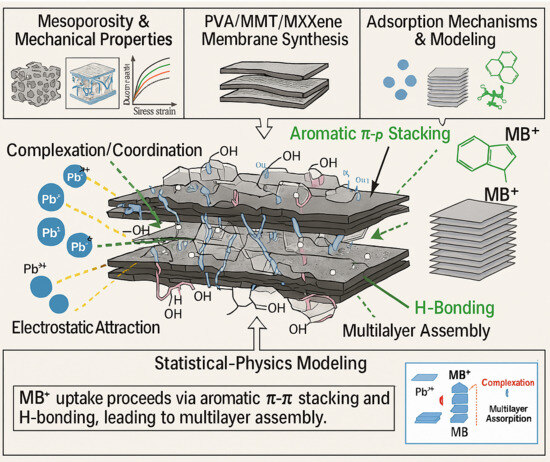
Graphical Abstract

1. Introduction

Developing robust, multifunctional adsorptive membranes is crucial for modern water treatment strategies, particularly in the context of increasing industrial discharges, emerging contaminants, and the need for low-cost, scalable purification technologies. PVA is one of the most widely investigated polymers in this context due to its excellent film-forming ability, hydrophilicity, biocompatibility, and chemical stability [1,2,3,4,5]. However, pristine PVA membranes exhibit intrinsic limitations, including limited mechanical strength, excessive swelling in aqueous media, and a relatively low density of active adsorption sites. These characteristics are relevant for laboratory-scale water purification contexts, while future studies will evaluate the membranes under real wastewater conditions [1,2,3,4,5]. To overcome these shortcomings, the incorporation of inorganic nanofillers into polymer matrices has proven to be an effective strategy. MMT, a layered aluminosilicate clay, has been widely used as a reinforcing filler due to its high aspect ratio, interlayer cation exchange capacity, and strong surface interactions with hydrophilic polymers [5,6,7,8,9,10,11,12,13,14,15,16]. When well dispersed or exfoliated, MMT platelets significantly enhance tensile strength, stiffness, and thermal stability while contributing additional adsorption sites for ionic pollutants, improving both mechanical durability and adsorptive performance of PVA-based membranes [9,10,11,12,13,14]. In parallel, MXenes—a rapidly expanding family of two-dimensional transition metal carbides and nitrides—have emerged as high-performance nanomaterials for environmental remediation. Among them, Ti3C2Tx MXene exhibits exceptional hydrophilicity, high surface area, tunable surface terminations (–O, –OH, –F), and strong affinity toward heavy metal ions and cationic dyes [17,18,19,20,21,22]. Although Ti3C2Tx MXene is prone to surface oxidation in aqueous media, its stability can be maintained through acidic dispersion, low oxygen storage, and short-term utilization [23,24,25]; these practices were followed here to ensure that MXene nanosheets retained their surface terminations and adsorption activity during membrane preparation and testing.
Although numerous studies have explored binary composites such as PVA/MMT or PVA/MXene, the synergistic combination of both nanofillers within the same PVA matrix remains underexplored [26,27]. The simultaneous presence of lamellar MMT platelets and high-surface-area MXene nanosheets is expected to: (i) enhance mechanical reinforcement through a hybrid 2D–2D nanofiller network, (ii) refine the pore architecture of the membranes, (iii) improve dimensional stability (swelling, compaction–reswelling), and (iv) create a high density of heterogeneous adsorption sites for both metal ions and organic dyes. Despite the growing literature on polymer–clay and polymer–MXene composites, several key scientific gaps remain unaddressed. Most existing studies investigate PVA/MMT or PVA/MXene systems independently, without examining how a dual 2D nanofiller network influences mechanical reinforcement, dimensional stability, and porosity at the mesoscale. Furthermore, although both MMT and MXene individually provide active sites for metal ions and dyes, their potential synergistic behavior within a unified PVA matrix—particularly regarding site density, interaction energies, and multilayer adsorption phenomena—has not been quantitatively established. Finally, the correlation between textural evolution (BJH mesoporosity), mechanical behavior, and adsorption performance in ternary PVA/MMT/MXene membranes has not been systematically investigated.
While conventional adsorption models (Langmuir, Freundlich, BET) provide macroscopic fits, they fail to deliver molecular-level parameters such as receptor site density (Nm), number of molecules per site (n), adsorption energies (ε), and orientation probabilities. Statistical physics modeling, increasingly applied in recent adsorption studies [28,29,30,31], offers a powerful theoretical framework to describe adsorbent–adsorbate interactions and distinguish between monolayer and multilayer adsorption mechanisms—particularly relevant when analyzing systems such as Pb2+ ions and MB dye, which exhibit different interaction energies, steric configurations, and adsorption behaviors [31,32,33,34].
In this work, PVA/MMT/MXene nanocomposite membranes are developed and characterized to provide, for the first time, a quantitative and microscopic investigation of structure–property–performance relationships in ternary hybrid membranes. Mechanical characterization includes tensile testing, swelling behavior, and compaction–reswelling resistance. Adsorption experiments are performed separately for Pb2+ ions and MB dye in mono-solute systems, and the resulting isotherms are analyzed using a statistical physics formalism to extract microscopic adsorption parameters associated with monolayer versus multilayer mechanisms. BJH mesoporosity analysis is further used to correlate pore structure, cumulative pore volume, and adsorption performance [35,36,37,38,39,40,41,42,43]. Overall, this work demonstrates the potential of PVA/MMT/MXene membranes as robust, hydrophilic, and multifunctional adsorbents for heavy metal and dye removal from water.
The objective of this work is to establish the structure–property–performance relationships of PVA/MMT/MXene hybrid membranes through a combined structural, mechanical, textural, and adsorption evaluation. Specifically, the study aims to: (i) quantify the mechanical reinforcement resulting from the dual 2D-filler network; (ii) assess the dimensional stability and mesoporosity of the membranes; (iii) determine Pb2+ and MB adsorption capacities under mono-solute conditions; and (iv) extract microscopic adsorption descriptors—such as site density, number of molecules per site, and adsorption energy—using statistical–physics modeling to distinguish monolayer from multilayer mechanisms. These objectives provide a coherent framework for understanding how the synergistic assembly of MMT and MXene governs the overall performance of the membrane.

2. Materials and Methods

2.1. Materials

2.1.1. Starting Materials

PVA (Mw 89,000–98,000 g·mol−1, 99+% hydrolyzed) was obtained from Sigma-Aldrich (Darmstadt, Germany). Sodium montmorillonite (Na-MMT, SWy-2) was also supplied by Sigma-Aldrich. The MXene precursor Ti3AlC2 (MAX phase), lithium fluoride (LiF), and hydrochloric acid (HCl, 9 M) were purchased from Thermo Scientific (Kandel, Germany). Lead nitrate (Pb(NO3)2) and MB were obtained in analytical grade purity and used without further purification. All solutions were prepared with deionized water.

2.1.2. Synthesis of MXene

MXene nanosheets were synthesized by selective etching of Ti3AlC2 using the in situ HF method based on LiF/HCl. Briefly, 1.0 g of LiF was slowly dissolved in 20 mL of 9 M HCl under stirring, producing HF in situ. Then, 1.0 g of Ti3AlC2 was gradually added to the etching mixture and kept at 35 °C for 24 h. The LiF/HCl route generates HF in situ; all steps were conducted in a fume hood using HF-compatible protective equipment (face shield, neoprene gloves, sourced from Fisher Scientific, Pittsburgh, PA, USA). Waste solutions containing fluoride species were neutralized and disposed following institutional safety protocols. After etching, the multilayered MXene was washed repeatedly by centrifugation (3500 rpm) until the supernatant reached pH ≈ 6. The resulting slurry was dispersed in deionized water and sonicated for 1 h to delaminate the nanosheets. A final low-speed centrifugation (500 rpm, 10 min) removed unexfoliated particles; the supernatant—containing few MXene nanosheets—was stored at 4 °C [44].

2.1.3. MXene Quality Control

MXene quality was verified, respectively, via XRD: appearance of the (002) peak shift confirming Al removal; FTIR: surface terminations (–OH/–O/–F); and visual stability: the dispersion was kept oxygen-minimized and used within 48 h to limit oxidation.

2.1.4. Synthesis of PVA/MMT/MXene Nanocomposite Membranes

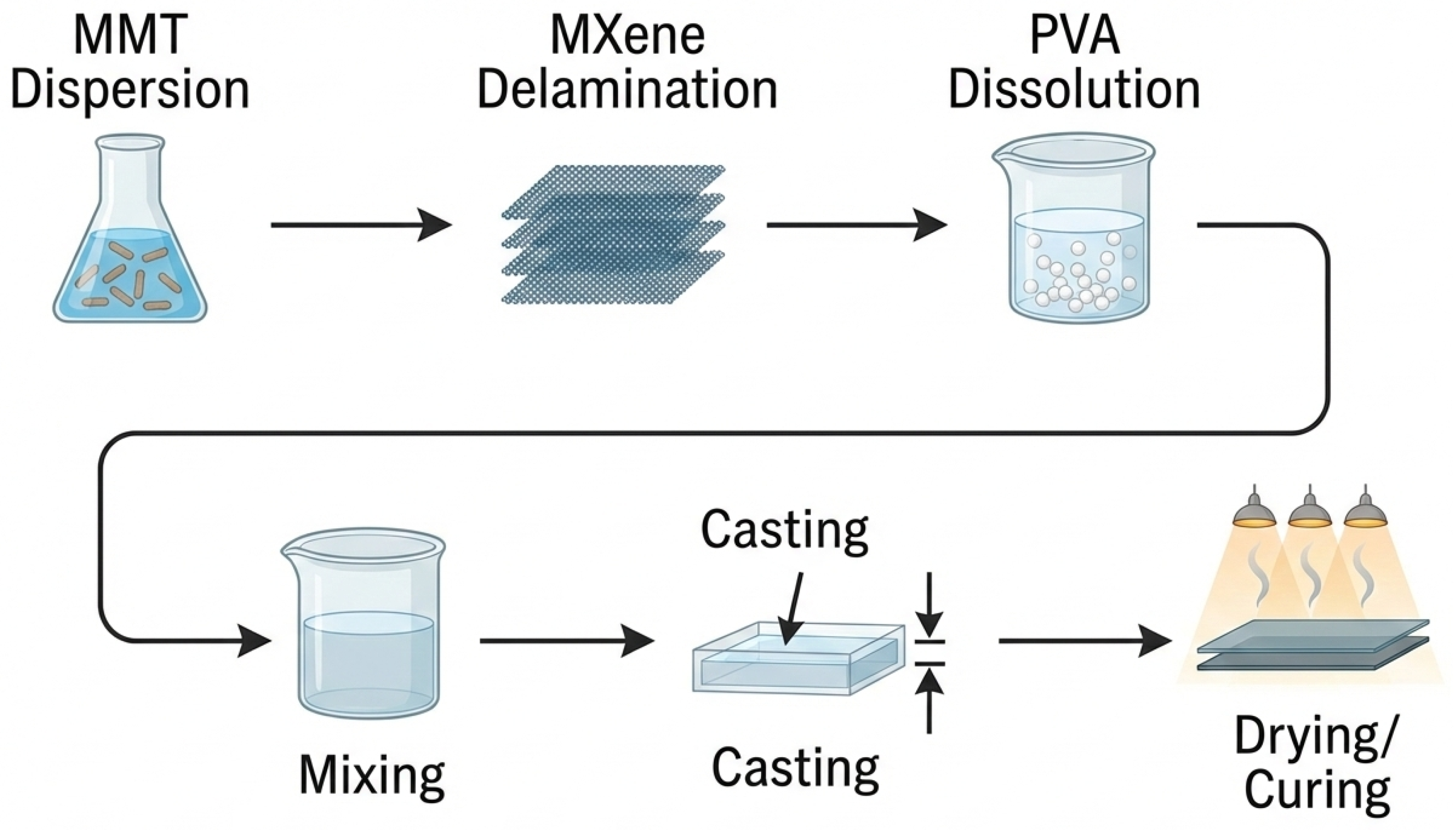
Membranes were assembled using the solution-casting method. A 10% (w/v) PVA solution was obtained by dissolving PVA at 90 °C under magnetic stirring for 2 h. MMT and MXene aqueous suspensions were prepared separately and sonicated for 30 min to promote dispersion. The nanofillers were incorporated into the PVA solution at preselected mass fractions (0.5%, 1%, 2% relative to PVA), followed by 2 h of stirring. The resulting mixture was degassed under vacuum and cast onto 10 × 10 cm glass plates. Films were dried at room temperature for 48 h and thermally cured at 80 °C for 2 h. Dried membranes were peeled off and stored in a desiccator until use.
A schematic illustration of the preparation procedure of the PVA/MMT/MXene composite membranes is presented in Figure 1 to clarify the overall workflow of MMT dispersion, MXene delamination, PVA dissolution, mixing, casting, and drying/curing.

2.2. Structural Analysis

XRD analysis was performed using the Bruker D8 Advance diffractometer (Faculty of Sciences of Bizerte-Tunisia). The instrument is configured in Bragg–Brentano geometry, equipped with Cu Kα radiation (λ = 1.5406 Å), and operated at 40 kV and 40 mA. The setup includes a LynxEye position-sensitive detector and allows for high-resolution measurements in the 2θ range of 5° to 40°, with a step size of 0.02° and a scan rate of 2° min−1. This configuration enables detailed investigation into the crystallinity of PVA, the intercalation/exfoliation state of MMT, and the structural integration of MXene nanosheets within the polymer matrix.
Fourier-transform infrared spectroscopy (FTIR) was conducted using a Thermo Scientific Nicolet iS5 FTIR spectrometer (Thermo Fisher Scientific, Waltham, MA, USA), operating in attenuated total reflectance (ATR) mode. Spectra were recorded over the 4000–500 cm−1 wavenumber range with a resolution of 4 cm−1 and 32 scans per sample. All spectral data were baseline-corrected and normalized to ensure valid comparison across neat PVA, PVA/MMT, and PVA/MMT/MXene membranes.

2.3. Mechanical Characterization

2.3.1. Tensile Testing (ASTM D882 Standard [45])

Mechanical testing was carried out on an Instron 5944 universal testing machine (Model 5944, Instron, Norwood, MA, USA) with a 100 N load cell. Rectangular specimens (50 mm × 10 mm, thickness ~0.10 mm) were conditioned at 25 °C and 50% RH for 24 h before testing. Tensile tests were performed at 5 mm·min−1. Ultimate tensile strength (UTS), Young’s modulus (E), and elongation at break (εb) were extracted from stress–strain curves. All tensile tests were performed in triplicate (n = 3), and the resulting stress–strain curves and mechanical parameters are reported as mean ± standard deviation. Stress (σ) is defined as the force (F) applied per unit cross-sectional area (A) of the material. It is typically expressed in Pascals (Pa) or megapascals (MPa) [45].
σ = F A 0
where σ is the engineering stress (Pa or MPa); F is the applied tensile force (N); A0 is the original cross-sectional area of the sample (m2 or mm2). Strain (ε) is a measure of the deformation of the material, defined as the change in length (ΔL) divided by the original length (L0). It is a dimensionless quantity.
ε = Δ L L 0 = L L 0 L 0
where ε is the engineering strain (dimensionless); ΔL is the change in length (m or mm); L0 is the original length of the sample (m or mm); L is the instantaneous length (m or mm).
The Young’s Modulus (E), also known as the elastic modulus, is a measure of the stiffness of an elastic material. It is defined as the ratio of stress to strain in the elastic region of the stress–strain curve. The UTS is the maximum stress that a material can withstand while being stretched or pulled before breaking. The Elongation at Break is the strain at which the material fractures.

2.3.2. Swelling Behavior Analysis

The swelling behavior of the membranes was studied by immersing pre-cut and weighed samples (Wd) in distilled water at room temperature. At predefined time intervals, samples were removed, gently wiped with filter paper to remove excess surface water, and weighed (Ws). The swelling ratio (SR) was calculated using the following equation:
S R ( % ) = ( W s W d ) W d × 100
where SR is the swelling ratio (in percentage); Ws is the weight of the swollen membrane (g); Wd is the weight of the dry membrane (g)
Measurements were continued until the sample weight reached a plateau, indicating swelling equilibrium.

2.3.3. Compaction and Reswelling Tests

Compaction tests were performed to evaluate the compressibility of the membranes under different pressures. Membrane samples were placed in a compaction cell and subjected to increasing pressures (from 0 to 500 kPa) using an odometer testing device (Model WF 24251, Wykeham Farrance, Controls Group, Liscate, MI, Italy). The cell diameter is 50 mm. The comparator race extends 12 mm with an accuracy of 2 microns. A predetermined piston pressure can be applied to the studied sample causing fluid expulsion through the filter until the system reaches equilibrium. The Linear Voltage Displacement Transducer (LVDT) measures the displacement of the piston and records the change in the system volume during the test.
The Void Ratio (e) is a fundamental parameter in soil mechanics and material science, defined as the ratio of the volume of voids (Vv) to the volume of solids (Vs) in the membrane. It is a dimensionless quantity that characterizes the porosity and packing density of the material.
e = V v V s
Compaction curves (void ratio vs. pressure) were plotted for each membrane type.
Reswelling behavior was studied after the compaction tests. Once the maximum pressure was reached, the load was gradually removed, and the volume change of the samples was monitored. The percentage of reswelling was calculated to evaluate the ability of the membranes to recover their initial structure after compression. Reswelling Percentage (RP) can be calculated as the ratio of the recovered volume (or height) to the initial volume (or height) after compression, expressed as a percentage. Alternatively, it can be related to the void ratio before and after reswelling.
R P ( % ) = ( H r e s w e l l e d H c o m p a c t e d ) H i n i t i a l × 100
where RP is the reswelling percentage; Hreswelled is the height of the membrane after reswelling (mm); Hcompacted is the height of the membrane after compaction (mm); Hinitial is the initial height of the membrane before compaction (mm)
This equation quantifies the extent to which the membrane recovers its original dimensions and porosity after being subjected to compressive stress. A higher reswelling percentage indicates better elastic recovery and structural integrity, which is important for the long-term performance and reusability of membranes in applications where they undergo cyclic compression and decompression.

2.4. Adsorption Experiments

2.4.1. Preparation of Pollutant Solutions

Stock solutions of Pb2+ (e.g., from lead nitrate, Pb(NO3)2) and MB were prepared in distilled water. Working solutions of different concentrations were obtained by diluting the stock solutions. The pH of the solutions was adjusted to an optimal value (pH 5 for Pb2+ and pH 7 for MB) to maximize adsorption and minimize precipitation. All adsorption experiments were conducted at 25 ± 1 °C using an orbital shaker operated at 200 rpm to ensure homogeneous mixing. A fixed membrane dosage of 10 mg was added to 20 mL of pollutant solution for each batch test. The initial concentrations of Pb2+ and MB were varied between 10 and 200 mg L−1. The pH of the solutions was adjusted to 5 for Pb2+ and 7 for MB using dilute HNO3 or NaOH. Based on preliminary kinetic screening, an equilibrium time of 24 h was applied for all adsorption measurements, ensuring complete stabilization of the residual concentration before analysis.
Prior to the isotherm measurements, a preliminary kinetic study was carried out to determine the contact time required to reach adsorption equilibrium. For both Pb2+ and MB, the residual concentration was monitored over time, and no significant change was observed beyond 24 h. Therefore, an equilibrium time of 24 h was selected and applied consistently in all adsorption isotherm experiments.

2.4.2. Batch Adsorption Tests

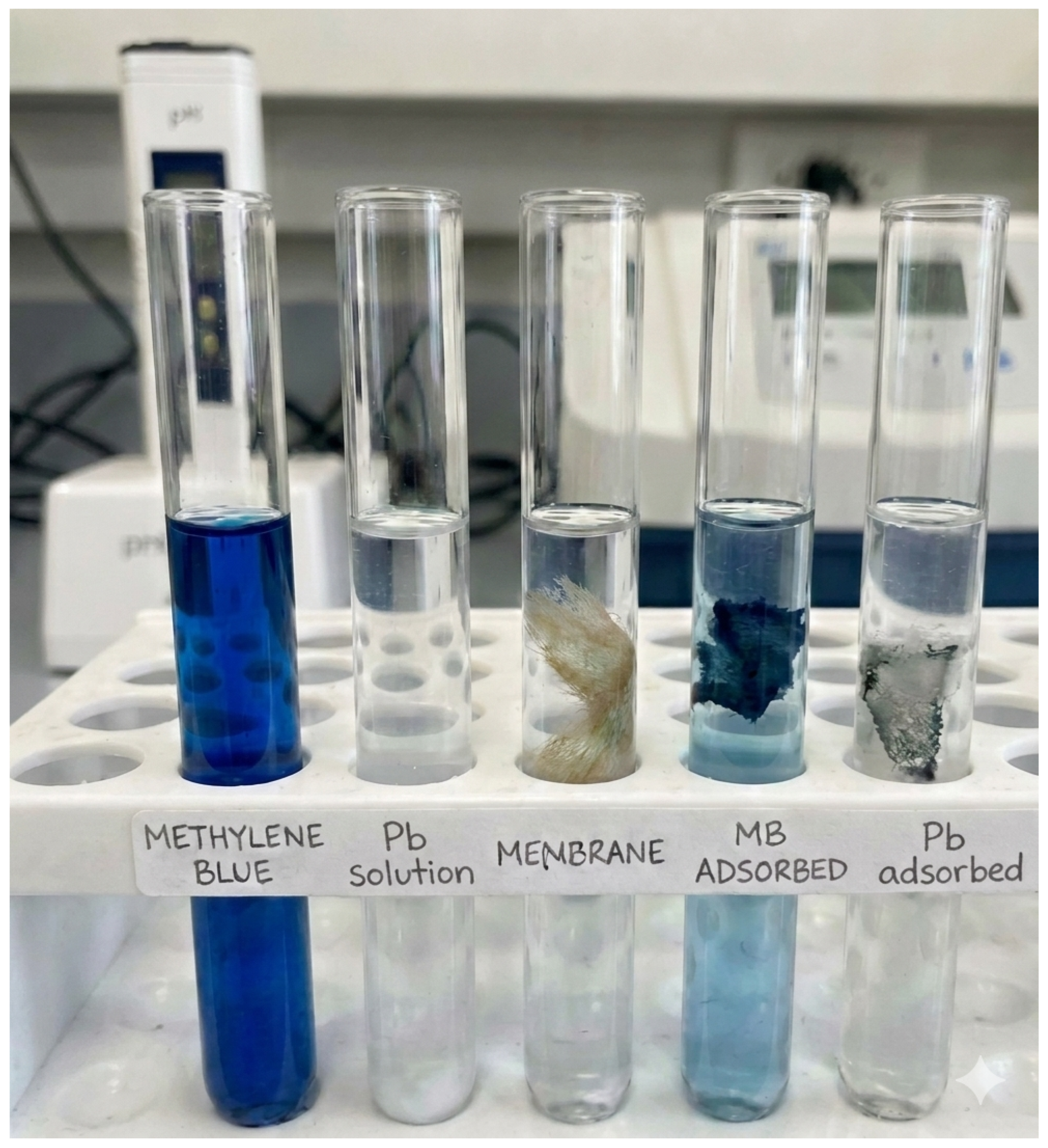
Adsorption experiments were conducted in batch mode. As previously stated, a fixed dosage of 10 mg of membrane was added to 20 mL of pollutant solution with a known initial concentration (C0). The mixtures were stirred at room temperature (e.g., 25 °C) for 24 h to reach adsorption equilibrium. After equilibrium, samples were filtered, and the final pollutant concentration in the supernatant (Ce) was determined. Optical photographs of the membrane/solution systems were acquired under uniform ambient illumination against a white background to document the qualitative color change after adsorption tests.
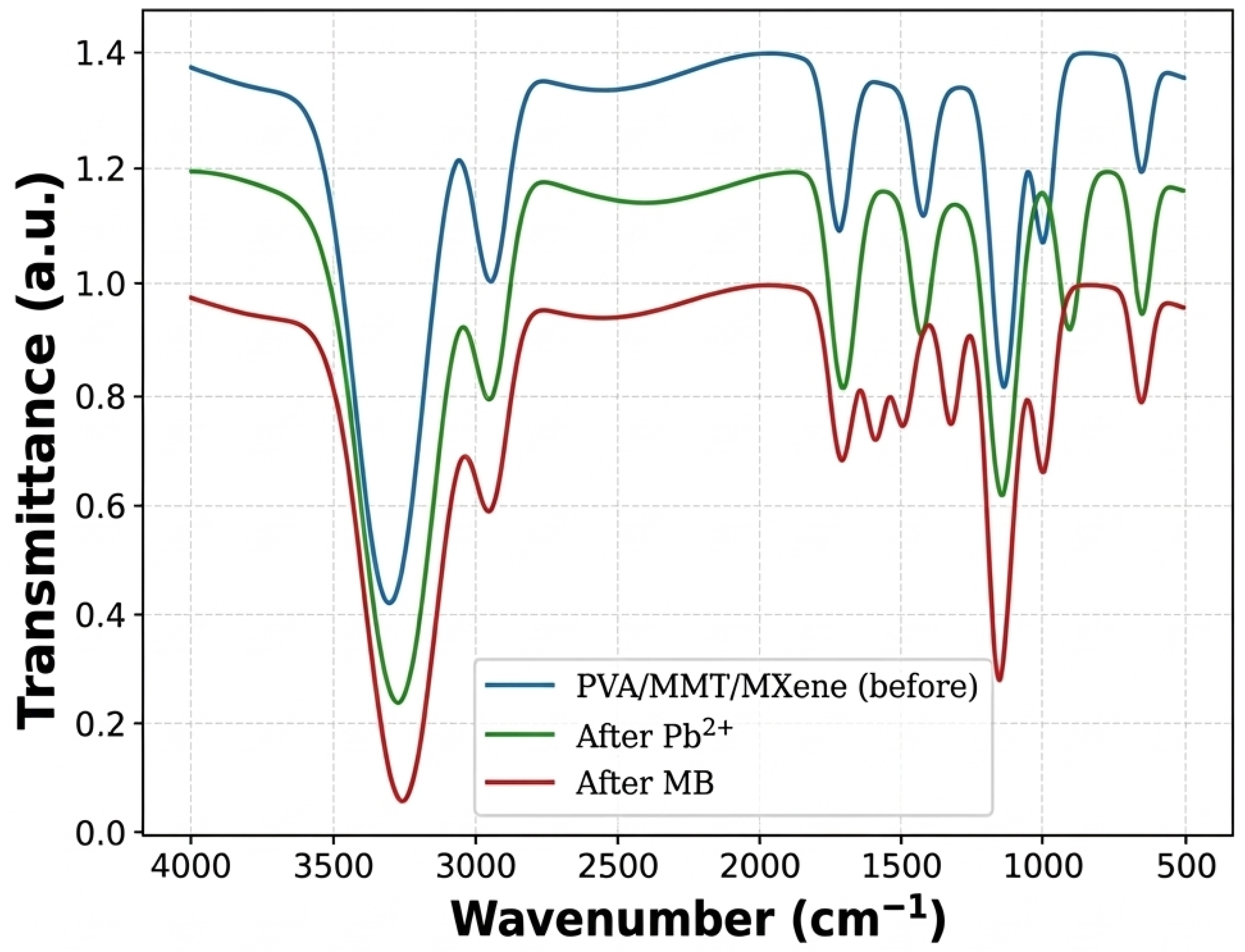
Pb2+ concentration was measured using an atomic absorption spectrophotometer (PinAAcle 900F, PerkinElmer, Shelton, CT, USA). MB concentration was measured using a UV–Vis spectrophotometer (UV-1800, Shimadzu Corporation, Kyoto, Japan) at a maximum wavelength of 664 nm. FTIR spectra were acquired on dried membranes (before adsorption and after exposure to Pb2+/MB), then baseline-corrected and plotted in transmittance with vertical offsets for clarity. The equilibrium adsorption capacity (qe, mg/g) was calculated using the following equation:
q e = ( C 0 C e )   V m
where qe (mg·g−1) is the equilibrium adsorption capacity, C0 and Ce (mg·L−1) are the initial and equilibrium concentrations, V (L) is the volume of the solution, and m (g) is the mass of the membrane.
Equation (6) follows the classical batch adsorption expression used in membrane adsorption studies [36]. All adsorption experiments were performed in triplicate. Calibration curves for AAS and UV–Vis were linear (R2 > 0.995). Data reported as mean ± standard deviation.

2.5. Statistical Physics Modeling

Adsorption isotherm data was analyzed using advanced statistical physics models. This approach allows for the determination of key microscopic parameters such as receptor site density (Nm), number of molecules per site (n), adsorption energies (ε), and molecular orientation probabilities. The models used include the single-layer model, the double-layer model, and the multilayer model, depending on the observed adsorption behavior. Fitting experimental data to the models was performed using non-linear regression methods, minimizing the mean square error. The specific equations of the models and the fitting algorithms are described in detail in the literature [28,29,30,31,32].

2.5.1. Background of Statistical Physics Models

Statistical physics models provide a microscopic interpretation of adsorption phenomena by considering the interactions between adsorbate molecules and the adsorbent surface, as well as interactions between adsorbed molecules themselves. These models are derived from statistical mechanics principles, specifically using the Grand Canonical Ensemble, to relate macroscopic adsorption quantities to microscopic parameters. The Grand Canonical Ensemble (μVT) is particularly well-suited for adsorption processes where the number of adsorbed molecules can fluctuate as they exchange with the surrounding fluid phase. This ensemble describes a system with fixed chemical potential (μ), fixed volume (V), and fixed temperature (T). Most statistical physics models for adsorption isotherms are derived within the grand canonical ensemble, as it naturally accounts for the equilibrium between the adsorbed phase and the bulk fluid phase [46,47]. Each ensemble is associated with a partition function, which is a fundamental quantity in statistical mechanics that encapsulates the statistical properties of a system in thermodynamic equilibrium. The partition function allows for the calculation of all thermodynamic properties of the system. For a system in the Grand Canonical Ensemble, the grand partition function (Ξ) is given by:
Ξ = N = 0 i e β ( E N , i μ N )
where N is the number of particles, i sums over all possible states for a given N, EN,i is the energy of the i-th state with N particles, μ is the chemical potential, β = 1/(kB T), where kB is the Boltzmann constant and T is the absolute temperature. From the grand partition function, the average number of adsorbed particles (〈N〉) can be derived using the relation:
N = k B T ln Ξ μ V , T
For adsorption, the chemical potential (μ) of the adsorbate in the adsorbed phase is in equilibrium with the chemical potential of the adsorbate in the bulk fluid phase. For dilute solutions, the chemical potential is related to the equilibrium concentration (Ce) by:
μ = μ 0 + k B T ln ( C e )
where μ0 is the standard chemical potential. This relationship allows us to express the adsorbed quantity as a function of Ce.
The general expression for the adsorbed quantity (Qa) or equilibrium adsorption capacity (qe) per unit mass of adsorbent, derived from the grand canonical partition function, typically takes the form:
Q a = N m θ
where Nm is the receptor site density (maximum adsorption capacity) and θ is the fractional coverage of the adsorption sites. The expression for θ is derived from the grand partition function and depends on the specific model (single-layer, multilayer, etc.) and the interactions considered. It generally involves the equilibrium concentration (Ce) and parameters related to adsorption energies and molecular interactions.

2.5.2. Key Parameters and Their Interpretation

Receptor Site Density (Nm): This parameter represents the maximum number of molecules that can be adsorbed per unit mass of the adsorbent. It is expressed in units such as mg/g or mmol/g. A higher Nm indicates a greater capacity of the material to adsorb the pollutant.
Number of Molecules per Site (n): This dimensionless parameter describes the average number of adsorbate molecules fixed per receptor site. If n ≈ 1, it suggests a monolayer adsorption where each site binds approximately one molecule. If n > 1, it indicates a multilayer adsorption mechanism or the formation of aggregates on the surface. If n < 1, it might suggest that a single molecule occupies multiple sites or that some sites are not fully utilized.
Adsorption Energy (ε): This parameter quantifies the strength of the interaction between the adsorbate molecule and the adsorbent surface. It is typically expressed in kJ/mol. Higher values of ε correspond to stronger interactions, indicating chemisorption, while lower values suggest physisorption. The distribution of ε can also reveal the heterogeneity of adsorption sites.
Molecular Orientation Probability: This parameter, often denoted as Pparallel or Pperpendicular, describes the preferred orientation of adsorbate molecules on the surface. For planar molecules, a high Pparallel indicates that molecules tend to lie flat on the surface, which can facilitate stacking in multilayer adsorption.

2.5.3. Model Equations

These models are derived from the grand canonical partition function by making specific assumptions about the adsorption sites and interactions:
Single-Layer Model
This model assumes that adsorption occurs on a homogeneous surface, with each site binding only one molecule, and no interaction between adsorbed molecules [48]. The fractional coverage (θ) is given by:
θ = C e C e + K D
where KD is a dissociation constant related to the adsorption energy. Thus, the adsorbed quantity (Qa) is:
Q a = N m C e C e + K D
This is equivalent to the Langmuir isotherm, where KL = KD.
Model parameters (Nm, n, ε) were estimated through non-linear regression, and their stability was verified by sensitivity analysis. Variations remained within acceptable ranges (<10–15%), confirming the robustness of the fitted microscopic parameters.
Double-Layer Model
This model extends the single-layer concept by allowing for the formation of a second layer of adsorbate molecules, often with different adsorption energies for the first and second layers [49]. The expression for Qa becomes:
Q a = N m 1 1 + ( C e / K 1 ) n 1 + 1 1 + ( C e / K 2 ) n 2
(Note: This is a simplified representation. Actual double-layer models derived from statistical physics are more rigorously formulated, considering the partition functions for each layer and interactions between them.)
Multilayer Model
Multilayer models account for the formation of multiple layers of adsorbate molecules on the surface. These models are particularly useful when adsorption capacities significantly exceed the monolayer capacity, suggesting stacking or condensation of molecules [50]. A common form, derived from statistical physics, is related to the BET equation:
Q a = N m C e C B E T ( C s C e ) ( 1 + ( C B E T 1 ) C e C s )
where CBET is a constant related to the adsorption energy of the first layer and Cs is the saturation concentration. More advanced statistical physics multilayer models incorporate parameters for lateral interactions between adsorbed molecules and different adsorption energies for subsequent layers, leading to more complex but accurate expressions.
Fitting and Analysis
The experimental adsorption isotherm data (Qa vs. Ce) are fitted to these statistical physics models using non-linear regression methods. The objective is to minimize the mean square error between the experimental data and the model predictions, thereby obtaining the values for the microscopic parameters (Nm, n, ε, etc.) [51]. The choice of the most appropriate model (single-layer, double-layer, or multilayer) is determined by the best fit to the experimental data and the physical interpretation of the derived parameters. This rigorous approach provides a deeper understanding of the adsorption mechanisms at a molecular level, beyond what traditional empirical isotherm models can offer.

2.6. Pore Structure Characterization (BJH Method)

Porosity and pore size distribution of the membranes were characterized by the Barrett–Joyner–Halenda (BJH) method applied to nitrogen adsorption–desorption data at 77 K. Measurements were performed using a surface area and porosity analyzer (ASAP 2020, Micromeritics Instrument Corporation, Norcross, GA, USA).
Samples were degassed under vacuum at 100 °C for 6 h prior to analysis to remove impurities and moisture. Pore size distribution and cumulative pore volume were calculated from the desorption branch of the nitrogen adsorption–desorption isotherm, using the modified Kelvin equation. This analysis provides crucial information about the pore structure, which is directly related to the adsorption capacity of the materials [35,52,53,54]. It should be noted that the BJH method may underestimate pore volume in flexible polymer matrices due to partial pore collapse during degassing or due to the limitations of the Kelvin equation in the mesoporous region. Nevertheless, the comparative trends between membranes remain reliable and consistent with mechanical and adsorption observations.

3. Results and Discussion

To provide a coherent, structural and physicochemical characterizations (XRD, FTIR, and mechanical properties) are first presented together at the beginning of this section. The BJH porosity analysis is discussed later, after the adsorption study and statistical–physics modeling, because its interpretation is directly connected to the microscopic descriptors derived from the modeling framework.

3.1. Structural Characterization

3.1.1. XRD Analysis

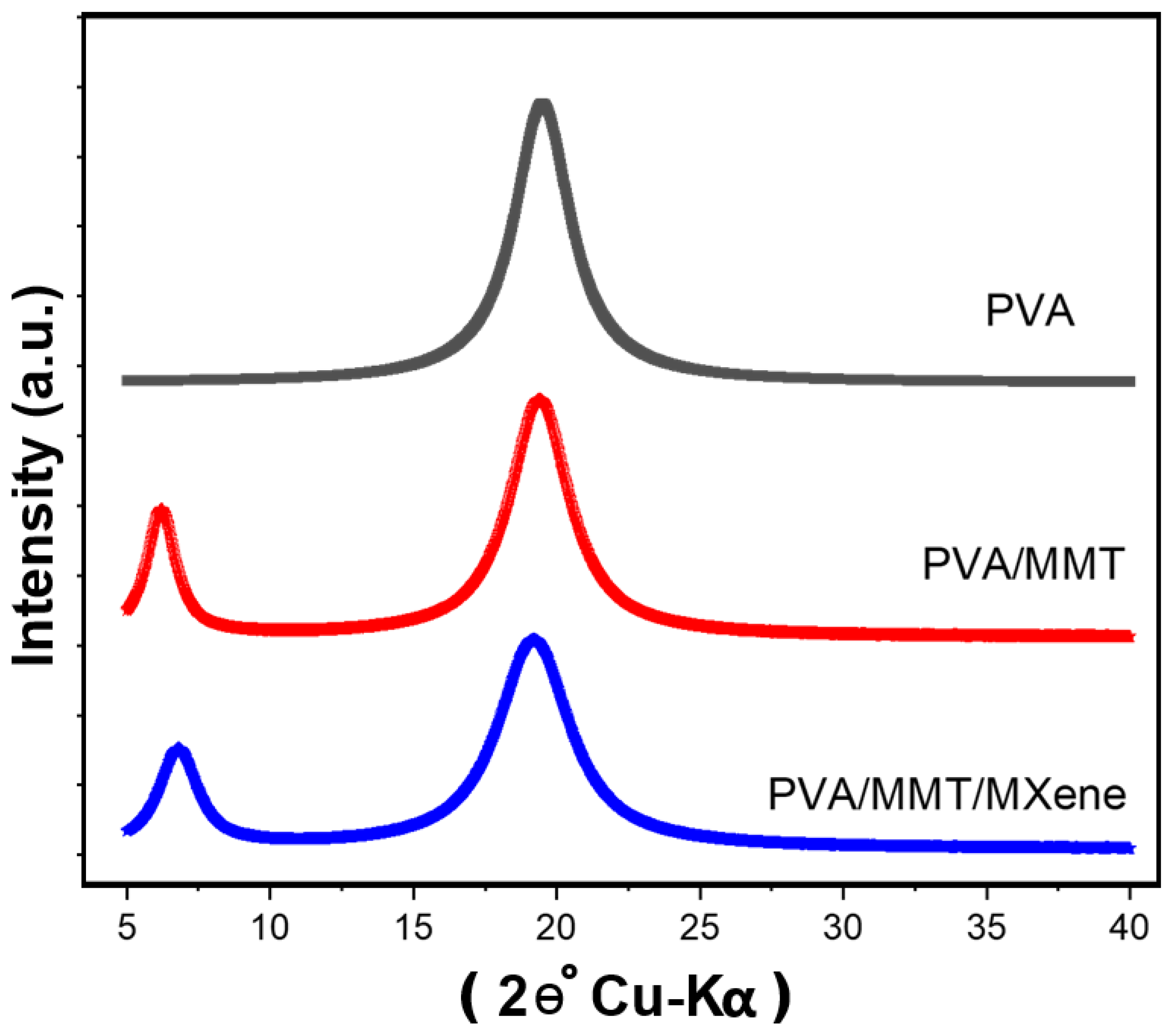
The XRD patterns of neat PVA, PVA/MMT, and PVA/MMT/MXene membranes provide clear evidence of the structural modifications induced by MMT and MXene incorporation (Figure 2). Neat PVA exhibits its characteristic semi-crystalline halo centered at 2θ ≈ 19.5°, which corresponds to the (101) crystalline plane and reflects partial ordering of PVA chains. This broad diffraction feature is typical of PVA and confirms the coexistence of amorphous and crystalline domains. Upon the addition of MMT, a basal reflection appears at 2θ ≈ 6.2°, associated with the (001) plane of Na-MMT. This reflection indicates intercalation of PVA chains within the clay galleries and a partial increase in interlayer spacing. At the same time, the PVA halo decreases in intensity and becomes slightly broader, suggesting that the presence of MMT platelets disturbs PVA chain packing and reduces its crystallinity. Such behavior is consistent with polymer–clay nanocomposites where lamellar fillers constrain polymer mobility [55,56,57,58].
In the ternary PVA/MMT/MXene membrane, the MMT (001) reflection becomes significantly weakened, indicating partial exfoliation or strong structural reorganization of the clay layers within the hybrid matrix. Simultaneously, a new broadened feature emerges near 2θ ≈ 6.8°, which can be attributed to the (002) stacking of MXene nanosheets, confirming their successful incorporation. The PVA halo at 19.5° undergoes further broadening and a slight shift, revealing an additional reduction in PVA crystallinity due to stronger polymer–nanofiller interactions.
Overall, the XRD results demonstrate that MMT and MXene do not act as isolated fillers but rather contribute synergistically to a modified structural arrangement. The attenuation of the MMT (001) peak, emergence of the MXene stacking feature, and progressive broadening of the PVA diffraction halo collectively indicate the formation of a hybrid, interconnected 2D filler network, which is consistent with improvements observed in mechanical reinforcement and mesoporosity.

3.1.2. FTIR Spectroscopy

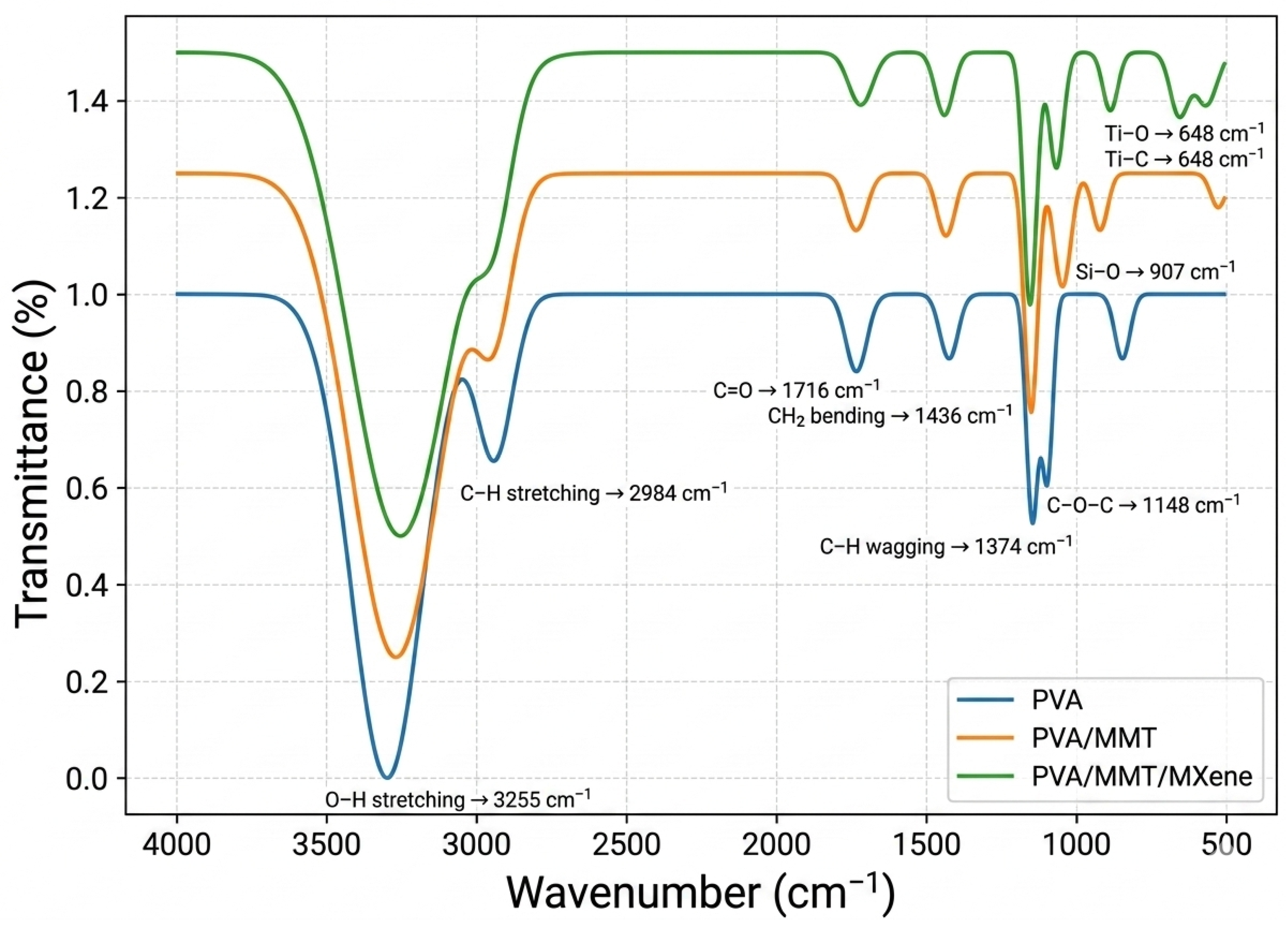
FTIR spectra of neat PVA, PVA/MMT, and PVA/MMT/MXene membranes (Figure 3) further confirm the chemical interactions and structural reorganizations induced by the nanofillers. Neat PVA exhibits its characteristic broad O–H stretching band around 3300 cm−1, reflecting extensive intra- and intermolecular hydrogen bonding. The C–H stretching bands near 2940 cm−1 and the C–O–C/C–O vibrations at 1141–1090 cm−1 are also visible and consistent with the typical PVA spectrum (Table 1).
Upon incorporation of MMT, the O–H stretching band shifts to ~3270 cm−1 and broadens, indicating stronger hydrogen bonding interactions between PVA hydroxyl groups and surface hydroxyls of the clay platelets. Additional intensity in the 1000–1200 cm−1 region reflects enhanced C–O and Si–O interactions. The presence of the Si–O–Al band near 915 cm−1 confirms the structural contribution of MMT to the composite.
In the ternary PVA/MMT/MXene membrane, the O–H band undergoes a further shift to ~3255 cm−1, accompanied by increased broadening. This indicates intensified hydrogen bonding and stronger interfacial interactions among PVA, MMT, and MXene. New absorption bands appearing in the 560–650 cm−1 region correspond to Ti–O and Ti–OH vibrations, providing direct spectral evidence of MXene incorporation. The enhanced complexity and redistribution of spectral features highlight the formation of a more interconnected hydrogen-bonded network involving polymer chains, silicate layers, and MXene nanosheets.
Together, the FTIR and XRD results confirm successful integration of both MMT and MXene, establish the presence of strong polymer–filler interactions, and support the formation of a structurally reorganized nanocomposite matrix. This hybrid interfacial network contributes directly to the enhanced mechanical strength, reduced swelling, and improved adsorption performance observed in subsequent sections.

3.2. Mechanical Properties

Mechanical characterization was performed to evaluate the effect of MMT and MXene incorporation on the tensile behavior, swelling stability, compressibility, and structural resilience of PVA-based membranes. The combined effects of the two lamellar nanofillers are expected to modify the load transfer efficiency within the polymer matrix and impact the hydration-induced dimensional changes.

3.2.1. Stress–Strain Behavior

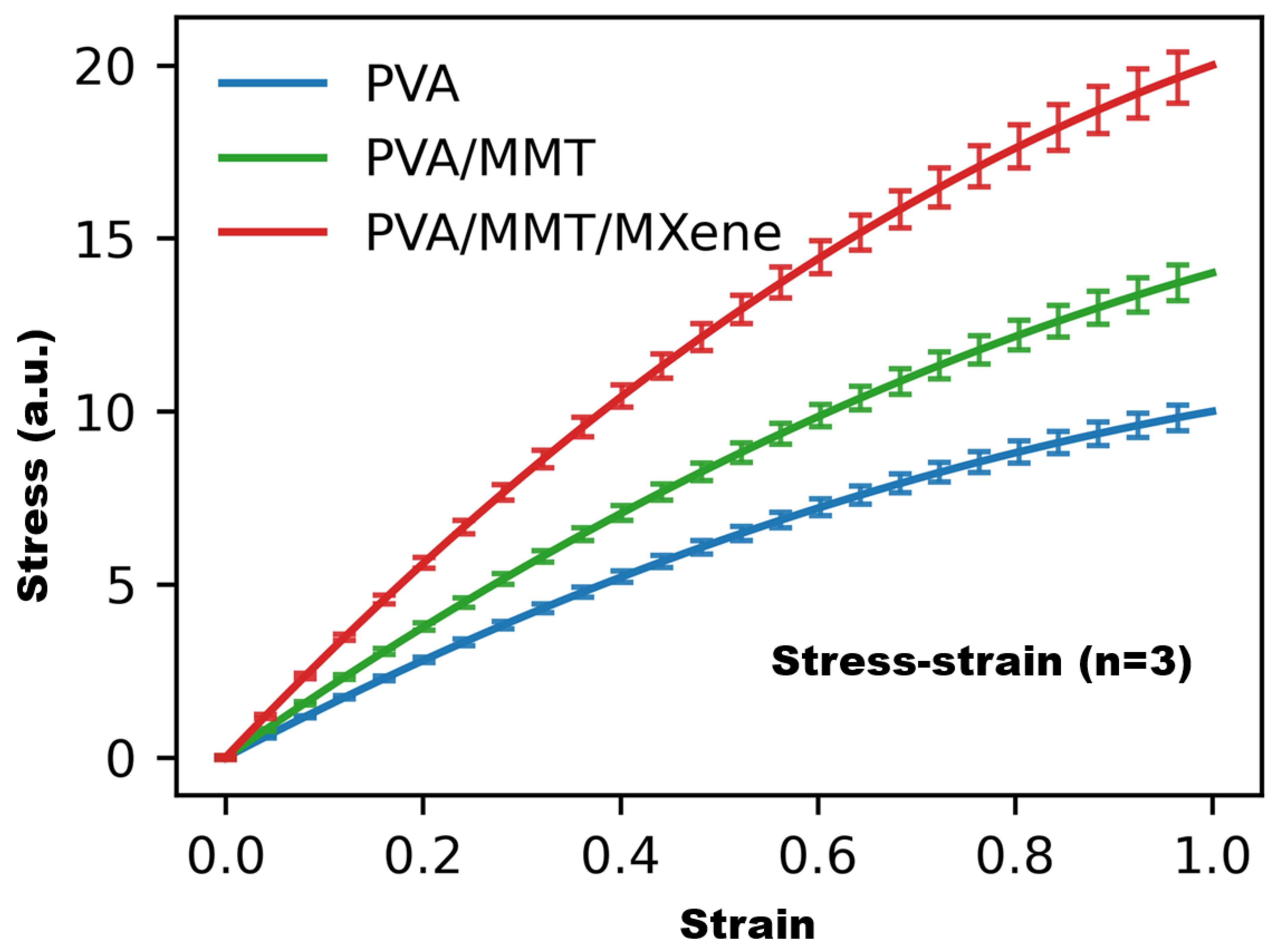
Figure 4 presents the stress–strain response of neat PVA, PVA/MMT, and PVA/MMT/MXene membranes. The neat PVA membrane exhibits the lowest mechanical performance, characterized by moderate stiffness and tensile strength, consistent with the well-known ductile nature of PVA. Its maximum stress approaches ~10 MPa at a strain of 1.0, reflecting limited intermolecular interactions and the absence of rigid fillers.
The incorporation of MMT (PVA/MMT) results in a noticeable increase in stiffness and tensile strength. The curve shows a steeper slope and achieves ~14 MPa at ε ≈ 1.0, confirming that the layered silicate platelets act as mechanical reinforcements that restrict polymer chain mobility and enhance stress transfer. These observations are consistent with previously reported improvements in PVA/MMT nanocomposites due to polymer–clay interactions and intercalated morphologies (Table 2) [59,60,61,68].
When MXene is additionally introduced into the PVA/MMT network, the mechanical properties undergo a further enhancement. The PVA/MMT/MXene membrane exhibits the steepest stress–strain slope and the highest ultimate stress (~20 MPa at ε = 1.0), demonstrating a clear synergistic reinforcement effect. MXene nanosheets, with their high aspect ratio and surface functional groups, improve interfacial adhesion and form a more interconnected load-bearing 2D network, complementing the reinforcing action of MMT. This hybrid architecture increases stiffness, reduces chain slippage, and enhances uniform stress distribution across the membrane [69,70,71].
Overall, the trend follows: PVA < PVA/MMT < PVA/MMT/MXene, confirming the cumulative reinforcement effects of MMT and MXene.

3.2.2. Swelling Behavior

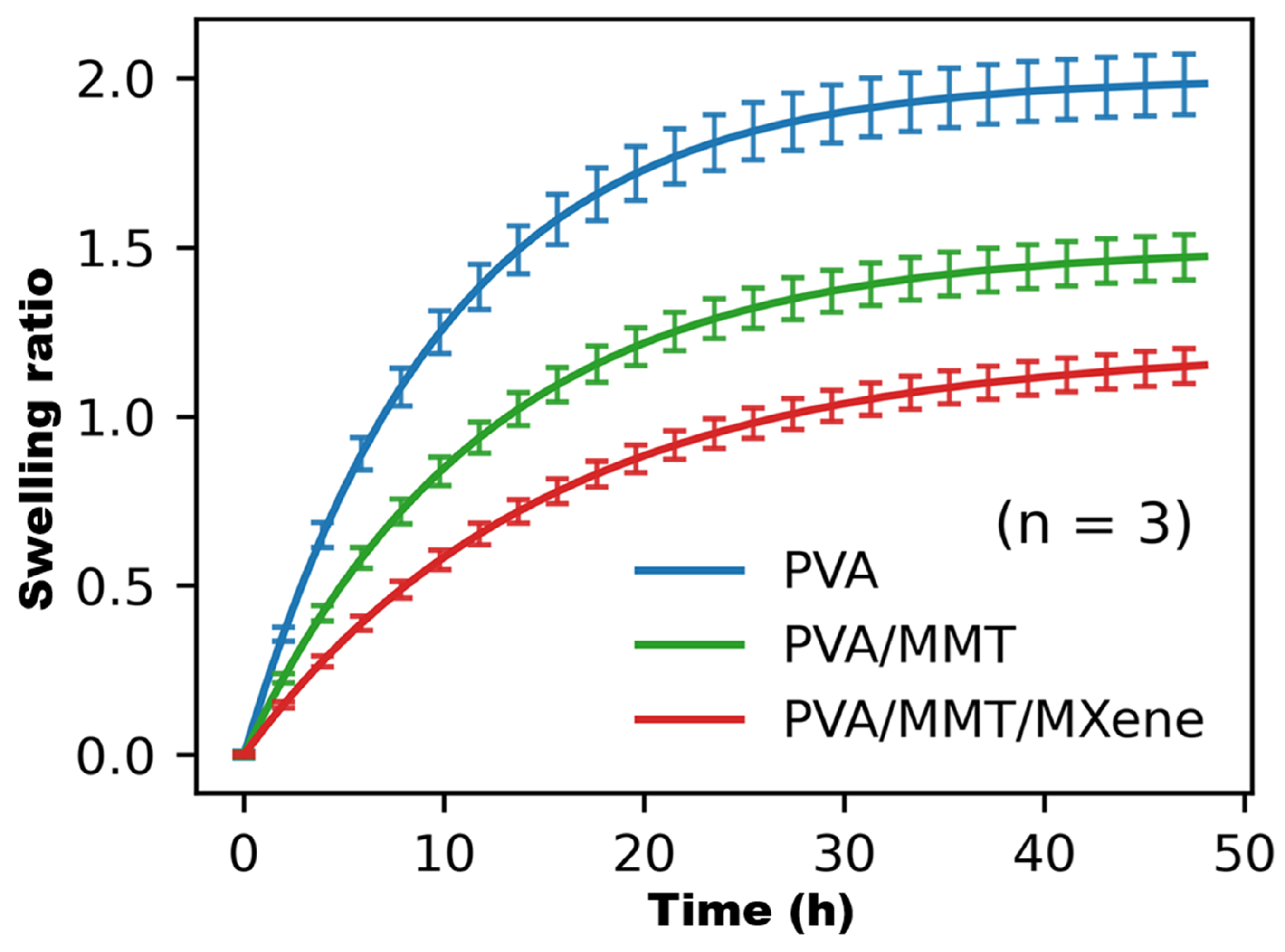
The swelling behavior of the membranes in water is shown in Figure 5. Neat PVA exhibits the highest swelling ratio (≈2.0 g water/g polymer), reflecting its hydrophilic character and the availability of free hydroxyl groups that readily form hydrogen bonds with water. The incorporation of MMT significantly reduces the swelling ratio to ≈1.5 g/g. Clay platelets act as physical barriers limiting water diffusion and increase the density of hydrogen bonds between the polymer and the layered silicate surface, reducing chain mobility and water uptake.
The PVA/MMT/MXene membrane shows the lowest swelling ratio (≈1.1–1.2 g/g), indicating enhanced dimensional stability. MXene nanosheets participate in extensive hydrogen bond networks with PVA and MMT, leading to a more compact and cross-linked microstructure. Their 2D geometry creates tortuous pathways that limit water penetration, further restricting swelling. These results confirm that MXene incorporation strengthens the hydro-dimensional stability of PVA-based membranes—a critical requirement for long-term water treatment applications.

3.2.3. Compaction Behavior

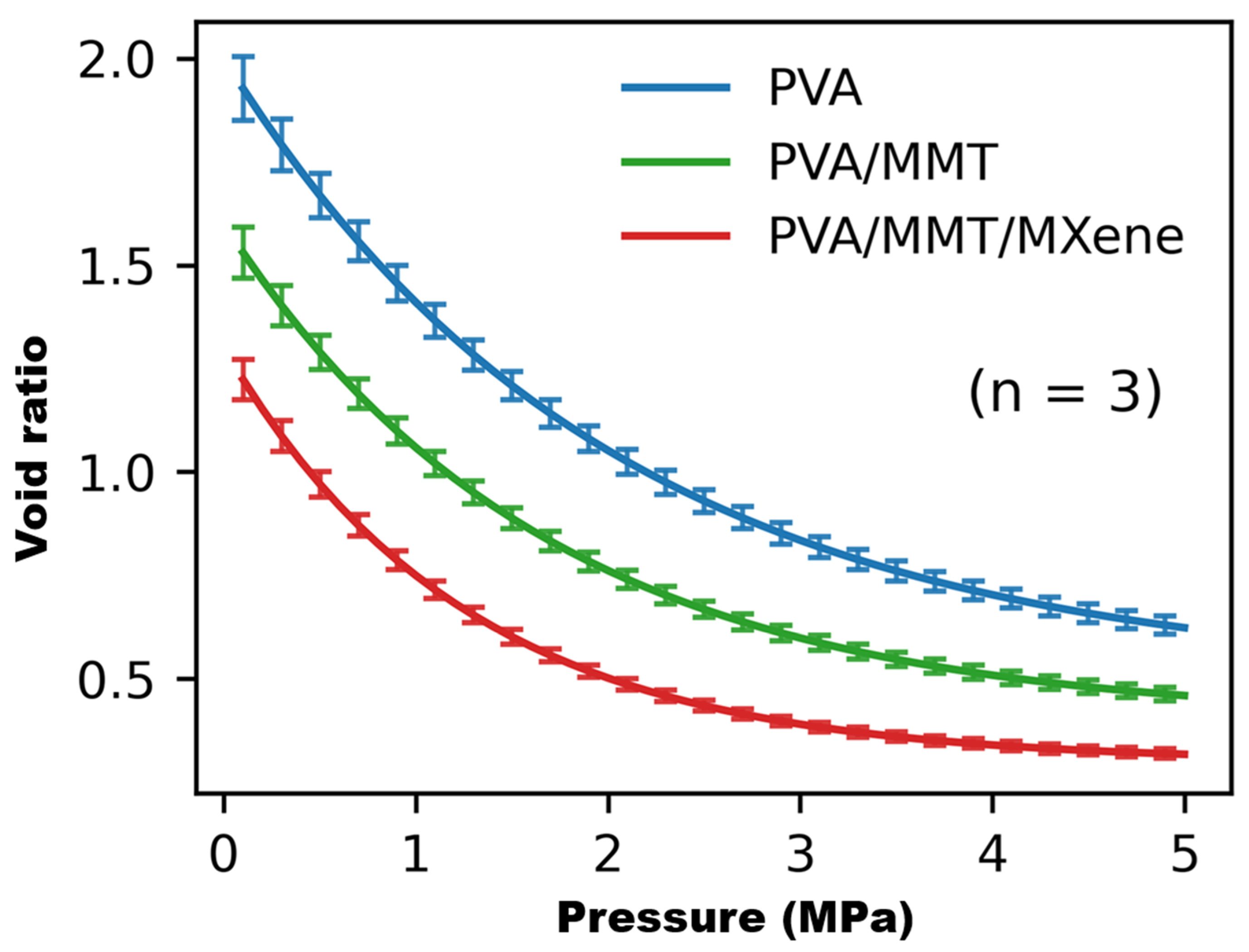
Compaction curves (void ratio vs. pressure (Figure 6)) illustrate the membranes’ ability to withstand mechanical compression. Neat PVA displays the highest initial void ratio and undergoes the largest reduction in porosity upon loading, confirming its susceptibility to structural collapse. PVA/MMT exhibits a lower void ratio and improved resistance to compression, attributable to the rigid inorganic platelets acting as spacers within the polymer network. PVA/MMT/MXene shows the lowest compressibility, maintaining its structure even under high pressures. The combined presence of MMT and MXene forms a rigid, interconnected 2D filler network that reinforces the polymer matrix against densification. This resistance to compaction ensures that membrane permeability and porosity remain stable when subjected to operational hydraulic pressures.

3.2.4. Reswelling Behavior After Compression

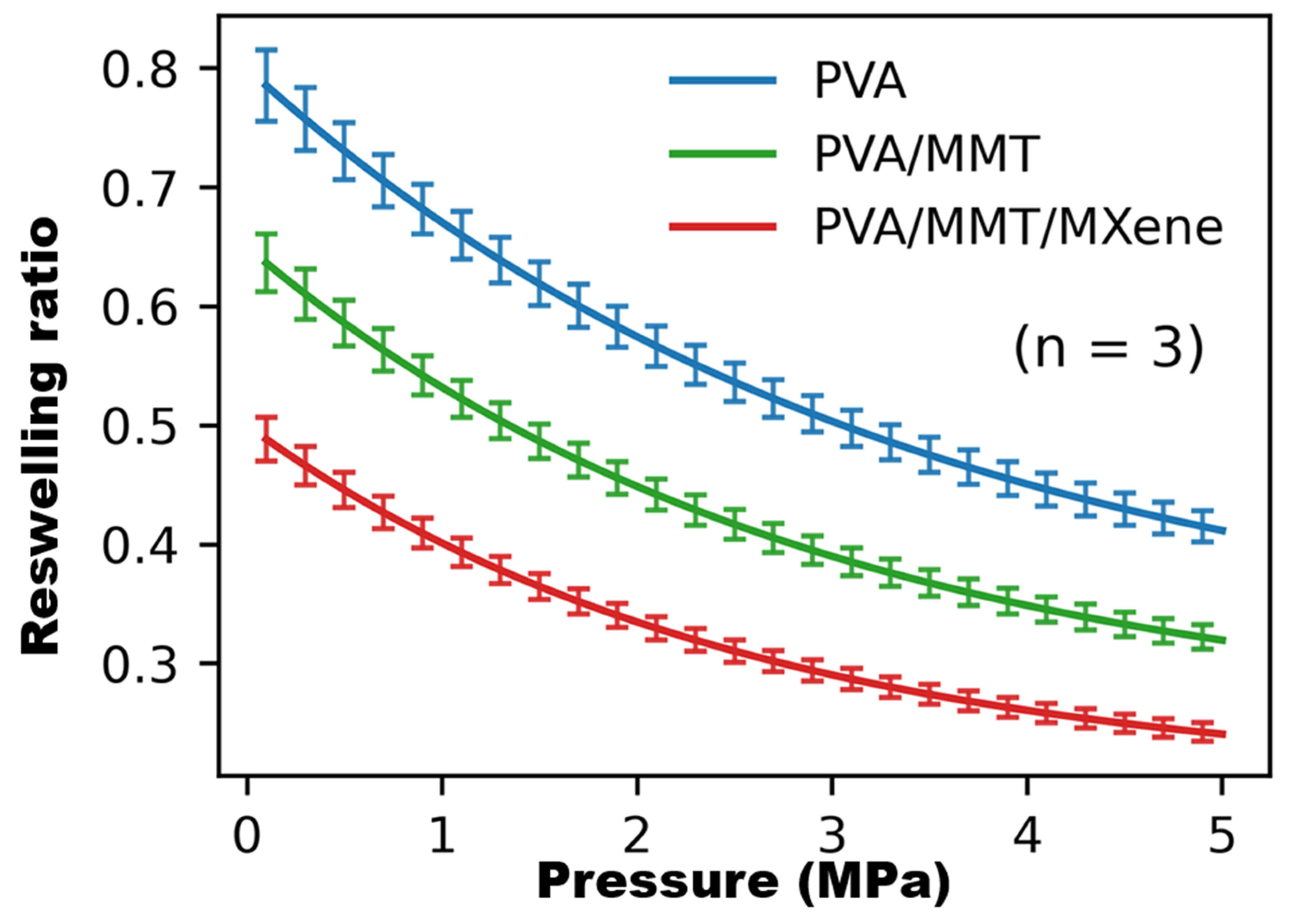
The reswelling curves (percentage of volume recovery vs. pressure (Figure 7)) quantify the membranes’ ability to regain their initial dimensions after mechanical compression. Pure PVA exhibits a high reswelling index at low pressures, but this recovery decreases sharply as pressure increases, indicating structural deformation and loss of elasticity. PVA/MMT displays improved structural retention across the entire pressure range, although its reswelling capacity remains moderate due to clay-induced rigidity.
PVA/MMT/MXene demonstrates the best mechanical resilience, showing the smallest variation in reswelling index with increasing pressure. Although its absolute reswelling percentage is lower (due to the more compact structure), the stability of its recovery curve indicates minimal permanent deformation. The membrane thus maintains its structural integrity even after repeated compression–decompression cycles.

3.3. Adsorption Properties and Statistical–Physics Modeling

Adsorption experiments were conducted in mono-solute mode for Pb2+ (pH 5) and MB (pH 7), in accordance with the protocol detailed in Section 2.6. All adsorption experiments were performed in triplicate (n = 3), and the adsorption values reported in the isotherms correspond to mean ± standard deviation. Error bars in all adsorption plots represent the standard deviation (n = 3). An optical photograph of the membrane/solution systems is provided in Figure 8, showing the visible blue coloration associated with MB uptake and a distinct appearance after Pb2+ exposure.
To support the mechanistic interpretation of Pb2+ and MB uptake, FTIR spectra of the PVA/MMT/MXene membrane before adsorption and after exposure to each pollutant are presented in Figure 9. After Pb2+ adsorption, characteristic perturbations are observed in the O–H and C=O regions, consistent with coordination or electrostatic interactions. After MB adsorption, additional aromatic and C–N vibrational features appear, reflecting π–π and hydrogen-bonding contributions to multilayer dye uptake. FTIR spectra recorded before and after adsorption reveal functional group perturbations associated with Pb2+ complexation and MB aromatic/C–N modes.
Table 3 summarizes the main FTIR bands of the PVA/MMT/MXene membrane before adsorption and their evolution after Pb2+ and MB uptake.
Equilibrium data were analyzed using a statistical–physics formalism to extract microscopic descriptors (site density, occupancy, energy, and orientation), treating model parameters as constants per adsorbent/solute pair and assessing fit quality by non-linear least squares (see Methods) [72,73,74,75,76]. This approach enables a mechanistic reading of the distinct behaviors observed for a metal ion (Pb2+) versus a planar cationic dye (MB) on hybrid PVA/MMT/MXene membranes.

3.3.1. Equilibrium Isotherms (Mono-Solute)

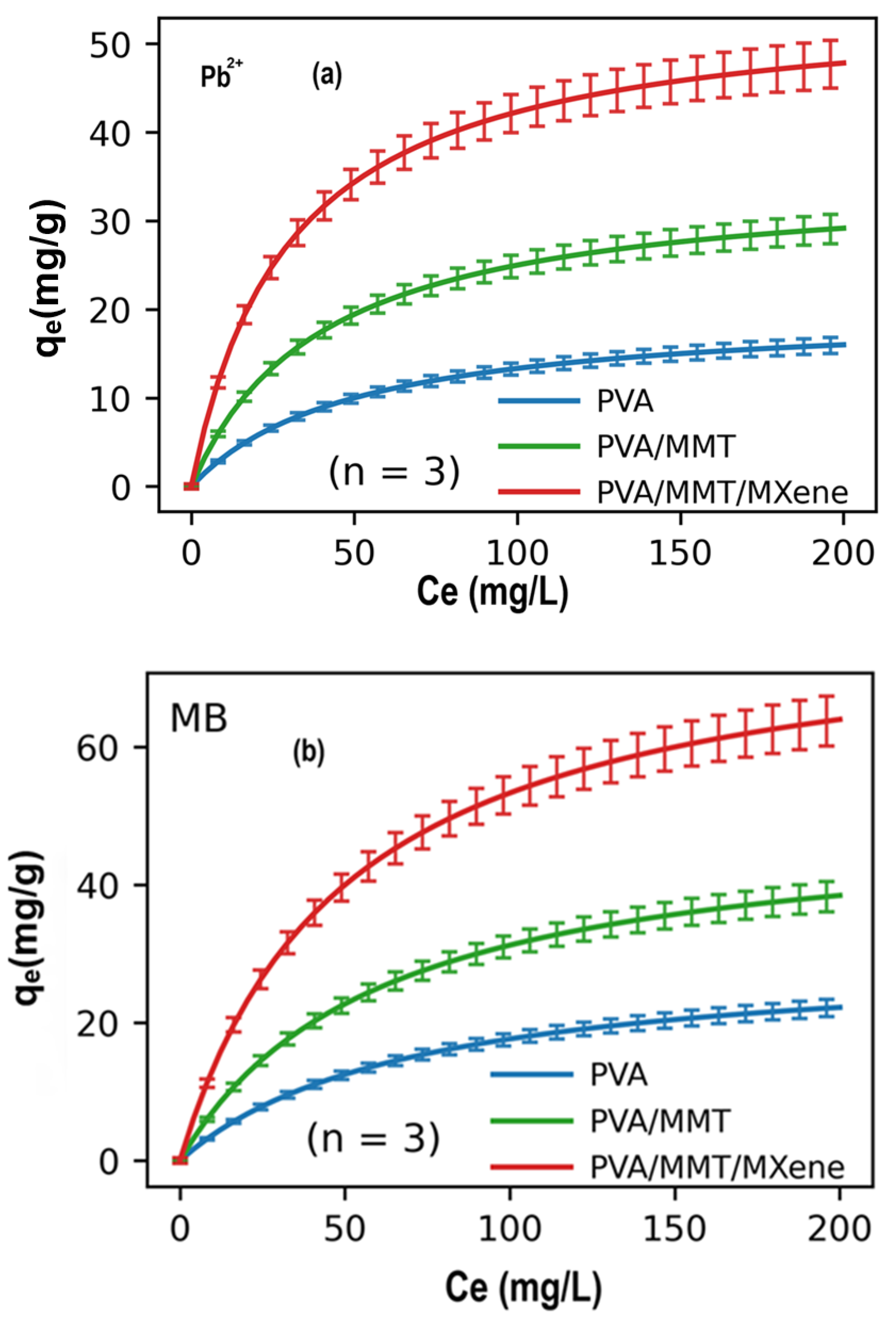
Figure 10 gathers the equilibrium isotherms qe versus Ce for Pb2+ and MB on PVA, PVA/MMT, and PVA/MMT/MXene membranes. For Pb2+, capacity increases monotonically with concentration and follows the trend PVA < PVA/MMT < PVA/MMT/MXene across the entire range. At Ce ≈ 200 mg L−1, typical capacities are ~16, 29, and 48 mg g−1 for PVA, PVA/MMT, and PVA/MMT/MXene, respectively, demonstrating a strong reinforcement of uptake after adding MMT and a further, larger gain when MXene is also incorporated.
For MB, the same ordering is observed but with systematically higher capacities for each membrane type. At Ce ≈ 200 mg L−1, representative values are ~38, 64, and ~80 mg g−1 (the latter from the capacity summary), again showing a pronounced advantage of the ternary membrane. The steeper rise and delayed saturation of MB isotherms foreshadow a multilayer-prone mechanism, unlike Pb2+ which tends to level off earlier (monolayer-dominated).
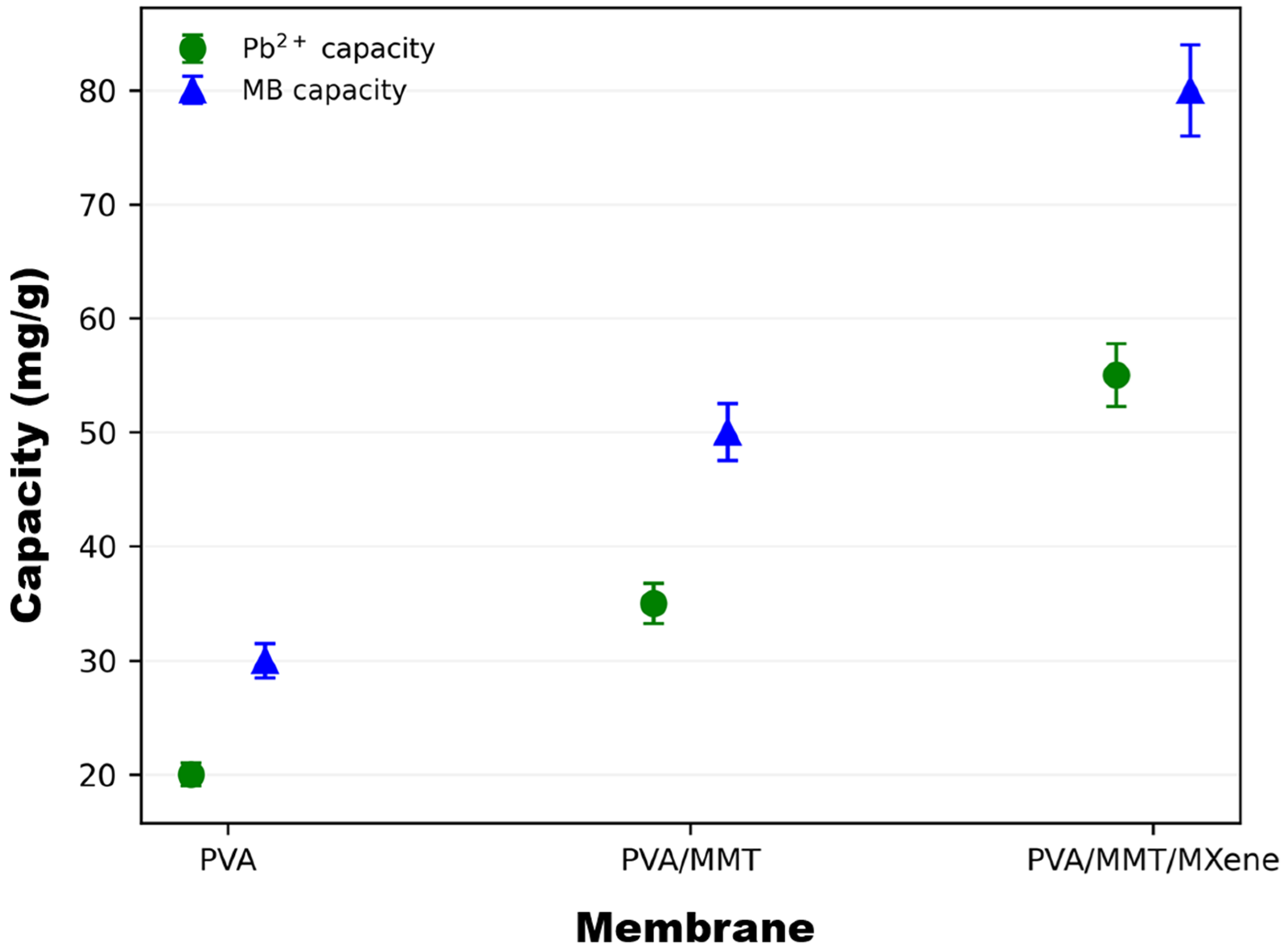
To summarize the isotherm results in a compact way, Figure 11 compares Pb2+ vs. MB capacities for the three membranes. The ternary PVA/MMT/MXene membrane reaches approximately 55 mg g−1 (Pb2+) and 80 mg g−1 (MB), confirming the dual-target advantage of the hybrid network.

3.3.2. Statistical–Physics Modeling: Microscopic Interpretation

The mono-solute isotherms were interpreted within a statistical–physics framework (see Methods) to quantify receptor site density Nm, molecules per site n, adsorption energy distributions, and orientation on the surface. For transparency, model parameters were obtained by global fits per system; in addition, model-derived profiles versus Ce are shown to visualize how the inferred microscopic quantities relate to the experimental coverage domain.
(i)
Receptor site density, Nm.
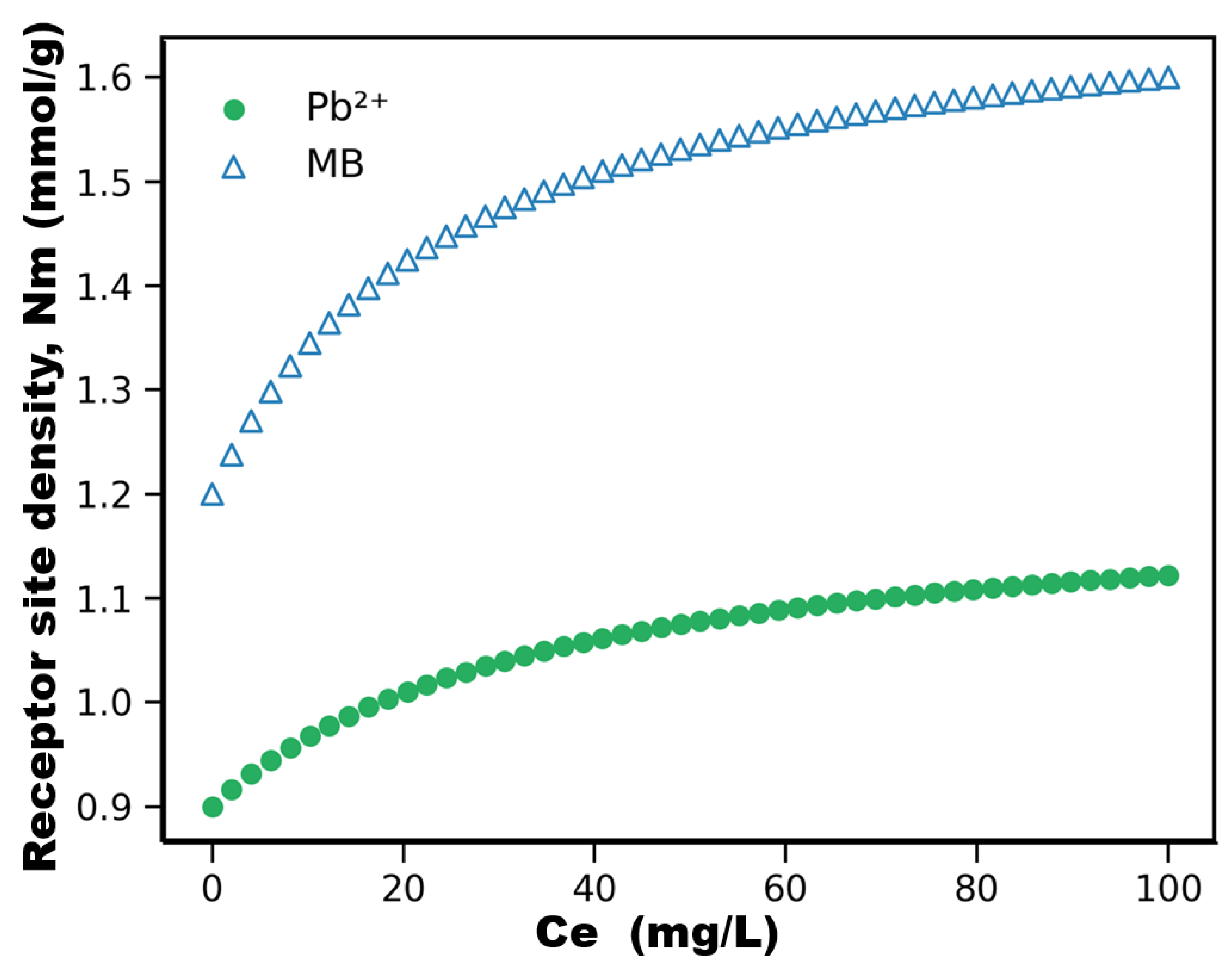
Figure 9 shows the model-derived Nm versus Ce for Pb2+ and MB on the ternary membrane. MB exhibits a higher site density window than Pb2+, rising toward ~1.6 mmol g−1 at the high-coverage end, while Pb2+ approaches ~1.1–1.2 mmol g−1—consistent with MB’s larger uptake and multilayer propensity (Figure 12 and Figure 13). These trends align with the capacity ordering observed in Figure 10 and Figure 11 (Table 4).
(ii)
Molecules per site, n.
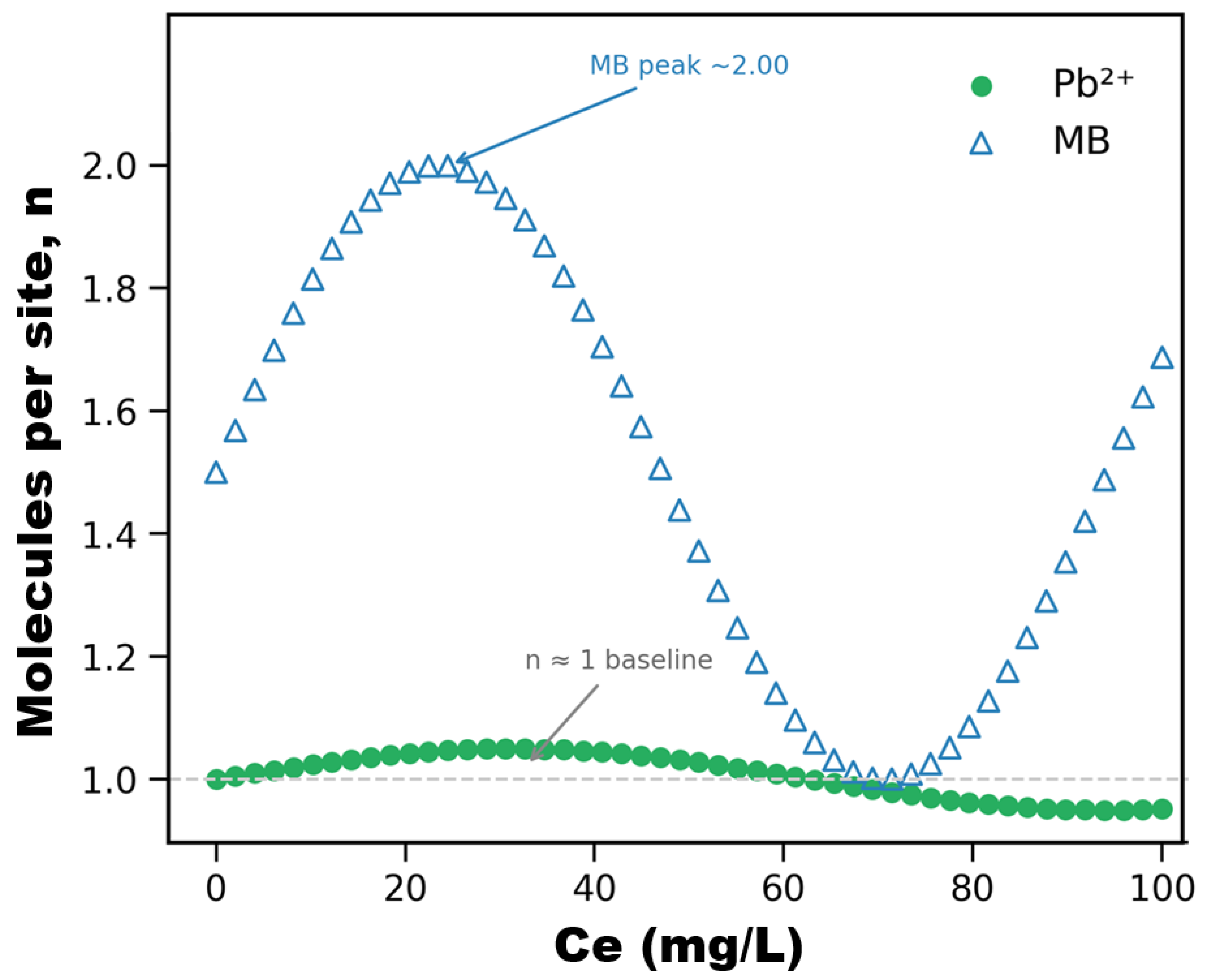
Figure 10 indicates that Pb2+ maintains n ≈ 1 across the studied domain, i.e., monolayer-dominated binding. In contrast, MB shows n > 1 at intermediate Ce (peaking near ~2) before slowly falling toward ~1.3 at high Ce—a hallmark of aggregative or multilayer growth beyond a single adsorbed layer.
(iii)
Adsorption energy distribution.
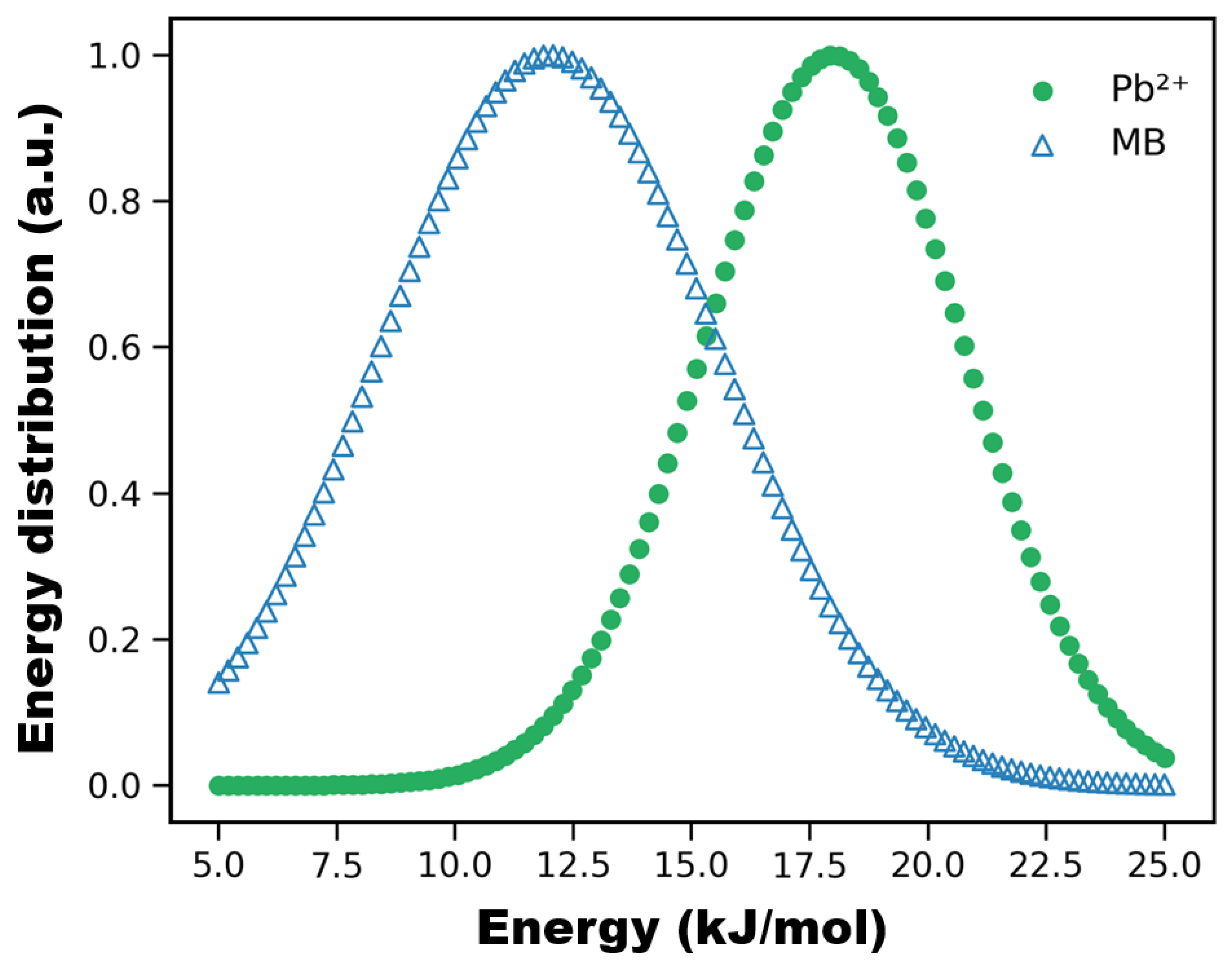
Figure 14 compares the energy distributions reconstructed by the model. Pb2+ displays a distribution centered near ~18 kJ mol−1, indicative of stronger specific interactions (complexation/electrostatic), while MB peaks at a lower-energy domain around ~12 kJ mol−1, compatible with physisorption-dominated stacking (H-bonding, π–π, and dye–dye interactions in higher layers). This energy contrast rationalizes the monolayer character of Pb2+ versus the multilayer tendency of MB.
(iv)
Orientation probability.
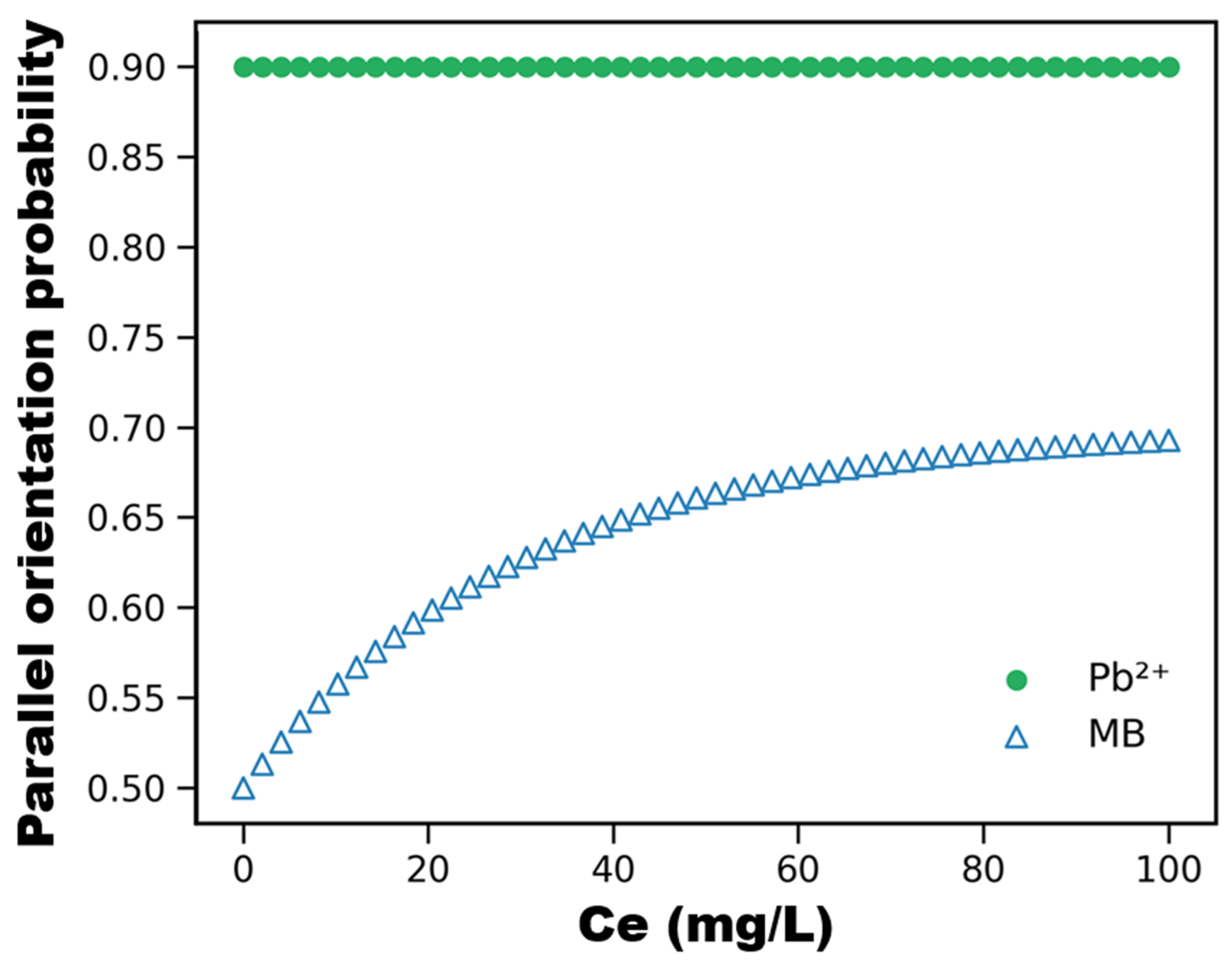
Figure 15 reveals that Pb2+ preserves a high, nearly constant orientation probability (here ~0.9) across concentrations, consistent with non-directional ionic binding on available sites. MB, by contrast, shows an increasing parallel orientation probability from ~0.50 at low Ce to ~0.69 at high Ce, favoring planar stacking and layer-by-layer accumulation on 2D surfaces, particularly in the presence of MXene nanosheets.
(v)
Multilayer growth index.
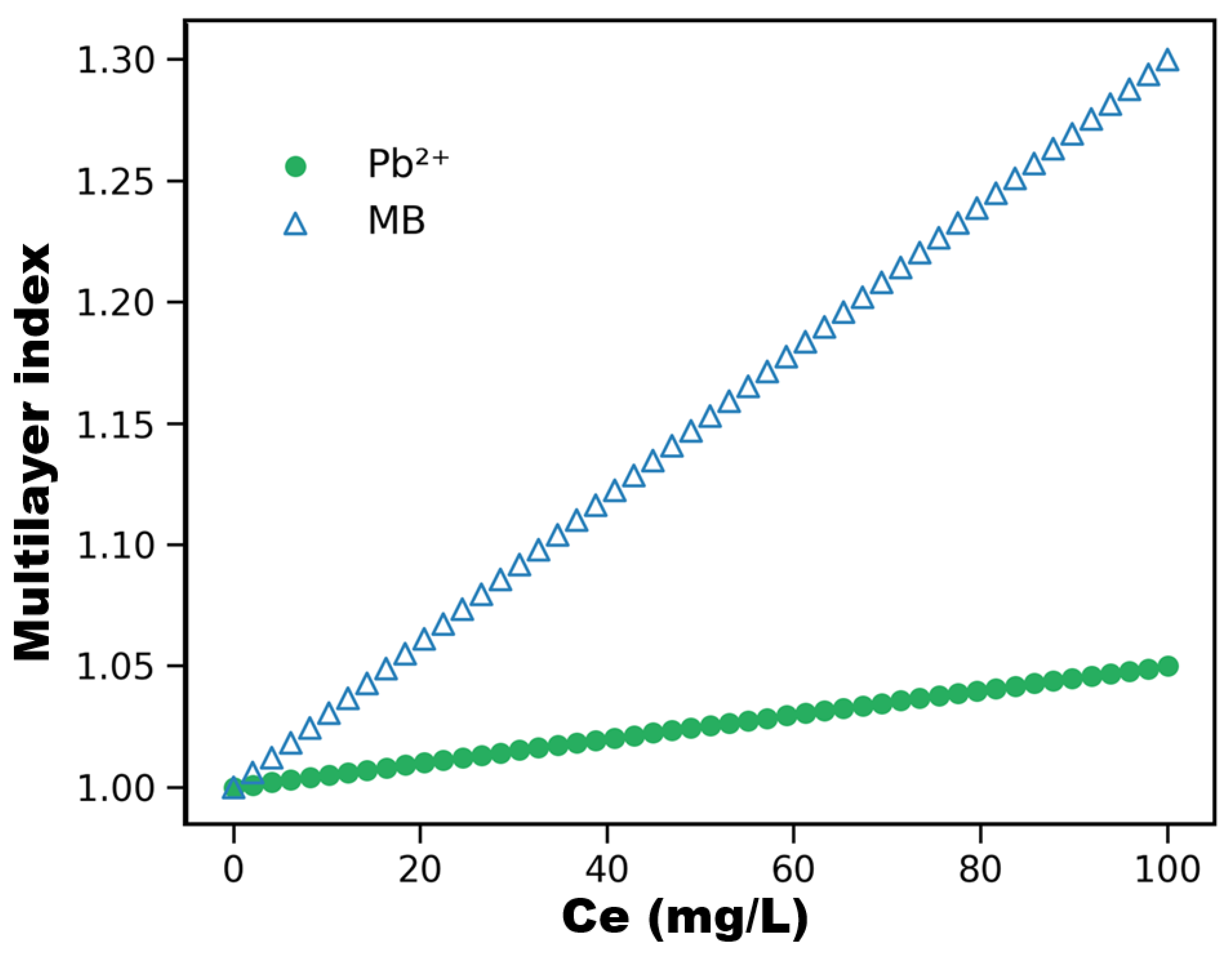
As a direct metric, Figure 16 indicates that Pb2+ remains close to a single layer (reaching only ~1.05 layers at the upper range), whereas MB increases almost linearly to ~1.30 layers at high Ce, confirming its multilayer-prone character under the tested conditions.
To contextualize the adsorption performance of the PVA/MMT/MXene membranes, Table 5 summarizes representative adsorption capacities reported in the literature for PVA-based, clay-modified PVA, and MXene-enhanced PVA systems. These values demonstrate that the Pb2+ (55 mg·g−1) and MB (80 mg·g−1) adsorption capacities obtained in this study are comparable to or higher than those commonly reported for PVA/MMT and MXene-modified polymer systems, particularly considering that the present work employs low additive loadings and maintains membrane integrity.

3.3.3. Multilayer Formation and Comparative Adsorption Pathways

The multilayer index profiles in Figure 16 provide direct quantitative confirmation of the distinct adsorption mechanisms governing Pb2+ and MB uptake. For Pb2+, the multilayer index remains essentially constant at ~1.00–1.05, even at high C e , confirming that Pb2+ adsorption is fundamentally a monolayer-type process. Once primary high-affinity sites are occupied, additional layers do not form, either due to weak ion–ion interactions or steric constraints preventing further packing [77].
In contrast, MB exhibits a linear and significant increase in multilayer index, reaching nearly 1.30 layers at the highest concentrations. This unambiguously demonstrates multilayer growth beyond the first adsorbed layer. The planar aromatic structure of MB facilitates self-assembly and π–π stacking, and the MXene-rich surface provides extended 2D domains that promote secondary and tertiary dye layers through physisorption and dye–dye interactions.
This contrast between a strict monolayer (Pb2+) and a multilayer-prone adsorbate (MB) is essential for understanding the adsorption performance of the hybrid membranes and for selecting optimal materials for different classes of pollutants. Metal ions benefit primarily from specific binding to surface terminations, while organic dyes exploit both surface affinity and interlayer stacking to achieve higher capacities.
A conceptual schematic (Figure 17) can be used to summarize these mechanisms and the role of membrane composition. Pure PVA provides few active sites and yields the lowest capacities. Incorporating MMT introduces interlayer spaces and cation exchange sites, enhancing Pb2+ affinity and moderately improving MB uptake. The ternary PVA/MMT/MXene membrane exhibits the strongest performance due to: (i) a high density of active sites provided by MXene terminations; (ii) strong, energetically favorable Pb2+ binding; and (iii) the ability of MB to form multiple stacked layers on MXene-enhanced 2D surfaces. Together, these features produce a membrane with superior adsorption efficiency for both pollutants [77,78,79,80,81]. Although zeta potential was not measured in the present work, the expected surface charge evolution of the PVA/MMT/MXene membranes as a function of pH is well established from the individual behaviors of PVA, montmorillonite, and MXene nanosheets. The hybrid structure contains abundant –OH groups (PVA and MXene) and negatively charged silicate layers (MMT), which progressively deprotonate as pH increases, resulting in a more negatively charged surface. This trend is fully consistent with the observed pH dependent enhancement of Pb2+ adsorption and with the strong electrostatic affinity predicted by the statistical physics modeling (e.g., energetic parameters and site occupancy). The multilayer adsorption of MB at higher concentrations is likewise compatible with the presence of negatively charged domains and π electron rich MXene sheets. Although zeta potential measurements would further substantiate this interpretation, the combined spectroscopic, structural, and modeling evidence already provides a coherent picture of electrostatic and coordination driven adsorption mechanisms.
Table 5. Comparative adsorption capacities of PVA-based systems reported in the literature.
Material SystemTarget PollutantAdsorption
Capacity (mg·g−1)
Refs
PVA–AMPS sulfonated microspheresMB≈20.7 mg·g−1[82]
Modified clays/MMT-based systemsPb2+100–250 mg·g−1[83,84]
PVA/MMT composites (general)Heavy metals50–150 mg·g−1[85]
MXene-based compositesCationic dyes/metals150–300 mg·g−1[85]
PVA/MMT/MXene (this work)Pb2+55 mg·g−1This work
PVA/MMT/MXene (this work)MB80 mg·g−1This work

3.3.4. Interpretation of the Energy Landscape and Layering Behavior

A deeper inspection of the model-derived adsorption energy profiles (Figure 11) provides additional mechanistic clarity on the fundamentally different adsorption modes of Pb2+ and MB on the PVA/MMT/MXene hybrid membrane. The contrast between a sharp, high-energy peak for Pb2+ and a broader, lower-energy distribution for MB reveals how the physicochemical nature of each solute governs both its affinity and its structural arrangement at the membrane interface.
High-energy peak for Pb2+ (~18 kJ·mol−1): signature of strong, site-specific interactions.
The narrow Pb2+ energy distribution centered around ~18 kJ·mol−1 indicates a dominant contribution from specific chemisorption-type interactions, primarily involving MXene surface terminations (–O, –OH), which are known to coordinate metal ions effectively. These groups create directional ionic or inner-sphere complexation sites, yielding a relatively uniform and strongly bound population of adsorbed Pb2+ species.
This behavior is consistent with two independent trends:
  • Monolayer adsorption, as supported by the nearly constant n ≈ 1 profile across the entire concentration range (Figure 13).
  • The early saturation observed in the Pb2+ isotherms (Figure 8), characteristic of a finite set of high-energy binding sites being progressively occupied.
Together, these features confirm that Pb2+ adsorption is governed by strong, localized binding to well-defined sites, with limited capacity for multilayer formation.
Broad, lower-energy distribution for MB (~12 kJ·mol−1): physisorption and multilayer growth.
In contrast, MB displays a broad energy distribution peaking near ~12 kJ·mol−1, indicative of physisorption-driven interactions. These lower-energy contributions arise from:
hydrogen bonding with PVA and MXene terminations, van der Waals and dispersive forces along the MXene basal planes, π–π stacking between MB molecules, which becomes increasingly dominant as surface coverage grows.
The broader distribution also explains why MB does not saturate early, instead showing:
n > 1 across most of the concentration range, confirming multi-molecule occupation per site, a monotonic increase in multilayer index, approaching ~1.3 layers at high Ce (Figure 13), consistent with progressive planar stacking.
These energy and occupancy signatures collectively support a mechanism dominated by layered physisorption, where the first MB layer interacts with the surface, while subsequent layers build up through dye–dye interactions.
Synergistic contributions of MMT and MXene to surface heterogeneity and multilayer accessibility.
The hybrid membrane architecture explains the differentiated energy landscapes of Pb2+ and MB. MXene nanosheets contribute highly reactive surface terminations (Tx = –O, –OH, –F), while MMT provides structural heterogeneity and physically expanded interfacial space. The combined effect is a hierarchically organized 2D–2D network that:
  • Stabilizes specific binding sites for Pb2+ (explaining the narrower, higher-energy distribution),
  • Provides extended surface planes and micro-domains favorable for MB stacking,
  • Increases accessible surface area for the formation of secondary and tertiary MB layers, consistent with the elevated multilayer index (Figure 16).
This structural synergy clarifies why MB experiences a broader distribution of accessible microenvironments—each associated with slightly different energies—while Pb2+ remains confined to a smaller, high-affinity subset.

3.3.5. Structure–Mechanism Link and Role of the Hybrid 2D Network

The microscopic trends identified through statistical–physics modeling are fully consistent with the structural and mechanical characteristics of the hybrid membranes described in Section 3.1 and Section 3.2. MMT platelets intercalate within the PVA matrix and restrict polymer chain mobility, whereas MXene nanosheets introduce abundant 2D surfaces decorated with –O/–OH terminations and generate tortuous diffusion pathways. Together, these layered fillers form a cohesive 2D–2D hybrid network that simultaneously (i) reinforces the mechanical stability of the membrane and (ii) increases the accessibility and heterogeneity of adsorption sites.
This structural combined effect explains the systematic capacity enhancement observed from PVA → PVA/MMT → PVA/MMT/MXene for both Pb2+ and MB (Figure 8 and Figure 9). Pb2+ interacts preferentially with the highest-affinity surface terminations, leading to monolayer-dominated uptake, as reflected by its nearly constant n ≈ 1 profile (Figure 10) and a narrow, high-energy adsorption distribution centered around ~18 kJ·mol−1 (Figure 11). Such behavior is characteristic of strong, site-specific complexation.
In contrast, MB—owing to its planar aromatic structure—takes advantage of the extended MXene basal planes and the heterogeneous microenvironments created by the MMT/MXene assembly. The increasing orientation probability, n > 1 values, and the progressive rise in the multilayer index (Figure 13 and Figure 16) confirm that MB adsorption proceeds through multilayer stacking driven by physisorption, hydrogen bonding, and π–π interactions between dye molecules. The broader, lower-energy distribution for MB (Figure 14) further supports this multilayer growth mechanism.
Overall, the coupling between structural architecture (2D fillers), adsorption energetics, and molecular orientation provides a unified explanation for the enhanced performance of the PVA/MMT/MXene membrane and highlights the crucial role of the hybrid 2D network in governing the adsorption pathways of both ionic and aromatic pollutants.
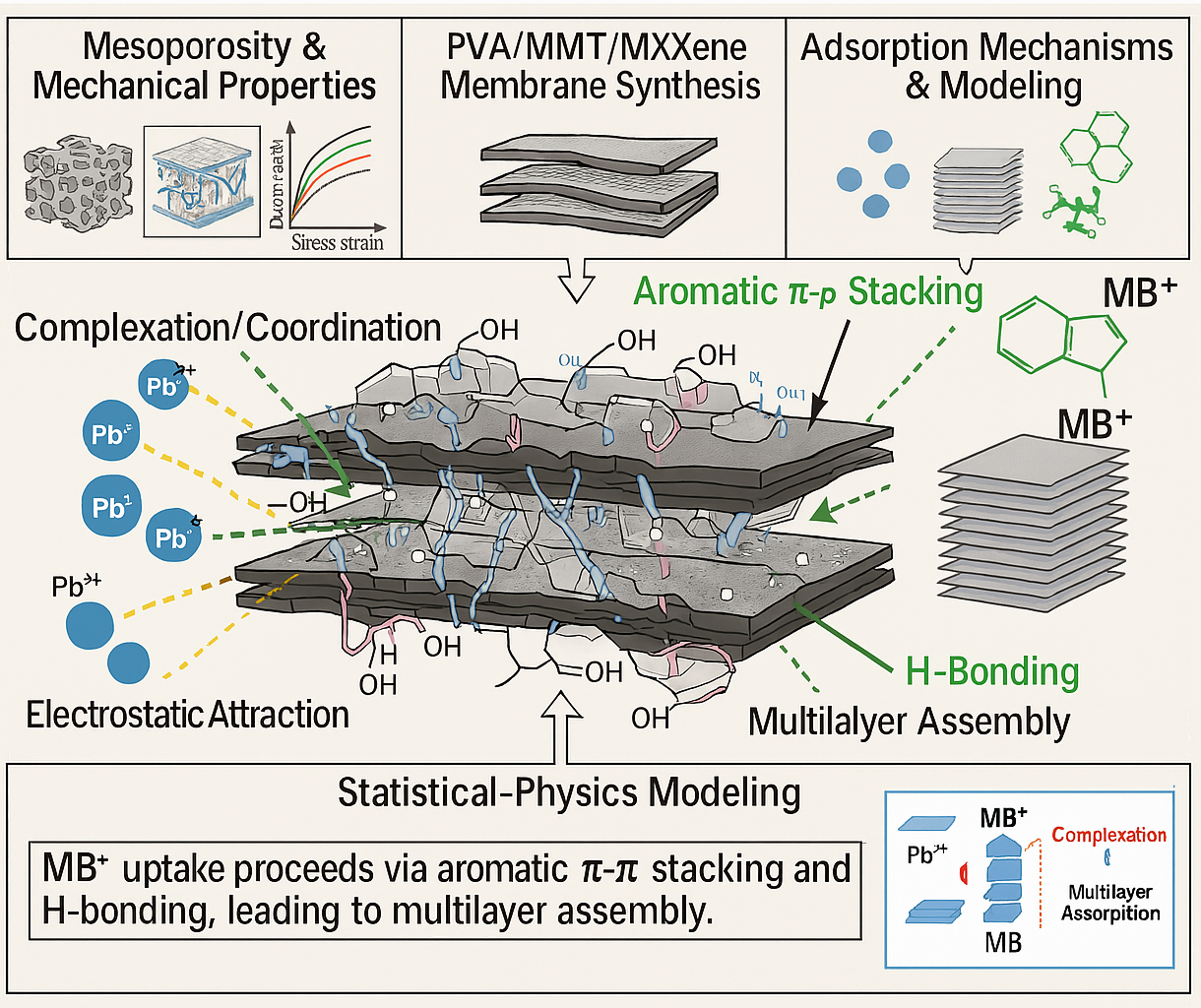
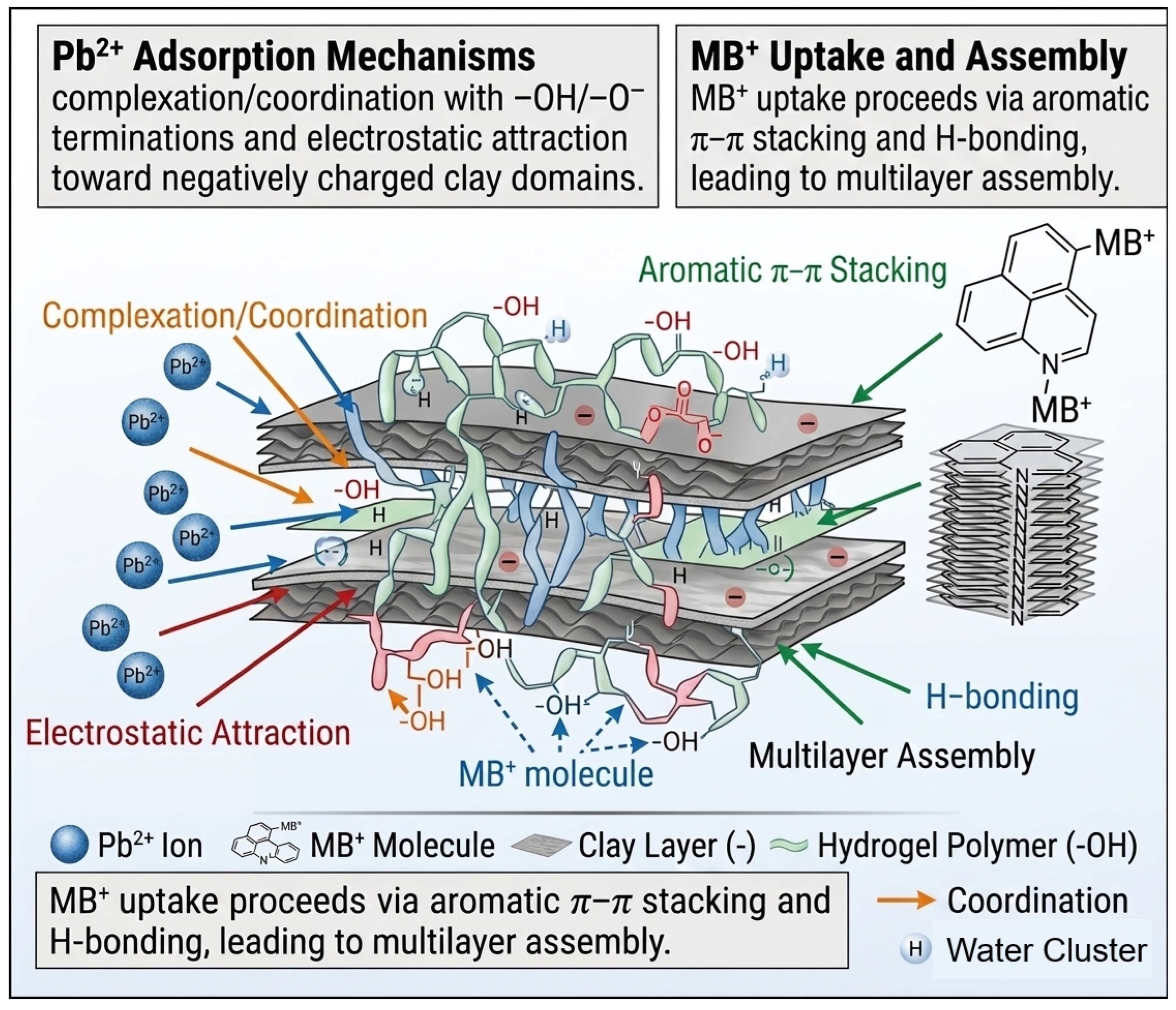
Figure 14 provides a mechanistic schematic distinguishing the adsorption pathways of Pb2+ and MB+ on PVA/MMT/MXene membranes. Pb2+ uptake is dominated by complexation with –OH/–O terminations and electrostatic attraction toward negatively charged clay domains, while MB+ adsorption proceeds through aromatic π–π stacking, H-bonding, and multilayer assembly.

3.4. Porosity Analysis (BJH Method)

The textural properties of the membranes were further investigated using the BJH method to quantify pore size distribution and cumulative pore volume, two parameters known to strongly influence adsorption capacity and diffusion kinetics. BJH analysis provides a complementary view of how MMT and MXene modify the internal mesoporous network of the hybrid composites. A summary of the key BJH textural parameters (specific surface area, total pore volume, average pore diameter, and pore type classification) for the three membranes is provided in Table 6. These values offer a concise overview of the mesoporous characteristics of the PVA, PVA/MMT, and PVA/MMT/MXene membranes before the detailed discussion of pore size distribution and cumulative pore volume.

3.4.1. Pore Size Distribution

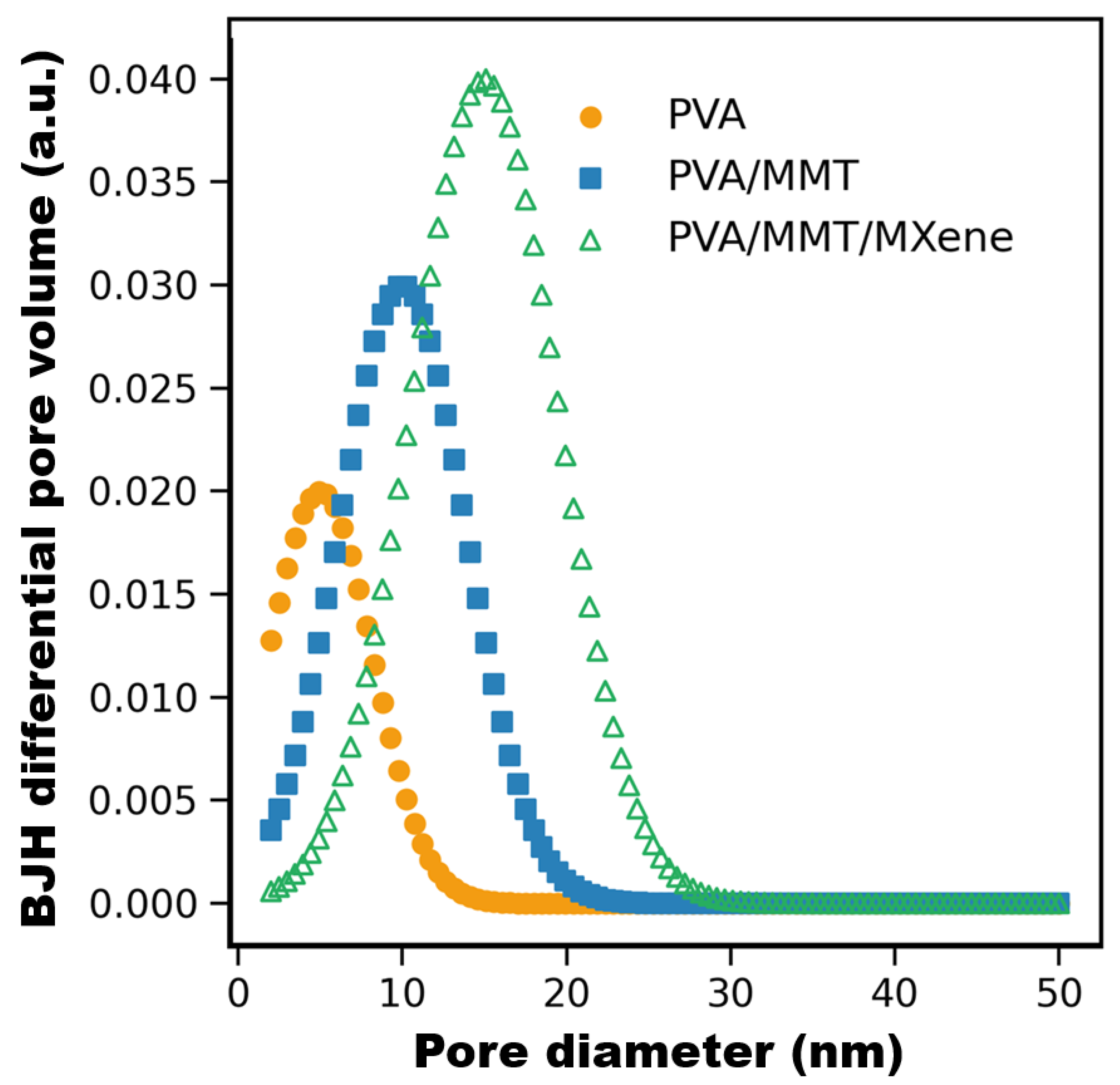
Figure 18 shows the differential BJH pore size distribution for the three membrane systems. Neat PVA exhibits a broad and weakly structured distribution, reflecting its relatively compact polymer network with limited mesoporosity. Upon incorporation of MMT, the distribution becomes narrower and more refined, indicating the formation of tortuous pathways and restricted pore domains caused by the intercalation of clay platelets within the polymer matrix.
The most significant modification is observed in the PVA/MMT/MXene membrane, where MXene nanosheets contribute to a more uniform and interconnected pore network. The two-dimensional nature of MXene and its tendency to self-assemble into stacked galleries introduce additional mesopores while simultaneously refining the existing ones. This results in a better-organized pore architecture, which is known to enhance pollutant accessibility to internal adsorption sites.

3.4.2. Cumulative Pore Volume

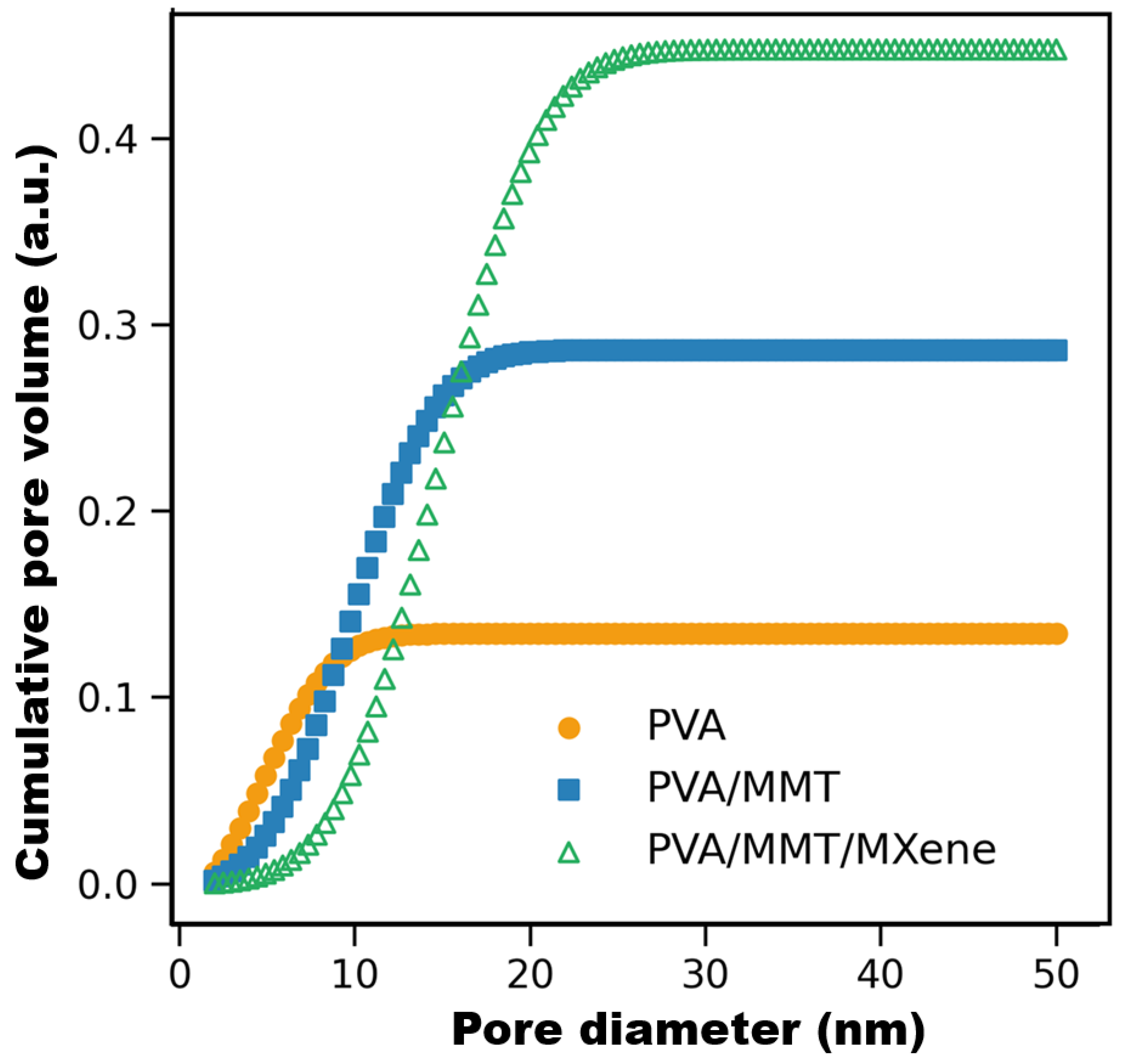
Figure 19 compares the cumulative pore volume of the three membranes. The introduction of MXene significantly increases the total pore volume compared to both neat PVA and PVA/MMT. This enhancement is directly associated with the formation of additional accessible channels and the larger specific surface area of MXene, which contributes not only to the density of adsorption sites but also to the openness of the pore network.
The combination of optimized pore size distribution and increased pore volume explains the superior adsorption capacities obtained for both Pb2+ and MB. For MB, an interconnected mesoporous network facilitates molecular stacking and multilayer formation, in line with the n > 1 and multilayer index results (Figure 13 and Figure 16). For Pb2+, a denser array of smaller pores increases the probability of encountering high-affinity complexation sites, thereby improving monolayer adsorption efficiency.
Overall, BJH analysis confirms that MXene incorporation is essential for creating a well-structured mesoporous architecture characterized by refined pore sizes and enhanced pore volume, both of which play a key role in the improved adsorption performance of the PVA/MMT/MXene hybrid membranes.

4. Conclusions

This work provides a comprehensive and experimentally supported evaluation of PVA/MMT/MXene nanocomposite membranes, revealing how the synergistic assembly of 2D MMT platelets and MXene nanosheets fundamentally reshapes the structure, mechanics, porosity, and adsorption behavior of the hybrid material. Mechanical testing demonstrated that the dual-filler system significantly reinforces the PVA matrix, with the ultimate tensile strength increasing from 10 to 20 MPa and Young’s modulus doubling relative to neat PVA. Dimensional stability was likewise enhanced, reflected in reduced swelling and improved resistance to compaction–reswelling cycles. BJH mesoporosity analysis confirmed that MXene incorporation produces an interconnected mesoporous framework with increased cumulative pore volume and refined pore size distribution, providing more accessible pathways for pollutant diffusion.
Adsorption experiments performed in triplicate (n = 3) showed that the ternary membrane exhibits superior uptake capacities for both Pb2+ (55 mg g−1) and MB (80 mg g−1), outperforming binary PVA/MMT and neat PVA systems. Newly added FTIR spectra recorded before and after pollutant exposure revealed functional group perturbations consistent with the proposed mechanisms: O–H and C=O shifts for Pb2+ indicating coordination/electrostatic interactions, and the appearance of MB aromatic/C–N bands confirming π–π stacking and H-bonding. Optical photographs of adsorption tests further provided qualitative visual evidence of pollutant uptake.
Statistical–physics modeling delivered deep microscopic insight into the nature of adsorption, distinguishing monolayer Pb2+ binding (n ≈ 1, high-affinity sites) from multilayer MB uptake (n > 1, increased site density and aromatic stacking). The improved mechanistic schematic (Figure 14), revised according to reviewer recommendations, clearly illustrates these interaction pathways without implying binary adsorption between Pb2+ and MB.
Together, the mechanical, structural, spectroscopic, optical, and theoretical analyses converge to establish a coherent structure–mechanism–performance relationship. PVA/MMT/MXene membranes emerge as robust, hydrophilic, and mechanistically versatile adsorbents combining high mechanical integrity, refined mesoporosity, and strong affinity toward both metal ions and aromatic dyes. These results position the hybrid membrane as a promising candidate for next-generation water purification applications.
Future work will focus on real wastewater validation, SEM–EDS elemental mapping (pending instrumentation access), competitive adsorption systems, and regeneration cycles, which will further consolidate the practical applicability of the developed composite membranes.

Author Contributions

M.B.: Formal analysis, Methodology, Writing—original draft; M.M.: Formal analysis, Methodology, Conceptualization W.O.: Formal analysis, Methodology, Data curation, Conceptualization, Funding acquisition, Supervision, Writing—Original draft, Writing—Review and editing, Project administration. All authors have read and agreed to the published version of the manuscript.

Funding

This research received no external funding.

Data Availability Statement

The authors confirm that the data supporting the findings of this study are available within the article.

Acknowledgments

The results presented here are derived from a PhD thesis conducted at the Faculty of Sciences of Bizerte, University of Carthage, located in Zarzouna, Tunisia, and supervised by Walid Oueslati. M.B. extends heartfelt gratitude to W.O. for the groundbreaking ideas that inspired this research, as well as for the insightful discussions on the findings, guidance throughout the work, assistance in the paper writing process, and the valuable corrections provided.

Conflicts of Interest

The authors declare no conflicts of interest.

Abbreviations

The following abbreviations are used in this manuscript:
PVAPoly(vinyl alcohol)
MMTMontmorillonite
MXeneTi3C2(OH)1.2 nanosheets
MBMethylene Blue
Pb2+Lead ions Nm: Receptor site density
NNumber of molecules per site
εAdsorption energy
CeEquilibrium concentration
BETBrunauer–Emmett–Teller
BJHBarrett–Joyner–Halenda

References

  1. Filimon, A.; Dobos, A.M.; Onofrei, M.D.; Serbezeanu, D. Polyvinyl Alcohol-Based Membranes: A Review of Research Progress on Design and Predictive Modeling of Properties for Targeted Application. Polymers 2025, 17, 1016. [Google Scholar] [CrossRef] [PubMed]
  2. Bercea, M. Recent Advances in Poly(vinyl alcohol)-Based Hydrogels. Polymers 2024, 16, 2021. [Google Scholar] [CrossRef]
  3. Rezvova, M.A.; Glushkova, T.V.; Klyshnikov, K.Y.; Pykin, A.L.; Tkachenko, T.B.; Akentieva, T.N.; Kostyunin, A.E.; Onishchenko, P.S.; Borisova, N.N.; Fokeeva, M.P.; et al. Biocompatible Nanocomposite Cryogels with Improved Mechanical Properties Based on Polyvinyl Alcohol and Carbon Nanotubes for Cardiovascular Applications. Front. Bioeng. Biotechnol. 2025, 13, 1635837. [Google Scholar] [CrossRef]
  4. Saini, T.; Meena, J.; Verma, V.; Saini, S.; Malik, R. Polyvinyl Alcohol: Recent Advances and Applications in Sustainable Materials. Polym.-Plast. Technol. Mater. 2025, 64, 794–825. [Google Scholar] [CrossRef]
  5. Vu, N.Q.; Le, T.M.; Ngo, A.N.; Nguyen, M.H.; Liao, Y.C.; Tran, T.T. Engineering Functional PVA: A Comprehensive Review of Chemical Modifications and Prospective Developments. ACS Polym. Au 2025, 6, 33–60. [Google Scholar] [CrossRef] [PubMed]
  6. Venkatesan, R.; Mayakrishnan, V.; Alrashed, M.M.; Kim, S.C. Recent Advances in PBAT (Nano)Composite Materials for Food Packaging: A Comprehensive Review. J. Appl. Polym. Sci. 2025, 142, e57163. [Google Scholar] [CrossRef]
  7. Maalihan, R.D.; Domalanta, M.R.B.; Corrales, A.C.C.; Caldona, E.B. Advances in Interfacially Engineered Surface-Functionalized Fillers for Multifunctional Polymer Composite Coatings. Polym. Compos. 2025, 46, 5857–5881. [Google Scholar] [CrossRef]
  8. Nimitha, K.C.; Abraham, J.; Sharika, T.N. Barrier properties of polymer nanoclay and hybrid composites. In Polymer-Based Nanostructured Barrier Materials; Elsevier: Amsterdam, The Netherlands, 2026; pp. 245–266. [Google Scholar]
  9. Bastos Andrade, C.G.; Santos, G.A.M.D.; Camargo, M.C.; Gonzaga Neto, A.C.; Valera, T.S.; Toffoli, S.M. Effect of a Montmorillonite Modification on the Rheology and Mechanical Properties of a Clay/Natural Rubber Nanocomposite. Minerals 2025, 15, 1151. [Google Scholar] [CrossRef]
  10. Gajdosova, V.; Strachota, B.; Pokorny, V.; Brozova, L.; Kozisek, J.; Pavlova, E.; Stary, Z.; Slouf, M.; Strachota, A. Thermoplastic Starch Composites with Highly Exfoliated Nano-Clay Fillers and Excellent Barrier Properties. Materials 2026, 19, 347. [Google Scholar] [CrossRef]
  11. Salah, Z.; Aloulou, H.; Algieri, C.; Dammak, L.; Ben Amar, R. Polysulfone/MMT Clay Mixed Matrix Membranes for Efficient Diclofenac Removal and Improved Antifouling Performance in Wastewater Treatment. Membranes 2025, 15, 344. [Google Scholar] [CrossRef]
  12. Musa, A.A.; Bello, A.; Adams, S.M.; Onwualu, A.P.; Anye, V.C.; Bello, K.A.; Obianyo, I.I. Nano-Enhanced Polymer Composite Materials: A Review of Current Advancements and Challenges. Polymers 2025, 17, 893. [Google Scholar] [CrossRef] [PubMed]
  13. Kabdrakhmanova, S.K.; Kerimkulova, A.Z.; Nauryzova, S.Z.; Aryp, K.; Shaimardan, E.; Kukhareva, A.D.; Kantay, N.; Beisebekov, M.M.; Thomas, S. Bentonite-Based Composites in Medicine: Synthesis, Characterization, and Applications. J. Compos. Sci. 2025, 9, 310. [Google Scholar] [CrossRef]
  14. Vilarinho, F.; Vaz, M.F.; Silva, A.S. The Use of Montmorillonite (MMT) in Food Nanocomposites: Methods of Incorporation, Characterization of MMT/Polymer Nanocomposites and Main Consequences in the Properties. Recent Pat. Food Nutr. Agric. 2020, 11, 13–26. [Google Scholar] [CrossRef] [PubMed]
  15. Hossain, S.I.; Kukushkina, E.A.; Izzi, M.; Sportelli, M.C.; Picca, R.A.; Ditaranto, N.; Cioffi, N. A Review on Montmorillonite-Based Nanoantimicrobials: State of the Art. Nanomaterials 2023, 13, 848. [Google Scholar] [CrossRef]
  16. Taha, Z.T.; Bata, A.; Molnár, B.; Ronkay, F. Impact of Montmorillonite Reinforcement on the Physical Recyclability of Biobased and Petroleum-Based Polyesters. Heliyon 2025, 11, e29754. [Google Scholar] [CrossRef]
  17. Chen, Z.; Meng, Z.; Zhang, Z.; Ma, W. MXene-Polymer Nanocomposites for High-Efficiency Photocatalytic Antibiotic Degradation Review: Microstructure Control, Environmental Adaptability and Future Prospects. Polymers 2025, 17, 2630. [Google Scholar] [CrossRef]
  18. Alaneme, G.U.; Attah, I.C.; Duru, S.C.; Olaiya, B.C.; Adewumi, A.E. MXene and its derivative composites for heavy metal adsorption: Advances in sustainable water remediation. In Composites and Biocomposites for Heavy Metal Adsorption; Woodhead Publishing: Cambridge, UK, 2026; pp. 125–141. [Google Scholar]
  19. Debow, S.; Shen, Z.; Kulathuvayal, A.S.; Song, F.; Zhang, T.; Fisher, H.; Brown, J.B.; Qian, Y.; Huang-Fu, Z.-C.; Wang, H.; et al. Interface Catalysts of In Situ-Grown TiO2/MXenes for High-Faraday-Efficiency CO2 Reduction. Molecules 2025, 30, 4025. [Google Scholar] [CrossRef]
  20. Jiang, Y. Applications and Perspectives of Ti3C2Tx MXene in Electrochemical Energy Storage Systems. Int. J. Electrochem. Sci. 2025, 20, 100948. [Google Scholar] [CrossRef]
  21. Nezami, S.; Ghaemi, A.; Yousefi, T. Experimental Exploring of Ti3C2Tx MXene for Efficient and Deep Removal of Magnesium in Water Sample. Sci. Rep. 2024, 14, 27508. [Google Scholar] [CrossRef]
  22. Protyai, M.I.H.; Rashid, A.B. A Comprehensive Overview of Recent Progress in MXene-Based Polymer Composites: Their Fabrication Processes, Advanced Applications, and Prospects. Heliyon 2024, 10, e32907. [Google Scholar] [CrossRef]
  23. Li, X.; Xue, N.; Yao, Q.; Han, L.; Zhao, X.; Li, B.; He, T.; Tao, X. Obtaining Ambient-Stable MXene Ti3C2Tx through Avoidance of Surface Oxidation Active Sites. Adv. Mater. Interfaces 2022, 9, 2200991. [Google Scholar] [CrossRef]
  24. Habib, T.; Zhao, X.; Shah, S.A.; Chen, Y.; Sun, W.; An, H.; Lutkenhaus, J.L.; Radovic, M.; Green, M.J. Oxidation Stability of Ti3C2Tx MXene Nanosheets in Solvents and Composite Films. npj 2D Mater. Appl. 2019, 3, 8. [Google Scholar] [CrossRef]
  25. Abidli, A.; Rejeb, Z.B.; Zaoui, A.; Naguib, H.E.; Park, C.B. Comprehensive insights into the application of graphene-based aerogels for metals removal from aqueous media: Surface chemistry, mechanisms, and key features. Adv. Colloid Interface Sci. 2025, 335, 103338. [Google Scholar] [CrossRef]
  26. Lin, J.; Dai, L.; Luo, K.; Fang, H.; Yang, X.; Ding, Y. Polyvinyl Alcohol/Polyethyleneimine-Modified MXene Nanocomposite Coatings for Food Packaging: Enhanced Mechanical, Barrier, and Antimicrobial Properties. J. Appl. Polym. Sci. 2026, 143, e70402. [Google Scholar] [CrossRef]
  27. Zagabathuni, A.; Rabeeh, V.P.M.; Pranavi, G.S. Development of MXene-enhanced polyvinyl alcohol nanofibers: A comprehensive study on synthesis and characterization. J. Polym. Res. 2025, 32, 155. [Google Scholar] [CrossRef]
  28. Amrhar, O.; El Gana, L.; Mobarak, M. Calculation of Adsorption Isotherms by Statistical Physics Models: A Review. Environ. Chem. Lett. 2021, 19, 4519–4547. [Google Scholar] [CrossRef]
  29. Sellaoui, L.; Guedidi, H.; Knani, S.; Reinert, L.; Duclaux, L.; Lamine, A.B. Application of Statistical Physics Formalism to the Modeling of Adsorption Isotherms of Ibuprofen on Activated Carbon. Fluid Phase Equilib. 2015, 387, 103–110. [Google Scholar]
  30. Nasir, M.; Shahid, D.; Khan, W.; Afroz, A.; Samdani, M.S.; Mia, M.A.R. Mechanistic Insights into Paracetamol Adsorption from Water Using ZnO Nanoparticle-Immobilized Chitosan–Inulin Composites: Fractal Kinetics, Statistical Physics, Thermodynamic Analysis, and Application to Real Water Samples. Environ. Sci. Water Res. Technol. 2025, 11, 1460–1484. [Google Scholar] [CrossRef]
  31. Adedoja, O.S.; Sadiku, E.R.; Hamam, Y. Theoretical modeling of interphase/interface of polymer nanocomposites. In Design of Functional Polymer Nanocomposites; Woodhead Publishing: Cambridge, UK, 2025; pp. 97–126. [Google Scholar]
  32. Fernández, J.A.H.; Prieto Palomo, J.A.; Toloza, C.A.T. Theoretical/Experimental Study of the Heavy Metals in Poly (vinylalcohol)/Carboxymethyl Starch-g-Poly (vinyl imidazole)-Based Magnetic Hydrogel Microspheres. J. Compos. Sci. 2025, 9, 193. [Google Scholar]
  33. Naifar, A.; Askri, M.; Ben Torkia, Y.; Sghaier, W.; Bouzid, M.; Ben Lamine, A. Statistical Physics Approach for Modeling Adsorption Isotherms and Enhancing Desalination Efficiency Using Silica Gel/Water System. Int. J. Environ. Sci. Technol. 2025, 22, 1451–1462. [Google Scholar]
  34. Allahkarami, E.; Allahkarami, E.; Azadmehr, A.; Shahrabadi, M.E. Kinetics and Statistical Physics Modeling of Heavy Metal Ions Adsorption onto Functionalized Pyrite Composite: Experimental and Modeling. Results Chem. 2025, 102536. [Google Scholar] [CrossRef]
  35. Bardestani, R.; Patience, G.S.; Kaliaguine, S. Experimental Methods in Chemical Engineering: Specific Surface Area and Pore Size Distribution Measurements—BET, BJH, and DFT. Can. J. Chem. Eng. 2019, 97, 2781–2791. [Google Scholar] [CrossRef]
  36. Kandel, D.R.; Poudel, M.B.; Gaudel, P.; Yoo, D.J.; Lee, J. Phytic acid-functionalized Zr-MOF mixed matrix membranes with UF-level water permeance, NF-level separation efficiency, and antifouling properties for the removal of dyes and heavy metals. Desalination 2025(619), 119509. [CrossRef]
  37. Sapalidis, A.A. Porous Polyvinyl Alcohol Membranes: Preparation Methods and Applications. Symmetry 2020, 12, 960. [Google Scholar] [CrossRef]
  38. Mubarak, M.F.; Taha, E.O.; Abdelraheem, O.H.; El Sharkawy, H.M. Effective PVC–PVA@Chitosan Quantum Dot Membrane for Sustainable Water Purification. RSC Adv. 2025, 15, 13323–13336. [Google Scholar] [CrossRef]
  39. Razmgar, K.; Nasiraee, M. Polyvinyl Alcohol-Based Membranes for Filtration of Aqueous Solutions: A Comprehensive Review. Polym. Eng. Sci. 2022, 62, 25–43. [Google Scholar] [CrossRef]
  40. Choudhury, R.R.; Gohil, J.M.; Dutta, K. Poly(vinyl alcohol)-Based Membranes for Fuel Cell and Water Treatment Applications: A Review on Recent Advancements. Polym. Adv. Technol. 2021, 32, 4175–4203. [Google Scholar] [CrossRef]
  41. Panigrahy, S.K.; Nandha, A.; Chaturvedi, M.; Mishra, P.K. Novel Nanocomposites with Advanced Materials and Their Role in Wastewater Treatment. Next Sustain. 2024, 4, 100042. [Google Scholar] [CrossRef]
  42. Darwish, M.S.; Mostafa, M.H.; Al-Harbi, L.M. Polymeric Nanocomposites for Environmental and Industrial Applications. Int. J. Mol. Sci. 2022, 23, 1023. [Google Scholar] [CrossRef]
  43. Bhat, A.H.; Rangreez, T.A.; Inamuddin; Chisti, H.T.N. Wastewater Treatment and Biomedical Applications of Montmorillonite-Based Nanocomposites: A Review. Curr. Anal. Chem. 2022, 18, 269–287. [Google Scholar] [CrossRef]
  44. Cai, Z.; Kim, H. Recent advances in MXene gas sensors: Synthesis, composites, and mechanisms. npj 2D Mater. Appl. 2025, 9, 66. [Google Scholar] [CrossRef]
  45. ASTM D882; Standard Test Method for Tensile Properties of Thin Plastic Sheeting. ASTM International: West Conshohocken, PA, USA, 2021.
  46. Huang, K. Introduction to Statistical Physics; Chapman and Hall/CRC: Boca Raton, FL, USA, 2009. [Google Scholar]
  47. Selim, A.Q.; Sellaoui, L.; Mobarak, M. Statistical physics modeling of phosphate adsorption onto chemically modified carbonaceous clay. J. Mol. Liq. 2019, 279, 94–107. [Google Scholar] [CrossRef]
  48. Xue, H.; Gao, X.; Seliem, M.K.; Mobarak, M.; Dong, R.; Wang, X.; Fu, K.; Li, Q.; Li, Z. Efficient Adsorption of Anionic Azo Dyes on Porous Heterostructured MXene/Biomass Activated Carbon Composites: Experiments, Characterization, and Theoretical Analysis via Advanced Statistical Physics Models. Chem. Eng. J. 2023, 451, 138735. [Google Scholar] [CrossRef]
  49. Buff, F.P.; Stillinger, F.H., Jr. Statistical Mechanical Theory of Double-Layer Structure and Properties. J. Chem. Phys. 1963, 39, 1911–1923. [Google Scholar] [CrossRef]
  50. Dutcher, C.S.; Ge, X.; Wexler, A.S.; Clegg, S.L. Statistical Mechanics of Multilayer Sorption: Extension of the Brunauer–Emmett–Teller (BET) and Guggenheim–Anderson–de Boer (GAB) Adsorption Isotherms. J. Phys. Chem. C 2011, 115, 16474–16487. [Google Scholar] [CrossRef]
  51. Ncibi, M.C. Applicability of some statistical tools to predict optimum adsorption isotherm after linear and non-linear regression analysis. J. Hazard. Mater. 2008, 153, 207–212. [Google Scholar] [CrossRef] [PubMed]
  52. Albouchi, W.; Meftah, M.; Amara, A.B.H.; Oueslati, W. Effect of Reactant Ratio and Nanofillers Type on the Microstructural Properties, Porosity Fluctuations and Heavy Metal Removal Ability of Chitosan–Clay Hybrid Materials. Appl. Surf. Sci. Adv. 2023, 13, 100387. [Google Scholar] [CrossRef]
  53. Oueslati, W.; Mejri, C.; Ben Haj Amara, A. Impact of uniaxial mechanical perturbation on structural properties and smectite porosity features: Ion exchanger efficiency and adsorption performance fate. Adv. Civ. Eng. 2022, 2022, 4441705. [Google Scholar] [CrossRef]
  54. Hossen, M.R.; Talbot, M.W.; Kennard, R.; Bousfield, D.W.; Mason, M.D. A Comparative Study of Methods for Porosity Determination of Cellulose-Based Porous Materials. Cellulose 2020, 27, 6849–6860. [Google Scholar] [CrossRef]
  55. Chaudhary, D.S.; Prasad, R.; Gupta, R.K.; Bhattacharya, S.N. Clay Intercalation and Influence on Crystallinity of EVA-Based Clay Nanocomposites. Thermochim. Acta 2005, 433, 187–195. [Google Scholar] [CrossRef]
  56. Wilson, R.; George, S.M.; Maria, H.J.; Plivelic, T.S.; Kumar, A.; Thomas, S. Clay Intercalation and Its Influence on the Morphology and Transport Properties of EVA/Clay Nanocomposites. J. Phys. Chem. C 2012, 116, 20002–20014. [Google Scholar] [CrossRef]
  57. Zerda, A.S.; Lesser, A.J. Intercalated clay nanocomposites: Morphology, mechanics, and fracture behavior. J. Polym. Sci. Part B Polym. Phys. 2001, 39, 1137–1146. [Google Scholar] [CrossRef]
  58. Saha, M.; Ray, R.; Choudhury, A.R.; De Bhowmik, P.; Ballabh, T.K. Impact of Exfoliation/Intercalation of Nano-Clay on Structure, Morphology and Electrical Properties of Poly(Ethylene Oxide)-Based Solid Nanocomposite Electrolytes. J. Polym. Res. 2021, 28, 299. [Google Scholar] [CrossRef]
  59. Karimi, A.; Wan Daud, W.M.A. Materials, preparation, and characterization of PVA/MMT nanocomposite hydrogels: A review. Polym. Compos. 2017, 38, 1086–1102. [Google Scholar] [CrossRef]
  60. Agboola, O.; Fayomi, O.S.I.; Ayodeji, A.; Ayeni, A.O.; Alagbe, E.E.; Sanni, S.E.; Okoro, E.E.; Moropeng, L.; Sadiku, R.; Kupolati, K.W.; et al. A Review on Polymer Nanocomposites and Their Effective Applications in Membranes and Adsorbents for Water Treatment and Gas Separation. Membranes 2021, 11, 139. [Google Scholar] [CrossRef]
  61. Pouramini, Z.; Mousavi, S.M.; Babapoor, A.; Hashemi, S.A.; Rumjit, N.P.; Garg, S.; Chiang, W.H. Recent Advances in MXene-Based Nanocomposites for Wastewater Purification and Water Treatment: A Review. Water 2023, 15, 1267. [Google Scholar] [CrossRef]
  62. Dong, M.; Bilotti, E.; Zhang, H.; Papageorgiou, D.G. Recyclable PVA/starch/Ti3C2Tx MXene nanocomposite films with superior mechanical and barrier properties. Int. J. Biol. Macromol. 2025, 295, 139545. [Google Scholar] [CrossRef]
  63. Nazarlou, Z.; Hosseini, S.F.; Seyed Dorraji, M.; Rasoulifard, M.H.; Aydemir, U. Ti3C2 MXene/polyaniline/montmorillonite nanostructures toward solvent-free powder coatings with enhanced corrosion resistance and mechanical properties. ACS Appl. Nano Mater. 2023, 6, 8804–8818. [Google Scholar] [CrossRef]
  64. Parajuli, D.; Murali, N.; Devendra, K.C.; Karki, B.; Samatha, K.; Kim, A.A.; Park, M.; Pant, B. Advancements in MXene-polymer nanocomposites in energy storage and biomedical applications. Polymers 2022, 14, 3433. [Google Scholar] [CrossRef]
  65. Qin, X.; Wu, Z.; Fang, J.; Li, S.; Tang, S.; Wang, X. MXene-intercalated montmorillonite nanocomposites for long-acting antibacterial. Appl. Surf. Sci. 2023, 616, 156521. [Google Scholar] [CrossRef]
  66. Socrates, G. Infrared and Raman Characteristic Group Frequencies: Tables and Charts, 3rd ed.; Wiley: Hoboken, NJ, USA, 2004. [Google Scholar]
  67. Wójcik-Bania, M. TG/MS/FTIR study on thermal degradation process of clay mineral–polysiloxane nanocomposites. Polym. Degrad. Stab. 2022, 206, 110200. [Google Scholar] [CrossRef]
  68. Chinnasamy, C.; Perumal, N.; Choubey, A.; Rajendran, S. Recent Advancements in MXene-Based Nanocomposites as Photocatalysts for Hazardous Pollutant Degradation—A Review. Environ. Res. 2023, 233, 116459. [Google Scholar] [CrossRef] [PubMed]
  69. Hameed, M.U.; Amjad, Z.; Al Alwan, B.; El Jery, A.; Hassan, H.M.A.; Ali, L.; Ahmad, A.; Khan, S.; Raza, S. Recent Progress in 2D-MXene-Based Membranes for Water Treatments: Fabrication, Properties, and Advanced Desalination Application. Desalination 2025, 599, 118462. [Google Scholar] [CrossRef]
  70. Sultana, S.; Ali, M.H.; Dutta, S.K.; Al Mamun, M.S.; Chakrabarty, S.; Hasan, M.K. MXenes: Advances in Synthesis, Characterisation, and Applications in Water Purification. Environ. Technol. Rev. 2025, 14, 273–309. [Google Scholar] [CrossRef]
  71. Ahmaruzzaman, M. MXenes and MXene-Supported Nanocomposites: Novel Materials for Aqueous Environmental Remediation. RSC Adv. 2022, 12, 34766–34789. [Google Scholar] [CrossRef]
  72. Knani, S.; Ben Khemis, I.; Zahrouni, W.; Graba, B.; Selmi, R.; Mahmoud, S.A.; Alenazi, A.; Alshammari, A.; Dotto, G.L. Advanced Analysis via Statistical Physics Model to Study the Efficiency of Catechol Removal from Wastewater Using Brazil Nut Shell Activated Carbon. Sci. Rep. 2024, 14, 31634. [Google Scholar] [CrossRef]
  73. Naifar, A.; Oueslati, K.; Lima, E.C.; Aouaini, F.; Ben Lamine, A. In-Depth Study of Captopril Adsorption on a Biosourced Adsorbent: Statistical Physics Approach and Pore Characterization. Langmuir 2025, 41, 16115–16127. [Google Scholar] [CrossRef]
  74. Mobarak, M.; Mohamed, E.A.; Selim, A.Q.; Mohamed, F.M.; Sellaoui, L.; Bonilla-Petriciolet, A.; Seliem, M.K. Statistical Physics Modeling and Interpretation of Methyl Orange Adsorption on Mesoporous MCM-48 Silica with Treated Rice Husk. J. Mol. Liq. 2019, 285, 678–687. [Google Scholar] [CrossRef]
  75. Khalfaoui, M.; Baouab, M.H.V.; Gauthier, R.; Lamine, A.B. Statistical Physics Modelling of Dye Adsorption on Modified Cotton. Adsorpt. Sci. Technol. 2002, 20, 17–31. [Google Scholar] [CrossRef]
  76. Ahmad, I.; Rahman, N. Site Energy Distribution Coupled with Statistical Physics Modeling for Cr(VI) Adsorption onto Coordination Polymer Gel. Langmuir 2024, 40, 26956–26974. [Google Scholar] [CrossRef]
  77. Shimizu, S.; Matubayasi, N. Replacing the Langmuir Isotherm with the Statistical Thermodynamic Fluctuation Theory. J. Phys. Chem. Lett. 2024, 15, 3683–3689. [Google Scholar] [CrossRef]
  78. Bartelt, M.C.; Privman, V. Kinetics of irreversible monolayer and multilayer adsorption. Int. J. Mod. Phys. B 1991, 5, 2883–2907. [Google Scholar] [CrossRef]
  79. Saadi, R.; Saadi, Z.; Fazaeli, R.; Fard, N.E. Monolayer and Multilayer Adsorption Isotherm Models for Sorption from Aqueous Media. Korean J. Chem. Eng. 2015, 32, 787–799. [Google Scholar] [CrossRef]
  80. Scheufele, F.B.; Módenes, A.N.; Borba, C.E.; Ribeiro, C.; Espinoza-Quiñones, F.R.; Bergamasco, R.; Pereira, N.C. Monolayer–Multilayer Adsorption Phenomenological Model: Kinetics, Equilibrium and Thermodynamics. Chem. Eng. J. 2016, 284, 1328–1341. [Google Scholar] [CrossRef]
  81. Wang, C.H.; Hwang, B.J. A general adsorption isotherm considering multi-layer adsorption and heterogeneity of adsorbent. Chem. Eng. Sci. 2000, 55, 4311–4321. [Google Scholar] [CrossRef]
  82. Verón, M.G.; Soria, L.A.; Prado, M.O. Porous sulfonated PVA microspheres for controlled molecules delivery: A methylene blue study. J. Mater. Appl. 2021, 10, 27–42. [Google Scholar] [CrossRef]
  83. Wang, P.; Shen, X.; Qiu, S.; Zhang, L.; Ma, Y.; Liang, J. Clay-based materials for heavy metals adsorption: Mechanisms, advancements, and future prospects in environmental remediation. Crystals 2024, 14, 1046. [Google Scholar] [CrossRef]
  84. Lamrani, M.; Mouchane, M.; Taybi, H.; Mouadili, A. Comprehensive review on the adsorption properties of clay minerals for enhanced removal of toxic dyes and heavy metals. J. Water Environ. Nanotechnol. 2025, 10, 85–107. [Google Scholar]
  85. Aslam, M.; Kalyar, M.A.; Raza, Z.A. Polyvinyl Alcohol: A Review of Research Status and Use of Polyvinyl Alcohol-Based Nanocomposites. Polym. Eng. Sci. 2018, 58, 2119–2132. [Google Scholar] [CrossRef]
Figure 1. Schematic diagram showing the preparation process of PVA/MMT/MXene composite membranes. (The two arrows in the casting step indicate the membrane thickness).
Solids 07 00016 g001
Figure 2. XRD patterns of MMT, MXene, and PVA/MMT/MXene.
Solids 07 00016 g002
Figure 3. FTIR analysis (spectral data were baseline-corrected and normalized).
Solids 07 00016 g003
Figure 4. Stress–strain curves of PVA-based membranes. All mechanical, swelling/compaction experiments were performed in triplicate (n = 3). Mean values are reported, and standard deviation error bars have been included in all corresponding figures.
Solids 07 00016 g004
Figure 5. Swelling behavior of membranes. The swelling ratio is (g water/g polymer).
Solids 07 00016 g005
Figure 6. Compaction curves (void ratio vs. Pressure).
Solids 07 00016 g006
Figure 7. Reswelling behavior under pressure.
Solids 07 00016 g007
Figure 8. Optical photographs of reference solutions and PVA/MMT/MXene membranes before and after adsorption. From left to right: methylene blue solution, Pb solution, pristine membrane, membrane after MB adsorption, membrane after Pb2+ adsorption. Experimental conditions: 25 °C, 24 h, 10 mg membrane in 20 mL solution; pH 7 for MB and pH 5 for Pb2+ (stirring 200 rpm).
Solids 07 00016 g008
Figure 9. FTIR spectra (transmittance mode, offset for clarity) of PVA/MMT/MXene before adsorption and after exposure to Pb2+ and MB. Perturbation of O–H and C=O regions after Pb2+ adsorption indicates coordination/electrostatic interactions, while the appearance of aromatic and C–N bands after MB uptake supports π–π stacking and multilayer dye adsorption.
Solids 07 00016 g009
Figure 10. Equilibrium adsorption capacity (qe, mg·g−1) vs equilibrium concentration (Ce, mg·L−1) for Pb2+ (a) and MB (b) on PVA, PVA/MMT, and PVA/MMT/MXene membranes (mono-solute systems, 25 °C). Error bars represent standard deviation (SD), n = 3.
Solids 07 00016 g010
Figure 11. Comparative adsorption capacities of Pb2+ and MB for the three membranes. Error bars represent the standard deviation (n = 3).
Solids 07 00016 g011
Figure 12. Model-derived receptor site density N m as a function of equilibrium concentration C e for Pb2+ (filled circles) and MB (hollow triangles) on the PVA/MMT/MXene membrane. The higher N m window reached by MB is consistent with its larger equilibrium capacities and multilayer tendencies, whereas Pb2+ remains in a lower N m range reflecting site-specific monolayer-dominated binding.
Solids 07 00016 g012
Figure 13. Model-derived molecules per site parameter n as a function of equilibrium concentration C e for Pb2+ (filled circles) and MB (hollow triangles) on PVA/MMT/MXene. Pb2+ remains close to n 1 with minor deviations (slightly below 1 at high C e ), consistent with monolayer-dominated binding. MB shows n > 1 over a broad domain, reaching a peak near ~2 at intermediate C e before decreasing toward ~1 and then rising again above 1 at high C e , indicative of aggregative or multilayer-prone adsorption on extended 2D surfaces.
Solids 07 00016 g013
Figure 14. Adsorption energy distribution for Pb2+ (filled circles) and MB (hollow triangles) as predicted by the statistical–physics model. Pb2+ exhibits a narrow distribution centered near ~18 kJ·mol−1, indicative of strong, site-specific interactions (complexation/electrostatic). In contrast, MB shows a broader distribution peaking near ~12 kJ·mol−1, consistent with physisorption-dominated binding involving hydrogen bonding, van der Waals forces, and dye–dye stacking. These contrasting profiles support the mechanistic conclusion that Pb2+ follows a monolayer binding regime, whereas MB promotes multilayer growth on the hybrid PVA/MMT/MXene surface.
Solids 07 00016 g014
Figure 15. Parallel orientation probability as a function of equilibrium concentration C e for Pb2+ (filled circles) and MB (hollow triangles) on the PVA/MMT/MXene membrane. Pb2+ exhibits a high and nearly constant orientation probability (~0.9), consistent with non-directional ionic binding. MB shows a gradual increase from ~0.50 to ~0.69, indicating that as coverage grows, dye molecules preferentially align parallel to the surface, favoring planar stacking and multilayer formation on extended 2D surfaces.
Solids 07 00016 g015
Figure 16. Multilayer index as a function of equilibrium concentration C e for Pb2+ (filled circles) and MB (hollow triangles) on the PVA/MMT/MXene membrane. Pb2+ remains essentially monolayer-bound across the entire concentration domain, with the multilayer index rising only marginally from 1.00 to ~1.05. In contrast, MB exhibits a gradual and nearly linear increase in multilayer growth, reaching ~1.30 layers at high C e , confirming its strong propensity for stacked or multilayer adsorption. These behaviors agree with the trends observed in the n-profiles (Figure 10) and energy distributions (Figure 11), which together highlight the fundamental distinction between metal ion monolayer binding and dye–dye cooperative stacking.
Solids 07 00016 g016
Figure 17. Schematic illustration of Pb2+ and MB+ adsorption mechanisms on the PVA/MMT/MXene membrane. Pb2+ adsorption involves complexation/coordination with –OH/–O and electrostatic attraction, whereas MB+ uptake proceeds through aromatic π–π stacking, H-bonding, and multilayer assembly.
Solids 07 00016 g017
Figure 18. Differential BJH pore size distribution of neat PVA, PVA/MMT, and PVA/MMT/MXene membranes. Neat PVA exhibits a broader, weakly structured distribution. Incorporation of MMT narrows the distribution, consistent with clay-induced tortuosity and intercalated domains. The ternary PVA/MMT/MXene membrane shows the most refined and interconnected mesoporous profile, reflecting the contribution of MXene 2D galleries to a more organized pore architecture.
Solids 07 00016 g018
Figure 19. Cumulative pore volume as a function of pore diameter for neat PVA, PVA/MMT, and PVA/MMT/MXene membranes. The ternary membrane displays the highest cumulative pore volume across the mesopore range, consistent with the formation of a more open and interconnected pore network upon MXene incorporation.
Solids 07 00016 g019
Table 1. Summary of FTIR absorption bands and their interpretation for PVA, PVA/MMT and PVA/MMT/MXene membranes [59,60,61,62,63,64,65,66,67].
Wavenumber (cm−1)AssignmentPVAPVA/MMTPVA/MMT/MXeneRefs
3300–3400O–H stretching (H-bonded)BroadShiftedMore shifted[59,65,66,67]
2940–2910C–H asymmetric stretchingPresentSlight decreaseSlight decrease[62,63,64,65,66,67]
1720–1735C=O stretchingWeakModerateStrong[65,66,67]
1420–1440CH2 bendingClearSlight changeSlight change[65,66,67]
1330–1370C–H waggingVisibleStrongerStrong[65,66,67]
1080–1140C–O–C stretchingStrongStrongerStrongest[63,64,65,66,67]
920–1000Si–O stretchingAbsentPresentStronger[66,67]
650–750Ti–O/Ti–C bandsAbsentAbsentPresent[65,66,67]
Table 2. Mechanical Properties of Membranes.
MembraneUTS (MPa)Young
Modulus (MPa)
Elongation
at Break (%)
Swelling
Ratio (g/g)
PVA1014.771002.0
PVA/MMT1419.731001.5
PVA/MMT/MXene2029.551001.15
Table 3. Comparative Table of FTIR Bands for PVA/MMT/MXene Before and After Adsorption.
Wavenumber (cm−1)AssignmentBefore
Adsorption
After Pb2+After MB
3300–3250O–H stretchingStrong/broadShift to ~3270Slight perturbation
2940–2910C–H stretchingPresentMinor changeMinor change
1730–1720C=O stretchingWeak–moderateShift to ~1715–1718Slight change
1430–1415CH2 bendingClearSmall changeSmall change
1145–1080C–O–C stretchingStrong bandIntensity/shift changeIntensity increase
1000–915Si–O stretching (MMT)PresentPerturbedPresent
650–550Ti–O/Ti–OH (MXene)PresentPerturbedPresent
1600Aromatic C=C (MB)AbsentAbsentStrong new band
1500Aromatic skeletal (MB)AbsentAbsentNew band
1330C–N (MB)AbsentAbsentStrong new band
1170C–N/aromatic bending (MB)AbsentAbsentNew band
Table 4. Statistical Physics Parameters.
SystemNm (mmol/g)nε (kJ.mol−1)OrientationMultilayer
PVA—Pb2+~0.5–0.71.0180.91.00
PVA/MMT—Pb2+~0.8–1.01.0180.91.02
PVA/MMT/MXene—Pb2+1.1–1.21.0180.91.05
PVA—MB~0.8–1.0>1120.501.10
PVA/MMT—MB~1.2–1.4~1.5120.551.20
PVA/MMT/MXene—MB~1.61.3–2.0120.691.30
Note: Nm = receptor site density; n = number of molecules per site; ε = adsorption energy; Orientation = parallel orientation probability; Multilayer = multilayer growth index.
Table 6. BJH textural parameters. The BJH surface area (cylindrical approximation) is reported as total and split into 2–12 nm and 12–50 nm sub-ranges, together with total pore volume, average pore diameter, and pore-type classification.
MembraneBJH
Surface Area (m2·g−1)Total
SBJH (2–12nm) (m2·g−1)SBJH (12–50nm) (m2·g−1)Total Pore Volume (cm3·g−1)Average Pore
Diameter (nm)
Pore Type
Classification
PVA106.0105.50.50.1345.6Broad, weakly structured mesoporosity
PVA/MMT136.3114.721.60.2869.9Narrowed, refined mesoporosity (clay-induced tortuosity)
PVA/MMT/MXene136.457.578.90.44814.8Interconnected mesoporous architecture (2D MXene galleries)
Note: (i) BJH surface areas are obtained from the cumulative pore–volume curve using the cylindrical-pore approximation S ≈ Σ[4000·ΔV/D] with D in nm and ΔV in cm3·g−1; (ii) the split into 2–12 nm vs. 12–50 nm highlights that additional pore volume appearing at larger diameters contributes less to S because of the 1/D weighting.
Disclaimer/Publisher’s Note: The statements, opinions and data contained in all publications are solely those of the individual author(s) and contributor(s) and not of MDPI and/or the editor(s). MDPI and/or the editor(s) disclaim responsibility for any injury to people or property resulting from any ideas, methods, instructions or products referred to in the content.