Article

Molecular Dynamics Simulation on Thermal-Oxidative Aging for Binder Explosives of RDX, Butadiene Rubber and Paraffin Wax

Department of Chemistry, School of Chemistry and Chemical Engineering, Nanjing University of Science and Technology, Nanjing 210094, China
*
Authors to whom correspondence should be addressed.
Submission received: 28 November 2025 / Revised: 19 December 2025 / Accepted: 4 January 2026 / Published: 7 January 2026

Abstract

During long-term storage, polymer-bonded explosives (PBXs) undergo thermal-oxidative aging due to environmental factors such as moisture and oxygen, which leads to a critical determinant of explosive performance. This study employed molecular dynamics simulations to investigate the impact of thermal-oxidative aging of butadiene rubber and paraffin wax composites used in the RDX-based polymer-bonded explosives. The interfacial binding energy between the binder system and RDX crystalline surfaces was evaluated. The cohesive energy density (CED), fractional free volume (FFV), mean square displacement (MSD), and mechanical properties were analysed to probe the mechanism of aging for butadiene rubber (BR) and paraffin wax (PW). The results demonstrate that, with progressive aging, the oxidation-induced chain scission of BR molecules leads to an increase in both the CED and solubility parameter of the BR/PW system. Initial oxidation reduces the FFV of the BR/PW system from 0.183 to 0.166, while subsequent chain scission causes the FFV to rise to 0.175. In terms of mechanical properties, the BR/PW system exhibits ductile behavior, with reductions in both Young’s modulus and shear modulus as aging progresses, leading to decreased material stiffness. For the RDX/binder system, oxidation enhances the interfacial binding energy, whereas chain scission in BR leads to a slight decline in the binding energy. Overall, oxidation exerts a more pronounced influence on the interfacial binding energy compared to chain scission.

1. Introduction

Polymer-Bonded Explosive (PBX) is a class of composite high explosives composed primarily of high-explosive crystals bonded together with a polymeric binder. Owing to its high energy density, low mechanical sensitivity, and excellent mechanical properties, PBX is widely employed in both military and industrial applications [1]. During long-term storage, the physicochemical properties of PBX may change under the influence of external environmental factors—such as temperature, humidity, and oxygen—potentially degrading their performance and reliability in intended applications [2]. Beyond the aging of the explosive matrix itself, the binder properties are also crucial in antiaging [3]. In addition to commonly used binders such as polyvinylidene fluoride (PVDF) and glycidyl azide polymer (GAP), butadiene rubber (BR) has also been selected as a binder for PBXs due to its good miscibility with other explosive components, as well as its superior mechanical properties and thermal resistance [4,5]. A complete PBX binder formulation typically consists of not just a single polymer, but also commonly incorporates additives that serve functions such as plasticization and curing. Paraffin wax (PW), a hydrocarbon mixture predominantly consisting of n-alkanes, is derived from specific petroleum distillates. Incorporating PW into the binder system decreases sensitivity, acts as a plasticizer, and enhances moisture resistance [6].
BR, as a binder component in PBX explosives, is highly susceptible to long-term thermo-oxidative ageing under the influence of temperature and oxygen due to the high content of unsaturated double bonds in its main chain [7,8,9,10,11]. Several scholars have currently conducted research on the aging of BR. Liang et al. employed multiple characterization techniques to analyze different aging stages. Their study revealed that the thermal oxidative aging of cis-polybutadiene primarily involves the oxidation of α-H to form alcohols, aldehydes, and ketones, which ultimately degrade into terminal acrolein moieties, while simultaneous radical addition reactions occur at the double bonds [7]. Zheng et al. simulated the thermo-oxidative aging behavior of BR under load using compressive stress relaxation tests. By integrating rheological theory, they established a modified Standard Linear Solid (SLS) model. Their findings indicate that BR’s stress relaxation behavior is predominantly governed by chemical relaxation processes, where crosslinking and oxidation are the dominant chemical reactions driving thermo-oxidative aging [9]. Olejnik et al. investigated the anti-aging effects of different antioxidants on chloroprene rubber (CR) and BR blends, and found that thermo-oxidative aging was characterized by the emergence of a characteristic peak corresponding to carbonyl stretching vibrations in the infrared spectrum [10]. These studies have primarily focused on investigating the properties of BR itself after aging. However, the effects of thermo-oxidative aging of BR on the binder system remain unclear. Investigating the effects of BR aging in the binder system can fill the gap regarding the impact of BR aging on composite systems, providing a theoretical basis for future simulation studies on the aging of composite systems.
In this study, we selected cyclotrimethylenetrinitramine (RDX) as the explosive matrix and employed a PBX formulation utilizing BR and PW as the binder system. Molecular dynamics (MD) simulations were conducted to investigate the effects of thermo-oxidative aging of BR on its compatibility with PW and the mechanical properties of the binder system. Building upon this, an interfacial model between the binder system and RDX explosive crystals was established to examine changes in interfacial binding energy induced by the thermo-oxidative aging of BR.

2. Model Construction and Simulation Methods

2.1. Establishment of BR-Paraffin Composite Model

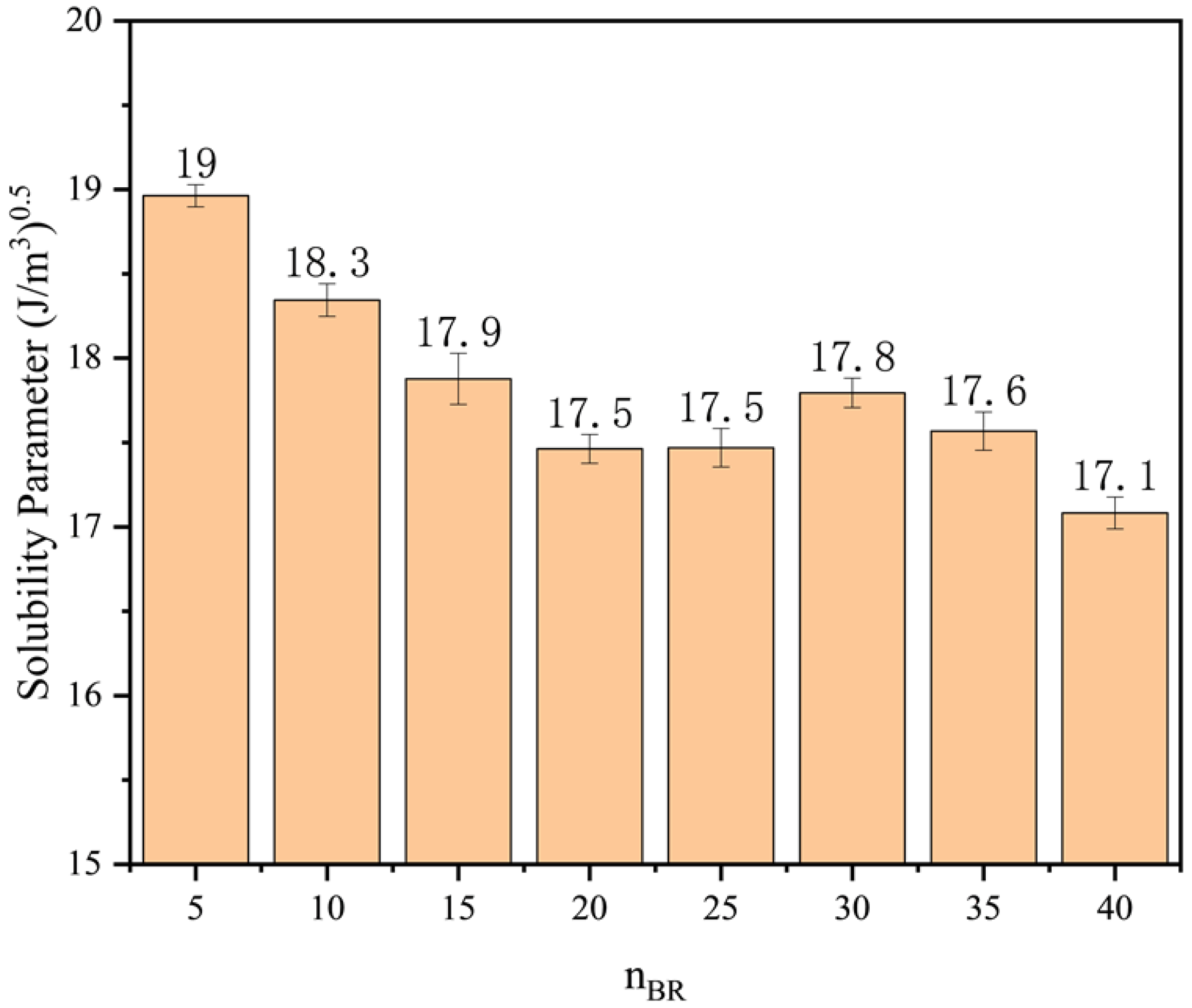
In this study, molecular models of a BR chain and a PW molecule were constructed using the visualization module in Materials Studio 7.0 [12]. When building the BR molecular model, selecting an appropriate chain length is critical: a chain that is too short introduces significant terminal effects, reducing its ability to represent the actual system, whereas a chain that is too long leads to computationally prohibitive costs. To determine a suitable range for the BR chain length (n), the solubility parameter (δ) was evaluated as a function of chain length; the results are presented in Figure 1.
Cohesive energy density (CED) is defined as the energy required to completely vaporize a unit volume of material, representing the summation of all intermolecular interactions—including van der Waals forces, hydrogen bonding, and other non-covalent attractions [13]. The cohesive energy density is represented by Equation (1). The solubility parameter, defined as the square root of cohesive energy density, was proposed by Hildebrand to quantify material polarity and solubility behavior. The solubility parameter is represented by Equation (2).
C E D = Δ E vap V m
δ = C E D = Δ E vap V m
where Δ E vap is the molar vaporization energy (sublimation energy for solids), and V m denotes the molar volume.
Using the Packing function within the Amorphous Cell module, amorphous BR models were constructed with fixed volume and density (40 × 40 × 40 Å, 0.91 g/cm3) while varying the chain length and number of molecules. These models underwent 100 ps of molecular dynamics (MD) simulation in the isothermal–isobaric (NPT) ensemble at 298 K. As shown in Figure 1, the solubility parameter (δ) of BR converges when the chain length n reaches 20. The calculated δ value of 17.5 at n = 20 differs by only 2% from the experimental value of 17.15 [14]. This indicates that a polymerization degree of 20 is sufficient to represent the polymeric behavior, achieving a balance between computational accuracy and efficiency. The PW molecular model is represented by C22H46.
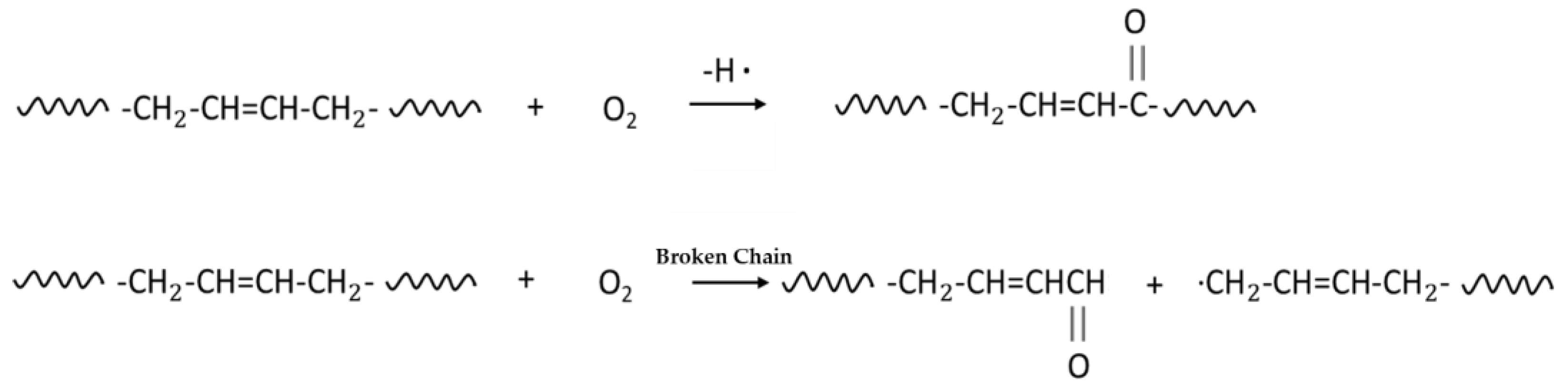
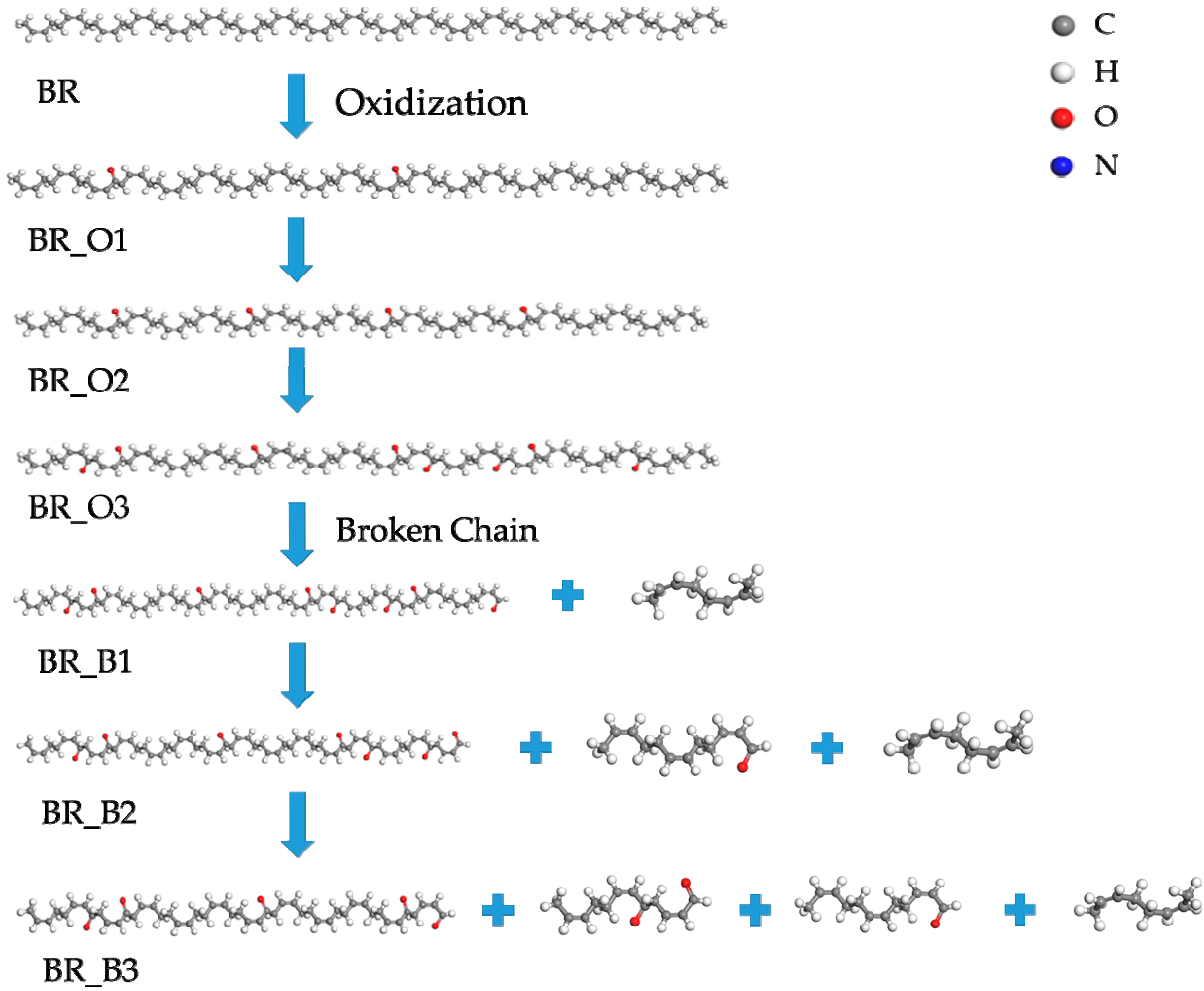
Based on the aging mechanism of BR depicted in Figure 2, oxygen atoms were introduced by replacing hydrogen atoms in two, four, and eight repeating units of the BR molecular chain [7]. These modifications correspond to oxidation degrees of 10%, 20%, and 40%, with the resulting structures denoted as BR_O1, BR_O2, and BR_O3, respectively. Additionally, oxidative chain scission was modeled by cleaving the polymer backbone at statistically selected α-H sites along unoxidized repeating units, leading to the formation of acrolein end groups. The newly generated chain termini were saturated with hydrogen atoms to simulate BR degradation via chain scission. The resulting fragmented BR chains are designated as BR_B1, BR_B2, and BR_B3 [15,16,17,18]. The scission sites were selected using a statistical approach. First, oxidized units along the BR chain were identified, as chain cleavage is favored at these weakened bonds or their immediate vicinity. From this set of oxidized units, a defined number of sites were then chosen randomly yet uniformly to undergo scission. For instance, in the OX_3 model (containing eight oxidized units), three bonds were designated for breakage. These three scission points were sequentially selected from among the eight oxidized units to simulate the progressive nature of chain degradation during aging. Finally, to avoid excessive clustering of breaks, the selected sites were distributed approximately evenly along the polymer backbone. The resulting BR chains with different aging states, constructed according to the thermo-oxidative aging mechanism, are depicted in Figure 3.
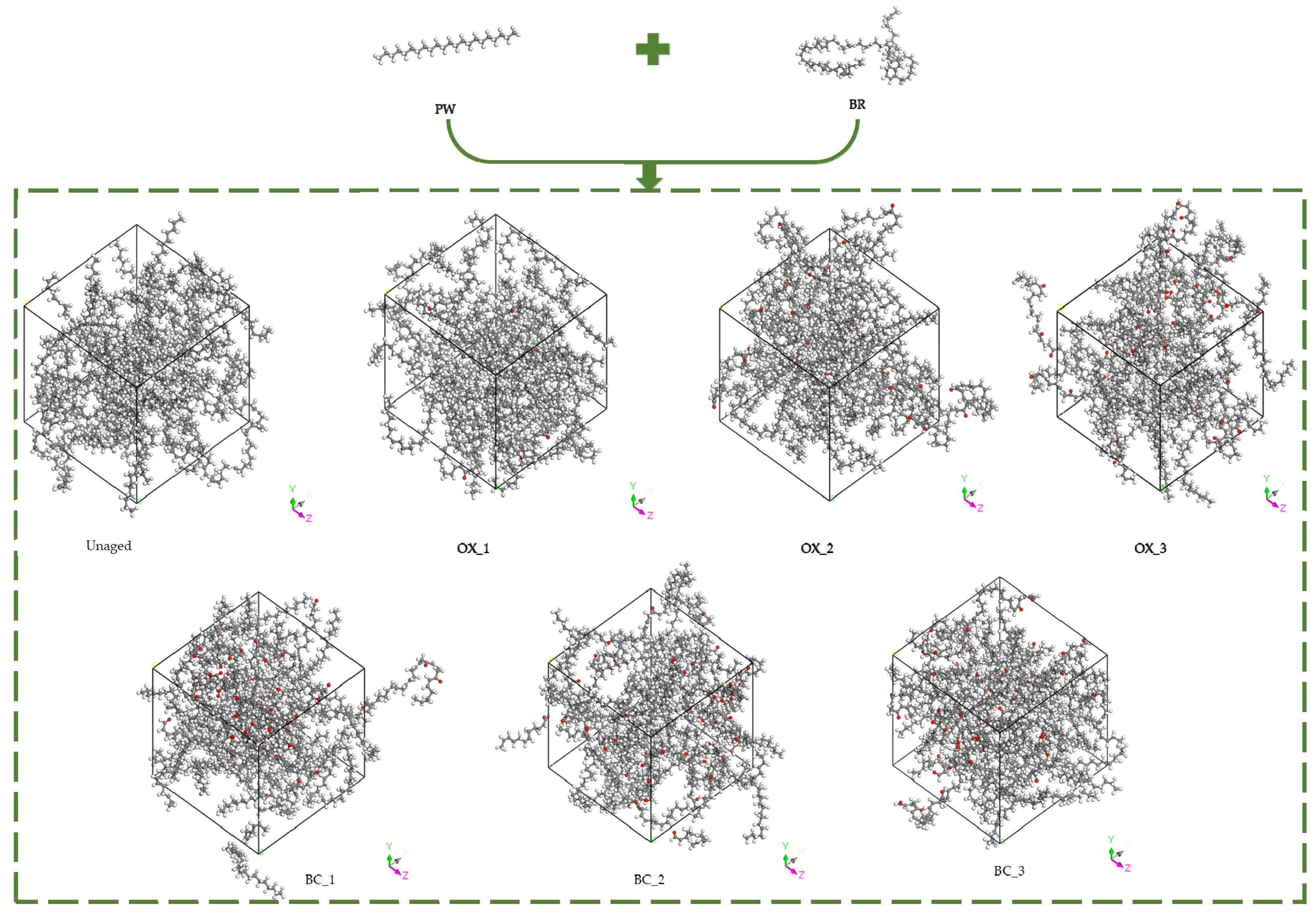
According to the formulation of RDX-based polymer-bonded explosives developed by the Southwest Technology and Engineering Research Institute, the mass ratio of BR to PW is 1:1. An amorphous BR/PW model was constructed using the Amorphous Cell module, consisting of eight BR polymer chains and twenty-eight paraffin wax (PW) molecules. The initial simulation cell dimensions were 32.45 × 32.45 × 32.45 Å. Based on the BR/PW mass ratio, the initial density of the model was set to 0.844 g/cm3. Aged composite models were subsequently built by combining BR chains at different degradation states with PW. Each aging system comprises eight BR chains with varying degrees of aging and twenty-eight PW molecules. For instance, the OX_1 system contains eight BR_O1 chains and twenty-eight PW molecules. The cell parameters of the different-aged models are summarized in Table 1, and the aging compliance models for each system are presented in Figure 4.

2.2. Establishment of the RDX/Binder Interface Model

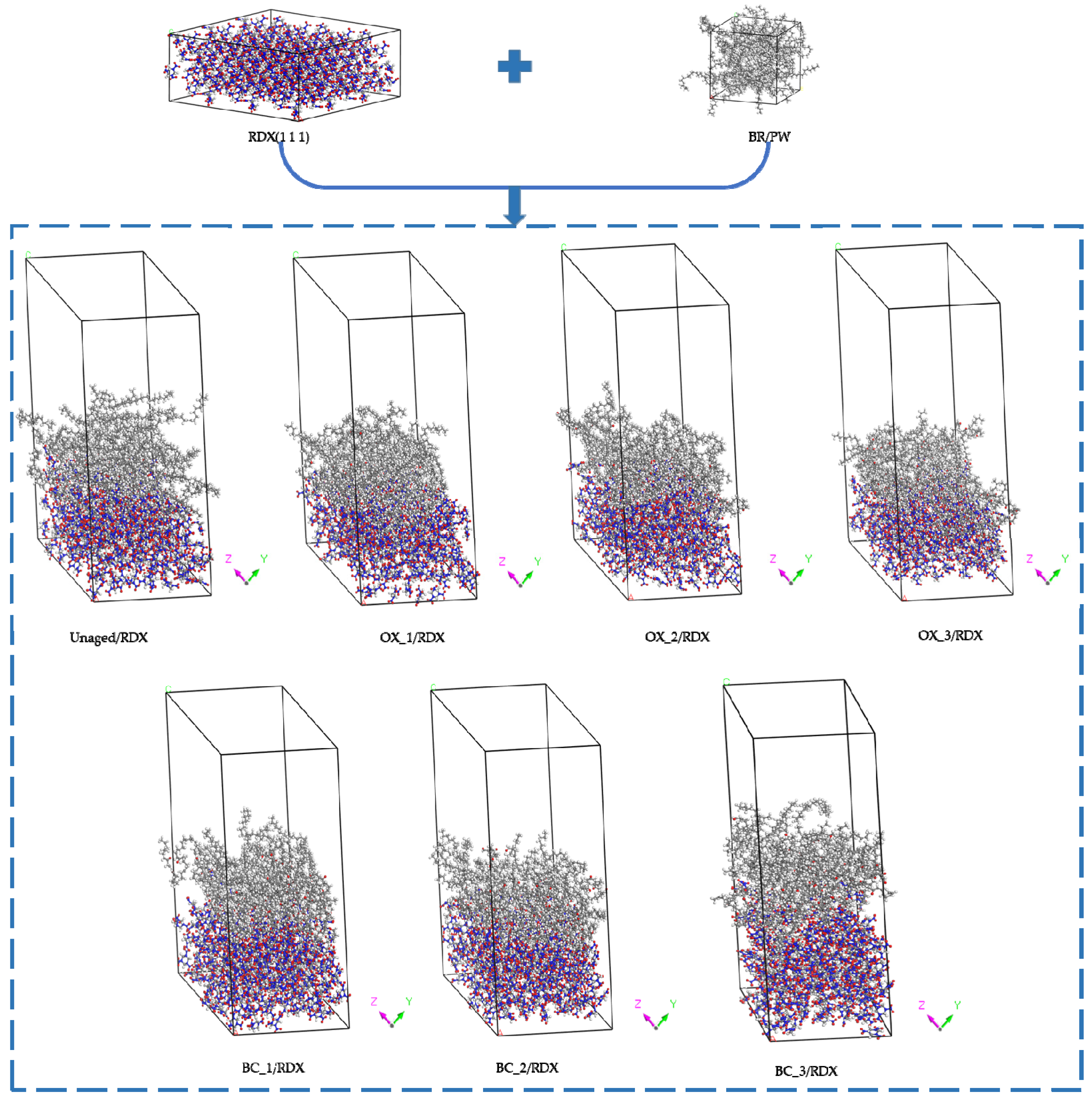
The (111) surface of RDX crystals is the largest and most common surface in real RDX crystals, typically exhibiting higher surface energy. This plane presents a specific arrangement of RDX molecules in which key functional groups (–NO2 groups) are oriented in a way that readily interacts with the binder, making it particularly suitable for studying polar interactions. Therefore, the (111) crystal plane was selected to construct the RDX/binder interface model [19]. The RDX crystal unit cell was obtained from the Crystallography Open Database (COD), with unit cell parameters of 13.18 × 11.57 × 10.71 Å [20]. The RDX unit cell was cleaved along the (111) crystallographic plane to generate a 25 Å-thick slab. This cleaved surface was periodized into a vacuum-free simulation box and expanded into a 3 × 3 × 1 supercell to create the RDX substrate. Subsequently, the BR/PW composite model was interfaced with the RDX layer using the Build Layers module, with a 50 Å vacuum buffer established perpendicular to the interface plane to mitigate periodic image artifacts. The construction process of the unaged BR/PW composite model and its interface with RDX is schematically illustrated in Figure 5.

2.3. Simulation Methods

The models were geometrically optimized using the Forcite module with the Smart Minimizer algorithm [21,22]. Subsequently, 10 annealing cycles were carried out under the NPT ensemble, with the temperature alternating between 298 K and 598 K. After each annealing step, the structures were re-optimized to ensure complete conformational relaxation. The lowest-energy configuration obtained from the annealing series was selected for subsequent molecular dynamics (MD) simulations. The optimized lowest-energy configuration underwent the following MD simulations sequentially: first, a 300 ps NVT ensemble simulation was conducted to achieve thorough conformational relaxation, followed by a 600 ps NPT ensemble simulation to obtain an equilibrated system configuration. All simulations employed the COMPASS II forcefield, which accurately describes the structural, dynamical, and thermo-dynamical properties of polymers and condensed-phase materials [23,24]. The simulations employed a 1 fs timestep, with temperature regulation via the Andersen thermostat and pressure control using the Berendsen barostat [25,26]. Van der Waals interactions were treated with an atom-based summation method, while electrostatic interactions were calculated using the Ewald summation technique [27,28].

3. Results

3.1. Cohesive Energy Density and Solubility Parameter

The cohesive energy density (CED) and solubility parameter (δ) values for the various aged BR/PW models are listed in Table 2. At the initial stage of aging, the introduction of oxygen atoms into the BR chains enhances their polarity, resulting in an increase in both CED and δ compared to the unaged system. Although chain scission in BR reduces cohesion by weakening chain entanglements and van der Waals interactions, the overall effect is dominated by the increased polarity from oxidation. Consequently, the solubility parameter exhibits a slight increase even after chain scission relative to the pre-scission state. Since PW is non-polar and possesses a low solubility parameter, the overall δ of the BR/PW composite rises from 17.04 (J·cm3)0.5 for the Unaged model to 17.85 (J·cm3)0.5 for the OX_3 model (40% oxidation). This widening gap in solubility parameters between BR and PW indicates that oxidation and chain scission progressively deteriorate the compatibility of BR with PW.

3.2. Fractional Free Volume

Free volume refers to the “void” space unoccupied by molecules or chain segments within a substance, representing the local space required for segmental motion or molecular diffusion [29]. The fraction free volume can be represented by Equation (3).
F F V = V F V = 1 V O V
where V represents cell volume, VO represents occupied volume, and VF represents free volume.
In molecular dynamics simulations, the free volume of each aged system was calculated using the scanning probe method via the Atom Volumes & Surfaces tool, with a Connolly radius of 0.5 Å. The resulting free volume fractions are summarized in Table 3. As oxidation proceeds, the free volume fraction decreases from 0.183 in the unaged model to 0.166 in the OX_3 model. In contrast, chain scission in BR increases the free volume fraction from 0.166 in the OX_3 model to 0.175 in the BC_3 model. During the initial stage of thermo-oxidative aging, oxidation enhances the polarity of BR chains, strengthening intermolecular attractions and promoting tighter molecular packing. This restricts the rotational and torsional freedom of the polymer chains, thereby reducing the free volume fraction. As aging continues, chain scission generates shorter fragments that exhibit higher mobility and introduce greater local structural disorder, which in turn elevates the free volume fraction.

3.3. Mean Square Displacement

The mean squared displacement (MSD) quantifies the average of the squared displacement of particles relative to their initial positions over a time interval [30]. The mean squared displacement is represented by Equation (4).
M S D ( t ) = < r ( t ) r ( 0 ) 2 >
where r(t) denotes the position vector of a particle at time t, < > represents the ensemble average over all particles or time spans.
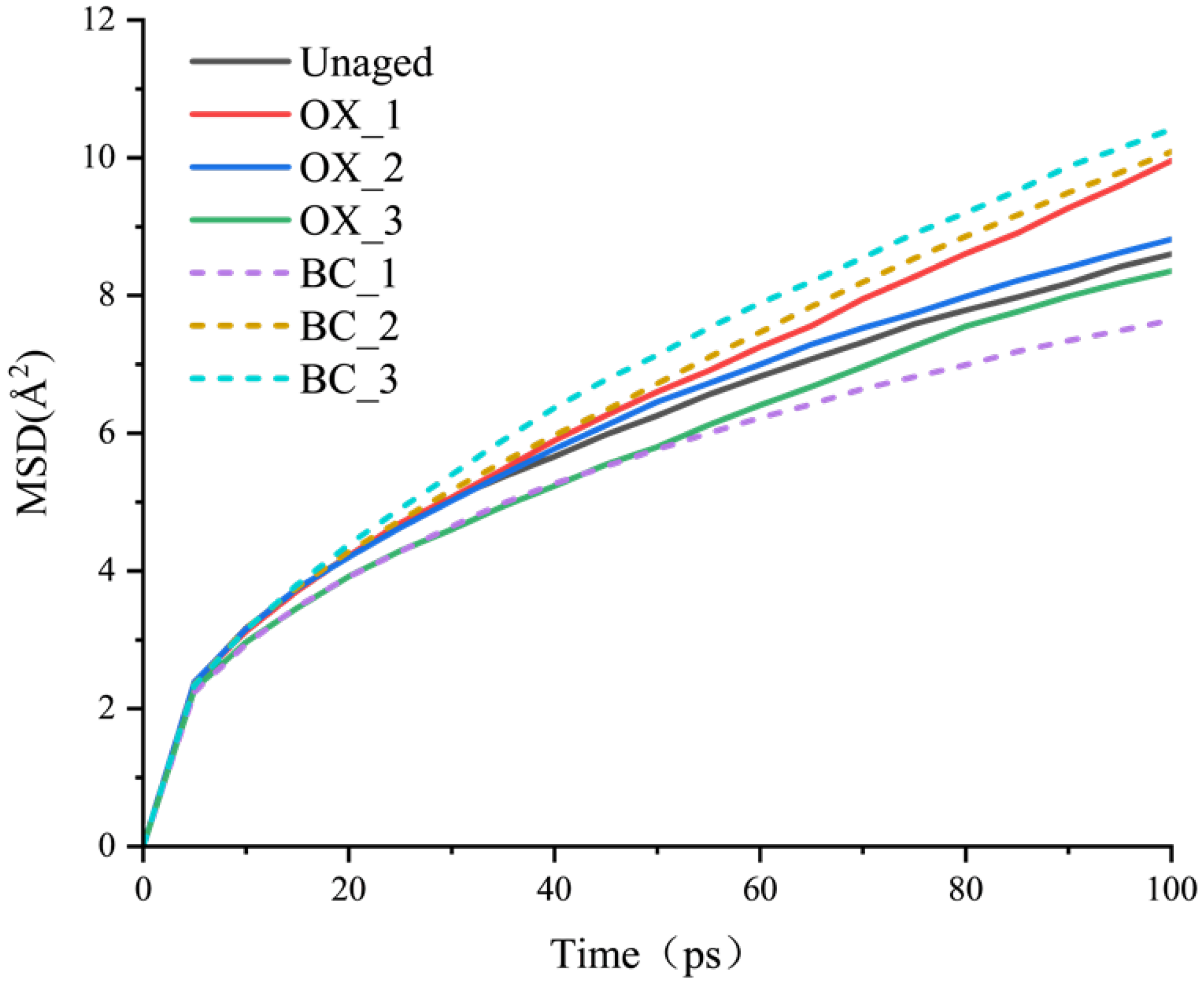
Figure 6 presents the mean squared displacement (MSD) of paraffin wax (PW) within all BR/PW models examined. Within the initial 50 ps, the MSD curves for all systems rise rapidly before transitioning to a slower, approximately linear increase. As thermo-oxidative aging proceeds, the initial oxidation of BR chains rapidly enhances molecular polarity, which subsequently stabilizes. This change is reflected in the MSD of PW, which first increases and then gradually decreases. In contrast, chain scission in BR generates a greater number of short-chain molecules, which promotes the diffusion of PW through the rubber matrix and leads to an overall rise in its mean squared displacement.

3.4. Mechanical Properties

Mechanical properties are a key indicator for determining whether PBXs can perform normally after long-term storage. The mechanical properties calculation module in MS 7.0 employs the constant strain method to apply a series of small finite strains to different binder models [31,32,33]. Using the virial theorem, the internal stress tensor is obtained, allowing the derivation of the elastic coefficient matrix for each binder model. Subsequently, the Lamé coefficients are determined from the matrix parameters, followed by the calculation of key mechanical properties such as Young’s modulus (E), bulk modulus (K), shear modulus (G), and Cauchy pressure (C12–C44). A single simulation was performed for each binder system, with the results presented in Table 4 and Table 5.
As shown in Table 4, the values of C11, C22, and C33 were 23, and the values of C44, C55, and C66 in the different aged systems. This indicates that the BR/PW binder system is close to an isotropic elastomer [34]. As can be seen from Table 5, the Cauchy pressure values of all aged systems were greater than 0, indicating ductile behavior of the binder systems. As oxidative chain scission progresses, the K/G values generally remain elevated compared to the Unaged model. Relative to the Unaged model, both Young’s modulus and shear modulus exhibit an overall decreasing trend across the aged models, indicating that oxidative chain scission in BR molecular chains leads to diminished stiffness and yield strength of the system. The mechanical properties of the models depend on the interactions between components. The aging of BR molecular chains weakens the intermolecular interactions, a trend that aligns with the variations observed in the fractional free volume.

3.5. Interface Binding Energy

The interfacial binding energy refers to the energy released when materials on both sides of a unit area interface bond together (or the energy required to separate them), conventionally denoted as Ebind [35]. The interfacial binding energy can be expressed by Equation (5).
E inter = E total ( E RDX + E BR / PW )
where Etotal is the total energy of the composite system; ERDX and EBR/PW refer to the energy when the RDX matrix and the binder system exist separately, respectively.
The interfacial binding energies of the RDX/binder systems are summarized in Table 6. Within these systems, neither the total binding energy nor the contribution from RDX exhibited significant variation. However, changes in the polymer component’s binding energy across the aged systems reveal a clear trend: during the initial thermo-oxidative aging stage, oxidation of the BR chains raises the system energy and intensifies molecular motion, which correspondingly reduces the load-bearing capacity of the binder. Furthermore, the RDX (111) surface offers a distinct molecular arrangement where key functional groups (–NO2) are oriented to favor interactions with the binder. This configuration is particularly relevant for probing polar interactions, especially after thermo-oxidative aging enhances the binder’s polarity and strengthens the interfacial adhesion.
Specifically, oxidation increases the interfacial binding energy from −325.70 kcal/mol in the Unaged model to −502.25 kcal/mol in the OX_3 model. In contrast, chain scission in BR lowers the interfacial binding energy from −502.25 kcal/mol in the OX_3 model to −474.63 kcal/mol in the BC_3 model.

4. Conclusions

This study utilized molecular dynamics simulations to examine how thermal-oxidative aging of BR affects its compatibility with PW in the binder system of RDX-based polymer-bonded explosives. Atomic-scale interface models between the binder system and RDX crystal surfaces were also constructed to quantitatively evaluate changes in interfacial binding energy induced by the aging process.
The results indicate that both oxidation and chain scission during thermo-oxidative aging elevate the cohesive energy density and solubility parameter of BR. Initially, the incorporation of oxygen enhances molecular polarity, leading to a marked increase in these properties relative to the unaged system. Although chain scission reduces cohesive energy density by weakening chain entanglements and van der Waals interactions, this reduction is offset in the early aging stage by the stronger effect of oxidation-induced polarity. Consequently, the solubility parameter shows only a modest increase following chain scission. As the difference in solubility parameters between BR and PW gradually widens, the oxidation and chain scission of BR ultimately degrade its compatibility with PW.
During the initial stage of thermo-oxidative aging, the oxidation of BR chains increases their polarity, which strengthens intermolecular attraction and promotes tighter molecular packing. This in turn restricts the rotational freedom of the chains and reduces the fractional free volume. As aging progresses, chain scission generates more short-chain molecules, enhancing molecular mobility and local structural disorder, and consequently increasing the fractional free volume. The initial oxidation-induced polarity also gradually reduces the mean-squared displacement of PW. By contrast, chain scission raises the population of short BR chains, which facilitates the diffusion of PW within the rubber matrix and leads to a higher mean-squared displacement.
Regarding mechanical properties, Young’s modulus and shear modulus decrease in all aged systems. Both oxidation and chain scission of the BR molecular chains reduce the stiffness and yield strength of the composite. Specifically, oxidation enhances the interfacial binding energy between the RDX matrix and the binder, whereas chain scission led to a slight decrease in binding energy.

Author Contributions

Conceptualization, Y.-C.L. and X.-H.J.; methodology, L.-D.W.; validation, L.-D.W., Y.-C.L. and D.-M.S.; formal analysis, L.-D.W.; investigation, L.-D.W., Y.-C.L., D.-M.S. and X.-H.J.; resources, X.-H.J. and Y.-C.L.; data curation, L.-D.W., Y.-C.L. and D.-M.S.; writing—original draft preparation, L.-D.W.; writing—review and editing, X.-H.J.; supervision, X.-H.J.; project administration, Y.-C.L.; and funding acquisition, Y.-C.L. All authors have read and agreed to the published version of the manuscript.

Funding

This work was funded by Southwest Technology and Engineering Research Institute Funding, HDH5923A0204.

Data Availability Statement

Data will be made available on request.

Conflicts of Interest

The authors declare no conflicts of interest.

References

  1. Goldrein, H.T.; Rae, P.J.; Palmer, S.J.P.; Lewis, A.L. Ageing Effects on the Mechanical Properties of a Polymer Bonded Explosive. In Ageing Studies and Lifetime Extension of Materials; Springer: Boston, MA, USA, 2001; pp. 129–136. [Google Scholar] [CrossRef]
  2. Li, K.-l.; Xu, T.; Li, X.; Han, Z.-w.; Wang, B.-l. Effect of Accelerated Aging on the Performances of RDX-based Pressed PBX. Chin. J. Energetic Mater. 2018, 26, 416–421. [Google Scholar] [CrossRef]
  3. Liu, X.; Yang, R.; Xu, Z.-P.; Ye, Y.; Tang, G.-S.; Zhao, M.; Zhang, Q.; Meng, X.-Z. Characterization of Polymer Aging: A Review. Chin. J. Polym. Sci. 2024, 42, 1642–1660. [Google Scholar] [CrossRef]
  4. Noble Jesus, C.; Evans, R.; Forth, J.; Estarellas, C.; Gervasio, F.L.; Battaglia, G. Amphiphilic Histidine-Based Oligopeptides Exhibit pH-Reversible Fibril Formation. ACS Macro Lett. 2021, 10, 984–989. [Google Scholar] [CrossRef]
  5. Xu, S.; Wu, Z.; Pang, A.M.; Li, H.X.; Tang, G. Application of Nitrile Butadiene Rubber Bonding Agents in CL-20/GAP System. Huozhayao Xuebao/Chin. J. Explos. Propellants 2018, 41, 578–581. [Google Scholar] [CrossRef]
  6. Gao, X.; Zhao, T.; Luo, G.; Zheng, B.; Huang, H.; Chai, Y.; Ma, R.; Han, X. A novel form-stable paraffin-based hydroxyl-terminated polybutadiene binder containing microencapsulated paraffin wax. J. Therm. Anal. Calorim. 2019, 135, 2125–2136. [Google Scholar] [CrossRef]
  7. Liang, L.; Zhong, J.; Ding, L.; Li, Z.; Zou, Y. Mechanism of Thermal Oxidative Aging of Butadiene Rubber. Polym. Mater. Sci. Eng. 2019, 35, 107–111. [Google Scholar] [CrossRef]
  8. Qian, C.; Chen, J.; Wang, S.; Wang, M.; Song, S. Molecular dynamics investigation on the thermal-oxidative aging and mechanical properties of nitrile butadiene rubber composites with molybdenum disulfide. Appl. Phys. A 2024, 130, 256. [Google Scholar] [CrossRef]
  9. Zheng, W.; Zhao, X.; Li, Q.; Chan, T.; Zhang, L.; Wu, S. Compressive stress relaxation modeling of butadiene rubber under thermo-oxidative aging. J. Appl. Polym. Sci. 2016, 134, 44630. [Google Scholar] [CrossRef]
  10. Olejnik, A.; Smejda-Krzewicka, A.; Strzelec, K. Effect of antioxidants on aging of the chloroprene rubber/butadiene rubber (CR/BR) blends. Int. J. Polym. Anal. Charact. 2019, 24, 475–486. [Google Scholar] [CrossRef]
  11. Zhang, F.; Yang, R.; Lu, D. Investigation of Polymer Aging Mechanisms Using Molecular Simulations: A Review. Polymers 2023, 15, 1928. [Google Scholar] [CrossRef]
  12. Akkermans, R.L.C.; Spenley, N.A.; Robertson, S.H. Monte Carlo methods in Materials Studio. Mol. Simul. 2013, 39, 1153–1164. [Google Scholar] [CrossRef]
  13. Li, C.; Strachan, A. Cohesive energy density and solubility parameter evolution during the curing of thermoset. Polymer 2018, 135, 162–170. [Google Scholar] [CrossRef]
  14. Small, P.A. Some factors affecting the solubility of polymers. J. Appl. Chem. 1953, 3, 71–80. [Google Scholar] [CrossRef]
  15. Li, Y.; Li, G.; Kong, L.; Zang, H. Experimental measurement and molecular dynamics simulation analysis of thermal aging performance in composite solid propellants. Polym. Degrad. Stab. 2024, 225, 110812. [Google Scholar] [CrossRef]
  16. Kong, L.; Dong, K.; Tang, Y.; Lai, S. Molecular Dynamics Simulation of the Influence of PEG-TDI Aging Degradation on Diffusibility and Compatibility of NG and BTTN. Propellants Explos. Pyrotech. 2021, 46, 1436–1446. [Google Scholar] [CrossRef]
  17. Ren, S.; Liu, X.; Lin, P.; Erkens, S.; Xiao, Y. Chemo-physical characterization and molecular dynamics simulation of long-term aging behaviors of bitumen. Constr. Build. Mater. 2021, 302, 124437. [Google Scholar] [CrossRef]
  18. Bao, C.; Xu, Y.; Zheng, C.; Nie, L.; Yang, X. Rejuvenation effect evaluation and mechanism analysis of rejuvenators on aged asphalt using molecular simulation. Mater. Struct. 2022, 55, 52. [Google Scholar] [CrossRef]
  19. Chen, G.; Wang, F. Molecular modeling and prediction of RDX crystal morphology. J. Energetic Mater. 2013, 21, 583–588. [Google Scholar] [CrossRef]
  20. Zhurov, V.V.; Zhurova, E.A.; Stash, A.I.; Pinkerton, A.A. Importance of the consideration of anharmonic motion in charge-density studies: A comparison of variable-temperature studies on two explosives, RDX and HMX. Acta Crystallogr. A 2011, 67, 160–173. [Google Scholar] [CrossRef] [PubMed]
  21. Wei, Q.; Zhang, Y.; Wang, Y.; Yang, M. A molecular dynamic simulation method to elucidate the interaction mechanism of nano-SiO2 in polymer blends. J. Mater. Sci. 2017, 52, 12889–12901. [Google Scholar] [CrossRef]
  22. Wang, B.; Gu, B.; Zhang, H.; Feng, X. Molecular Dynamics Simulation on Hydrogen Ion Implantation Process in Smart-Cut Technology. Acta Mech. Solida Sin. 2016, 29, 111–119. [Google Scholar] [CrossRef]
  23. Kondratyuk, N.D.; Pisarev, V.V. Calculation of viscosities of branched alkanes from 0.1 to 1000 MPa by molecular dynamics methods using COMPASS force field. Fluid Phase Equilibria 2019, 498, 151–159. [Google Scholar] [CrossRef]
  24. Sun, H.; Jin, Z.; Yang, C.; Akkermans, R.L.C.; Robertson, S.H.; Spenley, N.A.; Miller, S.; Todd, S.M. COMPASS II: Extended coverage for polymer and drug-like molecule databases. J. Mol. Model. 2016, 22, 47. [Google Scholar] [CrossRef]
  25. Andersen, H.C. Molecular dynamics simulations at constant pressure and/or temperature. J. Chem. Phys. 1980, 72, 2384–2393. [Google Scholar] [CrossRef]
  26. Berendsen, H.J.C.; Postma, J.P.M.; van Gunsteren, W.F.; DiNola, A.; Haak, J.R. Molecular dynamics with coupling to an external bath. J. Chem. Phys. 1984, 81, 3684–3690. [Google Scholar] [CrossRef]
  27. Ding, H.Q.; Karasawa, N.; Goddard, W.A., III. Atomic level simulations on a million particles: The cell multipole method for Coulomb and London nonbond interactions. J. Chem. Phys. 1992, 97, 4309–4315. [Google Scholar] [CrossRef]
  28. Toukmaji, A.Y.; Board, J.A. Ewald summation techniques in perspective: A survey. Comput. Phys. Commun. 1996, 95, 73–92. [Google Scholar] [CrossRef]
  29. Abbott, A.P.; Harris, R.C.; Ryder, K.S.; D’Agostino, C.; Gladden, L.F.; Mantle, M.D. Glycerol eutectics as sustainable solvent systems. Green Chem. 2011, 13, 82–90. [Google Scholar] [CrossRef]
  30. Chakraborty, T.; Hens, A.; Kulashrestha, S.; Chandra Murmu, N.; Banerjee, P. Calculation of diffusion coefficient of long chain molecules using molecular dynamics. Phys. E Low-Dimens. Syst. Nanostruct. 2015, 69, 371–377. [Google Scholar] [CrossRef]
  31. Dong, K.; Zhai, Z.; Jia, B. Swelling Characteristics and Interaction Mechanism of High-Rank Coal during CO2 Injection: A Molecular Simulation Study. ACS Omega 2022, 7, 6911–6923. [Google Scholar] [CrossRef] [PubMed]
  32. Sharma, S.; Chandra, R.; Kumar, P.; Kumar, N. Mechanical Properties of Carbon Nanofiber Reinforced Polymer Composites-Molecular Dynamics Approach. JOM 2016, 68, 1717–1727. [Google Scholar] [CrossRef]
  33. Sharma, S.; Chandra, R.; Kumar, P.; Kumar, N. Molecular dynamics simulation of polymer/carbon nanotube composites. Acta Mech. Solida Sin. 2015, 28, 409–419. [Google Scholar] [CrossRef]
  34. Guo, F.; Zhang, J.; Pei, J.; Zhou, B.; Hu, Z. Study on the Mechanical Properties of Rubber Asphalt by Molecular Dynamics Simulation. J. Mol. Model. 2019, 25, 365. [Google Scholar] [CrossRef] [PubMed]
  35. Koyanagi, J.; Itano, N.; Yamamoto, M.; Mori, K.; Ishida, Y.; Bazhirov, T. Evaluation of the mechanical properties of carbon fiber/polymer resin interfaces by molecular simulation. Adv. Compos. Mater. 2019, 28, 639–652. [Google Scholar] [CrossRef]
Figure 1. Solubility parameter (δ) of BR vs. length of molecular chain.
Solids 07 00006 g001
Figure 2. Oxidation and Chain Scission Reactions of BR.
Solids 07 00006 g002
Figure 3. Establishment of Models for Oxidation and Chain Scission of BR.
Solids 07 00006 g003
Figure 4. Construction of the BR/PW Amorphous Model.
Solids 07 00006 g004
Figure 5. Establishment of RDX and Composite Adhesive Interface Model.
Solids 07 00006 g005
Figure 6. Mean Squared Displacement (MSD) of Paraffin Wax.
Solids 07 00006 g006
Table 1. Cell parameters of different aging models.
SystemLengths (Å)Angles (Degrees)
abcαβγ
Unaged32.5632.5632.56909090
OX_132.6532.6532.65909090
OX_232.4932.4932.49909090
OX_332.3932.3932.39909090
BC_132.4432.4432.44909090
BC_232.6132.6132.61909090
BC_332.6932.6932.69909090
Table 2. Cohesive Energy Density and Solubility Parameter for Each Aged Model.
SystemCED/(J/m3)δ/(J/m3)0.5
Unaged2.90 × 10817.04
OX_12.94 × 10817.14
OX_23.03 × 10817.41
OX_33.19 × 10817.85
BC_13.32 × 10818.23
BC_23.24 × 10818.01
BC_33.30 × 10818.16
Note: CED denotes the cohesive energy density, while δ represents the solubility parameter.
Table 3. Fractional Free Volume of Aged Models.
SystemV3Vo3VF3FFV
Unaged34,523.3628,190.056333.310.183
OX_134,806.0328,063.346742.690.194
OX_234,291.5228,228.596062.930.177
OX_333,973.9028,350.805623.100.166
BC_134,153.8228,598.775555.050.163
BC_234,668.6328,632.636036.000.174
BC_334,922.6728,803.096119.580.175
Note: V denotes the total volume, Vo represents the occupied volume, VF indicates the free volume, and FFV is the fractional free volume.
Table 4. Elastic constants.
SystemC11C12C13C22C23C33C44C55C66
Unaged6.904.684.946.794.776.991.191.070.90
OX_16.014.844.426.514.896.600.951.160.96
OX_27.925.325.267.785.247.591.101.091.25
OX_36.615.074.976.834.617.551.041.050.99
BC_17.195.415.127.034.887.311.171.041.25
BC_27.725.285.226.855.006.830.800.911.14
BC_37.085.135.156.565.126.981.090.891.42
Table 5. Different mechanical modulus.
SystemLambda, GPaMu, GPaK, GPaG, GPaE, GPaC12–C44K/G
Unaged4.791.055.481.012.803.495.42
OX_14.331.035.160.851.963.896.10
OX_25.471.156.101.163.384.225.25
OX_34.941.035.400.922.234.025.85
BC_14.871.165.791.062.534.245.48
BC_25.230.955.770.962.964.485.99
BC_34.611.135.700.952.614.046.01
Table 6. Binding energy of RDX/binder system interfaces.
SystemEtotal, kcal/molERDX, kcal/molEBR/PW, kcal/molEbind, kcal/mol
Unaged/RDX−40,560.70−39,936.10−298.90−325.70
OX-1/RDX−40,580.40−39,927.90−289.41−363.06
OX-2/RDX−40,514.00−39,861.50−190.94−461.54
OX-3/RDX−40,250.50−39,679.70−68.55−502.25
BC-1/RDX−40,322.30−39,770.60−74.01−477.69
BC-2/RDX−40,463.40−39,946.00−69.67−447.70
BC-3/RDX−40,504.30−39,945.30−84.36−474.63
Disclaimer/Publisher’s Note: The statements, opinions and data contained in all publications are solely those of the individual author(s) and contributor(s) and not of MDPI and/or the editor(s). MDPI and/or the editor(s) disclaim responsibility for any injury to people or property resulting from any ideas, methods, instructions or products referred to in the content.