
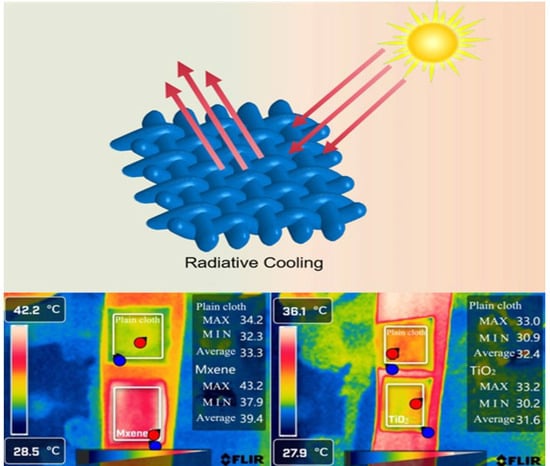
Synergistic Integration of MXene Photothermal Conversion and TiO2 Radiative Cooling in Bifunctional PLA Fabrics for Adaptive Personal Thermal Management


Abstract
Share and Cite
Han, T.; Yin, Y. Synergistic Integration of MXene Photothermal Conversion and TiO2 Radiative Cooling in Bifunctional PLA Fabrics for Adaptive Personal Thermal Management. Solids 2025, 6, 37. https://doi.org/10.3390/solids6030037
Han T, Yin Y. Synergistic Integration of MXene Photothermal Conversion and TiO2 Radiative Cooling in Bifunctional PLA Fabrics for Adaptive Personal Thermal Management. Solids. 2025; 6(3):37. https://doi.org/10.3390/solids6030037
Chicago/Turabian StyleHan, Tianci, and Yunjie Yin. 2025. "Synergistic Integration of MXene Photothermal Conversion and TiO2 Radiative Cooling in Bifunctional PLA Fabrics for Adaptive Personal Thermal Management" Solids 6, no. 3: 37. https://doi.org/10.3390/solids6030037
APA StyleHan, T., & Yin, Y. (2025). Synergistic Integration of MXene Photothermal Conversion and TiO2 Radiative Cooling in Bifunctional PLA Fabrics for Adaptive Personal Thermal Management. Solids, 6(3), 37. https://doi.org/10.3390/solids6030037