5.1. Cushion-Gas Injection
During the pre-filling stage, supercritical CO
2 is injected at a constant rate of 8 kg/s into the initially brine-saturated A-2 carbonate.
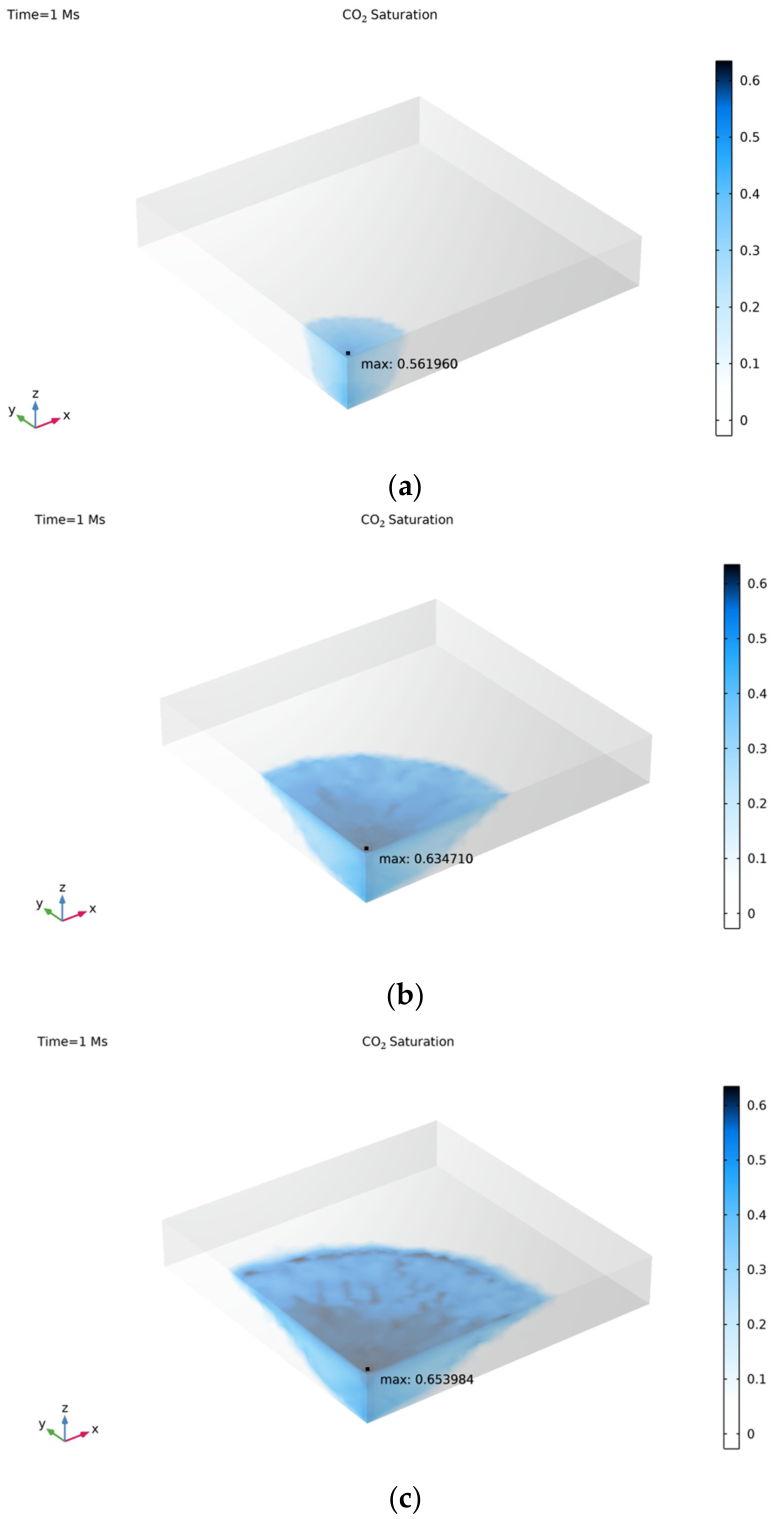
Figure 2a–c demonstrate 3D CO
2 saturation of the reservoir after 1, 5 and 8 months of injection, respectively, while
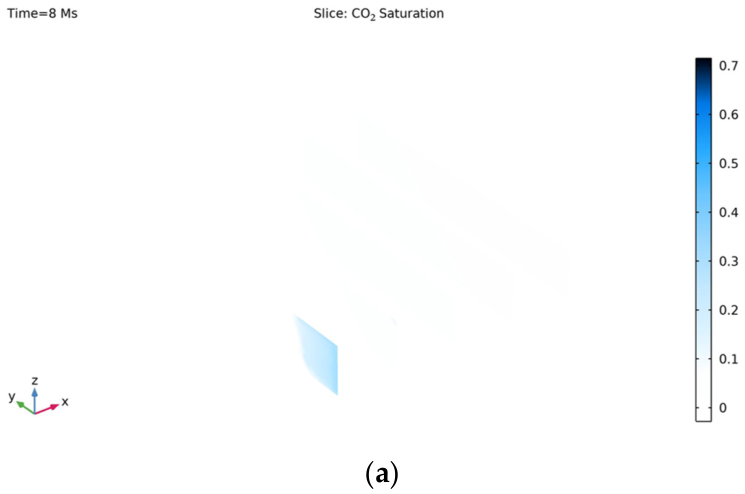
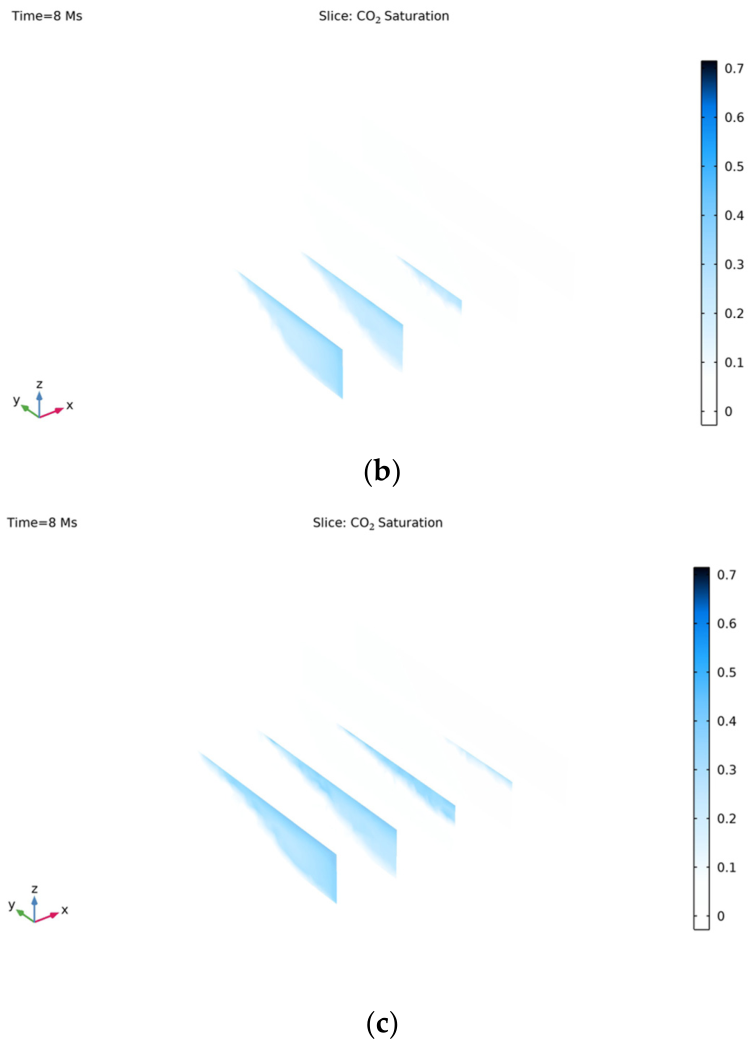
Figure 3a–c present vertical slices through the reservoir at the same times. After about 1 month, a compact CO
2 plume has formed around the well, with a maximum saturation of 0.56 confined to a limited radial extent. The plume is already strongly asymmetric in the vertical direction. CO
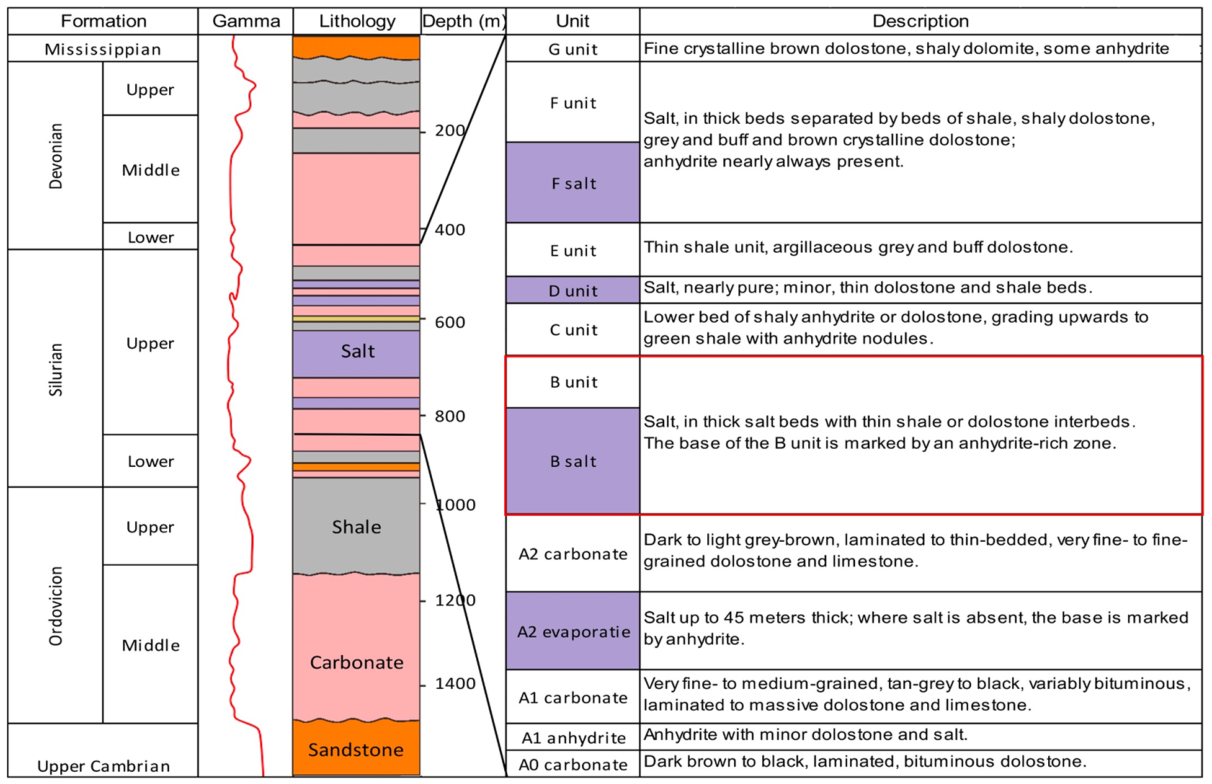
2 occupies mainly the upper part of the A-2 carbonate directly beneath the B salt, whereas the lower part of the reservoir remains brine-dominated. This observed plume geometry is controlled by the interaction of buoyancy and the limited reservoir thickness. Because supercritical CO
2 is less dense than brine, the plume rapidly traverses the 40 m vertical reservoir section and impinges on the impermeable B-salt top, after which further upward motion is arrested and the injected CO
2 is preferentially redistributed as a laterally spreading in the caprock-parallel layer.
By 5 months of injection, the CO2 front has migrated laterally along the reservoir top to a radial distance of roughly 250 m from the well. The plume geometry evolves into a broad wedge beneath the B salt, with CO2 saturation in the uppermost part of the reservoir reaching 0.63 around well and gradually tapering downward toward the reservoir mid-depth. In contrast, the lower few metres of the A-2 carbonate retain only modest CO2 saturation, and both the extent of the lower gas-filled zone and saturation show little growth compared with the 1-month results. This indicates that, once a continuous CO2 layer has formed beneath the B-salt caprock, plume evolution becomes strongly buoyancy-dominated: CO2 injected into the lower part of the completion is rapidly redistributed upward, and a quasi-steady balance is reached between local injection near the well and upward migration toward the reservoir top. Consequently, the lower portion of the reservoir remains largely brine-filled with a nearly stable, thin gas interval, while most incremental injected mass contributes to the lateral expansion and thickening of the caprock-parallel CO2 wedge in the upper reservoir. This behavior is further illustrated by vertical slices of saturation. In the slice intersecting the well, CO2 saturation reaches 0.62 and occupies almost the full upper part of the A-2 carbonate, whereas slices 100–200 m away show progressively thinner wedges with lower peak saturation. This systematic thinning and attenuation of the CO2 layer with distance from the well confirms a transition from advection-dominated filling in the near-well region to a more diffuse, buoyancy-assisted migration front in the far field. This distribution provides a favorable initial condition for subsequent cyclic operation, combining a high-saturation CO2 zone in the near-well region with a relatively stable brine column at the base of the reservoir that helps damp pressure fluctuations and limits early-time brine production.
After 8 months, the CO2 plume continues to spread radially beneath the reservoir top. The high-saturation wedge occupies much of the inner model domain, and the maximum saturation near the well increases slightly to about 0.65. Vertical slices through the A-2 carbonate reveal that the gas distribution is no longer simply centered on the well: in the slice intersecting the well, CO2 forms a relatively uniform caprock-parallel lens with peak saturation at 0.62, whereas in the adjacent slice that passes beyond the well, the highest saturation is located near the plume front. Farther out, slices show a progressively thinner layer with reduced maxima. This pattern indicates that, once a continuous CO2 layer has developed beneath the B-salt caprock, ongoing injection drives lateral accumulation of CO2 toward the advancing front, while advection near the well and buoyancy-assisted spreading in the far field jointly produce a smooth transition from CO2-rich to brine-dominated regions around the well. At this stage, plume growth is increasingly controlled by diffusion and dispersion, and CO2 accumulating at the far leading edge is unlikely to be effectively recovered during subsequent cyclic operation; from a CCES perspective, further extension of the cushion-gas injection period therefore provides little additional benefit. The increase in peak CO2 saturation becomes limited after the first several months, rising from about 0.56 after 1 month to 0.63 after 5 months and only slightly further to about 0.65 after 8 months. This suggests that the cushion-gas stage becomes progressively less efficient at increasing near-well working saturation; continued injection mainly expands the distal caprock-parallel plume rather than substantially increasing the recoverable high-saturation zone around the well.
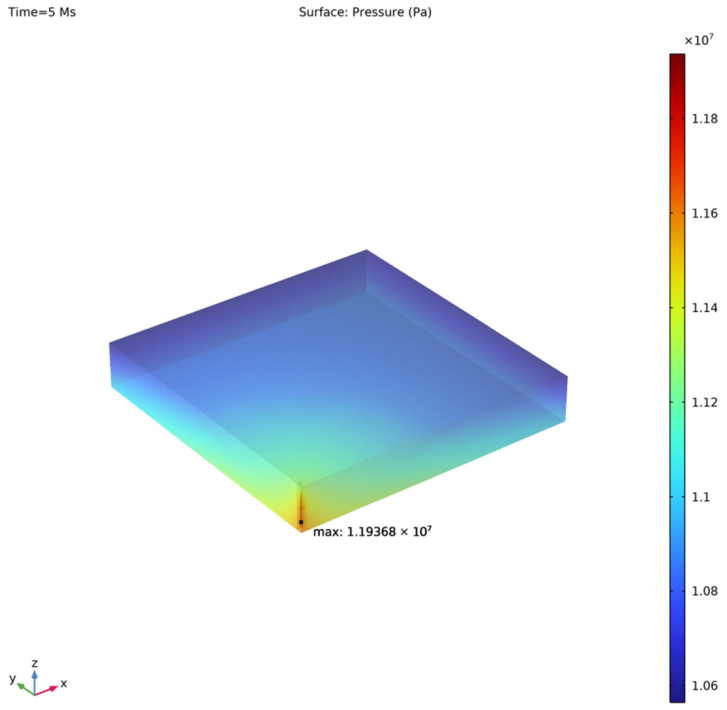
The associated pore pressure field after 5 months of injection (
Figure 4) exhibits a nearly radial pressure distribution centred on the well, with reservoir pressures ranging from about 10.6 MPa in the far field to 11.9 MPa at the wellbore. Relative to the initial hydrostatic pressure of approximately 9–10.4 MPa across the model depth interval, this pressure increase remains moderate and localized. This indicates that the selected cushion-gas injection rate is sufficient to establish a CO
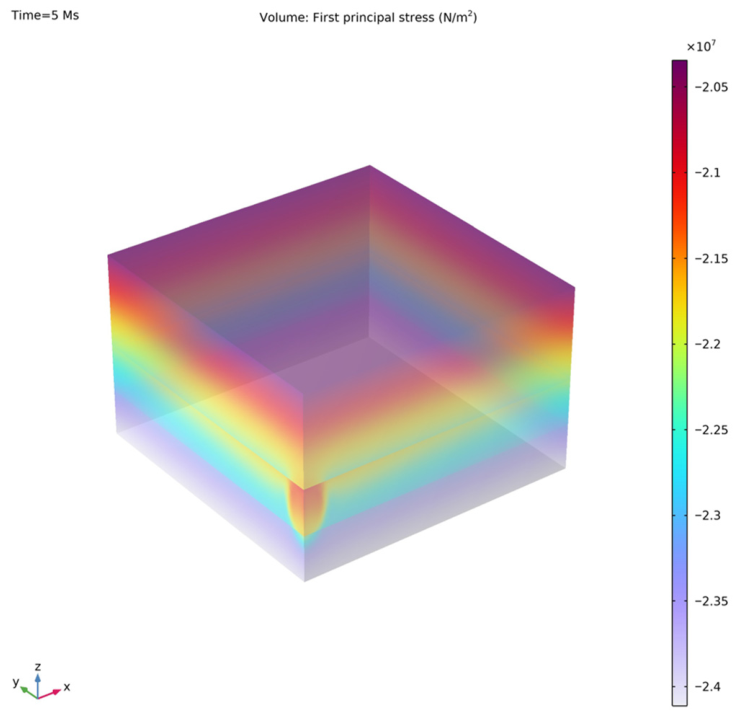
2 working volume without producing a large basin-scale overpressure response, and that the B and A-2 salt caprocks experience only limited additional hydraulic loading during the cushion-gas stage. The first principal stress field (
Figure 5) retains the initial depth-dependent layering imposed by the overburden, while showing a localised perturbation around the well where increased pore pressure slightly reduces the magnitude of compressive principal stress in the A-2 carbonate. Importantly, no large stress reversals or concentrations develop in the caprock, indicating that the chosen injection rate keeps the system within a mechanically stable regime during pre-filling.
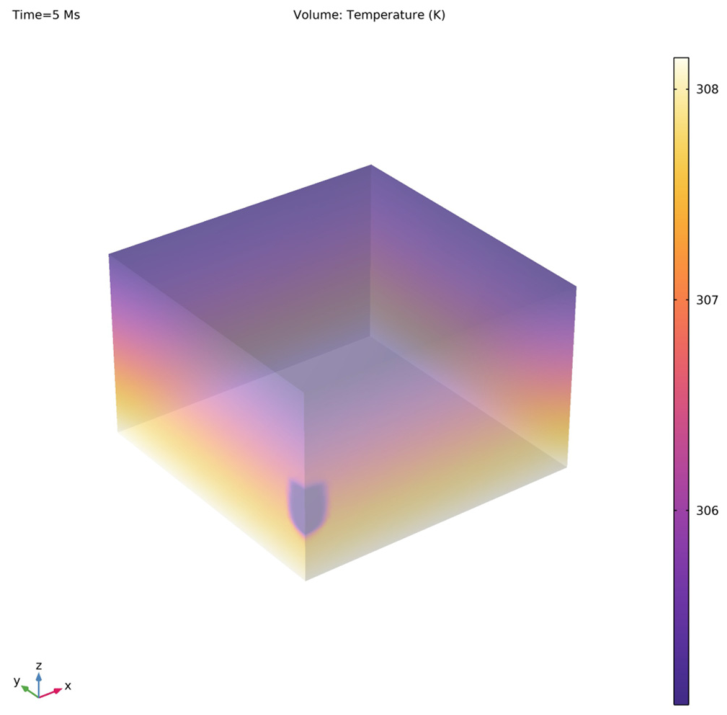
Finally, the temperature evolution remains minor during the cushion-gas injection (
Figure 6). The injected CO
2 at 32 °C (305 K) is only slightly cooler than the undisturbed reservoir (≈33–35 °C), so the resulting thermal perturbation is limited to about 1–2 K near the well and upper reservoir, with the background geothermal gradient largely preserved throughout the domain. These results confirm that the pre-filling stage mainly establishes a pressure-controlled CO
2 cushion, with only minor thermal disturbance. This is consistent with the model assumption that formation heat acts as a stabilising thermal buffer rather than a primary energy source.
5.2. Cyclic Injection-Production Performance
After 5 months of cushion gas injection, the A-2 carbonate contains a laterally continuous CO
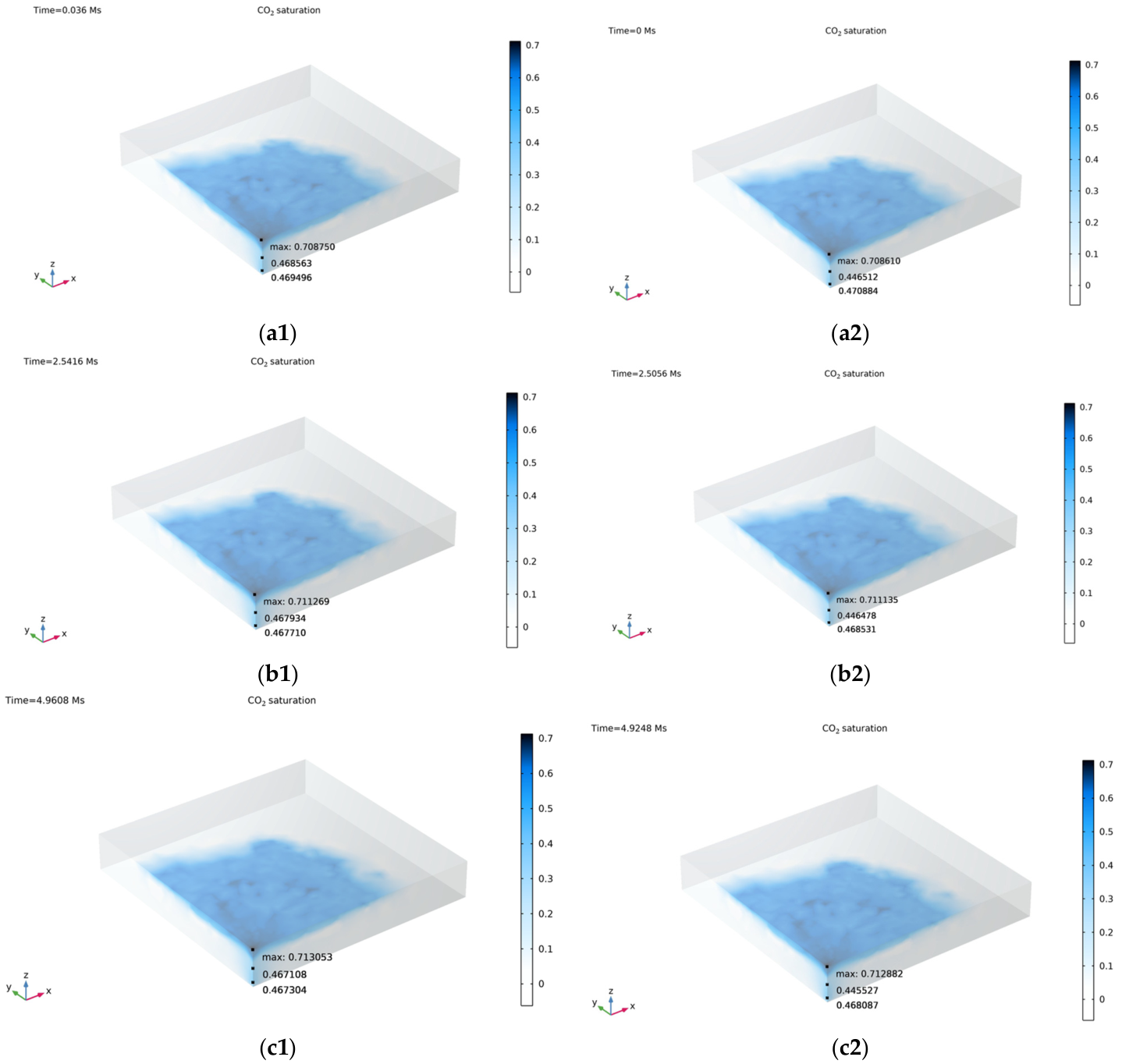
2 wedge pinned to the upper caprock, with peak saturation of about 0.6–0.7 near the well and a brine-dominated lower interval. On this basis, 24 h cycles of injection and production are imposed and simulated for two years, followed by an additional five-month period resolved at high temporal resolution. Three completion strategies are examined: a full-length case in which the entire perforated interval is produced, a case where production is restricted to the upper half of the well, and a split-completion configuration in which the upper and lower halves are produced at different rates.
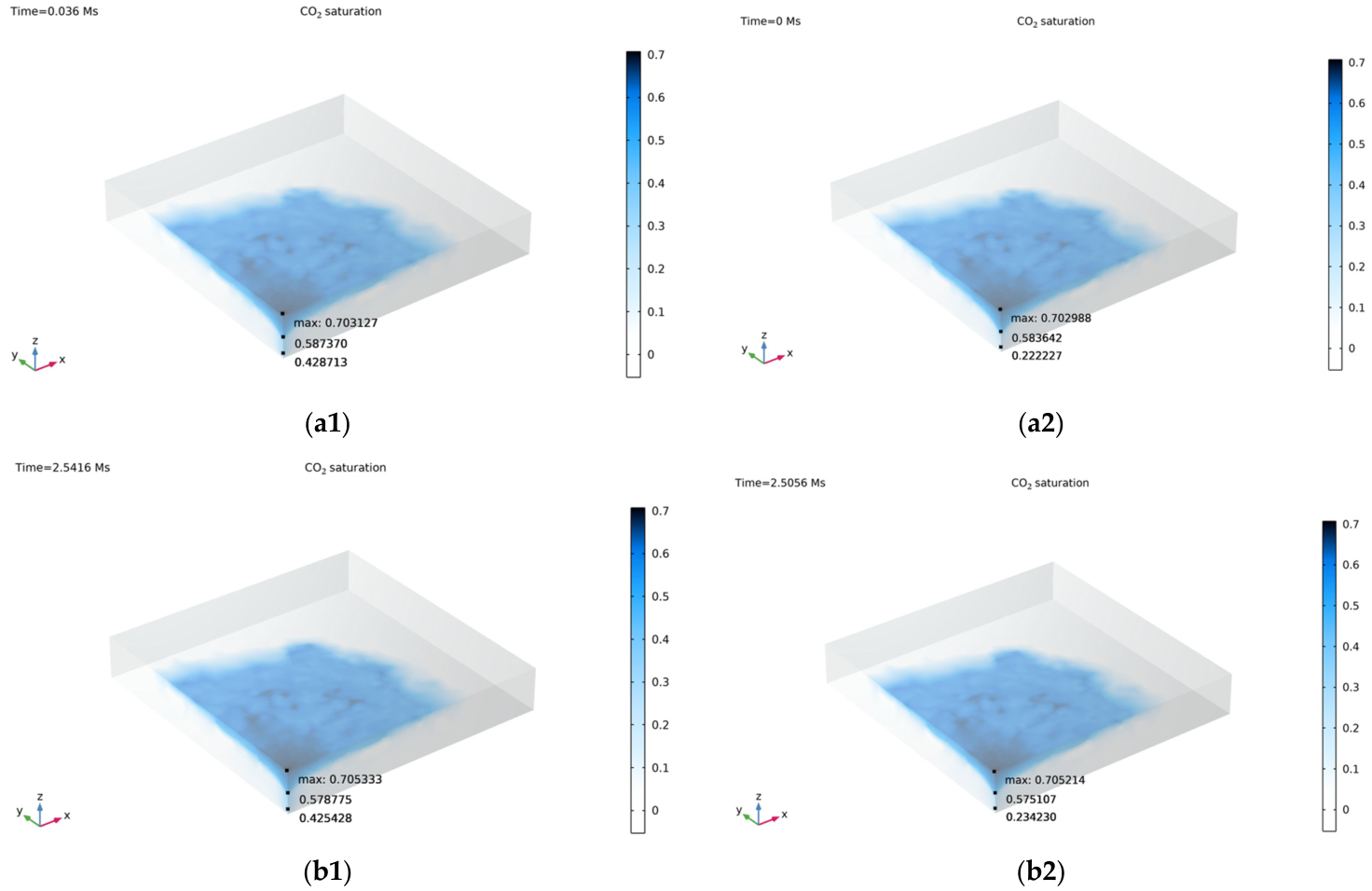
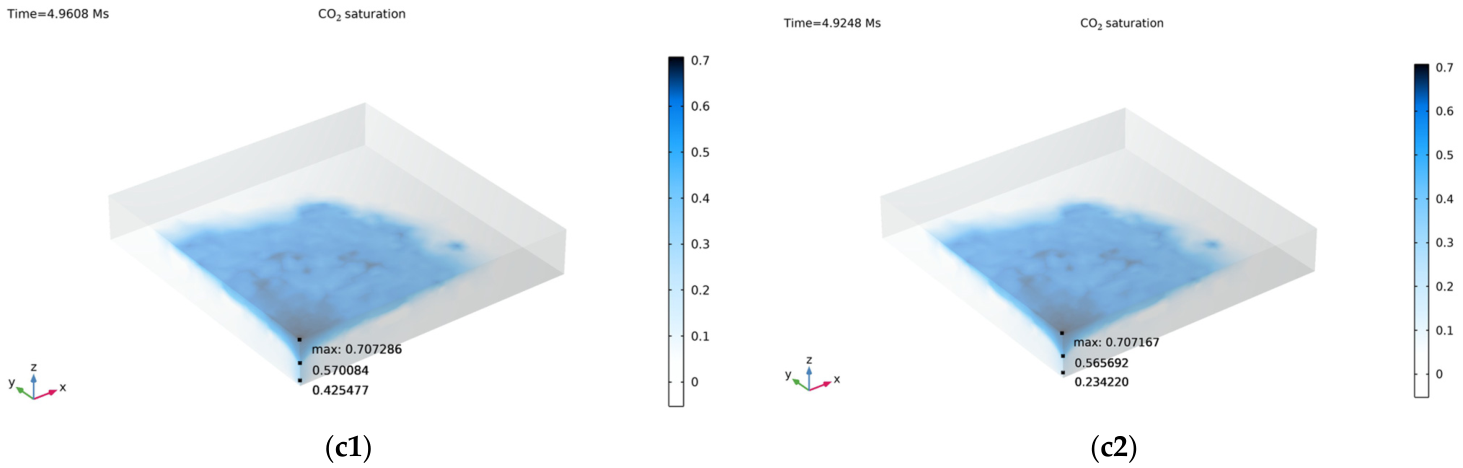
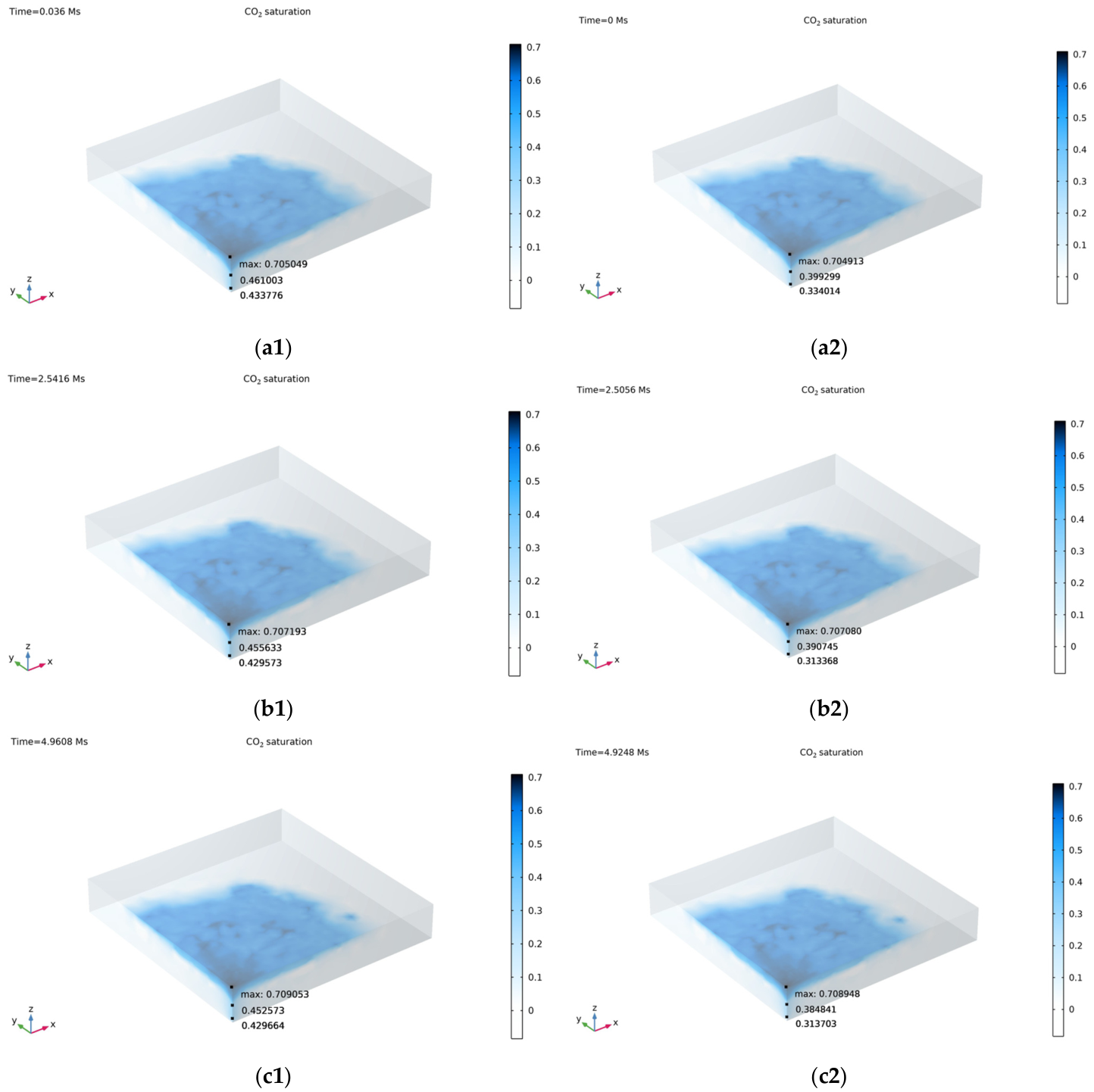
Figure 7,
Figure 8 and
Figure 9 show CO
2 saturation maps at the end of injection and production for 0, 2.5 and 5 months. Across all three schemes, the large-scale plume geometry established during cushion injection is largely preserved. Injection rebuilds a high-saturation zone around the well and reconnects it with the caprock-parallel wedge, whereas production creates only a local depletion zone without disrupting the upper gas layer. With increasing cycle number, saturation continues to be strongly vertically structured. In the lower part of the A-2 carbonate, CO
2 saturation shows a slight decrease during the early cycles as gas is redistributed upward; this downward depletion trend weakens over time as a quasi-steady state is approached. In the mid-reservoir, saturation continues to decline over the refined window, whereas in the upper 10–15 m beneath the B-salt caprock a gradual increase in saturation persists. This pattern suggests slow upward migration of CO
2 from the lower reservoir into the upper gas wedge. As buoyancy-driven segregation and production-driven depletion approach equilibrium, cyclic operation mainly redistributes CO
2 within the existing wedge rather than mobilising substantial additional gas from depth.
The three completion strategies have only a minor influence on the large-scale plume geometry, but they lead to discernible differences in how the near-well region is mobilised. In the full-length case, production taps both the upper gas-rich band and the lower brine-buffer zone, yielding a relatively broad but diffuse low-saturation region around the well after each production phase, while the end-of-injection maps show the widest lateral extent of the caprock-parallel CO2 wedge for a given cycle, reflecting the fact that the entire 40 m interval participates to some degree in recharge. At the same time, the lower CO2 wedge exhibits the lowest average saturation and the narrowest zone of CO2 enrichment among the three completion strategies, indicating that any further increase in net withdrawal would primarily drain this already gas-poor interval and weaken its ability to sustain upward replenishment of the caprock-proximal gas layer, potentially hindering upward replenishment and, over longer timescales, reducing the effective CO2 fraction in the produced fluid. The upper-only completion, by contrast, concentrates flow within the caprock-proximal wedge. At the end of injection, saturation maps show the highest peak CO2 saturations near the well but also the smallest laterally swept area. At the end of production, only a narrow depletion zone develops around the wellbore, while the surrounding gas cap remains comparatively compact. In this configuration the produced fluid is strongly CO2-rich, the actively swept gas volume is the smallest of the three cases, and the lower reservoir remains largely unchanged during cyclic operation. The slight decrease in CO2 saturation at lower reservoir over successive cycles indicates a slow, buoyancy-driven leakage of gas from the lower interval into the upper wedge, where it is produced, so that the lower reservoir evolves into a quasi-steady pressure buffer and a weak long-term CO2 source feeding the caprock-proximal gas layer. The split-completion case shows an intermediate response. Moderate mobilisation of the lower interval increases the vertically affected zone and slightly reduces peak CO2 saturation near the caprock relative to the upper-only case. Laterally, the plume extends farther than in the upper-only case but remains less extensive than in the full-length case; the production-related depletion footprint is also intermediate. As a result, both the lateral extent of the CO2-rich region and the characteristic saturation levels at the end of injection and production fall between those obtained for the full-length and upper-only configurations, confirming that completion strategy mainly redistributes where within the 40 m interval gas is cycled, rather than fundamentally altering the overall plume architecture.
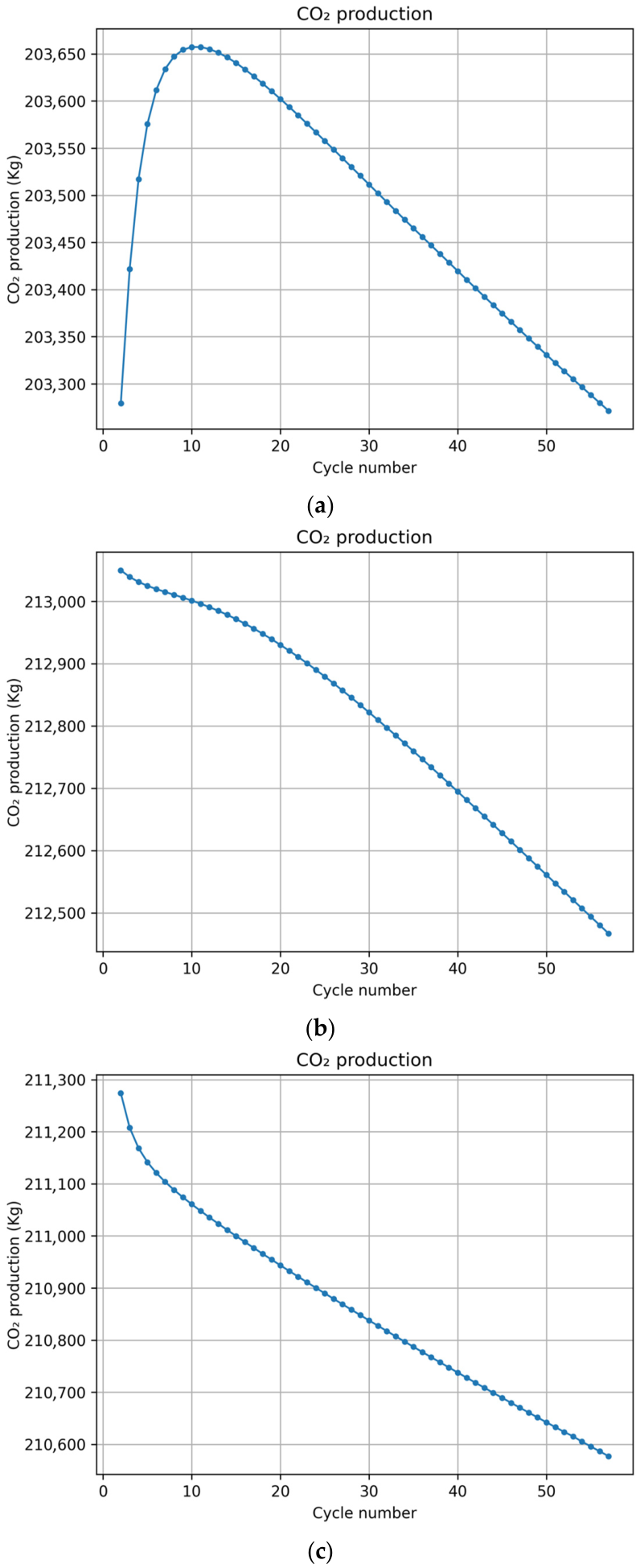
Across the three completion schemes the CO2 production rate per cycle remains very stable, but with clear systematic differences in level and trend. For the full-length completion, the production curve is weakly non-monotonic. During roughly the first ten cycles the average CO2 rate increases slightly, because the near-well interval is still transitioning from a brine-dominated state to a CO2-dominated one. As cycles proceed, more of the 40 m perforated section is swept by CO2, brine is flushed out, and gas saturation and gas relative permeability around the well both increase; therefore, a slightly higher CO2 mass flow is delivered. Once a stable gas wedge has formed along the upper part of the reservoir and the lower interval has adjusted to its role as a brine buffer, this charging phase ends. From that point onward the system behaves like a mature storage reservoir: small cumulative losses of CO2 from the swept region like buoyant leakage into the far field and residual trapping during each cycle gradually reduce the local gas saturation and mobility, so the per-cycle CO2 rate begins a very gentle decline of only 360 kg/cycle over the remaining cycles. It should be noted that this initial non-monotonic segment of the full-length curve is partly a start-up transient associated with using the 2-year simulation result as the initial condition rather than a fully periodic steady state. At the end of this long stage, pressure and saturation around the well are still evolving; when additional cyclic injection-production is imposed, the near-well region needs several cycles to re-equilibrate to the new boundary conditions. Although this initial increase in CO2 production is partly a numerical start-up transient associated with switching from the preceding long-term operation to cyclic operation in a new study, the underlying physics is analogous to field situations where a reservoir is shut in or operated under quasi-static conditions and then brought into another cycling. This short start-up adjustment is confined to the first few cycles and does not materially affect the subsequent quasi-steady production behavior or the long-term performance assessment.
For the upper-only completion, the average CO2 production rate is the highest (~213,120 kg/cycle at the beginning of the refined window) and is dominated by flow from the caprock-proximal gas cap. Because the actively swept volume is confined to the upper half of the reservoir, the time series shows an almost strictly monotonic decline, with the mean rate dropping by about 576 kg/cycle over all cycles. A very small irregularity appears over the first few cycles, but it is much less pronounced than in the full-length case, because the cyclic boundary conditions act directly on the already gas-rich upper interval and require only limited readjustment of near-well saturation and relative permeability. Once this brief adjustment is completed, the curve follows a smooth, gentle downward trend. The decline remains modest but is relatively steeper than for the full-length completion, consistent with gradual depletion of a smaller effective working volume that is cycled more intensively from one day to the next. Operationally, the smooth and nearly monotonic response suggests that the upper-only configuration is less sensitive to small operating perturbations and provides more predictable CO2 output during the simulated period.
For the split-completion case, the behavior falls between the two end-members in both absolute rate and temporal trend. The initial average CO2 production rate (~210,960 kg/cycle at the start of the refined window) is slightly lower than in the upper-only configuration but clearly higher than for the full-length completion. Over the simulated cycles the curve decreases monotonically by about 648 kg/cycle, reflecting that part of the flow is drawn from the lower, more brine-rich interval as well as from the caprock-proximal gas cap. As cycling proceeds, gradual replacement of CO2 by brine in the lower perforations and mild depletion of the upper wedge both contribute to the observed decline. The few minor wiggles at early times are small compared with the overall trend and indicate only a short adjustment as the coupled upper-lower flow pattern establishes itself; thereafter, the rate evolution is smooth and nearly linear. In relative terms, the decline rate sits between the upper-only and full-length schemes, consistent with a working volume and degree of brine involvement that are also intermediate between those two configurations.
Despite these differences, the production decline is small relative to the total mass produced per cycle (
Figure 10). Across the refined window, the change remains below 1%, indicating that all three strategies maintain stable working-gas output over the analysed period. The main distinction among the cases is therefore not a loss of overall deliverability, but the vertical distribution of the active working volume and the degree to which the lower brine-rich interval participates in production.
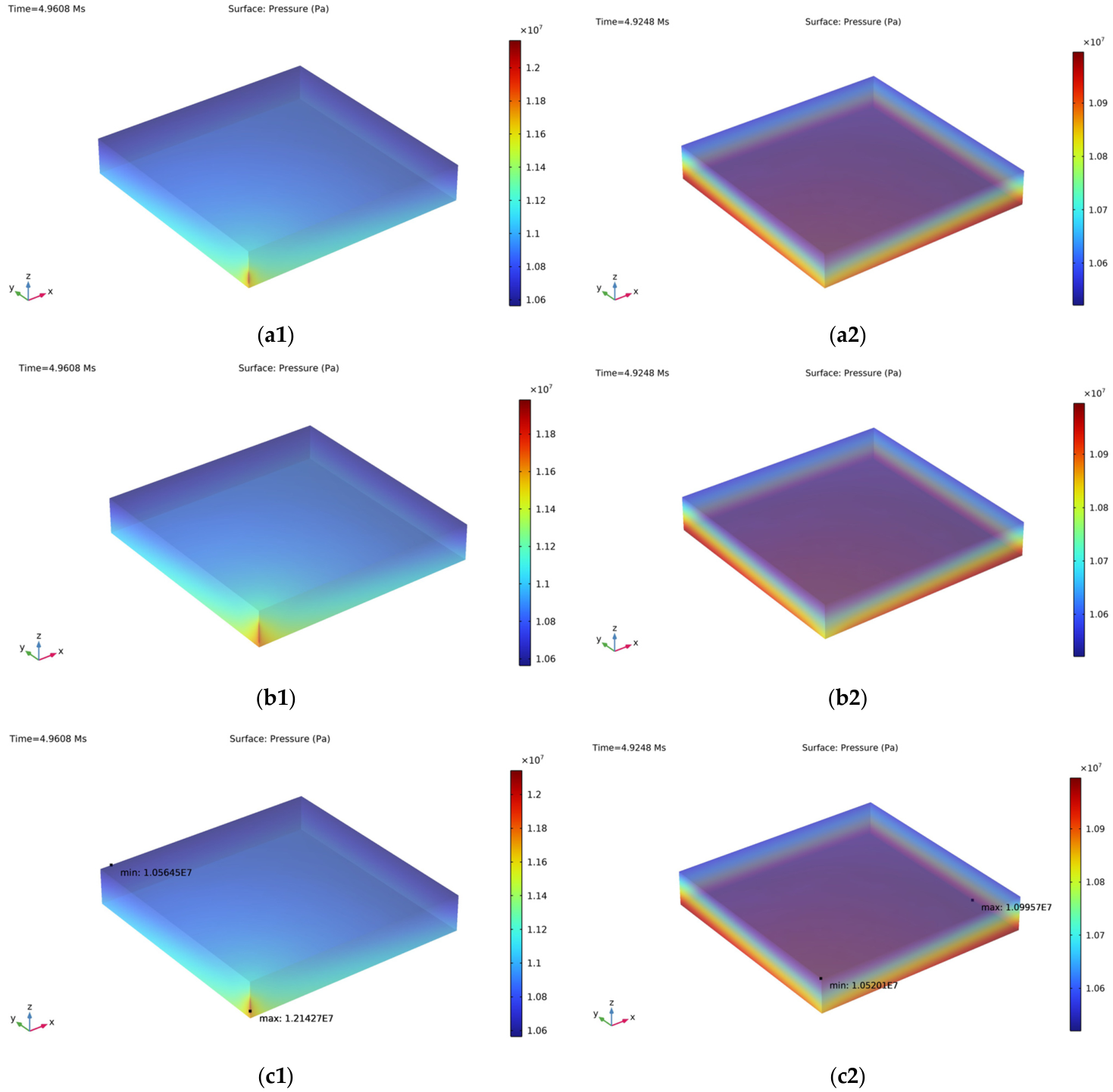
Pore-pressure maps after additional five months of cyclic operation show that the pressure disturbance remains strongly localized around the well and only weakly dependent on the completion strategy (
Figure 11). In all cases, the reservoir pressure field is close to the initial hydrostatic profile (~9–10 MPa) away from the well, while a narrow overpressured cone develops during injection and a corresponding underpressured cone forms during production.
For the full-length completion, end-of-injection results display a nearly symmetric pressure build-up along the 40 m perforated interval: the overpressure maximum is centred at the well, and the vertical pressure gradient within the A-2 carbonate is modest, because injection is distributed over the entire thickness. After production, a broad but relatively diffuse drawdown zone appears around the wellbore; pressure recovers rapidly with distance so that beyond a few hundred metres the reservoir remains essentially hydrostatic. This behavior is consistent with the saturation maps, where both the upper gas-rich band and the lower brine-rich interval participate in the flow and share the pressure perturbation.
In the upper-only completion, the injection phase is identical in terms of total mass rate, so the end-of-injection pressure cone is very similar in amplitude to the full-length case but more clearly skewed toward the upper part of the reservoir. Because production is confined to the upper perforations, the end-of-production maps show a stronger and more compact drawdown immediately beneath the B-salt, while the lower half of the A-2 carbonate experiences only a small pressure change. This pattern matches the saturation results, where the upper gas cap is actively swept while the lower zone acts largely as a pressure buffer. In practice this implies that cyclic loading is concentrated near the caprock, whereas the deeper part of the reservoir shields the system from large far-field pressure swings.
The split-completion configuration produces an intermediate response. During injection, the pressure build-up is again similar in magnitude but slightly more vertically uniform than in the upper-only case, reflecting that flow is allowed along the full interval. At the end of production, drawdown is distributed over both upper and lower perforations: the minimum pressures near the well are somewhat higher than in the upper-only case because the same total production is spread over a larger cross-section, and the underpressured volume extends a little deeper than in the full-length completion. This agrees with the CO2 saturation patterns, where a thicker interval is mobilised but the plume remains top-skewed.
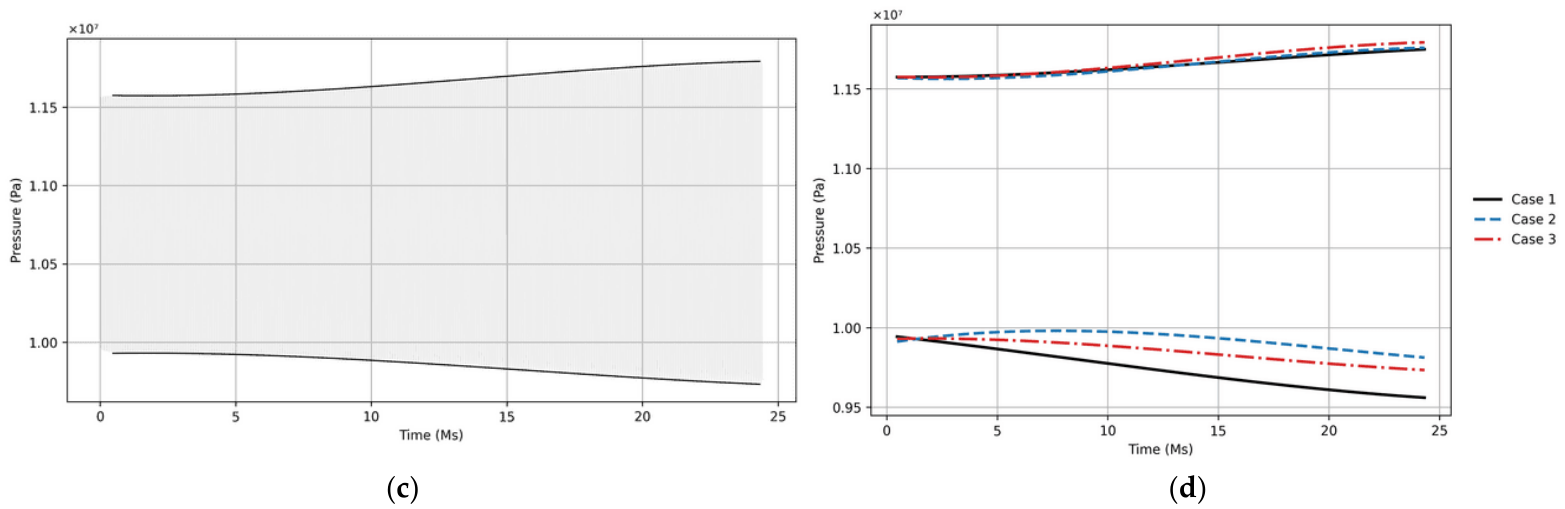
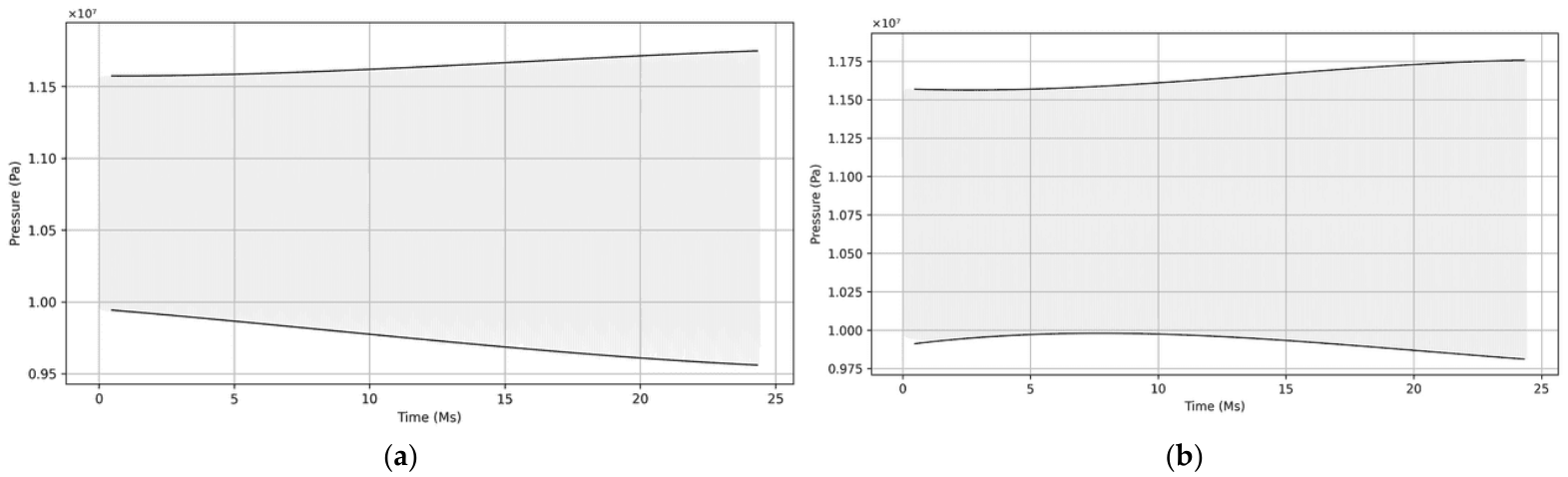
Figure 12 shows the evolution of average pressure along the perforated well interval over the additional five months of cyclic operation for the three completion schemes. In all three cases, the segment-averaged pressure along the perforated interval follows a clear 24 h saw-tooth pattern: pressure increases during the injection half-cycle and decreases during the production half-cycle, with the same basic cyclic shape throughout the five-month window. However, both the upper and lower bounds of these cycles evolve gradually with time. The peak injection pressures show a mild upward trend, whereas the minimum pressures at the end of production display a more pronounced downward shift, so that each successive cycle reaches slightly higher maxima and slightly lower minima than the previous one. The resulting drift in average wellbore pressure remains moderate relative to the overall 9–12 MPa operating range, but the monotonic widening of the pressure window indicates that the system is still slowly adjusting toward a new dynamic equilibrium. Extrapolating these trends suggests that, over longer timescales, cyclic operation would continue to induce gradual but bounded changes in injectivity and productivity, rather than rapidly driving the well beyond its operational pressure envelope. This pattern is consistent with the reservoir-scale results: slow redistribution of CO
2 and brine and small changes in local saturation and mobility lead to incremental changes in injectivity and productivity, which are reflected in the gradual separation of the pressure peaks and troughs.
Differences between the full-length, upper-only and split completions are more evident in how the upper and lower bounds of the pressure cycles separate over time. In the full-length case, the upper envelope rises by around 0.2 MPa while the lower envelope drops by around 0.4 MPa, giving the largest widening of the cycle window. This pattern arises because production draws not only from the CO2-rich caprock-proximal band but also from the brine-dominated lower half of the reservoir, and repeated withdrawal from this relatively CO2-poor zone causes a gradual pressure decline at depth, while cyclic injection maintains a slight net build-up in the upper gas cap. As a result, exploiting the full 40 m interval yields the strongest long-term separation between upper and lower pressures.
For the upper-only completion, both envelopes move much less: the upper pressure still creeps upward by around 0.2 MPa, while the lower envelope first increases slightly and then declines only weakly, so that the net change at depth is small. The initial increase reflects transient CO2 enrichment in the lower part of the completion due to CO2 injection, which stiffens the local response and elevates the minimum pressure, whereas continued buoyant migration and preferential production from the upper perforations progressively bleed CO2 out of this zone and allow the lower interval to relax back toward a brine-dominated state, reducing the minimum pressure. This dynamic evolution effectively damps the long-term widening of the pressure range, lowering cyclic stress amplitudes on the wellbore and adjacent rock and thus being favorable for well integrity and overall system lifetime.
The split-completion case is intermediate: the upper envelope increases by around 0.18 MPa and the lower decreases by around 0.20 MPa, so the pressure window widens less than in the full-length configuration but more than in the upper-only case. Because only part of the flow is taken from the lower half of the completion, depressurisation of the brine-rich lower interval is much slower than in the full-length case, which markedly limits the downward drift of the minimum pressure. At the same time, active withdrawal from the lower perforations accelerates the long-term loss of CO2 from depth compared with the upper-only scheme, preventing the lower envelope from remaining as stable as in that configuration. As a result, both the magnitude and rate of pressure-window widening fall between the two end-members, consistent with the split balance of flow between upper gas-rich and lower brine-buffer zones.
Overall, the pressure-envelope drift remains small relative to the absolute operating pressure. Even in the full-length case, where the widening is largest, the total envelope change is about 0.6 MPa within an operating pressure range of roughly 9–12 MPa. This indicates gradual near-well hydraulic adjustment rather than rapid pressure destabilisation. The smaller drift in the upper-only and split cases further suggests that reducing withdrawal from the lower brine-rich interval helps limit long-term pressure-window expansion.
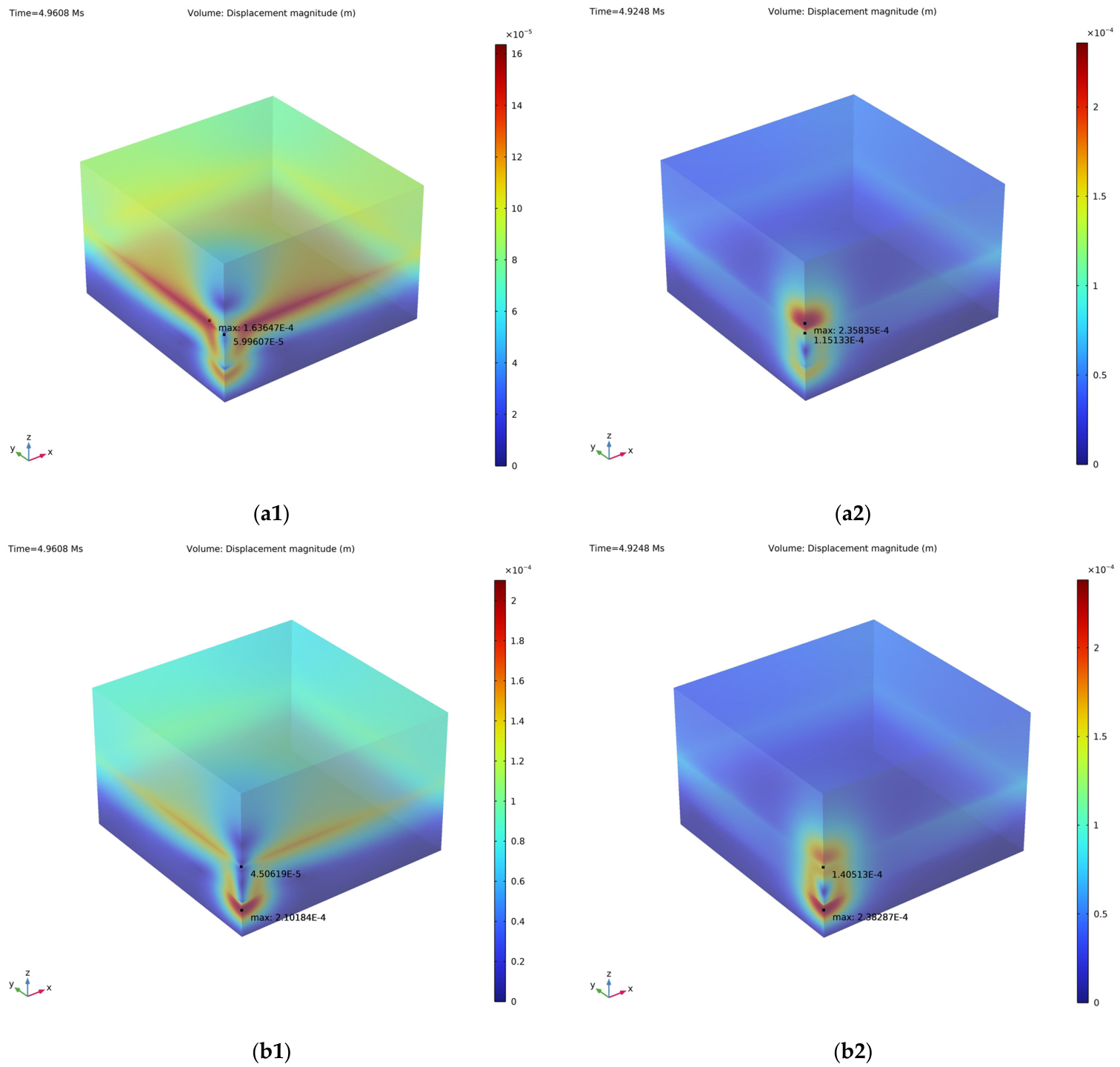
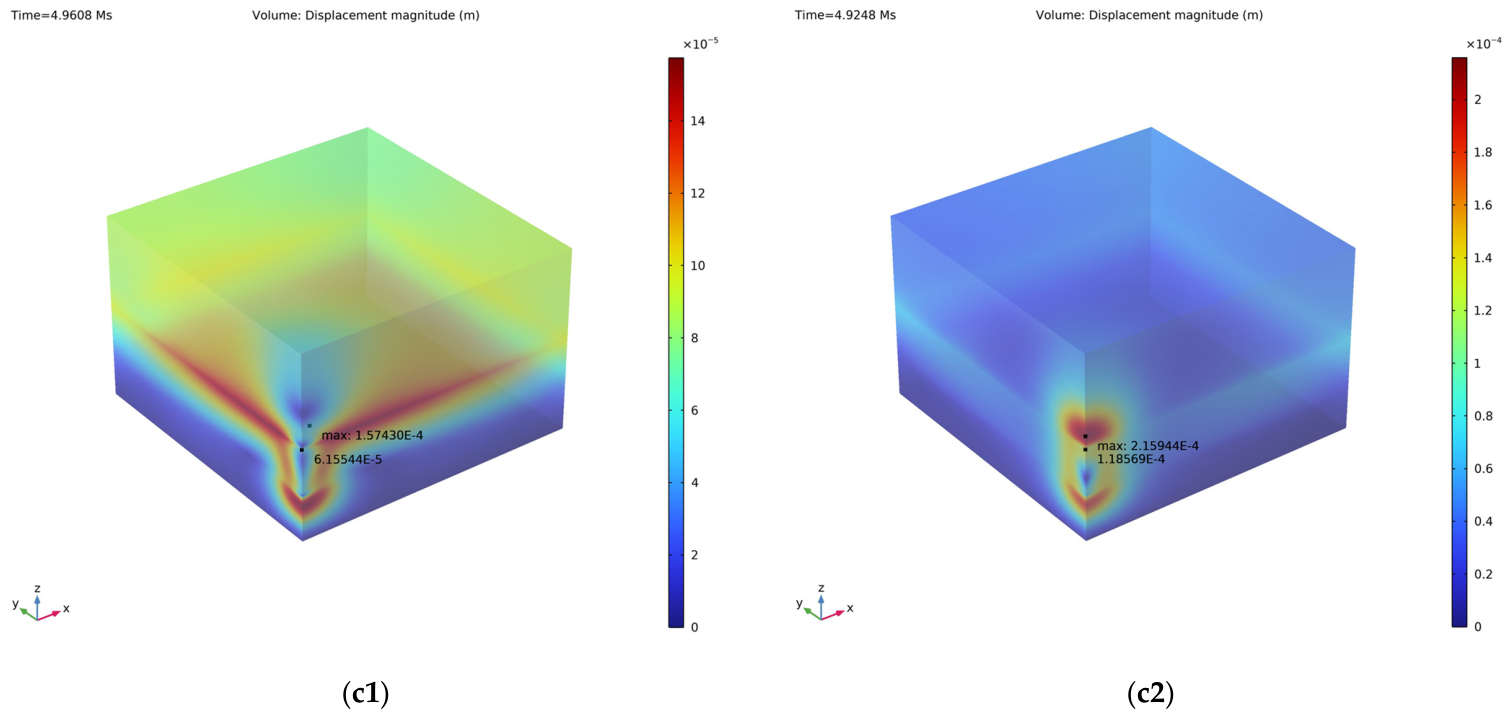
A set of displacement maps was extracted at the end of injection and production after five months of cyclic operation for all three completion strategies to assess the geomechanical impact of CCES. As shown in
Figure 13, across all completion schemes, the displacement field reflects two superposed components: a broad, gentle bending of the B salt, A-2 carbonate, and A-2 salt layers induced by the long-term pressure buildup, and a much sharper local disturbance around the well. In the end-of-injection snapshots, the dominant feature is a smooth, caprock-parallel uplift zone along the top of the A-2 carbonate directly above the CO
2 wedge, extending laterally well beyond the refined near-well region. Superimposed on this are small vertical kinks near the reservoir-caprock contacts and a modest local bulge around the wellbore, consistent with injection-induced overpressure concentrated in the upper part of the reservoir. This observed pattern reflects poroelastic coupling: elevated pore pressure within the CO
2-rich upper A-2 carbonate reduces effective vertical stress, causing slight expansion of the reservoir layer and flexural uplift of the overlying B salt, while contrasts in stiffness at the carbonate-salt interfaces localise vertical strain into the observed kinks. In addition, the localized bulge around the wellbore is attributed to the largest pore-pressure gradients occurring in the near-well region during injection.
At the end of production, the far-field bending nearly relaxes back toward the pre-injection state and the remaining deformation is much more localized: a small, symmetric compaction bowl develops around the well, affecting mainly the upper A-2 carbonate and the immediately over- and underlying salt, while the outer parts of the model show almost no visible change. This response is again poroelastic in origin: pressure drawdown in the near-well region increases effective stress in the CO2-charged interval, leading to slight vertical shortening of the reservoir and downward deflection of the overlying B salt. Because the pressure perturbation decays rapidly with distance and the surrounding halite is comparatively stiff and tight, this compaction is confined to a narrow zone around the well, and the far-field stress and displacement fields remain essentially unchanged.
Differences between the three completion schemes are expressed mainly in the amplitude and vertical reach of the near-well deformation bowl. In the full-length completion, both the end-of-injection uplift and end-of-production compaction are most pronounced: the displacement anomaly extends through nearly the entire 40 m reservoir interval and into the adjacent B-salt and A-2 salt, and peak magnitudes around the wellbore are largest among the three cases. This is consistent with the pressure and saturation results, where the full interval is actively cycled and the brine-dominated lower zone experiences the strongest long-term pressure decline. In the upper-only case, by contrast, deformation is tightly concentrated in the upper part of the A-2 carbonate and the base of the B-salt, with only very weak displacements in the lower reservoir and underlying salt. The compaction bowl around the well is shallower and has the smallest amplitude, reflecting that the lower half of the reservoir mainly acts as a buffered brine zone with limited direct participation in the cycles. The split completion shows an intermediate response: the deformation bowl penetrates deeper than in the upper-only case but remains less developed than in the full-length configuration, mirroring the fact that only part of the flow is drawn from the lower interval while the upper gas-rich zone still dominates the cyclic pressure changes.
In all simulations, peak displacements remain small, on the order of 10−4–10−3 m. These values are several orders of magnitude smaller than the Salina unit thicknesses and correspond to incremental strains of approximately 10−7–10−6. The associated changes in principal stresses are therefore very small compared with the in situ stress magnitudes and rock strengths. Because these stress perturbations closely follow the spatial pattern of the displacements and remain negligible at the scale of the basin stratigraphy, detailed stress contour plots are not presented; instead, the geomechanical response is summarised using the displacement fields as a compact proxy for the small perturbation to the stress field.