

How to Choose the Best Geometallurgical Strategy for Spatial Modeling of a Mineral Deposit



Abstract
1. Introduction
- A formal systems framework for geometallurgical modeling that explicitly represents information flows, dependencies, and constraints.
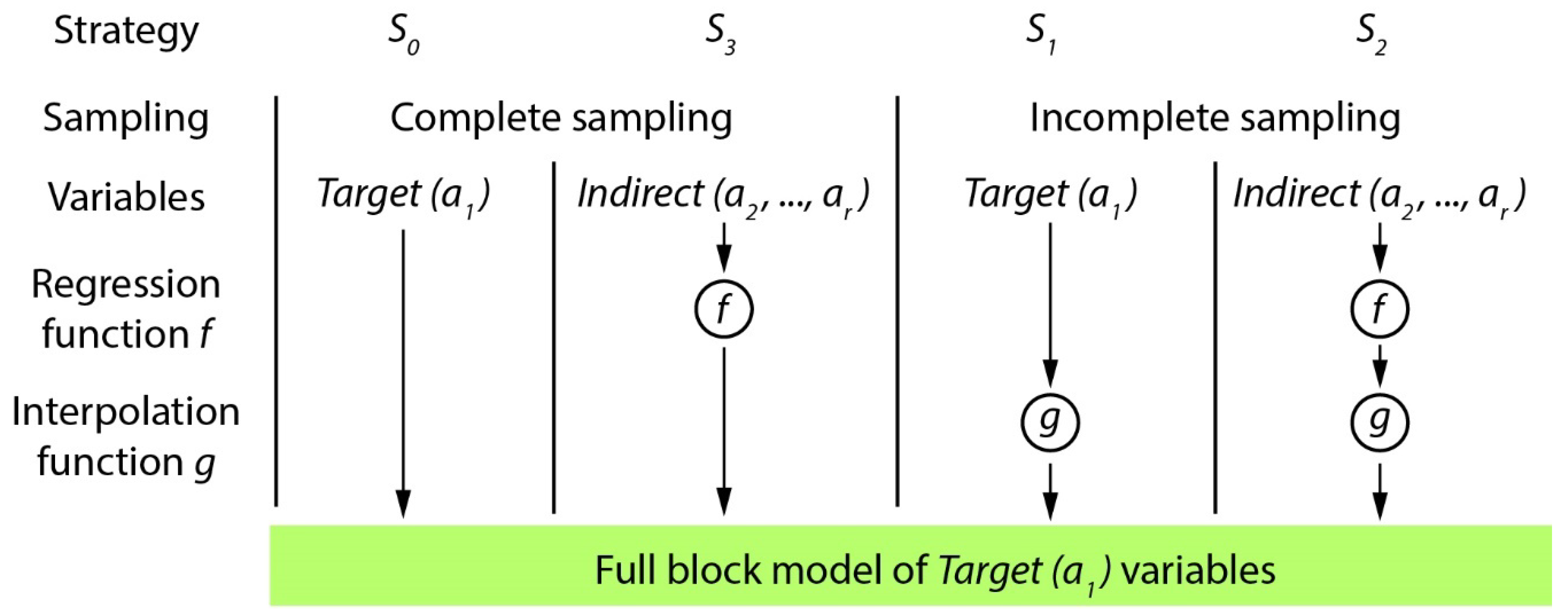
- A novel taxonomy of strategies (S0–S3) based on fundamental approaches to information management in complex systems.
- A decision algorithm that enables systematic strategy selection based on system characteristics (deposit complexity, cost structure, accuracy requirements).
- Quantitative analysis of boundary conditions where each strategy provides optimal system performance.
2. Economic Framework and Problem Formalization
2.1. Geometallurgical Block Model as an Information System
2.2. Economic Block Value: The Foundation for Optimization
2.3. Formalization of the Geometallurgical Modeling Problem
- Spatial Discretization: The deposit is divided into a set of unit blocks , with representing spatial coordinates.
- Block Properties: Each block is described by a consistent set of variables , where each variable represents a specific geological or technological property.
- Target Variable: One variable, denoted , is the target (e.g., geometallurgical ore type). Determining its value for all blocks is the ultimate goal.
- Block Homogeneity: Each block is considered homogeneous; all variable values are constant within a block.
- Data Availability: The values of variables in any given block may be known or unknown.
- Variable Dependencies:
- 6.1
- Internal (Regression): the value of a variable in a block may depend on other variables within the same block:
- 6.2
- External (Interpolation): the value of a variable may depend on its values in a subset of surrounding blocks :
- (a)
- Cost constraint: the total cost of obtaining information must not exceed a fraction of the potential revenue:where is the planned revenue fraction. Thus, represents the fraction of revenue the operator is prepared to spend on information acquisition. It is assumed that all quantities on the right-hand side of the inequality are known, and C depends on the choice of calculation strategy.
- (b)
- Accuracy constraint: the model error for the target variable must remain below a regulator-defined (e.g., the relative root mean square error prescribed by the Russian State Reserves Committee [35]).
3. A Decision Support Framework for Geometallurgical Strategy Selection
- I.
- Direct Measurement.
- II.
- Interpolation (): Estimating a value based on known values in surrounding blocks.
- III.
- Regression (): Calculating a value from other, cheaper variables within the same block.
3.1. Algorithm Inputs and Initial Data
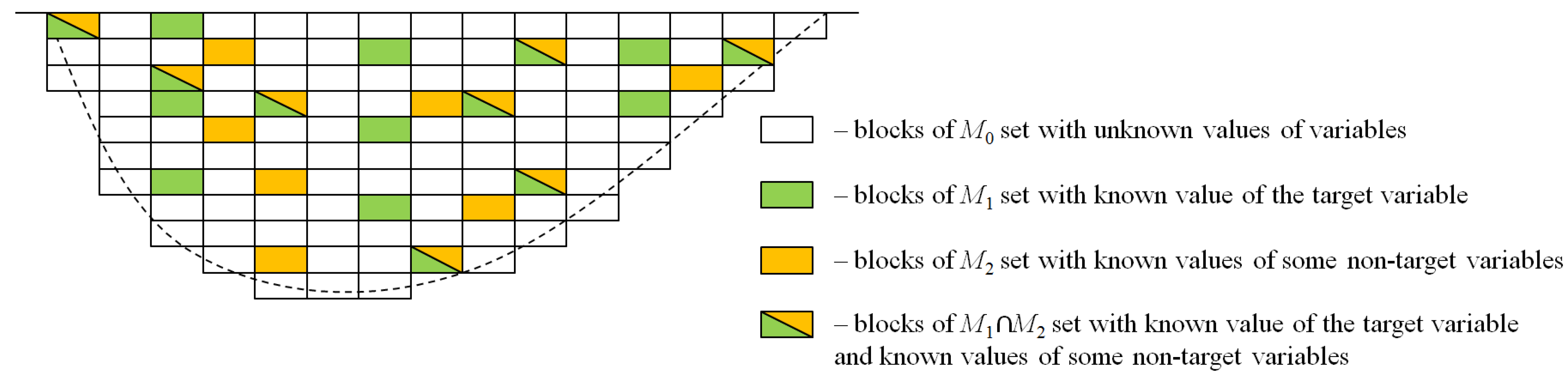
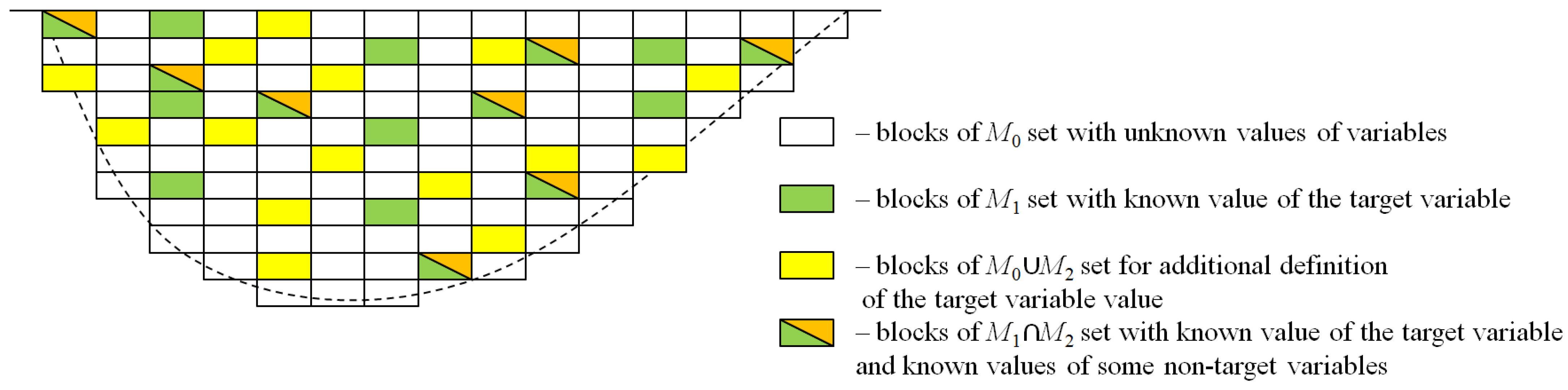
- : Blocks with unknown values for all variables.
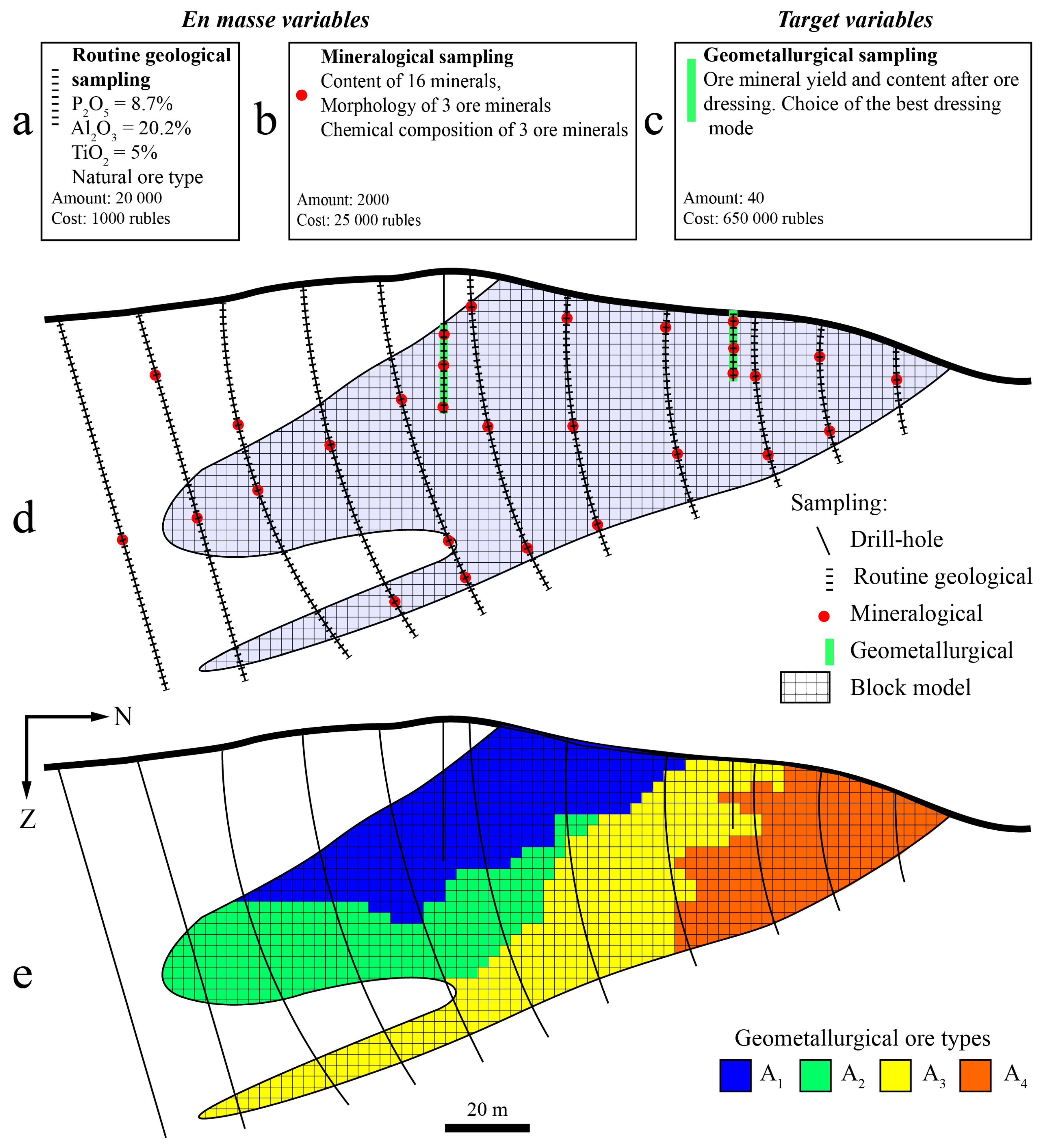
- : Blocks with a known value of the target variable (e.g., from geometallurgical tests).
- : Blocks with known values of one or more non-target variables (e.g., from routine geological or mineralogical sampling).
3.2. Strategy Evaluation Workflow
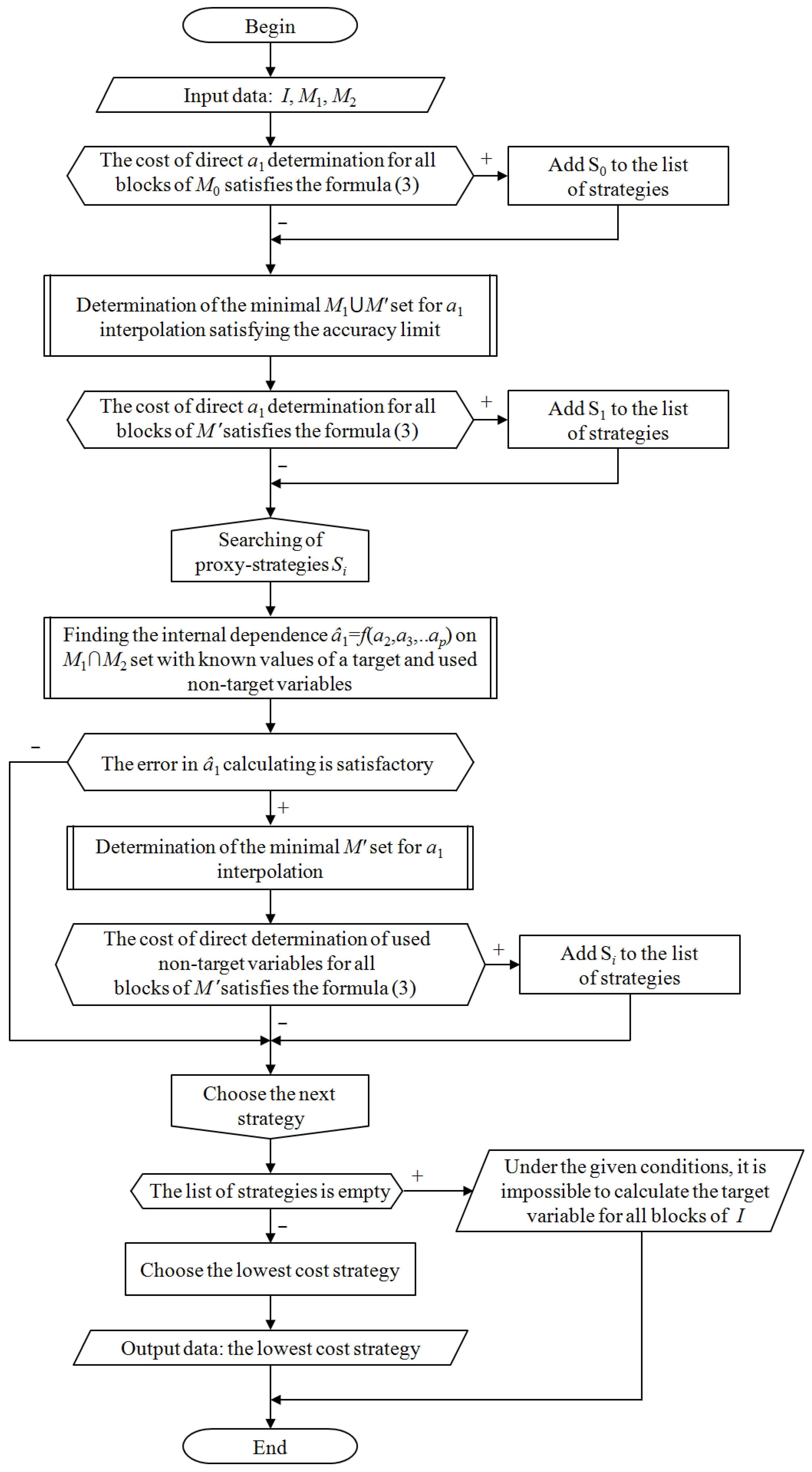
- Step 1: evaluate strategy S0 (Complete Direct Measurement)The algorithm first checks the feasibility of directly determining in all blocks of (Figure 4). It calculates the total cost and checks it against the cost constraint (Equation (3)). If feasible, S0 is added to the list of viable strategies. This strategy guarantees the highest accuracy but is typically cost-prohibitive.
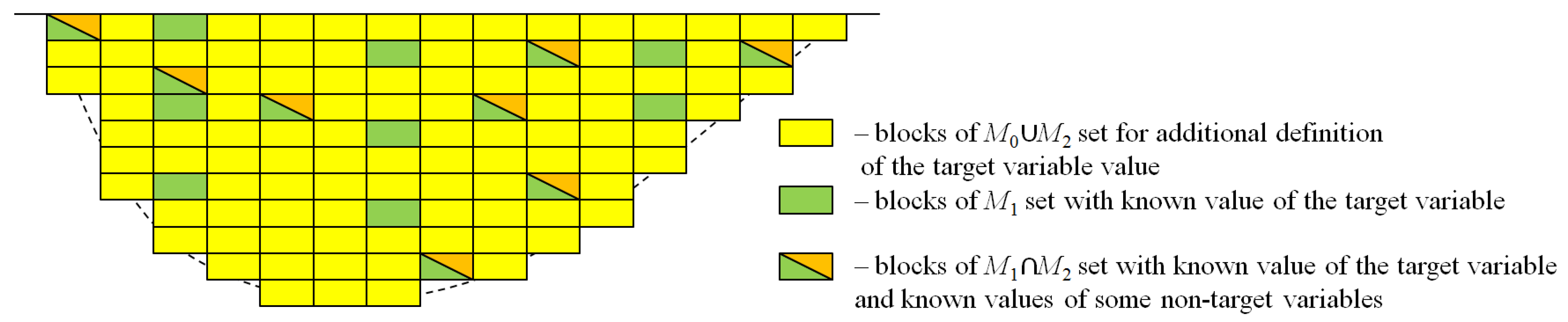
- Step 2: evaluate strategy S1 (Incomplete Direct Measurement + Interpolation)The algorithm determines a minimal set of additional blocks where must be directly measured to enable reliable interpolation across the entire model (Figure 5). The cost of measuring in is evaluated against Equation (3). If feasible, the values in all other blocks are estimated using the interpolation function , and S1 is added to the list of viable strategies.
- Step 3: evaluate strategy S2 (Proxy-Based + Regression + Interpolation)This step leverages internal dependencies (regressions) to reduce costs. For a given set of non-target variables:
- Regression building: Using blocks in , the algorithm constructs a regression function .
- Accuracy check: The error of the regression model is validated. If unsatisfactory, the strategy for this variable set is discarded.
- Cost evaluation: If accurate, the algorithm calculates the cost of directly measuring the required non-target variables in blocks and applies the regression to obtain for these blocks. Finally, interpolation is used to propagate these calculated values throughout the model, as described in Equation (5). The total cost is checked, and if feasible, S2 is added to the list.
- Step 4: evaluate strategy S3 (Complete Indirect + Regression)This strategy involves directly measuring all non-target variables in the entire block model and then applying the regression function to every block to obtain . While theoretically present in our taxonomy (Figure 2), this strategy is often uneconomical due to the high cost of exhaustive sampling of non-target variables, but it is evaluated for completeness.

3.3. Strategy Selection and Implementation
- If the list is empty, the deposit cannot be modeled profitably under the given constraints, signaling a need to renegotiate economic parameters or technological capabilities.
- If the list contains one or more strategies, the algorithm selects the one with the lowest total cost.
- The output is a definitive implementation plan, specifying the chosen strategy (S0, S1, S2, or S3), the required sampling campaign (), and the mathematical models () to be deployed.
4. Discussion
4.1. The Systems-Theoretic Interpretation of Strategy Performance
- Strategy S0 (Complete Direct Measurement) represents a brute-force approach to eliminating systemic uncertainty. While it achieves maximum accuracy, it functions as a closed system with minimal information processing, making it economically inefficient for all but the smallest, highest-value deposits. Its prohibitively high cost, as shown in Table 2, underscores a fundamental systems principle: the marginal cost of perfect information often exceeds its marginal benefit.
- Strategy S1 (Interpolation-Based) transforms the deposit into an information-sparse system reliant on spatial continuity. Its viability is entirely dependent on the external dependency . This strategy fails in geologically complex systems where spatial correlations break down, demonstrating how structural complexity within a system can invalidate simpler predictive models.
- Strategy S2 (Proxy-Based) embodies the concept of a complex adaptive system. It leverages internal dependencies () to create a more efficient and resilient information network. By using cheaper proxy variables, it effectively creates a model of the system that is far less costly to observe and monitor. Its dominance in our hypothetical scenarios (Table 2) highlights a core tenet of systems engineering: the power of indirect observation and inference in managing complex systems.
- Strategy S3 (Complete Indirect) represents a theoretical extreme where the system is fully described through its component relationships. Its current impracticality underscores the real-world constraints of data acquisition costs, even for proxy variables.
4.2. Comparative Analysis of Strategy Performance and System Trade-Offs
4.3. Managerial and Operational Implications as a Control System
- Resource allocation: The algorithm provides a quantitative basis for allocating exploration budgets, shifting the decision from “how much data can we afford?” to “what is the optimal data acquisition strategy to maximize project net present value?”
- Risk management: Strategies S1 and S2 explicitly quantify the trade-off between information cost and model uncertainty, allowing managers to make informed decisions under uncertainty—a classic challenge in systems management.
- Adaptive planning: The framework enables adaptive planning through iterative deployment. For instance, an initial low-cost S2 campaign could identify spatial domains where proxy relationships weaken, guiding a subsequent targeted S1 drilling campaign to resolve these uncertainties. This creates a closed-loop control system that dynamically optimizes information value over the project lifecycle.
4.4. Limitations and Boundary Conditions of the Framework
- Regression quality: The efficacy of the most potent strategy, S2, is wholly dependent on the discoverability and robustness of the regression function . In deposits where ore behavior is governed by poorly understood or non-linear mineralogical factors (e.g., complex textures), establishing a reliable may be the primary scientific challenge.
- Static economic parameters: The model uses a static economic snapshot. In reality, metal prices and costs fluctuate, making the cost constraint a dynamic variable. Future work could integrate real options analysis or stochastic optimization to address this temporal dimension.
- Data quality: The framework assumes that input data () is representative and reliable. Biased or non-representative sampling in early stages can lead to a cascade of errors in the chosen strategy, a manifestation of systemic error propagation.
4.5. Generalizability and Applications Beyond Geometallurgy
- Environmental management: optimizing monitoring network design for groundwater contamination, where direct sampling (S0) is expensive, but proxy measurements from geophysics (S2) could be highly efficient.
- Oil and gas geology: characterizing reservoir properties where core samples (S0) are limited, and strategies based on well log correlations (S2) or seismic data interpolation (S1) are commonplace.
- Agricultural land management: prescribing soil treatments based on a combination of direct soil tests (S0) and remote sensing data (S2).
5. Conclusions
Author Contributions
Funding
Data Availability Statement
Conflicts of Interest
Abbreviations
| ai | Variable characterizing the properties of a block b. i = 1, 2, …, r |
| Calculated value of variable ai | |
| Block model block with coordinates represented by a vector | |
| C | Cost of additional testing of blocks of the set M |
| Revenue received from the sale of all products extracted from the block | |
| f | Internal dependence of one variable on others (including regression function) |
| g | External dependence of one variable on its values in the surrounding blocks of the set V (interpolation function) |
| Cost of hedging block risks | |
| I | All blocks of the object |
| M1 | Set of blocks in which the value of the target variable is known |
| M2 | Set of blocks in which the values of some non-target variables are known |
| M’ | Set of blocks in which it is planned to define the values of variables |
| Cost of the block dressing | |
| Si | Strategy of geometallurgical exploration of the deposit |
| Cost of extracting and transporting the block | |
| V | Multiple blocks for interpolation |
| Planned revenue fracture | |
| x, y, z | Coordinates of the block (or decomposition of the vector into components) |
References
- Frenzel, M.; Baumgartner, R.; Tolosana-Delgado, R.; Gutzmer, J. Geometallurgy: Present and Future. Elements 2023, 19, 345–351. [Google Scholar] [CrossRef]
- Ortiz, J.M.; Avalos, S.; Riquelme, A.I.; Leuangthong, O.; Madani, N.; Frenzel, M. Uncertainty and Value: Optimising Geometallurgical Performance Along the Mining Value Chain. Elements 2023, 19, 377–383. [Google Scholar] [CrossRef]
- Koch, P.-H.; Rosenkranz, J. Sequential decision-making in mining and processing based on geometallurgical inputs. Miner. Eng. 2020, 149, 106262. [Google Scholar] [CrossRef]
- Hunt, J.; Berry, R.; Becker, M.; Baumgartner, R. A Special Issue Dedicated to Geometallurgy: Preface. Econ. Geol. 2019, 114, 1473–1479. [Google Scholar] [CrossRef]
- Dominy, S.C.; O’Connor, L.; Parbhakar-Fox, A.; Glass, H.J.; Purevgerel, S. Geometallurgy—A Route to More Resilient Mine Operations. Minerals 2018, 8, 560. [Google Scholar] [CrossRef]
- Hoal, K.O. Getting the Geo into Geomet. SEG Newsl. 2008, 73, 11–15. [Google Scholar] [CrossRef]
- Lishchuk, V.; Koch, P.-H.; Ghorbani, Y.; Butcher, A.R. Towards integrated geo-metallurgical approach: Critical review of current practices and future trends. Min. Eng. 2020, 145, 106072. [Google Scholar] [CrossRef]
- Parbhakar-Fox, A.; Baumgartner, R. Action Versus Reaction: How Geometallurgy Can Improve Mine Waste Management Across the Life-Of-Mine Free. Elements 2023, 19, 371–376. [Google Scholar] [CrossRef]
- Mackenzie, W.; Cusworth, N. The use and abuse of feasibility studies. In Proceedings Project Evaluation; The Australasian Institute of Mining and Metallurgy: Melbourne, Australia, 2007; pp. 65–76. [Google Scholar]
- Lamberg, P.; Rosenkranz, J.; Wanhainen, C.; Lund, C.; Minz, F.; Mwanga, A.; Parian, M. Building a geometallurgical model in iron ores using a mineralogical approach with liberation data. In Proceedings of the Second AusIMM International Geometallurgy Conference, Brisbane, Australia, 30 September–2 October 2013; pp. 317–324. [Google Scholar]
- Alruiz, O.M.; Morrell, S.; Suazo, C.J.; Naranjo, A. A novel approach to the geometallurgical modelling of the collahuasi grinding circuit. Miner. Eng. 2009, 22, 1060–1067. [Google Scholar] [CrossRef]
- McKay, N.; Vann, J.; Ware, W.; Morley, W.; Hodkiewicz, P. Strategic and Tactical Geometallurgy—A systematic process to add and sustain resource value. In The Third AUSIMM International Geometallurgy Conference; AusIMM: Perth, WA, USA, 2016; pp. 29–36. [Google Scholar]
- Del Castillo, M.F.; Dimitrakopoulos, R. A multivariate destination policy for geometallurgical variables in mineral value chains using coalition-formation clustering. Res. Policy 2016, 50, 322–332. [Google Scholar] [CrossRef]
- Navarra, A.; Grammatikopoulos, T.; Waters, K. Incorporation of geometallurgical modelling into long-term production planning. Min. Eng. 2018, 120, 118–126. [Google Scholar] [CrossRef]
- Quelopana, A.; Órdenes, J.; Araya, R.; Navarra, A. Geometallurgical Detailing of Plant Operation within Open-Pit Strategic Mine Planning. Processes 2023, 11, 381. [Google Scholar] [CrossRef]
- de Carvalho, J.P.; Dimitrakopoulos, R. Integrating geometallurgy in the simulation of processing plant responses and applying policy gradient for shovel allocation in operating mining complexes. Int. J. Mining Reclam. Environm. 2024, 38, 1–28. [Google Scholar] [CrossRef]
- Igneous Rocks: A Classification and Glossary of Terms. Recommendations of the International Union of Geological Sciences Subcommission on the Systematics of Igneous Rocks; Le Maitre, R.W., Ed.; Cambridge University Press: New York, NY, USA, 2002; ISBN 9780521662154. [Google Scholar]
- Atkinson, R. Project management: Cost, time and quality, two best guesses and a phenomenon, its time to accept other success criteria. Int. J. Proj. Manag. 1999, 17, 337–342. [Google Scholar] [CrossRef]
- Lishchuk, V.; Lamberg, P.; Lund, C. Classification of Geometallurgical Programs Based on Approach and Purpose. In Proceedings of the 13th Society for Geology Applied to Mineral Deposits (SGA) Biennial Meeting, Nancy, France, 24–27 August 2015; Society for Geology Applied to Mineral Deposits: Heidelberg, Germany, 2015; pp. 256–263. [Google Scholar]
- Ellefmo, S.L.; Aasly, K.; Lang, A.; Vezhapparambu, V.S.; Silva, C.A.M. Geometallurgical Concepts Used in Industrial Mineral Production. Econ. Geol. 2019, 114, 1543–1554. [Google Scholar] [CrossRef]
- Mishulovich, P.M.; Petrov, S.V. Geometallurgical Models Creation Principles. Vestn. St. Petersbg. Univ. Earth Sci. 2019, 64, 249–266, (In Russian with English Abstract). [Google Scholar] [CrossRef]
- Lishchuk, V.; Pettersson, M. The mechanisms of decision-making when applying geometallurgical approach to the mining industry. Miner. Econ. 2021, 34, 71–80. [Google Scholar] [CrossRef]
- Butcher, A.R.; Dehaine, Q.; Menzies, A.H.; Michaux, S.P. Characterization of Ore Properties for Geometallurgy. Elements 2023, 19, 352–358. [Google Scholar] [CrossRef]
- Parian, M.; Lamberg, P.; Möckel, R.; Rosenkranz, J. Analysis of Mineral Grades for Geometallurgy: Combined Element-to-Mineral Conversion and Quantitative X-Ray Diffraction. Min. Eng. 2015, 82, 25–35. [Google Scholar] [CrossRef]
- Koch, P.-H.; Lund, C.; Rosenkranz, J. Automated drill core mineralogical characterization method for texture classification and modal mineralogy estimation for geometallurgy. Min. Eng. 2019, 136, 99–109. [Google Scholar] [CrossRef]
- Dehaine, Q.; Filippov, L.O.; Glass, H.J.; Rollinson, G. Rare-metal granites as a potential source of critical metals: A geometallurgical case study. Ore Geol. Rev. 2019, 104, 384–402. [Google Scholar] [CrossRef]
- Sola, C.; Harbort, G. Geometallurgy-tricks, traps and treasures. In Proceedings of the 11th AusIMM Mill Operators’ Conference, Hobart, Australia, 29–31 October 2012. [Google Scholar]
- Lund, C.; Lamberg, P. Geometallurgy: A tool for better resource efficiency. Eur. Geol. 2014, 37, 39–43. [Google Scholar]
- Keeney, L.; Walters, S.G. A methodology for geometallurgical mapping and orebody modelling. In Proceedings of the 1st AusIMM International Geometallurgy Conference, Brisbane, Australia, 5–7 September 2011; pp. 217–225. [Google Scholar]
- Newton, M.J.; Graham, J.M. Spatial modelling and optimization of geometallurgical indices. In Proceedings of the 1st AusIMM International Geometallurgy Conference, Brisbane, Australia, 5–7 September 2011; pp. 5–7. [Google Scholar]
- Lang, A.M.; Ellefmo, S.L.; Aasly, K. Geometallurgical Flowsheet as a Tool for Designing and Communicating Geometallurgical Programs. Minerals 2018, 8, 372. [Google Scholar] [CrossRef]
- Bennett, D.W.; Munro, P.D. Practical geometallurgy—And let there be light. In Proceedings of the Mill Operators Conference 2024, Perth, Australia, 21–23 October 2024. [Google Scholar]
- Morales, N.; Seguel, S.; Cáceres, A.; Jélvez, E.; Alarcón, M. Incorporation of Geometallurgical Attributes and Geological Uncertainty into Long-Term Open-Pit Mine Planning. Minerals 2019, 9, 108. [Google Scholar] [CrossRef]
- Wellmer, F.-W. Economic Evaluations in Exploration; Springer: Berlin/Heidelberg, Germany, 1989; p. 163. [Google Scholar]
- Gusev, S.S.; Masalovich, N.S.; Lyubimova, L.N. Industry Standard. Quality Management of Analytical Works. Methods of Geological Quality Control of Analytical Works; VIMS: Moscow, Russia, 2005; Available online: https://meganorm.ru/Data2/1/4293741/4293741855.pdf (accessed on 20 December 2024). (In Russian)
- Steffensen, J.F. Interpolation, 2nd ed.; Courier Corporation: Mineola, NY, USA, 2006. [Google Scholar]
- JORC. Australasian Code for Reporting of Exploration Results, Mineral Resources and Ore Reserves (The JORC Code); JORC: Victoria, Australia, 2012. [Google Scholar]
- Abzalov, M. Applied Mining Geology; Pirajno, F., Ed.; Springer: Berlin/Heidelberg, Germany, 2016. [Google Scholar]
- Haldar, S.K. Mineral Exploration: Principles and Applications; Elsevier: Amsterdam, The Netherlands, 2018; ISBN 9780128140222. [Google Scholar]
- Singer, D.A. Risk Reduction in Line Grid Search for Elliptical Targets. Math. Geosci. 2021, 53, 675–687. [Google Scholar] [CrossRef]
- Drew, L.J. Pattern Drilling Exploration: Optimum Pattern Types and Hole Spacings When Searching for Elliptical Shaped Targets. J. Int. Assoc. Math. Geol. 1979, 11, 223–254. [Google Scholar] [CrossRef]
- Miller, J.W. Optimization of Grid-Drilling Using Computer Simulation. Math. Geol. 1991, 23, 201–218. [Google Scholar] [CrossRef]
- Kalashnikov, A.O.; Pakhomovsky, Y.A.; Bazai, A.V.; Mikhailova, J.A.; Konopleva, N.G. Rock-Chemistry-to-Mineral-Properties Conversion: Machine Learning Approach. Ore Geol. Rev. 2021, 136, 104292. [Google Scholar] [CrossRef]
- Lishchuk, V.; Lund, C.; Ghorbani, Y. Evaluation and Comparison of Different Machine-Learning Methods to Integrate Sparse Process Data into a Spatial Model in Geometallurgy. Miner. Eng. 2019, 134, 156–165. [Google Scholar] [CrossRef]
- Both, C.; Dimitrakopoulos, R. Applied Machine Learning for Geometallurgical Throughput Prediction—A Case Study Using Production Data at the Tropicana Gold Mining Complex. Minerals 2021, 11, 1257. [Google Scholar] [CrossRef]
- Bhuiyan, M.; Esmaeili, K.; Ordóñez-Calderón, J.C. Evaluation of Rock Characterization Tests as Geometallurgical Predictors of Bond Work Index at the Tasiast Mine, Mauritania. Miner. Eng. 2022, 175, 107293. [Google Scholar] [CrossRef]
- Ivanyuk, G.Y.; Kalashnikov, A.O.; Pakhomovsky, Y.A.; Mikhailova, J.A.; Yakovenchuk, V.N.; Konopleva, N.G.; Sokharev, V.A.; Bazai, A.V.; Goryainov, P.M. Economic Minerals of the Kovdor Baddeleyite-Apatite-Magnetite Deposit, Russia: Mineralogy, Spatial Distribution and Ore Processing Optimization. Ore Geol. Rev. 2016, 77, 279–311. [Google Scholar] [CrossRef]



| Sampling Type | Amount of Samples | Average Cost per Unit, 103 Rubles * |
|---|---|---|
| Drilling, m | - | 30 |
| Routine geological | 1000–50,000 | 1 |
| Mineralogical | 100–5000 | 25 |
| Geometallurgical | 10–100 | 650 |
| The result expected | ||
| Block model | 105–106 blocks | 0.001 |
| Strategy | Application Conditions | Summary Drilling Length, m | Drilling Cost, Thousand Rubles | Sample Number | Analyses Type | Analyses Cost, Thousand Rubles | Total Cost, Thousand Rubles |
|---|---|---|---|---|---|---|---|
| S0 | Small blocks (3 m × 3 m × 3 m), high complexity | 3,600,000 | 108,000,000 | 1,200,000 | Geomet. | 780,000,000 | 888,000,000 |
| Large blocks (30 m × 12 m × 12 m), low complexity | 225,000 | 6,750,000 | 7500 | Geomet. | 4,875,000 | 11,625,000 | |
| S1 | Low deposit complexity | 3000 | 90,000 | 60 | Geomet. | 39,000 | 129,000 |
| High deposit complexity | 30,000 | 900,000 | 600 | Geomet. | 390,000 | 1,290,000 | |
| S2 | Complexity of a deposit is low; good regression | 3000 | 90,000 | 600 | Routine | 600 | 90,600 |
| Complexity of a deposit is high; good regression | 20,000 | 600,000 | 2000 | Routine | 2000 | 602,000 | |
| Complexity of a deposit is low; regression requires additional variables | 3000 | 90,000 | 600 | Routine + Min | 15,600 | 105,600 | |
| Complexity of a deposit is high; regression requires additional variables | 20,000 | 600,000 | 2000 | Routine + Min | 52,000 | 652,000 | |
| S3 | Small blocks (3 m × 3 m × 3 m); good regression | 3,600,000 | 108,000,000 | 1,200,000 | Routine | 1,200,000 | 109,200,000 |
| Large blocks (30 m × 12 m × 12 m); good regression | 225,000 | 6,750,000 | 7500 | Routine | 7500 | 6,757,500 | |
| Small blocks (3 m × 3 m × 3 m); regression requires additional variables | 3,600,000 | 108,000,000 | 1,200,000 | Routine + Min | 31,200,000 | 139,200,000 | |
| Large blocks (30 m × 12 m × 12 m); regression requires additional variables | 225,000 | 6,750,000 | 7500 | Routine + Min | 195,000 | 6,945,000 |
| Strategy | Disadvantages | Advantages | Ideal Application Context |
|---|---|---|---|
| S0 | Highest cost (informationally “closed” system); inefficient resource use. | Maximum accuracy; eliminates model uncertainty. | Small, very high-value deposits; final feasibility study stage. |
| S1 | Accuracy limited by spatial structure (fails in complex systems); requires reliable interpolation model g. | Cost-effective for systems with high spatial continuity. | Large, geologically homogeneous deposits with clear zonation. |
| S2 | Accuracy depends on discoverability of robust proxy relationships f; requires technical expertise in model building. | Optimal balance of cost and accuracy for complex systems; leverages system internal structure. | Most real-world deposits, especially those with correlated geological and metallurgical parameters. |
| S3 | High cost of exhaustive proxy data collection; accuracy is capped by regression model f. | More cost-effective than S0; provides full spatial data on proxy variables. | Theoretically possible, but rarely optimal; could be used if proxy data is already available. |
Disclaimer/Publisher’s Note: The statements, opinions and data contained in all publications are solely those of the individual author(s) and contributor(s) and not of MDPI and/or the editor(s). MDPI and/or the editor(s) disclaim responsibility for any injury to people or property resulting from any ideas, methods, instructions or products referred to in the content. |
© 2026 by the authors. Licensee MDPI, Basel, Switzerland. This article is an open access article distributed under the terms and conditions of the Creative Commons Attribution (CC BY) license.
Share and Cite
Kalashnikov, A.O.; Manukovskaya, D.V.; Stepenshchikov, D.G. How to Choose the Best Geometallurgical Strategy for Spatial Modeling of a Mineral Deposit. Mining 2026, 6, 18. https://doi.org/10.3390/mining6010018
Kalashnikov AO, Manukovskaya DV, Stepenshchikov DG. How to Choose the Best Geometallurgical Strategy for Spatial Modeling of a Mineral Deposit. Mining. 2026; 6(1):18. https://doi.org/10.3390/mining6010018
Chicago/Turabian StyleKalashnikov, Andrey O., Diana V. Manukovskaya, and Dmitry G. Stepenshchikov. 2026. "How to Choose the Best Geometallurgical Strategy for Spatial Modeling of a Mineral Deposit" Mining 6, no. 1: 18. https://doi.org/10.3390/mining6010018
APA StyleKalashnikov, A. O., Manukovskaya, D. V., & Stepenshchikov, D. G. (2026). How to Choose the Best Geometallurgical Strategy for Spatial Modeling of a Mineral Deposit. Mining, 6(1), 18. https://doi.org/10.3390/mining6010018