1. Introduction
Entrepreneurial ecosystems are increasingly recognized as catalysts for innovation, new venture formation, and regional competitiveness. They are composed of interdependent actors—startups, investors, incubators, universities, and policymakers—whose interactions enable the flow of knowledge, talent, and capital [
1]. Unlike traditional industry clusters, entrepreneurial ecosystems exhibit high uncertainty and interdependence: changes in resource availability, policy incentives, or investor behavior propagate across multiple stakeholders and affect system resilience and innovation [
2,
3]. This makes ecosystem success not only a matter of individual firm performance but of system-level resource orchestration—how resources are allocated, sequenced, and recombined across actors [
4]. Although prior research has identified ecosystem components [
1,
5] and their success factors [
6], most of this work remains descriptive. It explains what ecosystems consist of rather than how decisions should be made when actors face competing objectives and uncertainty [
7]. Quantitative studies have emerged to examine causal relationships within ecosystems [
8], yet these models typically treat the ecosystem as static and deterministic, even though real-world decisions involve trade-offs between innovation, resilience, and economic cost. Moreover, current models rarely account for uncertainty in parameters such as policy budgets, investor appetite, or startup resource requirements [
9]. A parallel stream in strategy research emphasizes dynamic capabilities, where firms sense opportunities, seize them, and reconfigure resources in response to change [
10]. However, this literature focuses primarily on individual firms and provides little guidance for multi-actor decision-making, where resource allocation involves negotiation, simultaneity, and spillover effects. In entrepreneurial ecosystems, resource commitments (e.g., funding startups, providing physical or digital infrastructure, shaping policy incentives) must be coordinated among multiple stakeholders, often without complete information.
Recent advances in digital twins (DTs)—virtual, dynamic representations of physical systems—offer a promising lens for addressing these limitations. Digital twins allow experimentation with alternative decisions, simulate consequences before implementation, and update based on real or simulated feedback [
2,
11]. While DTs are increasingly used in manufacturing, logistics, and smart infrastructures [
12,
13], their application in entrepreneurial ecosystems remains conceptual and largely unexplored [
14]. Existing studies do not integrate optimization or decision-support mechanisms into the digital twin architecture. Simultaneously, fuzzy optimization provides a mechanism to represent imprecise or incomplete information, modeling parameters as ranges rather than fixed values [
15,
16]. In complex socio-technical domains (supply chains, sustainability assessments, and infrastructure planning) fuzzy optimization improves decision quality under uncertainty [
17] but has not been applied to ecosystem resource allocation. To date, no study has offered a decision-support framework that: jointly optimizes multiple conflicting ecosystem objectives (innovation, resilience, cost), handles uncertainty in resource availability and policy instruments, and models dynamic interactions over time across ecosystem stakeholders.
This study develops a digital twin-enabled fuzzy multi-objective optimization framework that simulates ecosystem dynamics and determines optimal resource allocation policies across multiple time periods. The framework contributes to research by: (1) embedding fuzzy optimization into a digital twin to operationalize decision-making under uncertainty [
2,
12,
13,
14,
15,
16,
17]; (2) modelling ecosystem resource orchestration as a multi-objective optimization problem solvable through exact methods and metaheuristic algorithms (NSGA-II, ACO) [
18,
19], and (3) showing empirically that innovation and resilience are driven by different levers: policy budgets influence innovation, while capacity and diversification drive resilience. In doing so, the study moves ecosystem research from identifying which components matter to informing how ecosystem resources should be allocated when uncertainty and multiple objectives coexist. Unlike descriptive ecosystem research or static optimization models, we develop a prescriptive framework that evaluates alternative policies and allocation strategies ex-ante using a digital twin. We provide a simulate-before-implement decision engine that prescriptively allocates resources in entrepreneurial ecosystems, revealing distinct levers for innovation (policy budgets) and resilience (capacity/diversification).
This research addresses a specific gap in the literature on entrepreneurial ecosystems, in that most previous studies have been either descriptive in nature or have merely examined the relationships between ecosystem actors, without providing a prescriptive and optimal framework for resource allocation under uncertainty. The main innovation of this paper is the integration of digital twin at the policy and decision-making level with multi-objective fuzzy optimization, which simultaneously allows for modeling innovation, resilience, and cost over a multi-period horizon. This approach differs from previous digital twin studies that have focused mainly on simulation or monitoring, and from conventional ecosystem optimization models that have often been static or deterministic. In addition, the theoretical contribution of the research is that it conceptualizes resource allocation in the entrepreneurial ecosystem as a dynamic, multi-objective, and uncertainty-sensitive process, and shows that innovation and resilience are not simply two co-directional outcomes, but rather distinct outcomes that are shaped by different allocation levers.
In this research, the concept of the digital twin is applied at the ecosystem decision-making level. Although in industrial applications, digital twins are often based on real-time and bidirectional data streams, in institutional contexts and entrepreneurial ecosystems that lack a centralized and real-time data infrastructure, the twin can act as a simulation-based profile based on periodic data updates. Therefore, the presented framework can be considered a “digital twin at the policy and decision-making level” that has the potential to be extended to online architectures in the future.
In the following, the structure of the paper is as follows. In
Section 2, the theoretical foundations related to entrepreneurial ecosystems, digital twins, resilience, and fuzzy decision-making are systematically reviewed and research gaps are explained.
Section 3 presents the conceptual framework of the research and explains the theoretical logic of the link between the physical layer, digital twins, and the decision-making layer. In
Section 4, the fuzzy multi-objective mathematical model is introduced along with the constraints and optimization logic.
Section 5 explains the research methodology and solution approaches including the exact method and meta-heuristic algorithms. In
Section 6, computational results, scenario analysis, sensitivity analysis, and efficiency assessment are presented and interpreted. Finally,
Section 7 is dedicated to summarizing the findings, explaining the theoretical and managerial implications, and suggesting future research directions.
2. Theoretical Background
Entrepreneurial ecosystems are commonly defined as interdependent networks of startups, investors, universities, intermediaries, and policymakers that co-create value through flows of knowledge, talent, and capital [
1,
3,
5,
20]. Early work mapped ecosystem elements and success factors—finance, culture, infrastructure, and policy—offering rich descriptions but limited prescriptive guidance for decision-making under competing objectives [
3,
5,
6,
7]. More recent research reframes ecosystems as systems of complementarities and interdependence that require active orchestration (who allocates what, when, and with whom) rather than passive component aggregation [
4]. Strategy scholarship further positions ecosystems as structures of roles, linkages, and bottlenecks whose governance shapes value creation and capture [
21,
22]. This shift (from inventories of actors to logics of resource orchestration) is pivotal for studying how innovation and resilience emerge at the system level.
Dynamic capabilities theory explains performance differences by the ability to sense opportunities and threats, seize them, and reconfigure assets under change [
10,
23,
24]. While typically applied at the firm level, the same logic extends to multi-actor systems where resource commitments (funding cohorts, building shared infrastructure, activating policy instruments) must be coordinated across organizations and time. Yet most ecosystem studies stop short of operationalizing sensing–seizing–reconfiguring as decisions that can be modeled and optimized; quantitative, prescriptive frameworks remain scarce.
Ecosystem performance depends not only on innovation cadence but also on resilience—the capacity to absorb shocks and recover functionality [
9]. Foundational resilience work (ecological and operations) highlights roles for redundancy/slack, diversification, and network structure in lowering time-to-recovery [
25,
26,
27]. In entrepreneurial settings, resilience is shaped by capacity constraints (shared resources, infrastructure) and allocation diversity (spreading investor exposure across ventures and stages). Quantifying diversification typically relies on concentration measures such as HHI to track exposure to correlated risks [
28]. Despite conceptual advances, we lack decision frameworks that jointly consider innovation, resilience, and cost under realistic constraints.
Ecosystem governance unfolds amid deep uncertainty—policy budgets, investor appetite, startup needs, and capacity vary over time [
8,
18]. Classical models often assume deterministic parameters and single objectives, limiting managerial usefulness. Fuzzy set theory allows imprecise quantities to be represented as membership functions over pessimistic–most likely–optimistic ranges [
15,
16,
29], enabling more realistic preference handling and constraint modeling. Because ecosystems involve inherent trade-offs, multi-objective optimization (MOO) provides a principled way to explore the Pareto frontier between innovation, resilience, and cost. Foundational MOO work and surveys provide solution concepts and performance metrics for trade-off analysis [
30,
31]. Modern metaheurokistics such as NSGA-II efficiently approximate diverse Pareto sets in complex spaces [
18], complementing exact solvers on smaller instances.
Digital twins (DTs) (dynamic virtual counterparts of physical systems) enable simulate-before-implement decision-making through continuous sensing, scenario testing, and feedback [
2,
11]. DTs are established in engineering and infrastructure domains [
12,
13] and are now entering socio-technical contexts where system behavior depends on policies, incentives, and organizational choices [
14]. What is missing are operational, optimization-driven DTs for entrepreneurial ecosystems that (i) encode multi-actor resource orchestration, (ii) capture uncertainty via fuzzy logic, and (iii) return actionable policies (diversification ratios, slack placement, cohort sizing, sequencing) rather than descriptive dashboards.
To translate system-level simulations into micro-level insights, data envelopment analysis (DEA) can assess relative efficiency of startups or programs given inputs (capital, resources) and outputs (innovation, economic benefit). DEA’s CCR and BCC models formalize technical and scale efficiency, offering interpretable benchmarks for reallocating support [
32,
33,
34]. Linking DT outputs to DEA thus closes the loop from simulation—evaluation—reconfiguration, enabling learning and improvement across cycles.
The literatures on ecosystems [
1,
3,
5,
6,
21,
22], dynamic capabilities [
10,
23,
24], resilience [
9,
25,
26,
27,
35], fuzzy decision-making [
15,
16,
30,
31,
32], and DTs [
2,
11,
12,
13,
14] are individually mature but insufficiently integrated. Despite recognizing decision complexity, they do not operationalize decision-making. We still lack a framework that: (1) embeds fuzzy MOO inside a digital twin to operationalize ecosystem-level sensing, simulation, and reconfiguration under uncertainty; (2) jointly optimizes innovation, resilience, and cost with explicit capacity and policy constraints; (3) scales via exact and metaheuristic solvers and feeds results into DEA for micro-actor efficiency learning; and (4) clarifies levers behind outcomes (policy budgets primarily drive innovation, whereas capacity/diversification primarily drive resilience), rather than treating innovation and resilience as parallel, co-moving objectives. By addressing these gaps, our study advances ecosystems from descriptive mappings toward prescriptive, data-driven orchestration, aligning exploration–exploitation choices with simulate-before-implement learning in a closed, managerial loop [
36,
37].
3. Conceptual Framework
We conceptualize entrepreneurial ecosystems as interdependent, multi-actor systems in which outcomes emerge from how stakeholders’ sense, simulate, and synchronize resource commitments under uncertainty. Building on ecosystem governance and resource orchestration perspectives [
10,
11,
12,
13,
14,
15], we argue that digital twin (DT) affordances reconfigure orchestration routines and thereby shape innovation cadence and absorptive resilience at the ecosystem level.
In this study, the entrepreneurial ecosystem is defined as a dynamic system of actors and institutions that, through institutional, financial, and infrastructural interactions, fulfill three main functions: (1) creating and developing innovation, (2) organizing and allocating resources, and (3) maintaining structural resilience in the face of shocks. These three functions form the basis for the design of the present quantitative model, and each is operationalized in the form of measurable indicators in the model.
3.1. Three Coupled Layers
(1) Physical layer—actors, complementarities, and governance. Startups, investors, and policymakers interact through complementarities (knowledge, finance, infrastructure) under governance arrangements that assign decision rights and accountability. This is where bottlenecks form, slack must be placed, and diversification choices are made [
4,
10,
20].
(2) Digital twin layer—sensing and simulating. A DT acts as a virtual replica that aggregates ecosystem state data (coverage, latency, fidelity) and enables ex-ante scenario exploration of allocation and policy choices. DTs shorten sense-making cycles, expand counterfactual search, and reduce real-world experimentation risk [
2,
11,
13,
14].
(3) Decision layer—synchronizing under uncertainty. Because key parameters (budgets, capacities, demands) are imprecise, the decision layer uses fuzzy multi-objective optimization to synchronize competing goals (innovation, resilience, and economic cost) producing actionable orchestration policies (e.g., diversification ratios, slack placement, cohort sizing, investment sequencing) [
15,
16,
18,
30].
3.2. Mechanism Logic
DT sensing reduces state uncertainty; DT simulating enlarges the feasible, policy-consistent alternative set; DT synchronizing aligns the timing and sequence of commitments across actors. Together, these affordances reshape orchestration routines (a) reallocation speed aftershocks [
2,
11,
13,
14], (b) diversity of investment ties [
36], and (c) slack placement at bottlenecks [
4,
36,
37] which in turn increase innovation cadence and reduce time-to-recovery (absorptive resilience).
3.3. Propositions
P1 (sensing—reallocation speed). Higher DT sensing (coverage × fidelity) increases the speed of resource reallocation following exogenous shocks, improving absorptive resilience [
2,
11,
13,
14].
P2 (simulating—diversification). Stronger DT simulating capability increases investment diversification, mediating a positive effect on resilience and innovation [
11,
14].
P3 (synchronizing—slack at bottlenecks). DT-enabled synchronization improves slack placement at high-betweenness resources, thereby reducing time-to-recovery [
4,
35].
P4 (trade-off reconfiguration). Up to a governance-dependent threshold, DT affordances flatten the innovation–cost frontier without degrading resilience [
10,
18].
P5 (governance moderation). The positive effects of DT affordances on orchestration routines and outcomes are strongest under moderate centralization (sufficient coordination without suppressing exploration) [
20,
21,
22].
3.4. Boundary Conditions and Rival Explanations
Benefits attenuate when data access is uneven across actors (sensing gaps), institutional turbulence undermines policy credibility (synchronization frictions), or complementarities are weak (low returns to coordination). Rivals (simple dashboards, slack-only strategies, or platform governance without DTs) can help under low uncertainty, but under multi-objective, shock-prone conditions DTs are expected to dominate due to simulate-before-implement learning and system-level synchronization.
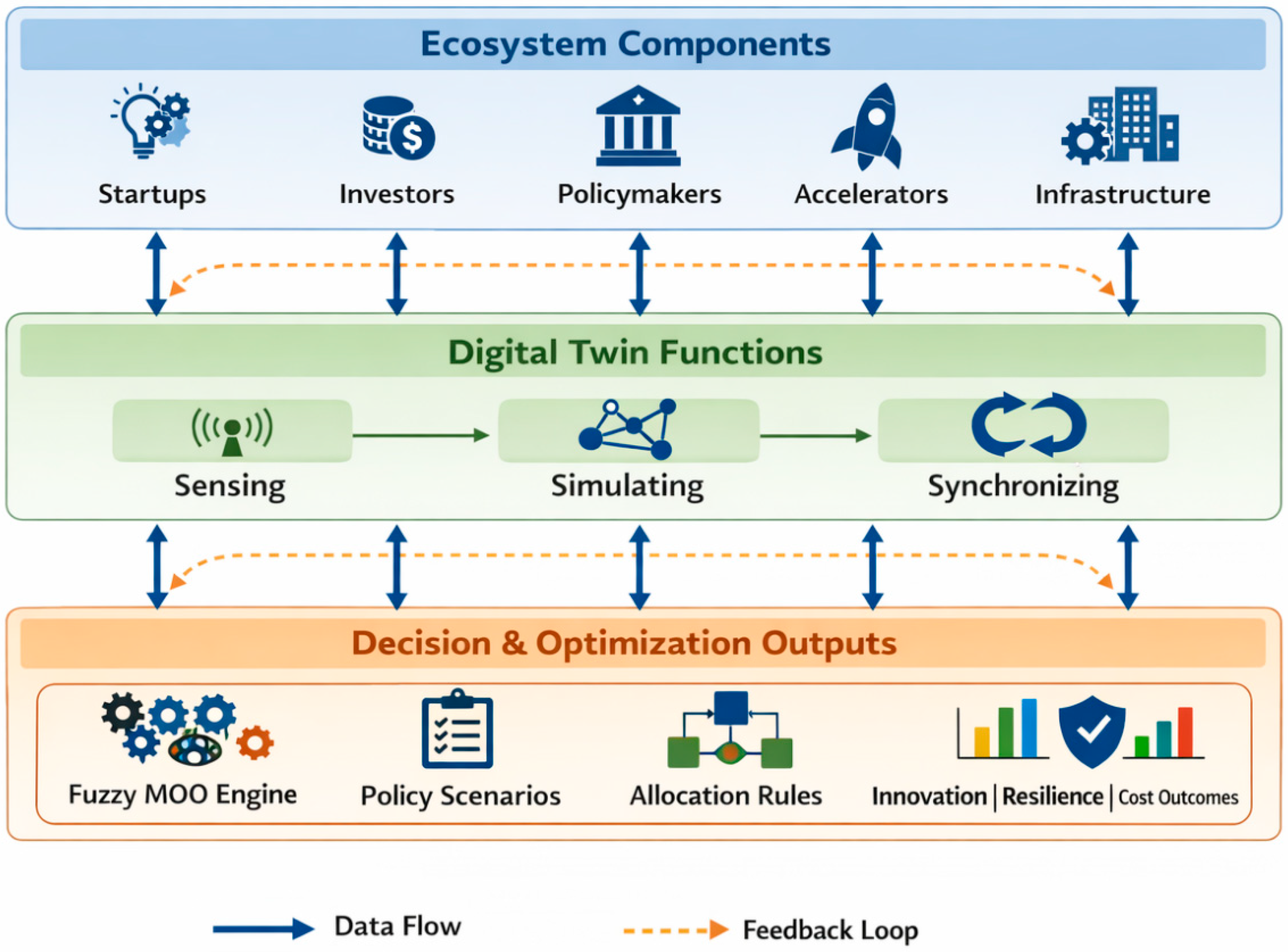
Figure 1 shows a layered architecture that makes a structural distinction between ecosystem components, digital twin functions, and decision outputs, and prevents the mixing of structural elements with analytical processes.
The first layer represents the main components of the entrepreneurial ecosystem, including startups, investors, policymakers, accelerators, and institutional infrastructure. These elements form the real and objective configuration of the ecosystem in which resource flows, institutional interactions, and allocation decisions take place. This layer reflects the economic and institutional environment in which innovation and resilience emerge as functional outcomes of the system.
The second layer represents the analytical functions of the digital twin and includes the processes of “sensing,” “simulating,” and “synchronizing.” At this level, the digital twin acts not as a new actor but as an analytical mechanism that takes data and ecosystem states and transforms them into virtual scenarios and “what if” experiments. This interpretation is consistent with the view that the digital twin is a dynamic and virtual counterpart of physical systems [
19,
20]. This allows the consequences of policies, financing combinations, or resource constraints to be assessed before actual intervention, without imposing direct costs or risks on the ecosystem.
The third layer is dedicated to decision outputs and optimization. At this level, the results of the simulation are processed through fuzzy multi-objective optimization and resource allocation strategies are derived. This layer simultaneously evaluates conflicting objectives such as innovation speed, ecosystem resilience, and economic cost, and takes into account uncertainties in parameters such as policy budgets, investor willingness, and startup needs [
21,
22,
23]. The outputs are presented as satisfaction-based optimal allocations that reflect managerial preferences and environmental ambiguity, rather than as definitive, single-point answers.
The linkage of these three layers creates an adaptive learning loop in which ecosystem data is fed into the simulation environment, its results are analyzed through optimization, and modified policy decisions are fed back into the ecosystem [
24,
25]. This architecture demonstrates that the proposed framework is not simply a static simulation model, but a dynamic analytical structure to support decision-making in entrepreneurial ecosystems [
38].
The conceptual framework of this study formulates the entrepreneurial ecosystem at three complementary levels. At the first level, the ecosystem is considered as a functional system whose outputs can be explained in terms of innovation, efficient resource allocation, and structural resilience. At the second level, the logic of value creation and capital flows is considered; in such a way that the mechanisms of financing, resource distribution, and interaction among economic actors are represented as the foundation of the ecosystem business model. At the third level, the interactions among institutional actors, investors, and entrepreneurs are conceptualized as a network of information flows and resources. The mathematical formulation presented below is a quantitative translation of these conceptual levels and attempts to represent them in the form of variables, parameters, and measurable performance indicators.
4. Mathematical Modeling
The mathematical model presented in this study is a quantitative operationalization of the three main functions of the entrepreneurial ecosystem. Specifically, the innovation index represents the value creation and innovation function, the resilience index represents the structural capacity and sustainability of the system, and the cost function represents the efficient allocation of resources at the policy level. The model parameters also reflect the institutional capacity, support budgets, and infrastructure capacity of the ecosystem.
The methodology of this research is based on the integration of a digital twin with a fuzzy multi-objective optimization model to enhance innovation and resilience in entrepreneurial ecosystems under uncertainty. The digital twin provides a virtual representation of the entrepreneurial ecosystem in which the dynamics of startups, investor interactions, and policymakers’ influence are simulated. The optimization layer uses fuzzy multi-objective programming to seek a balance between three conflicting goals: maximizing innovation, maximizing resilience, and minimizing economic costs. The fuzzy approach manages ambiguity in decision-makers’ preferences and environmental uncertainties and provides more realistic solutions for ecosystem development.
The present model is formulated based on several related streams in the decision-making and optimization literature. The innovation objective function is based on the logic of resource allocation to innovative activities and the value-creating capacity of actors, and is aligned with the perspective of resource orchestration in ecosystems. The resilience objective function is inspired by the literature that considers diversification, excess capacity, and structural flexibility as the main pillars of resistance to shocks. The cost objective function is also based on the conventional logic of the balance between resource consumption, investment, and economic benefits from the maturity of actors. The advantage of the proposed model is that it integrates these three dimensions not separately, but in a dynamic, multi-objective, and fuzzy framework at the ecosystem level; therefore, the present model can simultaneously analyze the trade-offs between innovation, resilience, and cost under uncertainty and over different time periods.
From a managerial perspective, this structure allows policymakers and investors to evaluate “what-if” decisions before committing resources in the real world. The model therefore supports dynamic capabilities, sensing conditions, simulating alternative actions, and reconfiguring resource allocations. The mathematical model is presented as follows.
| set of startups (s∈S) |
| set of investors (i∈I) |
| set of resources (infrastructural/supportive) (r∈R) |
| set of policies and interventions (k∈K) |
| set of discrete time periods (t∈T) |
| total capacity of resource r in period t |
| available budget of investor i in period t |
| unit cost of resource r |
| base innovation potential of startup s |
| productivity of resource r for startup s |
| economic benefit generated from the maturity of startup s |
| minimum and maximum required investment for startup s |
| minimum and maximum required resources for startup s |
| maximum number of startups that can be supported in period t |
| state of startup s at time |
| unit cost of policy k |
| total available policy budget in period t |
| amount of resource r allocated to startup s in period t |
| investment of investor i in startup s s in period t |
| binary variable, 1 if startup s is selected in period t, 0 otherwise |
| intensity level of policy k in period t |
| minimum satisfaction level among fuzzy objectives |
Since the objectives are conflicting, fuzzy multi-objective programming is used. A fuzzy membership function is defined for each objective. Then, the variable
α, which represents the minimum level of satisfaction of all objectives, is maximized:
Objective function (1) represents the innovation maximization of the entire ecosystem, which is a combination of the potential of startups and the resources allocated to them. Objective function (2) represents the resilience maximization of the ecosystem, which is realized through investment diversification and the existence of excess resource capacity. Objective function (3) represents the cost minimization of the entire ecosystem, which includes the total cost of resources and investments minus the economic benefits of startups. Fuzzy objective function (4) pursues the maximization of the minimum satisfaction level α among the three objectives of innovation, resilience, and cost. Constraint (5) ensures that the overall satisfaction level α α is not greater than the satisfaction level of the innovation objective. Constraint (6) ensures that the total consumption of each resource in each period does not exceed its available capacity. Constraint (7) ensures that the investment of each investor does not exceed his allocated budget. Constraint (8) limits the number of startups selected in each period to the maximum allowed amount. Constraint (9) ensures that each startup receives the minimum amount of capital it needs. Constraint (10) states that the capital allocated to each startup should not exceed the upper limit. Constraint (11) guarantees the minimum number of resources allocated to each startup. Constraint (12) indicates that the allocation of resources to each startup cannot exceed the allowed amount. Constraint (13) represents the dynamic equation of startup growth and specifies the relationship between resources, capital, and the level of innovative maturity. Constraint (14) limits the cost of policies to the budget available in each period.
Due to the dynamic and uncertain nature of entrepreneurial ecosystems, many of the model parameters cannot be estimated definitively. For this reason, a fuzzy approach is used to reflect the existing uncertainties. In this framework, the parameters are defined not as fixed numbers, but as triangular or trapezoidal fuzzy numbers. This allows for the model to simultaneously include probable, optimistic, and pessimistic values, and decision-making has greater flexibility. The first group of fuzzy parameters is related to resource capacity. The actual value of a resource capacity is usually affected by operating conditions, infrastructure constraints, and environmental changes, and deviates from the nominal value. The second set of fuzzy parameters is related to startup demand. The amount of capital and resources required by each startup varies under the influence of external factors such as market conditions, changes in customer demand, and the level of competition. To account for this variability, the limits of capital required and allocated resources are defined in a fuzzy manner. The third category of uncertainties concerns policymakers and support instruments. The implementation of policies and the allocation of related budgets always face risks such as changes in economic priorities, political fluctuations, or financial constraints. To represent these conditions, the cost of implementing the policy k and the policy budget in period t are defined in a fuzzy way:
In this regard, the values of L, M, and U represent the pessimistic, most likely, and optimistic states, respectively.
Defining fuzzy parameters in this way allows the mathematical model to be flexible against the inherent uncertainties of the ecosystem. In this case, the objective functions and constraints are evaluated not based on definite values, but on fuzzy values, and the degree of satisfaction with the realization of the objectives is calculated using fuzzy membership functions. This makes the final model not only theoretically powerful, but also in practice more applicable to the real and volatile conditions of entrepreneurial ecosystems.
This model contributes theoretically by showing how resource orchestration decisions (selection of startups, allocation of capital and resources, and timing of policy interventions) can be optimized in a digital environment before implementation. In contrast to deterministic allocation models, this approach explicitly incorporates uncertainty (through fuzzy parameters), conflicting objectives (innovation, resilience, cost), and multi-period dynamics—features that reflect the real behavior of entrepreneurial ecosystems.
5. Solution Approach and Computational Implementation
The analytical framework of the research is based on quantitative modeling and scenario analysis. After formulating the relationships and objectives in the form of a mathematical model, calculations are performed and optimal responses are extracted through computational procedures. In the following, the tools and algorithms used to implement and solve the model are introduced.
After formulating the mathematical model, it is necessary to describe the solution approach and its computational implementation. Since the choice of solution methods depends on the structure of the fuzzy multi-objective model, the type of constraints, and the dimensions of the problem, providing explanations of the exact and meta-heuristic algorithms in the continuation of the modeling maintains the logical coherence of the analysis. In this way, the research design framework and then the solution strategies used for problems at different scales are explained.
This research is of an applied-developmental type that aims to provide a new framework for modeling and optimizing entrepreneurial ecosystems in the context of digital twins. On the one hand, the research has developed a multi-objective mathematical model and designed solution methods based on a fuzzy approach at the theoretical level, and on the other hand, at the applied level, it has tested and evaluated the model practically using simulated data and public data taken from reliable articles and reports. Thus, the present article is classified as both theoretical research and applied studies and attempts to create a bridge between conceptual discussions and the real needs of policymakers and managers of entrepreneurial ecosystems. Unlike traditional empirical studies, entrepreneurial ecosystems often lack centralized real-time data, making it difficult to evaluate policy interventions in vivo. Digital twin-based simulation is therefore appropriate because it enables experimentation with resource allocation and policy scenarios without affecting real actors or investments. This choice aligns with research calling for experimentation-based, model-driven insights in ecosystem studies, especially when causal mechanisms are not directly observable in the field.
The data collection process was carried out in two stages. In the first stage, a set of simulated data was designed to cover various conditions and provide the possibility of testing the model on small and large scales. These data were constructed to cover a diverse range of demand scenarios, resource capacity constraints, policy budgets, and resource efficiency rates. In the second step, to validate the values and bounds used in the simulation, public data and statistical estimates available in scientific papers, industry reports, and policy documents were used. These sources played a calibration role and made the simulated scenarios numerically and logically consistent with the realities observed in entrepreneurial environments. A combination of exact and meta-heuristic methods was used to solve the model. For small- and medium-sized problems, the model was solved using GAMS software. The reason for choosing GAMS was its high ability to solve mathematical optimization models and access to exact solutions in finite dimensions. In contrast, for large-scale problems that were time-consuming or even impossible to solve with exact methods, two metaheuristic algorithms, the multi-objective genetic algorithm (NSGA-II) and the ant colony algorithm (ACO), were used.
The NSGA-II algorithm was selected due to its high efficiency in multi-objective problems. By utilizing Pareto sorting and the crowding mechanism, this algorithm is able to produce a diverse set of Pareto optimal solutions and give decision makers a comprehensive view of the trade-offs between different objectives. In contrast, the ant colony algorithm, inspired by the social behavior of ants and using the pheromone mechanism, was able to show high efficiency in searching the response space, especially in problems with complex resources and budget constraints. This diversity in the choice of algorithms also enabled comparisons between evolutionary and social approaches and increased the analytical power of the research. To implement these algorithms, a set of control parameters was set, which is presented in
Table 1. These parameters were adjusted based on initial tests as well as literature recommendations to strike a good balance between convergence speed and solution quality.
As can be seen, in NSGA-II, the population size was set to 100 and the number of generations was set to 200 to give the algorithm enough time to search and evolve the population. A relatively high crossover rate (0.9) was chosen to maintain the diversity of solutions, and a low mutation rate (0.1) was set to prevent the algorithm from being too far off. In the ant colony algorithm, the colony number was set to 50, the pheromone importance (α) was set to 1, the heuristic function importance (β) was set to 2, and the pheromone evaporation rate (ρ) was set to 0.5. These values allowed the algorithm to simultaneously consider past information and heuristic criteria and strike a balance between exploratory search and exploitation. All simulations and metaheuristic algorithms were implemented in Python 3.10. Standard libraries were used for optimization, data processing, and graphing. The system used to perform the calculations was a computer with an 11th generation Intel Core i7 processor, 16 GB of RAM, and the Windows 11 operating system. The choice of this hardware and software environment enabled the optimal and stable execution of algorithms at different scales, and resulted in the results obtained having appropriate stability and accuracy.
To ensure the credibility and realism of the results, we followed a two-step validation logic. (1) Structural validation confirmed that changes in key parameters (e.g., resource capacity, budget variation) produced outcomes aligned with theoretical expectations from resource orchestration and dynamic capabilities literature. (2) Calibration validity was achieved by using real, publicly available ecosystem benchmarks (startup survival rates, investment patterns, capacity constraints) to constrain the simulated dataset. This ensures that while data is simulated, behavior and dynamics are grounded in empirical insights and reflect plausible real-world ecosystem evolution patterns.
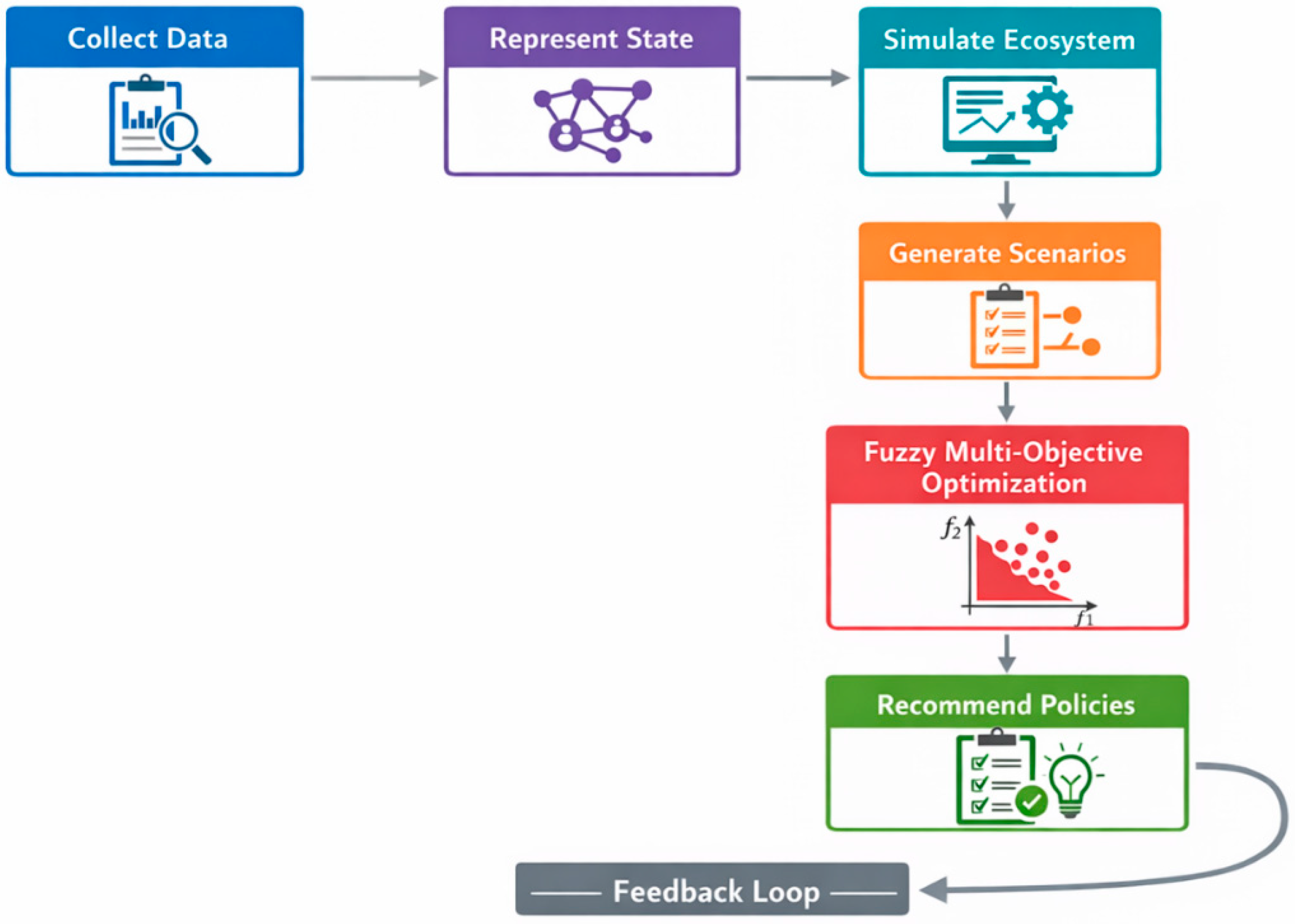
In order to increase the transparency of the implementation logic of the proposed framework, the operational flow of the model is shown step by step in
Figure 2. This diagram shows how data from the entrepreneurial ecosystem is processed in the digital twin environment and transformed into policy recommendations.
As can be seen in
Figure 2, the proposed framework is not simply a static analytical model, but rather operates as an integrated decision-making cycle. In the first step, ecosystem data is collected and transformed into a representative state of the system. This state is then simulated in the digital twin layer and different paths of ecosystem evolution are evaluated. Scenario generation allows for the examination of different policy combinations and resource allocations under uncertainty. Subsequently, the fuzzy multi-objective optimization module extracts acceptable options by considering conflicting objectives. The output of this process is presented in the form of policy recommendations and is fed back into the decision-making cycle through a feedback mechanism to allow for continuous updating and adaptation.
6. Analysis of Results
To evaluate the proposed framework, a combination of simulated and real data was used to both provide control over the experimental conditions and maintain the model’s relevance to the real environment. The bulk of the data was generated in simulated form to cover a wide range of different conditions and sizes from small to large. This data allowed the model to be examined in situations with different levels of complexity and helped to measure the efficiency of the algorithms in various scenarios. In addition to this data, a set of real data was also used, which included general statistics on demand and costs in the industrial supply chain. This real data was used as the basis for calibration and validation of the model to ensure that the research results were not simply the result of artificial simulations and that it could be adapted to real conditions. In line with our theoretical positioning, the purpose of the analysis is not merely to test algorithmic performance, but to demonstrate how a digital-twin-enabled decision model produces insights on resource orchestration and policy prioritization in entrepreneurial ecosystems. Thus, the interpretation of results is grounded in managerial and theoretical contribution rather than computational accuracy alone.
The model parameters and variable ranges were calibrated based on publicly available data published in entrepreneurship ecosystem reports and reliable statistical sources. Specifically, indicators related to startup survival rate, venture capital volume, support spending share, and innovation growth rate were adjusted using data published in the Global Entrepreneurship Monitor (GEM), Global Startup Ecosystem Report (GSER), World Bank data, and OECD reports on entrepreneurship and innovation. The numerical ranges used in the simulations are aligned with the observed averages and ranges in these sources to ensure the relative realism of the designed scenarios.
In order to comprehensively examine the performance of the model and algorithms, several scenarios were designed. These scenarios included situations with high and low demand fluctuations, conditions with severe resource capacity constraints, as well as situations with logistical disruptions. In addition, scenarios combining these factors were also considered to measure the resilience and stability of the proposed framework in critical situations. The high variety of scenarios allowed the model to be tested not only in stable states, but also in dynamic and volatile environments. The purpose of designing such data and scenarios was to show that the proposed framework has sufficient flexibility and reliability for use in real environments. Thus, the results obtained are not limited to specific or simple conditions, but also have the ability to be generalized to complex and real situations and can be the basis for practical decision-making for investors, startups, and policymakers.
Given the model-based and simulation-based nature of the research, the results and their analytical interpretation have been presented in an integrated manner to maintain a direct connection between computational findings and theoretical and managerial implications.
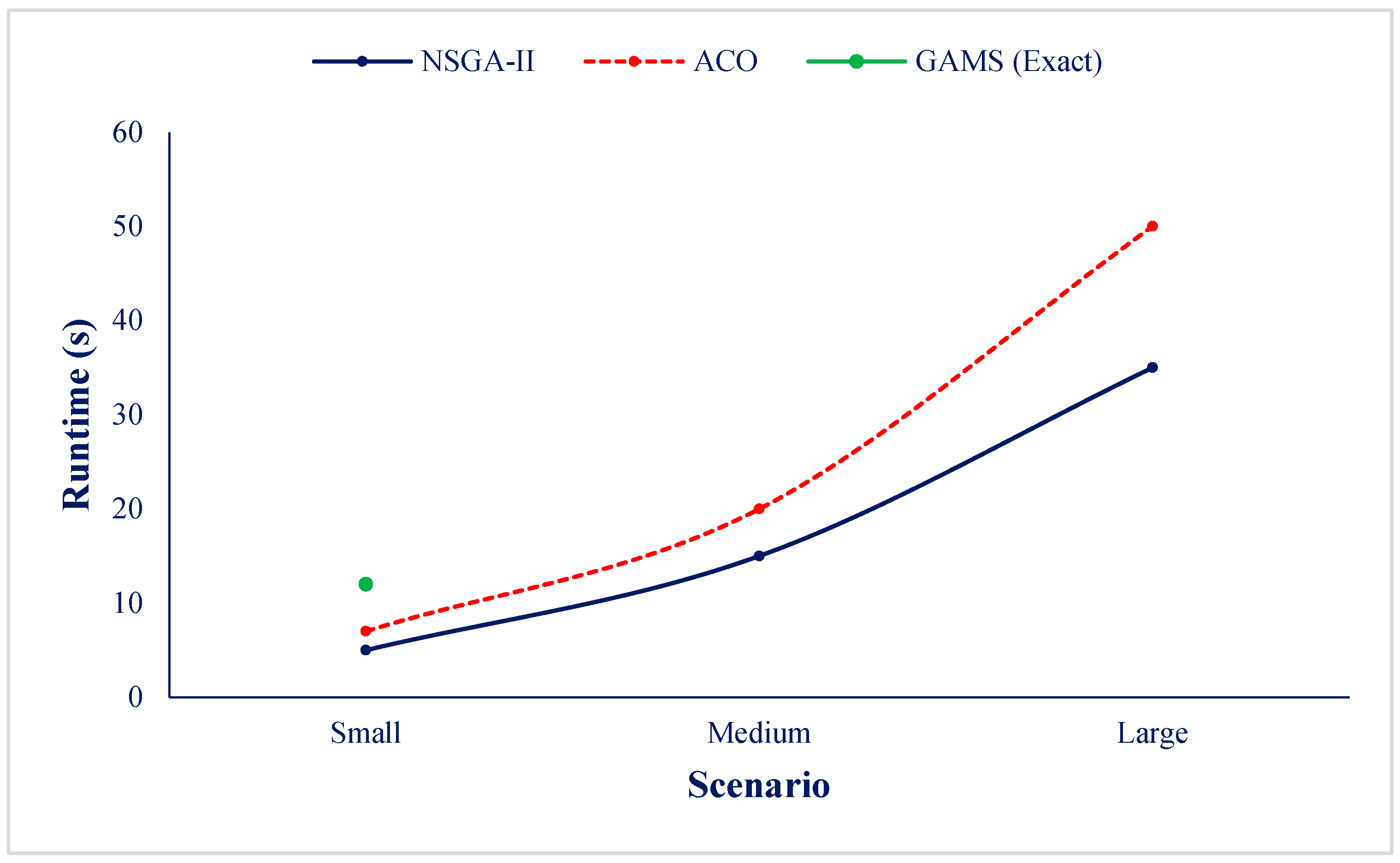
One of the important aspects in evaluating the proposed model is to examine the efficiency of the algorithms used in solving the problem. The first comparison criterion was related to the computational time. The results showed that both NSGA-II and ant colony algorithms were able to significantly reduce the solution time at large scales. This is especially important when decisions have to be made in dynamic environments and in a short time frame. As can be seen in
Figure 3, the trend of changes in computational time shows that increasing the problem dimensions has a significant impact on the reference methods, while the metaheuristic algorithms have shown a much gentler growth in execution time.
Theoretical implication: faster computational convergence enables exploration of alternative ecosystem configurations a core component of sensing and experimentation in dynamic capabilities.
Managerial implication: policymakers can test multiple policy/resource allocation strategies before implementation, reducing uncertainty and risk.
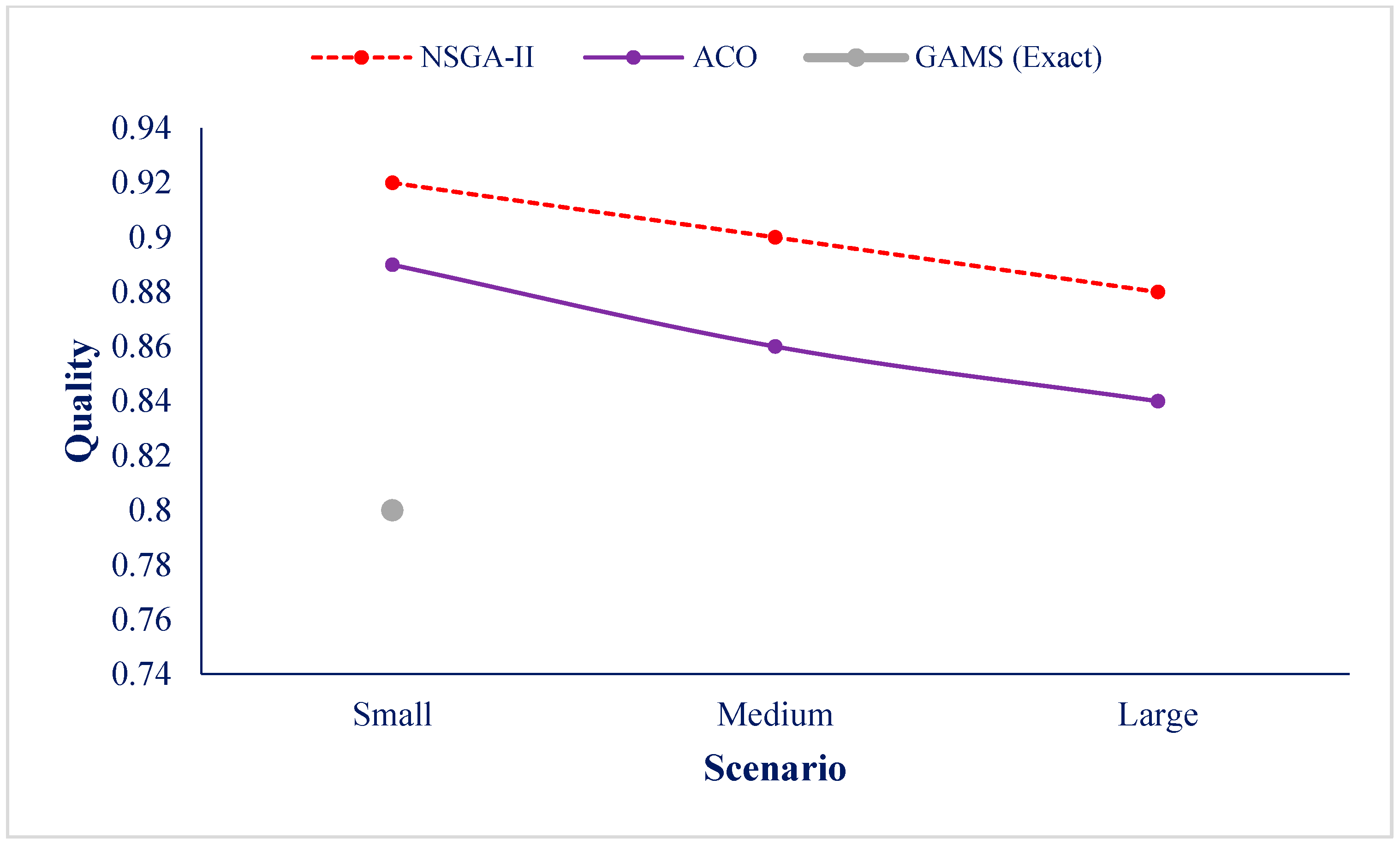
In the next step, the quality of the solutions obtained was evaluated. Indicators such as the best recorded value, the average of the results obtained and their distance to the Pareto front were selected for this comparison. The findings indicate that NSGA-II has been able to provide solutions with higher quality and closer to the efficiency frontier in most scenarios, while the ant colony algorithm has produced a greater variety of solutions in some specific conditions. As shown in
Figure 4, the quality curve of the NSGA-II results is higher than that of other methods in most cases, indicating its relative superiority in quality assurance.
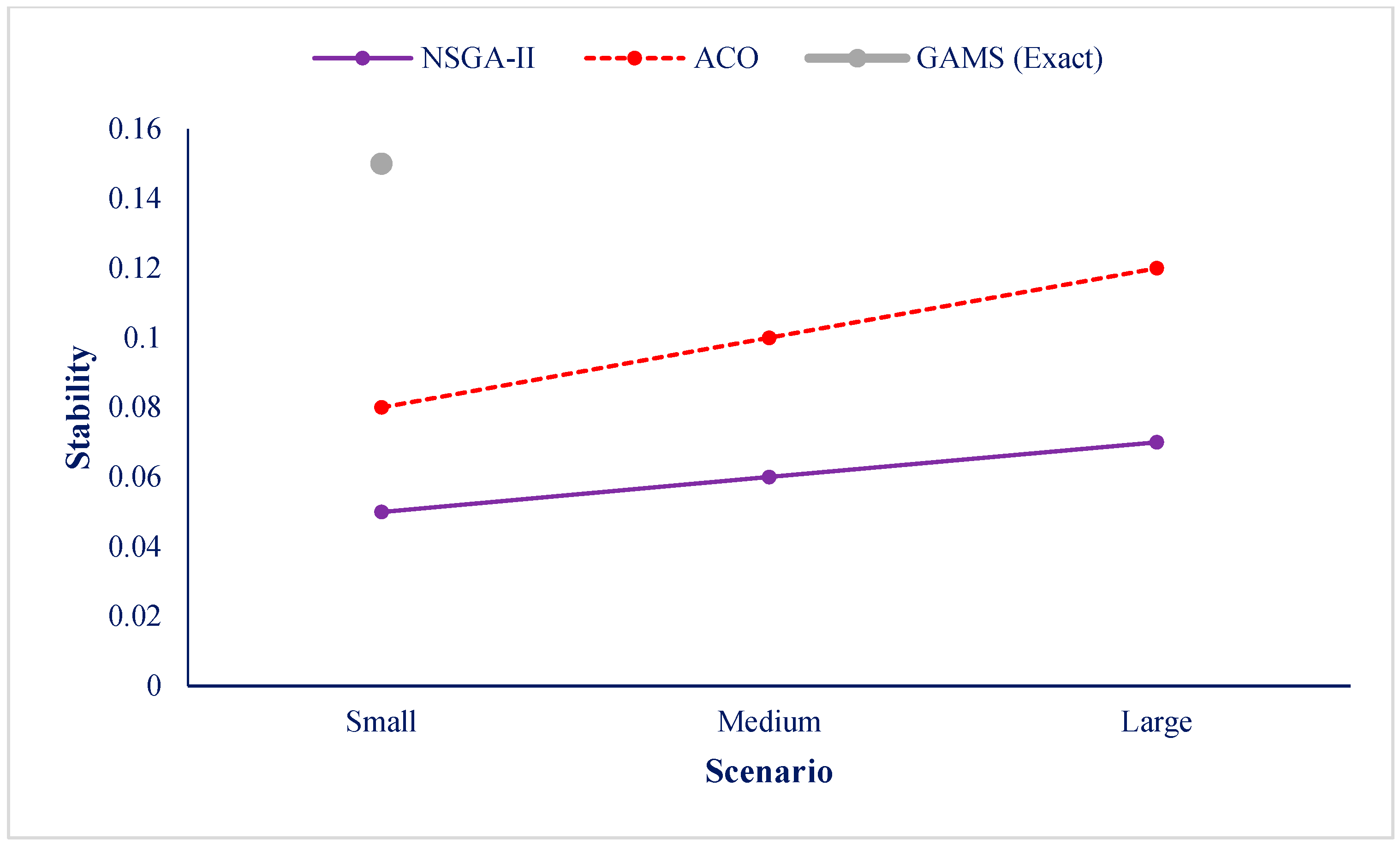
The stability of the algorithms was also analyzed as a key indicator. Stability means that the algorithm can provide similar results when run multiple times under the same conditions. In this analysis, the variability of the outputs was measured in several independent runs. The results showed that NSGA-II has much less dispersion and its outputs are almost convergent in different iterations, while the ant colony algorithm has shown more fluctuations in some cases.
Figure 5 shows the trend of the variability of the results of the algorithms in multiple runs and indicates that NSGA-II has higher stability and reliability than other methods.
In general, the comparison between the algorithms showed that NSGA-II performed better than the ant colony algorithm and the reference methods in all three criteria of computational time, solution quality, and stability. ACO was also able to create more diversity in solutions in some scenarios, but overall, it was at a lower level in terms of stability and proximity to the Pareto front. These results indicate that the proposed framework, relying on metaheuristic algorithms, is not only capable of solving large-scale problems, but can also help decision makers achieve fast, stable, and high-quality solutions. Therefore, the proposed model is eligible for practical use in real and volatile environments of entrepreneurial ecosystems and can be a reliable tool for promoting innovation and resilience.
To evaluate the effectiveness of the proposed framework, the model results were examined in different scenarios. The scenarios were designed to simulate real-world and volatile conditions of entrepreneurial ecosystems, including demand fluctuations, severe capacity constraints, and changes in support policies. The aim was to show that the model can provide balanced and reliable decisions not only in stable conditions but also in uncertain environments.
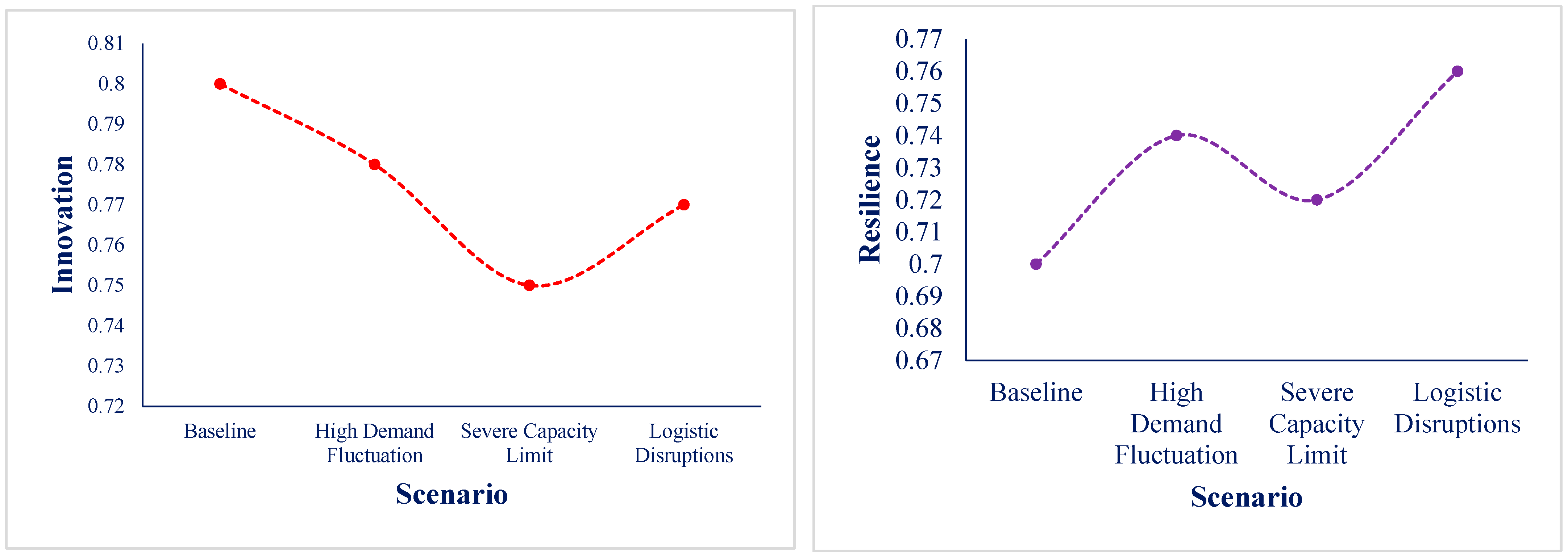
Figure 5 presents two graphs of the results related to innovation and resilience. As the innovation curve shows, even in conditions where the demand level fluctuated significantly, the model was able to maintain the innovation of startups at a relatively stable level. This suggests that the resource and capital allocation mechanism in the model is designed in such a way that the innovation of the entire system does not decrease significantly under environmental pressure. On the other hand, the resilience graph shows that the model was able to strengthen the adaptive capacity of the system under conditions of resource constraints or sudden changes in investors’ budgets by diversifying investments and distributing resources in a balanced manner. Overall,
Figure 6 shows that the model is able to simultaneously maintain innovation and increase resilience, even in volatile and uncertain environments.
These results demonstrate how digital twins support resource reconfiguration, since the model identifies how resource diversity and timing influence resilience. For policymakers, this means that resilience is not a by-product of innovation, it requires deliberate allocation design.
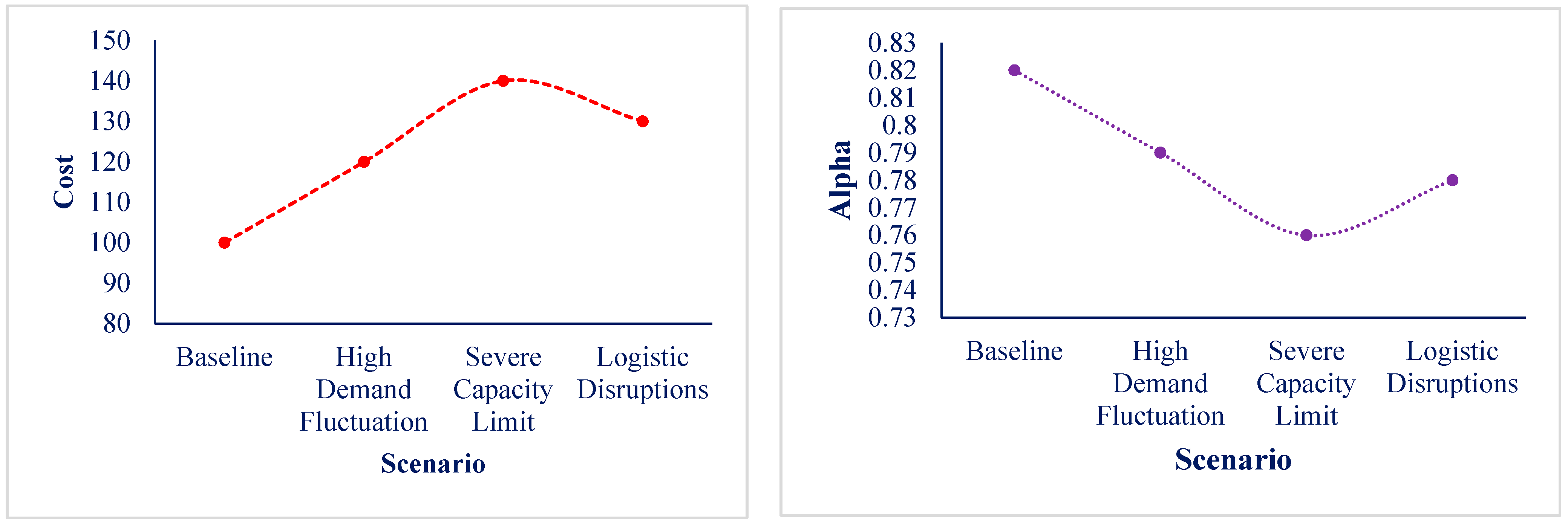
Figure 7 shows the results of the total cost and the fuzzy satisfaction level α. The cost variation curve shows that despite the increase in costs in some high-risk scenarios, the model was able to compensate for part of these costs with the economic benefits resulting from the maturity of startups. This trend well reflects the model’s ability to balance cost and benefit under uncertain conditions. The second graph presents the fuzzy satisfaction level α. It can be seen that even in the most severe fluctuating scenarios, the value of α remains at an acceptable level and never falls below the critical threshold. This means that the model has been able to simultaneously guarantee the achievement of the triple goals of innovation, resilience, and cost, and provide solutions that are practical and reliable for decision makers.
Overall, the explanations in
Figure 6 and
Figure 7 show that the proposed model not only performs well under normal conditions, but also provides efficient and balanced solutions when faced with uncertain and turbulent environments. This is the main strength of the proposed fuzzy framework, which can be directly used in policy-making and practical decision-making in entrepreneurial ecosystems.
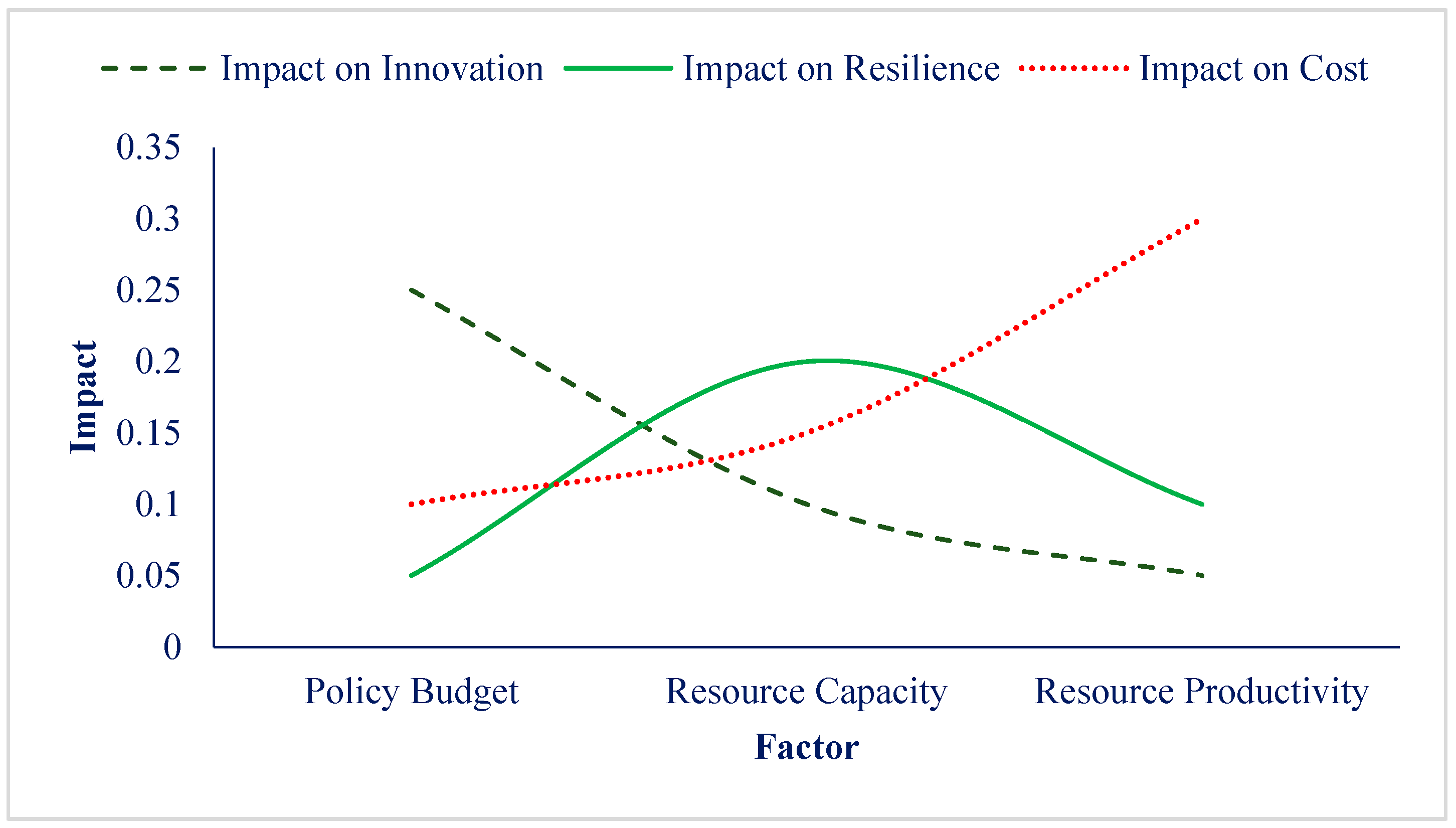
In order to show that the proposed model is not simply a “black box” and that the decision maker can clearly understand which parameters have the greatest impact on the output, a sensitivity analysis was conducted on the key parameters of the model. In this analysis, three categories of variables were examined: policy budget, resource capacity, and resource efficiency in startups. The aim of this assessment was to determine to what extent changes in each of these parameters could affect innovation, resilience, and total system cost. The results showed that changes in policy budget had the greatest impact on the level of innovation. When this budget was reduced, the total system innovation dropped significantly, although resilience did not change significantly. On the other hand, resource capacity had the greatest impact on resilience; that is, as capacities were limited, the system’s ability to create diversity and flexibility decreased. Finally, resource efficiency had the greatest impact on costs, and increasing productivity led to a significant reduction in total cost.
These findings are presented in
Figure 8. As can be seen, the relative importance of each parameter on the model outputs can be clearly seen. This type of analysis is of great value to decision makers, as it shows that if the main goal is to promote innovation, the focus should be on supportive policies, and if the goal is to improve resilience, capacity management becomes more important.
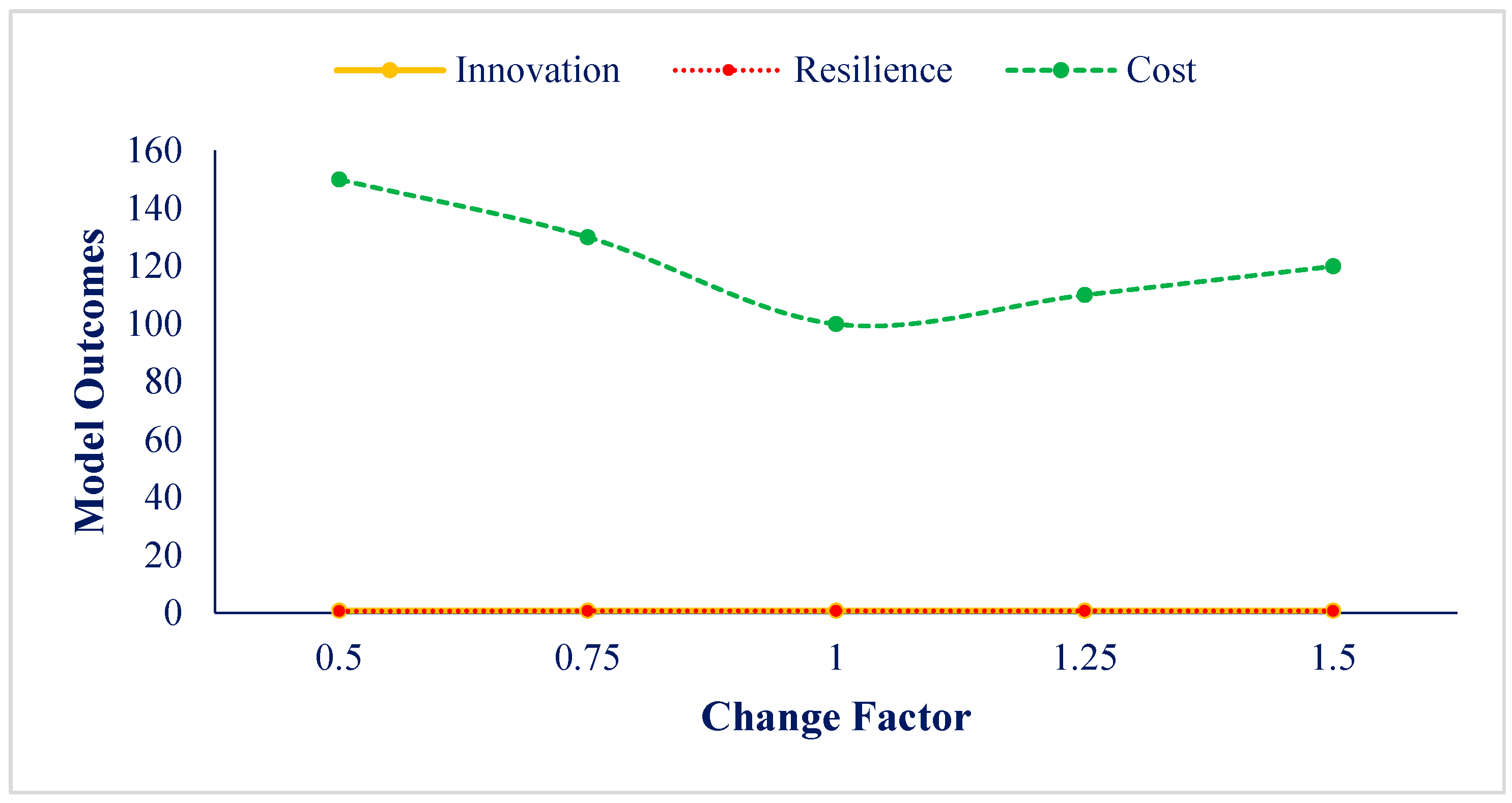
In addition, to further clarify the dynamic changes of the model, a curve-based analysis was also conducted. In this analysis, the output of innovation, resilience, and cost were examined with gradual changes in each key parameter over a certain interval. As shown in
Figure 9, the curves indicate that the model’s response to changes in the policy budget is not linear and exhibits jump behavior at some threshold points. This suggests that policymakers should be very sensitive to small but critical changes in the budget.
From a theoretical perspective, the results of the sensitivity analysis within the framework of the assumptions and parametric structure of the model show that in the designed scenarios, changes in policy budgets have had the greatest impact on the innovation index, while resource capacity and structural infrastructure have played a more prominent role in strengthening resilience. These patterns cannot be considered as universal propositions, but rather as the outcome of the model’s behavior under specific simulation conditions; however, this conceptual distinction is in line with some existing views in the ecosystem literature and can provide a basis for future empirical tests. The sensitivity analysis also showed that the proposed framework is not limited to generating balanced solutions, but is also able to identify vulnerabilities and key influential levers in the entrepreneurial ecosystem. The distinctive feature of this framework is that it is designed based on the digital twin approach and allows for the representation of the temporal dynamics of the ecosystem. Unlike static analyses that only provide an average or final state picture, the digital twin architecture, as a dynamic simulator, enables monitoring and evaluating system performance over successive periods of time and provides a deeper understanding of ecosystem evolution trends.
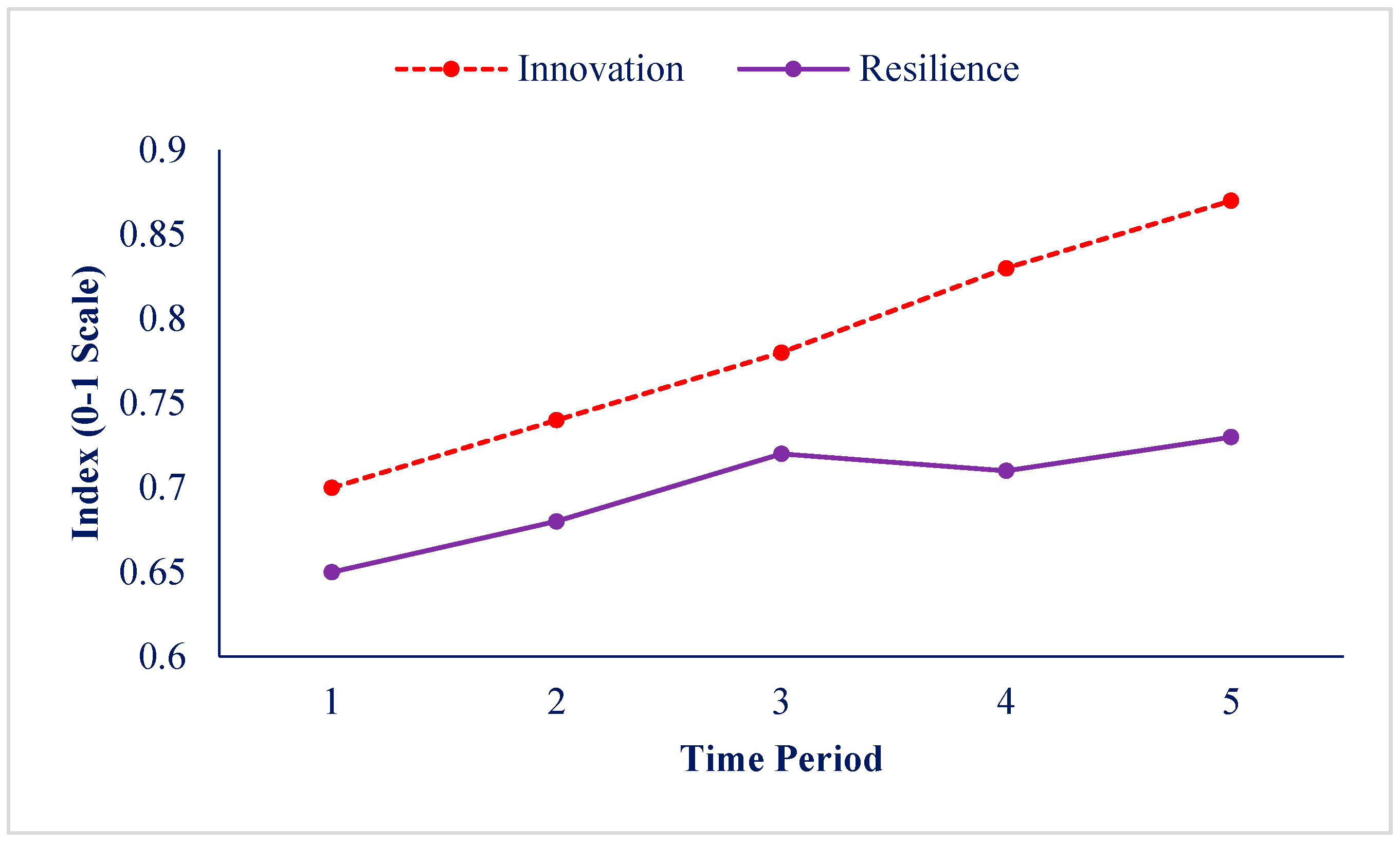
To demonstrate this capability, the model outputs were examined over five successive periods. As shown in
Figure 10, the innovation index has a gradually increasing trend, indicating that with the passage of time and the maturity of startups, the level of innovation of the entire ecosystem increases. In contrast, the resilience index experienced changes in the early periods under the influence of fluctuations in capital and resource capacity, but subsequently found a stable trend.
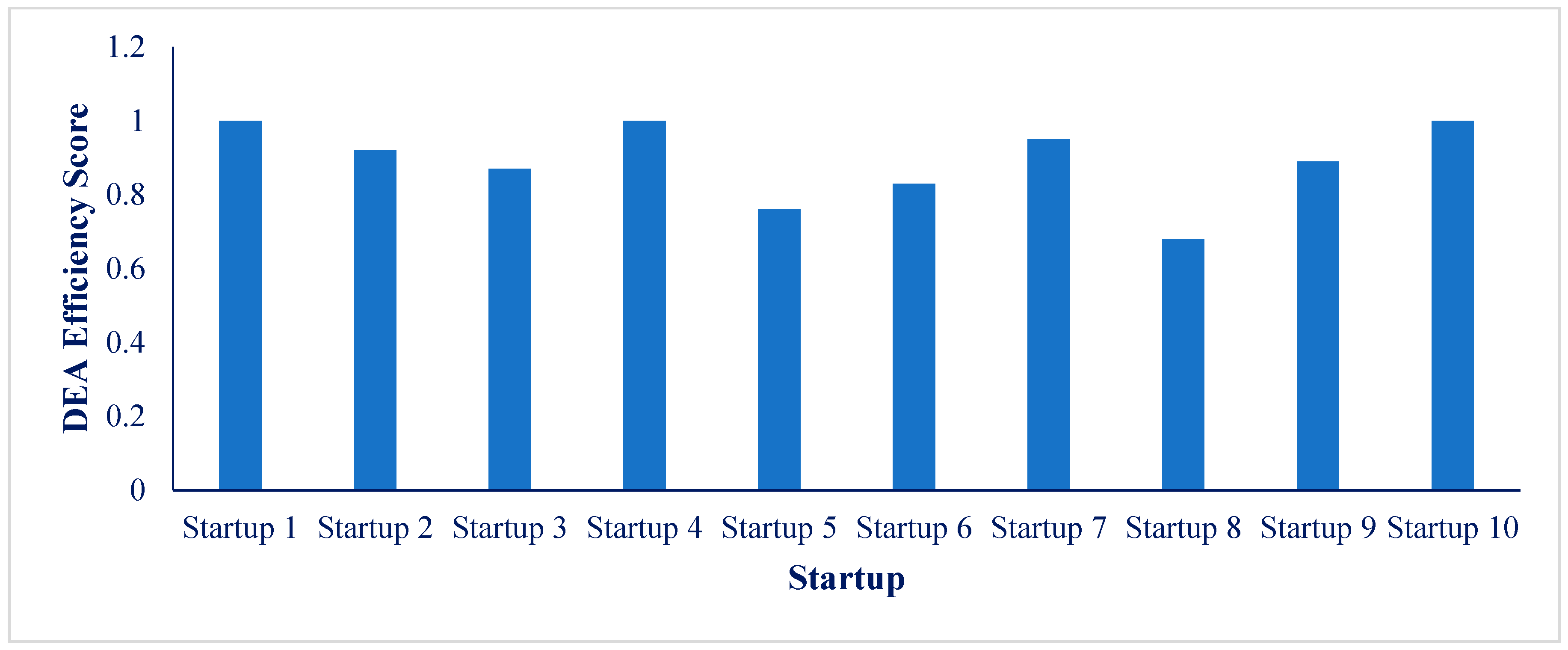
This analysis shows that the model is not just a tool for optimizing in the moment, but is also capable of capturing the long-term dynamics of the ecosystem. Digital twins play an important role here, as they allow decision-makers to see not only the current state, but also the likely path of future evolution. In this way, different scenarios can be run and see which policies or allocations will create the most sustainability and innovation over the long term. The proposed digital twin framework in this study is not limited to representing the macro-behavior of the entrepreneurial ecosystem, but is also able to provide valuable data at the micro level for analyzing the performance of decision-making units. One of the complementary tools for extracting these insights is data envelopment analysis (DEA). In this approach, the outputs of the digital twin simulation—including the level of innovation, cost, and economic benefits of startups in different scenarios—were used as input data to calculate the relative efficiency index. In this analysis, the total cost and resources consumed in the model were defined as inputs, and innovation and economic benefits were defined as outputs. Thus, DEA, relying on the dynamic and multi-scenario data of the digital twin, calculated the relative efficiency of each startup. The results showed that only a part of the startups were able to be on the efficiency frontier (efficiency score 1) and obtain the highest efficiency from the available resources. Other startups, despite receiving similar resources, were significantly further from the efficiency frontier.
Figure 11 shows the relative efficiency of startups based on this analysis. As can be seen, the digital twin not only reconstructs the macro-image of the ecosystem, but also allows the micro-performance of each startup to be objectively measured by feeding DEA data. This combination allows policymakers and investors to simultaneously understand both the efficiency of the system at the macro level and the relative efficiency of individual actors at the micro level.
This extends digital twin literature by showing that digital twins can operate as evaluation mechanisms, quantifying efficiency at the micro-actor level without requiring intrusive data collection from startups. These findings are particularly important because they show that digital twins are not just a prediction or simulation tool but can also provide an analytical platform for multi-level evaluation. In this way, decision-makers can not only understand how the model balances innovation, resilience, and cost at the macro level, but also be able to understand which startups are most productive in this dynamic environment and which ones need to be adjusted in resource allocation or policy support.
In order to ensure the reasonableness of the model’s behavior, a series of simple but key experiments were designed to examine the system’s response to changes in key parameters. The results of these experiments showed that the model is structurally consistent with theoretical expectations. For example, increasing the policy budget led to a significant growth in the innovation index, while limiting the resource capacity reduced the number of selected startups and the level of resilience. Also, improving resource efficiency reduced the total cost and improved the level of fuzzy satisfaction α. These behaviors are fully consistent with economic and intuitive logic and indicate that the model is not only mathematically consistent but also behaviorally valid. As a result, the structural validity of the model can be confirmed, and more advanced analyses can be based on it.
Furthermore, the results obtained have important managerial and policy implications. The adaptive behavior of the model against changes in key parameters shows that decision-makers can use the digital twin framework not only to assess the impact of policies and constraints at the macro-ecosystem level, but also to identify their consequences at the micro-level. For example, it was observed that increasing the policy budget directly enhances innovation, but if done without considering resource capacity, it can lead to reduced resilience. This warns policymakers that strengthening policies should be designed simultaneously with the development of infrastructure and supporting capacities. On the other hand, the findings are also important for accelerator managers and investors, as they show that improving resource efficiency, in addition to reducing costs, increases the level of satisfaction of the entire system and should therefore be prioritized in investment and management decisions. Overall, these results indicate that the proposed model is not just a computational tool but can also act as a decision-support system for managing entrepreneurial ecosystems. From this perspective, the digital twin framework allows different strategies to be tested in a virtual and secure environment before being implemented in the real world, allowing decision-makers to design policies and allocate resources with more confidence.
Despite the aforementioned managerial and analytical implications, the interpretation of the results should be done within the boundaries of the present model. The proposed framework focuses mainly on resource flows, capacities, allocations and their structural consequences, and therefore, some behavioral and organizational dynamics common in entrepreneurial ecosystems, including informal collaborations, strategic competition, gradual learning processes, negotiation between actors and network effects, are not explicitly included in the model. Also, although the scenarios and parameter ranges are calibrated using reliable public data, the empirical evaluation is not yet based on a fully instrumental and online data-based platform. Accordingly, the findings of this section should be interpreted as a structural and decision-supporting representation of the logic of ecosystem functioning under controlled conditions. However, this same level of formulation allows for systematic examination of trade-offs, identification of key levers, and comparison of policy scenarios, providing an analytical basis for model development at more advanced behavioral and data levels.
7. Conclusions
This study aims to develop and evaluate a decision-making framework based on digital twins and fuzzy multi-objective optimization, presenting a novel approach to resource allocation management in entrepreneurial ecosystems. Unlike descriptive studies that mainly identify ecosystem components or the relationships between them, the proposed framework in this study operationalizes decision-making at the macro-ecosystem level and allows testing of different resource allocation and policy scenarios before implementation. The integration of a dynamic mathematical model, fuzzy parameters, and exact and meta-heuristic solution algorithms made it possible to analyze the three conflicting objectives of innovation, resilience, and cost simultaneously and under uncertainty.
The findings of this study indicate that the main gap in literature has been the lack of a prescriptive yet theoretical framework to support ecosystem-level resource allocation decisions under uncertainty. By combining digital twin logic, multi-objective fuzzy optimization, and multi-period resource allocation, this paper goes beyond previous studies and shows that the analysis of entrepreneurial ecosystems can be elevated from the level of describing structures and relationships to the level of designing and guiding dynamic decisions. From this perspective, the theoretical contribution of the study is not limited to providing a practical tool, but rather to explaining that resource allocation mechanisms shape innovation and resilience in different ways and with different intensities.
From a theoretical perspective, the results showed that innovation and resilience in entrepreneurial ecosystems are influenced by different levels. Increasing policy budgets and institutional support had the greatest effect on the growth of the innovation index, while resource capacity and investment diversification played a more decisive role in strengthening resilience. This conceptual distinction takes the ecosystem literature beyond the assumption of simultaneous and co-directional movement of innovation and resilience, and shows that these two outcomes have different driving mechanisms. The proposed framework also operationally demonstrates how the digital twin can implement the logic of dynamic capabilities (sensing, simulating, and reconfiguring) at the ecosystem level.
From a managerial perspective, the results show that increasing financial resources alone does not guarantee ecosystem sustainability [
39], and effective policymaking requires the simultaneous design of capacity infrastructure and diversification mechanisms. Sensitivity analysis also revealed that improving resource efficiency has the greatest impact on reducing the costs of the entire system, without weakening the level of fuzzy satisfaction of other objectives. Thus, the proposed framework can act as a decision-making engine for policymakers, investors, and accelerator managers, enabling the design of less risky, simulation-based policies.
From an operational perspective, the implementation of the proposed framework does not necessarily require the immediate deployment of a complete online infrastructure, but can be developed in stages. In the first step, the use of aggregated data and public reports is sufficient to build an initial profile of the state of the ecosystem. In the second step, policy scenarios and resource allocations can be tested in a simulation and decision-making environment. In subsequent steps, as data and institutional maturity increases, it will be possible to add more regular data flows, dynamic updates, and more advanced analytical tools. From this perspective, the present framework can be used not only for fully instrumented ecosystems, but also for developing platforms, provided that its deployment is designed in a gradual manner and in proportion to the existing data and analytical capacity.
Despite the achievements presented, this research has some limitations. First, most of the data are designed in a simulated manner and although their values and limits are calibrated with valid public data, they are not based on live and real-time data of real ecosystems. Second, the model structure is based on linear relationships between variables and complex behavioral interactions between startups, knowledge spillovers and network effects are not explicitly modeled. Third, although the digital twin framework allows for dynamic analysis, in this version of the model, parameter updating is not performed online and based on machine learning.
Furthermore, the policy evaluation in this study was conducted at a pre-implementation level and based on simulation; therefore, the findings reflect the effectiveness of the proposed policies in a modeled environment rather than directly measuring their outcomes after implementation in a real context. Field validation of policy effects requires longitudinal data, actual policy implementation, and the possibility of pre- and post-intervention comparisons, which are beyond the scope of the present study.
Accordingly, future research directions can be formulated in a prioritized manner in two horizons: short-term and long-term. In the short-term, the first step is to connect the proposed framework to real data from entrepreneurial ecosystems, including data on investment flows, survival and growth rates of startups, capacity of supporting institutions, quality of innovation infrastructure, and changes in policy instruments over time. Such an extension can increase the empirical validity of the model and allow for more precise calibration of fuzzy parameters. In the same short-term horizon, the combination of digital twin and multi-objective fuzzy optimization with machine learning methods can also be pursued to dynamically and data-driven update of parameters, predict the behavior of ecosystem actors, and improve the accuracy of decision-making scenarios. For example, machine learning algorithms can extract patterns of changes in investor preferences, startup needs, or the effectiveness of support policies from historical data and feed these patterns into the digital twin feedback loop.
In the long term, it is important to develop the model to more explicitly represent the network structure of the ecosystem, so that the relationships between startups, investors, universities, accelerators, and policymakers are modeled not just as aggregate variables, but as a dynamic web of linkages, knowledge spillovers, inter-organizational collaborations, and interdependencies [
40]. In this case, integrating network models with digital twin logic and multi-objective optimization can enable more detailed analysis of bottlenecks, risk hotspots, and mechanisms for the diffusion of innovation and resilience. Also, testing this framework in different geographical and institutional contexts [
41], and comparing its performance in ecosystems with different levels of data and infrastructure maturity, can help the theoretical and practical generalizability of the research. Overall, strengthening the link between real data, machine learning, and network modeling outlines the natural path for the evolution of this framework to become an intelligent and adaptive decision-support system in the management of entrepreneurial ecosystems [
42]. This could also be a tool for overcoming potential crisis situations in various aspects and functions [
43]. Overall, this research demonstrates that digital twins, when combined with fuzzy multi-objective optimization, can go beyond mere simulation tools and become decision-making engines for managing complex and uncertain ecosystems. This framework is a step towards transforming ecosystem analysis from descriptive approaches to prescriptive and simulation-based design before implementation and provides a new field for interdisciplinary research at the intersection of management, complex systems, and intelligent decision-making.