
Systematic Review

Head-to-Head: AI and Human Workflows for Single-Unit Crown Design—Systematic Review

by
Andrei Vorovenci
1,
Viorel Ștefan Perieanu
2,†,
Mihai Burlibașa
2,*,†,
Mihaela Romanița Gligor
3,†,
Mădălina Adriana Malița
2,*,
Mihai David
2,
Camelia Ionescu
4,
Ruxandra Stănescu
5,
Mona Ionaș
3,
Radu Cătălin Costea
2,
Oana Eftene
6,
Cristina Maria Șerbănescu
1,
Mircea Popescu
1 and
Andi Ciprian Drăguș
2
1
Doctoral School, Carol Davila University of Medicine and Pharmacy, 050474 Bucharest, Romania
2
Department of Dental Technology, Faculty of Midwifery and Nursing, Carol Davila University of Medicine and Pharmacy, 050474 Bucharest, Romania
3
Faculty of Medicine, Lucian Blaga University of Sibiu, 550169 Sibiu, Romania
4
Department of Dental Prosthesis Technology, Faculty of Dentistry, Carol Davila University of Medicine and Pharmacy, 050474 Bucharest, Romania
5
Department of Implant-Prosthetic Therapy, Faculty of Dentistry, Carol Davila University of Medicine and Pharmacy, 050474 Bucharest, Romania
6
Orthodontics and Dento-Facial Orthopedics Department, Faculty of Dentistry, Carol Davila University of Medicine and Pharmacy, 050474 Bucharest, Romania
*
Authors to whom correspondence should be addressed.
These authors contributed equally to this work.
Submission received: 24 October 2025 / Revised: 2 January 2026 / Accepted: 27 January 2026 / Published: 2 February 2026

Abstract

Objectives: To compare artificial intelligence (AI) crown design with expert or non-AI computer-aided (CAD) design for single-unit tooth and implant-supported crowns across efficiency, marginal and internal fit, morphology and occlusion, and mechanical performance. Materials and Methods: This systematic review was conducted and reported in accordance with PRISMA 2020. PubMed MEDLINE, Scopus, Web of Science, IEEE Xplore, and Dentistry and Oral Sciences Source were searched from 2016 to 2025 with citation chasing. Eligible studies directly contrasted artificial intelligence-generated or artificial intelligence-assisted crown designs with human design in clinical, ex vivo, or in silico settings. Primary outcomes were design time, marginal and internal fit, morphology and occlusion, and mechanical performance. Risk of bias was assessed with ROBINS-I for non-randomized clinical studies, QUIN for bench studies, and PROBAST + AI for computational investigations, with TRIPOD + AI items mapped descriptively. Given heterogeneity in settings and endpoints, a narrative synthesis was used. Results: A total of 14 studies met inclusion criteria, including a clinical patient study, multiple ex vivo experiments, and in silico evaluations. Artificial intelligence design reduced design time by between 40% and 90% relative to expert computer-aided design or manual workflows. Marginal and internal fit for artificial intelligence and human designs were statistically equivalent in multiple comparisons. Mechanical performance matched technician designs in load-to-fracture testing, and modeling indicated stress distributions similar to natural teeth. Overall risk of bias was judged as some concerns across tiers. Conclusions: Artificial intelligence crown design delivers efficiency gains while showing short-term technical comparability across fit, morphology, occlusion, and strength for single-unit crowns in predominantly bench and in silico evidence, with limited patient-level feasibility data. Prospective clinical trials with standardized, preregistered endpoints are needed to confirm durability, generalizability, and patient-relevant outcomes, and to establish whether short-term technical advantages translate into clinical benefit.

1. Introduction

The integration of artificial intelligence in dentistry, particularly within prosthodontics, marks a major change from conventional manual methods towards more automated and efficient digital workflows for restorative procedures [1]. This paradigm shift is largely driven by computer-aided design and manufacturing (CAD/CAM) technologies, which have been essential in customizing dental restorations since their introduction in the 1970s, improving both efficiency and quality in the production of dental restorations [2]. As AI technologies continue to advance, their application in prosthodontics, particularly for tasks like dental restoration design, has expanded, with the potential to improve accuracy, morphology, occlusion, and efficiency [3,4,5,6]. The growing prevalence of AI in biomedical and industrial sectors highlights its potential to enhance the precision and accelerate the speed of dental procedures, although the clinical value of these systems must be demonstrated through rigorous validation [7]. Furthermore, this advancement could lead to more personalized material selection and accelerated biomaterial research, ultimately enhancing patient outcomes through AI-enabled clinical workflows [8,9]. However, despite the growing interest, its clinical efficacy, with respect to dental restoration design, remains insufficiently validated. While AI has many applications in dentistry today, such as diagnostic tools and treatment planning, its application in generating clinically viable single-unit crown designs remains an emerging and incompletely tested domain [10,11]. Therefore, most AI-based crown design systems have focused on optimizing specific technical parameters such as occlusal morphology, internal fit, and proximal contacts, often within in vitro or computational modeling environments [12,13,14,15]. The clinical applicability and development of these AI applications, however, still warrant thorough evaluation, necessitating a comprehensive assessment of their development, performance, and inherent limitations within prosthodontics [16].
Recent breakthroughs demonstrate that AI algorithms can analyse intraoral scans, digital impressions, and 3D models to design anatomically adequate dental prostheses, thereby improving the overall effectiveness and precision of prosthodontic design procedures [17]. AI-powered design systems leverage techniques such as convolutional neural networks and generative adversarial networks, through deep learning on extensive datasets, to generate simulated tooth images and assist in diagnosing various dental conditions [2,18,19]. Convolutional neural networks (CNNs) are commonly used to extract features from scan-based dental data, while generative architectures, including generative adversarial network (GAN) models, have been explored to reconstruct or propose anatomically reasonable crown morphology (Figure 1) [11,20]. These advanced algorithms enable the calculation of complex 3D geometric relationships between prepared teeth and surrounding dentition, facilitating the automated design of patient-specific crowns with enhanced precision [21]. However, most commercially available AI systems do not provide public access to their architectural details, training data composition, or validation protocols, raising important concerns regarding transparency, reproducibility, and potential bias.
Moreover, automated crown designs may still lack the anatomical details specific to the case and require human intervention for refinement, particularly in complex or atypical clinical presentations [22,23]. At present, most studies on AI crown design have focused on short-term technical outcomes derived from in vitro models or silicon-based simulations [6]. Only a minority of available studies provide clinical follow-up data, and those that do often feature limited sample sizes, absence of randomization, or inconsistent reporting of outcomes [17,22]. As such, the long-term clinical value and reproducibility of AI-generated designs remain uncertain.
This systematic review aims to synthesize existing literature to critically assess the performance of AI-driven methods in comparison to traditional or non-AI CAD workflows, particularly considering outcomes like marginal and internal fit (marginal gap and internal gap), occlusal contacts, and overall design morphology. In addition to reporting technical performance, this review also examines the methodological transparency, dataset availability, and reporting quality of included studies. The overarching objective is to assess not only whether AI-based systems improve crown design quality, but also to what extent current evidence supports their clinical translation. By identifying both advantages and limitations, this review aims to guide future research directions and the responsible integration of AI into restorative dentistry.

2. Materials and Methods

2.1. PICO Process Design

The research question was structured as follows: in adults who receive tooth- or implant-supported single-unit indirect restorations (crowns), including clinical recipients, ex vivo/bench models, and relevant in silico designs, do AI-generated or AI-assisted CAD workflows, compared with expert human or non-AI CAD workflows, yield equal or better technical outcomes (marginal/internal fit, morphological trueness, occlusal and proximal contacts) while reducing design time and downstream adjustments? The PICO table with structured inclusions/exclusions is provided in Table 1.

2.2. Search Strategy

The review was conducted in accordance with PRISMA (Preferred Reporting Items for Systematic Reviews and Meta-Analyses) 2020 [24]. A review protocol was developed a priori; however, it was not prospectively registered. The selection of studies was conducted using the following electronic databases: PubMed-MEDLINE, Scopus, Web of Science, IEEE Xplore, and Dentistry and Oral Science Source (EBSCO) for records published from 1st January 2016 through 30th October 2025, using combinations of controlled vocabulary and free-text terms representing three linked concepts: single-unit crowns in prosthodontic contexts, AI-based crown design approaches and products, and technical or efficiency endpoints related to fit, morphology, contacts, and design time. This timeframe was chosen due to the recent advent of AI crown design. Database-specific syntaxes are reported in Table 2. Language was restricted to English and publication types were limited to original research; reviews, editorials, and conference abstracts or proceedings were excluded at the search or screening stages. To maximize recall and identify grey or recently indexed literature, database searches were complemented with Elicit (Semantic Scholar API), applied with the same concept blocks, and the results were then screened, de-duplicated, and reconciled against the bibliographic sets before eligibility assessment. Comparative clinical studies, ex vivo or bench experiments, and in silico investigations were considered in which an AI-generated or AI-assisted crown design was directly compared against a human or non-AI workflow and at least one specified outcome was reported. Non-comparative reports, multi-unit prostheses without extractable single-unit data, studies focused solely on diagnostic or detection tasks without an actual crown design output, non-English publications, and any record lacking relevant technical or efficiency endpoints were excluded. Titles and abstracts were screened independently in duplicate, followed by duplicate full-text assessment; disagreements were discussed and, when necessary, adjudicated by a senior reviewer. Because the evidence spans clinical, ex vivo, and in silico tiers with inherently different inferential targets, a narrative synthesis was chosen, and tiered segregation was maintained to ensure that engineering or computational findings were employed to assess technical feasibility without being used to infer patient-level effects.

2.3. Data Collection Process

For each eligible study, three independent reviewers independently extracted data using piloted standardized forms, with discrepancies resolved by consensus and, when necessary, arbitration by a fourth reviewer. Extracted items included: (1) study design and setting (clinical, ex vivo/bench, or in silico), sample size/unit of analysis; (2) crown support type (tooth vs. implant) and tooth region; (3) scanning modality and acquisition parameters; (4) AI workflow characteristics (system name, commercial vs. research prototype, degree of automation, operator involvement, and software/version where stated) and comparator workflow (software/version and operator expertise where stated); (5) outcome definitions and measurement platforms, including region-of-interest conventions and calibration procedures; (6) time/efficiency metrics and statistical methods; and (7) transparency items for computational studies, including dataset provenance, partitioning (train/validation/test), validation strategy, and availability of code/weights when applicable. Data were extracted as reported; missing methodological safeguards were recorded as “not reported” rather than inferred.

2.4. Risk of Bias and Reporting-Quality Appraisal

Risk of bias was appraised with appropriate instruments and reported by domain using piloted forms applied in duplicate and resolved with consensus resolution. Non-randomized clinical comparisons of AI versus human CAD were assessed with ROBINS-I [25]; judgments addressed confounding, selection, intervention classification, deviations from intended interventions, missing data, outcome measurement, and selection of the reported result. Ex vivo and bench studies were appraised with QUIN [26], which captures internal validity and methodological safeguards pertinent to laboratory protocols, including sample size justification, randomization or allocation of specimens, operator blinding where feasible, repeatability and calibration of measurements, and standardization of scanning, superimposition, or micro-CT parameters. Computational model-development studies were evaluated separately using PROBAST-AI [27], operationalized for technical performance contexts (dataset provenance and representativeness, leakage risk, specification of inputs/objectives, ground-truth definition, partitioning into training/validation/test sets, validation strategy, and analysis integrity). In addition, TRIPOD-AI [28] reporting items were mapped descriptively for these computational studies to document reporting completeness (e.g., clarity of data splits, model description, and availability of code/data/weights when stated). Whenever a required item was not explicitly reported, such as allocation concealment in clinical comparisons, calibration and blinding of measurement personnel in bench protocols, or disclosure of data partitioning and reproducibility assets in computational work, the corresponding domain was rated as probably high risk or as presenting some concerns rather than being left as unclear.

2.5. Evidence Synthesis and Handling of Heterogeneity

The evidence was synthesized narratively because of substantial heterogeneity across study tiers, measurement platforms, and endpoint definitions. For fit reporting, we standardized terminology as marginal gap and internal gap. Alternative labels used by included studies (e.g., marginal discrepancy, adaptation, fit accuracy, cement space) were extracted according to each study’s operational definition and mapped marginal gap and/or internal gap; absolute marginal discrepancy was reported only when explicitly defined by the original authors. Clinical and bench studies variously quantified marginal and internal gaps through micro-CT or digital triple-scan superimposition with differing region-of-interest conventions, while computational and in silico investigations reported morphology with metrics such as root-mean-square error, Chamfer distance, and complemented intersection-over-union or related shape-similarity scores, and characterized contacts with disparate digital thresholds. Disclosure levels for AI pipelines also varied, with some studies specifying architectures, datasets, and hyperparameters, and others reporting only product-level descriptions. These differences, together with inconsistent or missing variance data, prevented valid statistical pooling. The narrative was therefore stratified by evidence tier and outcome domain, summarizing the direction and consistency of effects when endpoints were comparable at similar timepoints, and otherwise presented results descriptively while maintaining the separation between in silico findings and patient-related clinical outcomes. In order to avoid overstatement, conclusions regarding clinical effectiveness were restricted to clinically derived outcomes, while bench and in silico findings were interpreted as proof of technical possibility. In addition, we performed a qualitative sensitivity check by examining whether the overall direction of findings changed when excluding studies originating from the most prolific research group.

2.6. Reviewers and Use of Automation and AI-Assisted Tools

Screening of titles, abstracts, and full texts was performed in duplicate by four reviewers, with unresolved disagreements adjudicated by two senior reviewers; data extraction likewise proceeded in duplicate using piloted forms, and all inclusion or exclusion decisions, risk of bias judgments, and final data entries required human consensus. Elicit Pro was used to support citation discovery and relevance triage, while EndNote X9 was employed to manage references and de-duplication across sources. ChatGPT 5.0 was used only to draft standardized, non-decisional prose such as standard phrasing for Methods sections and figure captions, to generate schematic or illustrative figures, and to structure extraction templates; it was not used to make eligibility determinations, conduct risk of bias assessments, populate data fields, derive numerical values, or finalize study characteristics without human verification. A predefined validation protocol governed every AI-assisted artifact and required line-by-line human editing by two reviewers, cross-checking of all statements, attributes, and numbers against the extraction sheets and the source PDFs, rejection of any suggested citation not retrievable from the registered search sources, and archiving of prompts and outputs with timestamps; final acceptance of AI-assisted text or graphics required explicit agreement by at least two human reviewers.

3. Results

3.1. Study Selection

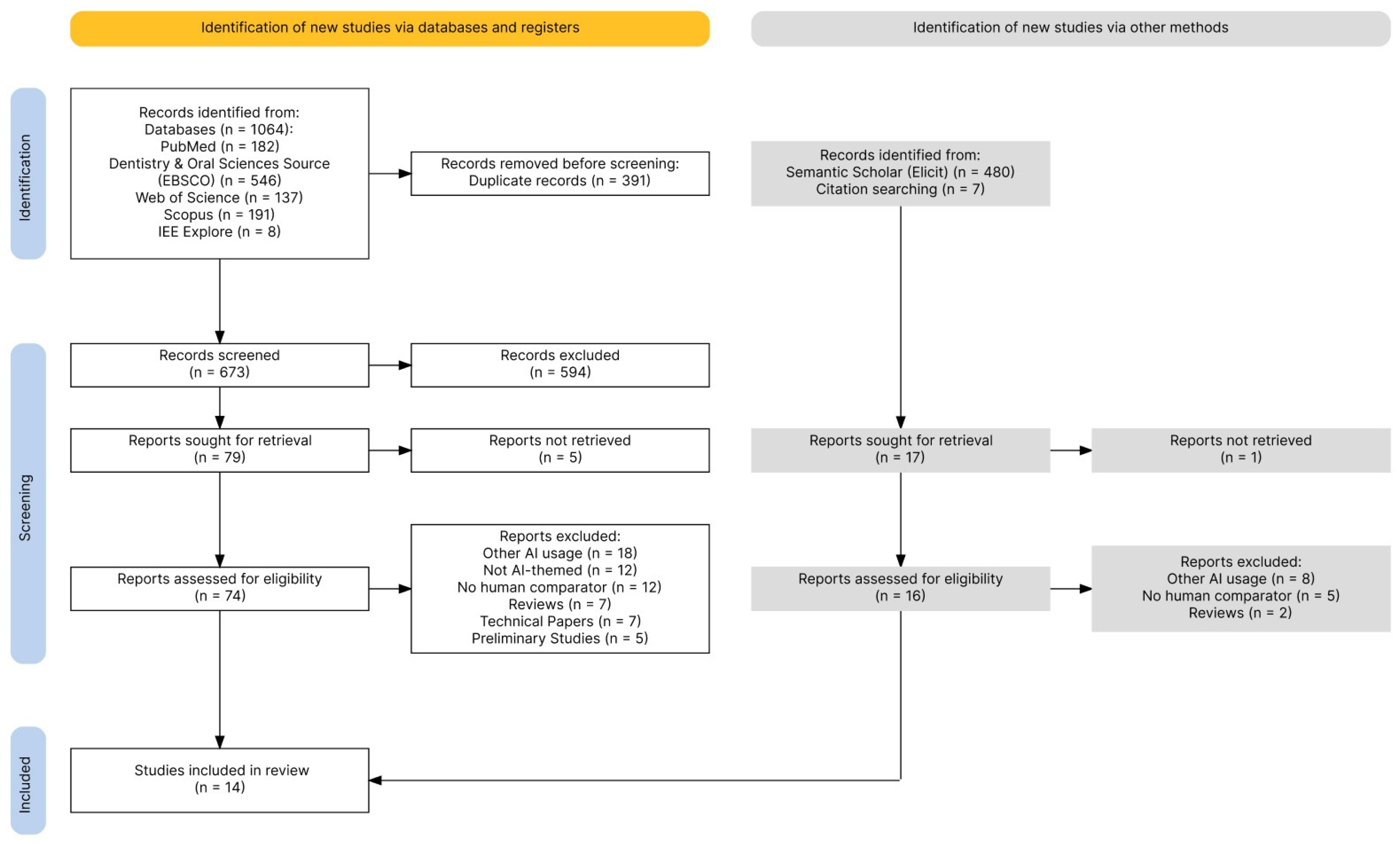
The searches identified 1064 records from bibliographic databases: PubMed (n = 182), Dentistry and Oral Sciences Source/EBSCO (n = 546), Web of Science (n = 137), Scopus (n = 191), and IEEE Xplore (n = 8). After de-duplication in EndNote X9 (n = 391), 673 unique records proceeded to title/abstract screening, where 594 were excluded as out of scope for AI-driven single-crown design or lacking a relevant comparative component. A total of 79 reports were sought for full-text review and 5 were unable to be retrieved, leaving 74 full texts assessed in duplicate. At this stage, 61 reports were excluded with recorded reasons: other AI usage not involving automated crown design (n = 18), not AI-themed (n = 12), no human comparator or control workflow (n = 12), reviews (n = 7), technical/methods-only papers without comparative outcomes (n = 7), and preliminary studies with incomplete data (n = 5). Additional identification routes yielded 480 records via Elicit (Semantic Scholar) and 7 through citation chasing. From these, 17 reports were sought for retrieval, 1 could not be obtained, and 16 underwent duplicate full-text assessment, after which 15 were excluded for other AI usage (n = 8), no human comparator (n = 5), or review format (n = 2). In total, 14 studies met the inclusion criteria and were included in the qualitative synthesis, spanning clinical, ex vivo, and in silico evaluations of AI-generated or AI-assisted single-crown design. Consistent with the protocol and the heterogeneity of endpoints and measurement platforms, no meta-analysis was planned or undertaken. The PRISMA 2020 flow diagram summarizing this process is shown in Figure 2 [29].

3.2. Study Characteristics

The evidence set comprised 14 comparative studies that directly contrasted AI-generated crown designs with designs produced by dental technicians. Study settings included laboratory ex vivo and in vitro evaluations across posterior and anterior tooth-supported crowns, single implant-supported crowns, primary molar crowns, lithium disilicate crowns, and mixed crown or inlay datasets, as well as computational in silico benchmarks against technician reference designs (Table 3). One clinical study evaluated interim complete crowns seated in patients. Human comparators were experienced technicians using established CAD platforms, most commonly 3Shape Dental System, 3Shape A/S, Copenhagen, Denmark and Exocad DentalCAD, exocad GmbH, Darmstadt, Germany (e.g., 3.1 Rijeka or 3.0 Galway where reported). The AI systems included Dentbird Crown by Imagoworks Inc., Seoul, Republic of Korea, 3Shape Automate by 3Shape A/S, Copenhagen, Denmark, PrintIn DentDesign by PrintIn, Taoyuan, Taiwan, and CEREC Biogeneric by Dentsply Sirona, Charlotte, USA, together with research models such as a 3D deep convolutional GAN and an implicit neural network that combined POCO point convolution with a PointMLP branch. Where architecture details were reported, Dentbird combined a CenterNet based convolutional network for tooth and margin detection with a pSp encoder and a StyleGAN generator for crown morphology, Automate was described as a proprietary cloud deep learning service with internal architecture not available, PrintIn DentDesign used a principal component analysis tooth shape model, and the implicit neural network described its point-based components. Primary outcomes included morphology or trueness metrics such as root-mean-square surface deviation, marginal and internal gaps reported in micrometers, occlusion and proximal contacts, esthetic and guidance measures for anterior cases, emergence profile for implant-supported crowns, and design time or workflow efficiency. Of the 14 included studies, only one provided clinical data, whereas the remainder were ex vivo/bench or in silico comparisons; therefore, the results primarily inform short-term technical performance and workflow efficiency rather than long-term clinical effectiveness.

3.3. Risk of Bias in Included Studies

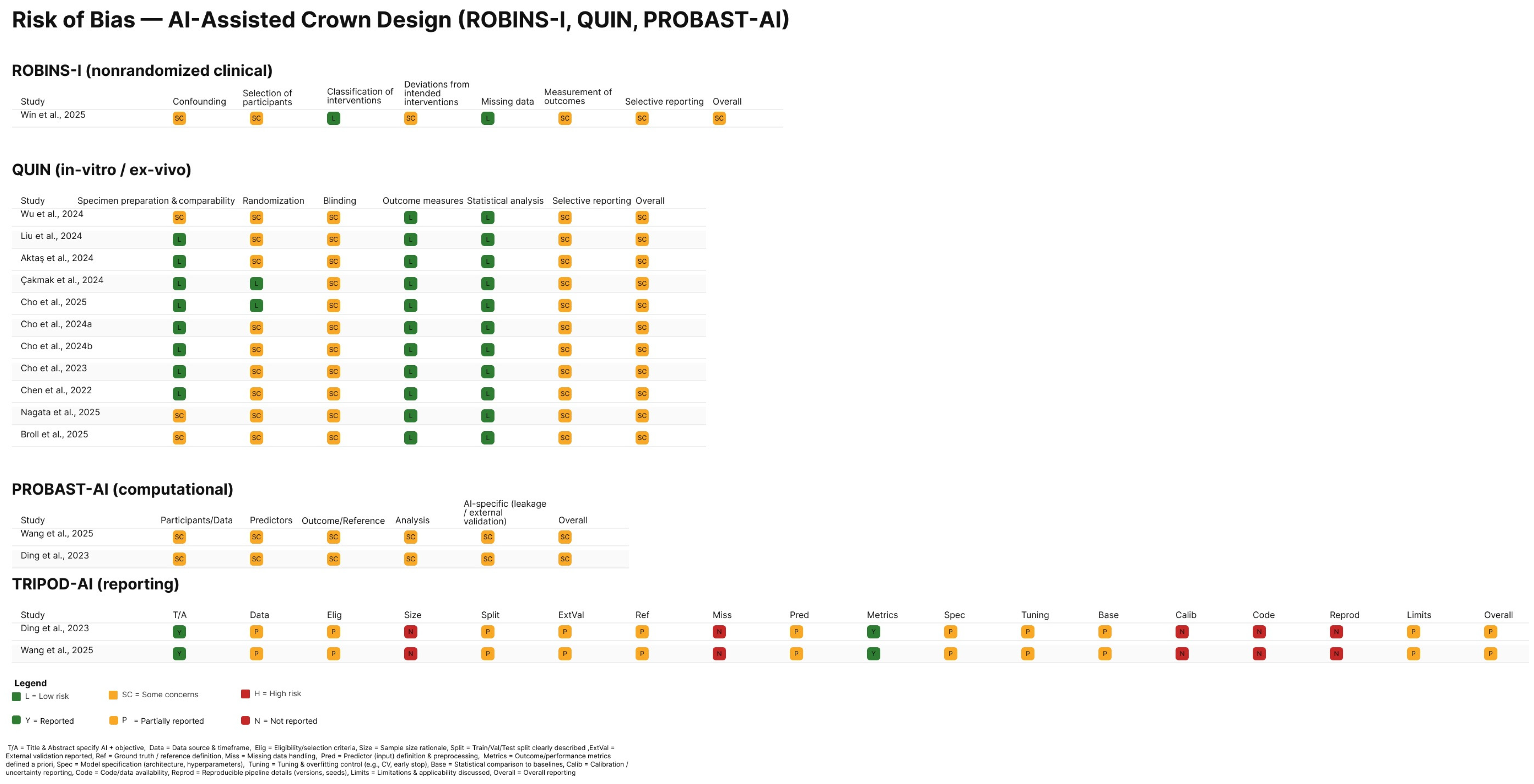
The single clinical comparison, by Win et al., 2025 (non-randomized), was assessed with ROBINS-I and judged Overall Some concerns [42]. The main limitations were residual confounding and selection of participants, while classification of interventions and missing data were Low risk. Deviations from intended interventions, measurement of outcomes, and selective reporting were each Some concerns, reflecting limited detail on protocol departures, the depth of blinding during outcome measurements, and reporting of preset outcomes. Across the in vitro and ex vivo set of studies appraised with QUIN, risk was generally acceptable for outcome measures and statistical analysis, which were most often Low risk owing to validated metrology and appropriate basic statistics. Specimen preparation and comparability was typically Low risk, although studies such as Wu et al., Nagata et al., and Broll et al. were rated Some concerns, where standardization or balance across arms was not fully documented [22,34,35]. The most frequent vulnerabilities were randomization and blinding, commonly Some concerns due to incomplete reporting of allocation procedures and assessor masking or calibration. Selective reporting was also usually Some concerns given limited protocol availability and incomplete outcome report. Taken together, the bench studies were consistently Overall Some concerns. For the computational model development evidence assessed with PROBAST-AI, Ding et al. and Wang et al. [36,41] are scored Some concerns across all domains and overall. In practice, this reflects partial reporting regarding dataset spectrum and eligibility in Participants and Data, input definitions and preprocessing in Predictors, the use and justification of digital reference standards in Outcome or Reference, and key aspects of the analytical strategy in Analysis and in AI-specific safeguards, including only partial information on data partitioning, leakage control, and validation beyond internal hold-out testing. In parallel, TRIPOD-AI was used as a sensitivity check of reporting completeness rather than as a risk of bias instrument. It focuses on whether the computational studies state the model and objective clearly, describe data sources and eligibility, justify sample size, detail dataset splits, define the reference standard, and disclose analysis choices along with code or data availability and reproducibility assets. In our set, both Ding et al. and Wang et al. [36,41] provided clear aims and core performance metrics, offered partial information on data provenance and eligibility, described splits but only to the extent of an internal hold-out which was treated as partial external validation, and did not report calibration or uncertainty or provide code, data, or reproducibility details such as versions and seeds. These reporting gaps do not change the risk of bias judgments, but temper confidence in the computational signals and highlight where future studies should strengthen transparency to support independent verification and broader applicability. These judgments are consolidated in a traffic light figure that aggregates domain-level and overall ratings across ROBINS I, QUIN, and PROBAST-AI, and includes a TRIPOD-AI panel set (Figure 3). Item-level TRIPOD-AI reporting completeness for Ding et al. and Wang et al. [36,41] is provided in Table 4, corresponding to the TRIPOD-AI panel shown in Figure 3.

3.4. Morphological and Occlusal Accuracy Outcomes

3.4.1. Morphological Accuracy

Across the included studies, AI-generated crowns generally achieved comparable overall geometric accuracy to those designed by experienced technicians, although subtle differences in crown morphology were noted. In a study of lithium disilicate crowns, a knowledge-based AI system produced significantly larger occlusal morphology deviations than human-designed crowns: the AI group’s mean occlusal profile error was ~0.368 mm, versus ~0.325 mm for an expert technician (p < 0.001). The AI crowns in that study also exhibited steeper cusp angles (~70.8°) than the original tooth (54.8°) and the student-designed crowns, although the AI’s cusp angles were not statistically different from the technician’s (both ~64–68°) [39]. Similarly, Wu et al. (2024) [22] found that while four different design approaches all produced acceptable posterior crowns, the AI-designed occlusal surfaces were the least true to the intended morphology. In their in vitro comparison, the Dentbird AI group had the highest RMS error on occlusal surfaces, significantly worse than the human expert CAD group (p < 0.001). The other AI (3Shape Automate) performed better, but an experienced human still achieved superior accuracy on certain aspects (e.g., distal surface contours, p = 0.029). Both AI systems struggled to match the expert’s precision on the occlusal anatomy, even though no differences were found in mesial surface or margin line accuracy. Liu et al. (2024) [38] likewise reported that an AI-generated crown design could nearly match a skilled human’s work in trueness. In their study, the average 3D surface deviation was on the order of 50–70 µm for the AI versus ~50 µm for conventional digital design. Both were far more accurate than a traditional hand wax-up, which showed several-fold larger errors (the manual wax group’s marginal gap was over 4× greater than the AI or digital groups). These results indicate that current AI methods can reproduce crown morphology with a precision on the scale of tens of microns, approaching expert-level accuracy, but they may still exhibit slightly higher deviations on intricate features like cusp anatomy or axial contours.
Multiple studies demonstrated that human technicians sometimes achieved closer morphology to the natural tooth than the AI [30,31,35,37]. For example, Broll et al. (2025) evaluated five design workflows on an identically prepared molar and found significant differences in morphology [35]. The crown designed by a skilled technician had the smallest deviation from the original tooth shape, outperforming both AI-driven software solutions and standard software proposals. All crowns were designed with the same parameters, yet the AI-generated models showed subtly larger shape discrepancies. Çakmak et al. (2024) also observed that a deep learning system’s initial output for anterior crowns had a greater discrepancy volume compared to a conventional CAD design, though this gap narrowed after minor human adjustments [37]. The fully automatic DL designs deviated by ~32.3% of crown volume from the technician’s design on average, whereas the AI designs refined by a technician differed by ~26.5% (p = 0.006). Regional analysis showed the unedited AI crowns had significantly higher RMS error on the palatal (lingual) surface than the technician-refined crowns (particularly in the incisal half, p = 0.021) [37]. Nonetheless, many studies noted that these morphological differences remained within acceptable bounds [32,34,37,38,41]. For instance, one ex vivo comparison defined a tolerance of ±50 µm for surface deviations and found both AI- and human-made crowns had a high proportion of their surfaces within that range. In Wang et al. (2025), an AI implicit neural network was trained to “reconstruct” maxillary molars; its automatically generated crowns showed an RMS deviation (~0.284 ± 0.031 mm) statistically equivalent to experienced technicians’ CAD designs (~0.303 ± 0.059 mm, p = 0.20) [36]. In other words, the AI’s geometric accuracy was on par with human designs when both were compared to the original tooth, and both closely replicated the patient’s natural crown morphology. The use of AI did not introduce any gross morphological errors: key parameters like cusp angulation remained within optimal ranges (approximately 50–70° in all groups) with no significant differences between AI and manual methods [36]. Moreover, Nagata et al. (2025) [34] reported that AI assistance can actually improve consistency and precision in crown shape. In their study, five technicians each designed the same crowns with and without an AI-based CAD system; the AI-equipped system produced far more uniform occlusal surface geometry (mean deviation ~25.7 µm) compared to the conventional designs created by different individuals (mean ~275.5 µm error).

3.4.2. Occlusal Accuracy and Contacts

When evaluating occlusal surface fit and contact precision, the AI-designed crowns showed mixed performance, with some notable differences from human designs. Several studies quantified occlusal discrepancies, the deviation in how the crown’s occluding surface meets the opposing teeth. In a clinical trial with 62 crowns, AI-designed restorations exhibited larger occlusal contact discrepancies than manually designed ones (mean ~149 ± 66 µm vs. ~105 ± 63 µm, Δ ≈ 44 µm). This difference was highly significant (p < 0.001) and indicated that, without adjustment, the AI-generated crowns tended to either hit high or remain slightly out of occlusion more often than clinician-designed crowns [42]. In an ex vivo comparison by Broll et al. (2025), none of the design systems perfectly recreated the ideal occlusal contacts of the original, unprepared tooth [35]. All groups showed “high deviations” in the positions of contact points, especially at the mesiolingual cusp, which led to no design achieving contact on every antagonist cusp exactly as the natural tooth did. Nonetheless, the AI-based designs in Broll’s study performed as well as the human technician’s design in functional terms: both achieved a similar number and distribution of occlusal contacts, and both required comparable minor adjustments to eliminate premature contacts. The authors concluded that AI-driven crown proposals demonstrated functional occlusion outcomes on par with an expert’s work, even though some contact point deviations were observed in all designs.
Detailed occlusal contact analysis from Cho et al. (2024) provides further insight [32]. In their laboratory study of implant-supported crowns, the conventionally designed crowns (human, CAD) exhibited the most ideal occlusal contacts (on average 5.5 contacts per crown, with the majority being at adequate contact intensity). The AI-designed crowns had slightly fewer occlusal contact points on average (about 4.3–4.5 contacts), and a higher proportion of those contacts were light or premature interferences. These differences in contact intensity were significant (p < 0.001). It was also found that the total number of occlusal contacts did not drastically differ between one AI software and the human design (Automate vs. technician, p = 0.32, n.s.), but the other AI (Dentbird) yielded significantly fewer contacts than the technician’s reference (4.3 vs. 5.5, p = 0.006). Clinically, this implies that an AI-generated crown might sit slightly high in some areas or miss a contact in others, necessitating minor chairside adjustments. In the same study, all three design groups (two AI and one human) produced cusp angles within the ideal range for efficient load distribution (~50–70°), and no differences in cusp inclination were detected (p = 0.065). This suggests that while contact points may vary, the fundamental occlusal form (cusp steepness and alignment) of AI crowns was sound and comparable to human designs [31,32].
Functional occlusion in anterior restorations was examined by Cho et al. (2025) and Çakmak et al. (2024) through incisal path analysis, reporting that the deep learning software’s initial crown proposal had a significantly larger deviation in the incisal guidance path compared to the technician-refined design (mean deviation ~290 µm vs. ~132 µm, p < 0.001) [33,37]. In practice, this means that the unedited AI crown would have altered the patient’s anterior guidance more noticeably.. Likewise, Nagata et al. (2025) [34] found that AI-generated designs eliminated certain asymmetries present in technician-made crowns. In crowns for two different teeth (#15 and #26), conventional CAD designs by different technicians showed inconsistent occlusal precision, for example, significantly larger misfit on the palatal cusps for both teeth, whereas the AI-guided designs had no significant side-to-side discrepancies. Finally, clinical fit studies confirmed that occlusal surface errors with AI are generally minor and correctable. Win et al. (2025) [42] measured the occlusal gap and found the AI crowns’ occlusal gap was slightly larger on average (by ~3–4 µm) than manually designed crowns, but both were well within a ±100 µm tolerance range. In their triple-scan analysis, AI crowns did show a tendency toward infra-occlusion or lighter contact, which the authors attributed to the AI’s “generalized” anatomy and lack of patient-specific fine-tuning. They noted that human designers often meticulously adjust occlusal contours to fit a patient’s unique bite, whereas the AI’s output may require one extra adjustment step to perfect the occlusion. Despite this, no critical occlusal errors were reported; any premature contacts produced by the AI designs could be eliminated by minor adjustment, and any slight infra-occlusion could be remedied with restorative adjustment or would equilibrate over time [42]. Taken together, these findings illustrate that AI-designed crowns can nearly mirror human-designed crowns in occlusal accuracy. While experienced human technicians still produced the most anatomically faithful crowns in certain metrics (especially fine morphology), the differences were usually small and not clinically consequential. AI-designed crowns demonstrated morphologic accuracy on par with skilled human designs in many studies (e.g., within ~40–50 µm RMS of each other) and achieved similar occlusal contact quality after minimal adjustments [35]. The consensus is that AI crown design systems can yield technically acceptable morphological and occlusal outputs under the tested conditions, and in some comparisons, these were statistically equivalent to conventional human-guided CAD workflows [39,42]. However, outcome definitions and measurement pipelines varied substantially across studies (e.g., RMS deviation, contact-number metrics, incisal-path deviation), which limited direct cross-study comparability and prevented uniform quantitative synthesis.

3.4.3. Marginal and Internal Fit Outcomes

Measured marginal gap widths for AI-designed crowns were consistently on the order of tens of microns, falling within clinically acceptable thresholds and usually not significantly different from those of human-designed crowns. For instance, Liu et al. documented marginal gaps on the order of ~11–46 µm with an AI design tool versus ~10–19 µm with a traditional digital workflow [38]. In a clinical trial involving 62 posterior crowns, Win et al. found that the vertical marginal gaps produced by a generative AI design were statistically equivalent to those from a manual CAD system in the buccal, mesial, and distal aspects; only at the lingual margin did the AI crowns show a slightly higher gap (though all means remained low, ~60–70 µm) [42]. Consistent with this, Broll et al. (2025) observed that vertical marginal gaps remained similar across different design modalities; in their bench experiment, the choice of AI-based vs. conventional software did not appreciably affect marginal gap, which hovered in the tens of microns range for all groups [35]. Some isolated differences in fit were noted: in one comparison, a fully automatic AI pipeline yielded a slightly worse internal gap (i.e., larger mean cement space) than both the human-designed and a semi-AI hybrid approach [31]. This suggests that certain AI systems might over-relieve or under-adjust the internal aspect unless refined, whereas others match human performance out-of-the-box. Additionally, the aforementioned minor lingual margin gap discrepancy with the AI method [42] highlights how specific tooth geometry or scanner limitations could influence one design method more than the other. All reported marginal and internal gaps for both AI and conventional crowns were within or below the commonly cited clinical acceptability cutoff (~100 µm). With several studies judged to have low risk of bias in this domain, including a randomized in vitro trial [34] that found no significant difference in marginal gap at four quadrants of the crown between AI and manual designs (means generally 50–75 µm), there is robust evidence that AI-designed crowns can achieve equivalent internal gap to those crafted by skilled technicians. Minor fit discrepancies that do arise appear to be technique- or case-specific, underscoring the need for routine verification (as one would also do for human designs), but not indicating any systematic deficiency in AI crown fit.

3.5. Mechanical Performance Outcomes

3.5.1. Fracture Resistance

Mechanical strength outcomes were reported exclusively in in vitro studies on tooth-supported restorations. In a laboratory fracture test of lithium disilicate crowns, Chen et al. (2022) [39] found no significant difference between AI-designed and human-designed crowns in load-to-fracture. All designs withstood forces on the order of 1.4–1.6 kN before failure (AI: 1556 ± 526 N; expert technician: 1486 ± 520 N; dental student: 1426 ± 433 N; p = 0.505). Broll et al. [35] observed that crowns generated by AI algorithms achieved fracture loads comparable to those of skilled technicians and well above those of conventional software designs. In their bench-top chewing simulation (1.2 × 10⁶ cycles at 50 N, followed by static loading), the AI-designed crowns exhibited the highest median fracture force (~1983 N), whereas crowns designed with a standard CAD library showed the lowest (~1186 N). The difference was statistically significant, with the conventional CAD group fracturing at lower loads than all other design groups. All tested crowns fell within clinically acceptable strength ranges.

3.5.2. Fatigue Performance and Failure Endurance

Laboratory and computational evidence suggest that AI-designed crowns do not compromise fatigue durability. In Broll et al. [35] ’s five-year equivalent chewing simulation, no crown, whether AI-designed, conventionally software-designed, or manually designed, failed prior to final fracture testing. This indicates that all design groups had similar resistance to cyclic loading in vitro. Likewise, a finite element analysis by Ding et al. [41] showed that an AI-generated crown (3D-DCGAN) replicated the stress distribution of a natural tooth more closely than a conventional CAD crown. Under a 300 N occlusal load, the AI crown and the natural tooth model experienced comparable peak stresses (26.7 MPa vs. 24.0 MPa, respectively). The AI-designed crown also exhibited a simulated fatigue life virtually identical to that of the natural anatomy, as both withstood similar cyclic loading ranges (100–400 N) in silico. These modeling results suggest that AI designs can achieve a favorable balance of morphology and material thickness that confers fatigue performance on par with or better than traditional designs. It should be noted that all fatigue findings stem from in silico or short-term in vitro simulations; no clinical survival, complication, or long-term follow-up data were reported, so these outcomes should be interpreted as evidence of technical feasibility rather than evidence of long-term clinical durability.

3.6. Time Efficiency Outcomes

AI-based crown design consistently demonstrated notable time savings over conventional methods across the included studies. In a tooth-supported crown study [31], the total CAD design and optimization time was significantly shorter with a GAN-powered system (approximately 4.5 min) compared to a traditional expert-driven CAD workflow (~6.2 min, p < 0.05). An even larger reduction was observed for implant-supported restorations: Cho et al. (2024b) reported that a fully automatic deep learning design (no human edits) required only 82.9 ± 30.4 s per crown, versus 370.3 ± 98.3 s with expert manual CAD (a 78% faster design), while an AI-assisted workflow with technician optimization took about 321.7 ± 98.3 s (still significantly faster than manual design; p ≤ 0.001) [32]. In other in vitro experiments, AI design times ranged from seconds to only a few minutes, dramatically outperforming human workflows [32]. Liu et al. (2023) found a mean AI crown design time of ~59 s, versus 229–300 s with conventional digital CAD and 263–600 s with manual wax-ups (roughly a four- to five-fold speedup) [38]. Likewise, Wu et al. (2024) measured an average of 146 min for AI software to complete multiple crown designs, compared to 244 min by an experienced CAD user and 584 min with a fully conventional process (a 40–75% time reduction in favor of AI) [22]. Another laboratory study reported similar efficiencies, with AI-based CAD roughly 4–5× faster than a standard CAD system. For instance, designing a maxillary crown took ~99 min with the AI tool versus 397 min with 3Shape CAD (p < 0.001) [34]. Across these studies, AI-driven design workflows shortened the design phase by approximately 40% up to 90% relative to expert or traditional techniques. Even a knowledge-based AI system was described as faster than student designers, with users showing improved speed after training on the AI system [39].

3.7. Chairside Adjustments

Across the included studies, AI-generated crowns required chairside adjustments that were comparable to, and in some cases fewer than, those designed by experienced technicians. In both tooth-supported and implant-supported settings, minor refinements to proximal and occlusal contacts were occasionally necessary, but no study reported non-seating, irreparable contact errors, or remake requirements attributable to the AI design within the tested protocols; however, these findings reflect short-term behavior and do not constitute evidence of long-term clinical effectiveness. Given the clinical relevance of proximal contact morphology and the need for objective quantification, future comparative studies should report validated proximal contact area metrics in addition to occlusal contact outcomes [43].
In tooth-supported crowns, one study found that fully automatic AI designs exhibited slightly heavier proximal or premature occlusal contacts than manually designed crowns, prompting light contact adjustment at insertion [31]. In implant-supported restorations, a paper reported that AI-only crowns had slightly fewer occlusal contacts and small axial contour differences, though no heavy occlusal contacts were present. These crowns generally seated well, and manual optimization further improved fit without significantly increasing design time [32].
In the only clinical study, AI and conventional crowns both required minimal adjustment. While the AI group had slightly higher occlusal inconsistencies (149 ± 66 µm vs. 105 ± 63 µm), seating was successful after minor polishing or proximal relief. Marginal gap was equivalent between groups, and no increase in clinical rework was observed [42].
Other bench studies [30,35] confirmed that neither AI nor manual workflows consistently produced perfect contacts, but AI designs were at least as accurate as conventional ones and benefitted from technician oversight when applied. Overall, AI-designed crowns demonstrated clinically acceptable seating behavior, with adjustment needs falling within the expected range for digital restorations.

4. Discussion

4.1. Summary of Main Findings

AI crown design consistently improves efficiency while preserving short-term technical performance in predominantly ex vivo and in silico comparative studies, with only limited patient-level evidence on short-term feasibility. Across studies, design time fell by about 40 to 90 percent, for example, 82.9 ± 30.4 s with a fully automatic workflow versus 370.3 ± 98.3 s with expert CAD in implant cases, 59 s versus 229 to 300 s in a bench comparison, and 146 min versus 244 min for multi-case runs; a technician study reported about 99 min with AI versus 397 min with standard CAD for a maxillary case [22,32,38].
Fit outcomes were generally within commonly cited clinical thresholds in bench/ex vivo settings and comparable to technician designs; the single clinical comparison suggested similar short-term adaptation with one site-specific difference that remained within acceptable limits [42]. Typical marginal and internal gaps for AI crowns were in the tens of micrometers and comparable to technician designs, for instance, 11.3 to 45.6 μm for AI versus 10.4 to 18.8 μm for digital CAD, and equivalent for most sites in the only clinical trial, with a slightly larger lingual margin still within clinical limits [31,38]. Bench data likewise showed similar vertical marginal gaps across AI and human groups, and pediatric crowns designed with AI or CAD remained within accepted thresholds [32,37].
Morphology and occlusion were generally similar [40,42]. Some studies favored human precision for fine occlusal anatomy, and a knowledge-based system showed larger occlusal deviation than expert work, although values remained clinically acceptable [41]. Implant and anterior analyses reported small differences in contact number or incisal path that were corrected with minor adjustments, and AI reduced inter operator variability in occlusal form [32,35].
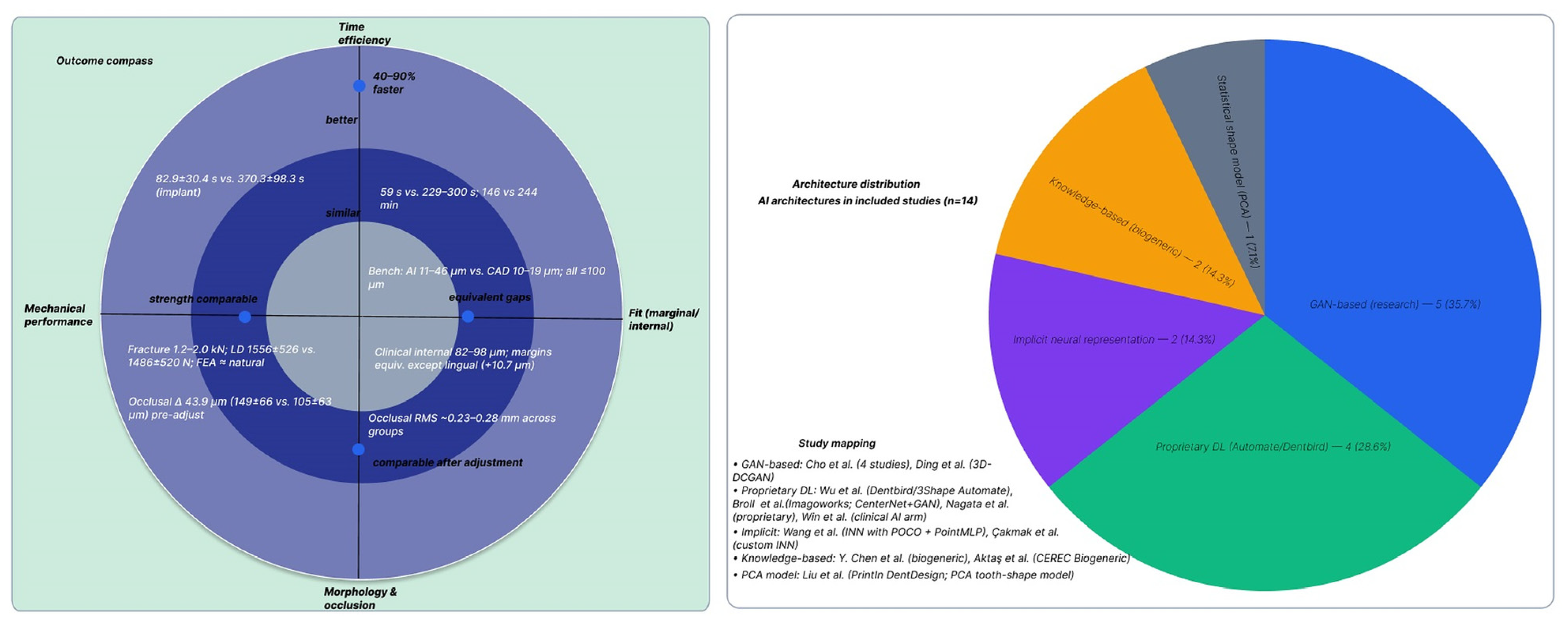
Mechanical performance was not inferior in the available in vitro tests and in silico simulations [31,32,35,41]. Fracture loads for lithium disilicate crowns did not differ between AI and human designs and exceeded typical biting forces, and a multi-workflow bench study showed comparable or higher median strength for AI designs [39]. Finite element analysis indicated stress patterns similar to natural teeth for AI-generated crowns [41]. Figure 4 synthesizes the comparative performance of artificial intelligence crown design versus expert computer-aided design across time efficiency, marginal and internal fit, morphology and occlusion, and mechanical performance, and presents the distribution of artificial intelligence architectures used in the included studies.

4.2. Robustness of Evidence and Key Considerations

It is important to note that 5 of the 14 included studies, the 4 by Cho et al. [30,31,32,33] and Çakmak et al. [37], came from the same research group, which has focused on the Dentbird (Imagoworks) and 3Shape Automate AI systems. These authors reported consistently favorable outcomes for AI designs (often highlighting Dentbird’s performance in various scenarios). To ensure that the overall conclusions are not influenced by one team’s results, a sensitivity analysis excluding those five studies was considered. The remaining literature (nine studies from independent groups in China, Japan, Europe, etc.) still supports the same main findings. Even without the aforementioned series of studies, the majority of independent studies report significant time savings with AI and no clinically meaningful deterioration in the primary technical endpoints they selected; however, heterogeneity in restoration types, materials, fabrication routes, and outcome definitions reduces certainty and limits precision. For example, all of the other studies conclude that AI-designed crowns perform as well as conventional designs in marginal gap, internal, and morphology. Many of these independent studies also echo the efficiency gains (e.g., Wu et al. [22], Liu et al. [38], and Nagata et al. [34] each demonstrated 4–5× faster design with AI). Thus, generative or ML-based crown design can reliably produce clinically acceptable crowns while greatly expediting the design process. Moreover, the inclusion of Win et al. [42], the only clinical trial to date, is important for external validity. That prospective study in actual patients confirms the in vitro findings: the AI-designed interim crowns seated successfully in real mouths with minimal adjustments and showed equivalent fit to traditional CAD crowns. The AI crowns did have slightly different occlusion prior to adjustment, but this was easily corrected, and no AI crown had to be rejected or remade. In summary, AI-designed crowns often meet or even exceed the functional benchmarks (proper contacts, occlusion, and strength) set by conventional designs, with any small discrepancies being correctable and falling within normal clinical ranges. These findings hold true across various scenarios (anterior vs. posterior, tooth- and implant-supported crowns, different materials and patient ages) and appear generalizable beyond any single research group.

4.3. Comparison with Existing Literature

Across prior reviews, the literature on artificial intelligence for prosthodontics was framed as promising yet sparse for comparative crown design evidence and essentially devoid of in vivo validation, whereas the present synthesis integrates multiple head-to-head experiments together with a patient study that directly contrasts artificial intelligence with expert computer-aided design, expanding the field beyond conceptual mapping into comparative outcomes. In crown design specifically, Kong et al. highlighted algorithmic variety and called for assessments tied to clinically meaningful endpoints such as morphology, fit, and occlusion, a gap addressed in this review through consolidated effect sizes for design time, marginal and internal fit, occlusal contact quality, and fracture performance across commercial and research systems [6]. Rokhshad et al. emphasized the predominance of deep learning for prosthesis design while underscoring heterogeneity and the need for standardization, which is answered by harmonized reporting of crown-level comparators and outcomes [44]. Joda et al. and Najeeb et al. positioned artificial intelligence as a promoter of digitalization within diagnostic and planning workflows and noted the lack of clinical trials, a need still necessary today in concordance with the findings from the current review that includes only one clinical patient comparison demonstrating equivalent marginal and internal fit with small and correctable occlusal differences [11,45]. Bernauer et al. reported that prosthodontic artificial intelligence studies were few and largely pilot in nature, while the present analysis aggregates a larger comparative base and quantifies performance deltas in the specific context of crown design [1]. Another paper from 2023 cataloged design pipelines and finite element strands across dentistry, and the present synthesis extends those threads by appraising fracture loads and modeled stress distributions alongside human comparators to link geometry to mechanical behavior [20]. A recent narrative review on generative deep learning noted that automatic proposals often benefit from minor refinement, which is consistent with the aggregated chairside data showing successful seating with brief polishing or proximal relief and no increase in adjustment time relative to technician designs [46]. A different review emphasized adoption, training and ethical transparency as preconditions for responsible integration, and the present review complements that perspective by standardizing outcome definitions across studies so that future clinical translation and governance can reference comparable performance endpoints [47]. A paper by Gangde et al. summarized restorative artificial intelligence and computer-aided design trends while noting the scarcity of standardized comparative outcomes, which is addressed here through side-by-side human versus artificial intelligence analyses across time, fit, morphology, occlusion, and strength [48]. What this review adds relative to the aforementioned reviews is the delivery of quantitative comparative effect sizes between expert human and AI for crown design time, marginal and internal fit, morphology and occlusion, and fracture behavior across diverse systems, together with inclusion of a clinical patient study that verifies equivalence in adaptation and documents small correctable occlusal differences, as well as aggregation of chairside adjustment behavior and multi-operator consistency effects.

4.4. Limitations of the Review

First, the protocol was not prospectively registered, which may reduce transparency; however, the eligibility criteria, outcomes, and database-specific search strategies are fully reported in the main manuscript to support reproducibility.
Secondly, the body of comparative evidence is still dominated by laboratory and computational designs, which limits direct inference to long-term clinical performance and important patient outcomes. Between-study heterogeneity was substantial across restoration types, materials, fabrication routes, and outcome definitions, which constrained the feasibility of a single pooled quantitative estimate. Outcome measurement methods varied widely, including different gap metrology protocols, surface registration pipelines, and occlusal contact analytics, which can influence absolute values and complicate cross-study synthesis. Proprietary algorithm transparency was limited for several commercial platforms, with non-disclosed internal architectures and training regimes, which introduces uncertainty about model generalizability and reproducibility.
The evidence base concentrates on a few platforms and research teams, with multiple studies from a single group evaluating the same commercial system, raising concerns about clustering of methodology and analytical choices. Several included studies reported small sample sizes and limited operator numbers, which heightens imprecision and susceptibility to operator learning effects.
Risk of bias and applicability concerns persist. The clinical comparison was non-randomized with some concerns for confounding and outcome measurement, and blinding of assessors was not always clearly described in laboratory evaluations. Two computational investigations were appraised a priori as presenting some concerns across domains, which further tempers certainty in purely in silico signals [36,41]. The breadth of morphological and occlusal metrics is improving, but remains inconsistent, and several studies prioritized geometric fidelity over functional validation such as dynamic contact, load distribution, or fatigue behavior. Finite element modeling and other simulations supported mechanistic plausibility, but rely on assumptions about material properties, boundary conditions, and loading that may not fully capture intraoral variability [49]. In addition, reporting quality limited interpretability in several domains. In bench studies, randomization of specimens, allocation concealment, and assessor blinding were often incompletely described, which increases susceptibility to measurement and performance bias even when standardized models are used. Across study types, preset primary outcomes and sample-size justification were inconsistently reported, increasing the risk of selective outcome reporting and imprecision.
Generalization is affected by the concentration of datasets in posterior single-crown scenarios and by the low representation of complex clinical contexts such as full arch rehabilitation, parafunctional loading, and medically complex patients. Although the results presented are promising, AI will prove truly useful only if it is adapted and validated across the full spectrum of restorations in fixed and removable prosthodontics, ensuring consistent performance beyond single-unit crowns. Furthermore, reporting of algorithm origin, dataset curation, and versioning was variable across studies, and several commercial evaluations did not disclose training data composition, which limits appraisal of spectrum bias and transportability to different scanners, occlusal schemes, or populations. Finally, although fracture resistance and stress distribution were assessed in selected experiments, standardized mechanical testing protocols and longer-term clinical follow-up remain scarce, so durability conclusions should be interpreted with caution pending prospective clinical trials.

4.5. Clinical Implications

Evidence supports short-term feasibility and technical comparability of artificial intelligence crown design for single-unit indications, with large time savings and no consistent deterioration in the reported technical endpoints relative to expert computer-aided design. However, because patient-level evidence is limited to a single non-randomized clinical comparison and long-term follow-up is unavailable, these findings should not be interpreted as proof of long-term clinical effectiveness or durability. Multi-operator data indicate reduced variability of occlusal form with artificial intelligence assistance, and pediatric work shows that performance can depend on the pairing of software with milling or printing [22,40]. In practice, adoption should include the same verification steps used for human designs: confirm marginal and internal fit, assess contacts, and anticipate only minor adjustments. Furthermore, cementation and adhesive protocol can influence seating behavior and the integrity of the bonded interface; future clinical trials should compare and report these strategies, when it comes to survivability and the delivery of functionally adequate restorations [50].

4.6. Future Research

Priorities include prospective clinical trials with longer follow-up and patient-reported outcomes to move beyond feasibility toward real-world effectiveness. Endpoints should be standardized and preregistered to include design time, chairside adjustment time, marginal and internal gaps, occlusal contact quality, esthetics where relevant, survival, and complications, addressing the heterogeneity observed across current studies. Comparative evaluations should span platforms, scanner and fabrication modalities, and tooth types, and should test software by manufacturing interactions seen in pediatric crowns. Mechanical evidence should expand beyond bench fatigue and static fracture to protocolized clinical survival, while computational modeling should be paired with experimental validation to confirm favorable stress distributions. Reporting should improve transparency about algorithms, training data, preprocessing, versioning, and update practices, given that several commercial evaluations did not disclose internal architectures or data provenance. Finally, economic and workflow studies are warranted to quantify value at the clinic and laboratory level in light of the consistent time gains presented.

5. Conclusions

Across 14 comparative studies, artificial intelligence crown design shows shortened design time without degrading marginal or internal fit, morphological trueness, occlusal function, or mechanical performance when compared with expert computer-aided design. Overall marginal and internal gaps values were within commonly cited clinical thresholds, and load-to-fracture performance was comparable across design modalities. The current evidence supports early technical consistency and improved efficiency gains for single-unit crowns in predominantly bench and in silico comparative evidence, with limited clinical data, while underscoring the need for standardized clinical endpoints and longer-term trials to confirm durability and patient-centered outcomes.

Author Contributions

Conceptualization, A.V., V.Ș.P., and M.R.G.; methodology, A.V., M.B., M.A.M., and M.D.; software, R.C.C., O.E., and A.C.D.; validation, C.I., R.S., and C.M.Ș.; formal analysis, A.V., M.P., M.D., and M.I.; investigation, A.V., A.C.D., R.S., and O.E.; resources, M.B., C.I., and M.P.; data curation, M.I., R.C.C., and C.M.Ș.; writing—original draft preparation, A.V., M.R.G., and M.A.M.; writing—review and editing, M.B., V.Ș.P., and C.I.; visualization, A.V., O.E., R.C.C., and M.D.; supervision, M.B., M.A.M., and M.P.; project administration, C.I., V.Ș.P., and A.C.D.; funding acquisition, M.B., M.A.M., and M.P. All authors have read and agreed to the published version of the manuscript.

Funding

This research received no external funding.

Institutional Review Board Statement

Not applicable.

Informed Consent Statement

Not applicable.

Data Availability Statement

The original contributions presented in this study are included in the article. Further inquiries can be directed to the corresponding authors. This review was not registered in advance.

Acknowledgments

During the preparation of this work, the authors used ChatGPT 5.0 (OpenAI, San Francisco, CA, USA) and Elicit Pro (Ought, Oakland, CA, USA) in order to generate figures, improve the readability of the text, and refine the data extracted. After using these tools, the authors reviewed and edited the content as needed and take full responsibility for the content of the publication.

Conflicts of Interest

The authors declare no conflict of interest.

Abbreviations

The following abbreviations are used in this manuscript:
AA3Shape Automate AI group
ADDentbird AI group
AIartificial intelligence
CADcomputer-aided design
CAD/CAMcomputer-aided design/computer-aided manufacturing
CEconventional experienced (technician)
CNNconvolutional neural network
CNconventional novice (technician)
CTcomputed tomography
CEREC Biogenericknowledge-based morphology library (Dentsply Sirona)
DBDentbird as-generated (no technician edits)
DLdeep learning
DMDentbird after brief technician optimization
FEfinite element
FPDfixed partial denture
GAIDgenerative AI-assisted design
GANgenerative adversarial network
IGinternal gap
INNimplicit neural network
IoUintersection over union
IOSintraoral scanner
ISCimplant-supported crown
MGmarginal gap
MLmachine learning
N/Anot available
NCnon-AI comparator (experienced technician digital CAD)
NSnot significant
PCAprincipal component analysis
pp-value
POCOpoint-convolution operator
PointMLPpoint-cloud multilayer perceptron branch
PICOPopulation, Intervention, Comparator, Outcomes
PRISMAPreferred Reporting Items for Systematic Reviews and Meta-Analyses
PROBAST-AIPrediction model Risk Of Bias ASsessment Tool—AI extension
QCquality control
QUINQuality Assessment Tool for In Vitro Studies
RCTsrandomized controlled trials
ReLUrectified linear unit
RMSroot-mean-square (deviation)
SDstandard deviation
StyleGANstyle-based generator
T-Scancomputerized occlusal analysis system
U-Netencoder–decoder CNN with skip connections
μmmicrometers
|dev|absolute deviation
exp. techexperienced technician
zlatent noise vector
3D-DCGAN3D deep convolutional GAN

References

  1. Bernauer, S.A.; Zitzmann, N.U.; Joda, T. The Use and Performance of Artificial Intelligence in Prosthodontics: A Systematic Review. Sensors 2021, 21, 6628. [Google Scholar] [CrossRef]
  2. Wu, J.; Huang, Y.; He, J.; Chen, K.; Wang, W.; Li, X. Automatic restoration and reconstruction of defective tooth based on deep learning technology. BMC Oral Health 2025, 25, 1292. [Google Scholar] [CrossRef]
  3. Aljulayfi, I.S.; Almatrafi, A.H.; Althubaitiy, R.O.; Alnafisah, F.; Alshehri, K.; Alzahrani, B.; Gufran, K. The Potential of Artificial Intelligence in Prosthodontics: A Comprehensive Review. Med. Sci. Monit. Int. Med. J. Exp. Clin. Res. 2024, 30, e944310. [Google Scholar] [CrossRef] [PubMed]
  4. Mai, H.N.; Win, T.T.; Kim, H.S.; Pae, A.; Att, W.; Nguyen, D.D.; Lee, D.H. Deep learning and explainable artificial intelligence for investigating dental professionals’ satisfaction with CAD software performance. J. Prosthodont. 2025, 34, 204–215. [Google Scholar] [CrossRef] [PubMed]
  5. Rokaya, D.; Jaghsi, A.A.; Jagtap, R.; Srimaneepong, V. Artificial intelligence in dentistry and dental biomaterials. Front. Dent. Med. 2025, 5, 1525505. [Google Scholar] [CrossRef] [PubMed]
  6. Kong, H.-J.; Kim, Y.-L. Accuracy of Artificial Intelligence-Designed Dental Crowns: A Scoping Review of In-Vitro Studies. Appl. Sci. 2025, 15, 9866. [Google Scholar] [CrossRef]
  7. Yeslam, H.E.; Freifrau von Maltzahn, N.; Nassar, H.M. Revolutionizing CAD/CAM-based restorative dental processes and materials with artificial intelligence: A concise narrative review. PeerJ 2024, 12, e17793. [Google Scholar] [CrossRef]
  8. Arjumand, B. The Application of artificial intelligence in restorative Dentistry: A narrative review of current research. Saudi Dent. J. 2024, 36, 835–840. [Google Scholar] [CrossRef]
  9. Popescu, M.; Perieanu, V.S.; Burlibașa, M.; Vorovenci, A.; Malița, M.A.; Petri, D.-C.; Ștețiu, A.A.; Costea, R.C.; Costea, R.M.; Burlibașa, A.; et al. Comparative Cost-Effectiveness of Resin 3D Printing Protocols in Dental Prosthodontics: A Systematic Review. Prosthesis 2025, 7, 78. [Google Scholar] [CrossRef]
  10. Alghauli, M.; Aljohani, W.; Almutairi, S.; Aljohani, R.; Alqutaibi, A. Advancements in digital data acquisition and CAD technology in Dentistry: Innovation, clinical Impact, and promising integration of artificial intelligence. Clin. Ehealth 2025, 8, 32–52. [Google Scholar] [CrossRef]
  11. Najeeb, M.; Islam, S. Artificial intelligence (AI) in restorative dentistry: Current trends and future prospects. BMC Oral Health 2025, 25, 592. [Google Scholar] [CrossRef]
  12. Hlaing, N.; Çakmak, G.; Karasan, D.; Kim, S.J.; Sailer, I.; Lee, J.H. Artificial Intelligence-Driven Automated Design of Anterior and Posterior Crowns Under Diverse Occlusal Scenarios. J. Esthet. Restor. Dent. Off. Publ. Am. Acad. Esthet. Dent. 2025, 1–14. [Google Scholar] [CrossRef]
  13. Șerbănescu, C.M.; Perieanu, V.Ș.; Malița, M.A.; David, M.; Burlibașa, M.; Vorovenci, A.; Ionescu, C.; Costea, R.C.; Eftene, O.; Stănescu, R.; et al. Nanofeatured Titanium Surfaces for Dental Implants: A Systematic Evaluation of Osseointegration. Antibiotics 2025, 14, 1191. [Google Scholar] [CrossRef] [PubMed]
  14. Albano, D.; Galiano, V.; Basile, M.; Di Luca, F.; Gitto, S.; Messina, C.; Cagetti, M.G.; Del Fabbro, M.; Tartaglia, G.M.; Sconfienza, L.M. Artificial intelligence for radiographic imaging detection of caries lesions: A systematic review. BMC Oral Health 2024, 24, 274. [Google Scholar] [CrossRef] [PubMed]
  15. Baena-de la Iglesia, T.; Navarro-Fraile, E.; Iglesias-Linares, A. Validation of an AI-aided 3D method for enhanced volumetric quantification of external root resorption in orthodontics. Angle Orthod. 2025, 95, 474–482. [Google Scholar] [CrossRef] [PubMed]
  16. Iosif, L.; Țâncu, A.M.C.; Amza, O.E.; Gheorghe, G.F.; Dimitriu, B.; Imre, M. AI in Prosthodontics: A Narrative Review Bridging Established Knowledge and Innovation Gaps Across Regions and Emerging Frontiers. Prosthesis 2024, 6, 1281–1299. [Google Scholar] [CrossRef]
  17. Karnik, A.P.; Chhajer, H.; Venkatesh, S.B. Transforming Prosthodontics and oral implantology using robotics and artificial intelligence. Front. Oral Health 2024, 5, 1442100. [Google Scholar] [CrossRef]
  18. Alsheghri, A.; Zhang, Y.; Ghadiri, F.; Keren, J.; Cheriet, F.; Guibault, F. Mesh-based segmentation for automated margin line generation on incisors receiving crown treatment. Math. Comput. Simul. 2026, 239, 716–728. [Google Scholar] [CrossRef]
  19. Melnyk, N.; Chertov, S.; Jafarov, R.; Karavan, Y.; Belikov, O. The use of CAD/CAM technologies in minimally invasive dental restorations: A systematic review. Rom. J. Oral Rehabil. 2025, 17, 56–72. [Google Scholar] [CrossRef]
  20. Ding, H.; Wu, J.; Zhao, W.; Matinlinna, J.P.; Burrow, M.F.; Tsoi, J.K.H. Artificial intelligence in dentistry—A review. Front. Dent. Med. 2023, 4, 1085251. [Google Scholar] [CrossRef]
  21. Win, T.T.; Mai, H.N.; Rana, S.; Kim, H.S.; Pae, A.; Hong, S.J.; Lee, Y.; Lee, D.H. User experience of and satisfaction with comput-er-aided design software when designing dental prostheses: A multicenter survey study. Int. J. Comput. Dent. 2025, 28, 251–262. [Google Scholar] [CrossRef]
  22. Wu, Z.; Zhang, C.; Ye, X.; Dai, Y.; Zhao, J.; Zhao, W.; Zheng, Y. Comparison of the Efficacy of Artificial Intelligence-Powered Software in Crown Design: An In Vitro Study. Int. Dent. J. 2025, 75, 127–134. [Google Scholar] [CrossRef]
  23. Sawangsri, K.; Bekkali, M.; Lutz, N.; Alrashed, S.; Hsieh, Y.-L.; Lai, Y.-C.; Arreaza, C.; Nassani, L.M.; Hammoudeh, H.S. Acceptability and deviation of finish line detection and restoration contour design in single-unit crown: Comparative evaluation between 2 AI-based CAD software programs and dental laboratory technicians. J. Prosthet. Dent. 2025, 134, 409–417. [Google Scholar] [CrossRef] [PubMed]
  24. Page, M.J.; McKenzie, J.E.; Bossuyt, P.M.; Boutron, I.; Hoffmann, T.C.; Mulrow, C.D.; Shamseer, L.; Tetzlaff, J.M.; Akl, E.A.; Brennan, S.E.; et al. The PRISMA 2020 statement: An updated guideline for reporting systematic reviews. BMJ 2021, 372, n71. [Google Scholar] [CrossRef] [PubMed]
  25. Sterne, J.A.; Hernán, M.A.; Reeves, B.C.; Savović, J.; Berkman, N.D.; Viswanathan, M.; Henry, D.; Altman, D.G.; Ansari, M.T.; Boutron, I.; et al. ROBINS-I: A tool for assessing risk of bias in non-randomised studies of interventions. BMJ (Clin. Res. Ed.) 2016, 355, i4919. [Google Scholar] [CrossRef] [PubMed]
  26. Sheth, V.H.; Shah, N.P.; Jain, R.; Bhanushali, N.; Bhatnagar, V. Development and validation of a risk-of-bias tool for assessing in vitro studies conducted in dentistry: The QUIN. J. Prosthet. Dent. 2024, 131, 1038–1042. [Google Scholar] [CrossRef]
  27. Moons, K.G.M.; Damen, J.A.A.; Kaul, T.; Hooft, L.; Andaur Navarro, C.; Dhiman, P.; Beam, A.L.; Van Calster, B.; Celi, L.A.; Denaxas, S.; et al. PROBAST+AI: An updated quality, risk of bias, and applicability assessment tool for prediction models using regression or artificial intelligence methods. BMJ 2025, 388, e082505. [Google Scholar] [CrossRef]
  28. Collins, G.S.; Moons, K.G.M.; Dhiman, P.; Riley, R.D.; Beam, A.L.; Van Calster, B.; Ghassemi, M.; Liu, X.; Reitsma, J.B.; van Smeden, M.; et al. TRIPOD+AI statement: Updated guidance for reporting clinical prediction models that use regression or machine learning methods. BMJ 2024, 385, e078378. [Google Scholar] [CrossRef]
  29. Haddaway, N.R.; Page, M.J.; Pritchard, C.C.; McGuinness, L.A. PRISMA2020: An R package and Shiny app for producing PRISMA 2020-compliant flow diagrams, with interactivity for optimised digital transparency and Open Synthesis. Campbell Syst. Rev. 2022, 18, e1230. [Google Scholar] [CrossRef]
  30. Cho, J.H.; Yi, Y.; Choi, J.; Ahn, J.; Yoon, H.I.; Yilmaz, B. Time efficiency, occlusal morphology, and internal fit of anatomic contour crowns designed by dental software powered by generative adversarial network: A comparative study. J. Dent. 2023, 138, 104739. [Google Scholar] [CrossRef]
  31. Cho, J.H.; Çakmak, G.; Yi, Y.; Yoon, H.I.; Yilmaz, B.; Schimmel, M. Tooth morphology, internal fit, occlusion and proximal contacts of dental crowns designed by deep learning-based dental software: A comparative study. J. Dent. 2024, 141, 104830. [Google Scholar] [CrossRef] [PubMed]
  32. Cho, J.H.; Çakmak, G.; Choi, J.; Lee, D.; Yoon, H.I.; Yilmaz, B.; Schimmel, M. Deep learning-designed implant-supported posterior crowns: Assessing time efficiency, tooth morphology, emergence profile, occlusion, and proximal contacts. J. Dent. 2024, 147, 105142. [Google Scholar] [CrossRef] [PubMed]
  33. Cho, J.H.; Çakmak, G.; Jee, E.B.; Yoon, H.I.; Yilmaz, B.; Schimmel, M. A comparison between commercially available artificial intelligence-based and conventional human expert-based digital workflows for designing anterior crowns. J. Prosthet. Dent. 2025; in press. [Google Scholar] [CrossRef] [PubMed]
  34. Nagata, K.; Inoue, E.; Nakashizu, T.; Seimiya, K.; Atsumi, M.; Kimoto, K.; Kuroda, S.; Hoshi, N. Verification of the accuracy and design time of crowns designed with artificial intelligence. J. Adv. Prosthodont. 2025, 17, 1–10. [Google Scholar] [CrossRef]
  35. Broll, A.; Hahnel, S.; Goldhacker, M.; Rossel, J.; Schmidt, M.; Rosentritt, M. Influence of digital crown design software on morphology, occlusal characteristics, fracture force and marginal fit. Dent. Mater. 2025, 42, 8–15. [Google Scholar] [CrossRef]
  36. Wang, Y.; Shi, Y.; Li, N.; Lin, W.S.; Tan, J.; Chen, L. Feasibility and accuracy of single maxillary molar designed by an implicit neural network (INN)-based model: A comparative study. J. Prosthodont. 2025. [Google Scholar] [CrossRef]
  37. Çakmak, G.; Cho, J.H.; Choi, J.; Yoon, H.I.; Yilmaz, B.; Schimmel, M. Can deep learning-designed anterior tooth-borne crown fulfill morphologic, aesthetic, and functional criteria in clinical practice? J. Dent. 2024, 150, 105368. [Google Scholar] [CrossRef]
  38. Liu, C.-M.; Lin, W.-C.; Lee, S.-Y. Evaluation of the efficiency, trueness, and clinical application of novel artificial intelligence design for dental crown prostheses. Dent. Mater. 2024, 40, 19–27. [Google Scholar] [CrossRef]
  39. Chen, Y.; Lee, J.K.Y.; Kwong, G.; Pow, E.H.N.; Tsoi, J.K.H. Morphology and fracture behavior of lithium disilicate dental crowns designed by human and knowledge-based AI. J. Mech. Behav. Biomed. Mater. 2022, 131, 105256. [Google Scholar] [CrossRef]
  40. Aktaş, N.; Bani, M.; Ocak, M.; Bankoğlu Güngör, M. Effects of design software program and manufacturing method on the marginal and internal adaptation of esthetic crowns for primary teeth: A microcomputed tomography evaluation. J. Prosthet. Dent. 2024, 131, 519.e1–519.e9. [Google Scholar] [CrossRef]
  41. Ding, H.; Cui, Z.; Maghami, E.; Chen, Y.; Matinlinna, J.P.; Pow, E.H.N.; Fok, A.S.L.; Burrow, M.F.; Wang, W.; Tsoi, J.K.H. Morphology and mechanical performance of dental crown designed by 3D-DCGAN. Dent. Mater. 2023, 39, 320–332. [Google Scholar] [CrossRef]
  42. Win, T.T.; Mai, H.-N.; Kim, S.-Y.; Cho, S.-H.; Kim, J.-E.; Srimaneepong, V.; Kaenploy, J.; Lee, D.-H. Fit accuracy of complete crowns fabricated by generative artificial intelligence design: A comparative clinical study. J. Adv. Prosthodont. 2025, 17, 224–234. [Google Scholar] [CrossRef] [PubMed]
  43. Marcov, E.-C.; Burlibașa, M.; Marcov, N.; Căminișteanu, F.; Ștețiu, A.A.; Popescu, M.; Costea, R.-C.; Costea, R.M.; Burlibașa, L.; Drăguș, A.C.; et al. The Evaluation of Restored Proximal Contact Areas with Four Direct Adherent Biomaterials: An In Vitro Study. J. Funct. Biomater. 2025, 16, 128. [Google Scholar] [CrossRef] [PubMed]
  44. Rokhshad, R.; Khosravi, K.; Motie, P.; Sadeghi, T.S.; Tehrani, A.M.; Zarbakhsh, A.; Revilla-León, M. Deep learning applications in prosthodontics: A systematic review. J. Prosthet. Dent. 2025. [Google Scholar] [CrossRef] [PubMed]
  45. Joda, T.; Balmer, M.; Jung, R.E.; Ioannidis, A. Clinical use of digital applications for diagnostic and treatment planning in prosthodontics: A scoping review. Clin. Oral Implant. Res. 2024, 35, 782–792. [Google Scholar] [CrossRef]
  46. Broll, A.; Goldhacker, M.; Hahnel, S.; Rosentritt, M. Generative deep learning approaches for the design of dental restorations: A narrative review. J. Dent. 2024, 145, 104988. [Google Scholar] [CrossRef]
  47. Alfaraj, A.; Nagai, T.; AlQallaf, H.; Lin, W.S. Race to the Moon or the Bottom? Applications, Performance, and Ethical Considerations of Artificial Intelligence in Prosthodontics and Implant Dentistry. Dent. J. 2024, 13, 13. [Google Scholar] [CrossRef]
  48. Gangde, P.; Kale Pisulkar, S.; Beri, A.; Das, P. Comparative evaluation of marginal and internal fit of zirconia crown designed using artifical intelligence and CAD-CAM software: A systematic review. Int. Arab J. Dent. 2025, 16, 197–207. [Google Scholar] [CrossRef]
  49. Choudhury, S.; Rana, M.; Chakraborty, A.; Majumder, S.; Roy, S.; RoyChowdhury, A.; Datta, S. Design of patient specific basal dental implant using Finite Element method and Artificial Neural Network technique. Proc. Inst. Mech. Eng. Part H J. Eng. Med. 2022, 236, 1375–1387. [Google Scholar] [CrossRef]
  50. Popescu, M.; Malița, M.; Vorovenci, A.; Ștețiu, A.A.; Perieanu, V.Ș.; Costea, R.C.; David, M.; Costea, R.M.; Ștețiu, M.A.; Drăguș, A.C.; et al. Wet vs. Dry Dentin Bonding: A Systematic Review and Meta-Analysis of Adhesive Performance and Hybrid Layer Integrity. Oral 2025, 5, 63. [Google Scholar] [CrossRef]
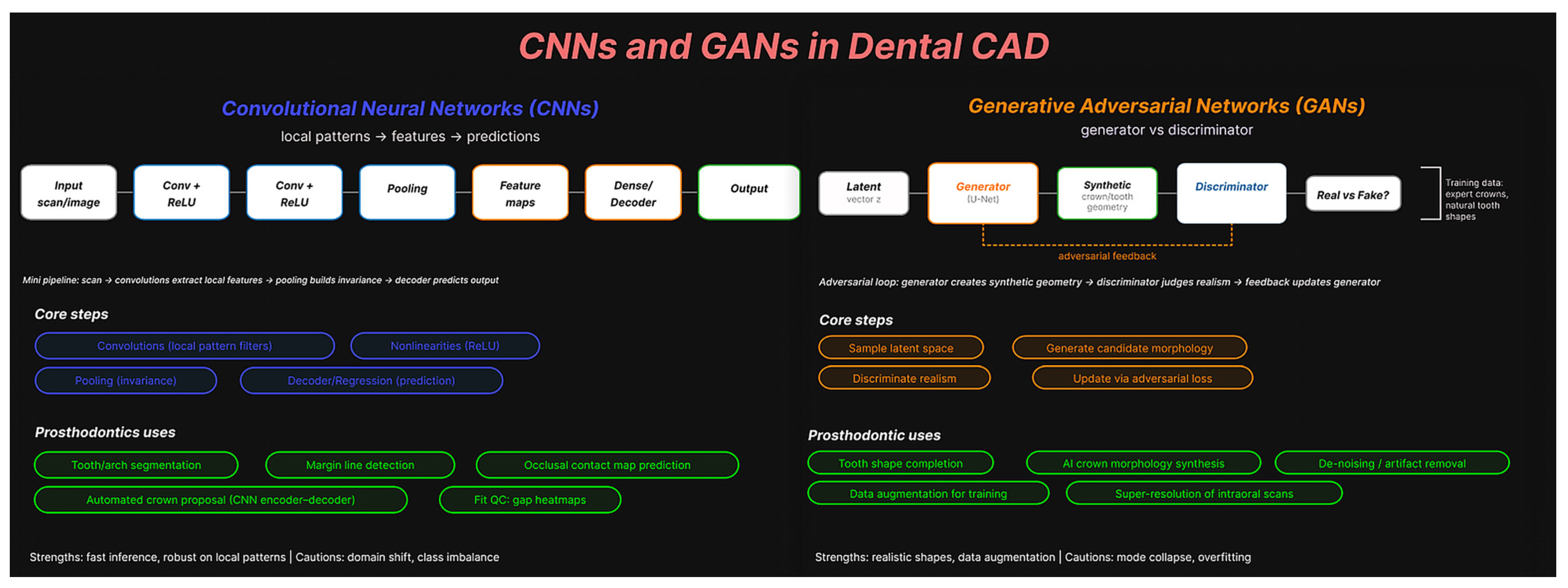
Figure 1. Convolutional neural networks (CNNs) and generative adversarial networks (GANs) in dental CAD/prosthodontics. Left panel (CNN): a feed-forward pipeline illustrates feature extraction at native resolution—two stacked Conv + ReLU blocks, pooling, and a decoder/regressor—applied to intraoral scans for tooth/arch segmentation, margin-line detection, occlusal contact-map prediction, automated crown proposals, and fit quality-control heatmaps. Right panel (GAN): an adversarial loop shows a latent vector z transformed by a generator (e.g., U-Net) into synthetic tooth/crown geometry, judged by a discriminator (“real” vs. “fake”), with feedback updating the generator; applications include tooth-shape completion, crown morphology synthesis, data augmentation, scan super-resolution, and de-noising. Abbreviations: AI, artificial intelligence; CAD, computer-aided design; CNN, convolutional neural network; GAN, generative adversarial network; ReLU, rectified linear unit; U-Net, encoder–decoder convolutional network with skip connections; QC, quality control; z, latent noise vector.
Oral 06 00016 g001
Figure 2. PRISMA diagram.
Oral 06 00016 g002
Figure 3. Risk of bias and reporting summary for AI-assisted crown design studies (ROBINS-I, QUIN, PROBAST-AI, TRIPOD-AI) [22,30,31,32,33,34,35,36,37,38,39,40,41,42]. Item-level TRIPOD-AI scoring is summarized in Table 4.
Oral 06 00016 g003
Figure 4. Outcome compass and architecture distribution for artificial intelligence crown design evidence [22,30,31,32,33,34,35,36,37,38,39,40,41,42]. AI: artificial intelligence; CAD: computer-aided design; DL: deep learning; GAN: generative adversarial network; DCGAN: deep convolutional generative adversarial network; INR: implicit neural representation; INN: implicit neural network; PCA: principal component analysis; RMS: root-mean-square; FEA: finite element analysis; LDS: lithium disilicate ceramic; μm: micrometer; N: newton; kN: kilonewton; s: seconds; min: minutes.
Oral 06 00016 g004
Table 1. PICO process for the systematic review on AI-assisted design of single-unit indirect restorations. Legend: AI = artificial intelligence; CAD = computer-aided design; IOS = intraoral scanner; RMS = root-mean-square; μm = micrometers; |dev| = absolute deviation; FPD = fixed partial denture.
ComponentDefinition for This ReviewInclusion Decision (Yes/No Questions)Data Items
Population(i) Clinical adults requiring single-unit indirect restorations (crowns, inlays, onlays, overlays) on teeth or implant abutments; (ii) Ex vivo/in silico standardized models of prepared teeth/abutments.P1. Clinical adults and/or standardized ex vivo/in silico models? P2. Single-unit restoration (not multi-unit/FPD)? P3. Tooth-borne or implant-supported within scope?Study context (clinical/ex vivo/in silico); tooth/abutment type and location; prep features (finish line, reduction, taper); scanner model and software/version; scan resolution/point density.
InterventionAI-generated/AI-assisted design from digital scans (e.g., convolutional neural network (CNN)/generative adversarial network (GAN)/transformer or another ML pipeline; fully automated or human-in-the-loop).I1. Is the restoration designed by AI (not only detection/segmentation)? I2. Digital input used (IOS/lab scan/CT)?AI type; training status and dataset size/source; automation level; target parameters (cement space μm, min thickness mm, contact targets); library/prior; post-processing; software/version; hardware; inference time; total design time (AI).
ComparatorExpert human CAD/CAM or non-AI (rule/library-based) CAD workflow.C1. Is there a non-AI comparator (human or rule/library CAD)?Comparator type; software/version; designer expertise; internal gap (IG; cement space) (μm); min thickness (mm); total design time (comparator).
Outcomes—Clinical fit and chairsideMarginal/internal fit; adjustment burden; contact quality; short follow-up.O1. Report marginal and/or internal fit? O2. Report clinical adjustment time/remakes/contact metrics?Marginal gap (mean/SD/n, μm, method/timepoint); internal gap (μm); chairside adjustment time (min); remakes (n); occlusal contacts (articulating/T-Scan metrics incl. center of force, % balance); proximal contacts (shimstock/feeler).
Outcomes—Technical accuracyGeometric/morphological accuracy of the designed restoration against a reference.O3. Report at least one technical accuracy metric? (Any of: trueness/precision root-mean-square (RMS); 95th-pct/max|dev|
Timepoints/Follow-upImmediate design outputs; try-in; cementation; short-term clinical follow-up if available.T1. Are timepoints stated (pre-cementation/after cementation/follow-up)?Timepoint per outcome; follow-up (months); attrition.
Study designs (S) (added for completeness)RCTs, non-randomized comparative clinical, prospective/retrospective cohorts, comparative ex vivo or in silico.S1. Comparative design? S2. Not a review/editorial/case report only?Design and setting; unit of analysis; groups/arms and n; power calc; ethics (or NA).
Exclusions Out of scope.X1. Segmentation/detection/classification without design; X2. No eligible comparator; X3. Not single-unit prosthodontic design; X4. No eligible outcomes; X5. Duplicate/overlap without unique data; X6. Non-extractable full text/language.Record explicit exclusion code and rationale.
Table 2. Database search strategies for AI-driven design and generation of fixed dental restorations (PubMed, Scopus, EBSCO—Dentistry and Oral Sciences Source, IEEE Xplore, and Elicit/Semantic Scholar).
Database/PlatformSyntax/Search String UsedFields SearchedLimits/Filters
PubMed (MEDLINE)(“Artificial Intelligence”[mh] OR “Machine Learning”[mh] OR “Deep Learning”[mh] OR “Neural Networks, Computer”[mh] OR “generative adversarial network”[tiab] OR GAN[tiab] OR “diffusion model”[tiab] OR “variational autoencoder”[tiab] OR VAE[tiab] OR transformer[tiab] OR transformers[tiab] OR “convolutional neural network”[tiab] OR CNN[tiab] OR “deep learning”[tiab] OR “machine learning”[tiab]) AND (“Dental Prosthesis Design”[mh] OR “Computer-Aided Design”[mh] OR “Crowns”[mh] OR “Inlays”[mh] OR “Veneers”[mh] OR crown[tiab] OR crowns[tiab] OR inlay[tiab] OR inlays[tiab] OR onlay[tiab] OR onlays[tiab] OR veneer[tiab] OR veneers[tiab] OR endocrown[tiab] OR endocrowns[tiab] OR bridge[tiab] OR bridges[tiab] OR “fixed partial denture”[tiab] OR “fixed partial dentures”[tiab] OR “fixed dental prosthesis”[tiab] OR “fixed dental prostheses”[tiab]) AND (design[tiab] OR designs[tiab] OR “restoration design”[tiab] OR generate[tiab] OR generative[tiab] OR generation[tiab] OR reconstruct[tiab] OR reconstruction[tiab]) AND (“Dentistry”[mh] OR “Prosthodontics”[mh] OR dental[tiab] OR prosthodontic[tiab] OR prosthodontics[tiab])MeSH + Title/AbstractYears: 2016–2025; Language: English; Article types: Journal Article, Review (exclude letters/editorials).
Scopus (Elsevier)TITLE-ABS-KEY(“deep learning” OR “machine learning” OR “convolutional neural network” OR CNN OR “generative adversarial network” OR GAN OR “diffusion model” OR “variational autoencoder” OR VAE OR transformer OR transformers) AND TITLE-ABS-KEY(crown OR crowns OR inlay OR inlays OR onlay OR onlays OR veneer OR veneers OR endocrown OR endocrowns OR “fixed partial denture” OR “fixed partial dentures” OR “fixed dental prosthesis” OR “fixed dental prostheses” OR bridge OR bridges OR pontic OR pontics) AND TITLE-ABS-KEY(design OR designs OR “restoration design” OR generate OR generative OR reconstruction OR reconstruct) AND TITLE-ABS-KEY(dental OR dentistry OR prosthodontic OR prosthodontics)TITLE, ABSTRACT, KEYWORDSYears: 2016–2025; Language: English; Document type: Article OR Review (exclude conference papers); Subject area: Dentistry.
EBSCOhost—Dentistry and Oral Sciences SourceTI,AB(“deep learning” OR “machine learning” OR “convolutional neural network” OR CNN OR “generative adversarial network” OR GAN OR “diffusion model” OR “variational autoencoder” OR VAE OR transformer OR transformers) AND TI,AB(crown OR crowns OR inlay OR inlays OR onlay OR onlays OR veneer OR veneers OR endocrown OR endocrowns OR “fixed partial denture” OR “fixed dental prosthesis” OR “fixed dental prostheses” OR bridge OR bridges OR pontic OR pontics) AND TI(design OR designs OR “restoration design”) AND SU(dentistry OR prosthodontics)Title, Abstract, Subject Headings (SU)Database: Dentistry and Oral Sciences Source; Source type: Academic Journals; Peer-reviewed; Language: English; Years: 2016–2025.
IEEE Xplore (IEEE)(“deep learning” OR “machine learning” OR “convolutional neural network” OR CNN OR GAN OR “diffusion model”) AND dental AND (crown OR bridge OR “fixed partial denture” OR “fixed dental prosthesis” OR inlay OR onlay OR veneer OR endocrown)Metadata (Title/Abstract/Author Keywords/Index Terms)Content type: Journals and Early Access; Years: 2016–2025; Language: English.
Elicit (Semantic Scholar)Keyword query (three-concept block): dentistry/prosthodontics + AI/ML/generative + restoration/design. Example: dental OR prosthodontics AND (deep learning OR machine learning OR convolutional neural network OR GAN OR diffusion model OR variational autoencoder) AND (crown OR inlay OR onlay OR veneer OR endocrown OR fixed dental prosthesis OR bridge) AND (design OR generation). Elicit converts to keywords and queries the Semantic Scholar corpus; use Elicit’s UI filters.Title/Abstract from Semantic Scholar corpus; full text when Elicit provides itYears: 2016–2025; Language: English; At screening: peer-reviewed journals; de-duplicated against database exports.
PubMed: [mh] = MeSH; [tiab] = Title/Abstract. EBSCO: TI = Title; AB = Abstract; SU = Subject Headings. Scopus: TITLE-ABS-KEY searches title, abstract, and author keywords. IEEE Xplore “Metadata only” effectively limits to title/abstract/index terms/author keyword.
Table 3. AI vs. human (dental technician) crown design—consolidated evidence across study designs (characteristics, marginal gap/internal gap, and efficiency).
Study (Year)Study DesignRestorationHuman ComparatorAI System (Vendor)AI Technology Type (From Study)Fit and Accuracy (MG/IG, RMS, etc.)Time/EfficiencyClinical/Functional Notes
Cho et al., 2023 [30] Laboratory/ex vivoTooth-supported posterior crownsNC: 3Shape Dental System (ET)Dentbird Crown (Imagoworks)CenterNet-based CNN (tooth detection/margins) + pSp encoder + StyleGAN generator (GAN)Internal gap RMS AI better than technician CAD (p < 0.001); occlusal morphology deviation lower with AIAI faster; ~60 s reduction at final stepOcclusion/contacts comparable to NC; fewer post-design modifications with AI
Cho et al., 2024a [31] Laboratory/ex vivoPosterior crownsNC: 3Shape Dental System (ET)3Shape Automate (3Shape) and Dentbird (Imagoworks)Automate: proprietary cloud DL (architecture N/A). Dentbird: CenterNet + pSp + StyleGANInternal fit: AD ≈ NC > AA (platform effect); morphology similar; contacts more favorable with NCAD 82.9 ± 30.4 s vs. NC 370.3 ± 98.3 sFully automatic AI designs (no tech edits) evaluated vs. NC criteria
Cho et al., 2024b [32] Laboratory/ex vivoSingle implant-supported posterior crowns (ISC)NC: 3Shape (ET); DM: tech-optimized AIDentbird (Imagoworks)—DB (as-generated) and DM (with brief tech optimization)CenterNet + pSp + StyleGAN-based DL stackMorphology/volume deviation: DM < DB; emergence profile and functional metrics similar across groups; MG/IG N/ADB fastest (exact times N/A)Some contours benefited from limited technician optimization (DM)
Cho et al., 2025 [33] Computational/LabMaxillary central incisor crownsET
CAD design
Dentbird (Imagoworks) and 3Shape Automate (3Shape)Dentbird: CenterNet + pSp + StyleGAN; Automate: proprietary (architecture N/A)Esthetics and guidance non-inferior to expert designs; MG/IG N/AN/AAnterior guidance and esthetic proportions satisfied by AI designs
Wu et al., 2025 [22] Laboratory/in vitroPosterior crownsET and NT: Exocad DentalCADAutomate (standalone) and Dentbird (web)Dentbird: GAN + CNN; Automate: proprietary (architecture N/A)RMS (median) Occlusal: AA 228.3 μm, AD 281.3 μm, CE 228.6 μm, CN 233.5 μm; Distal: CE best; margin line: no significant differenceAI 146 min vs. CE 244 min; Conventional 584 minAI boosts efficiency; experienced tech still best on some occlusal/distal sites
Nagata et al., 2025 [34]Laboratory/ex vivo (typodonts #15, #26)Premolar and molar crowns5 ETs (3–32 yr) on 3ShapeDentbird (Imagoworks)Commercial DL platform (CenterNet + GAN modules; exact phrasing varies)Marginal gap < 120 μm for AI and CAD; selected occlusal points AI 25.7 ± 13 μm vs. CAD 275.5 ± 116.8 μmAI significantly faster (quantitative time N/A)Margins comparable; AI favored at specific occlusal sites
Broll et al., 2025 [35]Laboratory/ex vivoPosterior crownsET (Exocad)Automate (3Shape); Dentbird (Imagoworks)Vendor systems as above (Automate architecture N/A; Dentbird CenterNet + StyleGAN)Vertical MG 223–293 μm across AI and technician/CAD groups (NS)N/ATechnician often best morphology; function and fracture loads comparable
Wang et al., 2025 [36]Computational (in silico)Maxillary first molarETCustom INN model (research)Implicit Neural Network with POCO point-conv + PointMLP local branch (trained on ~500 arches)RMS AI 0.2839 ± 0.0307 mm vs. Tech 0.3026 ± 0.0587 mm (p = 0.202, NS)N/ARecommends adding clinically relevant metrics beyond RMS
Çakmak et al., 2024 [37] Computational/LabMaxillary central incisor crownsNC: Exocad 3.1 (ET); DM: tech-optimized AIDentbird (Imagoworks)GAN + CNN (CenterNet + StyleGAN via pSp)Esthetics similar; incisal path deviation higher with raw AI; length/inclination similar; MG/IG N/AN/ATech tweaks (DM) improve palatal guidance without harming labial esthetics
Liu et al., 2024 [38]Laboratory/ex vivoCrowns and inlaysManual digital and manual wax-upPrintIn DentDesign (PrintIn Co., Taipei)Statistical ML (PCA tooth-shape model)MG AI 11.3–45.6 μm; Digital 10.4–18.8 μm; Wax-up 66.0–79.8 μm; AI/digital ≪ wax-up (p < 0.05)AI 58–60 s; Digital 229–300 s; Wax-up 263–600 sTrueness comparable AI vs. digital; both superior to wax-up
Chen et al., 2022 [39] Laboratory/ex vivoLithium-disilicate crownsET and students (NT)CEREC Biogeneric (Dentsply Sirona)Knowledge-based library (biogeneric morphology)MG/IG N/A (fit not primary); morphology deviation lower in human CAD; fracture behavior acceptable bothN/AAI showed more restorable substrate damage upon failure
Aktaş et al., 2024 [40]Laboratory/ex vivoPrimary molar crownsET (Exocad)Dentbird (Imagoworks)Commercial DL (Dentbird CenterNet + StyleGAN family)MG ~54 ± 43 μm (AI-3D-printed best axial); CAD-milled best marginal; software × manufacturing interaction p = 0.004N/AAll groups within clinical limits
Ding et al., 2023 [41] Computational (in silico)Premolar crownsET CAD and CEREC Biogeneric3D-DCGAN (research)3D deep convolutional GANMorphology closest to natural tooth; favorable FE stress; MG/IG N/AN/AOcclusal contacts broadly similar across groups
Win et al., 2025 [42]ClinicalSingle complete interim crownsExocad DentalCAD 3.0 Galway ET (≥10-yr tech)Dentbird Crown v3.x.x (Imagoworks)—web-based GAIDCommercial generative AI system; underlying architecture in this paper N/AIG ~82–98 μm (NS AI vs. CAD); marginal gaps equivalent overall; lingual margin AI worseN/AReal-patient trial; occlusal contact discrepancy larger with AI but within limits
NC = non-AI comparator (experienced technician digital CAD); AD = Dentbird AI group; AA = 3Shape Automate AI group; DB = Dentbird as-generated (no technician edits); DM = Dentbird after brief technician optimization; ET = experienced dental technician; NT = novice dental technician; GAID = generative AI–assisted design workflow; ISC = implant-supported crown; MG = marginal gap (μm); IG = internal gap (μm); RMS = root-mean-square deviation (trueness); NS = not significant; p = p-value; N/A = not available; DL = deep learning; CNN = convolutional neural network; GAN = generative adversarial network; pSp = pixel2style2pixel encoder; StyleGAN = style-based generator; CenterNet = keypoint-based detector; INN = implicit neural network; POCO = point-convolution operator; PointMLP = point-cloud multilayer perceptron branch; 3D-DCGAN = 3D deep convolutional GAN; CAD = computer-aided design; CEREC Biogeneric = knowledge-based morphology library (Dentsply Sirona); exp. tech = experienced technician.
Table 4. TRIPOD-AI reporting completeness for computational model-development studies (items correspond to the TRIPOD-AI panel in Figure 3). Legend: Y = adequately reported; P = partially reported/insufficient detail; N = not reported/not available.
TRIPOD-AI Item (Figure 3 Abbreviation; Pragmatic Mapping)Ding et al., 2023 [41]Wang et al., 2025 [36]
T/A—Title/Abstract identifies AI model development + target taskY (explicit aim to develop a true 3D AI algorithm for crown design).Y (explicit feasibility aim to develop an INN model for automatic molar reconstruction/crown design).
Data—Data source/setting/timeframe describedP (data source and acquisition are described, but representativeness and dataset spectrum beyond “healthy personnel” is limited).P (data source described; single-institution retrospective database; limited spectrum beyond defined criteria).
Elig—Eligibility/selection criteria reportedP (case description is provided, but eligibility is broad and limited to “healthy personnel” without granular criteria).Y/P (explicit inclusion/exclusion criteria are provided, but scope is narrow to intact maxillary first molars and “desirable” morphology).
Size—Sample size rationale/justificationN (dataset size stated, but no justification/power rationale for model development).P (power statement provided for RMS comparisons, but not a full model-development sample size justification).
Split—Train/validation/test partitioning describedP (mentions 12 additional test cases; no explicit validation strategy and limited leakage safeguards).Y (explicit train/validation/test split ratio 7:1.5:1.5 and rationale stated).
ExtVal—External validationN (only internal hold-out testing is described; no independent external dataset).N (internal split only; no independent external validation dataset/site).
Ref—Reference standard/ground truth definitionP (comparators and reference natural tooth are described for evaluation, but “ground truth” for generation and reference justification are limited).Y (original clinical crowns are isolated and used as the comparison reference for generated crowns).
Miss—Missing data handlingN (not described).N (not described).
Pred—Predictors/inputs + preprocessing describedP (inputs and manual segmentation described; limited reproducibility detail on standardization).P (processed arch creation and smoothing described; still limited detail on operator variability and repeatability).
Metrics—Performance metrics defined and reportedY (explicit metrics including cusp angle, RMS/3D similarity, occlusal contact, and FEA-based outputs).Y (CD, F-score, volumetric IoU, RMS deviations, plus deviation maps and statistical testing).
Spec—Model specification (architecture/pipeline) describedY (generator/discriminator layer structure, filters, kernel/stride/padding, activations, BN, LeakyReLU slope).Y (two-branch architecture described; POCO-only vs. POCO-PointMLP and training workflow described).
Tuning—Hyperparameter tuning/overfitting controlP (states multiple parameters were investigated; does not clearly report final selected hyperparameters or selection protocol).P (uses validation set and reports training/validation curves; tuning process and selection criteria not fully formalized).
Base—Comparator/baseline clearly specifiedY (explicit comparison against natural tooth, biogeneric, and technician CAD).Y (explicit comparison vs. technician-designed crowns and original clinical crowns).
Calib—Calibration/uncertainty estimatesN (not reported).N (not reported).
Code—Code/weights/data availabilityN (no code/weights/dataset access reported).N (no code/weights/dataset access reported).
Reprod—Reproducibility assets (versions/seeds)N (not reported).N (not reported).
Limits—Limitations/applicability discussedP (limitations and scope are discussed, but not in a TRIPOD-AI structured way).P (limitations noted; acknowledges metric limitations and restricted tooth-type training data).
Overall—Overall reporting completenessP (strong architecture/metrics; weaker eligibility granularity, split/validation structure, and reproducibility assets).P (clear dataset criteria and splits/metrics; no external validation and no reproducibility assets).
Disclaimer/Publisher’s Note: The statements, opinions and data contained in all publications are solely those of the individual author(s) and contributor(s) and not of MDPI and/or the editor(s). MDPI and/or the editor(s) disclaim responsibility for any injury to people or property resulting from any ideas, methods, instructions or products referred to in the content.