Review

Blastic Plasmacytoid Dendritic Cell Neoplasm in the Era of Targeted Therapies

Department of Oncology, Italian National Institute of Health, Viale Regina Elena 299, 00161 Rome, Italy
Hemato 2026, 7(2), 15; https://doi.org/10.3390/hemato7020015
Submission received: 29 March 2026 / Revised: 7 May 2026 / Accepted: 13 May 2026 / Published: 14 May 2026

Abstract

Blastic plasmocytoid dendritic cell neoplasm (BPDCN) is a rare myeloid malignancy, characterized by the involvement of multiple organs, including the skin, bone marrow and blood, lymph nodes and the central nervous system. According to tumor location, the disease is classified as skin-only, systemic-only, and skin and systemic. The cutaneous manifestations of disease are typical and are represented by violaceous single tumors or multiple plaques present in sun-exposed cutaneous areas. BPDCN is issued from the malignant transformation of dendritic cell progenitors and is diagnosed using the classical immunophenotypes CD123, CD4 and CD56 in addition to specific membrane markers of plasmocytoid dendritic cells. BPDCN is an aggressive disease and is associated with a short survival. Upfront therapies involve either chemotherapy regimens in fit patients and CD123-targeted therapies, including interleukin-3 conjugated with diphtheria toxin (Tagraxofusp, SL-401), or Pivekimab sunirine, an anti-IL-3R-drug conjugate, for both fit and unfit patients. Targeted treatments limit the toxicities of chemotherapy and allow the bridging of a consistent proportion of patients to hematopoietic stem cell transplantation, the only treatment associated with potential long-term survival.

1. Introduction

Human dendritic cells (DCs) are professional antigen-presenting cells that support a functional bridge between innate and adaptive immunity. DCs are heterogeneous and are classified in various subsets that differentiate for their phenotype, functional properties and tissue localization: conventional (classical DC1 (cDC1)) characterized by CD141+ expression and specialized to cross-presenting antigens to CD8+ T cells; conventional/classical DC2 (cDC2), characterized by CD1c expression and specialized to activated CD4+ helper T cells; plasmocytoid DCs (pDCs), characterized by CD123 and CD303 expression, by similarity with plasma cells and by the production of large amounts of type 1 Interferon (IFN-α) in response to viral infection; monocyte-derived DCs (moDCs), differentiating from monocytes at the site of inflammatory or infective processes [1]. In addition to these DC subsets, more recent studies have led to the identification of DC3, a subset of DCs characterized by high CD14 expression and distinct functional roles with respect to cDC2. An additional subset of DCs of more recent identification is represented by transitional dendritic cells (tDCs) representing a DC subset distinct from cDCs and involved in mediating proinflammatory antiviral responses [2]. Finally, a last subset of DCs is represented by Langherans cells (LCs), corresponding to a highly specialized subset of DCs localized in the epithelial layers of the skin and mucosal epithelium and endowed with a unique self-renewing capacity and pronounced migratory properties [3].
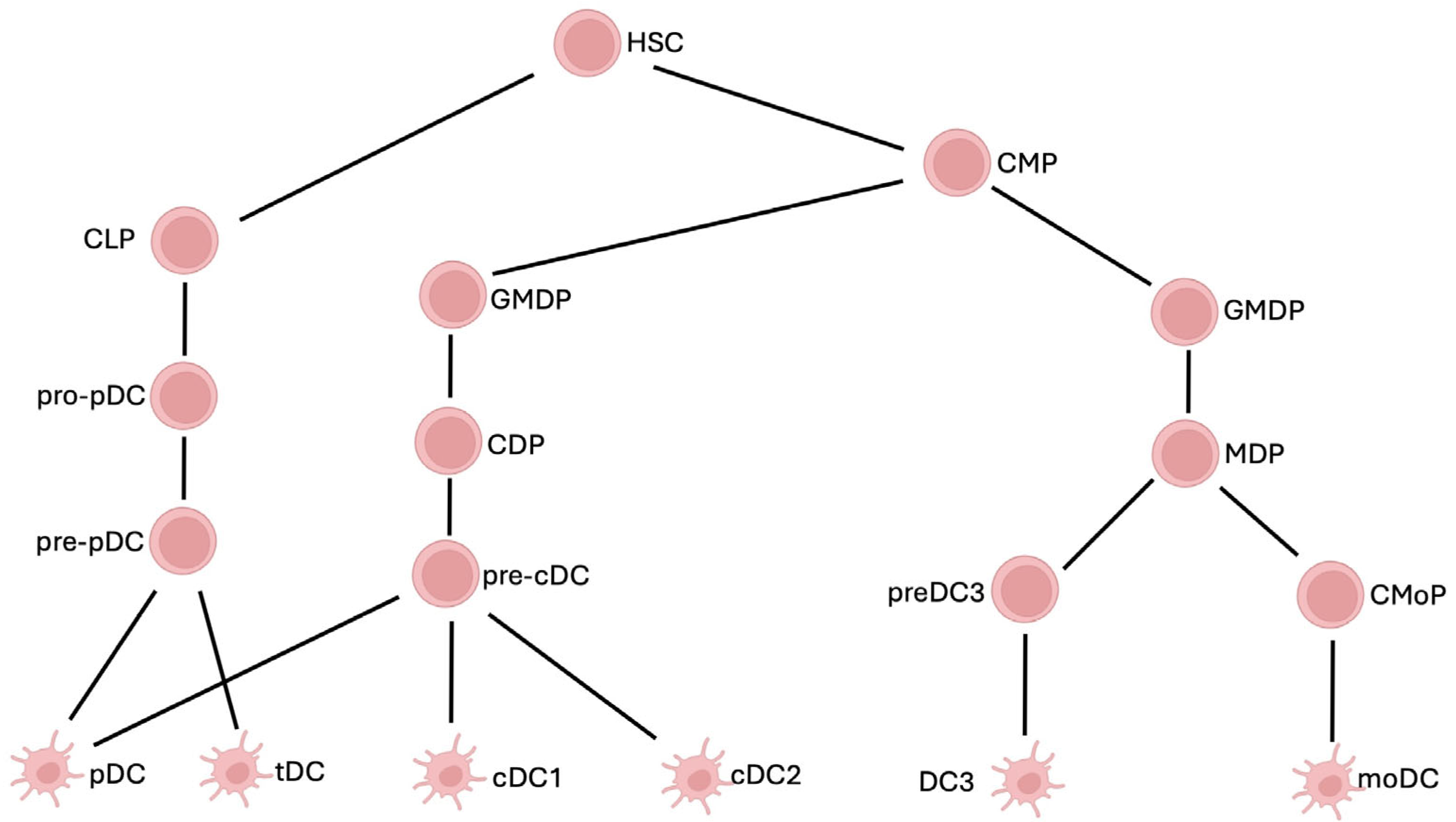
DCs are generated by hematopoietic stem cells (HSCs) through a complex and highly regulated differentiation process. DCs differentiate into DCs through a myeloid and lymphoid progenitor pathway, as a result of growth factors, such as granulocyte macrophage colony stimulating factor (GM-CSF), fms-like tyrosine inase-3 ligand (FLT3-L) and tumor necrosis factor alpha (TNF-α). This complex process implies first the differentiation of CD34+ HSCs to common myeloid progenitor (CMP) or to common lymphoid progenitor (CLP), followed by differentiation into more differentiated progenitors, which in turn generate the precursor cells of the various DC subsets [4]. In particular, the CMP initially differentiates into granulo-monocytic progenitors (GMDPs) characterized by high expression of the interferon regulatory factor 8 (IRF8), which in turn differentiates into common dendritic progenitors (CDPs) or into monocytic–dendritic progenitors (MDPs); CDPs generate through their differentiation/maturation pDCs, cDC1 and cDC2, while MDPs generate through their differentiation/maturation DC3 and moDS [4]. (Figure 1) CLP can generate through their differentiation pDCs, tDCs and some cCDs. The process of differentiation of CLPs is different from that observed for CMPs and does not imply the differentiation into CDPs. Thus, these cells generate pro-pDCs and pre-pDCs, which in turn differentiate into pDCs, tDCs and some cDCs.
Three models have been proposed to explain the developmental relationships between pDCs and other dendritic lineages: following a canonical model, pDCs develop from CDPs but deviate early from cDC precursors, which differentiate into cDC1 and cDC2; a revised model indicates that pDCs develop together with B cells from lymphoid progenitors, whereas tDCs are progenitor cells generating cDC2s; a third model suggests that pDCs develop together with tDCs and share a progenitor with cDC1 [5].
Human pDCs originate from HSCs in the bone marrow (BM) and can differentiate through both myeloid and lymphoid progenitors, thus suggesting a flexible developmental origin [6,7,8]. Thus, a significant part of pDCs originate from lymphoid progenitors, in line with the observation that a subset of pDCs is dependent on B-cell biased lymphoid progenitors; they are defined as B pDCs and share transcriptional features with B cells [6,7]. The generation of pDCs from CLP implies the differentiation of these cells, primarily driven by FLT3-L, into pro-DCs/pre-pDCs through a molecular pathway involving the acquisition of high levels of transcription factors IRF8 and TCF4 and the loss of alternative lymphoid (B/T) potential [6,7].
Blastic plasmocytoid dendritic cell neoplasm (BPDCN) is a rare hematologic malignancy. Initially it was considered a form of lymphocyte-derived cutaneous lymphoma and called CD4+/CD56+ hematodermic tumor and agranular CD4+ NK cell leukemia. However, subsequent studies have shown that the disease originates from PDCs rather than from lymphocytes, and in 2016 the World Health Organization designated BPDCN as a separate category of myeloid malignancies [9].
BPDCN is an aggressive hematologic malignancy with features of cutaneous lymphoma, related to malignant PDCs in blood and BM [2]. At more advanced stages, malignant dendritic cells may infiltrate other tissues, including the liver, the spleen, lymph nodes, the central nervous system (CNS) and other tissues [10].
BPDCN is a very rare disease representing <1% of all acute leukemias and cutaneous lymphomas. It has an estimated incidence rate of approximately 0.04 to 0.05 cases per 100,000 individuals in the United States; 1000 to 1400 new cases are estimated to occur annually in the USA and Europe combined [11]. BPDCN primarily affects older adults, with a median age at diagnosis between 62 and 70 years; there is a significant male predominance, with a male-to-female ratio between 3:1 and 5:1 [11]. BPDCN has a bi-modal distribution, with one peak affecting children, adolescents and young adults (peaking around 20 years) and a second more frequent peak in older adults (peaking around 65–70 years) [12,13]. Pediatric cases are rare and usually present with a different clinical picture than adult cases [13].
The initial presentation of BPDCN is variable and may be localized only on the skin (skin-only) or may only be systemic (systemic-only) or mixed (systemic plus skin) [6]. The localization at the level of the skin, in the form of deep purple tumors or plaques, single or disseminated, is very frequent (80–95%) either alone or in association with systemic disease (50% of cases); systemic-only disease is more rare (10–20% of cases) [14].
Recent studies have contributed to a better understanding of the pathogenesis of BPDCN and have shown some improvements in the treatment of this aggressive tumor. Here, these studies are reviewed and critically analyzed.

2. Immunophenotypic Features of BPDCN

BPDCN is characterized by a specific immunophenotype, usually positive for CD4, CD56, CD123, HLA-DR and TCF4. Frequently, it is also positive for TCL1 and lacks lineage-specific markers of T-cells, B-cells or myeloid cells [15]. According to the WHO classification, positive markers for BPDCN are CD123, TCF4, TCL1, CD303, CD304, CD4 and CD56; negative markers are CD3, CD14, CD19, CD34, lysozyme and myeloperoxidase [9].
According to WHO 2022, standard immunophenotypic diagnostic criteria are (i) the expression of CD123 and of one of these other markers of pDCs (TCF4, TCL1, CD303 or CD304); (ii) the expression of any of these three markers and the absence of all the expected negative markers [16] (Table 1).
At the immunophenotypical level, it is important to distinguish BPDCN cells from reactive pDCs. An extensive flow cytometric analysis showed that BPDCN can be distinguished from reactive pDCs by means of CD56 expression, decreased/negative CD38, positive CD7, negative CD2, increased HLA-DR, and decreased CD123 expression [17] (Table 2). The combination of TCF4 and CD123 is highly sensitive and specific for BPDCN, with 100% of positivity in all cases analyzed [18]. Furthermore, the immunohistochemical combination SOX4/CD123 distinguishes BPDCN, including also cases of CD56 BPDCN, from reactive PDCs and other dendritic neoplasms [19]. Thus, the combinations of TCF4/CD123, TCF4/CD56 and SOX4/CD123 are very useful for BPDCN diagnosis and for monitoring minimal residual disease (MRD) [19].
A large retrospective analysis involved 297 BPDCN patients analyzed for their clinical and immunophenotypical features, with an immunohistochemical report in 236 cases; most patients were male (78%) and 75% had involvement of BM (>5% BPDCN blasts); peripheral blood (62%), skin (82%), lymphoadenopathy (49%), and CNS (29%) involvement was also observed [19]. Immunohistochemistry and flow cytometry analyses showed positivity for CD123, CD4 and CD56 in almost all samples [20].

3. Genetic Alterations in BPDCN

BPDCNs display a consistent number of genetic alterations, resembling to some extent those observed in myeloid malignancies, particularly molecularly defined secondary acute myeloid leukemias (AMLs) [10].
Epigenetic modifiers are frequently mutated in BPDCN, and their alterations play a relevant role in the pathogenesis of this malignancy. Genes involved in DNA methylation (TET2 and IDH2), chromatic accessibility (ARID1A and SMARCA1), histone methylation (ASXL1) and histone demethylation (KMD4D) are frequently mutated in BPDCN [21]. ASXL1 mutations include frameshift mutations and nonsense mutations; some ASXL1 mutations are recurrent. TET2 is the gene most frequently mutated in BPDCN (being mutated in >50% of cases) and its mutations play a relevant role in the pathogenesis of this malignancy [22,23]. The majority of TET2 mutations are non-recurrent; half of BPDCN patients had more than one TET2 mutation. The molecular characterization of TET2 mutations occurring in BPDCN patients showed that truncating mutations (stop-gain, frameshift or splice) predicted a worse outcome in BPCDN patients compared to missense TET2 mutations [23].
A fundamental study by Shimony and coworkers evaluated the association between TET2 and RAS mutations with organ involvement in adults with BPDCN [14]. According to organ involvement, 66 BPDCN patients were classified as skin-only, systemic plus skin, and systemic-only. Patients with skin-only BPDCN were more frequently aged ≥75 years and had higher UV exposure, lower complex karyotypes (0% vs. 32%, respectively) and mutated NRAS (0% vs. 29%) [14]. Conversely, those without skin involvement had lower UV exposure and fewer TET2 mutations (33% vs. 72%) [14] (Table 3). Median OS was 23.5, 20.4 and 17.5 for skin-only, systemic plus skin, and systemic-only, respectively [14]. Finally, the overt BM involvement (>5% BPDCN cells) was associated with poor OS compared to microscopic BM involvement (<5% BPDCN cells) [14].
A key study by Griffin et al. clarified the fundamental role of TET2 mutations in the pathogenesis of BPCDN skin lesions [24]. A subsequent study by Khanlari and coworkers provided evidence that bone marrow clonal hematopoiesis is highly prevalent (65% of cases) in BPDCN and frequently shares a clonal origin as evidenced by 77% of shared TET2 mutations [25]. In BPDCN, in the BM, clonal progenitors can undergo malignant transformation into acute leukemia or differentiate into immune cells that contribute to disease pathology in peripheral tissues. Outside the marrow, these clones are exposed to a variety of tissue-specific mutational processes. In BPDCN, sun exposure of PDCs and committed precursors causes the development of skin tumors and the acquisition of loss-of-function mutations in TET2, the most common premalignant alteration in BPDCN, which confers resistance to UV-induced cell death in PDCs, thus pathogenetically contributing to their malignant transformation [24].
It is important to note that TET2 mutations in BPDCN are biallelic and their frequencies are higher in BPDCN than in other myeloid malignancies [18]. Frequently, TET2 mutations are associated with ASXL1 mutations [26].
IDH1/IDH2 mutations are observed in 5–10% of BPDCN patients and are mutually exclusive with TET2 mutations; the presence of IDH mutations is important for their possible targeting using IDH inhibitors.
RAS signaling pathway mutations, including NRAS, KRAS and PTPN11, are frequent in BPDCN and drive rapid cellular proliferation. RAS mutations are specific to BPDCN and are usually not observed in preleukemic clonal hematopoiesis [25].
Mutations of RNA splicing factors SRSF2, ZRS2, U2AF1 and SF3B1 are often observed in BPDCN patients. Loss-of-function mutations of ZRS2, an X chromosome gene encoding a splicing factor, are enriched in BPDCN and almost all cases occur in males [27]. BPDCN-associated ZRS2 mutations impair apoptosis, promote the expansion of pDCs and predispose to leukemic transformation of these cells [27].
Mutations in tumor suppressor genes, such as TP53, ATM and RB1, are observed in a minority of BPDCN patients.
Mutations and deletions of transcription factors, such as IKZF1 (Ikaros) and ETV6, are frequently observed in BPDCN patients. In a series of 10 BPDCN patients, IKZF1 gene inactivation through structural rearrangement, focal inactivation or gene fusion was observed in 20% of cases [28]. IKZF1 gene inactivation may favor BPDCN development promoting cell growth [28].
Two types of recurrent chromosomal rearrangements are observed in BPDCN: about one-third of patients harbor a rearrangement of the MYC locus at 8p24, most frequently a translocation t(6;8) with 6p21; about 20–30% of patients with BPDCN display rearrangements generating fusions of the transcription factor MYB with several recurrent partners. Suzuki et al. analyzed 14 BPDCN patients, 5 pediatric and 9 adult patients: 100% of pediatric patients displayed MYB fusions as the unique genetic alteration; 4/9 adult patients showed MYB fusions, associated with the typical BPDCN mutations [29]. The most frequent gene fusions observed in these patients were MYB/PLEKH01, MYB/ZFAT, and MYB/DCPS [29]. An experimental study partly elucidated the role of BPDCN MYB fusions in disease pathogenesis through a shift in MYB function from a regulator of CD lineage genes to a regulator of G2/M cell cycle control genes: MYB fusions greatly increase DNA binding at these gene locations, resulting in uncontrolled gene expression and cell growth; furthermore, MYB fusions impair DC differentiation [30]. Rearrangements of MYC gene locus determine the location of RUNX2 regulatory regions upstream of MYC and drive its high expression, promoting, in cooperation with TET2 gene mutations, dendritic-like leukemia in mice [31].
Cytogenetic abnormalities are commonly observed in BPDCN. BPDCN is characterized by complex karyotypes observed in 50–75% of cases, with chromosomal losses being more frequent than gains. In particular, BPDCN is frequently characterized by the occurrence of major deletions involving chromosome 5q (loss of CDKN1B and ETV6) and chromosomes 13q13-q21 (loss of the RB1 gene); chromosome 6q23-qTER is frequently observed in BPDCN patients; 9p21.3 with deletion of CDKN2A/CDKN2B is common. As underlined above, complex karyotype alterations are exclusively observed in BPDCN with systemic tumor location [14].

4. BPDCN with Prior or Concomitant Hematologic Malignancy

A unique feature of BPCDN is that it frequently occurs concurrently with or evolving from another myeloid neoplasm such as chronic myelomonocytic leukemia (CMML) or myelodysplastic syndrome (MDS) and may be diagnosed concurrently or asynchronously. Evidence suggests that BPDCN frequently arises from a common myeloid progenitor cell shared with neighboring myeloid neoplasms, often evolving from clonal hematopoiesis. Mutations in TET2 are frequently observed across both BPDCN and the preceding myeloid malignancies, thus indicating their central role in the progression from myeloid neoplasms; other commonly identified mutations include ASXL1, DNMT3A, RAS and SRFSF2.
In a group of 87 adult BPDCN patients, Pemmaraju et al. observed that 20 patients (23%) presented as BPDCN with prior or concomitant hematologic malignancy (PCHM): 9 with MDS, 5 with CMML, 3 with myelofibrosis, and 3 with lymphoid/myeloma (1 T-acute lymphoid leukemia (T-ALL), 1 Hodgkin lymphoma and 1 multiple myeloma) [32]. No significant differences were observed at clinical and genetic levels between the groups of BPDCN patients with or without PCHM [32].
Some case report studies have included separate NGS analyses on BPDCN and CMML samples from patients who developed BPDCN after a prior history of CMML; these reports showed a shared genetic clonal origin and distinct clonal evolution of BPDCN and CMML [33,34,35]. Interestingly, the analysis of paired samples of a single patient with BPDCN transformation from an underlying CMML showed the common origins of CMML and BPDCN and the biallelic inactivation of the retinoblastoma gene (RB1) associated with the transformation of CMML to a BPDCN [35]. Interestingly, islands of CD123high cells were commonly observed in the bone marrow of patients with CMML; these cells display Ras pathway mutations as well as monocytic leukemic cells [36].
The analysis of patients with concomitant BPDCN and MDS showed that both originated from the same clonal origin known as clonal hematopoiesis, which subsequently evolved to BPDCN by acquiring multiple copy number alterations, including the loss of 13q14 [37].
A recent study showed two unique cases where BPDCN evolved from prior lymphoid cancers (T-cell lymphoblastic lymphoma and ALK-negative large-cell anaplastic lymphoma), with associated clonal hematopoiesis in the BM [38]. Whole-exome sequencing studies supported a clonal link between these lymphoid malignancies and subsequent BPDCN development, highlighting the potential for a shared clonal origin [38]. In one case, the disease even progressed to AML, supporting the idea that BPDCN and other hematologic cancers may arise from common precursors.

5. Treatment of BPDCN Patients

The treatment of BPDCN has evolved over time and now, in addition to chemotherapy, targeted therapies are also available.

5.1. Chemotherapy-Based Treatments

Historically, treatment options for BPDCN were limited to conventional chemotherapy, adopted from regimens used to treat AML or ALL or lymphomas. Two reports of clinical studies from two USA centers showed frequent disease responses in BPDCN patients treated with hyperfractionated cyclophosphamide, vincristine, adriamycin and dexamethasone (Hyper-CVAD) alternating with methotrexate and cytarabine [39,40]. The use of this intensive ALL-type therapy in younger and fit BPDCN patients, particularly in those eligible for hematopoietic stem cell transplantation (HSCT), elicited good results with up to 80% complete response (CR) and with an overall survival (OS) of around 30 months. Patients who received allo-HSCT had a significantly longer OS compared to those who did not receive transplantation [39].
However, many patients with BPDCN are older and frail and may not be able to tolerate the intensive Hyper-CVAD chemotherapy regimen. Thus, intensive chemotherapy regimens are not appropriate for many BPDCN patients with an age over 65 years.

5.2. Targeted Treatments for BPDCN Patients

To bypass this important limitation, a targeted therapy for BPDCN was developed through the targeting of CD123, the alpha chain of interleukin-3 receptor (IL-3Ralpha), which is highly expressed on the membrane of BPDCN cells [41]. To this end, Tagraxofusp (SL-401), a diphtheria toxin (DT) payload fused to recombinant human IL-3, was developed: this agent binds with high affinity to IL-3R and following its binding, the IL-3-DT/IL-R complex is internalized and DT is translocated to the cytosol where it blocks protein synthesis and induces apoptosis [42].
The DT-IL-3 compound (Tagraxofusp, SL-401) was evaluated in BPDCN patients. Initial phase I/II clinical studies showed an acceptable safety profile of Tagraxofusp, with a maximum tolerated dose (MTD) of 12.5 μg/kg/day, and a phase II clinical study showed an 84% overall response rate (ORR), with 59% CR [43]. In 2019, the results of a phase II clinical study supported the approval of Tagraxofusp for BPDCN patients: 29 patients received Tagraxofusp as first-line treatment and 15 as second-line and third-line treatment; in untreated patients, 72% achieved CR, and 45% of these patients subsequently underwent HSCT, with a survival rate of 52% at 24 months, while in relapsed/refractory (R/R) BPDCN patients, the ORR was 67% with an OS of 8 months [44]. The long-term results of this study, extended also to additional patients (65 treatment-naïve and 19 R/R), showed that for treatment-naïve patients, the ORR was 75%, 57% achieved CRc and the median duration of response was 24.9 months; the median OS was 15.8 months; 51% of patients achieving CR were bridged to allo-HSCT [45]. For the 19 R/R patients evaluated, ORR was 58%, including one CR and two CRc; the median OS was 8.2 months; only one patient was bridged to allo-HSCT [45].
Post hoc subgroup analyses of this study helped to better define the impact of Tagraxofusp in BPDCN patients. Of the 65 BPDCN patients treated with first-line Tagraxofusp, 21 received HSCT, 17 allo-HSCT and 7 auto-HSCT [46]. For allo-HSCT, mOS was 38.4 months and was not reached for auto-HSCT [46]. Another post hoc analysis involved ten patients aged <50 years enrolled in this study; at a median follow-up of 34 months, two patients achieved CR, five CRc and one partial response (PR); all these patients were bridged to HSCT (allo-HSCT for eight and auto-HSCT for two; seven of these patients were bridged to HSCT immediately following a Tagraxofusp-induced CR and three after additional multiagent chemotherapy) [47]. The mOS was 38.4 months for these patients [47]. The findings of this subgroup analysis suggest that Tagraxofusp treatment is safe and effective for younger adults with BPDCN, supporting this drug as the standard of care for all eligible patients with BPDCN [47].
Another post hoc analysis explored BPDCN patients with different fitness. Responses were observed in patients pertaining to different risk stratification (low-risk (LR), intermediate-risk (IR) and high-risk (HR)): ORR was 80%, 68% and 79%, while CR+CRc was 73%, 59% and 46% among LR, IR and HR, patients, respectively; mOS was 38.4 months, 15.8 months and 11.8 months for LR, IR and HR patients, respectively [47]. In total, 5/15, 10/22 and 6/28 LR, IR and HR patients, respectively, were bridged to HSCT and displayed a post-transplant mOS of 38.4 months, not reached (NR) and NR, respectively [48]. These results showed that Tagraxofusp enabled bridging to HSCT for eligible patients across the entire spectrum of fitness, including high-risk patients potentially deemed ineligible for intensive cytotoxic upfront regimens [48].
Multiagent intensive chemotherapy regimens used to treat BPDCN carry a high risk of myelosuppression. Thus, a post hoc analysis evaluated the effect of Tagraxofusp on hematopoiesis [49]. Of the 66 BPDCN patients treated in first line with Tagraxofusp, 32 had baseline bone marrow (BM) disease and 34 had no BM disease. Over the course on Tagraxofusp monotherapy treatment, hematopoiesis was progressively restored to normal values, with restoration of neutrophil levels, recovery of platelet counts and improvement of hemoglobin levels [49]. By cycle 2 of the treatment, all patients displayed peripheral blast clearance regardless of BM status [49].
A recent phase I/II study carried out in 11 BPDCN patients (7 treatment-naïve and 4 refractory/relapsed) showed among treatment-naïve patients a CR of 57% [50].
Real-world results from a European Named Patent Program (ENPP) confirmed the acceptable safety profile and the efficacy of Tagraxofusp in both treatment-naïve and relapsed/refractory BPDCN patients, with a significant rate of patients bridged to HSCT in both groups of patients [51,52].
A significant proportion of BPDCN patients are resistant to Tagraxofusp. The mechanisms of resistance to Tagraxofusp do not seem to involve a loss of CD123 expression on the surface of leukemia cells. In fact, leukemic cells obtained from patients analyzed before and during treatment with Tagraxofusp and at disease progression failed to demonstrate any decrease in CD123 expression [53]. Resistant BPCDN cells acquire deficiencies in the diphtamide synthesis pathway, which impairs the ability of Tagraxofusp to ADP-ribosylate EF2, which restores protein synthesis [53]. These deficiencies in diphtamide synthesis seems to be mediated by DNA methylation and are reversible by treatment with hypomethylating agents [53].
A recent study evaluated a new agent targeting CD123, Pivekimab sunirine (PVEK), a first-in-class antibody-drug conjugate (ADC) comprising a high-affinity anti-CD123 antibody with engineered cysteines in the CH3 domain to enable site-specific attachment of an alkylating indolinobenzodiazepine pseudodimer payload (through a cleavable linker) that alkylates DNA and causes single-strand DNA breaks without cross linking [54]. The phase I/II clinical study CADENZA evaluated PVEK in newly diagnosed (ND) and relapsed/refractory (R/R) BPDCN patients [55]. It included 33 patients with ND BPDCN, 20 BPDCN alone (de novo) and 13 BPDCN associated with another myeloid malignancy (de novo and PCHM), and 51 with R/R BPDCN [55]. CR+CRc was 75% for de novo BPDCN, 82% for BPDCN + PCHM and 18.8% for R/R BPDCN; mOS was 16.6 months for both de novo BPDCN and de novo BPDCN + PCHM and 5.8 months for R/R BPDCN [55]. Of the 84 patients, 19 proceeded to HSCT; among patients with CR+CRc, the HSCT rate was 52% for de novo BPDCN and de novo BPDCN+PCHM and 29% among R/R BPDCN [55].
Resistance to PVEK, as well as to other ADCs, may be related to various mechanisms, such as antigen loss or downregulation, impaired receptor internalization, altered intracellular trafficking and upregulation of drug efflux transporters [56]. A recent study suggested an alternative mechanism of resistance based on the emergence of protective tissue niches capable of sustaining disease persistence after PVEK treatment [57].

5.3. Venetoclax-Based Therapy

A preclinical study based on the evaluation of patient-derived BPDCN xenografts showed a consistent sensitivity to the anti-leukemic activity of the BCL2 inhibitor venetoclax (VEN) with improved survival after VEN treatment in vivo [58]. Furthermore, two R/R BPDCN patients received VEN off-label and experienced significant disease responses [58]. Gangat and coworkers reported a case series of 10 BPDCN patients treated with VEN+hypomethylating agents (HMA), with all patients responding to the treatment (70% CR and 30% PR); however, responses were short-lived and 30% of patients underwent HSCT [59]. Agha and coworkers reported a very remarkable complete and durable response in a patient with large skin and systemic involvement, initially treated with Bortezomib and then treated with VEN [60].
Pemmaraju et al. reported the results on 10 R/R BPDCN patients who received previous chemotherapy or anti-CD123 therapy or both and were treated with VEN-based regimens: 3 with VEN alone; 5 with VEN + decitabine; 2 with VEN + azacitidine. The response rate was 60%, including four patients who achieved CR/CRc and two with partial response; however, the duration of responses was short, ranging from 3 to 6 months [61]. Patients with TET2 mutations had shorter responses [61].
Two recent studies reported the evaluation of larger sets of BPDCN patients treated with VEN-based regimens. Stein and coworkers reported the results of a retrospective analysis carried out on 47 BPDCN patients treated with Tagraxofusp and 47 BPDCN patients treated with VEN-based regimens (26 with VEN alone and 21 with VEN+HMA) [62]. Median OS was significantly longer in patients treated with Tagraxofusp compared to those treated with VEN regimens (35.3 months vs. 10.5 months, respectively); the 12-month survival rates were better for Tagraxofusp-treated patients than for VEN-treated patients (72.1% vs. 42.8%, respectively) [62]. In patients treated with VEN-based regimens VEN+HMA treatment did not improve responses compared to VEN alone [62].
Lamkin et al. reported the results related to real-world use of VEN+HMA in a group of 14 BPDCN patients (10 with R/R disease) [62]. In R/R patients, ORR was 70%, with an mOS of 10.5 months [63]. Although the response rates in R/R patients were high, many of these patients displayed relapses involving central nervous system or extramedullary disease [63].
Khalife-Hachem et al. retrospectively analyzed data issued from nine French institutions that treated a total of 12 ND BPDCN patients, not eligible for intensive chemotherapy, with a combination of VEN, Bortezomib and Dexamethasone; the ORR was 100% and all patients achieved a CR or CRc; with a median follow-up of 14.5 months, relapse-free survival and overall survival were 8.4 and 9.4 months; at the last follow-up, 50% of patients were still alive, with four CR [64].
There is a clear rationale to evaluate the association of Tagraxofusp with VEN-based regimens for the treatment of both AML and BPDCN patients. A phase Ib clinical trial supported the acceptable safety and the efficacy of a triplet regimen based on Tagraxofusp, VEN and AZA for the treatment of CD123-positive AML and high-risk MDS [65]. Thus, a recent study reported the results on 27 BPDCN patients (16 ND and 11 R/R) treated with √, VEN and AZA [66]. Among ND patients, 88% achieved CRc and 64% did so in the R/R cohort; 63% of ND patients went to allo-HSCT and 55% did so among R/R patients [66]. Median OS was not reached in the ND cohort, with both 1- and 2-year OS of 60%; median progression-free survival in the ND cohort was not reached, with 1- and 2-year PFS of 58%; in the R/R cohort, median OS was 8.4 months, with 1-year OS of 36% and 2-year OS of 18%; median progression-free survival (PFS) in the R/R cohort was 6.3 months [66].

6. Prognostic Implication of Genetic Alterations in BPDCN Patients and Risk Stratification

As discussed above, genetic alterations in BPDCN are highly heterogeneous and are characterized by frequent mutations in epigenetic regulators and chromosome abnormalities, with a high frequency of complex karyotype.
TET2 mutations are the most frequent and are associated with a poor prognosis. Some studies showed that TET2 mutations alone represent a negative prognostic factor [26,27,28,29,30,31,32,33,34,35,36,37,38,39,40,41,42,43,44,45,46,47,48,49,50,51,52,53,54,55,56,57,58,59,60,61,62,63,64,65,66,67], while other studies showed that the presence of a set of mutations of genes involved in DNA methylation (TET2, IDH1, IDH2, and DNMT3A) confer a negative prognosis compared to BPDCN without mutations in DNA methylation genes [68].
The concomitant presence of three or more mutations was associated with negative outcomes compared to cases bearing <3 mutations [68,69].
A recent retrospective study carried out at Mayo Clinic on 69 BPDCN patients showed that the presence of an abnormal karyotype and WBC > 11 × 109/L represent independent predictors of inferior OS [69].
There are no guidelines for the risk stratification of BPDCN patients. Risk stratification for BPDCN patients is evolving from a reliance on clinical features alone to a more personalized approach incorporating molecular markers, aimed at identifying patients who can proceed to allo-HSCT. Prognostic evaluation focuses on both patient fitness (taking into account age, comorbidities and the hematopoietic cell transplantation-specific comorbidity index (HCT-CI)) and disease characteristics (considering peripheral blood WBC count, bone marrow involvement and central nervous system involvement). Additional criteria are provided by molecular and genetic profiles and by the presence of a prior hematologic malignancy.
CNS is frequently involved in BPDCN patients at disease presentation or at relapse and represents a major concern in 20–25% of these patients [70,71]. CNS localization must be screened at diagnosis and adequately treated with intrathecal chemo-prophylaxis during initial treatment [72].

7. Hematopoietic Stem Cell Transplantation for BPDCN Patients

Allogeneic HSCT (allo-HSCT) is considered the most effective consolidative strategy and a potential curative approach for BPDCN patients, particularly when performed in CR1. Several studies have explored the effectiveness of HSCT in BPDCN patients with the aim of defining the curative potential and the optimal timing of HSCT.
In 2013, the European Society for Blood and Marrow Transplantation (EBMT) reported the results of a registry study that included 39 BPDCN patients; among the 34 patients who received allo-HSCT, 55.9% of patients received HSCT in CR1 and 44.1% at later times (defined as >CR1) [73]. Patients allografted in >CR1 or with refractory disease had a higher incidence of relapse and an inferior OS compared to those transplanted in CR1 [73]. A single-institution retrospective analysis on 17 BPDCN patients who underwent allo-HSCT confirmed that PFS and OS rates were significantly better in CR1 patients compared to patients not in CR1 [74].
Larger observational studies on HSCT in BPDCN patients are available through the analysis of Blood and Marrow Transplantation Registries. Murthy and coworkers reported the analysis of 164 patients with BPDCN from 78 different medical centers [75]. The 5-year OS, disease-free survival (DFS), relapse-related mortality (RRM) and non-relapse mortality rates (NRM) were 51.2%, 44.4%, 32.2% and 23.3%, respectively [75]. On multivariate analyses, age ≥60 years was predictive for inferior OS [75]. Remission status at the time of allo-HSCT was predictive of survival: CR2, primary induction failure and relapse aa predicted significantly lower OS than CR1 [75]. Use of myeloablative conditioning with total body irradiation was predictive of improved DFS and reduced relapse risk [75]. This study showed that allo-HSCT in younger CPDCN patients in CR1 was associated with improved survival. Another study was based on the analysis of the EBMT registry data, including 162 BPDCN patients who underwent HSCT: 146 allo-HSCT and 16 auto-HSCT; 79 allo-HSCT patients received myeloablative conditioning (MAC) and 66 allo-HSCT patients received reduced-intensity conditioning (RIC) [76]. One-year OS and PFS rates were comparable after allo-HSCT and auto-HSCT. In patients receiving allo-HSCT, MAC with total body irradiation improved OS and PFS. Multivariate analysis in patients who underwent allo-HSCT showed that patients grafted in CR1 had better PFS and OS when compared to those allografted not in CR1; the cumulative incidence of relapse was significantly lower in patients who were in CR1 at the time of the allo-HSCT compared to those not in CR1 [76].
The analysis of 17 BPDCN patients reported in the BPCND international registry confirmed the efficacy of allo-HSCT in BPDCN patients transplanted at CR1, with 63% of patients surviving at a follow-up of 27 months [77].
Patients treated with Tagraxofusp as a first-line treatment who achieved a CR are candidates for HSCT. Pemmaraju and coworkers reported the post-transplant survival of 21 BPDCN patients treated in first line with SL-4901 and proceeding to HSCT: 14 allo-HSCT and 7 auto-HSCT [45]. Before HSCT, the patients received a median of four cycles of Tagraxofusp; for patients receiving allo-HSCT, the responses to Tagraxofusp were 50% CR, 43% CRi and 7% PR and for those receiving auto-HSCT, the responses were 57% CR, 29% CRi and 14% PR [45].
A descriptive analysis of the BPCDN patients enrolled in the pivotal phase II trial NCT 02113982 [43,44] showed that these patients can be subdivided into two subgroups (each of 31 patients) according to the level of skin involvement (low and high); the median PFS and OS for the low and high groups were 7.3 months vs. 4.1 months and 25 months vs. 12.0 months, respectively [78]. A similar number of patients in the low (10) and in the high (11) group underwent HSCT, and after transplantation, mPFS and OS were 25.5 months vs. not reached and 38.4 months versus not reached [78]. These observations suggest that BPCDN patients with high skin involvement also achieved a clear benefit from HSCT.
Although these studies strongly support the efficacy of HSCT in BPDCN patients in CR1, several questions remain unanswered. Thus, the best results of allo-HSCT in BPDCN patients have been obtained using MAC regimens of limited applicability in older, frail, unfit patients, for whom RIC represents the most appropriate approach [79]. The second open question is related to the need for developing efficient strategies of post-HSCT maintenance or consolidation therapy to reduce the risk of disease relapse. In this context, two possible approaches have been proposed, one using hypomethylating agents and the other using Tagraxofusp. Thus, one case report study showed the efficacy of repeated cycles of azacitidine as maintenance therapy in one patient who underwent allo-HSCT for BPDCN [80]. Another case report of one BPDCN patient treated with Tagraxofusp with a dose of 9 μg/kg for 16 cycles post-HSCT provided evidence that this treatment is feasible in this setting, with an acceptable profile of toxicity [81]. Interestingly, this patient cleared the persistent cytogenetic abnormalities observed before and after HSCT [81]. This last approach is under evaluation in patients with CD123+ hematologic malignancies, including BPDCN.

8. Conclusions

BPDCN is a rare aggressive myeloid malignancy. Consistent progress has been achieved in the past three decades concerning the understanding of the cellular and molecular mechanisms underlying BPDCN development and its treatment.
Remarkable progress has been made in the development of targeted treatments of BPDCN, mainly related to the discovery of the near-universal overexpression of CD123 in this tumor. Two compounds targeting CD123, Tagraxofusp (SL-401) and Pivekimab sunirine (PVEK), have shown high response rates in the frontline setting, allowing the bridging of a significant proportion of patients to HSCT. Other promising investigational targeted approaches are represented by BCL2 inhibitors and proteasome inhibitors. These new therapeutic strategies may contribute to significantly improving the poor outcomes historically associated with BPDCN.
The therapeutic algorithm emerging from these studies is that for fit patients, the goal is induction therapy with Tagraxofusp or intensive chemotherapy, followed by allo-HSCT at CR1, which offers the best long-term survival. The treatment of relapsed/refractory patients remains highly challenging; however, combination therapies, such as Tagraxofusp +Venetoclax+Azacitidine, show promise in increasing CR rates and bridging patients to transplant.

Funding

This research received no external funding.

Institutional Review Board Statement

Not applicable.

Informed Consent Statement

Not applicable.

Data Availability Statement

No new data were created or analyzed in this study.

Conflicts of Interest

The author declares no conflicts of interest.

References

  1. Abbaszadeh, M.; Naseri, B.; Taghizadeh-Teymorloei, M.; Mardi, A.; Rem Javan, M.; Masoumi, J.; Ghorbaninezhad, F.; Hatami-Sadr, A.; Tural, S.; Baradaran, B.; et al. Overview of dendritic cells subsets and their involvement in immune-related pathological disease. Bioimpacts 2025, 15, 30671. [Google Scholar] [CrossRef]
  2. Sulczewski, F.B.; Maqueda-Alfaro, R.; Alcantara-Hernandez, M.; Perez, O.; Saravanan, S.; Yun, T.J.; Seong, D.; Arroyo Hornero, R.; Raquer-McKay, H.M.; Esteva, E.; et al. Transitional dendritic cells are distinct from conventional DC2 precursors and mediate proinflammatory antiviral responses. Nat. Immunol. 2023, 24, 1265–1280. [Google Scholar] [CrossRef]
  3. Collin, M.; Milne, P. Langherans cell origin and regulation. Curr. Opin. Hematol. 2016, 23, 28–35. [Google Scholar] [CrossRef]
  4. Segura, E. Human dendritic cell subsets: An updated view of their ontogeny and functional specialization. Eur. J. Immunol. 2022, 52, 1759–1767. [Google Scholar] [CrossRef]
  5. Adams, N.M.; Das, A.; Yun, T.J.; Reizis, B. Ontogeny and function of plasmocytoid dendritic cells. Ann. Rev. Immunol. 2024, 42, 347–373. [Google Scholar] [CrossRef] [PubMed]
  6. Arajuo, A.; Dekker, J.; Garrison, K.; Su, Z.; Rhee, C.; Hu, Z.; Lee, B.K.; Hurtado, D.O.; Lee, J.; Iver, V.; et al. Lymphoid origin of intrinsically activated plasmocytoid dendritic cells in mice. eLife 2024, 13, RP96394. [Google Scholar] [CrossRef]
  7. Kanayama, M.; Izumi, Y.; Onai, N.; Akashi, T.; Hiraoka, Y.; Ohteki, T. Diverse developmental pathways of lymphoid conventional dendritic cells with distinct tissue distribution and function. Sci. Adv. 2025, 11, eadt4909. [Google Scholar] [CrossRef] [PubMed]
  8. Rodrigues, P.F.; Trsan, T.; Cvijetic, G.; Khantakova, D.; Panda, S.K.; Liu, Z.; Ginhoux, F.; Cella, M.; Colonna, M. Progenitors of distinct lineages shape the diversity of mature type 2 conventional dendritic cells. Immunity 2024, 57, 1567–1585. [Google Scholar] [CrossRef] [PubMed]
  9. Arber, D.A.; Orazi, A.; Hasserjian, R.; Thiele, J.; Borowitz, M.J.; LeBeau, M.; Bloomfield, C.; Cazzola, M.; Vardiman, J. The 2016 revision of the world health organization Classification of myeloid neoplasms and acute leukemia. Blood 2016, 127, 2391–2405. [Google Scholar] [CrossRef]
  10. Shimony, S.; Lurkin, M.R.; Gangat, N.; Le Boeuf, N.R.; Feraco, A.M.; Lane, A.A. Blastic plasmocytoid dendritic cell neoplasm (BPDCN): 2025 update on diagnosis, pathophysiology, risk assessment and management. Am. J. Hematol. 2025, 100, 1408–1422. [Google Scholar] [CrossRef]
  11. Guru Marthy, G.S.; Pemmaraju, N.; Atallah, E. Epidemiology and survival of blastic plasmocytoid dendritic cell neoplasm. Leuk. Res. 2018, 73, 21–23. [Google Scholar] [CrossRef]
  12. Cuglievan, B.; Connors, J.; He, J.; Khazal, S.; Yedururi, S.; Dai, J.; Garces, S.; Queseda, A.E.; Roth, M.; Garcia, M.; et al. Blastic plasmocytoid dendritic cell neoplasm: A comprehensive review in pediatrics, adolescents, and young adults (AYA) and an update of novel therapies. Leukemia 2023, 37, 1767–1778. [Google Scholar] [CrossRef] [PubMed]
  13. Karki, U.; Budhathoki, P.; Shah, A.; Ghimiri, B.; Poudel, S.; Chisti, M.M.M. Epidemiology and survival outcomes in blastic plasmocytoid dendritic cell neoplasm (BPDCN): A US population-based study. Blood 2023, 142, 5185–5186. [Google Scholar] [CrossRef]
  14. Shimony, S.; Keating, J.; Fay, C.J.; Luskin, M.R.; Neuberg, D.S.; Le Boeuf, N.R.; Lane, A.A. Organ involvement in adults with BPDCN is associated with sun exposure history, TET2 and RAS mutations and survival. Blood Adv. 2024, 8, 2803–2812. [Google Scholar] [CrossRef]
  15. El Hussein, S.; Wang, W. Flow cytometry profiling of plasmocytoid dendritic cell neoplasms. Cancers 2024, 16, 2118. [Google Scholar] [CrossRef]
  16. Khoury, J.D.; Solary, E.; Abla, O.; Akkari, Y.; Alaggio, R.; Apperley, J.F.; Bejar, R.; Berti, E.; Busque, L.; Chan, J.; et al. The 5th edition of the World Health Organization classification of hematolymphoid tumors: Myeloid and histiocytic/dendritic neoplasms. Leukemia 2022, 36, 1703–1719. [Google Scholar] [CrossRef] [PubMed]
  17. Wang, W.; Khoury, J.D.; Miranda, R.N.; Jorgensen, J.L.; Xu, J.; Loghavi, S.; Li, S.; Pemmaraju, N.; Nguyen, T.; Medeiros, L.J.; et al. Immunophenotypic characterization of reactive and neoplastic plasmocytoid dendritic cells permits establishment of a ten-color flow cytometric panel for initial workup and residual disease evaluation of blastic plasmocytoid dendritic cell neoplasm. Haematologica 2021, 106, 1047–1055. [Google Scholar] [CrossRef]
  18. Sukswai, N.; Aung, P.P.; Yin, C.C.; Li, S.; Wang, W.; Wang, S.A.; Ortega, V.; Lyapichev, K.; Nagarjan, P.; Alfattal, R.; et al. Dual expression of TCF4 and CD123 is highly sensitive and specific for blastic plasmocytoid dendritic cell neoplasm. Am. J. Surg. Pathol. 2019, 43, 1429–1437. [Google Scholar] [CrossRef]
  19. Wu, S.J.; Sadigh, S.; Lane, A.A.; Pinkus, G.S. Expanding the immunophenotypic spectrum of neoplastic and reactive plasmocytoid dendritic cells. Am. J. Clin. Pathol. 2023, 159, 455–463. [Google Scholar] [CrossRef]
  20. Herreros, B.M.; Vicente, I.N.; Sitkiewicz, M.; Madrid, P.L.; Targoski, L.; Sempere, A.; Sanchez-Garcia, J.; Serrano, J.; Ancines, M.P.; Labrador, J.; et al. Disease presentation and immunophenotype characteristics in 257 patients with blastic plasmocytoid dendritic cell neoplasm: A Pethema/Palg study. Blood 2025, 146, 218–220. [Google Scholar] [CrossRef]
  21. Sapienza, M.R.; Abate, F.; Melle, F.; Orecchioni, S.; Fuligni, F.; Etebari, M.; Tabanelli, V.; Laginestra, M.A.; Pileri, A.; Mottas, G.; et al. blastic plasmocytoid dendritic cell neoplasm: Genomics mark epigenetic dysregulation as a primary therapeutic target. Haematologica 2019, 104, 729–737. [Google Scholar] [CrossRef] [PubMed]
  22. Kunstner, A.; Schwarting, J.; Witte, H.M.; Bernard, V.; Stolting, S.; Kusch, K.; Nagharitinam, K.; von Bubnoff, N.; Muga Penas, E.M.; Merz, H.; et al. Integrative molecular profiling identifies two molecularly and clinically distinct subtypes of blastic plasmocytoid dendritic neoplasm. Blood Cancer J. 2022, 12, 101. [Google Scholar] [CrossRef]
  23. Beird, H.; Yin, C.C.; Khoury, J.D.; Pierce, S.; Abbas, H.A.; Zhao, L.; Skwarska, A.; Qualzibasch, M.; Konopleva, M.; Futreal, A. TET2 truncating mutations predict a worse outcome in blastic plasmocytoid dendritic cell neoplasm. Blood Adv. 2023, 7, 2000–2003. [Google Scholar] [CrossRef]
  24. Khanlari, M.; Yin, C.C.; Takahashi, K.; Lachowiez, C.; Tang, G.; Loghavi, S.; Bah, I.; Wang, W.; Konoplev, S.; Medeiros, L.J.; et al. Bone marrow clonal hematopoiesis is highly prevalent in blastic plasmocytoid dendritic cell neoplasm and frequently sharing a clonal origin in elderly patients. Leukemia 2022, 36, 1343–1350. [Google Scholar] [CrossRef] [PubMed]
  25. Griffin, G.K.; Booth, C.; Togami, K.; Chung, S.S.; Ssozi, D.; Verga, J.A.; Bouyssou, J.M.; Lee, Y.S.; Shanmugam, V.; Hornick, J.L.; et al. Ultraviolet radiation samples shapes dendritic cell leukemia transformation in the skin. Nature 2023, 618, 834–841. [Google Scholar] [CrossRef] [PubMed]
  26. Zhang, X.; Xsi, R.D.; Crane, G.M.; Cheng, Y.W. Biallelic TET2 mutations and canonical ASXL1 mutations are frequent and cooccur in blastic plasmocytoid dendritic cell neoplasm (BPDCN): An institutional experience and review of literature. Eur. J. Hematol. 2023, 4, 2036–2040. [Google Scholar]
  27. Togami, K.; Chung, S.S.; Madan, V.; Booth, C.; Kenyon, C.; Cabal-Hierro, L.; Taylor, J.; Kim, S.S.; Griffin, G.K.; Ghandi, M.; et al. Sex-biased ZRS2 mutations in myeloid malignancies impair plasmocytoid dendritic cell activation and apoptosis. Cancer Discov. 2022, 12, 522–541. [Google Scholar] [CrossRef]
  28. Bastidas Torres, A.N.; Cats, D.; Mei, H.; Fanoni, D.; Gliozzo, J.; Corti, L.; Paulli, M.; Vermeer, M.H.; Willemze, R.; Berti, E.; et al. Whole-genome analysis uncovers recurrent IKZF1 inactivation and aberrant cell adhesion in blastic plasmocytoid dendritic cell neoplasm. Genes Chromos Cancer 2020, 59, 295–308. [Google Scholar] [CrossRef]
  29. Suzuki, K.; Suzuki, Y.; Hama, A.; Murumatsu, H.; Gunji, M.; Ichikawa, D.; Hamada, M.; Taniguchi, R.; Kataoka, S.; Murakami, N.; et al. Recurrent MYB rearrangement in blastic plasmocytoid dendritic cell neoplasm. Leukemia 2017, 31, 1629–1633. [Google Scholar] [CrossRef]
  30. Booth, C.; Bouyssou, J.; Togami, K.; Armand, O.; Rivas, H.; Yan, K.; Rice, S.; Cheng, S.; Lachtara, E.; Bourquin, J.P.; et al. BPDCN MYB fusions regulate cell cycle genes, impair differentiation, and induce myeloid-dendritic cell leukemia. JCI Insight 2024, 9, e183889. [Google Scholar] [CrossRef]
  31. Kubota, S.; Tokunaga, K.; Umezu, T.; Yokomizo-Nakano, T.; Sun, Y.; Oshima, M.; Tan, K.T.; Yang, H.; Kanai, A.; Iwanaga, E.; et al. Lineage-specific RUNX2 super-enhancer activates MYC and promotes the development of blastic plasmocytoid dendritic cell neoplasm. Nat. Commun. 2019, 10, 1653. [Google Scholar] [CrossRef]
  32. Pemmaraju, N.; Kantarjian, H.; Khoury, J.D.; Loghavi, S.; O’Brien, S.; Cortes, J.E.; Garcia-Manero, G.; Jabbour, E.; Verstovsek, S.; Jain, N.; et al. Blastic plasmocytoid dendritic cell neoplasm (BPDCN) commonly presents in the setting of prior or concomitant hematologic malignancies (PCHM): Patient characteristics and outcomes in the rapidly evolving modern targeted therapy era. Blood 2019, 134, 2723. [Google Scholar] [CrossRef]
  33. Brunetti, L.; Di Battista, V.; Venanzi, A.; Schiavoni, G.; Martelli, M.P.; Ascani, S.; Mecucci, C.; Tiacci, E.; Falini, B. Blastic plasmocytoid dendritic cell neoplasm and chronic myelomonocytic leukemia; a shared clonal origin. Leukemia 2017, 31, 1238–1240. [Google Scholar] [CrossRef] [PubMed]
  34. Batta, K.; Bossenbroek, H.M.; Pemmaraju, N.; Wilks, D.; Chasty, R.; Dennis, M.; Milne, P.; Collin, M.; Beird, H.C.; Taylor, J.; et al. Divergent clonal evolution of blastic plasmocytoid dendritic cell neoplasm and chronic myelomonocytic leukemia from a shared TET2-mutated origin. Leukemia 2021, 35, 3299–3303. [Google Scholar] [CrossRef]
  35. Patnaik, M.M.; Lasho, T.; Howard, M.; Finke, C.; Ketterling, R.; Al-Kali, A.; Pardanani, A.; Droin, N.; Gangat, N.; Teffery, A.; et al. Biallelic inactivation of the retinoblastoma gene results in transformation of chronic myelomonocytic leukemia to a blastic plasmocytoid dendritic cell neoplasm: Shared clonal origins of two aggressive neoplasms. Blood Cancer J. 2018, 8, 82. [Google Scholar] [CrossRef]
  36. Lucas, N.; Duchmann, M.; Rameau, P.; Noel, F.; Michea, P.; Saada, V.; Kosmider, O.; Pierron, G.; Fernandez-Japico, M.; Howard, M.; et al. Biology and prognostic impact of clonal plasmocytoid dendritic cells in chronic myelomonocytic leukemia. Leukemia 2019, 33, 2466–2480. [Google Scholar] [CrossRef] [PubMed]
  37. Yamada, T.; Hiramoto, N.; Mori, T.; Yamashita, D.; Tai, Y.; Yamamoto, R.; Nishikubo, M.; Maruoka, H.; Sakamoto, K.; Takeuchi, K.; et al. Coincidence of cutaneous blastic plasmocytoid dendritic cell neoplasm and myelodysplastic syndrome derived from clonal hematopoiesis. Blood Cancer J. 2023, 13, 119. [Google Scholar] [CrossRef] [PubMed]
  38. Decker, S.; Kunstner, A.; Schwarting, J.; Witte, H.; Bernard, V.; Stolting, J.; Lohneis, P.; Kusch, K.; von Bubnoff, N.; Merz, H.; et al. Clonal evolution and blastic plasmocytoid dendritic cell neoplasm: Malignancies of divergent hematopoietic lineages emerging from a common founding clone. Leukemia 2024, 38, 1858–1861. [Google Scholar]
  39. Yun, S.; Chan, O.; Kerr, D.; Vincelette, N.; Idrees, A.; Mo, Q.; Sweet, K.; Lancet, J.E.; Kharfan-Dabaja, M.; Zhang, L.; et al. Survival outcomes in blastic plasmocytoid dendritic cell neoplasm by first-line treatment and stem cell transplant. Blood Adv. 2020, 4, 3435–3444. [Google Scholar] [CrossRef]
  40. Pemmaraju, N.; Wilson, N.R.; Garcia-Manero, G.; Sasaki, K.; Khoury, J.D.; Jain, N.; Borthakur, G.; Ravandi, F.; Daver, N.; Kadia, T.; et al. Characteristics and outcomes of patients with blastic plasmocytoid dendritic cell neoplasm treated with frontline HCVAD. Blood Adv. 2022, 6, 3027–3036. [Google Scholar] [CrossRef]
  41. Pelosi, E.; Castelli, G.; Testa, U. CD123 a therapeutic target for acute myeloid leukemia and blastic plasmocytoid neoplasm. Int. J. Mol. Sci. 2023, 24, 2718. [Google Scholar] [CrossRef]
  42. Testa, U.; Riccioni, R.; Biffoni, M.; Diverio, D.; Lo-Coco, F.; Foà, R.; Peschle, C.; Frankel, A.E. Diphteria toxin fused to variant human interleukin-3 induces cytotoxicity of blasts from patients with acute myeloid leukemia according to the level of interleukin-3 receptor expression. Blood 2005, 106, 2527–2529. [Google Scholar] [CrossRef] [PubMed]
  43. Frankel, A.E.; Woo, J.H.; Ahn, C.; Pemmaraju, N.; Medeiros, B.C.; Carraway, H.; Frankfurt, O.; Forman, S.J.; Yang, X.; Konopleva, M.; et al. Activity of SL-401, a targeted therapy directed to interleukin-3 receptor, in blastic plasmocytoid dendriticx cell neoplasm patients. Blood 2014, 124, 385–392. [Google Scholar] [CrossRef] [PubMed]
  44. Pemmaraju, N.; Lane, J.A.; Sweet, K.L.; Stein, A.S.; Vasu, S.; Blum, W.; Rizzieri, D.A.; Wang, E.S.; Duvic, M.; Sloan, J.M.; et al. Tagraxofusp in blastic plasmocytoid dendritic cell neoplasm. N. Engl. J. Med. 2019, 380, 1628–1637. [Google Scholar] [CrossRef]
  45. Pemmaraju, N.; Sweet, K.L.; Stein, A.S.; Wang, E.S.; Rizzieri, D.A.; Vasu, S.; Rosenblat, T.L.; Brooks, C.L.; Habboubi, N.; Mughal, T.I.; et al. Long-term benefits of tagraxofusp for patients with blastic plasmocytoid dendritic cell neoplasm. J. Clin. Oncol. 2022, 40, 3032–3036. [Google Scholar] [CrossRef] [PubMed]
  46. Pemmaraju, N.; Konopleva, M.; Qazilbash, M.; Stein, A.S.; Rizzieri, D.A.; Wang, E.S.; Vasu, S.; Gupta, I.; Lane, A.A. Durable post-transplant survival after first-line tagraxofusp for blastic plasmocytoid dendritic cell neoplasm. Leuk. Lymphoma, 2026; in press.
  47. Stein, A.S.; Lane, A.A.; Sweet, K.L.; Vasu, S.; Tosolini, A.; Katsetos, J.; Konopleva, M.; Pemmaraju, N. First-line tagraxofusp induces durable responses with prolonged survival in adults younger than 50 years with blastic plasmocytoid dendritic cell neoplasm: Post hoc analysis at a phase 2 trial. Br. J. Haematol. 2025, 207, 2592–2596. [Google Scholar] [CrossRef]
  48. Pemmaraju, N.; Herling, M.; Sweet, K.L.; Stein, A.S.; Vasu, S.; Rosenblatt, T.L.; Rizzieri, D.A.; Papayannidis, C.; Wang, E.S.; Konopleva, M.; et al. First-line tagraxofusp leads to durable responses and prolonged survival in adults with blastic plasmocytoid dendritic cell neoplasm regardless of fitness level. Haematologica, 2026; in press.
  49. Konopleva, M.; Pemmaraju, N.; Sweet, K.L.; Stein, A.S.; Rizzieri, D.A.; Wang, E.S.; Vasu, S.; Rosenblatt, T.; Zuurman, M.; Gupta, I.; et al. Hematopoietic effects of tagraxofusp in treatment-naïve patients with blastic plasmocytoid dendritic cell neoplasm. Cancer 2026, 132, e70243. [Google Scholar] [CrossRef]
  50. Yokota, A.; Manukata, W.; Kiguchi, T.; Ogawa, Y.; Hino, M.; Kato, K.; Chiba, M.; Kawasaki, D.; Wasa, K.; Mikasa, T.; et al. A phase I/II study of tagraxofusp in Japanese patients with blastic plasmocytoid dendritic cell neoplasm. Int. J. Hematol. 2026; in press. [CrossRef]
  51. Herling, M.; Angelucci, E.; Benoit, T.M.; Rivoli, G.; Curti, A.; Gotze, K.S.; Withs, S.; Erakli, D.; Zuurman, M.; Deconinck, E. Durable outcomes with manageable safety leading to prolonged survival with tagraxofusp for treatment-naïve patients with blastic plasmocytoid dendritic cell neoplasm: Real world results from a European Named Patient Program. Ann. Hematol. 2025, 104, 4121–4131. [Google Scholar] [CrossRef]
  52. Angelucci, E.; Deconinck, E.; Benoit, T.M.; Braitsch, K.; Payannidis, C.; Schmaelter, A.K.; Erakli, D.; Zuurman, M.; Herling, M. Real-world study of tagroxofusp monotherapy in relapsed or refractory blastic plasmocytoid dendritic cell neoplasm. Leuk. Lymphoma 2025, 66, 2489–2497. [Google Scholar] [CrossRef]
  53. Togami, K.; Pastika, T.; Stephansky, J.; Ghandi, M.; Christie, A.L.; Jones, K.L.; Johnson, C.A.; Lindsay, R.W.; Brooks, C.L.; Letai, A.; et al. DNA methyltransferase inhibition overcomes diphtamide pathway deficiencies underlying CD123-targerted treatment resistance. J. Clin. Investig. 2019, 129, 5005–5019. [Google Scholar] [CrossRef]
  54. Cole, F.M.; Laszlo, G.S.; Lunn-Halbert, M.C.; Kehret, A.R.; Zweilder-McKay, P.A.; Rodriguez-Arboli, E.; Wu, D.; Nyberg, K.; Li, J.; Lim, S.; et al. Preclinical characterization of the anti-leukemia activity of the CD123 antibody-drug conjugate, pivekimab sunirine (IMGN632). Leukemia 2025, 39, 1243–1246. [Google Scholar] [CrossRef]
  55. Pemmaraju, N.; Marconi, G.; Montesinos, P.; Lane, A.A.; Mazzarella, L.; Salmann, D.A.; Ulrickson, M.L.; Schiller, G.J.; Erba, H.P.; Wang, E.S.; et al. Pivekimab sunirine in blastic plasmocytoid dendritic cell neoplasm. J. Clin. Oncol. 2026; in press.
  56. Sapienza, M.R. Anticipating and overcoming resistance in blastic plasmocytoid dendritic cell neoplasm: New insights from pivekimab sunirine. Haematologica, 2026; in press.
  57. Poussard, M.; Boichut, M.; Belakri, I.; Biichle, S.; Fredon, M.; Cael, B.; Roussel, X.; Renosi, F.; Van Moer, K.; Janji, B.; et al. Pivekimab in blastic plasmocytoid dendritic cell neoplasm: Assessing spatial response and unraveling resistance mechanisms. Haematologica, 2016; in press.
  58. Montero, J.; Stephansky, J.; Cai, T.; Griffin, J.K.; Cabal-Hierro, L.; Togami, K.; Hogdal, L.J.; Galisnky, I.; Morgan, E.A.; Aster, J.C.; et al. Blastic plasmocytoid dendritic cell neoplasm is dependent on BCL2 and sensitive to venetoclax. Cancer Discov. 2017, 7, 156–164. [Google Scholar] [CrossRef]
  59. Gangat, N.; Konopleva, M.; Patnaik, M.M.; Jabbour, E.; Di Nardo, C.; Al-Kali, A.; Foran, J.M.; Granroth, G.L.; Olteanu, H.; Kadia, T.; et al. Venetoclax and hypomethylating agents in older/unfit patients with blastic plasmocytoid dendritic cell neoplasm. Am. J. Hematol. 2022, 97, E62–E67. [Google Scholar] [CrossRef]
  60. Agha, M.E.; Monaghan, S.; Swerdlow, S.H. Venetoclax in a patient with a blastic plsmocytoid dendritic-cell neoplasm. N. Engl. J. Med. 2018, 379, 1479–1481. [Google Scholar] [CrossRef]
  61. Pemmaraju, N.; Phan, L.H.; Fell, G.; Luskin, M.R.; Swaminathan, M.; Pierce, S.; DiNardo, C.; Maiti, A.; Konopleva, M.; Lane, A.A. Prospective clinical trials of venetoclax and hypomethylating agents in relapsed BPDCN. Blood Neoplasia 2025, 2, 100086. [Google Scholar] [CrossRef]
  62. Stein, A.S.; Murthy, G.S.G.; Vakhhani, P.; Levavi, H.; Iyer, S.; Goldschmidt, D.; Gao, Y.; Katsetos, J.; Pelletier, C.; Kovacsovics, T. Longer survival with tagraxofusp versus venetoclx in patients with blastic plasmocytoid dendritic cell neoplasm (BPDCN): Results of a real-world analysis. Blood 2025, 146, 4612–4613. [Google Scholar] [CrossRef]
  63. Lamkin, E.; Shimony, S.; Mehra, S.; Lane, A.; Taylor, J. Real-world use of venetoclax and hypomethylating agents (HMA) in blastic plasmocytoid dendritic cell neoplasm (BPDCN): A multi-institutional case series. Blood 2025, 146, 6401–6402. [Google Scholar] [CrossRef]
  64. Khalife-Hachem, S.; Pages, A.; Akoury, E.; Bonnet, S.; Birsen, R.; Busquet, C.; Contejean, A.; Danu, A.; de Botton, S.; de Charette, M.; et al. Venetoclax-proteasome inhibitor-dexamethasone for unfit patients with blastic plasmocytoid dendritic cell neoplasm. Blood Adv. 2025, 9, 793–796. [Google Scholar] [CrossRef]
  65. Lane, A.A.; Garcia, J.; Raulston, E.G.; Garzon, J.L.; Baxter, E.W.; Leonard, R.; DeAngelo, D.J.; Luskin, M.R.; Reilly, C.R.; Stahl, M.; et al. Phase 1b trial of tagraxofusp in combination with azacitidine with or without venetoclax in acute myeloid leukemia. Blood Adv. 2024, 8, 591–602. [Google Scholar] [CrossRef]
  66. Lane, A.A.; Luskin, M.; Keating, J.; Leboeuf, N.; Garcia, J.; Shimony, S.; Leonard, R.; Goodpaster, A.; Nguyen, T.; Galinsky, I.; et al. Tagraxofusp, azacitidine, and venetoclax (TAG-AZA-VEN) triplet therapy shows efficacy, tolerability, and transplant potential in patients with blastic plasmocytoid dendritic cell neoplasm (BPDCN): Results of a phase 2 trial. Blood 2025, 146, 653–654. [Google Scholar] [CrossRef]
  67. Fei, F.; Telatar, M.; Tomasian, V.; Chang, L.; Danilova, O.; Arias-Stella, J.; Pillai, R.; Soma, L.; Tizro, P.; Becker, P.S.; et al. Genetic characteristics of blastic plasmocytoid dendritic cell neoplasm: A single institution experience. Oncotarget 2025, 16, 495–507. [Google Scholar] [CrossRef]
  68. Yin, C.; Pemmaraju, N.; You, J.; Li, S.; Wang, W.; Tang, Z.; Alsaimli, O.; Bhalia, K.N.; Qazilbash, M.; Konopleva, M.; et al. Integrated clinical genotype-phenotype characteristics of blastic plasmocytoid dendritic cell neoplasm. Cancers 2021, 13, 5888. [Google Scholar] [CrossRef]
  69. Andres, E.; Csizmar, C.F.; McCullough, K.; Al-Khali, A.; Porrata, L.; Alkhateeb, H.; Begna, K.; Forna, J.M.; Hefazi, M.; Hogan, W.; et al. Blastic plasmocytoid dendritic cell neoplasm (BPDCN): Prognostic factors and outcomes in 68 Mayo clinic patients. In Proceedings of the EHA2025, Milan, Italy, 12–15 June 2025. [Google Scholar]
  70. Pemmaraju, N.; Wilson, N.; Khoury, J.; Jain, N.; Daver, N.; Pierce, S.; Jabbour, E.; Kadia, T.; DiNardo, C.; Garcia-Manero, G.; et al. Central nervous system involvement in blastic plamocytoid dendritic cell neoplasm. Blood 2021, 138, 1373–1377. [Google Scholar] [CrossRef]
  71. Hilal, T.; Jain, S. Isolated CNS relapse of blastic plasmocytoid dendritic cell neoplasm. Blood 2022, 139, 1255. [Google Scholar] [CrossRef]
  72. Luskin, M.; Lane, A. Tagraxofusp for blastic plasmocytoid dendritic cell neoplasm. Haematologica 2023, 109, 44–53. [Google Scholar]
  73. Roos-Weil, D.; Dietrich, S.; Boumendil, A.; Polge, E.; Bron, D.; Carreras, E.; Atienza, A.I.; Arcese, W.; Beelen, D.W.; Cornelissen, J.; et al. Stem cell transplantation can provide durable disease control in blastic plasmocytoid dendritic cell neoplasm: A retrospective study from the European group for blood and bone marrow transplantation. Blood 2013, 121, 440–446. [Google Scholar] [CrossRef]
  74. Bashir, Q.; Milton, D.; Popat, U.; Kebriaei, P.; Hosing, C.; Khouri, I.; Rezvani, K.; Nieto, Y.; Oran, B.; Srour, S.; et al. Allogeneic hematopoietic cell transplantation for patients with blastic plasmocytoid dendritic cell neoplasm (BPDCN). Bone Marrow Transplant. 2021, 57, 51–56. [Google Scholar] [CrossRef]
  75. Murthy, H.; Zhang, M.J.; Chen, K.; Ahmed, S.; Deotare, U.; Ganguly, S.; Kansagra, A.; Michelis, F.; Nishhori, T.; Patnaik, M.; et al. Allogeneic hematopoietic cell transplantation for blastic plasmocytoid dendritic cell neoplasm: CIBMTR analysis. Blood Adv. 2023, 7, 7007–7016. [Google Scholar] [CrossRef]
  76. Bruch, P.M.; Dietrich, S.; Finel, H.; Boumendil, A.; Greinix, H.; Heineicke, T.; Bethge, W.; Beelen, D.; Schmid, C.; Martin, H.; et al. Retrospective analysis of hematopoietic cell transplantation for blastic plasmocytoid dendritic cell neoplasm: Conditioning intensity matters. Leukemia 2023, 37, 465–472. [Google Scholar] [CrossRef]
  77. Harutyunyan, L.; Konopleva, M.; Badikyan, M.; Alencar, A.; Ivanyan, A.; Owen, C.; Peng, C.T.; Kazandjian, D.; Tekkesin, F.; Taylor, J.; et al. Blastic plasmocytoid dendritic cell neoplasm (BPDCN) international registry: Assessment of the allo-HCT outcomes. Blood 2025, 146, 2518–2519. [Google Scholar] [CrossRef]
  78. Wang, E.; Lane, A.; Stein, A.S.; Vasu, S.; Rosenblat, T.; Rizzien, D.; Konopleva, M.; Katsetos, J.; Tosolini, A.; Pemmaraju, N. Favorable outcomes including post-transplant survival are seen independent of baseline skin burden in treatment-naïve patients (pts) with blastic plasmocytoid dendritic cell neoplasm (BPDCN) treated with tagraxofusp (TAG): Subgroup analysis of a pivotal trial. Blood 2025, 146, 5221–5222. [Google Scholar]
  79. Kharfan-Dabaya, M. Allogeneic hematopoietic cell transplantation as the standard of care for blastic dendritic cell neoplasm in first complete remission. Stem Cell Ther. 2025, 18, 93–99. [Google Scholar]
  80. Tao, L.L.; Wen, H.T.; Wang, Z.Y.; Cheng, J.; Zhao, L. Azacitidine maintenance therapy for blastic plasmocytoid dendritic cell neoplasm allograft: A case report. World J. Clin. Cases 2024, 12, 136–141. [Google Scholar] [CrossRef]
  81. Bashir, Q.; Konopleva, M.; Abueg, G.; Ramdial, J.; Hosing, C.; Srour, S.; Alousi, A.; Popat, U.; Nieto, Y.; Alatrash, G.; et al. Tagraxofusp maintenance post-hematopoietic stem cell transplantation provides long-term survival and manageable safety for a patient with blastic plasmocytoid dendritic cell neoplasm. Leuk. Res. Rep. 2025, 24, 100518. [Google Scholar]
Figure 1. Differentiation of human dendritic cell subsets. DC progenitors and precursors originate from bone marrow hematopoietic stem cells. The process of differentiation implies the progressive differentiation of HSCs through multipotent progenitors to precursors of the various subsets of DCs. HSC, hematopoietic stem cell; CMP, common myeloid progenitor; CLP, common lymphoid progenitor; GMDP, granulo-monocytic dendritic progenitor; CDP, common dendritic progenitor; pro-pDC, progenitor of plasmocytoid dendritic cell; pre-pDC, precursor of plasmocytoid dendritic cell; MDP, monocyte dendritic progenitor; cMoP, common monocyte precursor.
Hemato 07 00015 g001
Table 1. Immunophenotypic diagnostic criteria in BPDCN, according to WHO 2022.
Expected Positive ExpressionExpected Negative Expression
CD123 *CD3
TCF4 *CD14
TCL1 *CD19
CD303 *CD34
CD304 *Lysozyme
CD4Myeloperoxidase
CD56
Immunophenotypic diagnostic criteria:
- Expression of CD123 and one other pDC marker (*) in addition to CD4 and/or CD56.
- Expression of three pDC markers and lack of expression of all expected negative markers.
Additional diagnostic criteria can also be based on SOX4/TCF4 and SOX4/CD123 positivity.
Table 2. Expression of the most relevant cell surface markers in pDC and BPDCN.
CD123CD303CD304CD4CD56HLA-DRCD38CD7CD2
pDC++++++-++++-+
BPDCN+++++++++++++++/-+-
- Not expressed; +/- scarcely expressed; + low expression; ++ moderate expression; +++ high expression.
Table 3. Age, UV exposure, chromosome abnormalities and mutational profile in BPDCN patients with different organ involvement.
Skin-OnlySystemic Plus SkinSystemic-Only
UV exposureHighHighLow
Complex karyotypeAbsentPresentPresent
TET2 mutationsFrequentFrequentRare
NRAS mutationsAbsentFrequentFrequent
ASXL1 mutationsFrequentFrequentFrequent
Age ≥ 75 yearsFrequentRareRare
Disclaimer/Publisher’s Note: The statements, opinions and data contained in all publications are solely those of the individual author(s) and contributor(s) and not of MDPI and/or the editor(s). MDPI and/or the editor(s) disclaim responsibility for any injury to people or property resulting from any ideas, methods, instructions or products referred to in the content.