Review

A Review on Coconut Fibre and Plastic Waste Composites for Sustainable Maritime Applications: Mechanical Properties and Environmental Resistance


by
Hanifah Widiastuti
1,*,
Muhammad Hasan Albana
1,
Adi Syahputra Purba
1 and
Naufal Abdurrahman Prasetyo
2
1
Department of Mechanical Engineering, Politeknik Negeri Batam, Batam 29461, Indonesia
2
Department of Naval Construction Engineering, Politeknik Negeri Batam, Batam 29461, Indonesia
*
Author to whom correspondence should be addressed.
Macromol 2026, 6(2), 35; https://doi.org/10.3390/macromol6020035
Submission received: 7 October 2025 / Revised: 8 November 2025 / Accepted: 17 March 2026 / Published: 28 May 2026

Abstract

The linear economic model continues to drive multidimensional environmental problems, as it generates large volumes of plastic waste, as well as agricultural by-products, such as coconut husks. On the other hand, the maritime industry still relies on conventional materials such as wood, steel, and fibre-reinforced plastics, which have several usage challenges, including corrosion, toxicity, and difficulties associated with end-of-life management. These issues point to the need for more sustainable material options. This review examines the potential of combining coconut fibre (coir) with recycled plastics to produce a functional material for use in the maritime sector. The material is designed to add value to waste streams by providing a practical approach to reducing dependence on conventional and less sustainable resources. The review discusses fibre treatments (alkali, silane, acetylation) and fabrication methods (compression moulding, extrusion) and evaluates their impact on mechanical performance and durability. The studies show that coir–plastic composites possess highly tuneable mechanical properties. Tensile strengths are reported to range from approximately 2.4 MPa for natural resin matrices to 78 MPa for polyester hybrids, while the flexural modulus can be increased by up to 99% compared to the neat polymer blend. Fibre treatments (e.g., alkali) and fabrication methods are crucial, as they have been shown to improve tensile and flexural strength by over 40% and impact strength by 150%. However, the composites produced still show vulnerability to water absorption, UV radiation, and biofouling, which could limit their application in marine environments. To this end, several issues require further study, including long-term field validation, enhanced understanding of material fatigue, and scalable manufacturing.

1. Introduction

Human activities worldwide follow a linear economic model (take, make, dispose), which drives a multidimensional environmental crisis. Every year, global plastic production exceeds 359 million metric tonnes, but less than 10% is recycled [1]. Poor waste management, particularly in island and coastal countries, results in over 14 million tonnes of plastic entering marine ecosystems annually, accounting for nearly 80% of marine debris [2,3]. Microplastics are present throughout the aquatic food chain and pose toxicological risks to marine life and people [4].
Parallel to this challenge, the agricultural sector also generates large amounts of lignocellulosic biomass waste. One of the notable sectors is the coconut industry, with Indonesia, the Philippines, and India collectively producing over 62 million tonnes annually [5]. The coconut industry discards approximately 80% of the original weight in the form of husks and shells, resulting in Indonesia generating more than 1.5 million tonnes of husk waste per year [6]. Standard disposal practices, such as open burning or landfilling, could release CO2, CH4, and particulates (PM2.5), exacerbating climate change and air quality issues [7,8].
Despite the urgent challenge posed by plastic and agricultural wastes, there is also an opportunity in the maritime sector, which underpins global economies but depends on materials with significant sustainability drawbacks. Wood is renewable yet degrades due to marine organisms, such as shipworms (Teredo navalis); preventing this requires regular toxic chemical treatments, including creosote and copper-based paints, which can pollute water [9]. Steel corrodes easily in saltwater, resulting in increased maintenance costs, higher energy consumption, and more frequent dry docking [10]. Fibre-reinforced plastics (FRPs), although strong and durable, are derived from fossil-based thermosets and remain largely non-recyclable [11,12]. Although several studies have reported advances in high-performance thermoplastics [13,14], they still rely on synthetic fibres and virgin polymers.
A potential development has been reported in recent studies that explore the transformation of coconut fibre (coir) and post-consumer plastics into hybrid composites engineered for maritime use. Coconut fibre has been demonstrated to act as a superior natural fibre reinforcement. In comparison with other lignocellulosic fibres, such as hemp or flax, coconut fibre exhibits distinctive competitive advantages, primarily attributable to its remarkably high lignin content (35–45%) [8]. This composition is characterized by its exceptional natural resistance to moisture, saltwater, and attacks by fungi and decaying bacteria. From a mechanical perspective, this fibre exhibits a high degree of elongation at break, thereby significantly contributing to the toughness and impact resistance of the final composite. Its abundant, renewable, and low-cost availability further cements its position as a sustainable resource [15,16,17]. Jenish et al. [18] utilized carbonized coconut shell microparticles and natural fibres to produce strong epoxy composites. Siregar et al. [19] also found great potential in coconut husk fibres for sustainable material development.
Recent marine-oriented studies validate this potential, demonstrating that coir-reinforced polyolefin blends exhibit significant stiffening for non-structural components [20,21]. At the same time, hybrid composites exhibit enhanced toughness in areas relevant to wave-impact zones [22,23]. Moreover, fibre treatments such as alkalization have been proven to enhance moisture resistance and interfacial bonding further, thereby directly extending service life in seawater [24,25]. This collective evidence confirms coconut fibre as an up-and-coming candidate for developing durable, sustainable composites for demanding maritime applications.
Conversely, recycled plastic waste, including Polypropylene (PP), Polyethylene (PE), and Polyethylene Terephthalate (PET), collected from coastal and marine areas, could function as a polymer matrix. Despite the technical challenge posed by blending multiple types of recycled plastic, this challenge can be surmounted through the incorporation of a compatibilizer, such as Maleic Anhydride-grafted Polypropylene (MAPP) for a Polypropylene (PP) matrix. Mahesh et al. [26] tested reinforcing recycled thermoplastic composites with natural fibres, such as sisal, hemp, and jute, as well as nano clay. The incorporation of this material facilitates the establishment of a homogeneous, consistent, and suitable matrix.
Combining recycled plastic as a matrix with coconut fibre as reinforcement yields a green composite, also known as a recycled plastic composite, reinforced with natural fibres. This approach can close the material loop by diverting coconut husks and plastic from landfills and oceans, transforming them into high-value, durable products. As a result, it reduces reliance on virgin resources, minimizes pollution, and extends material life cycles [27]. As an abundant agricultural waste in coastal regions, coir offers a low-cost, renewable reinforcement that aligns with Blue Economy principles by creating value from waste while supporting local economies [8].
Green composites align with the principles of the Circular Economy and the Blue Economy agenda, which promote sustainable ocean-based growth. The Blue Economy is defined as the sum of all activities related to the ocean, encompassing its natural resources and the economic activities that occur in relation to it. This concept is predicated on the sustainable utilization of marine resources for the purpose of economic growth. The establishment of local industries that produce ship components from local waste has been identified as a key element of the model, with the potential to empower coastal communities through the creation of green jobs within the waste collection, recycling, and manufacturing value chain. Moreover, this approach has been shown to reduce dependence on virgin resources, support coastal livelihoods through waste collection and manufacturing, and contribute to the preservation of marine ecosystems [20,28].
The Waste-to-Value paradigm reframes coconut husk and plastic waste as valuable feedstocks, transforming environmental liabilities into resources. This is a direct application of the Circular Economy, which aims to close material loops by diverting waste from landfills, designing durable maritime products, and reducing reliance on virgin resources [27]. Applying this circular model within the maritime sector aligns with the Blue Economy, which promotes sustainable ocean-based development. The development of coir/plastic composites directly supports this by reducing marine pollution, offering eco-material alternatives, and fostering green jobs in coastal communities [20,28]. This integrated framework provides the foundational rationale for this review.
Despite extensive research on natural fibre composites and recycled plastics, there is a limited amount of work addressing their combined potential for marine applications. While studies have demonstrated the potential of coconut fibre in various composites [18,21,29,30,31], and others have explored recycled plastics as a matrix material [26,32,33], a key gap remains in understanding the performance of materials produced from coconut fibre and mixed recycled plastics under the demanding conditions of the maritime environment. The maritime environment presents a uniquely harsh set of challenges, including constant exposure to saltwater, dynamic loading, intense UV radiation, biofouling, and extreme thermal cycles, which collectively test a material’s structural integrity and long-term durability. Existing reviews often focus broadly on natural fibres or fail to bridge the gap between fundamental materials science and applied marine engineering.
This review aims to address this gap by systematically collating, analyzing, and synthesizing findings on the processing, characterization, and durability of coconut fibre-recycled plastic composites. This paper will examine processing variables and interface modifications that govern the material’s performance, evaluate the material’s suitability for maritime use by analyzing its resistance to marine-specific degradation mechanisms, and highlight current inadequacies in the literature, such as the scarcity of long-term ageing studies and standardized testing protocols. By bridging materials science, marine engineering, and sustainability, this study is expected to provide a roadmap for future research and to foster innovation in technically superior, environmentally sound, and socially responsible composite materials.

2. Materials and Processing Methodologies

2.1. Coconut Fibre (Coir)

Coconut fibre (coir), a significant and underutilized waste stream from the global agriculture sector, is a natural lignocellulosic fibre extracted from the mesocarp of the coconut fruit (Cocos nucifera L.). Its structure and chemical composition are distinct from other plant fibres, such as flax or jute, with a unique set of properties highly relevant to composite applications [34,35].
The chemical composition of coir is characterized by a high proportion of lignin, a complex amorphous polymer that provides structural rigidity and resistance to biological decay. A typical result from compositional analysis of coir compared to other natural fibres is presented in Table 1. The high lignin content (35–45%), perceived as the most defining characteristic of coir [36], is responsible for the fibre’s exceptional resistance to moisture absorption and microbial decay compared to other natural fibres, such as sisal or jute [15]. This inherent durability makes coir exceptionally suitable for outdoor and non-structural applications where wet conditions are prevalent. However, this lignin-rich, waxy surface is inherently hydrophobic and presents a poor surface for adhesion to most common polymeric matrices, which are also hydrophobic. This fundamental incompatibility leads to weak interfaces, inefficient stress transfer under mechanical load, and ultimately, compromised composite properties [24,37].
The cellulose microfibrils (32–43%), embedded within the lignin and hemicellulose matrix, are primarily responsible for the tensile strength of the fibre. Hemicellulose (10–20%), being highly hydrophilic, is primarily responsible for the fibre’s capability to absorb moisture. Absorption causes hemicellulose to swell, leading to dimensional instability in the fibre and the potential formation of micro voids at the fibre–matrix interface in a composite, which further weakens the bond within the material [38,39].
The schematic diagram of composite fabrication is depicted in Figure 1, illustrating the process from raw materials to composite products. There are two main stages in fabricating composite products from natural fibres, namely fibre pretreatment and composite fabrication. Each stage will be described in detail in Section 2.3 and Section 2.4, respectively.

2.2. Recycled Plastic Matrices

The polymer used as a matrix for composites affects the composite’s performance, cost, and environmental footprint. The most common recycled polymers used as matrices in composite production are recycled High-Density Polyethylene (rHDPE), recycled Polyethylene Terephthalate (rPET), and recycled Polypropylene (rPP) [40,41].
Recycled HDPE (rHDPE) is primarily obtained from milk jugs, shampoo bottles, and packaging containers. One of the most extensively studied matrices for coir composites, rHDPE, offers a good balance of impact strength, processability, and chemical resistance [42,43]. Its relatively low melting point (~130 °C) also helps prevent thermal degradation of natural fibres during processing.
Derived mainly from beverage bottles, recycled PET (rPET) possesses high tensile strength and modulus, making it suitable for high-stiffness composites. However, its higher melting point (~250 °C) could potentially lead to the degradation temperature of lignocellulosic fibres during the processing [37]. Furthermore, rPET is highly susceptible to hydrolysis during processing, a reaction that can be catalyzed by the moisture invariably present in natural fibres if they are not thoroughly dried [44].
Recycled PP (rPP) is commonly retrieved from food containers, automotive parts, and household goods. This type of plastic has a low density and good chemical resistance. However, PP is a polyolefin with a non-polar backbone, leading to poor adhesion with natural fibres. It often requires the incorporation of compatibility agents, such as Maleic Anhydride-grafted Polypropylene (MAPP), to achieve satisfactory composite properties [45,46].
The use of recycled plastics for composite fabrication introduces significant complexities, which are not typically encountered with virgin polymers. During processing, the recycled materials undergo multiple heat and shear cycles (during initial processing, service life, and recycling), resulting in polymer chain scission [32]. As a result, there is a possible reduction in molecular weight, diminished melt viscosity, and a decrease in ultimate mechanical properties, particularly impact strength [47].
An additional issue related to recycled polymers concerns the inherently heterogeneous composition. There can be significant variation in terms of molecular weight distribution, additive content (e.g., pigments, stabilizers), and the presence of different polymer grades, resulting in inconsistent and often unpredictable composite properties [41]. Labels, adhesives, food residues, and other polymeric contaminants (e.g., PVC) can also act as impurities. These contaminants could lead to the formation of weak points in the matrix, act as sites for stress concentration, and severely impair fibre–matrix adhesion [48].

2.3. Fibre Pre-Treatment Techniques

To address the compatibility issue between hydrophilic coir fibres and hydrophobic recycled plastic matrices, a range of fibre pre-treatment methods can be applied. These treatments alter the physical and chemical nature of the fibre surface to improve interfacial adhesion, limit moisture absorption, and enhance dispersion within the matrix.

2.3.1. Chemical Treatments

Alkali (NaOH) treatment is the most common, cost-effective, and widely studied chemical method for fibre pre-treatment. This method utilizes a mild NaOH solution (typically 2–10%) that would swell the fibre, breaking the hydrogen bonding in the cellulose network and leading to the dissolution of natural waxes, oils, and portions of hemicellulose and lignin [49]. This process leads the more reactive cellulose hydroxyl (-OH) groups to be on the fibre surface, increasing surface roughness and thereby enhancing mechanical reactivity with the polymer matrix [50]. For this process, determining the optimal processing parameters is crucial, as high concentrations of prolonged exposure can cause over-treatment, resulting in excessive delignification and degradation of the cellulose, which would ultimately weaken the fibre [51].
Additionally, silane treatment can also be used for fibre pre-treatment by using silane coupling agents, which are hybrid molecules that act as molecular bridges. The general formula of these molecules is Y-(CH2)n-Si-X3, where X is a hydrolysable group (e.g., methoxy, ethoxy) and Y is an organofunctional group (e.g., amino, vinyl, epoxy) [52]. The X groups hydrolyse in water or solvent to form silanols (Si-OH), which then condense and form stable covalent bonds with the -OH groups on the fibre surface. The Y group is chosen to be compatible with the specific polymer matrix, creating a strong interphase. This treatment significantly improves interfacial bonding, often resulting in substantial increases in composite strength and toughness, particularly in polyolefin matrices [37]. Some advanced processes could also be employed to increase the strength while maintaining flexibility, as in hydrogel sensor production, but it is challenging to apply the same method [53] for composite production.
Another method that could be used for fibre pre-treatment is acetylation. In this esterification reaction, the hydrophilic hydroxyl groups of the fibre cell wall are converted to hydrophobic acetyl groups using acetic anhydride, often with the aid of a catalyst [54]. This process reduces moisture absorption by increasing the cell wall thickness and enhances interfacial compatibility with hydrophobic plastics by lowering the surface energy of the fibre. It causes a permanent modification to the fibre, improving the long-term dimensional stability of the composite [55].

2.3.2. Physical Treatments

For physical treatments, one of the most used processes is steam explosion. It is a thermomechanical process in which lignocellulosic fibres are subjected to high-pressure saturated steam (typically 0.7–4.8 MPa) for a short period (seconds to minutes), followed by rapid decompression [56]. The “explosion” shakes the fibre bundles into individual fibrils, significantly increasing the aspect ratio and surface area available for bonding with the matrix. It also induces partial depolymerization of hemicellulose and lignin, which can enhance chemical reactivity.
Another standard physical treatment for fibre pre-treatment is plasma treatment. This surface-specific process is an eco-friendly modification in which the fibre is exposed to an ionized gas (plasma) generated from gases like air, oxygen, argon, or nitrogen [57]. The plasma hits the surface to create micro-roughness, clean impurities, and attach new polar functional groups (e.g., carbonyl, hydroxyl). It is a dry process that affects the nanometre layers of fibre to improve surface energy and wettability without affecting the bulk properties of the fibre. This process could dramatically improve surface energy and wettability [58].

2.4. Composite Fabrication Techniques

The composite fabrication process is critical in determining the final microstructure, properties, and economic viability of coir-reinforced recycled plastic composites. The choice of a suitable technique depends on the intended application, matrix type, and production volume.

2.4.1. Compression Moulding/Hot Pressing

Compression moulding is the most prevalent method at the laboratory scale for fabricating flat composite panels. The process typically involves dry mixing, preforming, and hot pressing. In the dry mixing process, coir fibres and plastic granules/particles are mixed manually or using a mechanical mixer. Then, the mixture is placed in a mould and subjected to heat (above the matrix melting point, Tm) and pressure for a specific time [59].
Critical parameters during these processes include temperature, pressure, and processing time. The temperature must be high enough to ensure complete melting and flow of the polymer without degrading the natural fibre. For rPET composites, this is a significant challenge [44]. In addition, the pressure chosen, typically at 5–15 MPa, is crucial for consolidating the material, eliminating air voids, and ensuring proper fibre–matrix contact. The processing time must be sufficient for complete heat transfer through the charge and for the polymer to flow and thoroughly wet the fibres.

2.4.2. Extrusion and Injection Moulding

These are continuous, industrially relevant processes essential for high-volume manufacturing. For extrusion, a twin-screw extruder is strongly preferred over a single screw for its superior mixing and compounding ability. The major challenge is the significant thermal and mechanical degradation of fibres due to high shear forces and elevated temperatures inside the barrel [60]. This challenge leads to a reduction in fibre length and aspect ratio, diminishing their reinforcing capability.
Injection moulding typically utilizes pelletized feedstock, which is first produced via extrusion. This method enables the high-volume manufacturing of intricate, net-shape components. However, the elevated shear rates inherent to the injection phase exacerbate the fibre degradation encountered during extrusion. Furthermore, the process induces a complex and frequently anisotropic alignment of fibres, which in turn causes directional variations in the mechanical properties of the final part [61].
Successful processing via these routes requires meticulous control of the temperature profile along the barrel, screw speed, and residence time to minimize fibre damage. Most critically, pre-drying of fibres (e.g., at 100–105 °C for 24 h) is absolutely mandatory to prevent steam-induced voids (porosity) and hydrolysis of matrices like rPET [33].

2.5. Factors Influencing Processing and Final Properties

The weight percentage of fibre incorporation, or fibre loading, critically influences composite properties. Stiffness, characterized by the modulus, typically increases proportionally with fibre content (up to approximately 20–30 wt%), as the higher modulus of the fibres reinforces the polymer matrix, as illustrated in Figure 2. In contrast, tensile and flexural strength exhibit a non-linear relationship; they increase to an optimum loading level beyond which they decline. This deterioration is attributed to fibre agglomeration, insufficient polymer wetting, and a concomitant rise in void content [62].
The aspect ratio (length-to-diameter, L/D) of fibres is a key determinant of mechanical performance. A higher aspect ratio facilitates more efficient stress transfer from the matrix to the reinforcing fibres, thereby enhancing composite strength. Nonetheless, this benefit is counterbalanced by processing challenges; longer fibres are susceptible to fragmentation under the high shear conditions of extrusion or injection moulding. Furthermore, they increase melt viscosity, complicating processing and flow [61].
Ensuring a homogeneous dispersion of fibres throughout the matrix is fundamental to composite performance. An inhomogeneous mixture creates regions of fibre aggregation and polymer-rich zones, which act as stress concentrators and potential initiation sites for premature mechanical failure. Consequently, employing rigorous pre-mixing techniques, such as high-speed kinetic mixing, or utilizing a highly concentrated masterbatch is often indispensable for achieving uniform distribution [44].

3. Mechanical Properties of Coir/Plastic Waste Composites

The evaluation of mechanical properties is essential to determine the viability of coir/plastic composites for maritime applications. This section will not only present quantitative data from the literature but will also discuss the underlying composite mechanisms that govern the material’s behaviour under different loading types. The analysis will focus on how parameters such as fibre treatment, fibre content, and interfacial adhesion regulate the failure mechanisms and performance under tensile, flexural, and impact loading.

3.1. Tensile Properties

Tensile properties are fundamentally governed by the strength of the individual fibres and the efficiency of stress transfer from the polymer matrix to the reinforcing fibres. A strong interfacial bond, often achieved through fibre treatments, is critical to ensure that the load is distributed evenly and to prevent premature matrix failure or fibre pull-out. As confirmed by SEM analysis, this improved interfacial bonding results in superior tensile performance.
Tensile properties are crucial in marine environments, as they primarily determine structural integrity against risks such as corrosion, cyclic loading, and extreme conditions. Seawater absorption triggers degradation processes—including chain scission, hydrolysis, plasticization, and damage to the fibre–matrix interface. These internal mechanisms can significantly reduce tensile strength, resulting in a loss of structural integrity [63]. When selecting ship materials, both tensile strength and flexibility must be considered, as their combination helps prevent cracking during impacts or when materials are subjected to dynamic loads [64]. Tensile tests on ship steel exposed to corrosion for 6–36 months accelerate mechanical degradation, including a decrease in material tensile strength, with a significant drop occurring within the first 6 months [65]. Based on this, the tensile properties of composites made from coir and plastic waste should be carefully considered.
Srikanth et al. [66] conducted tensile tests on untreated and alkali-treated coir fibre-reinforced Kondagogu gum (KGG) composites, revealing that the fibre weight fraction significantly influences the tensile strength. The tensile strength increases with fibre addition up to 10 wt%, after which it declines due to poor fibre–matrix interaction and stress concentration. At 10 wt%, treated composites achieved the highest tensile strength (2.44 MPa), which was 117% higher than neat KGG and slightly superior to untreated composites (2.30 MPa). Alkali treatment enhanced fibre–matrix adhesion by removing impurities, roughening the fibre surface, and facilitating better resin penetration, thereby improving stress transfer and load-bearing capacity. Comparisons with other natural fibre biocomposites (e.g., sugarcane bagasse, banana, cotton waste, tamarind seed gum, milkweed fibres) demonstrated that coir/KGG composites exhibit competitive tensile properties, especially at optimal fibre loading. Overall, 10 wt% alkali-treated coir fibre was identified as the optimal condition for achieving superior tensile strength and modulus of elasticity.
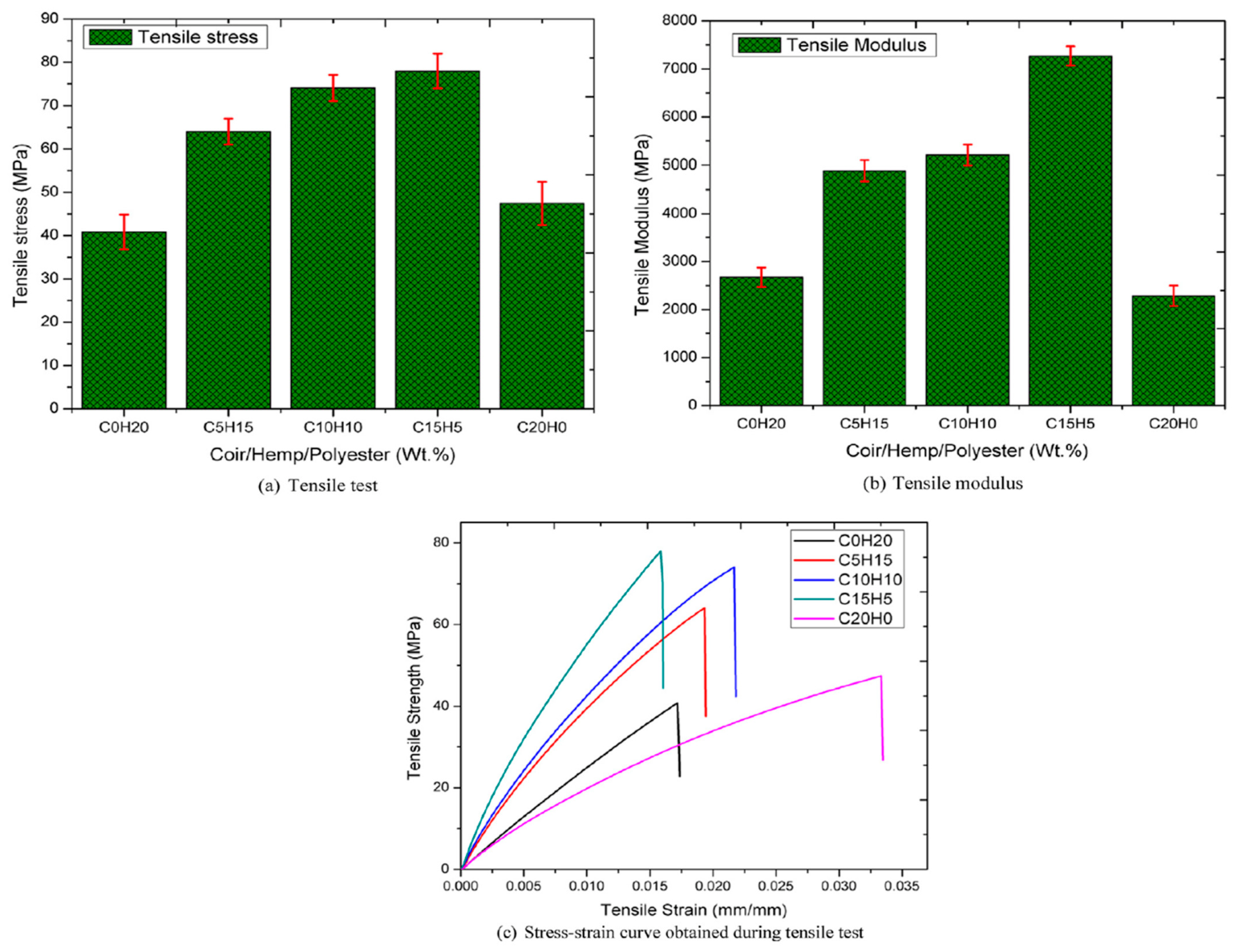
Hybrid composites exhibit superior tensile properties compared to single-fibre composites, as shown by Kumar et al. [22]. Specifically, increasing the coir fibre fraction while decreasing the hemp fibre fraction resulted in improved mechanical properties, as presented in Figure 3. For example, in the C5H15 composition, tensile strength rose from 40.83 MPa to 64 MPa, and tensile modulus increased from 2674.44 MPa to 4885.40 MPa compared to C0H20. Similarly, C10H10 achieved a tensile strength of 74 MPa and a modulus of 5207.75 MPa, whereas C15H5 yielded maximum values, 77.97 MPa for tensile strength and 7269.67 MPa for modulus. The superior bonding is attributed to the lower cellulose content of coir fibre, which absorbs less moisture and allows a stronger bond with the hemp and polyester matrix. Compared to non-hybrid composites (C0H20 and C20H0), hybrid composites showed better tensile properties. This enhancement in performance is primarily due to even load distribution resulting from good fibre–matrix bonding.
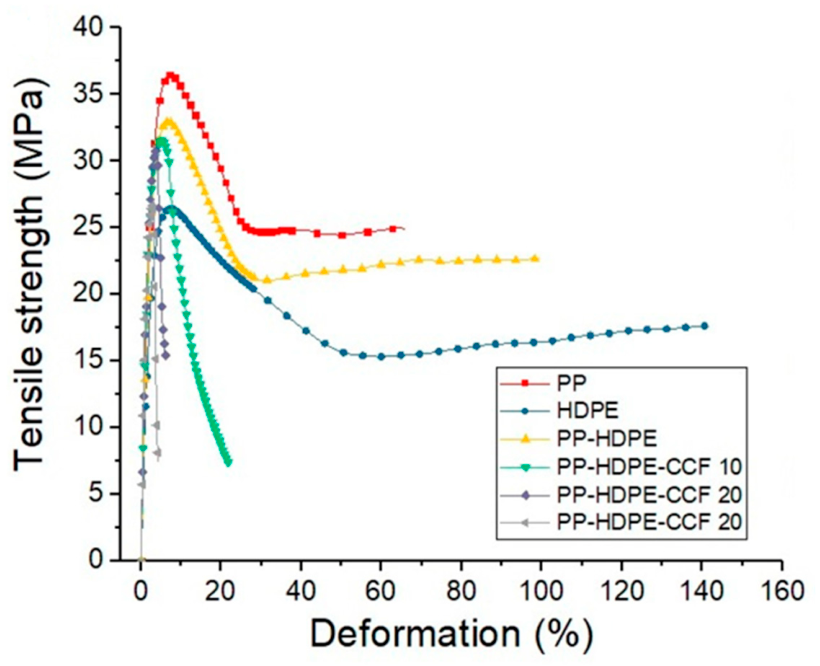
Hidalgo-Salazar et al. [21] evaluated the properties of PP-HDPE biocomposites modified with coir coconut fibres (CCF) up to 30% (w/w) using a melt blending process as depicted in Figure 4. Notably, the addition of CCF increased the tensile modulus by 78%. Before mechanical testing with an INSTRON 3366 Universal Testing Machine, specimens underwent conditioning at 23 °C and 50% relative humidity for seven days. Additionally, tensile testing involved V-type specimens at a test speed of 5 mm/min, in accordance with ASTM D638-14 standards [67].
Surface treatment methods substantially improve tensile properties. For example, Jayabal et al. [68] found that alkali treatment (5% NaOH) increased tensile strength by 40% in woven coir–polyester composites. Saxena et al. [69] investigated the effect of chemical treatment on coir fibre using single-fibre tensile tests. Treatment with 20 wt% NaOH resulted in a maximum load of 5.61 N, maximum stress of 8.16 N/mm2, maximum strain of 20.14%, and ultimate stress of 10.5 N/mm2. By comparison, a 20 wt% NaHCO3 treatment produced lower values: a maximum stress of 4.58 N/mm2 and a maximum strain of 15.15%. Untreated fibre showed a maximum stress of 5.87 N/mm2, maximum strain of 6.9%, and, notably, the highest maximum load at 12.875 N. These findings indicate that NaOH treatment increases both maximum stress and deformation ability, whereas NaHCO3 treatment reduces these properties compared to both untreated fibre and NaOH-treated fibre. Treating cellulosic fibres with 5% NaOH enhanced the wettability and interfacial adhesion between the fibres and the matrix, resulting in improved mechanical properties [70].
Matrix materials show varying compatibility with coconut fibre, as reported by Singh et al. [71]. Epoxy-based systems generally offer higher tensile strength than polyester matrices. Treated coir fibre/carbon fibre/epoxy hybrids also provide greater tensile strength than untreated ones. Tensile strength peaks at 10 percent fibre content, then declines as loading increases, reflecting the strong tensile performance of woven carbon fibre. SEM analysis of tensile fracture confirms improved interfacial bonding in coir carbon fibre/epoxy hybrids. Meanwhile, research conducted by Hidalgo-Salazar et al. [21] showed that polyolefin blends (PP-HDPE) with coir fibres exhibit significant stiffening effects due to reduced polymeric chain mobility. The reinforcement of coir fibre in epoxy polymer showed better performance than the neat polymer in most of the considered properties. The incorporation of titanium carbide (TiC) nanoparticles into coir fibre/epoxy composites resulted in a 4.99% improvement in tensile strength [72].

3.2. Flexural Properties

Flexural properties indicate a material’s resistance to bending, which simultaneously tests the tensile stress on the outer surface and the compressive stress on the inner surface. The primary failure mechanisms in fibre composites are often delamination (separation of layers) or fibre fracture on the tensile side. Therefore, the interfacial bond strength, which resists shear forces, and the tensile strength of the fibres themselves are the most critical factors.
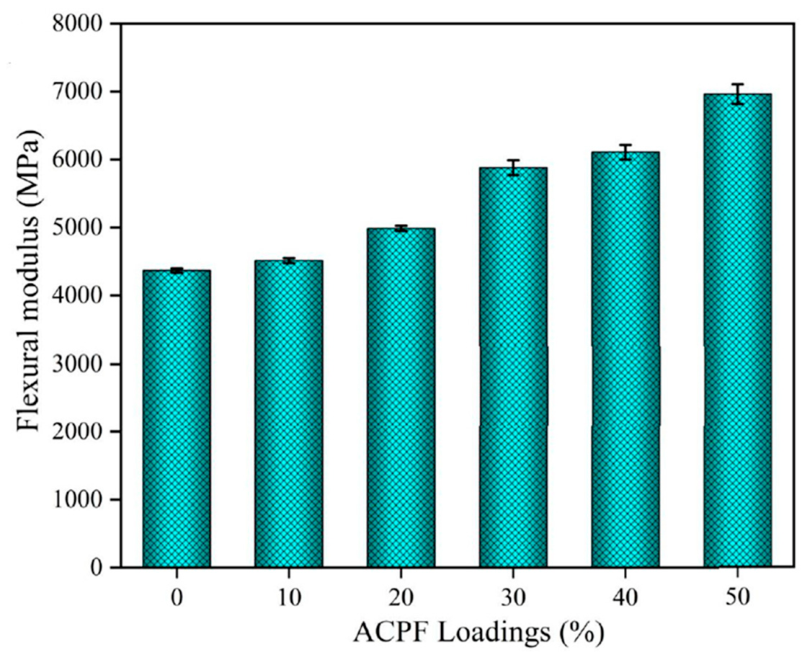
Prolonged exposure to marine conditions can reduce flexural resistance and increase the likelihood of structural failures. These risks are particularly pronounced in components subjected to substantial flexural loads, such as ship decks, hulls, and risers [73]. Recent research has shown that incorporating natural fibres into composites can significantly enhance their flexural properties. For example, Bhagat et al. [74] reported that composites with 10% coir fibre and a fibre length of 15 mm achieved a maximum flexural strength of 63 MPa. Fu et al. [29] observed that composites composed of alkali-treated coconut petiole fibres (ACPFs) and polylactic acid (PLA) exhibited a flexural modulus of 6959.70 MPa, representing a 50% increase compared to pure PLA, as illustrated in Figure 5. The flexural strength of coir fibre/epoxy composites increased from 115.05 to 124 MPa following the addition of titanium carbide (TiC) nanoparticles. In a related study, Hidalgo-Salazar et al. [21] evaluated a polyolefin blend matrix (PP-HDPE) reinforced with raw coir coconut fibres (CCFs). PP-HDPE-CCF biocomposites produced by melt blending with fibre loadings of up to 30% by weight exhibited flexural moduli that were up to 99% higher than those of the unmodified PP-HDPE blend. Surface treatments also significantly enhance flexural properties, as research conducted by Jayabal et al. [68] showed that NaOH treatment increases flexural strength by 42% in woven coir composites.

3.3. Impact Strength and Toughness

Impact resistance is crucial in marine applications because structural components frequently encounter dynamic loads, including wave impacts and collisions. The naturally high elongation of coir fibre could potentially contribute to the material’s toughness. Studies measuring this property show that coconut petiole fibre-reinforced PLA composites show an impact strength of 8.2 kJ/m2 at 50% fibre loading by weight, a 150% improvement over unmodified PLA [29]. Coir/glass hybrid composites exhibit an impact strength of 49.9 kJ/m2, which is over six times higher than that of the PLA composite [74]. Alkali (NaOH) treatment increases the impact strength of woven coir–polyester composites by 20% compared to untreated composites [68]. Incorporating jute and coconut coir fibers into epoxy polymer composites with rice husk ash (RHA) as a particulate filler significantly affects their mechanical performance. Optimizing the composite mix with 3% RHA in jute fiber composites achieved maximum values of 2.85 GPa for tensile modulus and 50.07 MPa for ultimate tensile strength. Conversely, the mechanical properties of coir composites declined as the filler percentage increased, highlighting the critical role of fiber-matrix compatibility [75].
Izod impact testing demonstrated that coir fibre, carbon fibre, and epoxy hybrid composites absorbed greater energy prior to fracture compared to other configurations. Composites incorporating treated fibres exhibited higher energy absorption than those with untreated fibres. Increasing fibre content enhanced the toughness of the composites. The primary mechanisms of energy dissipation included fibre pull-out, which was the most significant, as well as fracture and debonding. Alkali treatment resulted in further improvements in impact strength as can be seen in Table 2 [71].

3.4. Hardness and Wear Resistance

Hardness refers to the resistance to localized deformation, such as scratching or indentation [76]. This property is crucial for surfaces exposed to contact, debris impact, or abrasive forces. These conditions are common in marine environments. Bhagat et al. [74] examined the hardness and wear resistance of composite materials. They used coir and synthetic fibres (such as glass) as reinforcement in an epoxy matrix. Samples were prepared with various fibre volume fractions (10%, 20%, 30%, and 40%). There were also various ratios of coir to glass fibre (e.g., 100:0, 75:25, 50:50, 25:75, 0:100). Hardness testing was performed using the Rockwell Hardness Scale (HRL). Wear resistance testing was done using a Pin-on-Disc tool under dry sliding conditions. The test used a load of 20 N, a speed of 200 rpm, a duration of 5 min, and a track radius of 50 mm. Results showed that the hardness value increased significantly with the overall fibre volume fraction. Composites with 40% fibre showed the highest hardness value. Glass fibre contributed significantly to the increase in hardness. Composites with 100% glass fibre (0% coir) had the highest hardness value.
In contrast, composites with 100% coir fibre had the lowest hardness values. In hybrid composites (a mixture of coir and glass), hardness increased with the addition of more glass fibre. For example, a composition of 25% coir and 75% glass is harder than one with 50% coir and 50% glass, because glass fibre is harder and stiffer, and it bonds strongly with the epoxy matrix. These properties resist the penetrator during hardness testing. For wear resistance, glass fibre is very effective in increasing wear resistance. Composites with 100% glass fibre have the best wear resistance. Composites with 100% coir fibre have the worst wear resistance (the highest mass loss). In hybrid composites, wear resistance increases with an increase in glass fibre content. Pramod et al. [77] developed a new polymer composite by blending High-Density Polyethylene (HDPE) and Polycarbonate (PC) as the matrix, reinforced with coconut fibre and functionalized Multi-Walled Carbon Nanotubes (f-MWCNT). The composite, with a 70% HDPE and 19% PC matrix, and 10% coconut fibre plus 1% f-MWCNT reinforcement, showed 21.1% higher strength and 4.5% higher modulus compared to other composites. It also demonstrated good shear wear resistance and a low friction coefficient (0.14).

3.5. Summary: Structure–Property Relationships

A quantitative summary of the mechanical properties of coir/plastic composites from various studies is presented in Table 3. A study by Bhagat et al. [74] investigated the effect of critical processing parameters on the mechanical properties of hybrid composites reinforced with coir and glass fibre in an epoxy matrix. Specifically, the researchers analyzed fibre loading at 5% and 10% by weight, and fibre length at 5 mm, 10 mm, 15 mm, and 20 mm. The composites were fabricated using the hand lay-up technique, with a constant glass fibre loading of 20% by weight. After fabrication, mechanical tests—including tensile, flexural, and hardness measurements—were conducted. Notably, the interaction of loading and fibre length had a significant impact on mechanical performance. For example, composites with a 10% coconut fibre loading and a fibre length of 15 mm exhibited the highest tensile and flexural strengths, suggesting that these conditions enable the most effective stress transfer from the matrix to the fibres. In contrast, the composite with 10% fibre loading and 20 mm fibre length had the highest hardness, indicating that longer fibres increase resistance to indentation. Overall, the study concluded that optimizing loading and fibre length is key to maximizing mechanical performance. These findings clearly demonstrate that composite properties depend not only on the materials used but also on their processing and configuration.
In a related study, Singh et al. [71] investigated the effect of processing parameters on the mechanical, thermal, and morphological properties of hybrid composites reinforced with coconut coir and carbon fibre in an epoxy matrix. The critical processing parameter of primary focus in this study was the surface modification of coconut coir fibre through alkali (NaOH) treatment. Furthermore, variations in fibre weight percentage (10%, 20%, and 30%) were also analyzed. For fabrication, this study employed a vacuum bagging technique to minimize porosity and ensure optimal resin impregnation. The key findings of this study underscore the critical role of fibre surface treatment. Morphological analysis using Scanning Electron Microscopy (SEM) confirmed that alkali treatment significantly improved the interfacial bond between the coconut coir fibre and the epoxy matrix. This stronger bond proved effective in facilitating better load transfer. As a result, composites made with treated fibres demonstrated significant improvements in various mechanical properties, including tensile, compressive, flexural, and impact strengths, compared to untreated composites. Furthermore, the thermal stability of the material was also noted to have improved. Therefore, it can be concluded that fibre surface modification is a dominant and crucial processing parameter for engineering natural fibre-based hybrid composites with superior mechanical and thermal performance, especially for technical applications such as helmet shells and sports equipment.
Jayabal et al. [68] studied the mechanical properties and machining behaviour of coir-reinforced polyester composites. They focused on reinforcement architecture, using coir fibres as woven fabric. The composite was made by hand lay-up and compression moulding. The woven structure provided bidirectional reinforcement, enhancing tensile, flexural, and impact strengths compared to random fibre reinforcement. The interlocking woven structure also reduces drilling damage, such as delamination, which is common in layered composites. These findings show that fibre architecture is a key processing parameter. It influences both mechanical performance and behaviour during secondary manufacturing. Fibre arrangement is as critical as material composition.
A study by Mohit et al. [72] investigated the effect of adding titanium carbide (TiC) nanoparticles to coir–epoxy hybrid composites by varying the TiC concentration (1, 2, and 3 wt%) and dispersing the nanoparticles into an epoxy matrix using a hand lay-up method. The addition significantly improved the mechanical properties, with optimal performance at 2 wt% due to the nanoparticles’ ability to fill voids, strengthen the fibre–matrix bond, and enhance stress transfer. However, at 3 wt%, performance decreased due to particle agglomeration, which caused weak points. These results demonstrate that precise control of nanoparticle concentration is an effective means of enhancing the mechanical performance of natural fibre-based composites.

4. Environmental Resistance in Maritime Conditions

4.1. Water and Seawater Absorption Kinetics

Sanjeevi et al. [78] investigated the hygroscopic behaviour of hybrid natural fibre/phenol formaldehyde composites, identifying the primary mechanism of water uptake as following Fickian diffusion kinetics. Their analysis confirmed that moisture absorption initially increased linearly with the square root of time, characteristic of a diffusion-controlled process. However, the study also acknowledged the contributory role of capillary action, where water wicks into microcracks, voids, and along the poorly bonded fibre–matrix interfaces, accelerating the initial stage of water ingress and compromising the composite’s integrity from within.
The absorption of water had a direct and detrimental impact on the dimensional stability of the composites. The researchers established a strong correlation between the percentage of moisture uptake and volumetric swelling. This hygroscopic expansion induces internal stresses, which can lead to further microcracking and a permanent loss of dimensional accuracy, posing a significant challenge for applications that require precise tolerances.
Furthermore, the study quantified the severe degradation of mechanical properties resulting from water plasticization and hydrolysis. Tensile and flexural strength exhibited significant reductions due to the weakening of the cellulose fibres, the plasticization of the polymer matrix, and the loss of interfacial adhesion critical for stress transfer. The impact strength displayed a more complex non-monotonic trend, with an initial slight increase attributed to matrix plasticization followed by a decline after prolonged exposure. The work concludes that water absorption remains a critical drawback for natural fibre composites, emphasizing the need for improved interfacial bonding and moisture-resistant treatments.
Water and seawater absorption significantly influence the durability of natural fibre composites such as coconut fibre (coir) in maritime environments. Two primary mechanisms govern water absorption, which are capillary flow and molecular diffusion. In the initial stage, water penetrates the composite through pores, voids, microcracks in the polymer matrix, and lumen channels within the fibres. The quality of the fibre–matrix interface determines the effectiveness of this capillary. Weak interfacial bonds facilitate the more rapid ingress of water. Subsequently, molecular diffusion becomes the dominant process, with water molecules migrating through the polar polymer matrix. The rate of diffusion is governed by the chemical affinity between water and the matrix [79,80].
Water absorption has a significant impact on the dimensional stability and mechanical properties of composites. Swelling of fibres due to water uptake alters the composite’s dimensions, leading to microcracks and weakened structural integrity. Mulana et al. [30] showed that adding fly ash and coconut fibres changes water absorption and thickness swelling, finding a positive correlation between absorbed water and swelling. Ferraz et al. [81] found that fibre treatment and cement/fibre ratio influence water absorption and dimensional stability in cement-based composite boards.
Water absorption also affects mechanical properties. When water is absorbed, it acts as a plasticizer in the polymer matrix, weakening the bonds between molecules and at the fibre–matrix interface. This process leads to lower stiffness, tensile strength, and flexural strength. Renreng et al. [25] studied coir/epoxy composites treated with NaOH and microwaves to reduce the adverse effects of water. Kumar et al. [82] examined coir biocomposites with a soy-based adhesive, noting that water absorption can weaken the bio-based adhesive.
While both seawater and pure water can interact with polymeric materials, their mechanisms and effects differ substantially due to the complex ionic composition of seawater. Seawater plasticization involves more complex interactions due to the presence of dissolved salts (approximately 3.5% by weight, predominantly NaCl, with MgSO4, CaCl2, and other ions) [83]. The salt content creates an osmotic pressure gradient that typically reduces the equilibrium water content compared to immersion in pure water. Studies on epoxy composites have shown 20–30% lower water absorption in seawater compared to distilled water [84,85,86]. Cations (Na+, Mg2+, Ca2+) can interact with polar groups in polymer chains or at polymer–additive interfaces, potentially altering the degradation kinetics of the polymer. For semi-crystalline polymers like PP and PE, these interactions primarily occur in the amorphous regions.
Additionally, seawater constituents diffuse at different rates, with water molecules penetrating faster than hydrated ions due to size exclusion effects. This phenomenon creates concentration gradients that differ from pure water systems. Lastly, seawater’s alkaline pH (approximately 8.1) can catalyze specific hydrolytic degradation reactions differently than neutral pure water, particularly in polymers containing ester or amide linkages.

4.2. Degradation of Mechanical Properties After Ageing

Wet–dry cycles are even more destructive than continuous immersion for maritime applications, as they accurately simulate the tidal zone and wave action. Each cycle subjects the composite to repeated mechanical stress due to the swelling and shrinkage of the natural fibres. This cyclic dimensional change, as noted in reviews such as Islam et al. [87], acts like a pump, drawing in fresh water and salt during the “wet” phase and concentrating stresses during the “dry” phase. This process fatigues the matrix and propagates microcracks at the interface. Furthermore, in a seawater environment, these cycles can lead to the crystallization of salt within microcracks and pores upon drying. The crystallization pressure exerts immense internal forces that further widen cracks, accelerating fibre debonding and matrix fracture. The resulting degradation in mechanical properties is therefore not linear but accelerated and cumulative over cycles, leading to a more rapid and severe decline in tensile and flexural performance than would occur with immersion alone.
For sustainable maritime composites made from coconut fibre and plastic waste, these materials will suffer significant embrittlement and loss of structural integrity over time without modification. Several modifications that could be employed include chemical treatments (e.g., alkalization, silane, or acetylation of coconut fibres) to reduce their hydrophilicity and improve interfacial bonding with the plastic matrix. Additionally, ensuring a high-quality, hydrophobic matrix from the plastic waste stream and optimizing manufacturing to minimize voids are essential to creating a barrier against water ingress, thereby mitigating the devastating effects of these harsh but realistic environmental cycles.
Exposure to simulated maritime environments, including wet–dry cycles and prolonged immersion, substantially diminishes the mechanical properties of coir fibre composites. The primary degradation mechanisms are polymer matrix hydrolysis, deterioration of fibre–matrix interface bonds, and a decrease in fibre strength. Polymer matrix hydrolysis involves water-induced cleavage of chemical bonds, resulting in plasticisation and reduced mechanical strength. Interface deterioration occurs due to water accumulation at the interface, which weakens the adhesive bonds. Additionally, hydrolysis of cellulose fibres further reduces their intrinsic strength.
The wet–dry cycle is highly destructive because it creates repeated internal stresses from the swelling and shrinkage of the fibres. Bui et al. [88] investigated the effects of the wet–dry cycle on coconut fibre-reinforced mortar and found that it caused microcracks at the interface and in the mortar, leading to a greater decrease in mechanical strength than continuous immersion. Faria et al. [31] examined the resistance of coconut fibre-reinforced plant polyurethane composites to ageing and found that surface treatment of the fibres, such as alkali, improved mechanical property retention by increasing adhesive bonds and reducing water absorption. Long-term immersion tests revealed the kinetics of water absorption and the impact of saturation on material properties. Zhang et al. [89] evaluated the performance of coir fibres in lightweight concrete continuously exposed to water and found that the compressive strength decreased due to weakened bonds between the cement paste and coir fibres. Schiavon et al. [90] observed changes in the microstructure and mechanical properties of mortar with chemically treated coir fibres after long-term immersion and reported that chemical treatment was effective in reducing water absorption and improving strength retention.
Tensile and flexural strength are the properties most susceptible to degradation. Satish et al. [91] investigated natural fibre-reinforced epoxy composites, including coir. He found a significant decrease in tensile and flexural strength after ageing, which was attributed to a decline in interface integrity and fibre properties. Singh et al. [71] reported that surface modification of fibres is crucial for maintaining tensile strength after exposure to challenging environments.

4.3. Resistance to UV Radiation and Thermal Cycling

UV radiation (wavelength of 290–400 nm in terrestrial environments) initiates photochemical reactions in polymers through two primary mechanisms, namely, direct photolysis and photo-oxidation. PP is particularly susceptible to UV degradation due to its tertiary carbon atoms, which create weak points in the polymer backbone. In contrast, PE, lacking tertiary carbons, is inherently more UV-resistant than PP, but still undergoes significant photodegradation [92]. Recycled PP exhibits accelerated UV degradation compared to virgin material due to the pre-existing carbonyl groups from thermal oxidation during reprocessing. The increased surface area from microcracks and the presence of pro-degradant contaminants (transition metal ions from pigments or fillers) could also contribute to the acceleration of UV degradation. Studies have shown that recycled PP can experience a 40–60% reduction in tensile strength after UV exposure equivalent to 6–12 months of outdoor weathering, compared to 20–30% for virgin PP with adequate stabilization [48,93,94,95]. Similar to recycled PP, recycled PE is also prone to the formation of carbonyl (C=O) and vinyl (C=C) groups. There is also a risk of surface cracking and chalking due to preferential surface degradation. Recycled HDPE used in outdoor applications (such as bottles and containers) exhibits particular vulnerability at stress concentration points, where mechanical loading combines with UV degradation [33].
Based on the research by Vargas-Isaza et al. [96] on stabilizing TPU/PP blends against UV degradation, key strategies emerge to enhance coconut fibre and plastic waste composites for maritime use. Their work demonstrates that incorporating UV stabilizers (e.g., HALS) and antioxidants directly into the polymer matrix significantly reduces photo-oxidation, preventing surface cracking and embrittlement caused by prolonged sun exposure. For maritime applications, where UV radiation and thermal cycling from daily temperature fluctuations are prevalent, this approach is crucial for maintaining the structural integrity of recycled plastic matrices. Furthermore, ensuring strong interfacial adhesion between the stabilized plastic and coconut fibres—through compatibilizers or fibre treatments—is critical to prevent debonding exacerbated by thermal expansion stresses. Integrating these stabilization methods from the polymer blend study directly addresses the synergistic degradation from UV, heat, and moisture, thereby significantly extending the durability and service life of sustainable composites in harsh marine environments.
Ultraviolet (UV) radiation and thermal cycling are the main degradation factors for coir fibre composites in marine environments. High-energy UV radiation can break chemical bonds in polymer chains (photo-oxidation) and in lignocellulosic fibres. In polymer matrices, photo-oxidation causes a decrease in molecular weight, cracking, discolouration, and a reduction in mechanical properties. In coir fibres, the lignin component is susceptible to UV and undergoes photodegradation, causing the fibres to become brittle and lose strength. Thermal cycles exacerbate the situation by causing internal stress due to different expansion and contraction between the fibres and the matrix.
Several effective methods for improving the UV resistance of coir composites have been identified. The addition of UV stabilizers (such as HALS) and antioxidants can absorb or scatter UV radiation energy. Nanoparticles, such as Titanium Carbide (TiC), can act as a physical barrier. Mohit et al. [72] investigated the role of TiC nanoparticles in coir and basalt fibre-reinforced hybrid epoxy composites and found that the incorporation of TiC improved resistance to accelerated weathering. Surface treatment of fibres (such as alkali or silane) can also provide additional protection by reducing water absorption and improving interfacial bonding.
Siakeng et al. [97] investigated the effects of accelerated weathering on PLA composites reinforced with coir and pineapple fibres. They reported that exposure to UV and moisture caused discolouration and a decrease in surface integrity. Staffa et al. [98] investigated degradation in Polypropylene/coir composites and found that the addition of a compatibilizer and UV stabilization system significantly maintained mechanical properties and reduced surface degradation after artificial weathering.

4.4. Biological Resistance: Biofouling and Microbial Degradation

Based on the comprehensive review by Lewicka et al. [99] on polymers in agriculture, which highlights the susceptibility of natural materials to biological attack, critical insights can be applied to the vulnerability of coconut fibre and plastic waste composites to biofouling and microbial degradation in maritime environments. Coconut fibre (coir), while possessing a degree of natural resistance to rot and seawater due to its high lignin content, is not immune to colonization by marine borers, fungi, and bacteria that can digest cellulose and hemicellulose, leading to a loss of mechanical strength and structural integrity. The plastic waste matrix, depending on its type, can also be susceptible to microbial attack or, conversely, provide a surface for biofouling organisms to adhere to, increasing drag and weight. To mitigate this, the review underscores the effectiveness of integrating biocidal treatments and modifications, such as incorporating copper-based additives, silver nanoparticles, or chemically grafting antimicrobial agents onto the polymer chains, which can provide long-lasting protection against biological agents without significantly compromising the composite’s eco-friendly profile, thereby enhancing its durability for sustainable maritime applications.
Coconut husk fibre exhibits natural resistance to microbial attack due to its high lignin content (40–45%), which is difficult for most microorganisms to degrade. Pettit et al. [100] reported that lignin-rich substrates, such as coconut husk, exhibit slower degradation rates in green wall applications. Teixeira et al. [101] also noted that the durability of coconut husk in cement-based materials is influenced by its natural resistance to microbial decay.
However, coconut husk is susceptible to biological degradation under favourable conditions. Rajesh & Sumathi [102] reported that unprocessed natural fibres can be degraded by aerobic bacteria in soil and water-rich conditions. Arsyad et al. [103] used white rot fungi to modify the surface of coconut husk fibres, showing that unprocessed coconut husks can be decomposed by fungal activity. Suresh et al. [104] showed that young coconut husk fibres can be delignified using Pleurotus pulmonarius, confirming their susceptibility to microbial degradation.
To enhance biological resistance, several treatments have been explored. Alkaline treatment (NaOH) can remove sugars and soluble impurities that attract microbes. Ramu et al. [105] reported that coconut husk fibres treated with alkali showed increased resistance to environmental degradation. Lakshmaiya et al. [106] developed an environmentally friendly nanocomposite with NaOH-treated natural fibres that exhibited antibacterial properties. Biological treatment with specific fungi and integration into a polymer matrix can also protect fibres from microbial attack.

4.5. Synergistic Environmental Effects

Synergistic effects occur when the combined damage from two or more environmental factors is greater than the sum of the damage from each factor individually. In the context of coir fibre composites in a maritime environment, the synergistic effect of water/seawater absorption, UV radiation, and mechanical loading precipitates an accelerated degradation cycle.
UV radiation has been shown to induce surface microcracks and to cause degradation of the polymer matrix and fibre surface, thus facilitating water absorption. The absorption of water by the fibres results in swelling and matrix plasticisation, thereby weakening the interfacial bonds. Simultaneously applied mechanical loading provides energy to propagate microdamage and open cracks, allowing deeper penetration of water and UV. It has been demonstrated that the presence of salt ions in seawater can result in the crystallization of these ions within the cracks that occur during the drying cycle. This process has been shown to create additional internal stress.
The combination of moisture/temperature cycling with UV radiation creates synergistic degradation that exceeds the sum of individual effects. Water absorption swells the polymer matrix, increasing free volume and allowing deeper UV penetration. Studies on polyester composites have shown 35% deeper UV damage in wet conditions compared to dry conditions [107,108]. Elevated temperatures in hygrothermal cycling increase the rate constants of radical reactions. The Arrhenius relationship suggests that reaction rates double for every 10 °C increase in temperature. Thus, for polymers containing hydrolysable groups, moisture enables hydrolytic chain scission, which creates new chain ends that are more susceptible to UV oxidation. In recycled polymers, residual contaminants (e.g., polyesters, polycarbonates from mixed waste) undergo this coupled degradation. Furthermore, hygrothermal cycling can extract water-soluble additives and low-molecular-weight oxidation products, reducing UV protection. This condition is particularly significant in recycled polymers with heterogeneous distribution of additives.
Biofouling—the accumulation of microorganisms, algae, and marine invertebrates on submerged surfaces—interacts with UV degradation in complex ways. V-induced carbonyl and hydroxyl groups increase surface polarity and hydrophilicity, enhancing microbial adhesion. Contact angle measurements show decreases from 95–100° to 60–70° after 500 h of UV exposure for PE. Additionally, UV degradation creates surface cracks and pits (on a scale of 0.1–10 μm) that provide anchor points for biofilm formation. Atomic force microscopy (AFM) studies reveal 5–10 fold increases in surface roughness (Ra) after UV weathering [109,110]. Hence, UV degradation produces oligomers and oxidized fragments that can serve as nutrient sources for pioneering microorganisms. Once formed, biofilms (typical thickness 10–100 μm) absorb and scatter UV radiation, potentially reducing polymer degradation rates in fouled regions. Biofilms also maintain high local humidity (>90% RH), which enhances hygrothermal effects and potentially accelerates hydrolysis reactions beneath the fouling layer. In addition, microbial communities produce enzymes (such as esterases and peroxidases) and metabolites (including organic acids and reactive oxygen species) that can accelerate polymer degradation through biochemical pathways. They also create pH microenvironments (ranging from 4 to 10) that can catalyze hydrolysis or oxidation reactions differently than bulk seawater.
A study by Staffa et al. [98] demonstrated that compatibilizers and UV stabilizers have the capacity to mitigate initial damage to coir–Polypropylene composites, thereby influencing subsequent water resistance. In their 2021 study, Ganesan et al. [111] explored the deterioration of interface integrity in jute/coir composites, with a particular focus on the impact of environmental factors that can exacerbate this degradation process. In the case of composites bonded to mild steel, this synergistic effect has been shown to cause severe damage to the adhesive bond [112]. This effect is due to steel corrosion and differential swelling between the coir fibres and the matrix. Consequently, durability testing should employ combined environmental ageing protocols to obtain an accurate assessment of performance. It is imperative to employ strategies such as the utilization of hybrid reinforcement, compatibilizers, and coating protectors to mitigate these synergistic effects.

5. Prospects and Challenges for Maritime Application

5.1. Prospective for Maritime Application

Conventional materials exhibit well-characterized performance benchmarks. Marine-grade steel offers exceptional tensile strength (400–500 MPa) and impact resistance, albeit at a prohibitive density (~7.8 g/cm3) that elevates vessel mass and fuel consumption [10]. FRPs, notably glass/polyester systems, offer superior strength-to-weight ratios and corrosion resistance, but they depend entirely on petrochemical feedstocks and present formidable end-of-life recycling challenges [11,12]. Marine plywood, though derived from renewable resources, contributes to deforestation and necessitates recurrent toxic chemical treatments (e.g., creosote, copper chromium arsenic) to mitigate biofouling and microbial degradation [9].
Natural fibre-reinforced biocomposites exhibit outstanding environmental performance, exceptional physical and mechanical capabilities, and biological features, with their lightweight and high-strength characteristics enabling significant decreases in structural weight across multiple industries [113]. These biocomposites are increasingly utilized in various maritime applications, including boat hulls, decks, surfboards, buoys, sorbents, risers, and other maritime components, offering advantages such as reduced carbon footprints, diminished reliance on non-renewable resources, and increased natural biodegradability [114].
As described in Section 3, coir/recycled plastic composites demonstrate a distinct mechanical profile. The lower density (1.0–1.4 g/cm3) means that coir and recycled plastic composites can contribute to reducing the total weight of ships, which is highly relevant for fuel efficiency and operational performance [115]. Tensile strengths typically range from 20 to 80 MPa, while flexural moduli can be enhanced by up to 99% through optimal fibre loading and interfacial treatments [21,71]. Their principal advantages reside in their reduced density, inherent corrosion resistance, and notable energy absorption capacity via fibre pull-out mechanisms [23,74]. Nevertheless, these properties are contingent upon processing parameters, fibre–matrix adhesion quality, and environmental exposure.
A preliminary gap analysis between the reported properties and the requirements yields promising results for the non-critical application. Based on ISO 12215-5:2019 [116], the required tensile strength for marine hull impact resistance is 10–40 GPa, which exceeds the reported value of the coir/plastic composites. On the other hand, the tensile strength requirement for the interior panels is 30–60 MPa, which falls within the range of the reported value for coir/plastic composite. This finding is in accordance with other reports that these composites are unsuitable for primary hull structures in large vessels but emerge as compelling alternatives for non-critical applications—such as interior panelling, furniture, decking, and small craft hulls (<10 GT)—where specific stiffness and toughness requirements are met [9,117]. In addition, the relatively low modulus and higher elongation provide advantages in applications that require mild deformation or impact tolerance, for example, in cabin interiors that may be subject to light impacts or ship vibrations [118].
Utilizing coir/recycled plastic in a hybrid system of coir–synthetic fibre can also increase the potential utilization of coir/recycled plastic in the marine environment. Hybrid composite systems combine natural fibres with synthetic fibres such as glass or carbon [119]. These synergistic material systems facilitate the strengths of each fibre type to compensate for the weaknesses of the other, potentially offering a viable compromise for marine applications [120].
The mechanical performance of hybrid coir–synthetic fibre composites depends critically on the fibre ratio, arrangement, and quality of fibre–matrix interface. Tensile properties of hybrid composites generally follow a modified rule of mixtures, with the synthetic fibre component dominating the tensile behaviour. Studies on coir–glass fibre hybrid composites have reported tensile strengths ranging from 80 to 250 MPa, depending on the glass fibre content, compared to 200–400 MPa for pure glass fibre composites and 30–80 MPa for pure coir composites [121]. Optimal tensile performance typically occurs at hybrid ratios of 60–80% synthetic fibre content, where a sufficient volume of synthetic fibre ensures adequate load transfer. In contrast, natural fibres still provide meaningful cost and environmental benefits [122].
As previously described in Section 3, impact resistance represents one of the most promising attributes of hybrid composites, as natural fibres can significantly enhance energy absorption characteristics. The cellular structure of coir fibres, combined with their high elongation capacity and lower modulus compared to synthetic fibres, allows for progressive energy dissipation during impact events [42]. The glass–coir composites can achieve 40–70% improvement in impact energy absorption compared to pure glass fibre composites at equivalent weight, making them attractive for applications requiring damage tolerance [121]. The hybrid effect in impact properties often shows positive deviations from the rule of mixtures, where the failure of brittle synthetic fibres transfers load to the more ductile natural fibres, preventing catastrophic failure propagation [123].
Life cycle assessment (LCA) studies comparing natural fibre, synthetic fibre, and hybrid composites have shown that hybrid systems can achieve 20–40% reductions in embodied energy and 25–50% reductions in carbon footprint compared to all-synthetic composites, depending on the natural fibre content and assumptions about transportation distances and processing methods [124,125]. Coir fibre production generates approximately 0.5 kg CO2 equivalent per kilogram of fibre, compared to 1.8–2.5 kg CO2 equivalent for glass fibre production, representing a significant environmental advantage [125]. However, these analyses often do not fully account for shorter service life and higher maintenance requirements, which can reduce or eliminate environmental benefits when considered over the whole life cycle. A holistic LCA must transparently incorporate energy inputs for collection, sorting, fibre treatment, and composite fabrication to authenticate their environmental credentials [126,127].

5.2. Challenges in Maritime Application

Laboratory studies have confirmed that coconut fibre composites made from recycled plastics show promising mechanical properties and sustainability benefits. However, a significant gap remains between results obtained under controlled laboratory conditions and the demanding requirements of actual marine environments. The maritime environment is highly dynamic and corrosive, involving simultaneous exposure to ultraviolet (UV) radiation, salinity, constant humidity, wet–dry cycles, biofouling, and variable mechanical loads. Standard laboratory tests, which typically examine these factors individually, often fail to predict how materials will behave when all these stresses occur simultaneously [128].
The successful transition from laboratory prototypes to reliable and certifiable maritime components is hampered by a series of critical research gaps that must be addressed. The most pressing research gaps are the absence of standardized, long-term testing in a real-world marine environment, the lack of understanding of dynamic fatigue performance under realistic ocean wave loading, the need for the development of specific flame-retardant treatments to meet maritime safety regulations, and the challenge of scalability of fibre pretreatment processes and manufacturing methods to the industrial level. Addressing these four gaps will reveal what is still required for further study to make these sustainable composites viable for marine use.
An analysis of these four gaps will not only identify limitations in current knowledge but also reveal opportunities for future research. It is essential to recognize that these four research gaps do not exist as isolated issues; they are intricately interconnected in a complex web of cause and effect. Progress in one area directly depends on and influences progress in others. For example, long-term performance data obtained from in situ testing are critical because they capture synergistic degradation modes—such as the combined effects of UV degradation, saltwater intrusion, and microbial attack from biofouling—that are difficult to replicate in laboratory simulations accurately. This real-world degradation data, in turn, provides essential input for developing accurate fatigue life prediction models under stochastic wave loading.
The manufacturing scalability problem also significantly impacts material performance in several important ways. When production moves from small lab batches to the industrial scale, new defects can appear—such as voids forming and fibres distributing unevenly—that were not present in carefully prepared lab samples. These imperfections concentrate stress, which reduces fatigue life and accelerates how quickly the material degrades in seawater. Any manufacturing process that can be scaled up requires validation on two fronts: whether it produces material efficiently and whether the material can perform as intended.
Fire safety requirements add another layer of complexity that touches everything else. Adding flame retardants to the composite typically worsens its mechanical properties and reduces the material’s resistance to moisture, which can compromise its long-term durability and fatigue resistance. It means flame-retardant formulations need comprehensive evaluation—they must meet fire safety regulations, yes, but we also need to understand how they affect structural performance over time [129]. These flame retardants must also integrate into large-scale manufacturing without making production prohibitively expensive or complicated.
Given the interconnected nature of these issues, research needs to adopt an integrated approach, where solutions developed for one problem are tested against the requirements of all the others.

5.2.1. Lack of Standardized Long-Term (In Situ) Marine Trials

The current scientific literature assessing the durability of natural fibre composites (NFCs), including those made from coconut fibre varieties, relies primarily on laboratory-based methodologies. The predominant method is accelerated ageing tests, which expedite degradation processes. These procedures immerse composite samples in a 3–5% sodium chloride (NaCl) solution to replicate the salinity of seawater [130]. Other studies subject samples to more stringent conditions, such as water-filled autoclaves at elevated temperatures and pressures, to intensify water absorption and hydrolytic degradation [128]. Weathering chambers, which precisely control exposure to UV radiation, temperature, and humidity, are also routinely employed to evaluate atmospheric degradation.
Excessive reliance on laboratory simulation results is a substantial gap in understanding material degradation in marine environments. Laboratory methods fail to replicate the complex and synergistic interactions among multiple degradation mechanisms that occur in situ. In real marine settings, materials are subjected to a range of mutually reinforcing factors that contribute to damage. Standard laboratory tests often neglect or oversimplify critical elements, including biofouling, dynamic cycling, mechanical erosion, and chemical degradation. For instance, in ocean environments, submerged surfaces are quickly colonized by microorganisms, forming biofilms, which are subsequently followed by larger organisms such as barnacles and algae.
In contrast, biofouling is absent in sterile NaCl solutions [131]. The biological films that form in marine environments modify surface chemistry, retain moisture, and release acidic metabolic by-products, thereby accelerating the degradation of polymers and fibres. Additionally, marine components experience continuous cycling, such as wet–dry transitions, temperature changes, and fluctuating hydrostatic pressure, unlike static laboratory immersion. These cycles induce repeated internal stresses due to differences in thermal expansion and swelling between fibre and matrix, which accelerate fatigue and degradation at the fibre–matrix interface [132]. Mechanical erosion from wave action, ocean currents, and suspended particles leads to persistent abrasion, removing the protective polymer matrix and exposing fibres to corrosive conditions, which further accelerates degradation. Laboratory tests also fail to account for the combined effects of UV radiation and saltwater intrusion, which together cause more severe damage than either factor alone [128].

5.2.2. Understanding Dynamic Fatigue Performance Under Wave Loading

Research on the fatigue behaviour of natural fibre composites (NFCs) primarily employs standardized laboratory tests that involve cyclic loading at a constant amplitude. In these tests, samples are subjected to repeated cycles at fixed stress levels until failure. By varying the applied stress, researchers construct stress-life (S-N) or strain-life (S-N) curves that relate cyclic stress to the number of cycles to failure [133], thereby characterizing the fatigue life of NFC.
These studies are invaluable for characterizing fundamental fatigue damage mechanisms under ideal, controlled conditions. They provide insight into the microscopic processes leading to failure, such as crack initiation in the polymer matrix, debonding at the fibre–matrix interface, and, ultimately, fibre pull-out or fracture. Some more advanced studies have begun to incorporate environmental influences by conducting these tests under “wet” conditions (after water immersion) compared to standard “dry” conditions. This approach enables researchers to evaluate how moisture absorption affects a material’s fatigue resistance. However, even in these cases, the nature of the loading itself remains simplified as a constant-amplitude cycle [134].

5.2.3. Development of Specific Fire-Retardant Treatments for Maritime Safety Regulations

Fire safety is a critical issue in maritime environments due to the challenges associated with evacuation and limited access to firefighting resources. Consequently, all materials used onboard must comply with stringent fire-resistance standards, i.e., procedures of fire test [135], Bureau Veritas Class Rules NR 546 [136], and DNV-ST-C501 Composite components [134].
Research to enhance the fire resistance of natural fibre composites (NFCs) has focused on incorporating various flame-retardant (FR) additives. Metal hydroxides, such as Aluminum Trihydroxide (ATH) and Magnesium Hydroxide (MDH), operate via an endothermic mechanism. Upon heating, these compounds decompose and release water, which cools the material surface and dilutes nearby flammable gases, thereby suppressing combustion [129]. Phosphorus-based compounds represent another significant class of FR additives. Ammonium Polyphosphate (APP), for instance, acts as an effective intumescent agent by reacting with the polymer under heat to form a stable, foamy char layer. This char serves as an insulating barrier, shielding the substrate from heat and oxygen and limiting the emission of flammable gases [137]. Boron- and nitrogen-based compounds also contribute unique fire-retardant properties. Borax forms a glassy protective layer on fibre surfaces when heated, reducing heat and mass transfer. Nitrogen-based additives, such as urea, decompose to release non-flammable gases like ammonia and nitrogen, which dilute oxygen and reactive free radicals in the gas phase [138]. In addition to these chemical flame-retardants, the integration of nano-fillers has been investigated. Incorporating nano-fillers, such as montmorillonite (MMT) nanoclay or nanosilica (SiO2), enhances fire performance by promoting char formation, reinforcing the char structure, and creating complex pathways that impede the release of flammable decomposition products [137]. While this research has successfully demonstrated improved fire retardancy in a laboratory setting, a significant gap remains between what has been achieved and what is required for real maritime applications.

5.2.4. Scalability of Pretreatment and Manufacturing Processes to Industrial Levels

The transition from laboratory-scale production to industrial-scale manufacturing for natural fibre composites (NFCs) presents a series of critical challenges. These challenges can be divided into three primary areas: feedstock inconsistency, the economic viability of fibre treatment, and the adaptation of manufacturing methods.
Consistency of Recycled Plastic Feedstock
The first and perhaps most significant scalability challenge is the inconsistency of the recycled plastic feedstock. Unlike virgin polymers used in laboratories, industrial plastic waste streams are inherently heterogeneous. This feedstock can vary significantly in terms of molecular weight distribution, additive content (e.g., pigments, stabilizers), and the presence of different polymer grades, leading to inconsistent and often unpredictable composite properties [41]. Furthermore, contaminants such as labels, adhesives, food residues, and other polymers (e.g., polyvinyl chloride, or PVC) are common. These contaminants can act as weak points, inhibit fibre–matrix adhesion, and act as sites for stress concentration [48]. Moreover, recycled plastics have undergone multiple heat and shear cycles (during initial processing, service life, and recycling), leading to polymer chain scission [32]. As a result, there is a possible reduction in molecular weight and a decrease in ultimate mechanical properties, particularly impact strength, before they are ever incorporated into the composite [47]. Managing this variability at an industrial scale requires extensive sorting and cleaning processes, which add significant cost and complexity to the operation.
Economic Viability of Fibre Pretreatment
The second challenge is fibre variability and the economic viability of its treatment [139]. Natural fibres, such as coir, exhibit significant variations in properties, including diameter, length, and strength, depending on cultivation conditions and the extraction techniques used. To standardize the fibres and overcome the fundamental incompatibility between the hydrophilic (fibre) and hydrophobic (matrix) properties, chemical or physical treatments are necessary. While raw coir fibre may be low-cost, the multi-step processes required to turn it into an effective reinforcement—including cleaning, fibre separation (retting), chemical treatment (e.g., alkalization), and preform formation—add substantial labour, chemical, and energy costs [128]. The economic feasibility of applying these treatments consistently to thousands of tons of fibre becomes a critical barrier to commercial adoption.
Chemical treatments require the purchase of reagents, process control, and wastewater management. On the other hand, physical treatments, such as plasma (the application of ionized gas to modify fibre surfaces) or steam explosion (the use of high-pressure steam to break down fibres), demand significant energy input and capital investment [56,107]. These processes are essential for achieving consistent fibre quality and strong interfacial adhesion, both of which are necessary for reliable composite performance. However, they currently constitute a significant cost driver.
These upfront costs may be mitigated through strategic scaling and process integration. For instance, centralized pretreatment facilities can achieve economies of scale and reduce per-unit costs. Additionally, the use of recycled plastics, which are typically 20–50% less expensive than virgin polymers, can offset additional fibre preparation expenses [41,47]. Optimized manufacturing methods, such as continuous extrusion–compression moulding, can further increase production throughput and reduce energy consumption per unit, thereby enhancing overall cost-effectiveness [60,128]. In the future, conducting a comprehensive techno-economic analysis (TEA) is recommended to identify critical cost thresholds and optimize the balance among performance, durability, and production economics. Transparent evaluation of these scalability challenges and associated costs enables stakeholders to make informed decisions and develop business models that capitalize on the long-term economic and environmental benefits of these sustainable composites.
Adaptation of Manufacturing Methods
Finally, existing manufacturing methods are not directly translatable to the large-scale production of maritime components. Compression moulding, the dominant method in laboratory-scale studies, is ideal for creating flat test panels but is highly inefficient and cost-prohibitive for manufacturing large, complex-shaped components, such as deck panels or small boat hulls.
Industrial methods, such as extrusion and injection moulding, also face significant hurdles. Natural fibres have a low heat tolerance and begin to degrade at temperatures around 200–250 °C, which is below the processing temperature of many engineering polymers [128]. More importantly, the high shear forces and elevated temperatures inside an extruder barrel cause significant thermal and mechanical degradation of fibres. This process reduces the fibre length and aspect ratio, which drastically diminishes their reinforcing capability. It creates a scalability paradox, since the very processes designed for high volume can damage the reinforcing component, leading to a final product with lower mechanical performance than a carefully prepared laboratory prototype.
Overall, these results demonstrate that coconut fibre and recycled plastic composites have significant potential as lighter, more environmentally friendly alternatives for secondary applications in ship construction. However, for primary structural or high-load applications, these materials still require hybridization (e.g., glass–fibre outer layers) or highly controlled manufacturing processes to meet mechanical requirements and long-term durability in marine environments.

6. Conclusions and Future Perspectives

This review examines the current state of composites made from coconut fibre waste (coir) and recycled plastic, with particular emphasis on their potential use in maritime applications. The analysis demonstrates that these materials represent a viable Waste-to-Value approach, aligning with Circular Economy and Blue Economy principles by converting two significant waste streams—agricultural residues and plastic pollution—into functional products.
Coir/recycled plastic composites show adjustable mechanical properties, with reported tensile strengths ranging widely from ~2.4 MPa to ~78 MPa depending on the matrix and fibre configuration. Crucially, fibre loading and treatments are shown to enhance performance significantly, with studies noting up to a 99% increase in flexural modulus and a 40% increase in tensile strength with alkali treatment alone. Chemical treatments, particularly alkalization and silanization, have been demonstrated to enhance interfacial bonding between the hydrophobic coir fibres and the polymer matrix, thereby improving stress transfer and overall composite toughness.
However, the main limitation of these composites is their susceptibility to harsh marine conditions. Water and seawater absorption, which occurs through Fickian diffusion and capillary action, substantially degrades structural integrity by causing fibre swelling, matrix plasticization, and weakening of the fibre–matrix interface. Wet–dry cycles, UV exposure, and temperature fluctuations exacerbate these effects, working together to accelerate the loss of mechanical performance.
These composites appear suitable for non-structural and semi-structural uses, including interior panels, deck components, and small vessel hulls. Their mechanical properties cannot compete with virgin steel or fibre-reinforced plastics (FRP) for primary load-bearing structures. Nevertheless, their sustainability advantages, low raw material costs, and natural corrosion resistance make them attractive options when considering lifecycle and economic factors.
In summary, coir/recycled plastic composites have demonstrated feasibility at the laboratory scale. However, transitioning from laboratory findings to reliable, certifiable maritime components presents considerable challenges. Several critical research gaps need to be addressed to realize their full commercial potential. These include the absence of standardized, long-term testing in a real-world marine environment; the lack of understanding of dynamic fatigue performance under realistic ocean wave loading; the need for the development of specific flame-retardant treatments to meet maritime safety regulations; and the challenge of scalability of fibre pretreatment processes and manufacturing methods to the industrial level.

Author Contributions

Conceptualization, H.W. and M.H.A.; methodology, A.S.P.; formal analysis, H.W.; investigation, M.H.A. and N.A.P.; data curation, H.W.; writing—original draft preparation, H.W., A.S.P., N.A.P. and M.H.A.; writing—review and editing, H.W.; supervision, M.H.A.; project administration, A.S.P.; funding acquisition, H.W. All authors have read and agreed to the published version of the manuscript.

Funding

This research was funded by Direktorat Penelitian dan Pengabdian kepada Masyarakat, Direktorat Jenderal Riset dan Pengembangan Kementerian Pendidikan Tinggi, Sains, dan Teknologi: 067/C3/DT.05.00/PL-BATCHII/2025, dated 14 July 2025.

Institutional Review Board Statement

Not applicable.

Data Availability Statement

No new data were created or analyzed in this study. Data sharing is not applicable to this article.

Conflicts of Interest

The authors declare no conflicts of interest.

References

  1. Nayanathara Thathsarani Pilapitiya, P.G.C.; Ratnayake, A.S. The world of plastic waste: A review. Clean. Mater. 2024, 11, 100220. [Google Scholar] [CrossRef] [Scilit]
  2. Geyer, R. A Brief History of Plastics. 2020. Available online: https://api.semanticscholar.org/CorpusID:226750809 (accessed on 7 September 2025).
  3. Borrelle, S.B.; Ringma, J.; Law, K.L.; Monnahan, C.C.; Lebreton, L.; McGivern, A.; Murphy, E.; Jambeck, J.; Leonard, G.H.; Hilleary, M.A.; et al. Predicted growth in plastic waste exceeds efforts to mitigate plastic pollution. Sci. Am. Assoc. Adv. Sci. 2020, 369, 1515–1518. [Google Scholar] [CrossRef] [Scilit]
  4. Marcharla, E.; Vinayagam, S.; Gnanasekaran, L.; Soto-Moscoso, M.; Chen, W.-H.; Thanigaivel, S.; Ganesan, S. Microplastics in marine ecosystems: A comprehensive review of biological and ecological implications and its mitigation approach using nanotechnology for the sustainable environment. Environ. Res. 2024, 256, 119181. [Google Scholar] [CrossRef] [Scilit] [PubMed]
  5. FAO. FAOSTAT: Crops. Food and Agriculture Organization of the United Nations. [Internet]. 2022. Available online: http://www.fao.org/faostat/en/ (accessed on 7 September 2025).
  6. Direktorat Jenderal Perkebunan. Statistik Perkebunan Unggulan Nasional 2020–2022 [Internet]. 2021. Available online: https://ditjenbun.pertanian.go.id/template/uploads/2022/08/STATISTIK-UNGGULAN-2020-2022.pdf (accessed on 7 September 2025).
  7. Intergovernmental Panel on Climate Change (IPCC). Climate Change 2021—The Physical Science Basis: Working Group I Contribution to the Sixth Assessment Report of the Intergovernmental Panel on Climate Change [Internet]; Cambridge University Press: Cambridge, UK, 2023. [Google Scholar] [CrossRef] [Scilit]
  8. Vieira, F.; Santana, H.E.P.; Jesus, M.; Santos, J.; Pires, P.; Vaz-Velho, M.; Silva, D.P.; Ruzene, D.S. Coconut Waste: Discovering Sustainable Approaches to Advance a Circular Economy. Sustainability 2024, 16, 3066. [Google Scholar] [CrossRef] [Scilit]
  9. Verma, D.; Goh, K.L. 3-Natural fiber-reinforced polymer composites: Application in marine environments. In Biomass, Biopolymer-Based Materials, and Bioenergy [Internet]; Verma, D., Fortunati, E., Jain, S., Zhang, X., Eds.; Woodhead Publishing: Cambridge, UK, 2019; pp. 51–73. [Google Scholar] [CrossRef] [Scilit]
  10. Napper, I.E.; Thompson, R.C. Plastic Debris in the Marine Environment: History and Future Challenges. Glob. Chall. 2020, 4, 1900081. [Google Scholar] [CrossRef] [Scilit]
  11. Oliveux, G.; Dandy, L.O.; Leeke, G.A. Current status of recycling of fibre reinforced polymers: Review of technologies, reuse and resulting properties. Prog. Mater. Sci. 2015, 72, 61–99. [Google Scholar] [CrossRef] [Scilit]
  12. Ziemińska-Stolarska, A.; Sobulska, M.; Pietrzak, M.; Zbiciński, I. A Review of End-of-Life Scenarios for Fibre-Reinforced Polymer Materials. Energies 2024, 17, 3713. [Google Scholar] [CrossRef] [Scilit]
  13. Geng, H.; Cao, X.; Zu, L.; Pan, H.; Zhang, G.; Zhang, Q.; Fu, J.; Zhou, L.; Wu, Q.; Jia, X.; et al. The Effects of Laser-Assisted Winding Process Parameters on the Tensile Properties of Carbon Fiber/Polyphenylene Sulfide Composites. Materials 2024, 17, 4664. [Google Scholar] [CrossRef] [Scilit] [PubMed]
  14. Li, B.; Zhang, F.; Jiao, M.; Li, Y.; Wang, X.; Zhang, X. Carbon fiber/polyetherketoneketone composites. Part I: An ideal and uniform composition via solution-based processing. Polym. Compos. 2022, 43, 2803–2811. [Google Scholar] [CrossRef] [Scilit]
  15. Adeniyi, A.G.; Onifade, D.V.; Ighalo, J.O.; Adeoye, A.S. A review of coir fiber reinforced polymer composites. Compos. Part B Eng. 2019, 176, 107305. [Google Scholar] [CrossRef] [Scilit]
  16. Prasad, V.; Alliyankal Vijayakumar, A.; Jose, T.; George, S.C. A Comprehensive Review of Sustainability in Natural-Fiber-Reinforced Polymers. Sustainability 2024, 16, 1223. [Google Scholar] [CrossRef] [Scilit]
  17. Asim, M.; Jawaid, M.; Khan, A.; Asiri, A.M.; Malik, M.A. Effects of Date Palm fibres loading on mechanical, and thermal properties of Date Palm reinforced phenolic composites. J. Mater. Res. Technol. 2020, 9, 3614–3621. [Google Scholar] [CrossRef] [Scilit]
  18. Jenish, I.; Veeramalai Chinnasamy, S.G.; Basavarajappa, S.; Indran, S.; Divya, D.; Liu, Y.; Sanjay, M.R.; Siengchin, S. Tribo-Mechanical characterization of carbonized coconut shell micro particle reinforced with Cissus quadrangularis stem fiber/epoxy novel composite for structural application. J. Nat. Fibers 2022, 19, 2963–2979. [Google Scholar] [CrossRef] [Scilit]
  19. Siregar, J.P.; Cionita, T.; Hadi, A.E.; Setiyo, M.; Rejab, M.R.M.; Jaafar, J.; Fitriyana, D.F.; Dewi, R. Advancements in sustainable material development: A Comprehensive review of coir fiber and its composites. Mech. Eng. Soc. Ind. 2024, 4, 415–454. [Google Scholar] [CrossRef] [Scilit]
  20. Prabawa, F.; Adi, N.; Pranowo, W.; Sukoraharjo, S.; Gautama, B.; Suhelmi, I. Strategy on marine debris reduction in Indonesia: A review and recommendation. IOP Conf. Ser. Earth Environ. Sci. 2021, 925, 012027. [Google Scholar] [CrossRef] [Scilit]
  21. Hidalgo-Salazar, M.A.; Correa-Aguirre, J.P.; García-Navarro, S.; Roca-Blay, L. Injection Molding of Coir Coconut Fiber Reinforced Polyolefin Blends: Mechanical, Viscoelastic, Thermal Behavior and Three-Dimensional Microscopy Study. Polymers 2020, 12, 1507. [Google Scholar] [CrossRef] [Scilit]
  22. Kumar, G.S.; Rathan, A.; Bandhu, D.; Reddy, B.M.; Rao, H.R.; Swami, S.; Saxena, K.K.; Eldin, S.M.; Prashanth, N.N.A. Mechanical and thermal characterization of coir/hemp/polyester hybrid composite for lightweight applications. J. Mater. Res. Technol. 2023, 26, 8242–8253. [Google Scholar] [CrossRef] [Scilit]
  23. Venkatachalam, G.; Aravindh, S.; Mark, M.P.; Shenbaga Velu, P.; Bharathraj, K.B.; Varghese, A.K.; Subramani, V.P.; Ramakrishnan, R.; Manickam, S.; Manickam, S. Investigation of mechanical characteristics of coir fibre/hexagonal boron nitride reinforced polymer composite. Mater. Res. Express 2024, 10, 125302. [Google Scholar] [CrossRef] [Scilit]
  24. Rout, J.; Tripathy, S.S.; Misra, M.; Mohanty, A.K.; Nayak, S.K. The influence of fiber surface modification on the mechanical properties of coir-polyester composites. Polym. Compos. 2001, 22, 468–476. [Google Scholar] [CrossRef] [Scilit]
  25. Renreng, I.; Bakri, B.; Chandrabakty, S.; Naharuddin. Evaluation of Mechanical and Physical Properties of Pressed Coir Fiber/Epoxy Composite with NaOH and Microwave Treatment of Fiber. J. Renew. Mater. 2020, 9, 325–335. [Google Scholar] [CrossRef] [Scilit]
  26. Mahesh, V.; Joseph, A.S.; Mahesh, V.; Harursampath, D.; Chethan, V.N. Investigation on the mechanical properties of additively manufactured PETG composites reinforced with OMMT nanoclay and carbon fibers. Polym. Compos. 2021, 42, 2380–2395. [Google Scholar] [CrossRef] [Scilit]
  27. Korhonen, J.; Honkasalo, A.; Seppälä, J. Circular Economy: The Concept and its Limitations. Ecol. Econ. 2018, 143, 37–46. [Google Scholar] [CrossRef] [Scilit]
  28. Niaounakis, M. Management of Marine Plastic Debris; William Andrew: New York, NY, USA, 2017; p. 422. [Google Scholar]
  29. Fu, S.; Wu, H.; Zhu, K.; Zhao, Z.; Liang, Z. The Unique Morphology of Coconut Petiole Fibers Facilitates the Fabrication of Plant Composites with High Impact Performance. Polymers 2023, 15, 2200. [Google Scholar] [CrossRef] [Scilit] [PubMed]
  30. Mulana, F.; Prayogie Aulia, M.; Aprilia, S. Fly Ash/Coconut fiber reinforced polymer Composites: Effect on physical properties (Density, water Absorption, and thickness Swelling). Mater. Today Proc. 2023, 87, 180–186. [Google Scholar] [CrossRef] [Scilit]
  31. Faria, D.L.; Mendes, L.M.; Junior, J.B.G. Effect of surface treatment on the technological properties of coconut fiber–reinforced plant polyurethane composites. Environ. Sci. Pollut. Res. 2023, 30, 52124–52140. [Google Scholar] [CrossRef] [Scilit] [PubMed]
  32. Vilaplana, F.; Karlsson, S. Quality Concepts for the Improved Use of Recycled Polymeric Materials: A Review. Macromol. Mater. Eng. 2008, 293, 274–297. [Google Scholar] [CrossRef] [Scilit]
  33. Singh, A.K.; Bedi, R.; Kaith, B.S. Composite materials based on recycled polyethylene terephthalate and their properties—A comprehensive review. Compos. Part B Eng. 2021, 219, 108928. [Google Scholar] [CrossRef] [Scilit]
  34. Mohammed, L.; Ansari, M.N.M.; Pua, G.; Jawaid, M.; Islam, M.S. A Review on Natural Fiber Reinforced Polymer Composite and Its Applications. Int. J. Polym. Sci. 2015, 2015, 243947. [Google Scholar] [CrossRef] [Scilit]
  35. Singh, P.; Dubey, P.; Younis, K.; Yousuf, O. A review on the valorization of coconut shell waste. Biomass Convers. Biorefinery 2024, 14, 8115–8125. [Google Scholar] [CrossRef] [Scilit]
  36. Tomczak, F.; Satyanarayana, K.G.; Sydenstricker, T.H.D. Studies on lignocellulosic fibers of Brazil: Part III—Morphology and properties of Brazilian curauá fibers. Compos. Part A Appl. Sci. Manuf. 2007, 38, 2227–2236. [Google Scholar] [CrossRef] [Scilit]
  37. Ru, S.; Yang, R.; Yang, S.; Zhao, C. Effects of Physical and Mechanical Properties of Coir Fiber and Reinforced Epoxy Composites Treated with Acetic Anhydride and Alkali. J. Nat. Fibers 2023, 20, 2285819. [Google Scholar] [CrossRef] [Scilit]
  38. Faruk, O.; Bledzki, A.K.; Fink, H.-P.; Sain, M. Biocomposites reinforced with natural fibers: 2000–2010. Prog. Polym. Sci. 2012, 37, 1552–1596. [Google Scholar] [CrossRef] [Scilit]
  39. Al-Muhtaseb, A.; McMinn, W.; Magee, T. Moisture sorption isotherm characteristics of food products: A review. Food Bioprod. Process. 2002, 80, 118–128. [Google Scholar] [CrossRef] [Scilit]
  40. Gupta, A. Processing, Characterization and Engineering Applications of Fiber-Reinforced Thermoplastic Polymer Composites. Polymers 2025, 17, 1511. [Google Scholar] [CrossRef] [Scilit]
  41. Van Eygen, E.; Laner, D.; Fellner, J. Circular economy of plastic packaging: Current practice and perspectives in Austria. Waste Manag. 2018, 72, 55–64. [Google Scholar] [CrossRef] [Scilit]
  42. Biswas, S.; Kindo, S.; Patnaik, A. Effect of fiber length on mechanical behavior of coir fiber reinforced epoxy composites. Fibers Polym. 2011, 12, 73–78. [Google Scholar] [CrossRef] [Scilit]
  43. Huda, M.K.; Widiastuti, I. Natural Fiber Reinforced Polymer in Automotive Application: A Systematic Literature Review. J. Phys. Conf. Ser. 2021, 1808, 012015. [Google Scholar] [CrossRef] [Scilit]
  44. Yadav, Y.K.; Dixit, G.; Dixit, S. Natural fiber reinforced rPET/polyester composites: A review on development, mechanical performance, and sustainable management. Polym.-Plast. Technol. Mater. 2023, 62, 1823–1843. [Google Scholar] [CrossRef] [Scilit]
  45. Beg, M.D.H.; Pickering, K.L. Reprocessing of wood fibre reinforced polypropylene composites. Part I: Effects on physical and mechanical properties. Compos. Part A Appl. Sci. Manuf. 2008, 39, 1091–1100. [Google Scholar] [CrossRef] [Scilit]
  46. Baig, M.; Almeshari, B.; Aabid, A.; Junaedi, H.; Almajid, A. The effect of maleic anhydride grafted polypropylene addition on the degradation in the mechanical properties of the PP/wood composites. Heliyon 2024, 10, e30510. [Google Scholar] [CrossRef] [Scilit]
  47. Amornsakchai, T.; Duangsuwan, S. Upcycling of HDPE Milk Bottles into High-Stiffness, High-HDT Composites with Pineapple Leaf Waste Materials. Polymers 2023, 15, 4697. [Google Scholar] [CrossRef] [Scilit]
  48. Zhao, X.; Copenhaver, K.; Wang, L.; Korey, M.; Gardner, D.J.; Li, K.; Lamm, M.E.; Kishore, V.; Bhagia, S.; Tajvidi, M.; et al. Recycling of natural fiber composites: Challenges and opportunities. Resour. Conserv. Recycl. 2022, 177, 105962. [Google Scholar] [CrossRef] [Scilit]
  49. Kabir, M.M.; Wang, H.; Lau, K.T.; Cardona, F. Chemical treatments on plant-based natural fibre reinforced polymer composites: An overview. Compos. Part B Eng. 2012, 43, 2883–2892. [Google Scholar] [CrossRef] [Scilit]
  50. Lakshmi Narayana, V.; Bhaskara Rao, L. A brief review on the effect of alkali treatment on mechanical properties of various natural fiber reinforced polymer composites. Mater. Today Proc. 2021, 44, 1988–1994. [Google Scholar] [CrossRef] [Scilit]
  51. Barrera-Fajardo, I.; Rivero-Romero, O.; Unfried-Silgado, J. Investigation of the Effect of Chemical Treatment on the Properties of Colombian Banana and Coir Fibers and Their Adhesion Behavior on Polylactic Acid and Unsaturated Polyester Matrices. Fibers 2024, 12, 6. [Google Scholar] [CrossRef] [Scilit]
  52. Ma, P.C.; Kim, J.-K.; Tang, B.Z. Effects of silane functionalization on the properties of carbon nanotube/epoxy nanocomposites. Compos. Sci. Technol. 2007, 67, 2965–2972. [Google Scholar] [CrossRef] [Scilit]
  53. Liu, H.; Jin, Z.; An, L.; Wang, D.; Meng, Y.; Yang, A.; Zhang, H.; Zhang, Y. A Reproducible and Self-Repairable Ionic Skin with Robust Performance Retention Enabled by Modulating the Noncovalent Interactions. ACS Appl. Polym. Mater. Am. Chem. Soc. 2025, 7, 1459–1470. [Google Scholar] [CrossRef] [Scilit]
  54. Bledzki, A.K.; Gassan, J. Composites reinforced with cellulose based fibres. Prog. Polym. Sci. 1999, 24, 221–274. [Google Scholar] [CrossRef] [Scilit]
  55. Senthilraja, R.; Sarala, R.; Antony, A.G.; Seshadhri. Effect of acetylation technique on mechanical behavior and durability of palm fibre vinyl-ester composites. Mater. Today Proc. 2020, 21, 634–637. [Google Scholar] [CrossRef] [Scilit]
  56. Latif, N.H.A.; Brosse, N.; Ziegler-Devin, I.; Chrusiel, L.; Hashim, R.; Hussin, M.H. Structural characterization of modified coconut husk lignin via steam explosion pretreatment as a renewable phenol substitutes. Int. J. Biol. Macromol. 2023, 253, 127210. [Google Scholar] [CrossRef] [Scilit] [PubMed]
  57. Tendero, C.; Tixier, C.; Tristant, P.; Desmaison, J.; Leprince, P. Atmospheric pressure plasmas: A review. Spectrochim. Acta Part B At. Spectrosc. 2006, 61, 2–30. [Google Scholar] [CrossRef] [Scilit]
  58. Gupta, U.S.; Dhamarikar, M.; Dharkar, A.; Chaturvedi, S.; Kumrawat, A.; Giri, N.; Tiwari, S.; Namdeo, R. Plasma modification of natural fiber: A review. Mater. Today Proc. 2021, 43, 451–457. [Google Scholar] [CrossRef] [Scilit]
  59. Oksman, K.; Skrifvars, M.; Selin, J.-F. Natural fibres as reinforcement in polylactic acid (PLA) composites. Compos. Sci. Technol. 2003, 63, 1317–1324. [Google Scholar] [CrossRef] [Scilit]
  60. Mahendran, A.R.; Wuzella, G.; Aust, N.; Müller, U.; Kandelbauer, A. Processing and Characterization of Natural Fibre Reinforced Composites Using Lignin Phenolic Binder. Polym. Polym. Compos. 2013, 21, 199–206. [Google Scholar] [CrossRef] [Scilit]
  61. Madsen, B.; Gamstedt, E.K. Wood versus Plant Fibers: Similarities and Differences in Composite Applications. Adv. Mater. Sci. Eng. 2013, 2013, 564346. [Google Scholar] [CrossRef] [Scilit]
  62. Ku, H.; Wang, H.; Pattarachaiyakoop, N.; Trada, M. A review on the tensile properties of natural fiber reinforced polymer composites. Compos. Part B Eng. 2011, 42, 856–873. [Google Scholar] [CrossRef] [Scilit]
  63. Osa-uwagboe, N.; Silberschmidt, V.V.; Demirci, E. Review on Mechanical Performance of Fibre-Reinforced Plastics in Marine Environments. Appl. Compos. Mater. 2024, 31, 1991–2018. [Google Scholar] [CrossRef] [Scilit]
  64. Imanian Ghazanlou, S.; Mobasher Amini, A.; Carrier, F.-A.; Sarkar, D.K.; Rehman, K.; Javidani, M. Study of the Microstructure and Mechanical Properties of Steel Grades for Ship Hull Construction. Materials 2024, 17, 5687. [Google Scholar] [CrossRef] [Scilit]
  65. Vukelic, G.; Vizentin, G.; Ivosevic, S. Tensile strength behaviour of steel plates with corrosion-induced geometrical deteriorations. Ships Offshore Struct. 2022, 17, 2611–2619. [Google Scholar] [CrossRef] [Scilit]
  66. Srikanth, V.; Reddy, K.R.N.; Dutta, S.; Kumar, G.R. Effect of coir fiber loading on the mechanical, thermal, and physical properties of natural composites in applications of packaging. Proc. Inst. Mech. Eng. Part E J. Process Mech. Eng. 2024, 09544089241281208. [Google Scholar] [CrossRef] [Scilit]
  67. ASTM D638-14; Standard Test Method for Tensile Properties of Plastics [Internet]. ASTM International: West Conshohocken, PA, USA, 2014. Available online: http://www.astm.org (accessed on 7 September 2025).
  68. Jayabal, S.; Velumani, S.; Navaneethakrishnan, P.; Palanikumar, K. Mechanical and machinability behaviors of woven coir fiber-reinforced polyester composite. Fibers Polym. 2013, 14, 1505–1514. [Google Scholar] [CrossRef] [Scilit]
  69. Saxena, D.; Sandhwar, V.K.; Patel, J.; Desai, D. Analysis of properties of coir based natural fibers reinforced composites. AIP Conf. Proc. 2024, 3107, 040008. [Google Scholar] [CrossRef] [Scilit]
  70. Dugvekar, M.; Dixit, S. Thermal, structural, and morphological examination of mercerized coir fiber–reinforced composites. Proc. Inst. Mech. Eng. Part E J. Process Mech. Eng. 2023, 237, 982–988. [Google Scholar] [CrossRef] [Scilit]
  71. Singh, Y.; Singh, J.; Sharma, S.; Lam, T.-D.; Nguyen, D.-N. Fabrication and characterization of coir/carbon-fiber reinforced epoxy based hybrid composite for helmet shells and sports-good applications: Influence of fiber surface modifications on the mechanical, thermal and morphological properties. J. Mater. Res. Technol. 2020, 9, 15593–15603. [Google Scholar] [CrossRef] [Scilit]
  72. Mohit, H.; Sanjay, M.R.; Siengchin, S.; Khan, A.; Marwani, H.M.; Dzudzevic-Cancar, H.; Asiri, A.M. Effect of TiC Nanoparticles Reinforcement in Coir Fiber Based Bio/Synthetic Epoxy Hybrid Composites: Mechanical and Thermal Characteristics. J. Polym. Environ. 2021, 29, 2609–2627. [Google Scholar] [CrossRef] [Scilit]
  73. Saylık, A.; Temiz, Ş. Strength and morphological behavior of glass-carbon/epoxy hybrid composite plates aging in seawater, engine oil and diesel fuel degradation environment. J. Braz. Soc. Mech. Sci. Eng. 2024, 46, 535. [Google Scholar] [CrossRef] [Scilit]
  74. Bhagat, V.K.; Biswas, S.; Dehury, J. Physical, mechanical, and water absorption behavior of coir/glass fiber reinforced epoxy based hybrid composites. Polym. Compos. 2014, 35, 925–930. [Google Scholar] [CrossRef] [Scilit]
  75. Akhter, M.A.; Mondal, D.; Debnath, A.K.; Islam, M.A.; Rabbi, M.S. Evaluation of mechanical and thermal performance of jute and coconut fiber-reinforced epoxy composites with rice husk ash for wall insulation applications. Heliyon 2025, 11, e42211. [Google Scholar] [CrossRef] [Scilit]
  76. Pintaude, G. Hardness as an indicator of material strength: A critical review. Crit. Rev. Solid State Mater. Sci. 2023, 48, 623–641. [Google Scholar] [CrossRef] [Scilit]
  77. Pramod, T.; Sampathkumaran, P.; Sailaja, R.R.N.; Seetharamu, S.; Padmini, B.V.; Jagadeesh, H.; Kishore. Mechanical and wear behaviour of thermoplastic nanocomposites along with coir fibre. Bull. Mater. Sci. 2025, 48, 99. [Google Scholar] [CrossRef] [Scilit]
  78. Sanjeevi, S.; Shanmugam, V.; Kumar, S.; Ganesan, V.; Sas, G.; Johnson, D.J.; Shanmugam, M.; Ayyanar, A.; Naresh, K.; Neisiany, R.E.; et al. Effects of water absorption on the mechanical properties of hybrid natural fibre/phenol formaldehyde composites. Sci. Rep. 2021, 11, 13385. [Google Scholar] [CrossRef] [Scilit]
  79. Saw, S.K.; Akhtar, K.; Yadav, N.; Singh, A.K. Hybrid Composites Made from Jute/Coir Fibers: Water Absorption, Thickness Swelling, Density, Morphology, and Mechanical Properties. J. Nat. Fibers 2014, 11, 39–53. [Google Scholar] [CrossRef] [Scilit]
  80. Wang, J.; Hu, Y. Novel Particleboard Composites Made from Coir Fiber and Waste Banana Stem Fiber. Waste Biomass Valorization 2016, 7, 1447–1458. [Google Scholar] [CrossRef] [Scilit]
  81. Ferraz, J.M.; Del Menezzi, C.H.; Teixeira, D.E.; Martins, S.A. Effects of treatment of coir fiber and cement/fiber ratio on properties of cement-bonded composites. BioResources 2011, 6, 3481–3492. [Google Scholar] [CrossRef] [Scilit]
  82. Kumar, N.S.; Buddi, T.; Mwema, F.M.; Durga Rajesh, K.V. Evaluation of mechanical and physical properties of coconut fibre biocomposite reinforced with soya adhesive. Proc. Inst. Mech. Eng. Part E J. Process Mech. Eng. 2024, 238, 667–673. [Google Scholar] [CrossRef] [Scilit]
  83. Brandon, J.; Goldstein, M.; Ohman, M.D. Long-term aging and degradation of microplastic particles: Comparing in situ oceanic and experimental weathering patterns. Mar. Pollut. Bull. 2016, 110, 299–308. [Google Scholar] [CrossRef] [Scilit] [PubMed]
  84. Gewert, B.; Plassmann, M.M.; MacLeod, M. Pathways for degradation of plastic polymers floating in the marine environment. Environ. Sci. Process. Impacts R. Soc. Chem. 2015, 17, 1513–1521. [Google Scholar] [CrossRef] [Scilit] [PubMed]
  85. Doğan, N.F.; Oğuz, Z.A.; Erkliğ, A. An experimental study on the hydrothermal aging effect on the free vibration properties of hybrid aramid/glass/epoxy composites: Comparison of sea water and distilled water. Polym. Compos. 2023, 44, 6902–6912. [Google Scholar] [CrossRef] [Scilit]
  86. Visco, A.M.; Campo, N.; Cianciafara, P. Comparison of seawater absorption properties of thermoset resins based composites. Compos. Part A Appl. Sci. Manuf. 2011, 42, 123–130. [Google Scholar] [CrossRef] [Scilit]
  87. Islam, S.; Karim, F.-E.; Islam, M.R. Assessing the consequences of water retention on the structural integrity of jute fiber and its composites: A review. SPE Polym. 2024, 5, 457–480. [Google Scholar] [CrossRef] [Scilit]
  88. Bui, H.; Levacher, D.; Boutouil, M.; Sebaibi, N. Effects of Wetting and Drying Cycles on Microstructure Change and Mechanical Properties of Coconut Fibre-Reinforced Mortar. J. Compos. Sci. 2022, 6, 102. [Google Scholar] [CrossRef] [Scilit]
  89. Zhang, X.; Pel, L.; Gauvin, F.; Smeulders, D. Reinforcing Mechanisms of Coir Fibers in Light-Weight Aggregate Concrete. Materials 2021, 14, 699. [Google Scholar] [CrossRef] [Scilit] [PubMed]
  90. Schiavon, J.Z.; Borges, P.M.; de Oliveira Andrade, J.J. Physical-mechanical properties and microstructure changes in mortars with chemically treated coir fibers. J. Mater. Res. Technol. 2024, 30, 4030–4043. [Google Scholar] [CrossRef] [Scilit]
  91. Sathish, T.; Jagadeesh, P.; Rangappa, S.M.; Siengchin, S. Mechanical and thermal analysis of coir fiber reinforced jute/bamboo hybrid epoxy composites. Polym. Compos. 2022, 43, 4700–4710. [Google Scholar] [CrossRef] [Scilit]
  92. Karlsson, T.M.; Hassellöv, M.; Jakubowicz, I. Influence of thermooxidative degradation on the in situ fate of polyethylene in temperate coastal waters. Mar. Pollut. Bull. 2018, 135, 187–194. [Google Scholar] [CrossRef] [Scilit]
  93. Obadal, M.; Čermák, R.; Raab, M.; Verney, V.; Commereuc, S.; Fraïsse, F. Structure evolution of α- and β-polypropylenes upon UV irradiation: A multiscale comparison. Polym. Degrad. Stab. 2005, 88, 532–539. [Google Scholar] [CrossRef] [Scilit]
  94. Rabek, J.F. Polymer Photodegradation: Mechanisms and Experimental Methods; Springer Science & Business Media: Berlin/Heidelberg, Germany, 2012. [Google Scholar]
  95. Zhang, W.; Shen, J.; Guo, X.; Wang, K.; Jia, J.; Zhao, J.; Zhang, J. Comprehensive Investigation into the Impact of Degradation of Recycled Polyethylene and Recycled Polypropylene on the Thermo-Mechanical Characteristics and Thermal Stability of Blends. Molecules 2024, 29, 4499. [Google Scholar] [CrossRef] [Scilit]
  96. Vargas-Isaza, C.; Tamayo, J.A.; Baena, L.M.; Marin, J.F.; Benitez-Lozano, A.J. Stability of TPU/PP Blends Exposed to UV Radiation for Industrial Applications. Polymers 2025, 17, 1842. [Google Scholar] [CrossRef] [Scilit]
  97. Siakeng, R.; Jawaid, M.; Asim, M.; Siengchin, S. Accelerated Weathering and Soil Burial Effect on Biodegradability, Colour and Textureof Coir/Pineapple Leaf Fibres/PLA Biocomposites. Polymers 2020, 12, 458. [Google Scholar] [CrossRef] [Scilit]
  98. Staffa, L.H.; Agnelli, J.A.M.; de Souza, M.L.; Bettini, S.H. Considerations about the role of compatibilizer in coir fiber polypropylene composites containing different stabilization systems when submitted to artificial weathering. Cellulose 2020, 27, 9409–9422. [Google Scholar] [CrossRef] [Scilit]
  99. Lewicka, K.; Szymanek, I.; Rogacz, D.; Wrzalik, M.; Łagiewka, J.; Nowik-Zając, A.; Zawierucha, I.; Coseri, S.; Puiu, I.; Falfushynska, H.; et al. Current Trends of Polymer Materials’ Application in Agriculture. Sustainability 2024, 16, 8439. [Google Scholar] [CrossRef] [Scilit]
  100. Pettit, T.; Irga, P.J.; Torpy, F.R. Functional green wall development for increasing air pollutant phytoremediation: Substrate development with coconut coir and activated carbon. J. Hazard. Mater. 2018, 360, 594–603. [Google Scholar] [CrossRef] [Scilit] [PubMed]
  101. Teixeira, R.S.; Bufalino, L.; Denzin Tonoli, G.H.; dos Santos, S.F.; Savastano Junior, H. 32-Coir fiber as reinforcement in cement-based materials. In Advances in Bio-Based Fiber [Internet]; Rangappa, S.M., Puttegowda, M., Parameswaranpillai, J., Siengchin, S., Gorbatyuk, S., Eds.; Woodhead Publishing: Cambridge, UK, 2022; pp. 707–739. [Google Scholar] [CrossRef] [Scilit]
  102. Rajesh, A.; Sumathi, A. Strength and self-healing behavior of bacteria biocomposite concrete in soil exposure condition. Structures 2024, 59, 105673. [Google Scholar] [CrossRef] [Scilit]
  103. Arsyad, H.; Arma, L.H.; Syahid, M.; Putra, M.T. Improving Fiber-Matrix Compatibility by Surface Modification of Coconut Coir Fiber Using White Rot Fungi. Mater. Sci. Forum 2023, 1092, 19–25. [Google Scholar] [CrossRef] [Scilit]
  104. Suresh, G.; R, R.; Johney, J. Optimization of laccase production by Pleurotus pulmonarius through solid substrate fermentation of tender coconut fiber: Enhanced laccase production and biomass delignification. Biomass Convers. Biorefinery 2025, 15, 13769–13781. [Google Scholar] [CrossRef] [Scilit]
  105. Ramu, S.; Gedion Habtay, G.; Rajesh, M.; Kumar, R.S.; Karthigairajan, M.; Masannan, V.; Yuvaperiyasamy, M.; Durga, S. Alkali and non-alkali treated coconut coir fiber-reinforced coconut shell powder/MWCNT-filled polyester matrix composite: An experimental comparison. J. Environ. Nanotechnol. 2024, 13, 297–304. [Google Scholar] [CrossRef] [Scilit]
  106. Lakshmaiya, N.; Karthick, M.; Bhaskar, K.; Chukka, N.D.K.R.; Ross, N.S.; Maranan, R. Development of eco friendly hybrid nanocomposites with improved antibacterial and mechanical properties through NaOH treated natural fibers. Results Eng. 2025, 26, 104996. [Google Scholar] [CrossRef] [Scilit]
  107. Gupta, A.K.; Kiran, R.; Zafar, S.; Pathak, H. Effect of hygrothermal ageing on the mechanical properties of glass fiber reinforced polymer composite: Experimental and numerical approaches. Mater. Today Commun. 2024, 41, 111060. [Google Scholar] [CrossRef] [Scilit]
  108. Cooper, D.A.; Corcoran, P.L. Effects of mechanical and chemical processes on the degradation of plastic beach debris on the island of Kauai, Hawaii. Mar. Pollut. Bull. 2010, 60, 650–654. [Google Scholar] [CrossRef] [Scilit]
  109. Wypych, G. Handbook of Material Weathering; Elsevier: Amsterdam, The Netherlands, 2025. [Google Scholar]
  110. White, J.R.; Turnbull, A. Weathering of polymers: Mechanisms of degradation and stabilization, testing strategies and modelling. J. Mater. Sci. 1994, 29, 584–613. [Google Scholar] [CrossRef] [Scilit]
  111. Ganesan, K.; Kailasanathan, C.; Rajini, N.; Ismail, S.O.; Ayrilmis, N.; Mohammad, F.; Al-Lohedan, H.A.; Tawfeek, A.M.; Issa, Z.A.; Aldhayan, D.M. Assessment on hybrid jute/coir fibers reinforced polyester composite with hybrid fillers under different environmental conditions. Constr. Build. Mater. 2021, 301, 124117. [Google Scholar] [CrossRef] [Scilit]
  112. Samali, B.; Shadan, P.; Saeed, N. Bond degradation at environmentally exposed FRP-strengthened steel elements: State of the art. Compos. Part C Open Access 2023, 12, 100374. [Google Scholar] [CrossRef] [Scilit]
  113. Huang, Y.; Sultan, M.T.H.; Shahar, F.S.; Grzejda, R.; Łukaszewicz, A. Hybrid Fiber-Reinforced Biocomposites for Marine Applications: A Review. J. Compos. Sci. 2024, 8, 430. [Google Scholar] [CrossRef] [Scilit]
  114. Huang, Y.; Sultan, M.T.H.; Shahar, F.S.; Łukaszewicz, A.; Oksiuta, Z.; Grzejda, R. Kenaf Fiber-Reinforced Biocomposites for Marine Applications: A Review. Materials 2025, 18, 999. [Google Scholar] [CrossRef] [Scilit]
  115. El Hawary, O.; Boccarusso, L.; Ansell, M.P.; Durante, M.; Pinto, F. An Overview of Natural Fiber Composites for Marine Applications. J. Mar. Sci. Eng. 2023, 11, 1076. [Google Scholar] [CrossRef] [Scilit]
  116. ISO 12215-5:2019; Small Craft—Hull Construction and Scantlings. International Organization for Standardization: Geneva, Switzerland, 2019.
  117. Madueke, C.; Ekechukwu, O.; Kolawole, F. A review on coir fibre, coir fibre reinforced polymer composites and their current applications. J. Renew. Mater. 2024, 12, 2017. [Google Scholar] [CrossRef] [Scilit]
  118. Yadav, V.; Singh, S. A comprehensive review of natural fiber composites: Applications, processing techniques and properties. Mater. Today Proc. 2022, 56, 2537–2542. [Google Scholar] [CrossRef] [Scilit]
  119. Swolfs, Y.; Gorbatikh, L.; Verpoest, I. Fibre hybridisation in polymer composites: A review. Compos. Part A Appl. Sci. Manuf. 2014, 67, 181–200. [Google Scholar] [CrossRef] [Scilit]
  120. Rajak, D.K.; Pagar, D.D.; Menezes, P.L.; Linul, E. Fiber-Reinforced Polymer Composites: Manufacturing, Properties, and Applications. Polymers 2019, 11, 1667. [Google Scholar] [CrossRef] [Scilit]
  121. Yusoff, R.B.; Takagi, H.; Nakagaito, A.N. Tensile and flexural properties of polylactic acid-based hybrid green composites reinforced by kenaf, bamboo and coir fibers. Ind. Crops Prod. 2016, 94, 562–573. [Google Scholar] [CrossRef] [Scilit]
  122. Ramesh, M.; Palanikumar, K.; Reddy, K.H. Plant fibre based bio-composites: Sustainable and renewable green materials. Renew. Sustain. Energy Rev. 2017, 79, 558–584. [Google Scholar] [CrossRef] [Scilit]
  123. Sevkat, E.; Liaw, B.; Delale, F.; Raju, B.B. A combined experimental and numerical approach to study ballistic impact response of S2-glass fiber/toughened epoxy composite beams. Compos. Sci. Technol. 2009, 69, 965–982. [Google Scholar] [CrossRef] [Scilit]
  124. Joshi, S.V.; Drzal, L.T.; Mohanty, A.K.; Arora, S. Are natural fiber composites environmentally superior to glass fiber reinforced composites? Compos. Part A Appl. Sci. Manuf. 2004, 35, 371–376. [Google Scholar] [CrossRef] [Scilit]
  125. Dissanayake, N.P.J.; Summerscales, J.; Grove, S.M.; Singh, M.M. Energy Use in the Production of Flax Fiber for the Reinforcement of Composites. J. Nat. Fibers 2009, 6, 331–346. [Google Scholar] [CrossRef] [Scilit]
  126. Chandel, S.; Shaji, A.; Chutturi, M. Life Cycle Assessment of Biocomposites: Environmental Impacts and Sustainability Perspectives. In Innovations and Applications of Advanced Biomaterials in Healthcare and Engineering; IGI Global Scientific Publishing: Hershey, PA, USA, 2025; pp. 439–502. [Google Scholar]
  127. Hasan, M.Z.; Salit, M.S.; Hamdan, N.S.; Aziz, F.A.; Khan, A. Environmental life cycle analysis of natural fiber composites in energy sector. Phys. Sci. Rev. 2025, 10, 229–243. [Google Scholar] [CrossRef] [Scilit]
  128. Das, S.C.; Srivastava, C.; Grammatikos, S. Accelerated Aging of Natural Fiber Composites (NFCs), Their Fabrication Methods, Industrial Applications, Challenges, and Future Directions: An Overview. J. Nat. Fibers 2025, 22, 2540480. [Google Scholar] [CrossRef] [Scilit]
  129. Chapple, S.; Anandjiwala, R. Flammability of Natural Fiber-reinforced Composites and Strategies for Fire Retardancy: A Review. J. Thermoplast. Compos. Mater. 2010, 23, 871–893. [Google Scholar] [CrossRef] [Scilit]
  130. Anand, G.; Santhosh, N.; Vishvanathperumal, S. Introduction to Aging in Bio Composites. In Aging Effects on Natural Fiber-Reinforced Polymer Composites: Durability and Life Prediction [Internet]; Muthukumar, C., Krishnasamy, S., Thiagamani, S.M.K., Siengchin, S., Eds.; Springer Nature: Singapore, 2022; pp. 1–16. [Google Scholar] [CrossRef] [Scilit]
  131. Sousa-Cardoso, F.; Teixeira-Santos, R.; Mergulhão, F.J.M. Antifouling Performance of Carbon-Based Coatings for Marine Applications: A Systematic Review. Antibiotics 2022, 11, 1102. [Google Scholar] [CrossRef] [Scilit] [PubMed]
  132. Peng, C.; Ren, J.; Wang, Y. Degradation Behavior and Lifetime Prediction of Polyurea Anti-Seepage Coating for Concrete Lining in Water Conveyance Tunnels. Materials 2024, 17, 1782. [Google Scholar] [CrossRef] [Scilit]
  133. Fotouh, A.; Wolodko, J.D.; Lipsett, M.G. Fatigue of natural fiber thermoplastic composites. Compos. Part B Eng. 2014, 62, 175–182. [Google Scholar] [CrossRef] [Scilit]
  134. Fotouh, A.; Wolodko, J. Fatigue Behavior of Natural Fiber Reinforced Thermoplastic Composites in Dry and Wet Environments. In Proceedings of the ASME 2011 International Mechanical Engineering Congress and Exposition. Volume 8: Mechanics of Solids, Structures and Fluids; Vibration, Acoustics and Wave Propagation; ASME: Denver, CO, USA, 2011; pp. 71–77. [Google Scholar] [CrossRef] [Scilit]
  135. Code, I. International Code for Application of Fire Test Procedures; International Maritime Organization: London, UK, 2012. [Google Scholar]
  136. Bureau Veritas. Hull in Composite Materials and Plywood, Material Approval, Design Principles, Construction and Survey (NR 546). Available online: https://marine-offshore.bureauveritas.com/nr546-hull-composite-plywood-and-high-density-polyethylene-materials (accessed on 7 September 2025).
  137. Subasinghe, A.; Das, R.; Bhattacharyya, D. Study of thermal, flammability and mechanical properties of intumescent flame retardant PP/kenaf nanocomposites. Int. J. Smart Nano Mater. 2016, 7, 202–220. [Google Scholar] [CrossRef] [Scilit]
  138. Peng, S.Y.; Wen, S.Y.; Xin, P.Z.; Jegachandra, S.; Fouladi, M.H.; Shamel, M.M.; Hwa, C.C.; Namasivayam, S.N.; Ghassem, M.; Nor, M.J.M. Improvement of Fire Retardant Property of Natural Fiber. Appl. Mech. Mater. 2014, 471, 261–266. [Google Scholar] [CrossRef] [Scilit]
  139. Prome, F.S.; Hossain, M.F.; Rana, M.S.; Islam, M.M.; Ferdous, M.S. Different chemical treatments of natural fiber composites and their impact on water absorption behavior and mechanical strength. Hybrid Adv. 2025, 8, 100379. [Google Scholar] [CrossRef] [Scilit]
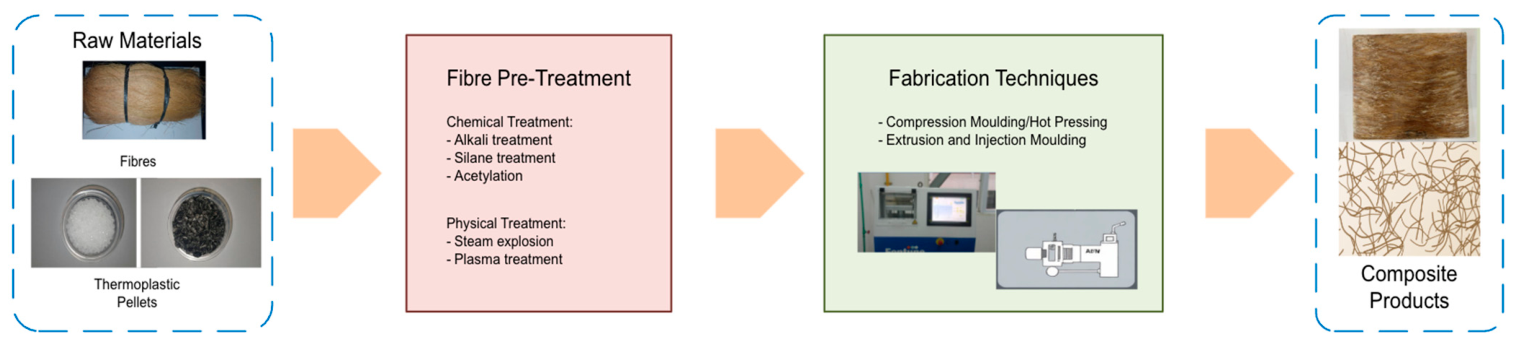
Figure 1. The fabrication of composites made from natural fibres and thermoplastic polymer.
Macromol 06 00035 g001
Figure 2. Tensile strength of several fibres reinforced with HDPE composites (reprinted/adapted with permission from Ref. [62]. Elsevier, 2011).
Macromol 06 00035 g002
Figure 3. Measurement of tensile strength and tensile modulus as well as stress–strain curve for coir/hemp/polyester hybrid composites (reprinted with permission from Ref. [22]. Elsevier, 2023).
Macromol 06 00035 g003
Figure 4. Average tensile stress vs. deformation of PP, HDPE, PP-HDPE, PP-HDPE blend, and their biocomposites (reprinted with permission from Ref. [21]. MDPI, 2020).
Macromol 06 00035 g004
Figure 5. Flexural modulus of PLA/ACPF composites with different fibre loadings (reprinted with permission from Ref. [29]. MDPI, 2023).
Macromol 06 00035 g005
Table 1. Chemical composition of coconut fibre (coir) compared to other natural fibres.
Fibre TypeCellulose (wt%)Hemicellulose (wt%)Lignin (wt%)References
Coconut (Coir)32–4310–2035–45[36]
Jute45–6318–2512–21[38]
Flax64–7116–182–5[38]
Sisal60–7810–148–14[38]
Table 2. Impact strength of various composite types.
Composite TypeCoir Fibre %Impact Strength (J/m)
A130% coir fibre + epoxy resin + hardener + carbon fibre242
A220% coir fibre + epoxy resin + hardener + carbon fibre139
A310% coir fibre + epoxy resin + hardener + carbon fibre72
A410% untreated coir fibre + epoxy resin + hardener + carbon fibre56
Table 3. Quantitative summary of mechanical properties of coir/plastic composites from various studies.
ReferencePolymer Matrix and ReinforcementFibre Content (wt%)Fibre TreatmentKey Mechanical Properties (Quantitative)Key Findings/Comparison
Srikanth et al. [66] Kondagogu gum (KGG)/Coir10%AlkaliTensile Strength: 2.44 MPa, Mod. of Elasticity: ~65 MPa117% increase in tensile strength vs. neat KGG.
Kumar et al. [21]Polyester/Hybrid (Coir + Hemp)15% Coir + 5% HempNot specifiedTensile Strength: 77.97 MPa, Tensile Modulus: 7269.67 MPaCoir/hemp hybridization showed superior tensile properties over non-hybrid composites.
Hidalgo-Salazar et al. [21] PP-HDPE Blend/Coir (CCF)30%RawTensile Modulus: Increased by 78%Flexural Modulus: Increased by 99%30% fibre addition significantly increased stiffness (modulus) compared to the neat blend.
Jayabal et al. [68]Polyester/Woven CoirNot specifiedAlkali (5% NaOH)Tensile Strength: Increased by 40% Flexural Strength: Increased by 42% Impact Strength: Increased by 20%Alkali treatment consistently improved all three key mechanical properties compared to untreated composites.
Fu et al. [29]PLA/Coconut Petiole Fibres (ACPFs)50%AlkaliFlexural Modulus: 6959.70 MPa, Impact Strength: 8.2 kJ/m250% increase in flexural modulus and 150% increase in impact strength vs. neat PLA.
Bhagat et al. [74]Epoxy/Coir10%15 mm (length)Flexural Strength: 63 MPaMaximum flexural strength achieved at 10% loading and 15 mm fibre length.
Bhagat et al. [74]Epoxy/Hybrid (Coir + Glass)Not specified-Impact Strength: 49.9 kJ/m2Hybridization with glass fibre increased impact strength over 6-fold vs. PLA composite.
Mohit et al. [72]Epoxy/Coir + TiC2% TiC-Flexural Strength: 124 MPa Tensile Strength: Increased by 4.99%Addition of TiC nanoparticles increased flexural strength from 115.05 MPa to 124 MPa.
Singh et al. [71]Epoxy/Hybrid (Coir + Carbon)30% CoirAlkaliImpact Strength: 242 J/mHybridization with carbon fibre and alkali treatment yielded the highest impact strength.
Akhter et al. [75]Polymer/Hybrid (Epoxy + Jute/Coir + Rice Husk Ash)Jute fibre + 3% RHA particulate filler-Tensile Modulus: 2.85 GPa
Tensile Strength: 50.07 MPa
The addition of 3% RHA significantly optimized the mechanical strength of jute composites, whereas it showed a declining trend in mechanical performance for coir composites as filler percentage increased.
Disclaimer/Publisher’s Note: The statements, opinions and data contained in all publications are solely those of the individual author(s) and contributor(s) and not of MDPI and/or the editor(s). MDPI and/or the editor(s) disclaim responsibility for any injury to people or property resulting from any ideas, methods, instructions or products referred to in the content.