
Article

Effect of Pine Wood Flour Grafted with Poly(propylene glycol) Toluene 2,4-Diisocyanate Terminated on the Properties of Polylactic Acid Composites


by
Itzel F. Franco Jacobo
1,
Ruben González Nuñez
2,
Abraham G. Alvarado Mendoza
1,
Gonzalo Canche Escamilla
3,
Eulogio Orozco Guareño
1 and
Francisco J. Moscoso Sánchez
1,*
1
Departamento de Química, Centro Universitario de Ciencias Exactas e Ingenierías, Universidad de Guadalajara, Blv. Marcelino García Barragán 1421, Col. Olímpica, Guadalajara 44430, Jalisco, Mexico
2
Departamento de Ingeniería Química, Centro Universitario de Ciencias Exactas e Ingenierías, Universidad de Guadalajara, Blv. Marcelino García Barragán 1421, Col. Olímpica, Guadalajara 44430, Jalisco, Mexico
3
Unidad de Materiales, Centro de Investigación Científica de Yucatán, Calle 43 No. 130 between 32th and 34th Street, Chuburná de Hidalgo, Mérida 97205, Yucatán, Mexico
*
Author to whom correspondence should be addressed.
Macromol 2026, 6(2), 25; https://doi.org/10.3390/macromol6020025

Submission received: 21 January 2026 / Revised: 7 April 2026 / Accepted: 9 April 2026 / Published: 14 April 2026
(This article belongs to the Topic Recent Advances in Composite Biomaterials)

Abstract

This study developed poly(lactic acid) (PLA) biocomposites reinforced with pine wood flour (10, 20, and 30 wt%) to achieve the interphase through chemical modification. Specifically, the wood flour was treated with poly(propylene glycol) toluene 2,4-diisocyanate terminated (PEGTDI), while 1 wt% poly(lactic acid)-g-maleic anhydride (PLA-g-MA) was integrated as a reactive compatibilizer during extrusion and thermocompression. Fourier-transform infrared spectroscopy (FTIR) analysis corroborated the occurrence of urethane formation and ester/anhydride linkages, as substantiated by the presence of characteristic bands indicative of surface carbamation at 1645 and 1726 cm−1. Thermal analysis revealed that both the pine wood flour and coupling agents promoted PLA crystallization; however, thermogravimetric analysis (TGA) indicated a decrease in thermal stability for functionalized composites, suggesting a trade-off between enhanced interfacial interaction and heat resistance. Mechanical testing demonstrated a significant reinforcement effect, with the Young’s modulus increasing by up to 22% in untreated composites. The coupling agents effectively optimized stress transfer at low fiber loadings (10 wt%), while flexural modulus improvements were predominant at higher loadings (20–30 wt%) regardless of treatment. These findings underscore the criticality of surface modification and compatibilizer selection for tailoring the structural and thermo-mechanical properties of PLA-based biocomposites, thereby providing a pathway for optimized performance in structural applications.

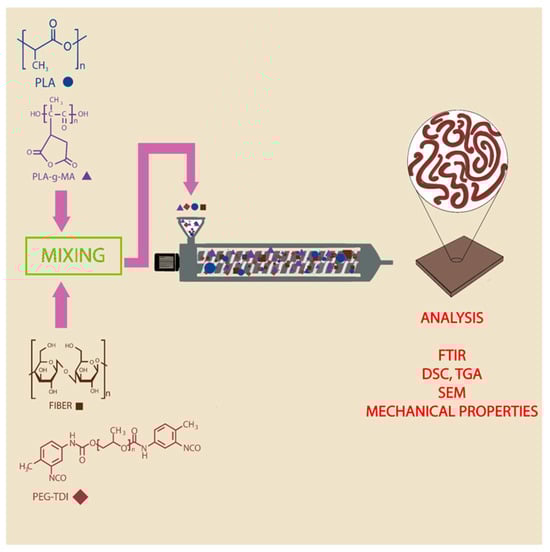
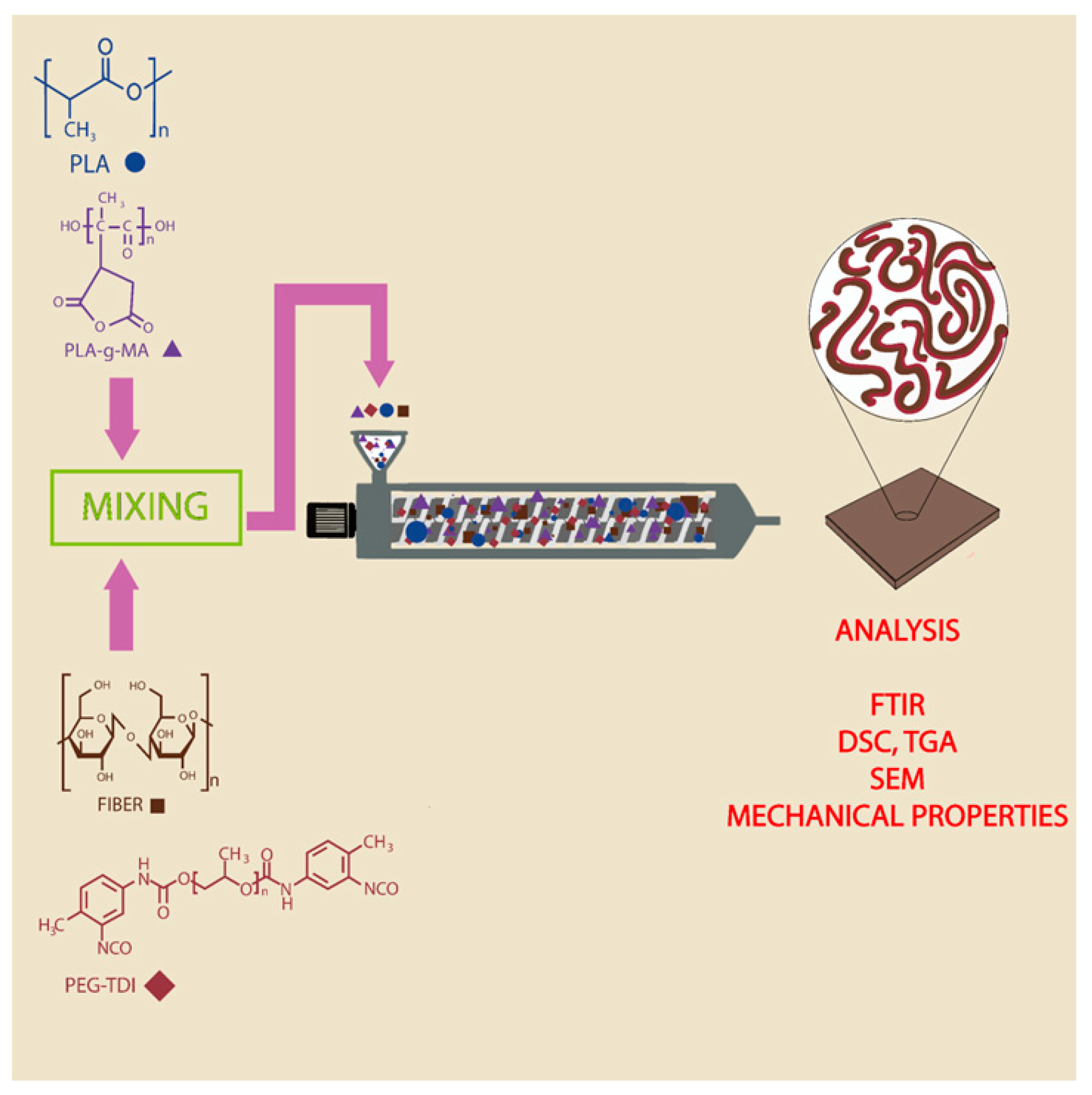
Graphical Abstract

1. Introduction

The use of natural fibers as reinforcements in composite materials has emerged as a field of considerable research interest worldwide. The primary benefits of these materials include their biodegradability, low cost, wide availability, renewability, and biocompatibility [1]. At the structural level, their lightness, versatility, and unique morphology make them ideal reinforcements for composite fabrication [2]. However, the hydrophilic nature of natural fibers hinders their dispersion in a polar polymer matrix due to poor interfacial compatibility, often resulting in heterogeneous dispersion and fiber agglomeration, which arises from the abundance of surface hydroxyl (-OH) groups. Nonetheless, the presence of these hydroxyl groups is also advantageous as it enables chemical modifications to be performed to enhance fiber–matrix compatibility and tailor properties for specific applications [3]. Common modification strategies include esterification, carboxymethylation, tempo-oxidation, amidation, acetylation and, most notably, carbamation [2]. The latter method, based on the use of isocyanates, promotes reactions with cellulose hydroxyl groups and improves compatibility with polymeric matrices. This approach has proven highly effective in a wide range of applications, with extensive studies reporting the development of polymeric matrices combined with chemically modified natural fibers [4]. In this context, both thermosetting polymers—such as polyester, epoxy resins, and phenolics—and thermoplastics—including polyethylene (PE), polystyrene (PS), and polypropylene (PP)—have been employed for fabrication [5].
More recently, increasing attention has been directed toward biodegradable thermoplastics reinforced with chemically modified natural fibers to develop environmentally friendly biocomposites with enhanced mechanical, thermal, and barrier properties [6]. The incorporation of natural fibers into biodegradable thermoplastic matrices, such as polylactic acid (PLA) and poly(3-hydroxybutyrate-co-3-hydroxyvalerate) (PHBV), is a common strategy for developing sustainable composite materials; however, the hydrophilic nature of fibers and the hydrophobic nature of most polymers result in low interfacial compatibility, thereby reducing mechanical performance. To address this issue, two main approaches are employed: fiber surface modification and the use of coupling agents. Chemical modification of the fibers alters surface characteristics and increases matrix affinity, as demonstrated by Colwell et al. [7]. On the other hand, as described by Seo et al. [8], coupling agents are compounds that contain reactive functional groups which form chemical bonds in situ, improving miscibility and adhesion between polymer matrices and the fiber reinforcement. Recent research has emphasized novel fiber-treatment methodologies and polymer enhancements to optimize interfacial interactions; for example, Hejna et al. [9] reviewed the use of isocyanates, such as 4,4′-diphenylmethane diisocyanate (MDI) and toluene diisocyanate (TDI), as effective compatibilization agents for wood fiber–polymer composites. These reactive agents have been demonstrated to be particularly effective in forming strong bonds at the interface, resulting in significant enhancements in material properties. Their analysis focused on the correlation between the isocyanate structure and modification conditions, and how these factors influence interactions between the matrix and the lignocellulosic filler. The researchers examined the impacts of these interactions on the structure–property relationships of the resulting composites.
Xie et al. [10] studied the effects of MDI on the properties of PBAT/BF composites. They found that MDI reduced the incompatibility between the polymer and filler, thereby increasing the strength of the resulting composite. Zhao et al. [11] investigated high-strength polylactic acid (PLA) biocomposites reinforced with epoxy resin-modified pine fibers, demonstrating that epoxy impregnation is a simple and cost-effective approach to enhancing the properties of PLA/pine fiber biocomposites. In particular, the incorporation of 1 wt% epoxy was identified as the optimal modification, resulting in an increase in tensile strength to 71 MPa and Young’s modulus to 5.4 GPa. Epoxy was confirmed to act as a compatibilizer, mitigating the chemical incompatibility between pine fiber and PLA. Lv et al. [12] investigated the modification of wood flour/PLA composites via reactive extrusion with maleic anhydride (MA), with their results indicating that MA enhances the interfacial compatibility between the two materials through efficient crosslinking and molecular interactions. The incorporation of 1 wt% MA yielded maximum performance, with a 144% increase in tensile strength and a 44% increase in flexural strength compared to unmodified composites. Thus, the effectiveness of MA as a compatibilizing agent for this type of composite material was confirmed. Seo et al. [8] examined the development of biocomposites composed of PLA, PBS, and wood flour via in situ reactive extrusion with MDI and MA employed as coupling agents. The results showed that MDI-modified biocomposites displayed superior mechanical performance, whereas those with MA achieved the highest tensile and flexural modulus values. When combined, MDI and MA resulted in a more balanced set of mechanical properties.
This study aimed to evaluate the structural and thermomechanical properties of poly (lactic acid) (PLA)-based biocomposites developed via a dual interfacial engineering strategy. This approach involves chemical surface modification of pine wood flour using poly(propylene glycol), toluene diisocyanate (PEGTDI), and simultaneous reactive compatibilization of the PLA matrix with maleic anhydride grafted PLA (PLA–g-MA). By integrating these methods, this study aims to introduce urethane linkages at the pine wood flour while promoting esterification and anhydride reactions at the matrix pine wood flour interface, thereby creating a tailored interphase to enhance structural integrity and thermomechanical performance.

2. Materials and Methods

2.1. Materials and Reagents

Ocote pine (Pinus teocote) fiber was obtained from wood workshops in Ciudad Guzmán, Jalisco, Mexico, and ground using a PULVEX 200 pulverizer from PULVEX group (Mexico City, Mexico). The resulting powder was sieved using a RO-TAP RX-30 sieve shaker (W.S. Tyler, Cleveland, OH, USA). Only fibers passing through a 50-mesh sieve and retained on a 70-mesh sieve of the Tyler series were used, yielding particles with a size range of 212 to 300 µm. The chemical composition of the pine fiber was determined following the TAPPI T-204 CM-99 [13] and TAPPI T-222 os-74 [14] standards, revealing a lignin content of 19.79 wt% and a holocellulose content of 80.21 wt%.
Polylactic acid (PLA) Ingeo 3251 D, supplied by NatureWorks LLC (Minnetonka, MN, USA), with a density of 1240 kg/m3 and a melting temperature of 162 °C, was used as the polymer matrix. The PLA pellets were first cryogenically conditioned in an Arctiko ULTF 80 ultra-freezer (Arctiko, Esbjerg, Denmark) at −80 °C for 48 h. Subsequently, the material was pulverized using a Retsch ZM 200 mill (Retsch GmbH, Haan, Germany), resulting in a typical particle size distribution with an average range of 297–400 μm.
The reagents employed included poly(propylene glycol) toluene 2,4-diisocyanate terminated (PEGTDI) (2300 Da, 80% purity; Sigma-Aldrich, St. Louis, MO, USA) and maleic anhydride (MA) (98.0% purity; Meyer brand, Mexico City, Mexico). Solvents consisted of potassium hydroxide (97% purity; Meyer brand, Mexico City, Mexico); xylene (98% purity), chloroform (98% purity), and hydrochloric acid (38% purity), all of analytical grade and obtained from Golden Bell (Monterrey, Mexico); and reagent-grade sulfuric acid (96% purity; Jalmek brand, Monterrey, Mexico). As catalysts, dibutyltin dilaurate (95% purity) and reagent-grade benzoic peroxide (BPO) (98% purity), both from Sigma-Aldrich, were used. All chemicals were applied without further purification.
Table 1 presents the formulations for the PLA pine wood flour compounds. Neat PLA was used as a control. PLA was compounded with 10, 20, and 30 wt% pine wood flour (F), modified pine wood flour (FM), pine wood flour with 1 wt% PLA-g-MA (F_1C), or modified pine wood flour with 1 wt% PLA-g-MA (FM_1C). The grafted copolymer PLA-g-MA was synthesized with a grafting degree of 1.4 wt% MA and added at 1 wt% to the composites.

2.2. Experimental Procedures

2.2.1. Preparation of Maleic Anhydride-Grafted Poly(lactic acid)

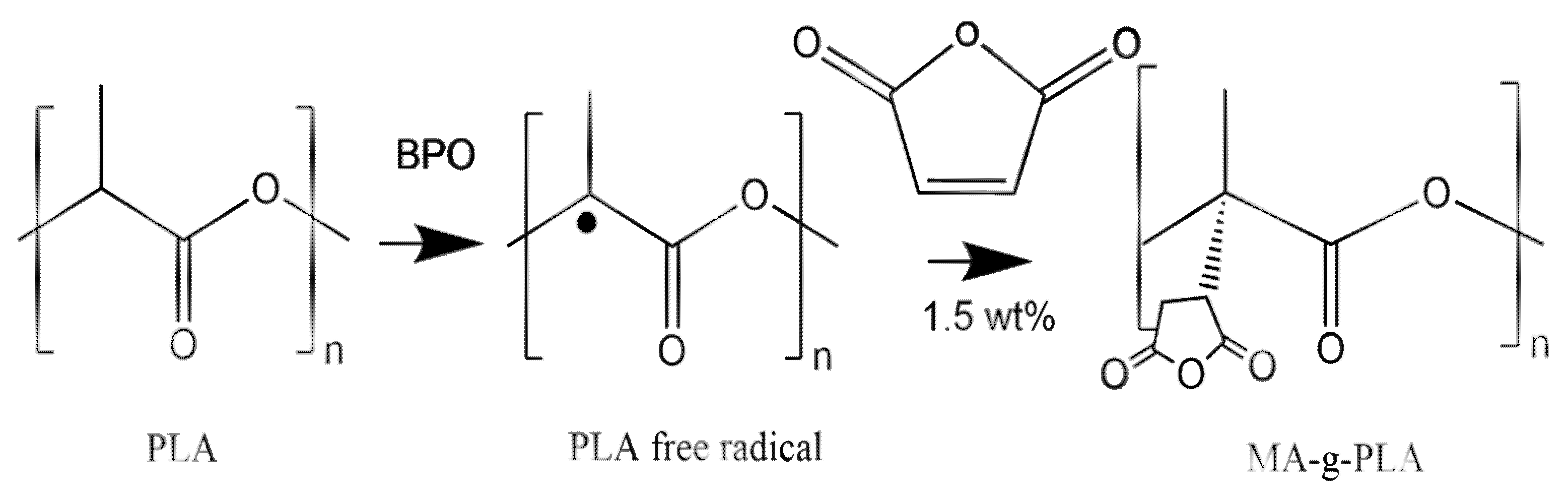
The grafted copolymer PLA-g-MA was synthesized by dissolving 100 wt% PLA and 1.5 wt% MA in 250 mL of chloroform. This solution was placed in a 500 mL beaker, heated on a hot plate with stirring, and 1 wt% BPO was added as an initiator. The reaction mixture was stirred for 10 h at 100 °C. After completion, the product was stored in the dark for 24 h and then dried in an oven at J. Met. Mater. Miner. 50 °C until a constant weight was reached, ensuring complete evaporation of the chloroform. The resulting copolymer was purified by dissolving in chloroform followed by precipitation in diethyl ether. The purified product was then dissolved in refluxing xylene at 85 °C for 4 h, and the hot solution was filtered. The grafting percentage of MA was determined through immediate titration of the hot solution, resulting in a grafting degree of 1.38% of MA in the PLA-g-MA [12,15]. The reaction scheme for grafting MA into PLA to produce PLA-g-MA is shown in Figure 1.

2.2.2. Treatment of Pine Fiber with Poly(propylene glycol) Toluene 2,4-Diisocyanate Terminated (PEGTDI)

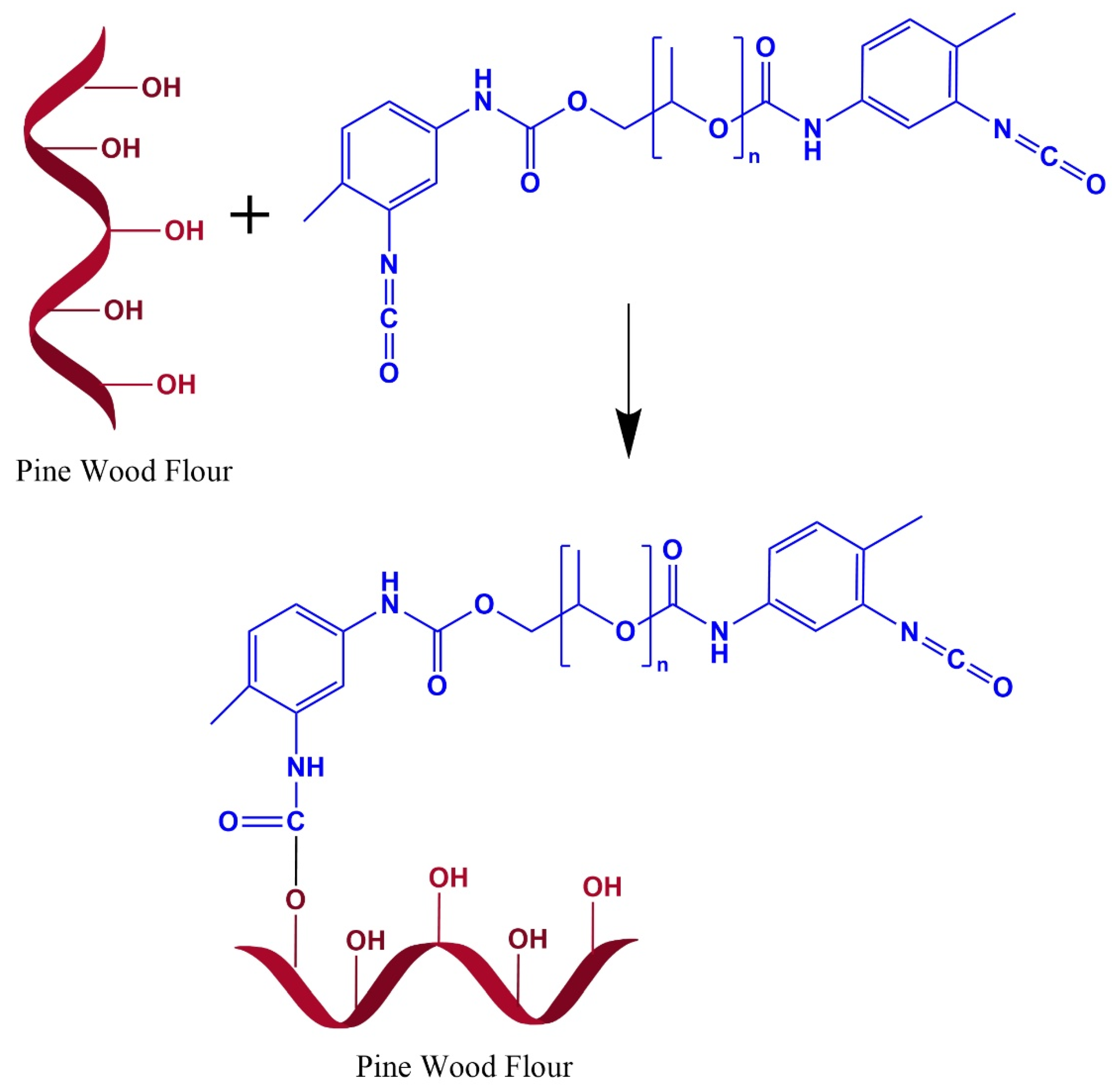
In the initial stage, the pine wood flour was pretreated to remove impurities. A 100 g sample of pine wood flour was weighed and placed into a 500 mL beaker containing a 10% (w/v) NaOH solution in ethanol. The mixture was then stirred for 3 h at room temperature, following which the pine wood flour was filtered and thoroughly washed with water to remove residual NaOH and ethanol. The cleaned pine wood flour was then dried in an aluminum vessel at 50 °C until a constant weight was achieved. For modification, 100 g of dried pine wood flour was introduced into a 1 L flask containing 500 mL of carbon tetrachloride and an appropriate amount of DBTD catalyst (1 wt% with respect to the pine wood flour). PEGTDI was then introduced to the flask dropwise under continuous stirring for 1 h, followed by an additional 2 h of reaction [16]. The PEGTDI-modified pine wood flour was purified by refluxing with acetone for 2 h using a Soxhlet extractor, followed by thorough washing with water. The results of our previous studies suggest that the pine wood flour purification step is important as the pine wood flour can become encapsulated with PEGTDI, leading to varying results [16]. The proposed reaction mechanism between the pine wood flour and the PEGTDI is depicted in Figure 2.

2.3. Extrusion Process

The biocomposites were prepared via melt-blending using a Thermo Scientific™ Process 11 parallel co-rotating twin-screw extruder (Thermo Fisher Scientific, Waltham, MA, USA), featuring an 11 mm screw diameter and a length-to-diameter (L/D) ratio of 40:1. Before processing, all raw materials were dried in a laboratory oven at 50 °C for 48 h to minimize moisture-induced degradation. Subsequently, the pulverized PLA, pine wood flour, and PLA-g-MA were dry-mixed using an industrial blender (Torrey, model LP-12, Monterrey, Mexico) for 5 min. This step ensured a homogeneous distribution of the components and prevented material segregation in the hopper, as the similar particle sizes of the pulverized polymer and the wood flour maintained a stable mixture throughout the process. Pure polylactic acid (PLA) and PLA/pine wood flour blends (10, 20, and 30 wt%) were processed using a temperature profile across the eight heating zones of 140/140/150/150/160/160/170/170 °C, with the die maintained at 170 °C while the screw speed was kept constant at 110 rpm. The blends were introduced into the main hopper via a volumetric feeder (11 mm single screw feeder, Type 567-7656, Thermo Fisher Scientific GmbH, Karlsruhe, Germany) operating at 10 rpm with a constant feed rate of 0.62 kg/h. The resulting extrudates were collected through a 2 mm diameter circular die, water-cooled, and subsequently pelletized for further characterization.

2.4. Fabrication of Plates

The pellets were dried in an oven (LUZEREN model PRO1001176, Beijing, China) at 50 °C for 72 h. Subsequently, 30 g of pellets were deposited into a 12 × 12 × 0.3 cm metal mold, which was then introduced into a Carver Inc. brand thermo press (Wabash, IN, USA). The pressing process consisted of two heating stages at 180 °C. In the first stage, the material was compressed at 160 kg/cm2 for 10 min. The press was then decompressed to allow for the removal of any volatile compounds. In the second stage, the material was compressed at 200 kg/cm2 for 10 min. After pressing, the equipment was turned off and the plates were cooled using water. Later, the plate was removed and, after two days, the specimens were cut for the different mechanical tests using a laser (Guian laser, model gn640ms, Jinan, China).

2.5. Characterization of Materials

Fourier-Transform Infrared Spectroscopy

FTIR spectra of the composite samples and pine wood flour were recorded via attenuated total reflectance (ATR) using a Thermo Scientific Nicolet instrument (Madison, WI, USA). Spectra were recorded at a resolution of 4 cm−1 over the range of 4000 to 500 cm−1, with 32 scans per sample. Signal identification was performed with baseline correction, without data smoothing, using the Origin Lab 2023b Software.

2.6. Characterization of the Mechanical Properties of the Composites

2.6.1. Tensile Test

Mechanical testing of the specimens was performed using a universal testing machine (INSTRON 3345, Norwood, MA, USA). Following ASTM D 638, a crosshead speed of 1 mm/min and a 1 kN load cell were employed at a temperature of 23 ± 2 °C. Five Type V specimens were used to calculate the average and standard deviation.

2.6.2. Flexural Test

Flexural tests were performed according to ASTM D 790 using a universal testing machine (INSTRON 4411, Norwood, MA, USA). Specimens were tested at a crosshead speed of 1 mm/min, with a pan-to-depth ratio of 16 times the average thickness, a 1 kN load cell, and temperature of 23 ± 2 °C. Five samples were used to report the average and standard deviation.

2.7. Scanning Electron Microscopy

The morphology and fracture surfaces of the pine wood flour were characterized using a JEOL JCM-6000Plus SEM (JEOL Ltd., Tokyo, Japan). Before observation, specimens were cryogenically fractured in liquid nitrogen and coated with a thin gold layer for 60 s in an SPI sputter coater. Microstructural features were examined at multiple magnifications to assess the effects of fiber modification.

2.8. Differential Scanning Calorimetry Testing

Thermal analyses were performed using a Q100 differential scanning calorimeter (DSC) (TA Instruments, New Castle, DE, USA). Samples (4–5 mg) were taken from the compression-molded plaques and placed in hermetically sealed aluminum pans. The analysis was conducted under a nitrogen atmosphere (50 mL/min). Specimens were initially heated from 30 to 210 °C at 10 °C/min and held isothermally for 1 min to eliminate their previous thermal history. A controlled cooling ramp to 30 °C was then performed at 10 °C/min, followed by a 1 min stabilization period. Finally, a second heating scan from 30 to 210 °C was recorded, followed by a final cooling ramp at the same rate. The glass transition temperature (Tg), enthalpy of fusion (ΔHm), melting temperature (Tm), enthalpy of crystallization (ΔHcc), and crystallization temperature (Tcc) values were obtained from the second heating and cooling cycles.
The degree of crystallinity of PLA (Xc) was determined using the following equation:
X c ( % ) =   H m H c c H r e f ×   w × 100
where ΔHref denotes the enthalpy of fusion of a 100% crystalline PLA (93.6 J/g), and w denotes the weight fraction of PLA present in the composite material [17].

2.9. Thermogravimetric Analysis

Thermogravimetric analysis was performed using a Discovery TGA (TA Instruments, New Castle, DE, USA). Approximately 5 mg of each compression-molded sample was heated from 30 °C to 700 °C at 10 °C/min under a nitrogen flow of 50 mL/min.

3. Results

3.1. Characterization of PLA-g-MA and Fiber

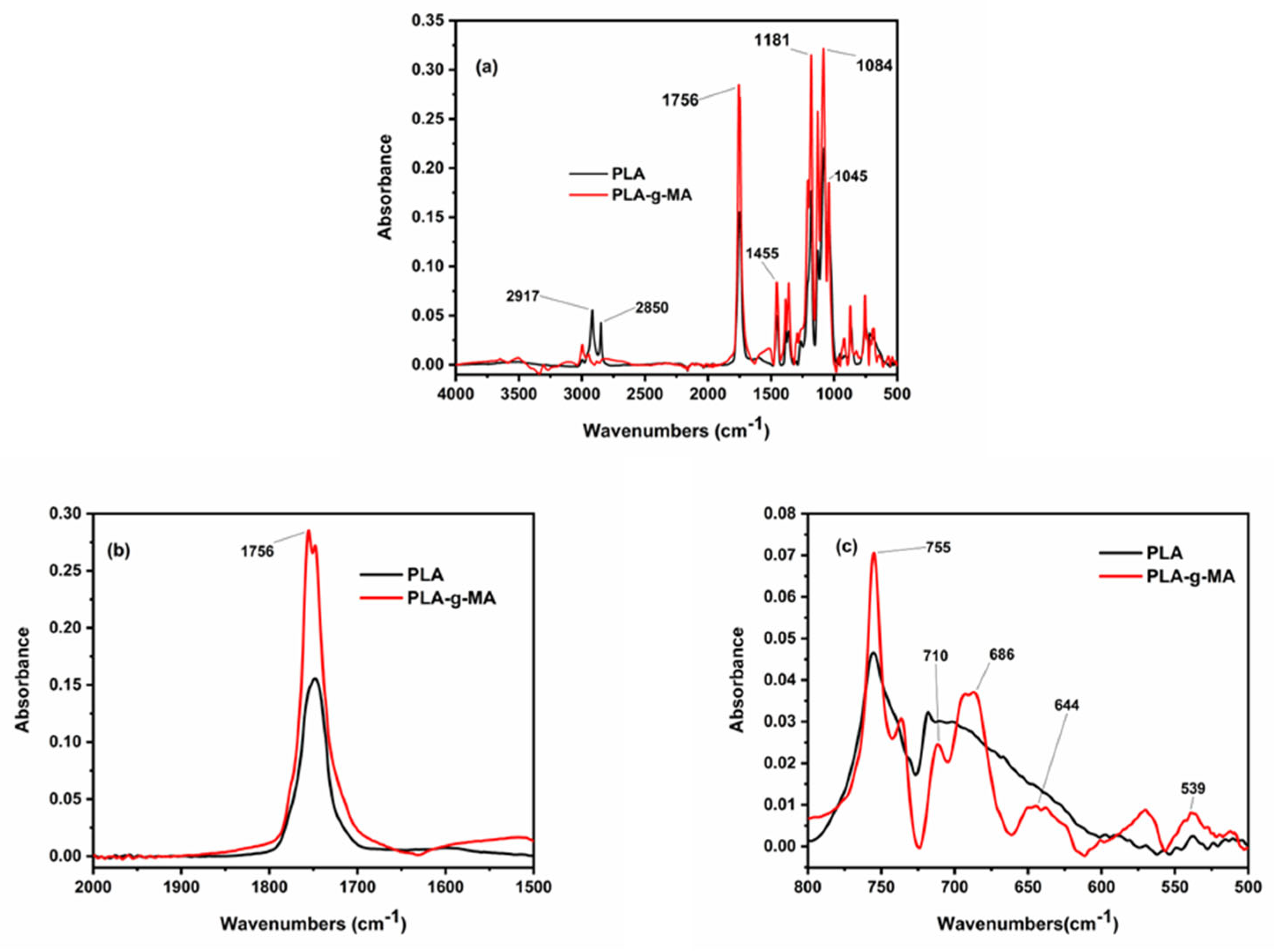
Figure 3 presents the FTIR spectra of PLA and PLA-g-MA. In Figure 3a, the characteristic absorption bands of both materials are clearly visible. Methyl group (-CH3) stretching is indicated at 2917 cm−1, while methine group (-CH3) stretching is indicated at 2850 cm−1. Additionally, C–H bending vibrations are indicated at 1455 and 1420 cm−1, C=O (from ester group) stretching at 1756 cm−1, the C-O stretching at 1181 cm−1, and -C–O–C group stretching vibrations at 1084 cm−1. Figure 3b shows the changes in the absorption bands after grafting MA onto PLA; specifically, an increase in the intensity of the band at 1756 cm−1 can be observed, attributed to the asymmetric and symmetric stretching of carbonyl groups of the MA, confirming the chemical modification [18]. Finally, Figure 3c shows bands between 755 and 710 cm−1 corresponding to the out-of-plane strain of the C–H bonds of maleic anhydride; signals between 710 and 644 cm−1 associated with torsional vibrations of the anhydride groups grafted onto the PLA chain; and bands between 644 and 539 cm−1 attributed to both the strain vibrations of the -C–O–C bonds of the PLA and the torsional modes of the anhydride groups of the MA [19].
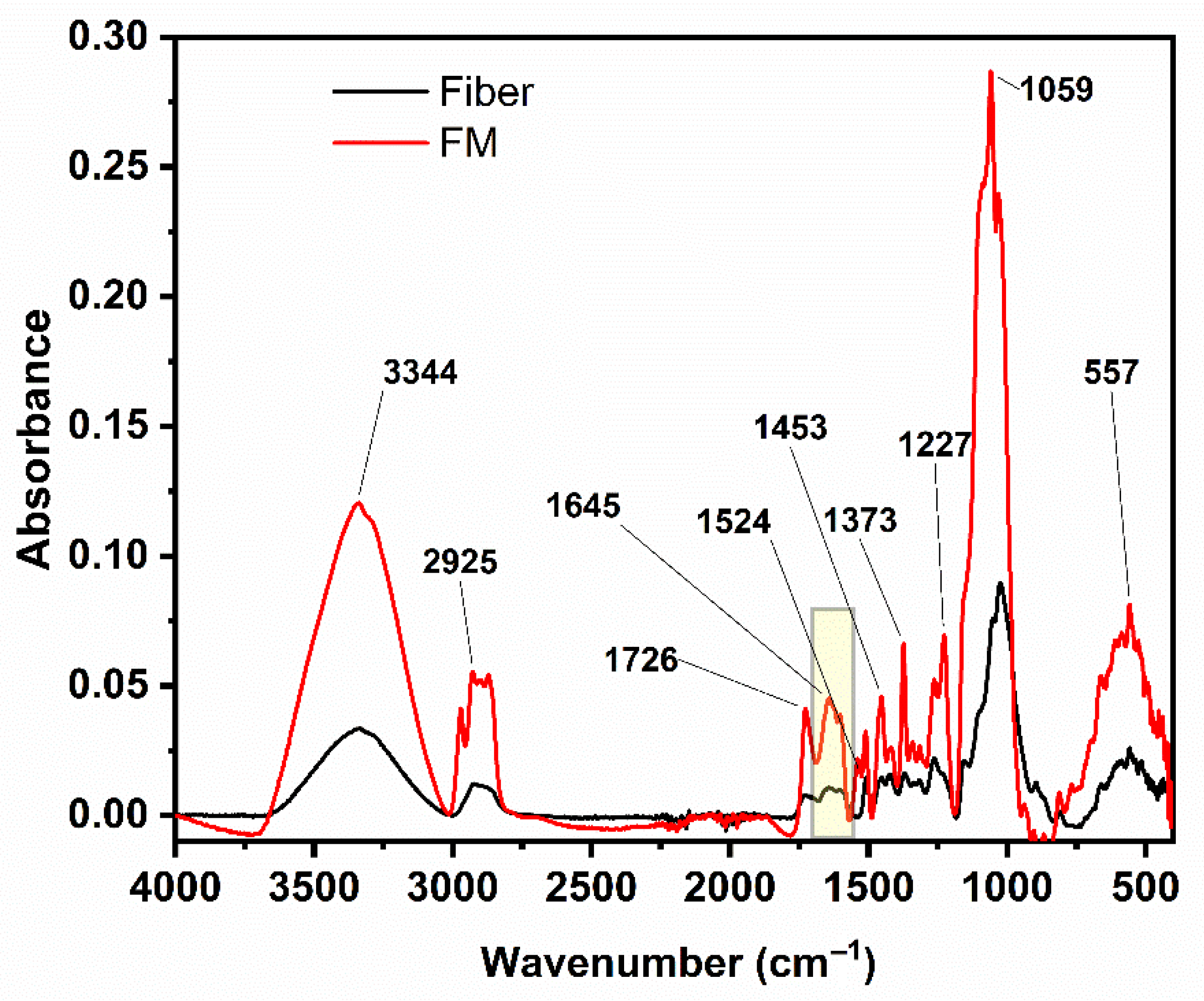
Figure 4 presents the FTIR spectra of pine wood flours before and after surface modification. The characteristic bands observed at 1726, 1373, 1227, and 1059 cm−1 confirm the presence of functional groups associated with the hemicelluloses and cellulose in the fibers. The band at 1453 cm−1 is assigned to the C-H bending in carbohydrates and lignin. The signals at 3344 cm−1 and 2925 cm−1 correspond to the stretching of the OH and CH groups, respectively, which are typically associated with carbohydrate and lignin structures [20]. The chemical interaction between the hydroxyl groups (–OH) of the pine wood flour and the isocyanate groups (–NCO) of poly(propylene glycol) toluene 2,4-diisocyanate terminated (PEGTDI) was assessed via FTIR, with successful modification evidenced by the disappearance of the characteristic peak of the isocyanate group (N=C=O) and the appearance of characteristic bands of the urethane bonds. In particular, the formation of urethane bonds was confirmed by the presence of the C=O stretching bands of the secondary urethane at 1726 cm−1 and the tertiary urethane at 1645 cm−1. Additional signals were observed at 1373 cm−1, corresponding to the C-N bond associated with an aromatic ring, and at 1059 cm−1, related to the aliphatic fraction. The stretching of the urethane C–O bond was identified at 1227 cm−1. Concurrently, a higher intensity was observed for the characteristic peaks of asymmetric stretching (2925 cm−1) and bending (1453 and 1412 cm−1) for the C-H bonds of methyl and methylene groups in the PEG chain. The presence of sharp and intense bands between 1645 and 1726 cm−1 indicates that the carbamation reaction of the pine wood flour was successful. In contrast, the broad band observed between 1651 and 1600 cm−1 for the unmodified pine wood flour was replaced by a band at 1626 cm−1 in PEGTDI-treated fibers, suggesting that the chemical modification process promoted the formation of urethane bonds [2]. To confirm that the pine wood flour reacted with PEGTDI, the nitrogen content incorporated into the pine wood flour as a result of the chemical modification was determined and quantified via elemental analysis (LECO TruSpec Micro, MI, USA), for which 1 mg samples of unmodified and PEGTDI-modified pine wood flour were evaluated. The natural pine wood flour had an elemental composition of 43.59% carbon (C), 6.14% hydrogen (H), 0.048% nitrogen (N), and 50.22% oxygen (O); in contrast, the modified pine wood flour showed a composition of 43.83% C, 4.74% H, 3.92% N, and 47.51% O, confirming the significant incorporation of nitrogen groups through reaction with the hydroxyl (–OH) groups of the pine wood flour.
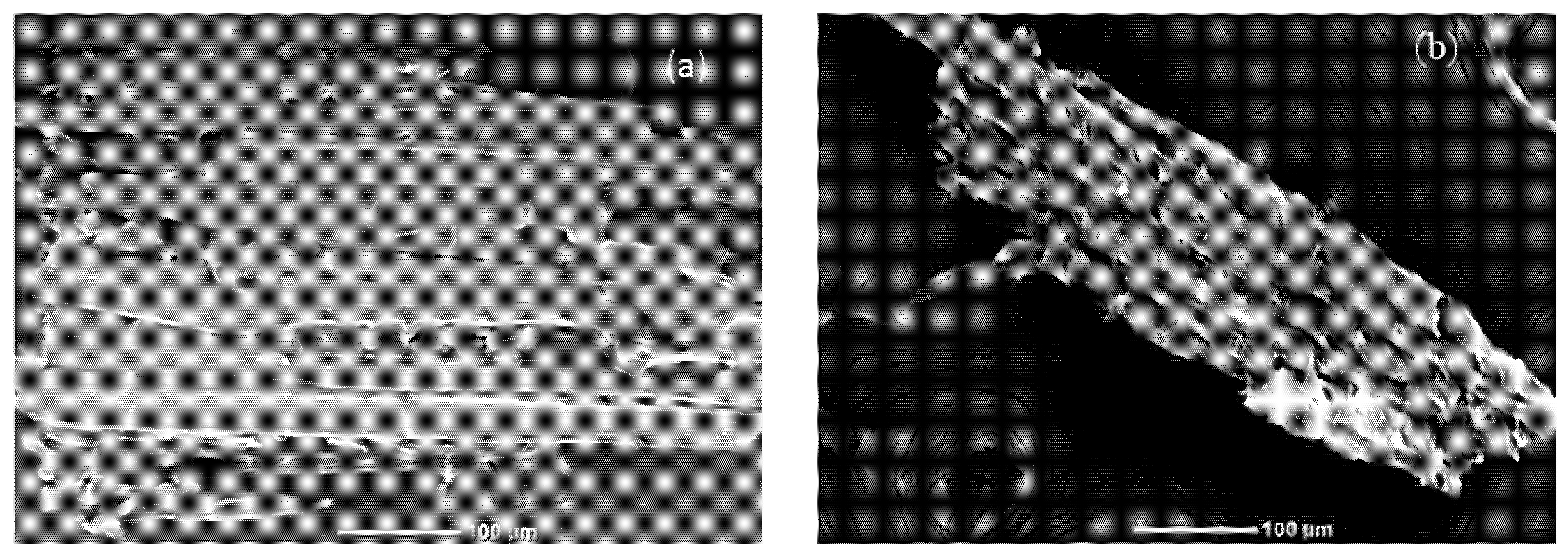
SEM micrographs of unmodified and PEGTDI-modified pine wood flours are presented in Figure 5. As illustrated in Figure 5a, the unmodified pine wood flour’s surface revealed a rough, irregular texture with grooves and parenchyma detachment, indicating the effects of grinding. In Figure 5b, the surface is more even, with smoother sections, which is attributable to the application of the PEGTDI coating.

3.2. Characterization of Composites

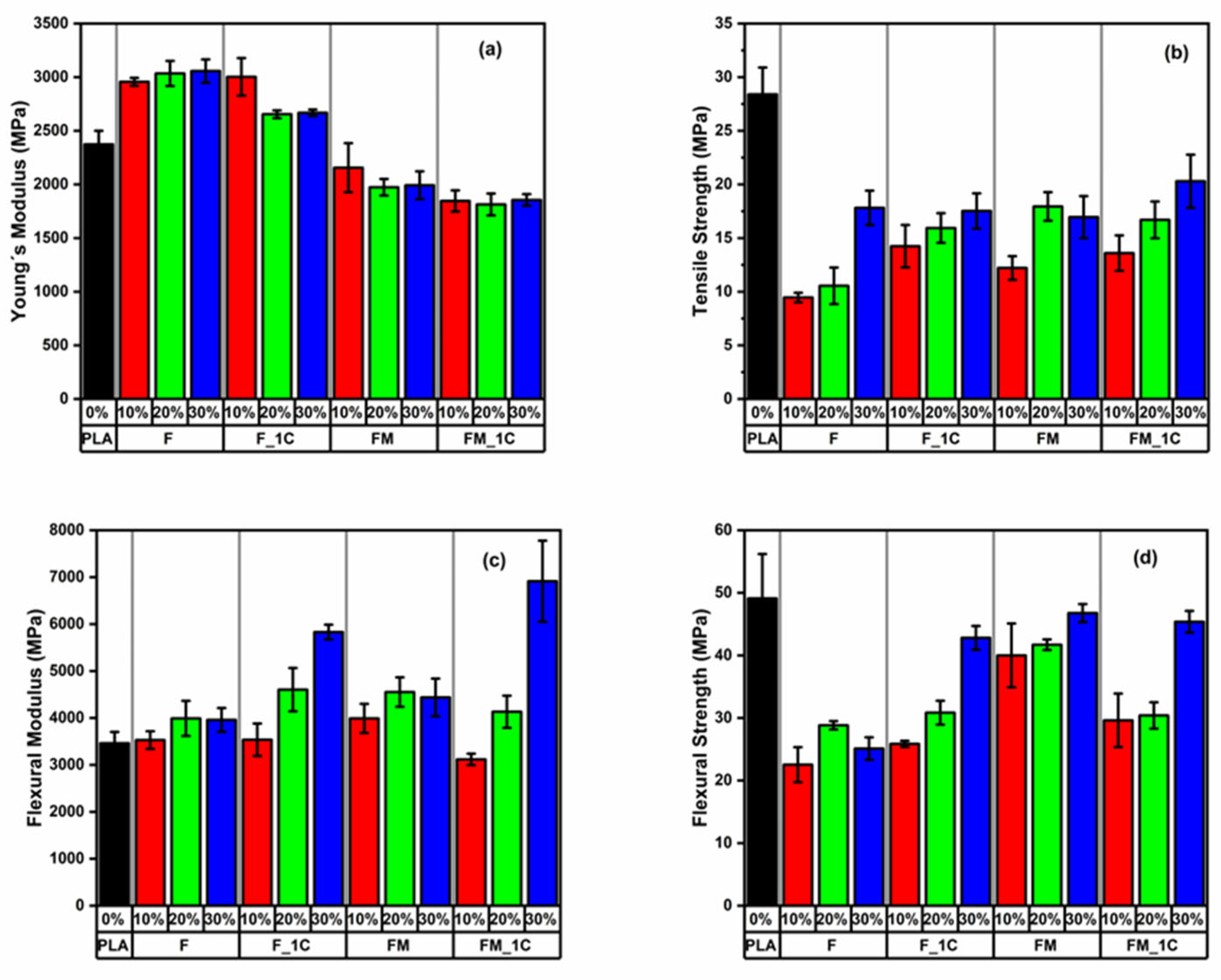
Figure 6 shows the tensile and flexural mechanical properties of PLA and composite materials reinforced with unmodified and PEGTDI-modified pine wood flours, in the presence or absence of a coupling agent. As shown in Figure 6a, the addition of 10–30% unmodified pine wood flour to composite materials resulted in a 20–22% increase in the Young’s modulus compared to pure PLA, suggesting a mechanical reinforcement effect due to the irregularity of the pine wood flour’s surface. In systems incorporating 10% pine wood flour and 1% coupling agent, the modulus increased by approximately 21%, suggesting that the coupling agent facilitates stress transfer at low pine wood flour loadings. However, when the pine wood flour content increased to 20–30% along with 1% coupling agent, the increases in modulus were slightly smaller compared to those for composites containing only fiber. Nevertheless, these materials exhibited higher relative stiffness compared to PLA. This suggests that 1% coupling agent can modify the pine wood flour–matrix interaction, which could limit the load transfer efficiency at higher reinforcement levels. Research has shown that the reinforcement efficiency in biocomposites depends on factors such as pine wood flour dispersion, length, surface treatment, and interfacial adhesion [21,22].
Conversely, composites made with modified pine wood flour, with or without a coupling agent, exhibited a reduction in the Young’s modulus compared to pure PLA. These findings indicate that modification with PEGTDI does not enhance interfacial adhesion and may potentially reduce it, thereby constraining stress transfer between the matrix and the pine wood flour. This behavior can be attributed to the fact that both isocyanate groups of PEGTDI reacted with the OH groups (see Figure 4) and, so, there were no groups left to react with the OH present in the PLA to form an FM–PLA interface. The flexural modulus and strength values of the composite materials are presented in Figure 6c. It can be observed that, at a 10% pine wood flour content, unmodified or modified and with or without a coupling agent, the flexural modulus was comparable to that of pure PLA. However, when the pine wood flour content (unmodified and modified) increased to 20% and 30%, all composite materials exhibited increases in the flexural modulus, regardless of the coupling agent. This behavior indicates that the presence of pine wood flour, even without treatment, contributes to enhanced flexural stiffness due to beneficial interfacial interactions between the matrix and the reinforcement. The increase in flexural modulus of pine wood flour-reinforced PLA composites can be attributed to the higher intrinsic modulus of the lignocellulosic pine wood flour relative to the matrix, which allows for more efficient load transfer during flexural deformation [23,24]. Furthermore, chemical modification of the pine wood flour contributes to improved interfacial adhesion through the partial elimination of amorphous components and an increase in surface roughness [25]. Additionally, the compatibilizer PLA-g-MA strengthened the pine wood flour–matrix interface by promoting chemical interactions between the two phases, reducing voids, and improving wetting. The incorporation of pine wood flour, its chemical modification, and the use of a compatibilizing agent act synergistically to restrict the molecular mobility of the matrix and promote load transfer, ultimately resulting in an increase in the flexural modulus compared to PLA. Regarding maximum flexural strength, all composites exhibited lower values than pure PLA. This decrease may be due to the formation of weak interfacial zones or a heterogeneous dispersion of pine wood flour within the matrix, thus reducing the material’s ability to withstand stress before fracturing [26]. Taken together, these results demonstrate that both fiber modification and interface characteristics are important for optimizing the mechanical performance of composite materials.
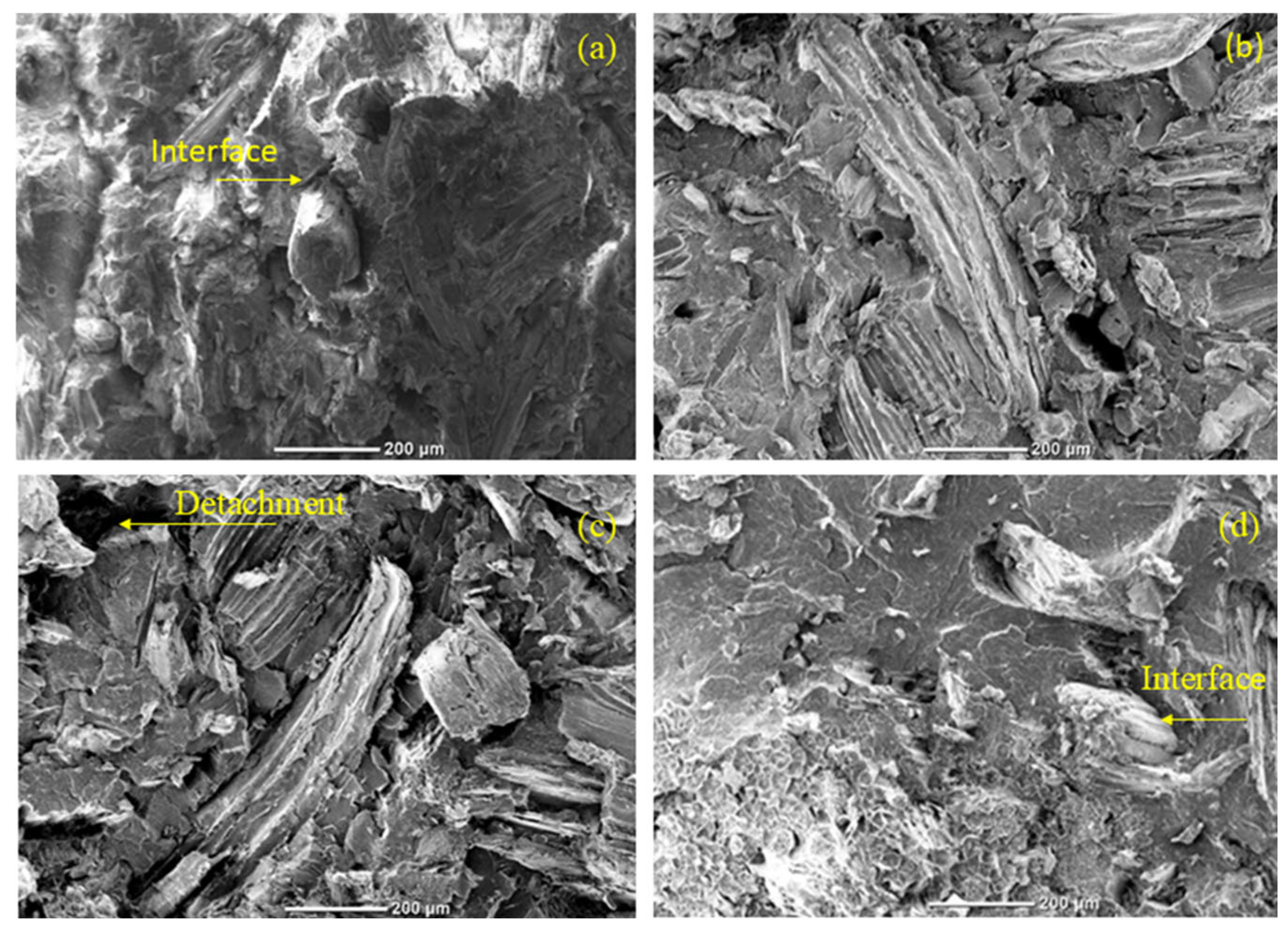
Figure 7 presents SEM micrographs of the 70PLA/30F composites with and without chemical modification of the pine wood flour and coupling agent. Figure 7a (70PLA/30F) provides evidence of pine wood flour breakage and localized bonding zones between the matrix and the reinforcement, with the relatively homogeneous pine wood flour distribution suggesting partial load transfer. Furthermore, interfacial spaces were identified, which are attributable to the chemical incompatibility between the hydrophilic cellulose and the hydrophobic PLA matrix, limiting adhesion and stress transfer [22,27]. In Figure 7b, the composite with coupling agent (70PLA/30F-1C) shows a more continuous interface, with anchored pine wood flour and minimal voids. This indicates that the coupling agent promotes fiber–matrix compatibilization and improves interfacial cohesion. In Figure 7c (70PLA/30FM), the chemically modified pine wood flour exhibits exposed surfaces and partial polymer detachment. This failure mode, characterized by pine wood flour splitting and tearing, suggests greater mechanical interaction through friction and entanglement, although interfacial adhesion failures persist. Finally, the 70PLA/30FM-1C material (Figure 7d) exhibited the most homogeneous interface with minimal voids, as the presence of modified pine wood flour and a coupling agent promotes more effective matrix adhesion, thus reducing detachment and improving interfacial cohesion. This behavior is attributed to reactions between isocyanate groups on the pine wood flour surface and the functional groups of the coupling agent, promoting the formation of chemical bonds and more stable anchoring.
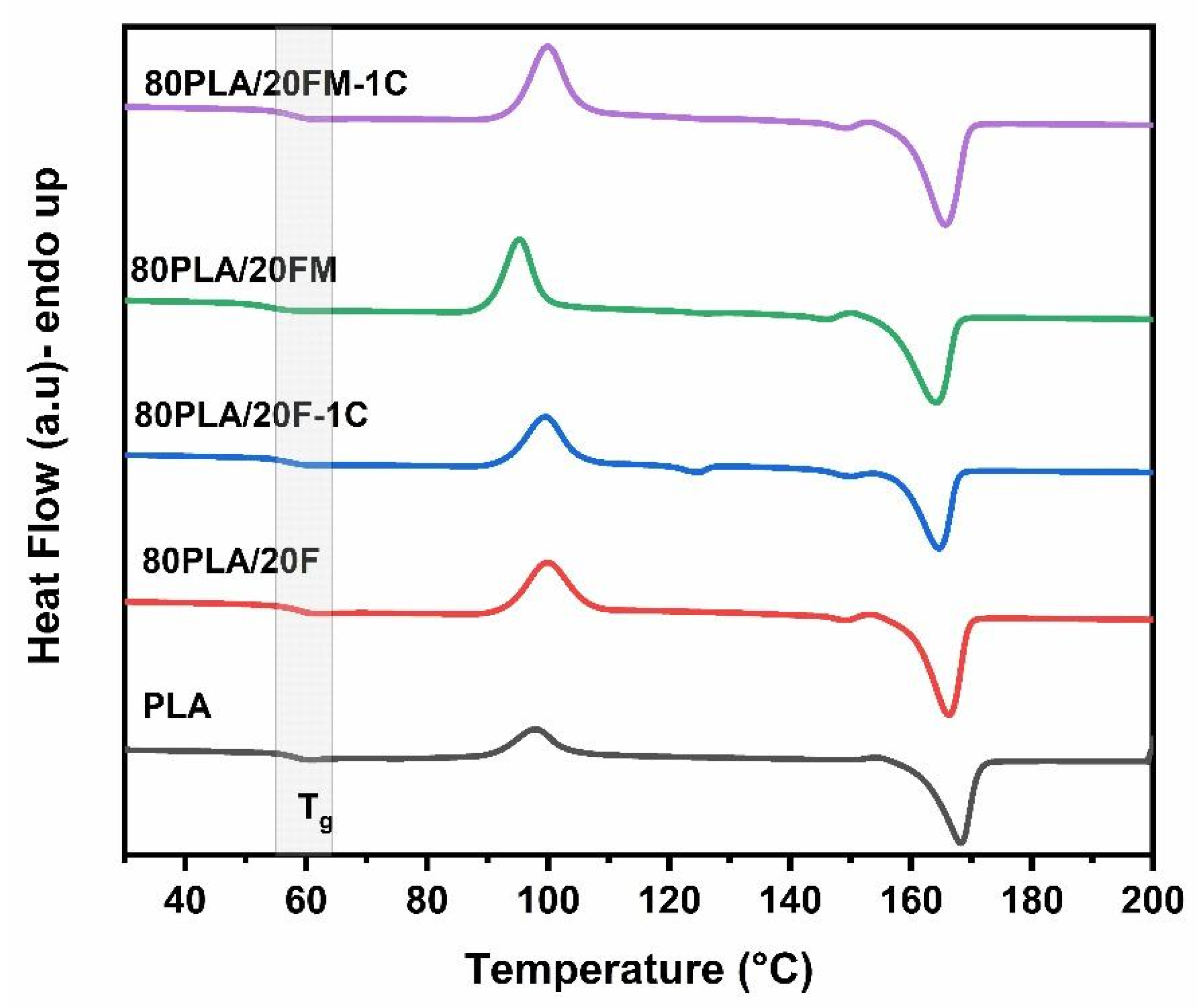
Figure 8 presents the DSC thermographs of PLA and the composite materials, obtained from the second heating and cooling cycle performed at a rate of 10 °C/min. The corresponding thermal parameters of glass transition temperature (Tg), enthalpy of fusion (ΔHm), melting temperature (Tm), enthalpy of crystallization (ΔHcc), crystallization temperature (Tcc), and degree of crystallinity are summarized in Table 2. The Tg of the composite materials did not show significant variations compared to PLA, regardless of the pine wood flour content (10–30 wt%), surface treatment (modified or unmodified), or the presence of a compatibilizing agent. This suggests that the amorphous phase did not undergo significant changes regarding the molecular mobility of the composite materials. The cold crystallization temperature (Tcc) decreased markedly in PLA/F compounds with a coupling agent, dropping from 99 °C in pure PLA to a range of 82–95 °C in PLA/F-1C systems. This decrease intensified as the pine wood flour content increased (10–30 wt%) and the coupling agent was incorporated, indicating more efficient reorganization of the chains during heating.
The presence of pine wood flour in combination with the coupling agent resulted in a shift in the cold crystallization peak to lower temperatures, suggesting that the heterogeneous nucleation induced by compatibilization promoted earlier crystallization. Conversely, in composites with modified pine wood flour (PLA/FM), even with a coupling agent (PLA/FM-1C), no substantial variations in Tcc were detected. This suggests that the surface modification applied to the pine wood flour may not have enabled sufficient interfacial interaction with the PLA matrix, potentially limiting its effectiveness in inducing nucleation and accelerating cold crystallization, despite additional compatibilization [28]. This behavior is attributed to inefficient heterogeneous nucleation, which is restricted by the inherent high viscosity of the PEGTDI grafted onto the pine wood flour surface.
Furthermore, the thermal analysis results showed that PLA exhibited a crystallinity percentage of 25.35%. With respect to composites, the incorporation of unmodified pine wood flour (PLA/F) or PEGTDI-modified pine wood flour (PLA/FM) did not generate significant changes in the polymer’s crystallization capacity. This finding aligns with previous studies, which indicate that lignocellulosic reinforcements act as effective nucleating agents only when there is adequate interfacial compatibility between phases [29]. Formulations containing only pine wood flour or modified fiber maintained slightly lower or higher values compared to PLA (22.54% and 30.27% for 90PLA/10F and 70PLA/30F; and 23.36% and 31.11% for 90PLA/10FM and 70PLA/30FM, respectively), demonstrating that, even with increased pine wood flour content, the induced nucleation mechanism is limited. This same behavior was observed when the modified pine wood flour was combined with 1% of the coupling agent, suggesting that surface functionalization did not generate a sufficiently active interface to induce efficient heterogeneous nucleation [11].
Conversely, the incorporation of the coupling agent into the PLA/F system led to substantial alterations in the crystallization thermokinetics. The incorporation of 1% coupling agent produced a significant increase in the final crystallinity (Xc), reaching a maximum value of 43.27% for the 70PLA/30F-1C composition. This increase was directly correlated with an increase in the enthalpy of fusion (ΔHm) and, more significantly, with a substantial decrease in the enthalpy of cold crystallization (ΔHcc) and a concomitant reduction in the cold crystallization temperature (Tcc). These results demonstrate the highly effective heterogeneous nucleation induced by compatibilization [30]. Consequently, the enhancements in final crystallinity and crystallization kinetics can be ascribed to the elevated interfacial adhesion facilitated by the coupling agent, which reduces the intrinsic energy barrier to PLA crystallization, thereby promoting early and accelerated reorganization of the polymer chains during cooling [28].
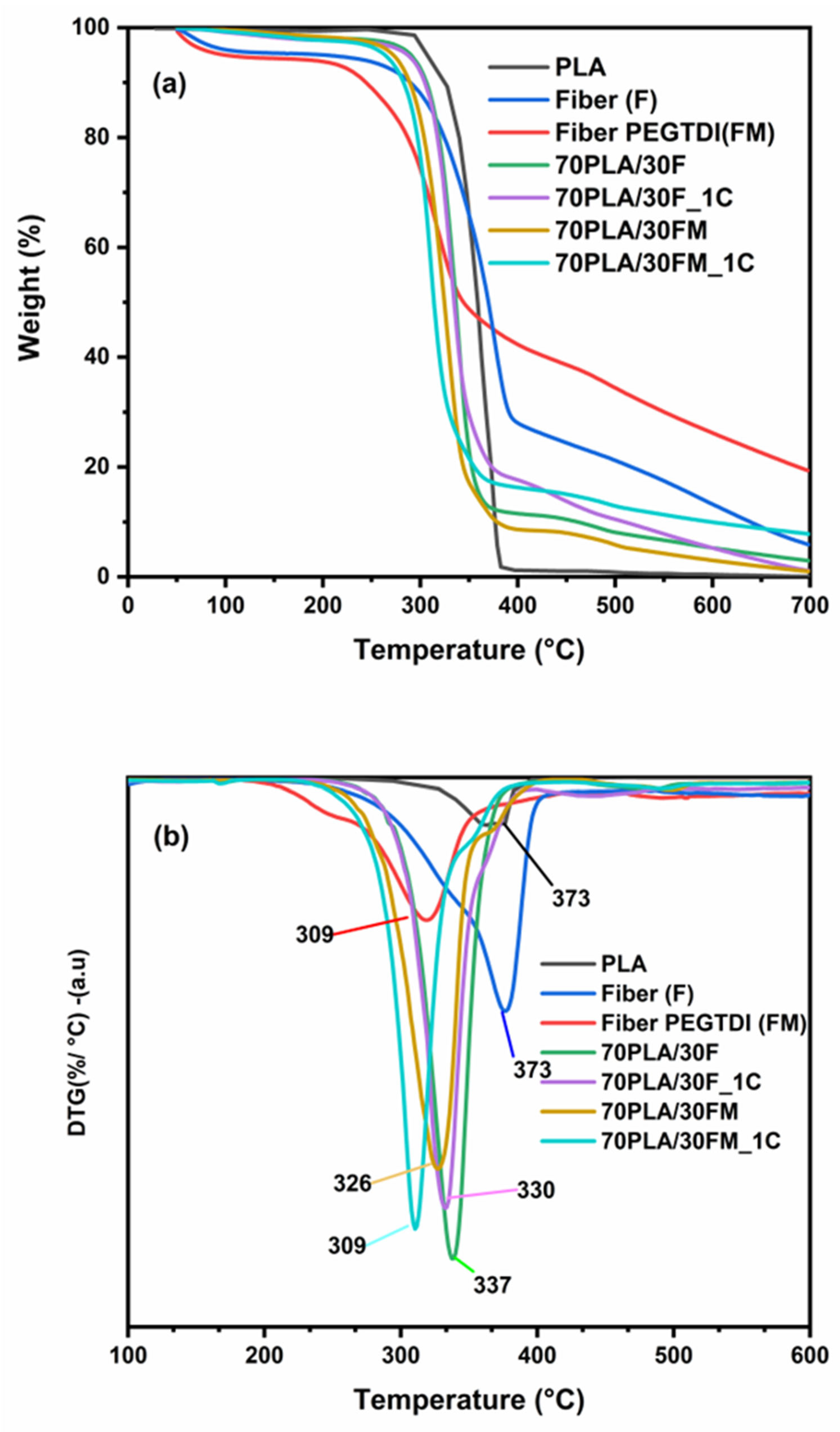
Figure 9 shows the thermogravimetric profiles of PLA and composites with 70% PLA and 30% chemically modified pine wood flour, with or without a compatibilizing agent. PLA exhibits a single degradation stage, with decomposition beginning around 292 °C and accelerated mass loss between 292 and 373 °C. The degradation process is complete at 373 °C and the residual mass between 600 °C and 700 °C is less than 2%, consistent with findings for aliphatic polyesters [31]. In contrast, the curve for pine wood flour demonstrated a multi-stage degradation process. The decomposition process can be divided into three stages, corresponding to the degradation of hemicellulose (224–334 °C), cellulose (334–373 °C), and lignin, the latter of which exhibits a more gradual degradation up to 700 °C. The residual mass of approximately 4% is related to the formation of carbon derived from lignin and extractives, a typical behavior of lignocellulosic fibers [32]. When the pine wood flour was functionalized with PEGTDI, the Tmax shifted to 309 °C, indicating the incorporation of thermolabile polymer segments and the presence of urethane linkages that are susceptible to thermal cleavage [23]. This modification reduced the degradation rate, resulting in a notable increase in residual mass at 700 °C (approximately 20%), likely due to crosslinking reactions and the lower surface hydrophilicity, which favor the formation of more stable carbonaceous structures. The 70PLA/30F and 70PLA/30F_1C composites demonstrated intermediate thermal stability compared to their constituent elements. For the 70PLA/30F blend, the Tmax decreased to 337 °C, attributable to the presence of hemicellulose and cellulose, which have lower degradation temperatures. The addition of 1% of the compatibilizer maintained a Tmax near 330 °C, suggesting that this additive improves interfacial adhesion but not thermal stability. This trend has also been reported in PLA–pine wood flour composites treated with isocyanates or acrylic compatibilizers [33]. Finally, the composites with functionalized pine wood flour (70PLA/30FM and 70PLA/30FM_1C) exhibited the lowest Tmax values (326 °C and 309 °C, respectively). These findings indicate that chemical modification with PEGTDI reduces the thermal stability of the pine wood flour and, consequently, of the composite. The addition of the compatibilizer accentuates this loss, indicating that the incorporated functional groups promote early material degradation. Overall, the results suggest that pine wood flour functionalization using PEGTDI enhances fiber–matrix adhesion but compromises the overall thermal resistance of the system, as previously reported [22,34].

4. Conclusions

This study demonstrated that the integration of PEGTDI-modified pine wood flour and PLA-g-MA as a compatibilizer allows for effective engineering of the biocomposite interphase through the formation of urethane and ester/anhydride linkages, which are critical for optimizing adhesion in the pine wood flour–matrix system. While this dual modification strategy successfully increased the tensile modulus and promoted polymer crystallinity via the coupling agent, the observed reductions in tensile strength and thermal stability suggest that enhanced interfacial bonding does not inherently translate to superior degradation resistance or stress-transfer efficiency.

Author Contributions

Conceptualization, A.G.A.M. and F.J.M.S.; methodology, I.F.F.J., E.O.G. and F.J.M.S.; formal analysis, A.G.A.M., G.C.E., R.G.N. and F.J.M.S.; investigation, I.F.F.J., A.G.A.M. and F.J.M.S.; resources, E.O.G., G.C.E., R.G.N. and F.J.M.S.; writing—original draft preparation, I.F.F.J. and F.J.M.S.; writing—review and editing, G.C.E., R.G.N., A.G.A.M. and F.J.M.S.; supervision, A.G.A.M. and F.J.M.S.; project administration, F.J.M.S.; funding acquisition, F.J.M.S. All authors have read and agreed to the published version of the manuscript.

Funding

This research was funded by the University of Guadalajara CUCEI, grant number U006EST PROSNI 2025. Itzel F. Franco Jacobo is grateful for the financial support from CONACYT granted with scholarship number 1240818.

Data Availability Statement

The raw data supporting the conclusions of this article will be made available by the authors on request.

Acknowledgments

The authors thank the Universidad de Guadalajara for providing the facilities and support to conduct this research in their laboratories.

Conflicts of Interest

The authors declare no conflicts of interest.

Abbreviations

PLApoly(lactic acid)
PEGTDIpoly(propylene glycol) toluene 2,4-diisocyanate terminated
FMmodified fiber
Ccompatibilizing agent

References

  1. Al-Azad, N.; Asril, M.F.M.; Shah, M.K.M. A Review on Development of Natural Fibre Composites for Construction Applications. J. Mater. Sci. Chem. Eng. 2021, 9, 1–9. [Google Scholar] [CrossRef]
  2. Olonisakin, K.; Li, R.; Zhang, X.X.; Xiao, F.; Gao, J.; Yang, W. Effect of TDI-Assisted Hydrophobic Surface Modification of Microcrystalline Cellulose on the Tensile Fracture of MCC/PLA Composite, and Estimation of the Degree of Substitution by Linear Regression. Langmuir 2021, 37, 793–801. [Google Scholar] [CrossRef] [PubMed]
  3. Bledzki, A.K.; Reihmane, S.; Gassan, J. Properties and modification methods for vegetable fibers for natural fiber composites. J. Appl. Polym. Sci. 1996, 59, 1329–1336. [Google Scholar] [CrossRef]
  4. Sepe, R.; Bollino, F.; Boccarusso, L.; Caputo, F. Influence of chemical treatments on mechanical properties of hemp fiber reinforced composites. Compos. Part B Eng. 2018, 133, 210–217. [Google Scholar] [CrossRef]
  5. George, J.; Sreekala, M.S.; Thomas, S. A review on interface modification and characterization of natural fiber reinforced plastic composites. Polym. Eng. Sci. 2001, 41, 1471–1485. [Google Scholar] [CrossRef]
  6. Mohammadi, M.; Ishak, M.R.; Sultan, M.T.H. Exploring Chemical and Physical Advancements in Surface Modification Techniques of Natural Fiber Reinforced Composite: A Comprehensive Review. J. Nat. Fibers 2024, 21, 2408633–2408678. [Google Scholar] [CrossRef]
  7. Colwell, J.; Halley, P.; Varley, R.; Heidarian, P.; McNally, T.; Peijs, T.; Vandi, L. Self-reinforced biodegradable thermoplastic composites. Adv. Compos. Hybrid Mater. 2024, 7, 128–147. [Google Scholar] [CrossRef]
  8. Seo, Y.R.; Bae, S.U.; Gwon, J.; Wu, Q.; Kim, B.J. Effects of Methylenediphenyl 4,4′-Diisocyanate and Maleic Anhydride as Coupling Agents on the Properties of Polylactic Acid/Polybutylene Succinate/Wood Flour Biocomposites by Reactive Extrusion. Materials 2020, 13, 1660. [Google Scholar] [CrossRef] [PubMed]
  9. Hejna, A.; Przybysz-Romatowska, M.; Kosmela, P.; Zedler, Ł.; Korol, J.; Formela, K. Recent advances in compatibilization strategies of wood-polymer composites by isocyanates. Wood Sci. Technol. 2020, 54, 1091–1119. [Google Scholar] [CrossRef]
  10. Xie, X.; Zhang, C.; Weng, Y.; Diao, X.; Song, X. Effect of Diisocyanates as Compatibilizer on the Properties of BF/PBAT Composites by In Situ Reactive Compatibilization, Crosslinking and Chain Extension. Materials 2020, 13, 806. [Google Scholar] [CrossRef]
  11. Zhao, X.; Li, K.; Wang, Y.; Tekinalp, H.; Larsen, G.; Rasmussen, D.; Ginder, R.S.; Wang, L.; Gardner, D.J.; Tajvidi, M.; et al. High-Strength Polylactic Acid (PLA) Biocomposites Reinforced by Epoxy-Modified Pine Fibers. ACS Sustain. Chem. Eng. 2020, 8, 13236–13247. [Google Scholar] [CrossRef]
  12. Lv, S.; Gu, J.; Tan, H.; Zhang, Y. Modification of wood flour/PLA composites by reactive extrusion with maleic anhydride. J. Appl. Polym. Sci. 2016, 133, 3295–43295. [Google Scholar] [CrossRef]
  13. TAPPI. TAPPI T 204 cm-97: Solvent Extractives of Wood and Pulp; TAPPI Press: Atlanta, GA, USA, 1997. [Google Scholar]
  14. TAPPI. TAPPI T 222 os-74: Acid-Insoluble Lignin in Wood and Pulp; TAPPI Press: Atlanta, GA, USA, 1974. [Google Scholar]
  15. Muenprasat, D.; Suttireungwong, S.; Tongpin, C. Functionalization of Poly(Lactic Acid) with Maleic Anhydride for Biomedical Application. J. Met. Mater. Miner. 2010, 20, 189–192. [Google Scholar]
  16. Joséphe, K.; Thomas, S.; Pavithran, C. Effect of chemical treatment on the tensile properties of short sisal fibre-reinforced polyethylene composites. Polymer 1996, 37, 5139–5149. [Google Scholar] [CrossRef]
  17. Valle Reyes, O.S.; Orozco-Guareño, E.; Hernández-Montelongo, R.; Alvarado Mendoza, A.G.; Martínez Chávez, L.; González Núñez, R.; Aguilar Martínez, J.; Moscoso Sánchez, F.J. Grafting of Lactic Acid and ε-Caprolactone onto Alpha-Cellulose and Sugarcane Bagasse Cellulose: Evaluation of Mechanical Properties in Polylactic Acid Composites. Polymers 2024, 16, 2964. [Google Scholar] [CrossRef]
  18. Jang, H.; Kwon, S.; Kim, S.J.; Park, S. Maleic Anhydride-Grafted PLA Preparation and Characteristics of Compatibilized PLA/PBSeT Blend Films. Int. J. Mol. Sci. 2022, 23, 7166. [Google Scholar] [CrossRef]
  19. Maharana, T.; Pattanaik, S.; Routaray, A.; Nath, N.; Sutar, A.K. Synthesis and characterization of poly(lactic acid) based graft copolymers. React. Funct. Polym. 2015, 93, 47–67. [Google Scholar] [CrossRef]
  20. Lehto, J.; Louhelainen, J.; Kłosińska, T.; Drożdżek, M.; Alén, R. Characterization of alkali-extracted wood by FTIR-ATR spectroscopy. Biomass Convers. Biorefin. 2018, 8, 847–855. [Google Scholar] [CrossRef]
  21. Somsuk, N.; Pramoonmak, S.; Chongkolnee, B.; Tipboonsri, P.; Memon, A. Enhancing Mechanical Properties of 3D-Printed PLA Composites Reinforced with Natural Fibers: A Comparative Study. J. Compos. Sci. 2025, 9, 180. [Google Scholar] [CrossRef]
  22. Gironès, J.; Lopez, J.P.; Vilaseca, F.; Bayer, R.; Herrera-Franco, P.J.; Mutjé, P. Biocomposites from Musa textilis and polypropylene: Evaluation of flexural properties and impact strength. Compos. Sci. Technol. 2011, 71, 122–128. [Google Scholar] [CrossRef]
  23. Faruk, O.; Bledzki, A.K.; Fink, H.P.; Sain, M. Biocomposites reinforced with natural fibers: 2000–2010. Prog. Polym. Sci. 2012, 37, 1552–1596. [Google Scholar] [CrossRef]
  24. Battegazzore, D.; Abt, T.; Maspoch, M.L.; Frache, A. Multilayer cotton fabric bio-composites based on PLA and PHB copolymer for industrial load carrying applications. Compos. Part B Eng. 2019, 163, 761–768. [Google Scholar] [CrossRef]
  25. Kabir, M.M.; Wang, H.; Lau, K.T.; Cardona, F. Chemical treatments on plant-based natural fibre reinforced polymer composites: An overview. Compos. Part B Eng. 2012, 43, 2883–2892. [Google Scholar] [CrossRef]
  26. Mazur, K.E.; Borucka, A.; Kaczor, P.; Gądek, S.; Bogucki, R.; Mirzewiński, D.; Kuciel, S. Mechanical, Thermal and Microstructural Characteristic of 3D Printed Polylactide Composites with Natural Fibers: Wood, Bamboo and Cork. J. Polym. Environ. 2022, 30, 2341–2354. [Google Scholar] [CrossRef]
  27. Herrera-Franco, P.J.; Valadez-González, A. A study of the mechanical properties of short natural-fiber reinforced composites. Compos. Part B Eng. 2005, 36, 597–608. [Google Scholar] [CrossRef]
  28. Shi, X.; Zhang, G.; Phuong, T.; Lazzeri, A. Synergistic Effects of Nucleating Agents and Plasticizers on the Crystallization Behavior of Poly(lactic acid). Molecules 2015, 20, 1579–1593. [Google Scholar] [CrossRef]
  29. Dobrzyńska-Mizera, M.; Knitter, M.; Woźniak-Braszak, A.; Baranowski, M.; Sterzyński, T.; Di Lorenzo, M.L. Poly(l-Lactic Acid)/Pine Wood Bio-Based Composites. Materials 2020, 13, 3776. [Google Scholar] [CrossRef]
  30. Jin, R.; Chen, Z.; Ouyang, Y.; Lin, X.; Dai, X.; Zhang, S.; Xu, R.; Wang, Z.; Peng, Y. Enhancing the Non-Isothermal Crystallization Kinetics of Polylactic Acid by Incorporating a Novel Nucleating Agent. Polymers 2024, 16, 3204. [Google Scholar] [CrossRef] [PubMed]
  31. Xiang, S.; Feng, L.; Bian, X.; Li, G.; Chen, X. Evaluation of PLA content in PLA/PBAT blends using TGA. Polym. Test. 2020, 81, 106211. [Google Scholar] [CrossRef]
  32. Yang, H.; Yan, R.; Chen, H.; Lee, D.H.; Zheng, C. Characteristics of hemicellulose, cellulose and lignin pyrolysis. Fuel 2007, 86, 1781–1788. [Google Scholar] [CrossRef]
  33. Asaithambi, B.; Ganesan, G.S.; Ananda Kumar, S. Banana/sisal fibers reinforced poly(lactic acid) hybrid biocomposites; influence of chemical modification of BSF towards thermal properties. Polym. Compos. 2017, 38, 1053–1062. [Google Scholar] [CrossRef]
  34. Nourbakhsh, A.; Ashori, A. Fundamental studies on wood–plastic composites: Effects of fiber concentration and mixing temperature on the mechanical properties of poplar/PP composite. Polym. Compos. 2008, 29, 569–573. [Google Scholar] [CrossRef]
Figure 1. Schematic representation of the reaction for synthesis of the PLA-g-MA grafting copolymer. Reproduced from [15], J. Met. Mater. Miner., 2010.
Macromol 06 00025 g001
Figure 2. The proposed reaction scheme between PEG-TDI and pine wood flour.
Macromol 06 00025 g002
Figure 3. FTIR spectra of PLA and PLA-g-MA: (a) full FTIR spectra from 4000 to 500 cm−1; (b) absorbance at 1850 cm−1 and 1770 cm−1 indicate asymmetric and symmetric stretching vibration of carbonyls in the grafted MA; and (c) the absorption bands between 710 and 644 cm−1 indicate torsional vibrations associated with anhydride groups grafted to the PLA chain.
Macromol 06 00025 g003
Figure 4. FTIR spectra of the modified pine wood flour (FM) and the pine wood flour.
Macromol 06 00025 g004
Figure 5. SEM images at magnifications of 100×: (a) unmodified pine wood flour and (b) PEGTDI-modified pine wood flour.
Macromol 06 00025 g005
Figure 6. Mechanical properties of composite materials: (a) Young’s Modulus; (b) tensile strength; (c) flexural modulus; and (d) flexural strength.
Macromol 06 00025 g006
Figure 7. SEM photomicrographs of the fracture surface of the composite materials: (a) 70PLA_30F; (b) 70PLA_30FM; (c) 70PLA_30F_1C; and (d) 70PLA_30FM_1C.
Macromol 06 00025 g007
Figure 8. DSC thermograms of PLA and its composites.
Macromol 06 00025 g008
Figure 9. Thermogravimetric analysis of neat PLA and its composites: (a) TGA curves; and (b) Derivative Thermogravimetry (DTG) curves.
Macromol 06 00025 g009
Table 1. Formulations for PLA pine wood flour compounds.
FormulationsCodePLA
(wt%)
Pine Wood Flour
(wt%)
FMGrafting Percentages of PLA-g-MA
(wt%)
SamplesPLA1000
PLA/pine wood flour90PLA/10F955
80PLA/20F8020
70PLA/30F7030
PLA/FM90PLA/10FM9010
80PLA/20FM8020
70PLA/30FM7030
PLA/pine wood flour–1% grafted copolymer90PLA/10F_1C9010 1
80PLA/20F_1C8020 1
70PLA/30F_1C7030 1
PLA/FM–1% grafted copolymer90PLA/10FM_1C90101
80PLA/20FM_1C80201
70PLA/30FM_1C70301
Table 2. Glass transition temperature (Tg), enthalpy of fusion (ΔHm), melting temperature (Tm), enthalpy of crystallization (ΔHcc), and crystallization temperature (Tcc) values obtained via DSC.
SamplesTg
(°C)
ΔHcc
J/g
Tcc
(°C)
ΔHm
(J/g)
Tm
(°C)
Xc
(%)
PLA59.1121.2299.2144.95167.0625.35
90PLA/10F58.7222.5198.1441.5167.0222.54
80PLA/20F57.5313.54100.4333.59166.1126.78
70PLA/30F57.5017.0299.3236.85166.5030.27
90PLA/10F_1C59.4223.1981.8254.08165.2036.67
80PLA/20F_1C57.1411.2384.6238.89165.0136.94
70PLA/30F_1C57.225.9292.4934.27166.5743.27
90PLA/10FM58.9519.6499.3739.32166.2923.36
80PLA/20FM58.5417.6899.8536.01166.5424.48
70PLA/30FM58.5516.5299.3636.90166.5231.11
90PLA/10FM_1C58.1522.6198.2041.64166.5822.59
80PLA/20FM_1C57.5311.50100.2228.99166.1123.36
70PLA/30FM_1C57.3119.6798.8741.07165.3632.66
Disclaimer/Publisher’s Note: The statements, opinions and data contained in all publications are solely those of the individual author(s) and contributor(s) and not of MDPI and/or the editor(s). MDPI and/or the editor(s) disclaim responsibility for any injury to people or property resulting from any ideas, methods, instructions or products referred to in the content.