


Abstract
Introduction: High-Intensity Focused Ultrasound (HIFU) is a widely used non-invasive esthetic treatment for facial/neck rejuvenation, inducing thermal coagulation for neocollagenesis. Despite its general safety, its non-optimal application risks neurological adverse events like tinnitus, trigeminal neuralgia, and headaches. Materials and Methods: Out of a pool of 124 patients treated with HIFU (Dual Hi; Med & Tech, Occhiobello, Italy) by experienced esthetic clinicians, four patients developed neurological or otological disturbances, which are presented as descriptive clinical case reports. These included acute tinnitus, exacerbation of pre-existing tinnitus, trigeminal neuralgia during treatment, and post-procedural headaches. To contextualize the clinical findings, relevant published literature on neurological adverse events associated with esthetic HIFU was reviewed in a non-systematic manner using major scientific databases, and used to support descriptive clinical interpretation rather than formal systematic analysis. Results: Rare transient events include acute tinnitus post-HIFU; exacerbated pre-existing tinnitus; trigeminal neuralgia during a procedure; and post-session headaches. Potential mechanisms might include thermal and mechanical nerve injury adjacent to the superficial musculoaponeurotic system (SMAS); all cases resolved successfully through tailored approaches—spontaneous resolution, corticosteroids plus hyperbaric oxygen therapy, analgesics, or ibuprofen. Conclusions: Neurological adverse effects from esthetic HIFU are uncommon/self-limiting but underscore the need for operator training, anatomical expertise, and patient history screening. Standardized protocols are essential for safety.
1. Introduction
High-Intensity Focused Ultrasound (HIFU) has gained rapid and widespread popularity in esthetic and regenerative medicine as a non-invasive alternative to traditional surgical procedures such as rhytidectomy. HIFU’s appeal lies in its minimal recovery time, reduced scarring, and ability to achieve noticeable rejuvenation effects without invasive intervention [1].
Clinical studies have demonstrated that HIFU can improve skin laxity and facial contouring through controlled thermal effects delivered at specific dermal and subdermal depths. Reported outcomes include dermal remodeling, collagen denaturation and reorganization, neocollagenesis and progressive tissue contraction [2] with a favorable safety profile characterized predominantly by transient and self-limited effects such as erythema, edema, and mild discomfort [3].
Since FDA approval in 2009 for eyebrow lifting, HIFU’s clinical use has expanded to face, neck, and décolleté rejuvenation, with additional off-label applications including body contouring, acne treatment, and hyperhidrosis management [4,5].
However, the increasing diffusion of these devices, often beyond specialized dermatologic or surgical settings, has been accompanied by reports of more severe and unpredictable adverse events. Described adverse events include fat atrophy, burns, cutaneous ulceration, and subcutaneous necrosis, particularly when inappropriate device settings are used or when treatment is performed by practitioners lacking sufficient anatomical expertise [6,7,8]. More concerning, though still underreported, are neurological and otological complications such as facial neuralgia, hypoesthesia, transient neuropraxia, tinnitus, and other auditory disturbances. Although rare, these events may significantly affect patients’ daily functioning and quality of life, most likely resulting from inadvertent energy delivery to sensitive anatomical structures in proximity to cranial nerves and vascular branches. The associated symptoms can persist variably, ranging from a few days after treatment to several months [9].
Patients may also experience procedure-related sensations such as pain, tingling, numbness, or paresthesia, which can persist for several days after treatment, occasionally lasting up to 10 days. The intensity and duration of these symptoms are highly variable, depending on individual sensitivity, treatment parameters, and—crucially—the clinician’s expertise in modulating ultrasound energy levels and frequencies according to the anatomical region and patient-specific characteristics [9].
Given the growing use of HIFU in esthetic practice, it is essential to improve awareness and recognition of such complications.
The aim of the present study is to report four clinical cases of neurological and otologic adverse events associated with HIFU treatment, supplemented by a non-systematic review of the literature to contextualize their clinical presentation, management, and outcomes. By highlighting these uncommon but clinically relevant reactions, this case series seeks to improve awareness of potential neuro-otologic complications and to support safer and more informed clinical practice, emphasizing the importance of operator training, detailed anatomical knowledge, and adherence to validated treatment protocols.
2. Methods
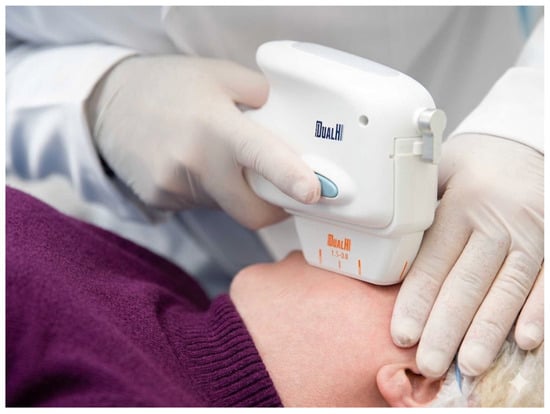
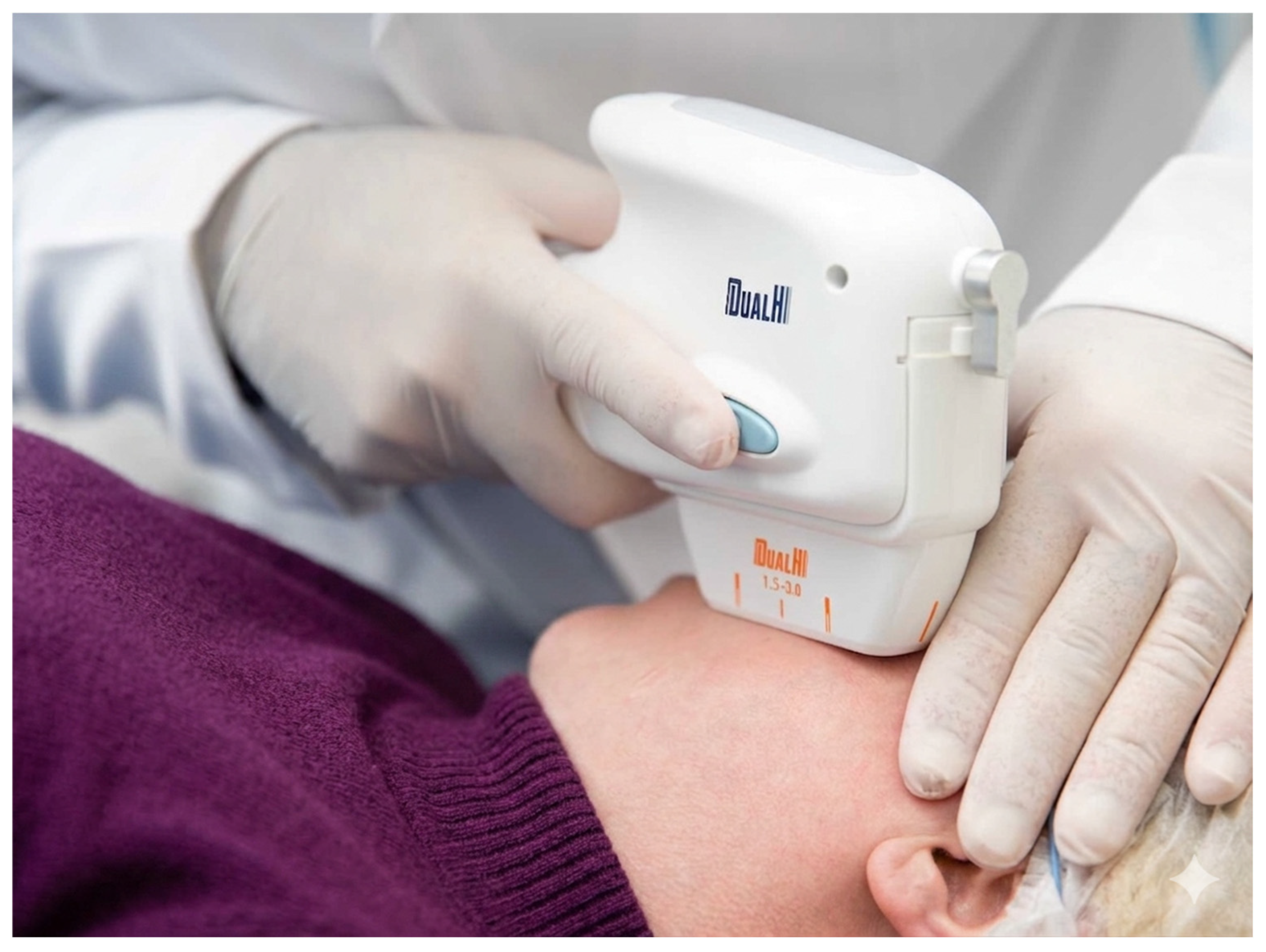
Out of a pool of 124 patients who underwent HIFU (Dual Hi; Med & Tech, Occhiobello, Italy) (Figure 1) treatment by expert esthetic clinicians, only 4 patients reported neurological disturbances, which were subsequently analyzed as illustrative cases in this review.
Figure 1.
A close-up view of the Dual Hi handpiece. The handpiece accommodates cartridges with working depths of 1.5 mm, 3.0 mm, or 4.5 mm, depending on the target tissue (superficial dermis, deep dermis, or SMAS) and tailored to the patient’s skin laxity and characteristics.
The present observational case series was conducted in a single-center private dental practice in Como, Italy. All 124 patients were treated exclusively with the same HIFU device, using individualized treatment protocols based on clinical indication and patient characteristics. All procedures were performed by the same experienced operator, and adverse neurological or otological events were evaluated and documented by the same clinician during follow-up and recall visits.
Ethical review and approval were waived by the scientific ethics committee, as the study involved the use of a CE-certified medical device applied exclusively in line with its designated clinical purpose. Patients received comprehensive information regarding the treatment’s mechanism of action, procedure details, application, expected benefits, and contraindications. Treatments were conducted solely by experienced clinicians, and all participants provided written informed consent for the intervention, protection of privacy, and utilization of anonymized clinical data and documentation for scientific publication. No deviations from standard practice or additional risks to participants were introduced. The study adhered to national and institutional regulations governing non-interventional observational research, in full compliance with the principles of the Declaration of Helsinki.
To contextualize the reported cases and support the clinical discussion, relevant published literature regarding neurological adverse events associated with HIFU in esthetic medicine was consulted. Scientific databases including PubMed, Scopus, and Web of Science were screened for English-language articles addressing complications such as tinnitus, headaches, and trigeminal neuralgia following facial and neck HIFU treatments. The selected literature was used descriptively to compare clinical findings, discuss possible mechanisms, and emphasize the importance of proper HIFU application and operator expertise in maintaining treatment safety. No restrictions were applied regarding study design or publication year. The inclusion criteria required articles to provide detailed methodologies and objective clinical assessments ensuring a comprehensive evaluation. Studies lacking rigorous methodological frameworks or published in non-indexed journals were excluded.
No formal risk-of-bias assessment or systematic data extraction was performed. The content of the selected studies was summarized descriptively, focusing on reported cases of tinnitus, headaches, and trigeminal neuralgia, highlighting the importance of proper and careful HIFU application to maintain its minimally invasive and safe profile.
Biological Effect, Characteristics and Mechanism of Action of Dual Hi
The Dual Hi is an energy-based esthetic regenerative medical device delivering controlled acoustic energy with precise localized thermal action to stimulate skin regeneration and rejuvenation. The Dual Hi comprises two integrated HIFU handpieces within a single compact unit; these two units allow the use of different cartridges with distinct tissue targets, including 1.5 mm, 3.0 mm, and 4.5 mm depths for the facial area, with an additional 6.5 mm cartridge for the neck and abdomen. The HIFU handpiece employs ultrasound (US) waves—mechanical elastic vibrations exceeding 20 kHz—that propagate through elastic media. These waves require a material medium for transmission and exhibit variations in velocity and impedance across different tissues, resulting in phenomena such as reflection, refraction, diffraction, absorption, beam divergence, and deflection. In HIFU a piezoelectric transducer converts electrical energy into a focused acoustic beam, delivering energy along precise lines of thermocoagulation points (TCPs, <1 mm3) at depths of 1.5–4.5 mm (targeting papillary/reticular dermis and SMAS) via cartridges with frequencies of 2–9 MHz and energies up to 2.5 J, coupled through gel. Intensity attenuates exponentially through the tissues, inducing focal temperatures > 65 °C for 2–3 s, sufficient for coagulative necrosis via protein denaturation, organelle rupture, and enzymatic digestion, while minimizing cavitation (prevalent at lower kHz frequencies). HIFU enables non-invasive facial lifting by targeting multiple depths: 1.5 mm for the superficial dermis (papillary layer, improving texture and fine wrinkles), 3 mm for the deep dermis/reticular layer (filler-like volume restoration), and 4.5 mm for the SMAS (lifting effect on the muscle-aponeurotic system), with an optional 6.5 mm for submental fat. Clinical protocols typically involve 3 sessions every 3 months (45–60 min each, 350–500 shots per face), using adjustable pitch (0.5–2 mm) to tailor density of TCPs based on aging severity—denser for advanced laxity, sparser for milder cases. Outcomes include enhanced skin luminosity, nasolabial fold reduction, cheek/jawline contouring, and neocollagenogenesis without anesthesia or downtime, mimicking surgical results while preserving surrounding tissues. Thermal effects dominate via Joule heating, converting mechanical energy into molecular kinetic motion for rapid focal heating (65–70 °C), far exceeding traditional thermoablation needs (43 °C for 60 min) and bypassing perfusion cooling limitation. Non-thermal mechanical effects include stable/inertial cavitation (oscillating gas microbubbles causing membrane shear via microstreaming), radiation forces, and chemical shifts (pH changes, permeabilization), triggering inflammation and tissue remodeling. Post-treatment, coagulative necrosis initiates a regenerative cascade, stimulating fibroblast proliferation for collagen/elastin synthesis, particularly effective on SMAS laxity and dermal flattening in chronoaging. HIFU uniquely reaches SMAS depths inaccessible to radiofrequency or superficial devices, offering precision via real-time imaging and cartridges, with minimal cavitation risk at MHz frequencies (vs. kHz for body lipolysis).
HIFU falls within the category of technological regenerative esthetic medicine devices named energy-based devices (EBDs), together with radiofrequency and non-ablative laser systems. In addition, these devices are widely regarded as safe when used by trained clinicians, with a low incidence of adverse effects, typically limited to transient erythema, mild edema, or temporary discomfort. HIFU systems such as the Dual Hi are positioned as a non-invasive alternative or adjunct to traditional surgical lifting procedures, offering patients the possibility of esthetic improvement without the risks, costs, and recovery time associated with surgery. Their clinical value lies in the combination of procedural efficiency, relatively short treatment times, absence of anesthesia, and rapid post-treatment recovery, making them particularly appealing in modern esthetic practice focused on minimally invasive, regenerative approaches.
3. Case Descriptions
3.1. Case 1—Sudden Onset of Tinnitus Following Repeated HIFU Sessions
A 61-year-old male, with no prior history of otologic or neurological disorders, underwent two HIFU sessions spaced three months apart. The treatment was performed on the lower face and neck using 3.0 mm and 4.5 mm cartridges targeting the deep dermis and SMAS layers. Energy settings ranged from approximately 0.8–1.2 J per shot depending on tissue depth and anatomical region. A total of approximately 400 shots were delivered per session, with a treatment duration of about 45 min. Shortly after the second treatment (within a few hours post-procedure), he developed acute unilateral tinnitus without associated hearing loss or vertigo. No pharmacological treatment was administered, as symptoms resolved spontaneously within two weeks following discontinuation of the procedure without medical intervention. No recurrence was observed during the six-month follow-up period.
3.2. Case 2—Exacerbation of Pre-Existing Tinnitus After Multiple HIFU Treatments
A 57-year-old female, with a known history of mild intermittent tinnitus, received four HIFU sessions at three-month intervals. HIFU was applied to the full face and submental region using 1.5 mm, 3.0 mm, and 4.5 mm cartridges. Energy parameters ranged from 0.3 to 0.6 J for the superficial dermis (1.5 mm), 0.6–1.0 J for the mid-dermis (3.0 mm), and 0.8–1.3 J for SMAS-level applications (4.5 mm). Each session included approximately 450–500 shots and lasted around 50–60 min. Worsening of tinnitus was reported within 24–48 h after the final session, particularly noticeable at night. Management included oral corticosteroids and ten hyperbaric oxygen therapy sessions, resulting in marked improvement. Oral corticosteroid therapy consisted of a short tapering course of prednisone (initial dose 25–50 mg/day orally for 5–7 days, followed by gradual dose reduction over the subsequent days). Hyperbaric oxygen therapy was administered as 10 sessions (2.0 ATA, 60 min per session, once daily). At follow-up, only occasional nocturnal tinnitus persisted.
3.3. Case 3—Acute Trigeminal Neuralgia Triggered by Single HIFU Application
A 75-year-old male, who had not reported previous neurological conditions, underwent one HIFU treatment. Pain onset occurred during the procedure (within minutes of energy delivery), when he experienced sharp, shooting facial pain along the trigeminal distribution. The procedure involved treatment of the midface and mandibular region using 3.0 mm and 4.5 mm cartridges directed to the deep dermal and SMAS layers. Energy levels ranged between 0.8 and 1.2 J per shot. Approximately 350 shots were administered before immediate interruption of the procedure, with a total treatment time of approximately 30 min. The patient subsequently disclosed a history of trigeminal neuralgia. Treatment was discontinued immediately, and symptoms resolved promptly with analgesic therapy, with complete remission thereafter. Analgesic treatment consisted of oral non-steroidal anti-inflammatory drugs, specifically ibuprofen 600 mg administered orally every 8 h as needed for pain control, for a total duration of approximately 3–5 days.
3.4. Case 4—Transient Headache and Migraine After Repeated HIFU Sessions
A 73-year-old female, with no prior history of migraine or chronic headache, underwent four HIFU sessions at three-month intervals. The patient underwent full-face and neck HIFU treatment using combined 1.5 mm, 3.0 mm, and 4.5 mm transducers. Energy settings were consistent with standard esthetic protocols (0.3–0.6 J for 1.5 mm cartridges, 0.6–1.0 J for 3.0 mm cartridges, and 0.8–1.3 J for 4.5 mm cartridges). Approximately 450 shots were delivered per session, with an average treatment duration of 50–60 min. Recurrent tension-type headache associated with mild photophobia developed within 24 h after the final treatment session. Conservative management with ibuprofen led to full resolution of symptoms within one week, with no further episodes reported at follow-up. Ibuprofen was prescribed at a dosage of 600 mg orally every 8 h for 3–5 days, with treatment discontinued upon complete symptom resolution.
Patients independently sought specialist consultations (neurology and/or otolaryngology) on their own initiative; these evaluations were not requested by the treating clinicians and no structured referral protocol was implemented. Management of adverse events was performed on a case-by-case basis according to symptom severity and clinical judgment. When pharmacological treatment was required, standard oral medications were prescribed at commonly used therapeutic doses, with duration tailored to symptom resolution.
The main clinical characteristics of the reported cases, including patient history, treatment protocols, adverse events, management, and outcomes, are summarized in Table 1.
Table 1.
Summary of reported adverse events following HIFU treatments in four clinical cases. The table outlines patient demographics, pre-existing conditions, treatment protocols, type and timing of adverse events, management strategies, clinical outcomes, and follow-up findings, highlighting the generally transient nature and favorable resolution of symptoms after appropriate intervention or treatment discontinuation.
4. Discussion
Out of a pool of 124 patients who underwent HIFU treatment performed by expert esthetic clinicians, four individuals reported transient neurological or otologic disturbances, which were subsequently analyzed as illustrative cases in this study. Among them, one patient developed acute trigeminal neuralgia during the procedure, later revealing a pre-existing but previously undisclosed history of neuralgia, suggesting that underlying nerve hypersensitivity may increase susceptibility to post-procedural neuropathic reactions. Two patients experienced tinnitus of varying intensity and duration—one de novo and one as an exacerbation of a pre-existing condition—both resolving partially or completely with conservative management. Additionally, one patient reported transient headache and migraine-like symptoms following repeated sessions, which resolved spontaneously with standard analgesic therapy.
Both tinnitus and headache (including tension-type headache and migraine) fall within the spectrum of neurological disorders. While headache is conventionally classified as a neurological condition, tinnitus is a multisystemic symptom that can originate from causes beyond the nervous system. Its etiology is heterogeneous and may include neurological factors, otorhinolaryngological conditions (e.g., hearing loss, cochlear damage, otosclerosis, infections), vascular issues (e.g., turbulence, hypertension), or psychological and stress-related factors [10]. This complexity complicates direct attribution of causality to esthetic ultrasound procedures. Nevertheless, these observations align with previously published case reports describing neurological adverse events following HIFU [6]. Supporting the potential interaction between ultrasound and neurological disturbances, tinnitus and headaches have also been reported as complications or side effects of exposure to high-frequency sounds and ultrasound in non-esthetic contexts, particularly occupational settings. Symptoms such as headache, tinnitus, dizziness, nausea, and ear fullness are commonly reported as subjective effects following exposure to ultrasound or very high-frequency sounds.
These findings might suggest that a deviation from recommended esthetic protocols —particularly excessive energy delivery, inadequate depth control, or neglect of anatomical variability—may result in transient or permanent neurological and peripheral nerve injuries. Documented complications include neuropraxia, hypoesthesia, and motor deficits involving the marginal mandibular, temporal or other superficial branches of the facial nerve [6,8].
A systematic review of HIFU complications similarly reported transient perioral numbness resolving within weeks, reinforcing that even superficial applications may affect neural structures. Friedmann et al. [3] further documented a series of five patients treated with focused ultrasound, in which transient facial nerve paralysis, skin ulceration, and subcutaneous atrophy occurred, underscoring the risks of aggressive protocols.
Thermal and mechanical injury mechanisms have been hypothesized, particularly when energy penetrates beyond the superficial musculoaponeurotic system (SMAS) [1].
Beyond direct nerve injury, the literature on occupational and environmental exposure to very high-frequency sound and ultrasound highlights subjective effects—headache, tinnitus, dizziness, nausea, and ear fullness—that can arise even at sub-therapeutic intensities. Proposed mechanisms include altered auditory perception through sound wave vibration, inflammatory responses manifesting as headache, and nerve fiber injury leading to paresthesia. These parallels suggest that similar biological pathways may contribute to the adverse symptoms observed in esthetic HIFU.
Despite these associations, there is currently no robust evidence that HIFU, when applied within validated esthetic protocols, is causally linked to chronic headache, migraine, or persistent tinnitus. Most reported events are transient and reversible, yet their occurrence emphasizes the need for vigilance.
Given the expanding use of high-energy ultrasound in esthetic medicine and the potential for these adverse events, often in the absence of standardized safety guidelines or anatomical mapping, further systematic research is warranted.
Administering structured questionnaires to patients who have undergone HIFU, and correlating their reported neurological symptoms with detailed medical histories, may allow identification of predisposing factors, including prior trigeminal or facial nerve disorders. Furthermore, such investigations may inform modifications to energy settings, penetration depth, and treatment planning to reduce the risk of neural injury.
From a hypothesis-generating standpoint, standard safety parameters might warrant individualized adjustment, potentially including lower energy levels, modified frequency settings, and adaptation of treatment parameters such as the number of passes and treated anatomical areas, in patients with a history of neurological conditions, trigeminal neuralgia, or tinnitus, in order to possibly reduce the risk of neuro-otological adverse events.
In conclusion, although neurological adverse effects such as neuralgia, tinnitus, and transient neuropraxia are relatively uncommon in esthetic HIFU, their occurrence underscores the importance of thorough practitioner training, comprehensive anatomical knowledge, and careful patient history-taking to identify any previous episodes or predisposing conditions. Adherence to evidence-based safety protocols, combined with standardized monitoring tools and patient risk stratification, may further reduce the incidence of such complications, ensuring both treatment efficacy and patient safety.
The authors hypothesize that the effects of ultrasound application to the auscultatory region and the ear may vary depending on the intensity, type and quality of the device, proximity of treatment sites, energy levels, depth settings, individual biological responses, and susceptibility. Such exposure may modulate auditory perception by altering the vibration of sound waves, potentially contributing to the onset or exacerbation of tinnitus. Moreover, it could trigger a state of deep-seated inflammation, clinically manifesting as headache. In addition, ultrasound stimulation may induce transient or permanent injury to peripheral nerves, affecting sensory fibers (resulting in numbness and tingling) or motor fibers (manifested as paresthesia).
This study has some limitations. Its observational design and the absence of a control group limit the ability to establish causal relationships between HIFU treatment and neurological adverse events. The reported effects, including tinnitus, headache, and transient neuropraxia, were primarily self-reported, introducing potential subjective bias. Moreover, the absence of objective clinical evaluation measures represents an additional limitation. A further limitation is that neurological and otolaryngological evaluations were not systematically performed within the study framework, as affected patients independently sought specialist assessment on their own initiative without clinician referral; therefore, detailed diagnostic reports were not consistently available.
Furthermore, the low incidence of events and the relatively short follow-up period may have limited the detection of delayed or persistent complications. Variability in treatment parameters, such as energy settings, depth, device type, and technique, as well as potential underreporting of pre-existing neurological conditions, further restricts the generalizability of the findings.
5. Conclusions
Neurological or otologic adverse events following esthetic HIFU appear to be rare and generally self-limiting, with a favorable clinical course. Pre-existing nerve sensitivity, as in the case of a patient with a history of trigeminal neuralgia, may predispose individuals to post-procedural neuropathic symptoms. Although headache and tinnitus are multifactorial conditions, a direct causal relationship with HIFU remains uncertain.
The transient nature of the reported symptoms aligns with previous studies, suggesting that mild, reversible effects on superficial or peripheral neural structures may result from localized thermal or mechanical stimulation. These observations underscore the importance of adequate practitioner training, precise anatomical knowledge, comprehensive patient history assessment, and strict adherence to validated safety protocols. Such measures can effectively minimize adverse reactions while ensuring optimal treatment outcomes. Further controlled studies are warranted to better define potential predisposing factors and underlying mechanisms. In this context, what may be considered improper or non-optimal application in terms of anatomical targeting, energy delivery, or depth selection should be interpreted as a potential contributing factor rather than a confirmed procedural error, underscoring the importance of caution in clinical practice and adherence to established anatomical guidelines.
Author Contributions
Conceptualization, O.R., G.P. and T.T.; Methodology, O.R., G.P., T.T. and M.D.F.; Validation, T.T. and M.D.F.; Formal Analysis, T.T. and M.D.F.; Investigation, O.R. and G.P.; Resources, O.R., G.P. and T.T.; Data Curation, O.R., G.P. and M.D.F.; Writing—Original Draft Preparation, O.R.; Writing—Review and Editing, G.P., T.T. and M.D.F.; Supervision, T.T. and M.D.F.; Project Administration, G.P. and T.T. All authors have read and agreed to the published version of the manuscript.
Funding
This research received no external funding.
Institutional Review Board Statement
This study is based on four descriptive clinical case reports derived from routine clinical practice, supplemented by a non-systematic review of the relevant literature used to contextualize the clinical findings. The procedures described were performed using CE-certified HIFU devices according to their intended clinical use. No experimental interventions, randomization, or control groups were involved. Ethical review and approval were waived in accordance with national and institutional regulations for non-interventional observational case reports. All procedures were conducted by experienced clinicians in compliance with the Declaration of Helsinki.
Informed Consent Statement
Informed consent was obtained from all subjects involved in the study. Patients were fully informed about the nature of the treatment, potential risks, expected outcomes, and use of anonymized clinical data for scientific purposes. Written consent for data processing and publication was obtained and appropriately archived.
Data Availability Statement
The original contributions presented in this study are included in the article. Further inquiries can be directed to the corresponding author.
Conflicts of Interest
The authors declare no conflicts of interest. No financial or commercial relationships influenced the study. All aspects of the research—including the study design, data collection, analysis, interpretation, manuscript preparation, and the decision to publish—were conducted independently of any commercial entity. Author Giovanna Perrotti, affiliated with the Lake Como Institute (private practice), declares no potential conflicts of interest related to this work.
References
- Sathaworawong, A.; Wanitphakdeedecha, R. Nerve injury associated with high-intensity focused ultrasound: A case report. J. Cosmet. Dermatol. 2017, 17, 162–164. [Google Scholar] [CrossRef] [Scilit] [PubMed]
- Marquardt, K.; Hartmann, C.; Wegener, F.; Park, J.Y.; Halbert, D.; Hsu, S.; Hengl, T. Microfocused ultrasound with visualization induces remodeling of collagen and elastin within the skin. J. Cosmet. Dermatol. 2024, 24, e16638. [Google Scholar] [CrossRef] [Scilit] [PubMed]
- Friedmann, D.P.; Bourgeois, G.P.; Chan, H.H.L.; Zedlitz, A.C.; Butterwick, K.J. Complications from microfocused transcutaneous ultrasound: Case series and review of the literature. Lasers Surg. Med. 2017, 49, 314–322. [Google Scholar]
- Haykal, D.; Sattler, S.; Verner, I.; Madhumita, M.; Cartier, H. A systematic review of high-intensity focused ultrasound in skin tightening and body contouring. Aesthetic Surg. J. 2025, 45, 690–698. [Google Scholar] [CrossRef] [Scilit]
- Omran, D.; Tomi, S.; Abdulhafid, A.; Alhallak, K. Expert opinion on non-surgical eyebrow lifting and shaping procedures. Cosmetics 2022, 9, 116. [Google Scholar] [CrossRef] [Scilit]
- Humphrey, V.S.; Rambhia, P.H.; Gmyrek, R.; Chapas, A. Microfocused ultrasound with visualization: A systematic review of adverse events and risk of subsequent facelift compromise. Dermatol. Surg. 2025, 51, 424–429. [Google Scholar] [PubMed]
- Zattar, L.C.; Faria, G.; Boggio, R. U-SMAS: Ultrasound findings of the superficial musculoaponeurotic system. Radiol. Bras. 2024, 57, e20240035. [Google Scholar] [CrossRef] [Scilit] [PubMed]
- Biskanaki, F.; Tertipi, N.; Sfyri, E.; Kefala, V.; Rallis, E. Complications and risks of high-intensity focused ultrasound (HIFU) in esthetic procedures: A review. Appl. Sci. 2025, 15, 4958. [Google Scholar] [CrossRef] [Scilit]
- Fletcher, M.D.; Lloyd Jones, S.; White, P.R.; Dolder, C.N.; Leighton, T.G.; Lineton, B. Effects of very high-frequency sound and ultrasound on humans. Part I: Adverse symptoms after exposure to audible very-high frequency sound. J. Acoust. Soc. Am. 2018, 144, 2511–2520. [Google Scholar] [CrossRef] [Scilit] [PubMed]
- Lee, A.; Abouzari, M.; Akbarpour, M.; Risbud, A.; Lin, H.W.; Djalilian, H.R. A proposed association between subjective nonpulsatile tinnitus and migraine. World J. Otorhinolaryngol. Head. Neck Surg. 2022, 9, 107–114. [Google Scholar] [CrossRef] [Scilit] [PubMed]

Disclaimer/Publisher’s Note: The statements, opinions and data contained in all publications are solely those of the individual author(s) and contributor(s) and not of MDPI and/or the editor(s). MDPI and/or the editor(s) disclaim responsibility for any injury to people or property resulting from any ideas, methods, instructions or products referred to in the content. |
© 2026 by the authors. Licensee MDPI, Basel, Switzerland. This article is an open access article distributed under the terms and conditions of the Creative Commons Attribution (CC BY) license.