
Systematic Failure of Vision Transformers in Imbalanced Skin Lesion Classification


Abstract
1. Introduction
- -
- An empirical study of ViT model training under realistic clinical conditions, with particular emphasis on data availability and class imbalance in dermoscopic image classification.
- -
- Design and implementation of a controlled experimental environment with multiple random seeds to assess the training stability and sensitivity of the ViT model.
- -
- Analysis of generalization failure and overfitting, evidenced by the discrepancy between validation and test performance and by class-wise degradation on long-tailed medical image datasets.
- -
- Illustration of the challenges of directly training standard ViT models and applying them to class-imbalanced classification, highlighting the importance of inductive biases and pretraining.
- -
- Discussion of the methodological contribution of this work, namely the need to assess training stability and reproducibility when applying ViT models to class-imbalanced medical image classification.
2. Related Work
3. Materials and Methods
3.1. Data Acquisition and Preprocessing
3.1.1. Dataset Description
3.1.2. Data Preprocessing and Quality Control
3.1.3. Dataset Partitioning Strategy and Reproducibility Controls
3.1.4. Class Distribution Analysis
3.1.5. Experimental Reproducibility Framework
3.1.6. Data Loading and Batch Processing
3.2. Model Architecture
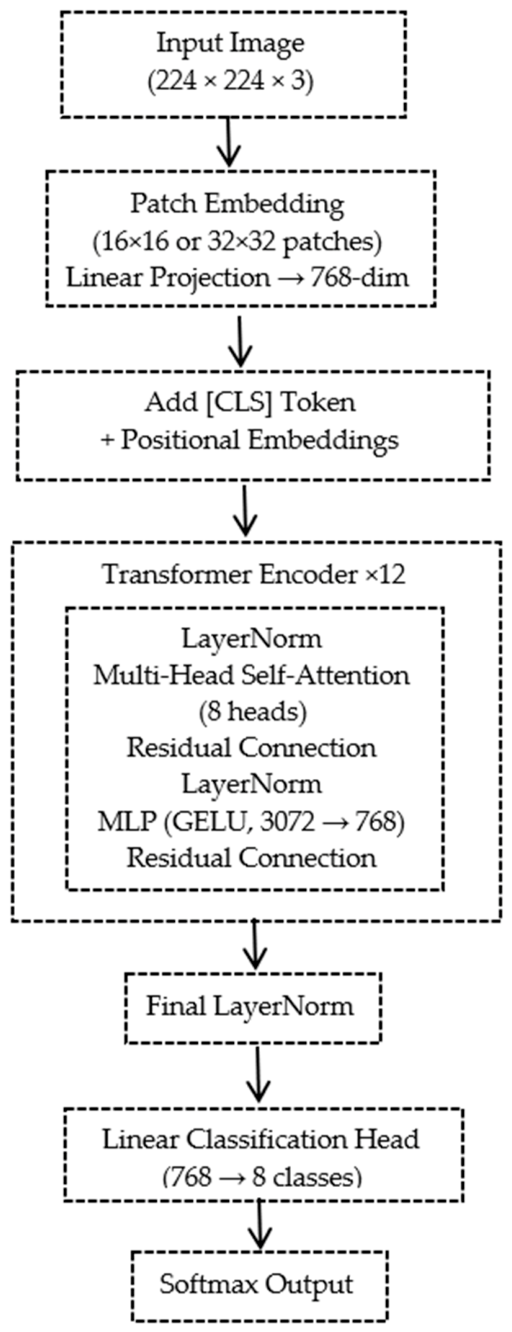
3.2.1. Vision Transformer Implementation
3.2.2. Classification Head and Output Objective
3.2.3. Model Initialization and Configuration
3.3. Training Procedure
3.3.1. Optimization Configuration
3.3.2. Training Regimen and Early Stopping
3.3.3. Class-Weighting Strategy for Imbalanced Training
3.3.4. Hardware and Computational Environment
3.3.5. Performance Evaluation Protocol
3.3.6. Hyperparameter Study and Statistical Analysis
4. Results
4.1. Training Stability and Convergence Analysis
4.2. Hyperparameter Effect Analysis
4.2.1. Statistical Comparison of Main Effects
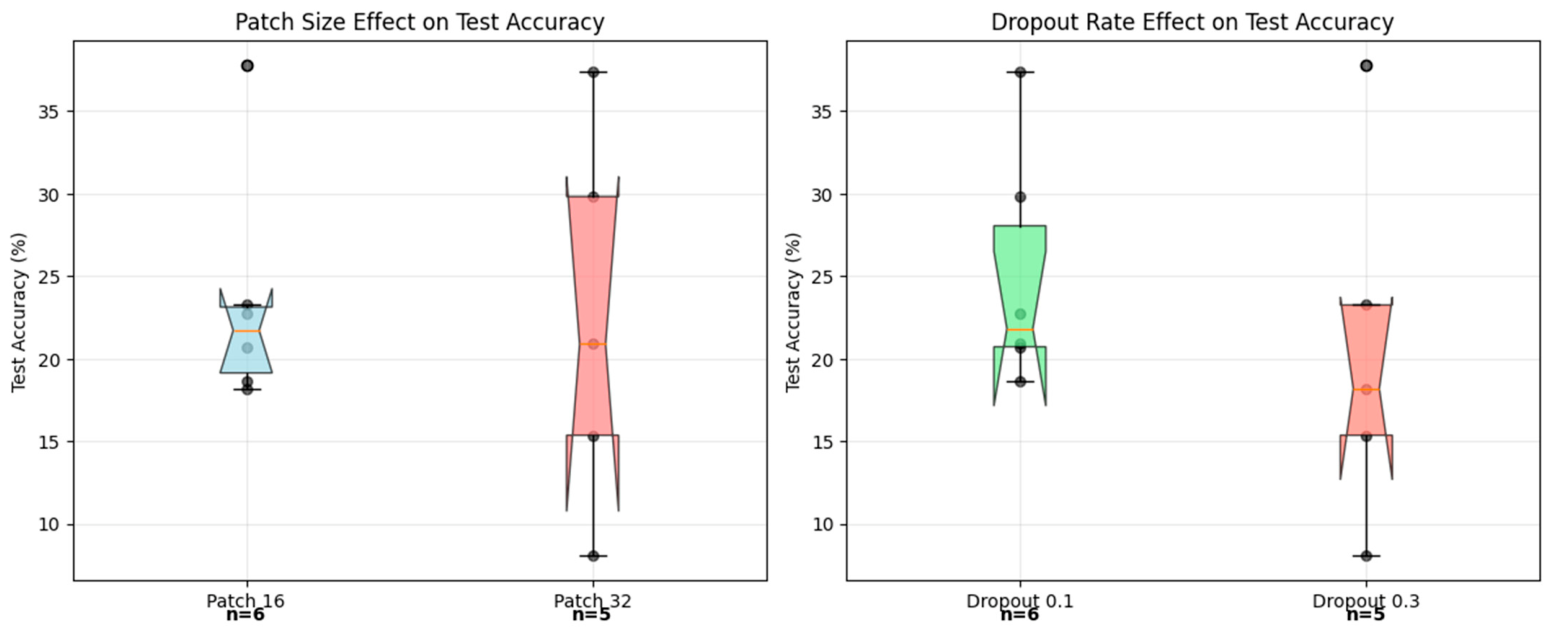
4.2.2. Patch Size Effects
4.2.3. Dropout Rate Effects
4.2.4. Reproducibility Assessment
4.3. Performance Metrics and Class-Wise Analysis
4.3.1. Model Performance Distribution
4.3.2. Class-Specific Performance Analysis
4.4. Correlation Analysis and Training Dynamics
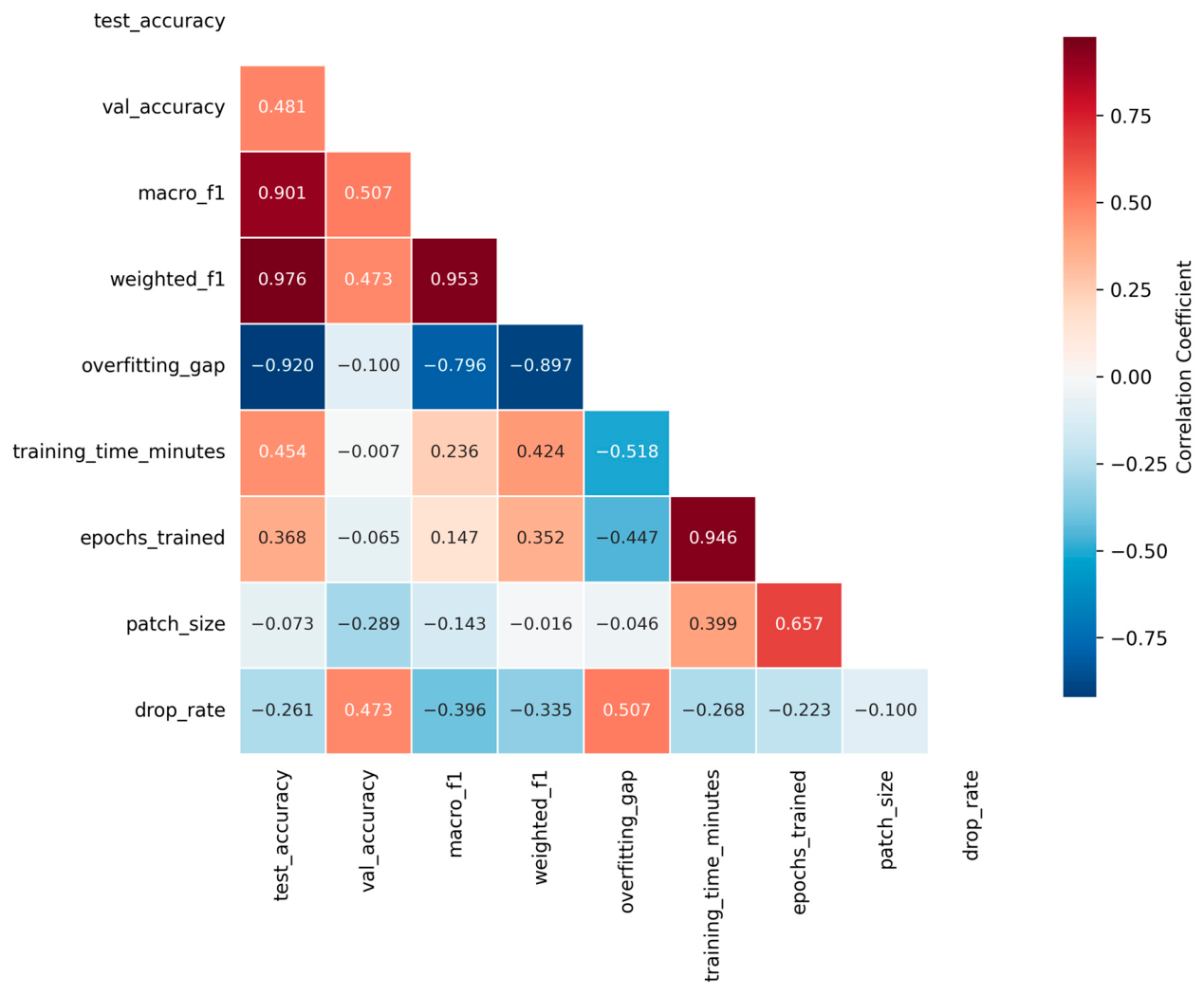
4.4.1. Performance-Overfitting Relationships
4.4.2. Training Curve Characteristics
5. Discussion
5.1. Training Stability and Architectural Mismatch
5.2. Hyperparameter Insensitivity and Optimization Challenges
5.3. Class Imbalance and Medical Domain Challenges
5.4. Computational Limitations and Methodological Constraints
5.5. Clinical Implications and Model Reliability
5.6. Comparison with Literature and Methodological Insights
5.7. Study Limitations and Future Research Directions
5.8. Implications for Medical AI Development
5.9. Theoretical Considerations on Training Stability
6. Conclusions
Author Contributions
Funding
Institutional Review Board Statement
Informed Consent Statement
Data Availability Statement
Acknowledgments
Conflicts of Interest
References
- Esteva, A.; Kuprel, B.; Novoa, R.A.; Ko, J.; Swetter, S.M.; Blau, H.M.; Thrun, S. Dermatologist-Level Classification of Skin Cancer with Deep Neural Networks. Nature 2017, 542, 115–118. [Google Scholar] [CrossRef] [PubMed]
- Aksoy, S. Multi-Input Melanoma Classification Using MobileNet-V3-Large Architecture. J. Autom. Mob. Robot. Intell. Syst. 2025, 19, 73–84. [Google Scholar] [CrossRef]
- Brinker, T.J.; Hekler, A.; Enk, A.H.; Klode, J.; Hauschild, A.; Berking, C.; Schilling, B.; Haferkamp, S.; Schadendorf, D.; Holland-Letz, T.; et al. Deep Learning Outperformed 136 of 157 Dermatologists in a Head-to-Head Dermoscopic Melanoma Image Classification Task. Eur. J. Cancer 2019, 113, 47–54. [Google Scholar] [CrossRef] [PubMed]
- ISIC International Skin Imaging Collaboration. Available online: https://www.isic-archive.com/ (accessed on 19 May 2026).
- Hekler, A.; Kather, J.N.; Krieghoff-Henning, E.; Utikal, J.S.; Meier, F.; Gellrich, F.F.; Upmeier Zu Belzen, J.; French, L.; Schlager, J.G.; Ghoreschi, K.; et al. Effects of Label Noise on Deep Learning-Based Skin Cancer Classification. Front. Med. 2020, 7, 177. [Google Scholar] [CrossRef]
- Rotemberg, V.; Kurtansky, N.; Betz-Stablein, B.; Caffery, L.; Chousakos, E.; Codella, N.; Combalia, M.; Dusza, S.; Guitera, P.; Gutman, D.; et al. A Patient-Centric Dataset of Images and Metadata for Identifying Melanomas Using Clinical Context. Sci. Data 2021, 8, 34. [Google Scholar] [CrossRef]
- Bisla, D.; Choromanska, A.; Berman, R.S.; Stein, J.A.; Polsky, D. Towards Automated Melanoma Detection with Deep Learning: Data Purification and Augmentation. In Proceedings of the 2019 IEEE/CVF Conference on Computer Vision and Pattern Recognition Workshops (CVPRW), IEEE, Long Beach, CA, USA, 15–20 June 2019; pp. 2720–2728. [Google Scholar]
- Bissoto, A.; Fornaciali, M.; Valle, E.; Avila, S. (De) Constructing Bias on Skin Lesion Datasets. In Proceedings of the 2019 IEEE/CVF Conference on Computer Vision and Pattern Recognition Workshops (CVPRW), IEEE, Long Beach, CA, USA, 15–20 June 2019; pp. 2766–2774. [Google Scholar]
- Hasan, M.K.; Elahi, M.T.E.; Alam, M.A.; Jawad, M.T.; Martí, R. DermoExpert: Skin Lesion Classification Using a Hybrid Convolutional Neural Network through Segmentation, Transfer Learning, and Augmentation. Inform. Med. Unlocked 2022, 28, 100819. [Google Scholar] [CrossRef]
- Brinker, T.J.; Hekler, A.; Enk, A.H.; Berking, C.; Haferkamp, S.; Hauschild, A.; Weichenthal, M.; Klode, J.; Schadendorf, D.; Holland-Letz, T.; et al. Deep Neural Networks Are Superior to Dermatologists in Melanoma Image Classification. Eur. J. Cancer 2019, 119, 11–17. [Google Scholar] [CrossRef]
- Le, D.N.T.; Le, H.X.; Ngo, L.T.; Ngo, H.T. Transfer Learning with Class-Weighted and Focal Loss Function for Automatic Skin Cancer Classification. arXiv 2020, arXiv:2009.05977. [Google Scholar] [CrossRef]
- Carcagnì, P.; Leo, M.; Cuna, A.; Mazzeo, P.L.; Spagnolo, P.; Celeste, G.; Distante, C. Classification of Skin Lesions by Combining Multilevel Learnings in a DenseNet Architecture. In Image Analysis and Processing—ICIAP 2019; Ricci, E., Rota Bulò, S., Snoek, C., Lanz, O., Messelodi, S., Sebe, N., Eds.; Lecture Notes in Computer Science; Springer International Publishing: Cham, Switzerland, 2019; Volume 11751, pp. 335–344. ISBN 978-3-030-30641-0. [Google Scholar]
- Tschandl, P.; Codella, N.; Akay, B.N.; Argenziano, G.; Braun, R.P.; Cabo, H.; Gutman, D.; Halpern, A.; Helba, B.; Hofmann-Wellenhof, R.; et al. Comparison of the Accuracy of Human Readers versus Machine-Learning Algorithms for Pigmented Skin Lesion Classification: An Open, Web-Based, International, Diagnostic Study. Lancet Oncol. 2019, 20, 938–947. [Google Scholar] [CrossRef] [PubMed]
- Ratul, M.A.R.; Mozaffari, M.H.; Lee, W.-S.; Parimbelli, E. Skin Lesions Classification Using Deep Learning Based on Dilated Convolution. bioRxiv 2019. [Google Scholar] [CrossRef]
- Gessert, N.; Nielsen, M.; Shaikh, M.; Werner, R.; Schlaefer, A. Skin Lesion Classification Using Ensembles of Multi-Resolution EfficientNets with Meta Data. MethodsX 2020, 7, 100864. [Google Scholar] [CrossRef]
- Kassem, M.A.; Hosny, K.M.; Fouad, M.M. Skin Lesions Classification into Eight Classes for ISIC 2019 Using Deep Convolutional Neural Network and Transfer Learning. IEEE Access 2020, 8, 114822–114832. [Google Scholar] [CrossRef]
- Rezvantalab, A.; Safigholi, H.; Karimijeshni, S. Dermatologist Level Dermoscopy Skin Cancer Classification Using Different Deep Learning Convolutional Neural Networks Algorithms. arXiv 2018, arXiv:1810.10348. [Google Scholar] [CrossRef]
- Xie, Y.; Zhang, J.; Xia, Y.; Shen, C. A Mutual Bootstrapping Model for Automated Skin Lesion Segmentation and Classification. IEEE Trans. Med. Imaging 2020, 39, 2482–2493. [Google Scholar] [CrossRef] [PubMed]
- Hasan, M.K.; Dahal, L.; Samarakoon, P.N.; Tushar, F.I.; Martí, R. DSNet: Automatic Dermoscopic Skin Lesion Segmentation. Comput. Biol. Med. 2020, 120, 103738. [Google Scholar] [CrossRef]
- Goyal, M.; Oakley, A.; Bansal, P.; Dancey, D.; Yap, M.H. Skin Lesion Segmentation in Dermoscopic Images with Ensemble Deep Learning Methods. IEEE Access 2020, 8, 4171–4181. [Google Scholar] [CrossRef]
- Tang, P.; Liang, Q.; Yan, X.; Xiang, S.; Sun, W.; Zhang, D.; Coppola, G. Efficient Skin Lesion Segmentation Using Separable-Unet with Stochastic Weight Averaging. Comput. Methods Programs Biomed. 2019, 178, 289–301. [Google Scholar] [CrossRef]
- ISIC Challenge 2018 Dataset. Available online: https://challenge.isic-archive.com/landing/2018/ (accessed on 1 April 2025).
- Dosovitskiy, A.; Beyer, L.; Kolesnikov, A.; Weissenborn, D.; Zhai, X.; Unterthiner, T.; Dehghani, M.; Minderer, M.; Heigold, G.; Gelly, S.; et al. An Image Is Worth 16 × 16 Words: Transformers for Image Recognition at Scale. arXiv 2020, arXiv:2010.11929. [Google Scholar] [CrossRef]
- Touvron, H.; Cord, M.; Douze, M.; Massa, F.; Sablayrolles, A.; Jégou, H. Training Data-Efficient Image Transformers & Distillation through Attention. arXiv 2020, arXiv:2012.12877. [Google Scholar] [CrossRef]
- Liu, Z.; Lin, Y.; Cao, Y.; Hu, H.; Wei, Y.; Zhang, Z.; Lin, S.; Guo, B. Swin Transformer: Hierarchical Vision Transformer Using Shifted Windows. arXiv 2021, arXiv:2103.14030. [Google Scholar] [CrossRef]
- Chen, J.; Lu, Y.; Yu, Q.; Luo, X.; Adeli, E.; Wang, Y.; Lu, L.; Yuille, A.L.; Zhou, Y. TransUNet: Transformers Make Strong Encoders for Medical Image Segmentation. arXiv 2021, arXiv:2102.04306. [Google Scholar] [CrossRef]
- Cao, H.; Wang, Y.; Chen, J.; Jiang, D.; Zhang, X.; Tian, Q.; Wang, M. Swin-Unet: Unet-Like Pure Transformer for Medical Image Segmentation. In Computer Vision—ECCV 2022 Workshops; Karlinsky, L., Michaeli, T., Nishino, K., Eds.; Lecture Notes in Computer Science; Springer Nature Switzerland: Cham, Switzerland, 2023; Volume 13803, pp. 205–218. ISBN 978-3-031-25065-1. [Google Scholar]
- Tschandl, P.; Rosendahl, C.; Kittler, H. The HAM10000 Dataset, a Large Collection of Multi-Source Dermatoscopic Images of Common Pigmented Skin Lesions. Sci. Data 2018, 5, 180161. [Google Scholar] [CrossRef] [PubMed]
- Lin, T.-Y.; Goyal, P.; Girshick, R.; He, K.; Dollár, P. Focal Loss for Dense Object Detection. arXiv 2017, arXiv:1708.02002. [Google Scholar] [CrossRef]
- King, G.; Zeng, L. Logistic Regression in Rare Events Data. Polit. Anal. 2001, 9, 137–163. [Google Scholar] [CrossRef]
- Cui, Y.; Jia, M.; Lin, T.-Y.; Song, Y.; Belongie, S. Class-Balanced Loss Based on Effective Number of Samples. In Proceedings of the 2019 IEEE/CVF Conference on Computer Vision and Pattern Recognition (CVPR), Long Beach, CA, USA, 15–20 June 2019. [Google Scholar]
- Chawla, N.V.; Bowyer, K.W.; Hall, L.O.; Kegelmeyer, W.P. SMOTE: Synthetic Minority Over-Sampling Technique. J. Artif. Intell. Res. 2002, 16, 321–357. [Google Scholar] [CrossRef]
- Kang, B.; Xie, S.; Rohrbach, M.; Yan, Z.; Gordo, A.; Feng, J.; Kalantidis, Y. Decoupling Representation and Classifier for Long-Tailed Recognition. arXiv 2019, arXiv:1910.09217. [Google Scholar] [CrossRef]
- Azad, R.; Kazerouni, A.; Heidari, M.; Aghdam, E.K.; Molaei, A.; Jia, Y.; Jose, A.; Roy, R.; Merhof, D. Advances in Medical Image Analysis with Vision Transformers: A Comprehensive Review. Med. Image Anal. 2024, 91, 103000. [Google Scholar] [CrossRef]
- Xiao, H.; Li, L.; Liu, Q.; Zhu, X.; Zhang, Q. Transformers in Medical Image Segmentation: A Review. Biomed. Signal Process. Control 2023, 84, 104791. [Google Scholar] [CrossRef]
- Pu, Q.; Xi, Z.; Yin, S.; Zhao, Z.; Zhao, L. Advantages of Transformer and Its Application for Medical Image Segmentation: A Survey. Biomed. Eng. OnLine 2024, 23, 14. [Google Scholar] [CrossRef]
- Sun, G.; Pan, Y.; Kong, W.; Xu, Z.; Ma, J.; Racharak, T.; Nguyen, L.-M.; Xin, J. DA-TransUNet: Integrating Spatial and Channel Dual Attention with Transformer U-Net for Medical Image Segmentation. Front. Bioeng. Biotechnol. 2024, 12, 1398237. [Google Scholar] [CrossRef]
- Shi, Y.; Li, F.; Zhao, S.; Yu, H.; Chen, X.; Liu, Q. IAP-TransUNet: Integration of the Attention Mechanism and Pyramid Pooling for Medical Image Segmentation. Front. Neurorobot. 2025, 19, 1706626. [Google Scholar] [CrossRef]
- Zeng, Z.; Xiao, J.; Yi, S.; Liu, Q.; Zhu, Y. M3-TransUNet: Medical Image Segmentation Based on Spatial Prior Attention and Multi-Scale Gating. J. Imaging 2025, 12, 15. [Google Scholar] [CrossRef] [PubMed]
- Krishnan, P.T.; Krishnadoss, P.; Khandelwal, M.; Gupta, D.; Nihaal, A.; Kumar, T.S. Enhancing Brain Tumor Detection in MRI with a Rotation Invariant Vision Transformer. Front. Neuroinform. 2024, 18, 1414925. [Google Scholar] [CrossRef]
- Sankari, C.; Jamuna, V.; Kavitha, A.R. Hierarchical Multi-Scale Vision Transformer Model for Accurate Detection and Classification of Brain Tumors in MRI-Based Medical Imaging. Sci. Rep. 2025, 15, 38275. [Google Scholar] [CrossRef]
- Shamshad, F.; Khan, S.; Zamir, S.W.; Khan, M.H.; Hayat, M.; Khan, F.S.; Fu, H. Transformers in Medical Imaging: A Survey. Med. Image Anal. 2023, 88, 102802. [Google Scholar] [CrossRef] [PubMed]
- Raghu, M.; Unterthiner, T.; Kornblith, S.; Zhang, C.; Dosovitskiy, A. Do Vision Transformers See Like Convolutional Neural Networks? arXiv 2021, arXiv:2108.08810. [Google Scholar] [CrossRef]



| Study Type | Pretraining | Hybrid CNN–ViT | Imbalance Handling | Stability Analysis | Proposed Study |
|---|---|---|---|---|---|
| CNN-based | Yes | Not applicable | Weighted/Focal | No | – |
| Hybrid CNN-ViT | Yes | Yes | Yes | No | – |
| Pure ViT (pretrained) | Yes | No | Limited | No | – |
| This work | No | No | Weighted CE | Yes (multi-seed) | √ |
| Refs | Domain/Task | Key Idea | Typical Training Requirement |
|---|---|---|---|
| ViT [23] | Natural images/classification | Patch tokenization + global self-attention. | Large-scale pretraining or large supervised data. |
| DeiT [24] | Natural images/classification | Data-efficient training via transformer-specific distillation. | ImageNet-scale data; distillation improves efficiency. |
| Swin Transformer [25] | General vision backbone | Hierarchical shifted-window attention for locality and scalability. | Standard supervised training; widely used as backbone. |
| TransUNet [26] | Medical imaging/segmentation | Hybrid CNN features + transformer encoder within U-Net decoder. | Benefits from pretrained encoders and strong locality priors. |
| Swin-Unet [27] | Medical imaging/segmentation | U-shaped network built from Swin blocks for local-global fusion. | Often trained with augmentation; benefits from hierarchical windows. |
| Method | Core Mechanism | Applicability | Practical Limitations |
|---|---|---|---|
| Weighted cross-entropy [30] | Re-weights classes inversely proportional to class frequency. | Mild-to-moderate imbalance; simple baseline. | Can over-compensate and destabilize optimization. |
| Focal loss [29] | Down-weights well-classified samples and focuses learning on hard examples. | Foreground/background or long-tailed settings. | Needs tuning (γ, α); may hurt calibration. |
| Class-balanced loss [31] | Uses effective number of samples to compute weights. | Long-tailed datasets with moderate label noise. | Still limited by extremely scarce minority samples. |
| Re-sampling (over/under) [32] | Adjusts mini-batch class composition through over- or under-sampling. | Improves minority exposure without changing loss. | Risk of overfitting minority; duplicates amplify noise. |
| ATwo-stage training/fine-tuning [33] | Representation learning followed by class-balanced fine-tuning. | When representation learning is data-limited. | May require careful scheduling and validation. |
| Study | Task | Transformer Model | Methodological Contribution |
|---|---|---|---|
| Azad et al. (2024) [34] | Multi-task medical image analysis (survey) | Various ViT-based models | Comprehensive review of transformers in medical imaging (classification, segmentation, detection). |
| Xiao et al. (2023) [35] | Medical image segmentation (review) | ViT, Swin, hybrid models | Systematic analysis of transformer architectures for segmentation tasks. |
| Pu et al. (2024) [36] | Medical image segmentation | Transformer-based networks | Discusses advantages of transformers over CNNs in medical segmentation. |
| DA-TransUNet (2024) [37] | Medical image segmentation | Dual-attention TransUNet | Integrates channel and positional attention for improved feature representation. |
| IAP-TransUNet (2025) [38] | Medical image segmentation | Lightweight TransUNet variant | Improves efficiency using attention pyramids and depthwise convolutions. |
| M3-TransUNet (2025) [39] | Medical image segmentation | Multi-scale TransUNet | Enhances multi-scale feature fusion for better boundary delineation. |
| Krishnan et al. (2024) [40] | Brain tumor classification (MRI) | Rotation-invariant ViT | Introduces rotation invariance into ViT for robust MRI analysis. |
| Sankari et al. (2025) [41] | Brain tumor detection | Domain-informed ViT | Incorporates clinical domain knowledge into transformer architecture. |
| Diagnostic Class | Training Set | Validation Set | Test Set | |||
|---|---|---|---|---|---|---|
| Count | % | Count | % | Count | % | |
| MEL (Melanoma) | 3618 | 17.9 | 904 | 17.8 | 3374 | 41.0 |
| NV (Nevus) | 10,300 | 50.8 | 2575 | 50.8 | 2495 | 30.3 |
| BCC (Basal Cell Carcinoma) | 2658 | 13.1 | 665 | 13.1 | 975 | 11.8 |
| AK (Actinic Keratosis) | 694 | 3.4 | 173 | 3.4 | 374 | 4.5 |
| BKL (Benign Keratosis) | 2099 | 10.4 | 525 | 10.4 | 660 | 8.0 |
| DF (Dermatofibroma) | 191 | 0.9 | 48 | 0.9 | 91 | 1.1 |
| VASC (Vascular) | 202 | 1.0 | 51 | 1.0 | 104 | 1.3 |
| SCC (Squamous Cell Carcinoma) | 502 | 2.5 | 126 | 2.5 | 165 | 2.0 |
| Total | 20,264 | 100.0 | 5067 | 100.0 | 8238 | 100.0 |
| Exp ID | Patch Size | Dropout | Random Seed | Test Accuracy (%) | Val Accuracy (%) | Overfitting Gap (%) | Macro F1 | Training Time (min) | Epochs |
|---|---|---|---|---|---|---|---|---|---|
| 1 | 16 | 0.1 | 42 | 18.6 | 42.0 | 23.3 | 0.114 | 70.2 | 6 |
| 2 | 16 | 0.1 | 123 | 20.7 | 40.4 | 19.7 | 0.101 | 69.3 | 7 |
| 3 | 16 | 0.1 | 456 | 22.7 | 46.0 | 23.3 | 0.125 | 78.7 | 8 |
| 4 | 16 | 0.3 | 42 | 18.2 | 49.6 | 31.5 | 0.097 | 59.9 | 6 |
| 5 | 16 | 0.3 | 123 | 37.8 | 50.5 | 12.7 | 0.161 | 69.6 | 7 |
| 6 | 16 | 0.3 | 456 | 23.2 | 50.7 | 27.5 | 0.123 | 88.5 | 9 |
| 7 | 32 | 0.1 | 42 | 20.9 | 45.2 | 24.3 | 0.132 | 80.0 | 10 |
| 8 | 32 | 0.1 | 123 | 29.8 | 46.3 | 16.5 | 0.149 | 72.3 | 9 |
| 9 | 32 | 0.1 | 456 | 37.4 | 45.4 | 8.0 | 0.142 | 133.8 | 17 |
| 10 | 32 | 0.3 | 42 | 8.0 | 41.8 | 33.7 | 0.044 | 80.0 | 10 |
| 11 | 32 | 0.3 | 123 | 15.4 | 44.3 | 29.0 | 0.089 | 72.1 | 9 |
| Diagnostic Class | Training % | Mean F1 Score | Std F1 | Performance Rank |
|---|---|---|---|---|
| NV (Nevus) | 50.8 | 0.449 | 0.051 | 1 |
| MEL (Melanoma) | 17.9 | 0.181 | 0.153 | 2 |
| BCC (Basal Cell Carcinoma) | 13.1 | 0.109 | 0.084 | 3 |
| AK (Actinic Keratosis) | 3.4 | 0.077 | 0.041 | 4 |
| SCC (Squamous Cell Carcinoma) | 2.5 | 0.039 | 0.038 | 5 |
| BKL (Benign Keratosis) | 10.4 | 0.034 | 0.044 | 6 |
| DF (Dermatofibroma) | 0.9 | 0.023 | 0.033 | 7 |
| VASC (Vascular) | 1.0 | 0.017 | 0.028 | 8 |
Disclaimer/Publisher’s Note: The statements, opinions and data contained in all publications are solely those of the individual author(s) and contributor(s) and not of MDPI and/or the editor(s). MDPI and/or the editor(s) disclaim responsibility for any injury to people or property resulting from any ideas, methods, instructions or products referred to in the content. |
© 2026 by the authors. Licensee MDPI, Basel, Switzerland. This article is an open access article distributed under the terms and conditions of the Creative Commons Attribution (CC BY) license.
Share and Cite
Aksoy, S.; Demircioglu, P.; Bogrekci, I. Systematic Failure of Vision Transformers in Imbalanced Skin Lesion Classification. Dermato 2026, 6, 22. https://doi.org/10.3390/dermato6020022
Aksoy S, Demircioglu P, Bogrekci I. Systematic Failure of Vision Transformers in Imbalanced Skin Lesion Classification. Dermato. 2026; 6(2):22. https://doi.org/10.3390/dermato6020022
Chicago/Turabian StyleAksoy, Serra, Pinar Demircioglu, and Ismail Bogrekci. 2026. "Systematic Failure of Vision Transformers in Imbalanced Skin Lesion Classification" Dermato 6, no. 2: 22. https://doi.org/10.3390/dermato6020022
APA StyleAksoy, S., Demircioglu, P., & Bogrekci, I. (2026). Systematic Failure of Vision Transformers in Imbalanced Skin Lesion Classification. Dermato, 6(2), 22. https://doi.org/10.3390/dermato6020022