Article

Absence of PD-L1 Protein Expression in Classic Dermatofibrosarcoma Protuberans

1
Department of Dermatology, Dortmund Hospital gGmbH, University Witten/Herdecke, 44137 Dortmund, Germany
2
Department of Dermatology, Ruhr-University Bochum, 44791 Bochum, Germany
3
Department of Dermatology, Christian Hospital Unna, 59432 Unna, Germany
*
Author to whom correspondence should be addressed.
Dermato 2026, 6(2), 11; https://doi.org/10.3390/dermato6020011
Submission received: 31 January 2026 / Revised: 13 March 2026 / Accepted: 31 March 2026 / Published: 1 April 2026

Abstract

Background: This study aimed to assess the prevalence of PD-L1 protein expression in dermatofibrosarcoma protuberans (DFSP) to provide insights into the potential use of immune checkpoint inhibitors. Methods: We retrospectively analyzed formalin-fixed, paraffin-embedded primary DFSP specimens (n = 17). Diagnoses were confirmed by two senior dermatopathologists according to guideline criteria, including diffuse CD34 positivity and storiform spindle cell morphology. All cases represented conventional DFSP without fibrosarcomatous transformation. PD-L1 immunohistochemistry was carried out using a rabbit monoclonal antibody (ab205921, clone 28-8; Abcam). Only membranous staining in viable tumor cells was scored as a tumor proportion score (TPS), where >1% was considered positive. Any cytoplasmic staining without convincing membranous accentuation was not scored. PD-L1 staining in tumor-infiltrating immune cells was recorded separately. Five pleomorphic dermal sarcomas served as positive controls. Results: The median age was 62 years (IQR 55–74); 12 patients were men and 5 were women. The primary sites were trunk (59%), upper extremity (35%), and lower extremity (6%); immunosuppression was present in 18%. By FNCLCC, 82% of tumors were G1 and 18% were G2; no G3 tumors were identified. All DFSPs were PD-L1-negative in DFSP cells (TPS ≤ 1%) and in tumor-infiltrating lymphocytess. Among controls, 3/5 pleomorphic dermal sarcomas were PD-L1-positive with the expected membranous pattern and variable intensity. Conclusions: PD-L1 expression was absent in this cohort of conventional, predominantly low-grade DFSP, suggesting that classic DFSP is generally not an ideal candidate for PD-1/PD-L1-directed checkpoint blockade. These conclusions should not be extrapolated to fibrosarcomatous DFSP or metastatic disease, where PD-L1 expression has been reported. Selective PD-L1 testing may still be warranted in clinically aggressive scenarios (e.g., fibrosarcomatous transformation, unresectable recurrence, or metastasis).

1. Introduction

Dermatofibrosarcoma protuberans (DFSP) is an uncommon, locally aggressive cutaneous sarcoma that usually arises on the trunk and proximal limbs of adults. Although distant metastases are rare, DFSP is characterized by infiltrative growth with tentacle-like extension into the subcutis and along fibrous septa, rendering complete excision challenging and predisposing to local recurrence, particularly after positive margins or inadequate initial surgery [1,2]. Standard management is surgery, using either wide local excision or margin-controlled techniques, with current practice guidelines emphasizing meticulous histologic margin assessment to minimize recurrence risk [1,2]. Nevertheless, anatomic constraints, recurrent disease after multiple operations, or large tumor burden may render lesions borderline resectable or unresectable, necessitating consideration of systemic therapy [1,2].
At the molecular level, most DFSPs harbor the pathognomonic COL1A1—platelet-derived growth factor receptor-β (PDGFB) fusion generated by t(17;22), which mediates autocrine activation of PDGFRB. This biology provides a therapeutic rationale for PDGFR-directed tyrosine kinase inhibition, and imatinib is an accepted option for inoperable, relapsing, or metastatic disease and is part of a neoadjuvant strategy used to facilitate organ-sparing surgery. Despite meaningful activity, primary resistance, incomplete responses, and eventual progression can occur. These clinical realities have prompted exploration of immunotherapeutic approaches, including immune checkpoint inhibitors (ICIs), in selected DFSP scenarios [3,4,5,6,7,8,9].
Across soft tissue sarcomas, responses to ICIs are heterogeneous and appear to track, at least in part, with immunobiologic features such as tumor mutational burden, intratumoral lymphocyte density, and PD-L1 expression. In contrast to cutaneous sarcomas such as pleomorphic dermal sarcoma (PDS) and cutaneous angiosarcoma, which may show PD-L1 expression and clinical responses to ICIs in subsets of patients, conventional DFSP has generally been regarded as immunologically “cold” [4,5,6,10,11]. Published PD-L1 rates in DFSP vary widely, likely reflecting methodological differences and biological heterogeneity by grade and disease stage [12,13,14]. Importantly, PD-L1 expression has been observed more often in fibrosarcomatous DFSP (FS-DFSP) and metastatic deposits than in classic DFSP [12,13,14,15,16,17,18,19,20]. Therefore, this investigation was designed to assess PD-L1 protein expression specifically in conventional DFSP without fibrosarcomatous transformation. The conclusions are intended to apply primarily to classic, low-grade DFSP rather than FS-DFSP or metastatic disease.

2. Materials and Methods

2.1. Study Design and Patients

We retrospectively studied consecutive patients with primary DFSP (n = 17) diagnosed at our institution. Formalin-fixed, paraffin-embedded (FFPE) tissue samples were available for all included cases. Slides stained with hematoxylin and eosin were independently reviewed by two senior dermatopathologists, with discrepancies resolved by consensus. In accordance with guideline criteria [2], diagnosis was based on diffuse infiltration of the dermal and subcutaneous skin compartments by relatively uniform spindle-shaped CD34-positive neoplastic cells arranged in a storiform pattern. All tumors represented the conventional DFSP subtype; no case showed fibrosarcomatous transformation. Tumor grade was assigned using the FNCLCC system (G1–G3). Routine immunohistochemistry included CD34, factor XIIIa, S100, SMA, desmin, and EMA as needed for differential diagnosis [1,2]. Cases were collected between 2016 and 2024 at a tertiary dermatologic oncology center. DFSP is an uncommon tumor with an incidence of approximately 0.8–5 patients/million individuals per year (2-fold higher incidence in black individuals), which limits the feasibility of assembling large single-center cohorts [3].

2.2. PD-L1 Immunohistology

PD-L1 immunohistochemistry was performed in accordance with the manufacturer’s instructions and previously described protocols [3,4]. Tissue sections were dried overnight at 37 °C, followed by deparaffinization in Rotihistol (Carl Roth, Karlsruhe, Germany) and rehydration through a graded series of alcohols. A rabbit monoclonal anti-PD-L1 antibody (ab205921, clone 28-8; Abcam, Cambridge, UK) was applied. Signal detection was carried out using the Dako REAL Detection System, Alkaline Phosphatase/RED, Rabbit/Mouse (K5005; Dako Agilent, Santa Clara, CA, USA). Slides were counterstained with hematoxylin (S202084; Dako Agilent), dehydrated, and coverslipped using Entellan (Merck, Darmstadt, Germany). Digital slide scanning was performed at 20× magnification with a Nanozoomer whole-slide scanner (Hamamatsu, Herrsching am Ammersee, Germany), and images were reviewed using NDP.view2 software.
PD-L1 expression in tumor cells was assessed using the tumor proportion score (TPS), defined as the percentage of viable tumor cells exhibiting partial or complete membranous staining of any intensity. Only membranous staining was taken into account for TPS evaluation, whereas isolated cytoplasmic staining without clear membranous localization was considered non-specific and excluded. A TPS greater than 1% was classified as positive. Additionally, PD-L1 expression in tumor-infiltrating immune cells was documented as present or absent, with positivity defined as staining in at least 1% of immune cells within the tumor area.

2.3. Controls and Assay Performance

Five pleomorphic dermal sarcomas (PDS) were included as positive controls, as PD-L1 expression is frequently observed in this tumor type [4]. In all staining runs, controls showed membranous PD-L1 staining with an intensity and distribution comparable to prior reports in PDS, supporting appropriate assay performance.

2.4. Statistical Analysis

Data were summarized descriptively. Because PD-L1 was negative in all DFSP cases, we did not perform inferential statistical analyses.

3. Results

3.1. Patient and Tumor Characteristics

Seventeen patients with primary DFSP were included. Clinico-histopathologic characteristics are displayed in Table 1. All tumors were conventional DFSP without fibrosarcomatous transformation and were predominantly low-grade by FNCLCC.

3.2. PD-L1 Expression

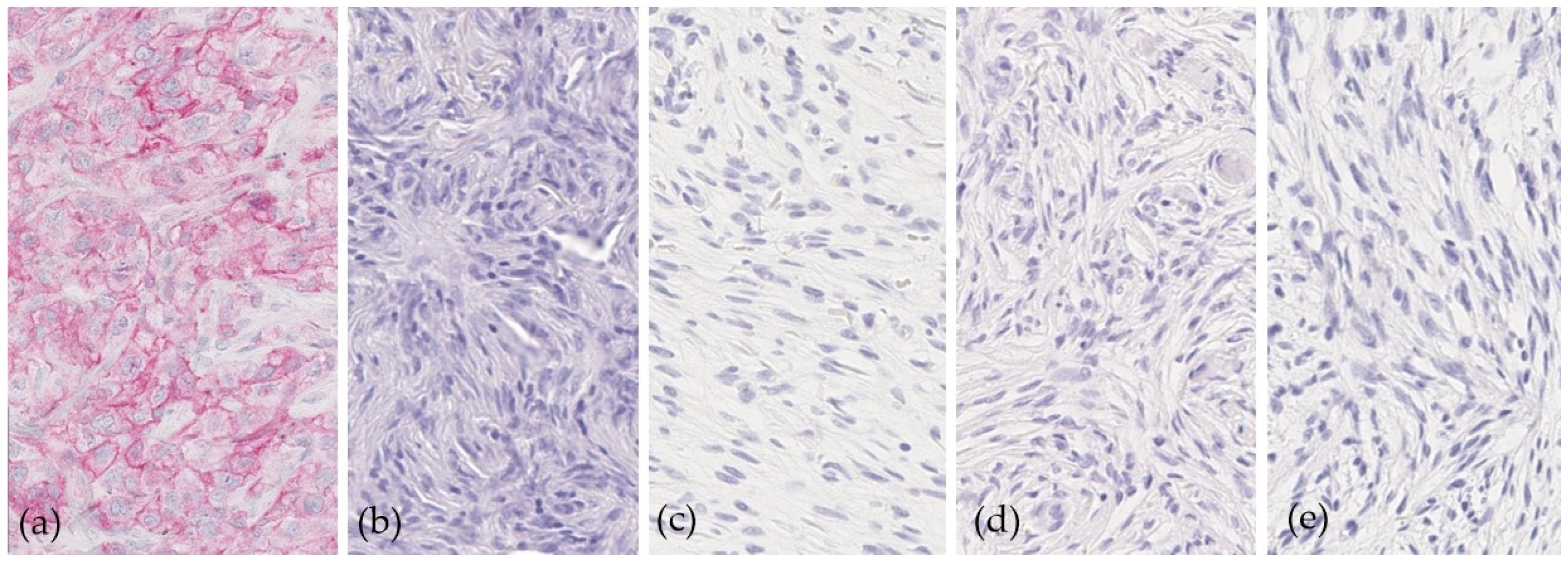
All DFSP cases were negative for PD-L1 in tumor cells (TPS ≤ 1%) and showed no PD-L1 expression in tumor-infiltrating lymphocytes. Among the five PDS controls, three were PD-L1-positive (TPS > 1%) with membranous staining (Figure 1). No convincing cytoplasmic PD-L1 staining was observed in DFSP tumor cells; occasional faint diffuse cytoplasmic blush was regarded as non-specific and was not scored.

4. Discussion

In this single-center cohort of 17 primary DFSPs, we observed no PD-L1 expression via immunohistology in either DFSP cells or tumor-infiltrating lymphocytes. All tumors included were conventional DFSP without fibrosarcomatous transformation and were predominantly low-grade. Accordingly, our findings support the view that classic DFSP is generally immunologically “cold” and may be a poor candidate for PD-1/PD-L1-directed ICI as monotherapy.
A key point is disease context. DFSP is a fusion-driven tumor (classically COL1A1–PDGFB) with generally low tumor mutational burden (TMB) on genomic profiling [19,21]. However, fibrosarcomatous transformation (FS-DFSP) can accumulate additional alterations and is associated with more aggressive behavior. In several series, PD-L1 expression was enriched in FS-DFSP and/or metastatic disease compared with conventional DFSP, suggesting stage- and grade-dependent immune escape mechanisms [12,13,14,20,21,22,23,24,25,26]. Therefore, our negative PD-L1 results should primarily be interpreted as applicable to conventional DFSP at initial presentation and should not be extrapolated to FS-DFSP or metastatic deposits.
Methodological factors also contribute to divergent PD-L1 rates reported in the sarcoma literature. PD-L1 immunostaining is sensitive to pre-analytics, antibody clone, platform, and scoring criteria, and sarcoma-focused reviews caution that results obtained outside validated companion-diagnostic contexts should be interpreted carefully [23]. To increase assay reliability, we used a widely applied PD-L1 clone (28-8) and included PDS as a positive control, which showed the expected membranous staining pattern and intensity, consistent with prior reports [4]. In our study, only membranous staining was scored for tumor TPS, while non-specific cytoplasmic staining was disregarded, aligning with common TPS-based approaches.
The absence of PD-L1 expression does not necessarily imply that immunotherapy cannot work in DFSP. Antitumor immunity is multifactorial, and broader characterization of the tumor immune microenvironment (TME) may reveal alternative vulnerabilities even in PD-L1-negative tumors. Recent computational frameworks and multi-omics toolkits (e.g., IOBR) support integrated analysis of transcriptomic and genomic datasets to quantify immune infiltration patterns, ligand–receptor interactions, and genome–TME associations, potentially identifying immune-relevant subgroups [26,27]. Moreover, for immune-cold tumors, combination strategies aiming to increase immunogenicity (e.g., inducing immunogenic cell death, modulating stromal barriers, or combining local therapies with systemic checkpoint blockade) are increasingly discussed; nanomedicine-based approaches designed to boost immunogenic cell death represent one such avenue [28]. Bioinformatic approaches linking gene-expression profiles to immune infiltration metrics (often using TCGA-based deconvolution) have been used across cancer types to nominate immune-related biomarkers and may be adapted to rare tumors when suitable datasets exist [29].
Our study has limitations. The study was monocentric and sample size was relatively small, which may limit generalizability. In addition, we relied on immunohistochemistry as the sole modality for PD-L1 assessment. Although our controls support assay performance, PD-L1 detection can vary across platforms and antibodies, and complementary approaches such as mRNA-based analyses (qPCR) or the interrogation of publicly available transcriptomic datasets could strengthen future studies. Finally, we did not include FS-DFSP or metastatic lesions, which are the disease contexts in which PD-L1 expression and ICI use may be more plausible [12,13,14,20]. Different antibody clones (e.g., 22C3, SP263, and 28-8) may show minor analytical variability; however, clone 28-8 is widely used in clinical PD-L1 assays and demonstrates comparable analytical sensitivity in multiple tumor entities. The small cohort size primarily reflects the rarity of DFSP rather than restrictive inclusion criteria. The absence of PD-L1 expression in all 17 tumors suggests that clinically relevant PD-L1 positivity is unlikely to be common in conventional DFSP, although rare positive cases cannot be fully excluded. These findings are consistent with reports indicating that PD-L1 expression is mainly observed in fibrosarcomatous or metastatic DFSP rather than in conventional low-grade disease.

5. Conclusions

PD-L1 expression was absent in this cohort of conventional, predominantly low-grade primary DFSP. These data suggest that routine PD-L1 testing and PD-1/PD-L1 blockade are unlikely to be broadly beneficial in classic DFSP. However, PD-L1 testing may still be considered in aggressive clinical scenarios (fibrosarcomatous transformation, unresectable recurrence, or metastatic disease), where biology may differ.

Author Contributions

Conceptualization, T.G.; methodology, T.G. and L.S.; investigation, Y.D., L.S., and T.G.; data curation, Y.D., S.S.W.-F., and L.S.; writing—original draft preparation, T.G.; writing—review and editing, L.S., S.S.W.-F., and Y.D.; supervision, T.G. All authors have read and agreed to the published version of the manuscript.

Funding

This research received no external funding.

Institutional Review Board Statement

This study was performed in accordance with the Declaration of Helsinki and approved by the Ethics Committee of the Ruhr-University Bochum (protocol: 16-5985).

Informed Consent Statement

Patient consent was waived due to the retrospective nature of the study and the use of anonymized archival tissue, as approved by the ethics committee.

Data Availability Statement

The data that support the findings of this study are available from the corresponding author upon reasonable request.

Conflicts of Interest

The authors declare no conflicts of interest.

References

  1. Brooks, J.; Ramsey, M.L. Dermatofibrosarcoma protuberans. In StatPearls; StatPearls Publishing: Treasure Island, FL, USA, 2025. [Google Scholar]
  2. Ugurel, S.; Kortmann, R.D.; Mohr, P.; Mentzel, T.; Garbe, C.; Breuninger, H.; Bauer, S.; Grabbe, S. S1 guidelines for dermatofibrosarcoma protuberans (DFSP)—Update 2018. J. Dtsch. Dermatol. Ges. 2019, 17, 663–668. [Google Scholar] [CrossRef] [PubMed]
  3. Maghfour, J.; Genelin, X.; Olson, J.; Wang, A.; Schultz, L.; Blalock, T.W. The epidemiology of dermatofibrosarcoma protuberans incidence, metastasis, and death among various population groups: A SEER database analysis. J. Am. Acad. Dermatol. 2024, 91, 826–833. [Google Scholar] [CrossRef] [PubMed]
  4. Gambichler, T.; Sorescu, E.; Razeghpour, F.; Becker, J.C.; Susok, L. Intratumoural programmed cell death protein expression in patients with atypical fibroxanthoma and pleomorphic dermal sarcoma. J. Eur. Acad. Dermatol. Venereol. 2025, 39, e665–e667. [Google Scholar] [CrossRef] [PubMed]
  5. Gambichler, T.; Koim, S.; Wrobel, M.; Käfferlein, H.U.; Brüning, T.; Stockfleth, E.; Becker, J.C.; Lang, K. Expression of programmed cell death proteins in Kaposi sarcoma and cutaneous angiosarcoma. J. Immunother. 2020, 43, 169–174. [Google Scholar] [CrossRef]
  6. Martin-Broto, J.; Moura, D.S.; Hindi, N. Which sarcoma requires PD-1/PD-L1 inhibitors, and what should be the best scheme? Curr. Opin. Oncol. 2025, 37, 331–338. [Google Scholar] [CrossRef]
  7. Zhou, M.H.; Stirrat, T.P.; Alam, M.; Bordeaux, J.S.; Brewer, J.D.; Minkis, K.; Nouri, K.; Remotti, F.; Matushansky, I.; Lipner, S.R. Dermatofibrosarcoma protuberans: A clinical review of diagnosis and management. J. Am. Acad. Dermatol. 2026, in press. [Google Scholar] [CrossRef]
  8. Navarrete-Dechent, C.; Mori, S.; Barker, C.A.; Dickson, M.A.; Nehal, K.S. Treatment of locally advanced or metastatic DFSP with imatinib: A systematic review. JAMA Dermatol. 2019, 155, 361–369. [Google Scholar] [CrossRef]
  9. Hao, X.; Billings, S.D.; Wu, F.; Stultz, T.W.; Procop, G.W.; Mirkin, G.; Vidimos, A.T. Dermatofibrosarcoma protuberans: Update on diagnosis and treatment. J. Clin. Med. 2020, 9, 1752. [Google Scholar] [CrossRef]
  10. Tawbi, H.A.; Burgess, M.; Bolejack, V.; Van Tine, B.A.; Schuetze, S.M.; Hu, J.; D’Angelo, S.; Attia, S.; Riedel, R.F.; Priebat, D.A.; et al. Pembrolizumab in advanced soft-tissue sarcoma and bone sarcoma (SARC028): A multicentre, two-cohort, single-arm, open-label phase 2 trial. Lancet Oncol. 2017, 18, 1493–1501. [Google Scholar] [CrossRef]
  11. Blay, J.Y.; Chevret, S.; Le Cesne, A.; Brahmi, M.; Penel, N.; Cousin, S.; Bertucci, F.; Bompas, E.; Ryckewaert, T.; Soibinet, P.; et al. Pembrolizumab in patients with rare and ultra-rare sarcomas (AcSé Pembrolizumab): Analysis of a subgroup from a non-randomised open-label phase 2 basket trial. Lancet Oncol. 2023, 24, 892–902. [Google Scholar] [CrossRef]
  12. Chen, H.; Liu, H.; Ai, J.; Du, X.; Sun, Y.; Xiao, S. PD-1/PD-L1 expression is associated with increased TIM-3 expression and tumour-infiltrating T lymphocytes in fibroblastic tumours. Clin. Transl. Oncol. 2022, 24, 586–596. [Google Scholar] [CrossRef] [PubMed]
  13. Park, S.; Cho, S.; Kim, M.; Park, J.U.; Jeong, E.C.; Choi, E.; Park, J.H.; Lee, C.; Chang, M.S. Dermatofibrosarcoma protuberans: A retrospective study of clinicopathologic features and related Akt/mTOR, STAT3, ERK, cyclin-D1 and PD-L1 expression. J. Am. Acad. Dermatol. 2018, 79, 843–852. [Google Scholar] [CrossRef] [PubMed]
  14. Dai, Z.; He, Y.; Zhang, X.; Tian, Z.; Zhu, G.; Ren, Z.; Ye, L.; Liu, Z.; Ma, C.; Cao, W.; et al. Head-and-neck dermatofibrosarcoma protuberans: Survival analysis and clinically relevant immunohistochemical indicators. Oral Dis. 2024, 30, 1040–1051. [Google Scholar] [CrossRef] [PubMed]
  15. Larkin, J.; Chiarion-Sileni, V.; Gonzalez, R.; Grob, J.J.; Cowey, C.L.; Lao, C.D.; Schadendorf, D.; Dummer, R.; Smylie, M.; Rutkowski, P.; et al. Combined nivolumab and ipilimumab or monotherapy in previously untreated melanoma (CheckMate 067). N. Engl. J. Med. 2015, 373, 23–34. [Google Scholar] [CrossRef]
  16. Motzer, R.J.; Escudier, B.; McDermott, D.F.; George, S.; Hammers, H.J.; Srinivas, S.; Tykodi, S.S.; Sosman, J.A.; Procopio, G.; Plimack, E.R.; et al. Nivolumab versus everolimus in advanced renal cell carcinoma (CheckMate 025). N. Engl. J. Med. 2015, 373, 1803–1813. [Google Scholar] [CrossRef]
  17. D’Angelo, S.P.; Bhatia, S.; Brohl, A.S.; Hamid, O.; Mehnert, J.M.; Terheyden, P.; Shih, K.C.; Brownell, I.; Lebbé, C.; Lewis, K.D.; et al. Avelumab in previously treated metastatic Merkel cell carcinoma: Long-term data and biomarker analyses from JAVELIN Merkel 200. J. Immunother. Cancer 2020, 8, e000674. [Google Scholar]
  18. Migden, M.R.; Rischin, D.; Schmults, C.D.; Guminski, A.; Hauschild, A.; Lewis, K.D.; Chung, C.H.; Hernandez-Aya, L.F.; Lim, A.M.; Chang, A.L.S.; et al. PD-1 blockade with cemiplimab in advanced cutaneous squamous cell carcinoma. N. Engl. J. Med. 2018, 379, 341–351. [Google Scholar] [CrossRef]
  19. Nacev, B.A.; Peng, K.; Marthi, S.; Zhang, R.; Goode, B.; Robinson, D.R.; Sanchez-Vega, F.; Smith, S.A.; Antonescu, C.R.; Rosenbaum, E.; et al. Clinical sequencing of soft-tissue and bone sarcomas delineates diverse genomic landscapes and potential therapeutic targets. Nat. Commun. 2022, 13, 3405. [Google Scholar] [CrossRef]
  20. Dancsok, A.R.; Setsu, N.; Gao, D.; Blay, J.Y.; Thomas, D.; Maki, R.G.; Nielsen, T.O.; Demicco, E.G. Expression of lymphocyte immunoregulatory biomarkers in bone and soft-tissue sarcomas. Mod. Pathol. 2019, 32, 1772–1785. [Google Scholar] [CrossRef]
  21. Zhu, M.M.T.; Shenasa, E.; Nielsen, T.O. Sarcomas: Immune biomarker expression and checkpoint inhibitor trials. Cancer Treat. Rev. 2020, 91, 102115. [Google Scholar] [CrossRef]
  22. Peng, C.; Jian, X.; Xie, Y.; Li, L.; Ouyang, J.; Tang, L.; Zhang, X.; Su, J.; Zhao, S.; Liu, H.; et al. Genomic alterations of dermatofibrosarcoma protuberans revealed by whole-genome sequencing. Br. J. Dermatol. 2022, 186, 997–1009. [Google Scholar] [CrossRef] [PubMed]
  23. Smith, S.C.; Sweeney, K.; Evans, M.G.; Angara, K.; Reynolds, C.; Price, B.; Park, S.J.; Elliott, A.; Oberley, M.J.; Boikos, S.A.; et al. Genomic profiling uncovers a broader spectrum of dermatofibrosarcoma protuberans: Implications for diagnosis and therapy. Mod. Pathol. 2025, 38, 100737. [Google Scholar] [CrossRef] [PubMed]
  24. Tsuchihashi, K.; Kusaba, H.; Yamada, Y.; Okumura, Y.; Shimokawa, H.; Komoda, M.; Uchino, K.; Yoshihiro, T.; Tsuruta, N.; Hanamura, F.; et al. PD-L1 expression is associated with fibrosarcomatous transformation of dermatofibrosarcoma protuberans. Mol. Clin. Oncol. 2017, 6, 665–668. [Google Scholar] [CrossRef][Green Version]
  25. Hashimoto, K.; Nishimura, S.; Ito, T.; Kakinoki, R.; Akagi, M. Immunohistochemical expression and clinicopathological assessment of PD-1, PD-L1, NY-ESO-1 and MAGE-A4 in highly aggressive soft-tissue sarcomas. Eur. J. Histochem. 2022, 66, 3393. [Google Scholar] [CrossRef] [PubMed]
  26. Marcus, L.; Fashoyin-Aje, L.A.; Donoghue, M.; Yuan, M.; Rodriguez, L.; Gallagher, P.S.; Philip, R.; Ghosh, S.; Theoret, M.R.; Beaver, J.A.; et al. FDA approval summary: Pembrolizumab for the treatment of tumour mutational burden-high solid tumours. Clin. Cancer Res. 2021, 27, 4685–4689. [Google Scholar] [CrossRef]
  27. Fang, Y.; Kong, Y.; Rong, G.; Luo, Q.; Liao, W.; Zeng, D. Systematic investigation of tumor microenvironment and antitumor immunity with IOBR. Med. Res. 2025, 1, 136–140. [Google Scholar] [CrossRef]
  28. Gao, J.; Wang, W.Q.; Pei, Q.; Lord, M.S.; Yu, H.J. Engineering nanomedicines through boosting immunogenic cell death for improved cancer immunotherapy. Acta Pharmacol. Sin. 2020, 41, 986–994. [Google Scholar] [CrossRef]
  29. Chen, J.; Wang, Z.; Wang, W.; Ren, S.; Xue, J.; Zhong, L.; Jiang, T.; Wei, H.; Zhang, C. SYT16 is a prognostic biomarker and correlated with immune infiltrates in glioma: A study based on TCGA data. Int. Immunopharmacol. 2020, 84, 106490. [Google Scholar] [CrossRef]
Figure 1. Positive membranous PD-L1 staining in a pleomorphic derma sarcoma (a). By contrast, PD-L1 was negative in four exemplarily shown dermatofibrosarcoma protuberans (be) (×400).
Dermato 06 00011 g001
Table 1. Clinicopathological characteristics of the DFSP cohort.
CharacteristicValue
Number of cases17
Age, years62 (IQR: 55–74)
Sex, n (%)Male: 12 (71%); female: 5 (29%)
Immunosuppression, n (%)3 (18%)
Primary site, n (%)Trunk: 10 (59%); upper extremity: 6 (35%); lower extremity: 1 (6%)
Histologic subtype, n (%)Conventional DFSP: 17 (100%); fibrosarcomatous DFSP: 0 (0%)
FNCLCC grade, n (%)G1 14 (82%); G2 3 (18%); G3 0 (0%)
PD-L1 in tumor cells (TPS > 1%)0/17 (0%)
PD-L1 in tumor-infiltrating immune cells (≥1%)0/17 (0%)
Disclaimer/Publisher’s Note: The statements, opinions and data contained in all publications are solely those of the individual author(s) and contributor(s) and not of MDPI and/or the editor(s). MDPI and/or the editor(s) disclaim responsibility for any injury to people or property resulting from any ideas, methods, instructions or products referred to in the content.