
Review

An Overview of Small Intestinal Bacterial Overgrowth and Gut Microbiota in Patients with Rosacea

Department of Dermatology, Faculty of Medicine, Near East University, 99138 Nicosia, Cyprus
Submission received: 27 December 2025 / Revised: 27 January 2026 / Accepted: 24 February 2026 / Published: 2 March 2026
(This article belongs to the Special Issue Reviews in Dermatology: Current Advances and Future Directions)

Abstract

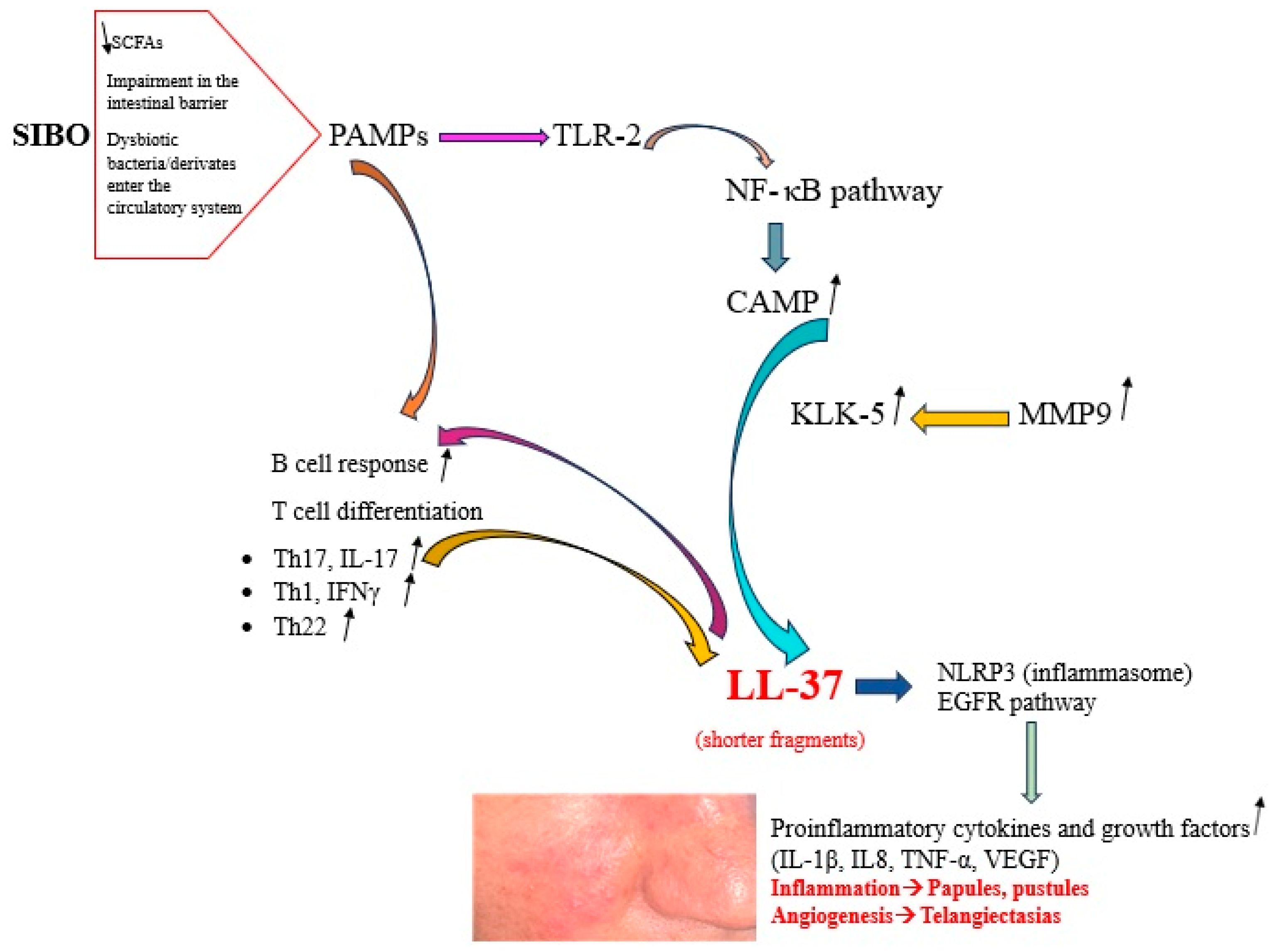
Rosacea is a chronic skin condition characterized by persistent inflammation, manifesting primarily on the face and causing redness, papules, pustules, and phymatous changes. The etiology of rosacea is multifactorial, with immune system factors playing a crucial role in its pathogenesis. The scientific literature contains an increasing number of studies that suggest a correlation between rosacea and the gut microbiota. Small intestinal bacterial overgrowth (SIBO) is defined as an excessive proliferation of potentially pathogenic bacteria within the small intestine of the gastrointestinal system. Multiple factors have been posited to explain the pathogenesis of rosacea, and the presence of SIBO has been identified as a potential factor in its occurrence. A decrease in the Lactobacillus genus, Prevotella copri, Lachnospiraceae, and Faecalibacterium within the gut microbiota may initiate inflammation related to rosacea. These bacterial species are crucial for regulating the intestinal mucosa. The findings indicate that there is an increase in Bacteriodes, Acidaminococcus, Megasphaera, and Ruminococcus in the gut microbiome of patients with rosacea. Probiotics can be advantageous for managing the intestinal microbiome, while Rifaximin treatment has shown efficacy in addressing inflammatory rosacea lesions associated with SIBO. The present review has been undertaken with the objective of enhancing our comprehension of SIBO in rosacea. The emphasis has been placed on the pathogenetic mechanisms and the shift in the gut microbiota that will lead to understanding probiotic benefits and therapy options in rosacea patients.
Keywords: rosacea; gastrointestinal microbiota; pathogenesis; immune response; probiotics rosacea; gastrointestinal microbiota; pathogenesis; immune response; probiotics