
Potential Distribution, Density and Abundance Estimate of the European Turtle Dove Streptopelia turtur (Linnaeus, 1758) in Apulia
 , ,
, ,  , ,
, ,  and
and 
Simple Summary
Abstract
1. Introduction
2. Materials and Method
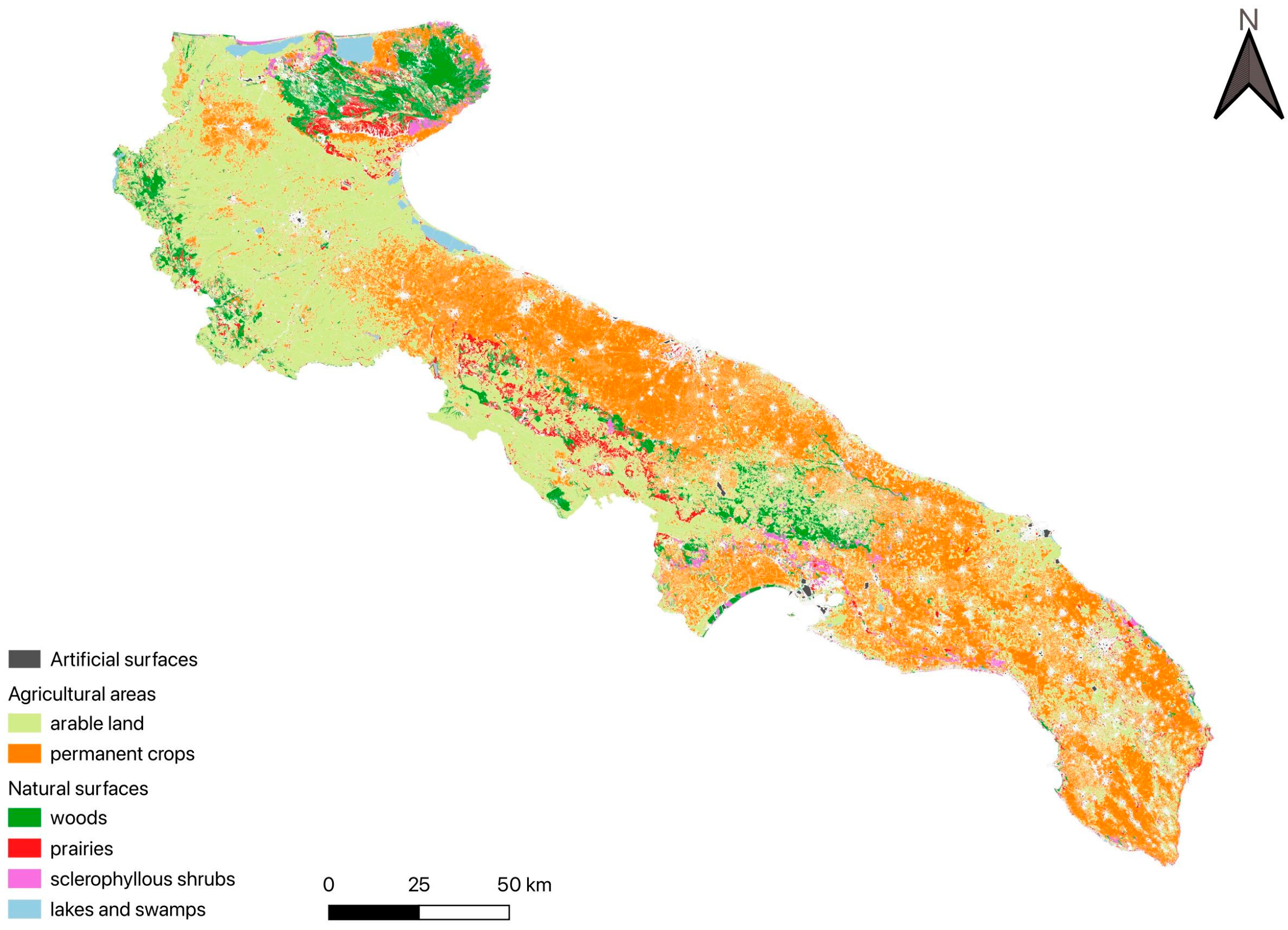
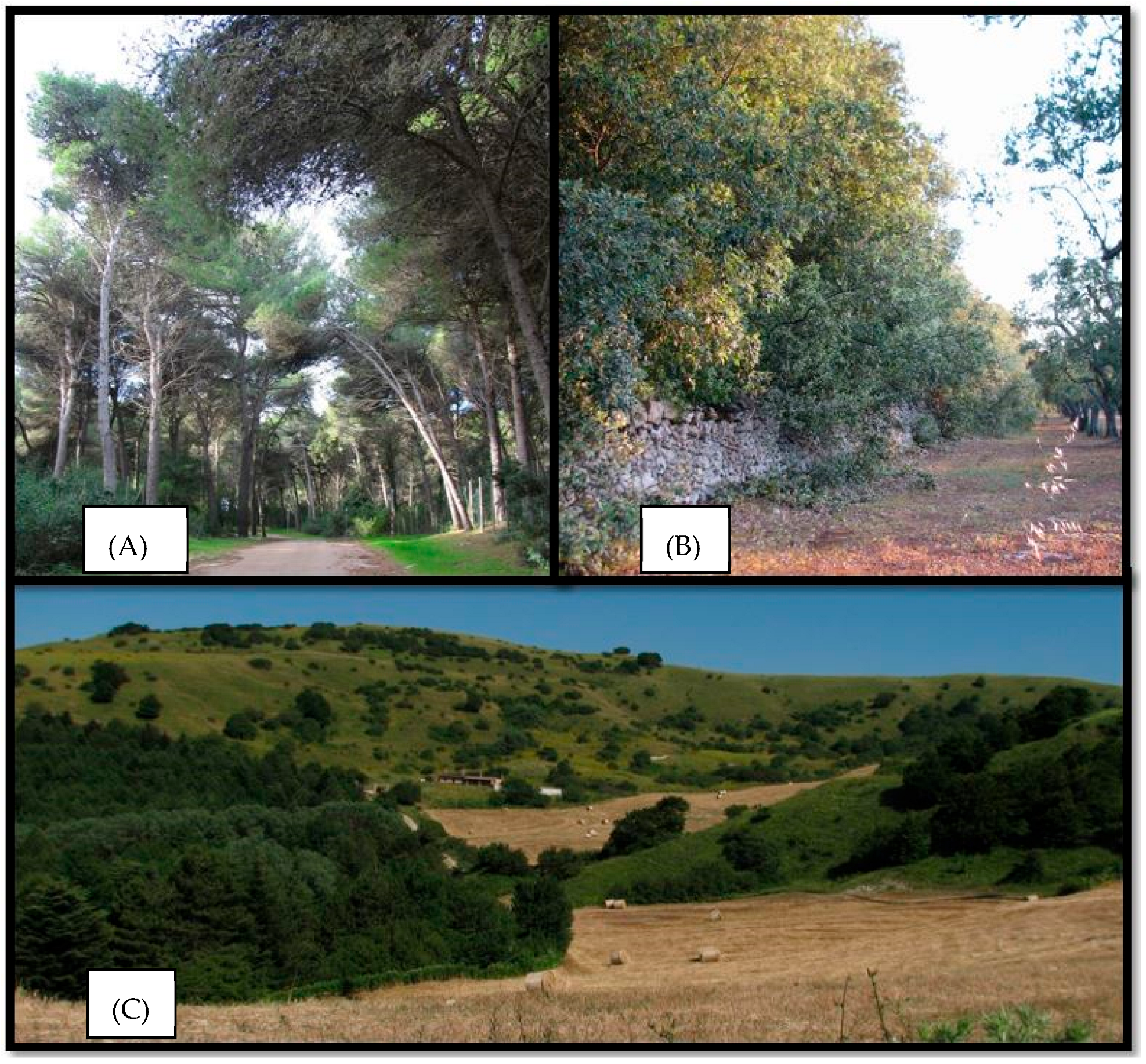
2.1. Study Area
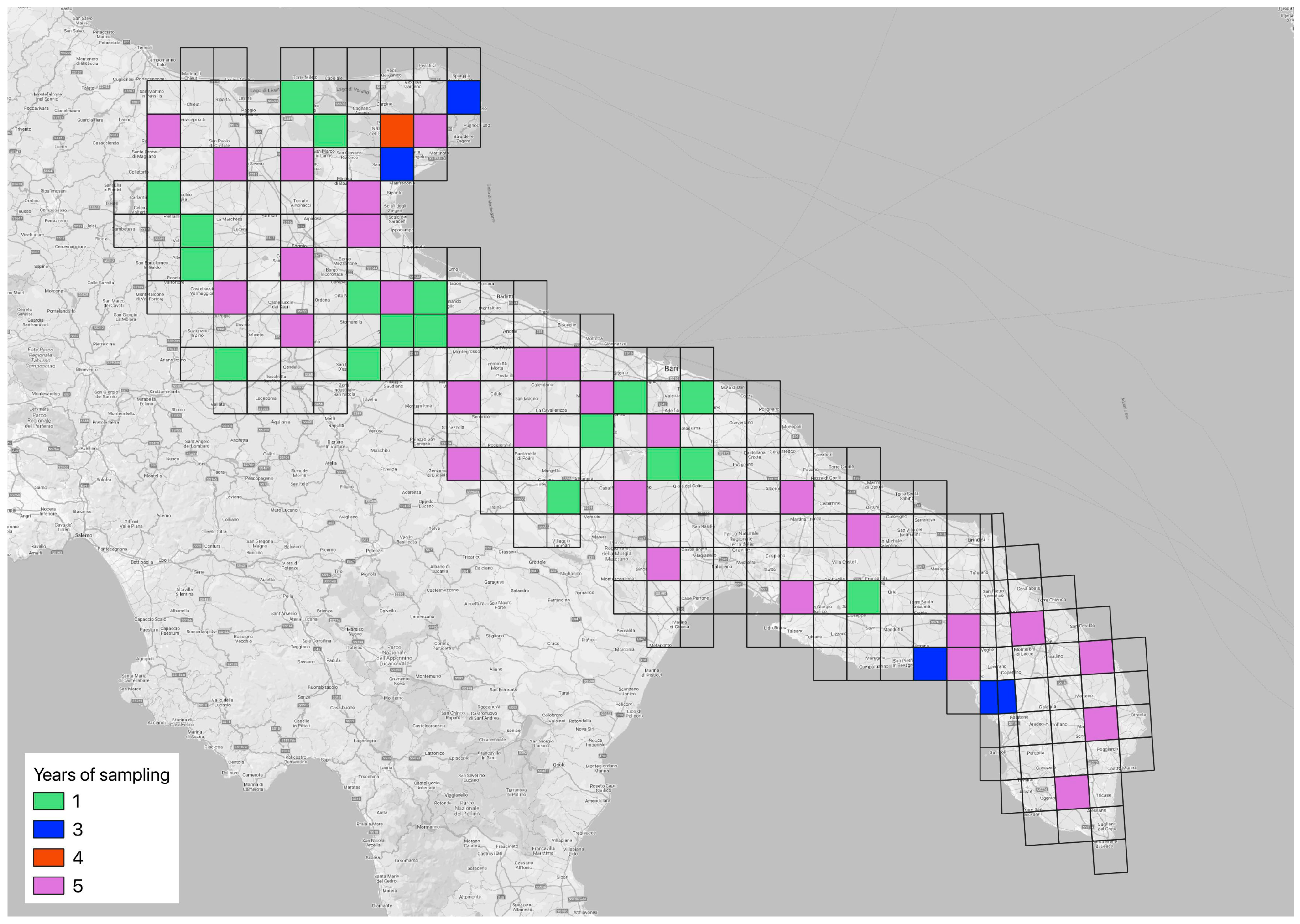
2.2. Study Design
2.3. Environmental Variables
2.4. Species Distribution Model (SDM)
2.5. Density and Abundance Estimation
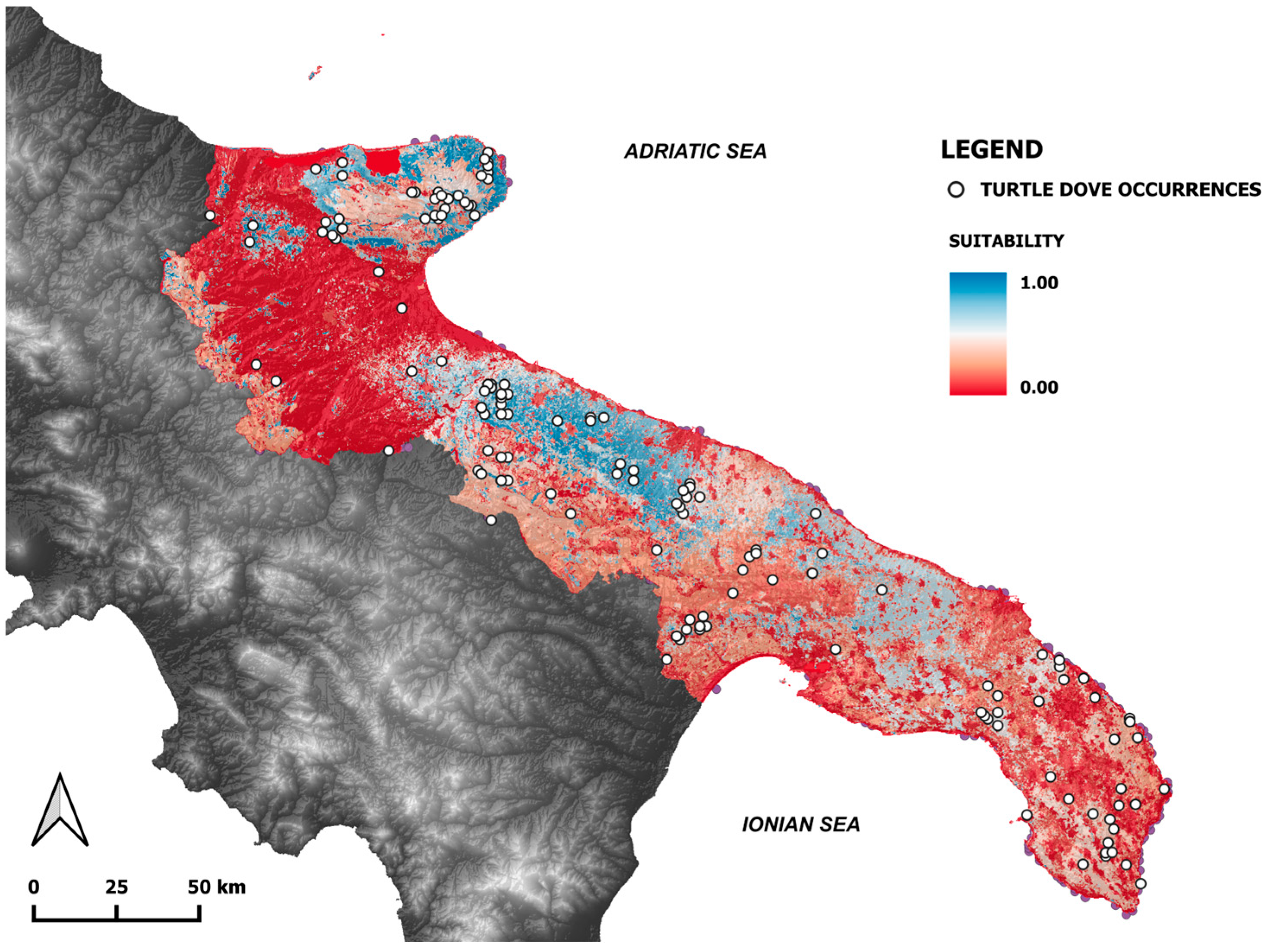
3. Results and Discussion
Limit of the Study
4. Conclusions
Author Contributions
Funding
Institutional Review Board Statement
Informed Consent Statement
Data Availability Statement
Acknowledgments
Conflicts of Interest
Appendix A

| Year | 2019 | 2020 | 2021 | 2022 | 2023 | Total |
|---|---|---|---|---|---|---|
| BK45 | x | x | x | 3 | ||
| BK57 | x | x | x | x | x | 5 |
| BK62 | x | x | x | x | x | 5 |
| BK74 | x | x | x | x | x | 5 |
| BK76 | x | x | x | x | x | 5 |
| WF18 | x | 1 | ||||
| WF19 | x | 1 | ||||
| WF27 | x | x | x | x | x | 5 |
| WF46 | x | x | x | x | x | 5 |
| WF48 | x | x | x | x | x | 5 |
| WF64 | x | 1 | ||||
| WF65 | x | 1 | ||||
| WF67 | x | 1 | ||||
| WF69 | x | x | x | x | x | 5 |
| WF76 | x | 1 | ||||
| WF77 | x | x | x | x | x | 5 |
| WF86 | x | 1 | ||||
| WF87 | x | 1 | ||||
| WF92 | x | x | x | x | x | 5 |
| WF94 | x | x | x | x | x | 5 |
| WF96 | x | x | x | x | x | 5 |
| WG02 | x | x | x | x | x | 5 |
| WG21 | x | x | x | x | x | 5 |
| WG41 | x | x | x | x | x | 5 |
| WG43 | x | 1 | ||||
| WG52 | x | 1 | ||||
| WG60 | x | x | x | x | x | 5 |
| WG71 | x | x | x | 3 | ||
| WG72 | x | x | x | x | 4 | |
| WG82 | x | x | x | x | x | 5 |
| WG93 | x | x | x | 3 | ||
| XE59 | x | x | x | x | x | 5 |
| XE98 | x | x | x | x | x | 5 |
| XF13 | x | x | x | x | x | 5 |
| XF15 | x | x | x | x | x | 5 |
| XF21 | x | 1 | ||||
| XF25 | x | x | x | x | x | 5 |
| XF33 | x | 1 | ||||
| XF34 | x | x | x | x | x | 5 |
| XF41 | x | x | x | x | x | 5 |
| XF44 | x | 1 | ||||
| XF52 | x | 1 | ||||
| XF53 | x | x | x | x | x | 5 |
| XF62 | x | 1 | ||||
| XF64 | x | 1 | ||||
| XF71 | x | x | x | x | x | 5 |
| XF91 | x | x | x | x | x | 5 |
| YE18 | x | 1 | ||||
| YE36 | x | x | x | 3 | ||
| YE46 | x | x | x | x | x | 5 |
| YE47 | x | x | x | x | x | 5 |
| YE55 | x | x | x | 3 | ||
| YF10 | x | x | x | x | x | 5 |
| WF25 | x | 1 | ||||
| WG00 | x | 1 |
References
- Barr, C.J.; Bunce, R.G.H.; Clarke, R.T.; Fuller, R.M.; Furse, M.T.; Gillespie, M.K.; Groom, G.B.; Hallam, C.J.; Hournung, M.; Howard, D.C.; et al. Countryside Survey 1990: Main Report; Department of the Environment: London, UK, 1993.
- Carboneras, C.; Moreno-Zarate, L.; Arroyo, B. The European Turtle Dove in the ecotone between woodland and farmland: Multi-scale habitat associations and implications for the design of management interventions. J. Ornithol. 2022, 163, 339–355. [Google Scholar] [CrossRef]
- Dunn, J.C.; Morris, A.J. Which Features of UK Farmland Are Important in Retaining Territories of the Rapidly Declining Turtle Dove Streptopelia turtur? Bird Study 2012, 59, 394–402. [Google Scholar] [CrossRef]
- Sauser, C.; Commagnac, L.; Eraud, C.; Guillemain, M.; Morin, S.; Powolny, T.; Villers, A.; Lormée, H. Habitats, Agricultural Practices, and Population Dynamics of a Threatened Species: The European Turtle Dove in France. Biol. Conserv. 2022, 274, 109730. [Google Scholar] [CrossRef]
- Korejs, K.; Riegert, J.; Mikuláš, I.; Vrba, J.; Havlíček, J. Habitat Preferences of European Turtle Dove Streptopelia turtur in the Czech Republic: Implications for Conservation of a Rapidly Declining Farmland Species. Vertebr. Biol. 2024, 73, 24001–24004. [Google Scholar] [CrossRef]
- Thoma, C.T.; Makridou, K.N.; Bakaloudis, D.E. Breeding Habitat Suitability Modeling to Inform Management Practices for the European Turtle Dove (Streptopelia turtur) in NE Greece. Ecologies 2025, 6, 25. [Google Scholar] [CrossRef]
- Ren, Y.; Princé, K.; Bocher, P.; Champagnon, J.; Duriez, O.; Jiguet, F. Defining optimal small woody features and water densities to maximize European turtle-dove (Streptopelia turtur) occurrence in French agricultural landscapes. Biol. Conserv. 2025, 309, 111302. [Google Scholar] [CrossRef]
- Browne, S.J.; Aebischer, N.J. Studies of West Palearctic birds: Turtle dove. Br. Birds 2005, 98, 58–72. [Google Scholar]
- Fuller, R.J.; Hinsley, S.A.; Swetnam, R.D. The relevance of non-farmland habitats, uncropped areas and habitat diversity to the conservation of farmland birds. Ibis 2004, 146, 22–31. [Google Scholar] [CrossRef]
- Brichetti, P.; Fracasso, G. Check-list degli uccelli italiani aggiornata al 2014. Riv. Ital. Orn. 2015, 85, 31–50. [Google Scholar] [CrossRef]
- Londi, G.; Lardelli, R.; Bogliani, G.; Brichetti, P.; Caprio, E.; Celada, C.; Conca, G.; Fraticelli, F.; Gustin, M.; Janni, O.; et al. Tortora selvatica. In Atlante Degli Uccelli Nidificanti in Italia; Edizioni Belvedere: Latina, Italy, 2022; pp. 1–703. (In Italian) [Google Scholar]
- Rete Rurale PAC & LIPU. Uccelli Comuni Delle Zone Agricole in Italia—Aggiornamento Degli Andamenti di Popolazione e del Farmland Bird Index per la Rete Nazionale Della PAC 2025. Available online: https://www.reterurale.it/farmlandbirdindex (accessed on 25 January 2026).
- BirdLife International Species Factsheet: European Turtle-Dove Streptopelia turtur. Available online: https://datazone.birdlife.org/species/factsheet/european-turtle-dove-streptopelia-turtur (accessed on 10 January 2025).
- Hanane, S.; Baamal, L. Are Moroccan fruit orchards suitable breeding habitats for Turtle Doves Streptopelia turtur? Bird Study 2011, 58, 57–67. [Google Scholar] [CrossRef]
- Brahmia, H.; Zeraoula, A.; Bensouilah, T.; Bouslama, Z.; Houhamdi, M. Breeding biology of sympatric Laughing Streptopelia senegalensis and Turtle Streptopelia turtur Dove: A comparative study in northeast Algeria. Zool. Ecol. 2015, 25, 220–226. [Google Scholar] [CrossRef]
- Hamza, F.; Hanane, S.; Almalki, M.; Chokri, M.A. How urbanization and industrialization shape breeding bird species occurrence in coastal Mediterranean oasis system. Urban Ecosyst. 2023, 26, 185–196. [Google Scholar] [CrossRef]
- Rete Rurale Nazionale & Lipu. Indice Farmland Bird Index (FBI)—Scheda Descrittiva. Available online: https://www.reterurale.it/flex/cm/pages/ServeBLOB.php/L/IT/IDPagina/25657 (accessed on 16 January 2025).
- Browne, S.J.; Aebischer, N.J. Habitat use, foraging ecology and diet of Turtle Doves Streptopelia turtur in Britain. Ibis 2003, 145, 572–582. [Google Scholar] [CrossRef]
- Aubineau, J.; Boutin, J.M. Hedgerow network management in a bocage landscape and its impact on nesting Columbidae in the West of France [wood pigeon (Columba palumbus), turtle dove (Streptopelia turtur); hawthorn (Crataegus monogyna)]. In Gibier Faune Sauvage; Office National de la Chasse: Paris, France, 1998. [Google Scholar]
- Hermant, D.; Frochot, B. Breeding habitats and spring densities of some Turdinae (blackbird, thrush) and Columbidae (pigeon, turtle dove) species in Cote d’Or (France) [mapping method, point count, index of abundance]. In Gibier Faune Sauvage; Office National de la Chasse: Paris, France, 1997. [Google Scholar]
- Gutiérrez-Galán, A.; Alonso, C. European Turtle Dove Streptopelia turtur diet composition in Southern Spain: The role of wild seeds in Mediterranean forest areas. Bird Study 2016, 63, 490–499. [Google Scholar] [CrossRef]
- Gustin, M.; Nardelli, R.; Brichetti, P.; Battistoni, A.; Rondinini, C.; Teofili, C. Lista Rossa IUCN Degli Uccelli Nidificanti in Italia 2019; Comitato Italiano IUCN e Ministero dell’Ambiente e della Tutela del Territorio e del Mare: Rome, Italy, 2019. [Google Scholar]
- Ministero dell’Ambiente e della Sicurezza Energetica. Piano di Gestione Nazionale Della Tortora Selvatica (Streptopelia turtur). (In Italian). Available online: https://www.mase.gov.it/portale/documents/d/guest/pcm_csr_atto_rep_23_02_03_2022_piano_piano_gestione_nazionale_tortora_selvatica-pdf (accessed on 10 April 2022).
- Liuzzi, C.; Mastropasqua, F.; Todisco, S. Avifauna Pugliese…130 Anni Dopo; Favia: Bari, Italy, 2013; p. 322. [Google Scholar]
- Di Nunno, F.; Granata, F. Groundwater level prediction in Apulia region (Southern Italy) using NARX neural network. Environ. Res. 2020, 190, 110062. [Google Scholar] [CrossRef]
- Ladisa, G.; Todorovic, M.; Liuzzi, G.T. A GIS-based approach for desertification risk assessment in Apulia region, SE Italy. Phys. Chem. Earth Parts A/B/C 2012, 49, 103–113. [Google Scholar] [CrossRef]
- Ruggiero, G.; Parlavecchia, M.; Dal Sasso, P. Typological characterization and territorial distribution of traditional rural buildings in the Apulian territory (Italy). J. Cult. Herit. 2019, 39, 278–287. [Google Scholar] [CrossRef]
- Serio, F.; Miglietta, P.P.; Lamastra, L.; Ficocelli, S.; Intini, F.; De Leo, F.; De Donno, A. Groundwater nitrate contamination and agricultural land use: A grey water footprint perspective in Southern Apulia Region (Italy). Sci. Total Environ. 2018, 645, 1425–1431. [Google Scholar] [CrossRef]
- Petito, M.; Cantalamessa, S.; Pagnani, G.; Pisante, M. Modelling and mapping Soil Organic Carbon in annual cropland under different farm management systems in the Apulia region of Southern Italy. Soil Tillage Res. 2024, 235, 105916. [Google Scholar] [CrossRef]
- Blondel, J. Point counts with unlimited distance. Stud. Avian Biol. 1981, 6, 414–420. [Google Scholar]
- Fornasari, L.; De Carli, E.; Brambilla, S.; Buvoli, L.; Mingozzi, A. Distribuzione dell’avifauna nidificante in Italia: Primo bollettino del progetto di monitoraggio MITO2000. Avocetta 2002, 26, 59–115. [Google Scholar]
- Brichetti, P.; Fracasso, G. Ornitologia Italiana, 3rd ed.; Stercorariidae-Caprimulgidae; Alberto Perdisa Editore Publisher: Ozzano dell’Emilia, Italy, 2006. [Google Scholar]
- Fick, S.E.; Hijmans, R.J. WorldClim 2: New 1-km spatial resolution climate surfaces for global land areas. Int. J. Climatol. 2017, 37, 4302–4315. [Google Scholar] [CrossRef]
- Augello, R.; Capogrossi, R.; Ceralli, D.; Bianco, P.; Luppi, S.; Putzolu, M.; Bertani, R.; Sanesi, G.; Giannico, V.; Elia, M.; et al. Carta della Natura della Regione Puglia—Standard Nazionale: Carta Degli Habitat alla Scala 1:25.000. Regione Puglia, ISPRA. 2025. Available online: https://www.isprambiente.gov.it/it/servizi/sistema-carta-della-natura/cartografia/carta-della-natura-alla-scala-1-50.000/puglia (accessed on 31 January 2026).
- Manly, B.F.J.; McDonald, L.L.; Thomas, D.L.; Mcdonald, T.L.; Erickson, W.P. Resource Selection by Animals: Statistical Design and Analysis for Field Studies, 2nd ed.; Kluwer Academic Publishers: Dordrecht, The Netherlands, 2002. [Google Scholar]
- Franklin, J.; Miller, J.A. Mapping Species Distributions: Spatial Inference and Prediction; Cambridge University Press: Cambridge, UK, 2009. [Google Scholar]
- Morrison, M.L.; Marcot, B.; Mannan, W. Wildlife-Habitat Relationships: Concepts and Applications; Island Press: Chicago, IL, USA, 2012. [Google Scholar]
- Browne, S.J.; Aebischer, N.J. Temporal changes in the breeding ecology of European Turtle Doves Streptopelia turtur in Britain, and implications for conservation. Ibis 2004, 146, 125–137. [Google Scholar] [CrossRef]
- Zuur, A.F.; Ieno, E.N.; Elphick, C.S. A protocol for data exploration to avoid common statistical problems: Data exploration. Methods Ecol. Evol. 2010, 1, 3–14. [Google Scholar] [CrossRef]
- R Core Team. R: A Language and Environment for Statistical Computing; R Foundation for Statistical Computing: Vienna, Austria, 2025. [Google Scholar]
- Hijmans, R.J.; van Etten, J.; Mattiuzzi, M.; Sumner, M.; Greenberg, J.A.; Perpinan Lamigueiro, O.; Bevan, A.; Racine, E.B.; Shortridge, A. Package Raster: Geographic Data Analysis and Modeling; Comprehensive R Archive Network: Wien, Austria, 2014. Available online: https://cran.r-project.org/web/packages/raster/raster.pdf (accessed on 31 January 2026).
- Hijmans, R.J. Package Terra: Spatial Data Analysis; Comprehensive R Archive Network: Wien, Austria, 2025. Available online: https://cran.r-project.org/web/packages/terra/terra.pdf (accessed on 31 January 2026).
- Naimi, B. Package Usdm: Uncertainty Analysis for Species Distribution Models; Comprehensive R Archive Network: Wien, Austria, 2017. Available online: https://cran.r-project.org/web/packages/usdm/usdm.pdf (accessed on 31 January 2026).
- Phillips, S.J.; Anderson, R.P.; Schapire, R.E. Maximum entropy modeling of species geographic distributions. Ecol. Model. 2006, 190, 231–259. [Google Scholar] [CrossRef]
- Elith, J.; Phillips, S.J.; Hastie, T.; Dudík, M.; Chee, Y.E.; Yates, C.J. A statistical explanation of MaxEnt for ecologists: Statistical explanation of MaxEnt. Divers. Distrib. 2011, 17, 43–57. [Google Scholar] [CrossRef]
- Phillips, S.J.; Dudík, M. Modeling of species distributions with Maxent: New extensions and a comprehensive evaluation. Ecography 2008, 31, 161–175. [Google Scholar] [CrossRef]
- Bateman, B.L.; VanDerWal, J.; Williams, S.E.; Johnson, C.N. Biotic interactions influence the projected distribution of a specialist mammal under climate change. Divers. Distrib. 2012, 18, 861–872. [Google Scholar] [CrossRef]
- Chiatante, G. Habitat requirements of the Masked Shrike Lanius nubicus in the southern Balkans. Bird Study 2021, 68, 198–210. [Google Scholar] [CrossRef]
- Betts, M.G.; Diamond, A.W.; Forbes, G.J.; Villard, M.-A.; Gunn, J.S. The importance of spatial autocorrelation, extent and resolution in predicting forest bird occurrence. Ecol. Model. 2006, 191, 197–224. [Google Scholar] [CrossRef]
- Dormann, C.F.; McPherson, J.M.; Araújo, M.B.; Bivand, R.; Bolliger, J.; Carl, G.; Davies, R.J.; Hirzel, A.; Jetz, W.; Kissling, W.D.; et al. Methods to account for spatial autocorrelation in the analysis of species distributional data: A review. Ecography 2007, 30, 609–628. [Google Scholar] [CrossRef]
- Chiatante, G. Spatial distribution of an assemblage of an endemic genus of birds: An example from Madagascar. Afr. J. Ecol. 2022, 60, 13–26. [Google Scholar] [CrossRef]
- Anderson, R.P.; Gonzalez, I., Jr. Species-specific tuning increases robustness to sampling bias in models of species distributions: An implementation with Maxent. Ecol. Model. 2011, 222, 2796–2811. [Google Scholar] [CrossRef]
- Radosavljevic, A.; Anderson, R.P. Making better Maxent models of species distributions: Complexity, overfitting and evaluation. J. Biogeogr. 2014, 41, 629–643. [Google Scholar] [CrossRef]
- Fawcett, T. An introduction to ROC analysis. Pattern Recogn. Lett. 2006, 27, 861–874. [Google Scholar] [CrossRef]
- Peterson, A.T.; Soberón, J.; Pearson, R.G.; Anderson, R.P.; Martínez-Meyer, E.; Nakamura, M.; Araújo, M.B. Ecological Niches and Geographic Distributions; Princeton University Press: Princeton, NJ, USA, 2011. [Google Scholar]
- Anderson, R.P.; Lew, D.; Peterson, A.T. Evaluating predictive models of species’ distributions: Criteria for selecting optimal models. Ecol. Model. 2003, 162, 211–232. [Google Scholar] [CrossRef]
- Brambilla, M.; Bassi, E.; Bergero, V.; Casale, F.; Chemollo, M.; Falco, R.; Longoni, V.; Saporetti, F.; Vigano, E.; Vitulano, S. Modelling distribution and potential overlap between Boreal Owl Aegolius funereus and Black Woodpecker Dryocopus martius: Implications for management and monitoring plans. Bird Conserv. Int. 2013, 23, 502–511. [Google Scholar] [CrossRef]
- Collins, S.D.; Abbott, J.C.; McIntyre, N.E. Quantifying the degree of bias from using county-scale data in species distribution modeling: Can increasing sample size or using county-averaged environmental data reduce distributional overprediction? Ecol. Evol. 2017, 7, 6012–6022. [Google Scholar] [CrossRef]
- Guillera-Arroita, G.; Lahoz-Monfort, J.J.; Elith, J.; Gordon, A.; Kujala, H.; Lentini, P.E.; McCarthy, M.A.; Tingley, R.; Wintle, B.A. Is my species distribution model fit for purpose? Matching data and models to applications. Glob. Ecol. Biogeogr. 2015, 24, 276–292. [Google Scholar] [CrossRef]
- Araújo, M.B.; Cabeza, M.; Thuiller, W.; Hannah, L.; Williams, P.H. Would climate change drive species out of reserves? An assessment of existing reserve-selection methods. Glob. Change Biol. 2004, 10, 1618–1626. [Google Scholar] [CrossRef]
- Araújo, M.B.; Guisan, A. Five (or so) challenges for species distribution modelling. J. Biogeogr. 2006, 33, 1677–1688. [Google Scholar] [CrossRef]
- Hijmans, R.J.; Phillips, S.J.; Leathwick, J.R.; Elith, J. Package Dismo: Species Distribution Modeling; Comprehensive R Archive Network: Wien, Austria, 2011. Available online: https://cran.r-project.org/web/packages/dismo/dismo.pdf (accessed on 31 January 2026).
- Muscarella, R.; Galante, P.J.; Soley-Guardia, M.; Boria, R.A.; Kass, J.M.; Uriarte, M.; Anderson, R.P. Package ENMeval: Automated Runs and Evaluations of Ecological Niche Models; Comprehensive R Archive Network: Wien, Austria, 2017. Available online: https://cloud.r-project.org/web/packages/ENMeval/ENMeval.pdf (accessed on 31 January 2026).
- Freeman, E. Package PresenceAbsence: Presence-Absence Model Evaluation; Comprehensive R Archive Network: Wien, Austria, 2012. Available online: https://cran.r-project.org/web/packages/PresenceAbsence/index.html (accessed on 31 January 2026).
- Dunn, J.C.; Morris, A.J.; Grice, P.V. Post-fledging habitat selection in a rapidly declining farmland bird, the European Turtle Dove Streptopelia turtur. Bird Conserv. Int. 2017, 27, 45–57. [Google Scholar] [CrossRef]
- Bani, L.; Massimino, D.; Bottoni, L.; Massa, R. A multiscale method for selecting indicator species and priority conservation areas: A case study for broadleaved forests in Lombardy, Italy. Conserv. Biol. 2006, 20, 512–526. [Google Scholar] [CrossRef] [PubMed]
- Mansouri, I.; Squalli, W.; El Agy, A.; El-Hassani, A.; El Ghadraoui, L.; Dakki, M. Comparison of Nesting Features and Breeding Success of Turtle Dove Streptopelia turtur between Orchards and Riparian Habitats. Int. J. Zool. 2021, 2021, 5566398. [Google Scholar] [CrossRef]
- García-Navas, V.; Tarifa, R.; Salido, T.; Gonzales-Robles, A.; Lòpez-Orta, A.; Valera, F.; Rey, P.J. Threshold responses of birds to agricultural intensification in Mediterranean olive groves. Ecol. Appl. 2025, 35, e70057. [Google Scholar] [CrossRef] [PubMed]
- Chiatante, G.; Porro, Z.E.N.O.; Meriggi, A. The importance of riparian forests and tree plantations for the occurrence of the European Turtle Dove Streptopelia turtur in an intensively cultivated agroecosystem. Bird Conserv. Int. 2021, 31, 605–619. [Google Scholar] [CrossRef]
- Calderón, L.; Campagna, L.; Wilke, T.; Lormee, H.; Eraud, C.; Dunn, J.C.; Rocha, G.; Zehtindjiev, P.; Bakaloudis, D.E.; Metzger, B.; et al. Genomic evidence of demographic fluctuations and lack of genetic structure across flyways in a long distance migrant, the European turtle dove. BMC Evol. Biol. 2016, 16, 237. [Google Scholar] [CrossRef]
- Marx, M.; Quillfeldt, P. Species distribution models of European Turtle Doves in Germany are more reliable with presence only rather than presence absence data. Sci. Rep. 2018, 8, 16898. [Google Scholar] [CrossRef]
- Puglisi, L.; Arcamone, E.; Franchini, M.; Giunchi, D.; Meschini, E.; Sacchetti, A.; Vanni, L.; Vezzani, A. Atlante Degli Uccelli Nidificanti e Svernanti in Toscana. 2 Distribuzione, Abbondanza e Conservazione; Regione Toscana: Firenze, Italy, 2024. [Google Scholar]
- Gutierrez-Galan, A.; Sanchez, A.L.; González, C.A. Foraging habitat requirements of European Turtle Dove Streptopelia turtur in a Mediterranean forest landscape. Acta Ornithol. 2019, 53, 143–154. [Google Scholar] [CrossRef]
- Moreno-Zarate, L.; Estrada, A.; Peach, W.; Arroyo, B. Spatial heterogeneity in population change of the globally threatened European turtle dove in Spain: The role of environmental favorability and land use. Divers. Distrib. 2020, 26, 818–831. [Google Scholar] [CrossRef]
- Tellería, J.L.; Carbonell, R.; Fandos, G.; Tena, E.; Onrubia, A.; Qninba, A.; Aguirre, J.I.; Hernandez-Tellez, I.; Martin, C.A.; Ramírez, Á. Distribution of the European turtle dove (Streptopelia turtur) at the edge of the South-Western Palaearctic: Transboundary differences and conservation prospects. Eur. J. Wildl. Res. 2020, 66, 74. [Google Scholar] [CrossRef]


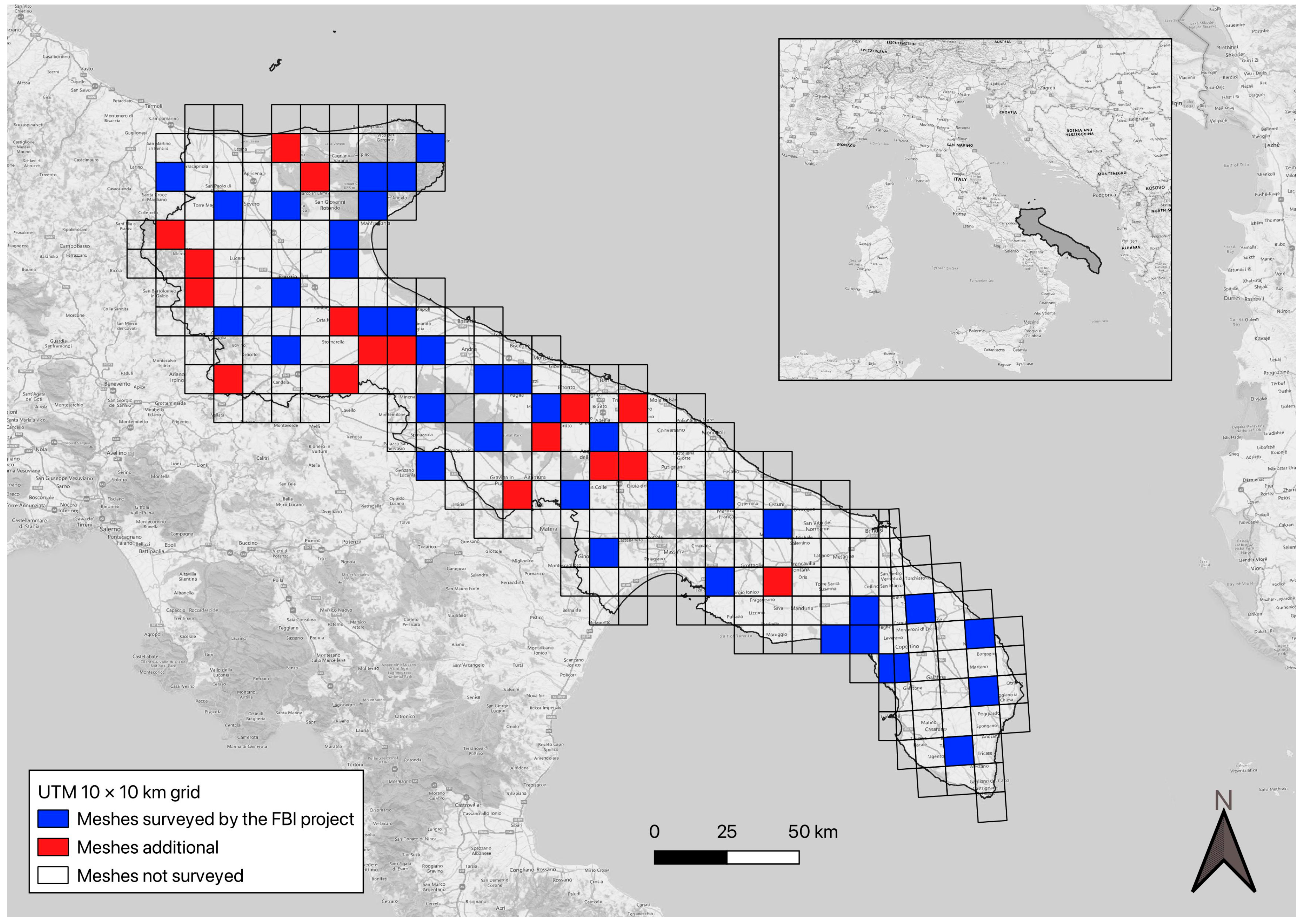

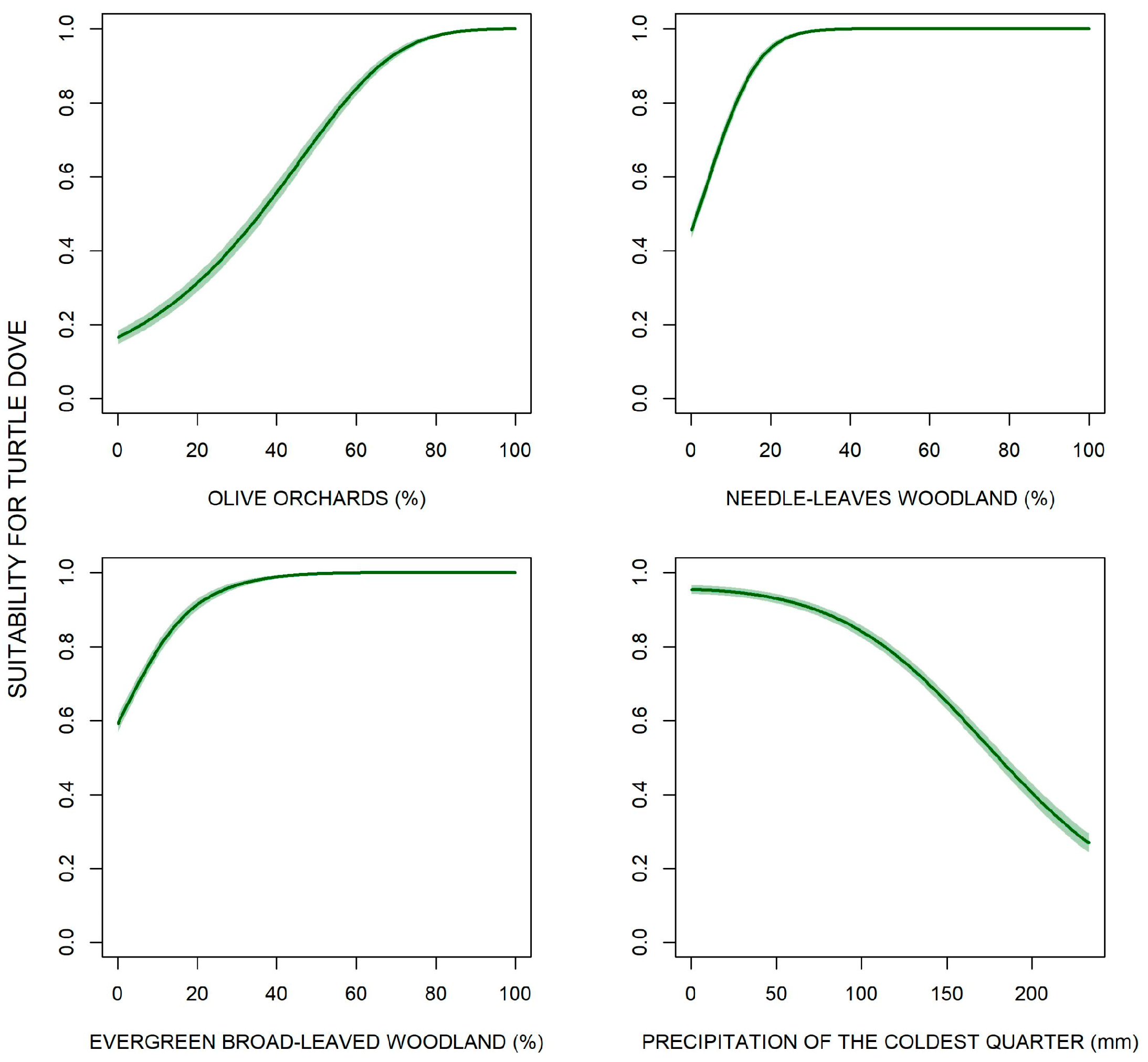

| Environmental Variables | Mean | SD | Range | VIFbef | VIFaft |
|---|---|---|---|---|---|
| Annual mean temperature (°C) | 15.3 | 1.71 | 0–17.2 | 799.57 | - |
| Temperature seasonality (SD) | 6.1 | 0.58 | 0–7.0 | 680.10 | 1.60 |
| Mean temperature of warmest quarter (°C) | 23.2 | 2.12 | 0–24.7 | 217.73 | - |
| Mean temperature of coldest quarter (°C) | 8.4 | 1.57 | 0–10.8 | 576.80 | 1.55 |
| Annual precipitation (mm) | 495.7 | 103.83 | 0–680 | 166.93 | - |
| Precipitation seasonality (CV) | 33.6 | 10.66 | 0–61.0 | 63.55 | - |
| Precipitation of warmest quarter (mm) | 69.5 | 16.05 | 0–99 | 46.37 | 1.75 |
| Precipitation of coldest quarter (mm) | 147.4 | 40.31 | 0–234 | 129.21 | 1.82 |
| Urban areas (% cover) | 6.2 | 21.63 | 0–100 | 5.68 | 1.39 |
| Intensively cultivated croplands (% cover) | 18.8 | 37.50 | 0–100 | 1.69 | - |
| Extensively cultivated croplands (% cover) | 21.7 | 36.42 | 0–100 | 1.52 | 2.12 |
| Olive orchards | 25.1 | 38.87 | 0–100 | 16.63 | 2.10 |
| Orchards and vineyards | 10.3 | 26.41 | 0–100 | 8.46 | 1.47 |
| Deciduous broad-leaved forests | 5.0 | 19.85 | 0–100 | 5.27 | 1.60 |
| Evergreen broad-leaved forests | 1.7 | 12.06 | 0–100 | 2.86 | 1.16 |
| Needle-leaved forests | 1.9 | 11.97 | 0–100 | 3.05 | 1.09 |
| Shrublands | 0.5 | 6.25 | 0–100 | 1.56 | 1.05 |
| Mediterranean maquis | 1.4 | 9.88 | 0–100 | 1.93 | 1.07 |
| Natural grasslands | 4.1 | 17.54 | 0–100 | 4.73 | 1.22 |
| Water bodies | 1.5 | 10.95 | 0–100 | 2.21 | 1.06 |
| Year | 2019 | 2020 | 2021 | 2022 | 2023 | Total | Mean | SD |
|---|---|---|---|---|---|---|---|---|
| Point counts | 497 | 624 | 438 | 437 | 730 | 2726 | 545.20 | 114.79 |
| Observed individuals | 31 | 41 | 46 | 37 | 56 | 211 | 42.20 | 8.47 |
| Observed pairs | 24 | 33 | 32 | 28 | 31 | 148 | 29.60 | 3.26 |
| Point counts with TD | 20 | 31 | 26 | 25 | 45 | 147 | 29.40 | 8.55 |
| % point counts with TD | 4.02% | 4.97% | 5.94% | 5.72% | 6.16% | 5.39% | 5.36% | 0.78% |
| Environmental Variable | λ | Mean | SE | LCI | UCI | Contribution | Permutation (% ± SD) |
|---|---|---|---|---|---|---|---|
| Olive orchards | L | 3.94 | 0.12 | 3.70 | 4.18 | 37.1 ± 0.98 | 40.6 ± 4.79 |
| Needle-leaved woodland | L | 9.70 | 0.20 | 9.29 | 10.09 | 19.1 ± 0.99 | 11.7 ± 3.21 |
| Q | −5.51 | 0.20 | −5.91 | −5.10 | - | - | |
| Evergreen broad-leaved woodland | L | 6.26 | 0.25 | 5.77 | 6.76 | 9.9 ± 0.93 | 6.4 ± 2.59 |
| Precipitation of the coldest quarter | L | −0.98 | 0.16 | −1.29 | −0.66 | 9.8 ± 0.95 | 7.9 ± 3.41 |
| Orchards and vineyards | L | 2.67 | 0.13 | 2.41 | 2.92 | 6.2 ± 0.33 | 8.7 ± 2.51 |
| Extensively cultivated croplands | L | 2.36 | 0.14 | 2.08 | 2.64 | 3.8 ± 0.29 | 9.4 ± 2.38 |
| Urban areas | L | −1.61 | 0.23 | −2.07 | −1.16 | 3.7 ± 0.31 | 2.1 ± 2.14 |
| Natural grasslands | L | −6.98 | 0.16 | −7.30 | −6.65 | 2.9 ± 0.33 | 4.1 ± 1.80 |
| Mean temperature of the coldest quarter | L | 2.05 | 0.23 | 1.58 | 2.51 | 2.0 ± 0.28 | 2.1 ± 1.72 |
| Deciduous broad-leaved woodland | L | 2.44 | 0.23 | 1.97 | 2.90 | 2.0 ± 0.24 | 4.0 ± 2.07 |
| Precipitation of the warmest quarter | L | 0.61 | 0.15 | 0.31 | 0.91 | 1.1 ± 0.09 | 1.1 ± 1.37 |
| Mediterranean maquis | L | 2.00 | 0.25 | 1.51 | 2.49 | 0.9 ± 0.22 | 0.8 ± 0.76 |
| Temperature seasonality | L | 3.51 | 0.33 | 2.85 | 4.17 | 0.8 ± 0.08 | 1.1 ± 1.09 |
| Water bodies | L | −0.88 | 0.07 | −1.01 | −0.74 | 0.7 ± 0.02 | 0.00 |
| Shrublands | L | −0.87 | 0.07 | −1.01 | −0.74 | 0.1 ± 0.02 | 0.00 |
| Year | 2019 | 2020 | 2021 | 2022 | 2023 | Mean | SD |
|---|---|---|---|---|---|---|---|
| Point counts | 497 | 624 | 438 | 437 | 730 | 545.2 | 114.79 |
| Surveyed area (km2) | 62.45 | 78.41 | 55.04 | 54.92 | 91.73 | 68.51 | 14.42 |
| Observed birds | 31 | 41 | 46 | 37 | 56 | 42.2 | 8.47 |
| Esteemed individuals | 44.29–62.00 | 58.57–82.00 | 65.71–92.00 | 52.86–74.00 | 80.00–112.00 | 60.29–84.40 | 12.10–16.94 |
| Esteemed individuals/km2 | 0.71–0.99 | 0.75–1.05 | 1.19–1.67 | 0.96–1.35 | 0.87–1.22 | 0.87–1.16 | 0.17–0.24 |
| Observed pairs | 24 | 33 | 32 | 28 | 48 | 33.00 | 8.15 |
| Esteemed pairs | 34.29–48.00 | 47.14–66.00 | 45.71–64.00 | 40.00–56.00 | 68.57–96.00 | 47.14–66.00 | 11.64–16.30 |
| Esteemed pairs/km2 | 0.55–0.77 | 0.60–0.84 | 0.83–1.16 | 0.73–1.02 | 0.75–1.05 | 0.69–0.97 | 0.10–0.14 |
| Total birds in Apulia | 13,738.50–19,156.50 | 14,512.50–20,317.50 | 23,026.50–32,314.50 | 18,576.00–26,122.50 | 16,834.50–23,607.00 | 17,337.60–24,303.60 | 3319.19–4697.87 |
| Total pairs in Apulia | 10,642.50–14,899.50 | 11,610.00–16,254.00 | 16,060.50–22,446.00 | 14,125.50–19,737.00 | 14,512.50–20,317.50 | 13,390.20–18,730.80 | 1982.41–2762.11 |
Disclaimer/Publisher’s Note: The statements, opinions and data contained in all publications are solely those of the individual author(s) and contributor(s) and not of MDPI and/or the editor(s). MDPI and/or the editor(s) disclaim responsibility for any injury to people or property resulting from any ideas, methods, instructions or products referred to in the content. |
© 2026 by the authors. Licensee MDPI, Basel, Switzerland. This article is an open access article distributed under the terms and conditions of the Creative Commons Attribution (CC BY) license.
Share and Cite
Tarricone, S.; La Gioia, G.; Colonna, M.A.; De Vito, N.; Lacitignola, M.; Gerardi, D.; Chiatante, G.; Campanile, D.; Fortunato, M.; Ragni, M. Potential Distribution, Density and Abundance Estimate of the European Turtle Dove Streptopelia turtur (Linnaeus, 1758) in Apulia. Birds 2026, 7, 20. https://doi.org/10.3390/birds7010020
Tarricone S, La Gioia G, Colonna MA, De Vito N, Lacitignola M, Gerardi D, Chiatante G, Campanile D, Fortunato M, Ragni M. Potential Distribution, Density and Abundance Estimate of the European Turtle Dove Streptopelia turtur (Linnaeus, 1758) in Apulia. Birds. 2026; 7(1):20. https://doi.org/10.3390/birds7010020
Chicago/Turabian StyleTarricone, Simona, Giuseppe La Gioia, Maria Antonietta Colonna, Nicolò De Vito, Massimo Lacitignola, Domenico Gerardi, Gianpasquale Chiatante, Domenico Campanile, Mariarosaria Fortunato, and Marco Ragni. 2026. "Potential Distribution, Density and Abundance Estimate of the European Turtle Dove Streptopelia turtur (Linnaeus, 1758) in Apulia" Birds 7, no. 1: 20. https://doi.org/10.3390/birds7010020
APA StyleTarricone, S., La Gioia, G., Colonna, M. A., De Vito, N., Lacitignola, M., Gerardi, D., Chiatante, G., Campanile, D., Fortunato, M., & Ragni, M. (2026). Potential Distribution, Density and Abundance Estimate of the European Turtle Dove Streptopelia turtur (Linnaeus, 1758) in Apulia. Birds, 7(1), 20. https://doi.org/10.3390/birds7010020