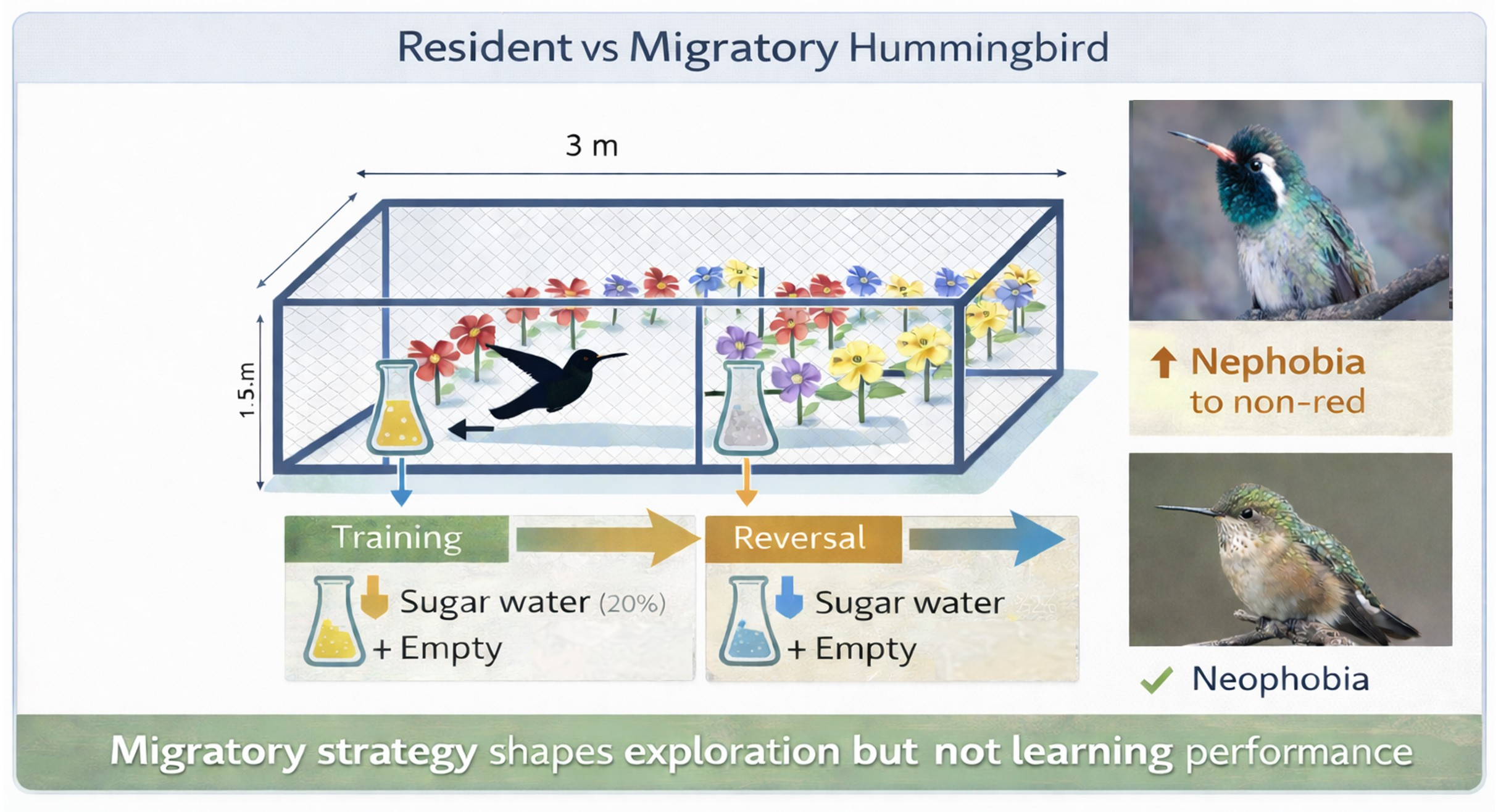

Migratory Status Shapes Exploratory Behavior but Not Learning Performance in Hummingbird Color Discrimination

Simple Summary
Abstract

1. Introduction
2. Materials and Methods
2.1. Study Site and Species
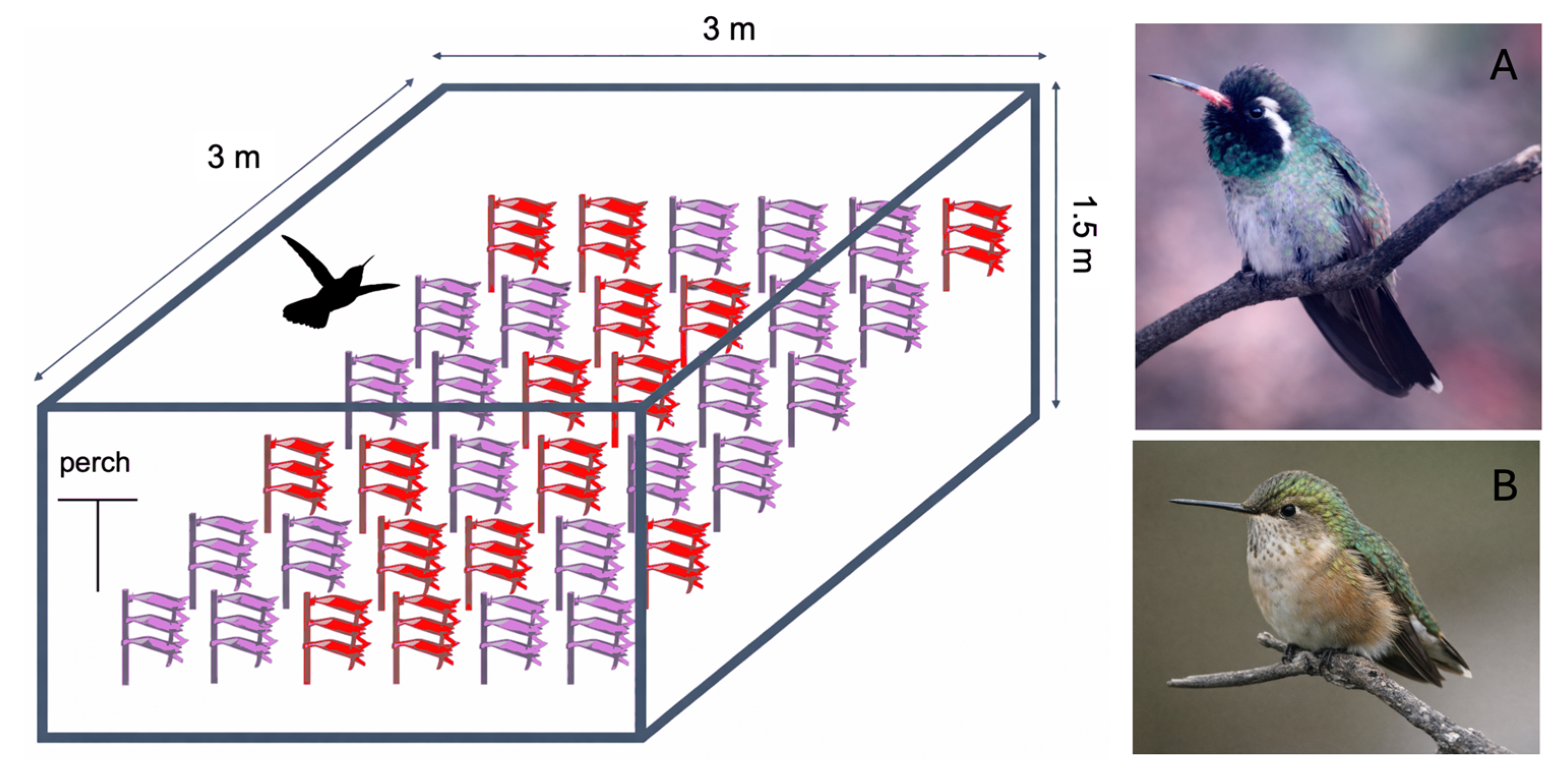
2.2. Experimental Setup
2.3. Reversal Learning Protocol
2.4. Behavioral Measures
2.5. Statistical Analyses
3. Results
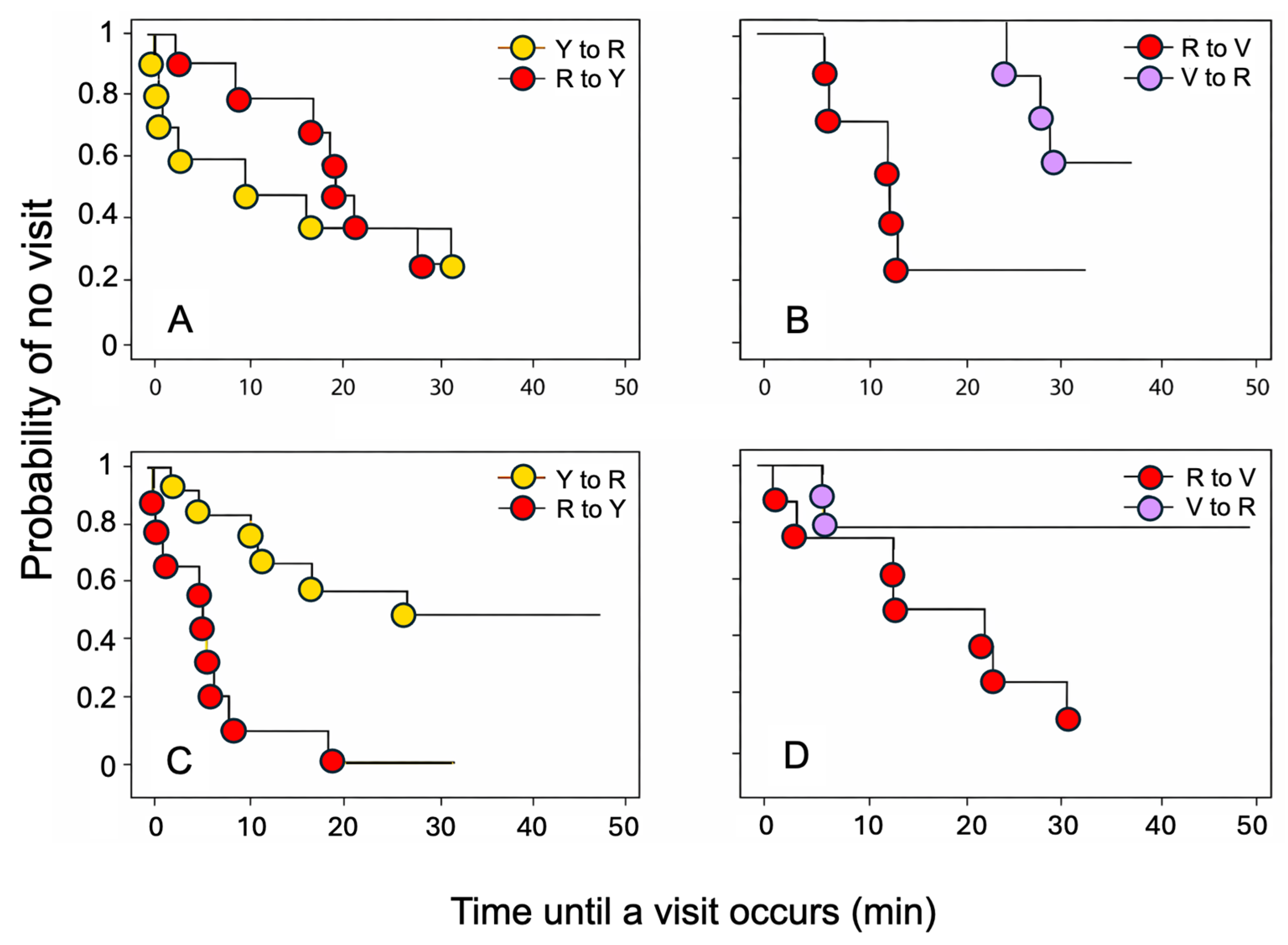
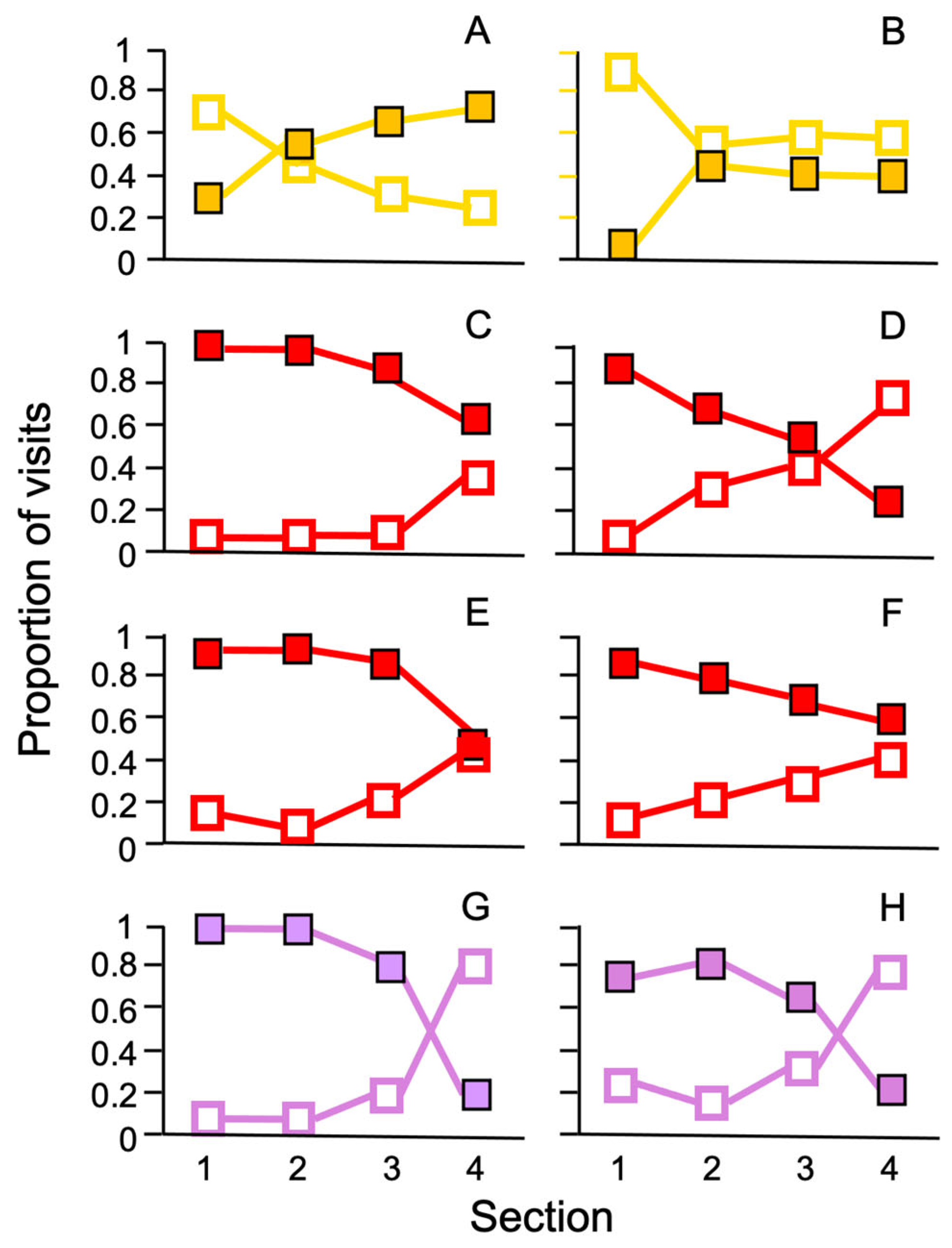
3.1. Exploration
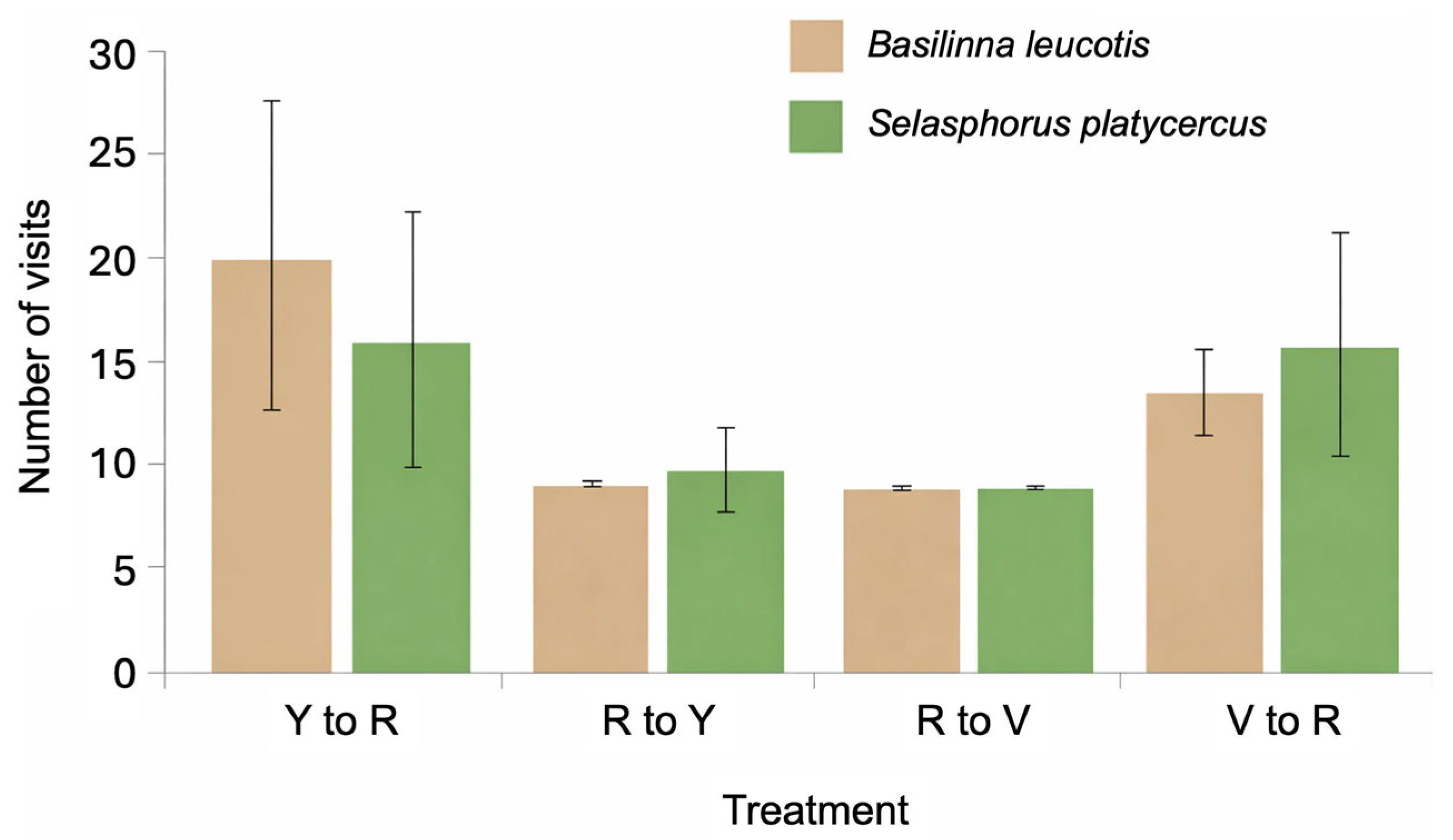
3.2. Exploitation
3.3. Inhibition
4. Discussion
4.1. Species Differences in Exploration Reflect Ecological Context
4.2. Color Discrimination and Spectral Similarity
4.3. Implications for Understanding Hummingbird Cognition
4.4. Methodological Considerations and Future Directions
5. Conclusions
Author Contributions
Funding
Institutional Review Board Statement
Informed Consent Statement
Data Availability Statement
Acknowledgments
Conflicts of Interest
References
- Bond, A.B.; Kamil, A.C.; Balda, R.P. Serial reversal learning and the evolution of behavioral flexibility in three species of North American corvids. J. Comp. Psychol. 2007, 121, 372–379. [Google Scholar] [CrossRef]
- Audet, J.N.; Lefebvre, L. What’s flexible in behavioral flexibility? Behav. Ecol. 2017, 28, 943–947. [Google Scholar] [CrossRef]
- Leimar, O.; Quiñones, A.E.; Bshary, R. Flexible learning in complex worlds. Behav. Ecol. 2024, 35, arad109. [Google Scholar] [CrossRef]
- Sol, D.; Timmermans, S.; Lefebvre, L. Behavioural flexibility and invasion success in birds. Anim. Behav. 2002, 63, 495–502. [Google Scholar] [CrossRef]
- Breen, A.J.; Guillette, L.M.; Healy, S.D. What can nest-building birds teach us? Comp. Cogn. Behav. Rev. 2016, 17, 83–123. [Google Scholar] [CrossRef]
- Biondi, L.M.; Medina, A.; Bonetti, E.A.; Paterlini, C.A.; Bó, M.S. Cognitive flexibility in a generalist raptor: A comparative analysis along an urbanization gradient. Behav. Ecol. 2024, 35, arae025. [Google Scholar] [CrossRef]
- Tebbich, S.; Sterelny, K.; Teschke, I. The tale of the finch: Adaptive radiation and behavioural flexibility. Philos. Trans. R. Soc. B 2010, 365, 1099–1109. [Google Scholar] [CrossRef]
- Morand-Ferron, J.; Reichert, M.S.; Quinn, J.L. Cognitive flexibility in the wild: Individual differences in reversal learning are explained primarily by proactive interference, not by sampling strategies, in two passerine bird species. Learn. Behav. 2022, 50, 153–166. [Google Scholar] [CrossRef] [PubMed]
- van den Heuvel, K.; Quinn, J.L.; Kotrschal, A.; van Oers, K. Artificial selection for reversal learning reveals limited repeatability and no heritability of cognitive flexibility in great tits (Parus major). Proc. Biol. Sci. 2023, 290, 20231067. [Google Scholar] [CrossRef]
- Audet, J.N.; Couture, M.; Jarvis, E.D. Songbird species that display more complex vocal learning are better problem-solvers and have larger brains. Science 2023, 381, 1170–1175. [Google Scholar] [CrossRef]
- Miller, R.; Garcia-Pelegrin, E.; Danby, E. Neophobia and innovation in critically endangered Bali Myna, Leucopsar rothschildi. R. Soc. Open Sci. 2022, 9, 211781. [Google Scholar] [CrossRef]
- Miller, R.; Lambert, M.L.; Frohnwieser, A.; Brecht, K.F.; Bugnyar, T.; Crampton, I.; Garcia-Pelegrin, E.; Gould, K.; Greggor, A.L.; Izawa, E.-I.; et al. Socio-ecological correlates of neophobia in corvids. Curr. Biol. 2022, 32, 74–85. [Google Scholar] [CrossRef]
- Quesada, J.; Chavez-Zichinelli, C.A.; Garcia-Arroyo, M.; Yeh, P.J.; Guevara, R.; Izquierdo-Palma, J.; MacGregor-Fors, I. Bold or shy? Examining the risk-taking behavior and neophobia of invasive and non-invasive house sparrows. Anim. Biodivers. Conserv. 2022, 45, 97–106. [Google Scholar] [CrossRef]
- Wojczulanis-Jakubas, K.; Araya-Salas, M. Foraging, fear and behavioral variation in a traplining hummingbird. Animals 2023, 13, 1997. [Google Scholar] [CrossRef] [PubMed]
- Healy, S.D.; Hurly, T.A. What hummingbirds can tell us about cognition in the wild. Comp. Cogn. Behav. Rev. 2013, 8, 13–28. [Google Scholar] [CrossRef]
- González-Gómez, P.L.; Araya-Salas, M. Perspectives on the study of field hummingbird cognition in the Neotropics. In Behavioral Ecology of Neotropical Birds; Reboreda, J.C., Fiorini, V.D., Tuero, D.T., Eds.; Springer: Cham, Switzerland, 2019; pp. 199–212. [Google Scholar]
- Ward, B.J.; Day, L.B.; Wilkening, S.R.; Wylie, D.R.; Saucier, D.M.; Iwaniuk, A.N. Hummingbirds have a greatly enlarged hippocampal formation. Biol. Lett. 2012, 8, 657–659. [Google Scholar] [CrossRef]
- Li, J.; Liu, J.-A.; Wang, L.; Li, D. Avian hippocampus: Recent advances in anatomy and physiological functions. Avian Res. 2024, 15, 100208. [Google Scholar] [CrossRef]
- Lara, C.; González, J.M.; Hudson, R. Observational learning in the white-eared hummingbird (Hylocharis leucotis): Experimental evidence. Ethology 2009, 115, 872–878. [Google Scholar] [CrossRef]
- Pérez, G.; Lara, C.; Viccon-Pale, J.; Signoret-Poillon, M. Memory for location and visual cues in white-eared hummingbirds (Hylocharis leucotis). Curr. Zool. 2011, 57, 468–476. [Google Scholar] [CrossRef]
- Pérez, G.; Lara, C.; Signoret-Poillon, M.; Viccon-Pale, J.A. Evaluación del uso de señales visuales y de localización por el colibrí cola-ancha (Selasphorus platycercus) al visitar flores de Penstemon roseus. Rev. Mex. Biodivers. 2012, 83, 144–151. [Google Scholar] [CrossRef]
- Barreto, E.; Boehm, M.M.A.; Ogutcen, E.; Abrahamczyk, S.; Kessler, M.; Bascompte, J.; Dellinger, A.S.; Bello, C.; Dehling, D.M.; Duchenne, F.; et al. Macroevolution of the plant–hummingbird pollination system. Biol. Rev. 2024, 99, 1831–1847. [Google Scholar] [CrossRef]
- Stoddard, M.C.; Eyster, H.N.; Hogan, B.G.; Morris, D.H.; Soucy, E.R.; Inouye, D.W. Wild hummingbirds discriminate nonspectral colors. Proc. Natl. Acad. Sci. USA 2020, 117, 15112–15122. [Google Scholar] [CrossRef]
- Whitney, K.D.; Smith, A.K.; White, T.E.; Williams, C.F. Birds perceive more intraspecific color variation in bird-pollinated than bee-pollinated flowers. Front. Plant Sci. 2020, 11, 590347. [Google Scholar] [CrossRef] [PubMed]
- Stiles, F.G. Taste preferences, color preferences, and flower choice in hummingbirds. Condor 1976, 78, 10–26. [Google Scholar] [CrossRef]
- Meléndez-Ackerman, E.J.; Campbell, D.R.; Waser, N.M. Hummingbird behavior and mechanisms of selection on flower color in Ipomopsis. Ecology 1997, 78, 2532–2541. [Google Scholar] [CrossRef]
- Ornelas, J.F.; Lara, C. Differential response to colour tasks on resident and migratory hummingbirds: A field test. Ethol. Ecol. Evol. 2015, 27, 357–378. [Google Scholar] [CrossRef]
- López-Segoviano, G.; Arenas-Navarro, M.; Nuñez-Rosas, L.E.; Arizmendi, M.D.C. Implications of dominance hierarchy on hummingbird-plant interactions in a temperate forest in Northwestern Mexico. PeerJ 2023, 11, e16245. [Google Scholar] [CrossRef]
- Martínez-Roldán, H.; Pérez-Crespo, M.J.; Lara, C. Unraveling habitat-driven shifts in alpha, beta, and gamma diversity of hummingbirds and their floral resource. PeerJ 2024, 12, e17713. [Google Scholar] [CrossRef]
- Lara, C. Temporal dynamics of flower use by hummingbirds in a highland temperate forest in Mexico. Ecoscience 2006, 13, 23–29. [Google Scholar] [CrossRef]
- R Core Team. R: A Language and Environment for Statistical Computing; R Foundation for Statistical Computing: Vienna, Austria, 2023. [Google Scholar]
- Therneau, T. A Package for Survival Analysis in R. R Pack-Age Version 3.2-7; CRAN (Comprehensive R Archive Network): Vienna, Austria, 2020; Available online: https://cran.r-project.org/package=survival (accessed on 13 January 2026).
- Bates, D.; Mächler, M.; Bolker, B.; Walker, S. Fitting linear mixed-effects models using lme4. J. Stat. Softw. 2015, 67, 1–48. [Google Scholar] [CrossRef]
- Mettke-Hofmann, C.; Lorentzen, S.; Schlicht, E.; Schneider, J.; Werner, F. Spatial neophilia and spatial neophobia in resident and migratory warblers (Sylvia). Ethology 2009, 115, 482–492. [Google Scholar] [CrossRef]
- González-Gómez, P.L.; Razeto-Barry, P.; Araya-Salas, M.; Estades, C.F. Does environmental heterogeneity promote cognitive abilities? Integr. Comp. Biol. 2015, 55, 432–443. [Google Scholar] [CrossRef]
- Martín González, A.M.; Ornelas, J.F.; Dalsgaard, B.; Márquez-Luna, U.; Lara, C. Meta-networks for the study of biogeographical traits in ecological networks: The Mexican hummingbird-plant assemblage. Sci. Nat. 2018, 105, 54. [Google Scholar] [CrossRef]
- Pritchard, D.J.; Hurly, T.A.; Healy, S.D. Wild hummingbirds require a consistent view of landmarks to pinpoint a goal location. Anim. Behav. 2018, 137, 83–94. [Google Scholar] [CrossRef]
- Tello-Ramos, M.C.; Hurly, T.A.; Healy, S.D. From a sequential pattern, temporal adjustments emerge in hummingbird traplining. Integr. Zool. 2019, 14, 182–192. [Google Scholar] [CrossRef] [PubMed]
- Tello-Ramos, M.C.; Hurly, T.A.; Barclay, M.; Healy, S.D. Hummingbirds modify their routes to avoid a poor location. Learn. Behav. 2021, 50, 89–98. [Google Scholar] [CrossRef]
- Araya-Salas, M.; Gonzalez-Gomez, P.; Wojczulanis-Jakubas, K.; López, V.; Wright, T.F. Spatial memory is as important as weapon and body size for territorial ownership in a lekking hummingbird. Sci. Rep. 2018, 8, 2001. [Google Scholar] [CrossRef]
- Cauchoix, M.; Hermer, E.; Chaine, A.S.; Morand-Ferron, J. Cognition in the field: Comparison of reversal learning performance in captive and wild passerines. Sci. Rep. 2017, 7, 12945. [Google Scholar] [CrossRef]
- Szabo, B.; Noble, D.W.A.; Whiting, M.J. Learning in non-avian reptiles 40 years on: Advances and promising new directions. Biol. Rev. 2021, 96, 331–356. [Google Scholar] [CrossRef] [PubMed]


Disclaimer/Publisher’s Note: The statements, opinions and data contained in all publications are solely those of the individual author(s) and contributor(s) and not of MDPI and/or the editor(s). MDPI and/or the editor(s) disclaim responsibility for any injury to people or property resulting from any ideas, methods, instructions or products referred to in the content. |
© 2026 by the authors. Licensee MDPI, Basel, Switzerland. This article is an open access article distributed under the terms and conditions of the Creative Commons Attribution (CC BY) license.
Share and Cite
Porras-Reyes, B.; Ornelas, J.F.; Lara, C. Migratory Status Shapes Exploratory Behavior but Not Learning Performance in Hummingbird Color Discrimination. Birds 2026, 7, 19. https://doi.org/10.3390/birds7010019
Porras-Reyes B, Ornelas JF, Lara C. Migratory Status Shapes Exploratory Behavior but Not Learning Performance in Hummingbird Color Discrimination. Birds. 2026; 7(1):19. https://doi.org/10.3390/birds7010019
Chicago/Turabian StylePorras-Reyes, Belgica, Juan Francisco Ornelas, and Carlos Lara. 2026. "Migratory Status Shapes Exploratory Behavior but Not Learning Performance in Hummingbird Color Discrimination" Birds 7, no. 1: 19. https://doi.org/10.3390/birds7010019
APA StylePorras-Reyes, B., Ornelas, J. F., & Lara, C. (2026). Migratory Status Shapes Exploratory Behavior but Not Learning Performance in Hummingbird Color Discrimination. Birds, 7(1), 19. https://doi.org/10.3390/birds7010019