
Article

Migratory Status Shapes Exploratory Behavior but Not Learning Performance in Hummingbird Color Discrimination

by
Belgica Porras-Reyes
1,
Juan Francisco Ornelas
2 and
Carlos Lara
1,*
1
Centro de Investigación en Ciencias Biológicas, Universidad Autónoma de Tlaxcala, Km 10.5 Autopista Tlaxcala-San Martín Texmelucan, San Felipe Ixtacuixtla 90120, Tlaxcala, Mexico
2
Red de Biología Evolutiva, Instituto de Ecología, A.C. (INECOL), Xalapa 91073, Veracruz, Mexico
*
Author to whom correspondence should be addressed.
Birds 2026, 7(1), 19; https://doi.org/10.3390/birds7010019
Submission received: 11 February 2026 / Revised: 5 March 2026 / Accepted: 9 March 2026 / Published: 10 March 2026

Simple Summary

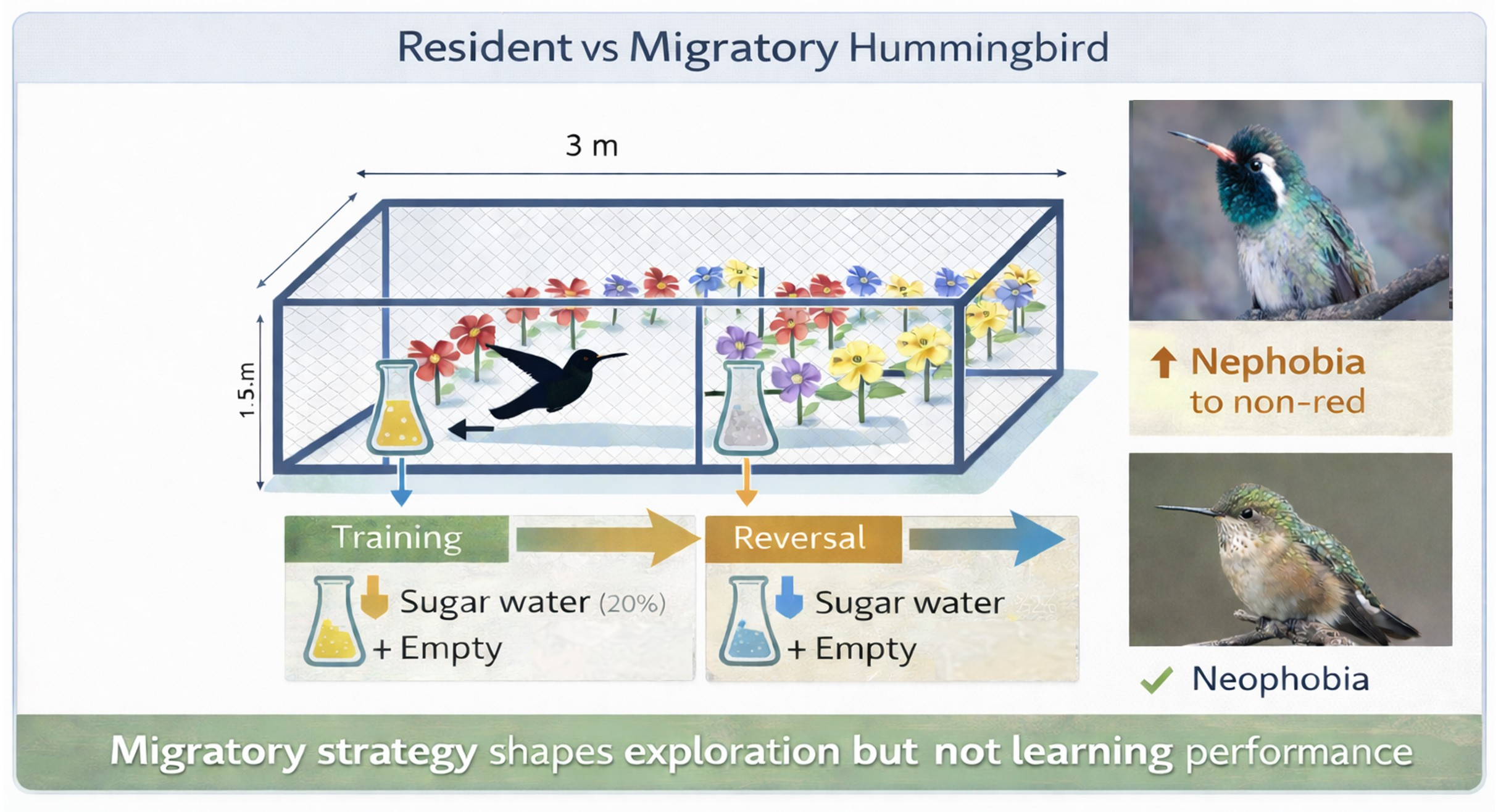
Animals living in changing environments must be able to adjust their behavior to find food successfully. We studied how two hummingbird species—one that lives year-round in central Mexico and another that migrates seasonally—respond to changes in flower color. Using artificial flowers filled with sugar water, we trained wild hummingbirds to associate specific colors with rewards, then reversed which color provided food to see how quickly they could adapt. We found that the migratory species was more cautious when approaching flowers that were not red, the predominant color in their natural environment. However, once both species began feeding, they learned equally well and adapted with similar speed when we switched the rewarding colors. These findings help us understand how different life strategies—being a year-round resident versus a seasonal migrant—may influence how animals explore and respond to new food sources. This knowledge is increasingly important as climate change and habitat modification create novel environments that require animals to be flexible in their foraging behavior.

Abstract

Behavioral flexibility allows animals to adjust their behavior in response to environmental changes. Hummingbirds, with their tetrachromatic color vision and enlarged hippocampal formation, represent an excellent model for studying cognitive flexibility in color discrimination. We evaluated three components of behavioral flexibility (exploration, exploitation, and inhibition) in two sympatric hummingbird species, the resident White-eared Hummingbird (Basilinna leucotis) and the migratory Broad-tailed Hummingbird (Selasphorus platycercus), using a reversal learning task with artificial flowers of different colors for evaluating exploration, exploitation, and inhibition simultaneously. Birds were trained to associate nectar rewards with either spectrally similar (red-yellow) or dissimilar (red-violet) color pairs. Our results revealed interspecific differences in exploration behavior depending on the rewarding color during training, while both species showed similar exploitation and inhibition capacities. The migratory S. platycercus showed stronger neophobia toward non-red flowers compared to the resident B. leucotis. Both species quickly learned the color-rewarding association when red was rewarding but required more visits when non-red colors were rewarding. These findings suggest that while both species can flexibly adjust their foraging behavior, differences in their ecology and migratory behavior may influence their initial responses to novel color cues.

Graphical Abstract

1. Introduction

Resource availability in natural environments is typically variable both spatially and temporally, imposing significant challenges on animals that depend on them. This environmental unpredictability has driven the evolution of behavioral flexibility—the ability to rapidly respond to changes in the environment and to display alternative solutions to problems when initial strategies are no longer effective [1,2,3]. Understanding the cognitive mechanisms underlying behavioral flexibility has become increasingly important in behavioral ecology, as flexible individuals may be better equipped to cope with novel environments, including those altered by human activities [4,5,6].
Tebbich et al. [7] proposed that behavioral flexibility can be decomposed into five cognitive components: exploration (approaching novel stimuli), exploitation (learning reward contingencies), inhibition (suppressing previously rewarding responses), generalization (applying learned rules to new situations), and innovation (discovering novel solutions). Among these, reversal learning tasks have emerged as one of the most comprehensive paradigms for evaluating exploration, exploitation, and inhibition simultaneously [8]. In these tasks, subjects first learn to discriminate between two stimuli (one rewarding, one non-rewarding), and once they reach a criterion, the reward contingencies are reversed, requiring them to inhibit their learned response and switch to the previously non-rewarding stimulus.
Recent studies have substantially advanced our understanding of the cognitive processes underlying reversal learning performance. Morand-Ferron et al. [8] demonstrated that individual differences in reversal learning among wild passerines are primarily explained by proactive interference—the difficulty of overcoming previously learned associations—rather than by differences in sampling strategies. This finding suggests that the ability to flexibly update learned associations may be a key determinant of behavioral flexibility. Furthermore, van den Heuvel et al. [9] found limited repeatability and no heritability of cognitive flexibility in great tits, suggesting that environmental factors may play a substantial role in shaping this trait. Complementary work by Audet et al. [2] on songbirds revealed that vocal learning ability correlates with problem-solving capacity, suggesting shared cognitive mechanisms across different learning domains.
Neophobia—the avoidance of novel stimuli—represents a critical component of exploration behavior that can significantly influence foraging decisions. Recent comparative studies have revealed that neophobia varies predictably with ecological factors including habitat use, social structure, and diet [10,11,12]. In birds, urban-dwelling populations often show reduced neophobia compared to rural conspecifics, potentially facilitating exploitation of novel anthropogenic resources [13]. However, the relationship between neophobia and cognitive flexibility remains complex, as highly neophobic individuals may also show superior reversal learning performance once they overcome initial avoidance [14].
Hummingbirds (family Trochilidae) represent an exceptional model system for studying cognitive flexibility in foraging contexts. These exclusively American birds are the most specialized nectarivorous vertebrates, visiting numerous flowers daily while maintaining mental maps of flower locations, nectar quality, and refill rates [15,16]. This cognitive demand is reflected in their neuroanatomy: hummingbirds possess a hippocampal formation that is two to five times larger, relative to telencephalon volume, than that of other birds including food-caching species [17]. Recent advances in understanding avian hippocampal function suggest this region supports not only spatial memory but also flexible context-dependent learning [18]. Studies on Mexican species have demonstrated sophisticated cognitive abilities, including observational learning and the flexible use of both spatial and visual cues to relocate rewarding flowers [19,20,21]. The remarkable cognitive abilities of hummingbirds appear linked to their complex plant–pollinator interactions, which have been increasingly documented across diverse Neotropical habitats [22].
Color vision plays a crucial role in hummingbird foraging ecology. Unlike humans, who are trichromatic, hummingbirds possess tetrachromatic vision with four types of cone photoreceptors, including one sensitive to ultraviolet light [23]. This expanded color vision allows hummingbirds to perceive a vast array of non-spectral colors, including combinations like UV + red and UV + green that are invisible to humans. Stoddard et al. [23] demonstrated through field experiments that wild Broad-tailed Hummingbirds (Selasphorus platycercus) can discriminate multiple non-spectral colors, and that approximately 35% of plant colors in their environment would appear as non-spectral hues to hummingbird eyes. The greater color discrimination ability of birds compared to bees may reduce stabilizing selection on flower color variation in bird-pollinated plants [24], suggesting that hummingbirds encounter substantial color variation in their natural foraging environment.
Despite their well-documented spatial memory and color discrimination abilities, surprisingly few studies have directly examined behavioral flexibility in color use by hummingbirds using reversal learning paradigms. While previous work has shown that hummingbirds can quickly switch color preferences when reward contingencies change [25,26,27], the relative contributions of exploration, exploitation, and inhibition to this flexibility remain largely unexplored. Furthermore, most cognitive research on hummingbirds has focused on temperate species, particularly the Rufous Hummingbird (Selasphorus rufus), leaving knowledge gaps about species with different life histories and ecological contexts. Recent studies in Mexican temperate forests have documented complex hummingbird–plant interaction networks shaped by dominance hierarchies [28], highlighting the importance of behavioral flexibility for resource access in competitive environments.
In this study, we evaluated behavioral flexibility in two sympatric hummingbird species at La Malinche National Park in central Mexico: the resident White-eared Hummingbird (Basilinna leucotis) and the migratory Broad-tailed Hummingbird (Selasphorus platycercus). These species are similar in body size and mass [19,27] but belong to different taxonomic clades (Emeralds vs. Bees, respectively). Recent surveys in Tlaxcala confirm that these are the two most abundant hummingbird species in the region, together comprising 80% of hummingbird observations across different habitat types [29]. At our study site, both species exploit a predominantly red-flowered plant assemblage [29,30], providing a natural context to examine whether they differ in their flexibility to use alternative flower colors.
We used reversal learning tasks with artificial flowers to test two main hypotheses. First, if both species face similar environmental variability in flower availability, we predicted they would show similar behavioral flexibility. Alternatively, differences in their migratory status and associated ecological demands might lead to divergent cognitive strategies. Second, we manipulated the spectral similarity of color pairs, presenting birds with either spectrally close (red-yellow) or distant (red-violet) color combinations. We predicted that behavioral flexibility would be greater when birds were challenged with spectrally similar colors, as these more closely resemble the natural variation they encounter in their environment.

2. Materials and Methods

2.1. Study Site and Species

Field work was conducted from May 2012 to September 2013 at La Malinche National Park (PNLM), Tlaxcala, Mexico (19°6′ N, 19°20′ W; 3000 m elevation). This protected area encompasses 45,711 ha of the neovolcanic La Malinche mountain, with vegetation dominated by pine, oak, and fir forests, along with grasslands and secondary vegetation. The climate is temperate humid with mean annual precipitation of 800 mm and mean temperature of 15 °C [30].
The hummingbird-visited plant community at PNLM includes species from families Plantaginaceae (Penstemon roseus, P. gentianoides), Onagraceae (Castilleja tenuiflora, C. scorzonerifolia), Lamiaceae (Salvia elegans, S. mocinoi), and Rubiaceae (Bouvardia ternifolia). The majority of these species produce red or reddish flowers [30]. Eleven hummingbird species have been recorded at the site, with B. leucotis and S. platycercus among the most abundant.
The White-eared Hummingbird (Basilinna leucotis) is a resident species present year-round at PNLM, with peak abundance from July to September. Adults weigh 3.5–3.9 g with bill lengths of 15.7–17.5 mm. Both sexes display a distinctive white postocular stripe, with males showing metallic violet crown and chin feathers (Figure 1). The Broad-tailed Hummingbird (Selasphorus platycercus) is a migratory species present at PNLM from July to November. Adults weigh 3.1–3.8 g with bill lengths of 16.5–19.4 mm. Males have an iridescent rose-pink gorget, while females are paler overall (Figure 1) [30].

2.2. Experimental Setup

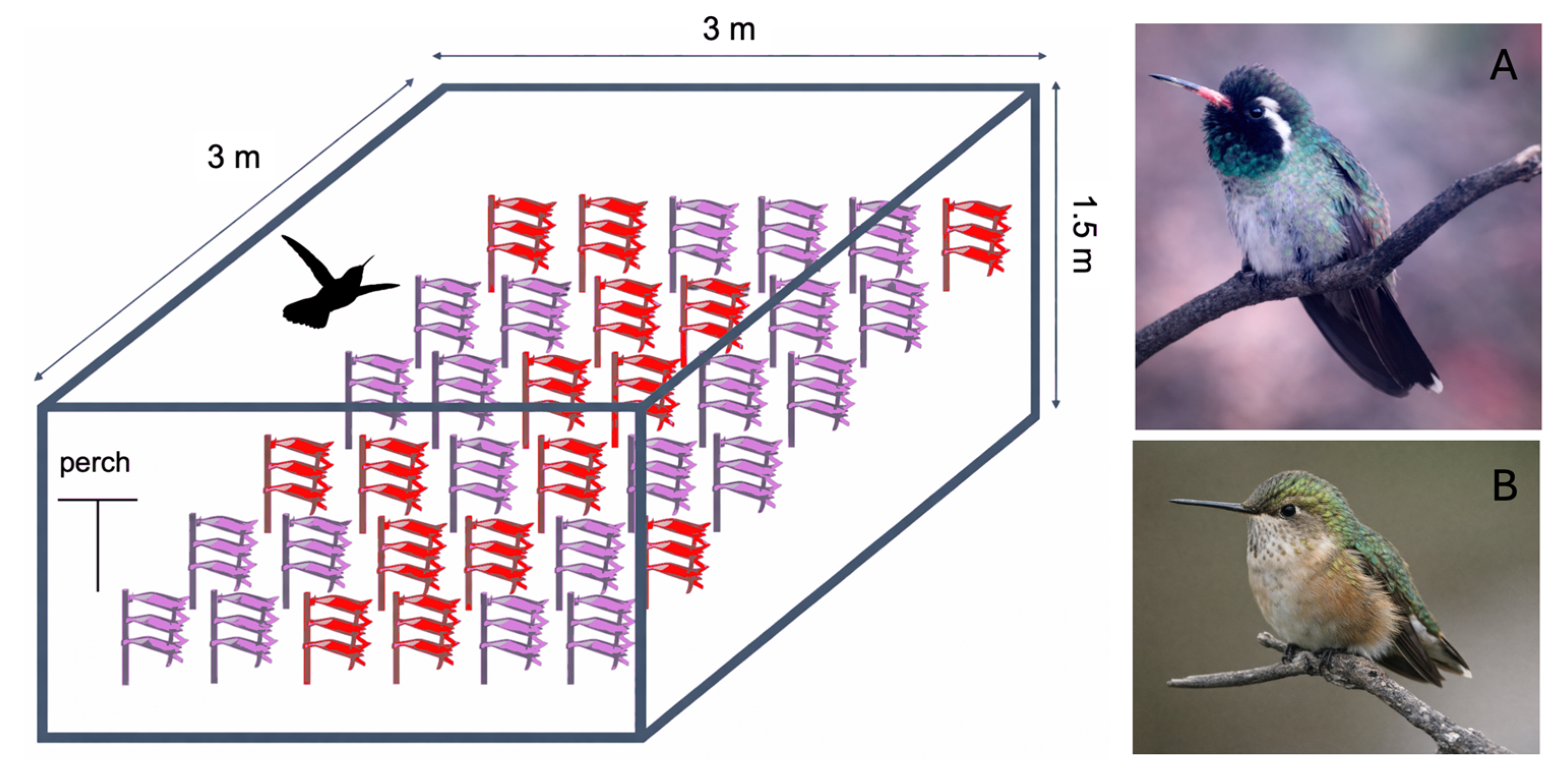
We captured adult hummingbirds using mist nets and individually tested them in a portable field aviary (3.0 × 3.0 × 1.5 m). The aviary contained an artificial flower array consisting of 36 wooden stakes (50 cm height, 1 cm diameter) arranged in a 6 × 6 grid with 30 cm spacing. Each stake held two artificial flowers separated by 20 cm, providing 72 flowers total. Artificial flowers were constructed from plastic micropipette tips (2.5 cm length) with plastic flagging tape petals in red, yellow, or violet. This plastic material was spectrally characterized (300–600 nm, including UV) by Ornelas & Lara [27], with red-yellow and red-violet pairs previously validated as spectrally similar and dissimilar, respectively, under hummingbird vision models. A T-shaped perch (60 cm height) was placed in one corner of the aviary (Figure 1). All trials were conducted between 0800 and 1500 h.

2.3. Reversal Learning Protocol

Birds were randomly assigned to one of four experimental groups defined by color pair and initial reward assignment: (1) yellow rewarding/red non-rewarding, (2) red rewarding/yellow non-rewarding, (3) red rewarding/violet non-rewarding, and (4) violet rewarding/red non-rewarding. Within each group, half of the 72 flowers displayed the rewarding color and contained 15 µL of 20% sucrose solution, while the other half displayed the non-rewarding color and were empty. Flower positions were randomized at the start of each phase.
Training phase: Birds were released into the aviary and allowed 30 min to make their first flower visit. If no visit occurred, the bird was released without further testing. If the bird visited any flower within 30 min, the observation period was extended for an additional 20 min. To advance to the reversal phase, birds had to achieve a criterion of visiting rewarding flowers on at least 8 of their last 10 visits. Birds meeting this criterion were held in a corner of the aviary for 15 min while the flower array was reconfigured for the reversal phase.
Reversal phase: Reward contingencies were reversed such that the previously non-rewarding color now contained nectar and vice versa. Birds were again allowed 30 min to make their first visit, with a 20 min extension following any flower visit. At the end of testing, birds were marked with unique color band combinations and released at their capture site.

2.4. Behavioral Measures

For each individual, we recorded three sets of variables corresponding to the three components of behavioral flexibility. For exploration, we measured (1) whether birds visited at least one rewarding flower during training, and (2) latency to first visit a rewarding flower. For exploitation, we measured (1) number of visits required to reach the training criterion (8/10 correct), and (2) whether the first visit during the reversal phase was to the previously rewarding color (indicating learned color-reward association). For the inhibition analysis, defined as the shift from visiting the previously rewarding color during training to the newly rewarding color during reversal, we quantified the proportion of visits directed to the previously rewarding color across the reversal phase. For each individual, the total number of visits during reversal was divided into four sequential sections of equal size, preserving the temporal order of visits. Proportions of visits to the previously rewarding and newly rewarding colors were calculated for each section.

2.5. Statistical Analyses

We used a three-way chi-square test to examine whether the frequency of birds visiting rewarding versus non-rewarding flowers during training depended on species and experimental group. Latency to first visit rewarding flowers was analyzed using Kaplan–Meier survival curves with log-rank tests comparing groups within each species. For the reversal phase, we used a binomial test to determine whether more birds than expected by chance made their first visit to the previously rewarding color. Changes in visit proportions across the reversal phase were analyzed using a linear mixed-effects model with Gaussian error distribution. We were interested in estimating the overall population-level pattern of behavioral change (whether birds shifted from previously rewarding to newly rewarding colors) rather than testing specific hypotheses about particular species or color combinations. Therefore, we included section (first vs. fourth quarter of reversal phase visits) as a fixed effect to test for temporal change, while treating species and experimental group as random effects to account for non-independence of observations within these categories. Individual identity was not included as a random effect because data were aggregated at the individual level before analysis—that is, we calculated the proportion of visits to each color type for each individual bird within each section, then modeled these proportions with species and group as grouping variables. All statistical analyses were conducted in R (version 4.3.0) [31]. Survival analyses were performed using the package survival (version 3.2-7) [32], contingency analyses using base R functions, and linear mixed-effects models were fitted using the package lme4 (1.1-35) [33].

3. Results

We captured 81 adult hummingbirds (40 B. leucotis: 9 females, 31 males; 41 S. platycercus: 23 females, 18 males). Of these, 41 individuals (21 B. leucotis, 20 S. platycercus) met the training criterion and advanced to the reversal phase.

3.1. Exploration

The frequency of birds visiting rewarding flowers during training depended on the interaction between species and experimental group (χ2 = 23.25, df = 6, p < 0.005). In groups where red flowers were rewarding (regardless of the alternative color), the majority of birds of both species visited rewarding flowers. However, species differed markedly when non-red colors were rewarding. When yellow was rewarding, most B. leucotis (8 of 10) visited rewarding flowers, while most S. platycercus (8 of 14) failed to visit them. When violet was rewarding, both species showed low visitation to rewarding flowers (B. leucotis: 2 of 11; S. platycercus: 3 of 10).
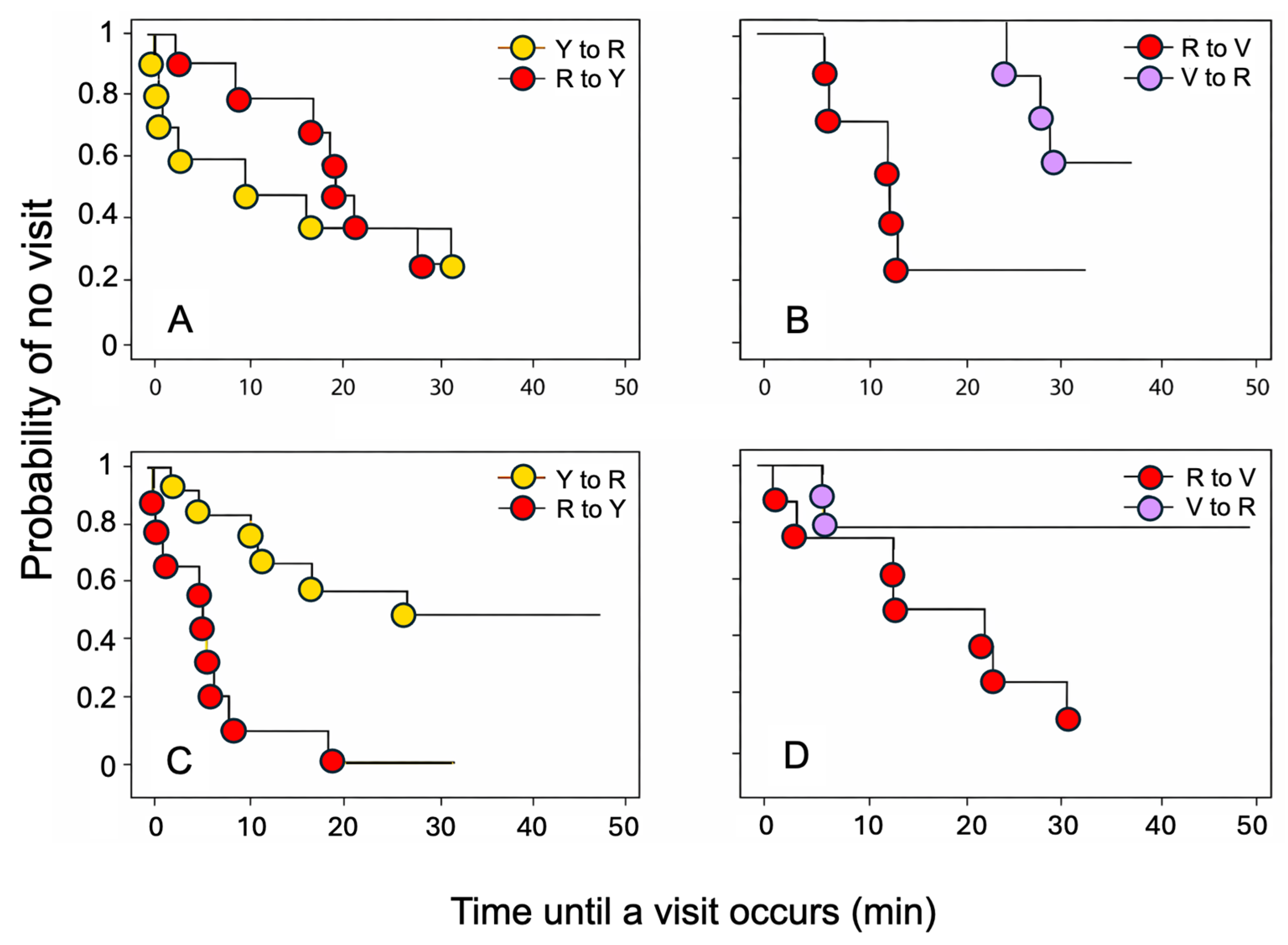
Survival analysis of latency to first visit to rewarding flowers revealed species-specific patterns (Figure 2). For B. leucotis, there was no significant difference in latency between the red-rewarding and yellow-rewarding groups (Log-rank χ2 = 0.351, p = 0.55), but birds visited red flowers significantly faster than violet flowers when those colors were rewarding (Log-rank χ2 = 5.412, p = 0.02). For S. platycercus, birds consistently visited red flowers faster than either yellow (Log-rank χ2 = 8.757, p = 0.003) or violet (Log-rank χ2 = 4.524, p = 0.03) when those alternative colors were rewarding. It is important to note that conclusions regarding violet flowers must be considered tentative given the very low number of individuals that interacted with violet-rewarding flowers (B. leucotis: 2 of 11; S. platycercus: 3 of 10). This low participation likely reflects strong neophobia toward this spectrally distant color rather than perceptual limitations, as discussed further below.

3.2. Exploitation

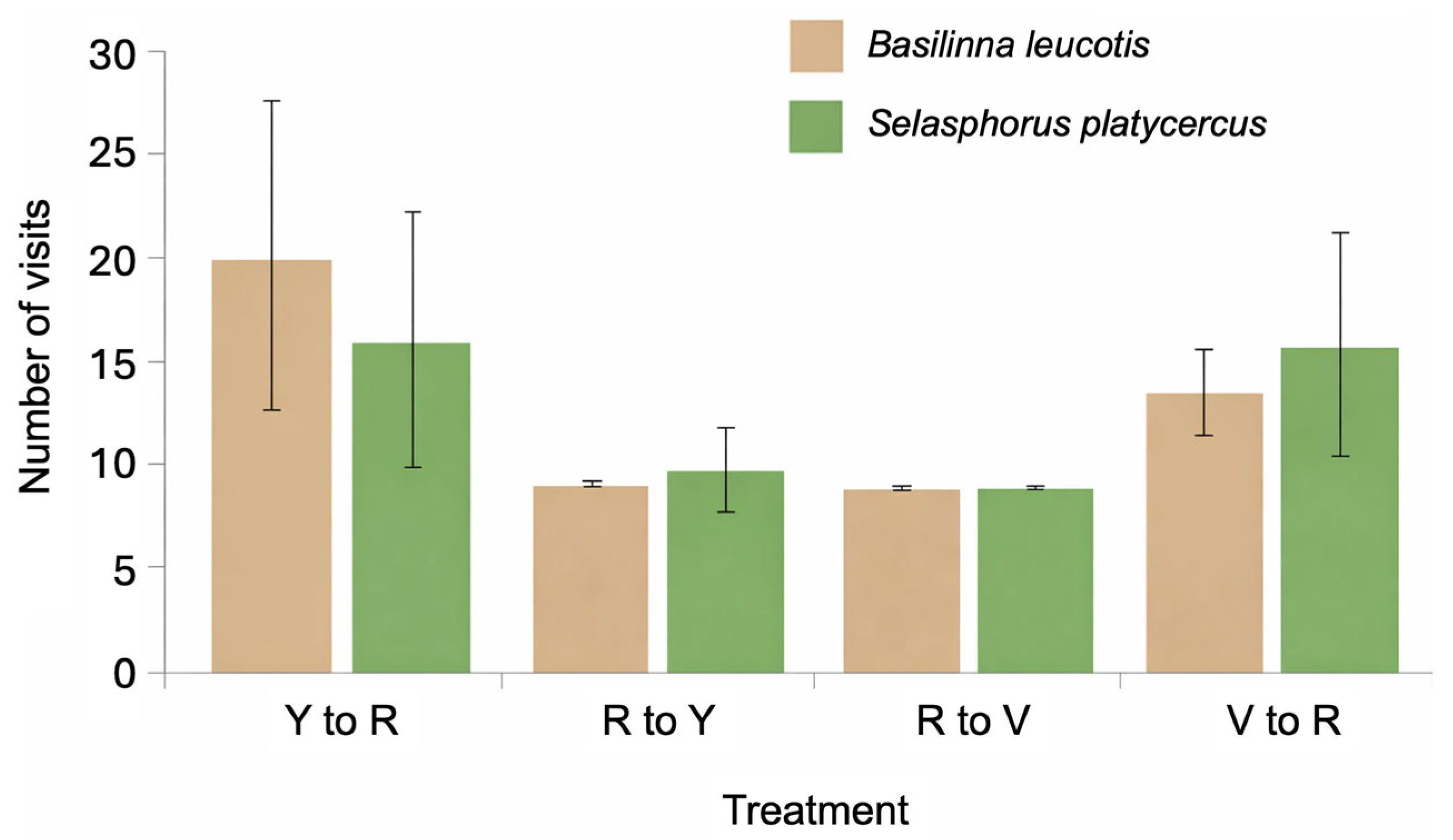
The number of visits required to reach the training criterion varied by group but not by species (Figure 3). Birds in red-rewarding groups typically achieved criterion within their first 10 visits. In contrast, birds in yellow-rewarding groups required substantially more visits (B. leucotis: mean = 20.33 visits; S. platycercus: mean = 16.75 visits). Too few birds reached criterion in violet-rewarding groups to permit statistical comparison (1 of 11 B. leucotis; 2 of 10 S. platycercus).
Evidence for learned color–reward associations came from first-visit behavior in the reversal phase. Across all groups and species, 37 of 41 birds (90%) made their first reversal phase visit to a flower of the previously rewarding color, significantly more than expected by chance (binomial test, p < 0.01). This pattern did not differ between species (χ2 = 1.0, df = 1, p = 0.31).

3.3. Inhibition

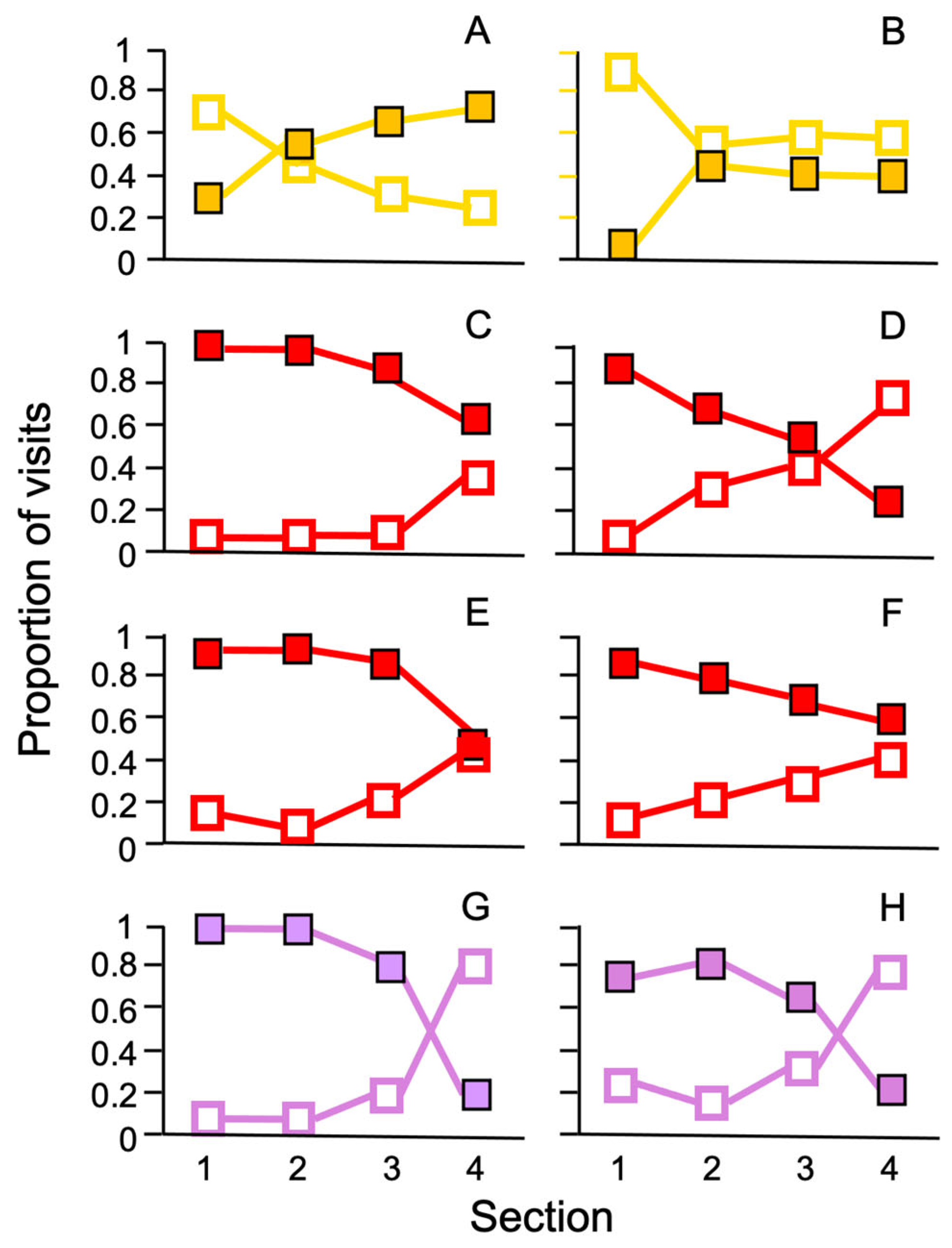
Analysis of visit proportions across the reversal phase revealed a significant effect of section (F = 50.25, df = 1, 37, p = 0.001), with the proportion of visits directed to the previously rewarding color decreasing markedly from the first to the fourth section. No significant effects of species (F = 0.83, df = 1, 35, p = 0.368) or group (F = 0.76, df = 3, 35, p = 0.473) were detected, and no significant interactions were observed. These results indicate that individuals of both species progressively inhibited visits to the previously rewarding color and shifted toward the newly rewarding color at similar rates regardless of species identity or color combination (Figure 4).

4. Discussion

Our study provides the first comprehensive assessment of behavioral flexibility in color discrimination using reversal learning in wild-caught hummingbirds. We found that while both species demonstrated the capacity for behavioral flexibility—successfully learning initial color-rewarding associations and reversing them when contingencies changed—they differed notably in their exploratory responses to novel colors. These findings contribute to our understanding of how cognitive ecology shapes foraging decisions in nectarivorous birds facing similar environmental conditions but differing in life history traits.

4.1. Species Differences in Exploration Reflect Ecological Context

The most striking interspecific difference we observed was in exploration behavior—specifically, neophobia toward non-red flower colors. The migratory S. platycercus showed stronger avoidance of both yellow and violet flowers compared to the resident B. leucotis, which readily approached yellow flowers even when they represented a novel color in the experimental context. This pattern is consistent with recent findings that neophobia varies predictably with ecological factors in birds [11,12], though it contrasts with predictions from some studies suggesting that migratory species should show reduced neophobia to facilitate rapid learning in new environments [34]. However, the observed differences in neophobia between species should be interpreted as context-dependent.
Our results may reflect the specific ecological context of La Malinche study site, where local floral environments are dominated by red flowers [30]. For S. platycercus, which visits this site during a relatively brief seasonal window, maintaining a strong association with red flowers may represent an efficient foraging strategy that minimizes search time for profitable resources. This interpretation aligns with recent work showing that hummingbird foraging efficiency in traplining species is influenced by behavioral traits including exploration tendency [14]. In contrast, B. leucotis, as a year-round resident, may encounter greater temporal variation in flower availability across seasons, potentially favoring more exploratory behavior toward alternative colors when they appear. This interpretation is consistent with González-Gómez et al. [35], who proposed that environmental heterogeneity promotes cognitive flexibility. Thus, migratory status appears to interact with resource predictability—with migrants showing stronger neophobia when reliable resources (red flowers) are available—rather than migratory status universally increasing or decreasing neophobia across all contexts.
These findings complement previous findings on behavioral differences between migratory and resident hummingbirds. Ornelas & Lara [27] reported that migratory species visited proportionally more rewarding flowers than residents in a similar experimental setup. However, their design captured aggregated behavioral responses during continuous foraging sessions, while our reversal learning task decomposes behavioral flexibility into specific components: exploration, exploitation, and inhibition. The differences we observed between species were concentrated in initial exploration—particularly neophobia toward non-red colors—whereas both species showed similar learning and inhibition capacities. This suggests that greater initial neophobia does not predict lower cognitive ability, but rather may represent a conservative strategy when familiar resources are reliable and time is limited, consistent with the foraging efficiency reported for migrants once they engage with rewarding resources. Importantly, this disassociation between high neophobia and efficient learning demonstrates that exploration operates as a decision threshold rather than a cognitive constraint [8,14]. Once S. platycercus assessed non-red flowers as safe, exploitation and inhibition proceeded at rates comparable to B. leucotis, indicating that the rapid shift reflects a more conservative decision rule for when to engage with novel stimuli rather than a fundamentally different cognitive strategy for processing information once engaged.
The stronger neophobia of S. platycercus toward non-red colors may reflect their greater lifetime and evolutionary exposure to red-flowered plant communities along their latitudinal migratory route, particularly in their North American breeding grounds where red flowers predominate in hummingbird–plant assemblages [36]. This pronounced red bias could make spectrally distant colors like violet appear particularly unfamiliar or risky, even when they signal rewards.

4.2. Color Discrimination and Spectral Similarity

Our experimental design manipulated the spectral distance between color pairs—previously validated as spectrally similar (red-yellow) versus dissimilar (red-violet) under hummingbird color vision models (see Methods)—predicting that birds would show greater behavioral flexibility with similar than dissimilar colors. The results strongly supported this prediction. Both species showed markedly higher exploration of spectrally similar colors: when yellow was rewarding, 80% of B. leucotis (8/10) and 43% of S. platycercus (6/14) visited rewarding flowers, compared to only 18% (2/11) and 30% (3/10), respectively, when the spectrally dissimilar violet was rewarding. Similarly, exploitation was more efficient with spectrally similar pairs: birds required approximately 10 visits to reach criterion with red-rewarding flowers and 16–20 visits with yellow-rewarding flowers, while too few individuals learned violet-rewarding associations to permit comparison. This pattern aligns with the ecological predominance of red flowers at La Malinche [30], where the natural color variation among hummingbird-pollinated flowers occurs primarily along the red-orange-yellow spectrum, making spectrally similar color shifts more ecologically relevant than shifts to spectrally distant colors like violet.
The strong avoidance of violet flowers by both species is particularly notable given recent advances in our understanding of hummingbird color vision. Stoddard et al. [23] demonstrated that Broad-tailed Hummingbirds can readily discriminate violet and other nonspectral colors, including UV-containing hues. Our results suggest that the ability to perceive color differences does not necessarily translate to equivalent willingness to approach those colors in foraging contexts. The low participation in violet-rewarding treatments clearly reflects behavioral avoidance (neophobia) rather than perceptual inability to discriminate violet from red. Whitney et al. [24] found that birds perceive more intraspecific color variation in bird-pollinated than bee-pollinated flowers, suggesting that hummingbirds may be particularly attentive to color variation within their preferred color range while showing greater wariness toward colors outside this range.

4.3. Implications for Understanding Hummingbird Cognition

Our findings complement the extensive body of research on spatial cognition in hummingbirds, particularly focusing on Rufous Hummingbirds. This research program has demonstrated remarkable capacities for spatial learning, timing, and episodic-like memory in wild hummingbirds (reviewed in Healy & Hurly [15]). Recent studies continue to unveil sophisticated cognitive abilities, such as the use of consistent landmark views for goal location [37], temporal adjustments in traplining behavior [38], and route modifications to avoid unproductive locations [39]. Similarly, research on Neotropical species has highlighted the significance of spatial memory for territory ownership and foraging efficiency [16,40].
The neurobiological basis for hummingbird cognitive abilities likely includes their enlarged hippocampal formation, which is two to five times larger relative to telencephalon volume than in other birds [17]. Recent advances in understanding avian hippocampal function suggest this region supports flexible context-dependent learning beyond pure spatial memory [18]. The rapid reversal learning we observed—with both species showing significant behavioral change within a single 20 min session—suggests that hummingbirds possess robust neural mechanisms for updating learned associations. This capacity for rapid behavioral adjustment may be particularly important given the complex competitive dynamics documented in hummingbird–plant interaction networks [22,28].

4.4. Methodological Considerations and Future Directions

Several aspects of our methodology warrant discussion. First, we used wild-caught birds tested in a field aviary, which combines benefits of controlled conditions with ecological realism. Cauchoix et al. [41] showed that wild great tits perform similarly in reversal learning whether tested in captivity or in the field, suggesting our results likely reflect natural cognitive abilities and previous foraging experience. Second, our criterion of 8/10 correct visits before reversal is somewhat lenient when compared to laboratory standards, but it was necessary given the constraints of testing wild birds in a single session. Critically, 37 of 41 birds (90%) that reached this criterion made their first reversal-phase visit to the previously rewarding color (binomial test: p < 0.0001), confirming that performance at this threshold reflected stable learned associations rather than random sampling. Third, our conclusions about similar exploitation and inhibition capacities between species are derived primarily from red-rewarding and yellow-rewarding treatments. Very few individuals of either species reached the training criterion when violet was rewarding (1 of 11 B. leucotis; 2 of 10 S. platycercus), precluding robust assessment of the resident species’ exploitation and inhibition performance under strongly non-red rewarding conditions. Therefore, we cannot determine whether the resident species would maintain similar learning efficiency when foraging contexts deviate substantially from the ecologically prevalent red-dominated floral spectrum. Fourth, capture and confinement stress may have temporarily elevated anxiety, potentially amplifying neophobic responses during initial exploration. We cannot rule out that species differ in stress responses to handling, which could interact with inherent neophobia differences. However, similar exploitation and inhibition performance once birds engaged suggests stress primarily affected exploration rather than learning capacity. Fifth, our design cannot disentangle innate versus learned components of color bias. Testing only wild adults means that genetically based color preferences and experience-driven preferences shaped by lifetime exposure to red-flowered communities cannot be separated. While we interpret species differences in light of ecological and evolutionary exposure to red flowers, we acknowledge that determining the relative contributions of genetic predisposition versus individual learning experience would require controlled-rearing experiments. Sixth, we did not assess individual personality traits (e.g., boldness, exploratory tendency) independent of color discrimination contexts. Therefore, we cannot rule out that observed differences in neophobia reflect variation in general personality or motivational state rather than cognitive strategies specifically linked to migratory status.
Future studies incorporating standardized behavioral assays in non-foraging contexts would help clarify whether species differences are task-specific or reflect broader personality differences. The relatively low number of birds completing the violet-rewarding treatment limits our ability to make strong inferences about that color specifically. Future studies could benefit from a pre-training habituation period that might reduce initial neophobia, or from examining individual variation in personality traits that may influence exploration [6]. Additionally, measuring ultraviolet reflectance of the artificial flower colors would help interpret results in the context of tetrachromatic vision. Recent methodological advances in field cognition research [42] provide opportunities to address these questions with larger sample sizes and more refined measurements.

5. Conclusions

This study demonstrates that sympatric hummingbird species can differ in exploratory responses to novel color cues while maintaining similar capacities for learning and behavioral inhibition. The stronger neophobia of the migratory S. platycercus toward non-red colors, compared to the resident B. leucotis, suggests that ecological differences between species can influence initial responses to novel stimuli even when ultimate learning abilities are similar. These findings highlight the importance of decomposing behavioral flexibility into its component processes when comparing species or populations.
Future research should extend this approach to additional species across the hummingbird radiation, including tropical residents, altitudinal migrants, and long-distance migrants. Comparative studies incorporating phylogenetic relationships, along with detailed measurements of local flower color availability, would help clarify how ecological demands shape cognitive flexibility in this remarkable group of birds. As climate change alters plant phenology and species distributions, understanding the cognitive flexibility of pollinators becomes increasingly important for predicting their capacity to track shifting resources.

Author Contributions

Conceptualization, B.P.-R., J.F.O. and C.L.; methodology, B.P.-R., J.F.O. and C.L.; validation, B.P.-R., J.F.O. and C.L.; formal analysis, B.P.-R., J.F.O. and C.L.; investigation, B.P.-R. and C.L.; data curation, B.P.-R., J.F.O. and C.L.; writing—original draft preparation, B.P.-R., J.F.O. and C.L.; writing—review and editing, B.P.-R., J.F.O. and C.L. All authors have read and agreed to the published version of the manuscript.

Funding

This research received no external funding.

Institutional Review Board Statement

Ethical review and approval were waived for this study design by the ethics committee of Universidad Autónoma de Tlaxcala. Wildlife capture and handling were conducted under SEMARNAT permit FAUT-0296. Research activities in La Malinche National Park did not require special authorization at the time of the study (2012–2013). No invasive procedures were conducted. Birds were temporarily held in field aviaries for behavioral observations and released at their capture sites with color band identification. All procedures followed institutional and national wildlife guidelines and the Guidelines for the Use of Wild Birds in Research proposed by the Ornithological Council.

Informed Consent Statement

Not applicable.

Data Availability Statement

The original data presented in the study are openly available in Mendeley Data at https://doi.org/10.17632/jy3vsv66wp.1.

Acknowledgments

We thank CONAHCYT for scholarship support to BMPR (grant 261724). We are grateful to the staff of La Malinche National Park for logistical support and to J.M. Arizmendi, K.L. Hoffman, A. Estrada-Torres, and R. Hudson for valuable comments on earlier versions of this manuscript.

Conflicts of Interest

The authors declare no conflicts of interest.

References

  1. Bond, A.B.; Kamil, A.C.; Balda, R.P. Serial reversal learning and the evolution of behavioral flexibility in three species of North American corvids. J. Comp. Psychol. 2007, 121, 372–379. [Google Scholar] [CrossRef]
  2. Audet, J.N.; Lefebvre, L. What’s flexible in behavioral flexibility? Behav. Ecol. 2017, 28, 943–947. [Google Scholar] [CrossRef]
  3. Leimar, O.; Quiñones, A.E.; Bshary, R. Flexible learning in complex worlds. Behav. Ecol. 2024, 35, arad109. [Google Scholar] [CrossRef]
  4. Sol, D.; Timmermans, S.; Lefebvre, L. Behavioural flexibility and invasion success in birds. Anim. Behav. 2002, 63, 495–502. [Google Scholar] [CrossRef]
  5. Breen, A.J.; Guillette, L.M.; Healy, S.D. What can nest-building birds teach us? Comp. Cogn. Behav. Rev. 2016, 17, 83–123. [Google Scholar] [CrossRef]
  6. Biondi, L.M.; Medina, A.; Bonetti, E.A.; Paterlini, C.A.; Bó, M.S. Cognitive flexibility in a generalist raptor: A comparative analysis along an urbanization gradient. Behav. Ecol. 2024, 35, arae025. [Google Scholar] [CrossRef]
  7. Tebbich, S.; Sterelny, K.; Teschke, I. The tale of the finch: Adaptive radiation and behavioural flexibility. Philos. Trans. R. Soc. B 2010, 365, 1099–1109. [Google Scholar] [CrossRef]
  8. Morand-Ferron, J.; Reichert, M.S.; Quinn, J.L. Cognitive flexibility in the wild: Individual differences in reversal learning are explained primarily by proactive interference, not by sampling strategies, in two passerine bird species. Learn. Behav. 2022, 50, 153–166. [Google Scholar] [CrossRef] [PubMed]
  9. van den Heuvel, K.; Quinn, J.L.; Kotrschal, A.; van Oers, K. Artificial selection for reversal learning reveals limited repeatability and no heritability of cognitive flexibility in great tits (Parus major). Proc. Biol. Sci. 2023, 290, 20231067. [Google Scholar] [CrossRef]
  10. Audet, J.N.; Couture, M.; Jarvis, E.D. Songbird species that display more complex vocal learning are better problem-solvers and have larger brains. Science 2023, 381, 1170–1175. [Google Scholar] [CrossRef]
  11. Miller, R.; Garcia-Pelegrin, E.; Danby, E. Neophobia and innovation in critically endangered Bali Myna, Leucopsar rothschildi. R. Soc. Open Sci. 2022, 9, 211781. [Google Scholar] [CrossRef]
  12. Miller, R.; Lambert, M.L.; Frohnwieser, A.; Brecht, K.F.; Bugnyar, T.; Crampton, I.; Garcia-Pelegrin, E.; Gould, K.; Greggor, A.L.; Izawa, E.-I.; et al. Socio-ecological correlates of neophobia in corvids. Curr. Biol. 2022, 32, 74–85. [Google Scholar] [CrossRef]
  13. Quesada, J.; Chavez-Zichinelli, C.A.; Garcia-Arroyo, M.; Yeh, P.J.; Guevara, R.; Izquierdo-Palma, J.; MacGregor-Fors, I. Bold or shy? Examining the risk-taking behavior and neophobia of invasive and non-invasive house sparrows. Anim. Biodivers. Conserv. 2022, 45, 97–106. [Google Scholar] [CrossRef]
  14. Wojczulanis-Jakubas, K.; Araya-Salas, M. Foraging, fear and behavioral variation in a traplining hummingbird. Animals 2023, 13, 1997. [Google Scholar] [CrossRef] [PubMed]
  15. Healy, S.D.; Hurly, T.A. What hummingbirds can tell us about cognition in the wild. Comp. Cogn. Behav. Rev. 2013, 8, 13–28. [Google Scholar] [CrossRef]
  16. González-Gómez, P.L.; Araya-Salas, M. Perspectives on the study of field hummingbird cognition in the Neotropics. In Behavioral Ecology of Neotropical Birds; Reboreda, J.C., Fiorini, V.D., Tuero, D.T., Eds.; Springer: Cham, Switzerland, 2019; pp. 199–212. [Google Scholar]
  17. Ward, B.J.; Day, L.B.; Wilkening, S.R.; Wylie, D.R.; Saucier, D.M.; Iwaniuk, A.N. Hummingbirds have a greatly enlarged hippocampal formation. Biol. Lett. 2012, 8, 657–659. [Google Scholar] [CrossRef]
  18. Li, J.; Liu, J.-A.; Wang, L.; Li, D. Avian hippocampus: Recent advances in anatomy and physiological functions. Avian Res. 2024, 15, 100208. [Google Scholar] [CrossRef]
  19. Lara, C.; González, J.M.; Hudson, R. Observational learning in the white-eared hummingbird (Hylocharis leucotis): Experimental evidence. Ethology 2009, 115, 872–878. [Google Scholar] [CrossRef]
  20. Pérez, G.; Lara, C.; Viccon-Pale, J.; Signoret-Poillon, M. Memory for location and visual cues in white-eared hummingbirds (Hylocharis leucotis). Curr. Zool. 2011, 57, 468–476. [Google Scholar] [CrossRef]
  21. Pérez, G.; Lara, C.; Signoret-Poillon, M.; Viccon-Pale, J.A. Evaluación del uso de señales visuales y de localización por el colibrí cola-ancha (Selasphorus platycercus) al visitar flores de Penstemon roseus. Rev. Mex. Biodivers. 2012, 83, 144–151. [Google Scholar] [CrossRef]
  22. Barreto, E.; Boehm, M.M.A.; Ogutcen, E.; Abrahamczyk, S.; Kessler, M.; Bascompte, J.; Dellinger, A.S.; Bello, C.; Dehling, D.M.; Duchenne, F.; et al. Macroevolution of the plant–hummingbird pollination system. Biol. Rev. 2024, 99, 1831–1847. [Google Scholar] [CrossRef]
  23. Stoddard, M.C.; Eyster, H.N.; Hogan, B.G.; Morris, D.H.; Soucy, E.R.; Inouye, D.W. Wild hummingbirds discriminate nonspectral colors. Proc. Natl. Acad. Sci. USA 2020, 117, 15112–15122. [Google Scholar] [CrossRef]
  24. Whitney, K.D.; Smith, A.K.; White, T.E.; Williams, C.F. Birds perceive more intraspecific color variation in bird-pollinated than bee-pollinated flowers. Front. Plant Sci. 2020, 11, 590347. [Google Scholar] [CrossRef] [PubMed]
  25. Stiles, F.G. Taste preferences, color preferences, and flower choice in hummingbirds. Condor 1976, 78, 10–26. [Google Scholar] [CrossRef]
  26. Meléndez-Ackerman, E.J.; Campbell, D.R.; Waser, N.M. Hummingbird behavior and mechanisms of selection on flower color in Ipomopsis. Ecology 1997, 78, 2532–2541. [Google Scholar] [CrossRef]
  27. Ornelas, J.F.; Lara, C. Differential response to colour tasks on resident and migratory hummingbirds: A field test. Ethol. Ecol. Evol. 2015, 27, 357–378. [Google Scholar] [CrossRef]
  28. López-Segoviano, G.; Arenas-Navarro, M.; Nuñez-Rosas, L.E.; Arizmendi, M.D.C. Implications of dominance hierarchy on hummingbird-plant interactions in a temperate forest in Northwestern Mexico. PeerJ 2023, 11, e16245. [Google Scholar] [CrossRef]
  29. Martínez-Roldán, H.; Pérez-Crespo, M.J.; Lara, C. Unraveling habitat-driven shifts in alpha, beta, and gamma diversity of hummingbirds and their floral resource. PeerJ 2024, 12, e17713. [Google Scholar] [CrossRef]
  30. Lara, C. Temporal dynamics of flower use by hummingbirds in a highland temperate forest in Mexico. Ecoscience 2006, 13, 23–29. [Google Scholar] [CrossRef]
  31. R Core Team. R: A Language and Environment for Statistical Computing; R Foundation for Statistical Computing: Vienna, Austria, 2023. [Google Scholar]
  32. Therneau, T. A Package for Survival Analysis in R. R Pack-Age Version 3.2-7; CRAN (Comprehensive R Archive Network): Vienna, Austria, 2020; Available online: https://cran.r-project.org/package=survival (accessed on 13 January 2026).
  33. Bates, D.; Mächler, M.; Bolker, B.; Walker, S. Fitting linear mixed-effects models using lme4. J. Stat. Softw. 2015, 67, 1–48. [Google Scholar] [CrossRef]
  34. Mettke-Hofmann, C.; Lorentzen, S.; Schlicht, E.; Schneider, J.; Werner, F. Spatial neophilia and spatial neophobia in resident and migratory warblers (Sylvia). Ethology 2009, 115, 482–492. [Google Scholar] [CrossRef]
  35. González-Gómez, P.L.; Razeto-Barry, P.; Araya-Salas, M.; Estades, C.F. Does environmental heterogeneity promote cognitive abilities? Integr. Comp. Biol. 2015, 55, 432–443. [Google Scholar] [CrossRef]
  36. Martín González, A.M.; Ornelas, J.F.; Dalsgaard, B.; Márquez-Luna, U.; Lara, C. Meta-networks for the study of biogeographical traits in ecological networks: The Mexican hummingbird-plant assemblage. Sci. Nat. 2018, 105, 54. [Google Scholar] [CrossRef]
  37. Pritchard, D.J.; Hurly, T.A.; Healy, S.D. Wild hummingbirds require a consistent view of landmarks to pinpoint a goal location. Anim. Behav. 2018, 137, 83–94. [Google Scholar] [CrossRef]
  38. Tello-Ramos, M.C.; Hurly, T.A.; Healy, S.D. From a sequential pattern, temporal adjustments emerge in hummingbird traplining. Integr. Zool. 2019, 14, 182–192. [Google Scholar] [CrossRef] [PubMed]
  39. Tello-Ramos, M.C.; Hurly, T.A.; Barclay, M.; Healy, S.D. Hummingbirds modify their routes to avoid a poor location. Learn. Behav. 2021, 50, 89–98. [Google Scholar] [CrossRef]
  40. Araya-Salas, M.; Gonzalez-Gomez, P.; Wojczulanis-Jakubas, K.; López, V.; Wright, T.F. Spatial memory is as important as weapon and body size for territorial ownership in a lekking hummingbird. Sci. Rep. 2018, 8, 2001. [Google Scholar] [CrossRef]
  41. Cauchoix, M.; Hermer, E.; Chaine, A.S.; Morand-Ferron, J. Cognition in the field: Comparison of reversal learning performance in captive and wild passerines. Sci. Rep. 2017, 7, 12945. [Google Scholar] [CrossRef]
  42. Szabo, B.; Noble, D.W.A.; Whiting, M.J. Learning in non-avian reptiles 40 years on: Advances and promising new directions. Biol. Rev. 2021, 96, 331–356. [Google Scholar] [CrossRef] [PubMed]
Figure 1. Experimental setup for color reversal learning tests. Schematic view of the experimental aviary (3 × 3 × 1.5 m) with the array of 72 artificial flowers distributed across 36 stakes (colored in red and violet) and the perch location (corner). (A) Basilinna leucotis (White-eared Hummingbird) and (B) Selasphorus platycercus (Broad-tailed Hummingbird), the two focal species used in the learning trials (Photos by Carlos Lara).
Birds 07 00019 g001
Figure 2. Time to visit rewarding flowers after reversal of color-rewarding association. Kaplan–Meier curves for Basilinna leucotis (A,B) and Selasphorus platycercus (C,D) following inversion of the trained color–nectar relationship. Color-pair notation indicates the initial trained color (first letter) and the newly rewarding color after reversal (second letter): Y = yellow, R = red, V = violet.
Birds 07 00019 g002
Figure 3. Number of visits required to reach the learning criterion during the training phase. Mean (±SD) number of visits needed to achieve the criterion of visiting 8 out of 10 rewarding flowers for Basilinna leucotis and Selasphorus platycercus across treatments. The first letter indicates the rewarding color during training, the second indicates the color that will be rewarding after reversal (Y = yellow, R = red, V = violet).
Birds 07 00019 g003
Figure 4. Visit proportions during color-reward reversal. Proportion of visits to rewarding flowers (filled symbols) and non-rewarding flowers (empty symbols) across sequential sections of the reversal phase for Basilinna leucotis (A,C,E,G) and Selasphorus platycercus (B,D,F,H). The decline in visits to non-rewarding flowers and increase in visits to rewarding flowers demonstrates behavioral flexibility in updating the learned color-reward association. Symbol colors represent flower colors: yellow panels (A,B), red panels (CF), and violet panels (G,H).
Birds 07 00019 g004
Disclaimer/Publisher’s Note: The statements, opinions and data contained in all publications are solely those of the individual author(s) and contributor(s) and not of MDPI and/or the editor(s). MDPI and/or the editor(s) disclaim responsibility for any injury to people or property resulting from any ideas, methods, instructions or products referred to in the content.