
Wing Shape and Size Variation in Migratory Sylviid Warblers: Links to Ecology and Migration



Simple Summary
Abstract
1. Introduction

2. Materials and Methods
2.1. Study Site
2.2. Data Collection
2.2.1. Biometric Measurements
2.2.2. Geometric Morphometrics: Imaging and Digitization
2.2.3. Functional Indices
2.3. Analyses
2.3.1. Statistical Analysis of Morphometric Variables
2.3.2. Landmark-Based Morphometric Analysis
3. Results
3.1. Measurements and Functional Indices
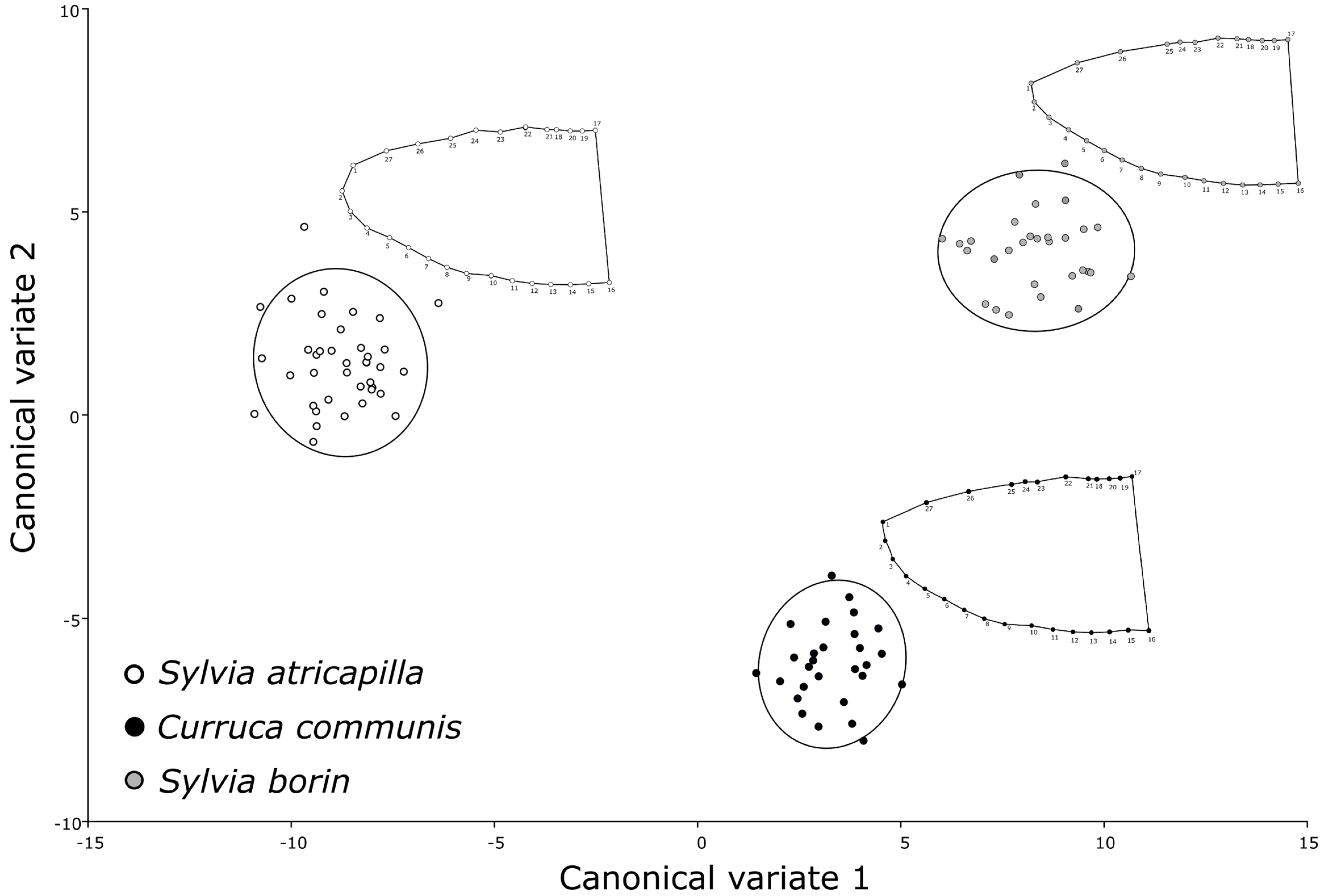
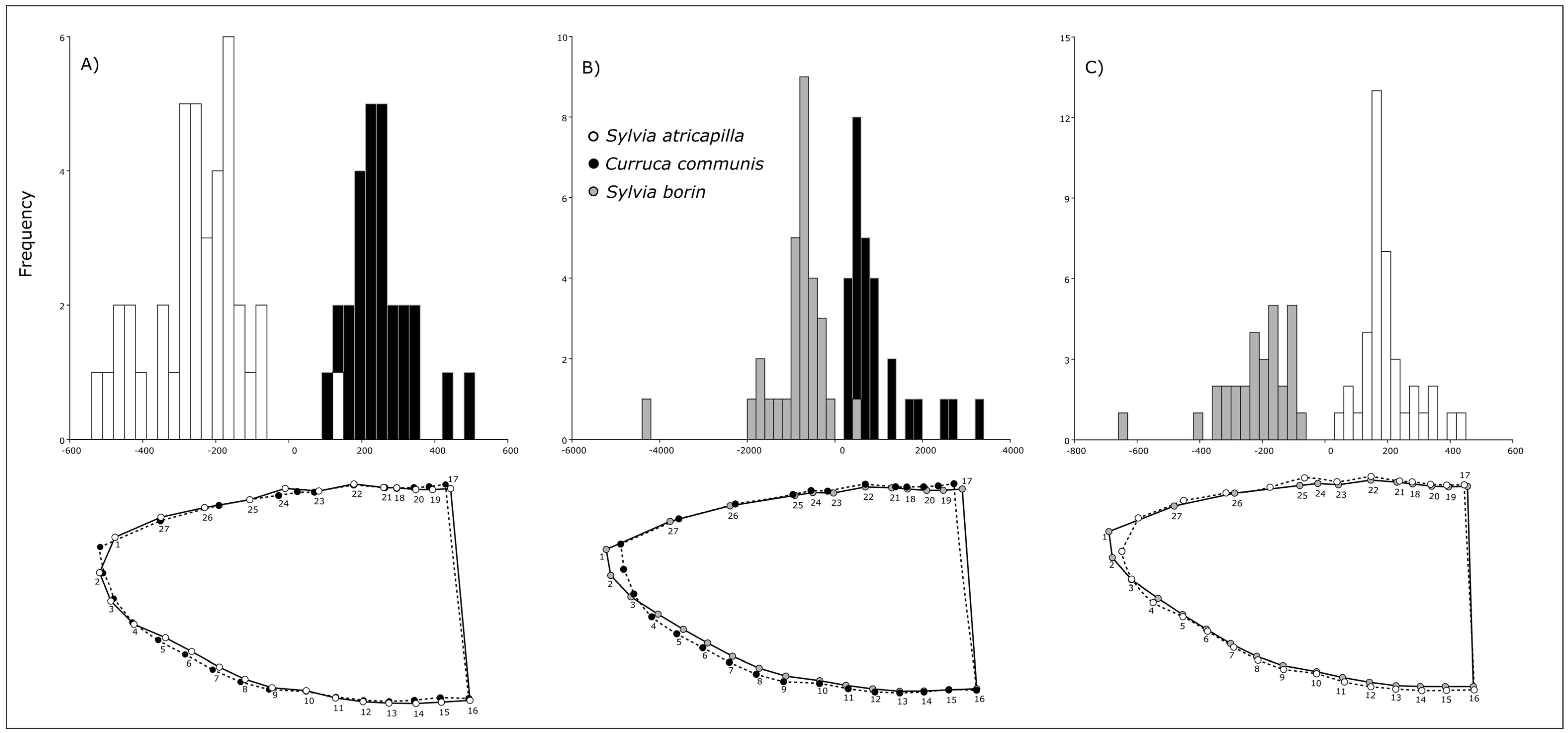
3.2. Geometric Morphometrics
4. Discussion
4.1. Methodological Convergence and Divergence
4.2. Interpreting Wing Shape Variation in Relation to Migration Ecology
4.3. Beyond Migration: Additional Ecological Pressures Shaping Wing Morphology
4.4. Conclusions, and Future Directions
Supplementary Materials
Author Contributions
Funding
Institutional Review Board Statement
Informed Consent Statement
Data Availability Statement
Acknowledgments
Conflicts of Interest
References
- Wainwright, P.C. Ecomorphology: Experimental Functional Anatomy for Ecological Problems. Am. Zool. 1991, 31, 680–693. [Google Scholar] [CrossRef]
- Koehl, M.A.R. When Does Morphology Matter? Annu. Rev. Ecol. Syst. 1996, 27, 501–542. [Google Scholar] [CrossRef]
- Pennycuick, C.J. Mechanics of Flight. In Avian Biology; Elsevier: Amsterdam, The Netherlands, 1975; pp. 1–75. ISBN 978-0-12-249405-5. [Google Scholar]
- Rayner, J.M.V. Form and Function in Avian Flight. In Current Ornithology; Johnston, R.F., Ed.; Springer: Boston, MA, USA, 1988; pp. 1–66. ISBN 978-1-4615-6789-9. [Google Scholar]
- Norberg, U.M. Vertebrate Flight: Mechanics, Physiology, Morphology, Ecology and Evolution; Zoophysiology; Springer: Berlin/Heidelberg, Germany, 1990. [Google Scholar]
- Lindhe Norberg, U.M. Structure, Form, and Function of Flight in Engineering and the Living World. J. Morphol. 2002, 252, 52–81. [Google Scholar] [CrossRef]
- Hedenström, A. Adaptations to Migration in Birds: Behavioural Strategies, Morphology and Scaling Effects. Phil. Trans. R. Soc. B 2008, 363, 287–299. [Google Scholar] [CrossRef] [PubMed]
- Lockwood, R.; Swaddle, J.P.; Rayner, J.M.V. Avian Wingtip Shape Reconsidered: Wingtip Shape Indices and Morphological Adaptations to Migration. J. Avian Biol. 1998, 29, 273. [Google Scholar] [CrossRef]
- Huber, G.H.; Turbek, S.P.; Bostwick, K.S.; Safran, R.J. Comparative Analysis Reveals Migratory Swallows (Hirundinidae) Have Less Pointed Wings than Residents. Biol. J. Linn. Soc. 2016, 120, 228–235. [Google Scholar] [CrossRef]
- Calmaestra, R.G.; Moreno, E. A Phylogenetically-Based Analysis on the Relationship between Wing Morphology and Migratory Behaviour in Passeriformes. Ardea 2001, 89, 407–416. [Google Scholar]
- Kaboli, M.; Aliabadian, M.; Guillaumet, A.; Roselaar, C.S.; Prodon, R. Ecomorphology of the Wheatears (Genus Oenanthe). Ibis 2007, 149, 792–805. [Google Scholar] [CrossRef]
- Baldwin, M.W.; Winkler, H.; Organ, C.L.; Helm, B. Wing Pointedness Associated with Migratory Distance in Common-garden and Comparative Studies of Stonechats (Saxicola torquata). J. Evol. Biol. 2010, 23, 1050–1063. [Google Scholar] [CrossRef]
- Minias, P.; Meissner, W.; Włodarczyk, R.; Ożarowska, A.; Piasecka, A.; Kaczmarek, K.; Janiszewski, T. Wing Shape and Migration in Shorebirds: A Comparative Study. Ibis 2015, 157, 528–535. [Google Scholar] [CrossRef]
- Carvalho Provinciato, I.C.; Araújo, M.S.; Jahn, A.E. Drivers of Wing Shape in a Widespread Neotropical Bird: A Dual Role of Sex-Specific and Migration-Related Functions. Evol. Ecol. 2018, 32, 379–393. [Google Scholar] [CrossRef]
- Marchetti, K.; Price, T.; Richman, A. Correlates of Wing Morphology with Foraging Behaviour and Migration Distance in the Genus Phylloscopus. J. Avian Biol. 1995, 26, 177. [Google Scholar] [CrossRef]
- Niemi, G.J. Patterns of Morphological Evolution in Bird Genera of New World and Old World Peatlands. Ecology 1985, 66, 1215–1228. [Google Scholar] [CrossRef]
- Swaddle, J.P.; Lockwood, R. Morphological Adaptations to Predation Risk in Passerines. J. Avian Biol. 1998, 29, 172. [Google Scholar] [CrossRef]
- Hahn, S.; Korner-Nievergelt, F.; Emmenegger, T.; Amrhein, V.; Csörgő, T.; Gursoy, A.; Ilieva, M.; Kverek, P.; Pérez-Tris, J.; Pirrello, S.; et al. Longer Wings for Faster Springs—Wing Length Relates to Spring Phenology in a Long-distance Migrant across Its Range. Ecol. Evol. 2016, 6, 68–77. [Google Scholar] [CrossRef] [PubMed]
- De La Hera, I.; Pulido, F.; Visser, M.E. Longitudinal Data Reveal Ontogenetic Changes in the Wing Morphology of a Long-distance Migratory Bird. Ibis 2014, 156, 209–214. [Google Scholar] [CrossRef]
- Thoma, C.T.; Makridou, K.N.; Bakaloudis, D.E.; Vlachos, C.G. Age-Specific Differences in Wing Pointedness and Wing Length of European Turtle Doves Streptopelia turtur Migrating through the Eastern Flyway. Ringing Migr. 2020, 35, 94–100. [Google Scholar] [CrossRef]
- Van Oordt, F.; Torres-Mura, J.C.; Hertel, F. Ecomorphology and Foraging Behaviour of Pacific Boobies. Ibis 2018, 160, 313–326. [Google Scholar] [CrossRef]
- Vanhooydonck, B.; Herrel, A.; Gabela, A.; Podos, J. Wing Shape Variation in the Medium Ground Finch (Geospiza fortis): An Ecomorphological Approach. Biol. J. Linn. Soc. 2009, 98, 129–138. [Google Scholar] [CrossRef]
- Savile, O.B.O. Adaptive Evolution in the Avian Wing. Evolution 1957, 11, 212–224. [Google Scholar] [CrossRef]
- Rayner, J.M.V. The Mechanics of Flight and Bird Migration Performance. In Bird Migration; Gwinner, E., Ed.; Springer: Berlin/Heidelberg, Germany, 1990; pp. 283–299. ISBN 978-3-642-74544-7. [Google Scholar]
- Bowlin, M.S.; Wikelski, M. Pointed Wings, Low Wingloading and Calm Air Reduce Migratory Flight Costs in Songbirds. PLoS ONE 2008, 3, e2154. [Google Scholar] [CrossRef]
- Swaddle, J.P.; Lockwood, R. Wingtip Shape and Flight Performance in the European Starling Sturnus vulgaris. Ibis 2003, 145, 457–464. [Google Scholar] [CrossRef]
- Van Oorschot, B.K.; Mistick, E.A.; Tobalske, B.W. Aerodynamic Consequences of Wing Morphing during Emulated Take-off and Gliding in Birds. J. Exp. Biol. 2016, 219, 3146–3154. [Google Scholar] [CrossRef]
- Norberg, U.M. Morphology of the Wings, Legs and Tail of Three Coniferous Forest Tits, the Goldcrest, and the Treecreeper in Relation to Locomotor Pattern and Feeding Station Selection. Philos. Trans. R. Soc. London B Biol. Sci. 1979, 287, 131–165. [Google Scholar] [CrossRef]
- Noreau, F.; Desrochers, A. Combined Effects of Migration Distance, Foraging Method Vegetation Density, and Population Density on Wing Shapes of Boreal Songbirds. BioRxiv 2018. BioRxiv:413351. [Google Scholar]
- Blondel, J.; Catzeflis, F.; Perret, P. Molecular Phylogeny and the Historical Biogeography of the Warblers of the Genus Sylvia (Aves). J. Evol. Biol. 1996, 9, 871–891. [Google Scholar] [CrossRef]
- Voelker, G.; Light, J.E. Palaeoclimatic Events, Dispersal and Migratory Losses along the Afro-European Axis as Drivers of Biogeographic Distribution in Sylvia Warblers. BMC Evol. Biol. 2011, 11, 163. [Google Scholar] [CrossRef] [PubMed]
- Cody, M.L. Habitat Selection and Interspecific Territoriality among the Sylviid Warblers of England and Sweden. Ecol. Monogr. 1978, 48, 351–396. [Google Scholar] [CrossRef]
- Bonte, D.; Provoost, S.; Hoffmann, M. Habitat and Territory Segregation within Sylviine Warblers of the Flemish Coastal Dunes. Belg. J. Zool. 2001, 131, 49–57. [Google Scholar]
- Wilhelmsson, P.; Jaenson, T.G.T.; Olsen, B.; Waldenström, J.; Lindgren, P.-E. Migratory Birds as Disseminators of Ticks and the Tick-Borne Pathogens Borrelia Bacteria and Tick-Borne Encephalitis (TBE) Virus: A Seasonal Study at Ottenby Bird Observatory in South-Eastern Sweden. Parasites Vectors 2020, 13, 607. [Google Scholar] [CrossRef] [PubMed]
- Moreau, R.E. The Palaearctic–African Bird Migration Systems; Academic Press: London, UK, 1972. [Google Scholar]
- Cramp, S.; Brooks, D.J. Handbook of the Birds of Europe, the Middle East, and North Africa: The Birds of the Western Palearctic; Oxford University Press: Oxford, UK, 1992; Volume VI. [Google Scholar]
- BirdLife International. Species Factsheet: Garden Warbler Sylvia Borin; BirdLife International: Cambridge, UK, 2024. [Google Scholar]
- BirdLife International. Species Factsheet: Common Whitethroat Curruca Communis; BirdLife International: Cambridge, UK, 2024. [Google Scholar]
- Berthold, P.; Terrill, S.B. Migratory Behaviour and Population Growth of Blackcaps Wintering in Britain and Ireland: Some Hypotheses. Ringing Migr. 1988, 9, 153–159. [Google Scholar] [CrossRef]
- Delmore, K.; Illera, J.C.; Pérez-Tris, J.; Segelbacher, G.; Lugo Ramos, J.S.; Durieux, G.; Ishigohoka, J.; Liedvogel, M. The Evolutionary History and Genomics of European Blackcap Migration. eLife 2020, 9, e54462. [Google Scholar] [CrossRef]
- Shirihai, H.; Gargallo, G.; Helbig, A. Sylvia Warblers: Identification, Taxonomy and Phylogeny of the Genus Sylvia; Christopher Helm Publishers Ltd.: London, UK, 2001. [Google Scholar]
- Ożarowska, A.; Zaniewicz, G.; Meissner, W. Blackcaps Sylvia atricapilla on Migration: A Link between Long-Term Population Trends and Migratory Behaviour Revealed by the Changes in Wing Length. Acta Ornithol. 2016, 51, 211–219. [Google Scholar] [CrossRef]
- BirdLife International. Species Factsheet: Eurasian Blackcap Sylvia Atricapilla; BirdLife International: Cambridge, UK, 2025. [Google Scholar]
- Dimaki, M.; Alivizatos, H. Ringing Studies of the Turtle Dove Streptopelia turtur (Aves: Columbidae during Passage through Antikythera Island, Southwestern Greece. J. Nat. Hist. 2015, 49, 419–427. [Google Scholar] [CrossRef]
- Kassara, C.; Bairaktaridou, K.; Kakalis, E.; Tsiopelas, N.; Giokas, S.; Barboutis, C. Activity Patterns of Eleonora’s Falcons during the Pre-Breeding Period: The Role of Habitat Composition on the Island of Antikythira. Avocetta 2019, 43. [Google Scholar] [CrossRef]
- Svensson, L. Identification Guide to European Passerines; British Trust for Ornithology: Norfolk, UK, 1992. [Google Scholar]
- Jenni, L.; Winkler, R. Moult and Ageing of European Passerines; Bloomsbury Publishing: London, UK, 1994. [Google Scholar]
- Milá, B.; Wayne, R.K.; Smith, T.B. Ecomorphology of Migratory And Sedentary Populations of the Yellow-Rumped Warbler (Dendroica coronata). Condor 2008, 110, 335–344. [Google Scholar] [CrossRef]
- Claramunt, S.; Derryberry, E.P.; Remsen, J.V.; Brumfield, R.T. High Dispersal Ability Inhibits Speciation in a Continental Radiation of Passerine Birds. Proc. R. Soc. B 2012, 279, 1567–1574. [Google Scholar] [CrossRef] [PubMed]
- Hernández, M.Á.; Campos, F.; Martín, R.; Santamaría, T. Usefulness of Biometrics to Analyze Some Ecological Features of Birds. In Biometrics: Unique and Diverse Applications in Nature, Science, and Technology; InTech: Rijeka, Croatia, 2011; pp. 1–22. [Google Scholar]
- Hedenstrom, A.; Pettersson, J. Differences in Fat Deposits and Wing Pointedness between Male and Female Willow Warblers Caught on Spring Migration at Ottenby, SE Sweden. Ornis Scand. 1986, 17, 182. [Google Scholar] [CrossRef]
- Rohlf, F.J. tpsDig2, version 2.32; Department of Ecology and Evolution, State University of New York at Stony Brook: Stony Brook, NY, USA, 2021. Available online: http://sbmorphometrics.org (accessed on 29 December 2025).
- Mitteroecker, P.; Gunz, P. Advances in Geometric Morphometrics. Evol. Biol. 2009, 36, 235–247. [Google Scholar] [CrossRef]
- Lee, S.; Kim, J.; Park, H.; Jabłoński, P.G.; Choi, H. The Function of the Alula in Avian Flight. Sci. Rep. 2015, 5, 9914. [Google Scholar] [CrossRef]
- Bao, H.; Song, B.; Yang, W.; Xuan, J.; Xue, D. The Progress of Aerodynamic Mechanisms Based on Avian Leading-Edge Alula and Future Study Recommendations. Aerospace 2021, 8, 295. [Google Scholar] [CrossRef]
- Schneider, C.A.; Rasband, W.S.; Eliceiri, K.W. NIH Image to ImageJ: 25 years of image analysis. Nat. Methods 2012, 9, 671–675. [Google Scholar] [CrossRef] [PubMed]
- Fiedler, W. Ecomorphology of the External Flight Apparatus of Blackcaps (Sylvia atricapilla) with Different Migration Behavior. Ann. N. Y. Acad. Sci. 2005, 1046, 253–263. [Google Scholar] [CrossRef] [PubMed]
- Zar, J.H. Biostatistical Analysis, 5th ed.; Pearson Prentice-Hall: Upper Saddle River, NJ, USA, 2010. [Google Scholar]
- Klingenberg, C.P. MORPHO J: An Integrated Software Package for Geometric Morphometrics. Mol. Ecol. Resour. 2011, 11, 353–357. [Google Scholar] [CrossRef]
- Bookstein, F.L. Morphometric Tools for Landmark Data: Geometry and Biology; Cambridge University Press: Cambridge, UK, 1991. [Google Scholar]
- Adams, D.C.; Rohlf, F.J.; Slice, D.E. Geometric Morphometrics: Ten Years of Progress Following the ‘Revolution’. Ital. J. Zool. 2004, 71, 5–16. [Google Scholar] [CrossRef]
- Drake, A.G.; Klingenberg, C.P. The Pace of Morphological Change: Historical Transformation of Skull Shape in St Bernard Dogs. Proc. R. Soc. B 2008, 275, 71–76. [Google Scholar] [CrossRef]
- Klingenberg, C.P. Visualizations in Geometric Morphometrics: How to Read and How to Make Graphs Showing Shape Changes. Hystrix Ital. J. Mammal. 2013, 24, 15–24. [Google Scholar] [CrossRef]
- Doswald, N.; Willis, S.G.; Collingham, Y.C.; Pain, D.J.; Green, R.E.; Huntley, B. Potential Impacts of Climatic Change on the Breeding and Non-breeding Ranges and Migration Distance of European Sylvia Warblers. J. Biogeogr. 2009, 36, 1194–1208. [Google Scholar] [CrossRef]
- Brewer, M.L.; Hertel, F. Wing Morphology and Flight Behavior of Pelecaniform Seabirds. J. Morphol. 2007, 268, 866–877. [Google Scholar] [CrossRef]
- Norberg, U.M.; Rayner, J.M.V. Ecological Morphology and Flight in Bats (Mammalia; Chiroptera): Wing Adaptations, Flight Performance, Foraging Strategy and Echolocation. Philos. Trans. R. Soc. London. B Biol. Sci. 1987, 316, 335–427. [Google Scholar] [CrossRef]
- Remeš, V. Nest Concealment and Parental Behaviour Interact in Affecting Nest Survival in the Blackcap (Sylvia atricapilla): An Experimental Evaluation of the Parental Compensation Hypothesis. Behav. Ecol. Sociobiol. 2005, 58, 326–332. [Google Scholar] [CrossRef]
- Węgrzyn, E.; Leniowski, K. Nest Site Preference and Nest Success in Blackcaps Sylvia atricapilla in Poland. Ardeola 2011, 58, 113–124. [Google Scholar] [CrossRef]
- Aymí, R.; Gargallo, G. Greater Whitethroat (Curruca communis). In Birds of the World; Billerman, S.M., Keeney, B.K., Rodewald, P.G., Schulenberg, T.S., Eds.; Cornell Lab of Ornithology: Ithaca, NY, USA, 2021. [Google Scholar]
- Cabodevilla, X.; Moreno-Zarate, L.; Arroyo, B. Differences in Wing Morphology between Juvenile and Adult European Turtle Doves Streptopelia turtur: Implications for Migration and Predator Escape. Ibis 2018, 160, 458–463. [Google Scholar] [CrossRef]
- Ożarowska, A.; Zaniewicz, G.; Meissner, W. Sex and Age-Specific Differences in Wing Pointedness and Wing Length in Blackcaps Sylvia atricapilla Migrating through the Southern Baltic Coast. Curr. Zool. 2021, 67, 271–277. [Google Scholar] [CrossRef]
- Hiemer, D.; Salewski, V.; Fiedler, W.; Hahn, S.; Lisovski, S. First Tracks of Individual Blackcaps Suggest a Complex Migration Pattern. J. Ornithol. 2018, 159, 205–210. [Google Scholar] [CrossRef]
- Tellería, J.L.; Hera, I.D.L.; Perez-Tris, J. Morphological Variation as a Tool for Monitoring Bird Populations: A Review: La Variación Morfológica Como Una Herramienta Para El Seguimiento De Las Poblaciones De Aves: Una Revision. Ardeola 2013, 60, 191–224. [Google Scholar] [CrossRef]
- Desrochers, A. Morphological Response of Songbirds to 100 Years of Landscape Change in North America. Ecology 2010, 91, 1577–1582. [Google Scholar] [CrossRef] [PubMed]



| Morphological Traits | Garden Warbler | Blackcap | Whitethroat |
|---|---|---|---|
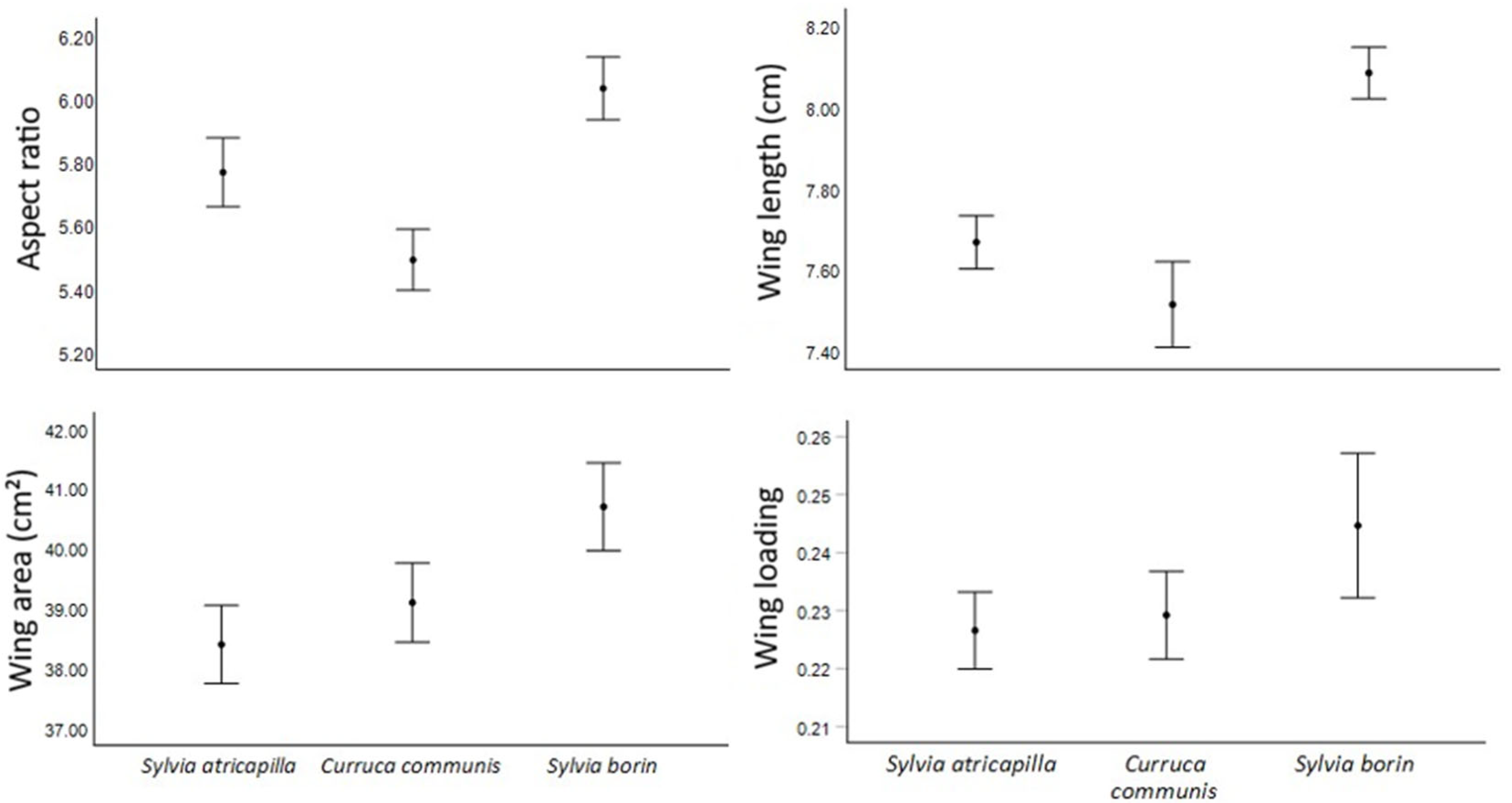
| Body mass (g) | 19.80 (±3.34, 47) | 17.48 (±1.36, 40) | 17.83 (±1.40, 29) |
| Wing length (cm) | 8.09 (±0.22, 46) | 7.67 (±0.20, 40) | 7.52 (±0.29, 30) |
| Ninth primary feather (cm) | 5.93 (±0.21, 46) | 5.19 (±0.17, 40) | 5.46 (±0.23, 30) |
| Fifth primary feather (cm) | 5.35 (±0.18, 46) | 5.33 (±0.15, 40) | 5.46 (±0.15, 30) |
| Wing area (cm2) | 40.70 (±2.38, 43) | 38.41 (±1.89, 35) | 39.10 (±1.66, 27) |
| Aspect ratio | 6.03 (±0.31, 40) | 5.77 (±0.31, 33) | 5.49 (±0.24, 27) |
| Wing loading | 0.245 (±0.041, 43) | 0.228 (±0.020, 35) | 0.229 (±0.019, 26) |
| Wing pointedness (i.e., Kipp’s Index) | 1.88 (±0.48, 43) | 1.76 (±0.22, 40) | 1.58 (±0.18, 30) |
| Species Pairwise Comparison | Statistic (F/H) | d.f. | p-Value |
|---|---|---|---|
| Wing length | 64.826 (F) | 2, 113 | <0.001 |
| Garden Warbler–Blackcap | <0.001 | ||
| Garden Warbler–Whitethroat | <0.001 | ||
| Blackcap–Whitethroat | 0.018 | ||
| Wing area | 12.781 (F) | 2, 102 | <0.001 |
| Garden Warbler–Blackcap | <0.001 | ||
| Garden Warbler–Whitethroat | 0.006 | ||
| Blackcap–Whitethroat | 0.385 | ||
| P9 primary feather | 151.914 (F) | 2, 113 | <0.001 |
| Garden Warbler–Blackcap | <0.001 | ||
| Garden Warbler–Whitethroat | <0.001 | ||
| Blackcap–Whitethroat | <0.001 | ||
| P5 primary feather | 6.129 (F) | 2, 113 | 0.003 |
| Garden Warbler–Blackcap | 0.718 | ||
| Garden Warbler–Whitethroat | 0.019 | ||
| Blackcap–Whitethroat | 0.003 | ||
| Aspect ratio | 28.018 (F) | 2, 97 | <0.001 |
| Garden Warbler–Blackcap | <0.001 | ||
| Garden Warbler–Whitethroat | <0.001 | ||
| Blackcap–Whitethroat | 0.001 | ||
| Body mass | 16.309 (H) | 2, 112 | <0.001 |
| Garden Warbler–Blackcap | <0.001 | ||
| Garden Warbler–Whitethroat | 0.015 | ||
| Blackcap–Whitethroat | 0.259 | ||
| Wing loading | 6.544 (H) | 2, 101 | 0.038 |
| Garden Warbler–Blackcap | 0.014 | ||
| Garden Warbler–Whitethroat | 0.099 | ||
| Blackcap–Whitethroat | 0.564 | ||
| Kipp’s Index | 19.025 (H) | 2, 114 | <0.001 |
| Garden Warbler–Blackcap | 0.088 | ||
| Garden Warbler–Whitethroat | <0.001 | ||
| Blackcap–Whitethroat | 0.007 |
| Interspecific Procrustes ANOVA | F | d.f. | Pillai’s Trace | p-Value |
|---|---|---|---|---|
| Garden Warbler–Blackcap | 36.31 | 50 | 0.99 | <0.0001 |
| Garden Warbler–Whitethroat | 11.66 | 50 | 0.98 | <0.0001 |
| Blackcap–Whitethroat | 20.53 | 50 | 0.99 | <0.0001 |
| Wing Shape | Garden Warbler | Blackcap | Whitethroat |
|---|---|---|---|
| Garden Warbler | - | 0.0716 (p < 0.0001) | 0.0462 (p < 0.0001) |
| Blackcap | 17.3373 (p < 0.0001) | - | 0.0577 (p < 0.0001) |
| Whitethroat | 11.3409 (p < 0.0001) | 14.1908 (p < 0.0001) | - |
| Wing Shape | Garden Warbler | Blackcap | Whitethroat | In Total |
|---|---|---|---|---|
| Garden Warbler | 96.67 (29/30) | - | 3.33 (1/30) | 100 (30) |
| Blackcap | - | 97.44 (38/39) | 2.56 (1/39) | 100 (39) |
| Whitethroat | - | 3.57 (1/28) | 96.43 (27/28) | 100 (28) |
Disclaimer/Publisher’s Note: The statements, opinions and data contained in all publications are solely those of the individual author(s) and contributor(s) and not of MDPI and/or the editor(s). MDPI and/or the editor(s) disclaim responsibility for any injury to people or property resulting from any ideas, methods, instructions or products referred to in the content. |
© 2026 by the authors. Licensee MDPI, Basel, Switzerland. This article is an open access article distributed under the terms and conditions of the Creative Commons Attribution (CC BY) license.
Share and Cite
Agtzidis, A.; Barboutis, C.; Giokas, S. Wing Shape and Size Variation in Migratory Sylviid Warblers: Links to Ecology and Migration. Birds 2026, 7, 18. https://doi.org/10.3390/birds7010018
Agtzidis A, Barboutis C, Giokas S. Wing Shape and Size Variation in Migratory Sylviid Warblers: Links to Ecology and Migration. Birds. 2026; 7(1):18. https://doi.org/10.3390/birds7010018
Chicago/Turabian StyleAgtzidis, Alexis, Christos Barboutis, and Sinos Giokas. 2026. "Wing Shape and Size Variation in Migratory Sylviid Warblers: Links to Ecology and Migration" Birds 7, no. 1: 18. https://doi.org/10.3390/birds7010018
APA StyleAgtzidis, A., Barboutis, C., & Giokas, S. (2026). Wing Shape and Size Variation in Migratory Sylviid Warblers: Links to Ecology and Migration. Birds, 7(1), 18. https://doi.org/10.3390/birds7010018