1. Introduction
The Tunisian Center for Nuclear Sciences and Technology (CNSTN) operates a pilot-scale unit equipped with a
60Co irradiator [
1]. The primary application of this irradiator is industrial, including the disinfection of disposable medical equipment and the purification of food-industry products [
2]. As a result, the
60Co source must maintain a high activity, typically in the hundreds of kilocuries range. Initially, in April 1999, the activity of the
60Co source was about 100 kCi. However, due to the natural radioactive decay of the
60Co, the current activity of the source has decreased to 2.86 kCi (April 2026). To maintain its optimal functionality, it is essential to refill the source. To address this, two studies were conducted to establish the optimal arrangement for the future refill of the
60Co source using MC simulations. The first study involved adding four
60Co pencils using GEANT4 [
3], while the second study involved adding six
60Co pencils using FLUKA [
2]. These research studies indicate that each proposed configuration may be regarded as optimal for the future replenishment of the
60Co source, provided that the geometry symmetry for the
60Co pencils distribution is maintained. These studies are limited by the restricted number of configurations examined regarding MC computational time and by the analytical approach employed to determine the optimal configurations. In this context, to calculate dosimetry data for industrial and medical applications, researchers still commonly rely on MC codes as essential tools [
4,
5,
6,
7]. However, a fundamental constraint inherent to MC-based approaches lies in their considerable computational burden, characterized by extensive memory usage and high CPU demand. This limitation is particularly evident in simulations conducted with the FLUKA code developed in a previous study [
2], where a single configuration run consumes approximately 10 h of processing time using a machine equipped with 8 GB of RAM, a 3.00 GHz CPU, 64-bit architecture, and an Intel Core i5 processor. Scaling this to the full design space of 210 candidate configurations would therefore accumulate to an estimated total computation time of approximately 98 days, a duration spanning nearly three months of uninterrupted processing.
Despite the widespread use of artificial intelligence in related fields such as medical physics and medical imaging [
8,
9,
10,
11], its application in this particular field to assist MC simulations has remained notably limited. Therefore, incorporating an appropriate AI-based model could further strengthen the analysis and enhance the overall reliability of the findings. The integration of artificial intelligence tools, encompassing both machine learning and deep learning frameworks, presents a compelling avenue for substantially mitigating the prohibitive computational demands associated with traditional simulation approaches. In light of this, Elhamdi et al. proposed a method that combines an Artificial Neural Network (ANN) with GEANT4-based MC simulations to determine the air absorbed dose rate from photon emissions of naturally occurring radionuclides [
12]. Additionally, assessment of unscattered flux and gamma-dose-rate conversion factors were performed using an AI tool. This approach significantly reduces computation time. In a related contribution, Mokhtari et al. investigated the potential of an Artificial Neural Network (ANN) to determine the optimal shielding configuration for a conventional gamma radiation source [
13]. Their findings demonstrated a remarkably high level of agreement between MC simulation outputs and ANN-generated predictions, with discrepancies remaining below 1%. Furthermore, the developed model proved capable of generalizing effectively beyond its training dataset, yielding reliable estimations for previously unseen input conditions.
Monte Carlo methods represent a well-established computational framework widely employed to investigate particle transport phenomena and interaction mechanisms in various media, as well as to model complex geometries. However, the reliability of these methods fundamentally depends on extensive random sampling and the simulation of large particle histories, making the overall process considerably time-consuming and computationally demanding. To overcome these limitations, Artificial Intelligence offers data-driven models that identify complex relationships in input datasets using brain-inspired learning mechanisms. To bridge these identified gaps, the present work explores the applicability of Artificial Intelligence, specifically through the implementation of Artificial Neural Network architectures, as a robust predictive framework for dose rate data, alongside linear regression to guide the selection of the most suitable loading configuration in anticipation of the forthcoming 60Co source refill.
2. Materials and Methods
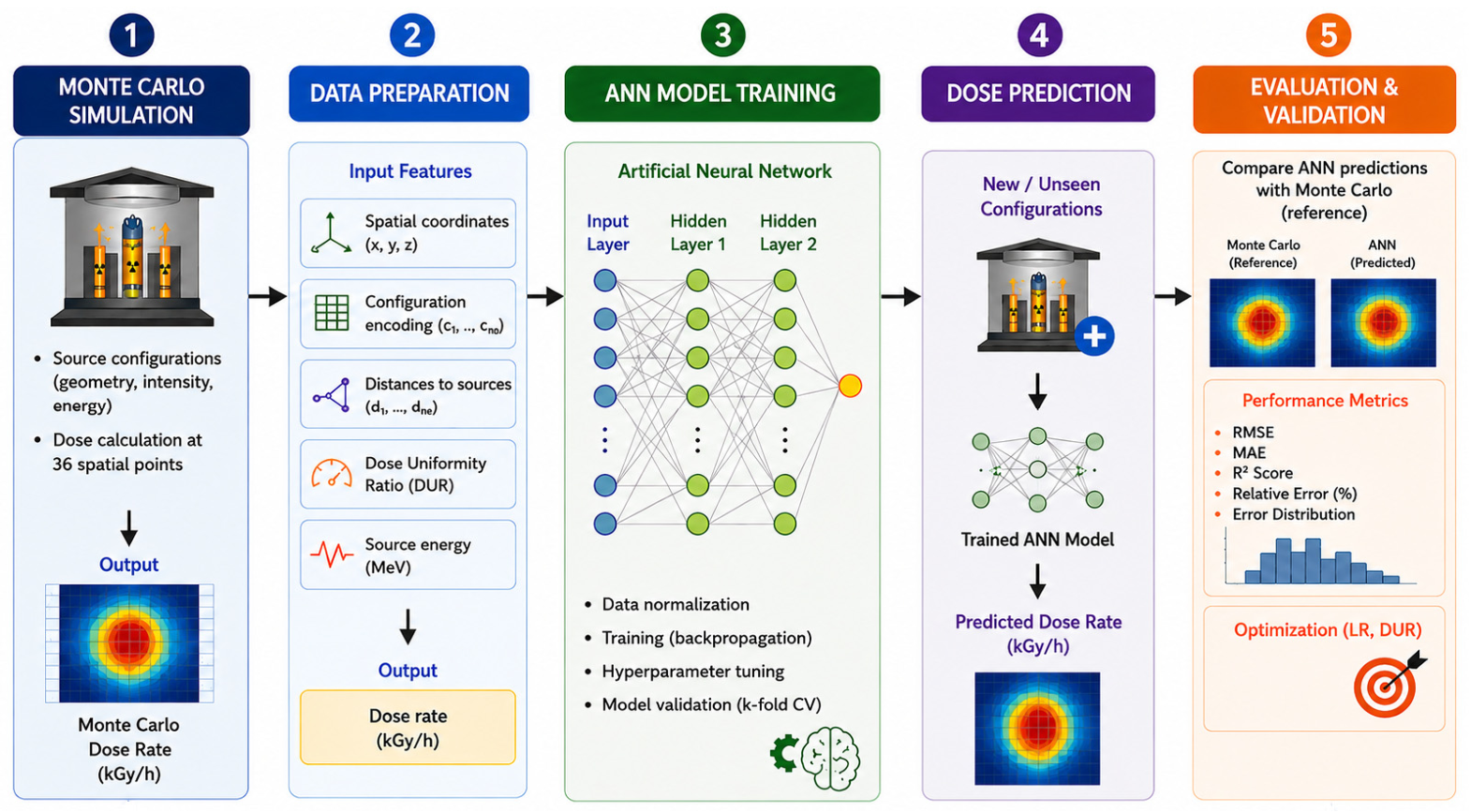
The proposed methodology, illustrated in
Figure 1, follows a structured pipeline integrating FLUKA MC simulations with an ANN model for accurate and efficient dose rate prediction. A dataset is first generated through MC simulations across various
60Co source configurations, from which relevant input features, including spatial coordinates, configuration encoding, source-to-position distances, dose uniformity ratio (DUR), source intensity, and source energy, are extracted and paired with their corresponding dose rate outputs. The processed dataset is subsequently used to train the ANN, enabling it to learn the complex input–output relationships governing dose rate distribution. Once trained, the model is deployed to predict dose rates for unseen configurations, with its performance rigorously assessed against FLUKA reference values using statistical metrics including RMSE, R
2, and relative error. The final step consists of selecting the optimal configuration based on the determination coefficient and DUR. Each step of this workflow is detailed in the dedicated subsections that follow.
2.1. The Study’s Monte Carlo Approach
The panoramic
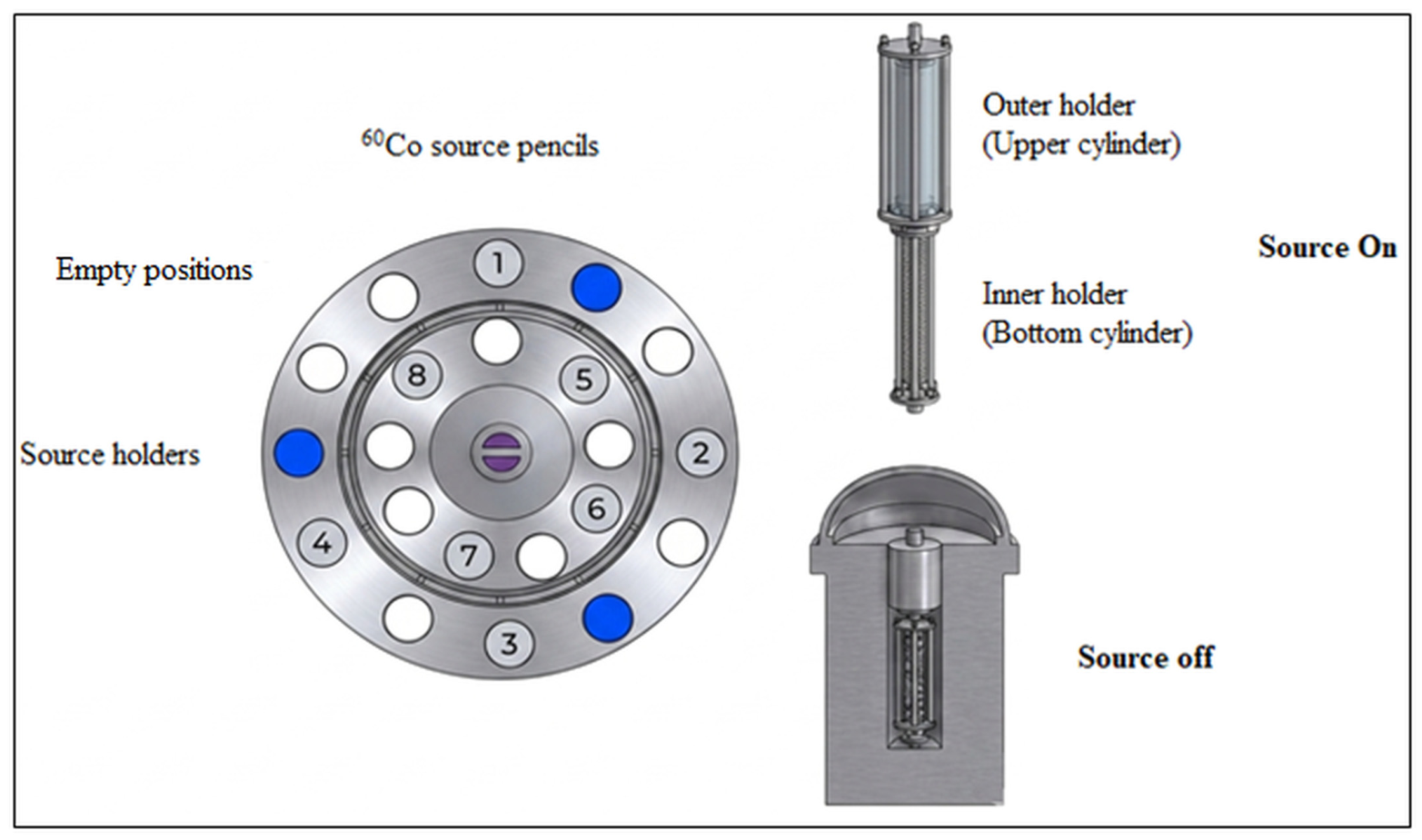
60Co irradiator is equipped with eight cylindrical pencil sources (C-188, MDS Nordion, Ottawa, ON, Canada), each 41 cm in height and 1 cm in diameter, double encapsulated in a welded stainless-steel cage. The source rack comprises 18 source housings arranged in two concentric cylindrical holders, with outer and inner diameters of 10 cm and 5.6 cm, respectively. The eight existing
60Co sources are distributed equally between the two holders, while the remaining ten housings are left empty for future source replenishment. As shown in
Figure 2, numbered circles (1–8) indicate the positions of the existing
60Co sources, and unnumbered white circles represent the vacant housings, providing a schematic representation of the source rack configuration prior to the refilling operation.
For the replenishment process, six new pencil sources are used, with the optimal configuration selected to preserve the plant’s operational characteristics, particularly dose distribution uniformity and the isotropic nature of the gamma radiation source. Using six pencils yields 210 possible configurations [
14]. However, due to the high computational cost of MC simulations, only thirty-five randomly selected configurations were analyzed in this study. This selection was made to provide representative coverage of the feasible design space while maintaining a computationally manageable number of Monte Carlo calculations, as simulating all possible configurations would require a prohibitive computation time.
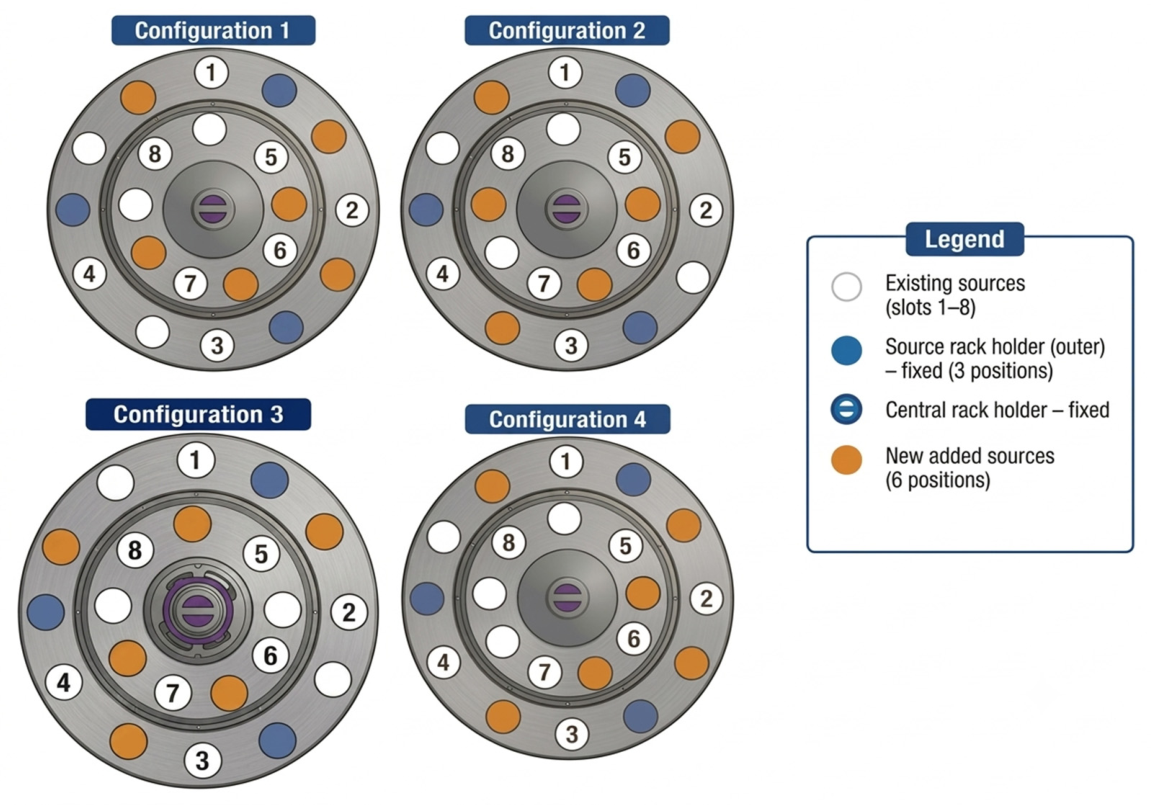
Figure 3 presents schematic illustrations of four distinct reloading configurations of the
60Co source pencils, selected from the thirty-five arrangements examined throughout this study. The newly inserted
60Co source pencils are depicted as orange circles in the figure. The three solid blue circles inside the outer cylinder and the central circle between the concentric cylinders represent the source rack holder.
To identify the most suitable refilling configurations, the absorbed dose-rate distribution surrounding the
60Co source was evaluated both before and after the refill process, considering measurements in both the transversal and longitudinal planes. These two complementary phases were based on the experimental setups reported by Kadri et al. [
15] and Gharbi et al. [
16], and were reproduced through FLUKA Monte Carlo simulations [
17,
18], following the methodology described in Section 2.4.1 of [
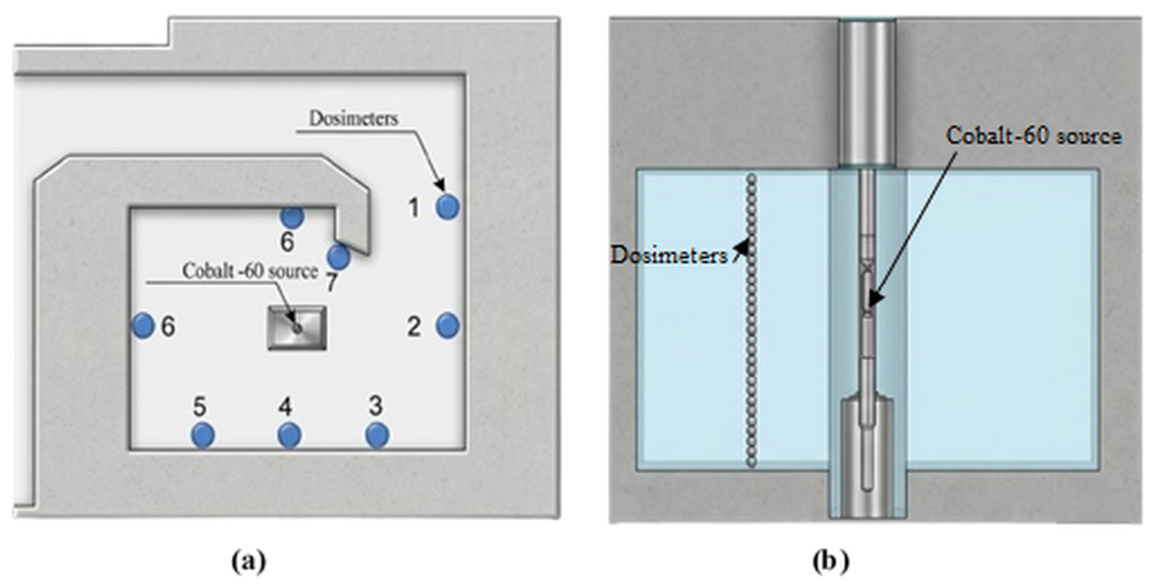
2], where the detector volume and material were previously validated. In Phase 1, corresponding to the transversal plane (x, y) and based on the setup of Kadri et al. [
15], seven spherical water-filled dosimeters, each with a radius of 1.3 cm, were positioned at an elevation of 157 cm above the room floor (
Figure 4a). However, in Phase 2, which corresponds to the longitudinal axis (z) and is based on the setup of Gharbi et al. [
16], detectors were modeled in FLUKA as water-filled spherical volumes of identical radius (1.3 cm), consistent with the validated detector configuration reported in [
2]. These detectors were distributed across twenty-nine sequential positions along the vertical axis, from the bottom to the top of the irradiation room, at uniform 10 cm intervals, and located at a lateral distance of 150 cm from the source (
Figure 4b). The validation of this simulation framework, established through systematic comparison with the experimental measurements reported in [
15,
16], is presented in detail in Reference [
2], confirming its accuracy and reliability for reproducing the dosimetric behavior of the irradiation facility. Following validation, dosimetry outputs extracted from each FLUKA simulation run across all proposed configurations were consolidated and enriched with geometrically and physically encoded parameters to construct the ANN input vector. This comprehensive dataset was subsequently exploited to predict dose rates for unseen configurations.
2.2. The Study’s Artificial Neural Network Approach
Artificial Neural Networks are computational intelligence frameworks inspired by the intricate architecture of biological neural systems found in the human brain [
19]. These models are fundamentally structured around interconnected processing units, commonly referred to as neurons or nodes, organized into successive layers, namely an input layer responsible for receiving raw data, one or more intermediate hidden layers tasked with extracting and transforming relevant features, and a final output layer delivering the predicted response [
20]. Each connection linking adjacent neurons carries an associated adjustable parameter known as a weight, which governs the magnitude of the transmitted signal. During the learning phase, the network iteratively refines these weights by minimizing the discrepancy between its generated predictions and the corresponding target values, through a process known as backpropagation combined with gradient-based optimization strategies. The incorporation of nonlinear activation functions within the hidden layers endows the network with the capacity to capture and model highly complex, nonlinear relationships embedded within the input data [
21]. Once adequately trained, an ANN demonstrates remarkable generalization capabilities, enabling it to produce reliable estimations for unseen input data.
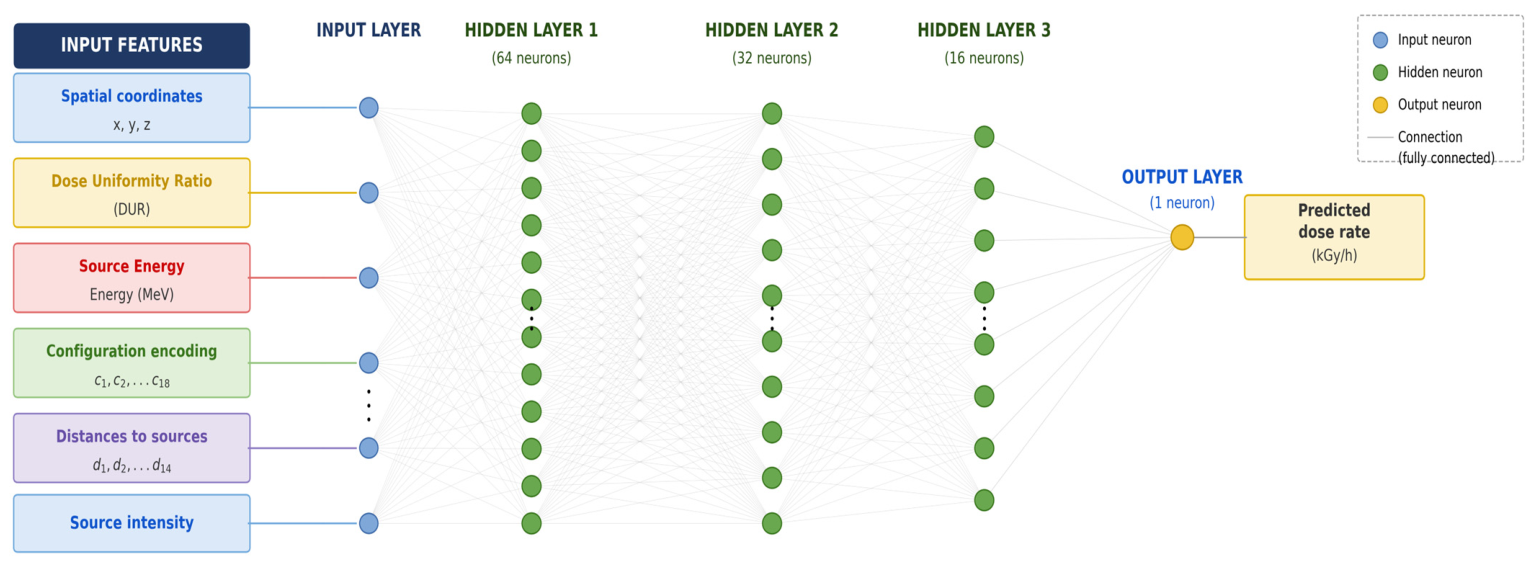
In this study, the ANN model was built upon a Feed-Forward Back Propagation topology, trained using the Adam Optimizer, and evaluated through mean square error minimization [
22]. Systematic optimization of the network architecture yielded an optimal structure comprising three hidden layers, each with different neurons. This architecture was determined empirically by evaluating multiple configurations with varying numbers of hidden layers, neurons per layer, and training hyperparameters, selecting the configuration that minimized validation error while maintaining good generalization (
Table 1). Dropout regularization and early stopping were further applied to mitigate overfitting.
Figure 5 details the ANN’s architecture.
Input features were standardized using StandardScaler to ensure uniform scaling across variables [
23]. To assess the generalizability of the developed ANN model, a Leave-One-Configuration-Out (LOCO) cross-validation scheme was applied, whereby all point-wise dose-rate samples associated with a given source configuration were systematically excluded from training and used exclusively for testing. This configuration-level exclusion provides a stringent evaluation of the model’s ability to generalize to entirely unseen source configurations, rather than merely interpolating between points within previously observed configurations, thereby offering a robust indication of its predictive reliability beyond the training dataset. Further details of the ANN architecture and training parameters are provided in
Table 1.
Each replenishment configuration is defined by the occupancy of 60Co unit source positions in the ANN input feature vector. A binary encoding scheme was adopted to represent the presence or absence of a 60Co pencil source at each position. In addition to the occupancy encoding, each pencil was modeled with intensity. To incorporate the physical relationship between source geometry and dose deposition, distance-based features and (x, y, z) coordinates were introduced for each measurement position. As a result, the input vector included spatial coordinates, dose uniformity ratio, configuration encoding, source intensity, and source-to-point distances, etc. This encoding strategy enables the ANN to effectively capture both the discrete nature of source arrangements and the underlying physical principles governing dose distribution to accurately predict the dose rate in a given position.
The collected dataset was transformed into a point-wise structure, where each spatial position represents an independent sample. Consequently, a total of 1260 measurement positions from 35 configurations, each measurement position from Phases 1 and 2 (36 positions per configuration), is described by a 56-feature input vector, which constructs a matrix dimension of 56 × 1260. The predictive accuracy of the proposed approach was evaluated by benchmarking the ANN-generated outputs against their corresponding FLUKA-based MC simulation references.
2.3. Statistical Analysis
To rigorously assess the degree of agreement between datasets, the non-parametric Mann–Whitney U statistical test was employed as a comparative analytical tool [
24]. The statistical test enables systematic evaluation of the consistency between experimentally measured and MC-simulated values, as well as between simulation-derived outputs and ANN-generated predictions. This analysis encompasses both the reference original configuration and the proposed candidate refill arrangements. Differences were considered significant for
p < 0.05 and not significant for
p > 0.05 [
25]. Statistical computations were carried out in Python 3.12.
2.4. Linear Regression
Linear Regression (LR) is a statistical modeling technique that is widely used in machine learning to quantify the relationship between one or more independent variables and a dependent variable, and to evaluate the predictive capability of the model [
26,
27]. It provides insights into the significance of the predictor variables, as well as the magnitude (estimated coefficient value) and direction (positive or negative) of their relationship with the dependent variable (Equation (1)):
where
y is the wage,
x is the education, and
α0 and
α1 are the regression coefficients.
To further evaluate the agreement between MC outputs and ANN predictions, the determination coefficient (R
2) was adopted as a complementary statistical metric [
28]. This coefficient quantifies the proportion of variance in the dependent variable explained by the model, ranging from 0 to 1, where values approaching unity indicate a stronger correlation and a more accurate model fit. Incorporating R
2 into the analysis provided meaningful insights into the reliability and robustness of the proposed machine learning framework in reproducing the variability observed in predicted and simulated dose rates.
3. Results and Discussions
Longitudinal dose rate distributions along the irradiation plane were evaluated using FLUKA-based MC simulations for both the original and proposed source configurations, and subsequently benchmarked against the experimental measurements reported by Gharbi et al. [
16]. The mean deviation (relative error) between simulated and measured values remained within 3% across all configurations. Statistical evaluation through the Mann–Whitney U-test confirmed no significant difference between FLUKA-derived dose rates and experimental data for either the original configuration or the thirty-five proposed replenishment scenarios for the
60Co source (
p > 0.05). Complementary validation was performed in the transversal plane using seven detector positions, with simulated results cross-referenced against the experimental dataset from [
15]; the mean discrepancy in this plane likewise fell below 3%. Collectively, these results affirm a robust agreement between MC calculations and independently obtained experimental measurements (
p > 0.05). The reported relative errors of less than 3% were obtained through comparison with the experimental measurements, indicating excellent agreement between the FLUKA Monte Carlo results and the experimental data and confirming the reliability of the developed FLUKA input model for dosimetry calculations.
The dose rates predicted by the Artificial Neural Network model were further compared against those calculated by MC simulations across all proposed configurations. The Mann–Whitney U test revealed no statistically significant difference between the ANN-predicted and FLUKA-computed dose rate values (p > 0.05), indicating that the trained ANN model reproduces the MC results with high statistical fidelity. The ANN model was developed and evaluated using the Leave-One-Configuration-Out (LOCO) cross-validation strategy applied to the complete dataset to enhance the model’s generalizability. The dataset was structured as an input matrix of dimensions 56 × 1260, in which each input vector encodes the source configuration and the corresponding spatial position, while the associated target output represents the point-wise dose rate at that specific position, used to train the ANN for dose-rate prediction. Consequently, the adoption of a point-wise data representation transformed these 35 configurations into 1260 independent samples, enabling the ANN to learn the relationship between source arrangements and dose-rate distributions from a substantially expanded dataset.
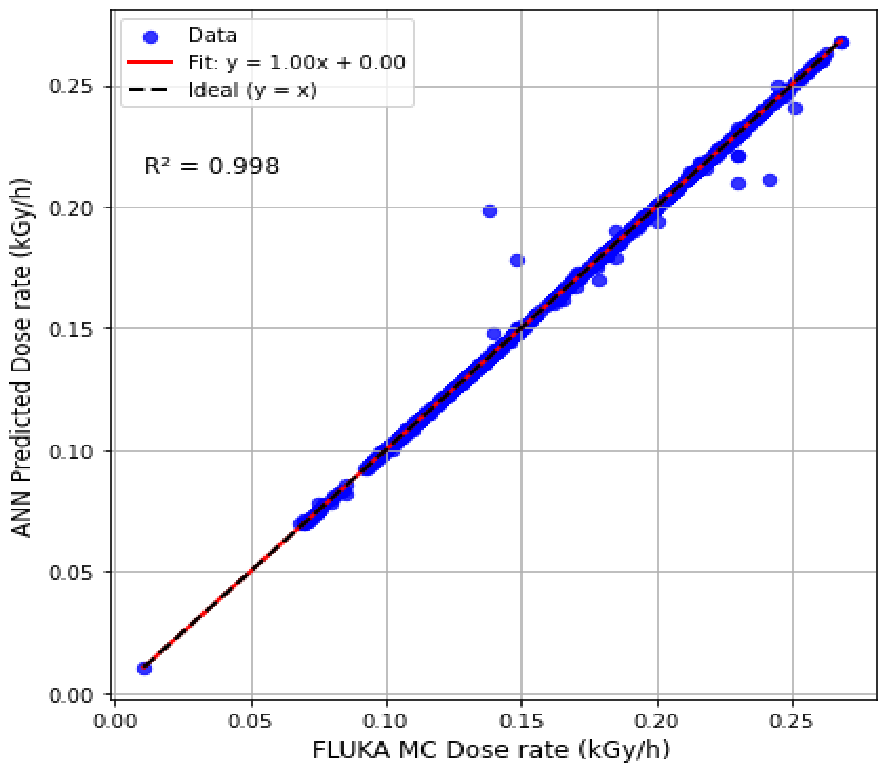
Figure 6 compares the dose rates predicted by the ANN model against MC reference values, revealing a remarkably close agreement between the two. Data points cluster tightly along the ideal line (y = x), reflecting the model’s ability to faithfully reproduce the simulated dose distribution across all measurement positions, a result that speaks to both the quality of the training data and the soundness of the network architecture. Linear regression analysis further reinforces this finding: the slope is effectively unity and the intercept negligible, together confirming that the ANN introduces no meaningful systematic bias into its predictions. The coefficient of determination is R
2 = 0.998, indicating that the model accounts for more than 99% of the variance in the reference data. However, a small number of points do show modest deviations from the regression and ideal lines. Rather than reflecting a fundamental limitation of the approach, these discrepancies are most plausibly linked to localized geometric effects (e.g., asymmetric arrangements) or intricate radiation-interaction phenomena. In such cases, the resulting dose-rate distribution becomes more complex and less regular, which is inherently challenging to capture, even for MC codes operating at full fidelity. Importantly, their magnitude remains well within acceptable bounds for practical dosimetry applications.
Furthermore, the application of dropout regularization and early stopping to mitigate overfitting and improve predictive performance on unseen data demonstrated consistent agreement with the corresponding FLUKA Monte Carlo simulations, confirming the ANN model’s capability to accurately reproduce the underlying dose-rate distributions.
The ANN model exhibits excellent agreement with MC reference simulations, as reflected by an MAE of 0.3 Gy/h and an RMSE of 2.2 Gy/h, as summarized in
Table 2, collectively confirming high predictive accuracy with minimal absolute deviation. Relative error analysis further supports model robustness, with a mean relative error of 0.23% and a median of 0.04%, indicating that the vast majority of predictions closely reproduce MC-computed values. The low standard deviation of relative errors (1.5%) attests to the model’s overall stability across the dataset. Nevertheless, a maximum relative error of 43.32%, which corresponds to a small number of isolated samples and is not representative of the overall model performance. Such deviations are likely associated with sparsely represented dosimetric conditions in the training dataset, whereas the low average errors and high R
2 value confirm the robustness of the ANN predictions for the vast majority of cases.
In the proposed methodology, the ANN model was applied to predict the dose rate around the
60Co source rack because the relationship between source arrangement and dose-rate distribution is highly nonlinear and difficult to capture with conventional analytical models. This choice offers a favorable trade-off between predictive accuracy and computational efficiency, although it comes at the cost of reduced interpretability compared to tree-based methods, and depends on the availability of a sufficiently large and representative training dataset for reliable generalization. The obtained results in the present study indicate that the ANN, once trained, provides near-instantaneous predictions (about 26 min per configuration) compared with the computationally intensive FLUKA Monte Carlo simulations (about 10 h) [
2], making it a practical tool for rapid configuration assessment.
Taken together, these results demonstrate that the ANN serves as a highly accurate and reliable support tool, augmenting MC simulations with significantly reduced computational demand. It preserves the predictive accuracy demanded by radiation physics while cutting the computational overhead, a meaningful step toward making dose rate calculations studies faster and more accessible in operational settings.
In the final step, linear regression analysis was applied across all proposed configurations benchmarked against the experimental data reported in [
15,
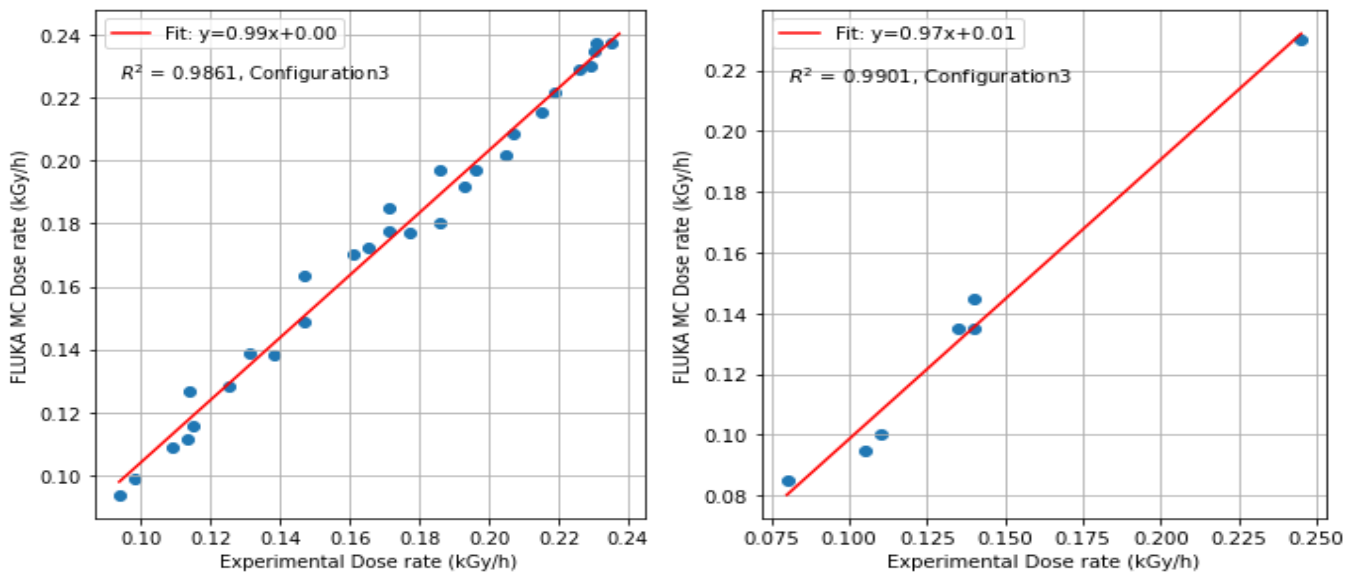
16], with the aim of identifying the optimal source arrangement. The results consistently point to configuration 3, illustrated in
Figure 3, as the best-performing arrangement, achieving the highest coefficient of determination of R
2 = 0.986 and R
2 = 0.990, reflecting an excellent fit between the MC-calculated and experimentally measured dose rates. The corresponding regression models for configuration 3 are presented in
Figure 7.
To further strengthen the selection process, a dose uniformity ratio (DUR)-based approach was introduced alongside the linear regression analysis, offering an independent lens through which to evaluate the various
60Co source rack refill configurations. The underlying logic is straightforward: since the Dose Uniformity Ratio (DUR) is defined as the ratio of the maximum dose to the minimum dose (Dmax/Dmin), a DUR value closer to 1 indicates better dose uniformity [
29,
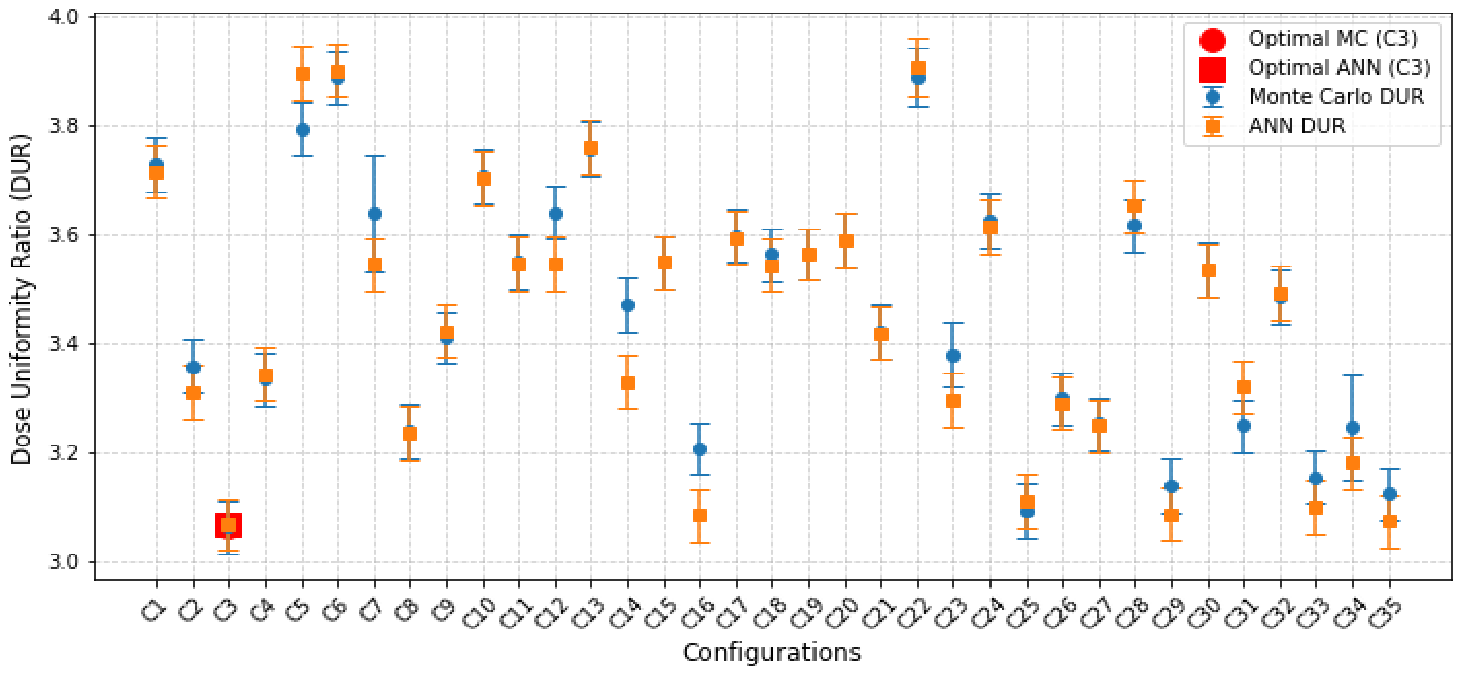
30]. Therefore, the configuration with the closest DUR to 1, provides the most uniform dose distribution throughout the irradiation room and is considered the most suitable candidate for future refill operations. All FLUKA calculations were performed using an analog (unbiased) Monte Carlo transport scheme, without variance-reduction or biasing techniques. Consequently, the dose-rate distributions used to derive the DUR values are subject solely to the statistical uncertainty inherent in the finite number of simulated particle histories. As shown in
Figure 8, configuration 3 stood out clearly from the rest, achieving the nearest DUR value (3.06) to the unit based on both FLUKA MC and ANN data, outperforming the other arrangements considered in this study. What makes this result particularly compelling is how well it aligns with the conclusions drawn from the linear regression analysis, where configuration 3 also emerged as the optimal configuration. The convergence of two independent evaluation methodologies toward a consistent outcome provides strong evidence that configuration 3 represents the most suitable arrangement for the future refill of the
60Co source rack. On the modeling side, the ANN predictions held up remarkably well against the MC reference results across all tested configurations, with only minor deviations observed. This is a meaningful outcome, as it demonstrates that the trained ANN can serve as a fast and reliable support tool, capable of guiding optimization decisions.