
This is an early access version, the complete PDF, HTML, and XML versions will be available soon.
Beyond Photons: Emerging Advances and Clinical Potential of Proton Beam Therapy in Gynecological Malignancies

1
Department of Molecular Pharmacology and Experimental Therapeutics, Mayo Clinic, Rochester, MN 55905, USA
2
Department of Gynecology and Obstetrics, The First Affiliated Hospital, Zhejiang University School of Medicine, Hangzhou 310003, China
*
Author to whom correspondence should be addressed.
Radiation 2026, 6(3), 23; https://doi.org/10.3390/radiation6030023
Submission received: 2 May 2026
/
Revised: 13 June 2026
/
Accepted: 23 June 2026
/
Published: 30 June 2026
Simple Summary
This review article explains how proton beam therapy, a more precise form of radiation treatment, may improve care for women with gynecological cancers such as cervical, uterine, and ovarian cancer. Unlike traditional radiation, proton therapy can target tumors more accurately while reducing damage to nearby healthy organs like the bowel and bladder. This may help lower side effects and improve quality of life. The review also discusses current challenges, including high cost and limited availability, and highlights the need for more clinical studies in the future.
Abstract
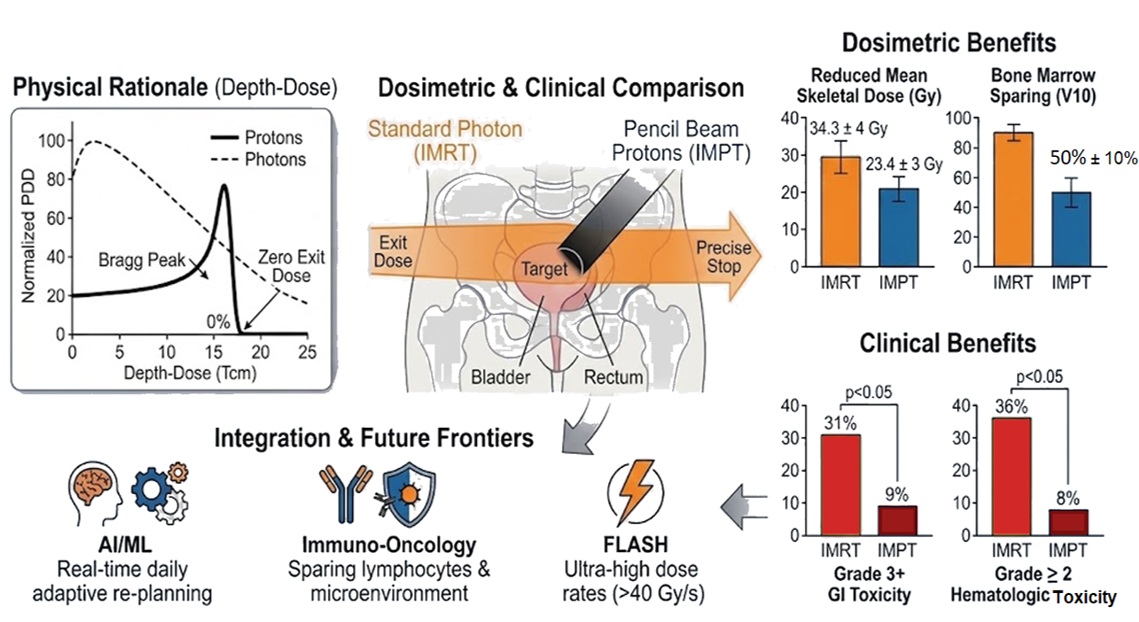
Radiation therapy is central to the management of gynecological cancers, including endometrial, cervical, ovarian, and vaginal malignancies. Despite advances in photon-based techniques, treatment-related toxicity remains significant owing to the anatomical proximity of pelvic targets to critical organs at risk (OARs), including the bowel, bladder, and bone marrow. Proton beam therapy exploits the Bragg peak to deliver a precise dose at depth with minimal exit dose, potentially reducing OAR exposure. This review develops the physical principles, dosimetric evidence, and early clinical data for proton therapy in gynecological malignancies, including cervical, endometrial, ovarian, vaginal, and vulvar cancers. Major focus is given to clinical conditions where conventional brachytherapy is not practical, and proton therapy may offer the greatest advantages, such as reirradiation for recurrent disease, post-operative pelvic irradiation, and extended field nodal treatment. This review also emphasizes current constraints that have slowed down wide clinical implementation, such as the lack of mature prospective data, cost, and accessibility. Finally, we emphasize future directions, including well-designed comparative trials, integration with systemic and immunotherapies, and adaptive treatment strategies. As the body of accumulated evidence evolves, the proton beam therapy potential for the treatment of gynecological malignancies has tremendously increased due to its role in safety and personalization of radiation treatment.