1. Introduction
Flowering landscapes have long attracted visitors, but they do not constitute a single or self-evident tourism category. Some are designed gardens created primarily for display; others are working agricultural fields, culturally significant seasonal phenomena, festival settings, or visually prominent components of a wider rural landscape. Garden tourism research has examined visitor motivation, experience quality, and the social value of designed landscapes (
Connell, 2004;
Paiva et al., 2020;
Shapoval et al., 2021;
Moser, 2023). Agritourism and rural tourism scholarship, by contrast, has focused on the relationship between agricultural production, rural amenities, local enterprise, and visitor activity (
Lane, 1994;
Phillip et al., 2010;
Ammirato et al., 2020;
Lane & Kastenholz, 2015;
Xue et al., 2020). Festival and destination studies add further perspectives on temporal concentration, image formation, and event-led visitation (
Tkaczynski, 2013;
Zamani-Farahani & Fox, 2018). Flower-based destinations sit across these studies without being adequately explained by any one of them.
For the purposes of this review, flower-sea tourism landscapes are defined as extensive or visually concentrated flowering landscapes that function as seasonal attractions, cultural symbols, experiential settings, and, in many cases, productive rural environments. Visitor preference research further indicates that landscape attributes influence how nature-based and agricultural tourism experiences are evaluated (
Moyle et al., 2017;
H. Wang et al., 2023). The expression “flower-sea” is retained as an analytical label for what may also be described as a mass-flowering tourism landscape; it is not presented as an established botanical category or a standardized term in English-language tourism research. It encompasses mass flowering perceived at landscape scale, whether generated by ornamental planting, horticultural production, agricultural cultivation, or seasonal flowering of culturally significant trees. Isolated specimens, small decorative flowerbeds, indoor exhibitions, and flower markets without a landscape-scale flowering setting fall outside this boundary because they do not combine floral concentration, landscape perception, and destination mobilization. The category nevertheless overlaps with garden tourism, agritourism, event tourism, nature-based tourism, and cultural-landscape tourism. The common feature is not a particular flower species or ownership model, but the conversion of concentrated floral display into a reason for travel and a basis for destination meaning.
Two characteristics make this resource form distinctive. First, flower-sea tourism relies on unusually strong visual concentration. Colour, repetition, scale, pattern, and the relationship between flowers and their surrounding landscape produce immediately legible images. These attributes play an important role in shaping visitors’ aesthetic preferences and emotional perceptions of the landscape (
Tomitaka et al., 2021;
Zhuang et al., 2021), while tourism-oriented visual consumption may nevertheless reduce the place to little more than a temporary visual backdrop (
Cohen & Fennell, 2019). Second, the resource is temporally fragile. Peak visual quality may last only days or weeks, and visitation can be compressed into a short period. Seasonality can create anticipation and symbolic intensity, but it also generates congestion, volatile local revenue, operational pressure, and exposure to climatic shifts (
Koenig-Lewis & Bischoff, 2005;
Cuccia & Rizzo, 2011;
Sakurai et al., 2011). Flower-sea tourism therefore contains a structural tension: the same temporal concentration that produces scarcity and attraction can undermine environmental quality and destination resilience. From a carrying-capacity perspective, the relevant limit is not a universal visitor number but the interaction among temporal intensity, spatial concentration, visitor behaviour, management capacity, environmental limits, and resident tolerance (
Butler, 2020;
Pásková et al., 2021).
Research on individual flower destinations provides valuable but uneven evidence. Studies of Japanese cherry blossoms connect flowering phenology with festivals, cultural ecosystem services, local perceptions, and preservation value (
Nagai et al., 2019;
Moriuchi & Basil, 2019;
Sussan & Nakagawa, 2019;
Katsuda et al., 2022). Lavender research frequently addresses the relationship between rural tourism, product chains, and regional imagery, although direct visitor-based work on Provence remains limited (
Janczarska-Bergel, 2019;
Giray et al., 2019;
Bertan, 2023). Work on Dutch tulips concerns horticultural culture, destination images, visitor behaviour, and managed display environments (
Gebhardt, 2014;
Van Gorp & Béneker, 2007;
Zhao & Sharma, 2022). Tuscany is well represented in studies of rural tourism and agricultural landscape perception, but sunflower tourism itself is rarely examined as an organized destination system (
Randelli et al., 2014;
Santoro et al., 2020;
Venturi et al., 2021). The evidence base is thus fragmented not only by country and flower species, but also by disciplinary emphasis and evidential function. Phenological and ecological research explains flowering reliability and productive functions; event research examines motivation and collective participation; garden and visitor-experience studies address sensory and aesthetic evaluation; rural-tourism research focuses on enterprise networks and local value; and place-branding research examines representation and identity. These roles are complementary but not interchangeable.
The principal problem is interpretive. Existing accounts often identify attractive attributes—colour, cultural symbolism, fragrance, festivals, agricultural products, or social-media visibility—without explaining how those attributes are converted into destination-level value. Visual quality may initiate visitation, but it does not by itself explain repeat engagement, place differentiation, local benefit, ecological stewardship, or the capacity to withstand climatic and market change. Rural tourism research suggests that value depends on relationships among local resources, networks, enterprises, community actors, and visitor experience (
Saxena et al., 2007;
Kastenholz et al., 2020). Place-branding scholarship similarly shows that destination identity is negotiated rather than simply projected through attractive images (
Kavaratzis & Hatch, 2013;
Pike & Page, 2014). These insights have not yet been assembled into a flower-sea-specific account of destination development.
The review is guided by three research questions. RQ1 asks: What resource configurations distinguish the selected flower-sea tourism landscapes? RQ2 asks: Through what recurrent mechanisms are these resources converted into attraction, identity, visitor engagement, market visibility, and rural value? RQ3 asks: How can the resulting configurations and mechanisms be integrated into an RMO framework that recognizes positive and negative outcomes, governance capacities, seasonality, and ecological vulnerability? The contribution is not a claim that four focal cases exhaust the diversity of flower tourism. Rather, the review uses contrasting cases and supplementary transferability checks to derive provisional, ideal-typical development archetypes and a framework for subsequent empirical testing. In doing so, it shifts attention from the descriptive inventory of flower destinations to the processes through which temporary floral scenery may—or may not—become a durable tourism resource.
2. Review Design and Analytical Procedure
2.1. Review Positioning
This study adopts an integrative comparative review design. Integrative reviews are appropriate when a field is conceptually dispersed and when relevant evidence is distributed across several bodies of literature, because they allow empirical, theoretical, historical, and contextual material to be brought together within a coherent analytical account (
Whittemore & Knafl, 2005;
Torraco, 2005;
Snyder, 2019). The purpose of the review is not to estimate a pooled effect, rank destinations statistically, or claim exhaustive retrieval of every publication concerning flower-based tourism. It is instead to define the resource form more clearly, compare contrasting destination-landscape configurations, identify recurring development mechanisms, and develop a conceptual framework that can guide subsequent empirical research.
A comparative design is necessary because flowering landscapes enter tourism systems in fundamentally different ways. Japanese cherry blossoms constitute a culturally ritualized and climate-sensitive phenological event; lavender in Provence connects productive fields, villages, scent, and value-added products; Dutch tulip tourism combines commercial horticulture with deliberately designed display environments; and Tuscan sunflowers form part of a wider agrarian landscape and rural tourism economy. Treating these cases as interchangeable examples would obscure the different processes through which floral resources acquire destination value. The analysis therefore focuses on configurations of resources, practices, institutions, and vulnerabilities rather than on a universal checklist of destination success.
The comparative unit is the destination-landscape configuration rather than the individual publication. Publications are used as sources of evidence and interpretation, while the cases provide the level at which temporal, cultural, experiential, productive, ecological, and governance relationships are compared. This distinction enables the review to move beyond a descriptive inventory of destinations and to examine how similar visible resources may be organized through different tourism-development logics.
2.2. Theoretical Basis of the Analytical Dimensions
The common analytical dimensions were derived from complementary destination-development perspectives rather than assembled as a flower-specific checklist. Destination-competitiveness models distinguish inherited and created resources from supporting conditions, destination management, demand, and performance (
Dwyer & Kim, 2003;
Ritchie & Crouch, 2010). Event-tourism theory explains how time-bounded phenomena are transformed into planned occasions, collective participation, and destination positioning (
Getz, 2008). Integrated rural-tourism research emphasizes networks, complementarity, local enterprise, and value distribution (
Saxena et al., 2007;
Lane & Kastenholz, 2015). Place-branding research explains how cultural narratives and mediated representations differentiate destinations while remaining open to stakeholder negotiation (
Kavaratzis & Hatch, 2013;
Pike & Page, 2014). Seasonality and carrying-capacity research foregrounds temporal and spatial concentration, resident tolerance, environmental limits, and visitor management (
Koenig-Lewis & Bischoff, 2005;
Butler, 2020;
Pásková et al., 2021).
Together, these perspectives support eight dimensions: landscape resource form; temporal structure; cultural–symbolic embedding; visitor experience; productive and economic integration; branding and mediated visibility; management and ecological conditions; and vulnerabilities and trade-offs. The dimensions provide a common template for comparing heterogeneous evidence without treating all source types as equivalent.
2.3. Literature Identification and Source Management
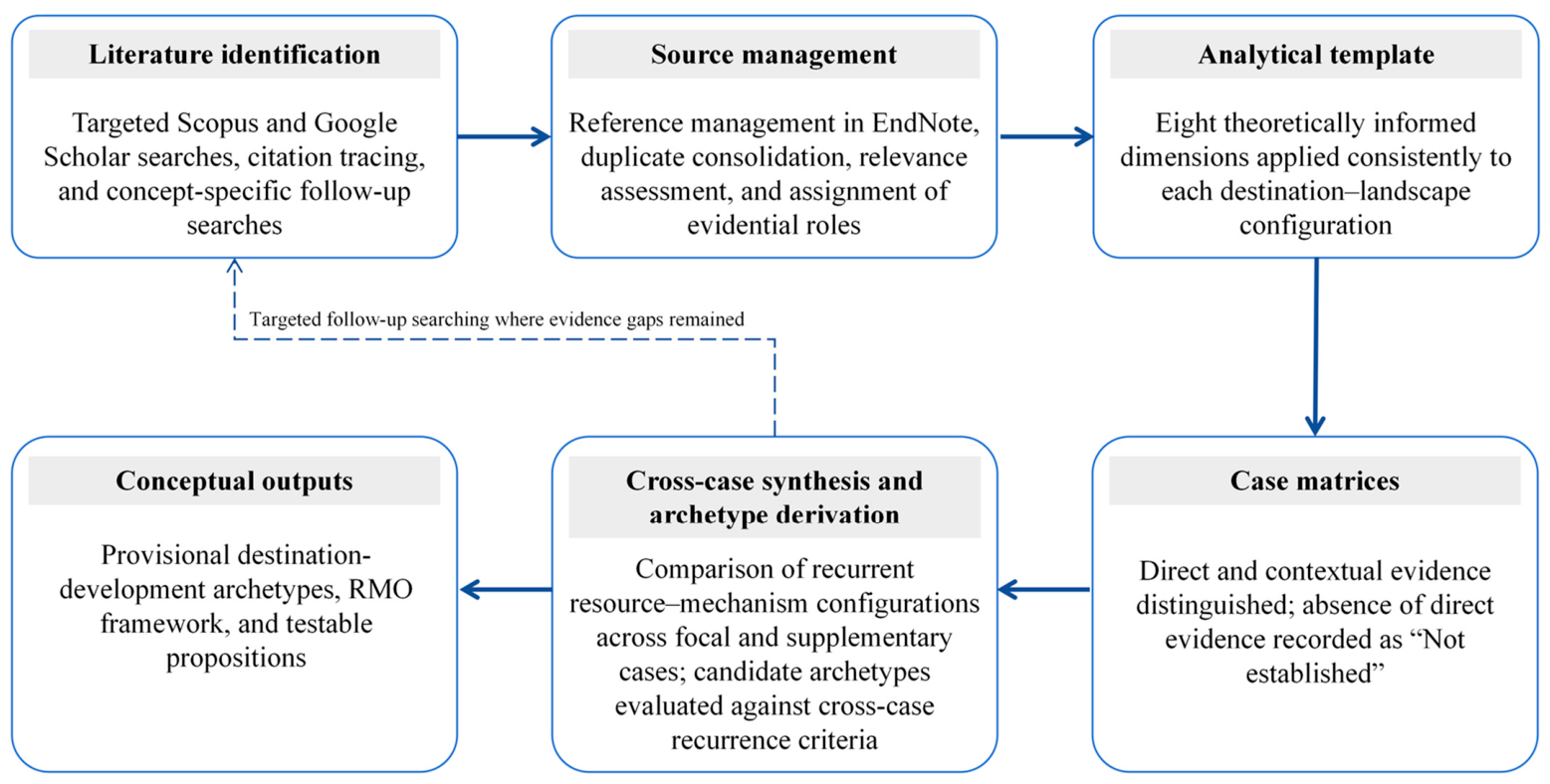
Relevant literature was identified iteratively through targeted searches in Scopus and Google Scholar and managed in an EndNote working library. The literature search covered sources available up to 27 July 2026. The principal publication period was January 2000 to July 2026, while earlier seminal works were retained when they supplied indispensable historical or theoretical foundations. Search terms were organized into three groups: phenomenon terms, including “flower tourism”, “flower-viewing tourism”, “garden tourism”, and “flower festival”; destination-specific terms concerning Japanese cherry blossoms, Provence lavender, Dutch tulips, and Tuscan sunflowers; and transferable development concepts, including rural tourism, agritourism, destination branding, visitor experience, seasonality, carrying capacity, visitor management, cultural landscapes, and multifunctional agricultural landscapes. Database searching was supplemented by backward reference tracing, selective forward citation searching, and targeted follow-up searches where a destination, mechanism, or evidential boundary remained insufficiently developed. The process was conceptually guided rather than exhaustive, and searching ceased when additional queries and citation tracing no longer produced substantively new case characteristics, mechanisms, or evidence boundaries relevant to the comparative framework. Because the search was targeted and iterative, no fixed Google Scholar result cap or uniform relevance-ranking cut-off was applied; follow-up searching was governed by the stated conceptual stopping rule. Documented search strands and term combinations are provided in
Supplementary Table S1.
Priority was given to peer-reviewed journal articles. Academic books, book chapters, doctoral research, and selected conference publications were retained where they supplied distinctive historical, conceptual, or destination-specific material not readily available in journal form. The final analytical corpus comprised 70 sources, which were not treated as methodologically equivalent. Direct studies of a focal destination supported local statements concerning visitor practices, cultural meanings, management conditions, or tourism development. Broader rural-tourism, place-branding, seasonality, event-tourism, and landscape studies were used to interpret transferable mechanisms. Agricultural and ecological research was included only when it clarified the productive or environmental functions of the landscape; it was not treated as evidence that a destination offered a particular tourism activity unless that activity was directly examined. A source-function inventory is provided in
Supplementary Table S2. Duplicate and overlapping records in the EndNote working library were consolidated by comparing titles, authors, publication years, and DOI information before the final analytical corpus was established.
This source-use principle is important because the literature is uneven across the four cases. Japanese cherry blossoms are supported by substantial work on festivals, cultural ecosystem services, climate sensitivity, and preservation, whereas direct visitor-focused research on Provence lavender and sunflower-specific tourism in Tuscany is more limited. The review therefore does not impose uniform evidential strength across cases. Destination-specific claims are stated only where direct support is available, while contextual and conceptual sources are used to explain broader relationships without being presented as proof of unverified local practices. Evidence confidence was judged qualitatively as High, Moderate, Low, or Not established according to the directness, consistency, and destination specificity of the supporting literature, and was reported separately from configurational prominence.
2.4. Source Relevance, Evidential Roles, and Case Selection
Sources were retained when they performed at least one of four analytical functions: providing direct evidence about a focal or supplementary destination; clarifying a concept required to define flower-based tourism; explaining a transferable destination-development mechanism; or documenting a productive, ecological, cultural, or spatial landscape function explicitly connected to tourism or landscape value. Sources were not used in the analytical core when they addressed a crop or environmental process without a defensible connection to the research questions; concerned isolated, decorative, indoor, or market settings rather than landscape-scale flowering; relied primarily on unverified promotional claims; lacked sufficient bibliographic information; duplicated a retained source without adding distinct analytical value; or were invoked to support a destination-specific activity that they did not directly examine. English-language sources were prioritized to maintain consistency of interpretation, although the resulting language bias is acknowledged in the limitations.
The four focal cases were selected purposively according to information-rich and maximum-variation logic in qualitative research synthesis (
Suri, 2011). Selection required established public recognition as a flowering landscape, a documented relationship with tourism, sufficient evidence to examine more than visual appearance alone, and variation in temporal concentration, cultural meaning, landscape design, agricultural production, visitor experience, and rural setting. Other candidates—including Washington, D.C. cherry blossoms, Chinese flower-viewing destinations, South African wildflowers, lavender destinations outside Provence, and botanical-garden events—were considered. Cases were not selected as focal configurations when they duplicated a development logic already represented without adding a meaningful contrast, focused on a single event or attraction with insufficient evidence across the common dimensions, or were more appropriate as transferability checks. Tuscany was retained deliberately as a boundary case because it illustrates how a flowering crop may contribute to destination value without functioning as a bounded or independently organized flower-tourism attraction.
Table 1 summarizes how the four focal configurations were operationalized, the analytical rationale for their inclusion, their principal evidence boundaries, and the corresponding evidence-confidence assessments.
2.5. Comparative Dimensions and Case Matrices
The comparative analysis proceeded through a common case-level template so that each destination was examined through the same analytical questions rather than through whichever characteristics were most visible in the available literature. The template covered landscape resource form; temporal structure; cultural-symbolic embedding; visitor experience; productive and economic integration; branding and mediated visibility; management and ecological conditions; and vulnerabilities and trade-offs. These dimensions were theoretically informed by destination-development and competitiveness models, event tourism, integrated rural tourism, place branding, seasonality and carrying-capacity research, and multifunctional-landscape scholarship (
Dwyer & Kim, 2003;
Getz, 2008;
Ritchie & Crouch, 2010;
Lane & Kastenholz, 2015;
Kavaratzis & Hatch, 2013;
Butler, 2020).
Table 2 makes the theoretical relationship explicit.
2.6. Comparative Coding and Conceptual Synthesis
Evidence was organized within a case matrix for each focal configuration. The unit of coding was a source-based claim, finding, or interpretation relevant to one or more of the eight dimensions. For each item, the analysis recorded the destination or theoretical context, whether the evidence was direct or contextual, and its analytical role as a resource attribute, value-creation mechanism, destination outcome, enabling condition, moderating condition, or vulnerability. The first author conducted primary extraction and matrix construction, and the second author reviewed the analytical template, case boundaries, and evidential qualifications. Interpretive differences were resolved through discussion until agreement was reached on the relevant category and confidence statement. Absence of direct evidence was recorded as Not established rather than treated as proof that an attribute was unimportant or absent. A summarized case-level analytical matrix is provided in
Supplementary Table S3.
The synthesis proceeded sequentially. First, coded evidence was assembled into a destination–landscape configuration for each focal case. Second, the matrices were compared to identify recurrent combinations of resources, practices, mechanisms, and vulnerabilities. Third, a candidate archetype was retained when a primary focal expression was supported by a comparable function in another focal case, supplementary destination, or transferable comparative literature. Photography-based visibility was rejected as a separate digital-branding archetype because mediated image circulation operated across all four configurations, while scenic viewing was rejected as a separate archetype because attractiveness described a resource attribute rather than a value-creation process. The retained archetypes are provisional, overlapping configurations rather than mutually exclusive classifications. Configurational prominence was assessed as Primary when an attribute defined the dominant logic of a case configuration, Secondary when it was present but not defining, and Not central when it was not integral to that configuration. Evidence confidence was assessed as High when consistent destination-specific evidence was available, Moderate when limited direct evidence converged with contextual evidence, Low when support was sparse or predominantly contextual, and Not established when no direct support was identified. These two judgments were reported separately to avoid conflating configurational importance with evidential strength. The archetype derivation audit is provided in
Supplementary Table S4.
The RMO framework was developed from the completed case configurations, cross-case comparison, and archetype derivation. The synthesis distinguishes tourism resource attributes from process-oriented mechanisms, differentiated positive and negative outcomes, enabling capacities, and moderating conditions. This separation avoids treating descriptive characteristics, such as social-media visibility or ecological function, as though they were mechanisms or verified sustainability outcomes. The relationships represented in the framework are interpretive propositions derived from the comparative synthesis and should be understood as theoretically proposed configurational pathways rather than empirically verified causal effects.
In the final analytical stage, destination-specific statements were checked against the cited evidence, unsupported activity lists were excluded, and broader literature was used only for contextual or conceptual interpretation. This check preserved the distinction between what is directly documented in a focal destination and what is inferred from transferable tourism or landscape theory.
Figure 1 summarizes the literature-identification and conceptual-synthesis sequence.
3. Comparative Profiles of Flower-Sea Tourism Landscapes
3.1. Japanese Cherry Blossoms: Phenology, Ritual, and Social Time
Japanese cherry blossom tourism is organized around a short and publicly anticipated flowering period. The northward progression of bloom is monitored and communicated as a national seasonal event, while local festival dates, household travel decisions, and business activity depend on phenological timing. Research linking flowering dates and festivals shows that cherry blossoms provide cultural ecosystem services whose value is inseparable from the timing of bloom (
Nagai et al., 2019). This temporal concentration produces more than scarcity. It turns biological change into social time: people plan gatherings, movement, and seasonal rituals around the flower.
The practice of hanami anchors this temporal event in collective culture. Cherry blossoms have accumulated historically changing meanings related to transience, collective memory, and national representation, and these meanings should not be reduced to a single aesthetic idea (
Ohnuki-Tierney, 2002;
Moriuchi & Basil, 2019). Contemporary local studies show that symbolic wild cherry landscapes can also support community identity and motivate management concern (
Katsuda et al., 2022). The tourism resource therefore emerges from an interaction between phenology, cultural practice, and place. Trees provide the flowering event, but ritualized viewing gives that event a repeatable social form.
Economic and management questions follow directly from this concentration. Visitors demonstrate willingness to contribute to preservation, indicating that the blossom is perceived as more than a free visual amenity (
Sussan & Nakagawa, 2019). Meanwhile, festivals and businesses are exposed to earlier flowering and uncertainty in peak timing (
Allen et al., 2014;
Sakurai et al., 2011). Concentrated visitation can generate crowding and operational pressure in shared public space, particularly when high demand is synchronized with a brief biological window.
Moriuchi and Basil (
2019) accordingly frame the sustainability of hanami festivals as a cultural-management issue rather than a simple promotional opportunity.
Japan most strongly exemplifies the temporal–ritual festival archetype. Its primary mechanism is the cultural organization of seasonal scarcity. Nevertheless, it also contains designed displays, branding, food and merchandise, and local economic integration. The archetype identifies the dominant logic, not an exclusive mode. Its central vulnerability is that climate-sensitive timing and concentrated visitation can weaken the very experience on which the destination depends.
The Japanese configuration is not treated as a homogeneous national destination. It represents a distributed phenological–cultural system whose local parks, streets, heritage settings, and festivals differ in governance, symbolism, visitor volume, and ecological condition. Japan therefore provides High-confidence evidence for the shared temporal–ritual mechanism, while site-specific conclusions remain bounded to the local studies from which they were drawn.
3.2. Provence Lavender: Sensory Landscape and Product Integration
Lavender tourism in Provence is built on a different configuration. Its attraction is not only the colour of extensive fields but the conjunction of visual rhythm, scent, rural settlement, agricultural production, and a recognizable regional lifestyle. The fields are working landscapes rather than scenery detached from production. Lavender is associated with a range of essential-oil, fragrance, cosmetic, and food applications (
Wells et al., 2018). Within the regional tourism context of Vaucluse, these product associations, together with villages and dispersed cultivation areas, contribute to a broader rural destination image (
Janczarska-Bergel, 2019). Their contribution to extending the tourism experience is interpreted here as a value-creation mechanism rather than as a directly measured visitor outcome.
This configuration is consistent with wider research on sensory-rich rural tourism. Sensory and emotional encounters can strengthen place attachment when they are connected to a coherent setting rather than offered as isolated attractions (
Kastenholz et al., 2020). Lavender has an unusually strong olfactory identity, and product use allows that sensory cue to persist after travel. Comparative work on lavender tourism outside Provence also shows how cultivation, festivals, local products, and rural entrepreneurship can be assembled into a tourism proposition (
Giray et al., 2019). Such comparative evidence is useful for mechanism-building, but it should not be treated as proof that every activity described elsewhere occurs in Provence.
The direct academic evidence on Provence lavender visitors is less developed than the strength of its public image might suggest. Existing work supports the importance of the rural setting and regional development context, but detailed claims about specific workshops, organic routes, or standardized ecological practices are unevenly documented. The case is therefore interpreted through the regional evidence available for Vaucluse, supplemented by broader lavender-tourism and blossom-landscape research concerning sensory experience and product integration (
Janczarska-Bergel, 2019;
Bertan, 2023;
Giusepponi, 2023). The resulting confidence is Moderate: the sensory–product mechanism is theoretically and contextually supported, but is supported by less direct visitor-based evidence than the Japanese temporal–ritual configuration.
Provence most strongly exemplifies the sensory–product integration archetype. Its primary mechanism is value extension: a seasonal visual landscape is translated into multisensory memory and purchasable products that can circulate beyond the field and beyond the flowering period. Potential risks include landscape commodification, roadside congestion, access conflicts, and dependence on a highly recognizable but seasonally compressed image. Product integration can moderate seasonality, but only when local producers capture value and field access is managed without degrading agricultural operations.
3.3. Dutch Tulips: Designed Horticultural Showcase and Mediated Visibility
Dutch tulip tourism combines two landscape systems that should not be conflated: commercial bulb fields and deliberately designed display environments. The fields express agricultural production through large-scale bands of colour. Designed garden environments can concentrate varietal diversity and organize visitor experience through spatial composition and interpretation (
Paiva et al., 2020). In the Dutch context, Keukenhof exemplifies this display logic alongside the commercial bulb-field landscape, while the wider tourism image draws power from the relationship between horticultural production, curated display, and national flower culture (
Gebhardt, 2014). Visitors may encounter both systems within a wider regional trip, but the review does not assume that every visitor combines them or that one substitutes directly for the other. Their interaction occurs at the destination-system level: commercial production supplies horticultural identity and field imagery, whereas designed attractions provide concentrated interpretation, amenities, and managed circulation.
Tulips also carry a long historical association with Dutch commerce and visual culture. The legacy of seventeenth-century speculation remains part of public narration (
Garber, 1989), but the evidence used here more directly supports the contemporary alignment of horticultural expertise, seasonal display, and projected national imagery (
Gebhardt, 2014;
Van Gorp & Béneker, 2007). In this case, destination branding is supported by an industry and design culture rather than added after the landscape has been created.
High visibility produces management problems. Visitors sometimes enter working fields in search of photographs, creating conflicts with production and landowner expectations (
Zhao & Sharma, 2022). More broadly, Dutch experiments in redirecting visitor flows show that information can influence spatial distribution, but that dispersal strategies must consider the visitor experience rather than simply move people away from famous sites (
Mitas et al., 2023). These lessons are relevant to tulip areas where social-media imagery can concentrate demand at a few accessible fields.
The Netherlands most strongly exemplifies the designed horticultural showcase archetype. The dominant mechanism is coordinated display: horticultural knowledge, spatial design, national imagery, and visitor infrastructure convert flowering plants into a curated destination proposition. Secondary expressions include product integration and seasonal event programming; rural-route development is treated as context-dependent rather than as a defining feature of the Dutch case. The central vulnerability is the tension between unrestricted image-seeking and the operational requirements of working horticulture.
3.4. Tuscan Sunflowers: A Rural-Embedded Rather than Stand-Alone Attraction
Tuscany functions in this review as a deliberately contrasting case. Sunflowers contribute to the visual identity of parts of the region, but the evidence does not support describing Tuscany as a discrete sunflower-tourism system comparable to Japanese hanami or a designed tulip attraction. Sunflower fields are better understood as seasonal components of a wider cultural landscape composed of hills, vineyards, olive groves, farm buildings, roads, villages, and agricultural practices. Rural tourism in Tuscany developed through the reuse of agricultural buildings, the availability of rural amenities, and the evolution of agritourism enterprises rather than through a single floral product (
Randelli et al., 2014;
Sonnino, 2004).
This distinction matters theoretically. A flower landscape may create tourism value without functioning as a bounded attraction. In Tuscany, sunflower fields strengthen the scenic coherence and seasonal variability of the rural setting. Their value is relational: a field gains meaning through its position within a recognizable agrarian landscape and through the accommodation, food, mobility, and heritage experiences that surround it (
Lemmi & Siena Tangheroni, 2013;
Carneiro et al., 2015). Research on Tuscan landscape perception shows that tourists respond to agricultural heritage as an integrated landscape, not simply to individual crops (
Santoro et al., 2020). Work on regional landscape structure similarly underscores the layered interaction between agricultural land use and territorial identity (
Venturi et al., 2021).
Sunflowers retain productive and ecological functions. They are crops, and their pollination depends on local and landscape-scale ecological conditions (
Bartual et al., 2018). These functions should not be romanticized as automatic sustainability outcomes. Tourism can support awareness and local spending, but it can also encourage roadside stopping, field entry, and the conversion of working landscapes into consumable images. The productive status of the field imposes limits on access and requires coordination with farmers.
Tuscany therefore most strongly exemplifies the rural-embedded agritourism archetype. The dominant mechanism is contextual integration: the flower field contributes to a broader place experience and rural economy rather than carrying the tourism offer by itself. Direct destination-specific evidence connecting Tuscan sunflower landscapes with dedicated tourism products remains limited. The case remains analytically valuable precisely because it demonstrates that flower-tourism value can be diffuse, secondary, and embedded in a wider rural system. Tuscany is therefore treated as a boundary/contrast configuration rather than as evidence of a mature stand-alone sunflower-tourism system; confidence is Low for a bounded sunflower system but Moderate for the broader rural-embedded mechanism.
3.5. Supplementary Transferability Check
Three supplementary configurations were used to assess whether the proposed mechanisms appeared beyond the four focal cases. Washington, D.C. provides an urban cherry-blossom festival in which motivation and past experience shape visitor attitudes (
Li et al., 2018). Chinese flower-viewing cases at Taihu Lake and Chengdu add evidence on festival experience, resident legitimacy, and the coexistence of economic and environmental effects (
Li et al., 2022;
Luo et al., 2021), while national mapping demonstrates the broader spatial and temporal diversity of flower-viewing tourism in China (
L. Wang et al., 2022). South African wildflower tourism provides evidence that landscape-scale seasonal flowering can generate rural tourism value outside the focal species and destination systems (
Turpie & Joubert, 2004;
Kruger et al., 2013).
These configurations are not treated as additional full profiles and do not remove the purposive character of the review. Their narrower role is to test whether the recurrent mechanisms and archetype combinations travel beyond the case from which each was first recognized.
Table 3 summarizes the supplementary configurations, the mechanisms examined, and their contribution to assessing the transferability of the proposed mechanisms.
3.6. Cross-Case Comparison
The comparison reveals that flower-sea tourism does not progress through a single development sequence. The same attribute can perform different functions. Seasonality in Japan is ritualized through anticipation and collective viewing; in Provence it organizes a regional touring season; in the Netherlands it supports intensive horticultural display; and in Tuscany it contributes to changing rural scenery without defining the full tourism calendar. Cultural meaning is explicit and historically layered in Japan, strongly branded in the Netherlands, associated with regional lifestyle and products in Provence, and embedded in agrarian landscape identity in Tuscany.
The cases also differ in the location of value creation. In Japan, value is concentrated in a time-bound public practice. In Provence, value is extended through products and multisensory associations. In the Netherlands, it is coordinated through display design, horticultural institutions, and image circulation. In Tuscany, it is distributed across accommodation, food, mobility, heritage, and the broader rural landscape. These differences justify the use of archetypes rather than a list of universal success factors.
Each archetype was developed from a primary focal expression supported by a comparable function in another focal case, supplementary destination, or comparative literature. The archetypes are therefore case-informed configurations rather than destination-specific labels. Their purpose is to identify combinations of mechanisms that may recur with different prominence and confidence, not to assign each destination to a fixed category. The comparison therefore supports archetype retention on the basis of recurrent functional configurations rather than a one-to-one correspondence between focal cases and archetypes.
Table 4 summarizes the cross-case prominence of the analytical attributes together with the corresponding evidence-confidence assessments.
4. Destination Development Archetypes
Archetypes are analytical devices that clarify recurring configurations. They do not imply that a destination belongs permanently to one category or that all cases within a category are identical. Real destinations are hybrids, and their configurations change as new experiences, governance arrangements, and market channels develop. The four provisional, case-derived archetypes identify the principal route through which a floral resource may be organized and converted into tourism value.
4.1. Archetype Derivation and Rejected Alternatives
The derivation followed a functional rather than a case-label rule. Short flowering, collective anticipation, and repeated social practice supported the temporal–ritual festival archetype. Sensory identity combined with cultivation and products supported sensory–product integration. Curated planting, interpretation, amenities, and managed circulation supported the designed horticultural showcase. Flower fields combined with accommodation, food, mobility, and agricultural heritage supported rural-embedded agritourism. Photography and social-media visibility were rejected as a separate digital-branding archetype because mediated image circulation operated across all four configurations. Visual attractiveness was also rejected as a scenic-viewing archetype because it described a resource rather than a value-creation process.
4.2. Temporal–Ritual Festival Archetype
In the temporal–ritual festival archetype, biological timing is transformed into a socially organized event. The resource is attractive because it is brief, anticipated, and collectively recognized. Ritual, festival programming, media forecasts, and repeated seasonal practice reduce uncertainty about how the landscape should be experienced. The destination sells neither a permanent facility nor an unrestricted rural view; it offers participation in a shared moment.
This archetype produces strong symbolic value but high operational exposure. A mismatch between festival dates and flowering, unusually warm conditions, or extreme crowding can reduce experience quality. Management therefore requires phenological monitoring, flexible programming, public-space coordination, and the protection of culturally significant trees. The archetype is most clearly expressed by Japanese cherry blossoms, with supplementary expression in the Washington, D.C. and Taihu Lake cherry-blossom festival cases. It corresponds to event tourism’s emphasis on planned occasions, temporal concentration, collective participation, and event-motivated travel (
Getz, 2008).
4.3. Sensory–Product Integration Archetype
The sensory–product integration archetype converts landscape experience into a wider consumption system. Colour, scent, texture, taste, and craft are linked to products and narratives that visitors can carry away. This mechanism extends value spatially, from the field to villages and shops, and temporally, from the flowering season to year-round product use. It also creates opportunities for local producers to capture tourism expenditure.
Its weakness is that products may become generic souvenirs detached from place. The archetype works best when product origin, cultivation, producer knowledge, and local participation remain visible. Provence lavender is the clearest example; similar elements occur in horticultural retail and agritourism linking crops with food, accommodation, and local products. Detachment from material and social origins may weaken authenticity and place specificity (
Ye et al., 2018). Weak links to local enterprises may also reduce local value retention (
Saxena et al., 2007).
4.4. Designed Horticultural Showcase Archetype
The designed horticultural showcase archetype relies on intentional composition, concentrated varietal display, interpretation, and managed circulation. Its value derives from making horticultural expertise visible. Pattern, sequencing, viewpoints, and supporting facilities organize visitor attention and reduce some of the uncertainty associated with dispersed working fields.
The archetype can accommodate large visitor numbers more effectively than unplanned roadside viewing, but it requires substantial investment and may separate tourists from agricultural realities. Dutch tulip tourism most strongly exemplifies this configuration, while designed-garden and visitor-experience research provides supporting evidence for the broader mechanism.
4.5. Rural-Embedded Agritourism Archetype
In the rural-embedded agritourism archetype, flowers are not necessarily the principal attraction. They contribute to the amenity, distinctiveness, and seasonal rhythm of a working rural landscape. Tourism value is generated through combinations of scenery, accommodation, local food, mobility, agricultural heritage, and contact with production. The flower field acts as one component of an integrated rural experience.
This archetype can distribute value more widely and reduce dependence on a single attraction, but the contribution of the floral landscape may be difficult to measure. It also raises questions about land access, farmer benefit, and the cumulative effect of tourism-led conversion. Within the present comparison, Tuscany provides the clearest boundary expression of the rural-embedded agritourism archetype, although direct evidence for a bounded sunflower-tourism system remains limited. Comparable support comes from Provence and integrated rural-tourism research linking cultivation, accommodation, food, local products, and rural enterprise networks.
4.6. Archetype Overlap and Principal Vulnerabilities
The archetypes overlap because destination development is configurational. A temporal festival can incorporate designed displays; a horticultural showcase can sell products; a rural-embedded landscape can develop ritual events; and sensory branding can intensify image-driven crowding. The analytical value lies in identifying the dominant mechanism, its principal vulnerability, and the contextual requirements needed to mitigate that vulnerability.
Table 5 links the archetypes to their dominant mechanisms, supplementary expressions, vulnerabilities, contextual requirements, and evidence confidence.
5. A Resource–Mechanism–Outcome (RMO) Framework
5.1. From Attributes to Process-Oriented Mechanisms
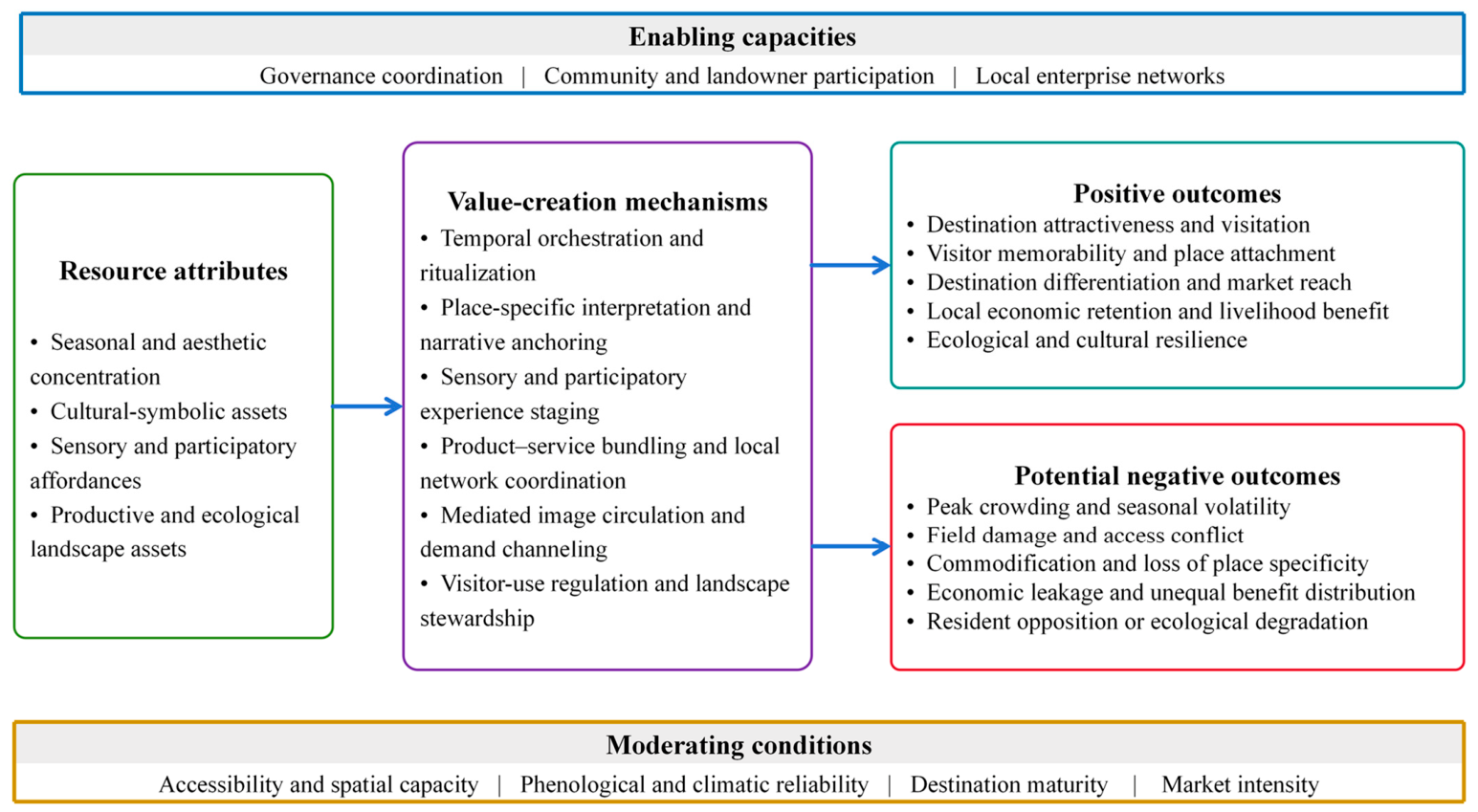
The cross-case evidence suggests that floral resources do not produce destination outcomes directly. Attributes require organization. Seasonal and aesthetic concentration can generate attention, but cultural interpretation, experience design, market mediation, production linkages, and governance determine what that attention becomes. The proposed framework therefore separates three analytical levels: tourism resource attributes, destination value-creation mechanisms, and destination outcomes. Contextual conditions influence the relationships between all three levels.
Four resource groups recur across the cases. Seasonal and aesthetic concentration includes flowering timing, scale, colour, pattern, and the visual relationship with the surrounding landscape. Cultural-symbolic assets include ritual, historical association, local narrative, and shared identity. Sensory and participatory affordances include smell, movement, festivals, interpretation, education, and guided or self-directed activity. Productive and ecological landscape assets include agricultural production, product chains, pollination, landscape stewardship, and the relationship between visitors and working land.
To avoid overlap between mechanisms and outcomes, the framework defines mechanisms as processes of value conversion: temporal orchestration and ritualization; place-specific interpretation and narrative anchoring; sensory and participatory experience staging; product–service bundling and local network coordination; mediated image circulation and demand channeling; and visitor-use regulation and landscape stewardship. These processes explain how a resource is organized, interpreted, circulated, connected to local actors, or governed; they do not assume that attraction, visibility, local value, or sustainability has already been achieved.
The relationships among these levels are configurational rather than one-to-one. A single resource attribute may activate several mechanisms, and each mechanism may contribute to multiple outcomes depending on governance, accessibility, community participation, visitor management, and seasonality conditions.
5.2. Positive and Negative Outcomes
The outcomes are not assumed to occur simultaneously or to be uniformly positive. Positive outcomes include destination attractiveness and visitation; visitor memorability and place attachment; destination differentiation and market reach; local economic retention and livelihood benefit; and ecological and cultural resilience. Potential negative outcomes include peak crowding and seasonal volatility; field damage and access conflict; commodification and loss of place specificity; economic leakage and unequal benefit distribution; and resident opposition or ecological degradation. A destination may therefore achieve high visibility without local value, or strong engagement while remaining ecologically or socially vulnerable.
5.3. Enabling Capacities and Moderating Conditions
Context is divided into enabling capacities and moderating conditions. Governance coordination, community and landowner participation, and local enterprise networks are enabling capacities because they organize collective action, legitimacy, and value retention. Accessibility and spatial capacity, phenological and climatic reliability, destination maturity, and market intensity are moderating conditions because they alter the strength or direction of the pathways. Visitor-use regulation is represented as a mechanism when it actively shapes behaviour, while the institutional capacity to implement that regulation is contextual. Integrated rural tourism research emphasizes that relationships and networks are central to converting dispersed rural resources into destination value (
Saxena et al., 2007), while multifunctional-landscape research shows that ecological, productive, and recreational functions require explicit design and governance (
Landis, 2017;
García-Martín et al., 2022;
Garibaldi et al., 2023).
This distinction also clarifies levels of analysis. Visitor motivation, memory, and attachment are individual outcomes; enterprise coordination and local value retention operate at organizational and network levels; destination differentiation, crowding, and resident acceptance operate at destination or community levels; and landscape damage or resilience operates at an ecological and territorial level. The framework connects these levels through proposed processes but does not imply that evidence at one level automatically demonstrates an outcome at another.
Figure 2 illustrates the proposed resource–mechanism–outcome (RMO) framework and the position of enabling capacities and moderating conditions within it.
5.4. Applying the Framework
Application begins by defining the destination–landscape configuration and scale, identifying demonstrable resources, and examining which mechanisms are organized. A short-lived urban blossom festival may be assessed primarily through temporal orchestration, crowding, public-space coordination, and participant meaning. A lavender route may emphasize sensory–product integration, but product origin, producer participation, and leakage should be examined. For crop fields embedded in a rural destination, farmer benefit, route agreements, and local network coordination may be more diagnostic than total visitor numbers (
Spagnoli & Mundula, 2021). These examples illustrate an application sequence rather than fixed classification rules. Application should therefore be treated as an iterative process rather than a one-time diagnostic exercise. As phenological conditions, visitor pressures, institutional arrangements, and local priorities change, destinations should reassess resource configurations, mechanisms, outcomes, and contextual conditions and adjust management responses accordingly.
5.5. Propositions for Future Empirical Testing
Proposition 1. Seasonal and aesthetic concentration is proposed to stimulate travel motivation and visitation activation and may thereby enhance destination attractiveness; however, these effects may weaken when temporal compression generates unmanaged visitor pressure or when flowering time becomes unreliable.
Proposition 2. Cultural-symbolic embedding strengthens place differentiation by converting a transferable floral image into a destination-specific narrative and repeated social practice.
Proposition 3. Sensory and participatory experience staging, product–service bundling, and mediated image circulation are proposed to translate visually concentrated landscape resources into visitor engagement, memorability, and market reach; these processes may also generate commodification or crowding when origin integrity and demand channeling are weak.
Proposition 4. The long-term rural value of flower-sea tourism depends on local network coordination, value retention, landscape stewardship, community and landowner participation, and governance arrangements that align visitor use with productive-landscape requirements.
Proposition 5. Mediated visibility is expected to have a dual effect: it can extend destination reach, but it may intensify field damage, access conflict, and resident opposition when visitor-use regulation and spatial capacity are insufficient.
These propositions are theoretical statements derived from the focal case matrices, supplementary transferability checks, archetype derivation audit, and RMO structure. They are not causal findings. They provide a basis for visitor surveys, resident studies, comparative case research, longitudinal phenological analysis, network analysis, and field observation.
6. Discussion: Contributions and Implications
6.1. Conceptual Contribution: Defining the Resource Form
The first contribution is a clearer boundary around flower-sea tourism landscapes. The category is narrower than tourism involving plants in general but broader than garden tourism or agritourism alone. Its defining feature is concentrated flowering perceived at landscape scale and mobilized as a reason for travel. This formulation accommodates designed gardens, productive fields, and culturally significant flowering trees while requiring analysts to specify which landscape system is actually being studied. It overlaps with nature-based tourism through biological seasonality, with cultural-landscape tourism through place meaning, and with event tourism through synchronized participation; these relationships do not erase the need for a distinct landscape-scale flowering boundary. The distinction prevents a frequent slippage in which facts about a crop, a garden, a festival, or an entire rural region are treated as interchangeable.
The boundary also foregrounds temporality. Flower landscapes are not simply scenic resources with a seasonal calendar; their value is often created by temporal scarcity. Seasonality research has usually examined demand fluctuations at the destination level (
Koenig-Lewis & Bischoff, 2005;
Cuccia & Rizzo, 2011). Flower-sea tourism makes the biological source of that fluctuation especially visible. Flowering time is simultaneously an ecological event, a marketing signal, and an operational constraint.
6.2. A Configurational Understanding of Flower-Sea Tourism Archetypes
The second contribution lies in conceptualizing flower-sea tourism development through provisional, case-derived, and overlapping archetypes rather than mutually exclusive destination categories. The cross-case analysis indicates that the reviewed flower destinations rarely depend on a single development mechanism. Instead, they combine seasonality, cultural symbolism, sensory engagement, landscape design, product integration, destination branding, and rural contextualization in different configurations and with varying degrees of prominence.
For example, Japanese cherry blossom tourism most strongly exemplifies the temporal–ritual festival archetype, but its development also depends on destination branding, media visibility, and the spatial integration of flowering landscapes with cultural heritage settings. Provence is primarily associated with the sensory–product integration archetype, while also displaying rural-embedded characteristics. Dutch tulip tourism combines the designed horticultural showcase archetype with festival programming, agricultural production, product integration, and international destination branding. In Tuscany, sunflower landscapes most strongly express the rural-embedded agritourism archetype, functioning less as self-contained attractions than as components of a wider rural tourism system that includes agricultural production, cultural scenery, and regional place identity.
The archetypes should therefore be understood as analytical configurations rather than fixed destination types. Each archetype identifies a dominant combination of resources and development mechanisms, while allowing individual destinations to exhibit characteristics associated with several configurations. This approach captures the hybrid and relational nature of rural tourism development, in which tourism products emerge through interactions among landscapes, cultural practices, agricultural activities, local enterprises, institutions, and visitor experiences (
Lane & Kastenholz, 2015). It also provides a more transferable basis for comparing flower-sea destinations because the framework can be applied to different regional contexts without assuming that each destination must conform to a single predetermined model.
This configurational interpretation can also be positioned in relation to established destination-development perspectives rather than operating separately from them. Destination-competitiveness models distinguish inherited or created resources, supporting conditions, destination management, demand, and performance (
Dwyer & Kim, 2003;
Ritchie & Crouch, 2010), whereas the present synthesis complements these models by making the intervening processes of resource conversion more explicit. The RMO framework places process-oriented mechanisms between floral resources and destination outcomes while recognizing that enabling capacities and moderating conditions shape how these pathways operate. It also adds specificity to event-tourism perspectives by showing that, in flower-sea destinations, phenological timing is not merely an event-scheduling condition but a biologically constrained resource that can simultaneously generate attraction and vulnerability (
Getz, 2008). In relation to integrated rural tourism, the framework reinforces the importance of networks and local coordination (
Saxena et al., 2007;
Lane & Kastenholz, 2015), while distinguishing local enterprise networks as an enabling capacity, local network coordination as a value-creation mechanism, and local economic retention as a possible outcome. Place-branding perspectives are similarly refined by treating mediated visibility as a value-conversion mechanism rather than assuming that visibility itself constitutes destination differentiation or market success (
Kavaratzis & Hatch, 2013;
Pike & Page, 2014). The contribution is therefore not a competing theory of destination development, but a flower-sea-specific process synthesis that connects and differentiates established destination-development concepts under conditions of concentrated seasonality, landscape-scale visibility, and productive or ecological embeddedness.
6.3. Explaining Value Conversion
The third contribution is the distinction between resources, mechanisms, and outcomes. Descriptive frameworks often move directly from an attractive attribute to a positive value label. Such a structure risks tautology: natural and aesthetic appeal becomes visual value, cultural significance becomes identity value, and sustainability becomes sustainable value. The framework instead asks which processes connect resource attributes with destination outcomes. Cultural embedding, for example, is not valuable merely because culture is present; it becomes consequential when interpretation and practice make the landscape place-specific. Productive integration does not guarantee rural benefit; it matters when farmers and local enterprises capture value and participate in management.
This distinction is particularly important for destination branding. Flower landscapes are photogenic and readily circulated, but visibility can be detached from local meaning and carrying capacity. Place-branding research treats identity as negotiated among projected narratives, local culture, and stakeholder interpretation (
Kavaratzis & Hatch, 2013). In flower-sea destinations, user-generated images can strengthen recognition while simultaneously directing crowds toward fragile or private fields. Brand amplification is therefore a mechanism with both positive and negative outcomes, not an outcome in itself.
The framework likewise separates ecological function from sustainability claims. Pollinator support, agricultural production, and landscape diversity may be present, but their existence does not demonstrate sustainable tourism. Sustainability depends on how tourism interacts with farming, access, waste, transport, habitat, and local decision-making. Multifunctional landscape design can help reconcile functions, but trade-offs must remain visible (
Landis, 2017;
Huang et al., 2015;
Tran et al., 2023).
6.4. The Seasonality–Visibility Paradox
A further contribution is the identification of a seasonality–visibility paradox. The strongest flower destinations are often those with the most concentrated and recognizable imagery. Concentration creates urgency, media attention, and a shared sense of occasion. Yet the same visibility can compress demand into a narrow window and a small number of photographed locations. In this setting, marketing success may reduce experience quality and damage productive landscapes. Overtourism scholarship cautions against defining the problem only by visitor volume; the issue is the relationship between intensity, spatial concentration, governance, and local tolerance (
Mihalic, 2020).
The paradox suggests that management should not aim simply to increase visibility. Destinations must control how visibility is translated into movement. Timed information, route design, alternative viewpoints, distributed events, and clear field-access norms can reduce concentration. Experiments in visitor-flow redistribution show that information can influence destination choice, but that recommendations must remain attractive and credible to visitors (
Mitas et al., 2023). Practical responses visible in the reviewed evidence include Japanese phenological monitoring and flexible festival timing, Dutch information-based visitor-flow redistribution, designed display environments that provide managed alternatives to field entry, and distributed routes or product experiences that extend value beyond a single viewpoint. These measures do not remove the seasonality–visibility paradox, but they alter how attention is translated into movement and pressure. The effectiveness of these responses, however, also depends on local institutional capacity to coordinate and implement management measures and on visitors’ willingness to comply with routing, access, and timing guidance; neither condition can be assumed across destinations.
6.5. Practical Implications for Destination Planning and Management
First, seasonality should be managed as a design and governance problem rather than treated only as a marketing calendar. Managers need phenological monitoring, flexible event dates, peak-day transport plans, overflow routes, and communication that distinguishes expected bloom from guaranteed conditions. Bloom communication should distinguish forecasts from observed conditions, state uncertainty, update regularly, and link temporal information to transport, parking, route capacity, access restrictions, and alternative sites rather than presenting a fixed flowering guarantee. Extending the season through varietal selection or staggered planting may be appropriate in designed or productive settings, but it should not override ecological suitability or cultural authenticity.
Second, cultural interpretation should be selective and place-specific. A flower acquires destination meaning through local practice, historical association, agricultural knowledge, or community memory. Generic symbolism and borrowed festival formats are unlikely to create durable identity. Interpretation can take the form of routes, storytelling, exhibitions, farmer-led demonstrations, or seasonal events, but it should explain the relationship between the flower and the place rather than merely decorate the visitor experience.
Third, experience diversification should connect visitors to the landscape system. Sensory activities, horticultural education, local products, and guided rural mobility can extend engagement beyond photography. Garden-visitor research shows that experience quality and repeat visitation depend on more than the presence of attractive plants (
Shapoval et al., 2021;
Díaz-Meneses & Amador-Marrero, 2024). Diversification should therefore be evaluated by whether it deepens understanding, distributes spending, and reduces pressure, not by the number of activities offered.
Fourth, local value capture requires explicit institutional arrangements. Farmers and landowners bear costs when visitors enter fields, block roads, or interfere with production. Benefit-sharing may involve paid routes, product partnerships, parking revenue, cooperative marketing, or support for landscape maintenance. Integrated rural tourism depends on networks among enterprises and public actors rather than isolated attractions (
Saxena et al., 2007). Community participation is equally important where festivals alter public space or where destination imagery reshapes local identity.
Finally, destination evaluation should use multiple outcomes. Attractiveness and visitation may be assessed through destination-image ratings, travel intentions, arrivals, and conversion from online interest. Engagement may be assessed through dwell time, participation, recall, place attachment, and revisit intention. Market differentiation may be assessed through search visibility, media reach, and the geographic distribution of visitor-generated content. Rural economic value may be assessed through local expenditure retention, farmer participation, product sales, employment, and benefit distribution. Sustainability and resilience may be assessed through temporal and spatial crowding, resident acceptance, field damage, waste, habitat condition, production continuity, forecast reliability, and off-season activity. A destination can be highly visible yet economically leaky, culturally shallow, or ecologically vulnerable.
7. Limitations and Future Research
This review has five principal limitations. First, the purposive selection of four cases supports conceptual contrast but not representativeness. Important configurations may be found in rose, canola, lotus, wildflower, or tropical flowering destinations. The archetypes should therefore be treated as an open analytical set rather than a closed typology. Second, the evidence is uneven. Japanese cherry blossoms and Tuscany’s wider rural landscape are comparatively well documented, whereas direct scholarly work on Provence lavender visitors and Tuscany sunflower tourism remains limited. The analysis responds by qualifying destination-specific claims and separating configurational prominence from evidence confidence, but this asymmetry still affects the depth of comparison. Third, the focus on English-language scholarship may underrepresent locally published research and management knowledge in Japan, France, the Netherlands, and Italy.
Fourth, the targeted and conceptually guided review procedure remains subject to limitations in reproducibility and interpretive validation. Because searches were not prospectively logged at the individual record-screening level, complete database-specific identification and exclusion counts are unavailable. Primary evidence extraction and coding were conducted by the first author, with the second author reviewing the analytical template, case boundaries, evidential classifications, and interpretive decisions. The supplementary audit trail, common analytical template, rejected alternatives, and discussion-based resolution of differences strengthened transparency and analytical consistency, but publication, visibility, and confirmation bias cannot be eliminated.
Fifth, the cases differ in geographical scale and institutional form. The destination–landscape configuration makes these differences explicit, but it does not render national, regional, and site-level systems directly equivalent. The comparison should therefore be understood as conceptual and configurational rather than statistical. Accordingly, neither the archetypes nor the RMO framework should be interpreted as predictive models. They identify recurrent configurations and theoretically proposed relationships for comparison and empirical testing, but they do not forecast destination outcomes in specific settings.
The archetypes and the RMO framework are not proposed as universally applicable or culturally invariant models. Ritual meanings, landownership arrangements, public-space norms, agricultural structures, and attitudes toward commercialization vary across destinations. The framework should therefore be treated as a comparative and sensitizing analytical device whose categories, proposed pathways, and contextual conditions require local interpretation and empirical validation, particularly beyond the Japanese and European focal cases. Future research should test and refine the framework rather than treat its categories as fixed classifications. Visitor surveys could examine whether cultural embedding, sensory experience, and productive-landscape awareness operate through distinct pathways. Comparative case studies could investigate how governance and farmer participation influence local value capture. Longitudinal research is needed to connect flowering phenology, climate variability, event timing, and visitor flows. Digital trace data could reveal how mediated image circulation concentrates demand, while field observation could assess access conflict and landscape damage.
8. Conclusions
Flower-sea tourism landscapes are not successful simply because flowers are abundant or visually striking. They become tourism resources when seasonal and aesthetic attributes are organized through cultural practice, experience design, product relationships, branding, and landscape governance. The four cases reviewed here demonstrate different dominant pathways: ritualized seasonality in Japan, sensory and product extension in Provence, coordinated horticultural display in the Netherlands, and rural embeddedness in Tuscany.
These pathways are best understood as overlapping archetypes rather than destination labels. Their comparison informs the RMO framework, which separates resource attributes from process-oriented mechanisms, positive and negative outcomes, enabling capacities, and moderating conditions. Governance coordination, accessibility and spatial capacity, community and landowner participation, local enterprise networks, visitor-use regulation, and climate-sensitive seasonality shape whether the conversion of floral scenery into tourism value is beneficial and durable.
The central implication is that visual success is necessary but insufficient. A highly photographed landscape can remain culturally generic, economically leaky, ecologically exposed, or operationally fragile. Flower-sea tourism becomes more resilient when destination identity is place-specific, visitor experience is connected to the landscape system, local actors capture value, and peak visibility is managed rather than pursued without limit.
Supplementary Materials
The following supporting information can be downloaded at:
https://www.mdpi.com/article/10.3390/tourhosp7080251/s1, Table S1: Documented literature-identification strands, term combinations, and follow-up procedures; Table S2: Final source-function inventory; Table S3: Case-level analytical matrix; Table S4: Archetype derivation and rejected-alternative audit. All sources listed in Table S2 correspond to References 1–70 in the main manuscript.
Author Contributions
Conceptualization, Q.C. and N.B.M.T.; methodology, Q.C. and N.B.M.T.; investigation, Q.C.; data curation, Q.C.; formal analysis, Q.C.; validation, N.B.M.T.; visualization, Q.C.; writing—original draft preparation, Q.C.; writing—review and editing, Q.C. and N.B.M.T.; supervision, N.B.M.T.; project administration, N.B.M.T. All authors have read and agreed to the published version of the manuscript.
Funding
This research was funded by the Natural Science Project of Shaanxi Provincial Department of Education (Grant No. 22JK0255).
Institutional Review Board Statement
Not applicable.
Informed Consent Statement
Not applicable.
Data Availability Statement
No new primary empirical data were generated in this study. The literature-identification summary, source-function inventory, case-level analytical matrix, and archetype derivation and rejected-alternative audit are provided in the
Supplementary Materials.
Acknowledgments
The authors used OpenAI ChatGPT (GPT-5.5) to assist with language refinement, manuscript organization, and the wording and layout of schematic figures. All scholarly interpretations, source verification, and final revisions were undertaken by the authors, who take full responsibility for the content of the manuscript.
Conflicts of Interest
The authors declare no conflicts of interest.
References
- Allen, J. M., Terres, M. A., Katsuki, T., Iwamoto, K., Kobori, H., Higuchi, H., Primack, R. B., Wilson, A. M., Gelfand, A., & Silander, J. A. (2014). Modeling daily flowering probabilities: Expected impact of climate change on Japanese cherry phenology. Global Change Biology, 20(4), 1251–1263. [Google Scholar] [CrossRef] [Scilit] [PubMed]
- Ammirato, S., Felicetti, A. M., Raso, C., Pansera, B. A., & Violi, A. (2020). Agritourism and sustainability: What we can learn from a systematic literature review. Sustainability, 12(22), 9575. [Google Scholar] [CrossRef] [Scilit]
- Bartual, A. M., Bocci, G., Marini, S., & Moonen, A. C. (2018). Local and landscape factors affect sunflower pollination in a Mediterranean agroecosystem. PLoS ONE, 13(9), e0203990. [Google Scholar] [CrossRef] [Scilit] [PubMed]
- Bertan, S. (2023). The impacts of lavender gardens on rural tourism. In S. Bala, & P. Singhal (Eds.), Diversity, equity, and inclusion efforts of businesses in rural areas (pp. 118–129). IGI Global. [Google Scholar] [CrossRef] [Scilit]
- Butler, R. W. (2020). Tourism carrying capacity research: A perspective article. Tourism Review, 75(1), 207–211. [Google Scholar] [CrossRef] [Scilit]
- Carneiro, M. J., Lima, J., & Lavrador Silva, A. (2015). Landscape and the rural tourism experience: Identifying key elements, addressing potential, and implications for the future. Journal of Sustainable Tourism, 23(8–9), 1217–1235. [Google Scholar] [CrossRef] [Scilit]
- Cohen, E., & Fennell, D. A. (2019). Plants and tourism: Not seeing the forest [n]or the trees. Tourist Studies, 19(4), 585–606. [Google Scholar] [CrossRef] [Scilit]
- Connell, J. (2004). The purest of human pleasures: The characteristics and motivations of garden visitors in Great Britain. Tourism Management, 25(2), 229–247. [Google Scholar] [CrossRef] [Scilit]
- Cuccia, T., & Rizzo, I. (2011). Tourism seasonality in cultural destinations: Empirical evidence from Sicily. Tourism Management, 32(3), 589–595. [Google Scholar] [CrossRef] [Scilit]
- Díaz-Meneses, G., & Amador-Marrero, M. (2024). Visitor experience at Viera y Clavijo Botanic Garden: Satisfaction and loyalty antecedents. Journal of Outdoor Recreation and Tourism, 47, 100778. [Google Scholar] [CrossRef] [Scilit]
- Dwyer, L., & Kim, C. (2003). Destination competitiveness: Determinants and indicators. Current Issues in Tourism, 6(5), 369–414. [Google Scholar] [CrossRef] [Scilit]
- Garber, P. M. (1989). Tulipmania. Journal of Political Economy, 97(3), 535–560. [Google Scholar] [CrossRef] [Scilit] [PubMed]
- García-Martín, M., Huntsinger, L., Ibarrola-Rivas, M. J., Penker, M., D’Ambrosio, U., Dimopoulos, T., Fernández-Giménez, M. E., Kizos, T., Muñoz-Rojas, J., Saito, O., Zimmerer, K. S., Abson, D. J., Liu, J., Quintas-Soriano, C., Sørensen, I. H., Verburg, P. H., & Plieninger, T. (2022). Landscape products for sustainable agricultural landscapes. Nature Food, 3(10), 814–821. [Google Scholar] [CrossRef] [Scilit] [PubMed]
- Garibaldi, L. A., Zermoglio, P. F., Jobbágy, E. G., Andreoni, L., Ortiz de Urbina, A., Grass, I., & Oddi, F. J. (2023). How to design multifunctional landscapes? Journal of Applied Ecology, 60(12), 2521–2527. [Google Scholar] [CrossRef] [Scilit]
- Gebhardt, A. C. (2014). The making of dutch flower culture: Auctions, networks, and aesthetics [Doctoral dissertation, University of Amsterdam]. [Google Scholar]
- Getz, D. (2008). Event tourism: Definition, evolution, and research. Tourism Management, 29(3), 403–428. [Google Scholar] [CrossRef] [Scilit]
- Giray, F. H., Kadakoğlu, B., Çetin, F., & Bamoi, A. G. A. (2019). Rural tourism marketing: Lavender tourism in Turkey. Ciência Rural, 49(2), e20180651. [Google Scholar] [CrossRef] [Scilit]
- Giusepponi, K. (2023). Blossom landscapes, flower tourism and multi-area business models between opportunities and risks. In S. Sedmak, S. Laporšek, A. Grdović Gnip, & A. Trnavčević (Eds.), MIC 2023: Toward green, inclusive, and digital growth (pp. 47–59). University of Primorska Press. [Google Scholar]
- Huang, J., Tichit, M., Poulot, M., Darly, S., Li, S., Petit, C., & Aubry, C. (2015). Comparative review of multifunctionality and ecosystem services in sustainable agriculture. Journal of Environmental Management, 149, 138–147. [Google Scholar] [CrossRef] [Scilit] [PubMed]
- Janczarska-Bergel, K. (2019). Tourism as one of factors of regional development of the Department of Vaucluse in South-Eastern France. Studies of the Industrial Geography Commission of the Polish Geographical Society, 33(1), 178–187. [Google Scholar] [CrossRef] [Scilit]
- Kastenholz, E., Marques, C. P., & Carneiro, M. J. (2020). Place attachment through sensory-rich, emotion-generating place experiences in rural tourism. Journal of Destination Marketing & Management, 17, 100455. [Google Scholar] [CrossRef] [Scilit]
- Katsuda, K., Saeki, I., Shoyama, K., & Kamijo, T. (2022). Local perception of ecosystem services provided by symbolic wild cherry blossoms: Toward community-based management of traditional forest landscapes in Japan. Ecosystems and People, 18(1), 275–288. [Google Scholar] [CrossRef] [Scilit]
- Kavaratzis, M., & Hatch, M. J. (2013). The dynamics of place brands: An identity-based approach to place branding theory. Marketing Theory, 13(1), 69–86. [Google Scholar] [CrossRef] [Scilit]
- Koenig-Lewis, N., & Bischoff, E. E. (2005). Seasonality research: The state of the art. International Journal of Tourism Research, 7(4–5), 201–219. [Google Scholar] [CrossRef] [Scilit]
- Kruger, M., Viljoen, A., & Saayman, M. (2013). Who pays to view wildflowers in South Africa? Journal of Ecotourism, 12(3), 146–164. [Google Scholar] [CrossRef] [Scilit]
- Landis, D. A. (2017). Designing agricultural landscapes for biodiversity-based ecosystem services. Basic and Applied Ecology, 18, 1–12. [Google Scholar] [CrossRef] [Scilit]
- Lane, B. (1994). What is rural tourism? Journal of Sustainable Tourism, 2(1–2), 7–21. [Google Scholar] [CrossRef] [Scilit]
- Lane, B., & Kastenholz, E. (2015). Rural tourism: The evolution of practice and research approaches—Towards a new generation concept? Journal of Sustainable Tourism, 23(8–9), 1133–1156. [Google Scholar] [CrossRef] [Scilit]
- Lemmi, E., & Siena Tangheroni, M. (2013). The experience-oriented tourism in Tuscan rural areas. European Journal of Tourism, Hospitality and Recreation, 4(3), 47–68. [Google Scholar]
- Li, J., Deng, J., & Pierskalla, C. (2018). Impact of attendees’ motivation and past experience on their attitudes toward the National Cherry Blossom Festival in Washington, D. C. Urban Forestry & Urban Greening, 36, 57–67. [Google Scholar] [CrossRef] [Scilit]
- Li, J., Zhong, Y., Li, Y., Hu, W., Deng, J., Pierskalla, C., & Zhang, F. (2022). Past experience, motivation, attitude, and satisfaction: A comparison between locals and tourists for Taihu Lake International Cherry Blossom Festival. Forests, 13(10), 1608. [Google Scholar] [CrossRef] [Scilit]
- Luo, S., Furuya, K., & Xie, J. (2021). Impacts and residents’ attitudes to flower-viewing tourism in Chengdu, PR China. Tourism Recreation Research, 46(4), 516–530. [Google Scholar] [CrossRef] [Scilit]
- Mihalic, T. (2020). Conceptualising overtourism: A sustainability approach. Annals of Tourism Research, 84, 103025. [Google Scholar] [CrossRef] [Scilit]
- Mitas, O., Badal, R., Verhoeven, M., Verstraten, K., de Graaf, L., Mitasova, H., Weijdema, W., & Klijs, J. (2023). Tell me where to go: An experiment in spreading visitor flows in the Netherlands. International Journal of Environmental Research and Public Health, 20(8), 5441. [Google Scholar] [CrossRef] [Scilit] [PubMed]
- Moriuchi, E., & Basil, M. (2019). The sustainability of ohanami cherry blossom festivals as a cultural icon. Sustainability, 11(6), 1820. [Google Scholar] [CrossRef] [Scilit]
- Moser, S. (2023). The garden visitor experience: Multisensory meaning making in designed landscapes. Museum Management and Curatorship, 38(6), 679–695. [Google Scholar] [CrossRef] [Scilit]
- Moyle, B. D., Scherrer, P., Weiler, B., Wilson, E., Caldicott, R., & Nielsen, N. (2017). Assessing preferences of potential visitors for nature-based experiences in protected areas. Tourism Management, 62, 29–41. [Google Scholar] [CrossRef] [Scilit]
- Nagai, S., Saitoh, T. M., & Yoshitake, S. (2019). Cultural ecosystem services provided by flowering of cherry trees under climate change: A case study of the relationship between the periods of flowering and festivals. International Journal of Biometeorology, 63, 1051–1058. [Google Scholar] [CrossRef] [Scilit] [PubMed]
- Ohnuki-Tierney, E. (2002). Kamikaze, cherry blossoms, and nationalisms: The militarization of aesthetics in Japanese history. University of Chicago Press. [Google Scholar] [CrossRef] [Scilit]
- Paiva, P. D. O., Sousa, R. B., & Carcaud, N. (2020). Flowers and gardens on the context and tourism potential. Ornamental Horticulture, 26(1), 121–133. [Google Scholar] [CrossRef] [Scilit]
- Pásková, M., Wall, G., Zejda, D., & Zelenka, J. (2021). Tourism carrying capacity reconceptualization: Modelling and management of destinations. Journal of Destination Marketing & Management, 21, 100638. [Google Scholar] [CrossRef] [Scilit]
- Phillip, S., Hunter, C. J., & Blackstock, K. (2010). A typology for defining agritourism. Tourism Management, 31(6), 754–758. [Google Scholar] [CrossRef] [Scilit]
- Pike, S., & Page, S. J. (2014). Destination Marketing Organizations and destination marketing: A narrative analysis of the literature. Tourism Management, 41, 202–227. [Google Scholar] [CrossRef] [Scilit]
- Randelli, F., Romei, P., & Tortora, M. (2014). An evolutionary approach to the study of rural tourism: The case of Tuscany. Land Use Policy, 38, 276–281. [Google Scholar] [CrossRef] [Scilit]
- Ritchie, J. R. B., & Crouch, G. I. (2010). A model of destination competitiveness/sustainability: Brazilian perspectives. Revista de Administração Pública, 44(5), 1049–1066. [Google Scholar] [CrossRef] [Scilit]
- Sakurai, R., Jacobson, S. K., Kobori, H., Primack, R., Oka, K., Komatsu, N., & Machida, R. (2011). Culture and climate change: Japanese cherry blossom festivals and stakeholders’ knowledge and attitudes about global climate change. Biological Conservation, 144(1), 654–658. [Google Scholar] [CrossRef] [Scilit]
- Santoro, A., Venturi, M., & Agnoletti, M. (2020). Agricultural heritage systems and landscape perception among tourists: The case of Lamole, Chianti (Italy). Sustainability, 12(9), 3509. [Google Scholar] [CrossRef] [Scilit]
- Saxena, G., Clark, G., Oliver, T., & Ilbery, B. (2007). Conceptualising integrated rural tourism. Tourism Geographies, 9(4), 347–370. [Google Scholar] [CrossRef] [Scilit]
- Shapoval, V., Rivera, M., & Croes, R. (2021). The quality of gardens tourism and the visitor experience: Differentiating between first-time and repeat visitors. Annals of Leisure Research, 24(4), 449–467. [Google Scholar] [CrossRef] [Scilit]
- Snyder, H. (2019). Literature review as a research methodology: An overview and guidelines. Journal of Business Research, 104, 333–339. [Google Scholar] [CrossRef] [Scilit]
- Sonnino, R. (2004). For a ‘piece of bread’? Interpreting sustainable development through agritourism in Southern Tuscany. Sociologia Ruralis, 44(3), 285–300. [Google Scholar] [CrossRef] [Scilit]
- Spagnoli, L., & Mundula, L. (2021). Between urban and rural: Is agricultural parks a governance tool for developing tourism in the periurban areas? Reflections on two Italian cases. Sustainability, 13(14), 8108. [Google Scholar] [CrossRef] [Scilit]
- Suri, H. (2011). Purposeful sampling in qualitative research synthesis. Qualitative Research Journal, 11(2), 63–75. [Google Scholar] [CrossRef] [Scilit]
- Sussan, F., & Nakagawa, H. (2019). What price beauty! Tourists willingness-to-pay for cherry blossom preservation. Arts and the Market, 9(1), 95–110. [Google Scholar] [CrossRef] [Scilit]
- Tkaczynski, A. (2013). Flower power? Activity preferences of residents and tourists to an Australian flower festival. Tourism Analysis, 18(5), 607–613. [Google Scholar] [CrossRef] [Scilit]
- Tomitaka, M., Uchihara, S., Goto, A., & Sasaki, T. (2021). Species richness and flower color diversity determine aesthetic preferences of natural-park and urban-park visitors for plant communities. Environmental and Sustainability Indicators, 11, 100130. [Google Scholar] [CrossRef] [Scilit]
- Torraco, R. J. (2005). Writing integrative literature reviews: Guidelines and examples. Human Resource Development Review, 4(3), 356–367. [Google Scholar] [CrossRef] [Scilit]
- Tran, D. X., Pearson, D., Palmer, A., Dominati, E. J., Gray, D., & Lowry, J. (2023). Integrating ecosystem services with geodesign to create multifunctional agricultural landscapes: A case study of a New Zealand hill country farm. Ecological Indicators, 146, 109762. [Google Scholar] [CrossRef] [Scilit]
- Turpie, J., & Joubert, A. (2004). The value of flower tourism on the Bokkeveld Plateau—A botanical hotspot. Development Southern Africa, 21(4), 645–662. [Google Scholar] [CrossRef] [Scilit]
- Van Gorp, B., & Béneker, T. (2007). Holland as other place and other time: Alterity in projected tourist images of the Netherlands. GeoJournal, 68, 293–305. [Google Scholar] [CrossRef] [Scilit]
- Venturi, M., Piras, F., Corrieri, F., Fiore, B., Santoro, A., & Agnoletti, M. (2021). Assessment of Tuscany landscape structure according to the regional landscape plan partition. Sustainability, 13(10), 5424. [Google Scholar] [CrossRef] [Scilit]
- Wang, H., Zhan, J., Wang, C., Blinov, O. A., Asiedu Kumi, M., Liu, W., Chu, X., Teng, Y., Liu, H., & Yang, Z. (2023). Integrating agricultural and ecotourism development: A crop cultivation suitability framework considering tourists’ landscape preferences in Qinghai Province, China. Remote Sensing, 15(19), 4685. [Google Scholar] [CrossRef] [Scilit]
- Wang, L., Zhou, L., Tang, C., & Ning, Z. (2022). Spatial and temporal distribution characteristics of flower-viewing tourism and its influencing factors in China. Journal of Resources and Ecology, 13(4), 746–758. [Google Scholar] [CrossRef] [Scilit]
- Wells, R., Truong, F., Adal, A. M., Sarker, L. S., & Mahmoud, S. S. (2018). Lavandula essential oils: A current review of applications in medicinal, food, and cosmetic industries of lavender. Natural Product Communications, 13(10), 1403–1417. [Google Scholar] [CrossRef] [Scilit]
- Whittemore, R., & Knafl, K. (2005). The integrative review: Updated methodology. Journal of Advanced Nursing, 52(5), 546–553. [Google Scholar] [CrossRef] [Scilit] [PubMed]
- Xue, L.-L., Chang, Y.-R., & Shen, C.-C. (2020). The sustainable development of organic agriculture-tourism: The role of consumer landscape and pro-environment behavior. Sustainability, 12(15), 6264. [Google Scholar] [CrossRef] [Scilit]
- Ye, S., Xiao, H., & Zhou, L. (2018). Commodification and perceived authenticity in commercial homes. Annals of Tourism Research, 71, 39–53. [Google Scholar] [CrossRef] [Scilit]
- Zamani-Farahani, H., & Fox, D. (2018). The contribution of rose and rosewater tourism and festival to the destination image. Event Management, 22(4), 541–554. [Google Scholar] [CrossRef] [Scilit]
- Zhao, X., & Sharma, N. (2022). Local perceptions and behavior of Chinese tourists at the tulip fields in the Netherlands. In Chinese outbound tourist behaviour (1st ed., pp. 166–180). Routledge. [Google Scholar] [CrossRef] [Scilit]
- Zhuang, J., Qiao, L., Zhang, X., Su, Y., & Xia, Y. (2021). Effects of visual attributes of flower borders in urban vegetation landscapes on aesthetic preference and emotional perception. International Journal of Environmental Research and Public Health, 18(17), 9318. [Google Scholar] [CrossRef] [Scilit] [PubMed]
| Disclaimer/Publisher’s Note: The statements, opinions and data contained in all publications are solely those of the individual author(s) and contributor(s) and not of MDPI and/or the editor(s). MDPI and/or the editor(s) disclaim responsibility for any injury to people or property resulting from any ideas, methods, instructions or products referred to in the content. |