
Article

Who Gets to Wander? Compound Mobility Friction, Intersectional Identities, and the Politics of Solo Female Travel in the Digital Age


by
Anastasia Christou
School of Law and Social Sciences, Middlesex University London, London NW4 4BT, UK
Tour. Hosp. 2026, 7(8), 245; https://doi.org/10.3390/tourhosp7080245
Submission received: 28 June 2026 / Revised: 2 August 2026 / Accepted: 3 August 2026 / Published: 12 August 2026

Abstract

The proliferation of solo female travel as a cultural and social practice has been accompanied by a narrow representational default: the solo female traveller of tourism marketing, and of much scholarship, remains implicitly white, Western, middle-class, able-bodied, and heterosexual. This paper addresses that narrowing by developing ‘compound mobility friction’, a conceptual tool for understanding how overlapping social positions (race, class, age, sexuality, and nationality) interact multiplicatively, rather than merely additively, to shape women’s access to, experience of, and safety within independent travel. The paper is conceptual in orientation: it develops and illustrates the concept through an interpretive synthesis of publicly available survey data, industry intelligence reports, and published scholarship on digital travel cultures, rather than through original coding of a bounded corpus of digital texts. Organised around four intersecting axes (race and ethnicity, class, age, sexuality and gender identity) the discussion illustrates how constraints on solo female travel are likely to be unevenly distributed, and how marginalised travellers may perform additional, uncompensated labour of research, risk assessment, and community-based knowledge production that mainstream travel safety discourse does not reliably provide. The paper’s contribution is twofold: it offers compound mobility friction as an analytical vocabulary that is distinct from, and more precise than, adjacent concepts such as intersectionality and mobility justice, and it identifies concrete implications for tourism research methodology, destination marketing, and travel safety infrastructure.

1. Introduction: The Unmarked Traveller and the Problem of Default

The figure of the solo female traveller has become a significant cultural symbol in the early twenty-first century. She is adventurous, independent, empowered, and increasingly ubiquitous across media platforms, tourism marketing, and academic scholarship. The global solo travel market was valued at USD 482.5 billion in 2024 and is projected to reach USD 1508 billion by 2033 (Grand View Research, 2025). Women constitute more than three-quarters of all solo travellers (Grand View Research, 2025), and searches for the term ‘solo female travel’ have increased fivefold since pre-pandemic levels, surpassing January 2020 peaks by early 2024 (Solo Female Travellers, 2024). Yet this traveller carries, almost always unexamined, a set of unmarked social characteristics: she is, by default, white; by implication, economically comfortable; and she travels from the Global North, young or middle-aged, presumed heterosexual and cisgender. When the literature speaks of her constraints, it speaks of gender largely in isolation, without sustained attention to the racial, economic, national, and generational positions that give any particular woman’s gendered experience its specific texture and weight.
This paper questions that abstraction. It argues that the dominant framing of solo female travel in tourism studies risks a form of epistemic reduction: by centring a partial social subject and treating her as broadly representative, the field has given less attention to the compound, layered, and often multiplicative constraints faced by women whose social positions diverge from that default. To address this gap, the paper introduces the concept of ‘compound mobility friction’, a theoretical tool designed to capture the way in which intersecting social categories do not simply add to one another’s effects but can amplify and transform them, producing qualitatively distinct experiences of mobile life.
The argument is built across a theoretical and empirical architecture that brings several bodies of scholarship into dialogue. The foundational mobilities paradigm developed by Sheller and Urry (2006), which demonstrated that movement is never socially neutral but is structured through unequal regimes of access, infrastructure, and permission, provides the first pillar. The second pillar is drawn from my own body of critical interdisciplinary work on gendered mobilities, intersectionality, and the affective dimensions of movement and emplacement (Christou & Kofman, 2022; Christou, 2022; Janta & Christou, 2019; Oso et al., 2017). The third pillar is drawn from the growing literature on Black women’s digital travel archives and counter-publics, particularly Arthur’s (2022) concept of ‘digital culture bearing’, read alongside the empirically grounded advocacy scholarship of the Black Travel Alliance. Together, these frameworks enable a multi-layered reading of solo female travel that is simultaneously theoretical, empirical, and politically engaged.
Briefly, to sum up in terms of the theoretical and empirical scaffolding on which the argument rests, theoretically, the paper draws on Sheller and Urry’s (2006) mobilities paradigm, Sheller’s (2018) mobility justice framework, my own body of work on gendered mobilities, affective habitus, and intersectionality (Christou & Kofman, 2022; Christou, 2022; Janta & Christou, 2019; Oso et al., 2017), and Arthur’s (2022) concept of digital culture bearing. Empirically, it draws on three categories of publicly available source material described in full in Section 3: community and industry survey data on solo female travel, the MMGY Travel Intelligence/Black Travel Alliance Portrait of Black Travellers in America and published open-access scholarship on digital travel cultures. The justification for, and the limitations of, this evidence base are set out in Section 3, and the reader is asked to treat that section, rather than this introduction, as the authoritative account of what the paper’s empirical claims can and cannot support.
To state the paper’s objectives directly: this paper aims (i) to develop compound mobility friction as an analytical concept and to specify how it differs from intersectionality, mobility justice, compounded marginalisation, differential mobility, and affective labour; (ii) to illustrate the concept’s plausibility against publicly available evidence on solo female travel across four intersecting axes; and (iii) to draw out implications for tourism research methodology, destination marketing, and travel safety infrastructure. The literature engaged in Section 2 is organised around four debates that map onto these aims: the limits of gender-only analysis in solo female travel research; the relationship between intersectionality and mobility justice in tourism; digital travel cultures and counter-public knowledge production; and the resulting need for a new conceptual framework.
The paper proceeds as follows. Section 2 develops the theoretical framework across these four debates, articulates the concept of ‘compound mobility friction’, and specifies how it is distinct from adjacent concepts. Section 3 sets out the methodological approach, including the paper’s positioning as a conceptual contribution, an account of its data sources, its analytical approach, and its limitations. Section 4 presents the empirical discussion, structured around four intersecting axes: race and ethnicity, class, age, sexuality and gender identity. Section 5 discusses the theoretical and policy implications of the discussion, including concrete steps for implementation. Section 6 concludes with reflections on what a structurally intersectional tourism studies might look like in practice.

2. Theoretical Framework: Compound Mobility Friction and the Intersectional Tourist Social Subject

2.1. The Mobilities Turn and the Limits of Gender-Only Analysis in Solo Female Travel Research

The new mobilities paradigm, crystallised in Sheller and Urry’s (2006) foundational statement, constituted a significant epistemological shift in the social sciences. It insisted that movement, dwelling, and their relation had to be understood as socially produced: that mobility was not a natural or universal condition but was differentially distributed, regulated, and enabled through material infrastructures, institutional arrangements, and cultural imaginaries. For tourism studies, this paradigm opened rich possibilities, drawing attention to the ways in which tourist practice was shaped not simply by individual desire or economic capacity but by broader socio-spatial regimes of mobile life.
Yet the mobilities paradigm, in its foundational articulations, carried its own occlusions. As feminist and postcolonial scholars have observed, the mobile subject of early mobilities theory tended to be implicitly masculinised, Western, and relatively privileged. Sheller’s (2018) subsequent development of the ‘mobility justice’ framework was a decisive reorientation, foregrounding the recognition that access to mobility is structured through hierarchies of race, gender, class, and citizenship, and arguing that tourists and other elites are able to roam freely while migrants and those most in need are abandoned and imprisoned at borders (Sheller, 2018, p. 5). This turn is essential for any analysis of solo female travel that aspires to honesty about whose travel gets studied, celebrated, and theorised, and whose remains marginal, suspect, or invisible.
Feminist tourism scholarship has established foundational critiques of the gendered power geometries embedded in tourist spaces, practices, and representations. Aitchison (2005) offered a landmark critical appraisal of feminist and gender research in tourism studies, identifying the trajectory from feminist empiricism through standpoint feminism to poststructural feminism and the persistent marginalisation of gender research within the mainstream of tourism inquiry. Yang and Schanzl (2023), in a recent survey of the gender imperative in tourism geographies research, argue that tourism spaces and places are critically shaped by differences surrounding gender, race, ethnicity, class, sexuality, ability, religion, nationality, and other social markers of in- and ex-clusion, and that the hierarchies of power and privilege that weave through tourism geographies remain inadequately theorised in an intersectional register (Yang & Schanzl, 2023, p. 2). The present paper takes this critique as its point of departure.
Finally, my individual and collective body of work has contributed critically to precisely this reorientation. The edited volume Interrogating Intersectionalities, Gendering Mobilities, Racializing Transnationalism (Oso et al., 2017) constituted an important theoretical intervention, bringing together scholarship that centred the intersection of gender and race in the analysis of transnational movement and challenging fixed and overly schematic understandings of intersectional approaches to migration and mobility. The volume foregrounded the power geometries through which sexism and racism articulate the experience of mobile and minority subjects, a framing with direct implications for the analysis of tourist women of colour navigating destination spaces structured by racialised aesthetics and imperial histories.

2.2. Intersectionality and Mobility Justice in Tourism

Crenshaw’s (1989, 1991) development of intersectionality as a legal and political concept offered a decisive contribution to critical social theory. It argued that the categories through which individuals experience discrimination and oppression are not simply parallel tracks but mutually constitutive formations: that race and gender do not simply add to one another but interact to produce experiences that are irreducible to either axis alone (Pasura & Christou, 2018). This insight has entered tourism studies only partially and unevenly. Mooney’s (2018) methodological reflection in Annals of Tourism Research pointed to the relative underdevelopment of intersectional approaches in tourism research, noting the tendency to treat social categories as isolated variables rather than as systemically interacting dimensions of experience.
More recent scholarship has begun to address this gap from several directions. Wang et al. (2025) have theorised solo travel as an intersectional rite of passage, demonstrating how overlapping social identities shape the transformative process of identity transition during young women’s journeys to adulthood. Nisha et al. (2025) have produced a study of the intersectional marginalisation of female Muslim tourists, demonstrating through empirical fieldwork in Fiji how Islamic cultural practices amplify gendered marginalisation and how gender, in turn, amplifies religion-based marginalisation, producing what they term ‘compounded marginalisation’. Rostami et al. (2026) have extended this analysis to the specific context of conservative gender norms, demonstrating through a reanalysis of motivations for solo female travel how intersecting social positions transform the meaning and practice of independent travel for women operating outside Western liberal contexts. Together, these contributions constitute the emerging intersectional turn in tourism studies to which the present paper contributes.
Christou and Kofman’s (2022) critical framework for thinking through these dynamics builds on three decades of scholarship on gendered migration and mobilities, incorporating both men and women, masculinities, sexualities, and wider intersectional insights, and providing an analytical framework that moves beyond the equation of gender with women. This move is relevant for tourism studies too: solo female travel is not simply a women’s issue but a gendered, racialised, classed, and aged issue that implicates the wider social structure of mobility regimes.
A third debate, distinct from but connected to the first two, concerns digital travel cultures and counter-public knowledge production: the growing recognition, discussed by Arthur (2022) and engaged fully in Section 4, that travel blogs, forums, and influencer archives are not incidental to tourism scholarship but constitute sites where marginalised travellers produce and circulate knowledge that mainstream travel institutions do not reliably supply. This debate is picked up substantively in the empirical discussion (Section 4.1 and Section 4.4); it is flagged here because it is this literature, together with the first two debates, that motivates the fourth debate this section now, which turns to the need for a conceptual framework, developed in Section 2.4 and Section 2.5, capable of holding gender, race, class, age, and sexuality together analytically rather than treating them as separable variables.

2.3. Affective Habitus and the Emotional Geography of Differential Travel

In earlier work, (Christou, 2022) my theorisation of affective habitus in historical geographies of mobilities offers a particularly generative conceptual resource for thinking about what differential mobility friction feels like, not only structurally but affectively. Drawing on Bourdieu’s concept of habitus and reworking it through the lens of emotional geographies and critical mobilities studies, I argue that the affective dimensions of movement, including the emotions of longing, belonging, apprehension, and exclusion, are not merely psychological responses to structural conditions but are themselves socially structured dispositions that shape mobile subjects’ orientations towards space, place, and movement. The analysis demonstrates this through case studies of migrants, refugees, and indigenous peoples navigating challenging structural conditions, showing how emotions linked to agency provide a generative lens for exploring how social relationships and political subjectivities intersect to inform mobile identities and lifeworlds (Christou, 2022, p. 216).
Barrios Aquino et al. (2022), in their introduction to the same Special Issue on emotions and mobilities, establish that gendered, temporal, and spatial representations of emotion are inseparable from the structural conditions of mobile life, and that understanding the affective economies of mobility requires sustained attention to the intersecting social positions that shape the emotions available to differently positioned mobile subjects (Barrios Aquino et al., 2022, pp. 201–202).
Transposed to the analysis of solo female travel, this framework allows us to ask not only what structural barriers women face in accessing mobility but how those barriers are internalised, anticipated, and negotiated in the affective register. A Black woman who studies whether a destination is safe for someone who looks like her is not only managing external risk but is performing an affective labour of pre-emptive navigation that shapes her relationship to the journey before she boards any aircraft. A working-class woman who is aware that her mode of travel marks her as insufficiently aspirational within the dominant aesthetic economies of travel culture is managing an affective relation to class stigma that structures her presence in tourist spaces. These forms of affective labour are, on the evidence discussed in Section 4, unevenly distributed along intersectional lines, and they constitute a dimension of mobility friction that purely structural analyses can miss.
Christou and Bloor (2021), in their analysis of the liminality of loneliness and intersectional affectivity, provide a conceptual vocabulary for understanding digital knowledge practices as forms of care: modes of collective feminist practice in which knowledge about vulnerability, constraint, and survival is produced, circulated, and shared across communities of differently positioned women. Their argument that feminist ethics requires a reflexive, relational, and politically engaged approach to inquiry is directly apposite to the analysis developed in the present paper.

2.4. Compound Mobility Friction: A New Concept

Drawing on these frameworks, this paper advances the concept of compound mobility friction. Mobility friction, understood in its simplest form, refers to the resistance that mobile subjects encounter in moving through space, resistance that is socially produced, institutionally embedded, and culturally reproduced. Compound mobility friction specifies that this resistance is not merely cumulative across different social axes but multiplicative: it designates the ways in which overlapping social positions interact to produce qualitatively distinct forms of constraint, exclusion, and affective navigation that cannot be predicted from an examination of any single axis in isolation.
This concept connects productively with the theoretical apparatus of mobility justice developed by Sheller (2018), which argues that uneven mobility (relations between people, access to transport, urban infrastructures and global resources) is systemically produced through interlocking hierarchies of race, gender, class, and citizenship (Sheller, 2018, p. ix). Where mobility justice offers a structural and political-philosophical account of these hierarchies, compound mobility friction offers an analytical tool for tracking their manifestation in the lived experience of individual mobile subjects. The concept also extends Nisha et al.’s (2025) empirical documentation of ‘compounded marginalisation’ in the specific context of female Muslim tourists into a broader theoretical framework capable of accounting for other configurations of intersecting social positions.
Consider the following illustrative composite, constructed for expository purposes from the patterns documented across the sources discussed in Section 4 rather than from any single individual’s account. A Black, working-class, middle-aged woman travelling alone from a country in the Global South may encounter compound mobility friction at several stages of her journey: in the racialised assumptions embedded in visa application procedures and border control practices; in the classed architectures of accommodation and experiential tourism that presuppose certain levels of economic capital; in the ageist framing that renders older solo women less visible in tourism marketing; in the racialised geographies of destination spaces structured through colonial and neocolonial histories; and in the representational economies of travel culture that can render her experience either invisible or exoticized. On the argument developed here, these frictions are not independent of one another; each can amplify the others. The result, the paper argues, is a qualitatively distinct and more pervasive experience of impediment and exclusion than standard frameworks of tourism studies, fixated on gender as the primary or sole axis of analysis, are able to account for.

2.5. Operationalising Compound Mobility Friction: Distinctiveness and Dimensions

Because compound mobility friction is developed here in dialogue with several adjacent bodies of theory, it is necessary to state explicitly what it adds to this existing vocabulary rather than leaving its distinctiveness to be inferred. Table 1 summarises the relationship between compound mobility friction and five closely related concepts used elsewhere in the literature engaged above.
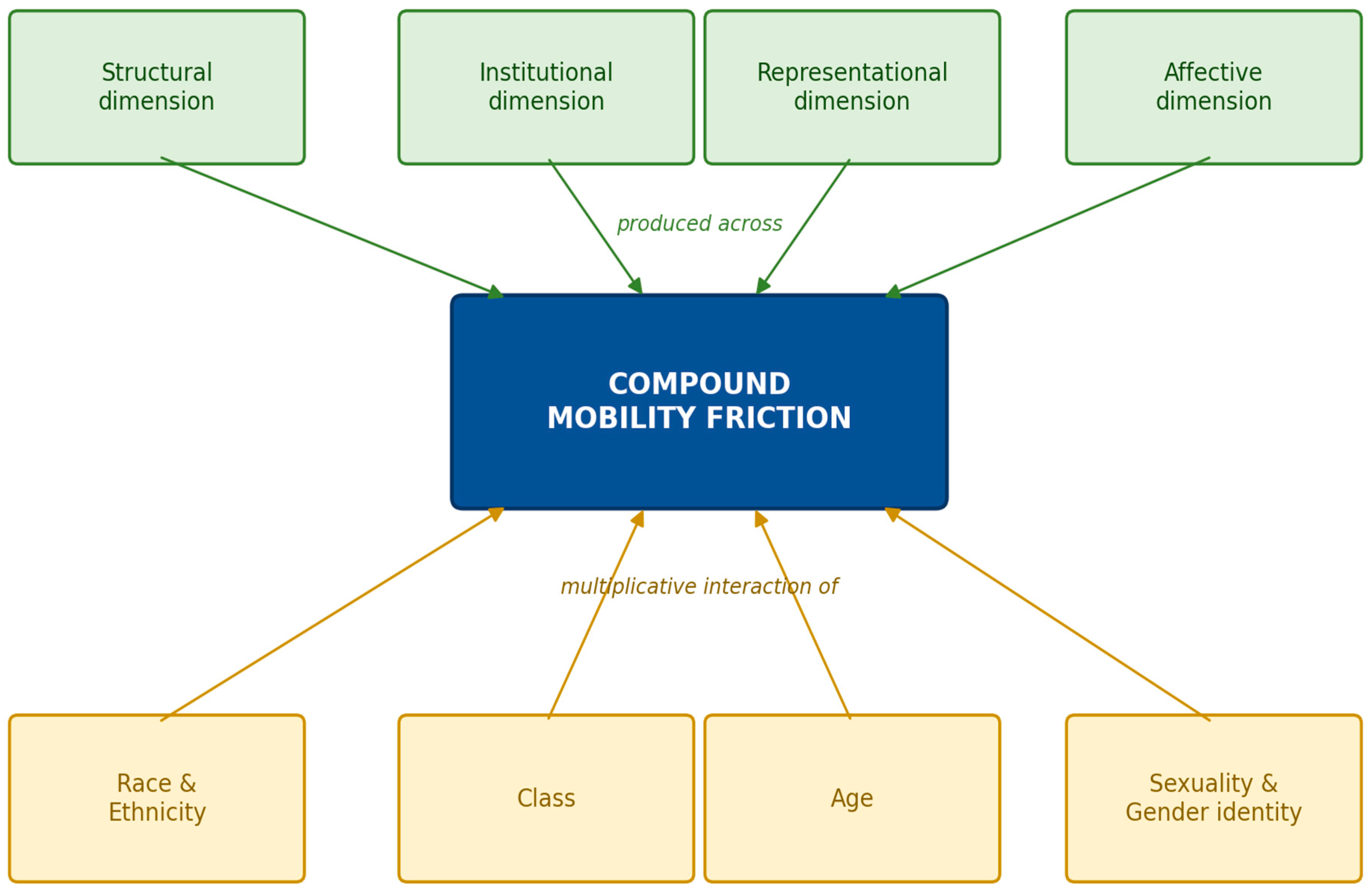
Compound mobility friction is not offered as a replacement for any of these frameworks, but as an analytical instrument that operates across four dimensions, allowing a researcher to specify where, in a given empirical instance, friction is being produced:
  • Structural dimension: formal and material barriers, including visa regimes, insurance costs, and accessibility infrastructure.
  • Institutional dimension: the policies and practices of tourism institutions, including marketing categories, published safety advisories, and platform design.
  • Representational dimension: the visual and discursive economies of travel media and marketing that determine who is imagined as ‘the’ traveller.
  • Affective dimension: the internalised, anticipatory, and embodied labour theorised through affective habitus (Christou, 2022) (Figure 1).
In the discussion that follows (Section 4), each axis is examined with attention to which of these four dimensions the cited evidence most directly illuminates. This is signalled descriptively in the text rather than through a formal coding scheme, since, as Section 3 explains, the evidence base is secondary survey and report data rather than a primary discourse corpus assembled and coded for this study.

3. Methodology

3.1. Positioning and Research Design

This paper is conceptual in orientation. Its primary contribution is the development of compound mobility friction as an analytical concept, set out in Section 2. The empirical material discussed in Section 4 is used illustratively, to ground the concept in documented patterns of solo female travel and to test its plausibility against publicly available evidence, rather than as the output of an independent primary discourse analysis of a purpose-built corpus of digital texts. This positioning is stated explicitly here because conceptual development illustrated by secondary evidence, and primary qualitative discourse analysis of an original dataset, are different modes of scholarship that carry different methodological obligations. The present paper should be read and evaluated as the former. Readers looking for sample sizes of coded forum posts, inter-coder reliability statistics, or a search-term protocol for an original digital corpus will not find them here, because no such corpus was assembled for this study; Section 3.4 discusses this limitation, and what a complementary primary study would need to do, directly.

3.2. Data Sources

Table 2 summarises the publicly available sources on which the discussion in Section 4 draws.
These sources were selected because they are, to the author’s knowledge, the most comprehensive openly accessible datasets addressing solo female travel behaviour (Solo Female Travellers Global Survey; Solo Traveller Reader Survey), Black traveller spending and safety perceptions (MMGY Travel Intelligence/Black Travel Alliance), and Black women’s digital travel culture (Arthur, 2022, respectively, at the time of writing. No systematic search protocol, defined access date, or exhaustive review of alternative datasets was undertaken to establish this; the selection reflects the author’s field knowledge of the most-cited openly available sources in this area, and this is acknowledged as a limitation in Section 3.4 rather than presented as a systematic sampling procedure.

3.3. Analytical Approach

Given the conceptual positioning set out in Section 3.1, the analytical approach used here is best described as an interpretive, theoretically guided synthesis rather than a formal qualitative coding procedure. Two reading practices inform this synthesis. First, a thematic reading organises the cited material around the four axes structuring Section 4: race and ethnicity, class, age, sexuality and gender identity. These four axes were predetermined by theory, not induced from the data: they were selected in Section 2 because they recur across the intersectionality, mobility justice, and digital-culture studies reviewed there as the axes most consistently theorised alongside gender in existing tourism scholarship, and their empirical treatment in Section 4 is illustrative of this pre-existing theoretical framework rather than the product of an inductive, grounded-theory-style derivation from a coded dataset. Second, a feminist critical discourse-analytic sensibility (Aitchison, 2005) is brought to bear on how the cited sources construct, normalise, or foreground particular travelling subjects: for instance, which forms of respondent testimony an industry survey chooses to publish, and which forms of travel experience receive sustained marketing and media attention and which do not.
This is a mode of critical reading applied to already-published material, not an independent coding exercise conducted on a self-assembled corpus of raw digital text. Accordingly, the paper does not report inter-coder reliability, sample sizes of forum posts, or a search-term protocol, because no such original corpus was assembled for this study.

3.4. Scope and Limitations

The evidence base described above carries limitations that qualify the claims made in this paper, and these are unpacked here.
  • Sampling. The Solo Female Travellers and Solo Traveller World surveys draw on self-selected samples of an existing travel-community membership, skewed toward travellers who are already digitally engaged, predominantly English-speaking, and sufficiently resourced to complete a voluntary industry survey. They are not representative samples in a statistical sense and cannot support population-level claims; they are treated here as documented evidence of the concerns and experiences of a specific, digitally engaged travel-community population.
  • Provenance of commercial reports. The MMGY Travel Intelligence/Black Travel Alliance report and the Hostelworld and Grand View Research statistics are commercial, non-peer-reviewed publications produced by, or in partnership with, industry and advocacy organisations that have an interest in demonstrating the market significance of the travellers they represent. Their figures are cited here as documented industry evidence of scale and concern, not as academic data, and readers should weigh them accordingly.
  • Absence of a primary digital corpus. Because the paper does not draw on an original coded corpus of digital forum or influencer text, its account of digital counter-publics in Section 4.1, Section 4.3, and Section 4.4 is necessarily mediated through secondary literature, particularly Arthur (2022), and through the testimony that industry surveys have already selected for publication, rather than through the author’s direct engagement with a representative sample of user-generated content.
A natural next step for this programme of research, distinct from the conceptual contribution offered here, would be a primary qualitative study that samples and codes a defined corpus of forum and influencer material against the four dimensions of compound mobility friction set out in Section 2.5, with a documented search protocol, explicit inclusion and exclusion criteria, and a reported sample size.

3.5. Researcher Positionality and Digital Ethics

Any engagement with questions of race, gender, class, and mobility requires explicit acknowledgement of the researcher’s own positionality. The author self-identifies as a migrant woman of working-class heritage and first-in-the-family academic, working in a university context in the United Kingdom. The analysis is shaped by, as well as contributing to, a critical intersectional sociology developed through decades of multi-sited, multi-method fieldwork across countries in the Global North and Global South. This positionality does not disqualify the analysis but requires sustained reflexivity: the aim is not to speak for marginalised travellers but to develop conceptual tools that can account for their experiences more adequately, and to centre the scholarship, advocacy, and self-representation that those travellers themselves have produced.
This positionality shaped the analysis in identifiable ways rather than functioning as a general disclaimer. It shaped source selection: the decision to foreground the MMGY Travel Intelligence/Black Travel Alliance report and Arthur’s (2022) study of Black women travel influencers, rather than treating race as a residual category within a generic solo-travel literature, follows directly from the author’s own scholarly commitment to centring racialised and classed experience in migration and mobility research. It shaped interpretation: the reading of economic constraint in Section 4.2 as structural rather than as a matter of individual budgeting choices reflects the author’s working-class positionality and her long-standing theoretical commitment to treating class as a structural rather than residual category. It also shaped ethical decisions: because the author’s own scholarly practice treats publicly available survey and report data as requiring the same care as directly collected data, the paper restricts itself throughout to material that sources have already aggregated, anonymised, or published as representative testimony, rather than to raw, individually attributable forum posts (see below).
All secondary material engaged in this paper is publicly available. Because the paper does not draw on an original corpus of raw forum posts or influencer content (Section 3.4), it does not reproduce individual usernames, handles, or unaggregated posts; the only quoted or paraphrased testimony used is testimony that survey publishers (principally Solo Female Travellers) have themselves already selected, aggregated, and published as representative respondent commentary, without attribution to identifiable individuals. This is a narrower ethical exposure than a primary digital ethnography would carry, precisely because the paper is conceptual rather than corpus-based (Section 3.1); a future primary study of the kind proposed in Section 3.4 would need its own protocol for handling usernames, sensitive posts, and contextual privacy in raw digital material, and would not be able to rely on the approach taken here. The paper is committed to what Christou and Bloor (2021) call the negotiation of feminist ethics in research practice: a reflexive, relational, and politically engaged approach to inquiry that is attentive to the power relations between researcher and researched, and, in this case, between researcher and the published sources on which the analysis draws.

4. Empirical Discussion: Compound Mobility Friction Across Four Intersecting Axes

4.1. Race and Ethnicity: Navigating the White Travel Imaginary

The dominance of whiteness in both the marketing and the academic study of solo female travel is not incidental but structural. It reflects and reproduces what scholars have begun to theorise as a white travel imaginary: a set of assumptions about who the traveller is, what she wants, what she fears, and whose knowledge is authoritative, organised around the normative centrality of white, Western femininity (Pritchard & Morgan, 2000; Yang & Schanzl, 2023). The empirical scale of this misrepresentation is documented in the MMGY Travel Intelligence Portrait of Black Travellers in America (MMGY Travel Intelligence/Black Travel Alliance, 2025), commissioned with the Black Travel Alliance and the National Coalition of Black Meeting Professionals. Based on a national survey of 2000 Black leisure travellers and DK Shifflet’s TRAVEL PERFORMANCE/Monitor intelligence, the report finds that U.S. Black leisure travellers took over 184 million trips in 2023, generating a total spend of USD 145 billion, a 33 per cent increase from 2019, when the same group spent USD 109.4 billion (MMGY Travel Intelligence/Black Travel Alliance, 2025). Safety and a welcoming atmosphere were cited as highly influential in travel decisions by 79 per cent of respondents, consistent with the interpretation that safety concerns for Black travellers are not generic but racially specific; as a commercial, non-peer-reviewed report (see Section 3.4), this figure is treated as documented industry evidence rather than academic data.
The experiential consequences of this structural marginalisation are expressed with notable consistency in the testimony that the Solo Female Travellers survey chooses to publish. The 2026 survey includes respondent testimony noting that much of the travel industry, when addressing solo female travellers, caters primarily to white women and does not account for the varied experiences of other racial groups, and that, for one respondent, her experience as a Black woman is not frequently discussed outside conversations with other Black female travellers, requiring destination-specific knowledge about racism and local dynamics that mainstream safety resources do not reliably provide (Solo Female Travellers, 2026). This paper terms this pattern safety knowledge asymmetry: the differential distribution of destination-specific, racially relevant safety intelligence, such that Black women travellers must perform an additional labour of preparation, research, and risk-mapping that white travellers can more often take for granted. This is offered as an interpretation consistent with the published testimony cited, rather than as a finding independently verified against a larger, systematically sampled body of respondent testimony.
Earlier work by MMGY Global/Black Travel Alliance (2021) found that 54 per cent of U.S.-based Black travellers agreed they were more likely to visit a destination if they saw Black representation in travel advertising (MMGY Global/Black Travel Alliance, 2021). This figure speaks to the representational economy of tourism marketing: visibility functions not merely aesthetically but as a practical safety signal, communicating to Black travellers whether a destination has considered their presence and found it welcome. The absence of such representation can, on this reading, itself constitutes a form of compound mobility friction operating in the representational dimension identified in Section 2.5: a structural signal of unwelcome that operates before any journey begins.
Arthur’s (2022) study of Black women travel influencers Jessica Nabongo and Oneika Raymond illuminates a digital counter-practice that has emerged in response to this asymmetry. Arthur develops the concept of digital culture bearing to describe the ways in which Black women travel influencers use Instagram not merely to document their journeys but to construct diasporic knowledge networks, nurturing wisdom about Africa and about the Black traveller’s relationship to destination spaces, cultures, and histories (Arthur, 2022, p. 4). This practice is simultaneously a counter-representational politics, challenging the white travel imaginary, and a practical epistemology, producing the racially specific travel knowledge that dominant platforms do not reliably provide. For tourism studies, this suggests that at least some of the digital archives produced by Black women travellers should be understood not merely as testimony or user-generated content but as structured knowledge systems that constitute alternative cartographies of safe, meaningful, and politically conscious travel; a claim advanced here on the basis of Arthur’s (2022) single published case study, and one that would benefit from further primary research across a larger sample of digital archives (see Section 3.4).
It is important not to read this discussion as treating Black women travellers as a homogeneous group. The safety knowledge asymmetry and digital culture bearing discussed above are likely produced differently for a Black British woman travelling in continental Europe than for a Black American woman travelling in West Africa, and differently again for Black women travellers who are also working-class, queer, older, or navigating precarious immigration status; nationality, class, sexuality, age, and migration background can all be expected to modulate how racialisation is experienced in specific destination contexts, in line with the multiplicative logic set out in Section 2.4. The sources drawn on here (particularly the U.S.-focused MMGY Travel Intelligence/Black Travel Alliance report and Arthur’s (2022) study of two U.S.-based influencers) speak most directly to a U.S. context, and the discussion above should be read as illustrative of a wider pattern rather than as a general claim about Black women travellers as an undifferentiated category.

4.2. Class and Economic Capital: The Stigmatised Traveller

Class has been comparatively undertheorised in the solo female travel literature. Where it appears, it tends to do so implicitly, through the assumption that the solo traveller is sufficiently economically independent to fund international travel, or through celebratory narratives of budget travel that present economic constraint as adventurousness or resourcefulness. This framing can obscure the structural nature of class-based barriers to mobile life and the affective dimensions of class stigma in tourist spaces.
The 2024 Solo Female Travellers survey data reveal class-stratified patterns in destination aspiration and travel behaviour. The survey finds that 65 per cent of respondents worry about the higher costs of solo travel compared to travelling with a companion, the second-most commonly cited concern after personal safety, cited by 70 per cent (Solo Female Travellers, 2024). These figures point to the structural significance of economic position in shaping the experience of solo travel. The survey further finds that 35 per cent of respondents never purchase medical insurance when travelling solo (Solo Female Travellers, 2024), a figure consistent with the interpretation that, for at least some solo travellers, insurance functions as a discretionary rather than a routine expense. On the argument developed in this paper, this is a material manifestation of compound mobility friction in its structural dimension: a working-class solo female traveller who cannot afford insurance faces not only the financial risks that insurance would mitigate but also the representational risk of being positioned as irresponsible within travel safety discourse.
The 2026 survey extends this picture, documenting broadly similar concerns across the sampled respondents. Women report worrying about personal safety (68 per cent), higher costs (68 per cent), language barriers (47 per cent), getting lost (40 per cent), and feeling lonely (32 per cent) (Solo Female Travellers, 2026). These aggregate figures, however, conceal the differential significance each concern is likely to carry for differently classed travellers: for a middle-class traveller, higher costs may represent a negotiable constraint, while for a working-class traveller they may represent an absolute barrier. This is offered as a plausible interpretation of the aggregate data rather than as a claim the survey itself disaggregates by class, since the published survey does not report a class breakdown of these figures.
Janta and Christou’s (2019) study on hosting as social practice and gendered insights into contemporary tourism mobilities provides an important counterpoint. Their research on the social dynamics of hosting and visiting in tourist and VFR (Visiting Friends and Relatives) mobilities demonstrates that even among relatively privileged mobile women, the intersections of nationality, duration of migration, and family circumstance produce differentiated experiences of social intimacy, hospitality, and belonging. The paper’s attention to culture, intimacy, and identity as pathways to transformative social practices among hosts and guests (Janta & Christou, 2019, p. 168) resonates with the present analysis: tourist encounters are rarely simply economic transactions or leisure practices but are saturated with relational, affective, and social significance that is likely to vary according to the mobile subject’s compound social position.
The dominant aesthetic economies of travel culture, expressed across travel media, influencer content, and marketing, tend to presuppose a level of economic capital that naturalises certain experiences (e.g., boutique hotels, curated food tourism, artisanal encounters) while implicitly marginalising others, such as budget hostels, package holidays, and domestic tourism. According to platform data from one major hostel-booking site, one industry statistic indicates that 60 per cent of solo travellers on the hostel-booking platform Hostelworld identify as female (Hostelworld, 2025), which is at least suggestive that women are drawn to the social and budget-friendly aspects of hostel travel; this figure is offered as illustrative rather than conclusive. This mode of travel nonetheless receives comparatively little attention in academic and industry tourism discourse, which remains structured, in significant part, around an aesthetic of independent luxury rather than collective economy.
This pattern connects to a longer-standing literature on budget and backpacker travel that solo female travel research has engaged only intermittently. Scheyvens (2002) and Sørensen (2003) each document backpacker and budget travel as a distinct tourism culture with its own economies of status, sociality, and infrastructure, rather than as a lesser or transitional version of more resourced travel; reading solo female travel through this literature, rather than treating budget travel as a residual category defined only by what it lacks, would allow future research to take working-class and backpacker travel practices seriously as objects of study in their own right, alongside the boutique and luxury-oriented travel more commonly centred in tourism marketing research.
It should also be acknowledged that the digital sources drawn on in this paper are themselves likely to be class-biassed. Participation in online travel forums, the maintenance of a travel blog, and sustained engagement with travel influencer content all presuppose a baseline of digital access, discretionary time, and cultural capital; travellers experiencing the most acute economic constraint, including those who forgo solo travel altogether or travel only domestically, are structurally less likely to appear in the digital archives this paper and the wider literature draw upon. The class analysis offered here should therefore be read as an account of how class stratification appears among travellers who are already digitally visible, rather than a complete account of class and mobility.

4.3. Age and Life Course: The Invisible Older Female Traveller

Age has received relatively more attention in recent tourism literature on solo women’s travel, particularly given the growth of post-retirement independent travel among women in the Global North. Yet the framing of ageing solo travellers has tended to reproduce the default-traveller assumptions identified in Section 1, treating older women’s travel as a variant on the dominant theme rather than as a site from which to interrogate that framework itself.
Survey data from the Solo Traveller Reader Survey, drawing on responses from over 2400 participants, finds that more than 80 per cent of 2024 respondents were women, American, held university or graduate degrees, and were over the age of 55 (Solo Traveller World, 2025). Within this cohort, price and safety were the two most influential factors in destination selection, cited by 77 per cent and 76 per cent of respondents, respectively (Solo Traveller World, 2025). These figures document the economic significance of older solo travellers within this specific, self-selected readership and the centrality of safety concerns, though the racially undifferentiated nature of the published data means the survey cannot, on its own, speak to the compound friction experienced by older women of colour specifically.
The ageism embedded in mainstream travel culture, which centres youth as the horizon of authentic travel experience, plausibly produces a specific form of mobility friction for older women travellers: not only practical forms, such as less targeted safety advice and fewer community spaces geared to older travellers, but a representational form of relative invisibility in the visual economy of travel media. This invisibility is likely compounded by the intersection of age with other social positions; an older Black woman travelling alone, for instance, would not be expected, on the logic developed in Section 2, simply to experience the sum of age-based and race-based frictions, but a distinct configuration of the two. My own sustained engagement with the mobilities of ageing populations across my work on second-generation diaspora communities, and youth mobilities in crisis contexts (Christou, 2022; Michail & Christou, 2018) provides a sociologically rich framework for thinking about how age intersects with other social positions in the production of mobile identities and constraints, attentive to both structural conditions and the affective dimensions of ageing in and through movement. Michail and Christou (2018), in their study of youth mobilities in crisis-era Greece, document the liminal and austere conditions under which mobile identities are formed and negotiated, a framework of crisis-inflected liminality that is productive for thinking about the constraints facing older solo travellers negotiating the ageist representational economies of contemporary travel culture.
The empirical grounding for claims about older solo travellers would also be strengthened by attending more closely to dimensions of the life course that the cited surveys do not directly measure: health and disability status, retirement and pension income, widowhood, and caregiving responsibilities all shape whether, when, and how older women can travel solo, independently of chronological age itself. A woman in her sixties who is also a primary carer for an ageing parent or a grandchild faces a structurally different mobility calculus from an otherwise similar woman without caregiving responsibilities; disability and chronic illness reshape questions of accessible infrastructure and travel insurance in ways that intersect with, but are not reducible to, age-based ageism in travel marketing; and retirement income and pension adequacy determine whether the ‘invisible older traveller’ problem is primarily representational or primarily material for a given woman. None of the sources drawn on in this paper measure these dimensions directly, and this is noted here as a specific, addressable gap for future survey design and for the primary digital discourse study proposed in Section 3.4, rather than as a claim this paper is able to resolve with its existing evidence base.
Community discussion on solo-travel platforms such as TripAdvisor, as characterised in the secondary and industry literature on digital travel cultures (see Section 3.4), suggests that women across the life course use digital platforms to share experiences of travelling alone, and that older women travellers in particular may construct alternative communities of practice and knowledge, sharing destination recommendations, safety strategies, and accounts of social encounter. If borne out by dedicated primary research, this pattern would constitute an informal counter-public to the youth-centred visual economy of mainstream travel culture; the present paper offers it as a plausible hypothesis consistent with the wider literature which can be subsequently explored as an original empirical finding.

4.4. Sexuality and Gender Identity: Beyond the Heteronormative Traveller

The literature on LGBTQIA+ travellers has developed substantially in recent years, and queer tourism studies has established a significant body of work on gay and lesbian travel practices. Yet this literature has itself tended to reproduce the same default-traveller assumptions (Section 1), focusing primarily on gay and lesbian travellers whose race, class, and national position go unmarked, and paying comparatively less attention to the intersections of sexuality and gender identity with race, class, age, and nationality. Lewis et al. (2024), in a tourism geographies study of queer people of colour’s perceptions of Pride in Sydney, document the ways in which mainstream LGBTQIA+ tourism spaces can simultaneously offer queer acceptance and reproduce racial hierarchies, producing a distinctive form of compound friction for queer travellers of colour (Lewis et al., 2024, p. 521).
Conceptual precision also requires distinguishing sexuality, gender identity, and gender expression, which the travel-safety literature and much tourism scholarship often collapse into a single ‘LGBTQIA+’ category. Sexuality concerns the direction of a traveller’s romantic or sexual attraction and shapes risks such as the criminalisation of same-sex conduct or intimacy discussed below; gender identity concerns a traveller’s own sense of their gender, which for transgender and non-binary travellers raises distinct risks around identity documents, border screening, and access to gendered facilities that a cisgender lesbian or bisexual traveller does not face in the same way; and gender expression concerns the outward presentation of gender, which shapes the everyday visibility and legibility of a traveller regardless of how she identifies. A lesbian or bisexual cisgender woman, a transgender woman, and a non-binary traveller are likely to encounter compound mobility friction through substantially different mechanisms even where their destinations and racial or class positions are held constant, and the discussion that follows should not be read as implying a single, undifferentiated ‘queer travel experience’.
The global landscape of LGBTQIA+ travel safety involves acute compound risk for intersectionally marginalised travellers. ILGA World documents that same-sex relations remain criminalised in 64 countries worldwide, with the death penalty applying in a number of jurisdictions (ILGA World, 2024). For a queer woman of colour travelling alone, the standard risk calculus of solo female travel, primarily structured around gender-based safety risks, intersects with a distinct set of sexuality-based risks that vary considerably by destination and are further modulated by race, class, and nationality. On the argument developed here, the compound mobility friction such a traveller may face is not simply the sum of gender-based, sexuality-based, and race-based risks but a qualitatively distinct configuration of constraint.
The 2026 Solo Female Travellers survey includes published testimony from respondents describing additional intersectional dimensions of travelling as queer: unique safety considerations, additional layers of destination-specific research, and forms of double or triple risk-mapping that, respondents report, demand intellectual and emotional labour beyond what standard travel safety resources provide (Solo Female Travellers, 2026). This additional labour is read here as a form of compound mobility friction produced through the intersection of sexuality with gender and, for queer women of colour, with race as well.
This dimension of compound mobility friction connects to the political and epistemic significance of Black women’s digital culture bearing, as theorised by Arthur (2022). The digital archives produced by LGBTQIA+ travellers of colour, like those produced by Black women travellers more broadly, plausibly function not simply as personal narratives but as knowledge resources and practical cartographies of differential risk and differential belonging that supplement safety advice provided by mainstream travel institutions. The feminist ethics engaged by Christou and Bloor (2021) in their analysis of the liminality of loneliness and intersectional affectivity provide a conceptual vocabulary for understanding such digital knowledge practices as forms of care: modes of collective feminist practice in which knowledge about vulnerability, constraint, and survival is produced, circulated, and shared across communities of differently positioned women.

5. Discussion: Implications for Tourism Research, Policy, and Industry

5.1. Reconceptualising Safety in an Intersectional Register

The concept of compound mobility friction developed in this paper has implications that extend beyond academic theorisation. If the constraints faced by intersectionally marginalised solo travellers are, as argued here, multiplicative rather than simply additive, then interventions that address a single axis of constraint are likely to fail to reach the travellers most profoundly affected by compound frictions. Gender-responsive safety advice that does not account for race, or age-friendly tourism marketing that does not account for class, would constitute partial responses to a structural problem. Effective intervention, on this argument, requires a structural rather than piecemeal approach.
The evidence discussed in this paper suggests that safety (the most consistently cited concern among solo female travellers, cited by 68–70 per cent of respondents across the 2024 and 2026 Solo Female Travellers surveys) is unlikely to be experienced uniformly across intersectionally differentiated travellers. The MMGY Travel Intelligence/Black Travel Alliance (2025) data show that 79 per cent of Black leisure travellers cite safety and a welcoming atmosphere as highly influential in their travel decisions, and that word-of-mouth recommendations from friends and family remain the primary driver of travel planning decisions, particularly for Boomers. This is consistent with, though it does not on its own demonstrate, the interpretation that Black travellers supplement the safety information provided by mainstream travel resources with community-based knowledge networks; a practice that, if this interpretation holds, would constitute both a response to compound mobility friction and a form of collective resistance to the white travel imaginary. It should be emphasised that this claim rests on cross-sectional survey data rather than a causal or longitudinal design, and should be read as suggestive rather than conclusive.

5.2. Implications for Destination Marketing Organisations

For destination marketing organisations, the discussion above suggests that the representation of solo female travellers in marketing materials would benefit from expansion. The current prevalence of white, young, economically comfortable solo travellers in visual marketing sits uneasily alongside the documented scale of travel spending by Black travellers, older women, and other currently underrepresented groups. The MMGY Travel Intelligence/Black Travel Alliance (2025) study finds that 54 per cent of U.S. Black leisure travellers agreed they are more likely to visit a destination if they see Black representation in travel advertising, a finding that connects representational politics to market economics, albeit on the basis of a single, commercially produced report. Nearly half (46 per cent) of Black leisure travellers are members of Black travel groups, such as Black Travel Movement and Black Women Travels, which foster a sense of community and provide culturally tailored experiences (MMGY Travel Intelligence/Black Travel Alliance, 2025). These community structures constitute a parallel infrastructure of travel knowledge production that destination marketing organisations have, on this evidence, engaged with only unevenly.
The knowledge systems produced through digital culture bearing and community-based travel advocacy represent a resource the industry could engage with more systematically. Arthur’s (2022) analysis of Black women travel influencers suggests that at least some such knowledge systems are sophisticated and practically effective, producing racially specific safety intelligence, diasporic knowledge of destination cultures, and counter-representational politics that marginalised travellers report needing. Engaging with these systems would require not merely including diverse faces in marketing materials, but treating Black women travellers, queer travellers of colour, working-class travellers, and older solo travellers as knowledge producers rather than only as market segments.

5.3. Implications for Tourism Research Methodology

For tourism research methodology, this discussion contributes to a growing body of argument for critical qualitative engagement with the material produced in digital counter-publics, while also illustrating the methodological caution that such engagement requires. The travel blogs, forum discussions, influencer archives, and advocacy research reports referenced in this paper constitute significant potential social science data, produced through collective, community-based knowledge practices that survey-based and quantitative methods alone may not capture. Yang and Schanzl (2023) have argued for an explicitly feminist and decolonial orientation in tourism geographies research, contending that the field should move beyond approaches that treat gender as an isolated variable and towards frameworks capable of accounting for the fuller complexity of social difference in tourist spaces.
The conceptual approach developed in this paper, of theoretically guided synthesis of secondary material organised around a structurally intersectional analytical framework, is offered as one contribution to that reorientation, and as a foundation for the primary, systematically coded digital discourse analysis identified in Section 3.4 as a necessary next step. The growing literature on digital methods ethics, including Christou and Bloor’s (2021) work in relation to feminist research practice, provides the normative framework within which such primary analyses could be conducted responsibly.

5.4. From Principle to Practice: Concrete Steps

The implications sketched above can be translated into more concrete steps, offered here as illustrative starting points for practice rather than as a validated implementation programme, since evaluating their effectiveness would require research beyond the scope of this conceptual paper.
  • Destination marketing campaign redesign: moving beyond adding diverse faces to existing campaign templates, towards commissioning campaign narratives directly from within the communities being represented. For example, briefing Black women travel content creators, older solo travellers, and LGBTQIA+ travellers of colour as creative partners with editorial input, not only as talent. This addresses primarily the representational dimension of compound mobility friction (Section 2.5), and, where creative partners also shape destination-safety messaging, the affective dimension as well.
  • Intersectional travel safety infrastructure: destination safety advisories and traveller helplines organised so that a user can layer relevant identity filters (for example, race, gender identity, disability) rather than receiving a single generic safety brief, drawing on the four-dimension structure set out in Section 2.5 to specify which kind of risk (structural, institutional, representational, or affective) a given piece of advice addresses.
  • Non-tokenising collaboration with marginalised traveller communities: tourism boards compensating community organisations (such as the Black Travel Alliance or LGBTQIA+ travel advocacy groups) for consultancy on a continuing, resourced basis, with agreed editorial and decision-making input, rather than commissioning a single campaign feature or one-off panel appearance. This targets the institutional dimension of compound mobility friction (Section 2.5): the ongoing policies and resourcing structures through which tourism organisations engage marginalised communities, rather than a single representational gesture.
  • Platform organisation of identity-sensitive safety knowledge: travel platforms and forums structuring destination safety information so that identity-specific knowledge, of the kind Arthur (2022) documents Black women influencers producing informally, is discoverable and searchable within mainstream platform architecture rather than remaining dependent on a traveller already knowing which community archive to search for. This addresses the institutional and structural dimensions of compound mobility friction (Section 2.5): the platform policies and information architecture through which safety knowledge either does or does not reach the travellers who need it.

6. Conclusions: Towards a Structurally Intersectional Tourism Studies

This paper has argued, on the basis of a conceptual synthesis illustrated by the secondary evidence discussed in Section 4, that the dominant frameworks through which solo female travel is often understood in tourism studies risk inadequacy to the reality they aim to describe. Such frameworks can centre a partial subject, treat her as broadly representative, and thereby give insufficient attention to the compound, multiplicative constraints that shape the travel experiences of women whose social positions diverge from the white, Western, middle-class, heterosexual, able-bodied default. The concept of compound mobility friction, developed here through a synthesis of my own critical sociology of gendered mobilities and intersectionality, Sheller’s mobility justice framework, and Arthur’s digital culture bearing concept, and distinguished from these adjacent concepts in Section 2.5, is offered as a conceptual tool for thinking more precisely about these dynamics. The paper’s contribution can be summarised along three dimensions. Theoretically, it develops compound mobility friction as an analytical concept distinct from intersectionality, mobility justice, compounded marginalisation, differential mobility, and affective labour (Section 2.5), and specifies the four dimensions, structural, institutional, representational, and affective, through which such friction is produced. Methodologically, it demonstrates a mode of theoretically guided synthesis of secondary, publicly available material as a legitimate basis for conceptual development, while being explicit about the limits of that evidence base and about what a primary digital discourse analysis would still need to establish (Section 3). Practically, it translates the framework into concrete steps for destination marketing, travel safety infrastructure, and platform design, each linked to a specific dimension of compound mobility friction (Section 5.4).
The discussion, drawing on digital and survey material across four intersecting axes (race and ethnicity, class, age, sexuality and gender identity) suggests that compound mobility friction is not merely a theoretical construct but a pattern with support in the available evidence, expressed with notable consistency across the sources through which marginalised travellers make sense of and navigate their mobile lives. The digital counter-publics associated with Black women travellers, queer travellers of colour, working-class travellers, and older solo travellers appear, on this evidence, to function not only as testimonies of constraint but as active knowledge systems and alternative cartographies of belonging and risk that the academy and the industry have been slow to recognise as such; confirming this more fully, however, requires the primary digital discourse analysis identified as a next step in Section 3.4.
The paper’s call is not simply for more inclusive representation, though that matters, but for a rethinking of the epistemological foundations of tourism research: a shift from methodological atomism towards a more structural, intersectional, and decolonially informed framework capable of accounting for the complexity of contemporary mobile life. Such a framework is relevant not only to the academy but to the political and institutional contexts in which decisions about travel infrastructure, safety advice, marketing, and representation are made. Compound mobility friction is proposed here as one condition of contemporary tourist practice, on the evidence and with the limitations set out above. The question this paper leaves open is whether tourism studies has the theoretical ambition, and the empirical resources, to investigate it further.

Funding

This research received no external funding.

Institutional Review Board Statement

Not applicable.

Informed Consent Statement

Not applicable.

Data Availability Statement

All data discussed in this paper are openly accessible via the sources cited in Section 3.2. No new primary data requiring archiving were generated by this study.

Conflicts of Interest

The author declares no conflicts of interest. Note on Identities and Pronouns: The designation ‘female’ with the pronoun ‘she/her’ is used in this paper as one of many possible designations a solo traveller might embrace. As some sections draw on autoethnographic reflection, the author’s own pronouns (she/her) are used throughout. For guidance on bias-free language use in relation to gender, the American Psychological Association’s guidelines are available at https://apastyle.apa.org/style-grammar-guidelines/bias-free-language/gender (accessed on 1 August 2026).

References

  1. Aitchison, C. (2005). Feminist and gender perspectives in tourism studies: The social-cultural nexus of critical and cultural theories. Tourist Studies, 5(3), 207–224. [Google Scholar] [CrossRef]
  2. Arthur, T. O. (2022). ‘We bring home the roots’: Black women travel influencers, digital culture bearing, and African internationalism on Instagram. Social Media + Society, 8(2). [Google Scholar] [CrossRef]
  3. Barrios Aquino, M., Chanamuto, N., & Christou, A. (2022). Introduction: Emotions and mobilities: Gendered, temporal and spatial representations. Emotions: History, Culture, Society, 6(2), 201–214. [Google Scholar] [CrossRef]
  4. Christou, A. (2022). Theorising affective habitus in historical geographies of mobilities: Unfolding spatio-temporal modalities. Emotions: History, Culture, Society, 6(2), 215–236. [Google Scholar] [CrossRef]
  5. Christou, A., & Bloor, K. (2021). The liminality of loneliness: Negotiating feminist ethics and intersectional affectivity. Journal of Cultural Analysis and Social Change, 6(1). [Google Scholar] [CrossRef] [PubMed]
  6. Christou, A., & Kofman, E. (2022). Gender and migration: IMISCOE short reader. Springer. [Google Scholar] [CrossRef]
  7. Crenshaw, K. (1989). Demarginalizing the intersection of race and sex: A Black feminist critique of antidiscrimination doctrine, feminist theory and antiracist politics. University of Chicago Legal Forum, 1989(1), 139–167. [Google Scholar]
  8. Crenshaw, K. (1991). Mapping the margins: Intersectionality, identity politics, and violence against women of color. Stanford Law Review, 43(6), 1241–1299. [Google Scholar] [CrossRef]
  9. Grand View Research. (2025). Solo travel market size, share and trends report, 2026–2033. Grand View Research. Available online: https://www.grandviewresearch.com/industry-analysis/solo-travel-market-report (accessed on 1 August 2026).
  10. Hostelworld. (2025). State of solo travel 2025. Available online: https://www.hostelworld.com/state-of-solo-travel (accessed on 1 August 2026).
  11. ILGA World. (2024). State-sponsored homophobia: Global legislation overview update. ILGA World. Available online: https://ilga.org (accessed on 1 August 2026).
  12. Janta, H., & Christou, A. (2019). Hosting as social practice: Gendered insights into contemporary tourism mobilities. Annals of Tourism Research, 74, 167–176. [Google Scholar] [CrossRef]
  13. Lewis, C., Chandra, S., & Markwell, K. (2024). Exploring queer people of colour’s perceptions of pride in Sydney. Tourism Geographies, 26(3), 520–539. [Google Scholar] [CrossRef]
  14. Michail, D., & Christou, A. (2018). Youth mobilities, crisis, and agency in Greece: Second generation lives in liminal spaces and austere times. Transnational Social Review, 8(3), 245–257. [Google Scholar] [CrossRef]
  15. MMGY Global/Black Travel Alliance. (2021). The Black traveler: Insights, opportunities and priorities (Phase II). MMGY Travel Intelligence. [Google Scholar]
  16. MMGY Travel Intelligence/Black Travel Alliance. (2025). Portrait of Black travelers in America. MMGY Travel Intelligence. Available online: https://mmgyintel.com/u-s-black-travel-market-is-now-a-145-billion-audience-according-to-new-research/ (accessed on 1 August 2026).
  17. Mooney, S. (2018). Illuminating intersectionality for tourism researchers. Annals of Tourism Research, 72, 175–176. [Google Scholar] [CrossRef]
  18. Nisha, F., Cheung, C., & Tung, V. W. S. (2025). Intersectional marginalisation of female Muslim tourists. Tourism Management, 108, 105099. [Google Scholar] [CrossRef]
  19. Oso, L., Grosfoguel, R., & Christou, A. (Eds.). (2017). Interrogating intersectionalities, gendering mobilities, racializing transnationalism. Routledge. [Google Scholar]
  20. Pasura, D., & Christou, A. (2018). Theorizing black (African) transnational masculinities. Men and Masculinities, 21(4), 521–546. [Google Scholar] [CrossRef]
  21. Pritchard, A., & Morgan, N. J. (2000). Constructing tourism landscapes: Gender, sexuality and space. Tourism Geographies, 2(2), 115–139. [Google Scholar] [CrossRef]
  22. Rostami, A., Daniels, G., Trupp, A., & Chaichi, K. (2026). Intersectionality and female solo travel: Rethinking motivations amidst conservative gender norms. Journal of Ethnic and Cultural Studies, 13(2), 182–205. [Google Scholar] [CrossRef] [PubMed]
  23. Scheyvens, R. (2002). Backpacker tourism and third world development. Annals of Tourism Research, 29(1), 144–164. [Google Scholar] [CrossRef]
  24. Sheller, M. (2018). Mobility justice: The politics of movement in an age of extremes. Verso. [Google Scholar]
  25. Sheller, M., & Urry, J. (2006). The new mobilities paradigm. Environment and Planning A, 38(2), 207–226. [Google Scholar] [CrossRef]
  26. Solo Female Travelers. (2024). 2024 solo female travel trends and statistics. Solo Female Travelers. Available online: https://www.solofemaletravelers.club/solo-female-travel-stats-2024/ (accessed on 1 August 2026).
  27. Solo Female Travelers. (2026). 2026 solo female travel trends and statistics. Solo Female Travelers. Available online: https://www.solofemaletravelers.club/solo-female-travel-stats/ (accessed on 1 August 2026).
  28. Solo Traveler World. (2025). Solo travel statistics and data: Historical trends, sources cited. Solo Traveler World. Available online: https://solotravelerworld.com/about/solo-travel-statistics-data/ (accessed on 1 August 2026).
  29. Sørensen, A. (2003). Backpacker ethnography. Annals of Tourism Research, 30(4), 847–867. [Google Scholar] [CrossRef]
  30. Wang, Z., Leung, X. Y., & Huang, X. (2025). Redefining womanhood: Solo travel as intersectional rites of passage. Tourism Management, 111, 105225. [Google Scholar] [CrossRef]
  31. Yang, E. C. L., & Schanzl, H. (2023). On the gender imperative in tourism geographies research. Tourism Geographies, 26(1), 1–22. [Google Scholar] [CrossRef]
Figure 1. Compound mobility friction: four dimensions produced through the multiplicative interaction of four intersecting axes.
Tourismhosp 07 00245 g001
Table 1. Summary Table of Compound Mobility Friction Concept to five closely related concepts in the Literature Review.
ConceptCore ClaimRelation to Compound Mobility Friction
Intersectionality (Crenshaw, 1989, 1991)Categories of oppression are mutually constitutive rather than additive.Compound mobility friction adopts this premise but operationalises it specifically for mobility and travel contexts, and further specifies the dimensions through which friction can be located (see below).
Mobility justice (Sheller, 2018)A structural, political-philosophical account of uneven access to mobility across scales, from the urban to the planetary.Compound mobility friction works at a finer grain: it is designed to track how the hierarchies mobility justice identifies manifest in an individual traveller’s lived, situational experience.
Compounded marginalisation (Nisha et al., 2025)An empirical finding that religion and gender amplify one another for Muslim women tourists in a specific fieldwork context.Compound mobility friction generalises this empirical pattern into a portable theoretical framework applicable, in principle, to other configurations of intersecting social positions.
Differential mobility (general mobilities literature)The general observation that mobility is unevenly distributed across social groups.Compound mobility friction specifies a mechanism (multiplicative rather than additive interaction) and a set of sites (below) through which that unevenness is produced.
Affective labour (drawing on Hochschild and subsequent feminist geography)Unpaid emotional and interpretive work performed within relations of power.Compound mobility friction treats affective labour as one dimension among four, not as coextensive with the concept as a whole.
Table 2. Empirical Data Sources.
SourceTypeScope and SampleTime PeriodRole in the Analysis
Solo Female Travellers Global SurveyCommunity/industry survey, openly publishedApproximately 5000 respondents; self-selected members of the Solo Female Travellers platform and mailing list2024 and 2026 editionsQuantitative context; source of published open-ended respondent testimony discussed in Section 4.1 and Section 4.4
MMGY Travel Intelligence/Black Travel Alliance, Portrait of Black Travellers in AmericaCommercial travel-intelligence report, commissioned with the Black Travel Alliance and the National Coalition of Black Meeting ProfessionalsNational survey of 2000 Black leisure travellers, combined with DK Shifflet TRAVEL PERFORMANCE/Monitor dataPublished 2025; travel behaviour data for 2023 and 2019Empirical grounding for Section 4.1 and Section 5.2
Solo Traveller Reader SurveyCommunity platform survey, openly publishedOver 2400 respondents; self-selected readership of Solo Traveller WorldFielded 2024, published 2025Empirical grounding for Section 4.3
Arthur (2022), Social Media + SocietyPeer-reviewed, open-access journal articleQualitative case analysis of two Black women travel influencers’ Instagram content2022Conceptual and illustrative grounding for Section 4.1 and Section 4.4
Grand View Research (2025); Hostelworld (2025); MMGY Global/Black Travel Alliance (2021)Industry market-research reportsAggregated secondary statistics2021, 2024, 2025Single illustrative statistics cited in Section 1, Section 4.2 and Section 5.2
Disclaimer/Publisher’s Note: The statements, opinions and data contained in all publications are solely those of the individual author(s) and contributor(s) and not of MDPI and/or the editor(s). MDPI and/or the editor(s) disclaim responsibility for any injury to people or property resulting from any ideas, methods, instructions or products referred to in the content.