
Environmental Sustainability Indicators and International Tourism Demand: Evidence from Machine Learning and SHAP Analysis

 , , ,
, , ,
Abstract
1. Introduction
2. Literature Review
3. Methodology and Research Design
3.1. Research Hypotheses
3.2. Research Design and Sample
3.3. Time-Series Split and Cross-Validation
3.4. Algorithm Selection and Constraints
4. Results and Discussion
4.1. Descriptive Statistics
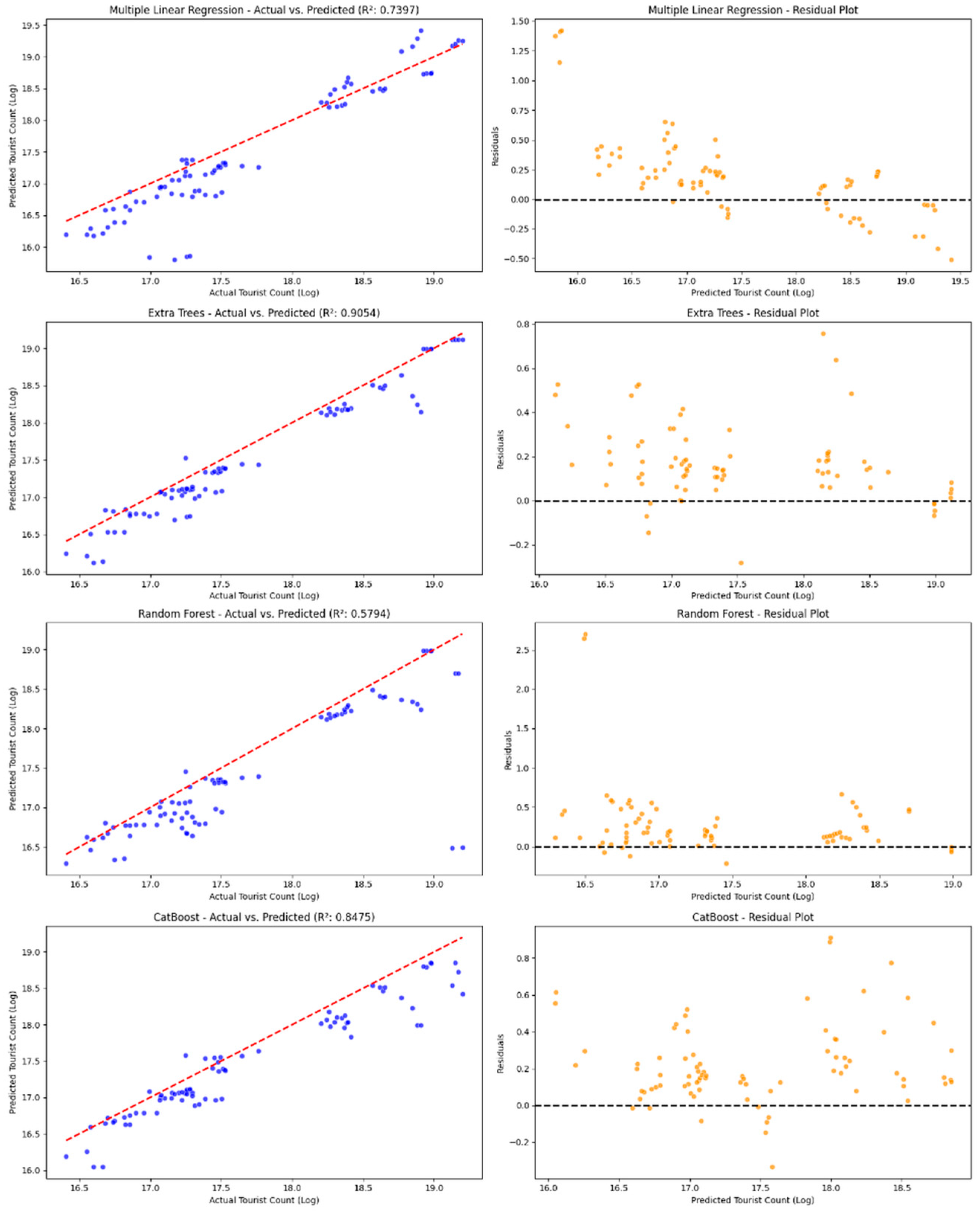
4.2. Model Performance Results
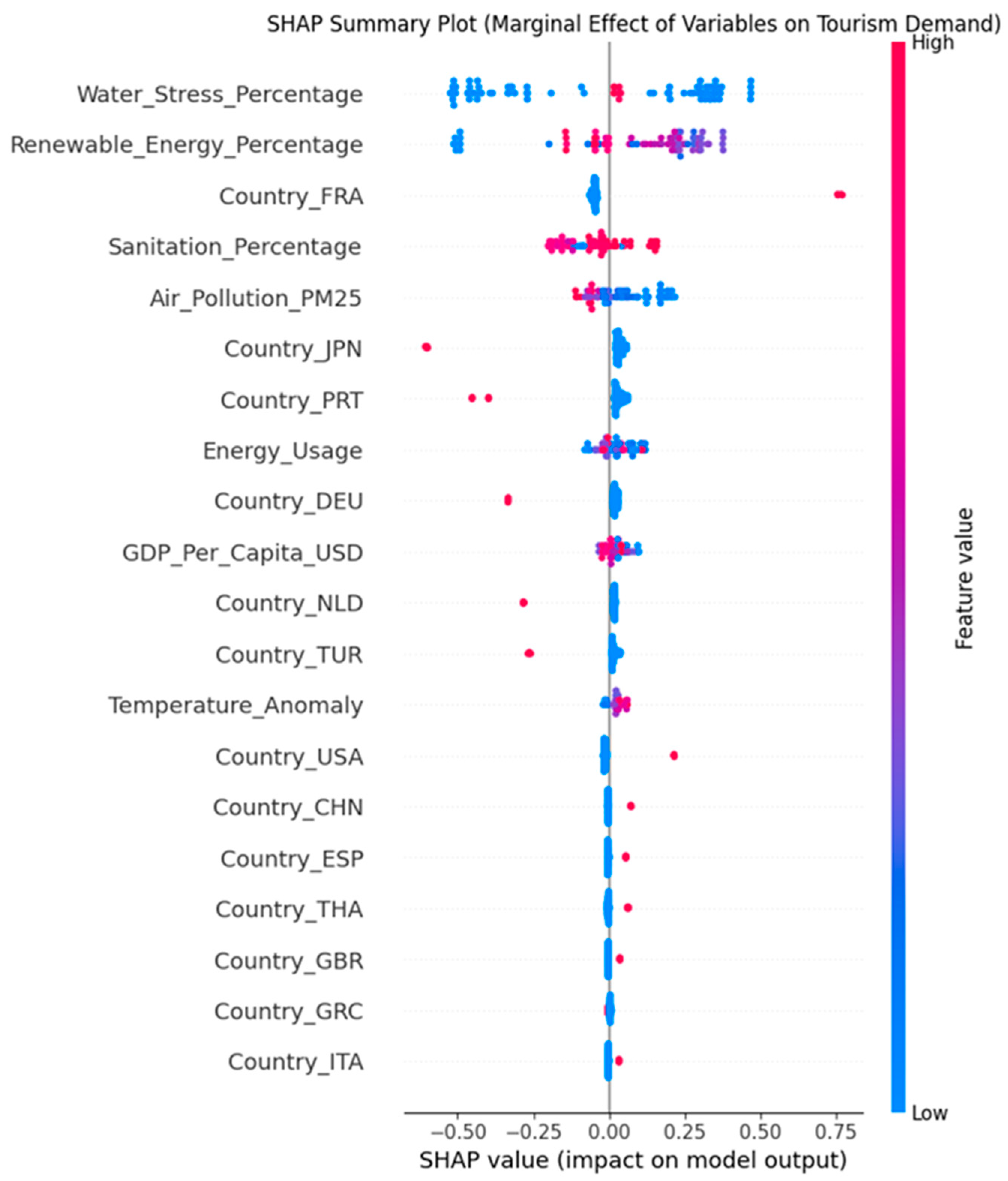
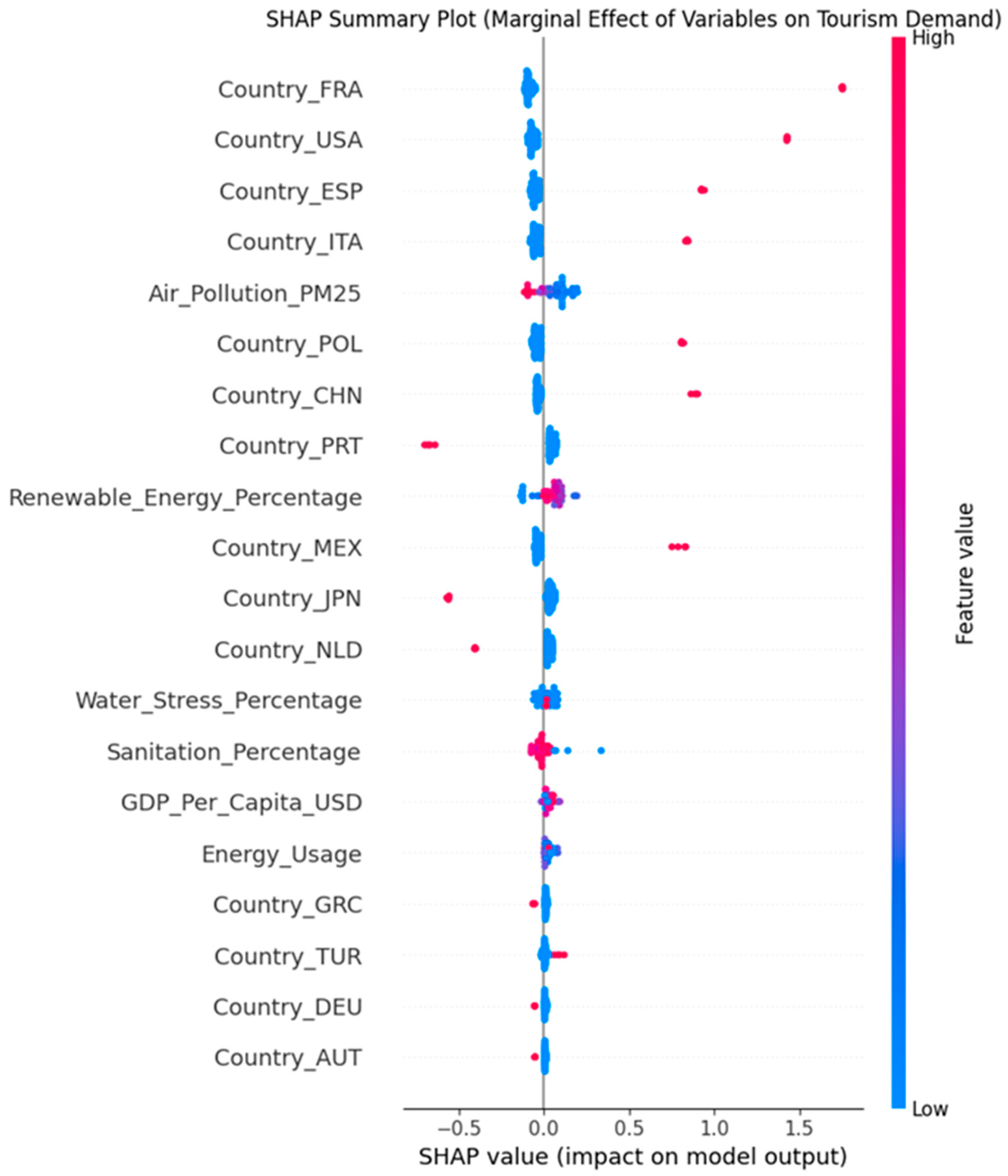
4.3. Variable Importance and SHAP Analysis
5. Conclusions
Author Contributions
Funding
Institutional Review Board Statement
Informed Consent Statement
Data Availability Statement
Acknowledgments
Conflicts of Interest
Abbreviations
| EKC | Environmental Kuznets Curve |
| SDG | Sustainable Development Goals |
| GDP | Gross domestic product |
| RMSE | Root Mean Squared Error |
| MAE | Mean Absolute Error |
| MSE | Mean Squared Error |
| MLR | Multiple Linear Regression |
| ET | Extra Tress |
| SHAP | SHapley Additive exPlanations |
References
- Chen, J., Li, C., Huang, L., & Zheng, W. (2025). Tourism demand forecasting: A deep learning model based on spatial-temporal transformer. Tourism Review, 80(3), 648–663. [Google Scholar] [CrossRef]
- Dimitriadou, A., Gogas, P., & Papadimitriou, T. (2025). Tourism and uncertainty: A machine learning approach. Current Issues in Tourism, 28(14), 2278–2298. [Google Scholar] [CrossRef]
- Dogan, E., & Aslan, A. (2017). Exploring the relationship among CO2 emissions, real GDP, energy consumption and tourism in the EU and candidate countries: Evidence from panel models robust to heterogeneity and cross-sectional dependence. Renewable and Sustainable Energy Reviews, 77, 239–245. [Google Scholar] [CrossRef]
- Dube, K. (2024). Evolving narratives in tourism and climate change research: Trends, gaps, and future directions. Atmosphere, 15(4), 455. [Google Scholar] [CrossRef]
- Dwyer, L., & Kim, C. (2003). Destination competitiveness: Determinants and indicators. Current Issues in Tourism, 6(5), 369–414. [Google Scholar] [CrossRef]
- Ergen, H., & Aslan, A. (2026). Examining the impact of air transportation, tourism, and economic growth on PM2.5 pollution: A comparative analysis of EUROCONTROL member nations. Letters in Spatial and Resource Sciences, 19(8), 8. [Google Scholar] [CrossRef]
- European Environment Agency (EEA). (2025). Economic losses from weather- and climate-related extremes in Europe. Available online: https://www.eea.europa.eu/en/analysis/indicators/economic-losses-from-climate-related?activeAccordion=ecdb3bcf-bbe9-4978-b5cf-0b136399d9f8 (accessed on 31 March 2026).
- Fu, J., & Qin, J. (2026). Tourism demand forecasting with multi-source data: A hybrid framework integrating denoising, signal decomposition, and machine learning. Management System Engineering, 5, 6. [Google Scholar] [CrossRef]
- Gorelick, N., Hancher, M., Dixon, M., Ilyushchenko, S., Thau, D., & Moore, R. (2017). Google Earth Engine: Planetary-scale geospatial analysis for everyone. Remote Sensing of Environment, 202, 18–27. [Google Scholar] [CrossRef]
- Gössling, S., Bredberg, M., Randow, A., Sandström, E., & Svensson, P. (2006). Tourist perceptions of climate change: A study of international tourists in Zanzibar. Current Issues in Tourism, 9(4–5), 419–435. [Google Scholar] [CrossRef]
- Gössling, S., & Peeters, P. (2015). Assessing tourism’s global environmental impact 1900–2050. Journal of Sustainable Tourism, 23(5), 639–659. [Google Scholar] [CrossRef]
- Gössling, S., Scott, D., Hall, C. M., Ceron, J. P., & Dubois, G. (2012). Consumer behaviour and demand response of tourists to climate change. Annals of Tourism Research, 39(1), 36–58. [Google Scholar] [CrossRef]
- Grossman, G. M., & Krueger, A. B. (1995). Economic growth and the environment. The Quarterly Journal of Economics, 110(2), 353–377. [Google Scholar] [CrossRef]
- Guo, Y., & Chai, Y. (2025). Toward green tourism: The role of renewable energy for sustainable development in developing nations. Frontiers in Sustainable Tourism, 4, 1512922. [Google Scholar] [CrossRef]
- Hamilton, J. M., Maddison, D. J., & Tol, R. S. J. (2005). Climate change and international tourism: A simulation study. Global Environmental Change, 15(3), 253–266. [Google Scholar] [CrossRef]
- Hassan, S. S. (2000). Determinants of market competitiveness in an environmentally sustainable tourism industry. Journal of Travel Research, 38(3), 239–245. [Google Scholar] [CrossRef]
- Hastie, T., Tibshirani, R., & Friedman, J. (2009). The elements of statistical learning: Data mining, inference, and prediction (2nd ed.). Springer. [Google Scholar] [CrossRef]
- Ibragimov, K., Perles-Ribes, J. F., & Ramón-Rodríguez, A. B. (2022). The impact of climate change on tourism demand: Evidence from Kazakhstan. Anatolia, 33(2), 293–297. [Google Scholar] [CrossRef]
- Islam, H., Unurlu, Ç., Işık, C., Saha, S., Khoshnood, M., & Sarker, N. K. (2026). Green innovation and tourism demand: The moderating role of sustainable development goals (SDGs). Sustainable Development, 1–17. [Google Scholar] [CrossRef]
- James, G., Witten, D., Hastie, T., & Tibshirani, R. (2021). Linear regression. In An introduction to statistical learning. Springer. [Google Scholar] [CrossRef]
- Jopp, R., DeLacy, T., & Mair, J. (2010). Developing a framework for regional destination adaptation to climate change. Current Issues in Tourism, 13(6), 591–605. [Google Scholar] [CrossRef]
- Kaján, E., & Saarinen, J. (2013). Tourism, climate change and adaptation: A review. Current Issues in Tourism, 16(2), 167–195. [Google Scholar] [CrossRef]
- Katircioglu, S. T. (2014). International tourism, energy consumption, and environmental pollution: The case of Turkey. Renewable and Sustainable Energy Reviews, 36, 180–187. [Google Scholar] [CrossRef]
- Khanna, R., & Sharma, C. (2023). Does financial development raise tourism demand? A cross-country panel evidence. Journal of Hospitality & Tourism Research, 47(6), 1040–1070. [Google Scholar] [CrossRef]
- Krasniqi, S., Dreshaj, K., & Shala Dreshaj, F. (2023). Determinants of tourism demand in selected countries of meta: Empirical panel analysis. DETUROPE—The Central European Journal of Regional Development and Tourism, 15(1), 23–46. [Google Scholar] [CrossRef]
- Kuhn, M., & Johnson, K. (2013). Applied predictive modeling. Springer. [Google Scholar] [CrossRef]
- Kuldasheva, Z., Ahmad, M., Salahodjaev, R., & Fahlevi, M. (2023). Do tourism and renewable energy influence CO2 emissions in tourism-dependent countries? International Journal of Energy Economics and Policy, 13(6), 146–152. [Google Scholar] [CrossRef]
- Law, R., Li, G., Fong, D. K. C., & Han, X. (2019). Tourism demand forecasting: A deep learning approach. Annals of Tourism Research, 75, 410–423. [Google Scholar] [CrossRef]
- Lenzen, M., Sun, Y. Y., Faturay, F., Ting, Y. P., Geschke, A., & Malik, A. (2018). The carbon footprint of global tourism. Nature Climate Change, 8, 522–528. [Google Scholar] [CrossRef]
- Lim, C. (1997). Review of international tourism demand models. Annals of Tourism Research, 24(4), 835–849. [Google Scholar] [CrossRef]
- Liu, S., Islam, H., Ghosh, T., Sibt e Ali, M., & Afrin, K. H. (2025). Exploring the nexus between economic growth and tourism demand: The role of sustainable development goals. Humanities and Social Sciences Communications, 12, 441. [Google Scholar] [CrossRef]
- Muñoz Sabater, J. (2019). ERA5-Land monthly averaged data from 1950 to present. Copernicus Climate Change Service (C3S) Climate Data Store (CDS). [Google Scholar] [CrossRef]
- Nag, A., & Sarkar, S. (2024). Integrating choice freedom, economic health, and transportation infrastructure to forecast tourism demand: A case study of Bishnupur and its alignment with sustainable development goals. Transport Policy, 147, 198–214. [Google Scholar] [CrossRef]
- Nyiwul, L., Shakya, M., Lamichhane, A., & Hu, Z. (2024). Adoption of tools for sustainable tourism development: Role of environmental vulnerability. Journal of Policy Research in Tourism, Leisure and Events, 16(3), 349–371. [Google Scholar] [CrossRef]
- Olmedo, F. G. (2026). Tourism and water stress: A worrying convergence in time and place. In J. Martínez-Valderrama, & J. Olcina Cantos (Eds.), The labyrinth of desertification. Springer. [Google Scholar] [CrossRef]
- Omarova, A., Saubetova, B., Abubakirova, A., Saimagambetova, G., & Pernebekkyzy, N. (2025). Renewable energy consumption, tourism and climate change relationship in developed countries. International Journal of Energy Economics and Policy, 16(1), 218–224. [Google Scholar] [CrossRef]
- Onifade, S. T., Gyamfi, B. A., Bekun, F. V., & Altuntaş, M. (2022). Significance of air transport to tourism-induced growth hypothesis in E7 economies: Exploring the implications for environmental quality. Tourism: An International Interdisciplinary Journal, 70(3), 339–353. [Google Scholar] [CrossRef]
- Özdemir, D., & Tosun, B. (2023). Determinants of tourism demand in context of environmental quality. Advances in Hospitality and Tourism Research (AHTR), 11(2), 294–316. [Google Scholar] [CrossRef]
- Paramati, S. R., Alam, M. d. S., & Chen, C. F. (2017). The effects of tourism on economic growth and CO2 emissions: A comparison between developed and developing economies. Journal of Travel Research, 56(6), 712–724. [Google Scholar] [CrossRef]
- Pata, U. K., & Tanriover, B. (2023). Is the load capacity curve hypothesis valid for the top ten tourism destinations? Sustainability, 15(2), 960. [Google Scholar] [CrossRef]
- Perry, A. (2006). Will predicted climate change compromise the sustainability of mediterranean tourism? Journal of Sustainable Tourism, 14(4), 367–375. [Google Scholar] [CrossRef]
- Rosselló Nadal, J., & Santana Gallego, M. (2022). Gravity models for tourism demand modeling: Empirical review and outlook. Journal of Economic Surveys, 36(5), 1358–1409. [Google Scholar] [CrossRef]
- Rutty, M., Steiger, R., Demiroglu, O. C., & Perkins, D. R. (2021). Tourism climatology: Past, present, and future. International Journal of Biometeorology, 65, 639–643. [Google Scholar] [CrossRef]
- Scott, D. (2021). Sustainable tourism and the grand challenge of climate change. Sustainability, 13(4), 1966. [Google Scholar] [CrossRef]
- Shang, Y., Bi, C., Wei, X., Jiang, D., Taghizadeh-Hesary, F., & Rasoulinezhad, E. (2023). Eco-tourism, climate change, and environmental policies: Empirical evidence from developing economies. Humanities and Social Sciences Communications, 10, 275. [Google Scholar] [CrossRef]
- Shmueli, G. (2010). To explain or to predict? Statistical Science, 25(3), 289–310. [Google Scholar] [CrossRef]
- Song, H., Dwyer, L., Li, G., & Cao, Z. (2012). Tourism economics research: A review and assessment. Annals of Tourism Research, 39(3), 1653–1682. [Google Scholar] [CrossRef]
- Song, H., & Li, G. (2008). Tourism demand modelling and forecasting—A review of recent research. Tourism Management, 29(2), 203–220. [Google Scholar] [CrossRef]
- Song, H., Qiu, R. T. R., & Park, J. (2019). A review of research on tourism demand forecasting: Launching the Annals of Tourism Research Curated Collection on tourism demand forecasting. Annals of Tourism Research, 75, 338–362. [Google Scholar] [CrossRef]
- Stern, D. I. (2004). The rise and fall of the environmental kuznets curve. World Development, 32(8), 1419–1439. [Google Scholar] [CrossRef]
- Su, Y., & Lee, C. C. (2022). The impact of air quality on international tourism arrivals: A global panel data analysis. Environmental Science and Pollution Research, 29, 62432–62446. [Google Scholar] [CrossRef]
- Sun, S., Wei, Y., Tsui, K. L., & Wang, S. (2019). Forecasting tourist arrivals with machine learning and internet search index. Tourism Management, 70, 1–10. [Google Scholar] [CrossRef]
- Tai, Y., & Javed, M. A. (2025). Energy integration as a catalyst for tourism growth and economic stability: Evidence from european nations. International Journal of Energy Research, 2025, 8843761. [Google Scholar] [CrossRef]
- Tonsakunthaweeteam, S., Pongsakornrungsilp, S., Pongsakornrungsilp, P., Ketkaew, K., Rattanapan, P., & Grusevaja, M. (2025). Climate and visa exemption policies on international tourism revenue: A cross-country panel study. Journal of Human, Earth, and Future, 6(4), 900–915. [Google Scholar] [CrossRef]
- Trinajstić, M., Cerović, L., & Krstinić Nižić, M. (2022). Tourism demand and energy consumption in the service sector: Panel analysis of selected EU countrıes. Ekonomski Pregled, 73(3), 371–389. [Google Scholar] [CrossRef]
- Vašaničová, P., & Melnyk, K. (2026). Regional and income-based disparities in health and hygiene: Evidence from the travel & tourism development index. Hygiene, 6(1), 11. [Google Scholar] [CrossRef]
- Witt, S. F., & Witt, C. A. (1995). Forecasting tourism demand: A review of empirical research. International Journal of Forecasting, 11(3), 447–475. [Google Scholar] [CrossRef]
- Yu, Y., Gong, Y., Tao, Y., Won, D., & Zhang, G. (2025). An Examination of the impact of climate change on international inbound tourism: Insights from China. International Journal of Tourism Research, 27, E70057. [Google Scholar] [CrossRef]
- Zhang, J., & Lu, Y. (2022). Exploring the effects of tourism development on air pollution: Evidence from the panel smooth transition regression model. International Journal of Environmental Research and Public Health, 19(14), 8442. [Google Scholar] [CrossRef]
- Zhang, Y., & Ali, Q. (2024). Socio-economic determinants of sustainable tourism and their nexus with energy, environment, and economy (3ES): A panel data analysis. Energy Strategy Reviews, 56, 101577. [Google Scholar] [CrossRef]
- Zhou, W., Faturay, F., Driml, S., & Sun, Y. Y. (2024). Meta-analysis of the climate change-tourism demand relationship. Journal of Sustainable Tourism, 32(9), 1762–1783. [Google Scholar] [CrossRef]
- Zikirya, B., Wang, J., & Zhou, C. (2021). The relationship between CO2 emissions, air pollution, and tourism flows in China: A panel data analysis of Chinese provinces. Sustainability, 13(20), 11408. [Google Scholar] [CrossRef]



| Variable (Feature) | Description/Measurement Unit | Data Source |
|---|---|---|
| Tourist_Arrivals_Log (Dependent Variable) | Natural logarithm of international tourist arrivals. | World Bank |
| Temperature_Anomaly | Annual mean surface temperature anomaly (°C). | ECMWF ERA5-Land (Google Earth Engine) |
| Air_Pollution_PM2.5 | Population exposure to average PM2.5 air pollution (µg/m3). | World Bank |
| Water_Stress_Percentage | Ratio of freshwater withdrawals to available freshwater resources (water stress, %). | World Bank |
| Renewable_Energy_Percentage | Share of renewable energy in total final energy consumption (%). | World Bank |
| Sanitation_Percentage | Percentage of population with access to basic sanitation services (%). | World Bank |
| Energy_Usage | Energy use per capita (kg of oil equivalent). | World Bank |
| GDP_Per_Capita_USD | GDP per capita (USD) representing destination economic size. | World Bank |
| Model | Optimized Parameters (Best Parameters) |
|---|---|
| Multiple Linear Regression | fit_intercept: True |
| Random Forest | max_depth: None, min_samples_leaf: 1, n_estimators: 250 |
| Extra Trees | max_depth: None, min_samples_leaf: 1, n_estimators: 100 |
| CatBoost | depth: 4, iterations: 500, learning_rate: 0.05 |
| Variables | Mean | Std. Dev. | Min | Max |
|---|---|---|---|---|
| Tourist_Arrivals_Log (Dependent Variable) | 17.359 | 0.941 | 15.375 | 19.199 |
| Temperature_Anomaly (°C) | 0.454 | 0.534 | −1.160 | 2.368 |
| Air_Pollution_PM25 (µg/m3) | 22.249 | 13.955 | 6.226 | 65.813 |
| Water_Stress_Percentage (%) | 154.165 | 404.028 | 2.892 | 1866.670 |
| Renewable_Energy_Percentage (%) | 11.535 | 8.480 | 0.000 | 35.700 |
| Sanitation_Percentage (%) | 96.174 | 6.738 | 56.820 | 100.000 |
| Energy_Usage (kg of oil equivalent) | 3861.590 | 2296.110 | 898.075 | 11,703.275 |
| GDP_Per_Capita_USD | 27,304 | 16,322.8 | 969.200 | 64,746.500 |
| Model | R2 Score | Adjusted R2 | RMSE | MAE | MSE |
|---|---|---|---|---|---|
| Extra Trees | 0.9054 | 0.8563 | 0.2419 | 0.1869 | 0.0585 |
| CatBoost | 0.8475 | 0.7683 | 0.3071 | 0.2370 | 0.0943 |
| Multiple Linear Regression | 0.7397 | 0.6045 | 0.4012 | 0.2851 | 0.1610 |
| Random Forest | 0.5794 | 0.3610 | 0.5100 | 0.2863 | 0.2601 |
| Rank | CatBoost Variables | Weight (%) | Extra Trees Variables | Weight (%) |
|---|---|---|---|---|
| 1 | Water Stress | 28.20 | Country Fixed Effect: France | 18.13 |
| 2 | Renewable Energy | 27.12 | Country Fixed Effect: USA | 11.51 |
| 3 | Sanitation | 13.61 | Country Fixed Effect: Spain | 8.74 |
| 4 | Country Fixed Effect: France | 5.84 | Sanitation | 7.93 |
| 5 | Energy Usage | 5.68 | Country Fixed Effect: Italy | 7.29 |
| 6 | Country Fixed Effect: Japan | 4.07 | Country Fixed Effect: Poland | 6.57 |
| 7 | Air Pollution | 3.99 | Country Fixed Effect: Mexico | 6.27 |
| 8 | GDP per Capita | 2.30 | Country Fixed Effect: China | 5.67 |
| 9 | Country Fixed Effect: Portugal | 2.05 | Country Fixed Effect: Japan | 4.40 |
| 10 | Country Fixed Effect: Türkiye | 1.65 | Renewable Energy | 4.25 |
Disclaimer/Publisher’s Note: The statements, opinions and data contained in all publications are solely those of the individual author(s) and contributor(s) and not of MDPI and/or the editor(s). MDPI and/or the editor(s) disclaim responsibility for any injury to people or property resulting from any ideas, methods, instructions or products referred to in the content. |
© 2026 by the authors. Licensee MDPI, Basel, Switzerland. This article is an open access article distributed under the terms and conditions of the Creative Commons Attribution (CC BY) license.
Share and Cite
Oruç Erdoğan, E.; Özdemir, O.; Erdoğan, M.; Durmuş Özdemir, E.; Özdemir, Ş. Environmental Sustainability Indicators and International Tourism Demand: Evidence from Machine Learning and SHAP Analysis. Tour. Hosp. 2026, 7, 170. https://doi.org/10.3390/tourhosp7060170
Oruç Erdoğan E, Özdemir O, Erdoğan M, Durmuş Özdemir E, Özdemir Ş. Environmental Sustainability Indicators and International Tourism Demand: Evidence from Machine Learning and SHAP Analysis. Tourism and Hospitality. 2026; 7(6):170. https://doi.org/10.3390/tourhosp7060170
Chicago/Turabian StyleOruç Erdoğan, Eda, Ozan Özdemir, Murat Erdoğan, Eren Durmuş Özdemir, and Şefika Özdemir. 2026. "Environmental Sustainability Indicators and International Tourism Demand: Evidence from Machine Learning and SHAP Analysis" Tourism and Hospitality 7, no. 6: 170. https://doi.org/10.3390/tourhosp7060170
APA StyleOruç Erdoğan, E., Özdemir, O., Erdoğan, M., Durmuş Özdemir, E., & Özdemir, Ş. (2026). Environmental Sustainability Indicators and International Tourism Demand: Evidence from Machine Learning and SHAP Analysis. Tourism and Hospitality, 7(6), 170. https://doi.org/10.3390/tourhosp7060170