1. Introduction
Food has evolved from a basic necessity into a central component of tourism experiences and destination competitiveness. Contemporary tourism research increasingly positions gastronomy as a key driver of destination attractiveness, shaping tourists’ satisfaction, behavioral intentions, and overall travel experiences (
Okumus et al., 2018;
Stone et al., 2018;
Suhartanto et al., 2022). In the post-pandemic context, culinary experiences have gained renewed importance as tourists place greater emphasis on authenticity, safety, health, and meaningful engagement with local cultures (
Zenker & Kock, 2020;
Sharma et al., 2021). Beyond its functional role, cuisine represents a cultural and symbolic resource that embodies identity, heritage, and local knowledge through culinary practices and dining experiences (
Gyimóthy & Mykletun, 2009). As highlighted in recent reports by the United Nations World Tourism Organization (UNWTO), culinary tourism has become a strategic asset for destination differentiation and cultural exchange (
UNWTO, 2012;
Ellis et al., 2018).
Culinary tourism refers to travel experiences in which food plays either a primary or complementary role in motivating destination visits (
Ellis et al., 2018). Tourists engage in diverse food-related activities, including visiting producers, participating in festivals, and consuming local cuisine to explore cultural identity and heritage (
Hall & Mitchell, 2000;
Björk & Kauppinen-Räisänen, 2019). As a result, gastronomy has become a powerful tool in destination branding and marketing. Empirical studies consistently demonstrate that food significantly influences travel decision-making and expenditure patterns, with tourists allocating a substantial proportion of their travel budget to food and beverage consumption (
Galati et al., 2021;
Suhartanto et al., 2022). This underscores the growing economic and experiential importance of culinary tourism.
Globally, culinary tourism has been widely examined across diverse cultural contexts. In Europe, destinations such as Spain, Italy, and France have successfully leveraged gastronomy as a cornerstone of regional identity and tourism development (
Alderighi et al., 2016;
Ellis et al., 2018). In Asia, culinary tourism is strongly shaped by street food culture, symbolic meanings, and social consumption practices, as evidenced in countries such as China and India (
Choe & Kim, 2018). These studies collectively demonstrate that culinary tourism is a multidimensional phenomenon influenced by cultural, psychological, and contextual factors. However, the extent to which these insights apply to emerging destinations—where culinary systems, socio-cultural dynamics, and tourism infrastructures differ significantly—remains insufficiently explored.
In Vietnam, culinary tourism has emerged as an important pillar of tourism development, supported by the country’s rich and diverse food heritage. Culinary tourism in Vietnam generated approximately USD 222.7 million in 2023 and is expected to continue growing (
Grand View Research, 2024). Vietnam has also received global recognition through prestigious awards such as the World Culinary Awards, contributing to its international gastronomic image. Within this national context, the Mekong Delta represents a distinctive culinary region, where food culture is deeply embedded in river-based ecosystems, agricultural practices, and community traditions. Local cuisine in this region reflects not only culinary techniques but also cultural identity, ecological adaptation, and sustainable livelihoods (
N. T. Nguyen & Trang, 2020;
Tuan, 2020). Despite its significance, the Mekong Delta remains underrepresented in empirical culinary tourism research, particularly in studies published in international journals.
Although the literature on culinary tourism has expanded substantially in recent years, several important limitations remain. First, prior studies have predominantly treated culinary motivation as a broad antecedent of general tourism outcomes, such as destination image, satisfaction, revisit intention, or overall travel experience. As a result, the mechanism through which distinct culinary motivations translate into specific consumption behaviors remains underdeveloped. In particular, limited attention has been paid to local food purchase intention as a behavior-specific outcome, despite its direct relevance to local value creation, destination sustainability, and community-based tourism development. Second, existing studies often conceptualize culinary motivation as a relatively homogeneous construct, without sufficiently distinguishing between different motivational domains and their potentially unequal behavioral effects. This creates a theoretical limitation because experiential–functional motivations (e.g., sensory appeal, cultural experience, health concerns) may operate differently from social-symbolic motivations (e.g., prestige and interpersonal relationships). However, prior research rarely examines these motivational dimensions simultaneously within a unified explanatory framework. Consequently, the boundary conditions under which certain motivations become more behaviorally influential than others remain unclear. Third, although push–pull motivation theory has frequently been applied in tourism research, its application in culinary tourism remains largely descriptive rather than mechanism-oriented. Existing studies often classify motivations as push or pull factors without explicitly explaining how these motivations influence concrete consumption decisions. This limits the explanatory power of the framework in predicting tourism-related consumer behavior. Accordingly, there remains a need to reconceptualize push–pull motivations not merely as travel triggers, but as differentiated behavioral drivers with varying levels of influence on local food consumption. Finally, the majority of culinary tourism studies are concentrated in developed tourism markets, while emerging destinations remain comparatively underexplored. In particular, Vietnamese-language scholarship on local food systems, regional gastronomy, and Mekong Delta culinary culture has received limited integration into the international literature. This creates both contextual and theoretical gaps, as culinary motivations may operate differently in destinations where food consumption is embedded in everyday cultural familiarity rather than novelty-seeking or symbolic consumption.
To address these limitations, this study develops an integrated motivation–behavior framework grounded in push–pull motivation theory to examine how multidimensional culinary motivations influence domestic tourists’ intention to purchase local food in the Mekong Delta. Specifically, the study aims to: (i) identify the key motivational dimensions influencing local food purchase intention, and (ii) examine the differential behavioral effects of experiential–functional versus social–symbolic motivations. This study contributes to the culinary tourism literature in three main ways. First, it advances push–pull motivation theory by extending its application from general travel motivations to a behavior-specific consumption outcome, namely local food purchase intention. Rather than treating culinary motivations as uniformly influential, the study conceptualizes them as differentiated behavioral mechanisms with unequal explanatory power. Second, the study introduces a theoretically meaningful distinction between experiential–functional motivations and social–symbolic motivations, thereby clarifying why some motivations exert stronger behavioral influence in emerging culinary destinations. Third, the study provides empirical evidence from the Mekong Delta, an under-researched emerging destination, while incorporating contextually grounded insights from Vietnamese culinary and tourism scholarship. In doing so, the study enhances both the contextual diversity and theoretical refinement of culinary tourism research, while also offering practical implications for destination marketing and sustainable local food development.
Importantly, the Mekong Delta’s culinary identity is closely linked to its agritourism potential, as many local food experiences originate directly from agricultural production systems, floating markets, fruit orchards, aquaculture activities, and rural farming communities. Tourists’ intention to purchase local food therefore extends beyond consumption behavior and reflects engagement with the region’s agricultural heritage, local supply chains, and community-based tourism economy. In this sense, culinary tourism in the Mekong Delta represents an intersection between gastronomy and agritourism, where food consumption contributes to preserving traditional agricultural practices and supporting rural livelihoods. Examining local food purchase intention in this context thus provides additional insight into how culinary tourism can strengthen sustainable agritourism development in emerging destinations such as the Mekong Delta.
2. Literature Review
2.1. Culinary Tourism and Local Food
Culinary tourism has evolved from a niche activity into a central component of contemporary tourism experiences, reflecting a broader shift toward experiential and meaning-driven consumption. While early conceptualizations defined culinary tourism primarily as visitation to food producers, festivals, and restaurants (
Hall & Mitchell, 2001), more recent scholarship frames it as a multidimensional and experiential phenomenon that integrates sensory engagement, cultural identity, and place-making (
Ellis et al., 2018;
Okumus et al., 2018;
Stone et al., 2018). In this perspective, gastronomy is no longer a supplementary element but a core tourism resource that contributes to destination differentiation and competitiveness, similar to heritage and cultural attractions (
Quan & Wang, 2004).
Recent studies emphasize that culinary tourism operates at the intersection of experience, culture, and sustainability. Food serves as a medium through which destinations communicate cultural narratives, linking cuisine to history, traditions, and local identity (
Sims, 2009;
Chen & Huang, 2018). At the same time, tourists increasingly seek authentic and immersive experiences, valuing local ingredients, traditional preparation methods, and direct interaction with communities (
Björk & Kauppinen-Räisänen, 2019). In the post-pandemic context, this trend has intensified, with growing attention to food safety, traceability, sustainability, and health-related attributes (
Okumus et al., 2018;
Sharma et al., 2021). Consequently, culinary tourism is now understood as a holistic experience that combines hedonic, cultural, and functional values.
Parallel to this evolution, the concept of local food has expanded significantly. Earlier definitions focused primarily on geographic proximity or place of production (
Hingley et al., 2010), but contemporary literature conceptualizes local food as a multidimensional construct encompassing spatial proximity, cultural representation, authenticity, sustainability, and short supply chains. This broader perspective recognizes that local food is not only defined by “where it is produced” but also by “what it represents” in terms of identity, heritage, and socio-economic systems (
Björk & Kauppinen-Räisänen, 2019;
Okumus et al., 2018). In the Vietnamese context, local food plays a particularly important role in expressing regional identity and supporting community-based tourism. In the Mekong Delta, culinary practices are closely tied to river-based ecosystems, seasonal ingredients, and indigenous knowledge, making local cuisine both a cultural asset and a driver of sustainable tourism development (
N. T. Nguyen & Trang, 2020;
Tuan, 2020). Despite its significance, such context-specific perspectives remain underrepresented in the international literature, highlighting the need for further empirical investigation.
2.2. Tourists’ Motivations and Behavioral Intentions
Tourism motivation is widely recognized as a complex and multidimensional construct that explains why individuals travel and engage in specific activities. Classical frameworks, such as those proposed by
Crompton (
1979) and
Pearce (
1988), conceptualize motivation in terms of psychological needs and socio-cultural drivers. In culinary tourism, these motivations extend beyond basic needs to encompass experiential, emotional, cultural, and social dimensions (
Mak et al., 2012;
Björk & Kauppinen-Räisänen, 2019). Foundational models, including
Fields’ (
2002) typology and
Kim et al.’s (
2009) framework, have identified key motivational dimensions such as cultural experience, sensory appeal, interpersonal interaction, and prestige. However, recent research suggests that these motivations have evolved, incorporating additional factors such as authenticity-seeking, sustainability orientation, and health cosciousness, particularly in response to changing consumer preferences and global disruptions such as COVID-19 (
Okumus et al., 2018;
Sharma et al., 2021).
Behavioral intention represents an individual’s readiness to perform a specific behavior and is widely used as a predictor of actual behavior in tourism and consumer research. In culinary tourism, positive food-related experiences have been shown to influence a range of behavioral outcomes, including revisit intention, destination loyalty, word-of-mouth communication, and willingness to purchase local products (
Sthapit et al., 2019;
Suhartanto et al., 2022). Importantly, local food purchasing behavior represents a distinct and economically significant outcome, as it directly contributes to local economies and supports sustainable tourism development.
Despite substantial progress in the literature, several limitations remain. First, many studies examine motivations and behavioral outcomes in isolation, without integrating them into a comprehensive framework. Second, although the relationship between culinary experiences and general behavioral intentions (e.g., revisit intention) has been widely explored, relatively fewer studies focus specifically on local food purchase intention as a behavioral outcome. Third, the relative importance of different motivational dimensions remains context-dependent and insufficiently examined in emerging destinations. Finally, there is a notable lack of engagement with local and regional perspectives, particularly Vietnamese-language scholarship and Mekong Delta-specific gastronomy, which limits the contextual relevance of existing models.
Addressing these gaps, the present study develops an integrated framework linking multidimensional culinary motivations to tourists’ intention to purchase local food within the Mekong Delta context. By doing so, it contributes to the literature in three ways: (i) by extending existing motivational frameworks to a specific consumption behavior, (ii) by providing empirical evidence from an under-researched emerging destination, and (iii) by incorporating a contextually grounded understanding of local food systems and culinary culture.
2.3. Push and Pull Motivation Theory
Motivation remains a central construct in explaining tourist behavior and has evolved beyond early need-based frameworks such as Maslow’s hierarchy. While Maslow’s model provides a general understanding of human needs, it has been widely criticized for its limited contextual applicability in tourism settings. In response, tourism scholars have developed more domain-specific frameworks, among which the push–pull motivation theory has become one of the most widely adopted (
Crompton, 1979;
Dann, 1977). This framework conceptualizes tourist motivation as the interaction between internal drivers (push factors) and external destination attributes (pull factors).
Push factors refer to intrinsic psychological forces that stimulate individuals’ desire to travel, such as escape, novelty seeking, social interaction, and self-development. In the context of culinary tourism, these internal motivations manifest as desires for cultural exploration, sensory stimulation, and health-oriented consumption (
Mak et al., 2012;
Okumus et al., 2018). In contrast, pull factors are destination-specific attributes that attract tourists, including food quality, authenticity, local ingredients, dining environments, and cultural uniqueness. These factors shape tourists’ perceptions of a destination’s attractiveness and influence their behavioral responses (
Björk & Kauppinen-Räisänen, 2019).
Although the push–pull framework provides a useful analytical lens, recent studies emphasize that the distinction between push and pull factors is not always clear-cut, particularly in culinary tourism. For instance, sensory appeal and health concerns may function both as internal motivations and as evaluations of external food attributes (
Suhartanto et al., 2022). Similarly, cultural experience can be interpreted as both a push factor (desire for cultural immersion) and a pull factor (availability of authentic culinary offerings). This conceptual overlap highlights the need for context-specific operationalization of motivational constructs.
Building on this perspective, the present study adopts a pragmatic classification of motivational factors aligned with prior empirical research (
Akyuz, 2019;
Cordova-Buiza et al., 2021), while explicitly acknowledging the fluidity between push and pull dimensions. Specifically, cultural experience, interpersonal relationships, and prestige motivation are conceptualized as push factors reflecting internal psychological drivers, whereas sensory appeal and health concerns are treated as pull-related evaluations associated with food attributes and consumption experiences. This classification allows for a more nuanced understanding of how different motivational dimensions interact to influence local food purchasing behavior.
2.4. Previous Studies
Recent research on culinary tourism has increasingly emphasized the multidimensional nature of tourists’ motivations and their influence on behavioral outcomes. Rather than focusing on isolated factors, contemporary studies highlight the interplay between experiential, cognitive, and affective dimensions in shaping food-related decisions (
Okumus et al., 2018;
Suhartanto et al., 2022).
Empirical evidence consistently demonstrates the importance of cultural experience and authenticity in culinary tourism. Studies conducted in diverse contexts, including Europe and Asia, show that tourists are motivated by the desire to engage with local traditions and cultural narratives through food (
Björk & Kauppinen-Räisänen, 2019;
Choe & Kim, 2018). Similarly, sensory appeal, such as taste, aroma, and visual presentation, has been identified as a key determinant of food consumption and satisfaction (
Mak et al., 2012). Health-related considerations have also gained prominence, particularly in the post-pandemic context, where food safety, hygiene, and nutritional value significantly influence tourists’ preferences and purchase intentions (
Sharma et al., 2021).
In addition, social and symbolic dimensions of food consumption have been widely discussed. Interpersonal relationship motivations highlight the role of food in facilitating social interaction and shared experiences, while prestige motivation reflects the growing influence of social media and status signaling in shaping consumption behavior (
Stone et al., 2018;
Suhartanto et al., 2022). However, empirical findings regarding these factors remain mixed, with some studies reporting weaker or context-dependent effects, particularly among domestic tourists.
Within the Vietnamese context, existing studies have primarily examined specific aspects of tourism behavior, such as destination choice, post-pandemic travel intention, or purchasing behavior of local specialties (
Tuan, 2020;
Dong et al., 2020;
My, 2021). While these studies provide valuable insights, they tend to adopt fragmented approaches and do not systematically integrate culinary-specific motivations with behavioral intentions. Moreover, there remains limited engagement with regional and cultural particularities, especially in the Mekong Delta, where local food systems are deeply embedded in socio-cultural and ecological contexts.
Taken together, prior research highlights several important gaps. First, there is a lack of integrative models that simultaneously examine multiple culinary motivations and their direct effects on local food purchase intention. Second, the relative importance of different motivational dimensions remains context-dependent and underexplored in emerging destinations. Third, Vietnamese and Mekong Delta-specific culinary contexts remain insufficiently represented in the international literature. Addressing these gaps is essential for advancing both theoretical understanding and practical applications in culinary tourism research.
2.5. Theoretical Framework
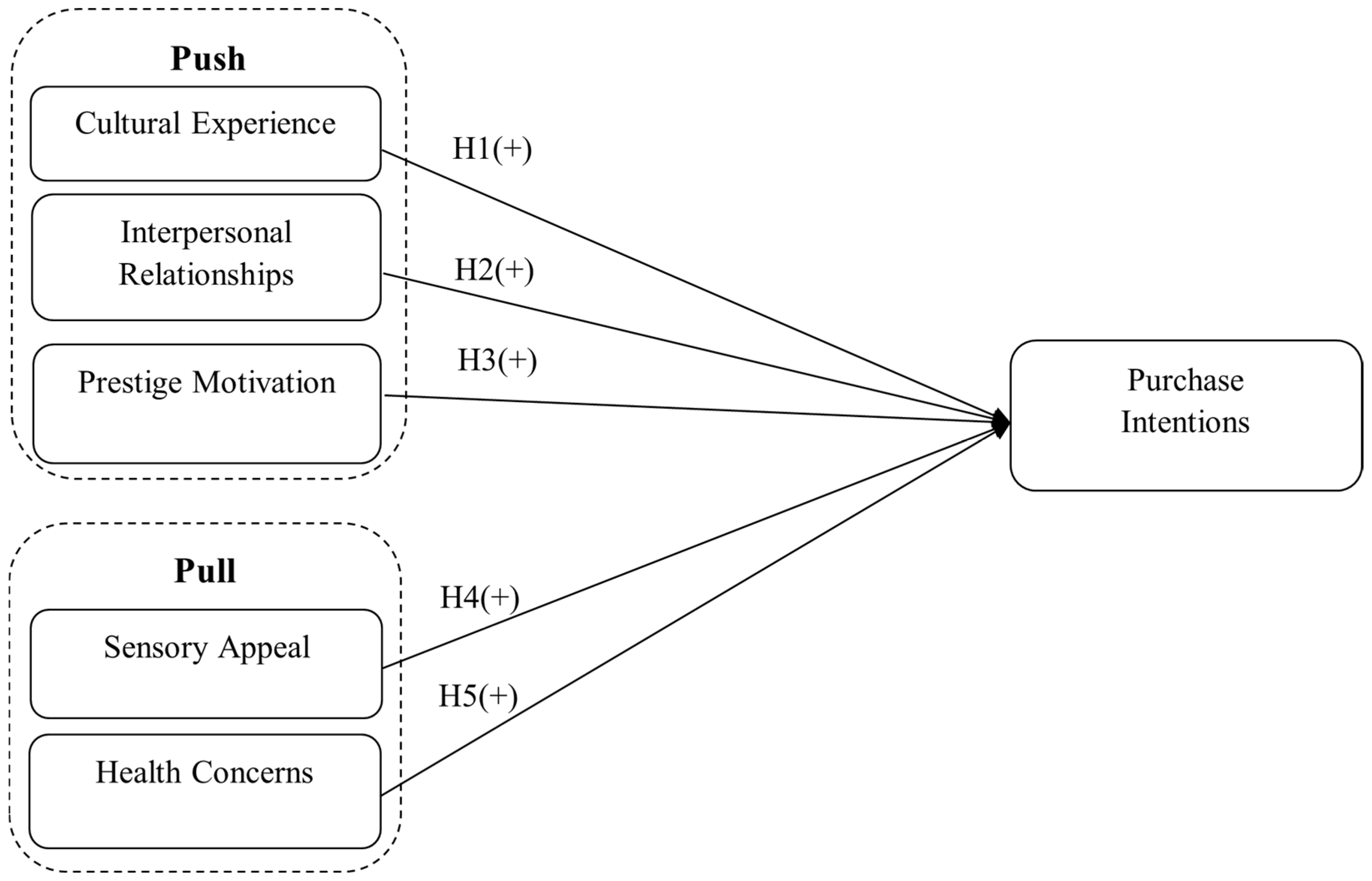
Building on the push–pull motivation framework and recent advances in culinary tourism research, this study develops an integrated model to explain domestic tourists’ intention to purchase local food in the Mekong Delta (
Figure 1). Food consumption is conceptualized as a central component of the tourism experience, contributing not only to satisfaction but also to destination attachment and behavioral intention (
Kivela & Crotts, 2006;
Stone et al., 2018).
The proposed framework incorporates five key motivational constructs: cultural experience, interpersonal relationships, prestige motivation, sensory appeal, and health concerns. Cultural experience reflects tourists’ desire to engage with local traditions and identities through food, which has been consistently identified as a primary driver of culinary tourism (
Kim et al., 2009;
Choe & Kim, 2018). Sensory appeal captures the experiential dimension of food consumption, including taste, smell, and visual presentation, which directly influences tourists’ evaluations and satisfaction (
Mak et al., 2012). Health concerns represent an increasingly important factor, particularly in shaping perceptions of food quality, safety, and nutritional value (
Sharma et al., 2021).
Interpersonal relationship motivation emphasizes the social function of food as a medium for interaction and bonding, while prestige motivation reflects the symbolic and status-related aspects of culinary consumption, especially in the era of digital sharing and social media (
Stone et al., 2018). However, the influence of these social motivations may vary across contexts, particularly between domestic and international tourists.
Unlike previous studies that primarily focus on destination choice or satisfaction, this study explicitly links culinary motivations to intention to purchase local food, thereby extending the application of the push–pull framework to a specific behavioral outcome. Furthermore, by situating the analysis within the Mekong Delta, the study incorporates a context-specific perspective that reflects the region’s unique culinary culture and consumption patterns.
Overall, the proposed framework contributes to the literature in three ways. First, it integrates multiple motivational dimensions into a unified model, addressing the fragmentation observed in prior research. Second, it extends the push–pull theory to explain local food purchasing behavior in a culinary tourism context. Third, it provides empirical evidence from an emerging destination, thereby enriching the geographical diversity of culinary tourism studies.
2.6. Research Hypotheses
Cultural experience motivation reflects tourists’ intrinsic desire to engage with local traditions, identities, and ways of life through food consumption. In culinary tourism, food serves as a cultural medium through which visitors can access intangible heritage, local knowledge, and symbolic meanings embedded in cuisine. Prior studies suggest that authentic culinary experiences enhance tourists’ emotional connection with destinations and stimulate consumption-related behaviors (
Kim et al., 2009;
Choe & Kim, 2018). In this sense, purchasing local food is not merely a transactional activity but also an extension of cultural immersion. Empirical evidence consistently shows that tourists who seek cultural authenticity are more likely to engage in local food consumption and related purchasing behaviors (
Akyuz, 2019;
Cordova-Buiza et al., 2021;
Galati et al., 2021). Accordingly, cultural experience motivation is expected to positively influence tourists’ intention to purchase local food. Hence, it is hypothesized that:
H1. Cultural experience motivation positively influences tourists’ intention to purchase local food.
Interpersonal relationship motivation emphasizes the social dimension of tourism experiences, where food consumption facilitates interaction, bonding, and shared experiences among travelers and between tourists and local communities. Food-related activities, such as dining together or participating in culinary experiences, provide opportunities for social connection and relationship building (
Fields, 2002). However, recent studies suggest that the strength of this motivation may vary depending on travel context, particularly between domestic and international tourists, as well as individual travel styles (
Suhartanto et al., 2022). While interpersonal motivations can enhance engagement with local food experiences, their direct influence on purchasing behavior remains context-dependent. Nevertheless, drawing on prior empirical findings (
Akyuz, 2019;
Cordova-Buiza et al., 2021), interpersonal relationship motivation is hypothesized to positively influence tourists’ intention to purchase local food. Therefore, it is hypothesized that:
H2. Interpersonal relationship motivation positively influences tourists’ intention to purchase local food.
Prestige motivation relates to the symbolic and status-oriented aspects of consumption, where individuals seek recognition, self-expression, and social distinction through their experiences. In the context of culinary tourism, prestige can be derived from consuming unique or high-quality local dishes, as well as sharing these experiences through social media platforms (
Stone et al., 2018;
Yeoman & McMahon-Beattie, 2016). This form of conspicuous consumption reflects the growing importance of experiential value and social signaling in tourism behavior. However, the relevance of prestige motivation may differ across cultural and socioeconomic contexts, with some studies reporting weaker effects among domestic tourists or in less luxury-oriented settings. Despite these variations, prior research indicates that prestige motivation can positively shape behavioral intentions in culinary contexts (
Galati et al., 2021). Therefore, it is expected that prestige motivation positively influences tourists’ intention to purchase local food. Thus, it is hypothesized that:
H3. Prestige motivation positively influences tourists’ intention to purchase local food.
Sensory appeal represents one of the most immediate and influential drivers of food-related behavior, encompassing taste, aroma, texture, and visual presentation. In culinary tourism, sensory experiences are central to tourists’ evaluation of local cuisine and significantly shape their overall satisfaction and behavioral responses (
Mak et al., 2012). Unlike more abstract motivations, sensory appeal operates at an experiential level, directly influencing decision-making during food consumption. Empirical studies consistently identify sensory attributes as key predictors of food choice and purchase intention (
Kim et al., 2009;
Galati et al., 2021). Given its direct and experiential nature, sensory appeal is expected to exert a strong positive influence on tourists’ intention to purchase local food. Then, it is hypothesized that:
H4. Sensory appeal motivation positively influences tourists’ intention to purchase local food.
Health concerns have emerged as an increasingly important motivational factor in tourism, particularly in the post-pandemic context. Tourists are becoming more conscious of food safety, hygiene, nutritional value, and the perceived health benefits of local ingredients (
Sharma et al., 2021). Local food is often associated with freshness, natural production methods, and authenticity, which contribute to positive health perceptions (
Kim et al., 2009). These perceptions can reduce perceived risk and increase trust in local food consumption, thereby enhancing purchase intention. Recent studies confirm that health-related motivations play a significant role in shaping tourists’ food choices and consumption behavior (
Cordova-Buiza et al., 2021;
Suhartanto et al., 2022). Accordingly, health concerns are expected to positively influence tourists’ intention to purchase local food.
H5. Health concerns positively influence tourists’ intention to purchase local food.
5. Conclusions and Implications
5.1. Conclusions
This study advances the understanding of culinary tourism behavior by empirically linking multidimensional culinary motivations to a specific consumption outcome—local food purchase intention—within the Mekong Delta context. The findings reveal a differentiated structure of motivational influence in which experiential (sensory appeal), functional (health concerns), and cultural (cultural experience) drivers exert significant effects, whereas social-symbolic motivations (interpersonal relationships and prestige) are non-significant.
Theoretically, three contributions emerge. First, the study extends push–pull motivation theory by shifting the focus from general behavioral intentions to behavior-specific explanation, thereby strengthening its predictive utility in tourism consumption research (
Crompton, 1979;
Ellis et al., 2018). Second, it identifies contextual boundary conditions, demonstrating that motivational salience varies in emerging, domestically oriented destinations, where familiarity and everyday consumption reduce the relevance of symbolic drivers (
Okumus et al., 2018). Third, the findings support a hierarchical differentiation of motivations, distinguishing between primary (experiential–functional) and secondary (social–symbolic) drivers, thus offering a more nuanced conceptualization of motivation–behavior linkages in culinary tourism (
Mak et al., 2012).
5.2. Implications
The results suggest that push–pull theory should be conceptualized as a dynamic and context-sensitive system rather than a static classification of motivations. The non-significance of prestige and interpersonal motivations indicates that not all motivational dimensions translate equally into behavior, particularly when consumption is culturally familiar and low in symbolic value. This highlights the need for future research to incorporate boundary conditions such as destination maturity, tourist type (domestic vs. international), and consumption context into motivational models. Furthermore, the prominence of sensory and health-related factors points to the importance of integrating experiential immediacy and risk perception into culinary tourism theory, particularly in post-pandemic settings where safety and embodied experience are central to decision-making (
Sharma et al., 2021). This reinforces calls for more behaviorally grounded models that bridge psychological motivations with actual consumption outcomes.
From a managerial perspective, the findings indicate that effective destination strategies should prioritize experience design and product attributes over symbolic positioning. (i) Enhancing sensory appeal: Businesses should invest in taste quality, presentation, and immersive dining environments to influence on-site decision-making and satisfaction; (ii) Strengthening health and safety communication: Transparent information on sourcing, hygiene standards, and nutritional value can reduce perceived risk and build consumer trust; and (iii) Leveraging cultural storytelling: Embedding local narratives, traditions, and heritage into culinary offerings can enhance perceived authenticity and experiential value.
Given the limited role of prestige and interpersonal motivations, luxury-based or status-signaling strategies may be less effective in this context. Instead, positioning local food as authentic, accessible, and experientially rich is likely to generate stronger behavioral responses and support sustainable destination development.
5.3. Limitations
This study has several limitations. The use of convenience sampling may limit generalizability, and the focus on domestic tourists constrains cross-cultural comparison. Future research should examine international tourist segments to assess whether social-symbolic motivations become more salient in unfamiliar contexts.
In addition, the study relies on self-reported purchase intention rather than actual purchase behavior. Although purchase intention is widely used as a proxy for behavioral outcomes in tourism and consumer research, intentions do not always translate into actual consumption behavior. Future studies could therefore employ transaction data, field experiments, observational methods, or longitudinal designs to better validate the intention–behavior relationship in culinary tourism contexts.
Additionally, incorporating moderating variables (e.g., age, income, travel style, or food involvement) could provide deeper insight into heterogeneous motivational effects. Methodologically, future studies are encouraged to employ SEM-based approaches (CFA and structural modeling) to further validate both measurement and structural relationships. Expanding research across different regions would also enhance the external validity and theoretical generalizability of culinary tourism models.