Article

The Mediating Role of Destination Brand Authenticity in the Relationship Between Online Destination Brand Experience and Destination Brand Engagement

1
Faculty of Economics and Administrative Sciences, Business Administration, Gaziantep University, Gaziantep 27000, Türkiye
2
Finance, Banking and Insurance Department, Bingöl University, Bingöl 12000, Türkiye
*
Author to whom correspondence should be addressed.
Tour. Hosp. 2026, 7(6), 161; https://doi.org/10.3390/tourhosp7060161
Submission received: 7 April 2026 / Revised: 17 May 2026 / Accepted: 28 May 2026 / Published: 3 June 2026

Abstract

This research focuses on the effects of online destination brand experience on destination brand authenticity, destination brand engagement, and external search behavior and behavioral intention. It also investigates the mediating effect of destination brand authenticity on the relationship between online destination brand experience and destination brand engagement. The research population consisted of visitors who had experienced the Zeugma and Gaziantep cultural tourism destinations. The Smart PLS (Partial Least Squares) statistical program was used for data analysis. The analysis results showed that online destination brand experience positively affected destination brand authenticity and destination brand engagement. Destination brand engagement influenced external search behavior and behavioral intention positively. However, the findings revealed that the social engagement dimension of destination brand engagement did not have a significant effect on external search behavior. Furthermore, the effect of the cognitive engagement dimension on behavioral intention was also insignificant. Finally, it was found that destination brand authenticity partially mediated the relationship between online destination brand experience and destination brand engagement.

1. Introduction

Branding is crucial for a destination. Destination branding includes elements, such as brand names, logos, and symbols, that are marketing tools to differentiate tourist attractions and reflect tourists’ experiences in a destination (Qayyum et al., 2025; Lin et al., 2024). Providing online experiences is inevitable for destinations in this branding process, given that these online platforms are increasingly used by visitors to search for information about a destination, plan their travel experience, and motivate them to take action by offering a wealth of content. Today’s visitors create experiences online before making decisions about a destination. Over 80% of visitors search for information online before making a travel decision (Google Travel Study, 2022). Of those planning a trip, 70% research destinations through blogs, vlogs, and review sites (Statista, 2023). Zeugma and Gaziantep, cultural tourism destinations, offer visitors experiences through digital platforms. The Zeugma Mosaic Museum, exhibiting a vast collection of Roman and Late Antique mosaics, is considered one of the world’s largest mosaic museums (Türkiye Tourism Promotion and Development Agency, 2023; Zeugma Mosaic Museum, 2024). This highlights the growing importance of online destination brand experience (ODBE) and the need for new models explaining how online experiences influence tourist behavior. Visitors who interact with destinations through online platforms are more likely to research tourism products and services on those platforms and to continue sharing information with other users. Therefore, it is crucial for destinations to understand user engagement to develop and implement digital marketing strategies through these platforms, thereby improving their performance. Tourism destinations are offering numerous opportunities to visitors by incorporating ODBE and destination brand authenticity (DBA) to enhance brand competitiveness and attractiveness. Because authenticity shapes tourists’ preferences and desires, it can be evident in the value propositions of destinations, products, services, and brands, and it plays an important role in destination tourism (Kim & Kim, 2020; Napoli et al., 2014).
DBA refers to the extent to which a city’s identity can be conveyed honestly and authentically, creating an engaging experience and a profound one for visitors. From cultural richness and rich history to enduring traditions, these elements play a significant role in shaping the destination’s image and engagement with visitors. When a destination can convey its brand authenticity, it can provide an engaging tourist experience and establishes an emotional connection between visitors and the place (Kumar & Kaushik, 2022). Therefore, tourism destinations are now placing greater emphasis on increasing brand engagement by exploring diverse, authentic experiences to enhance brand competitiveness. Behavioral outcomes resulting from interactions offered through online platforms can significantly impact the destination’s success. Therefore, ODBE relies on visual and interactive elements to communicate brand value and create virtual representations of the destination. Therefore, destination brands should leverage such research findings by exploring opportunities to offer tourists relevant and enjoyable online experiences (Can et al., 2025b; Haq et al., 2024).
Today, online social networks and smartphones make these interactions easier. Visitors can share information, write reviews, and recommend tourist destinations anytime and anywhere. Online platforms are said to have a significant impact on destination branding and destination engagement (Marine-Roig & Clavé, 2015). Destination brand engagement (DBE) is also influenced by the experiences offered by these online platforms and encourages positive visitor behavior (Kumar & Kaushik, 2020; Mariani et al., 2018). Brand social media platforms are critical for engaging visitors (Taecharungroj et al., 2024). Social media destination brand pages contribute to the overall destination experience by enabling travelers to interact with brands in the pre-visit period (to seek and find their motivation for visiting) (Lonardi et al., 2024). Therefore, to stand out online, destination brands are using advanced communication and interactive technologies through websites, social media, and virtual reality platforms (Jiménez-Barreto et al., 2019). A better understanding of the impact of these technologies is crucial for developing strategies to enhance destination sustainability by creating and managing authenticity through digital interactions.
Despite the increasing importance of digital tourism platforms, the existing literature still provides a limited understanding of how online destination brand experiences shape tourists’ perceptions and behavioral responses, particularly within cultural heritage destinations. Previous studies have generally focused on isolated relationships, such as destination brand authenticity, engagement, or behavioral intention, while the integrated mechanism linking ODBE, DBA, DBE, external search behavior, and behavioral intention remains underexplored. Furthermore, they have predominantly concentrated on general tourism settings, with limited attention given to culturally rich destinations where authenticity plays a central role in shaping visitor perceptions and engagement. In addition, although authenticity has been recognized as a crucial tourism construct, the mediating role of DBA in explaining how online experiences translate into behavioral outcomes has not been sufficiently researched in the destination branding literature.
To address these gaps, the present study develops and tests a comprehensive model integrating ODBE, DBA, DBE, external search behavior, and behavioral intention within the context of Zeugma and Gaziantep cultural tourism destinations. This study contributes to the tourism and destination branding literature in three ways. First, it extends the understanding of how digitally mediated destination experiences influence tourists’ perceptions, engagement, and behavioral outcomes. Second, it reveals the mediating role of destination brand authenticity in the relationship between online destination experiences and visitor responses. Third, it provides empirical evidence from culturally and historically significant destinations, thereby enriching the limited literature on digital destination branding in heritage tourism contexts. Beyond the contextual contribution, this study also provides a theoretical contribution by explaining the underlying psychological and relational mechanisms through which online destination brand experiences influence visitor responses. Specifically, the study conceptualizes destination brand authenticity not merely as a direct outcome of online experiences but as a mediating mechanism that transforms digitally mediated destination interactions into deeper engagement and behavioral outcomes. This study sets out to contribute to the growing literature on digital destination branding by integrating authenticity, engagement, and behavioral processes within a single comprehensive framework.

2. Conceptual Framework

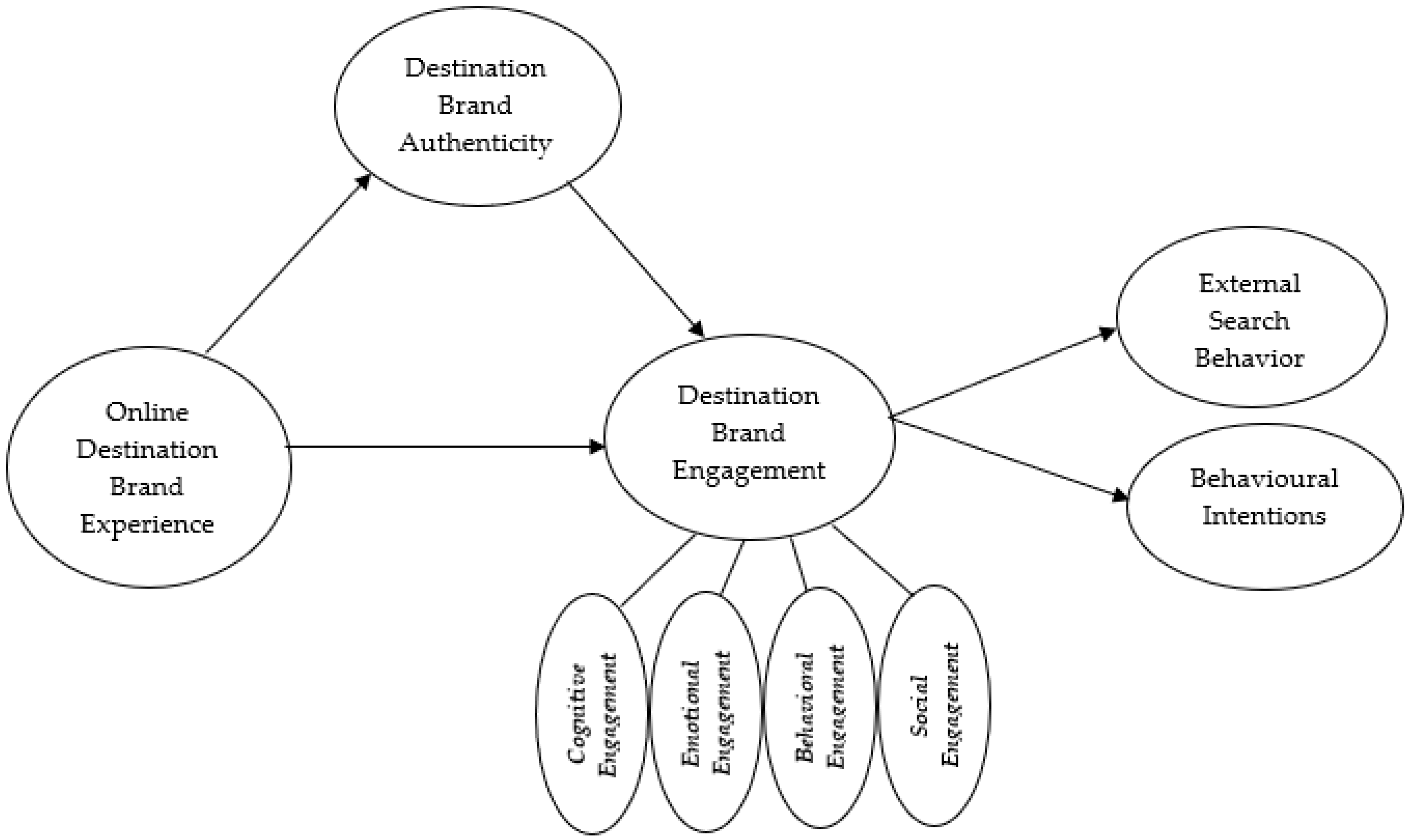
The conceptual model of this study drew on relationship marketing, consumer–brand engagement theory, and experiential perspectives in tourism research. These perspectives suggest that digitally mediated destination experiences shape visitors’ cognitive, emotional, and behavioral responses through interactive and relational mechanisms. In this context, the online destination brand experience is expected to influence visitors’ perceptions of authenticity, thereby strengthening destination brand engagement and behavioral outcomes. The framework also assumes that tourists’ interactions with destination-related digital content are not merely informational processes but also experiential and psychologically meaningful, influencing external search behavior and future behavioral intentions. Therefore, the proposed model integrates authenticity, engagement, and behavioral processes into a unified theoretical framework explaining how online destination experiences influence visitor responses in cultural heritage tourism contexts.

2.1. Online Destination Brand Experience

Adapted from customer experience literature (Brakus et al., 2009), ODBE is defined as the sum of affective, emotional, cognitive, and behavioral outcomes resulting from visitors’ internal and subjective responses to their interaction with a destination’s online platforms (Khan & Fatma, 2021; Jiménez-Barreto et al., 2020). Recent tourism studies increasingly emphasize that online destination experiences are not merely informational tools but also experiential environments that shape tourists’ perceptions, emotions, and behavioral responses before physical travel occurs. In this context, ODBE has become an important strategic component of destination branding and digital tourism marketing. Visitors use these online platforms to gain motivation and take action. Through multimedia content, such as videos, images, audio, and text, they can get to know and experience the destination before a physical visit. Therefore, depending on these experiences, DBA, DBE, external search behavior (ESB), and behavioral intention (BI) are influenced, playing a critical role in the success of the destination. Online environments are two-way communication channels where destinations present their content to millions of visitors. This channel strengthens visitors’ connection with the destination by improving DBE and DBA (Shah et al., 2025; Candrea et al., 2025). However, previous studies have not reached a clear consensus regarding the extent to which online destination experiences consistently influence visitor engagement and behavioral outcomes. While some studies emphasize the positive role of immersive and interactive digital experiences, others suggest that the effectiveness of online experiences may vary depending on contextual factors, such as destination type, perceptions of authenticity, technological quality, and visitor motivations. These inconsistencies indicate that the mechanisms through which ODBE shapes visitor responses remain insufficiently understood.

2.2. Destination Brand Authenticity

DBA is defined as visitors’ perception that a destination represents its own values and origins, is perceived as authentic and genuine, and is honest in fulfilling its promises (Shi et al., 2022). DBA is the degree to which visitors rate a destination as sustainable, reliable, and honest (R. Chen et al., 2020). The concept of authenticity has been widely discussed in tourism literature through different theoretical perspectives. Early studies primarily focused on object-based authenticity, which emphasizes the originality and genuineness of tangible cultural objects and heritage elements. Later, constructivist perspectives suggested that authenticity is socially constructed through tourists’ perceptions and interpretations rather than being objectively inherent in destinations. In addition, existential authenticity emphasizes the emotional and self-related experiences tourists gain through interactions with destinations (N. Wang, 1999). In destination branding, authenticity has become increasingly important, as tourists seek meaningful, trustworthy, and culturally rich experiences that differentiate destinations from standardized tourism offerings. However, previous studies have largely focused on physical tourism experiences, while limited attention has been given to how digital and online destination experiences contribute to the formation of destination brand perceptions of authenticity. Therefore, examining DBA within digitally mediated destination environments remains an important research area. DBA positively influences emotional commitment and behavioral outcomes by building trust in visitors (Yi et al., 2022). The importance of DBA is becoming increasingly significant. Today, visitors seek authentic and immersive experiences to feel the local atmosphere, interact with locals, and understand the essence of the culture. A destination that is aware of and strives to preserve and develop its DBA will increase its visitor attractiveness and contribute to sustainable economic and social development. Therefore, the authenticity of a destination brand is a crucial factor in tourism decisions. Authenticity positively influences tourists’ attitudes, participation, and behavioral intentions toward cultural heritage sites (Luo et al., 2024). DBA has a positive effect on tourism experience and emotions, which in turn has a significant impact on tourists’ destination choice and behavioral intentions (Khan & Fatma, 2021; Kumail et al., 2022). Nevertheless, authenticity remains a concept subject to ongoing debate in the tourism literature. Some scholars view authenticity as an objective characteristic inherent in destinations and cultural assets, whereas others argue that authenticity is subjectively constructed through tourists’ personal interpretations and experiences. In digital tourism environments, these debates become even more complex because online representations may simultaneously enhance perceptions of authenticity while also creating concerns about commercialization, staged experiences, or artificial representations of local culture.

2.3. Destination Brand Engagement

DBE encompasses cognitive, behavioral, and emotional processes as the totality of visitor interaction with a destination (R. Chen et al., 2020). Considered in four dimensions, cognitive engagement, emotional engagement, behavioral engagement, and social engagement, DBE significantly impacts participation due to visitors making recommendations and sharing information in digital environments. The cognitive engagement dimension of DBE reflects visitors’ interest in the destination and their desire to learn more about it (e.g., prices, opening hours, and booking details). The emotional engagement dimension is described as the degree of passion, excitement, and happiness visitors feel in response to positive emotions. Behavioral engagement, another dimension, is defined as investing energy and time in recommending or encouraging others to visit that destination. Finally, social engagement is the interaction visitors develop with communities related to the destination. These groups can include digital brand communities or other types of communities (Cheung et al., 2023). Destination brand engagement is theoretically grounded in relationship marketing and consumer–brand engagement theory, which emphasize the development of long-term interactive relationships between consumers and brands (R. Chen et al., 2020). In tourism contexts, engagement reflects tourists’ cognitive, emotional, behavioral, and social connections with destinations that emerge through interactive experiences across both physical and digital environments. Recent developments in digital tourism platforms and social media have transformed engagement into a more participatory and co-creative process, enabling tourists not only to consume destination-related content but also to actively share experiences, interact with other users, and contribute to the formation of the destination image. Nevertheless, previous studies have reported inconsistent findings regarding the effects of different engagement dimensions on tourist behavior, suggesting that contextual factors, such as destination type, perceptions of authenticity, and emotional attachment, may influence engagement outcomes. Moreover, previous studies differ in their findings regarding which engagement dimension exerts the strongest influence on tourist responses, suggesting that engagement processes may operate differently across tourism contexts and digitally mediated experiences. Therefore, further investigation of DBE within cultural heritage destinations remains necessary.

2.4. External Search Behavior

ESB represents long-term behavioral intent stemming from an intimate relationship between the visitor and the destination brand. ESB is information-seeking activity not directly related to purchase needs. Travelers exhibit external search behavior when browsing tourism-related information on digital tourism platforms, subscribing to destination-related social media channels, and searching for shared experiences on digital blogs (Filieri et al., 2020). Visitors with strong behavioral and social engagement are more likely to use digital platforms to search for destination-related information consistently (Cheung et al., 2023).

2.5. Behavioral Intentions

Behavioral intention, defined as a visitor’s conscious and planned tendency to engage in future behaviors (Wong et al., 2020; Hamarat et al., 2026; Sukthankar et al., 2026), is considered a significant factor in the tourism experience. This is because it provides information about visitors’ future interactions with the destination, serving as a fundamental reference point in making and implementing critical decisions. This, in turn, enables tourism managers to utilize resources more effectively and improve their marketing efforts (Yeh et al., 2025; Matiza & Kruger, 2021). In destination marketing, the interaction offered by ODBE manifests in visitors’ cognitive, emotional, and behavioral responses, thereby enhancing DBE and directly influencing behavioral intentions (So et al., 2020).

3. Theoretical Framework

3.1. Online Destination Brand Experience and Destination Brand Authenticity

ODBE generates affective, emotional, cognitive, and behavioral outcomes by eliciting responses through experiences on online platforms and motivates visitors to engage. Another factor that provides this motivation to visitors is the search for authentic experiences (Deb & Lomo-David, 2021). Experiences offered by online platforms are considered both an antecedent and a consequence of DBA (Islam et al., 2020). This is because authenticity, as a fundamental element of cultural and natural destinations, is related to both tourists’ perceptions of a destination and what it offers, as well as their emotional connection and positive behaviors towards it (Kim & Kim, 2020). Therefore, DBA positively develops tourist–brand relationships (Kumar & Kaushik, 2022) and is also influenced by the experiences provided by online platforms (Dai et al., 2021; Paraskevaidis & Weidenfeld, 2021). A significant positive relationship has been found between brand experience and brand authenticity (Tran & Nguyen, 2022; Murshed et al., 2023). Therefore, the brand experience offered by digital platforms is an important factor in shaping visitors’ perception of authenticity (Shizhen et al., 2025). Praswati et al. (2021) also show in their research that online destination brand experience positively affects destination brand authenticity. Therefore, the first hypothesis is proposed as follows:
H1. 
Online destination brand experience positively affects destination brand authenticity.

3.2. Online Destination Brand Experience and Destination Brand Engagement

Destination experiences encompass consumer sensations, emotions, understanding, and behavior evoked by stimuli associated with a brand. ODBE enhances brand engagement by aligning these experiences with a distinctive and memorable one, helping destinations create positive impressions and meet visitor expectations (Satar et al., 2024). It is suggested that interactive social connections facilitated by online platforms may encourage future use of digital platforms, increasing the desire to connect and interact with other groups. Visitors using online platforms demonstrate increased behavioral and social engagement, and their internal and subjective responses are positively influenced by their interaction with the destination’s online platforms (Leung et al., 2022; Y. Wang et al., 2020). Research shows that social media content can trigger processes that promote visit intentions, brand recommendations, loyalty, and engagement (Jiménez-Barreto et al., 2019, 2020; Khan & Fatma, 2021; Can et al., 2025a; Grosso et al., 2024). Online destination brand experience positively influences brand engagement (Jiménez-Barreto et al., 2020). Consistent with previous studies, the following hypotheses are proposed in this research:
H2a. 
Online destination brand experience positively influences cognitive engagement.
H2b. 
Online destination brand experience positively influences emotional engagement.
H2c. 
Online destination brand experience positively influences behavioral engagement.
H2d. 
Online destination brand experience positively influences social engagement.

3.3. Destination Brand Authenticity and Destination Brand Engagement

Brands with high authenticity are said to have good quality, higher consumer awareness, and easier purchase ability, which in turn increases brand engagement (X. Chen et al., 2021). In terms of destinations, authenticity is considered a fundamental service in destination engagement for visitors. This is because DBA reinforces visitors’ experience of avoiding routines during a tour and of engaging with the brand more authentically (R. Chen et al., 2020). There is a positive correlation between DBA and DBE (Sjuhada & Zulfa, 2024). This indicates that brand authenticity increases tourist engagement. In other words, when DBA is high, it shows that the need for authenticity is met and tourists are more likely to achieve a high level of destination brand engagement (Bryce et al., 2015). Perceived authenticity in destinations leads to positive outcomes for visitors’ sensory, emotional, intellectual, and behavioral brand experiences (Wareebor et al., 2025). DBA is one of the key factors in brand engagement that positively influences visitor emotions (Luo et al., 2024; Majeed & Kim, 2024; Safeer et al., 2021) and is among the most critical indicators of attracting visitors (Park et al., 2023). Therefore, the following hypotheses are proposed:
H3a. 
Destination brand authenticity positively influences cognitive engagement.
H3b. 
Destination brand authenticity positively influences emotional engagement.
H3c. 
Destination brand authenticity positively influences behavioral engagement.
H3d. 
Destination brand authenticity positively influences social engagement.

3.4. Destination Brand Engagement and External Search Behavior

DBE motivates visitors based on their perception of a product or service that engages their senses or mind. Specifically, it enhances external search behavior by directing them to engage more internally with a particular brand, thereby increasing brand interest. Emotional brand engagement encourages visitors to explore further digital tourism platforms offering services related to the destination by expressing the feelings stemming from their interaction with the brand. Visitors increase engagement by exhibiting external search behavior when browsing tourism-related information on digital tourism platforms, subscribing to destination-related social media channels, and searching for shared experiences on digital tourism sites (Filieri et al., 2020). It is stated that visitors’ acquisition of useful information on digital tourism platforms is driven by cognitive engagement, which in turn, fosters repetitive behaviors (Kim & Kim, 2020). Behavioral engagement is defined as the time, energy, and effort travelers spend interacting with a destination. This has increased with the development of social media technology, and visitors exhibiting high levels of behavioral engagement are more willing to recommend activities and visit the destination with like-minded visitors (Touni et al., 2020; Parihar & Dawra, 2020). Therefore, it is stated that DBE increases visitor interaction by being influenced by experiences offered through mobile applications and online platforms (Fang et al., 2017; Kumar & Kaushik, 2020; Cheung et al., 2023). Hence, this study proposes the following hypotheses:
H4a. 
Cognitive engagement positively influences external search behavior.
H4b. 
Emotional engagement positively influences external search behavior.
H4c. 
Behavioral engagement positively influences external search behavior.
H4d. 
Social engagement positively influences external search behavior.

3.5. Destination Brand Engagement and Behavioral Intentions

Visitors are attracted to brands that can influence physical interactions or behaviors, thereby stimulating bodily experiences. Destination brand engagement positively affects visitor-brand engagement and behavioral intention through satisfaction with behavioral experiences, encompassing cognitive, emotional, behavioral, and social engagement elements (Ahn & Back, 2018; Kumar & Kaushik, 2020). The rich content of the Zeugma and Gaziantep destinations increases the tendency to actively participate in activities (Zeugma Mosaic Museum, 2024). Therefore, a high level of visitor engagement and interaction with a destination leads to positive word-of-mouth, resulting in positive behavioral intention to recommend the destination to others. It is also stated that visitors’ participation in events organized in tourism destinations affects their intention to revisit (Bryce et al., 2015; So et al., 2016). High levels of DBE, meaning the overall interaction (cognitive, behavioral, and emotional) that travelers develop with the destination they are interested in, have a positive motivational effect on BI. Visitors with higher engagement in a destination brand community are more likely to exhibit positive behavioral intentions towards the destination (Moro & Rita, 2018). In particular, travelers’ emotional attachments to these destinations constantly drive them to search for information about them on digital platforms (Scarpi et al., 2019; R. Chen et al., 2020). Therefore, this study makes the following predictions:
H5a. 
Cognitive engagement positively influences behavioral intention.
H5b. 
Emotional engagement positively influences behavioral intention.
H5c. 
Behavioral engagement positively influences behavioral intention.
H5d. 
Social engagement positively influences behavioral intention.

3.6. The Mediating Role of Destination Brand Authenticity

The motivational role of authenticity influences tourists’ experiences by shaping their cognitive willingness to engage (Yi et al., 2022; Taheri et al., 2020). This is because authenticity functions as an internal validation process. When authenticity is perceived, tourists are more likely to believe that the destination can offer meaningful, culturally compatible experiences, thereby strengthening their motivational readiness to visit (Kim & Kim, 2020). Brand authenticity is considered a significant outcome of brand experience that leads to brand success and helps brands become more authentic (Tran et al., 2020). Therefore, DBA functions as a transmission mechanism guiding future travel decisions and can explain a potential transformation in destination brand engagement within the context of online destination brand experience (Hasanein et al., 2026).
Authentic experiences enhance destination brand experience by freeing tourists from constraints, leading them to recommend the destination to others and revisit it in the near future, thus influencing behavioral and social engagement (Yi et al., 2017; Jiang et al., 2017). Authenticity affects DBE by being influenced by visitors’ lived experiences. It is considered that authenticity can lead tourists to develop a richer emotional attachment to the destination through ODBE. This is because the authenticity of the destination meets the intended meaning or existential desire that tourists expect from travel (Jiang et al., 2017), thereby increasing cognitive and affective engagement (Cheung et al., 2023).
DBA triggers participation in activities, interaction, and emotional and behavioral responses (Taheri et al., 2020; Amer et al., 2023). Authenticity influences the online destination brand experience in this environment by shaping expectations, pre-preferences, cognitive engagement, and the social, behavioral, and emotional aspects of DBE (Zhou et al., 2023; Rickly, 2022). DBE significantly affects attitudinal and behavioral loyalty bonds such as behavioral intention (Shi et al., 2022; Yin & Dai, 2021). Considering that DBA can play a role between ODBE and DBE by increasing emotional commitment (Khan & Fatma, 2021) and DBE (Luo et al., 2024; R. Chen et al., 2020), the following hypotheses are proposed:
H6. 
Destination brand authenticity mediates the relationship between online destination brand experience and cognitive engagement.
H7. 
Destination brand authenticity mediates the relationship between online destination brand experience and emotional engagement.
H8. 
Destination brand authenticity mediates the relationship between online destination brand experience and behavioral engagement.
H9. 
Destination brand authenticity mediates the relationship between online destination brand experience and social engagement.

4. Method

The primary aim of this study is to investigate the effects of online destination brand experience on destination brand authenticity, destination brand engagement, external search behavior, and behavioral intentions. Furthermore, the study explores the mediating role of destination brand authenticity in the relationship between online destination brand experience and destination brand engagement (see Figure 1). A quantitative research method was adopted to test the proposed conceptual model, and the data were analyzed using SmartPLS 4.1.1.8, which is suitable for examining complex relationships among latent variables and for prediction-oriented structural models.
The research population consisted of individuals who had visited the Zeugma and Gaziantep cultural tourism destinations within the last 12 months and obtained information about these destinations through online platforms such as official tourism websites, virtual museums, social media, blogs, and travel platforms. Zeugma and Gaziantep were selected as the empirical context of the study because they represent one of Türkiye’s most distinctive cultural tourism settings, combining historical heritage, archaeological value, gastronomy, and destination identity. In particular, Zeugma is internationally recognized for its archaeological and museum-based heritage, while Gaziantep is widely associated with cultural and gastronomic tourism. Therefore, these destinations provide an appropriate context for examining how online destination brand experience shapes tourists’ perceptions of authenticity, engagement, search behavior, and behavioral intentions.
The selection of respondents was based on their relevance to the research purpose. Since the study focuses on online destination brand experience, only individuals who had both visited the relevant destinations and had been exposed to online destination-related content before or during their visit were included in the sample. This criterion ensured that participants had sufficient experience to evaluate the online representation of the destination as well as its perceived authenticity and engagement outcomes. Before completing the questionnaire, respondents were asked to review specific online content related to the destinations, such as official promotional websites and virtual museum applications. This procedure was applied to standardize participants’ exposure to online destination information and to strengthen the validity of their evaluations.
Data were collected through a survey-based research design. The questionnaire was administered online to individuals who met the sampling criteria. Participants were reached through online survey forms, and the data collection process was supported by social media groups and travel-related online communities. A convenience sampling method was used due to the absence of a complete sampling frame for all visitors to the Zeugma and Gaziantep destinations and the practical difficulty of accessing the entire population. Although convenience sampling limits the statistical generalizability of the findings, the use of screening criteria ensured that the sample consisted of respondents relevant to the study context. Therefore, the sample can be considered appropriate for representing the target population of recent visitors who experienced these destinations and interacted with destination-related online content.
The data collection process was carried out in the first quarter of 2026. After the data cleaning process, incomplete and invalid questionnaires were removed, and 482 valid and complete questionnaires were included in the final analysis.
The measurement items used in this study were adapted from previously validated scales in the literature. The ODDBE assessment items were adapted from Khan and Fatma (2021). Participants rated these items on a 5-point Likert scale, where 1 means “strongly disagree” and 5 means “strongly agree.” The DBA and BI constructs were assessed using the scale proposed by Can et al. (2025b), which was also measured on a 5-point Likert scale. The items for cognitive engagement, emotional engagement, behavioral engagement, and social engagement identified for DBE, as well as ESB, were taken from Cheung et al. (2023). Similarly, visitors were asked to rate the statements using a 5-point Likert scale.
To ensure methodological transparency and contextual appropriateness, the questionnaire was adapted to the Zeugma and Gaziantep cultural tourism context. General expressions in the original scales were revised to reflect the selected destinations and their online content, including official tourism websites, virtual museum applications, social media content, travel platforms, and other destination-related digital information sources. The adapted questionnaire was then reviewed by academic experts in tourism marketing, destination branding, and consumer behavior to assess content validity, clarity, and contextual relevance. Based on their feedback, minor wording revisions were made to improve readability.
Before the main data collection, a pilot test was conducted with a small group of participants with characteristics similar to those of the target sample. The pilot test evaluated item clarity, questionnaire flow, completion time, and the suitability of the items for the cultural tourism context. Since no major comprehension problems were identified, the questionnaire was finalized for the main survey. In addition, the reliability and validity of the adapted scales were statistically examined during the main analysis through Cronbach’s alpha, composite reliability, average variance extracted, and discriminant validity procedures.

Data Analyses

In this study, SmartPLS 4.1.1.8was used as the statistical and analytical tool. Partial least squares structural equation modeling (PLS-SEM) was used as the primary analytical technique due to its suitability for predictive research and theory development in complex models involving multiple latent structures and mediating relationships (Hair et al., 2019; Elshaer et al., 2025). Unlike covariance-based SEM, PLS-SEM imposes fewer constraints on data distribution and is particularly suitable when the research objective is to explain the variance in underlying endogenous structures rather than to validate an established theoretical model (Hair et al., 2017). In this respect, PLS-SEM was considered a suitable methodological choice. This research focuses on the effects of online destination brand experience on destination brand authenticity, destination brand engagement, and external search behavior and behavioral intention. It also uses the Partial Least Squares (PLSc) method to examine the key factors of the mediating model between destination brand authenticity, online destination brand experience, and destination brand engagement. In light of these fundamental factors, the proposed model addresses an area that has not been sufficiently studied and where generalized conclusions have not yet been drawn. The primary aim is to explore the theoretical structural relationships within the proposed model and to evaluate the predictive effectiveness of exogenous variables.
In the evaluation of the measurement model, Cronbach’s alpha (α) and external model validity (Composite Reliability (CR), Average Variance Extracted (AVE), external loadings, Fornell–Larcker criterion, and Heterotrait–Monotrait Ratio (HTMT)) were calculated. For the evaluation of the structural model, InnerVIF, R2 and f2 values were used. Subsequently, Structural Equation Modeling (SEM) was applied to test the proposed hypotheses.
Given the cross-sectional and single-informant nature of the data, potential common-method bias was considered at both the research design and statistical assessment stages. In terms of procedural remedies, several measures were taken during questionnaire design and data collection to reduce potential common method effects (Podsakoff et al., 2003). Participation was voluntary, respondent anonymity was assured, and participants were informed that there were no right or wrong answers. In addition, the questionnaire items were presented clearly and neutrally to reduce evaluation apprehension and social desirability bias. The measurement items were also adapted from previously validated scales, and their wording was reviewed to ensure clarity and contextual appropriateness.
In addition to these procedural remedies, a full collinearity test was conducted to statistically assess potential common method bias. Following Kock (2015), variance inflation factor values were examined for all latent constructs. The results indicated that all VIF values were below the conservative threshold of 3.3, suggesting that common method bias is unlikely to be a serious concern in this study. Furthermore, in the structural model assessment, all inner VIF values were below 3, indicating that multicollinearity among the constructs was not a critical issue.
Nevertheless, because the data were collected using a cross-sectional, self-reported survey design, the possibility of common method effects cannot be ruled out. Similarly, potential endogeneity concerns may arise from omitted variables, measurement error, or simultaneous relationships among perceptual constructs. Although the hypothesized relationships in this study were developed based on prior theory and relevant literature, the cross-sectional design does not allow strong causal inferences. Therefore, the results should be interpreted as evidence of theoretically grounded associations rather than definitive causal effects.

5. Results

First, the demographic characteristics of the survey participants are summarized, and the detailed results are presented in Table 1.
Demographic findings related to the sample showed that participants were predominantly young and young adult individuals. The largest share was held by the 25–34 age group (34.0%), followed by the 18–24 age group (25.5%) and the 35–44 age group (18.1%). 56.0% of the participants were female and 44.0% were male; 59.3% are single and 40.7% were married. In terms of education level, bachelor’s degree holders constituted the largest group with 39.6%, followed by associate degree holders (22.0%) and postgraduate degree holders (17.4%). In terms of income distribution, the middle-income group was the largest (42.3%), while the low-income group accounted for 29.5%. The study was based on 482 valid survey data collected using convenience sampling in the first quarter of 2026 from individuals who visited Zeugma and Gaziantep within the last 12 months and obtained information about the destination through online platforms. This indicates that the sample points to a visitor profile that is relatively young, highly educated, and concentrated in the middle-income group, who particularly utilize digital information resources.

5.1. Measurement Model Assessment

The measurement model was examined to assess the validity of the constructs, including convergent and discriminant validity evaluations (Hair et al., 2014). Initially, external loadings were examined, and it was found that all items exceeded the 0.50 threshold (Kaiser, 1974).
Convergent validity was assessed using AVE and CR. It was determined that AVE values should be at least 0.50 (Fornell & Larcker, 1981), and CR values exceeding 0.70 are considered acceptable thresholds for all constructs (Chin, 1998). Factor structure reliability was also assessed using the Cronbach’s alpha coefficient (Marmaya et al., 2019). In this study, all Cronbach’s alpha coefficients were above 0.70, demonstrating satisfactory internal consistency (Hair et al., 2019). Similarly, all CR values exceeded the 0.70 threshold and all AVE values exceeded 0.50. The results reported in Table 2 demonstrate good model fit. Overall, based on these analyses, the measurement model was confirmed to be both reliable and valid.
To assess the discriminant validity of the scales, the HTMT and the Fornell–Larcker criterion were analyzed. The HTMT results are presented in detail in Table 3. The analysis showed that all HTMT values were below 0.85, confirming sufficient discriminant validity (Hair et al., 2019).
Secondly, the Fornell–Larcker criterion was calculated to ensure discriminant validity. For this purpose, the square root of the AVE values was calculated for each construct and compared with the correlations among the constructs. The results are presented in detail in Table 4.
The analysis revealed that the square root of AVE exceeded the correlations among constructs for all constructs (Fornell & Larcker, 1981). Based on these assessments, it was concluded that the scales possess sufficient discriminant validity.
To assess overall model fit, various goodness-of-fit indices were examined, including the standardized root mean square residual (SRMR), normed fit index (NFI), and discrepancy measures d_G and d_ULS. The SRMR value was 0.040, below the commonly accepted threshold of 0.08, indicating an acceptable level of model fit (Hu & Bentler, 1999). The NFI value was 0.867, indicating a satisfactory fit and approaching the recommended benchmark value of 1.0 (Hair et al., 2013). In addition, the discrepancy measures d_G (0.453) and d_ULS (1.123) exceeded the 0.05 threshold, indicating that the estimated model differs sufficiently from the saturated model, as suggested by Dijkstra and Henseler (2015). The model’s chi-square value was calculated as 1285.839. When these results are considered as a whole, it is seen that the proposed model exhibits an acceptable level of fit within the context of PLS-SEM analysis.

5.2. Structural Model Assessment

To structurally evaluate the research model, Inner VIF, coefficient of determination (R2), and effect size (f2) were examined. For the scales used in this study, all Inner VIF values are below 3, indicating that multicollinearity between structures is not a problem (Diamantopoulos & Siguaw, 2006). The results are presented in detail in Table 5. Secondly, in the structural model analysis, the ratio of variance explained by the independent variables in the dependent variables was evaluated through R2 values. Accordingly, the explained variance was determined as 0.26 for BE, 0.42 for BI, 0.22 for CE, 0.31 for DBA, 0.24 for EE, 0.37 for ESB, and 0.23 for SE. These values generally exceed the typical 0.20 threshold required in consumer research (Marmaya et al., 2019). Thirdly, effect size (f2) values were analyzed in the structural model. According to Cohen (1988), f2 values between 0.02 and 0.15 indicate a low effect, between 0.15 and 0.35 a moderate effect, and above 0.35 a high effect. The results revealed that the effect sizes were generally small. Effect size results are presented in Table 5.
After evaluating both the measurement model and the structural model, the proposed hypotheses were tested using SEM. A detailed summary of the hypothesis testing results is presented in Table 5.
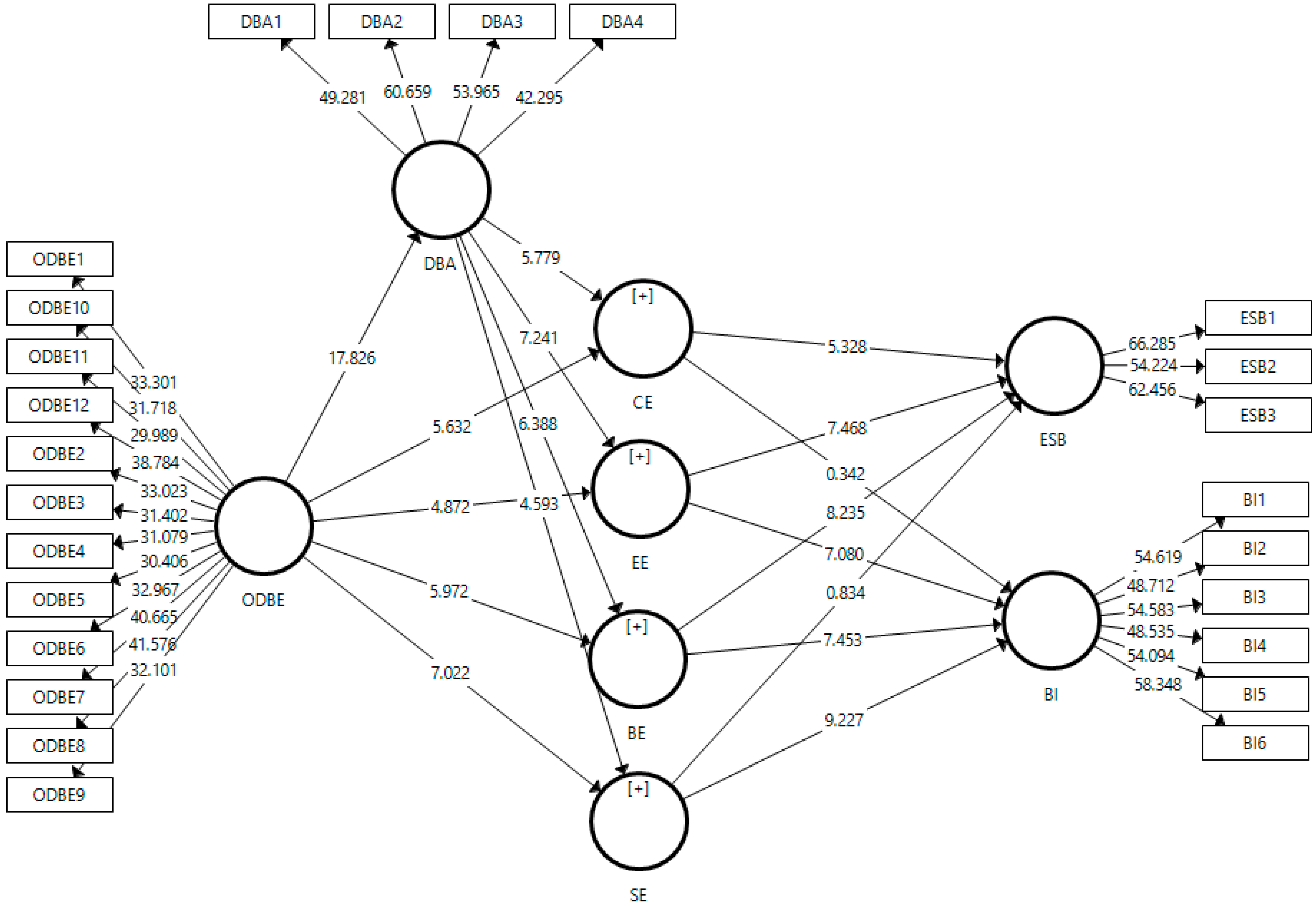
The findings from the SEM analysis show that ODBE has a positive effect on DBA, CE, EE, BE, and SE. Accordingly, hypotheses H1, H2a, H2b, H2c, and H2d are supported. DBA positively affected CE, EE, BE, and SE, supporting hypotheses H3a, H3b, H3c, and H3d. Furthermore, it was observed that CE, EE, and BE positively affect ESB, leading to the acceptance of hypotheses H4a, H4b, and H4c. However, SE had no effect on ESB; therefore, hypothesis H4d was not accepted. Finally, the effects of the DBE dimensions on BI were examined. EE, BE, and SE had a positive effect on BI, supporting hypotheses H5b, H5c, and H5d. However, CE had no effect on BI; therefore, hypothesis H5a was not accepted. Beta coefficients and significance levels for these relationships are presented in Figure 2 and Table 5.
Finally, the mediating effect of DBA on the relationship between the ODBE and DBE dimensions was examined.
Mediation analysis revealed that DBA significantly mediated the relationships across all ODBE and DBE dimensions (CE-EE-BE-SE). Consequently, hypotheses H6, H7, H8, and H9 are supported (see Table 6). Since both direct and indirect effects were significant, the type of mediation was described as “partial mediation” (Zhao et al., 2010).

6. Discussion

This research examines the effects of online destination brand experience on destination brand engagement, destination brand authenticity, external search behavior, and behavioral intention, thereby questioning the mediating role of destination brand authenticity. According to the study’s results, all hypotheses except H4d and H5a are supported.
According to the research results, the hypothesis (H1) that online destination brand experience positively affects destination brand authenticity is supported. This result is consistent with the literature (Shizhen et al., 2025; Kumar & Kaushik, 2022; Tran & Nguyen, 2022; Murshed et al., 2023; Praswati et al., 2021). The experiences of visitors who have obtained information and interacted with Zeugma and Gaziantep destinations through online platforms also have a significant impact on the destination brand experience.
Hypotheses (H2a–d) suggesting that online destination brand experience positively influences destination brand engagement have also been supported by the literature (Jiménez-Barreto et al., 2019, 2020; Khan & Fatma, 2021; Can et al., 2025a; Grosso et al., 2024). As active participants in the destination, visitors act as advocates and exhibit pro-destination behaviors in the process of creating shared value. Therefore, visitors show higher engagement behavior with an emotional connection when they feel like they are part of the destination (Mandagi et al., 2024).
Furthermore, the hypotheses (H3a–d) that destination brand authenticity positively influences destination brand engagement have been supported by the literature (Luo et al., 2024; Majeed & Kim, 2024; Safeer et al., 2021). Visitors exhibit mental engagement by reacting to the authenticity provided by digital platforms before visiting the destination, thereby establishing a significant relationship between authenticity and engagement (Jiménez-Barreto et al., 2020).
Similarly, the hypothesis that cognitive engagement, emotional engagement, and behavioral engagement, dimensions of destination brand engagement, positively influence external search behavior (H4a–c) is consistent with the literature (Fang et al., 2017; Kumar & Kaushik, 2020; Cheung et al., 2023). It is particularly noted that visitors with high destination brand engagement engage in a thorough planning process using social media and digital channels at every stage of their travel planning (Chavadi et al., 2023). These findings can also be interpreted within the framework of information search and consumer decision-making theories, which suggest that highly engaged consumers tend to invest more effort in information acquisition before making travel-related decisions. In digital tourism environments, cognitively, emotionally, and behaviorally engaged visitors may perceive external information searches as a way to reduce uncertainty and enhance decision confidence. This result further indicates that engagement is not merely an emotional reaction but also an active motivational mechanism encouraging continuous interaction with destination-related content. Therefore, external search behavior may be considered an important behavioral outcome reflecting deeper psychological involvement with the destination brand. However, the hypothesis that the social engagement dimension positively influences external search behavior (H4d) was not supported. This suggests that socially active visitors tend to take direct action rather than seeking information from external sources. That real-time information and advice from their social circles are sufficient for them. The findings that social interaction does not always have a significant effect on information-seeking behavior are also consistent with the literature (Cheung et al., 2023). One possible explanation for this insignificant relationship is that socially engaged visitors may already possess sufficient destination-related information through their existing online communities and peer interactions, reducing the need for additional external information searches. In cultural heritage tourism contexts, visitors may rely more on emotional attachment, symbolic meanings, and experiential expectations than on extensive information-seeking. Furthermore, social engagement in digital environments may primarily function as a tool for experience sharing and social expression rather than information acquisition. This finding also suggests that not all dimensions of engagement influence tourist behaviors in the same way, emphasizing the multidimensional nature of destination brand engagement. Chow and Shi (2015) also found that user collaboration on social media pages is not always a strong predictor of behavioral loyalty.
The hypotheses (H5b–d) that emotional, behavioral, and social engagement dimensions of destination brand engagement positively influence behavioral intention are consistent with the literature (Scarpi et al., 2019; R. Chen et al., 2020; Bryce et al., 2015; So et al., 2016). DBE becomes a significant factor in sustainability and competitive advantage by enabling visitors to become brand ambassadors for the destination (Mandagi et al., 2024). From a theoretical perspective, this finding supports the argument that destination brand engagement functions as a relational mechanism that transforms online interactions into future behavioral responses. Emotional, behavioral, and social engagement dimensions appear to strengthen tourists’ psychological attachment to the destination, thereby increasing revisit intentions, positive word-of-mouth, and recommendation behaviors. This result is particularly important for cultural heritage destinations, where emotional immersion, symbolic value, and social interaction may have stronger effects on tourist decision-making processes than purely functional evaluations. The findings also reinforce previous studies, emphasizing that the emotional and experiential dimensions of engagement play a more dominant role in shaping tourist behavioral intentions in digitally mediated tourism environments. However, the hypothesis (H5a) that cognitive engagement positively influences behavioral intention is not supported. Cheung et al. (2023) also found that the relationship between cognitive engagement and search behavior was insignificant in their research on Gen Z visitors. In this context, it is considered that visitors shape their intentions towards a destination based on emotional enthusiasm and social connections rather than cognitive knowledge (Rihova et al., 2018). This finding may indicate that possessing destination-related knowledge alone is insufficient to generate strong behavioral intentions in tourism settings. Particularly in cultural and experiential tourism contexts, visitors’ future behavioral intentions may depend more on emotional resonance, memorable experiences, and perceived authenticity than on purely cognitive evaluations. In digitally mediated destination environments, tourists are frequently exposed to emotionally stimulating visual and interactive content, which may strengthen affective and social engagement more strongly than cognitive processing. Therefore, cognitive engagement may play a supportive rather than decisive role in shaping behavioral intentions.
Finally, the mediation analysis revealed that destination brand authenticity (H6a–d) significantly mediates the relationship between online destination brand experience and destination brand engagement (Cheung et al., 2023; Khan & Fatma, 2021; Taheri et al., 2020; Amer et al., 2023; Luo et al., 2024; R. Chen et al., 2020). Visitors demonstrate a process of mental engagement by responding to reflections of authenticity presented on digital platforms before a physical visit. Authenticity is not only the result of an online experience but also that this experience functions as a bridge, providing a reliable, accurate, and authentic foundation for visitors’ perception (Jiménez-Barreto & Campo-Martínez, 2018). Therefore, it is argued that a destination’s website strengthens its ability to encourage visitors to actively engage with the destination if it provides both a rich experience and strong evidence that this experience is authentic (Rini et al., 2024). This result also indicates that online destination experiences alone may not be sufficient to create strong visitor engagement unless these experiences are perceived as authentic and trustworthy. Therefore, authenticity can be considered a critical psychological mechanism that transforms online destination experiences into meaningful visitor responses and engagement outcomes.
The findings suggest that online destination experiences influence visitor behaviors not only directly but also through complex psychological and relational mechanisms involving authenticity and engagement. This highlights the importance of viewing digital destination branding as an interactive and experience-based process rather than merely an informational communication activity. In particular, the study demonstrates that authenticity and engagement jointly play critical roles in transforming digitally mediated experiences into meaningful behavioral outcomes in cultural heritage tourism contexts.

6.1. Theoretical Implications

This research provides various theoretical contributions to the literature. Primarily, it develops theoretical contributions in tourism marketing and destination branding. By revealing the significant impact of ODBE on DBA and DBE, it expands the relevant literature. Brand experience, which was examined more at the branding level in previous studies, is emphasized in this research for its role in shaping perceptions of destination authenticity and destination brand engagement in the online platform environment. Therefore, the importance of ODBE in digital tourism marketing is better revealed, enriching the developing literature.
Secondly, the research findings contribute to the DBA literature by identifying destination brand authenticity as a key mechanism linking the online experiences offered by a destination to destination brand engagement. Although authenticity has been widely discussed in tourism studies, its mediating role between online destination brand experience and destination brand engagement has received limited attention. Therefore, this research reveals this mediating effect, providing empirical evidence that visitors interpret their online brand experiences through their perceptions of authenticity, and that this interpretation results in a deeper engagement with the destination brand.
Thirdly, this research fills a gap in this area by revealing the impact of DBE on ESB and BI. This finding shows that when DBE is high, visitors are more likely to seek additional information about the destination, and their behavioral intentions to visit and purchase tourism-related services are stronger. Therefore, destination brand engagement is an important behavioral bridge between visitors and the tourism actions they wish to undertake. This study provides a comprehensive theoretical perspective explaining how online destination brand experiences are transformed into meaningful tourist responses through perceptions of authenticity and engagement processes.

6.2. Practical Implications

The research findings provide important practical implications and guidance for tourism stakeholders, particularly destination managers, tourism marketers, and digital tourism platforms. Firstly, ODBE significantly increases both DBA and DBE. This result indicates that destination marketing organizations should prioritize developing interactive, rich, and immersive digital experiences that increase engagement on social media platforms and official websites. These digital experiences, supported by high-quality visuals, storytelling, AR- and VR-created virtual tours, and user-created interactive content, can strengthen destination perceptions among visitors and provide unforgettable online experiences. For cultural heritage destinations such as Zeugma and Gaziantep, digital destination strategies should go beyond conventional promotional communication and focus more strongly on authenticity-centered online experiences. Destination managers may enhance visitors’ engagement by incorporating authentic storytelling, virtual museum experiences, local cultural narratives, archaeological heritage presentations, and interactive digital content into official websites and social media platforms. In particular, visually rich and culturally meaningful representations of local gastronomy, traditions, historical artifacts, and regional identity may strengthen perceptions of authenticity and encourage stronger destination-related behavioral intentions. Furthermore, integrating user-generated content, visitor testimonials, virtual tours, and immersive technologies, such as augmented reality applications, may help destinations create more credible, emotionally engaging, and memorable digital experiences.
Secondly, DBA appears to play a critical role in strengthening DBE. Therefore, relevant managers should aim to promote destinations by highlighting local traditions, natural beauty, cultural heritage sites, local lifestyles, and gastronomy through authentic destination-related narratives when developing digital communication strategies, thereby increasing DBE.
Thirdly, since destination brand engagement positively influences external search behavior and behavioral intentions, tourism marketers need to design digital strategies that encourage active interaction and engagement with the destination brand. Interactive campaigns, social media engagement activities, influencer collaborations, and personalized digital content are expected to motivate potential tourists to seek additional information about the destination and increase their intention to visit.
Finally, the mediating role of DBA provides several implications. Destination managers must inevitably enhance visitors’ perception of authenticity through authentic representations that reflect the destination’s true identity. It is not enough to simply create online experiences; these experiences must also convey a sense of authenticity. In particular, the design of the digital experience on a destination website (photos, videos, stories) fosters visitors’ sense of authenticity, transforming them into active destination stakeholders. DBA is considered a mechanism that enables long-term relationships and engagement through the value created by digital stimuli in online environments (Kumar & Kaushik, 2022).

6.3. Limitations and Directions for Future Research

This study has some limitations that need to be addressed in future research. First, only survey data were used to test the research model. Although the survey method is appropriate for examining the proposed relationships among the variables, qualitative techniques, such as in-depth interviews or focus groups, could also be used to gain a deeper understanding of visitors’ online destination brand experiences. Future studies may therefore adopt mixed-methods research designs to provide richer insights into the relationships between online destination brand experience, destination brand authenticity, destination brand engagement, external search behavior, and behavioral intentions.
Second, the study used convenience sampling and online data collection, which may introduce selection bias. In particular, individuals who are more active on digital platforms, more interested in cultural tourism, or more willing to participate in online surveys may have been more likely to be included in the sample. Therefore, the findings should not be generalized to the entire population of visitors to Zeugma and Gaziantep without caution. Rather, the results are more representative of recent visitors who had prior exposure to destination-related online content and were digitally accessible during the data collection period. This limitation may affect the external validity of the findings. Future research could use probability-based sampling methods, on-site data collection, or mixed-mode survey designs to improve sample representativeness and enhance the generalizability of the results across different visitor segments.
Another limitation concerns the use of self-reported and cross-sectional survey data. Although procedural remedies were applied during questionnaire design and data collection, and full collinearity VIF results suggested that common-method bias was unlikely to be a serious concern, the possibility of common method bias cannot be completely ruled out. In addition, the cross-sectional nature of the data limits the ability to make strong causal claims. Potential endogeneity may also arise from omitted variables, measurement error, or reciprocal relationships among perceptual constructs. Future studies could address these issues using longitudinal designs, experimental approaches, multi-source data, or additional statistical techniques to more rigorously examine causality and reduce potential endogeneity concerns.
Fourth, the data sample consists only of domestic visitors. Therefore, the effects examined in this study may differ for foreign tourists. Further research could include international visitors and compare the perceptions and behavioral responses of domestic and foreign tourists. Alternatively, comparative studies could be conducted between visitors from developed and developing countries to examine whether cultural, economic, or travel-related differences influence the proposed relationships.
Fifth, the mediating effects of destination brand authenticity were examined in a unidimensional way. Further research could evaluate the mediating role of destination brand authenticity, accounting for its multidimensional structure. Such an approach may provide a more detailed understanding of how different dimensions of authenticity influence the relationship between online destination brand experience and destination brand engagement.
Finally, this study is limited to specific cultural tourism destinations, namely Zeugma and Gaziantep. Since each destination has its own unique identity, cultural meaning, tourism image, and visitor profile, the findings cannot be directly generalized to other destinations. Therefore, further studies could replicate the proposed model in different cultural, historical, gastronomic, or heritage tourism destinations and investigate whether the findings remain consistent across different destination contexts and sample groups.


7. Conclusions

This study demonstrates that online destination-related experiences play a decisive role in shaping how visitors interpret, evaluate, and respond to destination brands in digital environments. More specifically, the findings suggest that online destination brand experience is a key factor in fostering perceptions of authenticity and strengthening visitor engagement with the destination brand. In turn, these mechanisms contribute to visitors’ information-seeking tendencies and future behavioral responses toward the destination.
One of the main contributions of the study is to show that destination brand authenticity is an outcome of digital experience and an intervening mechanism that helps explain how online experiences are transformed into stronger forms of destination brand engagement. This research sheds light on a more nuanced understanding of the psychological process through which digital destination stimuli generate meaningful visitor responses.
Another important point emerging from the findings is that engagement with a destination brand does not operate uniformly across all outcomes. While several dimensions of engagement contribute positively to external search behavior and behavioral intention, some relationships remain insignificant. This indicates that visitor reactions in digital tourism contexts are complex and selective, and that not all forms of engagement lead to the same behavioral consequences.
This study highlights the strategic importance of designing digital destination experiences that are not only informative and attractive but also convey a credible, authentic destination identity. In an increasingly competitive tourism environment, such experiences may help destinations build stronger connections with potential visitors and encourage more favorable destination-related outcomes. By focusing on Zeugma and Gaziantep, this study also provides context-specific evidence that may be a basis for broader comparative research in destination branding and digital tourism.

Author Contributions

Conceptualization, S.Ç. and K.D.; methodology, S.Ç. and K.D.; software, S.Ç. and K.D.; validation, S.Ç. and K.D.; formal analysis, S.Ç. and K.D.; investigation, S.Ç. and K.D.; resources, S.Ç. and K.D.; data curation, S.Ç. and K.D.; writing—original draft preparation, S.Ç. and K.D.; writing—review and editing, S.Ç. and K.D.; visualization, S.Ç. and K.D. All authors have read and agreed to the published version of the manuscript.

Funding

This study received no external funding.

Institutional Review Board Statement

This study was conducted in accordance with the Declaration of Helsinki and was approved by the Bingöl University Social and Human Sciences Scientific Research and Publication Ethical Committee (Approval no: E-79879538-044-2600027084; meeting no: 4; decision no: 19; approval date: 30 April 2026).

Informed Consent Statement

Informed consent was obtained from all participants prior to participation in the online survey. Participation was voluntary, responses were collected anonymously, and participants could withdraw at any time.

Data Availability Statement

The data analyzed in this study are available upon reasonable request from the corresponding author.

Conflicts of Interest

The authors declare no conflicts of interest.

Abbreviations

The following abbreviations are used in this manuscript:
ODBEDestination brand experience
DBADestination brand authenticity
DBEDestination brand engagement
ESBExternal search behavior
BIBehavioral intention
PLS-SEMPartial least squares structural equation modeling
CMBCommon method bias
VIFVariance inflation factor
AVEAverage variance extracted
CRComposite reliability
HTMTHeterotrait–monotrait ratio
CECognitive engagement
EEEmotional engagement
BEBehavioral engagement
SESocial engagement

References

  1. Ahn, J., & Back, K. J. (2018). Antecedents and consequences of customer brand engagement in integrated resorts. International Journal of Hospitality Management, 75, 144–152. [Google Scholar] [CrossRef]
  2. Amer, S. M., Elshimy, A. A., & Abo El Ezz, M. E. S. M. (2023). The role of brand experience on brand equity: Mediating effect of authenticity in new luxury fashion brands. Cogent Business & Management, 10(3), 2285026. [Google Scholar] [CrossRef]
  3. Brakus, J. J., Schmitt, B. H., & Zarantonello, L. (2009). Brand experience: What is it? How is it measured? Does it affect loyalty? Journal of Marketing, 73(3), 52–68. [Google Scholar] [CrossRef]
  4. Bryce, D., Curran, R., O’Gorman, K., & Taheri, B. (2015). Visitors’ engagement and authenticity: Japanese heritage consumption. Tourism Management, 46, 571–581. [Google Scholar] [CrossRef]
  5. Can, A. S., Ekinci, Y., & Dilek-Fidler, S. (2025a). Fantasy or reality? Unveiling the power of realistic narratives in tourism social media advertising. Tourism Management, 106, 104998. [Google Scholar] [CrossRef]
  6. Can, A. S., Ekinci, Y., & Pino, G. (2025b). Examining the impact of joint brand advertising on perceived destination brand authenticity. International Journal of Advertising, 44(5), 861–885. [Google Scholar] [CrossRef]
  7. Candrea, A. N., Ivasciuc, I. S., Ispas, A., Constantin, C. P., & Nechita, F. (2025). From clicks to trips: Examining online destination brand experience in ecotourism decision making. Administrative Sciences, 15(6), 228. [Google Scholar] [CrossRef]
  8. Chavadi, C. A., Sirothiya, M., Menon, S. R., & MR, V. (2023). Modelling the effects of social media–based brand communities on brand trust, brand equity and consumer response. Vikalpa, 48(2), 114–141. [Google Scholar] [CrossRef]
  9. Chen, R., Zhou, Z., Zhan, G., & Zhou, N. (2020). The impact of destination brand authenticity and destination brand self-congruence on tourist loyalty: The mediating role of destination brand engagement. Journal of Destination Marketing & Management, 15, 100402. [Google Scholar] [CrossRef]
  10. Chen, X., You, E. S., Lee, T. J., & Li, X. (2021). The influence of historical nostalgia on a heritage destination’s brand authenticity, brand attachment, and brand equity: Historical nostalgia on a heritage destination’s brand authenticity. International Journal of Tourism Research, 23(6), 1176–1190. [Google Scholar] [CrossRef]
  11. Cheung, M. L., Leung, W. K., Taheri, B., & Tse, S. Y. (2023). Driving destination brand engagement: The role of traveler participation. International Journal of Tourism Research, 25(6), 565–580. [Google Scholar] [CrossRef]
  12. Chin, W. W. (1998). The partial least squares approach to structural equation modeling (G. A. Marcoulides, Ed.). Lawrence Erlbaum Associates. [Google Scholar]
  13. Chow, W. S., & Shi, S. (2015). Investigating customers’ satisfaction with brand pages in social networking sites. Journal of Computer Information Systems, 55(2), 48–58. [Google Scholar] [CrossRef]
  14. Cohen, J. (1988). Statistical power analysis for the behavioral sciences (2nd ed.). Lawrence Erlbaum Associates. [Google Scholar] [CrossRef]
  15. Dai, T., Zheng, X., & Yan, J. (2021). Contradictory or aligned? The nexus between authenticity in heritage conservation and heritage tourism, and its impact on satisfaction. Habitat International, 107, 102307. [Google Scholar] [CrossRef]
  16. Deb, M., & Lomo-David, E. (2021). Determinants of word of mouth intention for a World Heritage Site: The case of the Sun Temple in India. Journal of Destination Marketing & Management, 19, 100533. [Google Scholar] [CrossRef]
  17. Diamantopoulos, A., & Siguaw, J. A. (2006). Formative versus reflective indicators in organizational measure development: A comparison and empirical illustration. British Journal of Management, 17(4), 263–282. [Google Scholar] [CrossRef]
  18. Dijkstra, T. K., & Henseler, J. (2015). Consistent and asymptotically normal PLS estimators for linear structural equations. Computational Statistics & Data Analysis, 81, 10–23. [Google Scholar] [CrossRef]
  19. Elshaer, I. A., Azazz, A. M., Fayyad, S., Aljoghaiman, A., Fathy, E. A., & Fouad, A. M. (2025). From asymmetry to satisfaction: The dynamic role of perceived value and trust to boost customer satisfaction in the tourism industry. Tourism and Hospitality, 6(2), 68. [Google Scholar] [CrossRef]
  20. Fang, J., Zhao, Z., Wen, C., & Wang, R. (2017). Design and performance attributes driving mobile travel application engagement. International Journal of Information Management, 37(4), 269–283. [Google Scholar] [CrossRef]
  21. Filieri, R., Acikgoz, F., Ndou, V., & Dwivedi, Y. (2020). Is Tripadvisor still relevant? The influence of review credibility, review usefulness, and ease of use on consumers’ continuance intention. International Journal of Contemporary Hospitality Management, 33(1), 199–223. [Google Scholar] [CrossRef]
  22. Fornell, C., & Larcker, D. F. (1981). Evaluating structural equation models with unobservable variables and measurement error. Journal of Marketing Research, 18(1), 39–50. [Google Scholar] [CrossRef]
  23. Google Travel Study. (2022). Travel insights with Google: Understanding travelers’ digital behavior. Google Travel Research. Available online: https://www.thinkwithgoogle.com (accessed on 20 September 2025).
  24. Grosso, F. O., Rodriguez-Molina, M. A., & Castaneda-Garcia, J. A. (2024). The impact of destination brand social media content on consumer online brand-related activities (COBRAs). Tourism Management Perspectives, 51, 101239. [Google Scholar] [CrossRef]
  25. Hair, J. F., Hult, G. T. M., Ringle, C. M., & Sarstedt, M. (2014). A primer on partial least squares structural equation modeling (PLS-SEM). Sage. [Google Scholar]
  26. Hair, J. F., Hult, G. T. M., Ringle, C. M., Sarstedt, M., & Thiele, K. O. (2017). Mirror, mirror on the wall: A comparative evaluation of composite-based structural equation modeling methods. Journal of the Academy of Marketing Science, 45(5), 616–632. [Google Scholar] [CrossRef]
  27. Hair, J. F., Ringle, C. M., & Sarstedt, M. (2013). Partial least squares structural equation modeling: Rigorous applications, beter results and higher acceptance. Long Range Planning, 46(1–2), 1–12. [Google Scholar] [CrossRef]
  28. Hair, J. F., Risher, J. J., Sarstedt, M., & Ringle, C. M. (2019). When to use and how to report the results of PLS-SEM. European Business Review, 31(1), 2–24. [Google Scholar] [CrossRef]
  29. Hamarat, H., Çavuşoğlu, S., Göral, M., Gökçe, Y., Uslu, A., & Bükey, A. (2026). The impact of social media marketing activities on consumer inspiration, food pleasure, and behavioral intentions: Evidence from Dubai chocolate. Foods, 15(6), 1097. [Google Scholar] [CrossRef]
  30. Haq, M. D., Tseng, T.-H., Cheng, H.-L., Chiu, C.-M., & Kuo, Y.-H. (2024). This country is Loveable: A model of destination brand love considering consumption authenticity and social experience. Journal of Destination Marketing and Management, 32, 100878. [Google Scholar] [CrossRef]
  31. Hasanein, A. M., Al-Romeedy, B. S., Khairy, H. A., & Thani, A. M. A. (2026). AI-driven cultural storytelling and tourists’ behavioral intentions: Understanding the mediation of authenticity and destination image. Heritage, 9(2), 78. [Google Scholar] [CrossRef]
  32. Hu, L. T., & Bentler, P. M. (1999). Cutoff criteria for fit indexes in covariance structure analysis: Conventional criteria versus new alternatives. Structural Equation Modeling: A Multidisciplinary Journal, 6(1), 1–55. [Google Scholar] [CrossRef]
  33. Islam, J. U., Shahid, S., Rasool, A., Rahman, Z., Khan, I., & Rather, R. A. (2020). Impact of website attributes on customer engagement in banking: A solicitation of stimulus-organism-response theory. International Journal of Bank Marketing, 38(6), 1279–1303. [Google Scholar] [CrossRef]
  34. Jiang, Y., Ramkissoon, H., Mavondo, F. T., & Feng, S. (2017). Authenticity: The link between destination image and place attachment. Journal of Hospitality Marketing & Management, 26(2), 105–124. [Google Scholar] [CrossRef]
  35. Jiménez-Barreto, J., & Campo-Martínez, S. (2018). Destination website quality, users’ attitudes and the willingness to participate in online co-creation experiences. European Journal of Management and Business Economics, 27(1), 26–41. [Google Scholar] [CrossRef]
  36. Jiménez-Barreto, J., Rubio, N., & Campo, S. (2020). Destination brand authenticity: What an experiential simulacrum! A multigroup analysis of its antecedents and outcomes through official online platforms. Tourism Management, 77, 104022. [Google Scholar] [CrossRef]
  37. Jiménez-Barreto, J., Sthapit, E., Rubio, N., & Campo, S. (2019). Exploring the dimensions of online destination brand experience: Spanish and North American tourists’ perspectives. Tourism Management Perspectives, 31, 348–360. [Google Scholar] [CrossRef]
  38. Kaiser, H. F. (1974). An index of factorial simplicity. Psychometrika, 39(1), 31–36. [Google Scholar] [CrossRef]
  39. Khan, I., & Fatma, M. (2021). Online destination brand experience and authenticity: Does individualism-collectivism orientation matter? Journal of Destination Marketing & Management, 20, 100597. [Google Scholar] [CrossRef]
  40. Kim, M., & Kim, J. (2020). Destination authenticity as a trigger of tourists’ online engagement on social media. Journal of Travel Research, 59(7), 1238–1252. [Google Scholar] [CrossRef]
  41. Kock, N. (2015). Common method bias in PLS-SEM: A full collinearity assessment approach. International Journal of e-Collaboration (IJEC), 11(4), 1–10. [Google Scholar] [CrossRef]
  42. Kumail, T., Qeed, M. A. A., Aburumman, A., Abbas, S. M., & Sadiq, F. (2022). How destination brand equity and destination brand authenticity influence destination visit intention: Evidence from the United Arab Emirates. Journal of Promotion Management, 28(3), 332–358. [Google Scholar] [CrossRef]
  43. Kumar, V., & Kaushik, A. K. (2020). Does experience affect engagement? Role of destination brand engagement in developing brand advocacy and revisit intentions. Journal of Travel & Tourism Marketing, 37(3), 332–346. [Google Scholar] [CrossRef]
  44. Kumar, V., & Kaushik, A. K. (2022). Engaging customers through brand authenticity perceptions: The moderating role of self-congruence. Journal of Business Research, 138, 26–37. [Google Scholar] [CrossRef]
  45. Leung, W. K., Cheung, M. L., Chang, M. K., Shi, S., Tse, S. Y., & Yusrini, L. (2022). The role of virtual reality interactivity in building tourists’ memorable experiences and post-adoption intentions in the COVID-19 era. Journal of Hospitality and Tourism Technology, 13(3), 481–499. [Google Scholar] [CrossRef]
  46. Lin, S., Xu, S., Liu, Y., & Zhang, L. (2024). Destination brand experience, brand positioning, and intention to visit: A multi-destination comparison study. Journal of Vacation Marketing, 30(3), 599–614. [Google Scholar] [CrossRef]
  47. Lonardi, S., Scholl-Grissemann, U., Peters, M., & Messner, N. (2024). Leveraging minority language in destination online marketing: Evidence from Alta Badia, Italy. Journal of Destination Marketing and Management, 31, 100857. [Google Scholar] [CrossRef]
  48. Luo, L., Chen, J., Cheng, Y., & Cai, K. (2024). Empirical analysis on influence of authenticity perception on tourist loyalty in historical blocks in China. Sustainability, 16(7), 2799. [Google Scholar] [CrossRef]
  49. Majeed, S., & Kim, W. G. (2024). Investigating the role of destination-based brand authenticity and brand love on tourist–brand interaction, destination brand engagement, and tourist behavior. In R. A. Rather (Ed.), Consumer brand relationships in tourism. Tourism, hospitality & event management. Springer. [Google Scholar] [CrossRef]
  50. Mandagi, D. W., Indrajit, I., & Wulyatiningsih, T. (2024). Navigating digital horizons: A systematic review of social media’s role in destination branding. Journal of Enterprise and Development (JED), 6(2), 373–389. [Google Scholar] [CrossRef]
  51. Mariani, M., Mura, M., & Di Felice, M. (2018). The determinants of Facebook social engagement for national tourism organizations’ Facebook pages: A quantitative approach. Journal of Destination Marketing & Management, 8, 312–325. [Google Scholar] [CrossRef]
  52. Marine-Roig, E., & Clavé, S. A. (2015). Tourism analytics with massive user-generated content: A case study of Barcelona. Journal of Destination Marketing & Management, 4(3), 162–172. [Google Scholar] [CrossRef]
  53. Marmaya, N. H., Zakaria, Z., & Mohd Desa, M. N. (2019). Gen Y consumers’ intention to purchase halal food in Malaysia: A PLS-SEM approach. Journal of Islamic Marketing, 10(3), 1003–1014. [Google Scholar] [CrossRef]
  54. Matiza, T., & Kruger, M. (2021). Ceding to their fears: A taxonomic analysis of the heterogeneity in COVID-19 associated perceived risk and intended travel behaviour. Tourism Recreation Research, 46(2), 158–174. [Google Scholar] [CrossRef]
  55. Moro, S., & Rita, P. (2018). Brand strategies in social media in hospitality and tourism. International Journal of Contemporary Hospitality Management, 30(1), 343–364. [Google Scholar] [CrossRef]
  56. Murshed, F., Dwivedi, A., & Nayeem, T. (2023). Brand authenticity building effect of brand experience and downstream effects. Journal of Product & Brand Management, 32(7), 1032–1045. [Google Scholar] [CrossRef]
  57. Napoli, J., Dickinson, S. J., Beverland, M. B., & Farrelly, F. (2014). Measuring consumer-based brand authenticity. Journal of Business Research, 67(6), 1090–1098. [Google Scholar] [CrossRef]
  58. Paraskevaidis, P., & Weidenfeld, A. (2021). Perceived and projected authenticity of visitor attractions as signs: A Peircean semiotic analysis. Journal of Destination Marketing & Management, 19, 100515. [Google Scholar] [CrossRef]
  59. Parihar, P., & Dawra, J. (2020). The role of customer engagement in travel services. Journal of Product & Brand Management, 29(7), 899–911. [Google Scholar] [CrossRef]
  60. Park, J., Hong, E., & Park, Y. N. (2023). Toward a new business model of retail industry: The role of brand experience and brand authenticity. Journal of Retailing and Consumer Services, 74, 103426. [Google Scholar] [CrossRef]
  61. Podsakoff, P. M., MacKenzie, S. B., Lee, J. Y., & Podsakoff, N. P. (2003). Common method biases in behavioral research: A critical review of the literature and recommended remedies. Journal of Applied Psychology, 88(5), 879. [Google Scholar] [CrossRef]
  62. Praswati, A. N., Wardani, N. M., & Rohim, M. (2021). The impact of online destination brand experience, destination brand authenticity and tourist destination image on behavioral intentions. Journal of Indonesian Tourism & Development Studies, 9(3), 145–152. [Google Scholar] [CrossRef]
  63. Qayyum, A., Jamil, R. A., Shah, A. M., & Lee, K. Y. (2025). Unpacking the dark side of positive online destination brand engagement: Effects on stress, disengagement, and switching intention. Current Issues in Tourism, 28(16), 2702–2720. [Google Scholar] [CrossRef]
  64. Rickly, J. M. (2022). A review of authenticity research in tourism: Launching the annals of tourism research curated collection on authenticity. Annals of Tourism Research, 92, 103349. [Google Scholar] [CrossRef]
  65. Rihova, I., Buhalis, D., Gouthro, M. B., & Moital, M. (2018). Customer-to-customer co-creation practices in tourism: Lessons from customer dominant logic. Tourism Management, 67, 362–375. [Google Scholar] [CrossRef]
  66. Rini, E. S., Rombe, E., & Tarigan, M. I. (2024). Brand destination loyalty: The antecedents of destination brand experience. Cogent Business & Management, 11(1), 2320992. [Google Scholar] [CrossRef]
  67. Safeer, A. A., He, Y., & Abrar, M. (2021). The influence of brand experience on brand authenticity and brand love: An empirical study from Asian consumers’ perspective. Asia Pacific Journal of Marketing & Logistics, 33(5), 1123–1138. [Google Scholar] [CrossRef]
  68. Satar, M. S., Rather, R. A., Cheema, S., Parrey, S. H., Ghaderi, Z., & Cain, L. (2024). Transforming destination-based customer engagement to revisit intention through co-creation: Findings from SEM and fsQCA. Tourism Review, 79(3), 601–621. [Google Scholar] [CrossRef]
  69. Scarpi, D., Mason, M., & Raggiotto, F. (2019). To Rome with love: A moderated mediation model in Roman heritage consumption. Tourism Management, 71, 389–401. [Google Scholar] [CrossRef]
  70. Shah, A. M., Qayyum, A., Shah, M., Jamil, R. A., & Lee, K. (2025). Navigating negative events: The role of online destination brand experience in tourists’ travel decisions. Asia Pacific Journal of Marketing and Logistics, 37(3), 710–729. [Google Scholar] [CrossRef]
  71. Shi, H., Liu, Y., Kumail, T., & Pan, L. (2022). Tourism destination brand equity, brand authenticity and revisit intention: The mediating role of tourist satisfaction and the moderating role of destination familiarity. Tourism Review, 77(3), 751–779. [Google Scholar] [CrossRef]
  72. Shizhen, L., Hussain, K., Ari Ragavan, N., & Nisar, Q. A. (2025). The role of destination brand experience, emotions and brand credibility in influencing destination brand equity. Journal of Hospitality and Tourism Insights, 8(5), 1743–1763. [Google Scholar] [CrossRef]
  73. Sjuhada, R. R., & Zulfa, N. (2024). The impact of destination brand authenticity on tourist loyalty in Yogyakarta: A study on generation Z. Asian Journal of Social and Humanities, 2(6), 1277–1284. [Google Scholar] [CrossRef]
  74. So, K. K. F., King, C., Sparks, B. A., & Wang, Y. (2016). The role of customer engagement in building consumer loyalty to tourism brands. Journal of Travel Research, 55(1), 64–78. [Google Scholar] [CrossRef]
  75. So, K. K. F., Li, X., & Kim, H. (2020). A decade of customer engagement research in hospitality and tourism: A systematic review and research agenda. Journal of Hospitality & Tourism Research, 44(2), 178–200. [Google Scholar] [CrossRef]
  76. Statista. (2023). Share of travelers who use online resources before booking a trip worldwide. Statista. Available online: https://www.statista.com (accessed on 19 October 2025).
  77. Sukthankar, S., Fernandes, R., Gaonkar, S., & Shetye, A. (2026). Unveiling the determinants of tourists’ behavioural intention to adopt AI-powered chatbots for the hospitality and tourism industry: Revising the UTAUT2 model. Tourism and Hospitality, 7(3), 65. [Google Scholar] [CrossRef]
  78. Taecharungroj, V., Vasiljevic, Ð., & Pattaratanakun, A. (2024). Snapshots of nature: Harnessing Flickr data to frame sustainable brand positioning strategies for Thailand’s national parks. Journal of Outdoor Recreation and Tourism, 46, 100765. [Google Scholar] [CrossRef]
  79. Taheri, B., Gannon, M. J., & Kesgin, M. (2020). Visitors’ perceived trust in sincere, authentic, and memorable heritage experiences. The Service Industries Journal, 40(9–10), 705–725. [Google Scholar] [CrossRef]
  80. Touni, R., Kim, W. G., Choi, H. M., & Ali, M. A. (2020). Antecedents and an outcome of customer engagement with hotel brand community on Facebook. Journal of Hospitality & Tourism Research, 44(2), 278–299. [Google Scholar] [CrossRef]
  81. Tran, V. D., & Nguyen, N. T. T. (2022). Investigating the relationship between brand experience, brand authenticity, brand equity, and customer satisfaction: Evidence from Vietnam. Cogent Business & Management, 9(1), 2084968. [Google Scholar] [CrossRef]
  82. Tran, V. D., Vo, T. N. L., & Dinh, T. Q. (2020). The relationship between brand authenticity, brand equity and customer satisfaction. The Journal of Asian Finance, Economics and Business, 7(4), 213–221. [Google Scholar] [CrossRef]
  83. Türkiye Tourism Promotion and Development Agency. (2023). Zeugma mosaic museum. Available online: https://gaziantep.goturkiye.com (accessed on 20 November 2025).
  84. Wang, N. (1999). Rethinking authenticity in tourism experience. Annals of Tourism Research, 26(2), 349–370. [Google Scholar] [CrossRef]
  85. Wang, Y., Asaad, Y., & Filieri, R. (2020). What makes hosts trust Airbnb? Antecedents of hosts’ trust toward Airbnb and its impact on continuance intention. Journal of Travel Research, 59(4), 686–703. [Google Scholar] [CrossRef]
  86. Wareebor, S., Suttikun, C., & Mahasuweerachai, P. (2025). Perceived authenticity and tourist behavior toward local restaurants: An empirical study in Thailand. Tourism and Hospitality, 6(3), 123. [Google Scholar] [CrossRef]
  87. Wong, I. A., Ma, J., & Xiong, X. (2020). Touristic experience at a nomadic sporting event: Craving cultural connection, sacredness, authenticity, and nostalgia. Journal of Hospitality and Tourism Management, 44, 70–78. [Google Scholar] [CrossRef]
  88. Yeh, S. S., Leong, A. M. W., Hung, C. W., & Huan, T. C. (2025). Destination authenticity influence on tourists’ behavioral intentions, involvement and nostalgic sentiments. Tourism Review, 80(2), 456–471. [Google Scholar] [CrossRef]
  89. Yi, X., Fu, X., Lin, V. S., & Xiao, H. (2022). Integrating authenticity, well-being, and memorability in heritage tourism: A two-site investigation. Journal of Travel Research, 61(2), 378–393. [Google Scholar] [CrossRef]
  90. Yi, X., Lin, V. S., Jin, W., & Luo, Q. (2017). The authenticity of heritage sites, tourists’ quest for existential authenticity, and destination loyalty. Journal of Travel Research, 56(8), 1032–1048. [Google Scholar] [CrossRef]
  91. Yin, S., & Dai, G. (2021). Authenticity and tourist loyalty: A meta-analysis. Asia Pacific Journal of Tourism Research, 26(12), 1331–1349. [Google Scholar] [CrossRef]
  92. Zeugma Mosaic Museum. (2024). Wikipedia. Available online: https://en.wikipedia.org/wiki/Zeugma_Mosaic_Museum (accessed on 20 August 2025).
  93. Zhao, X., Lynch, J. G., Jr., & Chen, Q. (2010). Reconsidering baron and Kenny: Myths and truths about mediation analysis. Journal of Consumer Research, 37(2), 197–206. [Google Scholar] [CrossRef]
  94. Zhou, Z., Wang, Y., & Zhou, N. (2023). Effects of multidimensional destination brand authenticity on destination brand well-being: The mediating role of self-congruence. Current Issues in Tourism, 26(21), 3532–3546. [Google Scholar] [CrossRef]
Figure 1. Research model.
Tourismhosp 07 00161 g001
Figure 2. Hypothesis testing.
Tourismhosp 07 00161 g002
Table 1. Demographic characteristics of the participants.
Demographic Characteristicsn%
Age18–2412325.5
25–3416434.0
35–448718.1
45–544810.0
55–64326.6
65≤285.8
GenderMale21244.0
Female27056.0
Marital statusMarried19640.7
Singles28659.3
EducationPrimary education428.7
High School5912.3
Associate degree10622.0
Bachelor’s degree19139.6
Master’s degree/Ph.D.8417.4
IncomeVery low6313.1
Low14229.5
Medium20442.3
High5411.2
Very high193.9
Table 2. Reliability and validity (overall sample).
ItemsFactor Loading
Online Destination Brand Experience (ODBE)
α = 0.924; CR = 0.935; AVE = 0.545
I found the [X] attractive to some of my senses (visual/auditory).0.745
The [X] offered me a positive sensorial experience (visual/auditory).0.748
Overall, I had a satisfying sensory experience at destination [X].0.719
The [X] stimulated my curiosity about the destination.0.717
The [X] motivated me to learn more about the destination.0.713
The [X] made me think and reflect about the destination.0.734
The official [X] transmitted activity and vitality to me.0.773
The official [X] transmitted force and energy to me.0.773
The official [X] transmitted comfort and well-being to me.0.735
The [X] induced feelings and sentiments in me.0.717
I experienced pleasant feelings and emotions toward the destination while browsing through its [X].0.708
Visiting the [X] produced positive emotions towards the destination.0.771
Destination Brand Authenticity (DBA)
α = 0.841; CR = 0.893; AVE = 0.677
I believe that X is an authentic tourism destination.0.817
I believe that X is a genuine tourism destination.0.839
I believe that X is an original tourism destination.0.830
I believe that X is a unique tourism destination.0.805
Cognitive Engagement (CE)
α = 0.813; CR = 0.889; AVE = 0.728
I like to know more about destination X.0.871
I like to learn more about destination X.0.844
Anything related to destination X grabs my attention.0.843
Emotional Engagement (EE)
α = 0.808; CR = 0.886; AVE = 0.722
I feel very positive when I visit destination X.0.867
Visiting destination X makes me happy.0.830
I feel good when I visit destination X.0.852
Behavioral Engagement (BE)
α = 0.822; CR = 0.894; AVE = 0.738
I spend a lot of my discretionary time considering destination X.0.859
I try to fit browsing information about destination X into my schedule.0.854
I am heavily into destination X.0.863
Social Engagement (SE)
α = 0.852; CR = 0.910; AVE = 0.771
I love visiting destination X with other travelers from Destination Brand Communities (DBCs).0.883
I enjoy destination X more when I am with other travelers from DBCs.0.872
Destination X is more fun when other travelers on the DBCs visit it too.0.879
External Search Behavior (ESB)
α = 0.821; CR = 0.893; AVE = 0.736
I am interested in browsing blogs, vlogs, and reviews of destination X regularly.0.869
I would be interested in reading information about visiting destination X.0.847
I have compared services amongst digital tourism platforms that provide vacation packages to visit destination X.0.858
Behavioral Intentions (BI)
α = 0.907; CR = 0.928; AVE = 0.682
I would enjoy visiting X.0.834
X is worth visiting.0.810
I would like to visit X in the near future.0.835
I would say positive things about X to others.0.810
I would recommend X to others.0.829
I would encourage my friends to visit X.0.839
Table 3. Discriminant validity analysis results (HTMT).
Variables12345678
ODBE
DBA0.634
CE0.4760.506
EE0.4750.5550.360
BE0.5130.5540.3200.396
SE0.5020.4730.3120.3110.246
ESB0.5210.4270.4710.5690.5790.271
BI0.4840.5310.3030.5360.5130.5490.456
Table 4. Discriminant validity analysis results (Fornell–Larcker criterion).
Variables12345678
ODBE0.738
DBA0.5610.823
CE0.4150.4190.853
EE0.4130.4620.2970.850
BE0.4480.4600.2620.3240.859
SE0.4460.4010.2590.2600.2060.878
ESB0.4560.4390.3850.4690.4760.2290.858
BI0.4440.4640.2600.4630.4440.4830.3950.826
Note: Bold font represents the AVE square root value.
Table 5. Structural properties.
HypothesesβT Statisticsp ValuesInnerVIFf2
H1ODBE → DBA0.56117.8260.0001.0000.459
H2aODBE →CE0.2635.6320.0001.4590.061
H2bODBE → EE0.2244.8720.0001.4590.046
H2cODBE → BE0.2775.9720.0001.4590.071
H2dODBE → SE0.3237.0220.0001.4590.093
H3aDBA → CE0.2725.7790.0001.4590.065
H3bDBA → EE0.3377.2410.0001.4590.103
H3cDBA → BE0.3056.3880.0001.4590.087
H3dDBA → SE0.2204.5930.0001.4590.043
H4aCE → ESB0.2055.3280.0001.1720.058
H4bEE → ESB0.2967.4680.0001.2150.116
H4cBE → ESB0.3208.2350.0001.1680.140
H4dSE → ESB0.0320.8340.4101.1280.020
H5aCE → BI0.0130.3420.7321.1720.079
H5bEE → BI0.2777.0800.0001.2150.110
H5cBE → BI0.2797.4530.0001.1680.115
H5dSE → BI0.3519.2270.0001.1280.189
Note: ODBE = Online Destination Brand Experience; DBA = Destination Brand Authenticity; CE = Cognitive Engagement; EE = Emotional Engagement; BE = Behavioral Engagement; SE = Social Engagement; ESB = External Search Behavior; BI = Behavioural Intention.
Table 6. Mediation effect analysis results.
HypothesesβT Statisticsp Values
H6ODBE → DBA → CE0.1525.3840.000
H7ODBE → DBA → EE0.1896.5060.000
H8ODBE → DBA → BE0.1715.8290.000
H9ODBE → DBA → SE0.1244.3810.000
Note: ODBE = Online Destination Brand Experience; DBA = Destination Brand Authenticity; CE = Cognitive Engagement; EE = Emotional Engagement; BE = Behavioral Engagement; SE = Social Engagement.
Disclaimer/Publisher’s Note: The statements, opinions and data contained in all publications are solely those of the individual author(s) and contributor(s) and not of MDPI and/or the editor(s). MDPI and/or the editor(s) disclaim responsibility for any injury to people or property resulting from any ideas, methods, instructions or products referred to in the content.