1. Introduction
Branding is crucial for a destination. Destination branding includes elements, such as brand names, logos, and symbols, that are marketing tools to differentiate tourist attractions and reflect tourists’ experiences in a destination (
Qayyum et al., 2025;
Lin et al., 2024). Providing online experiences is inevitable for destinations in this branding process, given that these online platforms are increasingly used by visitors to search for information about a destination, plan their travel experience, and motivate them to take action by offering a wealth of content. Today’s visitors create experiences online before making decisions about a destination. Over 80% of visitors search for information online before making a travel decision (
Google Travel Study, 2022). Of those planning a trip, 70% research destinations through blogs, vlogs, and review sites (
Statista, 2023). Zeugma and Gaziantep, cultural tourism destinations, offer visitors experiences through digital platforms. The Zeugma Mosaic Museum, exhibiting a vast collection of Roman and Late Antique mosaics, is considered one of the world’s largest mosaic museums (
Türkiye Tourism Promotion and Development Agency, 2023;
Zeugma Mosaic Museum, 2024). This highlights the growing importance of online destination brand experience (ODBE) and the need for new models explaining how online experiences influence tourist behavior. Visitors who interact with destinations through online platforms are more likely to research tourism products and services on those platforms and to continue sharing information with other users. Therefore, it is crucial for destinations to understand user engagement to develop and implement digital marketing strategies through these platforms, thereby improving their performance. Tourism destinations are offering numerous opportunities to visitors by incorporating ODBE and destination brand authenticity (DBA) to enhance brand competitiveness and attractiveness. Because authenticity shapes tourists’ preferences and desires, it can be evident in the value propositions of destinations, products, services, and brands, and it plays an important role in destination tourism (
Kim & Kim, 2020;
Napoli et al., 2014).
DBA refers to the extent to which a city’s identity can be conveyed honestly and authentically, creating an engaging experience and a profound one for visitors. From cultural richness and rich history to enduring traditions, these elements play a significant role in shaping the destination’s image and engagement with visitors. When a destination can convey its brand authenticity, it can provide an engaging tourist experience and establishes an emotional connection between visitors and the place (
Kumar & Kaushik, 2022). Therefore, tourism destinations are now placing greater emphasis on increasing brand engagement by exploring diverse, authentic experiences to enhance brand competitiveness. Behavioral outcomes resulting from interactions offered through online platforms can significantly impact the destination’s success. Therefore, ODBE relies on visual and interactive elements to communicate brand value and create virtual representations of the destination. Therefore, destination brands should leverage such research findings by exploring opportunities to offer tourists relevant and enjoyable online experiences (
Can et al., 2025b;
Haq et al., 2024).
Today, online social networks and smartphones make these interactions easier. Visitors can share information, write reviews, and recommend tourist destinations anytime and anywhere. Online platforms are said to have a significant impact on destination branding and destination engagement (
Marine-Roig & Clavé, 2015). Destination brand engagement (DBE) is also influenced by the experiences offered by these online platforms and encourages positive visitor behavior (
Kumar & Kaushik, 2020;
Mariani et al., 2018). Brand social media platforms are critical for engaging visitors (
Taecharungroj et al., 2024). Social media destination brand pages contribute to the overall destination experience by enabling travelers to interact with brands in the pre-visit period (to seek and find their motivation for visiting) (
Lonardi et al., 2024). Therefore, to stand out online, destination brands are using advanced communication and interactive technologies through websites, social media, and virtual reality platforms (
Jiménez-Barreto et al., 2019). A better understanding of the impact of these technologies is crucial for developing strategies to enhance destination sustainability by creating and managing authenticity through digital interactions.
Despite the increasing importance of digital tourism platforms, the existing literature still provides a limited understanding of how online destination brand experiences shape tourists’ perceptions and behavioral responses, particularly within cultural heritage destinations. Previous studies have generally focused on isolated relationships, such as destination brand authenticity, engagement, or behavioral intention, while the integrated mechanism linking ODBE, DBA, DBE, external search behavior, and behavioral intention remains underexplored. Furthermore, they have predominantly concentrated on general tourism settings, with limited attention given to culturally rich destinations where authenticity plays a central role in shaping visitor perceptions and engagement. In addition, although authenticity has been recognized as a crucial tourism construct, the mediating role of DBA in explaining how online experiences translate into behavioral outcomes has not been sufficiently researched in the destination branding literature.
To address these gaps, the present study develops and tests a comprehensive model integrating ODBE, DBA, DBE, external search behavior, and behavioral intention within the context of Zeugma and Gaziantep cultural tourism destinations. This study contributes to the tourism and destination branding literature in three ways. First, it extends the understanding of how digitally mediated destination experiences influence tourists’ perceptions, engagement, and behavioral outcomes. Second, it reveals the mediating role of destination brand authenticity in the relationship between online destination experiences and visitor responses. Third, it provides empirical evidence from culturally and historically significant destinations, thereby enriching the limited literature on digital destination branding in heritage tourism contexts. Beyond the contextual contribution, this study also provides a theoretical contribution by explaining the underlying psychological and relational mechanisms through which online destination brand experiences influence visitor responses. Specifically, the study conceptualizes destination brand authenticity not merely as a direct outcome of online experiences but as a mediating mechanism that transforms digitally mediated destination interactions into deeper engagement and behavioral outcomes. This study sets out to contribute to the growing literature on digital destination branding by integrating authenticity, engagement, and behavioral processes within a single comprehensive framework.
4. Method
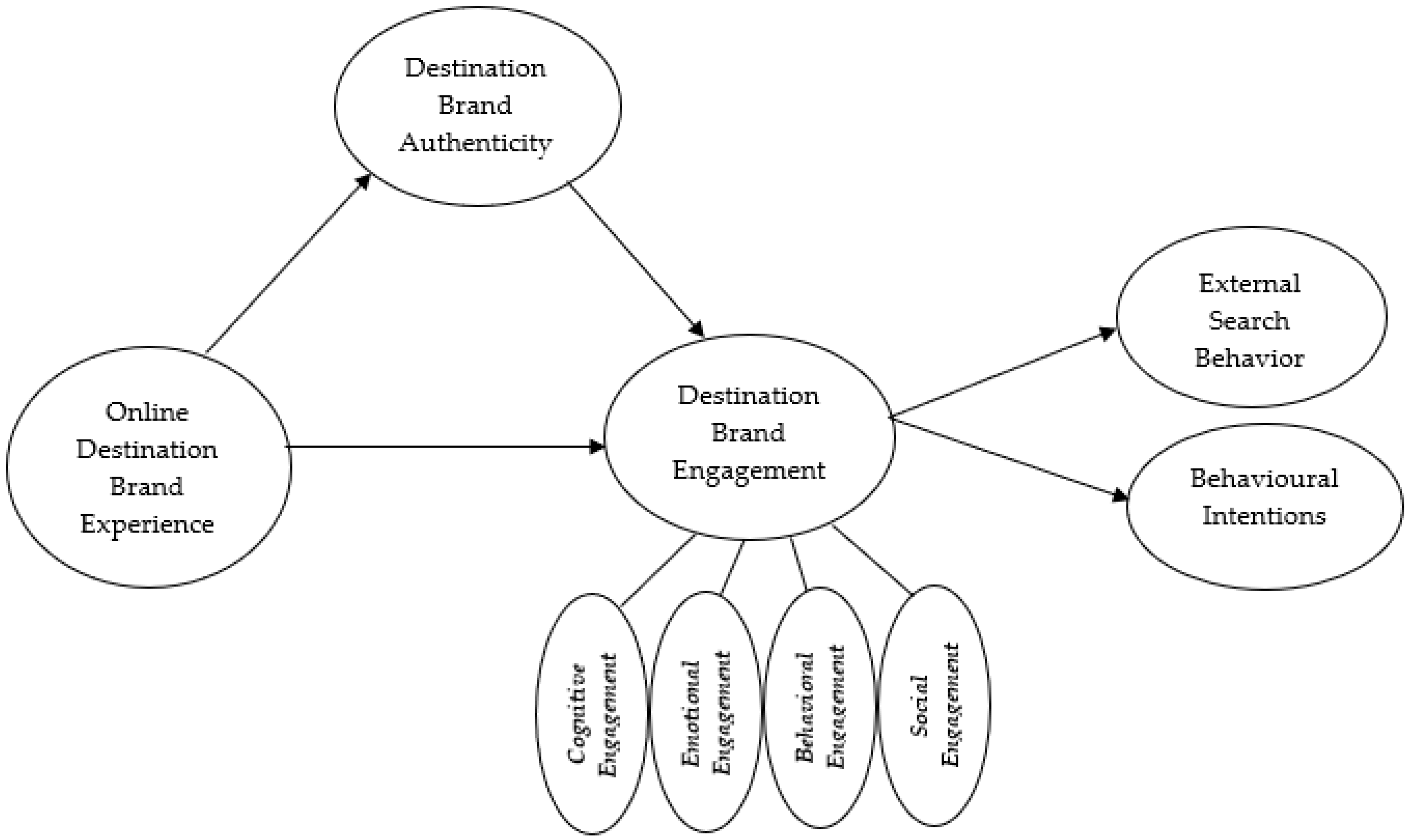
The primary aim of this study is to investigate the effects of online destination brand experience on destination brand authenticity, destination brand engagement, external search behavior, and behavioral intentions. Furthermore, the study explores the mediating role of destination brand authenticity in the relationship between online destination brand experience and destination brand engagement (see
Figure 1). A quantitative research method was adopted to test the proposed conceptual model, and the data were analyzed using SmartPLS 4.1.1.8, which is suitable for examining complex relationships among latent variables and for prediction-oriented structural models.
The research population consisted of individuals who had visited the Zeugma and Gaziantep cultural tourism destinations within the last 12 months and obtained information about these destinations through online platforms such as official tourism websites, virtual museums, social media, blogs, and travel platforms. Zeugma and Gaziantep were selected as the empirical context of the study because they represent one of Türkiye’s most distinctive cultural tourism settings, combining historical heritage, archaeological value, gastronomy, and destination identity. In particular, Zeugma is internationally recognized for its archaeological and museum-based heritage, while Gaziantep is widely associated with cultural and gastronomic tourism. Therefore, these destinations provide an appropriate context for examining how online destination brand experience shapes tourists’ perceptions of authenticity, engagement, search behavior, and behavioral intentions.
The selection of respondents was based on their relevance to the research purpose. Since the study focuses on online destination brand experience, only individuals who had both visited the relevant destinations and had been exposed to online destination-related content before or during their visit were included in the sample. This criterion ensured that participants had sufficient experience to evaluate the online representation of the destination as well as its perceived authenticity and engagement outcomes. Before completing the questionnaire, respondents were asked to review specific online content related to the destinations, such as official promotional websites and virtual museum applications. This procedure was applied to standardize participants’ exposure to online destination information and to strengthen the validity of their evaluations.
Data were collected through a survey-based research design. The questionnaire was administered online to individuals who met the sampling criteria. Participants were reached through online survey forms, and the data collection process was supported by social media groups and travel-related online communities. A convenience sampling method was used due to the absence of a complete sampling frame for all visitors to the Zeugma and Gaziantep destinations and the practical difficulty of accessing the entire population. Although convenience sampling limits the statistical generalizability of the findings, the use of screening criteria ensured that the sample consisted of respondents relevant to the study context. Therefore, the sample can be considered appropriate for representing the target population of recent visitors who experienced these destinations and interacted with destination-related online content.
The data collection process was carried out in the first quarter of 2026. After the data cleaning process, incomplete and invalid questionnaires were removed, and 482 valid and complete questionnaires were included in the final analysis.
The measurement items used in this study were adapted from previously validated scales in the literature. The ODDBE assessment items were adapted from
Khan and Fatma (
2021). Participants rated these items on a 5-point Likert scale, where 1 means “strongly disagree” and 5 means “strongly agree.” The DBA and BI constructs were assessed using the scale proposed by
Can et al. (
2025b), which was also measured on a 5-point Likert scale. The items for cognitive engagement, emotional engagement, behavioral engagement, and social engagement identified for DBE, as well as ESB, were taken from
Cheung et al. (
2023). Similarly, visitors were asked to rate the statements using a 5-point Likert scale.
To ensure methodological transparency and contextual appropriateness, the questionnaire was adapted to the Zeugma and Gaziantep cultural tourism context. General expressions in the original scales were revised to reflect the selected destinations and their online content, including official tourism websites, virtual museum applications, social media content, travel platforms, and other destination-related digital information sources. The adapted questionnaire was then reviewed by academic experts in tourism marketing, destination branding, and consumer behavior to assess content validity, clarity, and contextual relevance. Based on their feedback, minor wording revisions were made to improve readability.
Before the main data collection, a pilot test was conducted with a small group of participants with characteristics similar to those of the target sample. The pilot test evaluated item clarity, questionnaire flow, completion time, and the suitability of the items for the cultural tourism context. Since no major comprehension problems were identified, the questionnaire was finalized for the main survey. In addition, the reliability and validity of the adapted scales were statistically examined during the main analysis through Cronbach’s alpha, composite reliability, average variance extracted, and discriminant validity procedures.
Data Analyses
In this study, SmartPLS 4.1.1.8was used as the statistical and analytical tool. Partial least squares structural equation modeling (PLS-SEM) was used as the primary analytical technique due to its suitability for predictive research and theory development in complex models involving multiple latent structures and mediating relationships (
Hair et al., 2019;
Elshaer et al., 2025). Unlike covariance-based SEM, PLS-SEM imposes fewer constraints on data distribution and is particularly suitable when the research objective is to explain the variance in underlying endogenous structures rather than to validate an established theoretical model (
Hair et al., 2017). In this respect, PLS-SEM was considered a suitable methodological choice. This research focuses on the effects of online destination brand experience on destination brand authenticity, destination brand engagement, and external search behavior and behavioral intention. It also uses the Partial Least Squares (PLSc) method to examine the key factors of the mediating model between destination brand authenticity, online destination brand experience, and destination brand engagement. In light of these fundamental factors, the proposed model addresses an area that has not been sufficiently studied and where generalized conclusions have not yet been drawn. The primary aim is to explore the theoretical structural relationships within the proposed model and to evaluate the predictive effectiveness of exogenous variables.
In the evaluation of the measurement model, Cronbach’s alpha (α) and external model validity (Composite Reliability (CR), Average Variance Extracted (AVE), external loadings, Fornell–Larcker criterion, and Heterotrait–Monotrait Ratio (HTMT)) were calculated. For the evaluation of the structural model, InnerVIF, R2 and f2 values were used. Subsequently, Structural Equation Modeling (SEM) was applied to test the proposed hypotheses.
Given the cross-sectional and single-informant nature of the data, potential common-method bias was considered at both the research design and statistical assessment stages. In terms of procedural remedies, several measures were taken during questionnaire design and data collection to reduce potential common method effects (
Podsakoff et al., 2003). Participation was voluntary, respondent anonymity was assured, and participants were informed that there were no right or wrong answers. In addition, the questionnaire items were presented clearly and neutrally to reduce evaluation apprehension and social desirability bias. The measurement items were also adapted from previously validated scales, and their wording was reviewed to ensure clarity and contextual appropriateness.
In addition to these procedural remedies, a full collinearity test was conducted to statistically assess potential common method bias. Following
Kock (
2015), variance inflation factor values were examined for all latent constructs. The results indicated that all VIF values were below the conservative threshold of 3.3, suggesting that common method bias is unlikely to be a serious concern in this study. Furthermore, in the structural model assessment, all inner VIF values were below 3, indicating that multicollinearity among the constructs was not a critical issue.
Nevertheless, because the data were collected using a cross-sectional, self-reported survey design, the possibility of common method effects cannot be ruled out. Similarly, potential endogeneity concerns may arise from omitted variables, measurement error, or simultaneous relationships among perceptual constructs. Although the hypothesized relationships in this study were developed based on prior theory and relevant literature, the cross-sectional design does not allow strong causal inferences. Therefore, the results should be interpreted as evidence of theoretically grounded associations rather than definitive causal effects.
6. Discussion
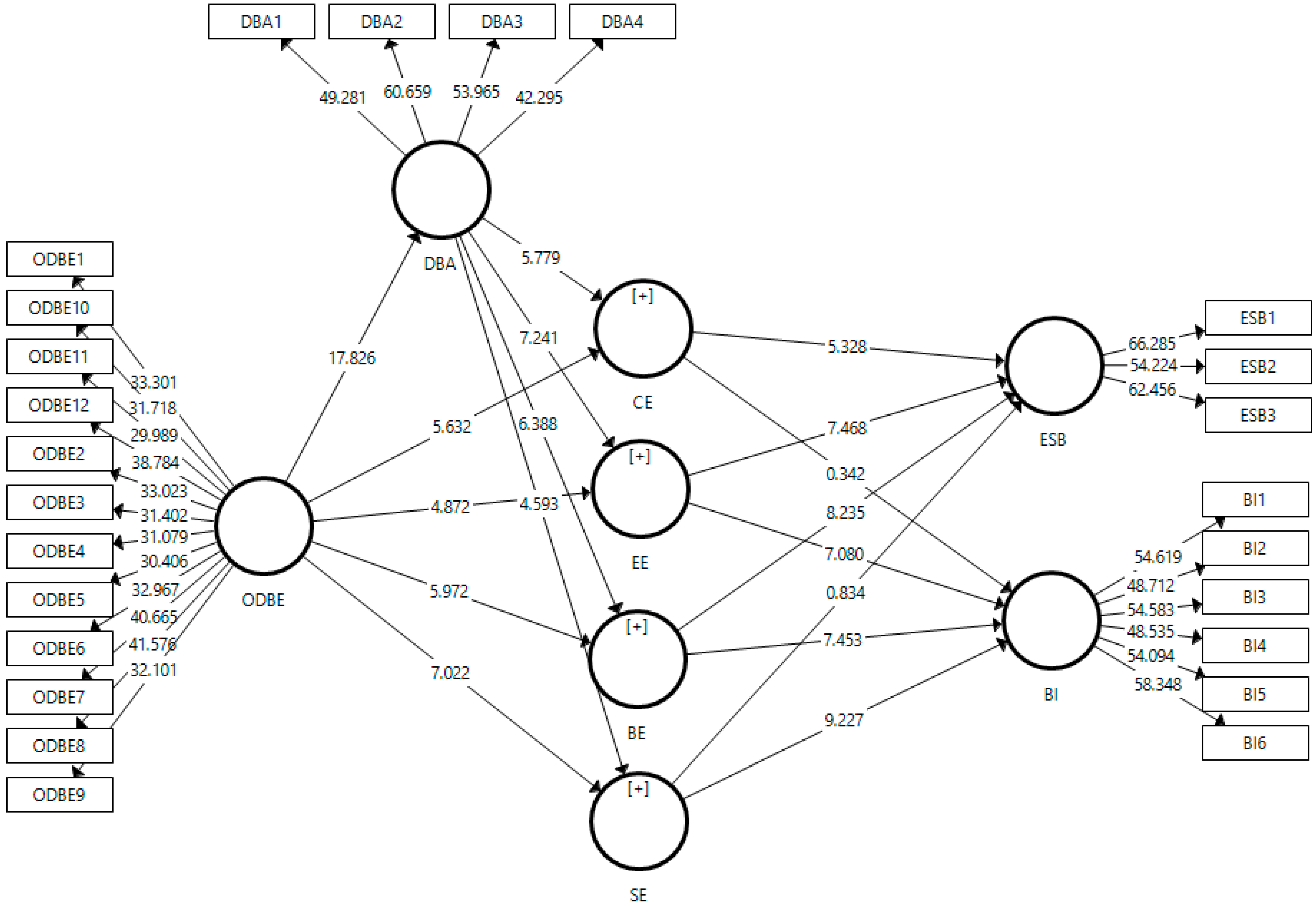
This research examines the effects of online destination brand experience on destination brand engagement, destination brand authenticity, external search behavior, and behavioral intention, thereby questioning the mediating role of destination brand authenticity. According to the study’s results, all hypotheses except H4d and H5a are supported.
According to the research results, the hypothesis (H1) that online destination brand experience positively affects destination brand authenticity is supported. This result is consistent with the literature (
Shizhen et al., 2025;
Kumar & Kaushik, 2022;
Tran & Nguyen, 2022;
Murshed et al., 2023;
Praswati et al., 2021). The experiences of visitors who have obtained information and interacted with Zeugma and Gaziantep destinations through online platforms also have a significant impact on the destination brand experience.
Hypotheses (H2a–d) suggesting that online destination brand experience positively influences destination brand engagement have also been supported by the literature (
Jiménez-Barreto et al., 2019,
2020;
Khan & Fatma, 2021;
Can et al., 2025a;
Grosso et al., 2024). As active participants in the destination, visitors act as advocates and exhibit pro-destination behaviors in the process of creating shared value. Therefore, visitors show higher engagement behavior with an emotional connection when they feel like they are part of the destination (
Mandagi et al., 2024).
Furthermore, the hypotheses (H3a–d) that destination brand authenticity positively influences destination brand engagement have been supported by the literature (
Luo et al., 2024;
Majeed & Kim, 2024;
Safeer et al., 2021). Visitors exhibit mental engagement by reacting to the authenticity provided by digital platforms before visiting the destination, thereby establishing a significant relationship between authenticity and engagement (
Jiménez-Barreto et al., 2020).
Similarly, the hypothesis that cognitive engagement, emotional engagement, and behavioral engagement, dimensions of destination brand engagement, positively influence external search behavior (H4a–c) is consistent with the literature (
Fang et al., 2017;
Kumar & Kaushik, 2020;
Cheung et al., 2023). It is particularly noted that visitors with high destination brand engagement engage in a thorough planning process using social media and digital channels at every stage of their travel planning (
Chavadi et al., 2023). These findings can also be interpreted within the framework of information search and consumer decision-making theories, which suggest that highly engaged consumers tend to invest more effort in information acquisition before making travel-related decisions. In digital tourism environments, cognitively, emotionally, and behaviorally engaged visitors may perceive external information searches as a way to reduce uncertainty and enhance decision confidence. This result further indicates that engagement is not merely an emotional reaction but also an active motivational mechanism encouraging continuous interaction with destination-related content. Therefore, external search behavior may be considered an important behavioral outcome reflecting deeper psychological involvement with the destination brand. However, the hypothesis that the social engagement dimension positively influences external search behavior (H4d) was not supported. This suggests that socially active visitors tend to take direct action rather than seeking information from external sources. That real-time information and advice from their social circles are sufficient for them. The findings that social interaction does not always have a significant effect on information-seeking behavior are also consistent with the literature (
Cheung et al., 2023). One possible explanation for this insignificant relationship is that socially engaged visitors may already possess sufficient destination-related information through their existing online communities and peer interactions, reducing the need for additional external information searches. In cultural heritage tourism contexts, visitors may rely more on emotional attachment, symbolic meanings, and experiential expectations than on extensive information-seeking. Furthermore, social engagement in digital environments may primarily function as a tool for experience sharing and social expression rather than information acquisition. This finding also suggests that not all dimensions of engagement influence tourist behaviors in the same way, emphasizing the multidimensional nature of destination brand engagement.
Chow and Shi (
2015) also found that user collaboration on social media pages is not always a strong predictor of behavioral loyalty.
The hypotheses (H5b–d) that emotional, behavioral, and social engagement dimensions of destination brand engagement positively influence behavioral intention are consistent with the literature (
Scarpi et al., 2019;
R. Chen et al., 2020;
Bryce et al., 2015;
So et al., 2016). DBE becomes a significant factor in sustainability and competitive advantage by enabling visitors to become brand ambassadors for the destination (
Mandagi et al., 2024). From a theoretical perspective, this finding supports the argument that destination brand engagement functions as a relational mechanism that transforms online interactions into future behavioral responses. Emotional, behavioral, and social engagement dimensions appear to strengthen tourists’ psychological attachment to the destination, thereby increasing revisit intentions, positive word-of-mouth, and recommendation behaviors. This result is particularly important for cultural heritage destinations, where emotional immersion, symbolic value, and social interaction may have stronger effects on tourist decision-making processes than purely functional evaluations. The findings also reinforce previous studies, emphasizing that the emotional and experiential dimensions of engagement play a more dominant role in shaping tourist behavioral intentions in digitally mediated tourism environments. However, the hypothesis (H5a) that cognitive engagement positively influences behavioral intention is not supported.
Cheung et al. (
2023) also found that the relationship between cognitive engagement and search behavior was insignificant in their research on Gen Z visitors. In this context, it is considered that visitors shape their intentions towards a destination based on emotional enthusiasm and social connections rather than cognitive knowledge (
Rihova et al., 2018). This finding may indicate that possessing destination-related knowledge alone is insufficient to generate strong behavioral intentions in tourism settings. Particularly in cultural and experiential tourism contexts, visitors’ future behavioral intentions may depend more on emotional resonance, memorable experiences, and perceived authenticity than on purely cognitive evaluations. In digitally mediated destination environments, tourists are frequently exposed to emotionally stimulating visual and interactive content, which may strengthen affective and social engagement more strongly than cognitive processing. Therefore, cognitive engagement may play a supportive rather than decisive role in shaping behavioral intentions.
Finally, the mediation analysis revealed that destination brand authenticity (H6a–d) significantly mediates the relationship between online destination brand experience and destination brand engagement (
Cheung et al., 2023;
Khan & Fatma, 2021;
Taheri et al., 2020;
Amer et al., 2023;
Luo et al., 2024;
R. Chen et al., 2020). Visitors demonstrate a process of mental engagement by responding to reflections of authenticity presented on digital platforms before a physical visit. Authenticity is not only the result of an online experience but also that this experience functions as a bridge, providing a reliable, accurate, and authentic foundation for visitors’ perception (
Jiménez-Barreto & Campo-Martínez, 2018). Therefore, it is argued that a destination’s website strengthens its ability to encourage visitors to actively engage with the destination if it provides both a rich experience and strong evidence that this experience is authentic (
Rini et al., 2024). This result also indicates that online destination experiences alone may not be sufficient to create strong visitor engagement unless these experiences are perceived as authentic and trustworthy. Therefore, authenticity can be considered a critical psychological mechanism that transforms online destination experiences into meaningful visitor responses and engagement outcomes.
The findings suggest that online destination experiences influence visitor behaviors not only directly but also through complex psychological and relational mechanisms involving authenticity and engagement. This highlights the importance of viewing digital destination branding as an interactive and experience-based process rather than merely an informational communication activity. In particular, the study demonstrates that authenticity and engagement jointly play critical roles in transforming digitally mediated experiences into meaningful behavioral outcomes in cultural heritage tourism contexts.
6.1. Theoretical Implications
This research provides various theoretical contributions to the literature. Primarily, it develops theoretical contributions in tourism marketing and destination branding. By revealing the significant impact of ODBE on DBA and DBE, it expands the relevant literature. Brand experience, which was examined more at the branding level in previous studies, is emphasized in this research for its role in shaping perceptions of destination authenticity and destination brand engagement in the online platform environment. Therefore, the importance of ODBE in digital tourism marketing is better revealed, enriching the developing literature.
Secondly, the research findings contribute to the DBA literature by identifying destination brand authenticity as a key mechanism linking the online experiences offered by a destination to destination brand engagement. Although authenticity has been widely discussed in tourism studies, its mediating role between online destination brand experience and destination brand engagement has received limited attention. Therefore, this research reveals this mediating effect, providing empirical evidence that visitors interpret their online brand experiences through their perceptions of authenticity, and that this interpretation results in a deeper engagement with the destination brand.
Thirdly, this research fills a gap in this area by revealing the impact of DBE on ESB and BI. This finding shows that when DBE is high, visitors are more likely to seek additional information about the destination, and their behavioral intentions to visit and purchase tourism-related services are stronger. Therefore, destination brand engagement is an important behavioral bridge between visitors and the tourism actions they wish to undertake. This study provides a comprehensive theoretical perspective explaining how online destination brand experiences are transformed into meaningful tourist responses through perceptions of authenticity and engagement processes.
6.2. Practical Implications
The research findings provide important practical implications and guidance for tourism stakeholders, particularly destination managers, tourism marketers, and digital tourism platforms. Firstly, ODBE significantly increases both DBA and DBE. This result indicates that destination marketing organizations should prioritize developing interactive, rich, and immersive digital experiences that increase engagement on social media platforms and official websites. These digital experiences, supported by high-quality visuals, storytelling, AR- and VR-created virtual tours, and user-created interactive content, can strengthen destination perceptions among visitors and provide unforgettable online experiences. For cultural heritage destinations such as Zeugma and Gaziantep, digital destination strategies should go beyond conventional promotional communication and focus more strongly on authenticity-centered online experiences. Destination managers may enhance visitors’ engagement by incorporating authentic storytelling, virtual museum experiences, local cultural narratives, archaeological heritage presentations, and interactive digital content into official websites and social media platforms. In particular, visually rich and culturally meaningful representations of local gastronomy, traditions, historical artifacts, and regional identity may strengthen perceptions of authenticity and encourage stronger destination-related behavioral intentions. Furthermore, integrating user-generated content, visitor testimonials, virtual tours, and immersive technologies, such as augmented reality applications, may help destinations create more credible, emotionally engaging, and memorable digital experiences.
Secondly, DBA appears to play a critical role in strengthening DBE. Therefore, relevant managers should aim to promote destinations by highlighting local traditions, natural beauty, cultural heritage sites, local lifestyles, and gastronomy through authentic destination-related narratives when developing digital communication strategies, thereby increasing DBE.
Thirdly, since destination brand engagement positively influences external search behavior and behavioral intentions, tourism marketers need to design digital strategies that encourage active interaction and engagement with the destination brand. Interactive campaigns, social media engagement activities, influencer collaborations, and personalized digital content are expected to motivate potential tourists to seek additional information about the destination and increase their intention to visit.
Finally, the mediating role of DBA provides several implications. Destination managers must inevitably enhance visitors’ perception of authenticity through authentic representations that reflect the destination’s true identity. It is not enough to simply create online experiences; these experiences must also convey a sense of authenticity. In particular, the design of the digital experience on a destination website (photos, videos, stories) fosters visitors’ sense of authenticity, transforming them into active destination stakeholders. DBA is considered a mechanism that enables long-term relationships and engagement through the value created by digital stimuli in online environments (
Kumar & Kaushik, 2022).
6.3. Limitations and Directions for Future Research
This study has some limitations that need to be addressed in future research. First, only survey data were used to test the research model. Although the survey method is appropriate for examining the proposed relationships among the variables, qualitative techniques, such as in-depth interviews or focus groups, could also be used to gain a deeper understanding of visitors’ online destination brand experiences. Future studies may therefore adopt mixed-methods research designs to provide richer insights into the relationships between online destination brand experience, destination brand authenticity, destination brand engagement, external search behavior, and behavioral intentions.
Second, the study used convenience sampling and online data collection, which may introduce selection bias. In particular, individuals who are more active on digital platforms, more interested in cultural tourism, or more willing to participate in online surveys may have been more likely to be included in the sample. Therefore, the findings should not be generalized to the entire population of visitors to Zeugma and Gaziantep without caution. Rather, the results are more representative of recent visitors who had prior exposure to destination-related online content and were digitally accessible during the data collection period. This limitation may affect the external validity of the findings. Future research could use probability-based sampling methods, on-site data collection, or mixed-mode survey designs to improve sample representativeness and enhance the generalizability of the results across different visitor segments.
Another limitation concerns the use of self-reported and cross-sectional survey data. Although procedural remedies were applied during questionnaire design and data collection, and full collinearity VIF results suggested that common-method bias was unlikely to be a serious concern, the possibility of common method bias cannot be completely ruled out. In addition, the cross-sectional nature of the data limits the ability to make strong causal claims. Potential endogeneity may also arise from omitted variables, measurement error, or reciprocal relationships among perceptual constructs. Future studies could address these issues using longitudinal designs, experimental approaches, multi-source data, or additional statistical techniques to more rigorously examine causality and reduce potential endogeneity concerns.
Fourth, the data sample consists only of domestic visitors. Therefore, the effects examined in this study may differ for foreign tourists. Further research could include international visitors and compare the perceptions and behavioral responses of domestic and foreign tourists. Alternatively, comparative studies could be conducted between visitors from developed and developing countries to examine whether cultural, economic, or travel-related differences influence the proposed relationships.
Fifth, the mediating effects of destination brand authenticity were examined in a unidimensional way. Further research could evaluate the mediating role of destination brand authenticity, accounting for its multidimensional structure. Such an approach may provide a more detailed understanding of how different dimensions of authenticity influence the relationship between online destination brand experience and destination brand engagement.
Finally, this study is limited to specific cultural tourism destinations, namely Zeugma and Gaziantep. Since each destination has its own unique identity, cultural meaning, tourism image, and visitor profile, the findings cannot be directly generalized to other destinations. Therefore, further studies could replicate the proposed model in different cultural, historical, gastronomic, or heritage tourism destinations and investigate whether the findings remain consistent across different destination contexts and sample groups.