1. Introduction
Tourism plays a major role in regional economic development by generating income, creating employment, stimulating local business activities, and strengthening spatial economic linkages across destinations (
García et al., 2024;
Li et al., 2024). However, the benefits of tourism are rarely distributed evenly across regions. At the global level, destinations with similar tourism potential often produce different performance outcomes because competitiveness depends not only on natural attractions, cultural assets, or market demand, but also on accessibility, infrastructure quality, service reliability, safety, governance, and institutional capacity. In this regard, destination competitiveness is increasingly understood as a performance-based and adaptive process in which destinations must continuously strengthen their resources, capabilities, and institutional arrangements to sustain tourism growth (
Hanafiah et al., 2016;
Özgit & Chelihi, 2026).
Infrastructure has long been recognised in tourism and hospitality research as a key foundation of destination performance. Transport systems reduce mobility barriers and connect tourists to destinations; energy infrastructure supports service continuity in accommodation, hospitality, and other tourism-related services; and digital access facilitates information searches, communication, booking, and transaction activities. Infrastructure, therefore, improves not only physical accessibility but also the efficiency, reliability, and quality of the tourism experience (
Khadaroo & Seetanah, 2007;
Nguyen, 2021). Recent studies further show that physical and digital infrastructure can stimulate tourism demand and help destinations convert visitor movements into broader economic benefits (
Ghosh, 2026;
Ruan et al., 2025). Nevertheless, infrastructure should not be viewed as an automatic guarantee of stronger tourism performance. A destination may have better roads, electricity access, and digital connectivity, but tourists may still avoid it if they perceive the place as unsafe, poorly governed, or unreliable. Thus, the relationship between infrastructure and tourism performance needs to be understood as conditional rather than uniform.
This conditional view is closely related to the growing global debate on safety, institutional risk, and destination trust. Safety perception is a central component of destination image, tourist satisfaction, revisit intention, and recommendation behaviour (
Ding & Wu, 2022). Tourists’ sense of safety is also formed across different stages of the travel experience, including pre-trip evaluation, on-site experience, and post-trip interpretation (
Zou & Yu, 2022). Consequently, the value of infrastructure depends not only on whether destinations are physically connected, but also on whether they are perceived as safe, trustworthy, and institutionally credible. Crime may weaken perceived safety and destination image, while corruption may reduce governance credibility, distort public investment, and undermine confidence in tourism-related services. Cross-country evidence also suggests that stronger institutional quality can reduce risks faced by tourists and tourism suppliers, thereby supporting tourism inflows and tourism revenues (
Kim et al., 2018).
Tourism outcomes are especially uneven in geographically fragmented and institutionally diverse settings. Tourism performance is not shaped solely by natural and cultural resources but also by the ability of supporting systems to reduce travel frictions, improve service quality, and connect tourism activity with local economic structures (
Purwono et al., 2024;
Bakker et al., 2023). Where transport, energy, and digital systems function effectively, tourism demand can generate stronger local business activity, employment, and regional linkages (
Yang & Fik, 2014;
Bakker et al., 2023). Conversely, inadequate infrastructure may increase travel costs, limit destination reach, reduce visitor satisfaction, and create leakage effects that weaken local economic gains (
Pratt, 2011;
Das & Naskar, 2018;
Chaitanya & Swain, 2024). Recent tourism studies also indicate that digital transformation and infrastructure modernisation are increasingly important for destination competitiveness and service quality (
Magoutas et al., 2024;
Vargová, 2026). However, smart and digital tourism initiatives are more likely to improve destination performance when they are supported by effective governance, sustainability-oriented planning, and integrated destination management (
El Archi et al., 2023).
Indonesia provides a highly relevant empirical setting for examining these issues. As an archipelagic emerging economy, Indonesia is characterised by substantial regional differences in infrastructure provision, accessibility, tourism resources, governance quality, and safety conditions. These differences are visible across provinces, where some regions benefit from better transport and service networks, while others continue to face connectivity constraints and weaker supporting systems (
Koerner & Spencer, 2023;
Nugroho et al., 2025). Although tourism activity has recovered after the pandemic, supported by strong domestic demand and the gradual return of international arrivals (
Antara & Sumarniasih, 2017;
Mardhani et al., 2021), the ability of provinces to convert tourism flows into sustained local economic outcomes remains uneven. Previous studies suggest that infrastructure can improve tourist mobility, expand market access, and enhance destination attractiveness (
Gidebo, 2021;
Rebelo et al., 2022;
Apriyanti, 2024;
Arabov et al., 2024). Yet, infrastructure provision in Indonesia remains spatially unequal, with more advanced systems concentrated in core regions such as Java, while many peripheral provinces continue to face accessibility and connectivity constraints.
The focus on domestic tourism is particularly important in this context. Domestic tourists are central to regional tourism recovery because their movements are closely linked to interprovincial mobility, local accessibility, travel affordability, and regional service conditions. At the subnational level, domestic tourism provides an appropriate lens for examining how infrastructure and institutional risk shape tourism outcomes across regions. Recent evidence from state-level tourism analysis also shows that domestic tourist movements can play a meaningful role in long-run tourism-related economic performance (
Singh & Alam, 2025). In Indonesia, this focus helps explain why some provinces are better able than others to transform infrastructure capacity into domestic tourism volume and expenditure.
At the same time, tourism growth must be considered within a broader sustainability and risk management agenda. Infrastructure expansion without adequate governance, safety management, and environmental responsibility may generate uneven benefits and create new pressures, including congestion, overtourism, ecological stress, and unequal visitor distribution. Recent studies on demarketing, visitor redistribution, digital destination management, green economy strategies, and sustainable tourism governance emphasise that destination competitiveness increasingly depends on the ability to balance growth, sustainability, community welfare, and responsible visitor management (
Andriotis & Saleh, 2026;
Purnomo & Khairunnisa, 2024). This perspective is important for regional destinations that seek to strengthen tourism performance without creating new vulnerabilities in destination systems.
A growing body of empirical research supports the view that crime and corruption can weaken economic performance and reduce the effectiveness of development drivers (
Saddiq & Abu Bakar, 2019;
Spyromitros & Panagiotidis, 2022). Recent evidence further suggests that institutional and risk-related factors may operate not only as direct constraints but also as conditioning variables that influence the effectiveness of public policies and investment through interaction effects (
Zhang et al., 2022). Nevertheless, several gaps remain in the tourism and hospitality literature. First, many studies still treat the infrastructure–tourism relationship as direct and relatively uniform, without sufficiently examining how it changes across different safety and institutional environments. Second, destination risk is often examined as an independent determinant of tourism outcomes, while its moderating role in the infrastructure–tourism nexus remains less developed. Third, domestic tourism at the subnational level remains underexplored, despite its importance for post-pandemic recovery, regional mobility, and local economic resilience. Fourth, few studies distinguish short-run adjustments from long-run equilibrium effects, although infrastructure and institutional conditions usually influence tourism systems gradually and cumulatively.
This study addresses these gaps by examining how economic infrastructure affects domestic tourism performance under different levels of destination risk across 34 Indonesian provinces. Domestic tourism performance is measured through domestic tourism volume and domestic tourism expenditure, allowing the study to capture both the scale and economic value of domestic tourism activity. Destination risk is represented by crime and corruption, which reflect differences in safety, governance, and institutional quality across regions. By applying a dynamic panel framework that separates short-run adjustments from long-run equilibrium relationships, this study provides a more nuanced explanation of how infrastructure contributes to tourism outcomes in heterogeneous regional settings.
The study offers three main contributions. First, it places domestic tourism performance at the centre of the analysis, rather than treating tourism only as a channel of aggregate economic growth. Second, it conceptualises destination risk as a moderating condition, thereby highlighting that the benefits of infrastructure depend on the safety and institutional environment in which tourism activity takes place. Third, it applies a dynamic empirical approach that captures both temporal adjustment and regional heterogeneity, offering insight into why similar infrastructure investments may generate different tourism outcomes across provinces. Overall, this study contributes to the tourism and hospitality literature by demonstrating that infrastructure-based tourism development is not only a matter of connectivity and service capacity but also of safety, institutional credibility, and sustainable destination governance.
2. Literature Review and Hypotheses Development
2.1. Theoretical Foundation
This study builds on an integrated conceptual basis linking destination competitiveness, accessibility, tourist safety evaluation, and institutional quality. These perspectives explain why economic infrastructure can improve domestic tourism performance and why its influence may weaken in destinations exposed to higher crime and corruption. Infrastructure is therefore not treated simply as physical facilities but as part of a destination system shaped by mobility, service capacity, digital connectivity, public confidence, governance quality, and institutional credibility (
Hanafiah et al., 2016;
Kim et al., 2018;
Ghosh, 2026).
A competitiveness-based view suggests that tourism performance depends on how effectively a destination converts resources and supporting conditions into visitor flows and tourism spending. Competitive destinations require not only natural and cultural attractions but also reliable infrastructure, accessible locations, service quality, institutional capacity, and adaptive governance.
Hanafiah et al. (
2016) link destination competitiveness to measurable performance outcomes, while
Özgit and Chelihi (
2026) emphasise adaptive governance and dynamic capabilities as foundations of sustainable tourism competitiveness. This view is consistent with recent research showing that destination quality increasingly depends on the interaction between infrastructure, digital transformation, environmental responsibility, and governance capacity (
Magoutas et al., 2024;
Vargová, 2026).
Accessibility explains the mechanism through which infrastructure affects tourism activity. Transport networks reduce spatial barriers and travel frictions, energy infrastructure supports service continuity, and digital access facilitates information searches, communication, and tourism-related transactions. These functions improve destination reach, convenience, and service reliability, which are essential for increasing tourism volume and expenditure. This logic is supported by studies showing that transport infrastructure, tourism infrastructure investment, and digital connectivity strengthen tourism development and destination attractiveness (
Khadaroo & Seetanah, 2007,
2008;
Adeola & Evans, 2020;
Nguyen, 2021;
Ruan et al., 2025).
However, infrastructure benefits are unlikely to be uniform across destinations. Tourist safety evaluation suggests that safety is a basic requirement in destination choice. Even when infrastructure is available, tourists may avoid places perceived as unsafe or institutionally unreliable.
Ding and Wu (
2022) show that tourism safety perception shapes destination image, satisfaction, revisit intention, and recommendation behaviour, while
Zou and Yu (
2022) explain that tourists’ sense of safety is formed across different travel stages. This reasoning is consistent with evidence that crime, terrorism, and insecurity reduce tourism demand and weaken destination attractiveness (
Santana-Gallego et al., 2016;
Tevdoradze et al., 2024;
Abu, 2025).
Institutional quality further determines how infrastructure is translated into tourism benefits. Strong institutions reduce uncertainty, improve public investment credibility, and build trust among tourists, firms, and local stakeholders. Weak institutions may distort infrastructure allocation, reduce service reliability, and weaken confidence in destination governance. Prior studies show that corruption can constrain tourism performance, while institutional quality can reduce risks and transaction costs faced by tourists and tourism suppliers (
Poprawe, 2015;
Kim et al., 2018;
Adedoyin et al., 2022;
Ghosh, 2026).
Overall, these perspectives indicate that the link between infrastructure and domestic tourism performance is conditional on the wider destination environment. Economic infrastructure can increase tourism volume and expenditure by improving accessibility, connectivity, and service reliability. However, crime and corruption may reduce these gains by weakening perceived safety, destination trust, governance credibility, and service confidence. This theoretical foundation supports the central argument that infrastructure matters for domestic tourism performance, but its effectiveness depends on the safety and institutional conditions under which tourism activity occurs (
S. Sharma et al., 1981;
Zhang et al., 2022;
Yue et al., 2024).
2.2. Domestic Tourism Performance
Tourism performance refers to the extent to which a destination is able to transform tourism demand into observable outcomes, particularly visitor movements and spending intensity. In this study, the concept is narrowed to domestic tourism performance because the empirical analysis focuses on domestic travel activity across Indonesian provinces. This focus is important because domestic tourism more directly reflects interregional mobility, local accessibility, and province-level tourism dynamics. Within the tourism and hospitality literature, performance is increasingly viewed as a core outcome that captures both the scale and economic quality of tourism activity, rather than merely a channel through which tourism contributes to wider economic growth (
Purwono et al., 2024;
Bakker et al., 2023). Domestic tourism volume represents the number of domestic tourist trips, whereas domestic tourism expenditure reflects the average spending generated from each trip. These two dimensions may not move in the same direction, since higher visitor flows do not automatically generate higher spending or stronger local economic linkages (
Pratt, 2011;
Chaitanya & Swain, 2024).
From a destination competitiveness perspective, tourism performance is shaped by the interaction between demand conditions and the quality of supporting systems, including infrastructure and the institutional environment (
Yang & Fik, 2014). Recent tourism and hospitality studies further show that destination performance is closely associated with service quality, digital integration, and broader competitiveness (
Magoutas et al., 2024;
Vargová, 2026). For domestic tourism, these supporting systems are especially relevant because travel choices are closely linked to road accessibility, energy reliability, basic digital access, price conditions, safety, and the perceived convenience of travelling across regions. In geographically heterogeneous settings such as Indonesia, differences in connectivity, accessibility, and governance conditions contribute to uneven tourism outcomes across provinces (
Nugroho et al., 2025;
Koerner & Spencer, 2023). Accordingly, domestic tourism performance provides a suitable framework for examining how economic infrastructure and destination risk jointly shape both the scale and economic value of tourism activity.
2.3. Economic Infrastructure and Domestic Tourism Performance
Economic infrastructure is a key condition for strengthening tourism performance because it reduces spatial barriers, lowers transaction costs, and improves destination accessibility. In broader development theory, infrastructure is viewed as a productivity-enhancing input that expands market access, supports economic interaction, and generates network externalities (
Calderón & Servén, 2004). In the tourism context, these mechanisms operate through improved mobility, service continuity, information access, and destination connectivity, all of which are essential for transforming tourism demand into domestic tourist flows and expenditure (
Calderón & Servén, 2008).
From a resource-based and accessibility perspective, infrastructure can be understood as a strategic destination asset. It strengthens the capacity of destinations to attract and retain tourists by improving reliability, accessibility, and market reach. This view is consistent with the argument that infrastructure reduces travel costs and facilitates tourist mobility, thereby expanding tourism demand (
Khadaroo & Seetanah, 2007;
Tian et al., 2022). For domestic tourism, this mechanism is especially important because interregional travel decisions are strongly influenced by the convenience, cost, safety, and reliability of movement across destinations.
Transport infrastructure directly supports tourism by reducing travel time and cost, widening destination reach, and enabling multi-destination travel patterns (
Antolini, 2023;
Fan, 2021;
Hrushka et al., 2021;
Tanjung et al., 2024). Energy infrastructure, particularly access to electricity, supports the operational continuity of hotels, restaurants, transport services, and other tourism-related businesses, thereby improving service reliability and visitor experience (
Lewis & Severnini, 2019;
Amaluddin et al., 2024). Basic digital access also contributes to domestic tourism performance by enabling information searches, communication, online reservations, navigation, and transaction support. In this study, digital access is treated as a basic connectivity condition rather than a comprehensive measure of digital infrastructure, which is consistent with the role of ICT in supporting tourism development (
Adeola & Evans, 2020;
El Archi et al., 2023).
Recent studies in tourism and hospitality further show that physical and digital infrastructure are important for converting tourism potential into actual economic outcomes (
Ghosh, 2026;
Ruan et al., 2025). These infrastructure dimensions should therefore be understood as complementary elements of an integrated destination system. Transport improves physical mobility, energy supports service reliability, and digital access strengthens information and transaction flows. Together, these functions enhance destination competitiveness and support the conversion of tourism demand into measurable performance (
Khadaroo & Seetanah, 2008;
Kanwal et al., 2020;
Arabov et al., 2024). Empirical evidence also confirms that infrastructure development contributes positively to tourism demand and regional tourism performance (
Gidebo, 2021;
Rebelo et al., 2022;
Apriyanti, 2024).
Accordingly, this study expects energy infrastructure, basic digital access, and transport infrastructure to improve domestic tourism performance. However, because domestic tourism volume and domestic tourism expenditure reflect different dimensions of performance, the effects of infrastructure may vary across these outcomes. Infrastructure may increase the number of domestic trips by improving accessibility, while also increasing expenditure per trip by enhancing service quality, convenience, and destination attractiveness. Based on this reasoning, the following hypotheses are proposed:
H1a. Energy infrastructure positively influences domestic tourism volume.
H1b. Energy infrastructure positively influences domestic tourism expenditure.
H1c. Basic digital access positively influences domestic tourism volume.
H1d. Basic digital access positively influences domestic tourism expenditure.
H1e. Transport infrastructure positively influences domestic tourism volume.
H1f. Transport infrastructure positively influences domestic tourism expenditure.
2.4. Destination Risk: Crime and Corruption
Tourism activity is highly sensitive to destination risk, particularly risks related to safety, security, governance, and institutional quality. For tourists, safety is not merely an additional destination attribute but a basic condition in travel decision-making. When a destination is perceived as unsafe, tourists may discount other advantages such as lower costs, shorter travel time, better facilities, or improved accessibility. From a tourism behaviour perspective, travellers tend to avoid destinations associated with insecurity, which can reduce visitor arrivals, shorten length of stay, and lower expenditure levels (
Tevdoradze et al., 2024;
Santana-Gallego et al., 2016). Recent studies also show that safety perception shapes destination image, satisfaction, revisit intention, and recommendation behaviour, indicating that safety directly influences both immediate travel choices and longer-term destination competitiveness (
Ding & Wu, 2022;
Zou & Yu, 2022).
In this context, crime increases both perceived and actual risk. Crime can weaken domestic tourism performance by reducing tourist confidence, damaging destination image, increasing anxiety during travel, and discouraging repeat visits. Even where infrastructure is available, high crime levels may reduce the willingness of tourists to visit or spend in a destination. Thus, crime should not be viewed only as a social problem external to tourism but as a destination risk factor that directly affects tourism demand and the ability of infrastructure to generate tourism benefits.
From an institutional perspective, corruption represents a structural constraint embedded within governance systems. It reduces the effectiveness of public investment, distorts allocation mechanisms, and weakens trust in regulatory frameworks (
Abu, 2025;
Poprawe, 2015). Within tourism systems, corruption may reduce the credibility of infrastructure projects, weaken coordination among tourism stakeholders, lower service reliability, and create uncertainty for tourists and service providers. Stronger institutional quality, by contrast, can reduce risks and transaction costs faced by tourists and tourism suppliers, thereby supporting tourism activity and tourism-related revenues (
Kim et al., 2018).
Recent contributions in tourism and hospitality emphasise that governance quality and macroeconomic stability act as binding constraints in determining tourism outcomes, particularly in developing economies (
Ghosh, 2026). This highlights that tourism performance depends not only on physical infrastructure but also on the institutional environment in which tourism activities are embedded. Accordingly, crime and corruption are not simply background conditions; they represent destination-level risks that may determine whether infrastructure, accessibility, and service capacity are converted into actual domestic tourism volume and expenditure.
A growing body of empirical research confirms that crime and corruption are associated with adverse economic outcomes, particularly in emerging economies (
Saddiq & Abu Bakar, 2019;
Spyromitros & Panagiotidis, 2022). More recent studies suggest that these factors also operate as conditioning variables, influencing the effectiveness of development drivers through interaction effects (
Zhang et al., 2022;
Yu et al., 2023). Consistent with the moderator framework of
S. Sharma et al. (
1981), destination risk may therefore alter the strength of the relationship between infrastructure and tourism performance. This study, therefore, treats crime and corruption as both direct constraints on domestic tourism performance and as risk conditions that may weaken the effectiveness of economic infrastructure.
H2a. Crime negatively influences domestic tourism volume.
H2b. Crime negatively influences domestic tourism expenditure.
H3a. Corruption negatively influences domestic tourism volume.
H3b. Corruption negatively influences domestic tourism expenditure.
2.5. Moderating Role of Destination Risk
The contribution of economic infrastructure to domestic tourism performance does not occur in isolation but is shaped by the broader destination environment. From a tourism and hospitality perspective, infrastructure effectiveness depends on whether surrounding conditions strengthen or weaken tourism experiences, service delivery, perceived safety, and destination trust (
Ghosh, 2026;
Kim et al., 2018). Infrastructure may improve accessibility, connectivity, and service capacity, but these advantages may not be fully converted into tourism volume and expenditure when destinations face high levels of risk.
Crime, as a safety-related risk, directly affects tourism behaviour because tourists generally place personal safety above other destination attributes. Even when infrastructure conditions are favourable, high crime levels can discourage visits, shorten length of stay, reduce discretionary spending, and weaken tourists’ willingness to recommend or revisit a destination (
Tevdoradze et al., 2024;
Santana-Gallego et al., 2016). This mechanism is consistent with studies showing that perceived safety shapes destination image, satisfaction, and travel intention (
Ding & Wu, 2022;
Zou & Yu, 2022). Accordingly, crime may weaken the link between infrastructure and tourism outcomes by reducing the extent to which improved accessibility and service capacity translate into stronger domestic tourism performance (
Abu, 2025;
Ghosh, 2026).
Corruption represents a different form of destination risk because it operates through the institutional environment. It can reduce governance quality, weaken the efficiency of infrastructure provision, distort resource allocation, and undermine service reliability (
Abu, 2025;
Poprawe, 2015;
C. Sharma, 2024). When corruption is high, infrastructure investment may become less effective because tourists, firms, and local stakeholders face greater uncertainty, lower trust in public services, and weaker confidence in destination management. This view is consistent with evidence that institutional quality reduces risks and transaction costs in tourism systems, while corruption constrains tourism performance and the economic returns from public investment (
Kim et al., 2018;
Adedoyin et al., 2022;
Ghosh, 2026).
Recent evidence suggests that risk-related and institutional factors not only have direct effects but can also condition the effectiveness of development drivers by shaping how investments translate into outcomes (
Zhang et al., 2022;
Yu et al., 2023;
Yue et al., 2024). Following the moderator framework of
S. Sharma et al. (
1981), crime and corruption are conceptualised as destination risk conditions that may alter the strength of the relationship between economic infrastructure and domestic tourism performance. Thus, similar infrastructure levels may generate stronger tourism gains in safer and better-governed destinations, but weaker gains where crime and corruption reduce safety, trust, and institutional credibility (
Kim et al., 2018;
Ghosh, 2026;
Yue et al., 2024).
Based on this reasoning, the following hypotheses are proposed. Crime, as a safety-related risk, is expected to weaken the effectiveness of infrastructure in supporting domestic tourism outcomes.
H4a. Crime weakens the effect of energy infrastructure on domestic tourism volume.
H4b. Crime weakens the effect of energy infrastructure on domestic tourism expenditure.
H4c. Crime weakens the effect of basic digital access on domestic tourism volume.
H4d. Crime weakens the effect of basic digital access on domestic tourism expenditure.
H4e. Crime weakens the effect of transport infrastructure on domestic tourism volume.
H4f. Crime weakens the effect of transport infrastructure on domestic tourism expenditure.
In contrast, corruption, as an institutional risk, is expected to weaken infrastructure effectiveness through governance and efficiency channels.
H5a. Corruption weakens the effect of energy infrastructure on domestic tourism volume.
H5b. Corruption weakens the effect of energy infrastructure on domestic tourism expenditure.
H5c. Corruption weakens the effect of basic digital access on domestic tourism volume.
H5d. Corruption weakens the effect of basic digital access on domestic tourism expenditure.
H5e. Corruption weakens the effect of transport infrastructure on domestic tourism volume.
H5f. Corruption weakens the effect of transport infrastructure on domestic tourism expenditure.
2.6. Conceptual Framework
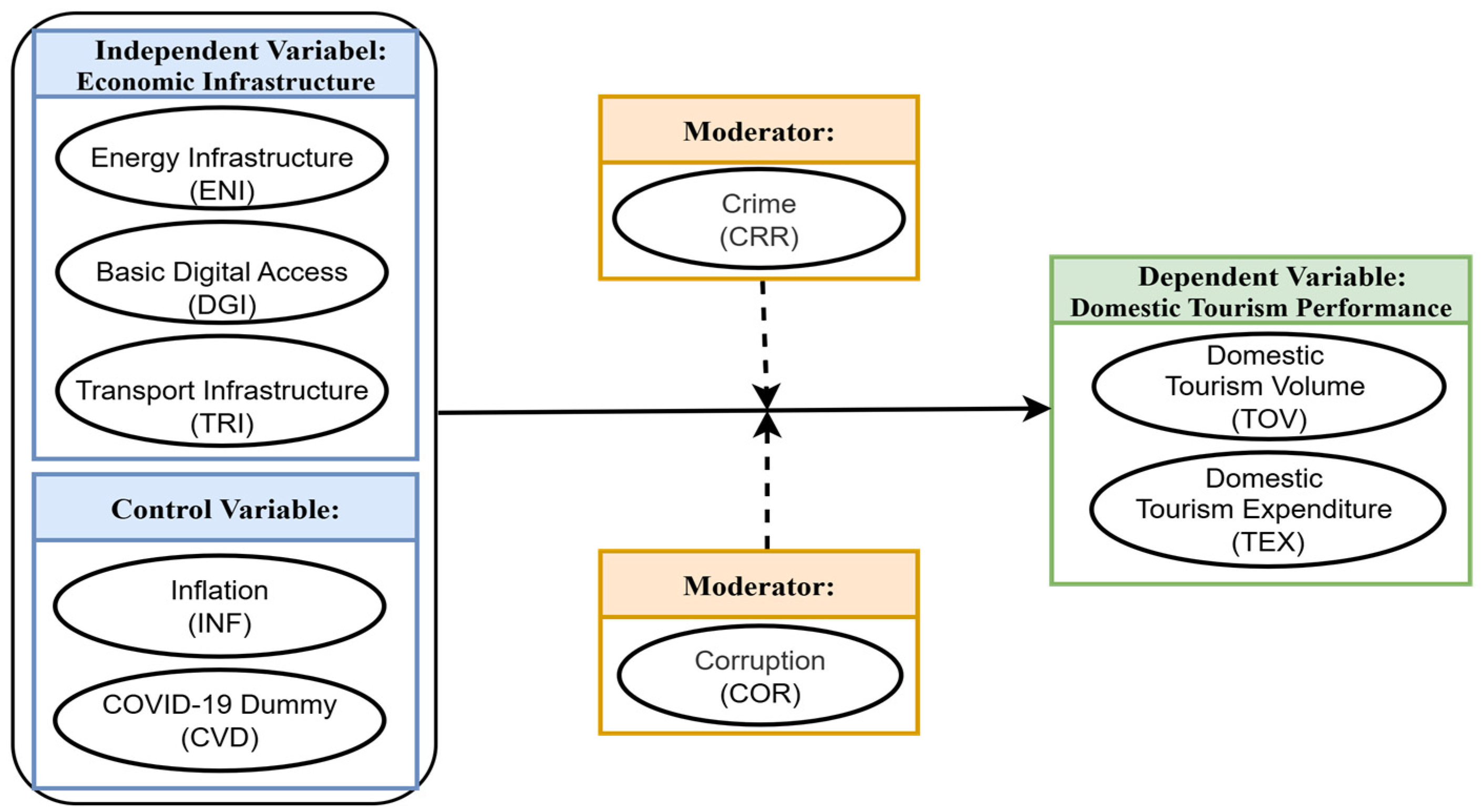
The conceptual framework in
Figure 1 summarises the theoretical logic of this study by showing how economic infrastructure influences domestic tourism performance under different destination risk conditions. Economic infrastructure is represented through three complementary dimensions: energy infrastructure, basic digital access, and transport infrastructure. Together, these dimensions support tourism activity by improving service reliability, information flows, physical mobility, and destination accessibility. In line with destination competitiveness and accessibility perspectives, these infrastructure components are expected to strengthen the capacity of provinces to convert tourism demand into domestic tourist trips and expenditure (
Hanafiah et al., 2016;
Khadaroo & Seetanah, 2007;
Nguyen, 2021).
Domestic tourism performance is specified as a dual outcome that captures both the scale and economic value of tourism activity. Domestic tourism volume reflects the intensity of domestic tourist movements across provinces, while domestic tourism expenditure represents the spending value generated from these movements. This distinction is important because a province may attract more domestic trips without necessarily generating higher expenditure per trip. Therefore, separating tourism volume from tourism expenditure allows the framework to capture different channels through which infrastructure affects domestic tourism outcomes (
Pratt, 2011;
Chaitanya & Swain, 2024).
Destination risk is incorporated as a moderating mechanism. Drawing on the framework of
S. Sharma et al. (
1981), crime and corruption are conceptualised as risk conditions that may alter the strength of the relationship between economic infrastructure and domestic tourism performance. Crime reflects the safety-related dimension of destination risk because tourists may avoid destinations perceived as unsafe, even when those destinations have favourable infrastructure or competitive travel conditions (
Ding & Wu, 2022;
Zou & Yu, 2022). Corruption reflects the institutional dimension of destination risk because weak governance may reduce the credibility, efficiency, and reliability of infrastructure-related tourism development (
Poprawe, 2015;
Kim et al., 2018). In this sense, infrastructure effectiveness is not assumed to be uniform across provinces but depends on the safety and institutional environment in which tourism activity occurs.
This conditional perspective is consistent with recent tourism and hospitality studies showing that infrastructure, digital transformation, governance, and institutional quality jointly shape tourism performance and destination competitiveness (
Ghosh, 2026;
Ruan et al., 2025;
Magoutas et al., 2024;
Vargová, 2026). It is also consistent with the argument that safety is a fundamental concern in tourist decision-making, meaning that infrastructure investment may produce weaker tourism gains when tourists perceive a destination as risky (
Santana-Gallego et al., 2016;
Tevdoradze et al., 2024). Accordingly, the framework positions crime and corruption not only as direct constraints on domestic tourism performance, but also as moderating conditions that determine how strongly infrastructure translates into tourism outcomes.
To ensure a well-specified model, inflation and the COVID-19 pandemic are included as control variables. Inflation captures changes in price levels that may affect travel costs, purchasing power, and tourism spending, while COVID-19 represents an external mobility shock that disrupted tourism demand and travel behaviour. Overall, the framework proposes that economic infrastructure affects domestic tourism performance both directly and conditionally. Its impact depends not only on the availability of energy infrastructure, basic digital access, and transport infrastructure, but also on whether destinations are safe, institutionally credible, and capable of converting infrastructure capacity into tourism value.
3. Materials and Methods
3.1. Data and Sample
This study uses a balanced panel dataset covering 34 Indonesian provinces from 2018 to 2024. The period includes the pre-pandemic years of 2018–2019, the COVID-19 disruption period of 2020–2021, and the post-pandemic recovery phase of 2022–2024. This time frame is appropriate because it captures both the disruption of tourism mobility during the pandemic and the subsequent recovery of regional travel activity (
Akita & Alisjahbana, 2023;
Singh & Alam, 2025).
The use of provincial-level data is particularly relevant because tourism performance in Indonesia is spatially uneven. Provincial data allow the analysis to capture differences in infrastructure provision, accessibility, safety conditions, governance quality, and tourism outcomes across regions. This subnational perspective is important in an archipelagic country where travel mobility, service availability, and connectivity vary considerably across space (
Koerner & Spencer, 2023;
Nugroho et al., 2025).
The study focuses on domestic tourism for three main reasons. First, domestic tourism is central to Indonesia’s regional tourism dynamics and post-pandemic recovery because domestic tourist movements are closely linked to interprovincial mobility, local accessibility, travel affordability, and regional service conditions. Second, domestic tourism indicators are available more consistently across all provinces, allowing greater comparability over time and across regions. Third, international tourism data are often concentrated in major gateway destinations and may not fully capture tourism activity in provinces with limited international arrivals. Therefore, focusing on domestic tourism provides a more suitable basis for analysing how infrastructure and destination risk shape province-level tourism performance.
All variables are obtained from Statistics Indonesia (BPS), ensuring consistency, reliability, and comparability across regions and time. The dataset combines domestic tourism indicators, infrastructure measures, destination risk variables, and socio-economic controls. This integrated dataset provides the empirical basis for examining domestic tourism performance across heterogeneous provincial contexts.
3.2. Variables and Measurement
Tourism performance is specified using two dependent variables, estimated separately to capture different dimensions of domestic tourism activity. Tourism volume (TOV) reflects the scale of tourism through the number of domestic tourist trips, while tourism expenditure (TEX) represents the economic value of tourism, measured by average expenditure per trip. This distinction allows the study to separate the scale and value dimensions of domestic tourism performance, since a higher number of trips does not necessarily generate higher spending per trip or stronger local economic linkages. These indicators allow for a more nuanced assessment, as factors influencing tourist flows may differ from those shaping spending behaviour (
Pratt, 2011;
Chaitanya & Swain, 2024).
Economic infrastructure is modelled through three complementary components. Energy infrastructure (ENI) is measured by the proportion of households with access to electricity, reflecting service availability and operational reliability (
Lewis & Severnini, 2019). Digital access (DGI) is proxied by mobile phone ownership. This variable is treated as a basic measure of digital connectivity and communication access rather than a comprehensive measure of digital infrastructure. Digital infrastructure is broader than mobile phone ownership because it may also include broadband quality, internet speed, platform readiness, digital payment systems, and smart tourism services. Nevertheless, mobile phone ownership remains relevant as a basic connectivity indicator because it captures minimum access for tourism-related information searches, communication, navigation, and transaction support (
Adeola & Evans, 2020;
El Archi et al., 2023;
Ruan et al., 2025). Transport infrastructure (TRI) is measured by the percentage of roads in good and moderate condition, representing physical accessibility and mobility across regions (
Khadaroo & Seetanah, 2008;
Tian et al., 2022).
Destination risk is incorporated through crime (CRM) and corruption (COR), both specified as moderating variables. Crime is measured by reported criminal cases, reflecting safety conditions that influence tourist perceptions and travel behaviour (
Santana-Gallego et al., 2016;
Tevdoradze et al., 2024). This indicator is relevant because safety conditions can affect tourist confidence, destination image, and willingness to travel. Corruption is proxied by reported corruption-related cases, capturing institutional quality and governance effectiveness (
Poprawe, 2015;
Abu, 2025). Although reported cases may not capture all forms of corruption or perceived governance risk, they provide an observable proxy for institutional risk across provinces.
To account for broader macroeconomic conditions and external shocks, inflation (INF) and a COVID-19 dummy (CVD) are included. Inflation reflects changes in price levels affecting travel costs and purchasing power, while the COVID-19 dummy captures disruptions in mobility and tourism demand during the pandemic period. The COVID-19 dummy is coded as 1 for 2020–2021 and 0 otherwise, reflecting the main period of pandemic-related mobility restrictions and tourism disruption.
A detailed description of all variables, including definitions, measurements, and data sources, is provided in
Table 1.
3.3. Model Specification
To examine how economic infrastructure influences domestic tourism performance under different destination risk conditions, this study employs a dynamic panel Autoregressive Distributed Lag (ARDL) model within an error-correction framework. The ARDL approach is appropriate because the effects of infrastructure on tourism are unlikely to occur only contemporaneously. Infrastructure may influence tourism gradually through improvements in accessibility, service reliability, information access, and destination competitiveness. Therefore, a dynamic specification is needed to distinguish short-run adjustments from long-run equilibrium effects (
Pesaran et al., 1999;
Pesaran, 2021;
Nguyen, 2021).
The ARDL framework is also suitable because the preliminary unit root tests show that the variables are integrated in mixed orders, I(0) and I(1), with no variable integrated at I(2). This supports the use of an ARDL-based model, which can accommodate different integration orders while estimating both short-run and long-run relationships. This approach is also consistent with recent tourism-related panel studies that employ PMG-ARDL modelling to examine long-run relationships and short-run adjustments in subnational tourism contexts (
Pesaran et al., 1999;
Singh & Alam, 2025).
The model is estimated using the Pooled Mean Group (PMG) estimator, which assumes homogeneous long-run relationships across provinces while allowing short-run dynamics, intercepts, and error variances to differ (
Pesaran et al., 1999;
Pesaran, 2021). This estimator is suitable for the Indonesian provincial context because provinces may share similar long-run structural relationships between infrastructure and domestic tourism performance, while still showing different short-run responses due to variations in accessibility, safety, governance, and tourism market conditions.
Domestic tourism performance is modelled separately using tourism volume (TOV) and tourism expenditure (TEX), enabling a differentiated assessment of how infrastructure affects both the scale and economic value of tourism activity. This separate estimation is necessary because infrastructure may influence domestic tourist trips and expenditure per trip through different channels. Improved transport access may increase visitor flows, while service reliability and digital access may shape spending behaviour.
The general ARDL(p, q) error-correction specification is expressed as follows:
where
denotes domestic tourism performance measured alternatively by TOV and TEX and
represents the vector of explanatory variables, including economic infrastructure (ENI, DGI, TRI), destination risk (CRM, COR), control variables (INF, CVD), and interaction terms. The operator
denotes first differences. The parameter
is the error-correction coefficient, expected to be negative and statistically significant, indicating convergence toward long-run equilibrium. The coefficients
capture long-run relationships, while the summation terms represent short-run dynamic adjustments.
To explicitly capture all hypothesised relationships, the implied long-run specification is expressed as follows:
This specification directly corresponds to the proposed hypotheses. The coefficients – capture the direct effects of economic infrastructure on domestic tourism performance (H1), while and represent the direct effects of crime and corruption (H2–H3). The interaction terms – test the moderating effects of destination risk (H4–H5), indicating whether crime and corruption weaken the influence of infrastructure on domestic tourism outcomes.
To identify the moderating effects more clearly and to avoid overloading the empirical specification with multiple interaction terms, the interaction effects are estimated in separate model specifications following established practice in moderation analysis (
Brambor et al., 2006;
S. Sharma et al., 1981). Accordingly, four models are estimated: (i) TOV with crime moderation, (ii) TEX with crime moderation, (iii) TOV with corruption moderation, and (iv) TEX with corruption moderation. This modelling strategy allows the study to distinguish the safety-related moderating role of crime from the institutional moderating role of corruption, while systematically assessing how destination risk conditions the effectiveness of economic infrastructure in shaping domestic tourism performance.
3.4. Estimation Technique
The empirical models are estimated using the PMG estimator within the panel ARDL framework. This approach is appropriate for analysing domestic tourism performance across heterogeneous provinces because it allows short-run coefficients, intercepts, and error variances to vary across cross-sections while maintaining a common long-run relationship (
Pesaran et al., 1999). This feature is relevant for Indonesia, where provinces may share similar long-run infrastructure–tourism relationships but differ in their short-run responses due to variations in accessibility, safety, governance, and tourism market conditions.
Compared with alternative estimators such as Mean Group (MG) and Dynamic Fixed Effects (DFE), PMG offers a balanced specification by allowing short-run heterogeneity while preserving efficiency in long-run estimation (
Pesaran, 2021). The suitability of PMG is assessed using the Hausman test. An insignificant Hausman statistic indicates that the long-run homogeneity restriction is not rejected, thereby supporting the use of PMG over MG.
The ARDL framework estimates both short-run and long-run relationships without requiring all variables to have the same integration order, provided that none is integrated of order two (
Pesaran et al., 1999). The error correction term (ECT) captures the speed at which short-run deviations return to long-run equilibrium. A negative and statistically significant ECT indicates a stable adjustment process, suggesting that domestic tourism performance converges toward its long-run path after temporary shocks.
Lag selection is conducted parsimoniously because the dataset is annual and covers 2018–2024. Excessive lags would reduce degrees of freedom and increase the risk of over-parameterisation. Therefore, the final lag structure is selected based on model stability, diagnostic adequacy, log-likelihood comparison, and the expected sign and significance of the ECT. This strategy allows the model to capture dynamic adjustment while remaining appropriate for the available panel structure.
3.5. Diagnostic and Preliminary Tests
To ensure the reliability of the empirical estimation, several preliminary and diagnostic tests are conducted before interpreting the ARDL–PMG results. Panel unit root tests are first applied to examine the integration properties of the variables. Specifically, the Im, Pesaran, and Shin (IPS) test and the Levin, Lin, and Chu (LLC) test are used to assess whether the variables are stationary at level or after first differencing (
Im et al., 2003;
Levin et al., 2002). These tests are required because the ARDL framework is suitable only when the variables are integrated at I(0) or I(1) and none is integrated at I(2).
Panel cointegration is then examined using the Pedroni and Kao tests to verify whether a stable long-run relationship exists among the variables (
Pedroni, 1999;
Kao, 1999). Given the provincial structure of the dataset, cross-sectional dependence is also tested using the Pesaran CD test (
Pesaran, 2021). This test is important because tourism activity, infrastructure development, and regional shocks may be interconnected across provinces through mobility flows, economic linkages, and shared policy environments.
The Hausman test is conducted to evaluate the suitability of the PMG estimator relative to the Mean Group estimator (
Pesaran et al., 1999). Wald tests are used to assess the joint significance of the explanatory variables, while log-likelihood values are used to compare model fit. The final ARDL structure is selected based on model adequacy, stability, diagnostic performance, log-likelihood values, and the expected sign and significance of the error correction term. This procedure ensures that the models remain parsimonious while still capturing the dynamic adjustment process in domestic tourism performance.
4. Results
4.1. Descriptive Statistics
Table 2 reports the descriptive statistics, revealing substantial variation in tourism performance and its underlying determinants across Indonesian provinces. This dispersion highlights the heterogeneous nature of regional tourism systems, where differences in infrastructure availability, accessibility, and institutional conditions shape tourism outcomes.
Domestic tourism volume (TOV) exhibits a relatively wide range, indicating uneven patterns of domestic travel intensity across regions. In contrast, domestic tourism expenditure (TEX) is less dispersed, suggesting that average spending per trip is more stable than travel frequency. This distinction implies that the drivers of domestic tourists’ flow and spending behaviour may differ across destinations.
Infrastructure indicators also display notable variation. Energy infrastructure (ENI) shows a high average level with limited dispersion, reflecting broadly widespread electricity access. Basic digital access (DGI) presents moderate variability, indicating unequal access to communication technology. Transport infrastructure (TRI), however, shows greater dispersion, pointing to significant disparities in physical connectivity and mobility across provinces.
Institutional conditions further reinforce regional differences. Crime (CRM) varies moderately, whereas corruption (COR) exhibits a wider range, suggesting uneven governance quality. Inflation (INF) differs across provinces, reflecting diverse local price environments, while the COVID-19 dummy (CVD) captures the share of observations affected by pandemic-related disruptions. Overall, these patterns underline the interconnected and uneven structure of tourism development in Indonesia.
4.2. Cross-Sectional Dependence
The Pesaran CD test results in
Table 3 indicate strong cross-sectional dependence across all variables. The null hypothesis of independence is rejected at the 1% level, suggesting that provincial tourism dynamics are not isolated but interconnected.
This finding reflects the integrated nature of tourism systems, where changes in one region can influence others through mobility flows, economic linkages, and shared policy environments. Such interdependence is particularly relevant in Indonesia, given its spatial connectivity and interregional tourism movements.
From a methodological perspective, the presence of cross-sectional dependence justifies the use of panel-based estimation techniques that accommodate interlinked dynamics. The ARDL–PMG framework is therefore appropriate, as it captures both heterogeneity across provinces and interdependencies within the system.
4.3. Panel Unit Root and Cointegration Results
Table 4 presents the panel unit root results, indicating a mixed order of integration among the variables. Given the presence of cross-sectional dependence, the CIPS test is used as the primary criterion for determining stationarity.
The results show that domestic tourism variables, including domestic tourism volume (TOV) and domestic tourism expenditure (TEX), are stationary at level, suggesting relatively stable statistical properties. Among infrastructure indicators, energy infrastructure (ENI) is also stationary at level, while basic digital access (DGI) and transport infrastructure (TRI) become stationary after first differencing.
A similar pattern is observed for institutional and macroeconomic variables. Crime (CRM) is stationary at level, whereas corruption (COR) and inflation (INF) are integrated of order one. This combination of I(0) and I(1) variables confirms the suitability of the ARDL framework, which accommodates mixed integration orders.
The Kao residual cointegration test further confirms the existence of a long-run relationship among the variables. The ADF statistics are negative and statistically significant at the 1% level, supporting the presence of a stable equilibrium relationship. These results justify the application of the ARDL–PMG approach to examine both long-run effects and short-run dynamics in domestic tourism performance.
4.4. ARDL–PMG Results
This section reports the ARDL–PMG estimation results based on the error-correction specification presented above. The analysis evaluates how economic infrastructure influences domestic tourism performance under varying destination risk conditions, distinguishing between long-run equilibrium relationships and short-run adjustment dynamics. The empirical results are estimated across four model specifications, with crime-based risk measures reported in
Table 5 and corruption-based risk measures presented in
Table 6.
4.4.1. Long-Run Effects of Economic Infrastructure
The long-run estimates indicate that economic infrastructure is a key determinant of domestic tourism performance across all model specifications. As shown in
Table 5, energy infrastructure (ENI), basic digital access (DGI), and transport infrastructure (TRI) generally exert positive and statistically significant effects, although their relative magnitudes differ.
Energy infrastructure consistently shows a positive and significant impact on both tourism volume and expenditure, supporting H1a–H1b. Basic digital access also contributes positively, although its effects are less consistent, providing partial support for H1c–H1d. Transport infrastructure emerges as the most influential factor, with strong and robust effects across both domestic tourism indicators, confirming H1e–H1f. These findings highlight the importance of accessibility and connectivity in enhancing destination competitiveness.
Crime (CRM) exhibits a significant negative association with domestic tourism performance, indicating that safety concerns reduce both travel activity and spending, thereby supporting H2a–H2b. More importantly, the interaction terms between infrastructure and crime are negative and statistically significant, suggesting that higher crime levels weaken the positive effects of infrastructure. This provides strong support for H4a–H4f and indicates that infrastructure effectiveness is conditional on safety conditions.
The results for corruption-based models (
Table 6) show a similar pattern. Infrastructure variables remain positive and significant, reinforcing the robustness of the baseline relationship. Corruption (COR) has a direct negative effect on domestic tourism performance, supporting H3a–H3b. In addition, the interaction terms between infrastructure and corruption are consistently negative and significant, indicating that governance weaknesses constrain the benefits of infrastructure investment. These findings support H5a–H5f and highlight the role of institutional quality in shaping domestic tourism outcomes.
4.4.2. Short-Run Dynamics and Error Correction
The short-run estimates in
Table 5 and
Table 6 indicate that most first-differenced infrastructure variables do not have a statistically significant effect on domestic tourism performance. This suggests that the expected positive influence of infrastructure does not occur instantly but unfolds progressively as destinations adapt and incorporate these improvements into their tourism systems.
A limited short-term effect is identified for transport infrastructure (ΔTRI), which shows a positive and significant association with domestic tourism volume in selected specifications. This provides partial short-run support for H1e, indicating that enhanced connectivity can stimulate travel flows in the near term, although the effect is not consistently observed across all models.
The short-run coefficients for crime (ΔCRM) and corruption (ΔCOR), along with their interaction terms with infrastructure variables, are largely insignificant. These findings imply that the direct effects captured in H2a–H2b and H3a–H3b, as well as the moderating effects in H4a–H4f and H5a–H5f, are not evident in the short run. Instead, the influence of destination risk appears to operate through longer-term structural mechanisms.
The error correction term (ECT) is negative and statistically significant across all specifications, confirming the presence of a stable long-run equilibrium. The estimated adjustment speeds indicate that short-term deviations from equilibrium are corrected relatively quickly, suggesting that domestic tourism performance converges efficiently toward its long-run path.
4.4.3. Moderating Effects of Crime and Corruption
In the long run, both crime and corruption exhibit negative and statistically significant direct effects on domestic tourism performance, leading to reductions in both domestic tourism volume and domestic tourism expenditure across provinces. These results are consistent with H2a–H2b and H3a–H3b, confirming that higher levels of destination risk weaken domestic tourism outcomes.
Moreover, the interaction terms between infrastructure variables and destination risk are consistently negative and statistically significant. Specifically, the coefficients for ENI × CRM, DGI × CRM, and TRI × CRM, as well as ENI × COR, DGI × COR, and TRI × COR, indicate that the positive effects of infrastructure on domestic tourism performance diminish as crime and corruption increase. These findings provide strong support for H4a–H4f and H5a–H5f.
This evidence suggests that destination risk plays a dual role by directly influencing domestic tourism performance while also moderating the effectiveness of infrastructure development. In this context, crime and corruption act as quasi-moderating factors that shape how infrastructure translates into tourism gains.
By contrast, the interaction effects in the short run are generally not significant, indicating that the moderating influence of destination risk emerges over time rather than through immediate adjustments.
4.5. Model Diagnostics and Robustness Checks
The diagnostic results reported in
Table 5 and
Table 6 provide strong support for the suitability of the ARDL–PMG framework in capturing domestic tourism performance across provinces. The Hausman test yields consistently insignificant
p-values across all model specifications, indicating that the assumption of long-run homogeneity cannot be rejected and confirming the preference for the PMG estimator over the Mean Group approach.
The Wald test statistics are significant at the 1% level in all cases, demonstrating that the explanatory variables jointly play a meaningful role in shaping domestic tourism outcomes. Moreover, the error correction term (ECT) remains negative and statistically significant throughout, confirming the existence of a stable long-run equilibrium and indicating that short-run fluctuations in domestic tourism performance are systematically corrected toward long-run conditions.
Additional support for model adequacy is reflected in the log-likelihood values, which point to satisfactory explanatory power across specifications. The chosen lag structure, PMG(1,1,1,1,1,1,1), is well-suited to capturing both short-term dynamics and long-term relationships in domestic tourism activity.
Importantly, the stability of coefficient signs and their statistical significance across both crime-based (
Table 5) and corruption-based (
Table 6) models highlights the robustness of the findings. This consistency suggests that the relationships linking infrastructure, destination risk, and domestic tourism performance remain reliable under alternative institutional risk measures, reinforcing confidence in the empirical results within a tourism and hospitality context.
5. Discussion
5.1. Economic Infrastructure Effects and Domestic Tourism Performance
The findings show that economic infrastructure functions as a structural driver of domestic tourism performance, but its influence is stronger in the long run than in the short run. This pattern suggests that infrastructure does not immediately translate into higher tourist flows or spending. Instead, its effects accumulate gradually as destinations become more accessible, services become more reliable, and tourism-related businesses adjust to improved connectivity. The positive long-run effects of energy infrastructure, basic digital access, and transport infrastructure on both domestic tourism volume and domestic tourism expenditure indicate that infrastructure strengthens the capacity of destinations to convert tourism demand into measurable outcomes. This finding is consistent with the view that infrastructure supports destination competitiveness by improving accessibility, operational efficiency, and the quality of the tourism experience (
Khadaroo & Seetanah, 2007;
Hanafiah et al., 2016).
The stronger long-run effects are also consistent with broader infrastructure literature.
Timilsina et al. (
2021) show that infrastructure tends to generate larger long-run elasticities than short-run effects, while
Calderón et al. (
2015) argue that infrastructure contributes to economic performance through cumulative capital formation and productivity gains. In the tourism context, this means that infrastructure should be understood less as an immediate stimulus and more as an enabling system that gradually improves destination readiness, business linkages, and visitor experience. This interpretation also supports recent tourism evidence showing that tourism-related outcomes often depend on sustained improvements in accessibility, service systems, and regional capacity rather than short-term infrastructure changes (
Das & Naskar, 2018;
Nguyen, 2021;
Singh & Alam, 2025).
Among the infrastructure components, transport infrastructure shows the most direct relevance for domestic tourism performance. Better transport conditions reduce travel time and mobility costs, increase destination reach, and make interregional travel more convenient. This is particularly important for domestic tourists, whose travel decisions are closely linked to road access, trip affordability, and the ease of moving between destinations. The finding is consistent with
Khadaroo and Seetanah (
2008) and
Nguyen (
2021), who identify transport connectivity as an important determinant of tourism demand. It also reinforces the argument that accessibility remains a central condition for tourism competitiveness, especially in geographically diverse settings such as Indonesia.
Energy infrastructure also contributes significantly to domestic tourism outcomes, especially over the long run. Reliable electricity access supports accommodation, restaurants, transport services, digital transactions, and other tourism-related activities. Its effect is therefore not limited to household welfare but extends to the reliability and quality of tourism services. This finding is consistent with
Lewis and Severnini (
2019) and
Amaluddin et al. (
2024), who show that electrification can produce persistent economic benefits. In tourism destinations, these benefits operate through more stable service provision, improved visitor experience, and stronger business continuity.
Basic digital access has a positive but relatively less consistent role compared with transport and energy infrastructure. This result is theoretically meaningful. Mobile phone ownership captures basic connectivity, but it does not fully represent the wider digital infrastructure ecosystem, such as broadband quality, internet speed, digital payment systems, platform readiness, or smart tourism services. Therefore, the weaker effect of digital access suggests that basic connectivity alone may be insufficient to generate strong tourism gains unless it is supported by broader digital capability and destination management systems. This interpretation is consistent with
Ruan et al. (
2025), who show that digital technology contributes to tourism growth when supported by favourable regional conditions, and with
Magoutas et al. (
2024), who emphasise that digitalisation improves tourism performance when embedded within broader structural readiness.
El Archi et al. (
2023) similarly stress that smart tourism initiatives require integrated technological and sustainability-oriented destination management.
The control variables further clarify the conditions under which infrastructure affects domestic tourism performance. Inflation has a negative effect, indicating that price instability can reduce tourism performance by weakening purchasing power, increasing travel costs, and reducing destination competitiveness. This result is consistent with
Mihalic (
2016),
Athari et al. (
2021), and
Adedoyin et al. (
2022), who highlight the sensitivity of tourism demand to macroeconomic conditions. Similarly, the COVID-19 shock has a strong negative effect, confirming that mobility restrictions and health-related uncertainty disrupted both tourism flows and expenditure.
Akita and Alisjahbana (
2023) also show that tourism-dependent regions experienced deeper and more persistent contractions during the pandemic, reflecting the vulnerability of regional tourism systems to external shocks.
Overall, these findings indicate that infrastructure-driven domestic tourism growth is cumulative, system-dependent, and conditional. Infrastructure provides the basic capacity for tourism development, but its benefits depend on whether destinations can translate improved accessibility, service reliability, and digital connectivity into better visitor experiences and higher spending. The limited short-run effects further imply that infrastructure policy should not be evaluated only through immediate tourism gains. Instead, its value lies in strengthening the long-term foundations of domestic tourism competitiveness, especially when supported by price stability, institutional capacity, and resilience to external shocks.
5.2. Moderating Role of Crime and Corruption in the Infrastructure–Domestic Tourism Nexus
The moderation results show that destination risk fundamentally shapes how economic infrastructure is translated into domestic tourism performance. Three key patterns emerge. First, crime and corruption directly reduce tourism outcomes, indicating that destinations with higher risk conditions tend to experience weaker tourism activity. Second, the long-run interaction effects between infrastructure and risk variables are negative and statistically significant, suggesting that crime and corruption reduce the returns to infrastructure. Third, the absence of significant short-run moderation effects indicates that these risk mechanisms operate gradually through structural changes in safety perception, institutional trust, and destination confidence. Thus, the results show that infrastructure effects are not universal; they depend on the safety and governance conditions under which tourism activity takes place.
The deterrent effect of crime is consistent with previous tourism research.
Santana-Gallego et al. (
2016) show that crime can reduce tourism demand across destinations, while
Tevdoradze et al. (
2024) highlight the adverse effects of criminal activity on tourism. The present findings extend this evidence by showing that crime not only lowers domestic tourism volume and expenditure directly but also weakens the effectiveness of infrastructure. Even when infrastructure improves accessibility and service capacity, high crime levels may discourage travel by increasing perceived risk, reducing destination image, and weakening tourists’ confidence. This interpretation is consistent with studies showing that safety perception influences destination image, satisfaction, revisit intention, and travel decisions (
Ding & Wu, 2022;
Zou & Yu, 2022).
Corruption produces a similarly negative but more institutionalised effect. While crime mainly operates through perceived safety and travel avoidance, corruption affects the governance environment in which tourism infrastructure is planned, delivered, and maintained. It can reduce public investment efficiency, distort resource allocation, weaken policy credibility, and undermine service reliability. Evidence from
Poprawe (
2015);
Dutt and Traca (
2010); and
Maria et al. (
2022) supports the view that corruption increases implicit costs and reduces economic efficiency. In the tourism context, this means that infrastructure investment may generate weaker outcomes when tourists, firms, and local stakeholders have low confidence in destination governance. Stronger institutional quality, by contrast, can reduce risks and transaction costs faced by tourists and tourism suppliers (
Kim et al., 2018).
These findings are also consistent with recent tourism and hospitality studies.
Ghosh (
2026) shows that infrastructure effectiveness in attracting tourism depends on governance quality and macroeconomic stability, while
Vargová (
2026) emphasises that destination competitiveness increasingly requires alignment between structural development, institutional quality, and sustainability. The present study adds to this literature by showing that destination risk acts as a boundary condition for infrastructure-based tourism development. In other words, infrastructure may create destination capacity, but crime and corruption determine whether that capacity is converted into actual domestic tourist trips and expenditure.
From a conceptual perspective, the joint significance of direct and interaction effects indicates that crime and corruption function as quasi-moderators, following
S. Sharma et al. (
1981). This means that destination risk has a dual role: it directly constrains domestic tourism performance and also conditions the strength of the infrastructure–tourism relationship. This finding strengthens the theoretical argument that tourism performance is shaped not only by destination resources and infrastructure capacity, but also by the institutional and safety environment in which those resources operate. It also supports recent evidence that risk and institutional factors may alter the effectiveness of development drivers through interaction effects (
Zhang et al., 2022;
Yu et al., 2023;
Yue et al., 2024).
The absence of significant short-run moderation effects further confirms the structural nature of these relationships. Crime and corruption do not necessarily change the impact of infrastructure immediately. Instead, their moderating influence appears over time as repeated exposure to safety concerns, weak governance, or unreliable services affects tourist confidence, business expectations, and destination reputation.
Yue et al. (
2024) similarly argue that institutional quality operates as a slow-moving determinant. This supports the interpretation that destination risk shapes long-run equilibrium outcomes rather than short-term tourism fluctuations.
Overall, the findings indicate that domestic tourism development is inherently conditional on destination risk. Infrastructure investments can support tourism volume and expenditure, but their effectiveness depends on safe, transparent, and well-governed destination environments. Without these conditions, infrastructure may improve physical capacity without generating proportional tourism gains. Therefore, the policy lesson is not simply to invest more in infrastructure but to ensure that infrastructure development is accompanied by crime reduction, governance improvement, institutional credibility, and stronger destination trust.
5.3. Theoretical Implications
This study advances the tourism and regional development literature by reframing the relationship between infrastructure and domestic tourism performance as a dynamic and context-dependent process. Rather than treating infrastructure as a uniform and immediate driver of tourism outcomes, the findings show that its effects operate mainly through long-run structural mechanisms. This perspective strengthens the argument that infrastructure contributes to tourism not simply by expanding physical capacity but by gradually improving accessibility, service reliability, destination functionality, and the conditions under which tourism demand is converted into visitor flows and expenditure.
The absence of consistent short-run effects, combined with robust long-run relationships, indicates that infrastructure benefits accumulate over time through improved connectivity, reduced transaction costs, and enhanced service capacity. This temporal pattern is consistent with the broader infrastructure-growth literature (
Calderón et al., 2015;
Timilsina et al., 2021) and extends it to the tourism context by showing the importance of distinguishing short-run adjustments from long-run equilibrium outcomes. The study therefore contributes to tourism theory by demonstrating that infrastructure-led tourism development should be understood as a gradual adjustment process rather than an immediate response mechanism.
A central theoretical contribution lies in integrating destination risk into the infrastructure-based tourism framework. The results show that crime and corruption exert both direct and interaction effects, indicating that infrastructure effectiveness depends on the safety and institutional environment in which tourism activity takes place. This supports and extends prior evidence on the role of governance, risk, and institutional quality in shaping tourism demand and tourism-related outcomes (
Adedoyin et al., 2022;
Kim et al., 2018;
Santana-Gallego et al., 2016;
Zhang et al., 2022). By incorporating crime and corruption as moderating conditions, this study moves beyond the conventional assumption that infrastructure automatically produces tourism gains. It shows that destination risk can alter the strength of infrastructure effects by shaping tourist confidence, institutional trust, and service credibility.
Conceptually, the joint significance of direct and interaction effects suggests that crime and corruption function as quasi-moderators (
S. Sharma et al., 1981). They directly constrain domestic tourism performance while also shaping the extent to which infrastructure investment generates tourism benefits. This provides a theoretical explanation for why destinations with comparable infrastructure levels may experience different tourism outcomes. The difference lies not only in infrastructure availability, but also in whether the surrounding institutional and safety environment enables that infrastructure to be used effectively.
Overall, the study contributes to a more integrated understanding of domestic tourism systems, where infrastructure, accessibility, institutional quality, risk perception, and structural conditions interact in shaping long-run performance. This interpretation is consistent with recent tourism and hospitality studies emphasising that digital transformation, governance capacity, and destination competitiveness are mutually reinforcing rather than independent drivers of tourism development (
Ruan et al., 2025;
Magoutas et al., 2024;
Vargová, 2026;
Ghosh, 2026). The theoretical implication is clear: infrastructure matters, but its tourism value is conditional on safe, credible, and well-governed destination systems.
5.4. Practical Implications
The findings offer several practical implications for tourism policy and regional development. First, infrastructure investment remains essential, but it should be evaluated from a long-term perspective rather than through immediate tourism gains. The limited short-run effects indicate that infrastructure programmes may require time before they translate into stronger domestic tourism volume and expenditure. Therefore, policy evaluation should consider whether infrastructure improves accessibility, service reliability, destination functionality, and long-term competitiveness. This implication is consistent with the view that infrastructure contributes to tourism by strengthening destination accessibility and competitiveness over time (
Khadaroo & Seetanah, 2007;
Nguyen, 2021).
Second, transport infrastructure deserves particular policy attention because it has the most direct connection with domestic tourist mobility. Better roads and transport connectivity can reduce travel time, lower mobility costs, expand destination reach, and support interregional travel. However, transport investment should not be implemented as an isolated physical project. It should be integrated with destination planning, service development, digital information systems, and local business linkages so that improved connectivity generates wider tourism value.
Third, the findings show that infrastructure effectiveness depends strongly on institutional quality and public safety. Crime and corruption weaken the contribution of infrastructure to domestic tourism performance, indicating that physical investment must be accompanied by governance reform, law enforcement, regulatory transparency, and stronger institutional coordination. Strengthening public safety and improving governance credibility are therefore essential for maximising the returns from infrastructure investment (
Santana-Gallego et al., 2016;
Adedoyin et al., 2022;
Kim et al., 2018).
Fourth, local authorities and tourism management organisations should treat tourism development as a risk-sensitive policy agenda. The results indicate that destinations may face multiple risks, including safety and crime risk, governance and corruption risk, infrastructure reliability risk, reputational risk, price instability, environmental pressure, overtourism, and external shocks such as pandemics. These risks should be incorporated into destination planning so that tourism policies do not focus only on increasing visitor numbers but also on protecting destination resilience, community welfare, and long-term competitiveness.
Fifth, tourism management should be aligned with sustainable development principles. Local governments and tourism organisations should promote green tourism, encourage lower-impact mobility, improve visitor distribution across destinations, and prevent excessive concentration of tourists in already overburdened areas. Encouraging tourists to consider environmentally responsible destinations can help reduce pressure on fragile locations while supporting more balanced regional tourism development. Recent studies on demarketing and visitor redistribution, smart destination management, and green economy strategies show that tourism governance should balance growth with sustainability, environmental protection, and responsible visitor management (
Andriotis & Saleh, 2026;
El Archi et al., 2023;
Purnomo & Khairunnisa, 2024).
Finally, the practical message of this study is that domestic tourism development requires an integrated policy package. Infrastructure expansion, public safety, governance improvement, digital readiness, environmental protection, and risk management should be implemented simultaneously. Without this alignment, infrastructure may increase destination capacity but fail to generate sustainable tourism gains. With stronger institutional support and sustainable destination governance, infrastructure investment can become a more effective foundation for resilient domestic tourism growth.
6. Conclusions
This study examines how economic infrastructure shapes domestic tourism performance across 34 Indonesian provinces over the period 2018–2024, with particular attention to the conditioning roles of crime, corruption, inflation, and the COVID-19 shock. Using a panel ARDL–PMG framework, the results show that infrastructure influences domestic tourism outcomes mainly through long-term structural mechanisms, with only limited short-run responses.
The findings indicate that energy and transport infrastructure play important roles in strengthening domestic tourism volume and expenditure over time, highlighting the importance of reliable services, physical accessibility, and network connectivity. Basic digital access also contributes to tourism outcomes, although its effect is more limited than that of transport and energy infrastructure, suggesting that basic connectivity needs broader digital readiness and destination management capacity to generate stronger tourism gains. Inflation consistently undermines tourism outcomes by eroding purchasing power and increasing travel costs, while the COVID-19 shock represents a major systemic disruption to tourism activity.
A central insight of this study is that infrastructure effects are inherently conditional. Crime and corruption not only exert direct negative effects on domestic tourism performance but also reduce the effectiveness of infrastructure through significant long-run interaction effects. These findings show that infrastructure investments do not automatically translate into improved tourism outcomes in destinations exposed to higher risk. The study therefore contributes to tourism and hospitality literature by demonstrating that the infrastructure–tourism relationship is dynamic, conditional, and institutionally embedded.
From a policy perspective, infrastructure expansion must be accompanied by stronger governance, public safety, risk management, digital readiness, and sustainable destination governance. For local authorities, the key lesson is that tourism policy should not focus only on building infrastructure but also on creating safe, credible, and well-managed destinations capable of converting connectivity and service capacity into tourism value.
Despite these contributions, several limitations should be acknowledged. The analysis relies on aggregated provincial data and reported indicators of crime and corruption, which may not fully capture local heterogeneity or perceived risk. In addition, mobile phone ownership is used only as a proxy for basic digital access and does not capture the wider digital infrastructure ecosystem. The study also focuses on domestic tourism, so the findings should not be automatically generalised to international tourism flows. Future research could use more disaggregated data, compare domestic and international tourism responses, examine nonlinear dynamics, and integrate perception-based measures of safety and institutional conditions.
Overall, this study demonstrates that infrastructure alone is not sufficient to secure stronger domestic tourism performance. Its developmental value depends on whether destinations are safe, institutionally credible, and capable of converting infrastructure capacity into meaningful tourism outcomes. For domestic tourism to become a resilient driver of regional development, infrastructure expansion must be integrated with crime reduction, governance improvement, risk management, digital readiness, and sustainable destination management.