1. Introduction
Digital nomadism has become a prominent expression of the post-pandemic reconfiguration of work, mobility, and tourism. Enabled by remote work technologies and increasingly supported by visas, coworking infrastructures, and destination marketing, digital nomads blur traditional distinctions between tourists, residents, migrants, and business travelers (
Ma et al., 2024;
Bednorz, 2024;
KC & Triandafyllidou, 2025). Research shows that they combine remote work, lifestyle mobility, and varying degrees of local embeddedness in ways that unsettle conventional tourism categories (
Prester et al., 2023;
Kaya Sayarı & Coşkun, 2024;
Sciuva, 2025;
Koufodontis & Gaki, 2025). For local firms, this ambiguity is not merely definitional: it affects whether digital nomads are understood as tourists, temporary residents, specialized customers, or sources of local pressure. This ambiguity matters because destinations, regulators, and especially local market actors must decide what digital nomads are, what kind of demand they represent, and how they should be accommodated or regulated.
Existing work has clarified much about this hybrid status. Studies show that digital nomads differ from short-stay leisure and business tourists in work routines, accommodation preferences, platform dependencies, and infrastructure needs (
Chevtaeva & Denizci-Guillet, 2021;
Ma et al., 2024;
Lacárcel, 2025). Other research highlights that destination and policy responses are shaped by goals such as tourism promotion, talent attraction, and regional development, while also raising concerns about geoarbitrage, legal uncertainty, housing pressure, and uneven local effects (
Mancinelli & Germann Molz, 2024;
Hannonen, 2025;
KC & Triandafyllidou, 2025;
Cohen & Hannonen, 2026). Taken together, this literature shows that digital nomads are a hybrid and policy-relevant group, but it says less about how this ambiguity is interpreted at the firm level. Existing studies have focused mainly on digital nomads themselves, on destinations, or on regulatory frameworks. Much less attention has been paid to how local businesses, especially SMEs, interpret this ambiguous population.
This omission matters because SMEs are central actors in local tourism and service economies, and prior research shows that they respond to market change through managerial interpretation rather than automatic adjustment (
Keskin, 2006;
Low et al., 2007;
Raju et al., 2011;
Giannacourou et al., 2015;
Bayon & Aguilera, 2021;
Dowell et al., 2023;
Bianchi & Stoian, 2024). Thus, digital nomadism becomes relevant to SMEs not only as a new demand segment but also as a category that must first be interpreted. A second gap concerns tourism classification and market meaning: tourism research shows that who counts as a “tourist” shapes expenditure expectations, duration assumptions, and destination strategy, yet little is known about how businesses classify ambiguous mobile populations whose legal, residential, and consumption profiles do not fit neatly into established categories (
Mccabe, 2005;
Frechtling, 2006;
Ferrari et al., 2018;
Konstantakis et al., 2020;
Massidda et al., 2022;
Zhang et al., 2023;
Ma et al., 2024;
Pérez-Granja & Pérez-Rodríguez, 2025). A third gap concerns the move from classification to response. Existing work suggests that digital nomads may generate both business opportunities and local pressures, but it remains unclear how these mixed evaluations emerge and how they translate into policy preferences and firm-level adaptation (
Kadek Rian Prayana & Sri Darma, 2023;
Christiansen et al., 2023;
Poulaki et al., 2023;
Arslan, 2024;
Hannonen, 2025). The core empirical problem is therefore that local firms encounter digital nomads not as an abstract mobility category, but as potential customers, users of local infrastructure, and contributors to local pressure. Yet existing research provides limited evidence on how SMEs translate this ambiguity into business classifications, evaluations, and responses. Accordingly, this study asks: how do Greek SMEs classify digital nomads, and how do these classification beliefs shape perceived business benefits and harms, support for policy guardrails, and firm-level adaptation intentions?
To answer this question, this study develops and tests an integrated SME-centered framework of digital nomad interpretation and response. It proposes that two upstream classification beliefs—Residency-Based Visitor Beliefs and Perceived Touristness—shape Perceived Business Benefits and Perceived Business Harms, which in turn influence support for Facilitative Policies, support for Guardrail Policies, and firm-level Adoption Intentions. In doing so, the study makes three contributions. First, it shifts digital nomad research toward a business-side perspective, showing that SME responses depend on how firms classify this ambiguous population. Second, it demonstrates that visitor status and tourist market meaning are analytically distinct and carry different implications for regulation and adaptation. Third, it links classification, evaluation, and response in a single explanatory model, thereby connecting tourism classification research with SME interpretation and adaptation research. Rather than asking only what digital nomads are, the study explains how and why businesses come to treat them as an opportunity, pressure, or both.
2. Literature Review and Theoretical Background
2.1. Digital Nomads as an Ambiguous Market Category
Digital nomadism is increasingly positioned as a mobile formation that unsettles conventional tourism categories because it combines remote work, lifestyle mobility, and extended stays in ways that do not fit cleanly within leisure-tourist or migrant frameworks. Conceptual work by (
Kaya Sayarı & Coşkun, 2024) frames digital nomads as post-tourists whose work–leisure balance destabilizes modernist dichotomies, while (
Prester et al., 2023) multi-sited ethnography similarly treats nomadic digital work as fluid, processual, and identity-based rather than place-bound. This ambiguity is echoed in destination-oriented and review research, which locates digital nomads at the intersection of work–life, leisure, and lifestyle mobility rather than within a single established category (
Ma et al., 2024;
Sciuva, 2025). What remains less clear is how this hybridity is translated into concrete destination, regulatory, and market classifications.
A consistent implication across the literature is that digital nomads generate needs and practices distinct from short-stay leisure and business tourists.
Ma et al. (
2024) show that destinations portray digital nomads through work, travel, social, financial, and everyday living needs, although often as a single homogeneous segment.
Chevtaeva and Denizci-Guillet (
2021) link nomad lifestyles to coworking spaces and coworkation experiences, while
Lacárcel (
2025) shows that digital platforms shape destination choice, entrepreneurship, workspace practices, and boundary management. For SMEs, these characteristics are not merely descriptive. They create practical uncertainty about whether digital nomads should be treated as tourists, temporary residents, business travelers, or specialized long-stay customers, and therefore about what services, prices, infrastructures, and policies should be adjusted for them.
Regulatory and spatial studies make this ambiguity even more visible.
KC and Triandafyllidou (
2025) show that digital nomad visas are justified through tourism promotion, investment attraction, and talent acquisition simultaneously, while
Koufodontis and Gaki (
2025) model a continuum from short-term digital mobility to longer-term digital settlement in Greece.
Sciuva’s (
2025) review similarly points to housing, settlement, and urban restructuring effects, including medium-term rental markets and possible gentrification. Collectively, these studies show that digital nomads are an ambiguous market category whose meaning changes across duration, infrastructure, and policy contexts. However, we still know little about how local businesses interpret this ambiguity; addressing that gap matters because SME classifications may shape whether digital nomads are treated as tourists, opportunity-bearing customers, or sources of local strain.
2.2. Tourism Classification and Market Meaning
Whether someone counts as a tourist cannot be treated as a legal distinction, because tourism research has shown that the category “tourist” is conceptually unstable and analytically consequential.
Mccabe (
2005) argues that tourist studies often assume the meaning of “tourist” rather than examining how the label operates socially and empirically, creating ambiguity for theory and interpretation. Tourism-type ontologies likewise show that tourism labels encode distinct forms of activity and meaning (
Zhang et al., 2023), while typology-based systems in cultural tourism operationalize visitor categories to predict behavior, preferences, and visit duration (
Konstantakis et al., 2020). Recent work on digital nomads reinforces this point by showing that mobile remote workers do not fit neatly into established categories of tourist, resident, migrant, or worker, making classification itself part of the governance and market problem (
Ma et al., 2024;
Sciuva, 2025;
KC & Triandafyllidou, 2025). Once classification carries behavioral expectations, its market significance becomes unavoidable.
This business relevance is most visible in expenditure research, where being treated as a tourist implies assumptions about spending patterns and economic value.
Frechtling (
2006) shows that visitor-expenditure estimation depends on defining qualified visitors and qualified expenditures, making classification central to credible tourism statistics. Studies of domestic and international travel further indicate that expenditure varies with transport mode, income, accommodation, travel purpose, and especially length of stay (
Massidda et al., 2022;
Ma et al., 2024;
Pérez-Granja & Pérez-Rodríguez, 2025). Thus, the business meaning of “tourist” is not only semantic; it shapes expectations about temporality, demand, service adaptation, and destination value.
Related evidence suggests that tourist classification has implications beyond spending totals. Length of stay repeatedly emerges as a key determinant of expenditure composition and daily outlays (
Massidda et al., 2022;
Pérez-Granja & Pérez-Rodríguez, 2025), implying that classification affects expectations about temporality and service adaptation. Likewise, transport connectivity, accommodation form, and interest profile shape not only how much visitors spend, but where and on what they spend, which matters for marketing and destination positioning (
Mudarra-Fernández et al., 2019;
Pérez-Granja & Pérez-Rodríguez, 2025). At the aggregate level, tourist expenditure produces multiplier effects across food production, value added, and household expenditure systems (
Ferrari et al., 2018), reinforcing that the business meaning of “tourist” extends to regional development.
What we know, therefore, is that tourist classification structures measurement, expenditure expectations, and economic-impact reasoning. What we do not know sufficiently is how businesses construct these classifications when faced with ambiguous mobile populations whose legal, residential, and consumption profiles do not align neatly. That gap matters because market actors may treat the same person differently depending on expected spending, stay duration, seasonality effects, and place-branding relevance.
In this study, Residency-Based Visitor Beliefs (RVBs) and Perceived Touristness (PT) are treated as distinct but related classification beliefs. RVBs are grounded in visitor-classification logic and refer to a status-based judgment: whether digital nomads are perceived as temporary, non-resident visitors located outside the local resident community. It therefore concerns perceived residency status, temporariness, and externality to the local population. PT refers to a market-based judgment: whether digital nomads are perceived as tourists from a business perspective, meaning customers whose presence implies tourism-like demand, spending, service use, and adaptation needs. Thus, RVBs concern visitor status, whereas PT concerns the tourist market meaning. A digital nomad may therefore be seen as a non-resident visitor without necessarily being seen as a tourist-like customer, or may be seen as tourist-like because of consumption patterns, even if their stay is longer than that of conventional tourists. This distinction reduces conceptual overlap: RVBs ask “are they temporary outsiders?”, whereas PT asks “do they function as tourism-relevant customers for the firm?”
This distinction is important for the hypotheses. If firms perceive digital nomads as temporary non-resident visitors, they may be more likely to support protective guardrails because such visitors are seen as external to the resident community and potentially requiring governance. A direct link with adoption intentions is also plausible, because recurring temporary visitors may encourage firms to consider adjustments to services or offers. However, this effect is expected to be less direct than the effect of PT, because visitor status alone does not necessarily imply clear commercial value. By contrast, PT should more strongly activate both market and policy responses because it frames digital nomads as tourism-relevant customers whose demand may require adaptation.
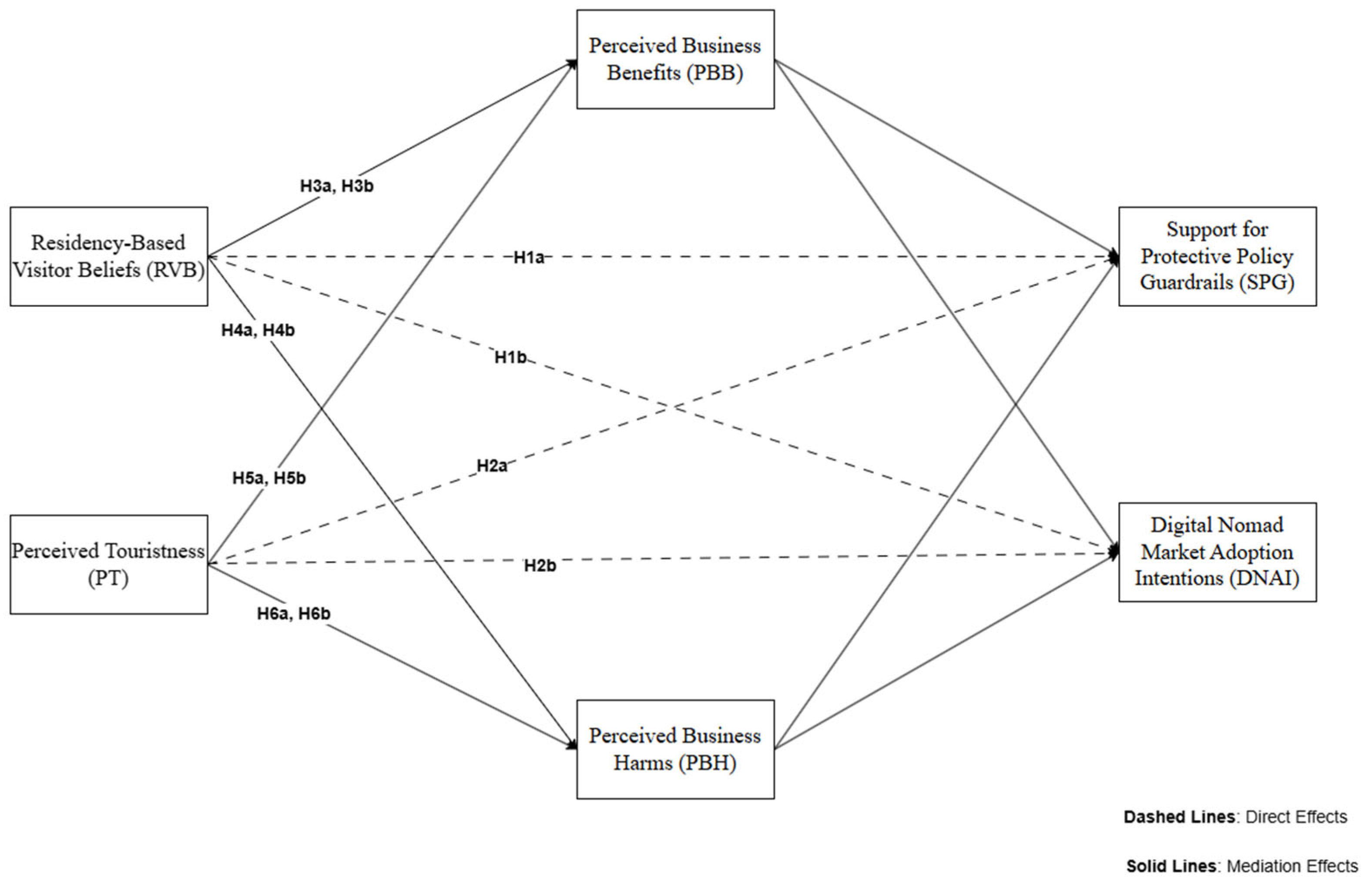
H1a. Residency-Based Visitor Beliefs (RVBs) positively influence Support for Protective Policy Guardrails (SPGs).
H1b. Residency-Based Visitor Beliefs (RVBs) positively influence Digital Nomad Market Adoption Intentions (DNAIs).
H2a. Perceived Touristness (PT) positively influences Support for Protective Policy Guardrails (SPGs).
H2b. Perceived Touristness (PT) positively influences Digital Nomad Market Adoption Intentions (DNAIs).
2.3. SMEs as Interpretive Market Actors and Evaluative Responses
SME research suggests that responses to market change are shaped by managerial interpretation rather than triggered automatically by external conditions. Studies of market orientation, learning, and innovativeness show that SMEs translate environmental signals into action through internal judgments and beliefs (
Keskin, 2006;
Low et al., 2007;
Raju et al., 2011). Related work on managerial perceptions further indicates that perceived resource value, uncertainty, and crisis expectations shape competitiveness and strategic behavior, even when such perceptions diverge from objective conditions (
Giannacourou et al., 2015;
Bayon & Aguilera, 2021). Tourism and hospitality studies similarly emphasize selective adaptation through networking, innovation, and capability development rather than mechanical adjustment to external demand (
Li et al., 2016;
Dowell et al., 2023;
Bianchi & Stoian, 2024). This perspective implies that SME responses to digital nomads should be understood as interpretive: before firms adapt, they must first decide what kind of market actors digital nomads are.
This interpretive process is likely to operate through both opportunity- and threat-based evaluations. The emerging literature portrays digital nomads as a segment associated with off-season demand, specialized consumption, coworking-related services, entrepreneurship, and knowledge spillovers into local ecosystems (
Kadek Rian Prayana & Sri Darma, 2023;
Christiansen et al., 2023;
Poulaki et al., 2023,
2025;
Arslan, 2024;
Hannonen, 2025). At the same time, existing work points to housing pressure, legal and tax ambiguity, infrastructure strain, gentrification, and uneven local gains (
Siemens, 2010;
Thullah & Abdulai Jalloh, 2021;
Christiansen et al., 2023;
Arslan, 2024;
Hannonen, 2025). For SMEs, these opportunity and threat evaluations are likely to depend on the prior classification of digital nomads: non-resident visitor status may make governance concerns more salient, whereas tourist market meaning may make demand and adaptation opportunities more salient. The present study therefore models benefits and harms as distinct evaluative mechanisms linking classification beliefs to downstream responses.
H3a. Residency-Based Visitor Beliefs (RVBs) have a positive indirect effect on Support for Protective Policy Guardrails (SPGs) through Perceived Business Benefits (PBBs).
H3b. Residency-Based Visitor Beliefs (RVBs) have a positive indirect effect on Digital Nomad Market Adoption Intentions (DNAIs) through Perceived Business Benefits (PBBs).
H4a. Residency-Based Visitor Beliefs (RVBs) have a positive indirect effect on Support for Protective Policy Guardrails (SPGs) through Perceived Business Harms (PBHs).
H4b. Residency-Based Visitor Beliefs (RVBs) have a negative indirect effect on Digital Nomad Market Adoption Intentions (DNAIs) through Perceived Business Harms (PBHs).
2.4. Policy Support and Business Adaptation
Research on tourism SMEs suggests that evaluations of opportunity and risk shape both policy preferences and organizational adaptation. Studies of adoption in tourism and hospitality show that perceived usefulness, trust, and barriers influence intentions to adjust business practices, while broader work on remote-work ecosystems indicates that supportive infrastructures and networks can enhance the attractiveness of places for location-independent professionals (
Wang & Azizurrohman, 2025;
Ahmad & Rasheed, 2025). At the policy level, destination research shows that stakeholder evaluations matter for support toward tourism planning, development, and governance (
Kokkranikal et al., 2011;
Drakulić Kovačević et al., 2018). In parallel, digital nomad research highlights the need to balance attraction with safeguards in contexts marked by housing strain, geoarbitrage, and regulatory uncertainty (
Mancinelli, 2020;
Mancinelli & Germann Molz, 2024;
Bednorz, 2024;
Cohen & Hannonen, 2026).
In this study, Support for Protective Policy Guardrails (SPGs) refers to support for regulatory or governance measures intended to manage the local externalities of digital nomadism rather than to block digital nomad activity. These guardrails include policy responses aimed at protecting housing affordability, reducing uneven local effects, clarifying legal or tax responsibilities, and ensuring that digital nomad attraction remains compatible with resident and destination interests. The concept therefore differs from general opposition to digital nomads: it captures support for managed integration and protective governance. Together, this literature suggests that perceived benefits should strengthen supportive adaptation, whereas perceived harms should increase support for protective guardrails and condition adoption:
H5a. Perceived Touristness (PT) has a positive indirect effect on Support for Protective Policy Guardrails (SPGs) through Perceived Business Benefits (PBBs).
H5b. Perceived Touristness (PT) has a positive indirect effect on Digital Nomad Market Adoption Intentions (DNAIs) through Perceived Business Benefits (PBBs).
H6a. Perceived Touristness (PT) has a positive indirect effect on Support for Protective Policy Guardrails (SPGs) through Perceived Business Harms (PBHs).
H6b. Perceived Touristness (PT) has a negative indirect effect on Digital Nomad Market Adoption Intentions (DNAIs) through Perceived Business Harms (PBHs).
Building on this logic, the present study links business-side classification, evaluative judgments, and downstream responses within a single framework illustrated in
Figure 1.
3. Research Methodology
3.1. Research Design, Data Collection and Sampling
This study employed a quantitative, cross-sectional survey design to examine how Greek SMEs classify digital nomads and how these classifications shape perceived business benefits and harms, support for digital-nomad-related policies, and firm-level adaptation intentions. SME owner-managers were selected as key informants because they are the actors most directly involved in interpreting customer groups, assessing commercial implications, and making strategic and operational decisions. To reduce variation in respondents’ interpretation of the focal population, the questionnaire introduced digital nomads as individuals who work remotely while staying temporarily outside their usual place of residence and combine mobility, digitally mediated work, and temporary local embeddedness (
Spector, 2019;
Mancinelli, 2020;
Hannonen, 2025;
KC & Triandafyllidou, 2025;
Sciuva, 2025).
Data were gathered using an online questionnaire administered through Google Forms. Data collection took place between October 2025 and January 2026, providing a cross-sectional snapshot of SME perceptions during that specific period. The survey was distributed through a targeted non-probability sampling strategy aimed at SMEs operating in tourism-linked and adjacent sectors in Greece. Dissemination relied on business networks, professional associations, sector contacts, entrepreneurial communities, and direct online circulation to potential respondents. Participation was voluntary and anonymous, and respondents were informed about the academic purpose of the study and their right to discontinue participation at any point. Because the sampling strategy was targeted rather than probability-based, the sample should not be interpreted as statistically representative of all Greek SMEs. Instead, it provides an analytically relevant sample of decision-relevant SME respondents operating in sectors where digital nomad demand is most likely to be encountered or evaluated. This sampling approach is appropriate for testing the proposed explanatory model, although it limits population-level generalization.
The target population consisted of SMEs active in sectors likely to encounter or evaluate digital nomad demand, including accommodation and short-term rentals, food and beverage, retail, transport, co-working and office services, professional and digital services, and culture and leisure (
Olsen & St George, 2004). The unit of analysis was the firm, and the unit of response was the owner or manager. Inclusion criteria required that respondents be at least 18 years old, currently hold an ownership or managerial role, represent an SME operating in Greece, and belong to a tourism-core or tourism-adjacent sector relevant to the study. Responses were excluded if participants did not hold a decision-relevant role, represented a large enterprise, public organization, or non-Greek business, belonged to an irrelevant sector, submitted duplicate entries, or provided questionnaires with excessive missing data or clear response-quality problems.
The target was N ≈ 900–1000 overall. This satisfies SEM practice for models with multiple indicators per latent construct and the requirements of multi-group analysis, while also aligning with the “10-times rule” logic commonly used in SEM and PLS-SEM research (
Hair & Alamer, 2022;
Wagner & Grimm, 2023). The final usable sample consisted of 747 respondents, which provides adequate statistical power for detecting small-to-moderate standardized effects, supports the estimation of indirect effects through bias-corrected bootstrap confidence intervals, and offers sufficient precision for confirmatory measurement assessment and subgroup comparisons, including tests of reliability and measurement invariance.
3.2. Measurement Scales
All multi-item constructs were measured on five-point Likert scales (1 = strongly disagree, 5 = strongly agree) (
Appendix A,
Table A1). As no established instrument directly captures SMEs’ classification of digital nomads, the scales were developed for this study and adapted from the relevant literature. Residency-Based Visitor Beliefs was measured with four items capturing whether SMEs perceive digital nomads as non-resident, temporary visitors rather than members of the local population, drawing on work on visitor classification and usual environment (
Mccabe, 2005;
Frechtling, 2006;
Wattanacharoensil & Stettler, 2025). Perceived Touristness was measured with four items assessing whether digital nomads are seen as tourists from a business and economic perspective, informed by tourism classification and expenditure research (
Konstantakis et al., 2020;
Ahmad & Rasheed, 2025).
Perceived Business Benefits and Perceived Business Harms were each measured with four items adapted from the literature on digital nomads’ local impacts and SME evaluations, with the former covering off-season demand, spending, demand stabilization, and market opportunity, and the latter covering housing pressure, leakage, capacity strain, and broader local costs (
Christiansen et al., 2023;
Arslan, 2024;
Ledesma-Chaves et al., 2024). The three dependent constructs were also measured with four items each:
Support for Facilitative Digital Nomad Policies, Support for Protective Policy Guardrails, and Digital Nomad Market Adoption Intentions, adapted from research on tourism policy, destination governance, digital nomad regulation, and SME adaptation and innovation in tourism and hospitality settings (
Ko & Stewart, 2002;
Kokkranikal et al., 2011;
Bednorz, 2024). Together, these measures operationalized the proposed sequence from classification beliefs to business evaluations and downstream policy and firm responses.
3.3. Sample Profile
The sample comprised 747 respondents (
Table 1). Most participants were co-owners/partners (36.0%) or general managers (31.5%), followed by owners (18.2%), other roles (9.8%), and department managers (4.6%). In firm-size terms, the sample was dominated by small enterprises (53.9%), followed by micro enterprises (29.3%) and medium-sized enterprises (16.7%). Regarding firm age, 34.3% had operated for less than 3 years, 28.1% for 3–5 years, 23.6% for 6–10 years, and 14.1% for more than 10 years. Tourism dependence was highest in the 41–60% category (33.1%), followed by 81–100% (27.0%), 61–80% (22.6%), 21–40% (8.8%), and 0–20% (8.4%). Housing pressure was most commonly reported as moderate (27.2%) or low (24.5%), followed by very low (19.7%), very high (17.1%), and high (11.5%).
4. Data Analysis and Results
The model was estimated using structural equation modeling in SmartPLS 4 (v4.1.1.8). PLS-SEM was selected because the study is primarily explanatory and prediction-oriented rather than focused on strict covariance-model fit testing. The model includes newly developed and adapted constructs, multiple mediating paths, and multi-group comparisons across SME contexts; therefore, variance-based SEM was appropriate for estimating the proposed classification–evaluation–response framework and assessing the explained variance of the endogenous constructs. CB-SEM would be more suitable for confirmatory model-fit evaluation, whereas the present study focuses on prediction, mediation, and group-specific structural differences. To examine potential heterogeneity across sub-populations, Multi-Group Analysis (MGA) was also conducted, allowing comparison of structural relationships across groups and making it possible to identify contextual differences that conventional regression approaches would not capture (
Sarstedt et al., 2011;
Matthews, 2017). Model estimation followed established SmartPLS procedures for calculating path coefficients, standard errors, and reliability metrics. For reflective constructs, indicator loadings of 0.70 or higher were treated as the benchmark for acceptable convergent validity. Overall, this analytical procedure enabled assessment of both the measurement model and the structural relationships, including comparisons across respondent groups.
4.1. Common Method Bias and Diagnostics
Common method bias was assessed using Harman’s single-factor test. A single unrotated factor accounted for 39.3% of the total variance, below the 50% threshold suggested by
Podsakoff et al. (
2012), indicating that common method bias was unlikely to be a serious concern. Because the questionnaire did not include a theoretically unrelated marker variable, a marker-variable test could not be performed. Therefore, additional collinearity-based diagnostics were used to complement Harman’s test. Indicator-level VIFs ranged from 1.260 to 3.388, and structural-level VIFs ranged from 1.000 to 2.012, all below commonly recommended thresholds (
Appendix A,
Table A2). These values suggest that neither item-level nor structural collinearity was severe enough to bias the model estimates. Taken together, the Harman test and VIF diagnostics suggest that common method bias and multicollinearity were unlikely to pose substantial threats to the results (
Hair & Alamer, 2022).
4.2. Measurement Model
The PLS-SEM procedure then proceeded to the evaluation of the reflective measurement model. Consistent with established guidelines, composite reliability, indicator reliability, convergent validity, and discriminant validity were assessed before interpreting the structural model, in order to confirm the psychometric soundness of the measures. Indicator reliability was examined through outer loadings, reflecting the extent to which each item’s variance was accounted for by its underlying latent construct. In line with commonly used recommendations, loadings of 0.70 or above were considered indicative of satisfactory item quality (
Sarstedt et al., 2021;
Hair & Alamer, 2022). At the same time, given that social science measures do not always meet this threshold, item removal was not applied mechanically. Instead, decisions about retaining or deleting indicators were based on whether their exclusion produced meaningful improvements in composite reliability and average variance extracted, thereby avoiding the premature removal of potentially useful items (
Hair et al., 2011;
Sarstedt et al., 2021).
Items with outer loadings between 0.40 and 0.70 were considered for removal only when their exclusion led to a meaningful improvement in the composite reliability or average variance extracted of the corresponding construct (
Hair et al., 2011). Applying these criteria and following established decision rules for measurement purification, two indicators—PBB4 and PBH4—were removed because their loadings fell below 0.50. As reported in
Table 2, this refinement improved the overall quality and parsimony of the measurement model while preserving adequate construct coverage, thereby supporting subsequent structural analysis and hypothesis testing.
Reliability was evaluated using Cronbach’s alpha, rho_A, and composite reliability (CR). The 0.70 threshold was achieved for DNAIs, PBBs, PBHs, PT, RVBs, and SPGs, while the remaining constructs also showed acceptable rho_A values, indicating moderate to high internal consistency. Convergent validity was supported, as AVE exceeded 0.50 for most constructs; where AVE was slightly below 0.50, it was considered acceptable because CR remained above 0.60 (
Hair et al., 2017,
2021). Discriminant validity was established through both the Fornell–Larcker criterion (
Fornell & Larcker, 1981), with each construct’s AVE square root exceeding its interconstruct correlations, and HTMT ratios below the conservative 0.85 threshold (
Henseler et al., 2015). Overall, the results indicate satisfactory reliability and construct validity. Detailed indices are reported in
Table 3 and
Table 4.
4.3. Structural Model
The structural model was evaluated on the basis of explained variance, predictive relevance, and path significance. The model accounted for 41.9% of the variance in DNAIs, 41.5% in PBBs, 37.1% in PBHs, and 45.2% in SPGs. These R2 values indicate substantively meaningful explanatory power for SME and tourism-behavior research, where managerial judgments and policy preferences are typically shaped by multiple organizational and contextual factors. The highest explained variance was observed for SPGs, suggesting that the model is particularly effective in explaining support for protective policy guardrails. The explained variance in DNAIs also indicates that classification beliefs and evaluative judgments are relevant predictors of firm-level adaptation intentions. In addition, the R2 values for PBBs and PBHs show that upstream classification beliefs explain a meaningful share of benefit- and harm-based evaluations. Predictive relevance was also supported, as the Q2_predict values for the endogenous constructs were positive and substantial (0.412 for PBBs, 0.367 for PBHs, 0.222 for DNAIs, and 0.374 for SPGs), suggesting moderate-to-strong out-of-sample predictive capacity.
Hypotheses were tested using nonparametric bootstrapping, which provided path estimates and standard errors for inference. Indirect effects were examined with a bias-corrected, one-tailed bootstrap procedure based on 10,000 resamples. Taken together, these results support the structural adequacy and predictive relevance of the model. Full estimates are reported in
Table 5.
Table 5 reports the structural path estimates. H1a was supported: Residency-Based Visitor Beliefs (RVBs) had a positive effect on Support for Protective Policy Guardrails (SPGs), β = 0.334, SD = 0.040, t = 8.33,
p < 0.001. However, H1b was not supported, as the effect of RVBs on Digital Nomad Market Adoption Intentions (DNAIs) was not significant, β = 0.008, SD = 0.041, t = 0.20,
p = 0.422. Thus, perceiving digital nomads as non-resident visitors increased support for guardrails but did not directly increase firms’ adaptation intentions.
Both hypotheses involving Perceived Touristness (PT) were supported. PT positively predicted SPGs, β = 0.110, SD = 0.030, t = 3.72, p < 0.001, supporting H2a, and also positively predicted DNAIs, β = 0.181, SD = 0.040, t = 4.50, p < 0.001, supporting H2b. These findings indicate that perceiving digital nomads as tourists from a business perspective was associated with both stronger regulatory support and stronger business adaptation intentions.
Beyond the hypothesized direct effects, both mediating constructs were significantly associated with the two outcome variables. Perceived Business Benefits (PBBs) positively predicted DNAIs, β = 0.390, SD = 0.037, t = 10.41,
p < 0.001, and SPGs, β = 0.258, SD = 0.040, t = 6.52,
p < 0.001. Perceived Business Harms (PBHs) also positively predicted DNAIs, β = 0.310, SD = 0.034, t = 9.04,
p < 0.001, and SPGs, β = 0.175, SD = 0.035, t = 4.96,
p < 0.001. The positive PBH → DNAI path is noted here descriptively and is interpreted in the
Section 5. Overall, three of the four hypothesized direct paths were supported, while the strongest observed effect in the model was the path from PBBs to DNAIs.
4.4. Mediation Analysis
Indirect effects were examined using bias-corrected bootstrapping with 10,000 resamples. As shown in
Table 6, the mediating roles of Perceived Business Benefits (PBBs) and Perceived Business Harms (PBHs) were supported for most, but not all, of the hypothesized paths.
For Residency-Based Visitor Beliefs (RVBs), all indirect effects were statistically significant. The indirect effect of RVBs on Support for Protective Policy Guardrails (SPGs) through PBBs was positive and significant, β = 0.166, SD = 0.027, t = 6.25, p < 0.001, supporting H3a. Likewise, the indirect effect of RVBs on Digital Nomad Market Adoption Intentions (DNAIs) through PBBs was positive and significant, β = 0.252, SD = 0.025, t = 9.95, p < 0.001, supporting H3b. The indirect effect of RVBs on SPGs through PBHs was also positive and significant, β = 0.106, SD = 0.022, t = 4.79, p < 0.001, supporting H4a. The indirect effect of RVBs on DNAIs through PBHs was also positive and significant, β = 0.188, SD = 0.022, t = 8.56, p < 0.001, supporting H4b. The negative sign previously reported for this path was a copying error and has been corrected. Because the direct path from RVBs to SPGs remained significant, mediation for the SPG outcome was partial. In contrast, because the direct path from RVBs to DNAIs was not significant, the indirect effects on DNAIs indicate full mediation.
For Perceived Touristness (PT), the mediation pattern was more selective. The indirect effects through PBBs were not significant for either SPGs, β = 0.001, SD = 0.008, t = 0.19, p = 0.424, or DNAIs, β = 0.002, SD = 0.011, t = 0.19, p = 0.424; therefore, H5a and H5b were not supported. However, the indirect effects through PBHs were significant. Specifically, PT had a positive indirect effect on SPGs through PBHs, β = 0.012, SD = 0.006, t = 1.89, p = 0.029, supporting H6a. PT also had a positive indirect effect on DNAIs through PBHs, β = 0.021, SD = 0.010, t = 2.08, p = 0.019, supporting H6b. The negative sign previously reported for this path was also a copying error and has been corrected. Because the direct paths from PT to both SPGs and DNAIs remained significant, these results indicate partial mediation through perceived business harms. The non-significant indirect effects for H5a and H5b indicate that Perceived Touristness did not operate through Perceived Business Benefits. This pattern appears to result from the weak association between PT and PBBs, rather than from a weak effect of PBBs on the outcome variables. In other words, although perceived benefits were strongly related to both SPGs and DNAIs, perceiving digital nomads as tourist-like customers did not necessarily translate into stronger benefit evaluations. PT therefore appears to relate to the outcomes more directly and indirectly only through perceived harms.
Overall, the mediation results suggest that RVBs influenced the two outcomes through both positive and negative evaluative channels, whereas PT operated indirectly only through PBHs. Thus, the evidence supports a mixed mediation pattern consisting of partial, full, and null mediation depending on the predictor, mediator, and outcome considered.
4.5. Multi-Group Analysis
Multi-group analysis showed significant heterogeneity across firm size, years in operation, and tourism dependence. For firm size, the largest differences involved the paths to SPGs, especially PBBs → SPGs, RVBs → SPGs, and PBHs → SPGs, with additional differences for RVBs → DNAIs, RVBs → PBBs, RVBs → PBHs, and PT → PBHs. For years in operation, significant differences were concentrated in the paths from RVBs to PBHs, SPGs, and DNAIs, as well as in the effects of PBBs on both outcomes. For tourism dependence, the most substantial differences appeared in the direct structural paths, particularly those linking PBBs, RVBs, PT, and PBHs to SPGs, DNAIs, and the mediators. Overall, these results indicate that the structural relationships varied meaningfully across business contexts (
Appendix A,
Table A3).
5. Discussion
This study examined how Greek SMEs interpret digital nomads and how those interpretations are associated with regulatory support and business adaptation. The findings support the central argument of the paper: SME responses are not mechanical, but appear to be related to classification beliefs and evaluative judgments. This extends prior work that has mainly approached digital nomads from the perspective of destinations, policy regimes, or nomads themselves (
Ma et al., 2024;
Hannonen, 2025;
KC & Triandafyllidou, 2025), by showing that local businesses also participate in constructing the meaning of this mobile population. In doing so, the results also align with broader SME research showing that managerial beliefs and expectations are associated with strategic responses to market change (
Keskin, 2006;
Low et al., 2007;
Raju et al., 2011;
Giannacourou et al., 2015).
A first key finding is that Residency-Based Visitor Beliefs and Perceived Touristness played different roles. Residency-Based Visitor Beliefs positively predicted support for protective guardrails, but had no direct effect on adoption intentions. By contrast, Perceived Touristness positively predicted both guardrail support and adoption intentions. This distinction is theoretically important because it is consistent with the view that classifying digital nomads as non-resident outsiders is primarily associated with a governance logic, whereas classifying them as tourists from a business perspective is associated with both governance and market-oriented responses. This sharpens earlier literature showing that digital nomads blur tourism, work, and settlement categories (
Prester et al., 2023;
Kaya Sayarı & Coşkun, 2024;
Sciuva, 2025), while tourism research has long shown that who counts as a tourist affects expenditure expectations, temporality, and destination strategy (
Mccabe, 2005;
Frechtling, 2006;
Pérez-Granja & Pérez-Rodríguez, 2025). The present results connect these streams by showing that SMEs distinguish between visitor status and tourist market meaning, and that the latter is more directly associated with adaptation.
A second important finding concerns the evaluative pathways. Perceived Business Benefits were positively associated with adoption intentions and support for guardrails. The first result is consistent with literature linking digital nomads to off-season revenue, specialized consumption, and local market opportunities (
Kadek Rian Prayana & Sri Darma, 2023;
Christiansen et al., 2023;
Poulaki et al., 2023,
2025). The fact that PBBs → DNAIs was the strongest path in the model suggests that perceived commercial value is a particularly important correlate of SME adaptation intentions, rather than proving that benefits causally drive adaptation. More notably, benefits were also positively associated with support for guardrails. This suggests that support for regulation should not be read simply as resistance. Instead, SMEs may favor protective measures even while recognizing business value, possibly because they see governance as necessary for sustaining that value under conditions of housing pressure, uneven local gains, or local strain. This interpretation is consistent with work emphasizing that digital nomadism generates both opportunities and tensions and therefore requires balancing attraction with control (
Mancinelli, 2020;
Bednorz, 2024;
Cohen & Hannonen, 2026).
The findings for Perceived Business Harms are especially revealing. Harms positively predicted guardrail support, as expected, but also positively predicted adoption intentions. Rather than indicating a contradiction, this pattern suggests that harms do not necessarily suppress action. Some SMEs may recognize costs such as housing pressure, leakage, or capacity strain while still viewing digital nomads as too important a market to ignore. In that sense, adaptation may reflect pragmatic adjustment under ambivalence rather than purely favorable orientation. An alternative explanation is also possible: firms already more inclined toward digital-nomad-oriented adaptation may be more attentive to both the benefits and the harms of this market, producing a positive association between perceived harms and adoption intentions. This reading fits the wider literature, which portrays digital nomads as both contributors to local ecosystems and sources of pressure on housing, regulation, and local balance (
Christiansen et al., 2023;
Arslan, 2024;
Hannonen, 2025;
Cohen & Hannonen, 2026).
The mediation results reinforce this mixed interpretation. For Residency-Based Visitor Beliefs, both benefit-based and harm-based indirect effects were significant. The positive pathway through benefits was associated with both outcomes, while the harms pathway was also positively associated with guardrail support and adoption intentions. Because the direct RVBs → DNAI path was not significant, the association between RVBs and DNAIs was fully mediated through evaluative mechanisms. This suggests that visitor-status classification becomes relevant for business adaptation mainly when it is translated into perceived commercial or local consequences. For Perceived Touristness, however, benefits did not mediate the effects, whereas harms did so partially for both outcomes. This pattern suggests that touristness may operate less through general benefit perceptions and more through a direct market-recognition logic, while still being accompanied by concern about local pressures. Thus, the model does not reveal a simple positive-versus-negative split; rather, it shows that business interpretations of digital nomads are simultaneously commercial and regulatory (
Low et al., 2007;
Giannacourou et al., 2015;
Wang & Azizurrohman, 2025).
The novelty of these findings lies not only in showing that SMEs evaluate digital nomads as opportunities or pressures, but in showing that such evaluations are preceded by classification judgments. The study demonstrates that visitor status and tourist market meaning are not interchangeable: RVBs were mainly associated with regulatory guardrail support, whereas PT was associated with both guardrail support and adoption intentions. This adds a business-side classification perspective to digital nomad research and shows that SMEs do not simply react to digital nomads as a new demand segment; they first interpret what kind of market category digital nomads represent. The positive association between perceived harms and adoption intentions further adds nuance by suggesting that adaptation may occur under ambivalence, where firms recognize local pressures while still considering digital nomads commercially relevant.
Finally, the multi-group analysis showed that these relationships vary across business contexts. Differences by firm size were concentrated in the paths leading to guardrail support, differences by years in operation were especially visible in the paths from Residency-Based Visitor Beliefs to harms, guardrails, and adoption, and tourism dependence moderated a large number of direct paths (
Mccabe, 2005;
Mudarra-Fernández et al., 2019;
Cohen & Hannonen, 2026). This is theoretically consistent with the view that firms positioned differently within the visitor economy will not interpret digital nomads in the same way. Overall, the findings support the broader claim that digital nomads are not a fixed market category for SMEs, but an interpreted one whose meaning depends on business context, expected value, and perceived local costs.
The Greek context is also important for interpreting these findings. Greece is highly dependent on tourism, with many local economies shaped by seasonality, small-firm structures, island and coastal destinations, and pressures on housing and local services. In such a setting, digital nomads may be interpreted not only as a new visitor segment, but also as a potential response to seasonality and as an additional source of local pressure. This may help explain why SMEs in the sample associated digital nomads with both business benefits and protective guardrails. The coexistence of opportunity and concern is therefore consistent with the structure of the Greek tourism economy, where SMEs often operate close to local resource constraints while depending heavily on visitor demand.
Because the study is cross-sectional, the estimated paths should be interpreted as theoretically specified associations rather than causal effects. Although the model is grounded in prior literature and specifies classification beliefs as upstream variables, alternative explanations cannot be ruled out. For example, SMEs already inclined to adapt to digital nomads may retrospectively perceive stronger benefits, may become more aware of related harms, or may classify digital nomads more clearly as tourists because they already view them as commercially relevant. Future longitudinal, experimental, or panel-based studies are therefore needed to establish temporal ordering and to test whether classification beliefs precede benefit and harm evaluations, or whether adaptation orientation also shapes those evaluations.
6. Practical Implications
The findings suggest that digital nomads should not be treated as an automatically beneficial market segment. SMEs distinguish between viewing them as non-resident visitors and as tourists from a business perspective, and these classifications shape both regulatory support and business adaptation. For destination managers and policymakers, this means that attraction strategies should go beyond promotion and address how local firms interpret digital nomads and what effects they expect from them.
The strongest practical implication concerns business adaptation. Because Perceived Business Benefits was the strongest predictor of Adoption Intentions, SMEs are more likely to adjust their services when they clearly see commercial value. Destination organizations, chambers of commerce, and business associations can support this by providing evidence on spending patterns, off-season demand, and sector-specific opportunities. In practical terms, SMEs may be encouraged to improve digital infrastructure, extend service flexibility, develop longer-stay offers, or strengthen multilingual and partnership-based services. At the same time, the results show that support for protective guardrails increases not only with perceived harms but also with perceived benefits. This indicates that regulation and market development should not be framed as opposites. SMEs may support digital nomad growth while also wanting safeguards for housing, local balance, and workforce protection. Policymakers should therefore combine facilitative measures, such as clearer tax guidance, co-working support, and destination branding, with selective protective measures where local pressure is high. Balanced governance is likely to be more legitimate than a purely pro-growth approach.
Finally, the multi-group findings suggest that policy should not assume a uniform SME response. Differences by firm size, years in operation, and tourism dependence indicate that some firms are more sensitive than others to both the opportunities and the risks associated with digital nomads. More targeted interventions, rather than one-size-fits-all strategies, are therefore likely to be more effective.
7. Conclusions, Limitations, and Future Directions
This study examined how Greek SMEs classify digital nomads and how these classifications are associated with business evaluations, policy guardrail support, and adaptation intentions. The findings show that SME responses are interpretive rather than automatic. Residency-Based Visitor Beliefs were mainly associated with support for guardrails, whereas Perceived Touristness was associated with both guardrail support and adaptation intentions. Perceived Business Benefits were the strongest correlate of adaptation intentions, while Perceived Business Harms were associated with both guardrail support and adaptation intentions. The main conclusion is that digital nomads “count” as tourists to businesses when firms interpret them as tourism-relevant market actors, not simply because they are temporary non-residents.
Several limitations indicate directions for future research. First, the cross-sectional design captures business interpretations at one point in time and does not establish causal ordering among classification beliefs, perceived benefits and harms, policy support, and adoption intentions. Future longitudinal or repeated-measures studies could examine whether SME classifications change as destinations mature, policies evolve, or local pressures intensify, and whether perceived benefits and harms shift with greater market exposure (
Kokkranikal et al., 2011;
KC & Triandafyllidou, 2025).
Second, the study relied on owner-manager self-reports, which are appropriate for examining managerial perceptions but do not capture objective business exposure or economic effects. Future research could combine surveys with qualitative interviews and business indicators such as revenue patterns, occupancy rates, length of stay, customer-segment shifts, or local housing-pressure measures (
Raju et al., 2011;
Dowell et al., 2023). Such designs would clarify how subjective evaluations relate to actual business conditions and help address potential endogeneity, including the possibility that firms already oriented toward digital-nomad adaptation perceive both higher benefits and higher harms.
Third, because no established scales directly capture business-side classification of digital nomads, several constructs were developed or adapted for this study. Although the measurement model performed satisfactorily, the removal of some indicators suggests that further scale refinement is needed. Future work should validate these measures across sectors, destinations, firm profiles, and institutional contexts, with particular attention to whether Residency-Based Visitor Beliefs and Perceived Touristness remain empirically distinct.
Finally, the study focused on SMEs in Greece, a relevant but context-specific setting. Greece’s tourism-dependent economy, strong seasonality, island and coastal destinations, and SME-dominated business landscape may intensify the coexistence of perceived opportunity and regulatory concern observed here. Replication in other national and regional contexts would help assess the transferability of the model. Future research could also examine sector exposure, urban versus island settings, policy environments, and local housing affordability to better explain when digital nomads are treated primarily as opportunity, pressure, or both.
Author Contributions
Conceptualization, S.B. and K.K.; methodology, S.B. and K.K.; software, S.B. and K.K.; validation, S.B. and K.K.; formal analysis, S.B. and K.K.; investigation, S.B. and K.K.; resources, S.B. and K.K.; data curation, S.B. and K.K.; writing—original draft preparation, S.B. and K.K.; writing—review and editing, S.B. and K.K.; visualization, S.B.; supervision, S.B. All authors have read and agreed to the published version of the manuscript.
Funding
This research received no external funding.
Institutional Review Board Statement
The study was conducted in accordance with the Declaration of Helsinki and approved by the Research Ethics and Deontology Committee (E.H.D.E.) of the University of Patras (protocol code Protocol/Ref. No.: 16216/175 and 22 October 2025).
Informed Consent Statement
Informed consent was obtained from all subjects involved in the study.
Data Availability Statement
The data presented in this study are available on request from the corresponding author due to privacy restrictions related to human participant data.
Conflicts of Interest
The authors declare no conflicts of interest.
Appendix A
Table A1.
Measurement scales used in data collection.
Table A1.
Measurement scales used in data collection.
| Residency-Based Visitor Beliefs (RVBs) |
|---|
| Thinking about digital nomads in your area… |
| RVB1 | Digital nomads in my area are best described as visitors. | Adapted from (Mccabe, 2005; Frechtling, 2006; Wattanacharoensil & Stettler, 2025) |
| RVB2 | The usual environment of digital nomads is outside this city or region. |
| RVB3 | Digital nomads should not be considered part of the local resident population. |
| RVB4 | From a local business perspective, digital nomads are temporary outsiders rather than locals. |
| Perceived Touristness (PT) |
| PT1 | Digital nomads are essentially tourists from a business perspective. | Adapted from (Konstantakis et al., 2020; Ahmad & Rasheed, 2025) |
| PT2 | Spending by digital nomads should be treated as tourism expenditure. |
| PT3 | Digital nomads belong more to inbound tourism than to the local customer base. |
| PT4 | For local businesses, digital nomads resemble tourists more than residents. |
| Perceived Business Benefits (PBBs) |
| PBB1 | Digital nomads help increase revenue during off-season periods. | Adapted from (Christiansen et al., 2023; Arslan, 2024; Ledesma-Chaves et al., 2024) |
| PBB2 | Digital nomads contribute positively to average customer spending. |
| PBB3 | Digital nomads help stabilize business demand across the year. |
| PBB4 | Digital nomads create valuable market opportunities for local businesses. |
| Perceived Business Harms (PBHs) |
| PBH1 | Digital nomad demand contributes to local housing pressures that make staffing more difficult. | Adapted from (Christiansen et al., 2023; Arslan, 2024; Ledesma-Chaves et al., 2024) |
| PBH2 | Platform-based and cross-border spending reduces the economic value that remains in the local business ecosystem. |
| PBH3 | Serving digital nomad demand can place pressure on business capacity without proportional profit. |
| PBH4 | The presence of digital nomads can create costs for local businesses and communities. |
| Support for Protective Policy Guardrails (SPGs) |
| SPG1 | I support short-term rental restrictions in areas facing strong housing pressure. | Adapted from (Ko & Stewart, 2002; Kokkranikal et al., 2011; Bednorz, 2024) |
| SPG2 | I support local levies or similar measures on medium-term stays when needed to manage local impacts. |
| SPG3 | I support housing-related safeguards that help prevent workforce displacement. |
| SPG4 | I support policies that balance attracting digital nomads with protecting the local community. |
| Digital Nomad Market Adoption Intentions (DNAIs) |
| DNAI1 | I intend to adapt my services or opening hours to better serve digital nomads. | Adapted from (Ko & Stewart, 2002; Kokkranikal et al., 2011; Bednorz, 2024) |
| DNAI2 | I intend to invest in digital nomad-friendly amenities such as fast Wi-Fi, workspaces, English-language service, or extended-stay offers. |
| DNAI3 | I intend to market my business more actively to digital nomads. |
| DNAI4 | I intend to develop offers or partnerships specifically targeting digital nomads. |
Table A2.
Collinearity diagnostics: indicator-level and structural-level VIF values.
Table A2.
Collinearity diagnostics: indicator-level and structural-level VIF values.
| Panel A. Indicator-Level VIF Values | Panel B. Structural-Level VIF Values |
|---|
| Indicator | VIF | Structural Path | VIF |
|---|
| DNAI1 | 2.537 | PBBs → DNAIs | 1.857 |
| DNAI2 | 2.431 | PBBs → SPGs | 1.857 |
| DNAI3 | 2.185 | PBHs → DNAIs | 1.725 |
| PBB1 | 3.388 | PBHs → SPGs | 1.725 |
| PBB2 | 2.833 | PT → DNAIs | 1.008 |
| PBB3 | 2.046 | PT → PBBs | 1.000 |
| PBH1 | 1.268 | PT → PBHs | 1.000 |
| PBH2 | 2.180 | PT → SPGs | 1.008 |
| PBH3 | 2.199 | RVBs → DNAIs | 2.012 |
| PT1 | 1.662 | RVBs → PBBs | 1.000 |
| PT2 | 1.779 | RVBs → PBHs | 1.000 |
| PT3 | 1.642 | RVBs → SPGs | 2.012 |
| PT5 | 1.368 | | |
| RVB1 | 1.573 | | |
| RVB2 | 1.982 | | |
| RVB3 | 1.931 | | |
| RVB4 | 1.732 | | |
| SPG1 | 1.327 | | |
| SPG2 | 1.284 | | |
| SPG3 | 1.260 | | |
Table A3.
Significant multi-group differences across firm size, years in operation, and tourism dependence.
Table A3.
Significant multi-group differences across firm size, years in operation, and tourism dependence.
| Moderator | Path | Comparison | Δβ | p |
|---|
| Firm size | PBBs → SPGs | SME-Large vs. SME-Medium | −0.519 | <0.001 |
| | PBBs → SPGs | SME-Large vs. SME-Small | −0.218 | 0.023 |
| | PBBs → SPGs | SME-Medium vs. SME-Small | 0.301 | <0.001 |
| | RVBs → SPGs | SME-Large vs. SME-Medium | 0.389 | <0.001 |
| | RVBs → SPGs | SME-Large vs. SME-Small | 0.540 | <0.001 |
| | RVBs → SPGs | SME-Medium vs. SME-Small | 0.150 | 0.039 |
| | PBBs → DNAIs | SME-Large vs. SME-Small | 0.217 | 0.039 |
| | RVBs → PBBs | SME-Medium vs. SME-Small | 0.124 | 0.034 |
| | RVBs → DNAIs | SME-Large vs. SME-Small | −0.274 | 0.016 |
| | RVBs → DNAIs | SME-Medium vs. SME-Small | −0.154 | 0.050 |
| | PT → SPGs | SME-Medium vs. SME-Small | −0.265 | 0.006 |
| | PBHs → SPGs | SME-Large vs. SME-Small | −0.249 | 0.020 |
| | PBHs → SPGs | SME-Medium vs. SME-Small | −0.334 | <0.001 |
| | RVBs → PBHs | SME-Large vs. SME-Small | −0.162 | 0.016 |
| | RVBs → PBHs | SME-Medium vs. SME-Small | −0.145 | 0.001 |
| | PT → PBHs | SME-Large vs. SME-Small | 0.392 | 0.025 |
| | PT → PBHs | SME-Medium vs. SME-Small | 0.350 | <0.001 |
| Years in operation | RVBs → PBHs | 3–5 years vs. 6–10 years | 0.333 | <0.001 |
| | RVBs → PBHs | 6–10 years vs. Less than 3 years | −0.341 | <0.001 |
| | RVBs → PBHs | 6–10 years vs. More than 10 years | −0.234 | 0.012 |
| | RVBs → DNAIs | 3–5 years vs. 6–10 years | 0.331 | 0.004 |
| | RVBs → DNAIs | 3–5 years vs. Less than 3 years | 0.231 | 0.044 |
| | RVBs → DNAIs | 3–5 years vs. More than 10 years | 0.266 | 0.038 |
| | RVBs → SPGs | 3–5 years vs. 6–10 years | 0.332 | 0.007 |
| | RVBs → SPGs | 6–10 years vs. More than 10 years | −0.412 | 0.001 |
| | RVBs → SPGs | 6–10 years vs. Less than 3 years | −0.286 | 0.017 |
| | PT → SPGs | 3–5 years vs. 6–10 years | 0.200 | 0.026 |
| | PBBs → SPGs | 3–5 years vs. 6–10 years | −0.206 | 0.042 |
| | PBBs → SPGs | 6–10 years vs. More than 10 years | 0.376 | 0.001 |
| | PBBs → SPGs | Less than 3 years vs. More than 10 years | 0.238 | 0.020 |
| | PT → DNAIs | 3–5 years vs. 6–10 years | 0.151 | 0.047 |
| | PT → DNAIs | 6–10 years vs. Less than 3 years | −0.305 | 0.019 |
| | PT → DNAIs | 6–10 years vs. More than 10 years | −0.303 | 0.019 |
| | PBBs → DNAIs | 3–5 years vs. Less than 3 years | −0.300 | 0.001 |
| | PBBs → DNAIs | 3–5 years vs. More than 10 years | −0.384 | 0.001 |
| | PBBs → DNAIs | 6–10 years vs. More than 10 years | −0.199 | 0.047 |
| | RVBs → PBBs | 3–5 years vs. Less than 3 years | 0.164 | 0.017 |
| Tourism dependence | PBBs → SPGs | 21–40% vs. 41–60% | −0.689 | <0.001 |
| | PBBs → SPGs | 21–40% vs. 61–80% | −0.539 | 0.004 |
| | PBBs → SPGs | 21–40% vs. <20% | −0.756 | 0.002 |
| | PBBs → SPGs | 41–60% vs. 81–100% | 0.462 | <0.001 |
| | PBBs → SPGs | 61–80% vs. 81–100% | 0.312 | 0.002 |
| | PBBs → SPGs | 81–100% vs. <20% | −0.528 | 0.003 |
| | RVBs → PBBs | 21–40% vs. 41–60% | −0.304 | 0.007 |
| | RVBs → PBBs | 21–40% vs. 81–100% | −0.293 | 0.009 |
| | RVBs → PBBs | 41–60% vs. 61–80% | 0.171 | 0.010 |
| | RVBs → PBBs | 41–60% vs. <20% | 0.245 | 0.003 |
| | RVBs → PBBs | 61–80% vs. 81–100% | −0.160 | 0.013 |
| | RVBs → PBBs | 81–100% vs. <20% | 0.234 | 0.004 |
| | RVBs → SPGs | 21–40% vs. 41–60% | 0.491 | 0.007 |
| | RVBs → SPGs | 21–40% vs. 61–80% | 0.389 | 0.019 |
| | RVBs → SPGs | 41–60% vs. 81–100% | −0.480 | <0.001 |
| | RVBs → SPGs | 41–60% vs. <20% | −0.407 | <0.001 |
| | RVBs → SPGs | 61–80% vs. 81–100% | −0.378 | 0.002 |
| | RVBs → SPGs | 61–80% vs. <20% | −0.305 | 0.003 |
| | PT → PBBs | 21–40% vs. 41–60% | −0.243 | 0.047 |
| | PT → PBBs | 21–40% vs. 81–100% | −0.448 | 0.013 |
| | PT → PBBs | 21–40% vs. <20% | −0.642 | 0.012 |
| | PT → PBBs | 41–60% vs. 81–100% | −0.205 | 0.006 |
| | PT → PBBs | 41–60% vs. <20% | −0.399 | 0.017 |
| | PT → PBBs | 61–80% vs. 81–100% | −0.228 | 0.015 |
| | PT → PBBs | 61–80% vs. <20% | −0.422 | 0.016 |
| | PT → SPGs | 41–60% vs. 81–100% | −0.154 | 0.032 |
| | PT → SPGs | 61–80% vs. <20% | −0.251 | 0.017 |
| | PT → DNAIs | 21–40% vs. <20% | 0.284 | 0.055 |
| | PT → DNAIs | 41–60% vs. 81–100% | 0.227 | 0.058 |
| | PT → DNAIs | 61–80% vs. 81–100% | −0.196 | 0.039 |
| | PT → DNAIs | 81–100% vs. <20% | 0.357 | 0.016 |
| | PBHs → DNAIs | 21–40% vs. <20% | −0.442 | 0.032 |
| | PBHs → DNAIs | 41–60% vs. 81–100% | −0.221 | 0.011 |
| | PBHs → DNAIs | 41–60% vs. <20% | −0.477 | 0.018 |
| | PBHs → DNAIs | 61–80% vs. 81–100% | −0.253 | 0.014 |
| | PBHs → DNAIs | 61–80% vs. <20% | −0.509 | 0.016 |
| | RVBs → PBHs | 21–40% vs. <20% | 0.335 | 0.016 |
| | RVBs → PBHs | 41–60% vs. 61–80% | 0.148 | 0.027 |
| | RVBs → PBHs | 41–60% vs. 81–100% | −0.119 | 0.023 |
| | RVBs → PBHs | 41–60% vs. <20% | 0.298 | 0.005 |
| | RVBs → PBHs | 61–80% vs. 81–100% | −0.267 | <0.001 |
| | RVBs → PBHs | 81–100% vs. <20% | 0.417 | <0.001 |
| | PBHs → SPGs | 21–40% vs. <20% | 0.464 | 0.017 |
| | PBHs → SPGs | 41–60% vs. 81–100% | 0.449 | 0.003 |
| | PBHs → SPGs | 61–80% vs. 81–100% | 0.481 | 0.004 |
| | PBHs → SPGs | 81–100% vs. <20% | 0.356 | 0.025 |
| | RVBs → DNAIs | 41–60% vs. 61–80% | 0.259 | 0.005 |
| | RVBs → DNAIs | 41–60% vs. 81–100% | 0.222 | 0.039 |
| | PT → PBHs | 21–40% vs. <20% | −0.345 | 0.036 |
| | PT → PBHs | 41–60% vs. 81–100% | −0.322 | 0.023 |
| | PT → PBHs | 61–80% vs. <20% | −0.415 | 0.014 |
| | PT → PBHs | 81–100% vs. <20% | −0.292 | 0.028 |
References
- Ahmad, N., & Rasheed, H. M. W. (2025). Tourism and hospitality SMEs and digital marketing: What factors influence their attitude and intention to use from the perspective of BRT, TAM and IRT. Journal of Hospitality and Tourism Insights, 8, 1546–1563. [Google Scholar] [CrossRef]
- Arslan, E. (2024). From tourists to nomads: Unveiling the transformative potential of digital nomads in travel and tourism. Worldwide Hospitality and Tourism Themes, 16, 269–281. [Google Scholar] [CrossRef]
- Bayon, M., & Aguilera, P. (2021). Managerial perceptions of the strategic relevance of resources and capabilities and its configuration for firm competitiveness: An exploratory study. Competitiveness Review, 31, 462–476. [Google Scholar] [CrossRef]
- Bednorz, J. (2024). Working from anywhere? Work from here! Approaches to attract digital nomads. Annals of Tourism Research, 105, 103715. [Google Scholar] [CrossRef]
- Bianchi, C., & Stoian, M. C. (2024). Exploring the role of managerial and organizational capabilities for the inbound internationalization of small and medium-sized enterprises. Journal of Small Business Management, 62, 724–762. [Google Scholar] [CrossRef]
- Chevtaeva, E., & Denizci-Guillet, B. (2021). Digital nomads’ lifestyles and coworkation. Journal of Destination Marketing and Management, 21, 100633. [Google Scholar] [CrossRef]
- Christiansen, R. A., Ihalauw, J. J. O. I., Albert Kriestian, N. A. N., & Yenny Purwati, S. E. (2023). Developing digital nomads as a new market segment and their role in the local digital ecosystem. Journal of System and Management Sciences, 13, 1–16. [Google Scholar] [CrossRef]
- Cohen, S., & Hannonen, O. (2026). A review of research into lifestyle mobilities and digital nomadism. Annals of Tourism Research, 116, 104067. [Google Scholar] [CrossRef]
- Dowell, D., Bowen, R., & Morris, W. (2023). Hospitality SME innovation: Responses to multifaceted crises. British Food Journal, 125, 4034–4047. [Google Scholar] [CrossRef]
- Drakulić Kovačević, N., Kovačević, L., Stankov, U., Dragićević, V., & Miletić, A. (2018). Applying destination competitiveness model to strategic tourism development of small destinations: The case of South Banat district. Journal of Destination Marketing and Management, 8, 114–124. [Google Scholar] [CrossRef]
- Ferrari, G., Mondéjar Jiménez, J., & Secondi, L. (2018). Tourists’ expenditure in tuscany and its impact on the regional economic system. Journal of Cleaner Production, 171, 1437–1446. [Google Scholar] [CrossRef]
- Fornell, C., & Larcker, D. F. (1981). Evaluating structural equation models with unobservable variables and measurement error. Journal of Marketing Research, 18, 39–50. [Google Scholar] [CrossRef]
- Frechtling, D. C. (2006). An assessment of visitor expenditure methods and models. Journal of Travel Research, 45, 26–35. [Google Scholar] [CrossRef]
- Giannacourou, M., Kantaraki, M., & Christopoulou, V. (2015). The perception of crisis by greek SMEs and its impact on managerial practices. Procedia Social and Behavioral Sciences, 175, 546–551. [Google Scholar] [CrossRef]
- Hair, J. F., & Alamer, A. (2022). Partial least squares structural equation modeling (PLS-SEM) in second language and education research: Guidelines using an applied example. Research Methods in Applied Linguistics, 1, 100027. [Google Scholar] [CrossRef]
- Hair, J. F., Hult, G. T. M., Ringle, C. M., & Sarstedt, M. (2017). A primer on partial least squares structural equation modeling (PLS-SEM). Sage. [Google Scholar]
- Hair, J. F., Hult, G. T. M., Ringle, C. M., Sarstedt, M., Danks, N. P., & Ray, S. (2021). An introduction to structural equation modeling. In Partial least squares structural equation modeling (PLS-SEM) using R (pp. 1–29). Springer International Publishing. [Google Scholar]
- Hair, J. F., Ringle, C. M., & Sarstedt, M. (2011). PLS-SEM: Indeed a silver bullet. Journal of Marketing theory and Practice, 19, 139–152. [Google Scholar] [CrossRef]
- Hannonen, O. (2025). Emergent geographies of digital nomadism: Conceptual framing, insights and implications for tourism. Tourism Geographies, 27, 568–578. [Google Scholar] [CrossRef]
- Henseler, J., Ringle, C. M., & Sarstedt, M. (2015). A new criterion for assessing discriminant validity in variance-based structural equation modeling. Journal of the Academy of Marketing Science, 43, 115–135. [Google Scholar] [CrossRef]
- Kadek Rian Prayana, I. A., & Sri Darma, G. B. (2023). Dynamic governance as an effort to develop quality tourism: Heaven for digital nomads. Tec Empresarial, 18(1), 312–331. [Google Scholar]
- Kaya Sayarı, B., & Coşkun, İ. O. (2024). Deconstructing digital nomads: Are they the last frontiers of the post-tourist? Worldwide Hospitality and Tourism Themes, 16, 258–268. [Google Scholar] [CrossRef]
- KC, H., & Triandafyllidou, A. (2025). Digital nomadism and the emergence of digital nomad visas: What policy objectives do states aim to achieve? International Migration Review, 60(1), 71–92. [Google Scholar] [CrossRef]
- Keskin, H. (2006). Market orientation, learning orientation, and innovation capabilities in SMEs: An extended model. European Journal of Innovation Management, 9, 396–417. [Google Scholar] [CrossRef]
- Ko, D.-W., & Stewart, W. P. (2002). A structural equation model of residents’ attitudes for tourism development. Tourism Management, 23(5), 521–530. [Google Scholar] [CrossRef]
- Kokkranikal, J., Cronje, P., & Butler, R. (2011). Tourism policy and destination marketing in developing countries: The chain of influence. Tourism Planning and Development, 8, 359–380. [Google Scholar] [CrossRef]
- Konstantakis, M., Alexandridis, G., & Caridakis, G. (2020). A personalized heritage-oriented recommender system based on extended cultural tourist typologies. Big Data and Cognitive Computing, 4, 12. [Google Scholar] [CrossRef]
- Koufodontis, N. I., & Gaki, E. (2025). Digital nomads or digital settlers? Rethinking regional development in the information age. Geoforum, 167, 104466. [Google Scholar] [CrossRef]
- Lacárcel, F. J. S. (2025). Digital technologies, sustainable lifestyle, and tourism: How digital nomads navigate global mobility? Sustainable Technology and Entrepreneurship, 4, 100096. [Google Scholar] [CrossRef]
- Ledesma-Chaves, P., Gil-Cordero, E., Navarro-García, A., & Maldonado-López, B. (2024). Satisfaction and performance expectations for the adoption of the metaverse in tourism SMEs. Journal of Innovation and Knowledge, 9, 100535. [Google Scholar] [CrossRef]
- Li, N., Toppinen, A., & Lantta, M. (2016). Managerial perceptions of SMEs in the wood industry supply chain on corporate responsibility and competitive advantage: Evidence from China and Finland. Journal of Small Business Management, 54, 162–186. [Google Scholar] [CrossRef]
- Low, D. R., Chapman, R. L., & Sloan, T. R. (2007). Inter-relationships between innovation and market orientation in SMEs. Management Research News, 30, 878–891. [Google Scholar] [CrossRef]
- Ma, W., Vatsa, P., Zhou, X., & Zhu, H. (2024). Household income and tourism expenditure: An unconditional quantile regression approach. Applied Economics, 56, 6144–6157. [Google Scholar] [CrossRef]
- Mancinelli, F. (2020). Digital nomads: Freedom, responsibility and the neoliberal order. Information Technology and Tourism, 22, 417–437. [Google Scholar] [CrossRef]
- Mancinelli, F., & Germann Molz, J. (2024). Moving with and against the state: Digital nomads and frictional mobility regimes. Mobilities, 19, 189–207. [Google Scholar] [CrossRef]
- Massidda, C., Piras, R., & Seetaram, N. (2022). Analysing the drivers of itemised tourism expenditure from the UK using survey data. Annals of Tourism Research Empirical Insights, 3, 100037. [Google Scholar] [CrossRef]
- Matthews, L. (2017). Applying multigroup analysis in PLS-SEM: A step-by-step process. In Partial least squares path modeling: Basic concepts, methodological issues and applications (pp. 219–243). Springer. [Google Scholar]
- Mccabe, S. (2005). ‘Who is a tourist?’: A critical review. Tourist Studies, 5, 85–106. [Google Scholar] [CrossRef]
- Mudarra-Fernández, A. B., Carrillo-Hidalgo, I., & Pulido-Fernández, J. I. (2019). Factors influencing tourist expenditure by tourism typologies: A systematic review. Anatolia, 30, 18–34. [Google Scholar] [CrossRef]
- Olsen, C., & St George, D. M. M. (2004). Cross-sectional study design and data analysis. College Entrance Examination Board, 26, 2006. [Google Scholar]
- Pérez-Granja, U., & Pérez-Rodríguez, J. V. (2025). Transport mode differences on daily tourist expenditure and overnight stays for domestic tourism in Spain. Applied Economics, 1–17. [Google Scholar] [CrossRef]
- Podsakoff, P. M., MacKenzie, S. B., & Podsakoff, N. P. (2012). Sources of method bias in social science research and recommendations on how to control it. Annual Review of Psychology, 63, 539–569. [Google Scholar] [CrossRef]
- Poulaki, I., Mavragani, E., Kaziani, A., & Chatzimichali, E. (2023). Digital nomads: Advances in hospitality and destination attractiveness. Tourism and Hospitality, 4, 483–498. [Google Scholar] [CrossRef]
- Poulaki, I., Vlassi, E., Mavragani, E., Chatzimichali, E., & Papatheodorou, A. (2025). Destination buzzers: Netnographying digital nomads. Tourism and Hospitality, 6, 81. [Google Scholar] [CrossRef]
- Prester, J., Cecez-Kecmanovic, D., & Schlagwein, D. (2023). Toward a theory of identity performance in unsettled digital work: The becoming of ‘digital nomads’. Journal of Information Technology, 38, 442–458. [Google Scholar] [CrossRef]
- Raju, P. S., Lonial, S. C., & Crum, M. D. (2011). Market orientation in the context of SMEs: A conceptual framework. Journal of Business Research, 64, 1320–1326. [Google Scholar] [CrossRef]
- Sarstedt, M., Henseler, J., & Ringle, C. M. (2011). Multigroup analysis in partial least squares (PLS) path modeling: Alternative methods and empirical results. In Measurement and research methods in international marketing (pp. 195–218). Emerald Group Publishing Limited. [Google Scholar]
- Sarstedt, M., Ringle, C. M., & Hair, J. F. (2021). Partial least squares structural equation modeling. In Handbook of market research (pp. 587–632). Springer. [Google Scholar]
- Sciuva, E. (2025). Geographies of digital nomadism: A research agenda. Geography Compass, 19, e70016. [Google Scholar] [CrossRef]
- Siemens, L. (2010). Challenges, responses and available resources: Success in rural small businesses. Journal of Small Business and Entrepreneurship, 23, 65–80. [Google Scholar] [CrossRef]
- Spector, P. E. (2019). Do not cross me: Optimizing the use of cross-sectional designs. Journal of Business and Psychology, 34, 125–137. [Google Scholar] [CrossRef]
- Thullah, A., & Abdulai Jalloh, S. (2021). A review of the economic, social and environmental impacts of tourism development. American Journal of Theoretical and Applied Business, 7, 39. [Google Scholar] [CrossRef]
- Wagner, R., & Grimm, M. S. (2023). Empirical validation of the 10-times rule for SEM. In L. Radomir, R. Ciornea, H. Wang, Y. Liu, C. M. Ringle, & M. Sarstedt (Eds.), State of the art in partial least squares structural equation modeling (PLS-SEM) (pp. 3–7). Springer International Publishing. [Google Scholar]
- Wang, T. L., & Azizurrohman, M. (2025). Digital nomads in Bali: Implications for employee experience in tourism-based SMEs. Qual Quant. [Google Scholar] [CrossRef]
- Wattanacharoensil, W., & Stettler, J. (2025). Residents’ perceptions of tourism impacts and regulatory measures: The case of Lucerne’s urban destination. International Journal of Tourism Cities, 12(1), 99–116. [Google Scholar] [CrossRef]
- Zhang, P., Wang, J., & Li, R. (2023). Tourism-type ontology framework for tourism-type classification, naming, and knowledge organization. Heliyon, 9, e15192. [Google Scholar] [CrossRef]
| Disclaimer/Publisher’s Note: The statements, opinions and data contained in all publications are solely those of the individual author(s) and contributor(s) and not of MDPI and/or the editor(s). MDPI and/or the editor(s) disclaim responsibility for any injury to people or property resulting from any ideas, methods, instructions or products referred to in the content. |