

Tourist Perception of Sustainable Community-Based Tourism: A Structural Model of Authenticity, Integral Sustainability and Ethical Co-Design
 ,
,  , ,
, ,  and
and
Abstract
1. Introduction
2. Literature Review
2.1. From Rural Tourism to Sustainable Community-Based Tourism (SCBT)
2.2. The Integrated SCBT Approach (Dangi & Jamal, 2016)
2.2.1. Integrated Sustainability
2.2.2. Community Empowerment
2.2.3. Justice and Ethics of Care
2.2.4. Meaningful Participation
2.3. Critical Tensions in Community-Based Tourism
2.3.1. The Authenticity Paradox
2.3.2. The Tourist Gaze and Power Relations
2.3.3. Participation as Contested Terrain
2.4. Model Dimensions: Tourist Perception
2.4.1. Independent Variables: Perceived SCBT Dimensions
2.4.2. Dependent Variable: Tourist Experience
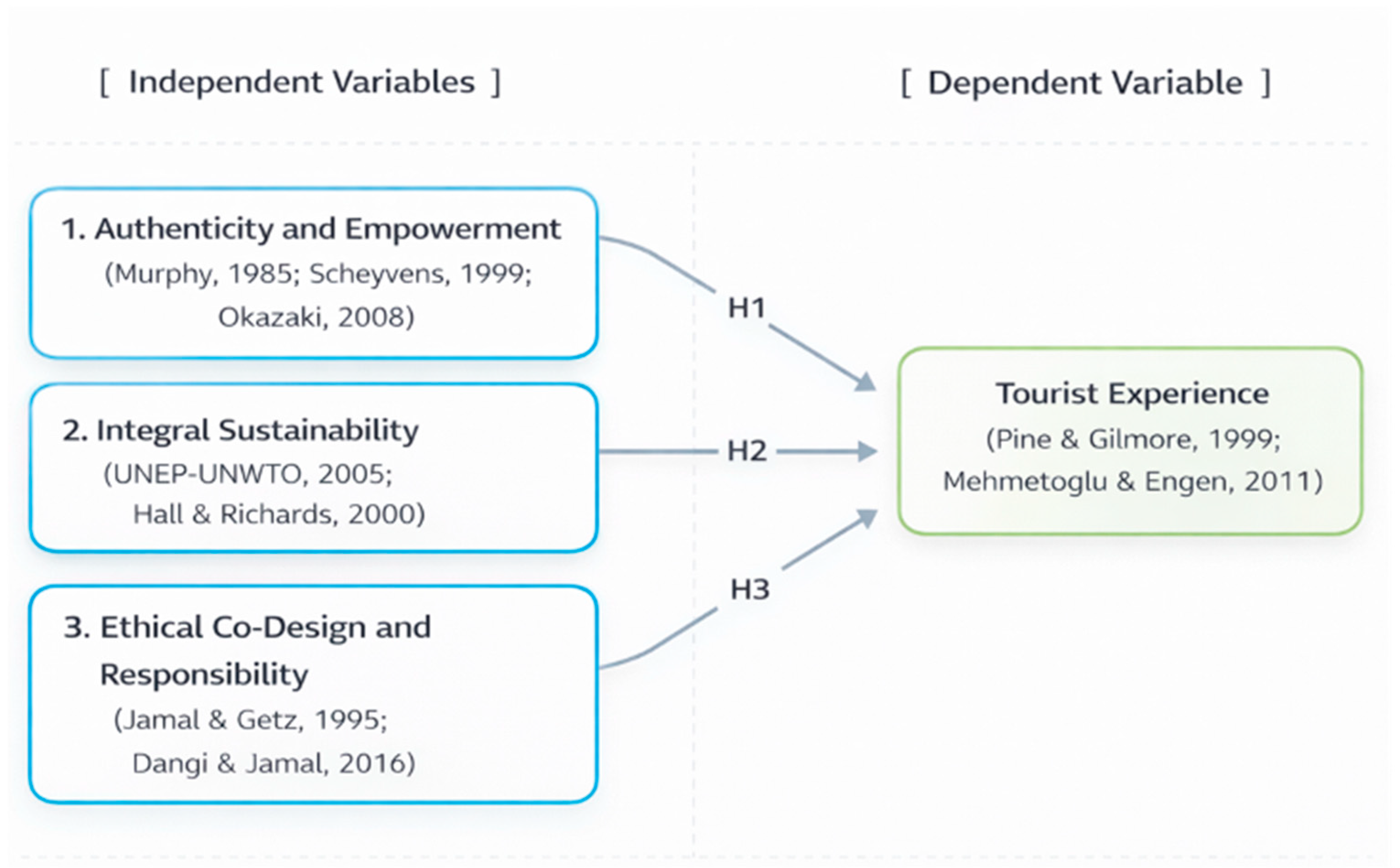
2.5. Conceptual Model and Hypotheses
3. Materials and Methods
3.1. Instrument and Operationalization of Variables
3.2. Sample
3.3. Data Analysis
4. Results
4.1. Measurement Model Assessment
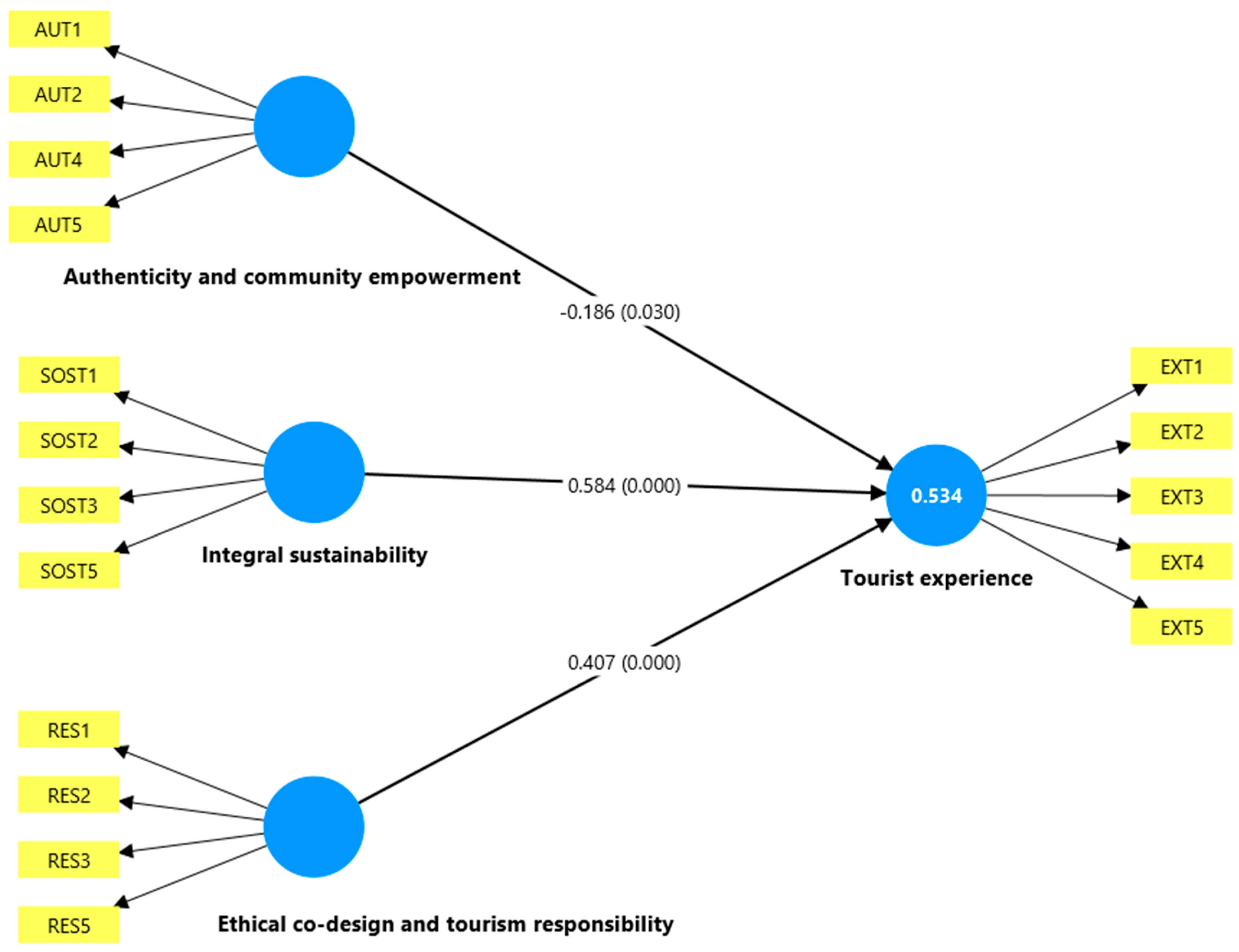
4.2. Structural Model Assessment
5. Discussion
5.1. Integral Sustainability as the Main Determinant of the Tourist Experience
5.2. Ethical Co-Design and Tourism Responsibility: Active Tourist Participation and Its Limits
5.3. Authenticity and Community Empowerment: An Inverse Relationship Under Scrutiny
5.4. The Tourist as an External Validator: Analytical Usefulness and Normative Limits
6. Conclusions
6.1. Conclusions and Implications
6.2. Limitations and Future Research Directions
Author Contributions
Funding
Institutional Review Board Statement
Informed Consent Statement
Data Availability Statement
Conflicts of Interest
References
- Aburumman, O. J., Omar, K., Al Shbail, M., & Aldoghan, M. (2022). How to deal with the results of PLS-SEM? In International conference on business and technology (pp. 1196–1206). Springer International Publishing. [Google Scholar]
- Adebayo, A. D., & Butcher, J. (2023). Community empowerment in Nigeria’s tourism industry: An analysis of stakeholders’ perceptions. Tourism Planning & Development, 20(4), 583–603. [Google Scholar] [CrossRef]
- Ali, F., Rasoolimanesh, S. M., Sarstedt, M., Ringle, C. M., & Ryu, K. (2018). An assessment of the use of partial least squares structural equation modeling (PLS-SEM) in hospitality research. International Journal of Contemporary Hospitality Management, 30(1), 514–538. [Google Scholar] [CrossRef]
- Benitez, J., Henseler, J., Castillo, A., & Schuberth, F. (2020). How to perform and report an impactful analysis using partial least squares: Guidelines for confirmatory and explanatory IS research. Information & Management, 57(2), 103168. [Google Scholar] [CrossRef]
- Bianchi, R. V. (2009). The ‘critical turn’ in tourism studies: A radical critique. Tourism Geographies, 11(4), 484–504. [Google Scholar] [CrossRef]
- Blackstock, K. (2005). A critical look at community based tourism. Community Development Journal, 40(1), 39–49. [Google Scholar] [CrossRef]
- Boluk, K. A., Cavaliere, C. T., & Higgins-Desbiolles, F. (2019). A critical framework for interrogating the United Nations sustainable development goals 2030 agenda in tourism. Journal of Sustainable Tourism, 27(7), 847–864. [Google Scholar] [CrossRef]
- Büscher, B., & Fletcher, R. (2017). Destructive creation: Capital accumulation and the structural violence of tourism. Journal of Sustainable Tourism, 25(5), 651–667. [Google Scholar] [CrossRef]
- Chhabra, D. (2010). Back to the past: A sub-segment of Generation Y’s perceptions of authenticity. Journal of Sustainable Tourism, 18(6), 793–809. [Google Scholar] [CrossRef]
- Cohen, E. (1988). Authenticity and commodification in tourism. Annals of Tourism Research, 15(3), 371–386. [Google Scholar] [CrossRef]
- Cooke, B., & Kothari, U. (Eds.). (2001). Participation: The new tyranny? Zed Books. [Google Scholar]
- Cruz-Cruz, E., Leyva-Hernández, S. N., & Avendaño-Rito, M. d. C. (2026). Cohesión social y emprendimiento artesanal en los Valles Centrales de Oaxaca, México. Revista de Métodos Cuantitativos para la Economía y la Empresa, 1–28. [Google Scholar] [CrossRef]
- Dangi, T. B., & Jamal, T. (2016). An integrated approach to “sustainable community-based tourism”. Sustainability, 8(5), 475. [Google Scholar] [CrossRef]
- Diamantopoulos, A., Sarstedt, M., Fuchs, C., Wilczynski, P., & Kaiser, S. (2012). Guidelines for choosing between multi-item and single-item scales for construct measurement: A predictive validity perspective. Journal of the Academy of Marketing Science, 40(3), 434–449. [Google Scholar] [CrossRef]
- Dolezal, C., & Novelli, M. (2022). Power in community-based tourism: Empowerment and partnership in Bali. Journal of Sustainable Tourism, 30(10), 2352–2370. [Google Scholar] [CrossRef]
- Dolinting, P. P., & Pang, V. (2022). Assessing the validity and reliability of adapted classroom climates instrument for Malaysian rural schools using PLS-SEM. International Journal of Education, Psychology and Counseling, 7, 383–401. [Google Scholar] [CrossRef]
- Garcia, F. C. S., & Vargas, W. F. C. (2024). Greenwashing in the tourism and hospitality sector: A systematic analysis of the literature. Revista Interamericana de Ambiente y Turismo—RIAT, 20(2), 174–191. [Google Scholar] [CrossRef]
- Ginjanjar, R., & Runingsawitri, H. S. (2023). Community empowerment in tourism development: Concepts and implications. The Eastasouth Management and Business, 1(3), 111–119. [Google Scholar] [CrossRef]
- González-García, R. J., Añó-Sanz, V., Parra-Camacho, D., & Calabuig-Moreno, F. (2018). Perception of residents about the impact of sports tourism on the community: Analysis and scale-validation. Journal of Physical Education and Sport, 18(1), 149–156. [Google Scholar] [CrossRef]
- Graciano, P. F., & Holanda, L. A. D. (2020). Análisis bibliométrico de la producción científica sobre turismo de base comunitario de 2013 a 2018. Revista Brasileira de Pesquisa em Turismo, 14, 161–179. [Google Scholar] [CrossRef]
- Guan, J., Zhu, D., Cheng, S., & Li, Q. (2025). “It is my place”: Residents’ community-based psychological ownership and its impact on rural tourism participation. Journal of Sustainable Tourism, 33(7), 1303–1329. [Google Scholar] [CrossRef]
- Hair, J. F., Hult, G. T., Ringle, C. M., & Sarstedt, M. A. (2017). Primer on partial least squares structural equation modeling (PLS-SEM). Sage Publications. [Google Scholar]
- Hair, J. F., Risher, J. J., Sarstedt, M., & Ringle, C. M. (2019). When to use and how to report the results of PLS-SEM. European Business Review, 31(1), 2–24. [Google Scholar] [CrossRef]
- Hall, D. R., & Richards, G. (Eds.). (2000). Tourism and sustainable community development (Vol. 1). Routledge. [Google Scholar]
- He, L., & Timothy, D. J. (2024). Tourists perceptions of cultural and creative souvenir products and their relationship with place. Journal of Tourism and Cultural Change, 22, 143–163. [Google Scholar] [CrossRef]
- Hickey, S., & Mohan, G. (2004). Towards participation as transformation: Critical themes and challenges. In Participation: From tyranny to transformation (pp. 3–24). Zed Books. [Google Scholar]
- Huruta, A. D., Sasongko, G., Wahyudi, Y., Saptuti Sri Kawuryan, I., & Yirong Lu, C. (2024). Sustainability and community-based tourism nexus: A mediation role of consumer satisfaction. Cogent Business & Management, 11(1), 2421418. [Google Scholar] [CrossRef]
- Jamal, T. B., & Camargo, B. A. (2014). Sustainable tourism, justice and an ethic of care: Toward the Just Destination. Journal of Sustainable Tourism, 22(1), 11–30. [Google Scholar] [CrossRef]
- Jamal, T. B., & Getz, D. (1995). Collaboration theory and community tourism planning. Annals of Tourism Research, 22(1), 186–204. [Google Scholar] [CrossRef]
- Jokom, R., Semuel, H., & Wijaya, S. (2025). Sustainable tourism experiences: The role of digital technology and government support in creating tourists’ memorable experiences. Cogent Business & Management, 12(1), 2482026. [Google Scholar] [CrossRef]
- Joppe, M. (1996). Sustainable community tourism development revisited. Tourism Management, 17(7), 475–479. [Google Scholar] [CrossRef]
- Krittayaruangroj, K., Suriyankietkaew, S., & Hallinger, P. (2023). Research on sustainability in community-based tourism: A bibliometric review and future directions. Asia Pacific Journal of Tourism Research, 28(9), 1031–1051. [Google Scholar] [CrossRef]
- Lane, B. (1994). What is rural tourism? Journal of Sustainable Tourism, 2(1–2), 7–21. [Google Scholar] [CrossRef]
- Lane, B. (2009). Rural tourism: An overview. In T. Jamal, & M. Robinson (Eds.), The SAGE handbook of tourism studies (pp. 354–370). SAGE Publications. [Google Scholar]
- Li, J., Coca-Stefaniak, J. A., Nguyen, T. H. H., & Morrison, A. M. (2024). Sustainable tourist behavior: A systematic literature review and research agenda. Sustainable Development, 32(4), 3356–3374. [Google Scholar] [CrossRef]
- Liu, Y. L., Chiang, J. T., & Ko, P. F. (2023). The benefits of tourism for rural community development. Humanities and Social Sciences Communications, 10(1), 137. [Google Scholar] [CrossRef]
- Long, P. T., Perdue, R. R., & Allen, L. (1990). Rural resident tourism perceptions and attitudes by community level of tourism. Journal of Travel Research, 28(3), 3–8. [Google Scholar] [CrossRef]
- MacCannell, D. (1973). Staged authenticity: Arrangements of social space in tourist settings. American Journal of Sociology, 79(3), 589–603. [Google Scholar] [CrossRef] [PubMed]
- Mathew, P. V., Cabral, C., & Mohandas, N. P. (2024). Influence of responsible tourism practices on the destination perceptions of tourists. International Journal of Tourism Research, 26(4), e2692. [Google Scholar] [CrossRef]
- Mehmetoglu, M., & Engen, M. (2011). Pine and Gilmore’s concept of experience economy and its dimensions: An empirical examination in tourism. Journal of Quality Assurance in Hospitality & Tourism, 12(4), 237–255. [Google Scholar] [CrossRef]
- Millan-Anaya, M. R., Cordova-Buiza, F., & Olavarria-Benavides, H. L. (2024). Beaches and medicinal lagoons tourism destination in Peru: Satisfaction and loyalty research. GeoJournal of Tourism and Geosites, 52(1), 286–293. [Google Scholar] [CrossRef]
- Mowforth, M., & Munt, I. (2015). Tourism and sustainability: Development, globalisation and new tourism in the Third World (4th ed.). Routledge. [Google Scholar]
- Murphy, P. E. (1985). Tourism: A community approach. Methuen. [Google Scholar]
- Nitzl, C. (2016). The use of partial least squares structural equation modelling (PLS-SEM) in management accounting research: Directions for future theory development. Journal of Accounting Literature, 37(1), 19–35. [Google Scholar] [CrossRef]
- Nunnally, J. C., & Bernstein, I. H. (1994). Psychometric theory. McGraw-Hill. [Google Scholar]
- Okazaki, E. (2008). A community-based tourism model: Its conception and use. Journal of Sustainable Tourism, 16(5), 511–529. [Google Scholar] [CrossRef]
- Osti, L., & Cicero, L. (2018). Tourists’ perception of landscape attributes in rural tourism. Worldwide Hospitality and Tourism Themes, 10(2), 211–221. [Google Scholar] [CrossRef]
- Palomino Villavicencio, B., Gasca Zamora, J., & López Pardo, G. (2016). El turismo comunitario en la Sierra Norte de Oaxaca: Perspectiva desde las instituciones y la gobernanza en territorios indígenas. El Periplo Sustentable, 30, 6–37. [Google Scholar]
- Peña, A. I. P., Jamilena, D. M. F., & Molina, M. Á. R. (2012). The perceived value of the rural tourism stay and its effect on rural tourist behaviour. Journal of Sustainable Tourism, 20(8), 1045–1065. [Google Scholar] [CrossRef]
- Pine, B. J., & Gilmore, J. H. (1999). The experience economy: Work is theatre & every business a stage. Harvard Business School Press. [Google Scholar]
- Rasoolimanesh, S. M. (2022). Discriminant validity assessment in PLSSEM: A comprehensive composite-based approach. Data Analysis Perspectives Journal, 3(2), 1–8. [Google Scholar]
- Reed, M. G. (1997). Power relations and community-based tourism planning. Annals of Tourism Research, 24(3), 566–591. [Google Scholar] [CrossRef]
- Rocca, L. H. D., & Zielinski, S. (2022). Community-based tourism, social capital, and governance of post-conflict rural tourism destinations: The case of Minca, Sierra Nevada de Santa Marta, Colombia. Tourism Management Perspectives, 43, 100985. [Google Scholar] [CrossRef]
- Sanagustin-Fons, V., Lafita-Cortés, T., & Moseñe, J. A. (2018). Social perception of rural tourism impact: A case study. Sustainability, 10(2), 339. [Google Scholar] [CrossRef]
- Scheyvens, R. (1999). Ecotourism and the empowerment of local communities. Tourism Management, 20(2), 245–249. [Google Scholar] [CrossRef]
- Scheyvens, R. (2002). Tourism for development: Empowering communities. Prentice Hall. [Google Scholar]
- Scheyvens, R., & van der Watt, H. (2021). Tourism, empowerment and sustainable development: A new framework for analysis. Sustainability, 13(22), 12606. [Google Scholar] [CrossRef]
- Schlosberg, D. (2007). Defining environmental justice: Theories, movements, and nature. Oxford University Press. [Google Scholar]
- Shishan, F., Majeed, S., Nimri, R., Qasem, Z., & Millanyani, H. (2025). Green hotels and greener choices: Impact of environmental claims on traveler perceptions. International Journal of Tourism Research. [Google Scholar] [CrossRef]
- Sosa, M., Aulet, S., & Mundet, L. (2021). Community-based tourism through food: A proposal of sustainable tourism indicators for isolated and rural destinations in Mexico. Sustainability, 13(12), 6693. [Google Scholar] [CrossRef]
- Soták-Benedeková, L., Rybárová, J., Tometzová, D., Seňová, A., & Rybár, R. (2025). Comprehensive analysis of rural tourism development: Historical evolution, current trends, and future prospects. Sustainability, 17(3), 1045. [Google Scholar] [CrossRef]
- Šegota, T., Mihalič, T., & Perdue, R. R. (2024). Resident perceptions and responses to tourism: Individual vs. community level impacts. Journal of Sustainable Tourism, 32(2), 340–363. [Google Scholar] [CrossRef]
- Tosun, C. (2006). Limits to community participation in tourism development in developing countries. Tourism Management, 27(6), 1137–1150. [Google Scholar] [CrossRef]
- UNEP & UNWTO. (2005). Making tourism more sustainable: A guide for policy makers. United Nations Environment Programme & World Tourism Organization. Available online: https://wedocs.unep.org/items/30f0298c-25a7-4ce5-852a-6371c2cbe991 (accessed on 15 January 2026).
- Urry, J., & Larsen, J. (2011). The tourist gaze 3.0. SAGE Publications. [Google Scholar]
- Werts, C. E., Linn, R. L., & Jöreskog, K. G. (1974). Interclass reliability estimates: Testing structural assumptions. Educational and Psychological Measurement, 34, 25–33. [Google Scholar] [CrossRef]
- Whyte, K. P. (2011). Environmental justice and Native American self-determination. In R. J. Brulle, & D. N. Pellow (Eds.), Environmental justice (pp. 155–172). MIT Press. [Google Scholar]
- Yanan, L., Ismail, M. A., & Aminuddin, A. (2024). How has rural tourism influenced the sustainable development of traditional villages? A systematic literature review. Heliyon, 10(4), e25627. [Google Scholar] [CrossRef] [PubMed]
- Zielinski, S., Jeong, Y., Kim, S. I., & Milanés, C. B. (2020). Why community-based tourism and rural tourism in developing and developed nations are treated differently? A review. Sustainability, 12(15), 5938. [Google Scholar] [CrossRef]



| Variable/Construct | Conceptual Definition | Dimensions/Items (Codes) | Theoretical Source |
|---|---|---|---|
| Authenticity and Community Empowerment (AEC) | Tourist perception of local control, cultural pride, and genuine community participation in tourism management. | Control and Authenticity: Faithful reflection of culture (AUT1) Perceived community control (AUT2) Host pride (AUT3) Participation in decision-making (AUT4) Genuine interactions (AUT5) | Murphy (1985); Scheyvens (1999); Dangi and Jamal (2016) |
| Integral Sustainability (SIC) | Perception of the balance between cultural heritage conservation, environmental responsibility, and resident quality of life. | Conservation and Balance: Preservation of traditions (SOST1) Environmental protection (SOST2) Responsible resource use (SOST3) Impact on lifestyle (SOST4) Tourist–resident balance (SOST5) | UNEP and UNWTO (2005); González-García et al. (2018); Dangi and Jamal (2016) |
| Ethical Co-Design and Responsibility (RES) | Tourist disposition to share responsibility for local development and perception of fair, transparent governance. | Ethics and Collaboration: Willingness to pay premium (RES1) Support for carrying capacity limits (RES2) Interest in participatory activities (RES3) Demand for transparency (RES4) Interest in volunteering (RES5) | Jamal and Camargo (2014); Dangi and Jamal (2016); Reed (1997) |
| Tourist Experience (EXT) | Overall valuation of the visitor’s experience based on the Experience Economy framework. | Experience Domains: Education/Learning (EXT1) Escapism/Immersion (EXT2) Aesthetics/Environment (EXT3) Entertainment (EXT4) Overall satisfaction (EXT5) | Pine and Gilmore (1999); Mehmetoglu and Engen (2011) |
| Construct | Item | Factor Loading | Cronbach’s Alpha | Composite Reliability (rho_a) | Composite Reliability (rho_c) | Average Extracted Variance (AVE) |
|---|---|---|---|---|---|---|
| Authenticity and community empowerment | AUT1 | 0.957 | 0.930 | 0.938 | 0.930 | 0.771 |
| AUT2 | 0.825 | |||||
| AUT4 | 0.946 | |||||
| AUT5 | 0.769 | |||||
| Ethical co-design and tourism responsibility | RES1 | 0.935 | 0.935 | 0.937 | 0.935 | 0.782 |
| RES2 | 0.813 | |||||
| RES3 | 0.880 | |||||
| RES5 | 0.905 | |||||
| Integral sustainability | SOST1 | 0.786 | 0.843 | 0.844 | 0.843 | 0.573 |
| SOST2 | 0.771 | |||||
| SOST3 | 0.742 | |||||
| SOST5 | 0.726 | |||||
| Tourist experience | EXT1 | 0.862 | 0.924 | 0.925 | 0.924 | 0.708 |
| EXT2 | 0.842 | |||||
| EXT3 | 0.832 | |||||
| EXT4 | 0.878 | |||||
| EXT5 | 0.789 |
| Relationship | Ratio Heterotrait-Monotrait (HTMT) |
|---|---|
| Ethical co-design and tourism responsibility <-> Authenticity and community empowerment | 0.708 |
| Integral sustainability <-> Authenticity and community empowerment | 0.327 |
| Integral sustainability <-> Ethical co-design and tourism responsibility | 0.364 |
| Tourist experience <-> Authenticity and community empowerment | 0.295 |
| Tourist experience <-> Ethical co-design and tourism responsibility | 0.490 |
| Tourist experience <-> Integral sustainability | 0.671 |
| Hypothesis | Original Sample | Mean | Standard Deviation | t Statistic | p Value | VIF | f2 |
|---|---|---|---|---|---|---|---|
| Authenticity and community empowerment -> Tourist experience | −0.186 | −0.183 | 0.086 | 2.167 | 0.030 | 2.016 | 0.037 |
| Ethical co-design and tourism responsibility -> Tourist experience | 0.407 | 0.404 | 0.093 | 4.364 | 0.000 | 2.077 | 0.173 |
| Integral sustainability -> Tourist experience | 0.584 | 0.587 | 0.067 | 8.764 | 0.000 | 1.17 | 0.63 |
Disclaimer/Publisher’s Note: The statements, opinions and data contained in all publications are solely those of the individual author(s) and contributor(s) and not of MDPI and/or the editor(s). MDPI and/or the editor(s) disclaim responsibility for any injury to people or property resulting from any ideas, methods, instructions or products referred to in the content. |
© 2026 by the authors. Licensee MDPI, Basel, Switzerland. This article is an open access article distributed under the terms and conditions of the Creative Commons Attribution (CC BY) license.
Share and Cite
Avendaño-Rito, M.d.C.; Leyva-Hernández, S.N.; Arango-Ramírez, P.M.; Cruz-Cruz, E.; Martínez-Vargas, A. Tourist Perception of Sustainable Community-Based Tourism: A Structural Model of Authenticity, Integral Sustainability and Ethical Co-Design. Tour. Hosp. 2026, 7, 127. https://doi.org/10.3390/tourhosp7050127
Avendaño-Rito MdC, Leyva-Hernández SN, Arango-Ramírez PM, Cruz-Cruz E, Martínez-Vargas A. Tourist Perception of Sustainable Community-Based Tourism: A Structural Model of Authenticity, Integral Sustainability and Ethical Co-Design. Tourism and Hospitality. 2026; 7(5):127. https://doi.org/10.3390/tourhosp7050127
Chicago/Turabian StyleAvendaño-Rito, María del Carmen, Sandra Nelly Leyva-Hernández, Paola Miriam Arango-Ramírez, Eduardo Cruz-Cruz, and Adrián Martínez-Vargas. 2026. "Tourist Perception of Sustainable Community-Based Tourism: A Structural Model of Authenticity, Integral Sustainability and Ethical Co-Design" Tourism and Hospitality 7, no. 5: 127. https://doi.org/10.3390/tourhosp7050127
APA StyleAvendaño-Rito, M. d. C., Leyva-Hernández, S. N., Arango-Ramírez, P. M., Cruz-Cruz, E., & Martínez-Vargas, A. (2026). Tourist Perception of Sustainable Community-Based Tourism: A Structural Model of Authenticity, Integral Sustainability and Ethical Co-Design. Tourism and Hospitality, 7(5), 127. https://doi.org/10.3390/tourhosp7050127