
Article

Tourist Perception of Sustainable Community-Based Tourism: A Structural Model of Authenticity, Integral Sustainability and Ethical Co-Design

by
María del Carmen Avendaño-Rito
,
Sandra Nelly Leyva-Hernández
*,
Paola Miriam Arango-Ramírez
,
Eduardo Cruz-Cruz
and
Adrián Martínez-Vargas
Instituto Tecnológico del Valle de Etla, Tecnológico Nacional de México, Oaxaca 68030, Mexico
*
Author to whom correspondence should be addressed.
Tour. Hosp. 2026, 7(5), 127; https://doi.org/10.3390/tourhosp7050127
Submission received: 31 March 2026 / Revised: 28 April 2026 / Accepted: 30 April 2026 / Published: 2 May 2026

Abstract

Sustainable Community-Based Tourism (SCBT) has been predominantly assessed from residents’ perspectives, leaving unexplored how tourists perceive and validate community sustainability. This study analyzes the influence of three SCBT dimensions, authenticity and community empowerment, integral sustainability, and ethical co-design, on tourist experience. Using Partial Least Squares Structural Equation Modeling (PLS-SEM), we analyzed 341 responses from Mexican tourists with experience in indigenous community destinations in Oaxaca. Results show that integral sustainability is the strongest predictor of tourist experience, followed by ethical co-design. Notably, authenticity and community empowerment exhibit a significant inverse relationship, suggesting tensions between genuine local governance and visitor expectations. These findings position tourists as external validators of SCBT and challenge the linear authenticity–experience relationship assumed in classic literature, highlighting the need for heritage interpretation strategies that mediate this interaction. The study provides evidence from underrepresented Latin American indigenous contexts, addressing theoretical and geographical gaps in sustainable tourism research.

1. Introduction

Rural tourism has traditionally been recognized as a vital strategy for economic diversification in non-urban areas, characterized by its reliance on natural and cultural resources (Lane, 1994, 2009). Empirical evidence confirms that well-managed rural tourism generates multidimensional benefits, including economic revitalization, heritage preservation, and strengthened social capital (Liu et al., 2023; Yanan et al., 2024). Tourist perceptions of landscape attributes and perceived value significantly influence behavioral intentions and destination loyalty (Osti & Cicero, 2018; Peña et al., 2012). However, a critical distinction must be made between conventional rural tourism and Sustainable Community-Based Tourism (SCBT). While the former may operate under extractive logics, SCBT requires a paradigm shift toward local governance, equity, and integral sustainability (Zielinski et al., 2020).
Despite the growing body of SCBT literature, a significant gap persists: most impact assessments continue to focus predominantly on residents’ perspectives (Long et al., 1990; González-García et al., 2018), a trend that remains evident in recent studies examining psychological ownership and community-level impacts (Šegota et al., 2024; Guan et al., 2025). This omission is critical, as tourist demand can incentivize ethical practices through market mechanisms. Recent bibliometric analyses identify this demand-side perspective as a research priority (Graciano & Holanda, 2020; Krittayaruangroj et al., 2023; Soták-Benedeková et al., 2025). Social perception studies confirm that visitor evaluations shape destination competitiveness, yet remain marginalized in community tourism research (Sanagustin-Fons et al., 2018). Evidence from Latin American contexts shows that community governance and social capital are key mediators of sustainable outcomes, particularly in indigenous territories where autonomy and cultural preservation intersect with external pressures (Rocca & Zielinski, 2022).
Furthermore, SCBT literature has been criticized for assuming a predominantly descriptive and normative character, with almost uncritical adherence to empowerment and authenticity as inherently positive (Blackstock, 2005). Critical scholars argue that participatory discourse can mask local elitism and neocolonial dynamics (Cooke & Kothari, 2001; Bianchi, 2009). Similarly, authenticity lacks engagement with classic debates on staged authenticity and commodification (MacCannell, 1973; Cohen, 1988). Recent critiques emphasize that sustainable tourism remains shaped by global political and economic interests that structure power relations within host communities (Mowforth & Munt, 2015). Without confronting these tensions, there is a risk of reproducing idealized assumptions
The integrated SCBT framework proposed by Dangi and Jamal (2016) addresses some of these limitations by incorporating justice, ethics of care, and meaningful participation. However, empirical validation from the tourist perspective remains scarce, particularly in Latin American indigenous contexts, where community governance systems present unique characteristics (Palomino Villavicencio et al., 2016). In light of this gap, this study is guided by the following research question: How do tourists’ perceptions of authenticity and community empowerment, integral sustainability, and ethical co-design influence their overall experience in indigenous community-based tourism destinations?
Addressing this question requires empirical validation to determine whether theoretical assumptions about empowerment and sustainability hold when confronted with visitor perceptions. This is particularly relevant in indigenous destinations, where governance mechanisms such as community assemblies and collective labor may be interpreted differently by outsiders compared to conventional tourism settings. Understanding these perceptual dynamics is essential to avoid idealized narratives and to identify potential misalignments between community governance practices and visitor expectations. In this context, this study aims to analyze the influence of tourists’ perceptions of three core dimensions of sustainable community-based tourism—authenticity and community empowerment, integral sustainability, and ethical co-design—on their overall tourist experience in indigenous community-based tourism destinations.
Unlike previous studies centered on residents, this research positions the tourist as an external validator of community sustainability, while acknowledging the epistemological limitations of perceptual measures. The study contributes to theory by: (1) empirically validating the Dangi and Jamal (2016) framework from the demand side; (2) challenging the linear authenticity–experience relationship assumed in the classic literature; and (3) providing evidence from underrepresented Latin American indigenous contexts. From a practical perspective, the findings offer actionable insights for community managers seeking to balance genuine governance practices with visitor expectations through heritage interpretation strategies.

2. Literature Review

2.1. From Rural Tourism to Sustainable Community-Based Tourism (SCBT)

Rural tourism has historically been conceived as a mechanism for economic diversification in non-urban areas, defined by its dependence on the natural and cultural resources of the environment (Lane, 1994, 2009). However, recent literature distinguishes between conventional rural tourism and Sustainable Community-Based Tourism (SCBT). While the former may operate under extractive or external logics, SCBT demands a paradigm shift toward local governance, equity, and integral sustainability (Zielinski et al., 2020; Yanan et al., 2024).
The foundations of this approach were established early when Hall and Richards (2000) argued that sustainable community development cannot be achieved without genuine integration between the tourism industry and local social systems. However, the implementation of these ideals has faced criticism from their inception. Joppe (1996) warned that discrepancies between planners’ objectives and the community’s real needs often result in unsustainable projects. Recent studies confirm that the benefits of tourism for rural development are not automatic but depend on communities’ capacity to manage territories and negotiate with external actors (Liu et al., 2023; Palomino Villavicencio et al., 2016). Soták-Benedeková et al. (2025) point out that current research trends prioritize interdisciplinary approaches that link environmental sustainability with social justice. However, Blackstock (2005) warns that community participation often remains instrumental, failing to achieve real empowerment. To address these historical and contemporary limitations, this study is based on the integrated SCBT framework proposed by Dangi and Jamal (2016).

2.2. The Integrated SCBT Approach (Dangi & Jamal, 2016)

Dangi and Jamal (2016) criticize traditional sustainable tourism approaches for fragmenting environmental, social, and economic dimensions while ignoring fundamental issues of justice, equity, and ethics. Their SCBT proposal integrates four theoretical pillars, explained below.

2.2.1. Integrated Sustainability

This pillar transcends the “triple bottom line” (economic, social, environmental) approach to incorporate a holistic vision in which sustainability must be rooted in the host community. According to UNEP and UNWTO (2005), sustainability in community tourism not only entails conserving natural resources but also maintaining cultural vitality and ensuring lasting benefits for residents. Dangi and Jamal (2016) emphasize that sustainability must encompass governance and intergenerational justice, ensuring that current decisions do not compromise the community’s future well-being.
However, Büscher and Fletcher (2017) warn that sustainability and conservation discourses can mask processes of “green grabbing,” in which environmental rhetoric serves capitalist interests rather than local well-being. This critique is relevant to the present study: sustainability perceived by tourists may not align with sustainability experienced by the community, especially when conservation measures restrict community access to traditional resources.

2.2.2. Community Empowerment

Based on the model of Scheyvens (1999, 2002), empowerment in the SCBT context is conceptualized as a multidimensional process that includes:
Economic Empowerment: Generation of local income, job creation for residents, and retention of economic benefits within the community. It is not just about income but about who controls resources and economic decisions (Adebayo & Butcher, 2023).
Psychological Empowerment: Strengthening residents’ self-esteem and cultural pride. It implies that the community positively values its cultural identity and perceives it as an asset, not an obstacle to development. Ginjanjar and Runingsawitri (2023) point out that this internal recognition is a precursor to active participation; without cultural pride, the tourism offering risks falling into empty commodification.
Social Empowerment: Strengthening community cohesion, improving collective well-being, and facilitating access to basic services. Tourism must contribute to social capital, not erode it. Scheyvens and van der Watt (2021) warn that social empowerment must evaluate whether tourism strengthens internal support networks or, conversely, generates fragmentation and conflicts among residents.
Political Empowerment: The community’s capacity to participate in decision-making, influence tourism policies, and exercise control over development in their territory. It is the most critical dimension, as without decision-making power, the other dimensions are insufficient (Scheyvens, 1999). Adebayo and Butcher (2023) corroborate that perceptions of political empowerment vary significantly among actors and that including marginalized voices is essential for legitimate governance.
However, empowerment is not without criticism. Cooke and Kothari (2001) argue that participatory approaches can become a “new tyranny,” in which local elites capture decision-making processes while maintaining the appearance of inclusivity. Dolezal and Novelli (2022) demonstrate in their study of community-based tourism in Bali that unequal power relations can persist even in apparently participatory models. Hickey and Mohan (2004) emphasize that empowerment must be analyzed as a contested process, not as a guaranteed outcome.
Scheyvens (1999) warns that empowerment is not a binary state (empowered/not empowered) but a continuum, on which communities may be empowered in some dimensions but not others. Ginjanjar and Runingsawitri (2023) reinforce this vision by indicating that the implications of empowerment in tourism development must be measured in light of these dimensional asymmetries. This perspective is fundamental to this research, as the tourist perception scale seeks to capture these nuances.

2.2.3. Justice and Ethics of Care

This pillar, grounded in Jamal and Camargo (2014), incorporates three fundamental ethical dimensions:
Distributive Justice: This refers to the equitable distribution of benefits (income, employment, infrastructure) and burdens (environmental impacts, congestion, cultural changes) of tourism. The central question is: Who gains and who loses from tourism development? Dangi and Jamal (2016) argue that SCBT must prioritize the most vulnerable community members, avoiding local elites capturing the majority of benefits. Schlosberg (2007) expands this concept by including the recognition of cultural identities and the capacity for participation as dimensions of environmental justice.
Procedural Justice: This refers to equity in decision-making processes. It is not enough to distribute benefits; communities must have a voice and vote in how tourism is planned, managed, and evaluated. This includes transparency in information, real opportunities for participation, and recognition of local knowledge (Whyte, 2011).
Ethics of Care: This proposes a relational approach based on mutual responsibility among tourists, operators, residents, and the natural environment. Unlike deontological ethics (rule-based) or utilitarian ethics (outcome-based), the ethics of care emphasizes relationships, empathy, and responsibility toward others, especially toward communities in vulnerable situations (Jamal & Camargo, 2014). Boluk et al. (2019) argue that decolonizing tourism research requires centering these relational ethics over extractive knowledge frameworks.

2.2.4. Meaningful Participation

Based on Murphy (1985) and Tosun (2006), this pillar distinguishes between two types of participation:
Instrumental Participation: Residents are consulted or used as labor, but have no real decision-making power. It is “front-stage” participation, where decisions are already made by external actors (the government, companies, NGOs).
Empowering Participation (Meaningful): Residents have control over key decisions, from planning to impact evaluation. It implies power transfer, not just task allocation. Tosun (2006) warns that, in developing countries, empowering participation faces structural barriers, including power centralization, a lack of technical capacity, and economic inequalities.
Murphy (1985) was a pioneer in arguing that the community must be treated as an integrated system where residents are active partners, not mere spectators of tourism development. However, Cooke and Kothari (2001) argue that participation can mask neocolonial dynamics in which Global South communities must conform to Global North sustainability expectations.

2.3. Critical Tensions in Community-Based Tourism

While the SCBT framework provides a normative foundation for sustainable tourism, critical scholarship warns against uncritical adoption of its core concepts. This section engages with theoretical tensions that problematize empowerment, authenticity, and the tourist’s role as a sustainability validator.

2.3.1. The Authenticity Paradox

The notion of authenticity, central to this study’s model, has been critically examined since MacCannell’s (1973) seminal work on staged authenticity. MacCannell argued that tourists seek authentic experiences beyond their everyday lives, but the tourism industry responds by constructing “staged” settings that simulate authenticity without genuine cultural depth. This creates a fundamental tension: what tourists perceive as authentic may be carefully managed performance rather than lived community reality.
Chhabra (2010) extends this debate to heritage tourism, demonstrating that perceptions of authenticity vary significantly across tourist segments and are influenced by prior knowledge, expectations, and interpretive mediation. For Generation Y tourists, authenticity is not an inherent attribute of the destination but a co-constructed perception shaped by the interaction between visitor expectations and destination presentation. This suggests that community empowerment, when not effectively interpreted, may be misread as disorganization rather than genuine local control.

2.3.2. The Tourist Gaze and Power Relations

The conceptualization of the tourist as an “external validator” of sustainability requires critical examination in light of Urry and Larsen’s (2011) theory of the tourist gaze. They argue that tourism is not a neutral activity but a structured way of seeing that privileges certain perspectives while marginalizing others. The tourist gaze is shaped by media, marketing, and cultural expectations, which may not align with community self-representations.
This raises an epistemological question: Can tourist perceptions legitimately validate community sustainability, or do they reproduce external power dynamics where community practices must conform to visitor expectations to be valued? Büscher and Fletcher (2017) warn that conservation and sustainability discourse can mask processes of “green grabbing” and accumulation by dispossession, where environmental rhetoric serves capitalist interests rather than local well-being.

2.3.3. Participation as Contested Terrain

Critical scholars challenge the assumption that participation is inherently emancipatory. Cooke and Kothari (2001) argue that participatory approaches can become a “new tyranny,” in which local elites capture decision-making processes while maintaining the appearance of inclusivity. Mowforth and Munt (2015) frame sustainable tourism within the global political economy, showing how sustainability discourse often serves Northern consumer expectations rather than Southern community needs.
These critiques do not invalidate SCBT but demand epistemological humility: tourist perceptions are valuable indicators but must be recognized as partial, mediated, and potentially misaligned with internal community realities. This study acknowledges these limitations while arguing that demand-side perspectives remain underexplored and necessary for understanding market incentives for ethical tourism.

2.4. Model Dimensions: Tourist Perception

To operationalize the SCBT framework from the demand side, three predictor dimensions and one outcome variable are defined, based on the reviewed literature.

2.4.1. Independent Variables: Perceived SCBT Dimensions

Although distributive justice is a theoretical pillar of SCBT (Scheyvens, 2002; Joppe, 1996), from the visitor’s perspective, these dimensions manifest observably through three measurable constructs:
Authenticity and Community Empowerment (AEC): Based on Murphy (1985) and Scheyvens (1999), it evaluates whether the tourist perceives that the community exercises real control. Okazaki (2008) points out that successful models depend on the community’s capacity to conceive and control the tourism offering. Tosun (2006) adds that the visitor’s perception of authenticity serves as an external indicator of the genuineness of local control.
Integral Sustainability (Cultural and Environmental) (SIC): Aligned with UNEP and UNWTO (2005) and Hall and Richards (2000), this dimension assesses perceptions of operational conservation. Sosa et al. (2021) highlight that indicators in rural destinations must be sensitive to local context. Liu et al. (2023) confirm that perceived sustainability is a critical determinant of destination quality.
Ethical Co-Design and Tourist Responsibility (RES): Grounded in the ethics of care (Jamal & Camargo, 2014; Dangi & Jamal, 2016) and collaboration theory (Jamal & Getz, 1995), this dimension examines the tourist’s disposition to co-responsibilize (pay a premium, accept carrying capacity limits), shifting from a passive role to an active ethical stakeholder.

2.4.2. Dependent Variable: Tourist Experience

The application of Pine and Gilmore’s (1999) framework to community tourism in indigenous contexts generates tensions that must be explained: staging poses the risk that ancestral cultural practices become mere performance for tourist consumption, altering traditional ritual cycles such as mayordomazgos (traditional community-based religious leadership systems involving rotational service and ceremonial responsibilities); co-creation through participation in tequios (communal work practices based on collective labor for community benefit) or traditional cooking oscillates between genuine reciprocity and authenticity simulation; thematization of “ancestral Zapotec life” can homogenize internal cultural diversity and simplify community negotiations about what is exhibitable; and the logic of “time well spent” as a valuation basis can pressure the sustainability of natural resources and social carrying capacity.
These tensions, documented in the Pueblos Mancomunados of the Sierra Juárez by Palomino Villavicencio et al. (2016), justify integrating the experiential framework with Dangi and Jamal’s (2016) approach, which provides the ethical conditions of justice, equity, and ethics of care for the tourist experience to be genuinely sustainable.
In the SCBT context, the experience is not only recreational but transformative. The adoption of the tourist perspective responds to a key theoretical and methodological need: it enables external validation of the authenticity, sustainability, and ethical conditions of care identified by Dangi and Jamal (2016) as SCBT pillars. This serves as an indirect indicator that community governance mechanisms (assemblies, communal lands, tequios) operate visibly and coherently with local empowerment principles, without the researcher needing to access internal decision-making processes that reflect the autonomy of indigenous peoples (Sosa et al., 2021).
Thus, the experience is operationalized within the Experience Economy framework of Pine and Gilmore (1999) and validated in tourism by Mehmetoglu and Engen (2011). Pine and Gilmore’s proposal constitutes an Economic Progression Theory, which postulates that economies evolve systematically toward increasingly differentiated, intangible, and valuable forms of offering. This progression is not linear or automatic but requires deliberate innovation in the business model.

2.5. Conceptual Model and Hypotheses

By integrating the postulates of Dangi and Jamal (2016) with tourism experience theory, a structural model is proposed in which perceptions of sustainability, empowerment, and ethics act as predictors of the overall experience. Departing from previous studies centered on residents (Long et al., 1990), this model positions the tourist as an external validator of community sustainability.
It is important to clarify that while Meaningful Participation is a core theoretical pillar of the SCBT framework (Dangi & Jamal, 2016; Murphy, 1985), it is not included as a separate latent construct in the structural model. This is a deliberate methodological decision based on the perceptual nature of this study. From the tourist’s perspective, participation is not directly observable as an isolated dimension but is perceived through its manifestations in other constructs. Specifically, elements of meaningful participation are incorporated within the Authenticity and Community Empowerment dimension (e.g., items AUT2 ‘Perceived community control’ and AUT4 ‘Participation in decision-making’), as well as in Ethical Co-Design (e.g., RES3 ‘Interest in participatory activities’). This approach avoids construct redundancy while maintaining theoretical coherence with the SCBT framework. It aligns with the epistemological position that tourists validate sustainability through observable outcomes rather than internal governance processes (Sosa et al., 2021).
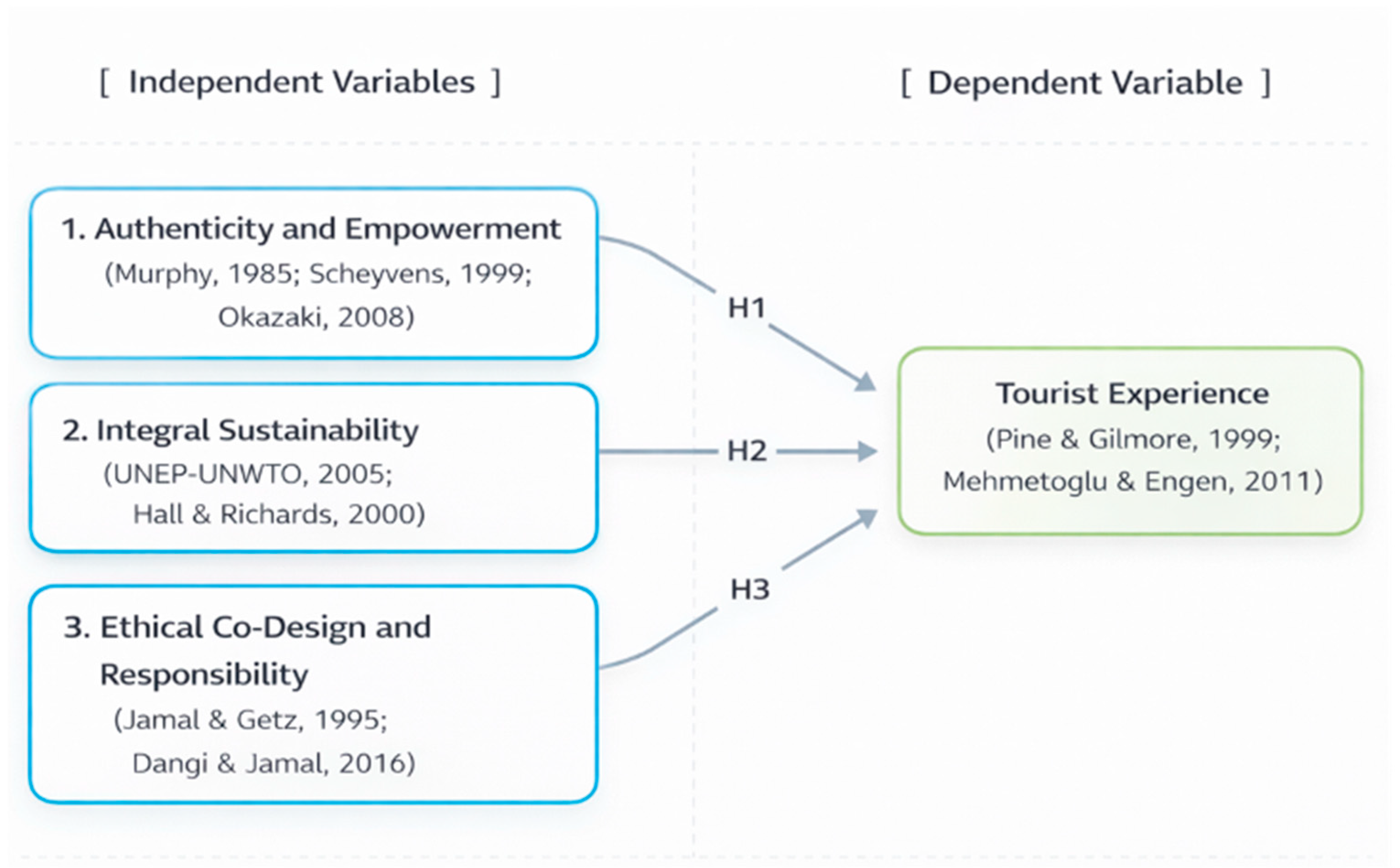
The model postulates the following theoretical relationships (Figure 1):
Authenticity → Experience: Following Okazaki (2008) and Tosun (2006), it is theorized that visible community empowerment generates a perception of authenticity that enriches the tourist experience. However, Joppe (1996) warns that if community management lacks efficiency, it could strain the service experience.
Sustainability → Experience: Hall and Richards (2000) established that sustainable community development enhances destination quality. Recent studies (Liu et al., 2023; Soták-Benedeková et al., 2025) confirm that tourists positively value conserved environments.
Ethical Co-design → Experience: Collaboration theory (Jamal & Getz, 1995) suggests that stakeholder participation improves legitimacy and satisfaction. Dangi and Jamal (2016) extend this toward an ethics of care that generates trust and emotional value.
Based on the above, the following hypotheses are proposed:
H1: 
The perception of authenticity and community empowerment significantly influences the tourism experience.
H2: 
The perception of integral sustainability (cultural and environmental) positively influences the tourism experience.
H3: 
The perception of ethical co-design and tourism responsibility positively influences the tourism experience.

3. Materials and Methods

3.1. Instrument and Operationalization of Variables

For data collection, a structured questionnaire was designed based on the Tourist Perception of Sustainable Community-Based Tourism (SCBT) scale. To ensure conceptual validity, the model’s constructs were defined based on specialized literature and adapted to the study’s context.
The instrument was developed around four key latent variables, which were measured using five-point Likert-type items (1 = strongly disagree; 5 = strongly agree). The variables of authenticity and community empowerment assess the visitor’s perceptions of local control, participation in decision-making, and cultural pride. In turn, integral sustainability captures the perceived balance between cultural heritage preservation, environmental responsibility, and the well-being of the host community. It is relevant to recognize that this study focuses on understanding the “perception of authenticity” that tourists associate with community empowerment, rather than on measuring the actual or objective levels of empowerment. By viewing tourists as indicators of the visible outcomes of governance, we can gain valuable insights into how perceptions form and how they reflect communities’ efforts toward empowerment. This perspective opens opportunities to enrich the visitor experience and enhance community engagement.
The construct of ethical co-design and tourism responsibility examines the visitor’s willingness to engage in responsible practices, as well as their perception of transparency and fairness in destination management. Finally, tourist experience is defined as the overall evaluation of the visitor’s experience, incorporating dimensions such as learning, immersion, aesthetic environment, entertainment, and overall satisfaction, as presented in Table 1.
The exclusively perceptual approach was a deliberate decision to respect the autonomy of Indigenous peoples. Accessing their internal decision-making processes (assemblies, communal work projects, systems of community offices) to obtain “objective” data could be invasive and compromise the sovereignty of the communities.
It is important to note that the original instrument included an additional dimension related to local benefits and distributive justice. However, following a preliminary assessment of collinearity and conceptual redundancy, this dimension was integrated into the constructs of ethical co-design and sustainability. This decision is based on the premise that, from the tourist’s perspective, equity is perceived through observable outcomes at the destination rather than through internal financial indicators, which is consistent with the perceptual approach adopted in this study. Table 1 details the conceptual definition, dimensions, items, and theoretical sources for each variable.
Despite the complexity of the constructs, Partial Least Squares Structural Equation Modeling (PLS-SEM) was used to assess their reliability and both convergent and discriminant validity (Hair et al., 2017). This approach confirmed that the items effectively capture distinct and consistent dimensions as perceived by the respondents.

3.2. Sample

A cross-sectional study with an explanatory approach was conducted. The sample consisted of 341 valid responses from a structured questionnaire administered to individuals aged 18 or older.
Data collection was carried out between November 2025 and March 2026 using a non-probabilistic convenience sampling approach. The questionnaire was distributed through digital platforms, primarily via social media groups such as Facebook. This sampling strategy is appropriate for exploratory research and for studies aiming to reach populations with specific characteristics, such as tourists with prior experience in community-based tourism.
The sample was composed of Mexican tourists who had previously participated in community-based tourism experiences. These experiences took place in rural and indigenous contexts, within territories managed by local communities, including destinations in Oaxaca, particularly the Sierra Norte and the Pueblos Mancomunados, as well as other regions characterized by strong cultural identity and community-based governance systems (Palomino Villavicencio et al., 2016; Zielinski et al., 2020). The inclusion of participants with this profile strengthens the reliability of the data, as their responses are grounded in direct experience with tourism models based on local participation, community control, and sustainability principles (Dangi & Jamal, 2016; Liu et al., 2023).
To assess sample adequacy, a statistical power analysis was conducted following the recommendations of Nitzl (2016) and Benitez et al. (2020) for PLS-SEM models. A medium effect size, a significance level of 0.05, and a statistical power of 0.8 were considered. Given that the proposed model includes three predictor variables, the minimum required sample size was 77 observations. Therefore, the final sample substantially exceeds this threshold, ensuring the robustness of the results.
Additionally, participants were informed about the voluntary nature of the study, and informed consent was obtained. Anonymity was guaranteed, and the data were used exclusively for academic purposes.

3.3. Data Analysis

Structural equation modeling using PLS-SEM was performed in SmartPLS 4. PLS-SEM was used for data analysis. This method allows for the estimation of complex models with multiple structural constructs and paths without imposing restrictive assumptions on data distribution (Hair et al., 2017). According to Hair et al. (2019), PLS-SEM is appropriate for exploratory research aimed at developing or extending theory in new contexts. Therefore, it is particularly suitable for this study, as it seeks to explore theoretical extensions in developing research contexts, such as indigenous tourism in Oaxaca. The significance of the relationships was determined using bootstrapping with 5000 subsamples, a nonparametric method essential for calculating robust t-values and p-values that validate the hypotheses (Hair et al., 2019; Benitez et al., 2020).
Prior to data analysis, it was confirmed that the skewness and kurtosis values were within the range of −3 to +3, allowing the model to be estimated using PLS-SEM (Aburumman et al., 2022). The analysis consisted of two stages. In the first stage, the measurement model was evaluated, and in the second, the structural model, according to the criteria of Hair et al. (2019).
First, to evaluate the measurement model, external factor loadings, construct reliability, and convergent and discriminant validity were analyzed using the consistent PLS algorithm (Hair et al., 2017). Second, the path coefficients and their significance, the coefficients of determination R2 and prediction Q2, and the effect sizes f2 were calculated, and it was corroborated that there was no multicollinearity between the constructs by means of the value inflation factors, calculated by the consistent PLS algorithm, consistent Bootstrapping PLS, and PLS Predict (VIF) (Benitez et al., 2020).

4. Results

4.1. Measurement Model Assessment

For the evaluation of the measurement model, the criteria proposed by Hair et al. (2019) and Benitez et al. (2020) were followed, including indicator loadings, construct reliability, convergent validity, and discriminant validity. In this way, the evaluation of the measurement model confirmed the instrument’s robustness. First, factor loadings were evaluated, considering valid those that exceeded the threshold of 0.708, which indicates that the constructs explain more than 50% of the variance in their indicators and guarantee acceptable item reliability, as shown in Table 2 (Hair et al., 2017). The smallest factor loading was 0.726 for SOST5, belonging to the Integral Sustainability construct, and exceeds the required threshold.
The construct reliability assessment included three coefficients: Cronbach’s alpha and the composite reliability coefficients rho_a, and rho_c (Werts et al., 1974; Hair et al., 2019). By including all three reliability coefficients, the assessment is comprehensive, not only because of the number of items (Cronbach’s alpha), but also because it considers factor loadings (composite reliability) (Dolinting & Pang, 2022). Item reliability values were greater than 0.8 and less than 0.95, indicating strong reliability and no redundancy issues among the items (Nunnally & Bernstein, 1994; Diamantopoulos et al., 2012). The lower values correspond to integral sustainability but remain above 0.8, which is considered a satisfactory range.
To assess convergent validity, Average Variance Extracted (AVE) values were used. Values greater than 0.5 indicate that the construct’s indicators explain at least 50% of the variance (Hair et al., 2019), which, for all constructs, exceeds this value. This implies that the set of indicators explains each construct.
To assess discriminant validity, the final point in the evaluation of the measurement model, the Heterotrait–Monotrait Ratio (HTMT) was used. This criterion was chosen because it is stricter than others, such as the Fornell–Larcker ratio (Hair et al., 2019; Rasoolimanesh, 2022). Values below 0.85 indicate that the constructs differ statistically, implying that each construct captures empirically distinct concepts within the model. Looking at Table 3, the highest value corresponds to the comparison between the constructs ethical co-design and tourism responsibility and authenticity, and community empowerment, with a value of 0.708, which is lower than the reference value, indicating discriminant validity between the constructs.

4.2. Structural Model Assessment

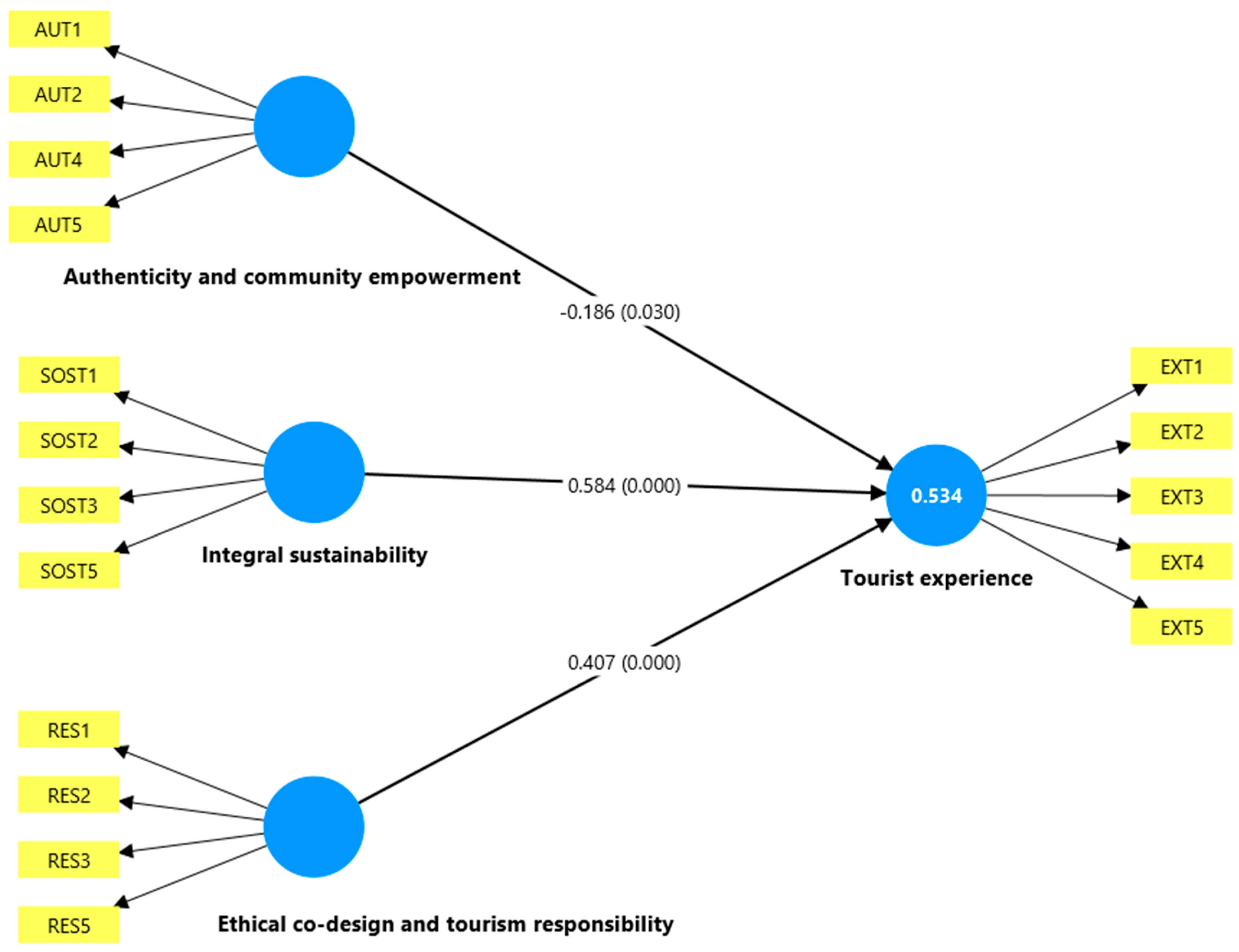
In the structural model evaluation, collinearity, path coefficients, and R2, f2, and Q2 values were determined (Ali et al., 2018). Table 4 presents the inflation factor values, which facilitate the evaluation of collinearity. These values were below the threshold of 3, indicating the absence of multicollinearity among the constructs (Hair et al., 2019). Path coefficients measure the effect of the independent (exogenous) construct on the dependent (endogenous) construct, and hypothesis testing can be performed based on their significance value. The highest path coefficient value corresponds to the relationship between integral sustainability and tourist experience (β = 0.584, p = 0.000), which is consistent with the effect size, the largest among all those presented, indicating a large effect (f2 = 0.630). Ethical co-design and tourism responsibility show a moderate effect (f2 = 0.173), while authenticity and community empowerment show a small effect (f2 = 0.037).
A critical finding of the model is the significant negative relationship (β = −0.186, p = 0.030) between Authenticity/Empowerment and Tourist Experience. This negative value indicates that as tourists perceive stronger and more genuine community control, their evaluation of their personal experience tends to decrease slightly. This result challenges the linear assumption that ‘more authenticity always equates to a better experience,’ underscoring the need for heritage interpretation strategies that help tourists understand and appreciate the complexity of indigenous autonomy.
The model yields an R2 of 0.534, indicating that the dimensions of community-based tourism explain 53.4% of the variance in the visitor experience, reflecting moderate to high predictive power in studies of human behavior in tourism. Additionally, the predictive relevance value (Q2 = 0.421) confirms that the model has adequate predictive capability.
For hypothesis testing, the path coefficients presented in Table 4 and Figure 2 were analyzed. The results indicate that the three hypotheses proposed in the study are statistically significant and are therefore confirmed.
First, authenticity and community empowerment significantly influence tourist experience (β = −0.186, p = 0.030), indicating that higher levels of perceived authenticity and community empowerment are associated with a decrease in tourist experience. Second, integral sustainability shows a positive, highly significant effect on the tourist experience (β = 0.584, p < 0.001), the strongest predictor in the model. Finally, ethical co-design and tourism responsibility also exhibit a positive and significant influence on tourist experience (β = 0.407, p < 0.001).
Overall, the findings suggest that the tourist experience in community-based tourism is primarily driven by perceived sustainability, followed by ethical and responsibility-related factors. At the same time, authenticity and community empowerment exhibit a weaker, inverse relationship.

5. Discussion

The structural model reveals that the three predictive dimensions of Sustainable Community-Based Tourism (SCBT) exert a statistically significant influence on the overall tourist experience, and together they explain 53.4% of its variance (R2 = 0.534, Q2 = 0.421), indicating a moderate-to-high explanatory power within tourism behavior studies. Although these findings are consistent with the theoretical framework proposed by Dangi and Jamal (2016), it is important to recognize that the observed relationships should not be interpreted in a linear or purely confirmatory manner. Rather, they reflect underlying tensions among sustainability, community governance, authenticity, and visitors’ expectations. Thus, each of the following subsections interprets the results from a reflective perspective and within a broader analytical framework, considering alternative interpretations and acknowledging the epistemological limitations inherent to the perceptual approach adopted.

5.1. Integral Sustainability as the Main Determinant of the Tourist Experience

The dimension of integral sustainability emerges as the strongest predictor of the tourist experience (β = 0.584, p < 0.001, f2 = 0.630), indicating that when tourists perceive harmony among cultural heritage preservation, environmental responsibility, and the well-being of the host community, they assign greater value to their travel experience, which increases significantly.
This finding is consistent with recent empirical evidence, as demonstrated by Hall and Richards (2000) and Liu et al. (2023), who highlight that the active participation of residents and institutional processes that ensure a fair distribution of benefits are essential for the perceived quality of the destination. Likewise, Jokom et al. (2025) confirm that sociocultural and environmental factors are fundamental in creating memorable tourism experiences within community-based tourism contexts.
From this perspective, it can be argued that, within the study area, tourists’ perceptions of sustainability function as critical mechanisms for the comprehensive valuation of the travel experience. This highlights how communities, despite their local specificities, must adapt to global tourism demands, where sustainability is highly valued as a solid and desirable attribute that shapes tourists’ lifestyles and value systems—an orientation they also seek to encounter in the destinations they visit as extensions of their own lived experience.
Although integral sustainability has the largest effect in the model (f2 = 0.630), this result primarily reflects tourists’ perceptions of the destination’s sustainability rather than its actual impact on social, environmental, or distributive outcomes within the host community. This distinction is important, as some studies suggest that sustainability in tourism may function more as a strategic communication and market positioning resource than as evidence of genuine structural transformation (Garcia & Vargas, 2024; Shishan et al., 2025).
In this regard, Garcia and Vargas (2024) point out that there is often a gap between the sustainability communicated to visitors and the sustainability actually practiced. This discrepancy may lead tourists to positively evaluate visible or symbolic actions without necessarily recognizing whether meaningful changes have occurred in terms of social justice, local governance, or equitable benefit distribution. Such findings may reveal strategic greenwashing practices through which Oaxacan communities have adapted their value propositions to tourism markets, projecting commercially attractive sustainability attributes without necessarily undergoing structural transformation in their operational practices (Garcia & Vargas, 2024).
Alternatively, this result may also be associated with the limited duration of the tourist experience itself, in which short-term immersion prevents visitors from empirically validating community-based sustainable practices, restricting their judgment to a superficial, aesthetic perception of the tourism offer. This behavior is consistent with literature documenting how environmental claims shape tourist perceptions even in the absence of deep verification of the destination’s actual performance (Garcia & Vargas, 2024).
This contrast between perceived sustainability and practiced sustainability constitutes an inherent limitation of the analytical model. Although the R2 value of 0.534 is considered moderate-to-high according to tourism research standards (Huruta et al., 2024), this result primarily captures visitors’ perceptions of the tourist experience. It does not necessarily reflect how sustainability is lived, negotiated, or distributed within the host community.
This perceptual gap becomes even more complex in destinations such as Oaxaca, characterized by high tourism diversification and mobility. The itinerant nature of tourism, which predominates in the study area, may act as a moderating variable: tourists operating under rapid travel schedules may lack sufficient time to engage deeply with the actual dimensions of community sustainability. In this sense, future research should contrast this dynamic with the principles of slow tourism, examining whether variations in travel styles significantly alter tourists’ evaluations, depth of understanding, and critical judgment regarding sustainable community practices.
Likewise, future studies incorporating community-based perspectives, as well as governance indicators and benefit distribution metrics, would allow the triangulation of these external perceptions with internal outcomes, significantly strengthening both the explanatory capacity and the causal robustness of the model.
Within these limits, the findings position integral sustainability as the main experiential value proposition of SCBT from the demand-side perspective, with important theoretical and practical implications for destination management and public policy design.

5.2. Ethical Co-Design and Tourism Responsibility: Active Tourist Participation and Its Limits

Ethical co-design and tourism responsibility emerged as the second significant predictor in the model (β = 0.407, f2 = 0.173), indicating that when tourists are willing to participate responsibly, for example, by respecting destination boundaries, valuing transparency, or contributing to community well-being, their tourism experience tends to be more positive.
From the collaboration theory proposed by Jamal and Getz (1995) and the ethics of care framework developed by Jamal and Camargo (2014), this finding suggests that when visitors perceive relationships based on reciprocity, shared responsibility, and respect toward the host community, the tourism experience acquires a moral dimension that strengthens the emotional bond with the destination. In this sense, the results confirm that responsible tourism practices increase both visitor satisfaction and the intention to engage in subsequent prosocial behaviors, as also reported by Mathew et al. (2024).
In the Oaxacan context, this involvement acquires particular relevance, since respect toward the community is not merely an ethical choice but also an operational necessity in territories where internal normative systems based on customs and traditions and the cargo system constitute the central axis of governance and social balance. These structures define the framework of social interaction not only for residents but also for external visitors.
However, this relationship should not be assumed to be automatic. The literature has extensively documented the gap between declared pro-environmental attitudes and actual tourist behavior, showing that individuals who express high ethical willingness do not always translate these intentions into concrete economic decisions or sustained commitments (Li et al., 2024). In many cases, the positive evaluation of ethical co-design reflects more the visitor’s self-image as a “responsible tourist” than a genuine transformation in the power relations within the destination.
In this sense, ethical co-design appears to primarily influence the qualitative valuation of the experience, as well as its symbolic and moral dimensions, rather than generating an effective redistribution of decision-making power toward the local community. The tourism experience improves when visitors perceive justice, reciprocity, and responsibility, but this does not necessarily imply structural changes in the political economy of community-based tourism.
Distinguishing between ethical perception and actual transformation is therefore essential to avoid excessively normative interpretations of responsible tourism.

5.3. Authenticity and Community Empowerment: An Inverse Relationship Under Scrutiny

The most theoretically relevant finding of this study is the negative relationship between authenticity, community empowerment, and the tourist experience (β = −0.186, p = 0.030, f2 = 0.037). Although the effect size is small, its direction challenges one of the most widely held assumptions in community-based tourism theory: that greater community control always yields a better visitor experience. This result suggests that the relationship among authenticity, empowerment, and tourist satisfaction is more complex and cannot be understood linearly.
A first explanation may be found in the tension between real community governance and the expectations of tourists accustomed to conventional tourism models. When local control is expressed through assemblies, tequios, cargo systems, or collective decision-making processes, these mechanisms strengthen community autonomy. However, they may also be perceived by some visitors as slow, inflexible, or lacking service standardization. Joppe (1996) had already warned about this possible disconnection between local management and visitor expectations, while studies conducted in the Pueblos Mancomunados of Oaxaca show that these forms of community organization may come into tension with the traditional logics of the tourism market (Palomino Villavicencio et al., 2016). Similarly, Blackstock (2005) argues that community-based tourism has often been idealized without recognizing that genuine local control may also generate friction with the visitor experience.
A second interpretation relates to the very notion of authenticity. Recent literature shows that authenticity should not be understood as a fixed characteristic of the destination, but rather as a socially constructed experience. It is not enough for a cultural practice to be authentic; it must also be understood and valued by the visitor. Recent studies confirm that tourist satisfaction depends not only on authenticity itself but also on interpretive mediation, context, and the emotional connection that tourists establish with the place (He & Timothy, 2024). When authenticity is not explained or culturally translated, it may generate distance rather than connection.
A third interpretation takes a more critical perspective and questions the tourist’s own capacity to evaluate community empowerment. Tourist perceptions are mediated by external viewpoints, prior expectations, and even stereotypical representations of Indigenous communities. If visitors interpret community autonomy through an external logic, the negative result may reflect not a problem of local governance, but rather a limitation of the perceptual instrument used to measure it. In other words, tourists observe community empowerment from the outside, but they do not necessarily understand its internal complexity or power dynamics.
A fourth, more operational interpretation suggests that the identified tensions may converge into structural gaps in management and professionalization. A significant proportion of tourism projects and enterprises share the weaknesses and limitations of the broader Oaxacan business environment, conditions that are further aggravated by the lack of specialized training and business knowledge.
Given that Oaxacan communities sustain themselves through their social, cultural, and symbolic authenticity, and that empowerment drives economic association, the negative relationship identified may stem from the difficulty residents face in creating and sharing narratives that allow them to convey the meaning of community-based tourism to visitors. This interpretation resonates with the findings of Cruz-Cruz et al. (2026), who recognize the complexity of analyzing formal business dimensions within socially and culturally oriented projects, attributing this friction to the everyday and often empirical way in which business practices are carried out. From an early age, community members become involved in serving tourists, often with limited formal preparation and restricted competencies for transforming these activities into structured business models.
Taken together, these interpretations show that the relationship between authenticity, empowerment, and tourist experience is neither automatic nor unidirectional. Greater authenticity does not always translate into greater satisfaction, especially when there is no effective mediation allowing visitors to understand the social and cultural value of community governance.
Therefore, this finding does not question the importance of local self-determination; on the contrary, it underscores the need to strengthen heritage interpretation strategies that reduce the distance between the tourist experience and the community’s lived reality, without compromising local autonomy.

5.4. The Tourist as an External Validator: Analytical Usefulness and Normative Limits

This study positions the tourist as an external observer of the dimensions of Sustainable Community-Based Tourism (SCBT), expanding traditional approaches that have primarily focused on residents’ perspectives (Long et al., 1990; González-García et al., 2018) and addressing the gap identified by Millan-Anaya et al. (2024) regarding the limited research conducted from the demand-side perspective. From this viewpoint, tourists’ perceptions help us understand how sustainability, ethics, and community governance are interpreted by those who consume the tourism experience, providing useful information for destination management and the design of heritage interpretation strategies.
However, assuming the tourist as a “validator” of community sustainability requires critical reflection. Visitors may perceive and evaluate certain visible elements of the experience, but they do not necessarily have sufficient access to or understanding of internal processes such as distributive justice, collective decision-making, or the actual levels of community empowerment. In this regard, there is an important opportunity for local communities to strengthen the design of their tourism products by expanding management and leadership capacities, as well as business knowledge and competencies, enabling them to communicate the value of sustainable tourism in a deeper and more comprehensive way.
Likewise, tourist involvement, regardless of whether visitors engage in short itinerant stays or longer visits, could become more immersive, allowing them to better capture the multidimensional essence of Oaxacan communities through more effective interpretive mediation. Therefore, tourists’ perceptions should not be understood as a definitive measure of local well-being, but rather as an external reading of how these dynamics are observed through the tourism experience, which, according to the results, still holds significant potential for further development.
Furthermore, assigning a legitimizing function to the tourist’s gaze may reproduce unequal power relations. When community sustainability is validated by visitor satisfaction or market acceptance, there is a risk of displacing the community’s own criteria for well-being, justice, and cultural continuity. In Indigenous contexts, where territorial autonomy and self-determination carry profound political significance, subordinating community legitimacy to tourist understanding may generate new forms of symbolic and economic dependency.
In this sense, the figure of the tourist as an external validator should be understood more as an analytical resource than as a normative assertion. Its usefulness lies in providing evidence of how the market perceives SCBT practices, but not in defining who has the authority to determine what sustainability, justice, or community development truly mean. Recognizing this distinction strengthens the model’s scope without falling into overinterpretation of its results.

6. Conclusions

6.1. Conclusions and Implications

This study analyzed how tourists’ perceptions of three dimensions of Sustainable Community-Based Tourism (SCBT), authenticity and community empowerment (H1), integral sustainability (H2), and ethical co-design (H3), influence the tourist experience in Indigenous destinations in Oaxaca. The structural model confirms all three hypotheses with moderate-to-high explanatory power. Integral sustainability (H2) and ethical co-design (H3) consolidate as positive drivers of the experience. However, authenticity and empowerment (H1) present a significant inverse relationship, challenging the linear assumptions of classical literature.
This negative finding constitutes the main theoretical contribution. It challenges the assumption that greater community control automatically produces better visitor experiences. It suggests that authenticity is not a fixed property but a relational process mediated by cultural interpretation. When visitors do not understand governance mechanisms such as assemblies or tequios, they may perceive them as disorganization rather than heritage value. This indicates divergences between community identity and the entrepreneurial competencies required to communicate its value. Therefore, the results refer to tourist perceptions and do not directly validate the quality of internal governance or the real distribution of benefits, a distinction essential to avoid normative overinterpretations.
For community managers and institutions, the findings highlight three priority areas. First, strengthening heritage interpretation is the most relevant intervention. Practices such as assemblies and cargo systems may generate friction if visitors do not understand their social significance. Trained guides and narrative materials are needed to explain these forms of governance without folklorizing them, building bridges of understanding that preserve local autonomy.
Second, specialized training in business issues for community leaders is crucial. Professionalizing the sector closes the gap between cultural richness and technical competence, transforming authenticity into a competitive product without losing social roots.
Third, making sustainability visible is essential to capitalize on its strong positive effect. Conservation actions and community well-being initiatives must be communicated through panels, testimonies, and visible certifications. Additionally, designing co-responsibility mechanisms can transform visitors’ ethical willingness into concrete support actions, avoiding the reduction of local practices to mere market transactions.

6.2. Limitations and Future Research Directions

This study has limitations that delimit its conclusions. Methodologically, convenience sampling via digital platforms may have attracted participants with prior interest in sustainability, potentially overrepresenting profiles sensitive to ethical values. Although the sample (n = 341) exceeds the minimum required, the results primarily represent Mexican tourists with prior experience in Oaxaca and cannot be generalized to international tourists or other contexts without comparative studies.
Epistemologically, the perceptual approach is an inherent limitation: tourist perceptions of empowerment and justice are partial and mediated by prior expectations, providing no direct evidence of real governance quality. This distinction is essential to avoid equating perceived sustainability with practiced sustainability. Likewise, the cross-sectional design prevents establishing definitive causal relationships.
Future research should incorporate longitudinal designs to analyze how these perceptions evolve. It is also relevant to develop mixed-method approaches combining quantitative analysis with in-depth interviews and ethnographic observation, incorporating host communities’ voices to triangulate external perceptions with internal outcomes. Multigroup analyses comparing domestic and international tourists, and repeat versus first-time visitors, would be valuable. Finally, replicating the model in other Indigenous contexts across Latin America would allow evaluating the external robustness of the SCBT framework, contributing to bidirectional models that integrate demand-side and community perspectives.
In Indigenous territories, where community identity constitutes the tourism resource and the basis of territorial autonomy, visitor perception transcends the experiential dimension and becomes a political and ethical issue. The tension revealed between authenticity and experience does not represent a failure of SCBT but one of its central challenges. Community tourism will only fulfill its promise of equity and cultural preservation if it builds interpretive bridges that allow visitors to understand the deeper meaning of community life. Heritage interpretation should be understood as a tool of cultural justice: only when visitors recognize the value of community autonomy does the tourist experience cease to be consumption and become a real possibility for ethical exchange and shared sustainability.

Author Contributions

Conceptualization, M.d.C.A.-R., S.N.L.-H. and P.M.A.-R.; methodology, M.d.C.A.-R. and S.N.L.-H.; software, S.N.L.-H.; validation, M.d.C.A.-R., S.N.L.-H. and P.M.A.-R.; formal analysis, M.d.C.A.-R. and S.N.L.-H.; investigation, M.d.C.A.-R., S.N.L.-H., P.M.A.-R. and E.C.-C.; resources, M.d.C.A.-R. and A.M.-V.; data curation, S.N.L.-H.; writing—original draft preparation, M.d.C.A.-R., S.N.L.-H., P.M.A.-R., E.C.-C. and A.M.-V.; writing—review and editing, M.d.C.A.-R., S.N.L.-H., P.M.A.-R., E.C.-C. and A.M.-V.; visualization, M.d.C.A.-R.; supervision, S.N.L.-H.; project administration, S.N.L.-H.; funding acquisition, M.d.C.A.-R. All authors have read and agreed to the published version of the manuscript.

Funding

This research received no external funding.

Institutional Review Board Statement

This study was conducted in accordance with the Declaration of Helsinki, and approved by the Institutional Review Board of Secretaría de Ciencias, Humanidades, Tecnología e Innovación (SECIHTI) (PEE-2025-G-550, 15 August 2025).

Informed Consent Statement

Informed consent was obtained from all subjects involved in this study.

Data Availability Statement

The original data presented in the study are openly available in Mendeley Data at https://doi.org/10.17632/4cshxrwfv7.1.

Conflicts of Interest

The authors declare no conflicts of interest.

References

  1. Aburumman, O. J., Omar, K., Al Shbail, M., & Aldoghan, M. (2022). How to deal with the results of PLS-SEM? In International conference on business and technology (pp. 1196–1206). Springer International Publishing. [Google Scholar]
  2. Adebayo, A. D., & Butcher, J. (2023). Community empowerment in Nigeria’s tourism industry: An analysis of stakeholders’ perceptions. Tourism Planning & Development, 20(4), 583–603. [Google Scholar] [CrossRef]
  3. Ali, F., Rasoolimanesh, S. M., Sarstedt, M., Ringle, C. M., & Ryu, K. (2018). An assessment of the use of partial least squares structural equation modeling (PLS-SEM) in hospitality research. International Journal of Contemporary Hospitality Management, 30(1), 514–538. [Google Scholar] [CrossRef]
  4. Benitez, J., Henseler, J., Castillo, A., & Schuberth, F. (2020). How to perform and report an impactful analysis using partial least squares: Guidelines for confirmatory and explanatory IS research. Information & Management, 57(2), 103168. [Google Scholar] [CrossRef]
  5. Bianchi, R. V. (2009). The ‘critical turn’ in tourism studies: A radical critique. Tourism Geographies, 11(4), 484–504. [Google Scholar] [CrossRef]
  6. Blackstock, K. (2005). A critical look at community based tourism. Community Development Journal, 40(1), 39–49. [Google Scholar] [CrossRef]
  7. Boluk, K. A., Cavaliere, C. T., & Higgins-Desbiolles, F. (2019). A critical framework for interrogating the United Nations sustainable development goals 2030 agenda in tourism. Journal of Sustainable Tourism, 27(7), 847–864. [Google Scholar] [CrossRef]
  8. Büscher, B., & Fletcher, R. (2017). Destructive creation: Capital accumulation and the structural violence of tourism. Journal of Sustainable Tourism, 25(5), 651–667. [Google Scholar] [CrossRef]
  9. Chhabra, D. (2010). Back to the past: A sub-segment of Generation Y’s perceptions of authenticity. Journal of Sustainable Tourism, 18(6), 793–809. [Google Scholar] [CrossRef]
  10. Cohen, E. (1988). Authenticity and commodification in tourism. Annals of Tourism Research, 15(3), 371–386. [Google Scholar] [CrossRef]
  11. Cooke, B., & Kothari, U. (Eds.). (2001). Participation: The new tyranny? Zed Books. [Google Scholar]
  12. Cruz-Cruz, E., Leyva-Hernández, S. N., & Avendaño-Rito, M. d. C. (2026). Cohesión social y emprendimiento artesanal en los Valles Centrales de Oaxaca, México. Revista de Métodos Cuantitativos para la Economía y la Empresa, 1–28. [Google Scholar] [CrossRef]
  13. Dangi, T. B., & Jamal, T. (2016). An integrated approach to “sustainable community-based tourism”. Sustainability, 8(5), 475. [Google Scholar] [CrossRef]
  14. Diamantopoulos, A., Sarstedt, M., Fuchs, C., Wilczynski, P., & Kaiser, S. (2012). Guidelines for choosing between multi-item and single-item scales for construct measurement: A predictive validity perspective. Journal of the Academy of Marketing Science, 40(3), 434–449. [Google Scholar] [CrossRef]
  15. Dolezal, C., & Novelli, M. (2022). Power in community-based tourism: Empowerment and partnership in Bali. Journal of Sustainable Tourism, 30(10), 2352–2370. [Google Scholar] [CrossRef]
  16. Dolinting, P. P., & Pang, V. (2022). Assessing the validity and reliability of adapted classroom climates instrument for Malaysian rural schools using PLS-SEM. International Journal of Education, Psychology and Counseling, 7, 383–401. [Google Scholar] [CrossRef]
  17. Garcia, F. C. S., & Vargas, W. F. C. (2024). Greenwashing in the tourism and hospitality sector: A systematic analysis of the literature. Revista Interamericana de Ambiente y Turismo—RIAT, 20(2), 174–191. [Google Scholar] [CrossRef]
  18. Ginjanjar, R., & Runingsawitri, H. S. (2023). Community empowerment in tourism development: Concepts and implications. The Eastasouth Management and Business, 1(3), 111–119. [Google Scholar] [CrossRef]
  19. González-García, R. J., Añó-Sanz, V., Parra-Camacho, D., & Calabuig-Moreno, F. (2018). Perception of residents about the impact of sports tourism on the community: Analysis and scale-validation. Journal of Physical Education and Sport, 18(1), 149–156. [Google Scholar] [CrossRef]
  20. Graciano, P. F., & Holanda, L. A. D. (2020). Análisis bibliométrico de la producción científica sobre turismo de base comunitario de 2013 a 2018. Revista Brasileira de Pesquisa em Turismo, 14, 161–179. [Google Scholar] [CrossRef]
  21. Guan, J., Zhu, D., Cheng, S., & Li, Q. (2025). “It is my place”: Residents’ community-based psychological ownership and its impact on rural tourism participation. Journal of Sustainable Tourism, 33(7), 1303–1329. [Google Scholar] [CrossRef]
  22. Hair, J. F., Hult, G. T., Ringle, C. M., & Sarstedt, M. A. (2017). Primer on partial least squares structural equation modeling (PLS-SEM). Sage Publications. [Google Scholar]
  23. Hair, J. F., Risher, J. J., Sarstedt, M., & Ringle, C. M. (2019). When to use and how to report the results of PLS-SEM. European Business Review, 31(1), 2–24. [Google Scholar] [CrossRef]
  24. Hall, D. R., & Richards, G. (Eds.). (2000). Tourism and sustainable community development (Vol. 1). Routledge. [Google Scholar]
  25. He, L., & Timothy, D. J. (2024). Tourists perceptions of cultural and creative souvenir products and their relationship with place. Journal of Tourism and Cultural Change, 22, 143–163. [Google Scholar] [CrossRef]
  26. Hickey, S., & Mohan, G. (2004). Towards participation as transformation: Critical themes and challenges. In Participation: From tyranny to transformation (pp. 3–24). Zed Books. [Google Scholar]
  27. Huruta, A. D., Sasongko, G., Wahyudi, Y., Saptuti Sri Kawuryan, I., & Yirong Lu, C. (2024). Sustainability and community-based tourism nexus: A mediation role of consumer satisfaction. Cogent Business & Management, 11(1), 2421418. [Google Scholar] [CrossRef]
  28. Jamal, T. B., & Camargo, B. A. (2014). Sustainable tourism, justice and an ethic of care: Toward the Just Destination. Journal of Sustainable Tourism, 22(1), 11–30. [Google Scholar] [CrossRef]
  29. Jamal, T. B., & Getz, D. (1995). Collaboration theory and community tourism planning. Annals of Tourism Research, 22(1), 186–204. [Google Scholar] [CrossRef]
  30. Jokom, R., Semuel, H., & Wijaya, S. (2025). Sustainable tourism experiences: The role of digital technology and government support in creating tourists’ memorable experiences. Cogent Business & Management, 12(1), 2482026. [Google Scholar] [CrossRef]
  31. Joppe, M. (1996). Sustainable community tourism development revisited. Tourism Management, 17(7), 475–479. [Google Scholar] [CrossRef]
  32. Krittayaruangroj, K., Suriyankietkaew, S., & Hallinger, P. (2023). Research on sustainability in community-based tourism: A bibliometric review and future directions. Asia Pacific Journal of Tourism Research, 28(9), 1031–1051. [Google Scholar] [CrossRef]
  33. Lane, B. (1994). What is rural tourism? Journal of Sustainable Tourism, 2(1–2), 7–21. [Google Scholar] [CrossRef]
  34. Lane, B. (2009). Rural tourism: An overview. In T. Jamal, & M. Robinson (Eds.), The SAGE handbook of tourism studies (pp. 354–370). SAGE Publications. [Google Scholar]
  35. Li, J., Coca-Stefaniak, J. A., Nguyen, T. H. H., & Morrison, A. M. (2024). Sustainable tourist behavior: A systematic literature review and research agenda. Sustainable Development, 32(4), 3356–3374. [Google Scholar] [CrossRef]
  36. Liu, Y. L., Chiang, J. T., & Ko, P. F. (2023). The benefits of tourism for rural community development. Humanities and Social Sciences Communications, 10(1), 137. [Google Scholar] [CrossRef]
  37. Long, P. T., Perdue, R. R., & Allen, L. (1990). Rural resident tourism perceptions and attitudes by community level of tourism. Journal of Travel Research, 28(3), 3–8. [Google Scholar] [CrossRef]
  38. MacCannell, D. (1973). Staged authenticity: Arrangements of social space in tourist settings. American Journal of Sociology, 79(3), 589–603. [Google Scholar] [CrossRef] [PubMed]
  39. Mathew, P. V., Cabral, C., & Mohandas, N. P. (2024). Influence of responsible tourism practices on the destination perceptions of tourists. International Journal of Tourism Research, 26(4), e2692. [Google Scholar] [CrossRef]
  40. Mehmetoglu, M., & Engen, M. (2011). Pine and Gilmore’s concept of experience economy and its dimensions: An empirical examination in tourism. Journal of Quality Assurance in Hospitality & Tourism, 12(4), 237–255. [Google Scholar] [CrossRef]
  41. Millan-Anaya, M. R., Cordova-Buiza, F., & Olavarria-Benavides, H. L. (2024). Beaches and medicinal lagoons tourism destination in Peru: Satisfaction and loyalty research. GeoJournal of Tourism and Geosites, 52(1), 286–293. [Google Scholar] [CrossRef]
  42. Mowforth, M., & Munt, I. (2015). Tourism and sustainability: Development, globalisation and new tourism in the Third World (4th ed.). Routledge. [Google Scholar]
  43. Murphy, P. E. (1985). Tourism: A community approach. Methuen. [Google Scholar]
  44. Nitzl, C. (2016). The use of partial least squares structural equation modelling (PLS-SEM) in management accounting research: Directions for future theory development. Journal of Accounting Literature, 37(1), 19–35. [Google Scholar] [CrossRef]
  45. Nunnally, J. C., & Bernstein, I. H. (1994). Psychometric theory. McGraw-Hill. [Google Scholar]
  46. Okazaki, E. (2008). A community-based tourism model: Its conception and use. Journal of Sustainable Tourism, 16(5), 511–529. [Google Scholar] [CrossRef]
  47. Osti, L., & Cicero, L. (2018). Tourists’ perception of landscape attributes in rural tourism. Worldwide Hospitality and Tourism Themes, 10(2), 211–221. [Google Scholar] [CrossRef]
  48. Palomino Villavicencio, B., Gasca Zamora, J., & López Pardo, G. (2016). El turismo comunitario en la Sierra Norte de Oaxaca: Perspectiva desde las instituciones y la gobernanza en territorios indígenas. El Periplo Sustentable, 30, 6–37. [Google Scholar]
  49. Peña, A. I. P., Jamilena, D. M. F., & Molina, M. Á. R. (2012). The perceived value of the rural tourism stay and its effect on rural tourist behaviour. Journal of Sustainable Tourism, 20(8), 1045–1065. [Google Scholar] [CrossRef]
  50. Pine, B. J., & Gilmore, J. H. (1999). The experience economy: Work is theatre & every business a stage. Harvard Business School Press. [Google Scholar]
  51. Rasoolimanesh, S. M. (2022). Discriminant validity assessment in PLSSEM: A comprehensive composite-based approach. Data Analysis Perspectives Journal, 3(2), 1–8. [Google Scholar]
  52. Reed, M. G. (1997). Power relations and community-based tourism planning. Annals of Tourism Research, 24(3), 566–591. [Google Scholar] [CrossRef]
  53. Rocca, L. H. D., & Zielinski, S. (2022). Community-based tourism, social capital, and governance of post-conflict rural tourism destinations: The case of Minca, Sierra Nevada de Santa Marta, Colombia. Tourism Management Perspectives, 43, 100985. [Google Scholar] [CrossRef]
  54. Sanagustin-Fons, V., Lafita-Cortés, T., & Moseñe, J. A. (2018). Social perception of rural tourism impact: A case study. Sustainability, 10(2), 339. [Google Scholar] [CrossRef]
  55. Scheyvens, R. (1999). Ecotourism and the empowerment of local communities. Tourism Management, 20(2), 245–249. [Google Scholar] [CrossRef]
  56. Scheyvens, R. (2002). Tourism for development: Empowering communities. Prentice Hall. [Google Scholar]
  57. Scheyvens, R., & van der Watt, H. (2021). Tourism, empowerment and sustainable development: A new framework for analysis. Sustainability, 13(22), 12606. [Google Scholar] [CrossRef]
  58. Schlosberg, D. (2007). Defining environmental justice: Theories, movements, and nature. Oxford University Press. [Google Scholar]
  59. Shishan, F., Majeed, S., Nimri, R., Qasem, Z., & Millanyani, H. (2025). Green hotels and greener choices: Impact of environmental claims on traveler perceptions. International Journal of Tourism Research. [Google Scholar] [CrossRef]
  60. Sosa, M., Aulet, S., & Mundet, L. (2021). Community-based tourism through food: A proposal of sustainable tourism indicators for isolated and rural destinations in Mexico. Sustainability, 13(12), 6693. [Google Scholar] [CrossRef]
  61. Soták-Benedeková, L., Rybárová, J., Tometzová, D., Seňová, A., & Rybár, R. (2025). Comprehensive analysis of rural tourism development: Historical evolution, current trends, and future prospects. Sustainability, 17(3), 1045. [Google Scholar] [CrossRef]
  62. Šegota, T., Mihalič, T., & Perdue, R. R. (2024). Resident perceptions and responses to tourism: Individual vs. community level impacts. Journal of Sustainable Tourism, 32(2), 340–363. [Google Scholar] [CrossRef]
  63. Tosun, C. (2006). Limits to community participation in tourism development in developing countries. Tourism Management, 27(6), 1137–1150. [Google Scholar] [CrossRef]
  64. UNEP & UNWTO. (2005). Making tourism more sustainable: A guide for policy makers. United Nations Environment Programme & World Tourism Organization. Available online: https://wedocs.unep.org/items/30f0298c-25a7-4ce5-852a-6371c2cbe991 (accessed on 15 January 2026).
  65. Urry, J., & Larsen, J. (2011). The tourist gaze 3.0. SAGE Publications. [Google Scholar]
  66. Werts, C. E., Linn, R. L., & Jöreskog, K. G. (1974). Interclass reliability estimates: Testing structural assumptions. Educational and Psychological Measurement, 34, 25–33. [Google Scholar] [CrossRef]
  67. Whyte, K. P. (2011). Environmental justice and Native American self-determination. In R. J. Brulle, & D. N. Pellow (Eds.), Environmental justice (pp. 155–172). MIT Press. [Google Scholar]
  68. Yanan, L., Ismail, M. A., & Aminuddin, A. (2024). How has rural tourism influenced the sustainable development of traditional villages? A systematic literature review. Heliyon, 10(4), e25627. [Google Scholar] [CrossRef] [PubMed]
  69. Zielinski, S., Jeong, Y., Kim, S. I., & Milanés, C. B. (2020). Why community-based tourism and rural tourism in developing and developed nations are treated differently? A review. Sustainability, 12(15), 5938. [Google Scholar] [CrossRef]
Figure 2. Structural model of the tourist experience. The path coefficients are in the arrows, and the p values are in parentheses. The R2 value is in the circle representing the endogenous variable.
Tourismhosp 07 00127 g002
Table 1. Operationalization of SCBT Model Variables.
Variable/ConstructConceptual DefinitionDimensions/Items (Codes)Theoretical Source
Authenticity and Community Empowerment (AEC)Tourist perception of local control, cultural pride, and genuine community participation in tourism management.Control and Authenticity:
Faithful reflection of culture (AUT1)
Perceived community control (AUT2)
Host pride (AUT3)
Participation in decision-making (AUT4)
Genuine interactions (AUT5)
Murphy (1985); Scheyvens (1999); Dangi and Jamal (2016)
Integral Sustainability (SIC)Perception of the balance between cultural heritage conservation, environmental responsibility, and resident quality of life.Conservation and Balance:
Preservation of traditions (SOST1)
Environmental protection (SOST2)
Responsible resource use (SOST3)
Impact on lifestyle (SOST4)
Tourist–resident balance (SOST5)
UNEP and UNWTO (2005); González-García et al. (2018); Dangi and Jamal (2016)
Ethical Co-Design and Responsibility (RES)Tourist disposition to share responsibility for local development and perception of fair, transparent governance.Ethics and Collaboration:
Willingness to pay premium (RES1)
Support for carrying capacity limits (RES2)
Interest in participatory activities (RES3)
Demand for transparency (RES4)
Interest in volunteering (RES5)
Jamal and Camargo (2014); Dangi and Jamal (2016); Reed (1997)
Tourist Experience (EXT)Overall valuation of the visitor’s experience based on the Experience Economy framework.Experience Domains:
Education/Learning (EXT1)
Escapism/Immersion (EXT2)
Aesthetics/Environment (EXT3)
Entertainment (EXT4)
Overall satisfaction (EXT5)
Pine and Gilmore (1999); Mehmetoglu and Engen (2011)
Note: The original instrument included a fifth dimension on Distributive Justice and Local Benefits (5 items, based on Scheyvens, 2002; Tosun, 2006). However, following a preliminary analysis of collinearity and perceptual relevance, this dimension was conceptually integrated within the constructs of Integral Sustainability and Ethical Co-Design for the final structural model, given that tourists validate equity through observable outcomes rather than through internal financial data. Source: Own elaboration based on literature review.
Table 2. Construct reliability and convergent validity.
ConstructItemFactor LoadingCronbach’s AlphaComposite Reliability (rho_a)Composite Reliability (rho_c)Average Extracted Variance (AVE)
Authenticity and community empowermentAUT10.9570.9300.9380.9300.771
AUT20.825
AUT40.946
AUT50.769
Ethical co-design and tourism responsibilityRES10.9350.9350.9370.9350.782
RES20.813
RES30.880
RES50.905
Integral sustainabilitySOST10.7860.8430.8440.8430.573
SOST20.771
SOST30.742
SOST50.726
Tourist experienceEXT10.8620.9240.9250.9240.708
EXT20.842
EXT30.832
EXT40.878
EXT50.789
Table 3. Discriminant validity.
RelationshipRatio Heterotrait-Monotrait (HTMT)
Ethical co-design and tourism responsibility <-> Authenticity and community empowerment0.708
Integral sustainability <-> Authenticity and community empowerment0.327
Integral sustainability <-> Ethical co-design and tourism responsibility0.364
Tourist experience <-> Authenticity and community empowerment0.295
Tourist experience <-> Ethical co-design and tourism responsibility0.490
Tourist experience <-> Integral sustainability0.671
Table 4. Structural model assessment results.
HypothesisOriginal SampleMeanStandard Deviationt Statisticp ValueVIFf2
Authenticity and community empowerment -> Tourist experience−0.186−0.1830.0862.1670.0302.0160.037
Ethical co-design and tourism responsibility -> Tourist experience0.4070.4040.0934.3640.0002.0770.173
Integral sustainability -> Tourist experience0.5840.5870.0678.7640.0001.170.63
Disclaimer/Publisher’s Note: The statements, opinions and data contained in all publications are solely those of the individual author(s) and contributor(s) and not of MDPI and/or the editor(s). MDPI and/or the editor(s) disclaim responsibility for any injury to people or property resulting from any ideas, methods, instructions or products referred to in the content.