1. Introduction
The acceptance and utilization of digital technologies is a critical factor for the adaptability and sustainability of modern organizations in the tourism industry, especially in environments characterized by increased uncertainty, technological acceleration, and constant organizational change (
Teece et al., 1997;
Doz & Kosonen, 2010). In such environments, the success of technological interventions does not depend solely on their technical characteristics, but on how they are perceived, interpreted, and integrated into everyday organizational practice by the subjects who are called upon to use them (
Weick, 1995).
In this context, the Technology Acceptance Model (TAM) has established itself as one of the most widely used theoretical tools for interpreting technology acceptance at the individual and organizational levels (
Davis, 1989;
Davis et al., 1989). Focusing on the concepts of perceived usefulness and perceived ease of use, TAM explains how users’ cognitive evaluations influence their intention to use and, ultimately, their adoption of technology (
Venkatesh & Davis, 2000;
Venkatesh et al., 2003). Despite its theoretical validity and extensive empirical application, TAM has been criticized for its relative disconnect from the broader organizational and strategic context within which user beliefs are formed (
Benbasat & Barki, 2007;
Bagozzi, 2007).
At the same time, as emphasized in the dynamic capabilities literature (
Teece, 2007), the concept of organizational agility has emerged as central to contemporary management and strategy theory. Organizational agility refers to the ability of organizations to perceive environmental changes in a timely manner, respond quickly to new conditions, and reshape structures, practices, and processes without disrupting their internal cohesion (
Overby et al., 2006;
Sherehiy et al., 2007). In contrast to static approaches to organizational capabilities, agility is understood as a dynamic and constantly activated property, inextricably linked to learning, experimentation, and uncertainty management (
Doz & Kosonen, 2010;
Teece, 2007).
Although both TAM and organizational agility have been studied extensively, the relationship between them remains theoretically underdeveloped. The majority of technology acceptance studies treat the organizational environment as a given or neutral background, without examining how higher-order organizational capabilities shape the cognitive and interpretive framework within which acceptance beliefs are formed (
Benbasat & Barki, 2007;
Bagozzi, 2007). Similarly, the literature on organizational flexibility often approaches technology as a tool or resource, without delving into the mechanisms through which it is accepted and given meaning by organizational subjects (
Overby et al., 2006;
Pavlou & El Sawy, 2011).
This article attempts to bridge this gap by proposing that organizational agility functions as an interpretive framework and organizational prerequisite for technology acceptance. It is argued that organizational agility does not directly influence the use of technology, but shapes the conditions under which users evaluate the usefulness, ease of use, and reliability of technological applications (
Weick, 1995;
Felin et al., 2012). In this way, agility indirectly but decisively influences the basic variables of TAM, acting as a higher-order organizational property that shapes users’ attitudes and intentions.
The aim of this article is to develop a coherent theoretical framework that repositions TAM within a dynamic organizational environment, highlighting the role of organizational agility as an interpretive framework and organizational condition within which technology acceptance mechanisms are activated. In this way, the article aims to contribute both to the literature on technology acceptance and to the theory of organizational agility, offering a more comprehensive understanding of the conditions under which technology can act as a lever for adaptation, learning, and organizational transformation (
Teece, 2007;
Pavlou & El Sawy, 2011).
2. Theoretical Framework
2.1. Technology Acceptance Model and Its Limitations
The Technology Acceptance Model (TAM) is one of the most influential theoretical frameworks for understanding technology acceptance. According to the model, perceived usefulness and perceived ease of use shape the intention to use, which in turn influences the actual adoption of technology (
Davis, 1989;
Davis et al., 1989). Subsequent extensions of the model (TAM2, UTAUT) reinforced its explanatory power by introducing social and organizational factors, such as social influence and facilitating conditions (
Venkatesh & Davis, 2000;
Venkatesh et al., 2003).
Despite its extensive application, TAM has been criticized for its tendency to approach technology acceptance as primarily an individual and cognitive process, disconnected from the broader organizational and strategic context (
Benbasat & Barki, 2007;
Bagozzi, 2007). In particular, the model explains how acceptance beliefs are formed, but does not adequately explain under what organizational conditions these beliefs acquire specific content and direction.
2.2. Organizational Agility as a Higher-Order Organizational Trait
Organizational agility refers to the ability of organizations to perceive environmental changes in a timely manner, respond quickly, and reshape practices, structures, and processes without losing internal cohesion (
Overby et al., 2006;
Doz & Kosonen, 2010). In contrast to static organizational capabilities, agility is understood as a dynamic, continuously activated property, closely linked to learning, experimentation, and uncertainty management.
The literature on dynamic capabilities positions agility as a mechanism that enables the activation and synchronization of sensing, seizing, and reconfiguring processes (
Teece et al., 1997;
Teece, 2007). In this sense, agility is not identified with specific practices or technologies, but functions as a meta-capability that shapes the way organizations learn and act in conditions of change.
2.3. Agility as an Interpretive Framework for Technology Acceptance
The central theoretical position of this framework is that organizational agility functions as an interpretive framework within which the basic beliefs of TAM are constructed. Technology acceptance does not take place in an organizational vacuum, but is part of a set of expectations, routines, and meanings related to change, learning, and experimentation.
In organizations with a high level of agility, technological change is understood as an expected and manageable part of organizational life. Under these conditions, the perceived usefulness of technology is enhanced, as technology is associated with adaptability and problem solving. At the same time, perceived ease of use is positively affected, as the effort to learn is interpreted as an investment rather than a cost.
Furthermore, agility contributes to reducing perceived risk and strengthening trust in technological systems through a culture of experimentation, tolerance for error, and decentralized decision-making (
Weick, 1995;
Felin et al., 2012). In this way, agility does not directly influence the intention to use, but acts indirectly, shaping the basic cognitive and evaluative variables of TAM.
2.4. Conceptual Positioning and Theoretical Contribution
Based on the above, organizational agility is theoretically positioned as a higher-order organizational prerequisite (contextual antecedent) for technology acceptance. TAM retains its role as a mechanism for explaining individual intention to use, while agility explains how the context within which these beliefs acquire meaning is formed.
This distinction maintains the conceptual purity and role of TAM, facilitates the avoidance of instrumental or reductive use of agility, and finally indicates the connection of micro-level cognitive mechanisms with meso-level organizational capabilities. In this framework, the present theoretical framework contributes to the literature in three ways. First, it repositions TAM within a dynamic organizational environment, responding to long-standing criticisms of its disconnect from the organizational context. Second, it reinforces the theory of organizational agility, highlighting its role in interpreting rather than simply using technology. Third, it offers a coherent bridge between individual cognitive mechanisms and organizational dynamics, paving the way for empirical approaches that combine different levels of analysis.
3. Hypotheses Development
Technology Acceptance Model and Usage Intention
This article empirically examines only the direct relationships between the variables of the Technology Acceptance Model and the intention to use. In this context, the terms performance expectancy and effort expectancy are used as functional equivalents of perceived usefulness and perceived ease of use, respectively, in accordance with the extensions of TAM and the relevant theoretical tradition of UTAUT.
According to the Technology Acceptance Model, the intention to use a technology is shaped by basic cognitive and functional evaluations concerning perceived usefulness, perceived ease of use, and conditions supporting technological use. TAM has been extensively applied in tourism and hospitality research, consistently demonstrating that these evaluations act as direct determinants of users’ behavioral intention.
Perceived usefulness (performance expectancy) refers to the extent to which users believe that using a technology will improve their performance or facilitate the execution of their work tasks. When technology is perceived as a tool that offers functional value and tangible benefits, the intention to use it is reinforced. Based on this logic, the following hypothesis is formulated:
H1. The perceived usefulness of technology (performance expectancy) positively influences the intention to use it (behavioral intention).
Perceived ease of use (effort expectancy) refers to the degree to which the use of technology is considered easy and free of significant cognitive or functional costs. The literature shows that, especially in organizational environments of digital transformation, ease of use acts as a mechanism for reducing uncertainty and learning costs. Therefore:
H2. The perceived ease of use of technology (effort expectancy) positively influences the intention to use it.
Beyond the classic cognitive variables of TAM, trust and perceived security of technology are critical dimensions of acceptance, especially in environments where data management, system reliability, and perceived risk reduction are of central importance. When users perceive a technology to be reliable and secure, they are more likely to develop a positive intention to use it. Therefore:
H3. Trust and perceived security of technology positively influence the intention to use.
Finally, facilitating conditions refer to the extent to which users perceive that there are sufficient organizational and technical resources to support the use of technology. The existence of clear procedures, technical support, and appropriate infrastructure reinforces the sense of feasibility of technology use and acts as a determining factor in the intention to adopt. Therefore:
H4. Facilitating conditions positively influence the intention to use technology.
Additional variables found in extensions of TAM/UTAUT (e.g., social influence, future prospects) were recorded in the research tool and evaluated in terms of reliability and validity, but are not hypothesized in this article, as the empirical part focuses on the basic direct relationships of the central variables of TAM with the intention to use. In this study, organizational agility is not attempted to be empirically assessed as a distinct latent variable, but is used as a theoretical and interpretative framework for understanding the relationships of the Technology Acceptance Model within a digital transformation environment.
4. Research Methodology and Hypothesis Testing
Sampling and participants. Data were collected via the local tourism organization in Thessaloniki, which distributed the questionnaire to its professional network in the metropolitan area of Thessaloniki. The sole inclusion criterion was professional activity in the tourism sector in the metropolitan area of Thessaloniki. Participation was voluntary and anonymous. A total of 634 valid questionnaires were included in the analysis (N = 634).
Data analysis. Covariance-based Structural Equation Modeling (CB-SEM) was employed using IBM SPSS AMOS v.21 to test the proposed hypotheses. Following a two-step approach, the measurement model was first assessed using confirmatory factor analysis (CFA), followed by estimation of the structural model. Parameters were estimated using maximum likelihood (ML). Model fit was evaluated using χ2/df, CFI, TLI, RMSEA (with 90% confidence interval), and SRMR, interpreted against commonly accepted thresholds. The analysis was performed on all valid questionnaires (N = 634).
Model fit.
Table 1 reports the model fit indices for the default model (AMOS v.21).
4.1. Checking the Reliability and Validity of the Measurements
Before testing the structural relationships, the internal consistency and validity of the measurement scales were assessed. The reliability of the individual variables was examined using Cronbach’s alpha, with all scales exceeding the acceptable threshold of 0.70, indicating satisfactory internal consistency. Specifically, the variables Security, Trust, Performance Expectancy, Effort Expectancy, Facilitating Conditions, Social Influence, Future Prospects, and Behavioral Intention showed high levels of reliability, while the overall reliability index of the questionnaire was particularly high.
Convergent validity was assessed using Average Variance Extracted (AVE) and Composite Reliability (CR) indices. For all latent variables, AVE values exceeded the threshold of 0.50 and CR values exceeded the threshold of 0.70, confirming that the individual items adequately reflect the corresponding theoretical constructs. At the same time, the normality test showed that the skewness and kurtosis values were within acceptable limits. Distinct validity was confirmed according to the Fornell–Larcker criterion, as the square root of the Average Variance Extracted (AVE) of each construct exceeded the correlations between them.
Given that the data were collected through a self-reported questionnaire and at a single point in time, the possibility of common method bias cannot be completely ruled out. However, the theoretically grounded structure of the model, the clear conceptual distinction of the variables, and the satisfactory levels of discriminant and convergent validity limit the risk of systematic bias that could materially affect the results.
4.2. Assessment of the Structural Model
After confirming measurement reliability and validity, the structural model reflecting the hypothesized relationships among the TAM-related variables was estimated in AMOS (v.21).
Model fit was evaluated using multiple indices (
Table 1). RMSEA (0.056) and CMIN/df (2.987) indicate acceptable fit, whereas incremental indices are slightly below conventional 0.90 guidelines (CFI = 0.894; TLI = 0.885; NFI = 0.849), suggesting acceptable-to-marginal fit. Accordingly, structural relationships are interpreted cautiously and in conjunction with the full set of measurement diagnostics.
4.3. Testing the TAM Hypotheses
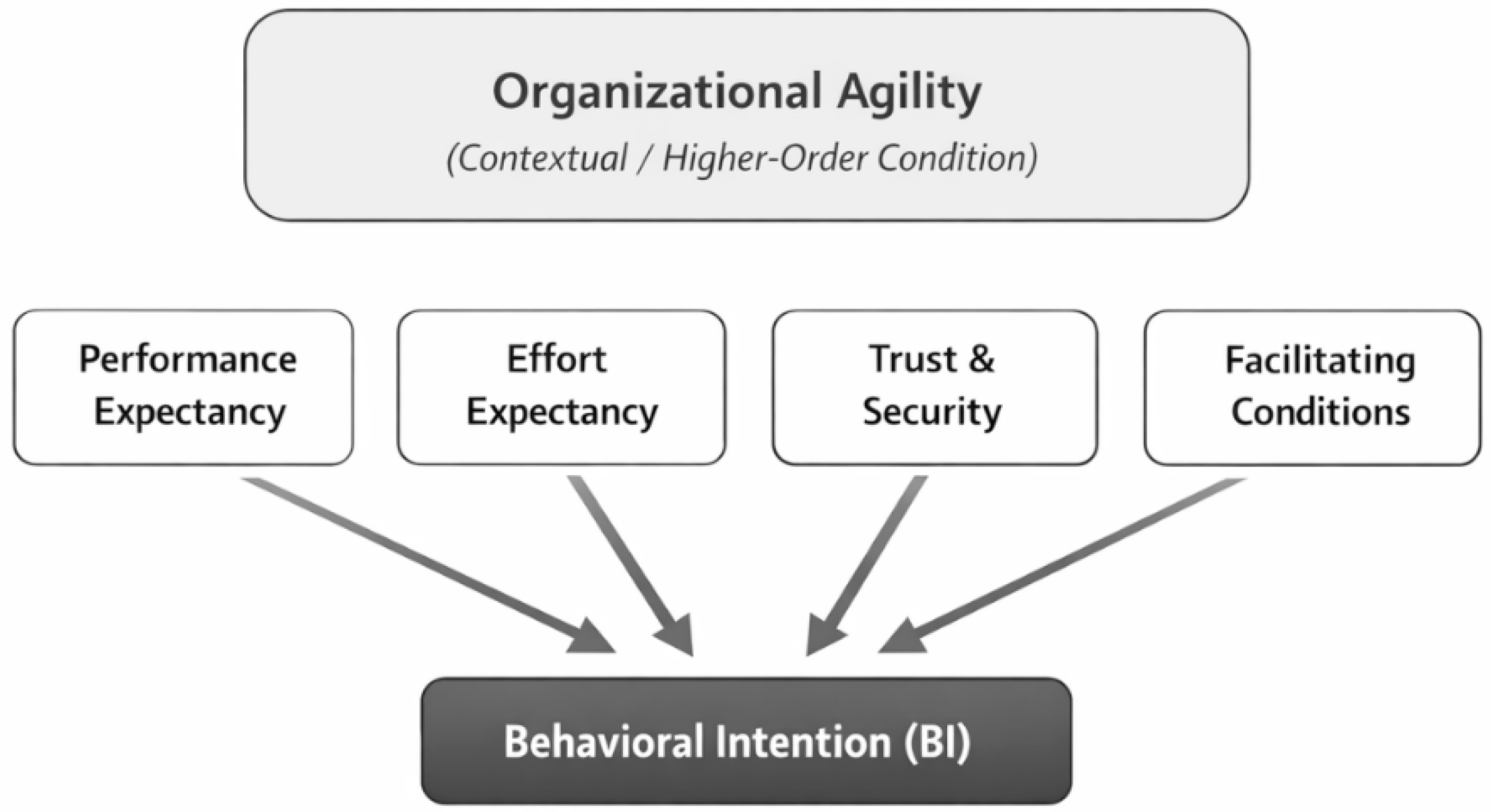
The hypotheses were tested using the standardized path coefficients of the structural model (Table 3/
Figure 1). The results indicate that:
Perceived usefulness (performance expectancy) has a statistically significant and positive effect on behavioral intention.
Perceived ease of use (effort expectancy) also has a statistically significant and positive effect on behavioral intention.
Trust and perceived security have a statistically significant and positive effect on behavioral intention.
Facilitating conditions are the strongest predictor of behavioral intention, underscoring the role of organizational and technical support in technology acceptance.
Therefore, all hypotheses predicting direct positive relationships between the TAM-related variables and intention to use are supported.
4.4. Summary Assessment of Hypothesis Testing
The results of the SEM analysis confirm the theoretical appropriateness of the technology acceptance model adopted in the paper and document that the intention to use the application is influenced by a set of cognitive, functional, and institutional factors. The combination of high reliability indices, satisfactory model fit, and statistically significant path coefficients (see
Table 1,
Table 2 and
Table 3) provides strong empirical support for the hypotheses formulated.
6. Discussion
The findings of the present study provide strong empirical support for the Technology Acceptance Model in the context of digital technology adoption within tourism and hospitality organizations. As reported in the Results section, all core TAM constructs examined—performance expectancy, effort expectancy, trust/security, and facilitating conditions—exerted positive and statistically significant effects on behavioral intention. This pattern confirms that users’ intentions to adopt digital technologies are shaped by a combination of cognitive evaluations, perceptions of institutional reliability, and assessments of organizational and technical support. In line with prior TAM-based research, the results demonstrate that technology acceptance in organizational settings cannot be reduced to isolated perceptions of usefulness or ease of use, but emerges from a broader configuration of evaluative mechanisms that jointly influence intention formation.
Among the examined relationships, facilitating conditions emerged as the strongest predictor of behavioral intention. This finding directly extends the results presented in
Table 3 and underscores the critical role of perceived organizational and technical support in shaping technology acceptance outcomes. When users perceive that adequate resources, infrastructure, and support mechanisms are available, their intention to use digital technologies is significantly strengthened. This result suggests that technology adoption is not solely driven by individual-level cognitive assessments, but is deeply embedded in perceptions of organizational readiness and support. Consequently, acceptance processes unfold within structured organizational environments that either enable or constrain the effective use of technological systems.
Building on this empirical pattern, the findings can be interpreted through the lens of organizational agility as an enabling organizational condition rather than as a directly measured construct. Although organizational agility was not operationalized as a latent variable in the empirical model, the prominence of facilitating conditions, trust/security, and performance expectancy points to an organizational context characterized by readiness for change, availability of support mechanisms, and institutionalized learning processes. These characteristics correspond conceptually to core dimensions of organizational agility discussed in the literature, including adaptive coordination, responsiveness, and the capacity to absorb technological change without disrupting everyday organizational practices. In this sense, organizational agility functions interpretively as a contextual antecedent that shapes how TAM beliefs are formed and activated, rather than as an independent predictor of behavioral intention.
The statistically significant effects of trust and perceived security further highlight the importance of institutional and psychological dimensions of technology acceptance. Trust in digital systems is not established solely through technical specifications, but is closely linked to organizational practices that promote transparency, reliability, and predictability. When users perceive digital technologies as secure and trustworthy, uncertainty associated with technological change is reduced, reinforcing positive behavioral intention. These findings suggest that trust operates at the intersection of individual perception and organizational context, supporting the argument that technology acceptance processes are embedded within broader organizational conditions rather than being purely individual-level phenomena.
Similarly, the positive effects of performance expectancy and effort expectancy reaffirm the central role of cognitive evaluations emphasized by the Technology Acceptance Model. However, their relative magnitude—particularly when compared to facilitating conditions—suggests that perceptions of usefulness and ease of use gain salience within supportive organizational environments. In contexts where learning, experimentation, and adaptation are normalized, the effort associated with using new technologies is more likely to be interpreted as an investment rather than as a cost. This interpretation is consistent with an agility-oriented organizational context, in which technological change is framed as manageable and meaningful rather than disruptive.
Taken together, the findings indicate that technology acceptance, as captured through the TAM framework, does not operate in an organizational vacuum. Instead, behavioral intention reflects the interaction between micro-level cognitive mechanisms and meso-level organizational conditions that shape how technologies are interpreted and enacted in practice. By positioning organizational agility as an interpretive context rather than as a directly tested variable, the study preserves the conceptual integrity of the Technology Acceptance Model while situating its explanatory relevance to dynamic organizational environments. This approach avoids conflating distinct theoretical levels and allows for a more nuanced understanding of how technology acceptance mechanisms are embedded within broader processes of organizational adaptation.
Overall, the contribution of the present study lies not in modifying the structural logic of the Technology Acceptance Model, but in situating it within a dynamic organizational framework that acknowledges the role of organizational conditions in shaping acceptance-related beliefs. The proposed interpretation offers a coherent bridge between established TAM research and contemporary discussions on organizational agility, opening avenues for future research to empirically examine these relationships across multiple levels of analysis.
7. Implications
7.1. Theoretical Implications
This study offers a complementary perspective to the organizational agility literature on technology acceptance and organizational theory in three distinct but interrelated ways. First, it strengthens the theoretical validity of the Technology Acceptance Model by empirically confirming the importance of its key variables in a contemporary organizational environment. The results confirm that the intention to use technology is shaped by a combination of cognitive evaluations, institutional parameters, and support perceptions, confirming the timeless usefulness of TAM.
Secondly, the study theoretically repositions TAM within a dynamic organizational framework, responding to long-standing criticisms that view it as overly individualistic and detached from organizational conditions. Without altering its conceptual structure, TAM is interpreted as a mechanism that is activated within specific organizational contexts. Organizational agility is proposed as such an interpretative framework, functioning as a higher-order organizational condition that shapes the way in which acceptance beliefs are formed.
Third, the study contributes to the literature on organizational agility by highlighting a less explored role of it: not only as an ability to adapt or transform, but also as an interpretive background that influences micro-level cognitive mechanisms. This connection provides a conceptual bridge between micro-level models of technology acceptance and meso-level organizational dynamics, strengthening the theoretical coherence between different research streams.
7.2. Practical Implications
At a practical level, the study’s findings indicate that the success of technological interventions does not depend solely on the design or functional capabilities of the technology, but also on the organizational environment into which it is introduced. The strong influence of facilitating conditions and trust on intention to use highlights the importance of investing in infrastructure, support mechanisms, and clearly defined procedures that help reduce user uncertainty.
For tourism-sector decision makers and digital transformation leaders, the results underscore that enhancing technology acceptance requires the parallel cultivation of organizational readiness. The development of a learning-oriented culture, the encouragement of experimentation, and tolerance toward failure can indirectly support the core TAM mechanisms, thereby facilitating the acceptance and functional integration of new technologies.
Furthermore, the observed role of trust and perceived security suggests that organizations should approach technological innovations not only as technical projects, but also as socio-organizational interventions. Transparent communication, clear delineation of roles and responsibilities, and consistent user support can help mitigate resistance and foster stronger behavioral intention toward technology use.
Finally, interpreting the findings through the lens of organizational agility provides organizations with a useful diagnostic perspective. Rather than focusing exclusively on individual acceptance indicators, organizations can assess the extent to which their internal environment supports continuous adaptation and learning. In this sense, technology acceptance is positioned not as an isolated objective, but as part of a broader strategy of organizational development and transformation.
7.3. Limitations and Future Research Directions
Despite the theoretical and methodological adequacy of the present study, certain limitations should be taken into account when interpreting the findings. The primary limitation refers to the fact that the research is based on cross-sectional data which do not allow for causal conclusions or the investigation of dynamic changes in technology acceptance over time. Future studies could adopt longitudinal or experimental research designs. Moreover, the sample is geographically limited to the metropolitan area of Thessaloniki and to companies in the tourism sector, which may limit the generalizability of the results to other regional or national contexts. Extending the research to different geographical and institutional contexts could strengthen the external validity of the conclusions. Finally, organizational agility was not empirically assessed as a distinct latent variable, but was used as a theoretical and interpretative framework for understanding the mechanisms of technology acceptance. Future research could empirically examine the role of organizational agility as a meso-level variable or mediating mechanism, further contributing to the link between technology acceptance models and organizational adaptability theories. Demographic variables (e.g., age, gender, education level, and work experience) were not collected, which limits the assessment of sample composition and potential subgroup heterogeneity; future studies should incorporate systematic demographic and firm-level profiling.