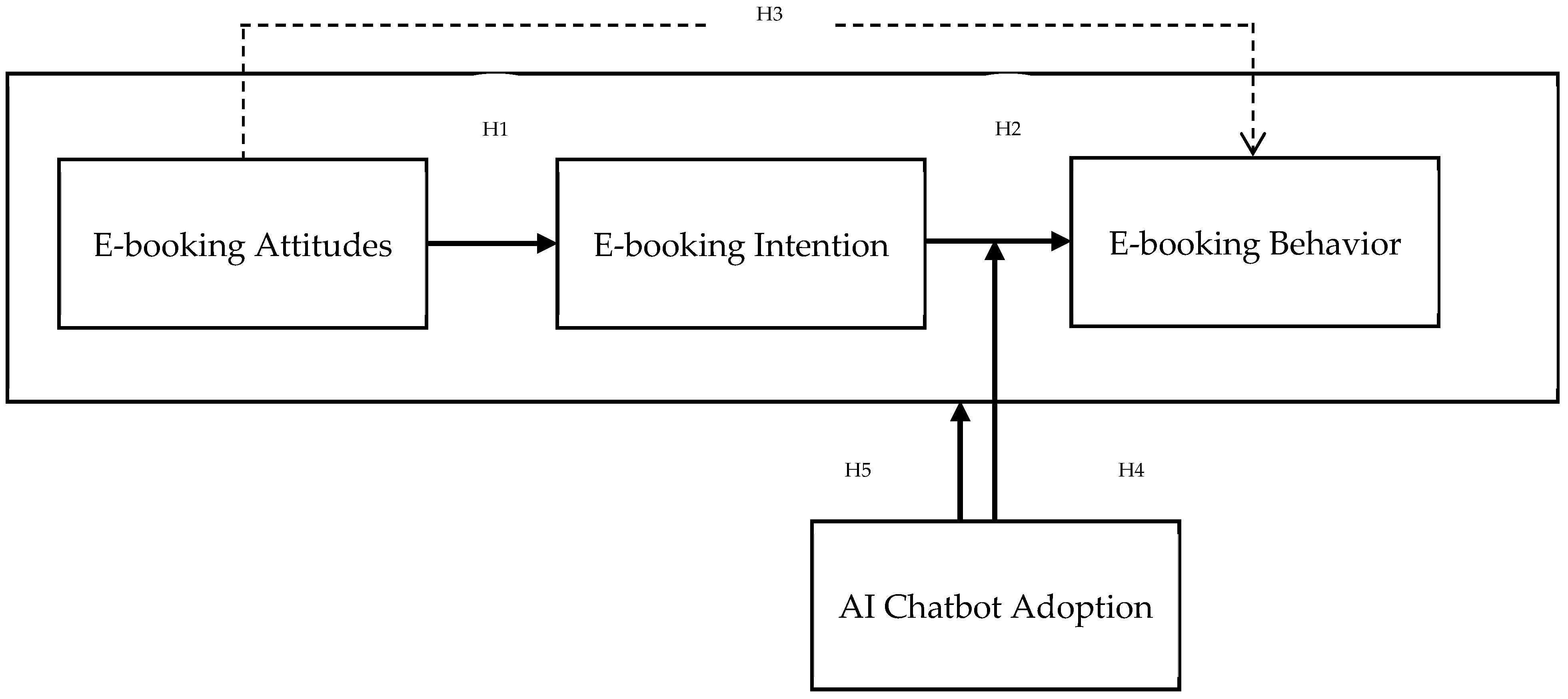

Can AI Chatbot Adoption Bridge the Gap Between Intention and Behavior in Tourism Service E-Booking: A Moderated Mediation Model Analysis


Abstract
1. Introduction
2. Literature Review and Hypothesis Development
2.1. Theory of Planned Behavior (TPB)
2.2. E-Booking Attitudes and Intention
2.3. E-Booking Intention and Behavior
2.4. Moderating Role of AI Chatbot Adoption
3. Methodology
3.1. Data Collection and Sampling
3.2. Measurement
3.3. Data Analysis
3.4. Common Method Bias
4. Results
4.1. Reliability and Convergent Validity
4.2. Discriminant Validity
4.3. Hypotheses Testing
5. Discussion and Implications
5.1. Discussion
5.2. Theoretical Implications
5.3. Practical Implications
6. Conclusions and Limitations
Author Contributions
Funding
Institutional Review Board Statement
Informed Consent Statement
Data Availability Statement
Conflicts of Interest
Appendix A

| Variables | Items | Description | Source |
|---|---|---|---|
| E-booking Attitudes (EA) | EA1 | I see more advantages than disadvantages in using online platforms to book travel services. | Casaló et al. (2015) and Zhang (2019) |
| EA2 | I am interested in using online booking platforms when planning my trips. | ||
| EA3 | If I had the opportunity and resources, I would prefer to rely on online platforms for most of my travel bookings. | ||
| EA4 | I believe that being able to book travel services online brings me convenience and satisfaction. | ||
| EA5 | Instead of relying on traditional offline methods, I would prefer to use online platforms to book travel services. | ||
| EA6 | By using online booking platforms, I feel that I can make better and more informed travel decisions. | ||
| E-booking Intention (EI) | EI1 | Using online platforms to book travel services is an important part of how I plan my trips. | Casaló et al. (2015) and Confente and Vigolo (2018) |
| EI2 | Next time, I plan to rely more on online platforms when booking travel services. | ||
| EI3 | When planning my trips, I intend to use online booking platforms to make more informed and convenient decisions. | ||
| EI4 | I am mindful of the advantages offered by online booking and intend to incorporate them into my travel planning. | ||
| EI5 | I intend to use online booking platforms in a responsible and efficient way when selecting travel services. | ||
| EI6 | If I need to book travel services, I will prioritize using online platforms instead of traditional offline methods. | ||
| E-booking behaviour (EB) | EB1 | I frequently book travel services (such as hotels, flights, or tours) through online platforms. | (Zhang, 2019) |
| EB2 | Recently, I have made several online travel booking transactions. | ||
| EB3 | I prefer to use online platforms whenever I need to book travel services. | ||
| EB4 | I have successfully completed online travel bookings without experiencing major difficulties. | ||
| EB5 | When I have travel needs, I choose online booking rather than visiting physical agencies or stores. | ||
| EB6 | I feel comfortable and familiar with the process of booking travel services online. | ||
| EB7 | I am willing to continue booking travel services online for my future trips. | ||
| AI Chatbot Adoption (CA) | CA1 | I use AI Chatbot to obtain information about travel services (e.g., hotels, flights, tours) before making online booking decisions. | Duong et al. (2025b) and Pham et al. (2024) |
| CA2 | I use AI Chatbot to ask questions about potential problems, risks, or uncertainties related to online travel booking. | ||
| CA3 | I use AI Chatbot to explore and compare different travel options and recommendations that match my needs and preferences. | ||
| CA4 | I use AI Chatbot to obtain information about prices, promotions, or booking conditions (e.g., refund policy, cancellation terms). | ||
| CA5 | Using AI Chatbot helps me gain extensive knowledge that supports my online travel booking decisions. |
References
- Ajzen, I. (1985). From intentions to actions: A theory of planned behavior. In Action control: From cognition to behavior (pp. 11–39). Springer. [Google Scholar] [CrossRef]
- Ajzen, I. (1991). The theory of planned behavior. Organizational Behavior and Human Decision Processes, 50(2), 179–211. [Google Scholar] [CrossRef]
- Ajzen, I. (2020). The theory of planned behavior: Frequently asked questions. Human Behavior and Emerging Technologies, 2(4), 314–324. [Google Scholar] [CrossRef]
- Baron, R. M., & Kenny, D. A. (1986). The moderator–mediator variable distinction in social psychological research: Conceptual, strategic, and statistical considerations. Journal of Personality and Social Psychology, 51(6), 1173. [Google Scholar] [CrossRef]
- Bhatiasevi, V., & Yoopetch, C. (2015). The determinants of intention to use electronic booking among young users in Thailand. Journal of Hospitality and Tourism Management, 23, 1–11. [Google Scholar] [CrossRef]
- Carvalho, I., & Ivanov, S. (2024). ChatGPT for tourism: Applications, benefits and risks. Tourism Review, 79(2), 290–303. [Google Scholar] [CrossRef]
- Casaló, L. V., Flavián, C., & Guinalíu, M. (2010). Antecedents and consequences of consumer participation in on-line communities: The case of the travel sector. International Journal of Electronic Commerce, 15(2), 137–167. [Google Scholar] [CrossRef]
- Casaló, L. V., Flavián, C., Guinalíu, M., & Ekinci, Y. (2015). Do online hotel rating schemes influence booking behaviors? International Journal of Hospitality Management, 49, 28–36. [Google Scholar] [CrossRef]
- Choi, D., Lee, S., Kim, S.-I., Lee, K., Yoo, H. J., Lee, S., & Hong, H. (2024, May 11–16). Unlock life with a Chat (GPT): Integrating conversational AI with large language models into everyday lives of autistic individuals. 2024 CHI Conference on Human Factors in Computing Systems, Honolulu, HI, USA. [Google Scholar] [CrossRef]
- Choi, W. C., & Chang, C. I. (2025). ChatGPT-5 in education: New capabilities and opportunities for teaching and learning. Preprints. Available online: https://www.preprints.org/manuscript/202508.0684 (accessed on 30 August 2025).
- Confente, I., & Vigolo, V. (2018). Online travel behaviour across cohorts: T he impact of social influences and attitude on hotel booking intention. International Journal of Tourism Research, 20(5), 660–670. [Google Scholar] [CrossRef]
- Cui, J., & Bell, R. (2022). Behavioural entrepreneurial mindset: How entrepreneurial education activity impacts entrepreneurial intention and behaviour. The International Journal of Management Education, 20(2), 100639. [Google Scholar] [CrossRef]
- Duong, C. D. (2022a). Big Five personality traits and green consumption: Bridging the attitude-intention-behavior gap. Asia Pacific Journal of Marketing and Logistics, 34(6), 1123–1144. [Google Scholar] [CrossRef]
- Duong, C. D. (2022b). Entrepreneurial fear of failure and the attitude-intention-behavior gap in entrepreneurship: A moderated mediation model. The International Journal of Management Education, 20(3), 100707. [Google Scholar] [CrossRef]
- Duong, C. D., Dao, T. T., Vu, T. N., Ngo, T. V. N., & Tran, Q. Y. (2024). Compulsive ChatGPT usage, anxiety, burnout, and sleep disturbance: A serial mediation model based on stimulus-organism-response perspective. Acta Psychologica, 251, 104622. [Google Scholar] [CrossRef] [PubMed]
- Duong, C. D., Nguyen, T. H., Ngo, T. V. N., Pham, T. T. P., Vu, A. T., & Dang, N. S. (2025a). Using generative artificial intelligence (ChatGPT) for travel purposes: Parasocial interaction and tourists’ continuance intention. Tourism Review, 80(4), 813–827. [Google Scholar] [CrossRef]
- Duong, C. D., Nguyen, T. H., Nguyen, M. H., Dang, N. S., Vu, A. T., & Do, N. D. (2025b). Exploring the role of generative artificial intelligence (ChatGPT) adoption in digital social entrepreneurship: A serial mediation model. Social Enterprise Journal, 21(5), 910–936. [Google Scholar] [CrossRef]
- Dwivedi, Y. K., Pandey, N., Currie, W., & Micu, A. (2024). Leveraging ChatGPT and other generative artificial intelligence (AI)-based applications in the hospitality and tourism industry: Practices, challenges and research agenda. International Journal of Contemporary Hospitality Management, 36(1), 1–12. [Google Scholar] [CrossRef]
- Goh, S., Ho, V., & Jiang, N. (2015). The effect of electronic word of mouth on intention to book accommodation via online peer-to-peer platform: Investigation of theory of planned behaviour. The Journal of Internet Banking and Commerce S, 2, 2–7. [Google Scholar] [CrossRef]
- Guo, Q., Mu, L., & Lou, S. (2024). Revolutionizing travel experiences: An in-depth analysis of intelligent booking systems and behavioral patterns. Intelligent Decision Technologies, 18(2), 1477–1494. [Google Scholar] [CrossRef]
- Hack-Polay, D., Dal Mas, F., Mahmoud, A. B., & Rahman, M. (2022). Barriers to the effective exploitation of migrants’ social and cultural capital in hospitality and tourism: A dual labour market perspective. Journal of Hospitality and Tourism Management, 50, 168–177. [Google Scholar] [CrossRef]
- Hassan, L. M., Shiu, E., & Shaw, D. (2016). Who says there is an intention–behaviour gap? Assessing the empirical evidence of an intention–behaviour gap in ethical consumption. Journal of Business Ethics, 136(2), 219–236. [Google Scholar] [CrossRef]
- Hayes, A. F. (2015). An index and test of linear moderated mediation. Multivariate Behavioral Research, 50(1), 1–22. [Google Scholar] [CrossRef]
- Jalilvand, M. R., & Samiei, N. (2012). The impact of electronic word of mouth on a tourism destination choice: Testing the theory of planned behavior (TPB). Internet Research, 22(5), 591–612. [Google Scholar] [CrossRef]
- Jeng, C.-R. (2019). The role of trust in explaining tourists’ behavioral intention to use e-booking services in Taiwan. Journal of China Tourism Research, 15(4), 478–489. [Google Scholar] [CrossRef]
- Karlsson, L., & Dolnicar, S. (2016). Does eco certification sell tourism services? Evidence from a quasi-experimental observation study in Iceland. Journal of Sustainable Tourism, 24(5), 694–714. [Google Scholar] [CrossRef]
- Ladhari, R., & Michaud, M. (2015). eWOM effects on hotel booking intentions, attitudes, trust, and website perceptions. International Journal of Hospitality Management, 46, 36–45. [Google Scholar] [CrossRef]
- Law, R., Lin, K. J., Ye, H., & Fong, D. K. C. (2024). Artificial intelligence research in hospitality: A state-of-the-art review and future directions. International Journal of Contemporary Hospitality Management, 36(6), 2049–2068. [Google Scholar] [CrossRef]
- Liu, J., Gu, J., Tong, M., Yue, Y., Qiu, Y., Zeng, L., Yu, Y., Yang, F., & Zhao, S. (2025). Evaluating the agreement between ChatGPT-4 and validated questionnaires in screening for anxiety and depression in college students: A cross-sectional study. BMC Psychiatry, 25(1), 359. [Google Scholar] [CrossRef]
- Minh, D. H., & Cuong, T. (2026). The link between sustainable entrepreneurial attitude, intention, and behavior: Moderating role of circular economy entrepreneurship. Strategy & Leadership, 54(2), 181–203. [Google Scholar] [CrossRef]
- Nautiyal, R., Albrecht, J. N., & Nautiyal, A. (2023). ChatGPT and tourism academia. Annals of Tourism Research, 99, 103544. [Google Scholar] [CrossRef]
- Pham, H. C., Duong, C. D., & Nguyen, G. K. H. (2024). What drives tourists’ continuance intention to use ChatGPT for travel services? A stimulus-organism-response perspective. Journal of Retailing and Consumer Services, 78, 103758. [Google Scholar] [CrossRef]
- Suki, N. M., & Suki, N. M. (2017). Flight ticket booking app on mobile devices: Examining the determinants of individual intention to use. Journal of Air Transport Management, 62, 146–154. [Google Scholar] [CrossRef]
- Sun, S., Law, R., & Schuckert, M. (2020). Mediating effects of attitude, subjective norms and perceived behavioural control for mobile payment-based hotel reservations. International Journal of Hospitality Management, 84, 102331. [Google Scholar] [CrossRef]
- Sun, S., Law, R., Schuckert, M., & Hyun, S. S. (2022). Impacts of mobile payment-related attributes on consumers’ repurchase intention. International Journal of Tourism Research, 24(1), 44–57. [Google Scholar] [CrossRef]
- Travel, Books and Food. (2025). 10 best Vietnam holiday destinations to visit in 2025 (tips, cruises and more). Travel, Books and Food. Available online: https://travelbooksfood.com/best-vietnam-holiday-destinations (accessed on 1 January 2020).
- Tuo, Y., Wu, J., Zhao, J., & Si, X. (2025). Artificial intelligence in tourism: Insights and future research agenda. Tourism Review, 80(4), 793–812. [Google Scholar] [CrossRef]
- Vietnam Ministry of Culture Sports and Tourism. (2025). Top 10 destinations in Vietnam trending for year-end travel. Available online: https://bvhttdl.gov.vn/10-diem-den-tai-viet-nam-la-lua-chon-hang-dau-xu-huong-du-lich-cuoi-nam-20251203190727238.htm#:~:text=V%E1%BB%9Bi%20nh%E1%BB%AFng%20ai%20mu%E1%BB%91n%20t%E1%BA%ADn,%C4%91%E1%BB%99ng%20Gi%C3%A1ng%20sinh%20s%C3%B4i%20%C4%91%E1%BB%99ng.&text=Du%20kh%C3%A1ch%20n%C6%B0%E1%BB%9Bc%20ngo%C3%A0i%20c%C5%A9ng,%2C%20Sa%20Pa%2C%20%C4%90%C3%A0%20L%E1%BA%A1t (accessed on 29 December 2025).
- Viglia, G., Dolnicar, S., Acuti, D., & Nicolau, J. L. (2024). If you want to learn about real behaviour, measure real behaviour. Journal of Sustainable Tourism, 32(11), 2245–2257. [Google Scholar] [CrossRef]
- Vlahović, O., Rađenović, Ž., Perović, D., Vujačić, V., & Davidović, K. (2024). Digital transformation in tourism: The role of e-booking systems. Croatian Regional Development Journal, 5(2), 129–145. [Google Scholar] [CrossRef]
- Waris, I., Farooq, M., Hameed, I., & Shahab, A. (2021). Promoting sustainable ventures among university students in Pakistan: An empirical study based on the theory of planned behavior. On the Horizon, 29(1), 1–16. [Google Scholar] [CrossRef]
- Wong, I. A., Lian, Q. L., & Sun, D. (2023). Autonomous travel decision-making: An early glimpse into ChatGPT and generative AI. Journal of Hospitality and Tourism Management, 56, 253–263. [Google Scholar] [CrossRef]
- Yap, J. B. H., & Chua, K. L. (2018). Application of e-booking system in enhancing Malaysian property developers’ competitive advantage: A blue ocean strategy? Property Management, 36(1), 86–102. [Google Scholar] [CrossRef]
- Yasir, N., Xie, R., & Zhang, J. (2022). The impact of personal values and attitude toward sustainable entrepreneurship on entrepreneurial intention to enhance sustainable development: Empirical evidence from Pakistan. Sustainability, 14(11), 6792. [Google Scholar] [CrossRef]
- Zhang, J. (2019). Is e-booking a planned behavior? A study on the effects of tourists’ habits and the two-stage moderating effects of risk perception. Tourism and Hospitality Prospects, 3(1), 43. [Google Scholar]


| Variables | Item | Frequency | Percentage (%) |
|---|---|---|---|
| Gender | Male | 259 | 42.7 |
| Female | 348 | 57.3 | |
| Age | 18–30 | 251 | 41.4 |
| 31–55 | 324 | 53.4 | |
| Above 55 | 32 | 5.3 | |
| Education | High school | 141 | 23.2 |
| Bachelor’s degree | 375 | 61.8 | |
| Master’s and PhD degree | 91 | 15.0 |
| Variables | Items | Factor Loadings | Cronbach’s Alpha | C.R | AVE |
|---|---|---|---|---|---|
| E-booking Attitudes (EA) | EA1 | 0.742 | 0.903 | 0.912 | 0.678 |
| EA2 | 0.708 | ||||
| EA3 | 0.791 | ||||
| EA4 | 0.782 | ||||
| EA5 | 0.755 | ||||
| EA6 | 0.871 | ||||
| E-booking Intention (EI) | EI1 | 0.816 | 0.880 | 0.888 | 0.632 |
| EI2 | 0.708 | ||||
| EI3 | 0.703 | ||||
| EI4 | 0.778 | ||||
| EI5 | 0.695 | ||||
| EI6 | 0.725 | ||||
| E-booking Behavior (EB) | EB1 | 0.713 | 0.900 | 0.918 | 0.642 |
| EB2 | 0.700 | ||||
| EB3 | 0.690 | ||||
| EB4 | 0.659 | ||||
| EB5 | 0.704 | ||||
| EB6 | 0.841 | ||||
| EB7 | 0.695 | ||||
| AI Chatbot Adoption (CA) | CA1 | 0.832 | 0.875 | 0.911 | 0.672 |
| CA2 | 0.796 | ||||
| CA3 | 0.772 | ||||
| CA4 | 0.765 | ||||
| CA5 | 0.892 |
| CA | EA | EB | EI | |
|---|---|---|---|---|
| CA | 0.820 | |||
| EA | 0.224 | 0.824 | ||
| EB | 0.232 | 0.578 | 0.801 | |
| EI | 0.175 | 0.471 | 0.628 | 0.795 |
| Predictor | B (Coeff) | SE | p | LLCI | ULCI |
|---|---|---|---|---|---|
| E-booking Intention (M) (R2 = 0.214; F = 165.210 ***) | |||||
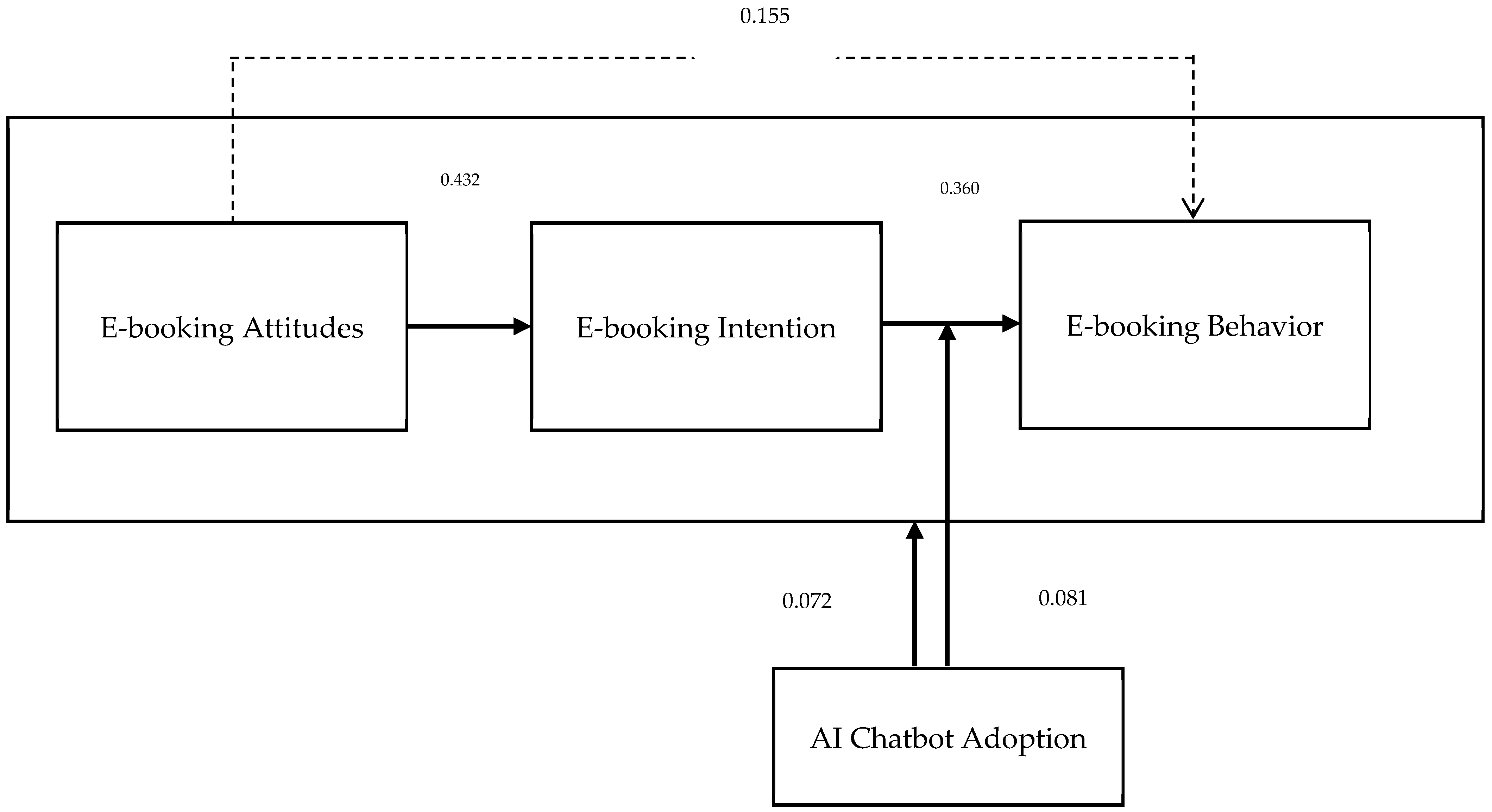
| E-booking Attitudes (X) | 0.432 | 0.034 | 0.000 | 0.366 | 0.498 |
| E-booking Behavior (Y) | |||||
| Total effect | |||||
| E-booking Attitudes (X) | 0.262 | 0.025 | 0.000 | 0.214 | 0.310 |
| E-booking Behavior (Y) (R2 = 0.478; F = 276.219 ***) | |||||
| Direct effects | |||||
| E-booking Attitudes (X) | 0.262 | 0.025 | 0.000 | 0.214 | 0.310 |
| E-booking Intention (M) | 0.360 | 0.026 | 0.000 | 0.308 | 0.411 |
| Boot indirect effect | Boot SE | Boot LLCI | Boot ULCI | ||
| Indirect effect of X on Y via M | 0.155 | 0.017 | 0.123 | 0.191 | |
| E-Booking Behavior (Y) | |||||
|---|---|---|---|---|---|
| Predictor | B (Coeff) | SE | p | LLCI | ULCI |
| Main effect | |||||
| E-booking Attitudes (X) | 0.243 | 0.096 | 0.000 | 0.195 | 0.290 |
| E-booking Intention (M) | 0.368 | 0.026 | 0.000 | 0.317 | 0.418 |
| Moderate effect | |||||
| E-booking Intention (M) × AI Chatbot Adoption (Z) | 0.081 | 0.024 | 0.008 | 0.034 | 0.128 |
| Total R2 | 0.513 | ||||
| F | 158.564 | ||||
| Conditional effects of M (focal predictor-M) at the values of AI Chatbot Adoption (moderator-Z): Z ¼ M 6 S.D. | |||||
| M − 1.S.D. (t = 8.044) | 0.258 | 0.030 | 0.000 | 0.187 | 0.308 |
| M (t = 14.326) | 0.368 | 0.026 | 0.000 | 0.317 | 0.418 |
| M + 1.S.D. (t = 14.618) | 0.488 | 0.033 | 0.000 | 0.422 | 0.553 |
| Boot indirect effect | Boot SE | Boot LLCI | Boot ULCI | ||
| Index of moderated mediation | 0.072 | 0.013 | 0.046 | 0.098 | |
| Conditional indirect effects of X on Y via M at the value of Z (Z = M ∓ S.D.) | |||||
| M − 1.S.D. | 0.107 | 0.153 | 0.078 | 0.138 | |
| M | 0.159 | 0.173 | 0.126 | 0.194 | |
| M + 1.S.D. | 0.210 | 0.023 | 0.166 | 0.257 | |
Disclaimer/Publisher’s Note: The statements, opinions and data contained in all publications are solely those of the individual author(s) and contributor(s) and not of MDPI and/or the editor(s). MDPI and/or the editor(s) disclaim responsibility for any injury to people or property resulting from any ideas, methods, instructions or products referred to in the content. |
© 2026 by the authors. Licensee MDPI, Basel, Switzerland. This article is an open access article distributed under the terms and conditions of the Creative Commons Attribution (CC BY) license.
Share and Cite
Anh, N.T.N.; Minh, D.H.; Cuong, T.; Chinh, T.T.Q. Can AI Chatbot Adoption Bridge the Gap Between Intention and Behavior in Tourism Service E-Booking: A Moderated Mediation Model Analysis. Tour. Hosp. 2026, 7, 68. https://doi.org/10.3390/tourhosp7030068
Anh NTN, Minh DH, Cuong T, Chinh TTQ. Can AI Chatbot Adoption Bridge the Gap Between Intention and Behavior in Tourism Service E-Booking: A Moderated Mediation Model Analysis. Tourism and Hospitality. 2026; 7(3):68. https://doi.org/10.3390/tourhosp7030068
Chicago/Turabian StyleAnh, Nguyen Thi Ngoc, Dinh Hoang Minh, Tran Cuong, and Tran Thi Quy Chinh. 2026. "Can AI Chatbot Adoption Bridge the Gap Between Intention and Behavior in Tourism Service E-Booking: A Moderated Mediation Model Analysis" Tourism and Hospitality 7, no. 3: 68. https://doi.org/10.3390/tourhosp7030068
APA StyleAnh, N. T. N., Minh, D. H., Cuong, T., & Chinh, T. T. Q. (2026). Can AI Chatbot Adoption Bridge the Gap Between Intention and Behavior in Tourism Service E-Booking: A Moderated Mediation Model Analysis. Tourism and Hospitality, 7(3), 68. https://doi.org/10.3390/tourhosp7030068