Article

Can AI Chatbot Adoption Bridge the Gap Between Intention and Behavior in Tourism Service E-Booking: A Moderated Mediation Model Analysis


1
School of Foreign Languages-Tourism, Hanoi University of Industry, Hanoi 100000, Vietnam
2
School of Economics, Hanoi University of Industry, Hanoi 100000, Vietnam
*
Author to whom correspondence should be addressed.
Tour. Hosp. 2026, 7(3), 68; https://doi.org/10.3390/tourhosp7030068
Submission received: 2 February 2026 / Revised: 24 February 2026 / Accepted: 25 February 2026 / Published: 2 March 2026

Abstract

Drawing on the Theory of Planned Behavior (TPB), this research examines how attitudes influence intentions and behaviors, and whether AI Chatbot serves as a contextual moderator that strengthens this linkage. Data were collected from 607 tourists at major destinations in Vietnam using systematic sampling. The hypotheses were tested with SPSS 26, AMOS 20, and the PROCESS macro to examine mediation and moderated mediation effects. The results show that e-booking intention partially mediates the relationship between e-booking attitudes and behavior. More importantly, AI Chatbot Adoption significantly enhances the intention–behavior linkage, thereby reducing the well-documented intention–behavior gap in e-booking. This result implies that tourism businesses and hotel managers can integrate AI Chatbot to provide real-time support, reduce customer hesitation, and improve booking conversion rates. Policymakers and AI developers are also encouraged to promote responsible adoption of AI in tourism to enhance service quality and customer trust.

1. Introduction

With the rapid advancement of technology, artificial intelligence (AI) models, most notably AI Chatbot, have had profound impacts on various aspects of human life (D. Choi et al., 2024). This chatbot model can generate real-time conversations and discussions with humans by providing suggestions, translations, summaries, and more (Carvalho & Ivanov, 2024). AI Chatbot has indeed ushered in a new era of artificial intelligence, in which human biological limitations are gradually being removed and replaced by AI. Recently, AI Chatbot has witnessed remarkable progress with increasingly powerful versions, such as ChatGPT, Gemini, DeepSeek, etc., (W. C. Choi & Chang, 2025). These versions demonstrate deeper reasoning and problem-solving abilities, handling more complex issues such as academic writing and research. Although debates regarding the use of AI Chatbots remain, it is undeniable that the model is delivering significant benefits across diverse fields. The tourism, hospitality, and hotel industries represent promising sectors for applying AI models, as these tools can enhance customer experiences while simultaneously increasing revenues for businesses and booking platforms (Guo et al., 2024; Law et al., 2024).
E-booking in tourism refers to the behavior by which customers use online platforms to search for, select, and reserve tourism services such as flights, hotels, tours, or transportation (Jeng, 2019). This form of booking enables travelers to quickly access information, compare prices and services transparently, and complete transactions conveniently without the need for intermediaries. However, in practice, tourism service e-booking providers remain hesitant to adopt AI in their platforms (Dwivedi et al., 2024). Despite the global trend toward AI adoption in tourism services, many leading booking platforms have only gradually incorporated AI-driven features into their systems (Vlahović et al., 2024). This reflects a contextual lag in the diffusion and implementation of advanced technologies. One reason lies in concerns that customers may resist changing long-established usage habits, which represents a unique barrier in this sector (Dwivedi et al., 2024). Nevertheless, given current trends, the adoption of such models is inevitable. In this context, AI Chatbot can be integrated as a decision-support tool for travelers, covering travel planning, destination recommendations, hotel bookings, and price comparisons and suggestions. This, in turn, can significantly enhance tourists’ overall experiences (Pham et al., 2024). Leveraging AI Chatbots’ potential may thus represent a strategic move that fosters substantial changes in the tourism industry, particularly by shaping customer decision-making behavior (Pham et al., 2024).
Existing research has recognized the potential role of AI in advancing the tourism and hospitality sectors. Yet, most studies to date have focused on the role of AI in tourism in general (Law et al., 2024; Tuo et al., 2025). More recently, studies by Pham et al. (2024) and Duong et al. (2025a) examined interactions between ChatGPT and tourist behavior. However, these studies only explored whether travelers are satisfied with and willing to continue using the model for tourism purposes. This highlights the absence of empirical evidence regarding AI’s role in facilitating booking decisions.
Indeed, to the best of our knowledge, there remains limited research examining the role of AI Chatbots in promoting consumer behavior and booking behavior. First, prior studies have been constrained in considering AI Chatbots as a potential decision-support tool for travelers. Second, although the Theory of Planned Behavior has established the sequence from attitude to intention to behavior, very few studies have simultaneously tested this mediating mechanism together with a technological moderator such as AI Chatbot Adoption.
Furthermore, prior studies have emphasized the persistent gap between intention and behavior (Hassan et al., 2016; Viglia et al., 2024). In other words, not all intentions translate into actions (Minh & Cuong, 2026). The tourism and booking domains are no exception, as many tourists often feel hesitant and struggle to make concrete decisions (Viglia et al., 2024). This hesitation arises partly from being overwhelmed by large volumes of information within a short timeframe. In such cases, traditional stimuli such as vouchers, advertisements, feedback, or reviews may no longer be effective. Therefore, bridging the intention–behavior gap becomes crucial as it helps companies and platforms retain customers and increase revenue (Karlsson & Dolnicar, 2016; Yap & Chua, 2018). Accordingly, this study posits that an AI Chatbot can play a critical role in narrowing this gap. By integrating an AI Chatbot into booking platforms, customers can make faster and easier decisions.
This study makes several significant contributions to the hospitality and tourism literature. First, it advances theoretical understanding by extending the Theory of Planned Behavior (TPB) to the context of AI-enabled tourism services. Specifically, the findings demonstrate how an AI Chatbot functions as a contextual moderator that strengthens the pathway from attitudes and intentions to booking behaviors, thus offering new insights into the long-standing intention–behavior gap in tourism research. Second, the study contributes methodologically by employing a moderated mediation model tested with SPSS, drawing on data collected from 607 respondents across major tourist destinations in Vietnam. This approach provides robust empirical evidence and uncovers both direct and indirect mechanisms through which an AI Chatbot influences tourists’ booking decisions. Finally, the study offers practical implications for tourism platforms and service providers, highlighting how the integration of conversational AI into e-booking systems can benefit them.
The structure of this research is divided into six sections: the introduction, literature review and hypothesis development, methodology, results, discussion and implications, and the conclusion with limitations.

2. Literature Review and Hypothesis Development

2.1. Theory of Planned Behavior (TPB)

The Theory of Planned Behavior (TPB) was developed by Ajzen (1985) from the Theory of Reasoned Action. This theory explains individual behavior through the relationship between behavioral intention and three determinants: attitude, subjective norm, and perceived behavioral control. Behavioral intention reflects the tendency to perform a specific action; attitude indicates a positive or negative evaluation of the behavior; subjective norm refers to perceived social pressure; while perceived behavioral control reflects the perceived ease or difficulty of performing the behavior. These factors not only influence intention but may also directly predict behavior. The TPB has been validated across multiple fields, such as entrepreneurship (Minh & Cuong, 2026), tourism destination choice (Jalilvand & Samiei, 2012), and more. In the context of online tourism, booking behavior can be considered a planned action, as tourists often proactively search for information, compare products and services (e.g., flights, hotels, tours), read reviews, and weigh up costs before making a decision (Bhatiasevi & Yoopetch, 2015). This behavior is rational and goal-oriented, motivated by the desire to maximize experiential value while minimizing investments of time, money, and effort. Empirical studies further confirm the applicability of the TPB in explaining online shopping and consumption behavior. This highlights the critical role of attitudes and trust in booking platforms in shaping tourists’ booking intentions and decisions (Goh et al., 2015; Jalilvand & Samiei, 2012).
However, in this study, we do not adopt all three components of the TPB model. Instead, we focus specifically on the role of attitude as the foundational antecedent of intention and behavior in our conceptual framework. This approach is justified for several key reasons. First, a substantial body of empirical research has demonstrated that attitude tends to exert the strongest effect on behavioral intention and behavior (Duong, 2022a; Minh & Cuong, 2026), a finding also confirmed in the context of online hotel booking (Zhang, 2019). Second, several studies indicate that it is not always necessary to employ the full TPB model, particularly when the relationship between intention and behavior requires further examination (Cui & Bell, 2022; Duong, 2022b). Indeed, in the tourism behavior context, most prior studies have concentrated on examining the predictive roles of all three TPB factors in shaping tourists’ intentions (Sun et al., 2020, 2022), whereas far fewer studies have explored the intention–behavior relationship or the mediating role of intention between attitude and online booking behavior. Furthermore, our study specifically aims to examine whether an AI Chatbot can bridge the gap between intention and e-booking behavior. Hence, incorporating all three TPB components is not necessary (Minh & Cuong, 2026; Waris et al., 2021). This selective application contributes to the current literature by shifting attention from factors influencing intention alone to the more critical intention–behavior relationship. This link has often been overlooked in prior studies (Hassan et al., 2016; Viglia et al., 2024).

2.2. E-Booking Attitudes and Intention

From the perspective of the Theory of Planned Behavior (TPB), individuals’ attitudes represent their overall evaluations of a phenomenon, which can be either positive or negative. In other words, attitudes reflect how a person perceives a particular issue, and this perception may depend on the values and beliefs associated with potential behaviors. Ajzen (1991) argued that when individuals hold a positive attitude, the behavior is more likely to occur, and vice versa. Thus, attitude is one of the key factors significantly influencing human behavior (Ajzen, 2020). Accordingly, when tourists develop a positive attitude toward online booking, they are more inclined to engage in purchasing travel products through digital platforms (Suki & Suki, 2017). Put differently, a favorable perception of online booking serves to strengthen tourists’ intention to complete such transactions (Ajzen, 1991).
A large body of empirical evidence also supports this view, suggesting that attitude is a critical determinant in shaping intention, particularly in the tourism context (e.g., Zhang (2019), Goh et al. (2015), Jalilvand and Samiei (2012)). Using survey methods, previous studies have consistently shown that attitude has a positive relationship with tourists’ e-booking intention. For instance, Ladhari and Michaud (2015) demonstrated that students exposed to positive hotel reviews exhibited more favorable attitudes and higher booking intentions than those who frequently encountered negative reviews. Similarly, Confente and Vigolo (2018), using the Theory of Reasoned Action (TRA), confirmed that attitude plays a significant role in fostering tourists’ intention to e-book hotels. However, the existing literature has primarily focused on e-booking services related to hotels while overlooking other types of travel services that are often integrated within the same platform. Hence, this study proposes a more comprehensive approach. In addition, research conducted in the context of artificial intelligence, widely regarded as an influential factor in shaping tourist behavior, remains limited (Pham et al., 2024). Based on these arguments, we propose the following hypothesis:
H1. 
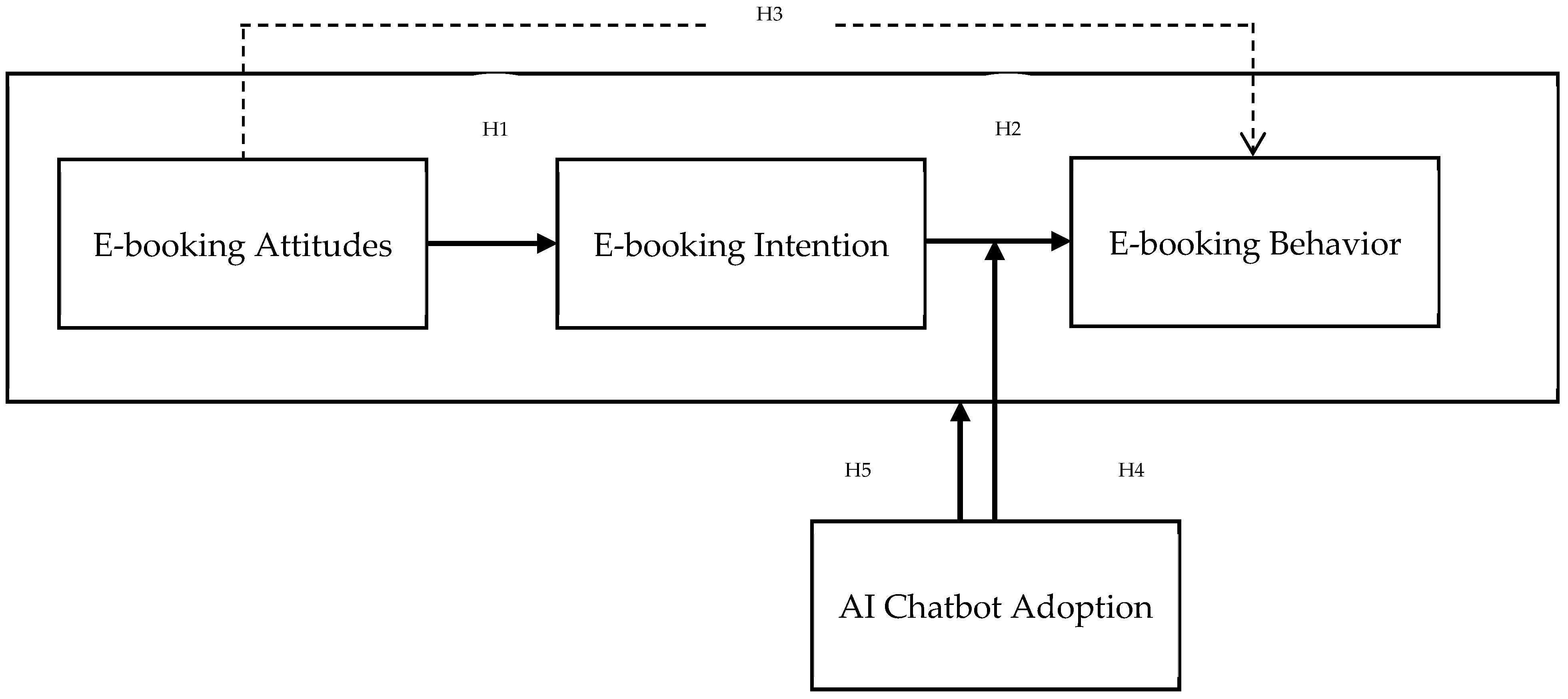
Attitude has a positive effect on the intention to use e-book travel services.

2.3. E-Booking Intention and Behavior

Ajzen (1985) posits that behavioral intention serves as a concrete indicator of behavior, reflecting both the readiness and intrinsic motivation of an individual to perform a particular action. Prior research has empirically examined the linkage between intention and behavior through measures such as loyalty, willingness to pay, switching behavior, and customer responses (Casaló et al., 2010). However, intentions do not always translate into behavior, as this process is often influenced by multiple factors originating from both the individual and the external environment (Ajzen, 2020).
Most prior studies have primarily focused on determinants of e-booking intention, while the link between intention and behavior has received limited attention. Among the few works addressing this issue, Zhang’s (2019) study in China stands out. The findings revealed that although tourists expressed an intention to book online, their heightened perception of risk weakened the relationship between intention and behavior. These lead them to refrain from making reservations. The study made an important contribution by highlighting that the intention–behavior relationship in the e-booking context can be moderated by factors such as risk perception.
Recent studies, such as the one performed by Viglia et al. (2024), emphasize the importance of moving beyond self-reported intentions by measuring booking behaviors, thereby addressing the long-standing intention–behavior gap in tourism research. While our study adopts a cross-sectional survey design and therefore does not directly capture real behavioral data, it contributes to this line of inquiry by investigating how technological factors, particularly the integration of AI Chatbots, can moderate the relationship between intention and e-booking behavior. In doing so, the research provides an alternative perspective: rather than solely relying on behavioral tracking, understanding how AI-enabled tools influence the translation of intentions into actions is equally critical. This approach enriches the existing literature by highlighting the role of emerging technologies in narrowing the intention–behavior gap within online tourism booking contexts. Based on these arguments, we propose the following hypothesis:
H2. 
Intention has a positive impact on e-booking tourism service behavior.
H3. 
Intention mediates the relationship between attitudes and behavior.

2.4. Moderating Role of AI Chatbot Adoption

The rapid advancement of artificial intelligence (AI) and the emergence of immersive information environments have transformed how tourists search for, evaluate, and book travel services. Among AI-driven tools, AI Chatbot has gained particular attention for its ability to generate personalized and contextually relevant information. Thus, it redefines the landscape of online tourism service booking (Wong et al., 2023). Unlike traditional search engines or single-featured chatbots, AI Chatbot provides comprehensive responses to complex queries by synthesizing information from diverse sources (Nautiyal et al., 2023). This empowers tourists to not only access details about attractions, dining, lodging, and transportation but to also receive cost-effective and sustainable recommendations aligned with their budget, preferences, and time constraints (Wong et al., 2023).
In this study, AI Chatbot Adoption is conceptualized as a behavioral facilitation factor that enhances the effectiveness of intention enactment. Although the TPB posits that intention predicts behavior, the strength of this link depends on contextual conditions. In online booking environments, cognitive uncertainty and information overload may weaken intention–behavior conversion. AI Chatbot, as an interactive decision-support tool, reduces uncertainty and increases decision confidence, thereby improving the likelihood that intention is translated into action.
Several studies suggest that technology anxiety or fear of failure can weaken the relationship between intention and behavior (Duong, 2022b; Zhang, 2019). In this context, an AI Chatbot may alleviate such anxiety by providing useful, tailored advice (Duong et al., 2024; Liu et al., 2025), thereby increasing the likelihood of bookings. An AI Chatbot can enhance the tourism experience by providing multimedia content such as images, videos, and virtual tours of suggested destinations. Its multilingual communication capabilities and accurate translations of local customs and expressions help overcome cultural and language barriers. These problems are often considered major challenges in international tourism (Hack-Polay et al., 2022). During travel, AI Chatbot can serve as an on-demand personal assistant, available 24/7 to support last-minute changes, address unexpected situations, and ensure a smoother travel experience. Therefore, the adoption of AI Chatbot into tourism booking platforms is believed to have significant impacts on tourist behavior (Duong et al., 2025a; Pham et al., 2024).
Despite these promising benefits, research has rarely examined the role of AI Chatbots in bridging the well-documented intention–behavior gap in online tourism booking. Prior studies have largely focused on tourists’ intentions or satisfaction with digital platforms, often overlooking whether such intentions translate into booking behavior. Indeed, many studies have also suggested that narrowing the gap between intention and behavior requires the presence of a moderating variable (Duong, 2022a, 2022b; Minh & Cuong, 2026). A moderating variable can either strengthen or weaken the effect of a relationship. This demonstrates that when a relationship is weak or inconsistent, the inclusion of a moderating variable is appropriate (Baron & Kenny, 1986).
This study addresses this gap by conceptualizing an AI Chatbot as a moderating factor that strengthens the link between intention and e-booking behavior. Specifically, by reducing uncertainty, increasing confidence, and minimizing decision delays, an AI Chatbot may enhance the likelihood that tourists’ intentions are converted into real booking actions. Based on these arguments, we propose the following hypothesis:
H4. 
AI Chatbot Adoption moderates the link between intention and behavior in e-booking tourism service.
Suppose that an AI Chatbot moderates the relationship between attitude and tourists’ intention to engage in e-booking. In this case, it is reasonable to assume that an AI Chatbot could conditionally influence the strength of the indirect linkage between attitude and booking behavior through intention. This implies that the mediating role of intention in connecting attitude to behavior may itself be contingent upon the presence of an AI Chatbot, resulting in moderated mediation effects.
An AI Chatbot serves as a facilitating factor that enhances the pathway from attitude to intention and subsequently to behavior. When tourists perceive an AI Chatbot as a reliable and supportive decision-making assistant, their positive attitudes toward e-booking are more likely to translate into stronger booking intentions, which in turn foster booking behavior. Conversely, in the absence of an AI Chatbot, or when its perceived usefulness is low, the motivational force of attitude on intention weakens, thereby reducing the likelihood that intention will lead to e-booking behavior. In this sense, AI Chatbot operates as a moderator that shapes the strength of the intention–behavior relationship, potentially narrowing the well-documented intention–behavior gap in online booking contexts. Based on these arguments, we propose the following hypothesis:
H5. 
AI Chatbot Adoption moderates the indirect effect of tourists’ attitudes on e-booking behavior through e-booking tourism service intention.
The proposed model is presented below (see Figure 1).

3. Methodology

3.1. Data Collection and Sampling

This study employs a quantitative research approach, and data were collected using a systematic sampling method. The data were gathered from tourists at popular destinations in Vietnam, including Pho Co Hanoi, Ho Chi Minh City, Sapa, Ha Long Bay, and Bai Dinh Temple, which were ranked as top attractions according to Travel, Books and Food (2025) and Vietnam Ministry of Culture Sports and Tourism (2025). Data collection was conducted by trained research assistants who positioned themselves in public areas such as beaches and ticket counters. To ensure randomness, every third tourist passing by was invited to participate in the interview. Tourists who agreed to participate were informed about the research purpose and the confidentiality of their responses.
Data collection was carried out over a period of ten weeks, from 10 March 2025 to 19 May 2025. At the end of this process, a total of 796 questionnaires were collected, of which 607 were deemed valid and included in the analysis. The demographic characteristics of the sample are presented below (see Table 1).

3.2. Measurement

The measurement scales (see Table A1) were designed using a 5-point Likert format ranging from “strongly disagree” to “strongly agree”. Since the original scales were in English, they were translated into Vietnamese by two independent language experts. The two translations were then compared and discussed to reach a consensus on the most appropriate version of the questionnaire. Subsequently, a pilot survey was conducted with a small group to assess clarity and suitability. The results confirmed that the questionnaire was entirely appropriate for implementation on a larger sample.
To ensure reliability, the measurement scales were adapted from previous studies with minor modifications.
In particular, the “E-booking Attitudes” scale, including six items, was modified from Yasir et al. (2022), Casaló et al. (2015), and Zhang (2019). Next, the “E-booking Intention” scale, including six items, was modified from Minh and Cuong (2026), Bhatiasevi and Yoopetch (2015), and Confente and Vigolo (2018).
The “E-booking Behavior” scale was developed by the authors based on the scale proposed by Zhang (2019). The original scale included three indicators: (i) level of usage; (ii) level of preference; and (iii) booking frequency. This structure was not sufficient to fully capture the complexity of booking behavior. Therefore, we developed a new seven-item scale focusing on frequency of use, recent booking actions, preference, familiarity, proficiency, and willingness to continue using online booking platforms in the future. In this study, the “E booking behavior” factor is conceptualized as self-reported booking behavior, capturing respondents’ recent and habitual enactment of online booking in the tourism context. Due to the lack of access to platform-level behavioral logs, we measured behavior using self-report indicators that reflect frequency and recency of booking actions, as well as behavioral enactment during the booking process.
In this study, the “AI Chatbot Adoption” scale measures how travelers use AI Chatbot as an information-support tool in the process of making online travel booking decisions. The scale reflects the extent to which AI Chatbot is integrated into their information search, risk assessment, option comparison, and understanding of booking conditions. The “AI Chatbot Adoption” scale, including five items, was adopted from Duong et al.’s (2025b) and Pham et al.’s (2024) studies. This scale was used in the context of entrepreneurship; we refined and modified it based on insights from Pham et al. (2024) and based on recommendations from experts in the field to make it suitable for the tourism context. In this study, AI Chatbot Adoption refers to travelers’ self-reported use of generative AI tools, such as ChatGPT or similar systems, as informational and decision-support aids during their booking process. It does not necessarily imply that such AI tools are embedded within the booking platforms themselves. Rather, the construct captures user-side adoption of AI Chatbots in the broader decision journey.

3.3. Data Analysis

Data analysis was performed in two main stages. First, the reliability and validity of the measurement scales were assessed using Cronbach’s Alpha, composite reliability (CR), average variance extracted (AVE), and outer loadings. Following the established thresholds (Cronbach’s Alpha and CR > 0.70; AVE > 0.50; outer loadings > 0.70), all constructs demonstrated satisfactory reliability and convergent validity, ensuring their suitability for subsequent analysis.
Second, hypothesis testing was conducted with SPSS version 26 using the PROCESS macro by Hayes (2015). To examine the mediating role of E-booking Intention (EI) in the relationship between E-booking Attitudes (EA) and E-booking Behavior (EB) (H1–H3), Model 4 was employed. To further test the moderating and moderated mediation effects of AI Chatbot Adoption (CA) (H4 and H5), Model 14 was applied. Bootstrapping with 5000 resamples was used to generate bias-corrected 95% confidence intervals. Effects were deemed significant when the confidence intervals excluded zero. Model explanatory power was assessed through R2 and F-statistics, while path coefficients (B), standard errors (SEs), and confidence intervals were reported to support hypothesis testing.

3.4. Common Method Bias

As the data were collected through a self-reported survey at a single point in time, this study may be subject to common method bias. To assess this issue, Harman’s single-factor test was conducted using unrotated exploratory factor analysis. The results showed that the first factor accounted for 31 percent of the total variance, which is below the commonly accepted threshold of 50 percent. This indicates that common method bias is unlikely to pose a serious threat to the study’s findings.

4. Results

4.1. Reliability and Convergent Validity

The results of the reliability and convergent validity analysis (see Table 2) indicate that all measurement scales meet the required standards. Specifically, the E-booking Attitudes scale shows outer loadings ranging from 0.708 to 0.871, with Cronbach’s Alpha = 0.903, CR = 0.912, and AVE = 0.678, reflecting very good reliability and convergent validity. The E-booking Intention scale has factor loadings between 0.695 and 0.816, Cronbach’s Alpha = 0.880, CR = 0.888, and AVE = 0.632, demonstrating acceptable reliability and convergence. Similarly, the E-booking Behavior scale achieves Cronbach’s Alpha = 0.900, CR = 0.918, and AVE = 0.642, with factor loadings from 0.659 to 0.841, confirming strong internal consistency. Finally, the AI Chatbot Adoption scale also meets the criteria, with outer loadings ranging from 0.765 to 0.892, Cronbach’s Alpha = 0.875, CR = 0.911, and AVE = 0.672. Thus, all measurement scales ensure reliability and convergent validity.

4.2. Discriminant Validity

The square roots of the AVE values on the diagonal are greater than the corresponding inter-construct correlations. In addition, all correlations between constructs are below 0.85. Therefore, it can be concluded that the model demonstrates adequate discriminant validity and that the constructs are empirically distinct (see Table 3).

4.3. Hypotheses Testing

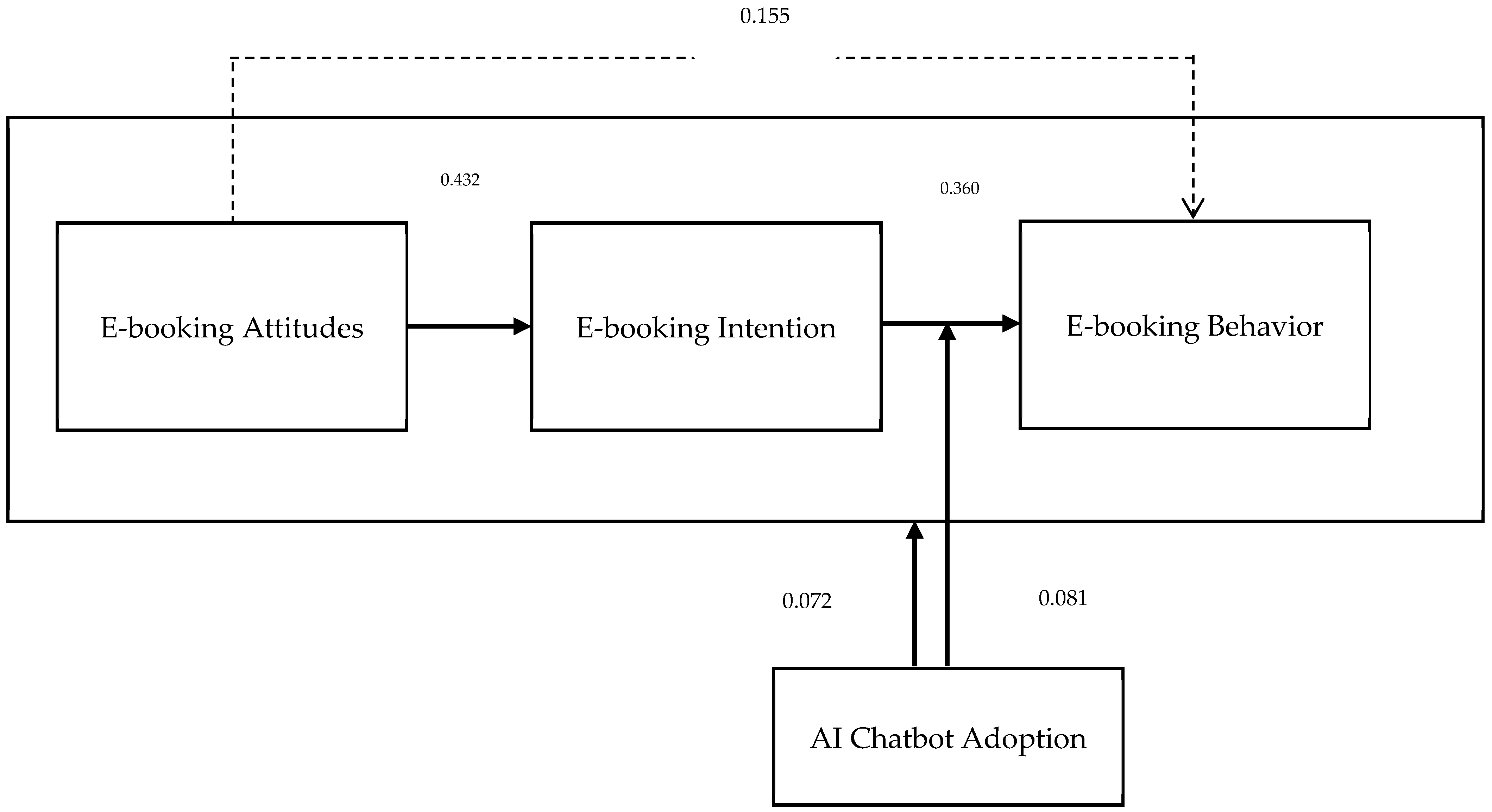
The direct and mediation test results (see Table 4) reveal that E-booking Attitudes (EA) significantly influence E-booking Intention (EI) (B = 0.432, SE = 0.034, p < 0.001, LLCI = 0.366, ULCI = 0.498), thereby supporting H1. In addition, EA also shows a significant total effect on E-booking Behavior (EB) (B = 0.262, SE = 0.025, p < 0.001, LLCI = 0.214, ULCI = 0.310). When EI was incorporated into the model, the direct path from EA to EB remained significant (B = 0.262, SE = 0.025, p < 0.001), while EI also exerted a strong and positive impact on EB (B = 0.360, SE = 0.026, p < 0.001), providing support for H2. Furthermore, the bootstrapping results confirmed a significant indirect effect of EA on EB through EI (B = 0.155, Boot SE = 0.017, LLCI = 0.123, ULCI = 0.191). Since the confidence interval did not include zero, the mediating role of EI was statistically validated, thereby supporting H3. Collectively, these findings demonstrate that EI partially mediates the relationship between EA and EB in the e-booking context.
Regarding the moderating role of AI Chatbot Adoption (CA), the results in Table 5 show that the interaction term between E-booking Intention (EI) and CA is positive and statistically significant (B = 0.081, SE = 0.024, p = 0.008, 95% confidence interval [0.034, 0.128]). This finding indicates that CA strengthens the relationship between EI and E-booking Behavior (EB), thereby supporting H4. The conditional effect analysis further demonstrates that the effect of EI on EB remains positive and significant at all three levels of CA. Specifically, the impact of EI on EB increases from low CA (B = 0.258, SE = 0.030, p < 0.001, 95% confidence interval [0.187, 0.308]) to medium CA (B = 0.368, SE = 0.026, p < 0.001, 95% confidence interval [0.317, 0.418]) and is strongest when CA is high (B = 0.488, SE = 0.033, p < 0.001, 95% confidence interval [0.422, 0.553]).
Moreover, the bootstrapping results provide evidence of moderated mediation. The index of moderated mediation is statistically significant (B = 0.072, SE = 0.013, 95% confidence interval [0.046, 0.098]), and the conditional indirect effects of EA on EB through EI are consistently higher with increasing levels of CA (low CA: B = 0.107, 95% confidence interval [0.078, 0.138]; medium CA: B = 0.159, 95% confidence interval [0.126, 0.194]; high CA: B = 0.210, 95% confidence interval [0.166, 0.257]). Since all confidence intervals exclude zero, the moderated mediation effect is confirmed, lending support to H5.
A summary of the path coefficients is presented in Figure 2 below.

5. Discussion and Implications

5.1. Discussion

Our study was conducted to examine whether the adoption of AI Chatbot can reduce the gap between intention and behavior in the context of online travel service booking. Our empirical evidence shows that all the proposed hypotheses are supported. Overall, the results are consistent with previous studies on the Theory of Planned Behavior, as attitude, intention, and behavior all show statistically significant relationships.
First, the results confirm that attitude has a positive effect on the intention to book travel services online. This finding is consistent with the TPB and several previous tourism studies (e.g., Jeng, 2019; Jalilvand & Samiei, 2012). When customers have a positive attitude toward e-booking, they tend to form significantly stronger intentions. Our findings reinforce the evidence that attitude is the most important factor among the three TPB constructs influencing intention in the digital tourism context. Similarly, e-booking intention is also found to be a good predictor of behavior, suggesting that intention is the direct antecedent of action. This indicates that in the digital tourism context, intentions are more easily translated into behavior. However, the magnitude of the effect of intention on behavior is smaller than that of attitude on intention. This implies that the conversion to behavior depends on multiple other conditions.
Second, the mediation analysis shows that intention plays a partial mediating role between attitude and e-booking behavior. This indicates that a positive attitude contributes to increasing the likelihood of e-booking both directly and indirectly, through the reinforcement of intention. The partial mediation nature suggests that attitude still retains some direct influence on behavior even after accounting for intention. A plausible explanation is that travelers with particularly positive attitudes toward e-booking may proceed with booking. This is because of enthusiasm or habitual tendencies, even when their specific intention is not explicitly reported. This finding is supported by several previous studies (e.g., Duong, 2022a, 2022b; Minh & Cuong, 2026). However, this relationship has been relatively underexplored in the e-tourism context. Hence, our empirical evidence helps fill these gaps. This emphasizes the enduring importance of fostering consumers’ positive attitudes, as they can both shape intention and independently drive behavior in the online booking environment.
Next, and most notably, this study provides empirical confirmation that the adoption of AI Chatbot moderates the relationship between intention and behavior in the context of electronic travel booking. The moderation results suggest that AI Chatbot reduces the discrepancy between intention and behavior (b = 0.081). However, given that the observed effect sizes are moderate, the findings should be interpreted as suggesting a narrowing rather than a complete elimination of the intention–behavior gap. In other words, the presence of AI Chatbot as a decision-support tool increases the likelihood that individuals with booking intentions will translate those intentions into actual booking actions, thus reducing discrepancies between what travelers intend to do and what they ultimately report doing.
This finding fills the empirical gap from previous observations of moderating factors that hinder conversion. For example, it was found that high perceived risk weakened the link between booking intention and action, resulting in many intended bookings not materializing. By contrast, our results identify AI Chatbot as a facilitating factor with the opposite effect; it increases the likelihood that an intention will culminate in a completed booking. This outcome directly supports calls in the literature to identify context-specific moderators that can strengthen the consistency between what consumers intend to do and what they do. Scholars have suggested that when the intention–behavior relationship is fragile or prone to gaps, the introduction of a moderator can help stabilize or reinforce this linkage. Our empirical evidence confirms that when travelers use AI Chatbot, this can significantly enhance the likelihood of converting online booking intentions into actions, thus functioning as a gap-bridging mechanism long hypothesized by tourism researchers (Carvalho & Ivanov, 2024; Dwivedi et al., 2024; Wong et al., 2023).
The way AI Chatbot strengthens the enactment of intentions can be understood through its unique capabilities. By providing personalized, context-rich, and real-time support, AI Chatbot theoretically reduces user uncertainty and hesitation at the critical juncture between the intention to book and the booking action. Unlike a traditional static website or a generic chatbot, AI Chatbot can interactively address travelers’ specific questions, deliver tailored recommendations (e.g., suggesting hotels that precisely match user preferences), and even resolve last-minute concerns such as price changes or travel restrictions. These advantages align with the arguments of Wong et al. (2023) and Nautiyal et al. (2023) who noted that AI assistants can equip travelers with comprehensive, synthesized information, thereby enhancing their confidence in decision-making. Our finding that AI Chatbot strengthens the intention–behavior link is consistent with this perspective.
Finally, the moderated mediation effect (H5) provides a nuanced extension of the above results. We find that AI Chatbot not only moderates the direct path from intention to behavior but also moderates the indirect path from attitude to behavior through intention (b = 0.072). The indirect effect of attitude on booking behavior via intention is significantly stronger when AI Chatbot is used by travelers, confirming a moderated mediation scenario. This means that the mediating role of intention depends on the level of AI Chatbot support: under strong AI Chatbot assistance, positive attitudes are more effectively translated into firm intentions, which then lead to bookings. This finding is theoretically important as it illustrates a case in which an external technological factor enhances the entire attitude → intention → behavior process. However, this does not imply that AI fully resolves the intention–behavior gap, but rather that it reinforces the predictive power of traditional TPB pathways within digitally augmented decision environments.
Although intention and behavior are theoretically distinct, the behavior construct in this study was measured using self-reported items, which may involve a certain degree of conceptual overlap with intention. This potential overlap could strengthen the observed relationship between the two constructs and influence the interpretation of the intention–behavior gap. As objective behavioral data were not used, the findings should be understood as reflecting the conversion from intention to self-reported behavior. Accordingly, the role of AI Chatbot should be interpreted as enhancing this conversion process rather than demonstrating a direct effect on objectively observed behavior.

5.2. Theoretical Implications

In conclusion, this study demonstrates that the predictive power of the Theory of Planned Behavior (TPB) is not fixed but can be enhanced through contextual innovations such as AI Chatbot. By functioning as a decision-support tool, generative AI strengthens the pathway from intention to behavior, thereby narrowing the long-standing intention–behavior gap in e-booking. This positions AI not merely as an object of adoption but as an enabling condition that ensures greater consistency between travelers’ stated intentions and their actions. The findings thus extend the TPB by showing that the intention–behavior link is conditional on the technological environment, highlighting the role of AI as a contextual moderator in consumer decision-making. These insights contribute to a more nuanced theoretical understanding of planned behavior in AI-augmented marketplaces and set the stage for future research exploring how digital contexts interact with user intentions to shape real-world behaviors.

5.3. Practical Implications

The findings of this study offer concrete implications for multiple stakeholders in the tourism and technology ecosystem. Given that AI Chatbot Adoption enhances the intention–behavior conversion, booking platforms may consider integrating AI-supported decision tools to facilitate consumer decision processes. For tourism businesses and e-booking platforms, the evidence that AI Chatbot enhances the conversion of intention into bookings suggests that embedding conversational AI directly into the customer journey can be a high-impact strategy. These businesses should not only adopt AI as a customer service channel but also use it as a proactive booking assistant that can deliver personalized suggestions, address customer hesitation, and reduce abandonment at the intention stage.
For hotel managers and tourism service administrators, AI Chatbot presents a practical solution to common frictions in the online booking process. To maximize this potential, managers should also optimize their digital content and keyword structures in ways similar to search engine optimization practices. By strategically refining property descriptions, service attributes, location tags, and frequently searched travel terms, hotels can increase the likelihood that AI Chatbots identify and recommend their offerings during travelers’ information queries. In an AI-assisted decision environment, structured, accurate, and semantically rich content becomes critical, as generative systems rely on accessible and well-indexed information to generate suggestions. Therefore, aligning online content strategy with AI-driven search logic may enhance visibility and indirectly improve booking conversion.
Although this study was conducted in Vietnam, the managerial implications should be interpreted considering specific cultural and market conditions. Vietnam represents a rapidly growing digital tourism market, characterized by high mobile usage, strong price sensitivity, and increasing openness to emerging technologies, particularly among younger consumers. In such contexts, AI Chatbot-supported decision tools may be especially effective in facilitating booking conversion.
For managers operating in more mature markets such as Europe or the United States, online booking systems are already well-established, and consumer trust is relatively high. Thus, the incremental value of AI Chatbot features may depend more on personalization quality, transparency, and perceived credibility rather than basic informational support. Therefore, firms should adapt AI implementation strategies to local digital maturity, consumer trust levels, and cultural attitudes toward automation, rather than assuming uniform effectiveness across markets.
From a policy perspective, the demonstrated behavioral influence of AI Chatbot highlights the need for tourism authorities and regulators to provide a supportive framework for responsible AI deployment. Policymakers should develop standards and incentives that encourage the use of trustworthy AI systems in tourism while also safeguarding consumer rights related to data usage, algorithmic transparency, and ethical automation. This includes offering technical guidance and training programs for small- and medium-sized tourism enterprises to ensure equitable access to AI benefits.
Finally, for AI developers and technology providers, this study signals a strong market demand for domain-specific, context-aware generative AI systems tailored for travel. Developers should prioritize designing tools that can interpret user preferences, respond adaptively to traveler needs, and integrate seamlessly with booking platforms. Continuous improvements in relevance, personalization, and conversational quality will be key to making AI a credible behavioral facilitator in digital tourism. Together, these stakeholder actions can harness the full potential of AI like AI Chatbot to improve service quality, increase operational efficiency, and close the persistent gap between intention and behavior in online travel services.

6. Conclusions and Limitations

This study contributes to the literature on digital tourism and consumer behavior by empirically demonstrating that AI Chatbot Adoption can significantly bridge the gap between booking intention and e-booking behavior. By integrating AI Chatbot as a contextual moderator into the Theory of Planned Behavior framework, the research highlights how generative AI can strengthen the intention–behavior relationship and function as a behavioral enabler in online travel decisions. The moderated mediation structure confirmed in this study provides a novel theoretical extension and offers practical strategies for stakeholders across the tourism and technology sectors.
Despite these contributions, this study has several limitations. First, the data were collected through a cross-sectional survey with self-reported measures, which may introduce bias and do not capture booking actions or causality. Second, the sample is limited to travelers in a single country (Vietnam), constraining the generalizability of the results to other populations and cultural contexts. These limitations point to clear directions for future research. We recommend that subsequent studies employ experimental or longitudinal designs to establish causal links and observe how AI assistance influences booking behavior over time. Additionally, it would be worthwhile to explore other forms of AI interaction—for example, comparing voice-based conversational agents with text-based chatbots—to determine whether the mode of AI communication differentially impacts the intention–behavior relationship. Such efforts would further elucidate the role of AI in consumer behavior and verify the robustness of our findings across diverse contexts. Finally, although we have argued for the use of attitude as the sole antecedent of intention and behavior, other constructs of the TPB may also play a potential role. Therefore, future research could extend our model by incorporating these additional factors.

Author Contributions

Conceptualization, N.T.N.A., D.H.M., T.C. and T.T.Q.C.; methodology, N.T.N.A., D.H.M., T.C. and T.T.Q.C.; software, not applicable; validation, N.T.N.A., D.H.M., T.C. and T.T.Q.C.; formal analysis, N.T.N.A., D.H.M., T.C. and T.T.Q.C.; investigation, N.T.N.A., D.H.M., T.C. and T.T.Q.C.; resources, not applicable; data curation, not applicable; writing—original draft preparation, N.T.N.A., D.H.M. and T.C.; writing—review and editing, N.T.N.A., T.C. and T.T.Q.C.; visualization, N.T.N.A.; supervision, N.T.N.A.; project administration, N.T.N.A. All authors have read and agreed to the published version of the manuscript.

Funding

The author received no financial support for the research, authorship, or publication of this article.

Institutional Review Board Statement

Ethical review and approval were waived for this study due to the Law on Science and Technology No. 29/2013/QH13.

Informed Consent Statement

Verbal informed consent was obtained from all subjects involved in the study. No personal information was collected or used in this article.

Data Availability Statement

The data supporting the findings of this study are available from the corresponding author upon reasonable request.

Conflicts of Interest

The author declares no potential conflicts of interest with respect to the research, authorship, or publication of this article.

Appendix A

Table A1. Items of all scales.
VariablesItemsDescriptionSource
E-booking Attitudes
(EA)
EA1I see more advantages than disadvantages in using online platforms to book travel services.Casaló et al. (2015) and Zhang (2019)
EA2I am interested in using online booking platforms when planning my trips.
EA3If I had the opportunity and resources, I would prefer to rely on online platforms for most of my travel bookings.
EA4I believe that being able to book travel services online brings me convenience and satisfaction.
EA5Instead of relying on traditional offline methods, I would prefer to use online platforms to book travel services.
EA6By using online booking platforms, I feel that I can make better and more informed travel decisions.
E-booking Intention
(EI)
EI1Using online platforms to book travel services is an important part of how I plan my trips.Casaló et al. (2015) and Confente and Vigolo (2018)
EI2Next time, I plan to rely more on online platforms when booking travel services.
EI3When planning my trips, I intend to use online booking platforms to make more informed and convenient decisions.
EI4I am mindful of the advantages offered by online booking and intend to incorporate them into my travel planning.
EI5I intend to use online booking platforms in a responsible and efficient way when selecting travel services.
EI6If I need to book travel services, I will prioritize using online platforms instead of traditional offline methods.
E-booking behaviour
(EB)
EB1I frequently book travel services (such as hotels, flights, or tours) through online platforms.(Zhang, 2019)
EB2Recently, I have made several online travel booking transactions.
EB3I prefer to use online platforms whenever I need to book travel services.
EB4I have successfully completed online travel bookings without experiencing major difficulties.
EB5When I have travel needs, I choose online booking rather than visiting physical agencies or stores.
EB6I feel comfortable and familiar with the process of booking travel services online.
EB7I am willing to continue booking travel services online for my future trips.
AI Chatbot Adoption
(CA)
CA1I use AI Chatbot to obtain information about travel services (e.g., hotels, flights, tours) before making online booking decisions.Duong et al. (2025b) and Pham et al. (2024)
CA2I use AI Chatbot to ask questions about potential problems, risks, or uncertainties related to online travel booking.
CA3I use AI Chatbot to explore and compare different travel options and recommendations that match my needs and preferences.
CA4I use AI Chatbot to obtain information about prices, promotions, or booking conditions (e.g., refund policy, cancellation terms).
CA5Using AI Chatbot helps me gain extensive knowledge that supports my online travel booking decisions.

References

  1. Ajzen, I. (1985). From intentions to actions: A theory of planned behavior. In Action control: From cognition to behavior (pp. 11–39). Springer. [Google Scholar] [CrossRef]
  2. Ajzen, I. (1991). The theory of planned behavior. Organizational Behavior and Human Decision Processes, 50(2), 179–211. [Google Scholar] [CrossRef]
  3. Ajzen, I. (2020). The theory of planned behavior: Frequently asked questions. Human Behavior and Emerging Technologies, 2(4), 314–324. [Google Scholar] [CrossRef]
  4. Baron, R. M., & Kenny, D. A. (1986). The moderator–mediator variable distinction in social psychological research: Conceptual, strategic, and statistical considerations. Journal of Personality and Social Psychology, 51(6), 1173. [Google Scholar] [CrossRef]
  5. Bhatiasevi, V., & Yoopetch, C. (2015). The determinants of intention to use electronic booking among young users in Thailand. Journal of Hospitality and Tourism Management, 23, 1–11. [Google Scholar] [CrossRef]
  6. Carvalho, I., & Ivanov, S. (2024). ChatGPT for tourism: Applications, benefits and risks. Tourism Review, 79(2), 290–303. [Google Scholar] [CrossRef]
  7. Casaló, L. V., Flavián, C., & Guinalíu, M. (2010). Antecedents and consequences of consumer participation in on-line communities: The case of the travel sector. International Journal of Electronic Commerce, 15(2), 137–167. [Google Scholar] [CrossRef]
  8. Casaló, L. V., Flavián, C., Guinalíu, M., & Ekinci, Y. (2015). Do online hotel rating schemes influence booking behaviors? International Journal of Hospitality Management, 49, 28–36. [Google Scholar] [CrossRef]
  9. Choi, D., Lee, S., Kim, S.-I., Lee, K., Yoo, H. J., Lee, S., & Hong, H. (2024, May 11–16). Unlock life with a Chat (GPT): Integrating conversational AI with large language models into everyday lives of autistic individuals. 2024 CHI Conference on Human Factors in Computing Systems, Honolulu, HI, USA. [Google Scholar] [CrossRef]
  10. Choi, W. C., & Chang, C. I. (2025). ChatGPT-5 in education: New capabilities and opportunities for teaching and learning. Preprints. Available online: https://www.preprints.org/manuscript/202508.0684 (accessed on 30 August 2025).
  11. Confente, I., & Vigolo, V. (2018). Online travel behaviour across cohorts: T he impact of social influences and attitude on hotel booking intention. International Journal of Tourism Research, 20(5), 660–670. [Google Scholar] [CrossRef]
  12. Cui, J., & Bell, R. (2022). Behavioural entrepreneurial mindset: How entrepreneurial education activity impacts entrepreneurial intention and behaviour. The International Journal of Management Education, 20(2), 100639. [Google Scholar] [CrossRef]
  13. Duong, C. D. (2022a). Big Five personality traits and green consumption: Bridging the attitude-intention-behavior gap. Asia Pacific Journal of Marketing and Logistics, 34(6), 1123–1144. [Google Scholar] [CrossRef]
  14. Duong, C. D. (2022b). Entrepreneurial fear of failure and the attitude-intention-behavior gap in entrepreneurship: A moderated mediation model. The International Journal of Management Education, 20(3), 100707. [Google Scholar] [CrossRef]
  15. Duong, C. D., Dao, T. T., Vu, T. N., Ngo, T. V. N., & Tran, Q. Y. (2024). Compulsive ChatGPT usage, anxiety, burnout, and sleep disturbance: A serial mediation model based on stimulus-organism-response perspective. Acta Psychologica, 251, 104622. [Google Scholar] [CrossRef] [PubMed]
  16. Duong, C. D., Nguyen, T. H., Ngo, T. V. N., Pham, T. T. P., Vu, A. T., & Dang, N. S. (2025a). Using generative artificial intelligence (ChatGPT) for travel purposes: Parasocial interaction and tourists’ continuance intention. Tourism Review, 80(4), 813–827. [Google Scholar] [CrossRef]
  17. Duong, C. D., Nguyen, T. H., Nguyen, M. H., Dang, N. S., Vu, A. T., & Do, N. D. (2025b). Exploring the role of generative artificial intelligence (ChatGPT) adoption in digital social entrepreneurship: A serial mediation model. Social Enterprise Journal, 21(5), 910–936. [Google Scholar] [CrossRef]
  18. Dwivedi, Y. K., Pandey, N., Currie, W., & Micu, A. (2024). Leveraging ChatGPT and other generative artificial intelligence (AI)-based applications in the hospitality and tourism industry: Practices, challenges and research agenda. International Journal of Contemporary Hospitality Management, 36(1), 1–12. [Google Scholar] [CrossRef]
  19. Goh, S., Ho, V., & Jiang, N. (2015). The effect of electronic word of mouth on intention to book accommodation via online peer-to-peer platform: Investigation of theory of planned behaviour. The Journal of Internet Banking and Commerce S, 2, 2–7. [Google Scholar] [CrossRef]
  20. Guo, Q., Mu, L., & Lou, S. (2024). Revolutionizing travel experiences: An in-depth analysis of intelligent booking systems and behavioral patterns. Intelligent Decision Technologies, 18(2), 1477–1494. [Google Scholar] [CrossRef]
  21. Hack-Polay, D., Dal Mas, F., Mahmoud, A. B., & Rahman, M. (2022). Barriers to the effective exploitation of migrants’ social and cultural capital in hospitality and tourism: A dual labour market perspective. Journal of Hospitality and Tourism Management, 50, 168–177. [Google Scholar] [CrossRef]
  22. Hassan, L. M., Shiu, E., & Shaw, D. (2016). Who says there is an intention–behaviour gap? Assessing the empirical evidence of an intention–behaviour gap in ethical consumption. Journal of Business Ethics, 136(2), 219–236. [Google Scholar] [CrossRef]
  23. Hayes, A. F. (2015). An index and test of linear moderated mediation. Multivariate Behavioral Research, 50(1), 1–22. [Google Scholar] [CrossRef]
  24. Jalilvand, M. R., & Samiei, N. (2012). The impact of electronic word of mouth on a tourism destination choice: Testing the theory of planned behavior (TPB). Internet Research, 22(5), 591–612. [Google Scholar] [CrossRef]
  25. Jeng, C.-R. (2019). The role of trust in explaining tourists’ behavioral intention to use e-booking services in Taiwan. Journal of China Tourism Research, 15(4), 478–489. [Google Scholar] [CrossRef]
  26. Karlsson, L., & Dolnicar, S. (2016). Does eco certification sell tourism services? Evidence from a quasi-experimental observation study in Iceland. Journal of Sustainable Tourism, 24(5), 694–714. [Google Scholar] [CrossRef]
  27. Ladhari, R., & Michaud, M. (2015). eWOM effects on hotel booking intentions, attitudes, trust, and website perceptions. International Journal of Hospitality Management, 46, 36–45. [Google Scholar] [CrossRef]
  28. Law, R., Lin, K. J., Ye, H., & Fong, D. K. C. (2024). Artificial intelligence research in hospitality: A state-of-the-art review and future directions. International Journal of Contemporary Hospitality Management, 36(6), 2049–2068. [Google Scholar] [CrossRef]
  29. Liu, J., Gu, J., Tong, M., Yue, Y., Qiu, Y., Zeng, L., Yu, Y., Yang, F., & Zhao, S. (2025). Evaluating the agreement between ChatGPT-4 and validated questionnaires in screening for anxiety and depression in college students: A cross-sectional study. BMC Psychiatry, 25(1), 359. [Google Scholar] [CrossRef]
  30. Minh, D. H., & Cuong, T. (2026). The link between sustainable entrepreneurial attitude, intention, and behavior: Moderating role of circular economy entrepreneurship. Strategy & Leadership, 54(2), 181–203. [Google Scholar] [CrossRef]
  31. Nautiyal, R., Albrecht, J. N., & Nautiyal, A. (2023). ChatGPT and tourism academia. Annals of Tourism Research, 99, 103544. [Google Scholar] [CrossRef]
  32. Pham, H. C., Duong, C. D., & Nguyen, G. K. H. (2024). What drives tourists’ continuance intention to use ChatGPT for travel services? A stimulus-organism-response perspective. Journal of Retailing and Consumer Services, 78, 103758. [Google Scholar] [CrossRef]
  33. Suki, N. M., & Suki, N. M. (2017). Flight ticket booking app on mobile devices: Examining the determinants of individual intention to use. Journal of Air Transport Management, 62, 146–154. [Google Scholar] [CrossRef]
  34. Sun, S., Law, R., & Schuckert, M. (2020). Mediating effects of attitude, subjective norms and perceived behavioural control for mobile payment-based hotel reservations. International Journal of Hospitality Management, 84, 102331. [Google Scholar] [CrossRef]
  35. Sun, S., Law, R., Schuckert, M., & Hyun, S. S. (2022). Impacts of mobile payment-related attributes on consumers’ repurchase intention. International Journal of Tourism Research, 24(1), 44–57. [Google Scholar] [CrossRef]
  36. Travel, Books and Food. (2025). 10 best Vietnam holiday destinations to visit in 2025 (tips, cruises and more). Travel, Books and Food. Available online: https://travelbooksfood.com/best-vietnam-holiday-destinations (accessed on 1 January 2020).
  37. Tuo, Y., Wu, J., Zhao, J., & Si, X. (2025). Artificial intelligence in tourism: Insights and future research agenda. Tourism Review, 80(4), 793–812. [Google Scholar] [CrossRef]
  38. Vietnam Ministry of Culture Sports and Tourism. (2025). Top 10 destinations in Vietnam trending for year-end travel. Available online: https://bvhttdl.gov.vn/10-diem-den-tai-viet-nam-la-lua-chon-hang-dau-xu-huong-du-lich-cuoi-nam-20251203190727238.htm#:~:text=V%E1%BB%9Bi%20nh%E1%BB%AFng%20ai%20mu%E1%BB%91n%20t%E1%BA%ADn,%C4%91%E1%BB%99ng%20Gi%C3%A1ng%20sinh%20s%C3%B4i%20%C4%91%E1%BB%99ng.&text=Du%20kh%C3%A1ch%20n%C6%B0%E1%BB%9Bc%20ngo%C3%A0i%20c%C5%A9ng,%2C%20Sa%20Pa%2C%20%C4%90%C3%A0%20L%E1%BA%A1t (accessed on 29 December 2025).
  39. Viglia, G., Dolnicar, S., Acuti, D., & Nicolau, J. L. (2024). If you want to learn about real behaviour, measure real behaviour. Journal of Sustainable Tourism, 32(11), 2245–2257. [Google Scholar] [CrossRef]
  40. Vlahović, O., Rađenović, Ž., Perović, D., Vujačić, V., & Davidović, K. (2024). Digital transformation in tourism: The role of e-booking systems. Croatian Regional Development Journal, 5(2), 129–145. [Google Scholar] [CrossRef]
  41. Waris, I., Farooq, M., Hameed, I., & Shahab, A. (2021). Promoting sustainable ventures among university students in Pakistan: An empirical study based on the theory of planned behavior. On the Horizon, 29(1), 1–16. [Google Scholar] [CrossRef]
  42. Wong, I. A., Lian, Q. L., & Sun, D. (2023). Autonomous travel decision-making: An early glimpse into ChatGPT and generative AI. Journal of Hospitality and Tourism Management, 56, 253–263. [Google Scholar] [CrossRef]
  43. Yap, J. B. H., & Chua, K. L. (2018). Application of e-booking system in enhancing Malaysian property developers’ competitive advantage: A blue ocean strategy? Property Management, 36(1), 86–102. [Google Scholar] [CrossRef]
  44. Yasir, N., Xie, R., & Zhang, J. (2022). The impact of personal values and attitude toward sustainable entrepreneurship on entrepreneurial intention to enhance sustainable development: Empirical evidence from Pakistan. Sustainability, 14(11), 6792. [Google Scholar] [CrossRef]
  45. Zhang, J. (2019). Is e-booking a planned behavior? A study on the effects of tourists’ habits and the two-stage moderating effects of risk perception. Tourism and Hospitality Prospects, 3(1), 43. [Google Scholar]
Figure 1. Proposed model.
Tourismhosp 07 00068 g001
Figure 2. Summary of the path coefficients.
Tourismhosp 07 00068 g002
Table 1. Respondents’ demographic profile.
VariablesItemFrequencyPercentage (%)
GenderMale 259 42.7
Female 348 57.3
Age18–30 251 41.4
31–55 324 53.4
Above 55 32 5.3
EducationHigh school 141 23.2
Bachelor’s degree 375 61.8
Master’s and PhD degree 91 15.0
Source: Authors’ own work.
Table 2. Reliability and converge validity.
VariablesItemsFactor LoadingsCronbach’s AlphaC.RAVE
E-booking Attitudes
(EA)
EA1 0.742 0.9030.9120.678
EA2 0.708
EA3 0.791
EA4 0.782
EA5 0.755
EA6 0.871
E-booking Intention
(EI)
EI1 0.816 0.8800.8880.632
EI2 0.708
EI3 0.703
EI4 0.778
EI5 0.695
EI6 0.725
E-booking Behavior
(EB)
EB1 0.713 0.9000.9180.642
EB2 0.700
EB3 0.690
EB4 0.659
EB5 0.704
EB6 0.841
EB7 0.695
AI Chatbot Adoption
(CA)
CA1 0.832 0.8750.9110.672
CA2 0.796
CA3 0.772
CA4 0.765
CA5 0.892
Source: Authors’ own work.
Table 3. Fornell–Lacker assessment.
CAEAEBEI
CA0.820
EA0.2240.824
EB0.2320.5780.801
EI0.1750.4710.6280.795
Source: Authors’ own work.
Table 4. Direct and indirect effects.
PredictorB (Coeff)SEpLLCIULCI
E-booking Intention (M) (R2 = 0.214; F = 165.210 ***)
E-booking Attitudes (X)0.4320.0340.0000.3660.498
E-booking Behavior (Y)
Total effect
E-booking Attitudes (X)0.2620.0250.0000.2140.310
E-booking Behavior (Y) (R2 = 0.478; F = 276.219 ***)
Direct effects
E-booking Attitudes (X)0.2620.0250.0000.2140.310
E-booking Intention (M)0.3600.0260.0000.3080.411
Boot indirect effectBoot SE Boot LLCIBoot ULCI
Indirect effect of X on Y via M0.1550.017 0.1230.191
Note(s): *** p < 0.001. Source: Authors’ own work.
Table 5. Moderated mediation effect.
E-Booking Behavior (Y)
PredictorB (Coeff)SEpLLCIULCI
Main effect
E-booking Attitudes (X)0.2430.0960.0000.1950.290
E-booking Intention (M)0.3680.0260.0000.3170.418
Moderate effect
E-booking Intention (M) × AI Chatbot Adoption (Z)0.0810.0240.0080.0340.128
Total R20.513
F158.564
Conditional effects of M (focal predictor-M) at the
values of AI Chatbot Adoption (moderator-Z): Z ¼ M 6 S.D.
M − 1.S.D. (t = 8.044)0.2580.0300.0000.1870.308
M (t = 14.326)0.3680.0260.0000.3170.418
M + 1.S.D. (t = 14.618)0.4880.0330.0000.4220.553
Boot indirect effectBoot SE Boot LLCIBoot ULCI
Index of moderated mediation0.0720.013 0.0460.098
Conditional indirect effects of X on Y via M at the value of Z (Z = M ∓ S.D.)
M − 1.S.D.0.1070.153 0.0780.138
M0.1590.173 0.1260.194
M + 1.S.D.0.2100.023 0.1660.257
Source: Authors’ own work.
Disclaimer/Publisher’s Note: The statements, opinions and data contained in all publications are solely those of the individual author(s) and contributor(s) and not of MDPI and/or the editor(s). MDPI and/or the editor(s) disclaim responsibility for any injury to people or property resulting from any ideas, methods, instructions or products referred to in the content.