
Shariah-Compliant Attributes and Muslims’ Intention to Visit Non-Muslim Countries


Abstract
1. Introduction
2. Literature Review
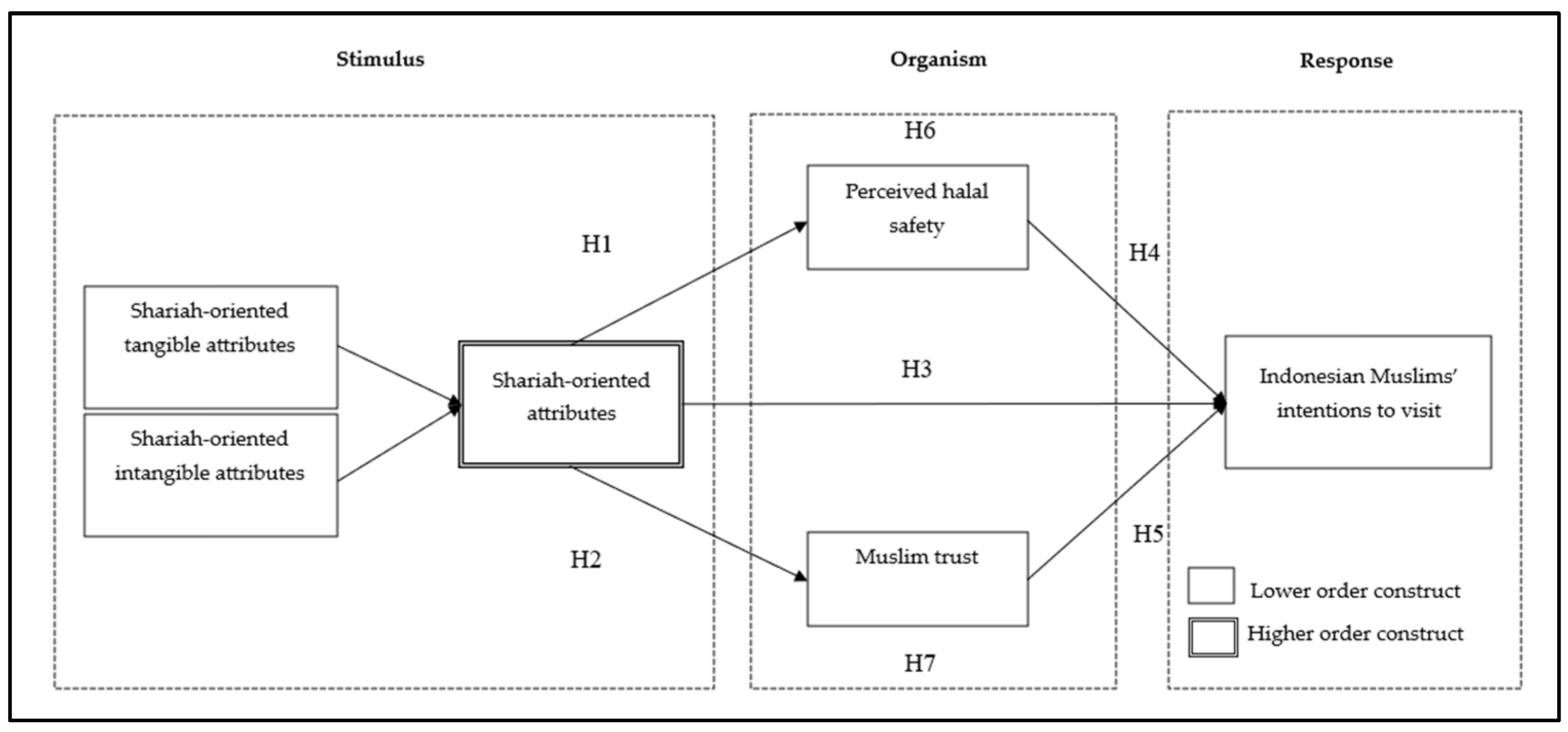
2.1. Theoretical Framework: The Stimulus–Organism–Response (SOR)
2.2. Application to Halal Tourism: Specific Theoretical Mappings
2.2.1. Stimulus (S): Shariah-Oriented Attributes
2.2.2. Organism (O): Perceived Halal Safety and Muslim Trust
2.2.3. Response (R): Visit Intention
2.2.4. Shariah-Oriented Attributes as Stimuli
Tangible Attributes
Intangible Attributes
2.3. Psychological Mechanisms as Organism
2.3.1. Perceived Halal Safety
2.3.2. Muslim Trust
2.4. Visit Intention as Response
2.5. Hypothesis Development
3. Methodology
3.1. Instrument Development
3.2. Data Collection
3.3. Data Analysis
4. Results
4.1. Descriptive Statistics
4.2. Measurement Model Assessment
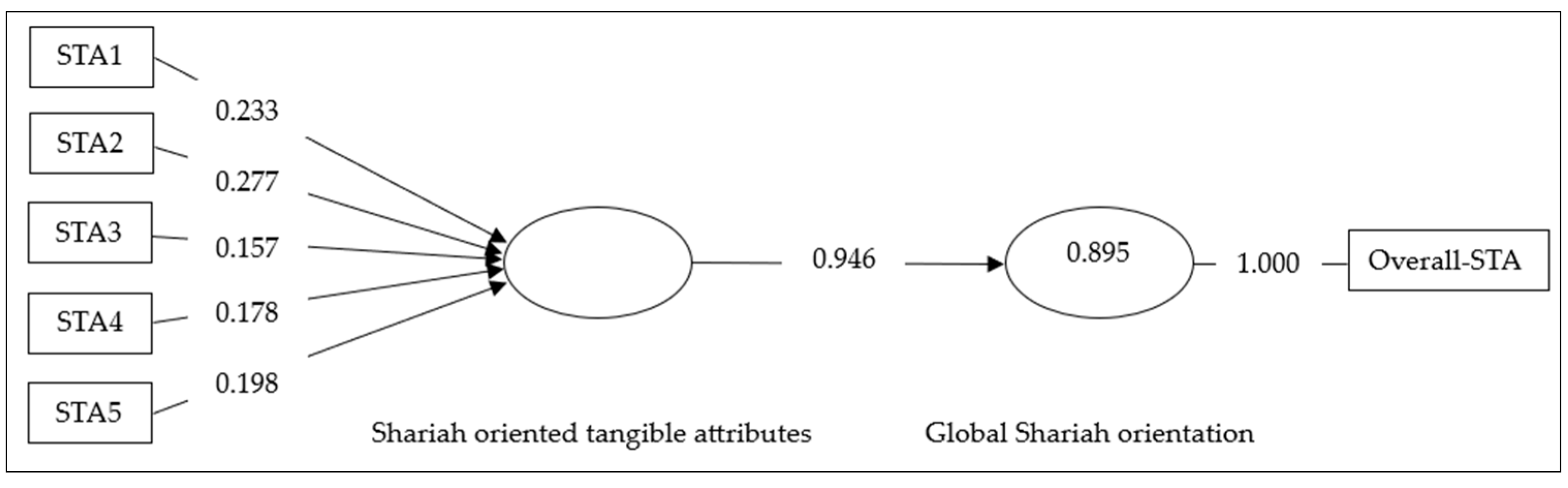
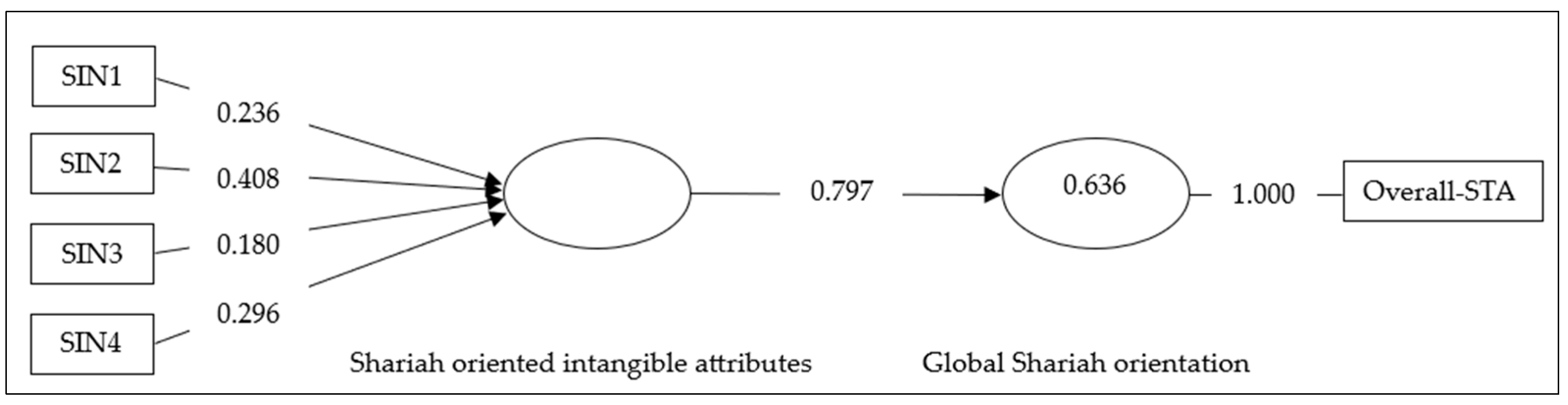
4.3. Higher-Order Component Validation
4.4. Redundancy Analysis for Convergent Validity
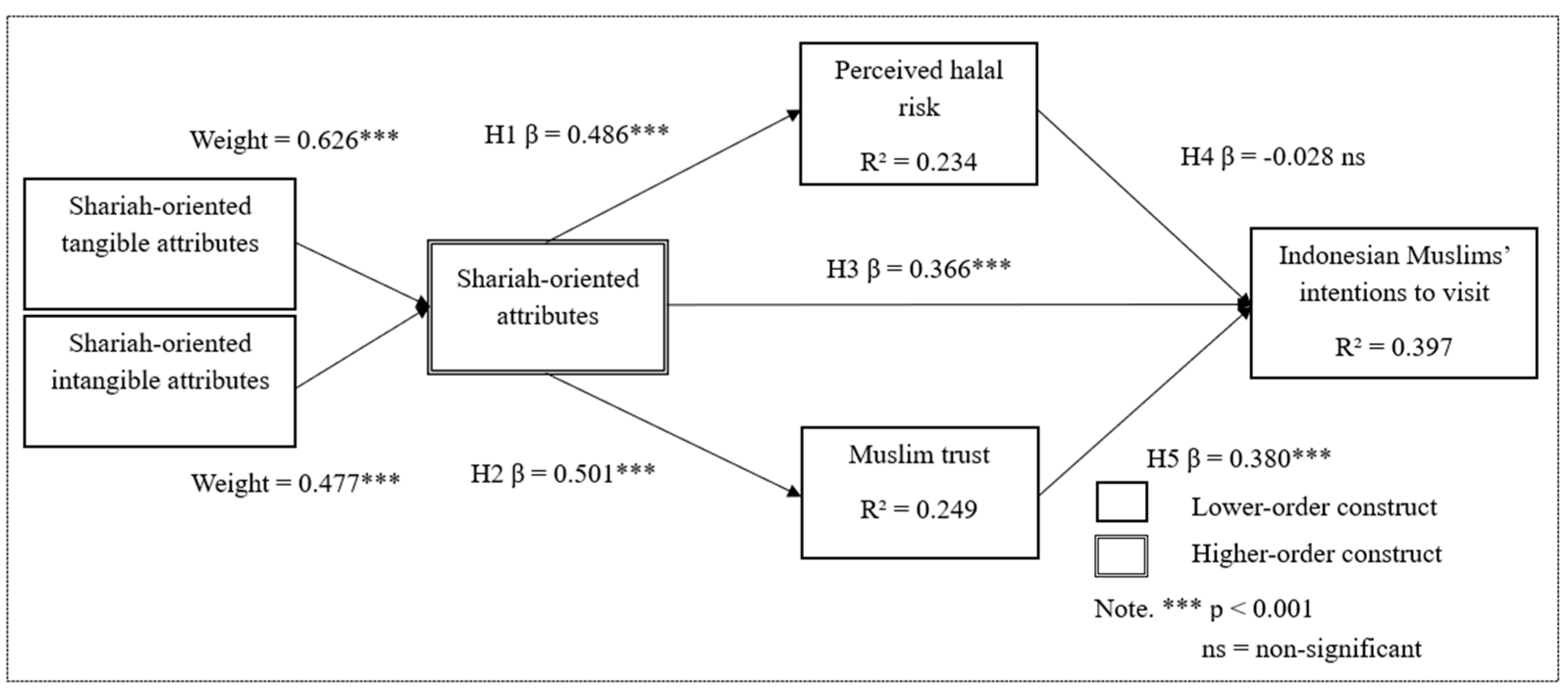
4.5. Structural Model Assessment and Hypothesis Testing
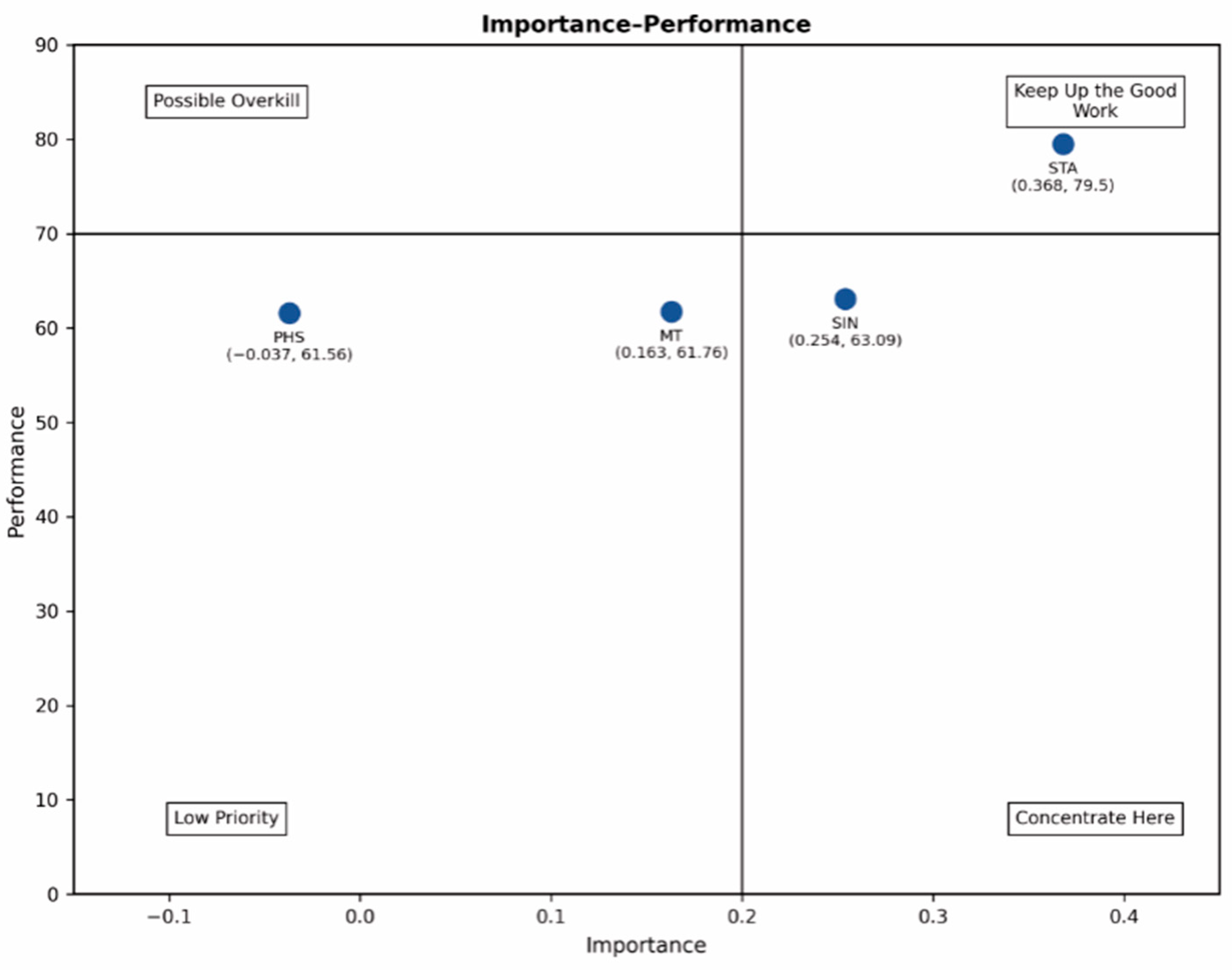
4.6. Importance Performance Map Analysis (IPMA)
5. Discussion, Implications, and Limitations
5.1. Discussion
5.2. Theoretical Implications
5.3. Practical Implications
- (1)
- Reframe marketing communication from attributes to safety assurance, rather than simply listing Shariah-compliant attributes (halal food, prayer facilities), destinations should emphasize how these attributes provide safety and confidence for Muslim tourists. Marketing messages should integrate safety narratives, such as “Travel with complete peace of mind knowing your religious obligations is fully supported”; assurance mechanisms, such as highlighting third-party halal certifications, testimonials from Muslim travellers, and partnerships with Islamic organizations; and visual evidence, for example by using imagery showing Muslim tourists comfortably practicing their faith at the destination.
- (2)
- Tourism operators should prioritize initiatives that enhance tourists’ safety perceptions rather than solely emphasizing Islamic attributes. This suggests that marketing communication strategies should integrate safety assurance messages alongside Shariah-compliance information to effectively convert attribute awareness into actual visit intentions.
- (3)
- Enhance safety communication and assurance systems the halal certification and branding systems should emphasize associations with safety, purity, and cleanliness to strengthen the perceived halal safety pathway. Destination marketing organizations (DMOs) should develop transparent halal certification systems that clearly communicate safety standards to third-party, provide detailed information about halal compliance procedures and safety protocols, and leverage digital platforms to share safety credentials and third-party certifications.
- (4)
- Differentiated marketing approaches, the indirect relationship implies that different marketing strategies may be needed for different tourist segments. Tourism enablers are predominantly processed via cognitive-evaluative pathways suggesting that (1) for Muslim tourists unfamiliar with the destination, the concrete safety evidence and halal assurance mechanisms should be emphasized before promoting Shairah attributes; (2) for repeat Muslim visitors, the focus should be on maintaining and upgrading safety standards while communicating new Shariah-oriented offerings; and (3) for first-time visitors, comprehensive safety information should be provided alongside Shariah attributes to build initial confidence.
5.4. Limitations
5.5. Conclusions
5.5.1. Summary of Theoretical Contributions
5.5.2. Summary of Practical Implications
5.5.3. Concluding Remarks
Author Contributions
Funding
Institutional Review Board Statement
Informed Consent Statement
Data Availability Statement
Conflicts of Interest
Appendix A

| Constructs | Items | Latent Variables |
|---|---|---|
| Shariah-oriented tangible Attributes (Abdou et al., 2024; Al-Ansi & Han, 2019; Han et al., 2019; Papastathopoulos et al., 2020) | STA1 | Accessibility of dining options with recognized halal certification |
| STA2 | Provision of prayer areas (mosalla) at tourist attractions | |
| STA3 | Provision of Shariah-compliant meal options throughout tourist sites and airport | |
| STA4 | Availability of Muslim-friendly toilet facilities with water supply (wudhu-friendly) | |
| STA5 | Visibility of Islamic-friendly décor and absence of inappropriate imagery | |
| Shariah-oriented intangible attributes (Al-Ansi & Han, 2019; Han et al., 2019; Papastathopoulos et al., 2020) | SIN1 | Cultural sensitivity and Islamic knowledge of service staff |
| SIN2 | Segregated services and facilities for men and women | |
| SIN3 | Muslim-friendly TV channels and media content | |
| SIN4 | Respectful atmosphere conducive to religious practice | |
| Perceived halal safety (Reverse scale from Aji et al., 2021) | PHS1 | I feel confident about the social environment in Thailand for practicing my faith (the use of reverse scale items) |
| PHS2 | In Thailand, I believe I can practice my faith freely (the use of reverse scale items) | |
| PHS3 | I am assured about halal food integrity in Thailand (the use of reverse scale items) | |
| Muslim Trust (Abubakar et al., 2017; Su et al., 2021) | TR1 | I trust in Muslim-friendly hospitality services |
| TR2 | I trust in Muslim-friendly facilities | |
| TR3 | I trust in Muslim-friendly and safety accommodations for Muslim tourists | |
| Intention to visit (Atzeni et al., 2022) | IV1 | I plan to visit Thailand as a non-Islamic destination someday |
| IV2 | I am willing to visit Thailand as a Muslim friendly destination | |
| IV3 | I will make an effort to visit Thailand as a non-Islamic destination |
References
- Abdou, A. H., Chan, M. P., Rehman, S. U., Albakhit, A. I. A., & Almakhayitah, M. Y. (2024). Islamic food laws: Customer satisfaction effect halal purchase intention in China. Moderating role of religiosity. British Food Journal, 126(8), 3088–3112. [Google Scholar] [CrossRef]
- Abubakar, A. M., Ilkan, M., Meshall Al-Tal, R., & Eluwole, K. K. (2017). eWOM, revisit intention, destination trust and gender. Journal of Hospitality and Tourism Management, 31, 220–227. [Google Scholar] [CrossRef]
- Aburumman, O. J., Omar, K., Al Shbail, M., & Aldoghan, M. (2023). How to deal with the results of PLS-SEM? In B. Alareeni, & A. Hamdan (Eds.), Explore business, technology opportunities and challenges after the COVID-19 pandemic (pp. 1196–1206). Springer International Publishing. [Google Scholar] [CrossRef]
- Aji, H. M., Muslichah, I., & Seftyono, C. (2021). The determinants of Muslim travellers’ intention to visit non-Islamic countries: A halal tourism implication. Journal of Islamic Marketing, 12(8), 1553–1576. [Google Scholar] [CrossRef]
- Ajzen, I. (1991). The theory of planned behavior. Organizational Behavior and Human Decision Processes, 50(2), 179–211. [Google Scholar] [CrossRef]
- Akhtar, N., Jin, S., Alvi, T. H., & Siddiqi, U. I. (2020). Conflicting halal attributes at halal restaurants and consumers’ responses: The moderating role of religiosity. Journal of Hospitality and Tourism Management, 45, 499–510. [Google Scholar] [CrossRef]
- Al-Ansi, A., & Han, H. (2019). Role of halal-friendly destination performances, value, satisfaction, and trust in generating destination image and loyalty. Journal of Destination Marketing & Management, 13, 51–60. [Google Scholar] [CrossRef]
- Atzeni, M., Del Chiappa, G., & Mei Pung, J. (2022). Enhancing visit intention in heritage tourism: The role of object-based and existential authenticity in non-immersive virtual reality heritage experiences. International Journal of Tourism Research, 24(2), 240–255. [Google Scholar] [CrossRef]
- Azali, M., Kamal Basha, N., Chang, Y.-S., Lim, X.-J., & Cheah, J.-H. (2023). Why not travel to Malaysia? Variations in inbound tourists’ perceptions toward halal-friendly destination attributes. Journal of Hospitality & Tourism Research, 47(1), 177–206. [Google Scholar] [CrossRef]
- Basendwah, M., Rahman, S., & Al-Sakkaf, M. A. (2024). Tourists’ satisfaction with Islamic attributes of destination: A systematic mapping study. Journal of Islamic Marketing, 15(5), 1414–1438. [Google Scholar] [CrossRef]
- Battour, M., Hakimian, F., Ismail, M., & Boğan, E. (2018). The perception of non-Muslim tourists towards halal tourism: Evidence from Turkey and Malaysia. Journal of Islamic Marketing, 9(4), 823–840. [Google Scholar] [CrossRef]
- Battour, M., Ismail, M. N., & Battor, M. (2011). The impact of destination attributes on Muslim tourist’s choice. International Journal of Tourism Research, 13(6), 527–540. [Google Scholar] [CrossRef]
- Battour, M., Ismail, M. N., Battor, M., & Awais, M. (2017). Islamic tourism: An empirical examination of travel motivation and satisfaction in Malaysia. Current Issues in Tourism, 20(1), 50–67. [Google Scholar] [CrossRef]
- Battour, M., Mady, K., Salaheldeen, M., Ratnasari, R. T., Sallem, R., & Al Sinawi, S. (2024). Halal tourism and ChatGPT: An overview of current trends and future research directions. Journal of Islamic Marketing, 15(12), 3464–3483. [Google Scholar] [CrossRef]
- Becker, J.-M., Klein, K., & Wetzels, M. (2012). Hierarchical latent variable models in PLS-SEM: Guidelines for using reflective-formative type models. Long Range Planning, 45(5–6), 359–394. [Google Scholar] [CrossRef]
- Boğan, E., Saraç, Ö., Kiper, V. O., & Batman, O. (2023). Exploring halal tourism-related factors that mitigate employees’ job pursuit intention in halal hotels: The moderating roles of age and gender. Journal of Hospitality and Tourism Management, 55, 368–379. [Google Scholar] [CrossRef]
- Cenfetelli, R. T., & Bassellier, G. (2009). Interpretation of formative measurement in information systems research. MIS Quarterly, 33, 689–707. [Google Scholar] [CrossRef]
- Cheah, J.-H., Sarstedt, M., Ringle, C. M., Ramayah, T., & Ting, H. (2018). Convergent validity assessment of formatively measured constructs in PLS-SEM: On using single-item versus multi-item measures in redundancy analyses. International Journal of Contemporary Hospitality Management, 30(11), 3192–3210. [Google Scholar] [CrossRef]
- Cheung, G. W., Cooper-Thomas, H. D., Lau, R. S., & Wang, L. C. (2024). Reporting reliability, convergent and discriminant validity with structural equation modeling: A review and best-practice recommendations. Asia Pacific Journal of Management, 41(2), 745–783. [Google Scholar] [CrossRef]
- Chi, N. T. K., & Phuong, V. H. (2022). Studying tourist intention on city tourism: The role of travel motivation. International Journal of Tourism Cities, 8(2), 497–512. [Google Scholar] [CrossRef]
- Davis, F. D. (1989). Perceived usefulness, perceived ease of use and user acceptance of information technology. MIS Quarterly, 13(3), 319–340. [Google Scholar] [CrossRef]
- Department of Tourism [DOT]. (2024). Tourism statistics. Available online: https://www.mots.go.th/mots_en (accessed on 1 December 2025).
- Dolnicar, S., Grün, B., Leisch, F., & Schmidt, K. (2014). Required sample sizes for data-driven market segmentation analyses in tourism. Journal of Travel Research, 53(3), 296–306. [Google Scholar] [CrossRef]
- Duarte, P., & Amaro, S. (2018). Methods for modelling reflective-formative second order constructs in PLS: An application to online travel shopping. Journal of Hospitality and Tourism Technology, 9(3), 295–313. [Google Scholar] [CrossRef]
- Eid, R. (2015). Integrating muslim customer perceived value, satisfaction, loyalty and retention in the tourism industry: An empirical study. International Journal of Tourism Research, 17(3), 249–260. [Google Scholar] [CrossRef]
- Eid, R., & El-Gohary, H. (2015). Muslim tourist perceived value in the hospitality and tourism industry. Journal of Travel Research, 54(6), 774–787. [Google Scholar] [CrossRef]
- El-Gohary, H. (2016). Halal tourism, is it really halal? Tourism Management Perspectives, 19, 124–130. [Google Scholar] [CrossRef]
- Fishbein, M., & Ajzen, I. (1975). Belief, attitude, intention and behavior. Addison-Wesley. [Google Scholar]
- Gaffar, V., Christiyanto, W. W., Arissaputra, R., Abror, A., Achmad, N., Hidayat, E. F. F., Siregar, Q. A., & Shahril, A. (2024). Digital halal literacy and halal destination attribute as the antecedents of revisit intention. International Journal of Tourism Cities. [Google Scholar] [CrossRef]
- Gautam, N., Verma, M., & Ray, B. (2024). Satisfaction unveiled: Decoding the antecedents and consequences of halal tourism—A metaanalytical approach. Journal of Islamic Marketing, 15(10), 2549–2572. [Google Scholar] [CrossRef]
- Green, N. (2016). The demographics of dystopia: The Muslim city in Asia’s future. History and Anthropology, 27(3), 273–295. [Google Scholar] [CrossRef]
- Hair, J. F., Risher, J. J., Sarstedt, M., & Ringle, C. M. (2019). When to use and how to report the results of PLS-SEM. European Business Review, 31(1), 2–24. [Google Scholar] [CrossRef]
- Hamdy, A., Eid, R., & Gao, X. (2024). Integrating Muslim-friendly tourist destination image, value, satisfaction and Muslim actual visit behaviour in the travel industry. International Journal of Tourism Research, 26(5), e2753. [Google Scholar] [CrossRef]
- Han, H., Al-Ansi, A., Olya, H. G. T., & Kim, W. (2019). Exploring halal-friendly destination attributes in South Korea: Perceptions and behaviors of Muslim travelers toward a non-Muslim destination. Tourism Management, 71, 151–164. [Google Scholar] [CrossRef]
- Harahsheh, S., Haddad, R., & Alshorman, M. (2020). Implications of marketing Jordan as a Halal tourism destination. Journal of Islamic Marketing, 11(1), 97–116. [Google Scholar] [CrossRef]
- Hariani, D., & Hanafiah, M. H. (2024). The competitiveness, challenges and opportunities to accommodate the Halal tourism market: A Sharia-law tourism destination perspectives. Journal of Islamic Marketing, 15(3), 919–942. [Google Scholar] [CrossRef]
- Hariani, D., Hanafiah, M. H., Anuar, N. A. M., & Ahmad, K. N. (2026). Promoting halal tourism in shariacompliant destination: Insights on aceh competitiveness and tourist perceived value and behavior. Tourism and Hospitality Research, 26(1), 159–175. [Google Scholar] [CrossRef]
- Haverila, M., Haverila, K., & McLaughlin, C. (2023). Competence-based appraisal of the quality of higher education using the Importance–Performance (IPMA) analysis. Journal of Marketing for Higher Education, 35(3), 446–470. [Google Scholar] [CrossRef]
- Henseler, J. (2021). Composite-based structural equation modeling: Analyzing latent and emergent variables. The Guilford Press. [Google Scholar]
- Henseler, J., Ringle, C. M., & Sarstedt, M. (2015). A new criterion for assessing discriminant validity in variance-based structural equation modeling. Journal of the Academy of Marketing Science, 43(1), 115–135. [Google Scholar] [CrossRef]
- Hughes, A. W. (2021). Islam and its history. In R. Lukens-Bull, & M. Woodward (Eds.), Handbook of contemporary Islam and Muslim lives (pp. 3–18). Springer International Publishing. [Google Scholar] [CrossRef]
- Jacoby, J. (2002). Stimulus-organism-response reconsidered: An evolutionary step in modeling (consumer) behavior. Journal of Consumer Psychology, 12(1), 51–57. [Google Scholar] [CrossRef]
- Jafari, J., & Scott, N. (2014). Muslim world and its tourisms. Annals of Tourism Research, 44, 1–19. [Google Scholar] [CrossRef]
- Jeaheng, Y., Al-Ansi, A., & Han, H. (2019). Halal-friendly hotels: Impact of halal-friendly attributes on guest purchase behaviors in the Thailand hotel industry. Journal of Travel & Tourism Marketing, 36(6), 729–746. [Google Scholar] [CrossRef]
- Jeaheng, Y., Al-Ansi, A., & Han, H. (2020). Impacts of halal-friendly services, facilities, and food and beverages on Muslim travelers’ perceptions of service quality attributes, perceived price, satisfaction, trust, and loyalty. Journal of Hospitality Marketing & Management, 29(7), 787–811. [Google Scholar] [CrossRef]
- Jia, X., & Chaozhi, Z. (2020). “Halal tourism”: Is it the same trend in non-Islamic destinations with Islamic destinations? Asia Pacific Journal of Tourism Research, 25(2), 189–204. [Google Scholar] [CrossRef]
- Jiang, S., Zhang, Z., Xu, H., & Pan, Y. (2024). What influences users’ continuous behavioral intention in cultural heritage virtual tourism: Integrating experience economy theory and stimulus–organism–response (SOR) model. Sustainability, 16(23), 10231. [Google Scholar] [CrossRef]
- Juliana, J., W. Mahri, A. J., Salsabilla, A. R., Muhammad, M., & Nusannas, I. S. (2023). The determinants of Muslim millennials’ visiting intention towards halal tourist attraction. Journal of Islamic Accounting and Business Research, 14(3), 473–488. [Google Scholar] [CrossRef]
- Kock, N., & Hadaya, P. (2018). Minimum sample size estimation in PLS-SEM: The inverse square root and gamma-exponential methods. Information Systems Journal, 28(1), 227–261. [Google Scholar] [CrossRef]
- Kock, N., & Lynn, G. S. (2012). Lateral collinearity and misleading result in variance-based SEM: An illustration and recommendations. Journal of the Association for Information Shystems, 13(7), 546–580. [Google Scholar] [CrossRef]
- Kusumah, E. P. (2024). Sustainable tourism concept: Tourist satisfaction and destination loyalty. International Journal of Tourism Cities, 10(1), 166–184. [Google Scholar] [CrossRef]
- Kusumawardhani, Y. (2024). Exploring tourist behavior on halal food as an option for culinary tourism. Malaysian Journal of Consumer and Family Economics, 32(1), 59–84. [Google Scholar] [CrossRef]
- Larson, D. R. (2023). Christianity. In World religions for healthcare professionals (3rd ed.). Routledge. [Google Scholar]
- Lestari, Y. D., Saidah, F., & Aliya Putri, A. N. (2023). Effect of destination competitiveness attributes on tourists’ intention to visit halal tourism destination in Indonesia. Journal of Islamic Marketing, 14(4), 937–965. [Google Scholar] [CrossRef]
- Li, M., Gao, Q., & Yu, T. (2023). Kappa statistic considerations in evaluating inter-rater reliability between two raters: Which, when and context matters. BMC Cancer, 23(1), 799. [Google Scholar] [CrossRef]
- Maminirina Fenitra, R., Hati, S. R. H., Khan, G., Setyowardhani, H., Daryanti, S., & Ramayah, T. (2025). Determining intention to visit halal destinations from the perspective of the push-pull-mooring framework. Journal of Hospitality and Tourism Insights, 8(4), 1395–1415. [Google Scholar] [CrossRef]
- Mausner, B., & Snyderman, B. B. (1993). The motivation to work. Transaction Publishers. Available online: https://books.google.com/books?hl=en&lr=&id=metNAQAAQBAJ&oi=fnd&pg=PR11&dq=Herzberg,+F.,+Mausner,+B.,+Snydermann,+B.,+1959.+The+Motivation+to+Work,+second+ed.+John+Wiley+%26+Sons,+New+York.&ots=GM3crNitD5&sig=hVAsSNx7RI44cH4CCAtdGo3CBJQ (accessed on 1 December 2025).
- Mayer, R. C., Davis, J. H., & Schoorman, F. D. (1995). An integrative model of organizational trust. Academy of Management Review, 20(3), 709–734. [Google Scholar] [CrossRef]
- McKnight, D. H., Cummings, L. L., & Chervany, N. L. (1998). Initial trust formation in new organizational relationships. The Academy of Management Review, 23(3), 473. [Google Scholar] [CrossRef]
- Mehrabian, A., & Russell, J. A. (1974). The basic emotional impact of environments. Perceptual and Motor Skills, 38(1), 283–301. [Google Scholar] [CrossRef]
- Milne, S., Sheeran, P., & Orbell, S. (2000). Prediction and intervention in health-related behavior: A meta-analytic review of protection motivation theory. Journal of Applied Social Psychology, 30(1), 106–143. [Google Scholar] [CrossRef]
- Mohamed, N., Taheri, B., Farmaki, A., Olya, H., & Gannon, M. J. (2020). Stimulating satisfaction and loyalty: Transformative behaviour and Muslim consumers. International Journal of Contemporary Hospitality Management, 32(9), 2903–2923. [Google Scholar] [CrossRef]
- Mohammed, I., Mahmoud, M. A., Preko, A., Hinson, R., & Yeboah, J. G. (2023). The impact of halal tourism on Muslim diaspora intention to recommend: An application of the theory of planned behaviour. Journal of Hospitality and Tourism Insights, 6(5), 1688–1708. [Google Scholar] [CrossRef]
- Morgan, R. M., & Hunt, S. D. (1994). The commitment-trust theory of relationship marketing. Journal of Marketing, 58(3), 20–38. [Google Scholar] [CrossRef]
- Muflih, M., & Juliana, J. (2021). Halal-labeled food shopping behavior: The role of spirituality, image, trust, and satisfaction. Journal of Islamic Marketing, 12(8), 1603–1618. [Google Scholar] [CrossRef]
- Muharam, I. N., & Asutay, M. (2019). Online disclosure practices of halal-friendly hotels. Journal of Islamic Marketing, 13(1), 119–132. [Google Scholar] [CrossRef]
- National Statistical Office. (2025). National statistical office of Thailand. Available online: https://www.nso.go.th (accessed on 1 December 2025).
- Nugroho, M. A., Manzilati, A., Ekawaty, M., & Badriyah, N. (2025). Islamic attributes and religiosity: A meta-analysis of their influence on halal tourism preferences. Journal of Islamic Accounting and Business Research. Available online: https://www.emerald.com/jiabr/article/doi/10.1108/JIABR-01-2025-0023/1298386 (accessed on 1 December 2025).
- Oktadiana, H., Pearce, P. L., & Chon, K. (2016). Muslim travellers’ needs: What don’t we know? Tourism Management Perspectives, 20, 124–130. [Google Scholar] [CrossRef]
- Osman, Z., & Sentosa, I. (2013). A study of mediating effect of trust on customer satisfaction and customer loyalty relationship in Malaysian rural tourism. European Journal of Tourism Research, 6(2), 192–206. [Google Scholar] [CrossRef]
- Padrón-Ávila, H., Croes, R., & Rivera, M. (2022). Activities, destination image, satisfaction and loyalty in a small island destination. Tourism Review, 77(1), 302–321. [Google Scholar] [CrossRef]
- Papastathopoulos, A., Kaminakis, K., & Mertzanis, C. (2020). What services do Muslim tourists want? Uncovering nonlinear relationships and unobserved heterogeneity. Tourism Management Perspectives, 35, 100720. [Google Scholar] [CrossRef]
- Parasuraman, A. B. L. L., Zeithaml, V. A., & Berry, L. (1988). SERVQUAL: A multiple-item scale for measuring consumer perceptions of service quality. Journal of Retailing, 64(1), 12–40. [Google Scholar]
- Patwary, A. K., Alam, M. M. D., Zainol, N. A., Ashraf, M. U., Alam, M. N., Hayat, N., & khreis, S. H. A. (2024). Unveiling the dynamics of revisit intention and word-of-mouth: An attribution theory approach to Halal-friendly hotel attributes and service encounter evaluation. Journal of Hospitality and Tourism Insights, 8(2), 753–773. [Google Scholar] [CrossRef]
- Pauzi, N., Razali, A., Man, S., Syed Jaafar, S. M. J., & Jamaludin, M. H. (2025). Influence of customer intention on patronizing halal logo in the food premises of Malaysia. Journal of Islamic Marketing, 16(2), 484–501. [Google Scholar] [CrossRef]
- Podsakoff, P. M., MacKenzie, S. B., Lee, J. Y., & Podsakoff, N. P. (2003). Common method biases in behavioral research: A critical review of the literature and recommended remedies. Journal of Applied Psychology, 88(5), 879–903. [Google Scholar] [CrossRef]
- Primadona, F., Hartoyo, H., Yuliati, L. N., & Arsyianti, L. D. (2024). Modeling tourist interest in visiting halal tourist destinations in West Nusa Tenggara (NTB): A systematic literature review. Economica: Jurnal Ekonomi Islam, 15(1), 1–15. [Google Scholar] [CrossRef]
- Qureshi, R. A., Dada, Z. A., Bhat, W. A., & Soudager, M. A. (2025). Modelling halal tourism as a reflective–reflective second-order construct: Linking attributes to tourist outcomes using structural model analysis. Journal of Islamic Marketing, 16(10), 2733–2780. [Google Scholar] [CrossRef]
- Rashid, N. R. N. A., Akbar, Y. A. A., Laidin, J., & Muhamad, W. S. A. W. (2019). Factors influencing Muslim tourists satisfaction travelling to non-Muslim countries. In F. Hassan, I. Osman, E. S. Kassim, B. Haris, & R. Hassan (Eds.), Contemporary management and science issues in the halal industry (pp. 139–150). Springer. [Google Scholar] [CrossRef]
- Rasul, T. (2019). The trends, opportunities and challenges of halal tourism: A systematic literature review. Tourism Recreation Research, 44(4), 434–450. [Google Scholar] [CrossRef]
- Ratnasari, R. T., Gunawan, S., Mawardi, I., & Kirana, K. C. (2021). Emotional experience on behavioral intention for halal tourism. Journal of Islamic Marketing, 12(4), 864–881. [Google Scholar] [CrossRef]
- Razzaq, S., Hall, C. M., & Prayag, G. (2016). The capacity of New Zealand to accommodate the halal tourism market—Or not. Tourism Management Perspectives, 18, 92–97. [Google Scholar] [CrossRef]
- Ringle, C. M., & Sarstedt, M. (2016). Gain more insight from your PLS-SEM results: The Importance–Performance map analysis. Industrial Management & Data Systems, 116(9), 1865–1886. [Google Scholar]
- Rostiani, R., Firdausi, A. S. M., Arini, H. M., Mulyani, Y. P., & Sunarharum, T. M. (2024). The effect of Islamic attributes, destination image, scepticism, perceived value and halal awareness on the intention to engage in Muslim-friendly travel. Journal of Islamic Marketing, 15(2), 613–632. [Google Scholar] [CrossRef]
- Sabo, A., Kuan, G., Sarimah, A., Kuay, H. S., & Kueh, Y. C. (2024). Psychometric properties of the newly developed self-report environmental determinants of health questionnaire (EDH-Q): Development and validation. BMC Psychology, 12(1), 438. [Google Scholar] [CrossRef]
- Saemona, I., Habibullah, M. A., Polindi, M., & Muttaqin, F. (2024). Halal product import trend: Opportunities and challenges for local industry. Iqtishaduna: International Conference Proceeding, 1, 247–254. [Google Scholar]
- Said, M. F., Adham, K. A., Muhamad, N. S., & Sulaiman, S. (2020). Exploring halal tourism in Muslim-minority countries: Muslim travellers’ needs and concerns. Journal of Islamic Marketing, 13(4), 824–842. [Google Scholar] [CrossRef]
- Salin, A. S. A. P., Manan, S. K. A., & Kamaluddin, N. (2020). Ethical framework for directors—Learning from the prophet. International Journal of Law and Management, 62(2), 171–191. [Google Scholar] [CrossRef]
- Samori, Z., & Sabtu, N. (2014). Developing halal standard for Malaysian hotel industry: An exploratory study. Procedia—Social and Behavioral Sciences, 121, 144–157. [Google Scholar] [CrossRef]
- Sarstedt, M., Ringle, C. M., Smith, D., Reams, R., & Hair, J. F. (2014). Partial least squares structural equation modeling (PLS-SEM): A useful tool for family business researchers. Journal of Family Business Strategy, 5(1), 105–115. [Google Scholar] [CrossRef]
- Schuberth, F. (2021). Confirmatory composite analysis using partial least squares: Setting the record straight. Review of Managerial Science, 15(5), 1311–1345. [Google Scholar] [CrossRef]
- Seçilmiş, C., Özdemir, C., & Kılıç, İ. (2022). How travel influencers affect visit intention? The roles of cognitive response, trust, COVID-19 fear and confidence in vaccine. Current Issues in Tourism, 25(17), 2789–2804. [Google Scholar] [CrossRef]
- Shoib, S., Armiya’u, A. Y., Nahidi, M., Arif, N., & Saeed, F. (2022). Suicide in Muslim world and way forward. Health Science Reports, 5(4), e665. [Google Scholar] [CrossRef]
- Sobari, N., Kurniati, A., & Usman, H. (2022). The influence of Islamic attributes and religious commitments toward halal wellness services customer satisfaction and loyalty. Journal of Islamic Marketing, 13(1), 177–197. [Google Scholar] [CrossRef]
- Sodawan, A., & Hsu, R. L.-W. (2022). Halal-friendly attributes and Muslims’ visit intention: Exploring the roles of perceived value and destination trust. Sustainability, 14(19), 12002. [Google Scholar] [CrossRef]
- Soonsan, N., & Jumani, Z. A. (2024). Perceptions of halal-friendly attributes: A quantitative study of tourists’ intention to travel non-Islamic destination. Journal of Islamic Marketing, 15(6), 1441–1460. [Google Scholar] [CrossRef]
- Stephenson, M. L. (2014). Deciphering ‘Islamic hospitality’: Developments, challenges and opportunities. Tourism Management, 40, 155–164. [Google Scholar] [CrossRef]
- Streukens, S., Leroi-Werelds, S., & Willems, K. (2017). Dealing with nonlinearity in Importance–Performance map analysis (IPMA): An integrative framework in a PLS-SEM context. In H. Latan, & R. Noonan (Eds.), Partial least squares path modeling: Basic concepts, methodological issues and applications (pp. 367–403). Springer International Publishing. [Google Scholar] [CrossRef]
- Su, Y., Xu, J., Sotiriadis, M., & Shen, S. (2021). Authenticity, perceived value and loyalty in marine tourism destinations: The case of Zhoushan, Zhejiang Province, China. Sustainability, 13(7), 3716. [Google Scholar] [CrossRef]
- Suci, A., Junaidi, Nanda, S. T., Kadaryanto, B., & van FC, L. L. (2021). Muslim-friendly assessment tool for hotel: How halal will you serve? Journal of Hospitality Marketing & Management, 30(2), 201–241. [Google Scholar] [CrossRef]
- Tahira, I. (2022). Muslim consumers’ perceptions of marketing Korea a Muslim-friendly and halal tourism destination: Future implications. Makara Human Behavior Studies in Asia, 26(2), 95–104. [Google Scholar] [CrossRef]
- Teeluckdharry, N. B., Teeroovengadum, V., & Seebaluck, A. K. (2024). A roadmap for the application of PLS-SEM and IPMA for effective service quality improvements. The TQM Journal, 36(5), 1300–1345. [Google Scholar] [CrossRef]
- Tiamiyu, T., Quoquab, F., & Mohammad, J. (2020). Muslim tourists’ intention to book on Airbnb: The moderating role of gender. Journal of Islamic Marketing, 13(3), 608–627. [Google Scholar] [CrossRef]
- Voorhees, C. M., Brady, M. K., Calantone, R., & Ramirez, E. (2016). Discriminant validity testing in marketing: An analysis, causes for concern, and proposed remedies. Journal of the Academy of Marketing Science, 44(1), 119–134. [Google Scholar] [CrossRef]
- Wahyuni, H. C., Vanany, I., Ciptomulyono, U., & Purnomo, J. D. T. (2020). Integrated risk to food safety and halal using a Bayesian Network model. Supply Chain Forum: An International Journal, 21(4), 260–273. [Google Scholar] [CrossRef]
- Wardi, Y., Abror, A., & Trinanda, O. (2018). Halal tourism: Antecedent of tourist’s satisfaction and word of mouth (WOM). Asia Pacific Journal of Tourism Research, 23(5), 463–472. [Google Scholar] [CrossRef]
- Wingett, F., & Turnbull, S. (2017). Halal holidays: Exploring expectations of Muslim-friendly holidays. Journal of Islamic Marketing, 8(4), 642–655. [Google Scholar] [CrossRef]
- Wong, K. K.-K. (2013). Partial least squares structural equation modeling (PLS-SEM) techniques using SmartPLS. Marketing Bulletin, 24(1), 1–32. [Google Scholar]
- Zamani-Farahani, H., & Henderson, J. C. (2010). Islamic tourism and managing tourism development in Islamic societies: The cases of Iran and Saudi Arabia. International Journal of Tourism Research, 12(1), 79–89. [Google Scholar] [CrossRef]
- Zulvianti, N., Aimon, H., & Abror, A. (2023). Perceived environmental value, destination image, and tourist loyalty: The role of tourist satisfaction and religiosity. Sustainability, 15(10), 8038. [Google Scholar] [CrossRef]


| Construct | Code | Outer Loading | Cronbach’s Alpha (α) | rho_A | CR | AVE |
|---|---|---|---|---|---|---|
| Shariah-oriented attributes | 0.713 | 0.781 | 0.871 | 0.772 | ||
| STA | 0.923 | |||||
| SIN | 0.831 | |||||
| Perceived halal safety | 0.959 | 0.962 | 0.973 | 0.924 | ||
| PHS1 | 0.946 | |||||
| PHS2 | 0.971 | |||||
| PHS3 | 0.966 | |||||
| Muslim trust | 0.883 | 0.885 | 0.928 | 0.811 | ||
| TR1 | 0.869 | |||||
| TR2 | 0.907 | |||||
| TR3 | 0.924 | |||||
| Intention to visit | 0.896 | 0.909 | 0.935 | 0.827 | ||
| IV1 | 0.931 | |||||
| IV2 | 0.929 | |||||
| IV3 | 0.867 |
| Construct | SIN | STA | PHS | TR | IV |
|---|---|---|---|---|---|
| SIN | |||||
| STA | 0.585 | ||||
| PHS | 0.392 | 0.445 | |||
| TR | 0.440 | 0.567 | 0.352 | ||
| IV | 0.353 | 0.635 | 0.215 | 0.670 |
| Construct | SIN | STA | PHS | TR | IV |
|---|---|---|---|---|---|
| SIN | 0.893 | ||||
| STA | 0.554 | 0.957 | |||
| PHS | 0.368 | 0.431 | 0.961 | ||
| TR | 0.396 | 0.529 | 0.326 | 0.901 | |
| IV | 0.325 | 0.600 | 0.202 | 0.600 | 0.910 |
| The Relationship Between Constructs | VIFs |
|---|---|
| Shariah-oriented attributes → Perceived halal safety | 1.000 |
| Shariah-oriented attributes → Muslim trust | 1.000 |
| Shariah-oriented attributes → Intention to visit | 1.616 |
| Shariah-oriented intangible attributes → Shariah-oriented attribute | 1.443 |
| Shariah-oriented tangible attributes → Shariah-oriented attribute | 1.443 |
| Perceived halal safety → Intention to visit | 1.280 |
| Muslim trust → Intention to visit | 1.429 |
| Construct | Item | Loading | Cronbach’s Alpha (α) | rho_A | CR | AVE |
|---|---|---|---|---|---|---|
| Shariah-oriented tangible attributes | 0.977 | 0.977 | 0.982 | 0.916 | ||
| STA1 | 0.954 | |||||
| STA2 | 0.967 | |||||
| STA3 | 0.952 | |||||
| STA4 | 0.948 | |||||
| STA5 | 0.963 | |||||
| Shariah-oriented intangible attributes | 0.915 | 0.915 | 0.940 | 0.798 | ||
| SIN1 | 0.906 | |||||
| SIN2 | 0.875 | |||||
| SIN3 | 0.906 | |||||
| SIN4 | 0.885 |
| Higher-Order Construct (HOC) | Lower-Order Component (LOC) | Outer Weights | t-Value | p-Value | Bias-Corrected Confidence Interval | VIF | Significance or Weight |
|---|---|---|---|---|---|---|---|
| Shariah-oriented attributes | Shariah-oriented tangible attributes | 0.923 | 36.490 | 0.000 *** | [0.626, 0.723] | 1.443 | Yes |
| Shariah-oriented intangible attributes | 0.831 | 106.658 | 0.000 *** | [0.411, 0.500] | 1.443 | Yes |
| Direct Effect/Indirect Effect | β | t-Value | p-Value | Bias-Corrected 95% Confidence Interval (95%) | Decision on Hypothesis |
|---|---|---|---|---|---|
| H1: SOA→PHS | 0.457 | 9.969 | 0.000 *** | [0.359, 0.539] | Supported |
| H2: SOA→TR | 0.536 | 10.505 | 0.000 *** | [0.426, 0.626] | Supported |
| H3: SOA→IV | 0.364 | 6.821 | 0.000 *** | [0.259, 0.465] | Supported |
| H4: PHS→IV | −0.108 | 2.046 | 0.041 * | [−0.210, −0.003] | Supported |
| H5: TR→IV | 0.440 | 8.412 | 0.000 *** | [0.332, 0.536] | Supported |
| H6: SOA→PHS→IV | −0.049 | 1.892 | 0.059 ns | [−0.105, −0.001] | Not supported |
| H7: SOA→TR→IV | 0.236 | 6.168 | 0.000 *** | [0.163, 0.315] | Supported |
Disclaimer/Publisher’s Note: The statements, opinions and data contained in all publications are solely those of the individual author(s) and contributor(s) and not of MDPI and/or the editor(s). MDPI and/or the editor(s) disclaim responsibility for any injury to people or property resulting from any ideas, methods, instructions or products referred to in the content. |
© 2026 by the authors. Licensee MDPI, Basel, Switzerland. This article is an open access article distributed under the terms and conditions of the Creative Commons Attribution (CC BY) license.
Share and Cite
Sodawan, A.; Hsu, R.L.-W. Shariah-Compliant Attributes and Muslims’ Intention to Visit Non-Muslim Countries. Tour. Hosp. 2026, 7, 61. https://doi.org/10.3390/tourhosp7020061
Sodawan A, Hsu RL-W. Shariah-Compliant Attributes and Muslims’ Intention to Visit Non-Muslim Countries. Tourism and Hospitality. 2026; 7(2):61. https://doi.org/10.3390/tourhosp7020061
Chicago/Turabian StyleSodawan, Ammarn, and Robert Li-Wei Hsu. 2026. "Shariah-Compliant Attributes and Muslims’ Intention to Visit Non-Muslim Countries" Tourism and Hospitality 7, no. 2: 61. https://doi.org/10.3390/tourhosp7020061
APA StyleSodawan, A., & Hsu, R. L.-W. (2026). Shariah-Compliant Attributes and Muslims’ Intention to Visit Non-Muslim Countries. Tourism and Hospitality, 7(2), 61. https://doi.org/10.3390/tourhosp7020061