
Real-Time Coping: The Role of Social Media Self-Disclosure in Managing Travel Anxiety


Abstract
1. Introduction
2. Literature Review
2.1. Theoretical Framework
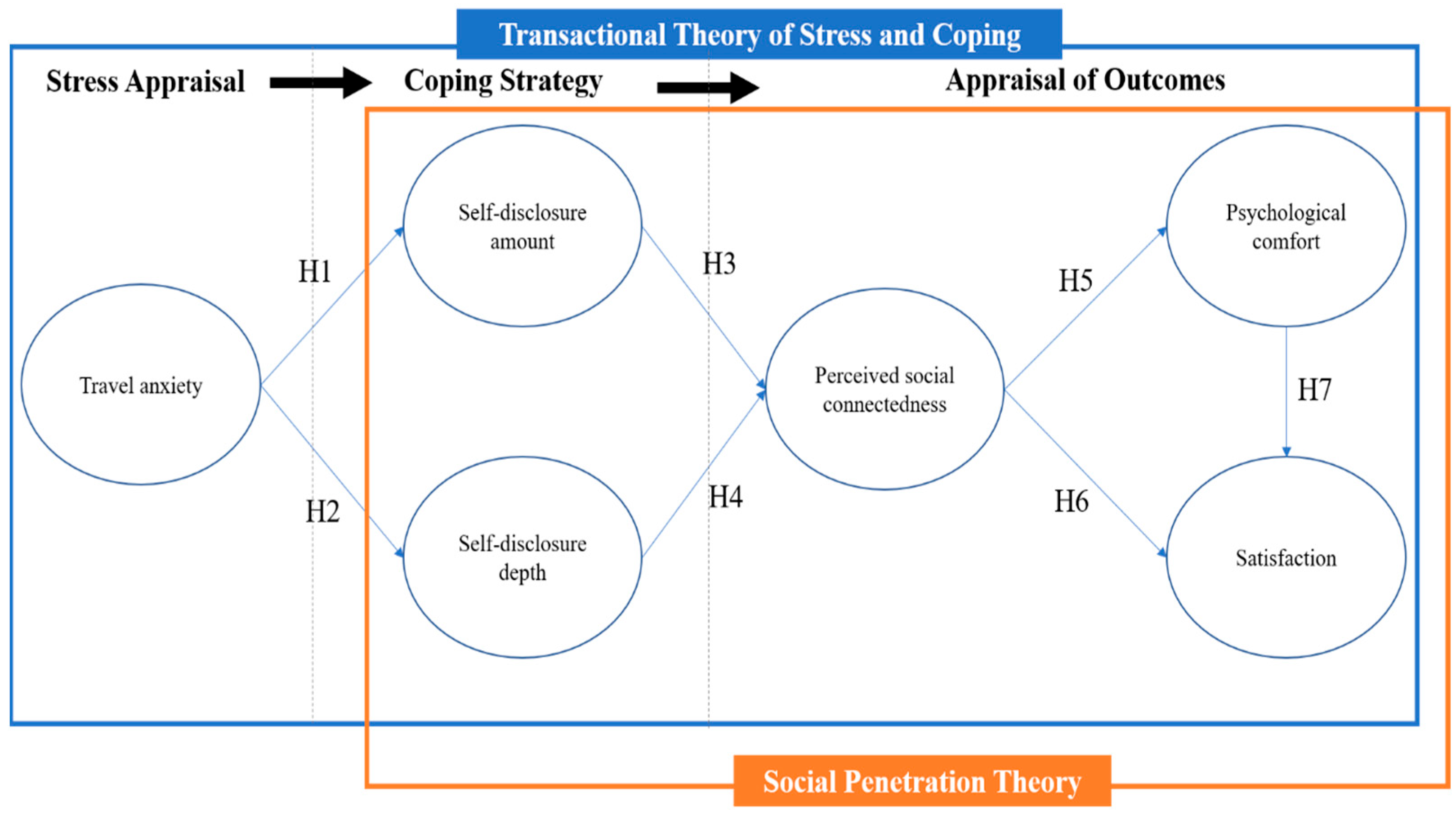
2.1.1. Transactional Theory of Stress and Coping (TTSC)
2.1.2. Social Penetration Theory (SPT)
2.1.3. Theoretical Synthesis: Socially Mediated Emotion Regulation
2.2. Travel Anxiety
2.3. Self-Disclosure
2.4. Social Connectedness and Outcomes
2.5. Psychological Comfort and Satisfaction
2.6. Mediating Role of Psychological Comfort
3. Methodology
3.1. Sample and Data Collection
3.2. Questionnaire Design
3.3. Data Analysis
3.4. Sample Profile
4. Results
4.1. Measurement Model
4.2. Structural Model
5. Conclusions and Discussion
5.1. Theoretical Implications
5.2. Practical Implications
5.3. Limitations
Funding
Institutional Review Board Statement
Informed Consent Statement
Data Availability Statement
Conflicts of Interest
References
- Ainsworth, J., & Foster, J. (2017). Comfort in brick and mortar shopping experiences: Examining antecedents and consequences of comfortable retail experiences. Journal of Retailing and Consumer Services, 35, 27–35. [Google Scholar] [CrossRef]
- Altman, I., & Taylor, D. A. (1973). Social penetration: The development of interpersonal relationships. Holt, Rinehart & Winston. [Google Scholar]
- Bai, Q., Dan, Q., Choi, Y., & Luo, S. (2025). Why we disclose on social media? Towards a dual-pathway model. Behavioral Sciences, 15(4), 547. [Google Scholar] [CrossRef] [PubMed]
- Biswas, C., Deb, S. K., Hasan, A. A. T., & Khandakar, M. S. A. (2021). Mediating effect of tourists’ emotional involvement on the relationship between destination attributes and tourist satisfaction. Journal of Hospitality and Tourism Insights, 4(4), 490–510. [Google Scholar] [CrossRef]
- Buzova, D., Sanz-Blas, S., & Cervera-Taulet, A. (2023). Co-creating emotional value in a guided tour experience: The interplay among guide’s emotional labour and tourists’ emotional intelligence and participation. Current Issues in Tourism, 26(11), 1748–1762. [Google Scholar] [CrossRef]
- Cao, X., Wang, M., & Zhang, W. (2024). How social media trust and ostracism affect tourist self-disclosure on SNSs: The perspective of privacy management strategy. Journal of Vacation Marketing, 30(1), 17–34. [Google Scholar] [CrossRef]
- Choe, Y., Kim, J., & Fesenmaier, D. R. (2017). Use of social media across the trip experience: An application of latent transition analysis. Journal of Travel & Tourism Marketing, 34(4), 431–443. [Google Scholar]
- Costa-Feito, A., Rodríguez-Santos, C., González-Fernández, A. M., & Marques dos Santos, J. P. (2025). The emotional paradox of short promotional videos in urban tourism: Cognitive and affective responses in decision-making under stress or joy. Journal of Travel & Tourism Marketing, 42(5), 708–723. [Google Scholar] [CrossRef]
- Demirtepe-Saygili, D. (2022). Stress, coping, and social media use. In Research anthology on combating cyber-aggression and online negativity (pp. 1036–1055). IGI Global Scientific Publishing. [Google Scholar]
- Finstad, K. (2010). Response interpolation and scale sensitivity: Evidence against 5-point scales. Journal of Usability Studies, 5(3), 104–110. [Google Scholar]
- Folkman, S., & Lazarus, R. S. (1985). If it changes it must be a process: Study of emotion and coping during three stages of a college examination. Journal of Personality and Social Psychology, 48(1), 150–170. [Google Scholar] [CrossRef]
- Fredrickson, B. L. (2001). The role of positive emotions in positive psychology: The broaden-and-build theory of positive emotions. American Psychologist, 56(3), 218–226. [Google Scholar]
- Gaur, S. S., Kingshott, R. P., & Sharma, P. (2019). Managing customer relationships in emerging markets: Focal roles of relationship comfort and relationship proneness. Journal of Service Theory and Practice, 29(5–6), 592–609. [Google Scholar] [CrossRef]
- Gross, J. J. (1998). The emerging field of emotion regulation: An integrative review. Review of General Psychology, 2(3), 271–299. [Google Scholar] [CrossRef]
- Hair, J. F., Risher, J. J., Sarstedt, M., & Ringle, C. M. (2019). When to use and how to report the results of PLS-SEM. European Business Review, 31(1), 2–24. [Google Scholar] [CrossRef]
- Hair, J. F., Jr., Matthews, L. M., Matthews, R. L., & Sarstedt, M. (2017). PLS-SEM or CB-SEM: Updated guidelines on which method to use. International Journal of Multivariate Data Analysis, 1(2), 107–123. [Google Scholar] [CrossRef]
- Henseler, J., Ringle, C. M., & Sarstedt, M. (2015). A new criterion for assessing discriminant validity in variance-based structural equation modeling. Journal of the Academy of Marketing Science, 43, 115–135. [Google Scholar] [CrossRef]
- Hofmann, W., Luhmann, M., Fisher, R. R., Vohs, K. D., & Baumeister, R. F. (2014). Yes, but are they happy? Effects of trait self-control on affective well-being and life satisfaction. Journal of Personality, 82(4), 265–277. [Google Scholar] [CrossRef]
- Hu, C., Hu, X., & Zhang, Y. (2025). How important is charisma? The impacts of charismatic tour-guiding and service disclosure on tourist trust, self-disclosure, interaction quality, and emotional solidarity. Tourism Management Perspectives, 58, 101367. [Google Scholar] [CrossRef]
- Huang, H., Ruan, W. Q., Li, Y. Q., & Wang, M. Y. (2023). Can companions share anxiety? The effect of travel companions on tourist anxiety during crisis situations. Asia Pacific Journal of Tourism Research, 28(9), 1000–1018. [Google Scholar] [CrossRef]
- Huang, H.-Y. (2016). Examining the beneficial effects of individual’s self-disclosure on the social network site. Computers in Human Behavior, 57, 122–132. [Google Scholar] [CrossRef]
- Jiang, G. X., Li, Y. Q., Ruan, W. Q., & Zhang, S. N. (2024). Relieving tourist anxiety during the COVID-19 epidemic: A dual perspective of the government and the tourist. Current Issues in Tourism, 27, 1095–1110. [Google Scholar] [CrossRef]
- Joshi, A., Kale, S., Chandel, S., & Pal, D. K. (2015). Likert scale: Explored and explained. British Journal of Applied Science & Technology, 7(4), 396. [Google Scholar] [CrossRef]
- Karagöz, D., Işık, C., Dogru, T., & Zhang, L. (2021). Solo female travel risks, anxiety and travel intentions: Examining the moderating role of online psychological-social support. Current Issues in Tourism, 24(11), 1595–1612. [Google Scholar] [CrossRef]
- Kemp, S. (2026, January 31). Digital 2026: South Korea. DataReportal. Available online: https://datareportal.com/reports/digital-2026-south-korea (accessed on 8 August 2025).
- Kirillova, K., Lehto, X. Y., & Cai, L. (2017). Existential authenticity and anxiety as outcomes: The tourist in the experience economy. International Journal of Tourism Research, 19(1), 13–26. [Google Scholar] [CrossRef]
- Kock, N. (2015). Common method bias in PLS-SEM: A full collinearity assessment approach. International Journal of e-Collaboration, 11(4), 1–10. [Google Scholar] [CrossRef]
- Lazarus, R. S., & Folkman, S. (1984). Stress, appraisal, and coping. Springer Publishing Company. [Google Scholar]
- Lee, R. M., & Robbins, S. B. (1995). Measuring belongingness: The social connectedness and the social assurance scales. Journal of Counseling Psychology, 42(2), 232. [Google Scholar] [CrossRef]
- Lee, S., Moon, H., Ko, J., Cankaya, B., Caine, E., & You, S. (2023). Social connectedness and mental health before and during the COVID-19 pandemic in a community sample in Korea. PLoS ONE, 18(10), e0292219. [Google Scholar] [CrossRef]
- Lee, Y. (2025). Travel alienation and coping strategies of international students: A qualitative exploration of the role of social support. International Journal of Tourism Research, 27(4), e70100. [Google Scholar] [CrossRef]
- Lei, X., Wu, H., Deng, Z., & Ye, Q. (2023). Self-disclosure, social support and postpartum depressive mood in online social networks: A social penetration theory perspective. Information Technology & People, 36(1), 433–453. [Google Scholar]
- Li, L., Yu, M., Choi, H.-S. C., & Lee, H. (2025). Exploring the psychological benefits of value co-creation in tourism: Enhancing hedonic and eudaimonic well-being through empowerment, social connectedness, and positive emotions. Journal of Vacation Marketing. [Google Scholar] [CrossRef]
- Lin, B., Fu, X., & Murphy, K. (2024). Investigating the foodstagramming mechanism: A customer-dominant logic perspective of customer engagement. Journal of Hospitality and Tourism Management, 58, 371–380. [Google Scholar] [CrossRef]
- Lin, C. Y., Chou, E. Y., & Huang, H. C. (2021). They support, so we talk: The effects of other users on self-disclosure on social networking sites. Information Technology & People, 34(3), 1039–1064. [Google Scholar]
- Lin, H., Zhang, M., Gursoy, D., & Fu, X. (2019). Impact of tourist-to-tourist interaction on tourism experience: The mediating role of cohesion and intimacy. Annals of Tourism Research, 76, 153–167. [Google Scholar] [CrossRef]
- Liu, M., Xu, J., Li, S., & Wei, M. (2023). Engaging customers with online restaurant community through mutual disclosure amid the COVID-19 pandemic: The roles of customer trust and swift guanxi. Journal of Hospitality and Tourism Management, 56, 124–134. [Google Scholar] [CrossRef]
- Liu, W., Xu, W., & Wu, M. (2022). The effect of tourist-to-tourist interaction on life satisfaction: A mediation role of social connectedness. Sustainability, 14(23), 16257. [Google Scholar] [CrossRef]
- Luo, J. M., & Lam, C. F. (2020). Travel anxiety, risk attitude and travel intentions towards “travel bubble” destinations in Hong Kong. International Journal of Environmental Research and Public Health, 17(21), 7859. [Google Scholar] [CrossRef]
- Michikyan, M., Subrahmanyam, K., Regan, P., Castillo, L. G., Ham, L., Harkness, A., & Schwartz, S. J. (2023). Social connectedness and negative emotion modulation: Social media use for coping among college students during the COVID-19 pandemic. Emerging Adulthood, 11(4), 1039–1054. [Google Scholar] [CrossRef]
- Nabity-Grover, T., Cheung, C. M., & Thatcher, J. B. (2020). Inside out and outside in: How the COVID-19 pandemic affects self-disclosure on social media. International Journal of Information Management, 55, 102188. [Google Scholar] [CrossRef]
- Peterkin, K. Y., Badu-Baiden, F., & Alhuqbani, F. M. (2024). Stress and coping: Exploring the experiences of travellers during COVID-19 hotel quarantine. Tourism Recreation Research, 49(5), 1063–1076. [Google Scholar] [CrossRef]
- Pizam, A., Neumann, Y., & Reichel, A. (1978). Dimensions of tourist satisfaction with a destination area. Annals of Tourism Research, 5(3), 314–322. [Google Scholar] [CrossRef]
- Podsakoff, P. M., MacKenzie, S. B., Lee, J.-Y., & Podsakoff, N. P. (2003). Common method biases in behavioral research: A critical review of the literature and recommended remedies. Journal of Applied Psychology, 88(5), 879–903. [Google Scholar] [CrossRef]
- Pratt, S., & Tolkach, D. (2022). Affective and coping responses to quarantine hotel stays. Stress and Health, 38(4), 768–778. [Google Scholar] [CrossRef] [PubMed]
- Prayag, G., Hosany, S., & Odeh, K. (2013). The role of tourists’ emotional experiences and satisfaction in understanding behavioral intentions. Journal of Destination Marketing & Management, 2(2), 118–127. [Google Scholar] [CrossRef]
- Putnam, R. D. (2000). Bowling alone: America’s declining social capital. In Culture and politics: A reader (pp. 223–234). Palgrave Macmillan US. [Google Scholar]
- Radia, K. N., Purohit, S., Desai, S., & Nenavani, J. (2022). Psychological comfort in service relationships: A mixed-method approach. Journal of Retailing and Consumer Services, 64, 102824. [Google Scholar] [CrossRef]
- Rains, S. A., & Keating, D. M. (2015). Health blogging: An examination of the outcomes associated with making public, written disclosures about health. Communication Research, 42(1), 107–133. [Google Scholar] [CrossRef]
- Ramsey, J. R., Zhang, Y., Lorenz, M. P., & Hosany, S. (2024). Travel stress, leisure exploration, and trip satisfaction: The mediating role of travel adjustment. Journal of Travel Research. Advance online publication. [Google Scholar]
- Rather, R. A., Hollebeek, L. D., Wait, M., & Khan, I. (2025). Tourists’ perceived travel risk, desire to travel, travel engagement, and subjective wellbeing: The moderating role of emotion regulation. Current Issues in Tourism, 1–21. [Google Scholar] [CrossRef]
- Rehman, S., Ahmad, J., Khan, A., & Alotaibi, K. A. (2025). Frequency of leisure travel and psychological well-being in pharmacists: The sequential mediating roles of perceived stress and social support. BMC Psychology, 13(1), 855. [Google Scholar] [CrossRef]
- Rimé, B. (2009). Emotion elicits the social sharing of emotion: Theory and empirical review. Emotion Review, 1(1), 60–85. [Google Scholar] [CrossRef]
- Spake, D. F., Beatty, S. E., Brockman, B. K., & Crutchfield, T. N. (2003). Consumer comfort in service relationships: Measurement and importance. Journal of Service Research, 5(4), 316–332. [Google Scholar] [CrossRef]
- Tidwell, L. C., & Walther, J. B. (2002). Computer-mediated communication effects on disclosure, impressions, and interpersonal evaluations: Getting to know one another a bit at a time. Human Communication Research, 28(3), 317–348. [Google Scholar] [CrossRef]
- Wang, S. (2025). Travel through time: Harnessing nostalgic Instagram content to overcome travel barriers. Journal of Vacation Marketing. [Google Scholar] [CrossRef]
- Wang, S., Kirillova, K., & Lehto, X. (2017). Travelers’ food experience sharing on social network sites. Journal of Travel & Tourism Marketing, 34(5), 680–693. [Google Scholar]
- Wang, S., Lehto, X., Cai, L., Behnke, C., & Kirillova, K. (2023). Travelers’ psychological comfort with local food experiences and place attachment. Journal of Hospitality & Tourism Research, 47(8), 1453–1477. [Google Scholar]
- Wheeless, L. R., & Grotz, J. (1976). Conceptualization and measurement of reported self-disclosure. Human Communication Research, 2(4), 338–346. [Google Scholar] [CrossRef]
- Wolfers, L. N., & Utz, S. (2022). Social media use, stress, and coping. Current Opinion in Psychology, 45, 101305. [Google Scholar] [CrossRef] [PubMed]
- Wu-Ouyang, B., & Hu, Y. (2023). The effects of pandemic-related fear on social connectedness through social media use and self-disclosure. Journal of Media Psychology, 35(2), 63–74. [Google Scholar] [CrossRef]
- Yan, H., Shen, C., Wei, Y., & Xiong, H. (2024). The visual effects of emoji in social media travel sharing on user engagement. Journal of Hospitality and Tourism Management, 61, 240–250. [Google Scholar] [CrossRef]
- Yin, J., & Hwang, J. (2025). Information overload and tourists’ booking discontinuance intention: An application of the transactional theory of stress and coping. Journal of Hospitality and Tourism Management, 62, 102–114. [Google Scholar] [CrossRef]
- Zenker, S., Braun, E., & Gyimóthy, S. (2021). Too afraid to travel? Development of a pandemic (COVID-19) anxiety travel scale (PATS). Tourism Management, 84, 104286. [Google Scholar] [CrossRef]
- Zhang, R. (2017). The stress-buffering effect of self-disclosure on Facebook: An examination of stressful life events, social support, and mental health among college students. Computers in Human Behavior, 75, 527–537. [Google Scholar] [CrossRef]
- Zhang, X., Liu, Y., & Wang, Z. (2024). The impact of SNS and COVID-19-related stress on psychological outcomes: An application of the transactional theory of stress and coping. Computers in Human Behavior, 149, 107944. [Google Scholar]
- Zhou, G., Hu, J., Du, Q., & Xiang, M. (2024). Impact of sincere social interaction on tourist citizenship behavior—Perspective from “self” and “relationships”. Journal of Hospitality and Tourism Management, 61, 1–10. [Google Scholar] [CrossRef]
- Zhuang, X., & Wang, Y. (2024). Social support and travel: Enhancing relationships, communication, and understanding for travel companions. International Journal of Tourism Research, 26(4), e2712. [Google Scholar] [CrossRef]



| Characteristics | Frequency (n) | Percentage (%) | |
|---|---|---|---|
| Gender | Female | 135 | 56.3 |
| Male | 105 | 43.8 | |
| Age | 20s | 53 | 22.1 |
| 30s | 98 | 40.8 | |
| 40s | 50 | 20.8 | |
| 50s | 30 | 12.5 | |
| 60 or above | 15 | 6.3 | |
| Marital Status | Married | 111 | 46.3 |
| Unmarried | 128 | 53.3 | |
| Other | 1 | 0.4 | |
| Education Level | High school graduate or below | 24 | 10.0 |
| Vocational/Associate degree | 28 | 11.7 | |
| Bachelor’s degree | 162 | 67.5 | |
| Graduate degree (Master’s or higher) | 26 | 10.8 | |
| Monthly Household Income (KRW) | Less than 3 million KRW | 40 | 16.7 |
| 3.00–3.99 million KRW | 42 | 17.5 | |
| 4.00–4.99 million KRW | 29 | 12.1 | |
| 5.00–5.99 million KRW | 26 | 10.8 | |
| 6.00–6.99 million KRW | 24 | 10.0 | |
| 7.00–7.99 million KRW | 18 | 7.5 | |
| 8 million KRW or above | 61 | 25.4 | |
| Constructs | Items | Loadings | CR | Rho_A | AVE | α | Sources |
|---|---|---|---|---|---|---|---|
| Travel Anxiety | Degree of anxiety felt about travel | 0.867 | 0.934 | 0.925 | 0.781 | 0.907 | Jiang et al. (2024); Karagöz et al. (2021) |
| Degree of nervousness felt about travel | 0.888 | ||||||
| Degree of discomfort felt about travel | 0.894 | ||||||
| Degree of worry about travel | 0.885 | ||||||
| Degree of concern felt about travel | 0.894 | ||||||
| Self-disclosure amount | I frequently share my travel experiences on social media while traveling. | 0.875 | 0.891 | 0.831 | 0.732 | 0.817 | C. Y. Lin et al. (2021); Cao et al. (2024) |
| I often share the emotions I experienced during travel on social media while traveling. | 0.889 | ||||||
| I spend a lot of time sharing my travel experiences on social media while traveling. | 0.800 | ||||||
| Self-disclosure depth | While traveling, I honestly express my travel experiences and emotions. | 0.809 | 0.914 | 0.881 | 0.727 | 0.875 | |
| While traveling, I use diverse words and images to express my feelings. | 0.807 | ||||||
| While traveling, I reveal my travel experiences and emotions without hesitation. | 0.915 | ||||||
| While traveling, I fully express the emotions I feel inside. | 0.874 | ||||||
| Social connectedness | While sharing my travel experiences on social media, I felt connected to the world around me. | 0.862 | 0.944 | 0.921 | 0.808 | 0.921 | Wu-Ouyang and Hu (2023) |
| While sharing my travel experiences on social media, I felt understood by people I know. | 0.908 | ||||||
| While sharing my travel experiences on social media, I felt a sense of closeness with others. | 0.926 | ||||||
| While sharing my travel experiences on social media, I felt more engaged in interactions with those around me. | 0.899 | ||||||
| Psychological comfort | uncomfortable–comfortable | 0.915 | 0.955 | 0.937 | 0.841 | 0.937 | Radia et al. (2022); Wang et al. (2023) |
| very uneasy–very much at ease | 0.927 | ||||||
| Very tense–very relaxed | 0.931 | ||||||
| distressed–calm | 0.894 | ||||||
| Satisfaction | This trip was better than I expected. | 0.944 | 0.962 | 0.941 | 0.893 | 0.940 | Ramsey et al. (2024) |
| I greatly enjoyed this trip. | 0.953 | ||||||
| Overall, I was satisfied with this trip. | 0.937 |
| Hypothesis | Path | β | t-Value | p-Value | Bias Corrected 95%CI | Supported | VIF | |
|---|---|---|---|---|---|---|---|---|
| Lower | Upper | |||||||
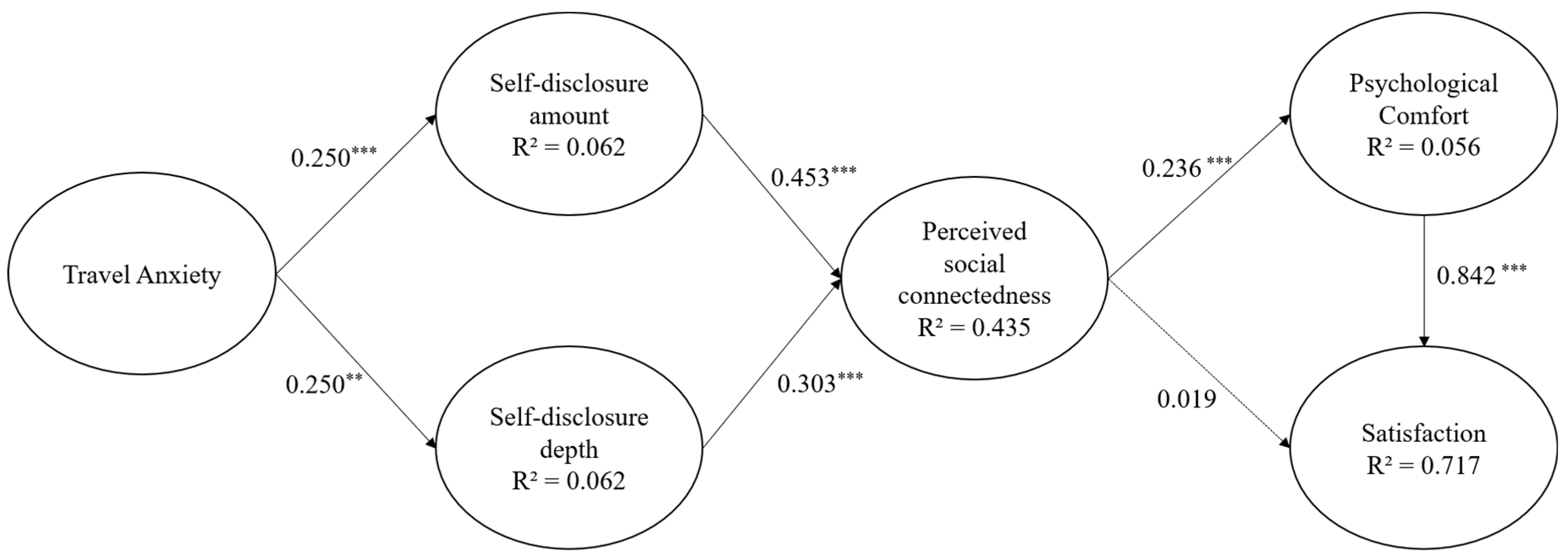
| H1 | Travel Anxiety → Self-disclosure amount | 0.250 | 3.698 | 0.000 | 0.105 | 0.370 | Yes | 1.000 |
| H2 | Travel Anxiety → Self-disclosure depth | 0.250 | 3.420 | 0.001 | 0.103 | 0.387 | Yes | 1.000 |
| H3 | Self-disclosure amount → Social connectedness | 0.453 | 8.064 | 0.000 | 0.341 | 0.561 | Yes | 1.342 |
| H4 | Self-disclosure depth → Social connectedness | 0.303 | 4.186 | 0.000 | 0.147 | 0.429 | Yes | 1.342 |
| H5 | Social connectedness → Psychological comfort | 0.236 | 3.705 | 0.000 | 0.103 | 0.353 | Yes | 1.000 |
| H6 | Social connectedness → Satisfaction | 0.019 | 0.457 | 0.648 | −0.075 | 0.093 | No | 1.059 |
| H7 | Psychological comfort → Satisfaction | 0.842 | 36.950 | 0.000 | 0.786 | 0.880 | Yes | 1.059 |
| H8 | Social connectedness → Psychological comfort → Satisfaction | 0.199 | 3.672 | 0.000 | 0.088 | 0.300 | Yes | — |
| Constructs | Travel Anxiety | Psychological Comfort | Satisfaction | Self-Disclosure Amount | Self-Disclosure Depth | Social Connectedness |
|---|---|---|---|---|---|---|
| Travel Anxiety | 0.884 | |||||
| Psychological Comfort | 0.198 | 0.917 | ||||
| Satisfaction | 0.190 | 0.847 | 0.945 | |||
| Self-Disclosure amount | 0.250 | 0.184 | 0.177 | 0.856 | ||
| Self-Disclosure depth | 0.250 | 0.386 | 0.324 | 0.505 | 0.853 | |
| Social connectedness | 0.280 | 0.236 | 0.218 | 0.606 | 0.532 | 0.899 |
| Constructs | Travel Anxiety | Psychological Comfort | Satisfaction | Self-Disclosure Amount | Self-Disclosure Depth | Social Connectedness |
|---|---|---|---|---|---|---|
| Travel Anxiety | ||||||
| Psychological Comfort | 0.202 | |||||
| Satisfaction | 0.192 | 0.902 | ||||
| Self-Disclosure amount | 0.282 | 0.207 | 0.201 | |||
| Self-Disclosure depth | 0.263 | 0.430 | 0.363 | 0.579 | ||
| Social connectedness | 0.303 | 0.253 | 0.234 | 0.695 | 0.586 |
Disclaimer/Publisher’s Note: The statements, opinions and data contained in all publications are solely those of the individual author(s) and contributor(s) and not of MDPI and/or the editor(s). MDPI and/or the editor(s) disclaim responsibility for any injury to people or property resulting from any ideas, methods, instructions or products referred to in the content. |
© 2026 by the author. Licensee MDPI, Basel, Switzerland. This article is an open access article distributed under the terms and conditions of the Creative Commons Attribution (CC BY) license.
Share and Cite
Wang, S. Real-Time Coping: The Role of Social Media Self-Disclosure in Managing Travel Anxiety. Tour. Hosp. 2026, 7, 33. https://doi.org/10.3390/tourhosp7020033
Wang S. Real-Time Coping: The Role of Social Media Self-Disclosure in Managing Travel Anxiety. Tourism and Hospitality. 2026; 7(2):33. https://doi.org/10.3390/tourhosp7020033
Chicago/Turabian StyleWang, Saerom. 2026. "Real-Time Coping: The Role of Social Media Self-Disclosure in Managing Travel Anxiety" Tourism and Hospitality 7, no. 2: 33. https://doi.org/10.3390/tourhosp7020033
APA StyleWang, S. (2026). Real-Time Coping: The Role of Social Media Self-Disclosure in Managing Travel Anxiety. Tourism and Hospitality, 7(2), 33. https://doi.org/10.3390/tourhosp7020033