2.1. Theoretical Foundations
AT explains how individuals interpret the causes of events and how these interpretations influence emotions and behavior
Weiner and Weiner (
1985). In tourism, causal attributions can be classified into three dimensions: locus (internal vs. external), stability (stable vs. unstable), and controllability (controllable vs. uncontrollable). Causal attributions influence tourists’ satisfaction, loyalty, and revisit intention (
Triantafillidou & Siomkos, 2014). That is, tourists who attribute their positive experiences to internal, stable, and controllable factors, such as spiritual satisfaction and interaction with other tourists, are more likely to have positive attributions and intend to revisit (
Chen et al., 2020). Positive attributions positively influence satisfaction and loyalty (
L. Su et al., 2017). Recent studies have found that sacred value enhances revisit intention in religious tourism (
Y. Su et al., 2025). However, limited studies have examined how attributions explain emotion-based constructs, such as enjoyment and memorability (
Wong et al., 2022). Given the locus of control reasoning, it is more appropriate to focus on intention rather than behavior, because tourists intend to revisit when they are constrained by time/resources.
According to TPB, intention is jointly shaped by attitude, subjective norm, and perceived behavioral control, which together predict behavioral outcomes (
La Barbera & Ajzen, 2020). Perceived behavior control significantly influences repeat travel (
Chou et al., 2025). Regarding religious tourism, subjective norms and cultural values have been shown to have a significant impact (
Cai & Jiang, 2024). However, the application of the TPB in East Asian temple tourism remains relatively limited. This research addresses the existing gap by exploring the extent to which attitudes, social influence, and perceived feasibility shape tourists’ intentions to return to Mount Wutai.
ELM explains that individuals interpret persuasive information via two main routes: the central route, which entails a thorough assessment of message content, and the peripheral route, which relies on cues such as the communicator’s credibility or the popularity of the message (
Petty et al., 2009). Regardless of the route taken, the final attitudes induced by these routes influence behavioral intentions, including revisit intention (
Rehman et al., 2022). ELM is frequently used in marketing and communication research. However, very few studies used this model in religious heritage tourism. Very few studies have examined how both rational elaboration and peripheral cues influence revisit intentions in temple tourism. By using ELM, this study elucidates how tourists’ attitudes towards Wutai Temple influence revisit intention through their perceptions of information quality and exposure to social cues from Wutai Temple, clarifying the psychological process of media exposure-intention.
2.2. Hypothesis Development
Tourists’ enjoyment is a fundamental emotional outcome of tourism experiences that substantially shapes overall evaluations and subsequent behavioral intentions (
Juliana et al., 2024). Positive emotional responses—such as pleasure, satisfaction, and relaxation—enhance tourists’ affective attachment to destinations and increase the likelihood of repeat visitation (
Yan & Halpenny, 2022). Enjoyment contributes not only to momentary satisfaction but also to the formation of enduring positive impressions that influence future travel choices. In relation to temple tourism, tourists who derive enjoyment from a serene environment, well-organized rituals, or considerate services are more inclined to cultivate affective bonds with the site. These favorable affective associations, in turn, enhance revisit intention. Thus, we advanced that
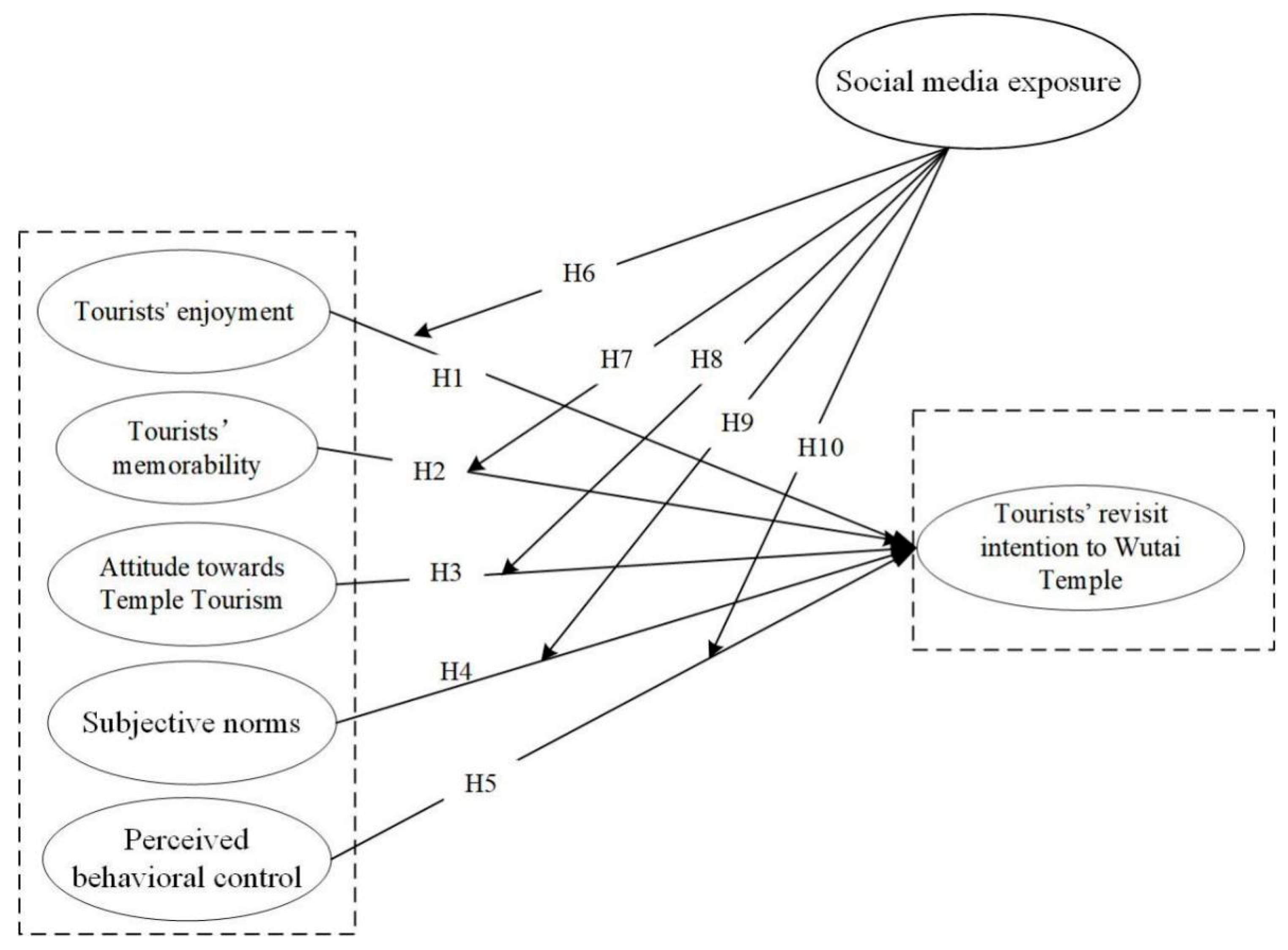
H1. Tourists’ enjoyment promotes their revisit intention to Mount Wutai.
Memorability reflects the emotional depth and uniqueness of a tourism experience and refers to the lasting impressions tourists form after their visit (
Rasoolimanesh et al., 2021). Memorable experiences tend to leave a mark on consumers by evoking emotions that trigger related behavior (
Karagöz & Ramkissoon, 2023). In other words, memorable activities in experiential tourism significantly enhance tourists’ attachment to destinations and revisit intention. In the case of temple tourism, if tourists have vivid memories of their experiences, such as the impressions they gain from the architecture of temples, meaningful interactions, environment (e.g., peaceful atmosphere), or entertainment, tourists’ revisit intention will be triggered by these recollections when they face similar decision-making in the future (
Yin & Jia, 2024). In other words, memory triggers revisit intention. Consequently, the research posits that
H2. Tourists’ memorability promotes tourists’ revisit intention to Mount Wutai.
In tourism behavior research, attitude is seen as a strong predictor of behavioral intention, which bridges cognitive evaluations and decision-making in the process of tourism consumption (
Rao et al., 2022). Generally, tourists with positive attitudes are interested in, approve of, and are willing to participate in tourism activities. Several studies have shown that positive attitudes greatly enhance revisit intention (
Peng et al., 2023). That is, when tourists have positive attitudes, they consider traveling to a destination as meaningful, worthwhile, or enjoyable, and are more likely to revisit. Stronger positive attitudes trigger stronger positive emotions and identify with destinations, which are important drivers of revisit behavior (
Isa et al., 2019). Accordingly, we formulate that
H3. Tourists’ attitude towards temple tourism positively influences tourists’ revisit intention to Mount Wutai.
Subjective norm is the perceived social pressure to behave in a certain way (
Xu et al., 2022). Usually, people consider the opinions of their family, friends, or even people of the same religion when deciding to revisit a destination. Subjective norm has a significant influence on tourists’ attitudes towards destinations and revisit behavior (
Zhuang et al., 2020). When tourists believe their families, friends, or even the religious community encourages them to do something, such as visiting the temple, they are more likely to form the intention to revisit. In the context of religious and spiritual tourism, people’s behavior is mainly influenced by cultural or religious norms. Social encouragement, including family traditions, recommendations from religious authorities, and opinions on social media, can enhance tourists’ intention to revisit sacred sites (
Hussain & Wang, 2024). Accordingly, we formulate that
H4. Subjective norm promotes tourists’ revisit intention to Mount Wutai.
PBC refers to an individual’s perceived ability to perform a behavior, influenced by personal resources and external conditions (
Hagger et al., 2022). PBC affects tourists’ ability to revisit the destination by influencing factors such as money, time, and physical access to the site. When tourists feel they have control over these factors and believe that revisiting is possible, they are more likely to have a revisit intention (
Baghirov et al., 2023). If individuals think that there are fewer barriers or obstacles to a behavior, for example, visiting a particular destination, they tend to have an intention to perform that behavior (
Siegrist et al., 2021). PBC over travel logistics, such as transportation costs or the time required to visit the temple, significantly affects revisit intention to Wutai Temple. Thus, the subsequent hypothesis is formulated:
H5. Perceived behavioral control positively influences their revisit intention to Mount Wutai.
Tourists’ enjoyment refers to the pleasure a tourism destination provides, making tourists feel good emotionally and psychologically, as reflected in their evaluations of their experiences as tourists (
Pestana et al., 2020). In temple tourism, tourists may feel tranquility, a sense of meaningfulness in Buddhist rituals, or comfort. Enjoyment positively affects tourists’ post-visit evaluations and revisit intention to a tourism destination (
González-Rodríguez et al., 2016). That is, tourists will have better evaluations and higher revisit intention for Wutai Temple after experiencing enjoyment in temple tourism. Moreover, the influence of enjoyment on revisit intention may be strengthened by different degrees of media exposure. Suppose tourists are repeatedly exposed to media such as short videos, travel reviews, or symbolic images of Wutai Temple. In that case, these external stimuli will help maintain and enhance tourists’ emotional states by reinforcing the initial emotional significance of Wutai Temple in their minds. Media exposure can reinforce the initial emotional significance of Wutai Temple, which is also spread from private feelings to shared beliefs and culture (
Wood & Kenyon, 2018), and help retain the memory of satisfaction with Wutai Temple. Therefore, we formulate that
H6. Social media exposure enhances the moderating effect between tourists’ enjoyment and their intention revisit to Mount Wutai.
Memorable experiences leave long-lasting cognitive and emotional traces that are strongly associated with future behavioral intentions (
González-Rodríguez et al., 2016). However, the strength of this influence may vary depending on contextual reinforcements. Media exposure refers to external stimuli that can be instrumental in maintaining and amplifying memory-related emotional responses. By interacting with user-generated content, such as revisit content, other tourists can relive past experiences and enhance their psychological attachment (
Li & Zhao, 2021). Thus, we posit that
H7. Social media exposure strengthens the association between tourists’ memorability and their revisit intention to Mount Wutai.
Positive attitudes are among the strongest predictors of revisit intention (
Soliman, 2019). Nevertheless, the magnitude of this predictive link may be shaped by contextual or external factors. Media exposure functions as a symbolic environment that reinforces tourists’ existing attitudes by providing continuous validation and social endorsement of the destination (
Arasli et al., 2021). When tourists encounter favorable content—such as testimonials, spiritual reflections, or immersive documentaries—related to temple tourism, their prior positive attitudes may be further strengthened and translated more readily into behavioral intentions (
Conner & Norman, 2022). In temple tourism, the impact is heightened by the symbolic significance and affective resonance conveyed through spiritual narratives. Therefore, this study proposes that
H8. Social media exposure positively moderates the relationship between tourists’ attitude towards temple tourism and their revisit intention to Mount Wutai.
Social media exposure refers to the extent to which an individual is exposed to and engages with content related to a specific topic through various media platforms, mainly social media (
Shahbaznezhad et al., 2022). Media exposure can amplify the visibility and perceived importance of specific destinations through user-generated content, endorsements by opinion leaders, and peer sharing. This external input can reinforce the social expectations or pressures associated with visiting a particular destination, thereby enhancing the role of subjective norms (
Lee et al., 2025). Media exposure can strengthen the influence of social factors on behavioral intentions. When individuals see friends, family members, or online community members positively sharing about a destination, the sense of social pressure to visit or revisit that destination becomes stronger. If media content presents spiritual or cultural narratives, it may also reinforce social norms, thereby making individuals more inclined to act in accordance with these perceived social expectations (
Singh & Bhuyan, 2025). Consequently, we advance that
H9. Social media exposure positively moderates the relationship between subjective norms and tourists’ revisit intention to Mount Wutai.
Social media exposure refers to the extent to which destination-related information, images, and narratives appear on platforms such as WeChat, Weibo, Douyin, or travel blogs (
Ouyang & Jiang, 2025). Influence of social media primarily manifests in emotional resonance, experiential imagination, and perceived social identity, rather than in directly altering tourists’ judgments of behavioral feasibility. In other words, social media is more likely to enhance tourists’ emotional responses, strengthen perceptions of social support, or reinforce normative expectations, whereas its impact on perceived behavioral control—such as “whether one has sufficient resources” or “whether the destination is accessible”—is generally limited (
Afren, 2024). Although tourists may occasionally encounter travel tips or practical guidance on social media, such fragmented information is often insufficient to alter their overall assessment of a destination’s feasibility significantly. Perceived behavioral control is typically shaped by more stable factors, such as individual resources, prior experiences, and structural constraints, which are not easily influenced by brief media exposure. Consequently, the following hypothesis is formulated in this study:
H10. Social media exposure strengthens the linkage between perceived behavioral control and tourists’ intention to revisit Mount Wutai.