
Sustainable Financing of Cultural Landscapes: Insights from Japan’s Furusato Nozei System

 , ,
, ,  ,
,  ,
, 
Abstract
1. Introduction
1.1. The Financial Crisis of Cultural Landscape
1.2. Limitations of Traditional Willingness-to-Pay Approaches
1.3. Furusato Nozei: An Institutional Innovation for Sustainable Landscape Financing
1.4. Research Objectives and Contributions
2. Research Hypotheses and Theoretical Basis
2.1. Psychological Pathway
2.2. Behavioural Investment
2.3. Socio-Demographic Conditions
3. Materials and Methods
3.1. Study Area
3.2. Data Acquisition
3.3. Socio-Demographic Characteristics
3.4. Questionnaire Design
3.5. Statistical Analysis
4. Results
4.1. Measurement Model
4.2. Structural Model
4.3. Validation of Hypotheses
5. Discussion
5.1. Psychological, Behavioural, and Socio-Demographic Pathways to WTP
5.2. Mechanism Operation and Policy Implications Under the Furusato Nozei System
5.3. International Comparisons and Broader Implications for Cultural Landscape Financing
5.4. Limitations and Future Research Directions
6. Conclusions
Author Contributions
Funding
Institutional Review Board Statement
Informed Consent Statement
Data Availability Statement
Conflicts of Interest
Abbreviations
| WTP | Willingness to Pay |
| M | Motivation |
| CI | Cognitive Images |
| AI | Affective Images |
| SI | Satisfaction and loyalty |
| E | Engagement |
| IL | Interaction with Locals |
| DE | Destination Evaluation |
| SRMR | Standardised Root Mean Square Residual |
| NLHF | National Lottery Heritage Fund |
| HLDS | Hometown Love Donation System |
References
- Abuamoud, I. (2025). Assessing tourists’ willingness to pay for sustainable tourism in Petra, a contingent valuation study. Nature Environment and Pollution Technology, 24, 211–222. [Google Scholar] [CrossRef]
- Agapito, D., Oom do Valle, P., & da Costa Mendes, J. (2013). The cognitive-affective-conative model of destination image: A confirmatory analysis. Journal of Travel & Tourism Marketing, 30(5), 471–481. [Google Scholar] [CrossRef]
- Agnoletti, M., Errico, A., Santoro, A., Dani, A., & Preti, F. (2019). Terraced landscapes and hydrogeological risk. Effects of land abandonment in Cinque Terre (Italy) during severe rainfall events. Sustainability, 11(1), 235. [Google Scholar] [CrossRef]
- Ajzen, I. (1991). The theory of planned behavior. Organizational Behavior and Human Decision Processes, 50(2), 179–211. [Google Scholar] [CrossRef]
- Alberini, A., & Longo, A. (2006). Combining the travel cost and contingent behavior methods to value cultural heritage sites: Evidence from Armenia. Journal of Cultural Economics, 30(4), 287–304. [Google Scholar] [CrossRef]
- Alrawadieh, Z., Prayag, G., Alrawadieh, Z., & Alsalameen, M. (2019). Self-identification with a heritage tourism site, visitors’ engagement and destination loyalty: The mediating effects of overall satisfaction. The Service Industries Journal, 39(7–8), 541–558. [Google Scholar] [CrossRef]
- Andreoni, J. (1989). Giving with impure altruism: Applications to charity and Ricardian equivalence. Journal of Political Economy, 97(6), 1447–1458. [Google Scholar] [CrossRef]
- Andreoni, J. (1990). Impure altruism and donations to public goods: A theory of warm-glow giving. The Economic Journal, 100(401), 464–477. [Google Scholar] [CrossRef]
- Andreoni, J., & Vesterlund, L. (2001). Which is the fair sex? Gender differences in altruism. The Quarterly Journal of Economics, 116(1), 293–312. [Google Scholar] [CrossRef]
- Antón, C., Camarero, C., & Laguna-García, M. (2017). Towards a new approach of destination loyalty drivers: Satisfaction, visit intensity and tourist motivations. Current Issues in Tourism, 20(3), 238–260. [Google Scholar] [CrossRef]
- Arkes, H. R., & Blumer, C. (1985). The psychology of sunk cost. Organizational Behavior and Human Decision Processes, 35(1), 124–140. [Google Scholar] [CrossRef]
- Aseres, S. A., & Sira, R. K. (2020). Estimating visitors’ willingness to pay for a conservation fund: Sustainable financing approach in protected areas in Ethiopia. Heliyon, 6(8), e04500. [Google Scholar] [CrossRef]
- Asia Pacific Foundation of Canada. (n.d.). With Japan as inspiration, South Korea unveils donation system to rejuvenate local economies. Available online: https://www.asiapacific.ca/publication/japan-inspiration-south-korea-unveils-donation-system (accessed on 24 September 2025).
- Baloglu, S., & McCleary, K. W. (1999). A model of destination image formation. Annals of Tourism Research, 26(4), 868–897. [Google Scholar] [CrossRef]
- Batool, N., Wani, M. D., Shah, S. A., & Dada, Z. A. (2025). Tourists’ attitude and willingness to pay on conservation efforts: Evidence from the west Himalayan eco-tourism sites. Environment, Development and Sustainability, 27(8), 18933–18951. [Google Scholar] [CrossRef]
- Bedate, A. M., Herrero, L. C., & Sanz, J. A. (2009). Economic valuation of a contemporary art museum: Correction of hypothetical bias using a certainty question. Journal of Cultural Economics, 33(3), 185–199. [Google Scholar] [CrossRef]
- Briedenhann, J., & Wickens, E. (2004). Tourism routes as a tool for the economic development of rural areas—Vibrant hope or impossible dream? Tourism Management, 25(1), 71–79. [Google Scholar] [CrossRef]
- Brown, P. H., & Minty, J. H. (2008). Media coverage and charitable giving after the 2004 tsunami. Southern Economic Journal, 75(1), 9–25. [Google Scholar] [CrossRef]
- Carson, R. T., Mitchell, R. C., Hanemann, M., Kopp, R. J., Presser, S., & Ruud, P. A. (2003). Contingent valuation and lost passive use: Damages from the Exxon Valdez oil spill. Environmental and Resource Economics, 25(3), 257–286. [Google Scholar] [CrossRef]
- Cevdet Altunel, M., & Erkurt, B. (2015). Cultural tourism in Istanbul: The mediation effect of tourist experience and satisfaction on the relationship between involvement and recommendation intention. Journal of Destination Marketing & Management, 4(4), 213–221. [Google Scholar] [CrossRef]
- Champ, P. A., Moore, R., & Bishop, R. C. (2009). A comparison of approaches to mitigate hypothetical bias. Agricultural and Resource Economics Review, 38(2), 166–180. [Google Scholar] [CrossRef]
- Chen, C.-F., & Phou, S. (2013). A closer look at destination: Image, personality, relationship and loyalty. Tourism Management, 36, 269–278. [Google Scholar] [CrossRef]
- Chen, C.-F., & Tsai, D. (2007). How destination image and evaluative factors affect behavioral intentions? Tourism Management, 28(4), 1115–1122. [Google Scholar] [CrossRef]
- Chi, C. G.-Q., & Qu, H. (2008). Examining the structural relationships of destination image, tourist satisfaction and destination loyalty: An integrated approach. Tourism Management, 29(4), 624–636. [Google Scholar] [CrossRef]
- Cohen, E. (1988). Authenticity and commoditization in tourism. Annals of Tourism Research, 15(3), 371–386. [Google Scholar] [CrossRef]
- Cong, L., Zhang, Y., Su, C.-H., Chen, M.-H., & Wang, J. (2019). Understanding tourists’ willingness-to-pay for rural landscape improvement and preference heterogeneity. Sustainability, 11(24), 7001. [Google Scholar] [CrossRef]
- Conner, M., & Norman, P. (2022). Understanding the intention-behavior gap: The role of intention strength. Frontiers in Psychology, 13, 923464. [Google Scholar] [CrossRef]
- Crompton, J. L. (1979). Motivations for pleasure vacation. Annals of Tourism Research, 6(4), 408–424. [Google Scholar] [CrossRef]
- da Costa Mendes, J., Oom do Valle, P., Guerreiro, M. M., & Silva, J. A. (2010). The tourist experience: Exploring the relationship between tourist satisfaction and destination loyalty. Tourism: An International Interdisciplinary Journal, 58(2), 111–126. [Google Scholar]
- Darlow, S., Essex, S., & Brayshay, M. (2012). Sustainable heritage management practices at visited heritage sites in Devon and Cornwall. Journal of Heritage Tourism, 7(3), 219–237. [Google Scholar] [CrossRef]
- Devaux, N., Berthold, E., & Dube, J. (2018). Economic impact of a heritage policy on residential property values in a historic district context: The case of the old city of Quebec. Review of Regional Studies, 48(3), 279–297. [Google Scholar] [CrossRef]
- Donation to Municipality Produced by Furusato Choice. (n.d.). Donation to Japanese municipality produced by Furusato choice. Available online: https://www.furusato-tax.jp/donationtojapan/en (accessed on 24 September 2025).
- Frey, B. S., & Jegen, R. (2001). Motivation crowding theory. Journal of Economic Surveys, 15(5), 589–611. [Google Scholar] [CrossRef]
- Fukasawa, E., Fukasawa, T., & Ogawa, H. (2020). Intergovernmental competition for donations: The case of the Furusato Nozei program in Japan. Journal of Asian Economics, 67, 101178. [Google Scholar] [CrossRef]
- Guzmán, P. C., Roders, A. R. P., & Colenbrander, B. J. F. (2017). Measuring links between cultural heritage management and sustainable urban development: An overview of global monitoring tools. Cities, 60, 192–201. [Google Scholar] [CrossRef]
- Hair, J. F. (2014). A primer on partial least squares structural equation modeling (PLS-SEM). Sage. [Google Scholar]
- Hair, J. F., Risher, J. J., Sarstedt, M., & Ringle, C. M. (2019). When to use and how to report the results of PLS-SEM. European Business Review, 31(1), 2–24. [Google Scholar] [CrossRef]
- Hanemann, W. M. (1991). Willingness to pay and willingness to accept: How much can they differ? The American Economic Review, 81(3), 635–647. [Google Scholar] [CrossRef]
- Hanli, S., Xin, Z., Chunhung, L., Jingbo, J., & Hayat, K. R. (2023). Tourists’ willingness to pay for the non-use values of ecotourism resources in a national forest park. Journal of Resources and Ecology, 14(2), 331–343. [Google Scholar] [CrossRef]
- Hasegawa, K. (2017). Japan’s “Furusato Nouzei”(hometown tax): Which areas get how much, and is it really working? [Bachelor’s thesis, Duke University]. Available online: https://sites.duke.edu/djepapers/files/2017/11/kayhasegawa-dje.pdf (accessed on 24 September 2025).
- Henseler, J., Dijkstra, T. K., Sarstedt, M., Ringle, C. M., Diamantopoulos, A., Straub, D. W., Ketchen, D. J., Jr., Hair, J. F., Hult, G. T. M., & Calantone, R. J. (2014). Common beliefs and reality about PLS: Comments on Rönkkö and Evermann (2013). Organizational Research Methods, 17(2), 182–209. [Google Scholar] [CrossRef]
- Hensher, D. A. (2010). Hypothetical bias, choice experiments and willingness to pay. Transportation Research Part B: Methodological, 44(6), 735–752. [Google Scholar] [CrossRef]
- Hosany, S., & Gilbert, D. (2010). Measuring tourists’ emotional experiences toward hedonic holiday destinations. Journal of Travel Research, 49(4), 513–526. [Google Scholar] [CrossRef]
- Hu, L., & Bentler, P. M. (1999). Cutoff criteria for fit indexes in covariance structure analysis: Conventional criteria versus new alternatives. Structural Equation Modeling: A Multidisciplinary Journal, 6(1), 1–55. [Google Scholar] [CrossRef]
- Jang, S. S., & Feng, R. (2007). Temporal destination revisit intention: The effects of novelty seeking and satisfaction. Tourism Management, 28(2), 580–590. [Google Scholar] [CrossRef]
- Jelinčić, D. A., & Šveb, M. (2021). Financial sustainability of cultural heritage: A review of crowdfunding in Europe. Journal of Risk and Financial Management, 14(3), 101. [Google Scholar] [CrossRef]
- Jeon, C.-Y., & Yang, H.-W. (2021). The impact of the COVID-19 pandemic on tourists’ wtp: Using the contingent valuation method. International Journal of Environmental Research and Public Health, 18(16), 8605. [Google Scholar] [CrossRef] [PubMed]
- Kemperman, A., van den Berg, P., Weijs-Perrée, M., & Uijtdewillegen, K. (2019). Loneliness of older adults: Social network and the living environment. International Journal of Environmental Research and Public Health, 16(3), 406. [Google Scholar] [CrossRef]
- Kim, S.-S., & Lee, C.-K. (2002). Push and pull relationships. Annals of Tourism Research, 29(1), 257–260. [Google Scholar] [CrossRef]
- Kyle, G., Graefe, A., Manning, R., & Bacon, J. (2004a). Effect of activity involvement and place attachment on recreationists’ perceptions of setting density. Journal of Leisure Research, 36(2), 209–231. [Google Scholar] [CrossRef]
- Kyle, G., Graefe, A., Manning, R., & Bacon, J. (2004b). Predictors of behavioral loyalty among hikers along the Appalachian Trail. Leisure Sciences, 26(1), 99–118. [Google Scholar] [CrossRef]
- Lee, Y.-J. (2016). The relationships amongst emotional experience, cognition, and behavioural intention in battlefield tourism. Asia Pacific Journal of Tourism Research, 21(6), 697–715. [Google Scholar] [CrossRef]
- Leonard, T. C. (2008). Richard H. Thaler, Cass R. Sunstein, Nudge: Improving decisions about health, wealth, and happiness: Yale university press, New Haven, CT, 2008, 293 pp, $26.00. The Social Science Journal, 45(4), 700–701. [Google Scholar] [CrossRef]
- Li, H., Chen, J., Ikebe, K., & Kinoshita, T. (2023). Survey of residents of historic cities willingness to pay for a cultural heritage conservation project: The contribution of heritage awareness. Land, 12(11), 2058. [Google Scholar] [CrossRef]
- Li, H., Ikebe, K., Kinoshita, T., Chen, J., Su, D., & Xie, J. (2024). How heritage promotes social cohesion: An urban survey from Nara city, Japan. Cities, 149, 104985. [Google Scholar] [CrossRef]
- Li, S., Saayman, A., Stienmetz, J., & Tussyadiah, I. (2022). Framing effects of messages and images on the willingness to pay for pro-poor tourism products. Journal of Travel Research, 61(8), 1791–1807. [Google Scholar] [CrossRef]
- López-Mosquera, N., & Sánchez, M. (2012). Theory of planned behavior and the value-belief-norm theory explaining willingness to pay for a suburban park. Journal of Environmental Management, 113, 251–262. [Google Scholar] [CrossRef]
- Lupu, A., & Allegro, I. (2024). Circular financing mechanisms for adaptive reuse of cultural heritage. In Adaptive reuse of cultural heritage: Circular business, financial and governance models (pp. 523–544). Springer International Publishing. [Google Scholar]
- MacCannell, D. (2004). Staged authenticity—Arrangements of social space in tourist settings. Tourism: The Experience of Tourism, 2(3), 195. [Google Scholar] [CrossRef]
- Maeer, G., Fawcett, G., & Killick, T. (2008). Values and benefits of heritage. A research review. Heritage Lottery Fund. [Google Scholar]
- Maki, A., Carrico, A. R., Raimi, K. T., Truelove, H. B., Araujo, B., & Yeung, K. L. (2019). Meta-analysis of pro-environmental behaviour spillover. Nature Sustainability, 2(4), 307–315. [Google Scholar]
- Makino, Y., & Ogawa, H. (2025). Ending the race for return gifts: Do gift caps in the Furusato Nozei program work? CIRJE, Faculty of Economics, University of Tokyo. [Google Scholar]
- Ministry of Internal Affairs and Communications. (n.d.). Easy to understand! Hometown tax payment. Available online: https://www.soumu.go.jp/main_sosiki/jichi_zeisei/czaisei/czaisei_seido/furusato/about/index.html (accessed on 24 September 2025).
- Mitchell, R. C., & Carson, R. T. (2013). Using surveys to value public goods: The contingent valuation method. RFF Press. [Google Scholar]
- Moran, D. (2002). Guy Garrod and Ken Willis 1999, economic valuation of the environment: Methods and case studies. Environmental and Resource Economics, 21(1), 101. [Google Scholar] [CrossRef]
- National Lottery Heritage Fund. (2018, December 20). About. Available online: https://www.heritagefund.org.uk/about (accessed on 24 September 2025).
- Nguyen Viet, B., Dang, H. P., & Nguyen, H. H. (2020). Revisit intention and satisfaction: The role of destination image, perceived risk, and cultural contact. Cogent Business & Management, 7(1), 1796249. [Google Scholar] [CrossRef]
- NIRA. (n.d.). A new stage for the Furusato Nozei system/my vision/papers. Available online: https://english.nira.or.jp/my_vision/2018/01/a-new-stage-for-the-furusato-nozei-system.html (accessed on 24 September 2025).
- Oliver, R. L. (2014). Satisfaction: A behavioral perspective on the consumer: A behavioral perspective on the consumer. Routledge. [Google Scholar]
- Onofrio, F., Rodella, I., & Gilli, M. (2025). Navigating WTP disparities: A study of tourist and resident perspectives on coastal management. Frontiers in Environmental Economics, 4, 1497532. [Google Scholar] [CrossRef]
- Penn, J. M., & Hu, W. (2018). Understanding hypothetical bias: An enhanced meta-analysis. American Journal of Agricultural Economics, 100(4), 1186–1206. [Google Scholar] [CrossRef]
- Prahalad, C. K., & Ramaswamy, V. (2004). Co-creation experiences: The next practice in value creation. Journal of Interactive Marketing, 18(3), 5–14. [Google Scholar] [CrossRef]
- Prayag, G. (2009). Tourists’ evaluations of destination image, satisfaction, and future behavioral intentions—The case of Mauritius. Journal of Travel & Tourism Marketing, 26(8), 836–853. [Google Scholar] [CrossRef]
- Prayag, G., Hosany, S., Muskat, B., & Del Chiappa, G. (2017). Understanding the relationships between tourists’ emotional experiences, perceived overall image, satisfaction, and intention to recommend. Journal of Travel Research, 56(1), 41–54. [Google Scholar] [CrossRef]
- Prayag, G., & Ryan, C. (2012). Antecedents of tourists’ loyalty to Mauritius: The role and influence of destination image, place attachment, personal involvement, and satisfaction. Journal of Travel Research, 51(3), 342–356. [Google Scholar] [CrossRef]
- Qu, H., Kim, L. H., & Im, H. H. (2011). A model of destination branding: Integrating the concepts of the branding and destination image. Tourism Management, 32(3), 465–476. [Google Scholar] [CrossRef]
- Quiroga, E. (2025). Beyond fishing: The value of maritime cultural heritage in Germany. Marine Policy, 182, 106845. [Google Scholar] [CrossRef]
- Ramdas, M., & Mohamed, B. (2014). Impacts of tourism on environmental attributes, environmental literacy and willingness to pay: A conceptual and theoretical review. Procedia—Social and Behavioral Sciences, 144, 378–391. [Google Scholar] [CrossRef]
- Ramkissoon, H., Weiler, B., & Smith, L. D. G. (2013). Place attachment, place satisfaction and pro-environmental behaviour: A comparative assessment of multiple regression and structural equation modelling. Journal of Policy Research in Tourism, Leisure and Events, 5(3), 215–232. [Google Scholar] [CrossRef]
- Rausch, A. (2019). Japan’s furusato nozei tax program. Electronic Journal of Contemporary Japanese Studies, 19(3), 6. [Google Scholar]
- Rössler, M. (2006). World heritage cultural landscapes: A UNESCO flagship programme 1992–2006. Landscape Research, 31(4), 333–353. [Google Scholar] [CrossRef]
- Ruiz Pulpón, Á. R., & Cañizares Ruiz, M. d. C. (2019). Potential of vineyard landscapes for sustainable tourism. Geosciences, 9(11), 472. [Google Scholar] [CrossRef]
- Rusbult, C. E. (1980). Commitment and satisfaction in romantic associations: A test of the investment model. Journal of Experimental Social Psychology, 16(2), 172–186. [Google Scholar] [CrossRef]
- Salpina, D., Casartelli, V., Marengo, A., & Mysiak, J. (2025). Financing strategies for the resilience of cultural landscapes. Lessons learned from a systematic literature and practice review. Cities, 162, 105922. [Google Scholar] [CrossRef]
- Sheeran, P., & Webb, T. L. (2016). The intention–behavior gap. Social and Personality Psychology Compass, 10(9), 503–518. [Google Scholar] [CrossRef]
- Shimauchi, T., Nambo, H., & Kimura, H. (2019). Funding tourism promotion and disaster management through hometown tax donation program. Journal of Global Tourism Research, 4(1), 39–45. [Google Scholar] [CrossRef] [PubMed]
- Si, W., Jiang, C., & Meng, L. (2022). The relationship between environmental awareness, habitat quality, and community residents’ pro-environmental behavior—Mediated effects model analysis based on social capital. International Journal of Environmental Research and Public Health, 19(20), 13253. [Google Scholar] [CrossRef]
- Snowball, J. D. (2008). Measuring the value of culture: Methods and examples in cultural economics. Springer. [Google Scholar]
- Stylidis, D., Shani, A., & Belhassen, Y. (2017). Testing an integrated destination image model across residents and tourists. Tourism Management, 58, 184–195. [Google Scholar] [CrossRef]
- Tasci, A. D., & Gartner, W. C. (2007). Destination image and its functional relationships. Journal of Travel Research, 45(4), 413–425. [Google Scholar] [CrossRef]
- Tax Policy Center. (2020). How did the TCJA affect incentives for charitable giving. Available online: https://taxpolicycenter.org/briefing-book/how-did-tcja-affect-incentives-charitable-giving (accessed on 24 September 2025).
- Toyoshima, Y., Kawakami, M., & Shen, Z. (2024). The current factors impeding the preservation and utilization of historical buildings in Japan. International Review for Spatial Planning and Sustainable Development, 12(4), 117–131. [Google Scholar] [CrossRef]
- Truelove, H. B., Carrico, A. R., Weber, E. U., Raimi, K. T., & Vandenbergh, M. P. (2014). Positive and negative spillover of pro-environmental behavior: An integrative review and theoretical framework. Global Environmental Change, 29, 127–138. [Google Scholar] [CrossRef]
- Tuan, T. H., & Navrud, S. (2007). Valuing cultural heritage in developing countries: Comparing and pooling contingent valuation and choice modelling estimates. Environmental and Resource Economics, 38(1), 51–69. [Google Scholar] [CrossRef]
- Wang, P., & Ya, J. (2023). Tourists’ willingness to pay conservation fees: The case of Hulunbuir Grassland, China. Journal of Resources and Ecology, 14(3), 656–666. [Google Scholar] [CrossRef]
- Wei, Y., Liu, H., & Park, K.-S. (2021). Examining the structural relationships among heritage proximity, perceived impacts, attitude and residents’ support in intangible cultural heritage tourism. Sustainability, 13(15), 8358. [Google Scholar] [CrossRef]
- Witt, B. (2019). Tourists’ willingness to pay increased entrance fees at Mexican protected areas: A multi-site contingent valuation study. Sustainability, 11(11), 3041. [Google Scholar] [CrossRef]
- World Economic Forum. (2023, February 14). Challenges of Furusato Nozei, Japan’s hometown tax programme. Available online: https://www.weforum.org/stories/2023/02/japans-hometown-tax-programme-show-challenges-for-the-future-tax-system/ (accessed on 24 September 2025).
- Wu, F., & Salleh, N. H. M. (2025). Residents’ willingness to pay for heritage conservation: Insight from a discrete choice experiment. International Journal of Geoheritage and Parks, 13(4), 493–505. [Google Scholar] [CrossRef]
- Yoon, Y., & Uysal, M. (2005). An examination of the effects of motivation and satisfaction on destination loyalty: A structural model. Tourism Management, 26(1), 45–56. [Google Scholar] [CrossRef]
- Zhao, H., Yang, Y., Chen, Y., Yu, H., Chen, Z., & Yang, Z. (2023). Driving factors and scale effects of residents’ willingness to pay for environmental protection under the impact of COVID-19. ISPRS International Journal of Geo-Information, 12(4), 163. [Google Scholar] [CrossRef]
- Zhao, S., Tan, Q., Li, Y., & Li, J. (2025). Revealing determinants shaping the sustainable consumption of single-use plastic food container substitutes. Environmental Impact Assessment Review, 110, 107670. [Google Scholar] [CrossRef]


| Variable | Frequency | Percentage |
|---|---|---|
| Sex | ||
| Men | 250 | 50% |
| Women | 250 | 50 |
| Age | ||
| 18–30 | 62 | 12.4% |
| 31–50 | 245 | 49% |
| 51–70 | 156 | 31.2% |
| >71 | 37 | 7.4% |
| Marital status | ||
| Married | 280 | 56% |
| Unmarried | 220 | 44% |
| Annual Household Income (10,000 JPY) | ||
| <100 | 22 | 4.4% |
| 100–200 | 16 | 3.2% |
| 200–300 | 23 | 4.6% |
| 300–400 | 49 | 9.8% |
| 400–500 | 47 | 9.4% |
| 500–600 | 61 | 12.2% |
| 600–700 | 47 | 9.4% |
| 700–800 | 46 | 9.2% |
| 800–900 | 31 | 6.2% |
| 900–1000 | 35 | 7.0% |
| 1000–1200 | 53 | 10.6% |
| 1200–1500 | 31 | 6.2% |
| 1500–1800 | 18 | 3.6% |
| 1800–2000 | 7 | 1.4% |
| >2000 | 14 | 2.8% |
| Address | ||
| Tokyo | 231 | 46.2% |
| Other Places | 269 | 53.8% |
| Variable | Item | Refs. |
|---|---|---|
| Motivation (M) | (Antón et al., 2017) | |
| M1 | I like to travel to refresh myself and spend time in a relaxed manner. | |
| M2 | I enjoy traveling to step away from everyday life and relax. | |
| M3 | I like learning about the lifestyles and customs of unfamiliar places. | |
| M4 | I enjoy exploring new cultures and experiencing different ways of life. | |
| M5 | I visit Shibamata because it has a long history and traditional culture. | |
| M6 | I would like to visit Shibamata during the time of its traditional festivals and events. | |
| M7 | I like Shibamata’s shopping street and traditional local food. | |
| M8 | I appreciate the natural scenery and the calm atmosphere of Shibamata. | |
| Destination Evaluation | (Agapito et al., 2013; Nguyen Viet et al., 2020) | |
| CI1 | Did you find the natural environment in Shibamata beautiful? | |
| CI2 | Did you feel that Shibamata has a rich history and culture? | |
| CI3 | Did you feel that Shibamata is a safe place? | |
| CI4 | Were there restaurants or shops where you could purchase souvenirs unique to Shibamata? | |
| CI5 | Were the signboards and rest areas easy to understand and sufficient? | |
| AI1 | The atmosphere was warm. | |
| AI2 | The experience was enjoyable. | |
| AI3 | The place was attractive. | |
| SL1 | Are you overall satisfied with your visit to Shibamata? | |
| SL2 | In the future, would you like to revisit the Shibamata area? | |
| SL3 | Would you recommend visiting Shibamata to others? | |
| Interaction with Locals (IL) | (Prayag, 2009) | |
| IL1 | I could develop friendly relationships with people in Shibamata. | |
| IL2 | Local people in Shibamata recommended places or food to me. | |
| IL3 | I could learn about local lifestyles and culture from residents. | |
| Engagement (E) | (Alrawadieh et al., 2019) | |
| E1 | Approximately how much money did you spend during your trip to Shibamata? | |
| E2 | How long was your stay in Shibamata? | |
| Variable | Loadings | VIF Range | Cronbach’s α | Composite Reliability | AVE |
|---|---|---|---|---|---|
| Motivation (M) | 0.928 | 0.941 | 0.666 | ||
| M1 | 0.763 | 2.135 | |||
| M2 | 0.837 | 2.848 | |||
| M3 | 0.829 | 2.893 | |||
| M4 | 0.839 | 2.976 | |||
| M5 | 0.838 | 2.717 | |||
| M6 | 0.766 | 2.034 | |||
| M7 | 0.824 | 2.600 | |||
| M8 | 0.828 | 2.436 | |||
| Destination Evaluation | 0.954 | 0.960 | 0.683 | ||
| CI1 | 0.825 | 2.486 | |||
| CI2 | 0.865 | 2.504 | |||
| CI4 | 0.856 | 2.494 | |||
| CI5 | 0.796 | 2.791 | |||
| CI6 | 0.805 | 2.492 | |||
| AI1 | 0.807 | 2.729 | |||
| AI2 | 0.825 | 3.696 | |||
| AI3 | 0.802 | 3.391 | |||
| SL1 | 0.862 | 3.556 | |||
| SL2 | 0.819 | 3.055 | |||
| SL3 | 0.825 | 2.989 | |||
| Interaction with Locals (IL) | 0.923 | 0.951 | 0.867 | ||
| IL1 | 0.916 | 3.174 | |||
| IL2 | 0.938 | 3.857 | |||
| IL3 | 0.940 | 3.557 | |||
| Engagement (E) | 0.704 | 0.868 | 0.767 | ||
| E1 | 0.831 | 1.419 | |||
| E2 | 0.918 | 1.419 |
| Heterotrait–Monotrait Ratio (HTMT) | |||||
| Constructs | DE | E | IL | M | Willingness to Pay |
| DE | - | ||||
| E | 0.324 | - | |||
| IL | 0.370 | 0.290 | - | ||
| M | 0.792 | 0.333 | 0.327 | - | |
| WTP | 0.196 | 0.317 | 0.326 | 0.211 | - |
| Fornell-Larcker Criterion | |||||
| Constructs | DE | E | IL | M | Willingness to Pay |
| DE | 0.827 | ||||
| E | 0.250 | 0.876 | |||
| IL | 0.345 | 0.238 | 0.931 | ||
| M | 0.746 | 0.253 | 0.299 | 0.816 | |
| WTP | 0.192 | 0.272 | 0.315 | 0.202 | 1.000 |
| Hypotheses (H) | Items | β | t | Confidence Intervals | p | Significance | |
|---|---|---|---|---|---|---|---|
| 2.50% | 97.50% | ||||||
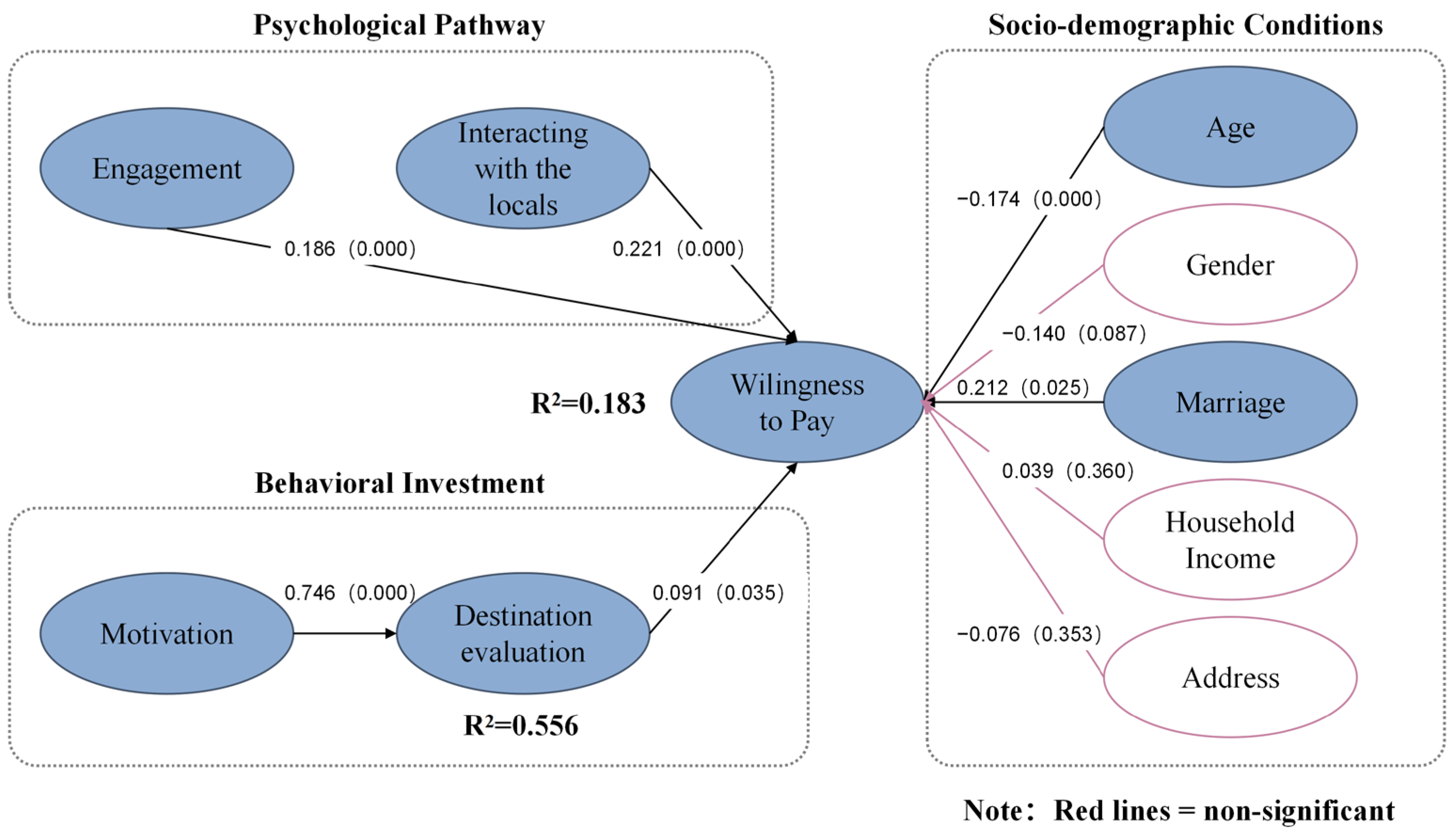
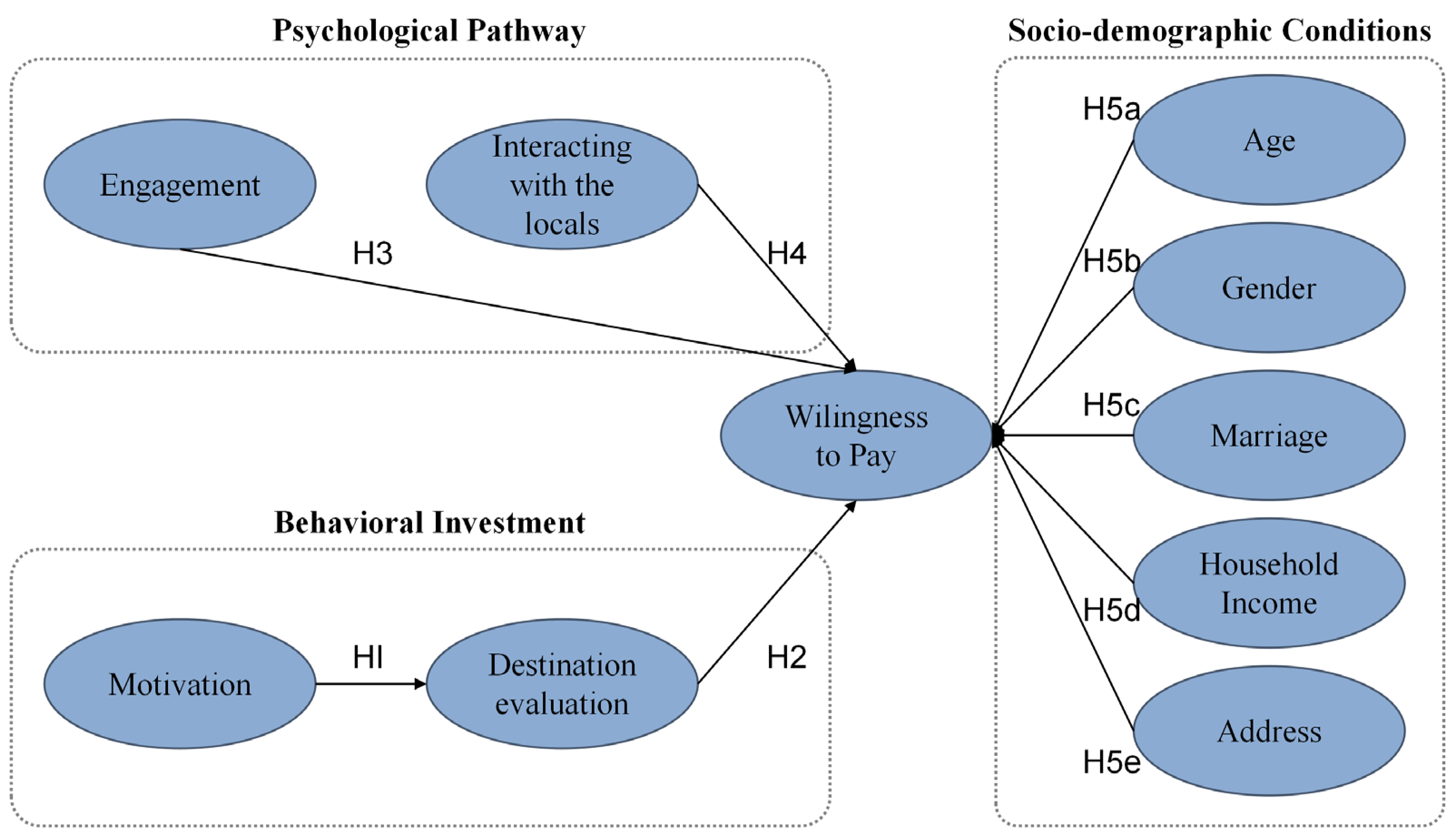
| H1 | M→ DE | 0.746 *** | 26.256 | 0.683 | 0.796 | 0.000 | Supported |
| H2 | DE → WTP | 0.091 * | 2.104 | 0.006 | 0.175 | 0.035 | Supported |
| H3 | E → WTP | 0.186 *** | 4.234 | 0.097 | 0.269 | 0.000 | Supported |
| H4 | IL → WTP | 0.221 *** | 4.528 | 0.121 | 0.316 | 0.000 | Supported |
| H5a | Age → WTP | −0.174 *** | 4.145 | −0.256 | −0.090 | 0.000 | Supported |
| H5b | Gender → WTP | −0.140 | 1.711 | −0.303 | 0.016 | 0.087 | Not Supported |
| H5c | Marriage → WTP | 0.212 * | 2.243 | 0.032 | 0.403 | 0.025 | Supported |
| H5d | Household Income → WTP | 0.039 | 0.915 | −0.043 | 0.123 | 0.360 | Not Supported |
| H5e | Address → WTP | −0.076 | 0.929 | −0.232 | 0.087 | 0.353 | Not Supported |
| Total Indirect Effects | ||||||
| Items | β | t | Confidence Intervals | p | Significance | |
| 2.50% | 97.50% | |||||
| M → WTP | 0.068 * | 2.090 | 0.005 | 0.131 | 0.037 | Supported |
| Specific Indirect Effects | ||||||
| Items | β | t | Confidence Intervals | p | Significance | |
| 2.50% | 97.50% | |||||
| M → DE → WTP | 0.068 * | 2.090 | 0.005 | 0.131 | 0.037 | Supported |
| Feature | Japan: Furusato Nozei | UK: National Lottery Heritage Fund (NLHF) | Korea: Hometown Love Donation System (HLDS) |
|---|---|---|---|
| Funding source | Portion of individual income and resident taxes redirected as donations. | Portion of state-run lottery sales (Good Causes income) | Individual donations |
| Mechanism | Direct, decentralised donations to chosen municipalities. | Centralised, competitive grants managed by a national body. | Direct, decentralised donations to chosen municipalities. |
| Donor incentives | Tax deduction (ceiling) + direct material return gifts (up to 30% of donation). | Lottery winnings potential; contribution to ‘good causes’ is indirect. | Tax deduction (ceiling) + direct material return gifts (up to 30% of donation). |
| Governance | Managed by local governments; central government regulates return gift value. | Governed by a parliamentary-accountable NGO board. | Managed by local governments; central government regulates. |
| Key strengths | Directly links donor choice with emotional attachment to a specific area; leverages private incentives for public good. | Capable of funding large-scale national projects; specialised grant evaluation. | Similar to Japan; aims to correct regional disparities. |
| Key challenges | Over-competition for return gifts; potential loss of net revenue; benefits skewed to high-income donors. | Reliance on lottery sales; donors cannot directly control project allocation. | Low recognition during initial implementation; competition issues similar to Japan. |
| Refs. | (NIRA, n.d.; World Economic Forum, 2023; Ministry of Internal Affairs and Communications, n.d.; Fukasawa et al., 2020) | (National Lottery Heritage Fund, 2018) | (Asia Pacific Foundation of Canada, n.d.) |
Disclaimer/Publisher’s Note: The statements, opinions and data contained in all publications are solely those of the individual author(s) and contributor(s) and not of MDPI and/or the editor(s). MDPI and/or the editor(s) disclaim responsibility for any injury to people or property resulting from any ideas, methods, instructions or products referred to in the content. |
© 2025 by the authors. Licensee MDPI, Basel, Switzerland. This article is an open access article distributed under the terms and conditions of the Creative Commons Attribution (CC BY) license (https://creativecommons.org/licenses/by/4.0/).
Share and Cite
Tang, Y.; Ma, R.; Luo, S.; Xie, J.; Zhang, S.; Zhang, J.; Furuya, K. Sustainable Financing of Cultural Landscapes: Insights from Japan’s Furusato Nozei System. Tour. Hosp. 2025, 6, 259. https://doi.org/10.3390/tourhosp6050259
Tang Y, Ma R, Luo S, Xie J, Zhang S, Zhang J, Furuya K. Sustainable Financing of Cultural Landscapes: Insights from Japan’s Furusato Nozei System. Tourism and Hospitality. 2025; 6(5):259. https://doi.org/10.3390/tourhosp6050259
Chicago/Turabian StyleTang, Yan, Ruochen Ma, Shixian Luo, Jing Xie, Sihan Zhang, Jing Zhang, and Katsunori Furuya. 2025. "Sustainable Financing of Cultural Landscapes: Insights from Japan’s Furusato Nozei System" Tourism and Hospitality 6, no. 5: 259. https://doi.org/10.3390/tourhosp6050259
APA StyleTang, Y., Ma, R., Luo, S., Xie, J., Zhang, S., Zhang, J., & Furuya, K. (2025). Sustainable Financing of Cultural Landscapes: Insights from Japan’s Furusato Nozei System. Tourism and Hospitality, 6(5), 259. https://doi.org/10.3390/tourhosp6050259