
Development of the Measurement Scale of Online Convention Service Quality (OCSQ)



Abstract
1. Introduction
2. Literature Review
2.1. Concept of Online Convention
2.2. Service Quality
2.2.1. Convention Service Quality
2.2.2. E-Service Quality
2.3. Key Components of Online Convention Service Quality
2.3.1. Human Service
2.3.2. Program Service
2.3.3. Platform Service
2.3.4. Interaction Service
2.4. Proposing Initial Measurement Items of OCSQ
3. Methodology
3.1. Delphi Technique
3.2. Reliability and Validity Test
4. Results
4.1. Frequency Analysis
4.2. Exploratory Factor Analysis (EFA)
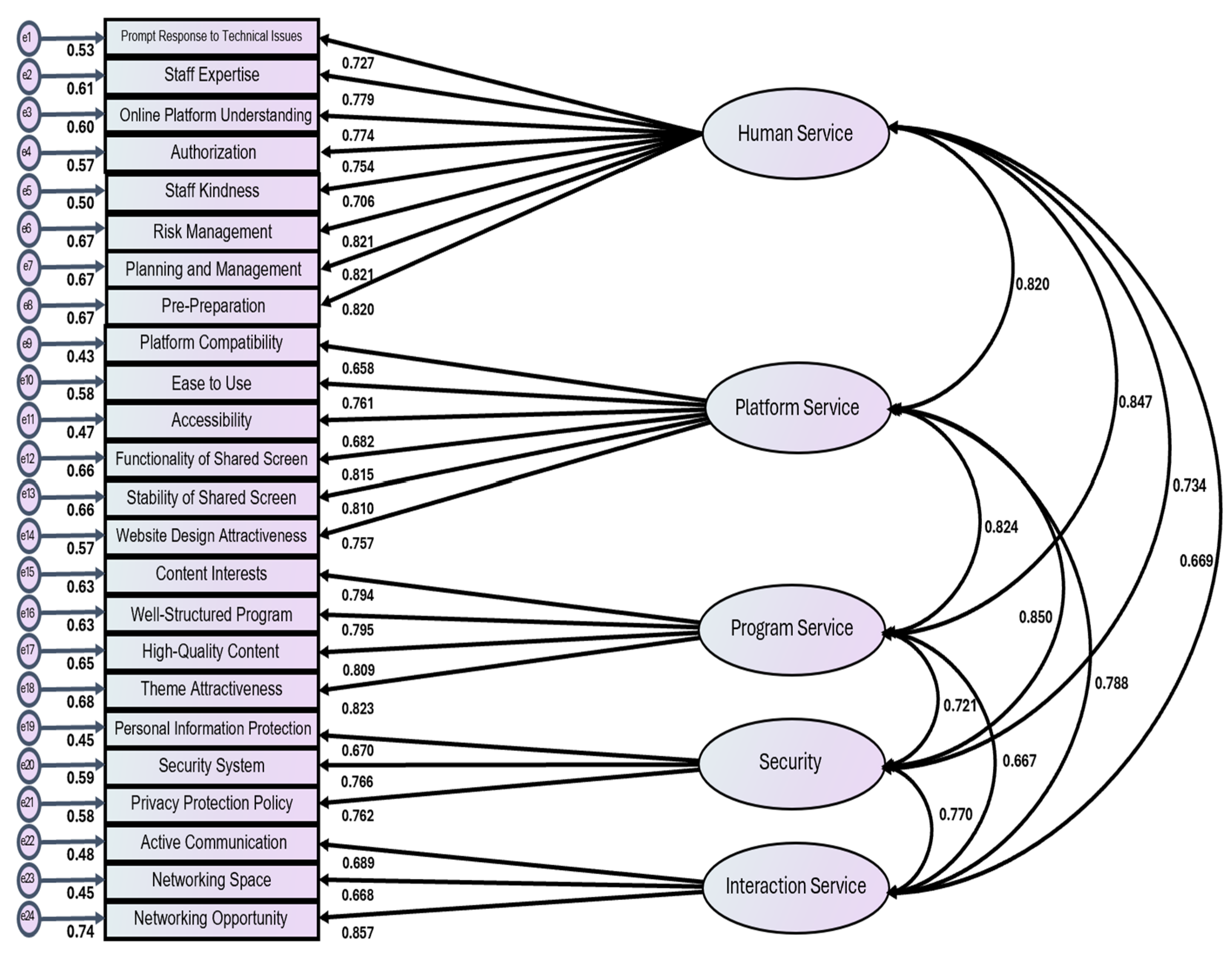
4.3. Confirmatory Factor Analysis (CFA)
5. Discussion and Implications
5.1. Theoretical Implications
5.2. Practical Implications
5.3. Limitations and Future Research Agenda
Author Contributions
Funding
Institutional Review Board Statement
Informed Consent Statement
Data Availability Statement
Conflicts of Interest
Abbreviations
| OCSQ | Online convention service quality |
| EFA | Exploratory Factor Analysis |
| CFA | Confirmatory Factor Analysis |
References
- Al-Geitany, S., Aljuhmani, H. Y., Emeagwali, O. L., & Nasr, E. (2023). Consumer behavior in the post-COVID-19 era: The impact of perceived interactivity on behavioral intention in the context of virtual conferences. Sustainability, 15(11), 8600. [Google Scholar] [CrossRef]
- Ali, B. J., Saleh, P. E., Akoi, S., Abdulrahman, A. A., Muhamed, A. S., Noori, H. N., & Anwar, G. (2021). Impact of service quality on the customer satisfaction: Case study at online meeting platforms. International Journal of Engineering, Business and Management, 5(2), 65–77. [Google Scholar] [CrossRef]
- Al-Salami, Q. H., & Abdalla, S. N. (2022). The impact of academic satisfaction as a mediator on international conferences. Cihan University-Erbil Journal of Humanities and Social Sciences, 6(1), 19–26. [Google Scholar] [CrossRef]
- An, J., Kim, H., & Hur, D. (2021). Keeping the competitive edge of a convention and exhibition center in MICE Environment: Identification of event attributes for long-run success. Sustainability, 13(9), 5030. [Google Scholar] [CrossRef]
- Anderson, J. C., & Gerbing, D. W. (1988). Structural equation modeling in practice: A review and recommended two-step approach. Psychological Bulletin, 103(3), 411–423. [Google Scholar] [CrossRef]
- Ashiq, R., & Hussain, A. (2024). Exploring the effects of e-service quality and e-trust on consumers’e-satisfaction and e-loyalty: Insights from online shoppers in Pakistan. Journal of Electronic Business & Digital Economics, 3(2), 117–141. [Google Scholar]
- Atanassova, M., & Russell, M. (2023, November 13). Meetings market survey 2023: ‘The work has gotten very difficult’, PCMA. Available online: https://www.pcma.org/meetings-market-survey-2023-business-events-industry-pulse/ (accessed on 11 May 2024).
- Ayre, C., & Scally, A. J. (2014). Critical values for lawshe’s content validity ratio: Revisiting the original methods of calculation. Measurement and Evaluation in Counseling and Development, 47(1), 79–86. [Google Scholar] [CrossRef]
- Barrera, R. B., García, A. N., & Moreno, M. R. (2014). Evaluation of the e-service quality in service encounters with incidents: Differences according to the socio-demographic profile of the online consumer. Revista Europea de Dirección y Economía de la Empresa, 23(4), 184–193. [Google Scholar] [CrossRef]
- Carnevale, J., & Hatak, I. (2020). Employee adjustment and well-being in the era of COVID-19: Implications for human resource management. Journal of Business Research, 116, 183–187. [Google Scholar] [CrossRef] [PubMed]
- Cheon, D.-H., & Hong, K.-W. (2018). The impact of medical tourism convention service quality perceived by foreign visitors on perceived value: Satisfaction: And behavioral intention. International Journal of Tourism and Hospitality Research (Korea), 32(6), 109–121. [Google Scholar] [CrossRef]
- Choi, H. M., & Yoon, Y. S. (2016). A study on the effect of convention participants’ convention service quality on convention destination’s visiting value, intention to behavior. In Korea science and art forum (Vol. 25, pp. 449–461). The Korean Society of Science & Art. [Google Scholar]
- DeLone, W. H., & McLean, E. R. (2003). The DeLone and McLean model of information systems success: A ten-year update. Journal of Management Information Systems, 19(4), 9–30. [Google Scholar]
- Demir, A., Maroof, L., Sabbah Khan, N. U., & Ali, B. J. (2020). The role of E-service quality in shaping online meeting platforms: A case study from higher education sector. Journal of Applied Research in Higher Education, 13(5), 1436–1463. [Google Scholar] [CrossRef]
- Dictionary.com. (2024). Convention. Available online: https://www.dictionary.com/browse/convention (accessed on 13 June 2024).
- Fan, W., Shao, B., & Dong, X. (2022). Effect of e-service quality on customer engagement behavior in community e-commerce. Frontiers in Psychology, 13, 965998. [Google Scholar] [CrossRef] [PubMed]
- Fassnacht, M., & Koese, I. (2006). Quality of electronic services: Conceptualizing andtesting a hierarchical model. Journal of Service Research, 9(1), 19–37. [Google Scholar] [CrossRef]
- Fornell, C., & Larcker, D. F. (1981). Evaluating structural equation models with unobservable variables and measurement error. Journal of Marketing Research, 18(1), 39–50. [Google Scholar] [CrossRef]
- Hair, J. F., Black, W. C., Babin, B. J., & Anderson, R. E. (2010). Multivariate data analysis (7th ed.). Pearson. [Google Scholar]
- Hansopaheluwakan, S. (2021). Analysis of e-service quality and website quality effect on e-customer loyalty through e-customer satisfaction (case study: Tokopedia). In IOP conference series: Earth and environmental science (Vol. 794, p. 012086). IOP Publishing. [Google Scholar]
- Hien, N. M. (2014). A study on evaluation of e-government service quality. International Journal of Humanities and Social Sciences, 8(1), 16–19. [Google Scholar]
- Higgins, S. E., Veach, P. M. C., MacFarlane, I. M., Borders, L. D., LeRoy, B., & Callanan, N. (2013). Genetic counseling supervisor competencies: Results of a delphi study. Journal of Genetic Counseling, 22, 39–57. [Google Scholar] [CrossRef]
- Ho, C. I., & Lee, Y. L. (2007). The development of an e-travel service quality scale. Tourism Management, 28, 1434–1449. [Google Scholar] [CrossRef]
- Howard, M. C. (2016). A review of exploratory factor analysis decisions and overview of current practices: What we are doing and how can we improve? International Journal of Human-Computer Interaction, 32(1), 51–62. [Google Scholar] [CrossRef]
- Hu, L. T., & Bentler, P. M. (1999). Cutoff criteria for fit indexes in covariance structure analysis: Conventional criteria versus new alternatives. Structural Equation Modeling: A Multidisciplinary Journal, 6(1), 1–55. [Google Scholar] [CrossRef]
- Hunter, J. (2023). Virtual conference 2021: Ideas: Tips: And tools, cvent. Available online: https://www.cvent.com/en/blog/events/virtual-conference (accessed on 3 May 2024).
- Hutcheson, G. D., & Sofroniou, N. (1999). The multivariate social scientist: Introductory statistics using generalized linear models. Sage Publications. [Google Scholar]
- Kaynama, S. A., & Black, C. I. (2000). A proposal to assess the service quality of online travel agencies: An exploratory study. Journal of Professional Services Marketing, 21(1), 63–88. [Google Scholar] [CrossRef]
- Kim, S. E. (2024). Virtual reality concerts: Determinants of success using the information system success model. In Journal of Convention & Event Tourism (Vol. 25, pp. 362–377). Routledge. [Google Scholar]
- Lawshe, C. H. (1975). A quantitative approach to content validity. Personnel Psychology, 28(4), 563–575. [Google Scholar] [CrossRef]
- Lee, J., Kim, D., & Lee, T. J. (2020). The development of an evaluation scale for B2B service quality: The case of the Korean convention industry. Journal of Convention & Event Tourism, 21(1), 1–21. [Google Scholar]
- Lee, J. S., & Min, C. K. (2013). Examining the role of multidimensional value in convention attendee behavior. Journal of Hospitality & Tourism Research, 37(3), 402–425. [Google Scholar]
- Lee, T. H., & Park, J. (2002). Study on the degree of importance of convention service factors: Focusing on the differences in perception between convention planners and participants. Journal of Convention & Exhibition Management, 3(4), 69–85. [Google Scholar]
- Li, H., & Suomi, R. (2009). A proposed scale for measuring e-service quality. International Journal of u-and e-Service Science and Technology, 2(1), 1–10. [Google Scholar]
- Lin, C. T., & Lin, C. W. (2013). Exhibitor perspectives of exhibition service quality. Journal of Convention & Event Tourism, 14(4), 293–308. [Google Scholar]
- Lynn, M. R. (1986). Determination and quantification of content validity. Nursing Research, 35(6), 382–386. [Google Scholar] [CrossRef] [PubMed]
- Mohanty, P., Dhoundiyal, H., & Choudhury, R. (2022). Events tourism in the eye of the COVID-19 storm: Impacts and implications. Apple Academic Press. [Google Scholar]
- Nasution, H., Fauzi, A., & Rini, E. S. (2019). The effect of e-service quality on e-loyalty through e-satisfaction on students of Ovo application users at the faculty of economics and business. University of North Sumatra, Indonesia. European Journal of Management and Marketing Studies, 4(1), 146–162. [Google Scholar]
- O’Connor, P., & Assaker, G. (2024). Examining the role of reputation as a moderator of E-service quality, trust, and E-loyalty in online travel services. Journal of Theoretical and Applied Electronic Commerce Research, 19(4), 3429–3442. [Google Scholar] [CrossRef]
- Parasuraman, A., Zeithaml, V. A., & Malhotra, A. (2005). E-S-QUAL: A multiple-item scale for assessing electronic service quality. Journal of Service Research, 7(3), 213–233. [Google Scholar] [CrossRef]
- Park, Y. A., Gretzel, U., & Sirakaya-Turk, E. (2007). Measuring web site quality for online travel Agenciesm. Journal of Travel & Tourism Marketing, 23, 15–30. [Google Scholar]
- PJ, S., Singh, K., Kokkranikal, J., Bharadwaj, R., Rai, S., & Antony, J. (2023). Service quality and customer satisfaction in hospitality, leisure, sport and tourism: An assessment of research in web of science. Journal of Quality Assurance in Hospitality & Tourism, 24(1), 24–50. [Google Scholar]
- Rogers, T. (2013). Conferences and conventions 3rd edition: A global industry (3rd ed.). Routledge. [Google Scholar]
- Roos, G., Oláh, J., Ingle, R., Kobayashi, R., & Feldt, M. (2020). Online conferences–Towards a new (virtual) reality. Computational and Theoretical Chemistry, 1189, 112975. [Google Scholar] [CrossRef]
- Rourke, L., Anderson, T., Garrison, D. R., & Archer, W. (1999). Assessing social presence in asynchronous text-based computer conferencing. The Journal of Distance Education/Revue de l’ducation Distance, 14(2), 50–71. [Google Scholar]
- Rundle, C. W., Husayn, S. S., & Dellavalle, R. P. (2020). Orchestrating a virtual conference amidst the COVID-19 pandemic. Dermatology Online Journal, 26(7), 1–3. [Google Scholar] [CrossRef]
- Santos, J. (2003). E-service quality: A model of virtual service quality dimensions. Managing Service Quality, 13(3), 233–246. [Google Scholar] [CrossRef]
- Saxena, U., Singh, S. V., Shekhar, H., & Borilkar, R. (2024). Assessing user experience and e-service quality of the UP tourism website. In International Conference on Innovation and Regenerative Trends in Tourism and Hospitality Industry (IRTTHI 2024) (pp. 203–213). Atlantis Press. [Google Scholar]
- Shone, A. (2014). Conference management: An introduction to conference and convention management. Conferences Direct Publications. [Google Scholar]
- Singh, J., & Singh, J. (2020). COVID-19 and its impact on society. Electronic Research Journal of Social Sciences and Humanities, 2(1), 168–172. [Google Scholar]
- Sung, H., & Lee, W. J. (2015). The effect of basic, performance and excitement service factors of a convention center on attendees’ experiential value and satisfaction: A case study of the phoenix convention center. Journal of Convention & Event Tourism, 16(3), 175–199. [Google Scholar]
- Svensson, D., & Radmann, A. (2023). Keeping distance? Adaptation strategies to the Covid-19 pandemic among sport event organizers in Sweden. Journal of Global Sport Management, 8(3), 594–611. [Google Scholar] [CrossRef]
- Talebpour, M., Ghaderi, Z., Rajabi, M., Mosalanejad, M., & Sahebkaran, M. A. (2017). Service quality aspects and sports scientific conventions: An experience from Iran. Journal of Convention & Event Tourism, 18(4), 260–281. [Google Scholar]
- Tanford, S., Montgomery, R., & Nelson, K. B. (2012). Factors that influence attendance: Satisfaction: And loyalty for conventions. Journal of Convention & Event Tourism, 13(4), 290–318. [Google Scholar]
- The Bizzabo Blog. (2024). The events industry’s top marketing statistics, trends, and data. Available online: https://blog.bizzabo.com/event-marketing-statistics (accessed on 20 July 2024).
- Union of International Associations. (2023). 64th international meetings statistics report. Union of International Associations. [Google Scholar]
- Vaid, J., & Kesharwani, S. (2020). A study of delegate’s perceptions of service quality in five star hotels and convention centers in Delhi NCR. Global Journal of Enterprise Information System, 12(1), 15–25. [Google Scholar]
- Wu, A., & Weber, K. (2005). Convention center facilities attributes and services: The delegates’ perspective. Asia Pacific Journal of Tourism Research, 10(4), 399–410. [Google Scholar] [CrossRef]
- Wu, H. C., Cheng, C. C., & Ai, C. H. (2016). A study of exhibition service quality, perceived value, emotion, satisfaction, and behavioral intentions. Event Management, 20(4), 565–591. [Google Scholar] [CrossRef]
- Xiang, W. R., & Wang, W. L. (2024). Does online travel & retail distribution agency’s e-service quality improve customer satisfaction, trust, and loyalty? Journal of Distribution Science, 22(10), 91–102. [Google Scholar]
- Xiang, S., Rasool, S., Hang, Y., Javid, K., Javed, T., & Artene, A. E. (2021). The effect of COVID-19 pandemic on service sector sustainability and growth. Frontiers in Psychology, 12, 1–18. [Google Scholar] [CrossRef]
- Yusuf, R. K., & Ratnawati, K. (2023). The influence of e-service quality and social presence on repurchase intention through customer trust. The International Journal of Social Sciences World (TIJOSSW), 5(2), 339–354. [Google Scholar]
- Zeithaml, V. A., Parasuraman, A., & Malhotra, A. (2000). A conceptual framework for understanding e-service quality, implications for future research and managerial practice. Marketing Science Institute. [Google Scholar]
- Zeithaml, V. A., Parasuraman, A., & Malhotra, A. (2002). Service quality delivery through web sites: A critical review of extant knowledge. Journal of the Academy of Marketing Science, 30(4), 362–375. [Google Scholar] [CrossRef]
- Zhang, M., Sun, L., Qin, F., & Wang, G. A. (2021). E-service quality on live streaming platforms: Swift guanxi perspective. Journal of Services Marketing, 35(3), 312–324. [Google Scholar] [CrossRef]



| Researchers | Convention Service Quality Attributes |
|---|---|
| A. Wu and Weber (2005) | Accessibility, Food and Beverage, Convention Facilities and Services, Public Facilities and Service and Service Provider by the Hong Kong Convention Venue (HKCV) |
| Tanford et al. (2012) | Program, Networking, Out-of-Convention Activities, locations, Costs |
| Sung and Lee (2015) | Value-Added Services, Facility Services, Space Services and Employee Services |
| H. C. Wu et al. (2016) | Interaction Quality, Physical Environment Quality, Performance Quality and Accessibility |
| Talebpour et al. (2017) | Accessibility, Convention Center Quality, Convention Quality and Accommodation Quality |
| Cheon and Hong (2018) | Accessibility, Convenient Facilities, Human Service, Physical Service and Program |
| Vaid and Kesharwani (2020) | Tangibility, Reliability, Assurance, Empathy, and Responsiveness |
| An et al. (2021) | Facility-related Attributes, Staff and Service, Cost and Other General Attributes |
| Al-Salami and Abdalla (2022) | Tangibles, Reliability, Responsiveness, Assurance, and Empathy |
| Researchers | Context | Components |
|---|---|---|
| Li and Suomi (2009) | E-service | Website Design, Reliability, Responsiveness, Security, Fulfillment, Personalization, Information, and Empathy |
| Hien (2014) | E-Government Service | Reliability, Communication, and Responsiveness |
| Nasution et al. (2019) | E-Education | Reliability, Responsibility, Privacy/Security, Quality/Benefit Information, Ease of Use/Usability, and Web Design |
| Demir et al. (2020) | Online Meeting | Efficiency, System Availability, Fulfillment, and Privacy |
| Ali et al. (2021) | Online Meeting | Efficiency, Fulfillment, System-Availability, and Privacy |
| Ashiq and Hussain (2024) | E-service | Reliability, Responsiveness, Security, and Convenience |
| Kim (2024) | Online Event | Content quality, System Quality, Service Quality |
| Dimensions | Categories | Items | Researchers |
|---|---|---|---|
| Human Service | Responsiveness of Employees | 5 | A. Wu and Weber (2005); Cheon and Hong (2018); Vaid and Kesharwani (2020); An et al. (2021); Ali et al. (2021) |
| Staff Expertise | 5 | ||
| Staff Readiness | 4 | ||
| Program Service | Expertise and Diversity of Program | 5 | Santos (2003); Tanford et al. (2012); Choi and Yoon (2016); Cheon and Hong (2018); Zhang et al. (2021) |
| Program Attractiveness | 8 | ||
| Convention Planning | 8 | ||
| Platform Service | Platform Aesthetics | 7 | DeLone and McLean (2003); Santos (2003); Ho and Lee (2007); Li and Suomi (2009); Hien (2014); Ali et al. (2021); Hansopaheluwakan (2021) |
| Platform Functionality | 11 | ||
| Platform Convenience | 7 | ||
| Platform Security | 5 | ||
| Interaction Service | Increasing Engagement | 7 | Hien (2014); Talebpour et al. (2017); Nasution et al. (2019); Demir et al. (2020); J. Lee et al. (2020); Zhang et al. (2021) |
| Increasing Network | 6 | ||
| Usefulness of Information | 6 | ||
| After Service | 5 |
| Name | Age | Occupation | Duration of Work |
|---|---|---|---|
| A | 40 | Convention Bureau | 16 years |
| B | 40 | Convention Bureau | 14 years |
| C | 43 | Convention Centre | 18 years |
| D | 32 | MICE Association | 8 years |
| E | 47 | Professor in Convention Major | 19 years |
| F | 40 | Professor in Convention Major | 17 years |
| G | 40 | Professor in Convention Major | 16 years |
| H | 40 | PCO | 14 years |
| I | 37 | Professor in Convention Major | 12 years |
| J | 33 | RTO | 9 years |
| Dimension | Category | Statements |
|---|---|---|
| Human Services | Staff Expertise | The convention staff responded kindly and favorably |
| The convention staff promptly responded to questions and systematic errors with the platform (e.g., platform access) | ||
| According to the situation, the convention staff approved participants appropriately (e.g., sharing screen) | ||
| The convention staff had knowledge and expertise in their respective duties | ||
| The convention staff had a sufficient understanding of the functions of the platform | ||
| Staff Readiness | The pre-preparation (e.g., rehearsal and online system check) was appropriate to keep the convention running smoothly | |
| Overall, the convention was well planned and managed | ||
| Risk management in this event was planned well | ||
| Program Services | Program Attractiveness | Overall, the program was well structured to increase immersion in the convention |
| Speakers’ presentation materials and content were of high quality | ||
| Overall, the convention was interesting | ||
| Convention Planning | The convention was run on a planned schedule | |
| The convention was run smoothly and worry-free | ||
| Overall, the convention theme and content were attractive | ||
| Platform Services | Platform Aesthetics | The size and layout of the transmission screen were well structured with a suitable platform |
| The official website’s design (color, font, logo, etc.) was visually appealing | ||
| The convention provided a sense of presence through the platform and online conference space | ||
| Platform functionality | Necessary information was easily retrieved through the official website or platform | |
| The function of the screen and sound worked smoothly during the meeting | ||
| The speaker’s screen and presentation materials were simultaneously shared | ||
| Platform Convenience | The access to the online convention platform was convenient | |
| Participation in the convention was possible through various online environments and devices | ||
| Overall, the online platform was easy to use | ||
| Platform Security | Privacy protection policies were well implemented | |
| Personal information and presentation materials were well protected | ||
| The security system worked well | ||
| Interaction Services | Participants could actively communicate with others (e.g., presenters, attendees) during the meeting | |
| Sufficient online space (section) was provided for individual networking with other participants | ||
| The convention provided various opportunities for active networking for participants and organizers (e.g., providing prior information actively) | ||
| Demographic Statistics | N (%) | Demographic Statistics | N (%) |
|---|---|---|---|
| Age | Gender | ||
| 20~29 | 76 (26.8%) | Female | 143 (50.4%) |
| 30~39 | 105 (37.0%) | Male | 141 (49.6%) |
| 40~49 | 59 (20.8%) | Income | |
| 50~59 | 26 (9.2%) | Less than KRW 1 Million | 17 (6%) |
| 60~69 | 18 (6.3%) | KRW 100 to 199 Million | 30 (10.6%) |
| Education Level | KRW 200 to 299 Million | 81 (28.5%) | |
| Below High School Graduate | 16 (5.6%) | KRW 300 to 399 Million | 66 (23.2%) |
| Currently in 2, 3 year College or Graduated | 23 (8.1%) | Over KRW 400 Million | 90 (31.7%) |
| Currently in 4 year University | 26 (9.2%) | Job | |
| 4 year University Graduate | 153 (53.9%) | Public Officer | 6 (2.1%) |
| Currently in Graduate School | 13 (4.6%) | MICE-Related Workers | 1 (0.4%) |
| Graduate School Graduate | 53 (18.7%) | Student | 24 (8.5%) |
| Frequency of convention participation over the past year | Professor | 6 (2.1%) | |
| 1 time | 78 (27.5%) | Owner-Operator | 21 (7.4%) |
| 2 times | 109 (38.4%) | Not Employed | 10 (3.5%) |
| 3 times | 47 (16.5%) | Company Staff | 194 (68.3%) |
| 4 times | 15 (5.3%) | Housewife | 8 (2.8%) |
| Over 5 times | 35 (12.3%) | Etc. | 14 (4.9%) |
| Dimension | Measurement Variables | Factor Loading | Eigen Value | Variance Explanation Power (%) | Cronbach’s Alpha |
|---|---|---|---|---|---|
| Human Service | Prompt Response to Technical Issues | 0.809 | 5.292 | 22.048 | 0.927 |
| Staff Expertise | 0.732 | ||||
| Online Platform Understanding | 0.724 | ||||
| Authorization | 0.717 | ||||
| Staff Kindness | 0.697 | ||||
| Risk Management | 0.669 | ||||
| Planning and Management | 0.655 | ||||
| Pre-Preparation | 0.618 | ||||
| Platform Service | Platform Compatibility | 0.798 | 3.681 | 15.339 | 0.897 |
| Ease to Use | 0.728 | ||||
| Accessibility | 0.719 | ||||
| Functionality of Shared Screen | 0.581 | ||||
| Stability of Shared Screen | 0.516 | ||||
| Website Design Attractiveness | 0.503 | ||||
| Program Service | Content Interests | 0.783 | 3.358 | 13.991 | 0.887 |
| Well-Structured Program | 0.724 | ||||
| High-Quality Content | 0.673 | ||||
| Theme Attractiveness | 0.657 | ||||
| Security Service | Personal Information Protection | 0.835 | 2.703 | 11.264 | 0.825 |
| Security System | 0.788 | ||||
| Privacy Protection Policy | 0.554 | ||||
| Interaction Service | Active Communication | 0.816 | 2.162 | 9.008 | 0.820 |
| Networking Space | 0.813 | ||||
| Networking Opportunity | 0.571 |
| Measurement Variables | Regression Weight | Standard Error | Critical Ratio | Standardized Regression Weights | Average Variance Extracted (AVE) | Construct Reliability | |
|---|---|---|---|---|---|---|---|
| Human Service | Prompt Response to Technical Issues | 1 | - | - | 0.727 | 0.603 | 0.924 |
| Staff Expertise | 1.098 | 0.085 | 12.972 | 0.779 | |||
| Online Platform Understanding | 1.142 | 0.089 | 12.891 | 0.774 | |||
| Authorization | 1.104 | 0.088 | 12.555 | 0.754 | |||
| Staff Kindness | 0.92 | 0.07 | 13.171 | 0.706 | |||
| Risk Management | 1.218 | 0.089 | 13.722 | 0.821 | |||
| Planning and Management | 1.23 | 0.09 | 13.73 | 0.821 | |||
| Pre-Preparation | 1.158 | 0.085 | 13.706 | 0.820 | |||
| Platform Service | Platform Compatibility | 1 | - | - | 0.658 | 0.562 | 0.884 |
| Ease to Use | 1.246 | 0.088 | 14.201 | 0.761 | |||
| Accessibility | 1.051 | 0.086 | 12.265 | 0.682 | |||
| Functionality of Shared Screen | 1.37 | 0.118 | 11.628 | 0.815 | |||
| Stability of Shared Screen | 1.32 | 0.114 | 11.564 | 0.810 | |||
| Website Design Attractiveness | 1.206 | 0.109 | 11.03 | 0.757 | |||
| Program Service | Content Interests | 1 | - | - | 0.794 | 0.648 | 0.881 |
| Well-Structured Program | 0.992 | 0.061 | 16.351 | 0.795 | |||
| High-Quality Content | 0.916 | 0.063 | 14.593 | 0.809 | |||
| Theme Attractiveness | 1.063 | 0.071 | 14.891 | 0.823 | |||
| Security | Personal Information Protection | 1 | - | - | 0.670 | 0.538 | 0.777 |
| Security System | 1.039 | 0.071 | 14.587 | 0.766 | |||
| Privacy Protection Policy | 0.985 | 0.096 | 10.255 | 0.762 | |||
| Interaction Service | Active Communication | 1 | - | - | 0.689 | 0.552 | 0.785 |
| Networking Space | 1.077 | 0.085 | 12.716 | 0.668 | |||
| Networking Opportunity | 1.112 | 0.1 | 11.11 | 0.857 | |||
Disclaimer/Publisher’s Note: The statements, opinions and data contained in all publications are solely those of the individual author(s) and contributor(s) and not of MDPI and/or the editor(s). MDPI and/or the editor(s) disclaim responsibility for any injury to people or property resulting from any ideas, methods, instructions or products referred to in the content. |
© 2025 by the authors. Licensee MDPI, Basel, Switzerland. This article is an open access article distributed under the terms and conditions of the Creative Commons Attribution (CC BY) license (https://creativecommons.org/licenses/by/4.0/).
Share and Cite
Lee, J.; Lee, B.-C.; Yang, J.-H. Development of the Measurement Scale of Online Convention Service Quality (OCSQ). Tour. Hosp. 2025, 6, 16. https://doi.org/10.3390/tourhosp6010016
Lee J, Lee B-C, Yang J-H. Development of the Measurement Scale of Online Convention Service Quality (OCSQ). Tourism and Hospitality. 2025; 6(1):16. https://doi.org/10.3390/tourhosp6010016
Chicago/Turabian StyleLee, Jun, Byeong-Cheol Lee, and June-Hee Yang. 2025. "Development of the Measurement Scale of Online Convention Service Quality (OCSQ)" Tourism and Hospitality 6, no. 1: 16. https://doi.org/10.3390/tourhosp6010016
APA StyleLee, J., Lee, B.-C., & Yang, J.-H. (2025). Development of the Measurement Scale of Online Convention Service Quality (OCSQ). Tourism and Hospitality, 6(1), 16. https://doi.org/10.3390/tourhosp6010016