Article

Empathy Toward Animals: Documenting Measurement Instruments Used in Research and Practice

1
Department of Sociology, Western Washington University, Bellingham, WA 98225, USA
2
Department of Environmental Studies, Western Washington University, Bellingham, WA 98225, USA
3
Woodland Park Zoo, Seattle, WA 98101, USA
*
Author to whom correspondence should be addressed.
J. Zool. Bot. Gard. 2026, 7(2), 22; https://doi.org/10.3390/jzbg7020022
Submission received: 16 April 2026 / Revised: 13 May 2026 / Accepted: 14 May 2026 / Published: 4 June 2026

Abstract

Empathy toward animals has received increasing attention because of its relationship to prosocial attitudes, conservation engagement, and environmental concern. Despite growing interest, the way empathy toward animals is measured varies widely across disciplines and applied contexts, making it difficult to compare findings or assess the strength of existing instruments. This paper examines the measurement landscape of empathy toward animals by identifying and describing tools used in both academic research and conservation practice. A search of Web of Science yielded 2155 unique records, resulting in a final sample of 65 peer-reviewed studies with empathy assessment instruments published between 2000 and 2025. These were supplemented by 42 instruments shared by members of the Advancing Conservation through Empathy for Wildlife (ACE for Wildlife®) Network, one of the largest known networks of professionals focused on enhancing and evaluating empathy toward animals. Across these sources, we observe substantial variation in how empathy is operationalized, including differences in construct emphasis, focal species, intended audiences, and attention to reliability and validity. Academic studies primarily use surveys emphasizing affective empathy toward mammals, whereas practitioner-developed tools are more diverse and often assess cognitive and motivational dimensions across cohort groups. In mapping differences in approaches, we identify persistent gaps and provide suggestions to better align scholarly and applied assessment tools.

1. Introduction

Empathy has long been recognized as a central concept within social and behavioral sciences and among practitioners. Empathy creates an “emotional bridge” between individuals [1] (p. 74) making it a powerful tool for social transformation [2]. Since the coining of the term “empathy” in the 1900s [3], scholars have sought to define and measure it, with most work centered on empathy toward humans [4,5,6]. However, empathy toward animals plays an important role in shaping prosocial attitudes and behaviors [7,8,9,10], as a growing body of research demonstrates that animal-based interventions can foster increased empathy toward both nonhuman animals and humans across diverse populations including children [11,12,13], incarcerated individuals [14], and adult learners [15]. With greater understanding about the importance of animals in human lives [16,17] and increased recognition of the severity of biodiversity loss [18] and associated consequences scholars have become more interested in assessing empathy toward animals [9,19]. Although seemingly different, empathy for humans and animals develop through the same social and cognitive process [20,21], with culture and socialization serving as key features [22,23]. This situates empathy as learned with inter-species empathy positively contributing to environmental attitudes and behaviors [24,25,26].
Alongside this growing interest has been an effort to measure empathy toward animals empirically. Since the early development of instruments such as Paul’s Animal Empathy Scale (AES) in 2000 [27], researchers have proposed a variety of tools intended to capture empathic responses toward nonhuman animals. In addition to academic research, empathy measurement tools have also been developed within applied settings such as zoos, aquariums, wildlife education programs, and conservation organizations. Practitioners in these settings frequently use assessment tools to evaluate educational programs, visitor experiences, and conservation messaging, often with the goal of understanding how engagement with animals influences attitudes, emotions, or behaviors. Despite the proliferation of these tools, relatively little attention has been given to examining how empathy toward animals is measured across studies and professional contexts.
Existing studies frequently reference empathy as a multidimensional socio-cognitive process shaped by broader social systems, including legal, educational, religious, scientific, and care-oriented contexts, but comparatively little attention has been given to how this construct is operationalized in empirical research or applied practice [4,5,6]. The purpose of this study is to map how empathy toward animals is measured across both scholarly research and professional practice. Specifically, we collected and coded instruments used to assess empathy toward animals in peer-reviewed literature alongside tools developed within conservation education networks. Our analysis focuses on identifying the types of instruments used, the dimensions of empathy they attempt to capture, the animals referenced in measurement items, and the extent to which reliability and validity are reported.
Rather than assessing these tools, this study focuses on documenting them to better understand the landscape of what these tools include and how they are applied. Mapping how empathy toward animals is operationalized across different research traditions and applied settings can help identify gaps in instrument design, highlight opportunities for future development, promote greater reliability and validity, and support coordinated efforts to establish tools that work across diverse contexts.

2. Background

2.1. Defining Empathy for Animals in the Measurement Landscape

Before assessing the landscape of empathy measurement, it is important to define terms. Empathy is a complex, multidimensional construct [3], with most definitions centering on humans [28]. While some scholars have argued that empathy lacks a consistent definition, reviews of the literature suggest otherwise [4,5,6]. Comparing definitions across studies, Eklund and Meranius [5] found most incorporate four social-emotional themes: understanding, feeling, sharing of emotion, and a recognition of the self and other as distinct. This has led to a variety of scales that incorporate similar items [4,5,6]. The two most prevalent are affective and cognitive empathy [29]. These are the two that we focus on in this review. Affective empathy refers to the capacity to emotionally resonate with another’s feelings [30], for example, experiencing distress when observing an animal in pain, whereas cognitive empathy involves understanding another’s experience through perspective taking [31], such as imagining how an animal or person might perceive a stressful situation. Although most definitions center empathy toward other humans, in this study we expand on Young and colleague’s (2018) definition by conceptualizing the human experience of empathy as extending to all living beings, including other humans, nonhuman animals, and plants:
Empathy is an emotional state that relies on the ability to engage in one or more of the following: perception, understanding, feeling, and/or action in response to the experiences or perspectives of another living being.
Rather than further complicating an already multidimensional construct, this broader framing reflects the empirical reality that empathy is directed toward different categories of living beings across a range of social, cultural, and institutional contexts. Narrower definitions risk obscuring how empathy operates relationally, particularly in settings where distinctions between concern for humans, nonhuman animals, and broader environmental systems are intertwined. From a measurement perspective, overly restrictive definitions can also limit the ability to capture the range of ways empathy is operationalized in existing instruments.
Empathy, compassion, sympathy, and attitudes are often used interchangeably, but they are distinct concepts [32,33,34,35]. Compassion (also known as motivational empathy or empathic concern) refers to the action-oriented dimensions of empathy in which emotional understanding or perspective taking contributes to a desire to help, protect, support, or otherwise respond to another being’s condition [36,37,38,39]. It is often conceptualized as a related but analytically distinct construct that is the ideal outcome of cognitive or affective empathy [40]. Sympathy is an awareness of another’s situational state; it is not the attempt to understand or share their emotions [32,33,34,35].
Attitudes are very different, as they are evaluative orientations, beliefs, or judgements about animals and human–animal relationships, which could include perceptions of animal value, welfare, or appropriate treatment. Unlike empathy, sympathy, or compassion, which involve emotional, cognitive, or action-oriented engagement with another being’s perceived experience, attitudes primarily reflect broader opinions or dispositions rather than attempts to understand, share, or respond to another’s emotional state. It is beyond the scope of this review to assess the measurement of all related concepts. This review is concerned specifically with the measurement of empathy, rather than adjacent constructs that may overlap conceptually but remain analytically distinct. By establishing a clear but inclusive conceptual boundary, while allowing for variation in expression, intensity, and target, this definition provides a more stable foundation for examining how empathy toward animals is operationalized and measured across different research and applied contexts.

2.2. Measuring Empathy for Humans

Human-oriented scales strongly influenced the development of animal-oriented scales, with many instruments adapting from existing items or conceptual frameworks. Understanding these foundations provides insight into the development of animal-oriented scales. The most widely cited human-oriented scales are the Hogan Empathy Scale (HES) (64 items), which measures cognitive empathy [41], the Questionnaire Measure of Empathy (QMEE) [38] renamed to the Balanced Emotional Empathy Scale (BEES) (30 items) [42] measuring affective empathy, the Interpersonal Reactivity Index (IRI) (28 items) measuring affective, cognitive and motivational empathy [43,44,45], the Empathy Quotient (EQ) (60 items for long, 40 items for short) [46] and the Basic Empathy Scale (BES) (20 items) which both measure affective and cognitive empathy [47]. In general, these scales are lengthy, with an average of 32 items (SD = 45) and a median of 21 [6]. Administering lengthy surveys in zoos, aquariums, and other informal learning environments is challenging because visitors engage in short, self-directed interactions within highly stimulating social settings. Extended instruments may increase respondent fatigue, reduce response quality, and limit practical utility in applied contexts [1].
Beyond standard surveys, some instruments ask respondents to rate what emotions they are feeling. One of the most recognized tools in this area is the Positive and Negative Affect Schedule (PANAS) [48], which asks about 20 emotional states. Although not in the original PANAS, modified versions have included empathy [49]. Similarly, the Batson Emotion List (BEL) (6 emotional states) asks people how much they experience a particular emotion, such as sympathy and compassion, after an experimental manipulation [50,51]. Finally, while the majority of these instruments assess empathy among adult humans, there are a few prominent tools to assess empathy among children for other humans such as the Bryant Index of Empathy for Children (BIEC) [52], the Griffith Empathy Measure (GEM) [53], the Feeling and Thinking scale (FT) [54], the Basic Empathy Scale (BES) [47], the Children’s Empathic Attitudes Questionnaire (CEAQ) [55], and the Young Children’s Empathy Measure (YCEM) [56]. Some of the adult and child empathy tools have been utilized as the baseline for developing animal inclusive empathy measures, often by simply adding “animal” at the end of the question. These adaptations are explored in the results section of this paper.

2.3. Recognizing the Measurement of Attitudes as Proxies for Empathy

It is important to briefly acknowledge instruments designed to measure attitudes toward animals, as these tools are frequently used as indirect indicators, or proxies, for empathic concern in human–animal research. However, because attitudinal measures capture evaluative orientations rather than the experiential and relational dimensions typically associated with empathy, they are conceptually distinct. For this reason, we review them in this section, but do not include them in the assessment of relevant animal-oriented empathy measures. One of the most recognizable tools is the Attitude Toward the Treatment of Animals Scale (ATTAS) or Animal Attitude Scale (AAS) (20 items, truncated to 5 or 10 items) assessing general opinions about animals and welfare [57,58]. The AAS has been modified multiple times. For instance, it was used to create the Pet, Pest, Profit (PPP) scale (30 items) [59,60], which assesses opinions about animals defined as pets, pests, or products for profit. It continues to be utilized as an opinion measure and sometimes is referenced as a proxy for empathy [61], although it is not explicitly an empathy measurement tool. Similarly, the Lexington Attachment to Pets Scale (LAPS) (23 items), measuring emotional attachment between people and pets [62], and the Animal-Human Continuity Scale (AHCS) (12 items) assessing respondent perception of humans and animals as dichotomous or on a continuum [63] have also been used as proxies for empathy toward animals. Although these scales contain items that the authors assert approximate empathic dispositions toward animals, they do not directly measure empathy for animals [64]. Instead, such items often assess related constructs, such as positive and negative perceptions, interest, connection, or concern for animals. Accordingly, the purpose of this paper is to examine how empathy toward animals is measured.

2.4. Who Is Measuring Empathy for Animals?

Two groups are engaged in this work: academic researchers and conservation organization evaluators or practitioners. While academic researchers focus on advancing theory and broader knowledge, conservation evaluators and practitioners work to identify actionable insights to improve real-world applications and find tools that are flexible, low burden, and fit operational flow. Because of differing goals, it is unclear how much these two entities are engaged in the construction of common tools or the degree to which they are measuring the same underlying concept. To date, there has been no paper that maps how empathy toward animals is measured, how reliability and validity are discussed, or how this is similar or different between academics and practitioners. In this paper we focus on the following question: what measurement instruments and approaches (quantitative and qualitative) are being used to assess empathy toward animals (animals being inclusive of wild, domestic, and liminal)? To do this, we explore how empathy is being measured across studies (peer-review and professional grey literature), what animals are represented, and how reliability and validity are discussed.

3. Materials and Methods

In this study, we systematically review instruments used to measure empathy toward animals in both peer-reviewed and professional grey literature. We include both qualitative and quantitative instruments that discuss and utilize a method for measuring empathy toward animals. There are many ways to assess attitudes toward animals and other factors that could imply empathy, but these tools do not directly measure empathy and were thus excluded from the analysis.

3.1. Peer-Reviewed Literature

To obtain our peer-reviewed literature sample, we used Web of Science. Web of Science was selected because it indexes scholarship across the natural sciences, social sciences, and humanities while also providing advanced filtering and citation tracking tools commonly used in reviews [65]. Because empathy toward animals spans interdisciplinary fields including psychology, sociology, conservation science, education, and animal studies, Web of Science offered broad disciplinary coverage appropriate for the goals of this review. Although additional databases may have yielded supplementary studies, our intent was to map the measurement landscape rather than conduct a meta-analysis of intervention outcomes. This review followed a PRISMA-informed framework for identifying, screening, and selecting relevant sources. Search procedures, inclusion and exclusion criteria, duplicate removal, and final article selection were documented, and a PRISMA style diagram was created to illustrate the flow process. The PRISMA figure is located in the Supplementary Materials as Figure S1. Our procedure follows the review approach that Vieten and colleagues used to map the measurement landscape of empathy toward humans [6].
We searched for articles using the phrases “measuring empathy for animals” (returning 313 articles), “empathy for animals” (returning 1161 articles), “animals, empathy,” (returning 1474 articles), “measuring empathy, animals” (returning 347 articles), “empathy scales for animals” (returning 288 articles), “measuring sympathy for animals,” (returning 106 articles), “sympathy for animals,” (returning 208), “measuring compassion for animals” (returning 149 articles), and “compassion for animals” (returning 477). Sympathy and compassion were included as search terms because these are emotion-related terms that have previously been used in some literature discussing empathy. All keywords were searched through December 2025. This returned a total of 4523 articles and 2155 after duplicates were removed.
Following duplicate removal, titles and abstracts were independently screened by two researchers to determine eligibility. Studies were included if they: (1) explicitly mentioned assessing empathy toward nonhuman animals; (2) mentioned utilizing an instrument to measure empathy toward animals; and (3) if they were published in a peer-reviewed journal. Studies focused exclusively on animal-to-animal empathy, veterinary clinical empathy toward humans, or general attitudes toward animals without an empathy-related component were excluded. During screening, disagreements regarding eligibility were discussed between coders until consensus was reached. Full-text articles meeting inclusion criteria were then coded for instrument type, empathy dimensions assessed (affective, cognitive, motivational), target population, focal taxa, instrument length, methodological approach, and reporting reliability and validity indicators. The final sample includes 65 sources spanning over 25 years (2000 to 2025).

3.2. Professional Grey Literature

To obtain our grey literature sample, we contacted the Advancing Conservation through Empathy for Wildlife Network (ACE for Wildlife Network®). The ACE for Wildlife Network is a coalition of professionals working in and with Association of Zoos and Aquariums (AZA) accredited organizations and affiliated researchers and community partners that use empathy practices in their work or research to enhance connection with animals and conservation [66]. The ACE for Wildlife Network was selected because it represents the largest known organized collaborations focused on empathy-centered conservation practice. To date there are 31 partner organizations and over 1000 members and affiliates [66]. At the time of the study, there were 26 partner organizations. To gather the sample, an email was sent to the 26 partner organizations requesting instruments that had been used to assess empathy toward animals within their respective institutions. We received 42 unique instruments from 15 different zoos and aquariums. This equates to a 57.7 percent response rate. Organizations that did not respond may have been constrained by limited capacity, possessed tools not yet ready for dissemination, or determined that none of their existing tools were directly applicable to the request.
All documents were coded by at least two researchers to account for instrument type (qualitative or quantitative), subject target (children, adults, staff/volunteers, general visitors), type of animal focused on, number of survey items, and measurement/coding practice (single question, scale development, content analysis, use of Likert response choices, etc.). By working with the ACE for Wildlife Network, we were able to gather unpublished, but readily applied, instruments from an array of zoos and aquariums engaged in measuring empathy for animals. We incorporated grey literature alongside peer-reviewed sources to more fully assess the extent and nature of engagement across both research and practitioner communities. Although the ACE for Wildlife Network represents one of the largest organized collaborations focused on empathy-centered conservation evaluation, it should not be interpreted as fully representative of all zoos, aquariums, or conservation organizations engaged in empathy assessment. Consequently, the grey literature analyzed here reflects a substantial, but not exhaustive, cross-section of practitioner-developed tools.

4. Results

Because instruments and subjects varied between the peer-reviewed and professional grey literature, the results are divided into two sections: peer-reviewed and grey literature. Tables listing the instruments and characteristics can be found in the Supplementary Materials featured on the lead author’s website and through the ACE for Wildlife Network. Eighty-six percent [53] of studies involved a survey component, while only eleven (17%) were qualitative assessments. Three studies involved a combination of interviews, surveys, and observations.

4.1. Measurement Instruments in Peer-Reviewed Literature

4.1.1. Quantitative Instruments in Peer-Reviewed Literature

We identified 21 unique survey tools being used to measure empathy toward animals within peer-reviewed literature. The first noted is the AES (22 items) from 2000 [27]. More recent tools include the Empathy Toward Animals (ETA) scale (12 items) developed by Powell [67], which has received much less attention but was recently revitalized in the work of Martins and colleagues [68]. This ETA scale extends some of the work from Davis [44] on human-oriented empathy. Likewise, Whitley and colleagues [69] developed the Empathy for Animals (EAS) scale to capture affective and cognitive empathy for animals broadly in 2025. A list of all survey tools that were identified can be found in Table 1. Reproductions of all 21 surveys with associated items can be found in Table S1 of the Supplementary Materials.
A total of 56 articles (86%) purposefully utilize one of the 21 survey instruments to measure empathy toward animals. Thirty-three of the 65 articles (51%) were published within the past five years (2021–2025). Of the 65 articles assessing empathy toward animals, 56 (86%) used a survey. Of these, 21 (38%) used a unique scale created for the study but rooted in classic human-oriented empathy scales. The number of survey items used to produce an empathy scale within the 21 approaches ranged from three to 42, with an average of 14.58 (SD = 10.52). Most scales used items with some type of Likert scale that ranged from five to nine ordered response choices such as strongly agree, moderately agree, agree, moderately disagree, strongly disagree, with most having seven [70]. In addition, most surveys included other items such as measures of empathy toward other humans and demographics. Most surveys focused on empathy toward mammals (46 or 82%), followed by birds (25 or 45%), non-descript animals (15 or 27%), reptiles (3 or 5%), and fish, invertebrates, and amphibians (3 or 5%). There was some overlap in tools that included one or more types of animals. The number of studies including birds is artificially inflated because Paul’s [27] AES from 2000 includes a single question about birds and was used in 24 or 44 percent of studies utilizing surveys.
Table 1. Named Survey Instruments in Peer-reviewed and Grey Literature (n = 21).
Survey Instrument NameReference
for
Survey
Instrument
Adapted from
Previous
Survey
Instrument
Type of
Empathy
Measured
Likert-Scale
Points
Items in Scale
Animal Empathy Scale
(AES)
[27][38]Affective5 to 9-point22
Animal Empathy Scale
Short Form (AES-S)
[71] [27]Affective9-point8
Affective Empathy
Zoo Exhibit Reaction
(AEZER)
[72]None ListedAffective7-point3
Balanced Emotional
Empathy Scale
Modified (Modified-BEES)
[73][42]Affective9-point30
Basic Empathy for
Animals Scale (BEAS)
[15][47]Affective,
Cognitive
5-point10
Batson Emotion List
Modified
(Modified-BEL)
[74][51]Affective7-point6
Compassion
Questionnaire for
Animals (CQA) and
Utilized Empathy Toward
Animals (ETA)
[40][67]Affective,
Cognitive,
Motivational
5-point28
Dispositional Empathy
with Nature Scale (DENS)
[9][75]Affective,
Cognitive
7 to 11-point10
Emotional and Cognitive
Empathy for Non-human
Species (ECENS)
[76][77]Affective7-point6
Emotional Response
Scale (ERS)
[78] [79]Affective7-point16
Emotional Toughness
Scales (ETS)
[80][81]Affective7-point10
Empathetic Reactions (ER)[82][83]Empathy7-point8
Empathy for Animals
Scale (EAS)
[69][15]Affective,
Cognitive,
Motivational
7 to 9-point3 to 15
Empathy for Wildlife
Scale (EW)
[84][85]General
Empathy
7-point10
Empathy Toward
Animals (ETS)
[67][75]Affective,
Cognitive
5-point12
Interpersonal Reactivity
Index Modified
(Modified-IRI)
[86][75]Affective,
Cognitive
5 to 7-point5 to 28
Laboratory Animal
Compassion Survey
(LACS)
[87][27]Affective6-point12
Measuring Empathy
Collaboration Assessment
Project (MECAP) Pre/Post
Survey Protocol and
Instruments
[88]None ListedCognitive5-point11
Owner-Bird Relationship
Scale (OBRS)
[89]CAS, LAPS,
OPRS,
PAS, PRS
General
Empathy
5-point21
Positive Affect Negative
Affect Scale Modified
(Modified-PANAS)
[90][48]Affective, List5-point2
Stockperson Attitude
Questionnaire (SAQ)
[91][92]General
Empathy
5-point42
The two most widely used scales were the AES and Modified-IRI. Forty-four percent (24) of survey-oriented publications utilized some version of the AES [27], which was applied in research from ten different countries [8,93,94,95,96,97,98,99,100]. Although widely used, this 22-item scale has several challenges. The measure largely assesses the extent to which people have an emotional reaction to negative things happening to mammals (mostly pets and one bird), has limited questions about wildlife, focuses entirely on affective empathy, and does not include reptiles, amphibians, fish, or invertebrates, which are often harder for people to connect with [101]. Because of this, it has limited applicability for conservation organizations that tend to be more concerned with enhancing cognitive and motivational empathy for less charismatic wildlife. A shortened scale (AES-S) exists [71] but still faces the same critiques. An example of a question from the AES is “Sad films about animals often leave me with a lump in my throat.” Nine percent [5] of publications used a modified version of the IRI. This 28-item scale overcomes some of the AES’s challenges, for example it measures affective, cognitive, and motivational dispositional empathy, which is one’s stable empathy orientation across situations. However, it focuses on dispositional rather than situational empathy. Instruments developed within academic contexts appear best suited for controlled research environments where longer survey administration is feasible, whereas practitioner-developed tools prioritize brevity, flexibility, and situational responsiveness within informal learning settings.

4.1.2. Qualitative Instruments in Peer-Reviewed Literature

Eleven (17%) of the studies utilized a qualitative approach. Of these, three (27%) involved content analysis to assess activities or prompts individuals responded to (drawings, personal meaning maps, and open-ended survey questions), two (18%) involved observational techniques, and seven (64%) employed interview methodologies. Each of the observational assessments evaluated unique animals: one evaluated empathy for salamanders [102], one addressed empathy for livestock [103], and one assessed empathy for statues in zoo environments [104]. Seven studies engaged interview methodologies with unique questions. Questions did not necessarily ask about empathy but were coded for demonstrations of motivational empathy. Only two generalized tools were identified in these studies: a modified YCEM used for interviews [56] and the Expressions of Empathy and Related Emotions Toward Animals: Observational Framework and Code Sheet from the Measuring Empathy Collaboration Assessment Project (MECAP) observational protocol [105]. MECAP was a partnership between the Woodland Park Zoo, Point Defiance Zoo and Aquarium, and Seattle Aquarium aimed at developing tools for zoos and aquariums to evaluate empathy messaging. Collectively, the grey literature suggests that practitioners have been less concerned with developing universally standardized scales and more concerned with creating adaptable tools capable of capturing empathy expression across diverse audiences, learning environments, and interaction formats.

4.1.3. Reliability and Validity of Peer-Reviewed Measures

Sound research instruments are expected to exhibit both reliability, producing consistent findings across similar conditions, and validity, reflecting the extent to which they accurately measure the intended construct. We coded studies for their discussion of both. We did not assess if validity and reliability were correctly calculated. With respect to reliability, most studies emphasized internal consistency, typically reporting Cronbach’s alpha coefficients. Internal consistency reflects the extent to which scale items are coherently structured to measure a common construct. Of the 55 studies using surveys, 38 (69%) reported internal consistency using Cronbach’s alphas, with most reporting acceptable values above 0.70 for scale constructs [106]. For qualitative studies, inter-coder reliability, or the extent to which multiple independent researchers would code data in the same way, was reported on four out of 11 studies (36%). Only eight (13%) of the qualitative studies discussed validity. This is not surprising, as a persistent challenge in qualitative research is the absence of shared conventions for conceptualizing and reporting reliability and validity [106].
Validity is a central concern when interpreting findings derived from empathy instruments, as claims about what such measures capture, even those based on highly cited scales, are often overstated [78]. For instance, scholars frequently use the original AES from 2000 to draw conclusions about empathy toward animals broadly, even though the scale is largely oriented toward mammals, primarily companion animals, with only a single item referencing birds and no questions referencing fish, amphibians, reptiles, or invertebrates. Because mammals tend to possess characteristics that more readily elicit human empathic responses, the AES may demonstrate acceptable reliability and validity when applied to assessing empathy for mammalian species. However, extending this instrument to assess empathy for non-mammalian animals, such as fish, raises concerns about construct validity: while the scale may yield consistent responses, it would not necessarily measure empathy for fish in any meaningful sense. Relatedly, Whitley and colleagues [69] demonstrate the importance of specifying the animal referent when assessing empathy, rather than assuming a single instrument can be applied across taxa. For example, respondents report significantly lower empathy when survey items reference “birds” compared to otherwise identical items using the more general term “animal” [69].

4.2. Measurement Instruments in Professional Grey Literature

Surveys made up slightly over half (22 or 52%) of the 42 professional grey literature instruments but only 17 (77%) were quantitative surveys. This means that over half (25 or 60%) of all instruments were qualitative (qualitative surveys, activities, observations, and interviews). Quantitative surveys averaged about 13.25 (SD = 7.15) questions, including non-empathy questions, with the smallest survey being four questions and the largest being 33. Because of the nature of academic research, many peer-reviewed studies utilized convenience samples of college students; however, practitioners in zoos and aquariums work with much more diverse populations. As a result, 27 instruments (64%) were designed for children and K-12 teachers, 10 studies (24%) were designed for visitors and members (24%), and five studies (12%) examined staff and volunteer responses. Because of the diversity of subjects and differing needs across these groups, we discuss grey literature in terms of subject groups instead of quantitative vs. qualitative focus.

4.2.1. Pre-Kindergarten to Highschool Children (Pre-K to 12th Grade) and Teacher Focus

Over half (23 or 55%) of professional grey literature focused on children Pre-kindergarten (approximately ages four to five) to 12th grade (age 18 years); an additional four included teachers, for a total of 27 instruments. Eleven of these instruments (48%) used observation protocols, six (26%) used surveys (two mainly quantitative, four mainly qualitative), five (24%) used activities, and one (4%) used an interview protocol. Observational protocols were designed to assess children in program-specific activities. Nine of the eleven protocols (81%) directly modified the MECAP observational tool. All eleven included a measure to assess a child’s recognition of an animal’s basic needs. Observation protocols used either a check list of different behaviors or a rating system. Two protocols focused largely on nonverbal expressions of empathy such as positive facial expression, body language, interpersonal distance, attention, and synchrony, while the MECAP was largely vocalization-focused.
Six (26%) instruments surveyed children directly. The number of questions dedicated to empathy varied. One instrument assessed teens’ level of empathy after participating in a program, asking: “Has participating in the (program) helped you feel more empathetic toward (animals)?” (yes, no, not sure). Another used three questions assessing perceptions of animals as important, having feelings, and respondents’ interest in helping the environment. Two survey instruments used modified items from the MECAP survey to assess pre/post affective, cognitive, and motivational empathy toward animals among camp participants. One survey used open-ended questions that could be coded for empathy. Five instruments used activities to assess empathy. Activities involved things like having children connect emotion words with animal images, drawing their favorite animal and what they need to feel safe, drawing themselves with an animal, describing how an animal in an image is feeling, and reporting emotions before and after a program. The outputs of these activities were coded for empathy. Coding rubrics were not provided for all tools. Finally, one tool used a modified version of the YCEM interview protocol [56]. This measure captures a child’s ability to understand and connect with emotions others are experiencing.
We also reviewed four survey instruments designed for K-12 teachers. Only one survey (25%) asked questions gauging the teacher’s empathy toward animals, which asked about understanding the animal’s behavior, needs, and point of view. One survey asked to what extent the teacher understood best practices to promote empathy and then included a question asking if the teacher had observed less, the same, or more empathy among their students. Two surveys had open-ended questions regarding the perceived benefit of zoo and class partnerships that could be coded for empathy.

4.2.2. Visitor and Member Focus

We reviewed 10 visitor-oriented instruments (24% of sample). Nine (90%) of these were surveys (7 quantitative surveys using Likert scales, 2 qualitative-open-ended question surveys). None of the surveys included more than 15 questions, likely reflecting the reality that it can be challenging to get quality engagement with lengthy surveys in informal learning environments regardless of the incentive. All quantitative surveys were substantially different; however, 71% included an item that measured cognitive empathy, and an equal number included an item measuring motivational empathy. Two surveys used a modified MECAP protocol. Among those that did not use the MECAP, only a handful of items measuring empathy were included. As an example, one survey asked visitors to rate themselves in relation to four cognitive empathy statements like, “I can easily put myself in the place of (animals/people)…,” and two items that asked about perspective taking and seeing animals happy as factors in wanting to help (5-point Likert scale from Not at all true to Extremely true). Another survey measured cognitive empathy with the statement “…I get a real feeling for what it is like to be in (the animal’s) place” (5-point Likert scale, strongly disagree to strongly agree). Surveys measuring motivational empathy included statements like “Today I feel inspired to care about wildlife” (5-point Likert scale, strongly disagree to strongly agree). Nearly three quarters (5 or 71%) of surveys used 5-point Likert scales.
There were two qualitative surveys. These asked visitors to answer 13 to 15 open-ended questions; however, the questions on each survey differed. Neither included a specific question about empathy, but both included one question assessing emotional response while observing the animal or program. One asked an additional question assessing inspiration to engage in conservation (motivational empathy). One program used the semantic differential scale (SDS) embedded in the MECAP, which is a perception scale and not necessarily an empathy assessment, to measure changes in perception and described changes as approximating empathy. There was only one instrument that used an observation protocol to assess whether an artifact in a zoo or aquarium (in this case a sign) elicited an empathy response. The observer watched as people interacted with signage and recorded for an empathetic response.

4.2.3. Staff and Volunteer Focus

We reviewed five instruments (12% of sample) targeting staff and volunteers, two observational protocols and one self-assessment used a modified MECAP observational or survey approach. The most comprehensive was a 29 item self-assessment for naturalists to complete after a guest interaction. Two observation protocols assessed how the instructor used empathy as a tool to activate empathy among program participants. There were two surveys that did not use MECAP. One survey included an item assessing an understanding of animal comfort when meeting visitors (5-point Likert scale), another asked “level of understanding when it comes to empathy and how to use it to make connections to guests” (4-point Likert scale, very little to very familiar), which assessed empathy understanding, but not empathy.

5. Discussion

As with human-focused empathy work, we see strides being made in defining, conceptualizing, and assessing empathy toward animals. Increases in publications over the past decade and the solidification of the ACE for Wildlife Network are indications of a growing field. However, while the literature and application of instruments have a rich history over a 25-year span, it remains disjointed. Instruments presented in the peer-reviewed literature are generally oriented around large quantitative surveys and designed to assess adult empathy toward animals, while instruments in the grey literature are more diverse with a greater qualitative focus (25 or 60%) and application to children (55% vs. 10%). Even the number of points within the Likert scales for quantitative surveys varied between peer-reviewed and professional grey literature, with peer-reviewed studies focusing on 7-point scales and professional grey literature tending to average 3–5 points. Because peer-reviewed literature is anchored by the early AES, the focus has been on assessing affective empathy, while professional grey literature instruments center cognitive and motivational empathy.
A central challenge in this body of literature is its fragmented character, marked by substantial variation in research instruments, study contexts, target populations, and animals of interest. Across the peer-reviewed literature, we identified 21 distinct quantitative survey instruments, alongside a single dominant framework, MECAP, emerging from the professional grey literature. In contrast, all qualitative instruments identified in both peer-reviewed and professional grey sources were unique, even when explicitly drawing on the MECAP framework. This lack of convergence constrains theoretical development and limits the accumulation of comparable findings for both scholars and practitioners. As a result, replication is rare, and explicit engagement with questions of validity remains limited. Recent work by Whitley and colleagues underscores the need for more systematic assessments of instrument validity, particularly when tools developed in mammal-centric contexts are extended to the study of empathy toward non-mammalian species [69].
Reliability remains an important challenge in the measurement of empathy toward animals. Instruments that do not produce consistent findings across contexts, taxa, or populations make it difficult to determine whether observed differences reflect meaningful variation in empathy or instability within the measure itself. This issue is particularly important in applied settings, where zoos, aquariums, and conservation organizations increasingly rely on assessment tools to evaluate education programming, visitor engagement, and institutional outcomes. Measures with weak or inconsistent reported reliability limit opportunities for replication and complicate efforts to compare findings across studies. Within this review, among quantitative studies, reliability was typically addressed solely through Cronbach’s alpha coefficients, reflecting internal consistency while largely overlooking other forms of reliability, such as test–retest stability. Among qualitative studies, few authors reported inter-coder reliability, and when such metrics were provided, methodological details regarding calculation and threshold were often absent. Moreover, scholars have increasingly questioned the appropriateness of commonly used statistics, such as chi-square tests, Cronbach’s alphas, and simple correlations, for assessing inter-coder reliability in qualitative research [107,108]. Many qualitative studies also failed to document coding procedures or decision rules, further limiting opportunities for evaluation or replication. To strengthen reliability, we recommend that qualitative studies on empathy toward animals explicitly develop and report coding protocols as a standard practice.
Validity presents a related, but distinct, concern. Limited attention to validity raises questions about whether some instruments are adequately capturing empathy as opposed to related constructs such as attitudes, attachment, or general concern for animals. This becomes especially important when instruments developed for one context, species group, or population are broadly applied across others without sufficient evaluation. In practice, insufficient evidence of validity increases the risk that programs or interventions may be interpreted as successful based on tools that are not accurately measuring the construct they were intended to assess. As noted above, the most frequently cited quantitative instrument, the AES, excludes reptiles, amphibians, fish, and invertebrates, focusing instead on mammals, with only a single item referencing birds. Consequently, the AES primarily captures affective empathy toward mammals rather than animals broadly construed. However, it has been applied broadly. A similar pattern is evident in qualitative studies, where non-mammalian species were rarely centered. This limitation is particularly consequential given that more than 74 percent of endangered species are not mammals, and substantial evidence demonstrates that people hold distinct attitudes toward different animal taxa [109]. Addressing biodiversity loss and conservation requires measurement instruments capable of assessing empathy across diverse animal taxa. However, the current measurement landscape remains heavily mammal-centric, limiting the ability of existing tools to capture variation in empathy toward less charismatic non-mammalian species.
Research instruments should be accessible to a broad group of people. They should be evaluated through an accessibility, diversity, equity, and inclusion (ADEI) lens, recognizing that relationships with animals, and decisions to engage or disengage, are shaped by culture, community, and individual differences. Observational protocols used to assess behavior may unintentionally privilege neurotypical, able-bodied, and Western forms of engagement if these assumptions are not made explicit and critically examined. Notably, some zoos and aquariums within this body of work have taken meaningful steps to address these concerns by developing assessment tools and protocols that attend to non-verbal environments and alternative modes of engagement.
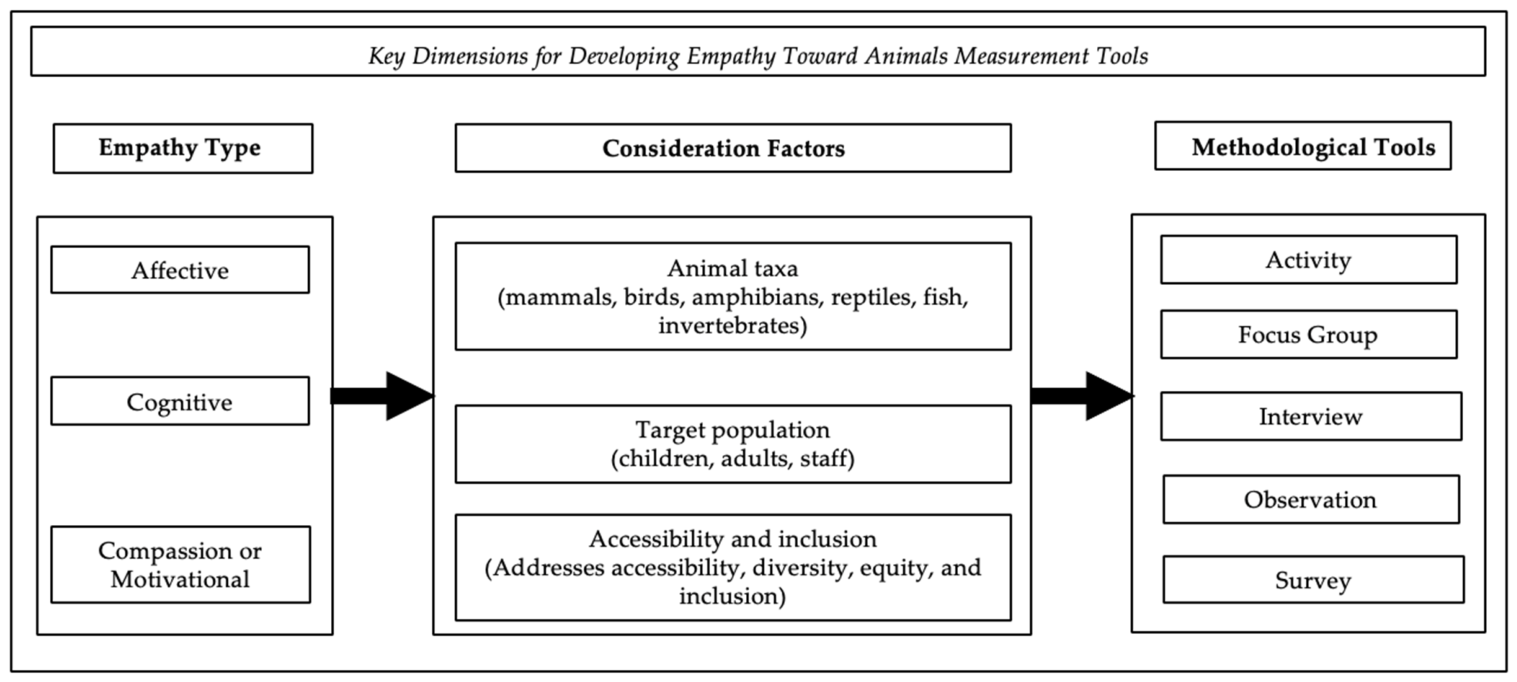
Although academic research is often motivated by the goal of informing practice, this review highlights a persistent disconnect between scholarly instrument development and the practical needs of professionals working in applied settings. Many empathy scales developed within academic contexts remain of limited utility for practitioners because they are lengthy, poorly aligned with specific target populations, insufficiently adaptable across contexts, or narrowly focused on one aspect of empathy. At the same time, practitioners often seek to leverage research to inform organizational decision-making and foster meaningful change; however, inconsistencies in measurement approaches, limited transparency in coding and analytic procedures, and uneven attention to reliability and validity complicate the interpretation of findings and raise questions about whether evidence-based changes are warranted. Bridging this divide requires sustained collaboration between academics and practitioners to develop flexible, context-sensitive instruments capable of assessing multiple types of empathy (affective, cognitive, and motivational), across animal taxa (e.g., mammals, birds, amphibians, reptiles, fish, and invertebrates), which is inclusive and reaches across age/cohort (see Figure 1). Figure 1 synthesizes key dimensions in developing empathy toward animal measurement tools. These dimensions include the type of empathy being measured (e.g., affective, cognitive, motivational), animal taxa (types or groups of animals the instrument assesses empathy toward), target populations (e.g., children, adult visitors, staff), and the consideration of accessibility and inclusion as well as the methodological tool (e.g., surveys, interviews, observations, and activity-based assessments). The figure also highlights the need for flexible multi-modal instruments capable of functioning across applied and research settings. Taken together, Figure 1 illustrates the fragmented but expanding landscape of empathy measurement toward animals, while also identifying opportunities for more integrated, cross-context assessment tools.
Instruments should use multiple methodological tools such as surveys, activities, observations. To be effective in real-world settings, such tools must be sufficiently streamlined to allow for practical implementation and interpretation, while also being supported by analytic protocols that uphold standards of validity and reliability.
In addition to their evaluative function, the instruments identified in this review offer meaningful opportunities to inform applied practice within zoos, aquariums, and conservation organizations. When used thoughtfully, the measuring of empathy toward animals can help shape educational programming, interpretive strategies, and visitor engagement efforts by clarifying which dimensions of empathy (affective, cognitive, or motivational) are most closely associated with learning outcomes, conservation-oriented attitudes, or behavioral intentions. At the organizational level, such tools may also contribute to exhibit design, staff training, and program assessment by providing insight into how different audiences engage with animals across settings and taxa. Realizing this potential, however, depends on the availability of measures that are appropriately scaled to applied contexts and accompanied by analytic guidance that supports interpretation and use. Continued collaboration between researchers and practitioners will be critical for ensuring that future assessments of empathy toward animals move beyond documentation and meaningfully inform institutional practice and conservation goals.

6. Conclusions

Over the past quarter century, researchers and practitioners have increasingly treated empathy toward animals as a consequential psychosocial factor linked to prosocial, pro-environmental, and conservation-relevant attitudes and behaviors [7,8,9,10,110]. Yet, the measurement landscape has developed in a piecemeal fashion, with instruments proliferating across disciplinary silos, settings, target populations, and focal taxa. This review addressed that gap by mapping the instruments currently in use, identifying how academic and practitioner communities have contributed to their development and deployment, and clarifying how measurement choices vary across contexts. The resulting synthesis indicates that the field is not short on tools; rather, it is short on shared measurement architecture, clear construct definitions, fit-for-purpose instrument design, and consistent evidence for reliability and validity across intended use cases. Advancing the science and practice of animal-oriented empathy measurement will therefore require coordinated instrument development grounded in theory, calibrated to real-world constraints, and evaluated with methodological rigor.
Several limitations of this review should be considered when interpreting these findings. First, our search strategy relied on a single bibliographic database (Web of Science). Although we supplemented this with practitioner-facing and professional grey literature, relevant studies and tools may exist outside the sources captured here. Second, screening was based on titles and abstracts for references to measuring empathy, sympathy, or compassion toward animals. It is therefore possible that we missed eligible work when measurement was not explicitly foregrounded in those fields. Third, the conceptual boundary between empathy, sympathy, compassion, and action-oriented responding remains contested in both scholarly and applied communities. In practice, many measures labeled as “compassion” align closely with what zoo and aquarium evaluation often operationalizes as motivational empathy. For instance, Khoury & Vergara [40] recently created a measure to assess compassion for animals (included as one of the instruments in Table 1). They argue that this is the first tool to measure compassion for animals. However, motivational empathy (also referred to as compassion) has long been measured within zoo and aquarium environments. Although they argue that their instrument is not measuring empathy, their instrument uses items that are like other tools in terms of measuring affective, cognitive, and motivational empathy. Fourth, although the ACE for Wildlife Network has a large membership base and is seen as a leader in promoting empathy in informal education animal-oriented environments, it is also likely that there are other conservation organizations outside of the Network that are using instruments to measure empathy toward animals that we are not aware of and were not included. Finally, while we catalogued reported reliability and validity information, we did not undertake a formal appraisal of the quality or appropriateness of those claims.
Taken together, these results point to a productive next phase for the field: a deliberate, collaborative program of instrument harmonization and validation that bridges academic and practitioner priorities. Such an effort should begin with explicit construct models that differentiate affective, cognitive, and motivational components; specify the animal referent with greater precision; and delineate expected pathways from empathy to outcomes across settings. From there, instrument families, not one universal scale, can be developed for different populations (children, general adults, specialized groups) and methodological tools (surveys, interviews, observations, activity-based assessments), paired with transparent protocols for coding, scoring, and interpretation. If pursued collectively, this agenda would improve replication, strengthen inferential claims, and yield measures that are both scientifically defensible and operationally useable, thereby supporting more credible evaluation, more targeted intervention design, and ultimately more effective conservation and animal care practice.

Supplementary Materials

The following supporting information can be downloaded at: https://www.mdpi.com/article/10.3390/jzbg7020022/s1, Table S1: All Recorded Studies Measuring Empathy for Animals (n = 65). Figure S1: PRISMA Chart.

Author Contributions

Conceptualization, C.T.W., K.B., M.J., T.B. and M.B.; methodology, C.T.W., K.B., M.J., T.B. and M.B.; software, C.T.W. validation, C.T.W., K.B., M.J., T.B. and M.B.; formal analysis, C.T.W., K.B., M.J., T.B. and M.B.; resources, C.T.W., K.B., M.J., T.B. and M.B.; data curation, C.T.W., K.B., M.J., T.B. and M.B.; writing—original draft preparation, C.T.W., K.B., M.J., T.B. and M.B.; writing—review and editing, C.T.W., K.B., M.J., T.B. and M.B.; visualization, C.T.W. and K.B.; supervision, C.T.W.; project administration, C.T.W., K.B., M.J., T.B. and M.B.; funding acquisition, C.T.W., M.J., T.B. and M.B. All authors have read and agreed to the published version of the manuscript.

Funding

This research was funded by a National Science Foundation Early CAREER Grant; number 2240023.

Institutional Review Board Statement

The IRB at Western Washington University was notified of the study, and it was determined that the study did not require ethical approval.

Data Availability Statement

Data are available by contacting the corresponding author.

Conflicts of Interest

The authors declare no conflicts of interest.

References

  1. Riess, H. The Science of Empathy. J. Patient Exp. 2017, 4, 74–77. [Google Scholar] [CrossRef]
  2. Batson, C.D. Empathic Concern: What It Is and Why It’s Important; Oxford University Press: Oxford, UK, 2023. [Google Scholar]
  3. Cuff, B.M.; Brown, S.J.; Taylor, L.; Howat, D.J. Empathy: A Review of the Concept. Emot. Rev. 2016, 8, 144–153. [Google Scholar] [CrossRef]
  4. Behler, A.M.C.; Berry, D.R. Closing the Empathy Gap: A Narrative Review of the Measurement and Reduction of Parochial Empathy. Soc. Personal. Psychol. Compass 2022, 16, e12701. [Google Scholar] [CrossRef]
  5. Eklund, J.H.; Meranius, M.S. Toward a Consensus on the Nature of Empathy: A Review of Reviews. Patient Educ. Couns. 2021, 104, 300–307. [Google Scholar] [CrossRef] [PubMed]
  6. Vieten, C.; Rubanovich, C.K.; Khatib, L.; Sprengel, M.; Tanega, C.; Polizzi, C.; Vahidi, P.; Malaktaris, A.; Chu, G.; Lang, A.J. Measures of Empathy and Compassion: A Scoping Review. PLoS ONE 2024, 19, e0297099. [Google Scholar] [CrossRef]
  7. Clayton, S.; Fraser, J.; Saunders, C.D. Zoo Experiences: Conversations, Connections, and Concern for Animals. Zoo Biol. Publ. Affil. Am. Zoo Aquar. Assoc. 2009, 28, 377–397. [Google Scholar] [CrossRef] [PubMed]
  8. Faner, J.M.V.; Dalangin, E.A.R.; De Leon, L.A.T.C.; Francisco, L.D.; Sahagun, Y.O.; Acoba, E.F. Pet Attachment and Prosocial Attitude toward Humans: The Mediating Role of Empathy to Animals. Front. Psychol. 2024, 15, 1391606. [Google Scholar] [CrossRef]
  9. Tam, K.-P. Dispositional Empathy with Nature. J. Environ. Psychol. 2013, 35, 92–104. [Google Scholar] [CrossRef]
  10. Wice, M.; Goyal, N.; Forsyth, N.; Noel, K.; Castano, E. The Relationship between Humane Interactions with Animals, Empathy, and Prosocial Behavior among Children. Hum.-Anim. Interact. Bull. 2020. [Google Scholar] [CrossRef]
  11. Brelsford, V.L.; Meints, K.; Gee, N.R.; Pfeffer, K. Animal-Assisted Interventions in the Classroom—A Systematic Review. Int. J. Environ. Res. Public Health 2017, 14, 669. [Google Scholar] [CrossRef]
  12. Faver, C.A. School-Based Humane Education as a Strategy to Prevent Violence: Review and Recommendations. Child. Youth Serv. Rev. 2010, 32, 365–370. [Google Scholar] [CrossRef]
  13. Zemanova, M.A.; Knight, A. The Educational Efficacy of Humane Teaching Methods: A Systematic Review of the Evidence. Animals 2021, 11, 114. [Google Scholar] [CrossRef] [PubMed]
  14. Villafaina-Domínguez, B.; Collado-Mateo, D.; Merellano-Navarro, E.; Villafaina, S. Effects of Dog-Based Animal-Assisted Interventions in Prison Population: A Systematic Review. Animals 2020, 10, 2129. [Google Scholar] [CrossRef]
  15. Whitley, C.T.; Kidder, E.N.; Ortiz, K.J.; Grauerholz, L. Sociological Animal Studies Courses Are More Effective Than Human-Centered Sociology Courses in Enhancing Empathy. Teach. Sociol. 2024, 52, 309–322. [Google Scholar] [CrossRef]
  16. Gruen, L. Entangled Empathy: An Alternative Ethic for Our Relationships with Animals; Lantern Books: New York, NY, USA, 2015. [Google Scholar]
  17. Melson, G.F.; Fine, A.H.; VonLintel, J.F. Animals in the Lives of Children. In Handbook on Animal-Assisted Therapy; Elsevier: Amsterdam, The Netherlands, 2025; pp. 301–322. [Google Scholar]
  18. Cardinale, B.J.; Duffy, J.E.; Gonzalez, A.; Hooper, D.U.; Perrings, C.; Venail, P.; Narwani, A.; Mace, G.M.; Tilman, D.; Wardle, D.A. Biodiversity Loss and Its Impact on Humanity. Nature 2012, 486, 59–67. [Google Scholar] [CrossRef]
  19. Hooper, D.U.; Adair, E.C.; Cardinale, B.J.; Byrnes, J.E.; Hungate, B.A.; Matulich, K.L.; Gonzalez, A.; Duffy, J.E.; Gamfeldt, L.; O’Connor, M.I. A Global Synthesis Reveals Biodiversity Loss as a Major Driver of Ecosystem Change. Nature 2012, 486, 105–108. [Google Scholar] [CrossRef]
  20. Ascione, F.R. Enhancing Children’s Attitudes about the Humane Treatment of Animals: Generalization to Human-Directed Empathy. Anthrozoös 1992, 5, 176–191. [Google Scholar] [CrossRef]
  21. Myers, O.G. The Significance of Children and Animals: Social Development and Our Connections to Other Species; Purdue University Press: West Lafayette, IN, USA, 2007. [Google Scholar]
  22. Cassels, T.G.; Chan, S.; Chung, W. The Role of Culture in Affective Empathy: Cultural and Bicultural Differences. J. Cogn. Cult. 2010, 10, 309–326. [Google Scholar] [CrossRef]
  23. Woolrych, T.; Eady, M.J.; Green, C.A. Authentic Empathy: A Cultural Basis for the Development of Empathy in Children. J. Humanist. Psychol. 2020, 64, 954–973. [Google Scholar] [CrossRef]
  24. Grandin, T.; Johnson, C. Animals Make Us Human: Creating the Best Life for Animals; Houghton Mifflin Harcourt: Boston, MA, USA, 2009. [Google Scholar]
  25. Plous, S. The Role of Animals in Human Society. J. Soc. Issues 1993, 49, 1–9. [Google Scholar] [CrossRef]
  26. Rault, J.-L.; Waiblinger, S.; Boivin, X.; Hemsworth, P. The Power of a Positive Human–Animal Relationship for Animal Welfare. Front. Vet. Sci. 2020, 7, 590867. [Google Scholar] [CrossRef] [PubMed]
  27. Paul, E.S. Empathy with Animals and with Humans: Are They Linked? Anthrozoös 2000, 13, 194–202. [Google Scholar] [CrossRef]
  28. Young, A.; Khalil, K.A.; Wharton, J. Empathy for Animals: A Review of the Existing Literature. Curator Mus. J. 2018, 61, 327–343. [Google Scholar] [CrossRef]
  29. Gusenbauer, M.; Haddaway, N.R. Which Academic Search Systems Are Suitable for Systematic Reviews or Meta-analyses? Evaluating Retrieval Qualities of Google Scholar, PubMed, and 26 Other Resources. Res. Synth. Methods 2020, 11, 181–217. [Google Scholar] [CrossRef] [PubMed]
  30. Maibom, H.L. Affective Empathy. In The Routledge Handbook of Philosophy of Empathy; Routledge: Abringdon, UK, 2017; pp. 22–32. [Google Scholar]
  31. Spaulding, S. Cognitive Empathy. In The Routledge Handbook of Philosophy of Empathy; Routledge: Abringdon, UK, 2017; pp. 13–21. [Google Scholar]
  32. Breyer, T. Empathy, Sympathy and Compassion. In The Routledge Handbook of Phenomenology of Emotion; Routledge: Abringdon, UK, 2020; pp. 429–440. [Google Scholar]
  33. Decety, J.; Lamm, C. The Biological Basis of Empathy. In Handbook of Neuroscience for the Behavioral Sciences; John Wiley & Sons: Hoboken, NJ, USA, 2009; pp. 940–957. [Google Scholar]
  34. Malbois, E. What Is Sympathy? Understanding the Structure of Other-Oriented Emotions. Emot. Rev. 2023, 15, 85–95. [Google Scholar] [CrossRef]
  35. Wispé, L. The Distinction between Sympathy and Empathy: To Call Forth a Concept, a Word Is Needed. J. Personal. Soc. Psychol. 1986, 50, 314. [Google Scholar] [CrossRef]
  36. Cameron, C.D. Motivating Empathy: Three Methodological Recommendations for Mapping Empathy. Soc. Personal. Psychol. Compass 2018, 12, e12418. [Google Scholar] [CrossRef]
  37. Eisenberg, N.; Miller, P.A. The Relation of Empathy to Prosocial and Related Behaviors. Psychol. Bull. 1987, 101, 91. [Google Scholar] [CrossRef]
  38. Mehrabian, A.; Epstein, N. A Measure of Emotional Empathy. J. Personal. 1972, 40, 525–543. [Google Scholar] [CrossRef] [PubMed]
  39. Weisz, E.; Zaki, J. Motivated Empathy: A Social Neuroscience Perspective. Curr. Opin. Psychol. 2018, 24, 67–71. [Google Scholar] [CrossRef] [PubMed]
  40. Khoury, B.; Vergara, R.C. Compassion Questionnaire for Animals: Scale Development and Validation. J. Environ. Psychol. 2024, 100, 102470. [Google Scholar] [CrossRef]
  41. Hogan, R. Development of an Empathy Scale. J. Consult. Clin. Psychol. 1969, 33, 307–316. [Google Scholar] [CrossRef] [PubMed]
  42. Mehrabian, A. Pleasure-Arousal-Dominance: A General Framework for Describing and Measuring Individual Differences in Temperament. Curr. Psychol. 1996, 14, 261–292. [Google Scholar] [CrossRef]
  43. Davis, J.F. Representation Matters: An Illustrated History of Race and Ethnicity in Advertising. Advert. Soc. Q. 2020, 21, 1–22. [Google Scholar] [CrossRef]
  44. Davis, M.H. A Multidimensional Approach to Individual Differences in Empathy. JSAS Cat. Sel. Doc. Psychol. 1980, 10, 85. [Google Scholar]
  45. Davis, M.H.; Luce, C.; Kraus, S.J. The Heritability of Characteristics Associated with Dispositional Empathy. J. Personal. 1994, 62, 369–391. [Google Scholar] [CrossRef]
  46. Baron-Cohen, S.; Wheelwright, S. The Empathy Quotient: An Investigation of Adults with Asperger Syndrome or High Functioning Autism, and Normal Sex Differences. J. Autism Dev. Disord. 2004, 34, 163–175. [Google Scholar] [CrossRef] [PubMed]
  47. Jolliffe, D.; Farrington, D.P. Development and Validation of the Basic Empathy Scale. J. Adolesc. 2006, 29, 589–611. [Google Scholar] [CrossRef]
  48. Watson, D.; Clark, L.A.; Tellegen, A. Development and Validation of Brief Measures of Positive and Negative Affect: The PANAS Scales. J. Personal. Soc. Psychol. 1988, 54, 1063–1070. [Google Scholar] [CrossRef]
  49. Whitley, C.T. Empathy Cafe: Using Animal Portraiture to Activate Emotional Affect. In Proceedings of the Seattle Aquarium Empathy Cafe, Seattle, WA, USA, April 2022. [Google Scholar]
  50. Batson, C.D. The Altruism Question: Toward a Social-Psychological Answer; Psychology Press: London, UK, 2014. [Google Scholar]
  51. Batson, C.D.; Polycarpou, M.P.; Harmon-Jones, E.; Imhoff, H.J.; Mitchener, E.C.; Bednar, L.L.; Klein, T.R.; Highberger, L. Empathy and Attitudes: Can Feeling for a Member of a Stigmatized Group Improve Feelings toward the Group? J. Personal. Soc. Psychol. 1997, 72, 105. [Google Scholar] [CrossRef]
  52. Bryant, B.K. An Index of Empathy for Children and Adolescents. Child Dev. 1982, 53, 413–425. [Google Scholar] [CrossRef]
  53. Dadds, M.R.; Hunter, K.; Hawes, D.J.; Frost, A.D.; Vassallo, S.; Bunn, P.; Merz, S.; Masry, Y.E. A Measure of Cognitive and Affective Empathy in Children Using Parent Ratings. Child Psychiatry Hum. Dev. 2008, 39, 111–122. [Google Scholar] [CrossRef]
  54. Garton, A.F.; Gringart, E. The Development of a Scale to Measure Empathy in 8-and 9-Year Old Children. Aust. J. Educ. Dev. Psychol. 2005, 5, 17–25. [Google Scholar]
  55. Funk, J.; Fox, C.; Chan, M.; Curtiss, K. Children’s Empathic Attitudes Questionnaire. J. Appl. Dev. Psychol. 2008, 29, 187–196. [Google Scholar] [CrossRef]
  56. Poresky, R.H. The Young Children’s Empathy Measure: Reliability, Validity and Effects of Companion Animal Bonding. Psychol. Rep. 1990, 66, 931–936. [Google Scholar] [CrossRef]
  57. Herzog, H.; Grayson, S.; McCord, D. Brief Measures of the Animal Attitude Scale. Anthrozoös 2015, 28, 145–152. [Google Scholar] [CrossRef]
  58. Herzog, J.; Harold, A.; Betchart, N.S.; Pittman, R.B. Gender, Sex Role Orientation, and Attitudes toward Animals. Anthrozoös 1991, 4, 184–191. [Google Scholar] [CrossRef]
  59. Dijkstra Klaasse, A.V.; Janssens, M.R.; Salvatori, D.C. Pet, Pest, Profit: Patient! How Attitudes Toward Animals Among Veterinary Students in the Netherlands Differ According to Animal Categories and Student-Related Variables. Animals 2025, 15, 2222. [Google Scholar] [CrossRef] [PubMed]
  60. Taylor, N.; Signal, T.D. Pet, Pest, Profit: Isolating Differences in Attitudes towards the Treatment of Animals. Anthrozoös 2009, 22, 129–135. [Google Scholar] [CrossRef]
  61. Mallet, P.; Vignoli, E. Two Emotional Roots of Youths’ Earth-Friendly Career Aspirations: Eco-Anxiety and Empathy Toward Animals. J. Career Dev. 2025, 52, 696–718. [Google Scholar] [CrossRef]
  62. Johnson, T.P.; Garrity, T.F.; Stallones, L. Psychometric Evaluation of the Lexington Attachment to Pets Scale (LAPS). Anthrozoös 1992, 5, 160–175. [Google Scholar] [CrossRef]
  63. Templer, D.I.; Connelly, H.J.; Bassman, L.; Hart, J. Construction and Validation of an Animal-Human Continuity Scale. Soc. Behav. Personal. Int. J. 2006, 34, 769–776. [Google Scholar] [CrossRef]
  64. Signal, T.D.; Taylor, N. Attitude to Animals and Empathy: Comparing Animal Protection and General Community Samples. Anthrozoös 2007, 20, 125–130. [Google Scholar] [CrossRef]
  65. Singh, V.K.; Singh, P.; Karmakar, M.; Leta, J.; Mayr, P. The Journal Coverage of Web of Science, Scopus and Dimensions: A Comparative Analysis. Scientometrics 2021, 126, 5113–5142. [Google Scholar] [CrossRef]
  66. ACE for Wildlife Network Empathy Reources. Available online: https://www.aceforwildlife.org/ (accessed on 1 December 2023).
  67. Powell, G.M. The Role of Individual Differences and Involvement on Attitudes Toward Animal Welfare. Master’s Thesis, Kansas State University, Manhattan, KS, USA, 2010. [Google Scholar]
  68. Martins, C.D.; Vergara, R.C.; Khoury, B. Internal and External Validation of the Empathy Toward Animals Scale. Anthrozoös 2025, 38, 131–152. [Google Scholar] [CrossRef]
  69. Whitley, C.T.; Kalof, L.; Urquhart, L.; Tatem, N.; Mair, M.; Ankoudinova, K.; Haight, I.; Meglathery, E.; Worden, M.; Wilkinson, D. Photo Portraiture Enhances Empathy for Birds with Potential Benefits for Conservation and Sustainability. Sustainability 2025, 17, 8833. [Google Scholar] [CrossRef]
  70. Joshi, A.; Kale, S.; Chandel, S.; Pal, D.K. Likert Scale: Explored and Explained. Br. J. Appl. Sci. Technol. 2015, 7, 396–403. [Google Scholar] [CrossRef]
  71. Okutan, N. Development of the Animal Empathy Scale Short Form. Psikiyatr. Güncel Yaklaşımlar 2023, 15, 177–191. [Google Scholar] [CrossRef]
  72. Luebke, J.F. Zoo Exhibit Experiences and Visitors’ Affective Reactions: A Preliminary Study. Curator Mus. J. 2018, 61, 345–352. [Google Scholar] [CrossRef]
  73. Westbury, H.R.; Neumann, D.L. Empathy-Related Responses to Moving Film Stimuli Depicting Human and Non-Human Animal Targets in Negative Circumstances. Biol. Psychol. 2008, 78, 66–74. [Google Scholar] [CrossRef]
  74. Małecki, W.; Pawłowski, B.; Sorokowski, P.; Oleszkiewicz, A. Feeling for Textual Animals: Narrative Empathy across Species Lines. Poetics 2019, 74, 101334. [Google Scholar] [CrossRef]
  75. Davis, M.H. Measuring Individual Differences in Empathy: Evidence for a Multidimensional Approach. J. Personal. Soc. Psychol. 1983, 44, 113–126. [Google Scholar] [CrossRef]
  76. Peñaherrera-Aguirre, M.; Figueredo, A.J.; Steklis, N.G.; Salmon, C. The Role of Cross-Species Relative Brain Size Variation and Time since Domestication in Explaining Human Empathy towards Domesticated Mammals. Personal. Indiv. Diff. 2023, 200, 111914. [Google Scholar] [CrossRef]
  77. Figueredo, A.J.; Steklis, N.G.; Peñaherrera-Aguirre, M.; Fernandes, H.B.F.; Cabeza de Baca, T.; Salmon, C.; Hernández-Chaves, M.G.; Araya, S.F.A.; Pérez-Ramos, M.; Frías-Armenta, M. The Adapa Tablets and the Tuxtla Glyphs: Coevolution between Human and Nonhuman Animals. Evol. Psychol. Sci. 2022, 8, 316–332. [Google Scholar] [CrossRef]
  78. Arluke, A.; Levine, J. Are People More Disturbed by Dog or Human Suffering? The Influence of Victim’s Species and Age. Soc. Anim. 2017, 25, 1–16. [Google Scholar]
  79. Batson, C.D. Prosocial Motivation: Is It Ever Truly Altruistic? Adv. Exp. Soc. Psychol. 1987, 20, 65–122. [Google Scholar]
  80. Alleyne, E.; Parfitt, C. Factors That Distinguish Aggression toward Animals from Other Antisocial Behaviors: Evidence from a Community Sample. Agg. Behav. 2018, 44, 481–490. [Google Scholar] [CrossRef]
  81. Gupta, M.E. Animal Abuse and Callousness: Predicting Frequency and Severity of Partner-Directed Aggression in Men. Master’s Thesis, University of Georgia, Athens, GA, USA, May 2003. [Google Scholar]
  82. Minarchek, M.J.; Skibins, J.C.; Luebke, J.F. The Impact of Interpretive Messaging and Animal Handling on Visitors’ Perceptions of Animal Welfare and Empathic Reactions. J. Interpret. Res. 2021, 26, 24–42. [Google Scholar] [CrossRef]
  83. Mast, F.; Zhao, L.; Maldonado, L. Instrument Development and Validation for Conservation Learning: A Tool for More Rigorous Research and Evaluation. Curator Mus. J. 2018, 61, 367–383. [Google Scholar] [CrossRef]
  84. Xu, K.; Ou, Q.; Xue, H.; Luo, D.; Zhang, S.; Xu, Y. Traditional Pettism: The Influence of Pet Ownership Status, Pet Type, and Pet Properties on Pet Moral Standing. Acta Psychol. Sin. 2023, 55, 1662. [Google Scholar] [CrossRef]
  85. Ghasemi, B.; Kyle, G.T. Toward Moral Pathways to Motivate Wildlife Conservation. Biol. Conserv. 2021, 259, 109170. [Google Scholar] [CrossRef]
  86. Daly, B.; Morton, L. Empathic Differences in Men Who Witnessed Animal Abuse: “Dissociation Effect” Between Cognitive and Affective Empathy. Soc. Anim. 2018, 26, 1–12. [Google Scholar] [CrossRef]
  87. Fitzpatrick, R.; Romanò, N.; Menzies, J. Exploring Compassion towards Laboratory Animals in UK-and China-Based Undergraduate Biomedical Sciences Students. Animals 2023, 13, 3584. [Google Scholar] [CrossRef]
  88. Woodland Park Zoo; Point Defiance Zoo & Aquarium; Seattle Aquarium. Empathy Towards Animals: Pre/Post Protocol and Instruments; Measuring Empathy Collaborative Assessment Project (MECAP): Washington, DC, USA, 2019. [Google Scholar]
  89. Burmeister, A.-K.; Drasch, K.; Rinder, M.; Prechsl, S.; Peschel, A.; Korbel, R.; Saam, N.J. Development and Application of the Owner-Bird Relationship Scale (OBRS) to Assess the Relation of Humans to Their Pet Birds. Front. Vet. Sci. 2020, 7, 575221. [Google Scholar] [CrossRef]
  90. Whitley, C.T.; Kalof, L.; Flach, T. Using Animal Portraiture to Activate Emotional Affect. Environ. Behav. 2021, 53, 837–863. [Google Scholar] [CrossRef]
  91. Hanna, D.; Sneddon, I.; Beattie, V. The Relationship between the Stockperson’s Personality and Attitudes and the Productivity of Dairy Cows. Animals 2009, 3, 737–743. [Google Scholar] [CrossRef]
  92. Breuer, K.; Hemsworth, P.H.; Barnett, J.L.; Matthews, L.R.; Coleman, G.J. Behavioural Response to Humans and the Productivity of Commercial Dairy Cows. Appl. Anim. Behav. Sci. 2000, 66, 273–288. [Google Scholar] [CrossRef]
  93. Calderón-Amor, J.; Luna-Fernández, D.; Tadich, T. Study of the Levels of Human–Human and Human–Animal Empathy in Veterinary Medical Students from Chile. J. Vet. Med. Educ. 2017, 44, 179–186. [Google Scholar] [CrossRef] [PubMed]
  94. Camilleri, L.; Gill, P.R.; Jago, A. The Role of Moral Disengagement and Animal Empathy in the Meat Paradox. Personal. Indiv. Diff. 2020, 164, 110103. [Google Scholar] [CrossRef]
  95. Cardoso, S.D.; Faraco, C.B.; de Sousa, L.; Pereira, G.D.G. Empathy with Humans and with Non-Human Animals: Are There Differences between Individuals Who Have Adopted and Those Who Have Relinquished a Pet? J. Vet. Behav. 2022, 49, 46–52. [Google Scholar] [CrossRef]
  96. Colombo, E.S.; Crippa, F.; Calderari, T.; Prato-Previde, E. Empathy toward Animals and People: The Role of Gender and Length of Service in a Sample of Italian Veterinarians. J. Vet. Behav. 2017, 17, 32–37. [Google Scholar] [CrossRef]
  97. Ellingsen, K.; Zanella, A.J.; Bjerkås, E.; Indrebø, A. The Relationship between Empathy, Perception of Pain and Attitudes toward Pets among Norwegian Dog Owners. Anthrozoös 2010, 23, 231–243. [Google Scholar] [CrossRef]
  98. Gaspar, A.; Esteves, F. Empathy Development from Adolescence to Adulthood and Its Consistency across Targets. Front. Psychol. 2022, 13, 936053. [Google Scholar] [CrossRef]
  99. Rothgerber, H.; Mican, F. Childhood Pet Ownership, Attachment to Pets, and Subsequent Meat Avoidance. The Mediating Role of Empathy toward Animals. Appetite 2014, 79, 11–17. [Google Scholar] [CrossRef]
  100. Taylor, H.; Williams, P.; Gray, D. Homelessness and Dog Ownership: An Investigation into Animal Empathy, Attachment, Crime, Drug Use, Health and Public Opinion. Anthrozoös 2004, 17, 353–368. [Google Scholar] [CrossRef]
  101. Devlin, S.; Ogle, B. Examining How a General Audience Rates Herptile Welfare in Zoos. J. Zoo Aquar. Res. 2022, 10, 101–106. [Google Scholar]
  102. Blizard, C.R.; Schuster, R.M. Fostering Children’s Connections to Natural Places through Cultural and Natural History Storytelling. Child. Youth Environ. 2007, 17, 171–206. [Google Scholar] [CrossRef]
  103. Leon, A.F.; Sanchez, J.A.; Romero, M.H. Association between Attitude and Empathy with the Quality of Human-Livestock Interactions. Animals 2020, 10, 1304. [Google Scholar] [CrossRef]
  104. Wilson, J.K.; Nageotte, N.L.; Pletcher, N. Evoking Empathy—An Overlooked Role of Animal Statues in Zoos. Zoo Biol. 2022, 41, 418–424. [Google Scholar] [CrossRef] [PubMed]
  105. Woodland Park Zoo; Point Defiance Zoo & Aquarium; Seattle Aquarium Measuring Empathy: Collaborative Assessment Project (MECAP). Available online: https://informalscience.org/project/measuring-empathy-collaborative-assessment-project/ (accessed on 10 October 2024).
  106. Nunnally, J.C. Psychological Theory, 2nd ed.; McGraw Hill: New York, NY, USA, 1978. [Google Scholar]
  107. Lombard, M.; Snyder-Duch, J.; Bracken, C.C. Content Analysis in Mass Communication: Assessment and Reporting of Intercoder Reliability. Hum. Commun. Res. 2002, 28, 587–604. [Google Scholar] [CrossRef]
  108. O’Connor, C.; Joffe, H. Intercoder Reliability in Qualitative Research: Debates and Practical Guidelines. Int. J. Qual. Methods 2020, 19, 1–13. [Google Scholar] [CrossRef]
  109. IUCN. The IUCN Red List of Threatened Species. Available online: https://www.iucnredlist.org/ (accessed on 23 August 2024).
  110. Myers, O.E., Jr.; Saunders, C.D.; Garrett, E. What Do Children Think Animals Need? Developmental Trends. Environ. Educ. Res. 2004, 10, 545–562. [Google Scholar] [CrossRef]
Figure 1. Key dimensions and methodological considerations involved in the development of instruments used to assess empathy toward animals across academic and practitioner contexts.
Jzbg 07 00022 g001
Disclaimer/Publisher’s Note: The statements, opinions and data contained in all publications are solely those of the individual author(s) and contributor(s) and not of MDPI and/or the editor(s). MDPI and/or the editor(s) disclaim responsibility for any injury to people or property resulting from any ideas, methods, instructions or products referred to in the content.