
Brief Report

Breeding Behaviors of the Endangered Prairie Butterfly Oarisma poweshiek (Lepidoptera: Hesperiidae) in Relation to Environmental Factors in an Ex Situ Conservation Setting

1
Conservation Department, Minnesota Zoo, Apple Valley, MN 55124, USA
2
Department of Fisheries, Wildlife and Conservation Biology, University of Minnesota, Saint Paul, MN 55108, USA
*
Author to whom correspondence should be addressed.
J. Zool. Bot. Gard. 2026, 7(1), 10; https://doi.org/10.3390/jzbg7010010
Submission received: 11 December 2025 / Revised: 15 January 2026 / Accepted: 27 January 2026 / Published: 2 February 2026

Abstract

The Poweshiek skipperling Oarisma poweshiek (Parker, 1870) (Lepidoptera: Hesperiidae) is an endangered prairie obligate butterfly native to the north central United States and southern Canada. Conservation efforts for this species rely on ex situ approaches for population augmentation and reintroductions. As such, improving our understanding of the behaviors of Poweshiek skipperlings and maximizing their reproductive output in an ex situ setting are critical for the success of associated conservation initiatives. In this study, we examined the frequency of breeding behaviors exhibited by Poweshiek skipperlings in relation to various environmental factors: sunlight intensity (measured in lux), ambient temperature, and age. Sunlight intensity was a significant predictor of breeding behavior frequency, but we did not detect an effect of ambient temperature on breeding behavior. We also documented a generally negative relationship between age and breeding behavior frequency for both sexes. The results of our study underscore the importance of natural sunlight in encouraging breeding behaviors in an ex situ conservation environment. Ex situ observations also can help identify environmental conditions that promote high levels of Poweshiek skipperling activity, which could be used to optimize the timing of in situ population surveys.

1. Introduction

Conservation-centered managed rearing and breeding (ex situ) programs are increasingly recognized as key tools to support the recovery of Lepidopterans in the USA [1,2,3]. For instance, population reinforcement and reintroduction programs to help stabilize depleted populations and reestablish extirpated sites are derived from ex situ populations and have been identified as a need to achieve recovery of the globally Critically Endangered [4] Poweshiek skipperling (Oarisma poweshiek) (Parker, 1870) (Lepidoptera: Hesperiidae) [5,6,7]. This prairie obligate butterfly, native to the north central United States and southern Canada, has experienced rapid declines over the past several decades, and is extirpated from more than 99% of its known historic locations [8,9]. It is listed as Endangered in the United States [10] and Canada [11].
Given that ex situ conservation tools are central to ongoing restoration efforts benefitting Poweshiek skipperlings, it is important to understand their reproductive behaviors in a captive setting to maximize reproductive potential. We can also leverage these ex situ actions to expand our species-specific knowledge when such details are lacking and otherwise difficult to study in situ for endangered species [12]. For instance, sunlight plays an important role in thermoregulation and vision for butterflies. Butterflies absorb heat from solar radiation to increase their thoracic temperature above the threshold for autonomous flight [13,14,15,16]. Flight frequency, in turn, can affect both mating frequency and host finding behavior, therefore increasing reproductive success [15,17,18]. Autonomous flight and vision also can influence reproductive success indirectly. A previous study conducted with European skippers Thymelicus lineola (Ochsenheimer, 1808) (Lepidoptera: Hesperiidae) observed that males always flew and never walked to perched females, likely relying on visual cues to locate mates [19]. Understanding the relationship between sunlight intensity and breeding behaviors is critical for ex situ conservation programs targeting imperiled Lepidopterans.
In this study, we examined the frequency of breeding behaviors of Poweshiek skipperlings in relation to sunlight intensity, measured in lux, and ambient temperature. Due to the importance of sunlight for butterfly behavior documented elsewhere, we hypothesized a positive relationship between sunlight intensity and breeding behavior frequency. Since butterflies absorb heat from solar radiation, not ambient air, we further hypothesized there would be weaker and non-linear associations between temperature and breeding behavior frequency, with breeding behaviors peaking at an optimal temperature and dropping off on either side of this optimal temperature. We also explored how the age of males and females affected breeding behavior frequency.

2. Materials and Methods

We leveraged the Minnesota Zoo’s large ex situ population of Poweshiek skipperlings that serves as conservation insurance and as a source for wild population augmentations and reintroductions, e.g., [7,20]. All butterflies utilized in this experiment were reared and maintained following established husbandry protocols developed by the Minnesota Zoo’s Pollinator Conservation Initiative. Activities were authorized under the U.S. Fish and Wildlife Service Native Endangered and Threatened Species Recovery Permit ES64079B and the State of Minnesota Special Permit 32847.
Between 2 July and 10 July 2023, we set up a total of 10 breeding cages outside, with one male and one female Poweshiek skipperling in each. Our sample size was constrained by the authorizing permits, breeding recommendations and a limited number of individuals that were not designated for concurrent conservation translocations into the wild. Once a pair mated, the female was placed into a separate cage for oviposition and retired from the experiment, and the male was paired with a new female, if possible. If a male died before it mated, the remaining female was paired with a new male. The fine mesh pop-up breeding cages measured 30.48 cm on each side and contained a 10.16 cm pot of prairie dropseed grass and a plastic cup holding flower cuttings as a nectar source, which were replaced daily (Figure S1). We used a HOBO model MX2202 data logger (Onset, Bourne, MA, USA) that was set up inside of a breeding cage to collect sunlight intensity data every minute. We deployed and planned to integrate ambient temperature data from a temperature probe set up inside a breeding cage, but due to equipment malfunction, we instead utilized ambient temperature data from a nearby Weather Underground station (The Weather Company, LLC, Brookhaven, GA, USA), station KMNAPPLE108, for our analyses.
Every day, we observed up to five cages at a time from approximately 9:00 to 17:00 and documented every time we observed breeding behaviors. Additionally, we collected general behavioral data every five minutes to document each individual’s behavior at that moment to develop a behavioral time budget. One of the breeding behaviors we looked for was male abdominal J’ing, which is when a male curves its abdomen towards a female and extends its claspers [19]. Additional breeding behaviors included male wing flicks, female wing vibrations when the male was near (suggesting receptivity), and actual mating. The non-breeding behaviors we observed included flying, perching, nectaring, and one observation of oviposition. Behaviors were either categorized as 1 (breeding behaviors as defined above) or 0 (other, non-breeding behaviors).
We analyzed the data using R Version 4.4.1 [21]. We counted the number of breeding behaviors in 5 min intervals, and assumed, conditional on random intercepts associated with each individual, that the number of breeding behaviors followed a Negative Binomial distribution:
Y i , t | τ i Negative   Binomial μ i , t , θ
l o g μ i , t = β 0 + β 1 Sunlight i , t + β 1 Temperature i , t + β 3 Temperature i , t 2 + τ i
τ i N 0 , σ τ 2
where Y i , t gives the number of breeding behaviors for individual i during interval t, μ i , t and θ are mean and overdispersion parameters of the Negative Binomial distribution, respectively, β 0 ,   β 1 ,     β 2 and   β 3 are regression parameters relating the mean (i.e., expected count) to the mean sunlight intensity and temperature associated with each observation interval, and τ i are Normally distributed random intercepts associated with each interval. We considered a non-linear effect of temperature, as we expected breeding behavior frequency to peak at an optimal temperature value and to decrease on either side of that optimal temperature. We scaled the sunlight intensity predictor prior to analysis to improve numerical stability [22]. We fit models separately for males and females, as some of the breeding behaviors were sex-specific (i.e., abdominal J’ing and wing flicks being unique to males, wing vibrations being unique to females). We used the glmmTMB package for model fitting [23,24], and we performed model diagnostic checking using the performance package [25] and the DHARMa package [26]. Additionally, we tested for temporal autocorrelation in the residuals using the DHARMa package [26]. We created effect plots using the ggeffects package [26] to visualize relationships between the explanatory variables and the expected number of breeding behaviors. We also conducted null hypothesis tests using the ‘Anova’ function in the car package [27].
We examined associations between age and breeding behavior frequency by plotting the mean number of breeding behaviors and their 95% confidence intervals exhibited by each age group for males and females using ggplot2 [28]. We note that we did not use any day 0 males in this experiment due to previous ex situ observations of males not demonstrating any breeding behaviors on the same day as they eclosed (ER, CN pers. obs.).

3. Results

We collected data from 10 breeding cages using a total of 14 males and 11 females, resulting in 5154 behavioral observations. 66 of these were classified as breeding behaviors (Table 1).
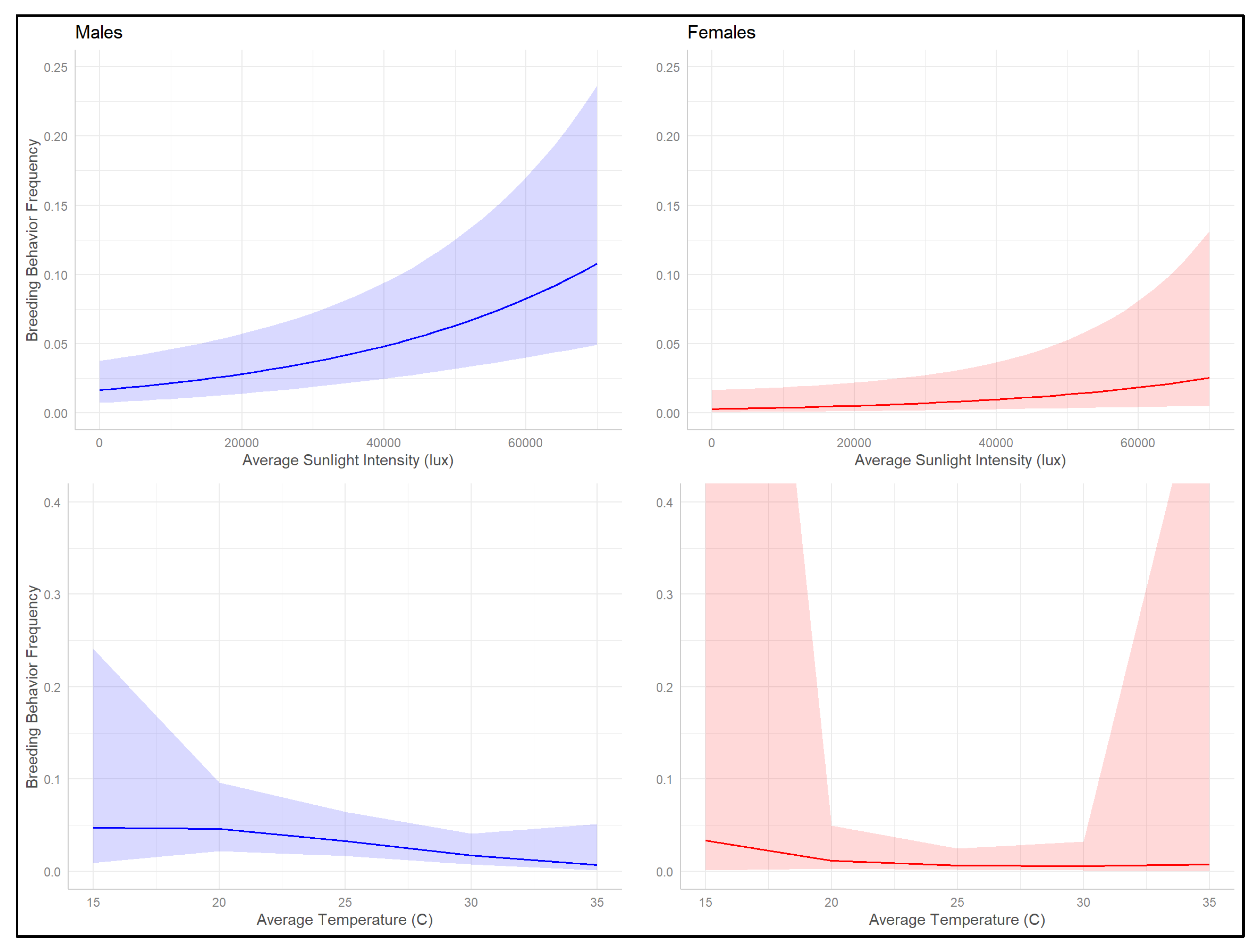
Residual diagnostic plots largely suggest model assumptions were reasonable and appropriate, and there was little evidence of autocorrelation in the residuals [29]. We observed a significant positive association between sunlight intensity and breeding behavior frequency for both males and females (Males: χ 1 2 (Wald Chi-square test) = 16.77, p-value < 0.0001; Females: χ 1 2 = 3.95, p-value = 0.047) (Figure 1). Neither males nor females reacted strongly to ambient temperature (Males: χ 1 2 = 5.08, p-value = 0.079; Females: χ 1 2 = 1.08, p-value = 0.58) (Figure 1).
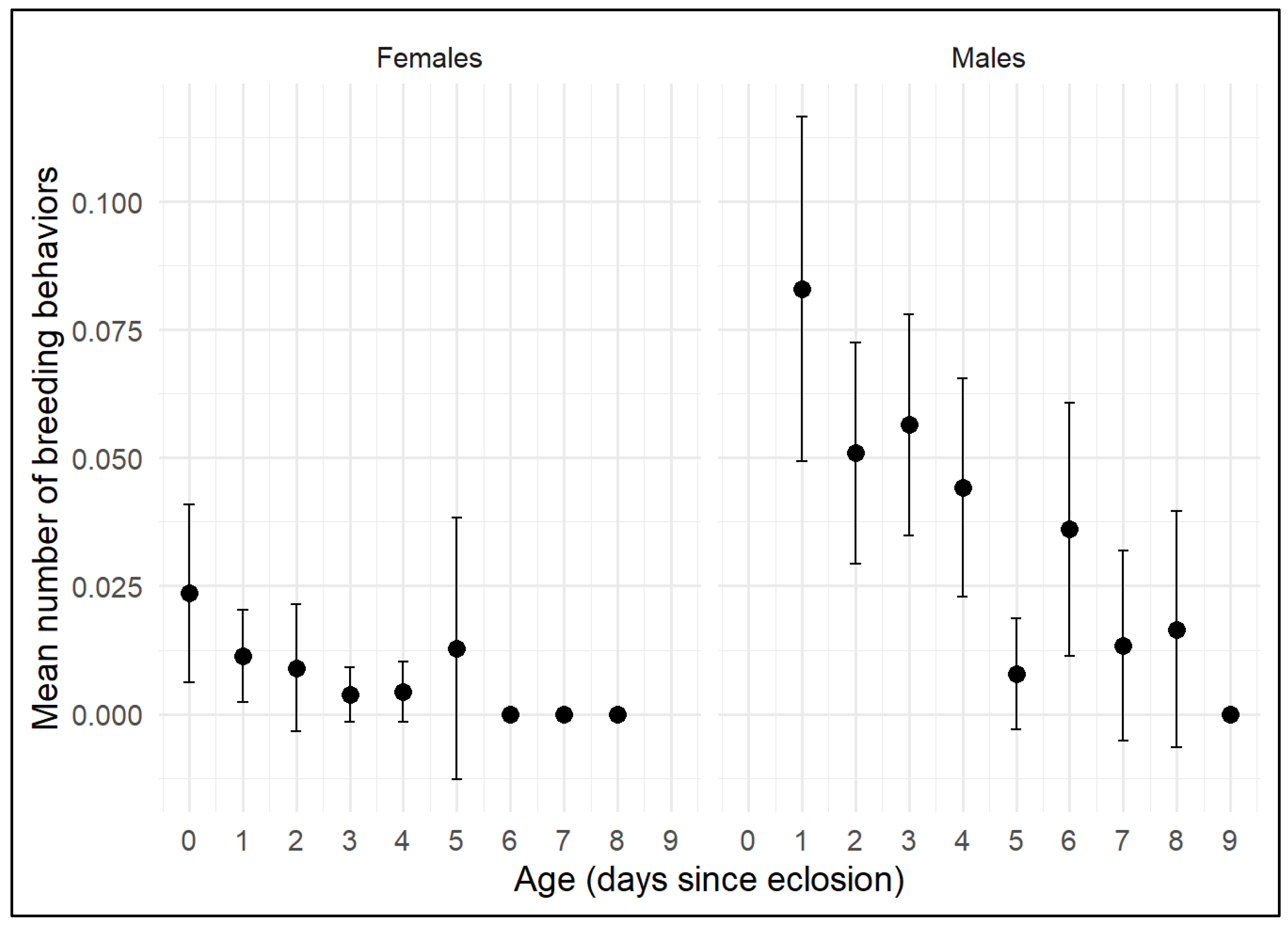
We documented that breeding behavior frequency declined with increasing age for both sexes (Figure 2), particularly with males who exhibited more frequent breeding behaviors at young ages than females.

4. Discussion

We observed a significant positive association between sunlight intensity and breeding behavior frequency for both males and females (Figure 1). This suggests that, at least in an ex situ setting, brighter conditions are ideal for maximizing Poweshiek skipperling breeding behavior frequency. We note, however, that the data loggers used in our study measured sunlight intensity in lux, which does not measure the full range of butterfly vision. We elected to use these tools as they are easily accessible by other husbandry practitioners and can be used to conduct similar studies with other species.
Liao et al. demonstrated that an increase in sunlight intensity ultimately led to an increase in mating success, and they suggest that it may be possible to regulate butterfly reproduction by controlling light intensity [18]. From an ex situ conservation standpoint, it would be advantageous to replicate light conditions conductive to maximizing butterfly breeding behaviors. However, as noted above, natural light conditions relating to intensity, spectral composition, and the UV environment all contribute to various breeding, oviposition, and mate selection behaviors [30,31,32,33,34] and may not be replicated perfectly by artificial light. Additionally, we have previously observed that Poweshiek skipperlings have failed to mate under artificial UV lighting conditions, perhaps due to a lack of certain components present in natural sunlight [35]. With our current technology, it may be difficult to replicate the effects that natural sunlight has on butterfly behavior, but the results of this study point to the importance of providing ample natural sunlight to encourage breeding behaviors in an ex situ conservation environment to maximize reproductive success. Future studies could explore how artificial visible light conditions affect Poweshiek skipperling breeding behaviors differently than artificial UV lighting conditions.
We did not detect an association between breeding behaviors and temperature for males or females (Figure 1). However, differences between thermal conditions inside the breeding cages and thermal conditions recorded by the Weather Underground station from which we pulled temperature data may have limited our ability to detect biologically meaningful relationships. Despite the weak statistical evidence to support an association between ambient temperature and breeding behavior frequency, we observed that the skippers were perched and largely inactive during the hottest parts of the day and were most active when the temperature was less extreme. The 2023 summer in Minnesota brought especially high temperatures, and in a few instances, we needed to halt observations and bring the breeding cages into cooler, more shaded areas for the safety of the skippers. Additionally, it should be noted that our study period did not include low daytime temperatures, which may have limited our ability to discover a drop off in breeding behavior frequency at low temperature values. Our results emphasize the importance of managing heat conditions appropriately, as hotter conditions not only could yield a decrease in breeding behavior activity but could also result in unnecessary stress for the animals. In an ex situ setting, it is possible to control the temperature that skippers experience, to an extent, to avoid heat-related stress or mortality, and to encourage more activity to promote breeding behaviors and maximize reproductive potential.
Only 66 of the 5154 behavioral observations were classified as breeding behaviors (Table 1). While this reflects the natural rarity of these behaviors, such a low event frequency can reduce sensitivity to detect weaker effects, such as those related to temperature. We recommend future studies to further analyze the potential effects of ambient temperature on breeding behavior frequency of Poweshiek skipperlings in an ex situ setting. Additionally, we acknowledge that courtship activity (i.e., male abdominal J’ing) is not the same as realized reproduction (mating), but due to our limited sample size, we did not have sufficient data to assess only realized reproduction in relation to sunlight intensity and ambient temperature in a modeling framework. However, assessing all courtship activity and realized reproduction allows us to gain a better understanding of the levels of Poweshiek skipperling activity in an ex situ setting and conditions ideal for maximizing reproductive potential.
We further note that other environmental factors, such as relative humidity, may also impact breeding behavior frequency of Poweshiek skipperlings in an ex situ setting. Future work could explore environmental variables other than sunlight intensity or ambient temperature in relation to Poweshiek skipperling breeding behavior frequency.
Both males and females tended to exhibit fewer breeding behaviors with increasing age (Figure 2). The trends we observed in this study are preliminary, and future work should look at how age may affect the likelihood to breed in Poweshiek skipperlings, but our initial results suggest that pairings should target young adults (such as Day 1 males and Day 0 females) to maximize the reproductive potential of these endangered butterflies. Maximizing the reproductive potential of the globally Critically Endangered Poweshiek skipperling in ex situ conservation settings is vital to its recovery so that we can produce as many individuals as possible for sustainable insurance populations and releases back into the wild. Studying their behaviors in an ex situ environment can also shed light on how these butterflies may behave in the wild, which can inform in situ work such as ideal conditions for conducting surveys to assess the status of wild populations.

Supplementary Materials

The following supporting information can be downloaded at: https://www.mdpi.com/article/10.3390/jzbg7010010/s1, Figure S1: The experimental cage setup. Each cage contained one male and one female Poweshiek skipperling. Flower cuttings and potted prairie dropseed grass were provided as nectar and perching sources. A data logger recording light intensity was set up inside one of the breeding cages. Table S1: The number of individuals that contributed to each age category. Age is defined as number of days since eclosion.

Author Contributions

Conceptualization, A.T., E.R. and C.N.; methodology, A.T., E.R. and C.N.; formal analysis, A.T. and J.F.; investigation, A.T., E.R. and C.N.; resources, E.R., C.N. and S.S.; data curation, A.T. and J.F.; writing—original draft preparation, A.T.; writing—review and editing, J.F., E.R., C.N. and S.S.; visualization, A.T. and J.F.; supervision, S.S.; project administration, S.S.; funding acquisition, E.R. All authors have read and agreed to the published version of the manuscript.

Funding

This research was funded by the Great Lakes Restoration Initiative through the U.S. Fish and Wildlife Service’s Threatened and Endangered Species Template and the Minnesota Zoo and Minnesota Zoo Foundation. J.F. received partial salary support from the Minnesota Agricultural Experimental Station.

Data Availability Statement

The original data presented in the study are openly available in the Data Repository for the University of Minnesota (DRUM) at https://doi.org/10.13020/hrvr-qv93.

Acknowledgments

The present work was part of AT’s undergraduate honors thesis at the University of Minnesota, Twin Cities. We thank Emilie Snell-Rood with the University of Minnesota for sharing useful literature resources and insightful comments on early versions of this manuscript. Additional support for husbandry operations was provided by Katherine Molina and Isabella Maiwurm.

Conflicts of Interest

The authors declare no conflicts of interest.

References

  1. Crone, E.E.; Pickering, D.; Schultz, C.B. Can captive rearing promote recovery of endangered butterflies? An assessment in the face of uncertainty. Biol. Conserv. 2007, 139, 103–112. [Google Scholar] [CrossRef]
  2. Schultz, C.B.; Russel, C.; Wynn, L. Restoration, Reintroduction, and captive Propagation for at-risk Butterflies: A review of British and American Conservation Efforts. Isr. J. Ecol. 2008, 54, 41–61. [Google Scholar] [CrossRef]
  3. Grow, S.; Allard, R.; Luke, D. The role of AZA-accredited zoos and aquariums in butterfly conservation. In Butterfly Conservation in North America: Efforts to Help Save Our Charismatic Microfauna; Daniels, J.C., Ed.; Springer Science + Business Media B.V.: New York, NY, USA, 2015; pp. 23–24. [Google Scholar]
  4. Royer, E. Oarisma poweshiek (amended version of 2019 assessment). The IUCN Red List of Threatened Species. 2020. Available online: https://dx.doi.org/10.2305/IUCN.UK.2020-1.RLTS.T122914337A166163683.en (accessed on 14 January 2026).
  5. Delphey, P.; Runquist, E.; Harris, T.; Nordmeyer, C.; Smith, T.; Traylor-Holzer, K.; Miller, P.S. (Eds.) Poweshiek skipperling and Dakota Skipper: Ex Situ Feasibility Assessment and Planning Workshop; IUCN/SSC Conservation Breeding Specialist Group: Apple Valley, MN, USA, 2016. [Google Scholar]
  6. Runquist, E.; Miller, P.; Stapleton, S.; Smith, T.; Cuthrell, D.; Nordmeyer, C. Using population viability analysis to inform and adapt ex situ conservation activities benefitting a critically endangered butterfly. Insect Conserv. Divers. 2025, 18, 718–730. [Google Scholar] [CrossRef]
  7. U.S. Fish and Wildlife Service. Recovery Plan for the Poweshiek skipperling (Oarisma poweshiek); Midwest Regional Office: Bloomington, MN, USA, 2022. [Google Scholar]
  8. Belitz, M.W.; Monfils, M.J.; Cuthrell, D.L.; Monfils, A.K. Life history and ecology of the endangered Poweshiek skipperling Oarisma poweshiek in Michigan prairie fens. J. Insect Conserv. 2019, 23, 635–649. [Google Scholar] [CrossRef]
  9. Marquardt, S.R.; Annis, M.; Drum, R.G.; Hummel, S.L.; Mosby, D.E.; Smith, T. On the Cutting Edge of Research to Conserve At-Risk Species: Maximizing Impact through Partnerships. Integr. Comp. Biol. 2018, 58, 140–149. [Google Scholar] [CrossRef] [PubMed]
  10. U.S. Fish and Wildlife Service. Endangered and Threatened Wildlife and Plants; Threatened Species Status for Dakota Skipper and Endangered Species Status for Poweshiek skipperling; U.S. Fish and Wildlife Service: Washington, DC, USA, 2014; pp. 63672–63748.
  11. COSEWIC. COSEWIC Assessment and Status Report on the Poweshiek skipperling, Oarisma poweshiek, in Canada; Committee on the Status of Endangered Wildlife in Canada: Ottawa, Canada, 2014. [Google Scholar]
  12. Daniels, J.C.; Hill, G.M.; Rossetti, K.A.; Sanchez, S.J.; Hornfelds, J.A. At-risk Butterfly Captive Propagation Programs to Enhance Life History Knowledge and Effective Ex Situ Conservation Techniques. J. Vis. Exp. 2020, 156, e60591. [Google Scholar] [CrossRef] [PubMed]
  13. Barton, M.; Porter, W.; Kearney, M. Behavioral thermoregulation and the relative roles of convection and radiation in a basking butterfly. J. Therm. Biol. 2014, 41, 65–71. [Google Scholar] [CrossRef]
  14. Clench, H.K. Behavioral Thermoregulation in Butterflies. Ecology 1966, 47, 1021–1034. [Google Scholar] [CrossRef]
  15. Liao, H.; Shi, L.; Liu, W.; Du, T.; Ma, Y.; Zhou, C.; Deng, J. Effects of Light Intensity on the Flight Behaviour of Adult Tirumala limniace (Cramer) (Lepidoptera: Nymphalidae: Danainae). J. Insect Behav. 2017, 30, 139–154. [Google Scholar] [CrossRef]
  16. Rutowski, R.L.; Demlong, M.J.; Leffingwell, T. Behavioral thermoregulation at mate encounter sites by male butterflies (Asterocampa leilia, Nymphalidae). Anim. Behav. 1994, 48, 833–841. [Google Scholar] [CrossRef]
  17. Dreisig, H. Thermoregulation and flight activity in territorial male graylings, Hipparchia Semele (Satyridae), and large skippers, Ochlodes venata (Hesperiidae). Oecologia 1995, 101, 169–176. [Google Scholar] [CrossRef]
  18. Liao, H.; Liu, C.; Du, T.; Shi, L. Light Intensity Affects the Reproductive Success of Danaus chrysippus (Lepidoptera: Danaidae) by Influencing Flight Behavior. J. Entomol. Sci. 2020, 55, 234–251. [Google Scholar] [CrossRef]
  19. Pivnick, K.A.; McNeil, J.N. Mate Location and Mating Behavior of Thymelicus lineola (Lepidoptera: Hesperiidae). Ann. Entomol. Soc. Am. 1985, 78, 651–656. [Google Scholar] [CrossRef]
  20. Thomas, A.; Fieberg, J.; Runquist, E.; Nordmeyer, C.; Stapleton, S. Oviposition substrate preferences of two endangered prairie butterflies in an ex situ conservation environment. Endanger. Species Res. 2025, 58, 15–21. [Google Scholar] [CrossRef]
  21. R Core Team. R: A Language and Environment for Statistical Computing; R Foundation for Statistical Computing: Vienna, Austria, 2024; Available online: https://www.R-project.org/ (accessed on 14 January 2026).
  22. Holger, S. Simple means to improve the interpretability of regression coefficients. Methods Ecol. Evol. 2010, 1, 103–113. [Google Scholar] [CrossRef]
  23. Brooks, M.E.; Kristensen, K.; van Benthem, K.J.; Magnusson, A.; Berg, C.W.; Nielsen, A.; Skaug, H.J.; Maechler, M.; Bolker, B.M. glmmTMB Balances Speed and Flexibility Among Packages for Zero-inflated Generalized Linear Mixed Modeling. R J. 2017, 9, 378–400. [Google Scholar] [CrossRef]
  24. McGillycuddy, M.; Warton, D.I.; Popovic, G.; Bolker, B.M. Parsimoniously Fitting Large Multivariate Random Effects in glmmTMB. J. Stat. Softw. 2025, 112, 1–19. [Google Scholar] [CrossRef]
  25. Lüdecke, D.; Ben-Shachar, M.; Patil, I.; Waggoner, P.; Makowski, D. performance: An R Package for Assessment, Comparison and Testing of Statistical Models. J. Open Source Softw. 2021, 6, 3139. [Google Scholar] [CrossRef]
  26. Hartig, F. DHARMa: Residual Diagnostics for Hierarchical (Multi-Level/Mixed) Regression Models. 2024. Available online: https://CRAN.R-project.org/package=DHARMa (accessed on 14 January 2026).
  27. Fox, J.; Weisberg, S. An R Companion to Applied Regression, 3rd ed.; Sage Publications: Thousand Oaks, CA, USA, 2019; Available online: https://www.john-fox.ca/Companion/ (accessed on 14 January 2026).
  28. Wickham, H. ggplot2: Elegant Graphics for Data Analysis; Springer: New York, NY, USA, 2016; Available online: https://ggplot2.tidyverse.org (accessed on 14 January 2026).
  29. Thomas, A.; Fieberg, J.; Runquist, E.; Nordmeyer, C.; Stapleton, S. R Code and Output Supporting: Breeding Behaviors of the Endangered Prairie Butterfly Oarisma poweshiek (Lepidoptera: Hesperiidae) in Relation to Environmental Factors in an Ex Situ Conservation Setting; Data Repository for the University of Minnesota (DRUM): Minneapolis, MN, USA, 2025. [Google Scholar] [CrossRef]
  30. Braem, S.; Van Dyck, H. On the role of direct sunlight for egg-laying behaviour: Lessons and ideas from the Speckled wood. Ecol. Entomol. 2021, 46, 800–806. [Google Scholar] [CrossRef]
  31. Hausmann, A.E.; Kuo, C.; Freire, M.; Rueda-M, N.; Linares, M.; Pardo-Diaz, C.; Salazar, C.; Merrill, R.M. Light environment influences mating behaviours during the early stages of divergence in tropical butterflies. Proc. Biol. Sci. 2021, 288, 20210157. [Google Scholar] [CrossRef]
  32. Kemp, D.J. Female mating biases for bright ultraviolet iridescence in the butterfly Eurema hecabe (Pieridae). Behav. Ecol. 2008, 19, 1–8. [Google Scholar] [CrossRef]
  33. Obara, Y.; Koshitaka, H.; Arikawa, K. Better mate in the shade: Enhancement of male mating behaviour in the cabbage butterfly, Pieris rapae crucivora, in a UV-rich environment. J. Exp. Biol. 2008, 211, 3698–3702. [Google Scholar] [CrossRef] [PubMed]
  34. Seymoure, B.M. Enlightening Butterfly Conservation Efforts: The Importance of Natural Lighting for Butterfly Behavioral Ecology and Conservation. Insects 2018, 9, 22. [Google Scholar] [CrossRef] [PubMed]
  35. Runquist, E.; Nordmeyer, C. Prairie Butterfly Conservation Program Annual Report—2016; Minnesota Zoo: Apple Valley, MN, USA, 2017. [Google Scholar]
Figure 1. Effect plots with confidence intervals representing the estimated relationships between sunlight intensity and breeding behavior frequency (top row), and temperature and breeding behavior frequency (bottom row), for males (left column) and females (right column). Sunlight intensity was a significant predictor of breeding behavior frequency for males and females, while ambient temperature was not a significant predictor of breeding behavior frequency for either sex.
Jzbg 07 00010 g001
Figure 2. Mean number of breeding behaviors exhibited by each age group and their 95% confidence intervals for females (left) and males (right).
Jzbg 07 00010 g002
Table 1. Total number of behavioral observations documented over the course of the study.
BehaviorNumber of Observations
Perched4975
Nectaring102
Flying10
Ovipositing1
Male abdominal J’ing *8
Male wing flicks *45
Female wing vibrations *7
Mating *6
* Classified as a breeding behavior
Disclaimer/Publisher’s Note: The statements, opinions and data contained in all publications are solely those of the individual author(s) and contributor(s) and not of MDPI and/or the editor(s). MDPI and/or the editor(s) disclaim responsibility for any injury to people or property resulting from any ideas, methods, instructions or products referred to in the content.